AdCreative.ai vs Predis.ai: Which AI Ad Tool Wins for Your Use Case?
Choosing between AdCreative.ai and Predis.ai looks straightforward until you actually compare how the two platforms are designed to be used. Both can generate advertising creatives, both use AI to accelerate content production, and both offer features that can make a traditional creative workflow faster. But they are not simply two versions of the same product.
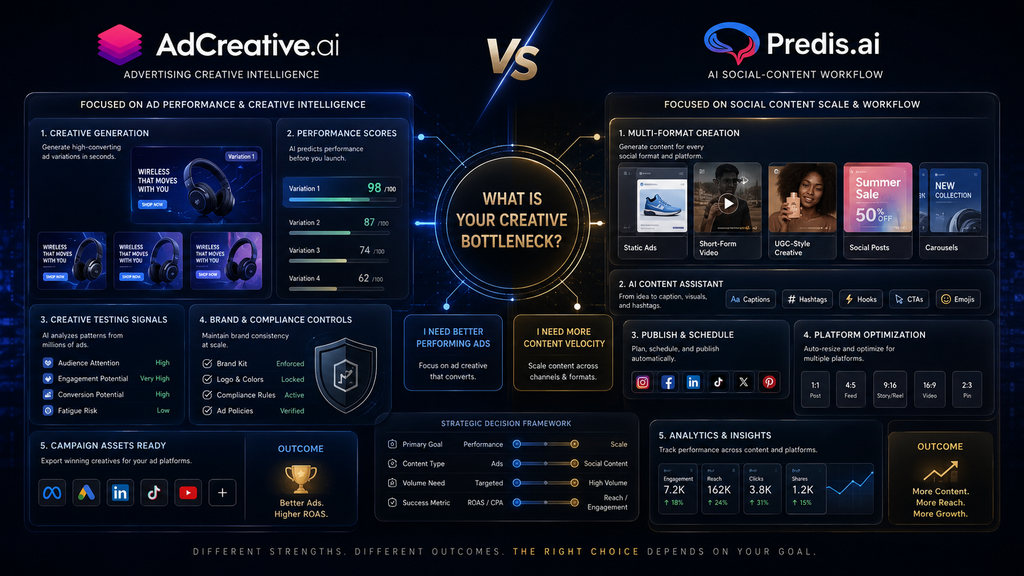
The more useful question is not “Which AI tool has more features?” It is “Which platform is built around the problem my marketing team is actually trying to solve?” That distinction changes the answer considerably. AdCreative.ai is more tightly centered on advertising creative production, creative analysis, performance-oriented insights, and ad-specific workflows, while Predis.ai stretches further into social content creation, video, carousels, scheduling, publishing, competitor analysis, and multi-channel content operations.
Affiliate disclosure: AI Hustle World may earn a commission if you purchase a product through an affiliate link in this article. That does not change how we evaluate the products; recommendations are based on product capabilities, workflow fit, pricing, limitations, and practical use cases.
The difference becomes especially important for a small business owner, ecommerce operator, creator, agency, or paid-media team that does not have unlimited time. A platform can be cheaper and still be the wrong purchase if it forces you to keep another tool for the part of the workflow that matters most. Conversely, paying for a specialized advertising platform may be unnecessary if your real bottleneck is producing and publishing a steady stream of social content.
This comparison therefore focuses on workflow fit rather than feature-count competition. We will look at what each platform is actually optimized to do, how their credit systems affect the economics, where each tool is stronger, where each becomes less compelling, and when using both would be rational rather than redundant.
AdCreative.ai vs Predis.ai: The Short Answer
Choose AdCreative.ai when advertising creative production, creative performance analysis, and ad-specific optimization are central to your workflow. Choose Predis.ai when you need a broader system for creating, repurposing, scheduling, and publishing social and marketing content across multiple channels.
That is the simplest answer, but it needs qualification.
AdCreative.ai currently positions its platform around generating advertising assets, ad copy, product visuals, video ads, Instant Ads, Creative Insights, Competitor Insights, and Creative Scoring. Its official product pages describe the platform as a system for generating ad assets, analyzing creative performance, studying competitors, and scoring creatives before media spend.
Predis.ai has a broader content-operations orientation. Its current feature set includes social media posts, ads, ecommerce product posts, videos, reels, carousels, brand guidelines, collaboration, competitor analysis, scheduling, publishing, and APIs for multiple content formats. Its scheduler can connect multiple major social platforms and manage creation, scheduling, and publishing from one workflow.
So if your team says, “We need more advertising creatives to test and better intelligence around those creatives,” AdCreative.ai is the more natural fit.
If your team says, “We need to keep Instagram, TikTok, LinkedIn, Facebook, Pinterest, YouTube Shorts, and other channels consistently supplied with content,” Predis.ai becomes much more compelling.
The mistake is buying one because it has a longer feature list when the real question is where your workflow is breaking.
The Real Difference: They Start From Different Problems
The easiest way to understand AdCreative.ai vs Predis.ai is to imagine two marketing teams sitting in the same office.
The first team already knows what campaigns it wants to run. Its problem is that the advertising team needs more creative concepts, more variations, better creative analysis, and a faster way to understand what is working. The team is not primarily struggling to fill a social-media calendar. It is struggling to produce and evaluate advertising assets efficiently enough for a performance-marketing operation.
That is close to the problem AdCreative.ai is designed around.
The second team has a different problem. It needs content every day or several times a week across multiple channels. A campaign may need a static post, carousel, Reel, short video, caption, hashtags, branded design, and scheduled publication. The bottleneck is not just generating one advertising image; it is maintaining a broader content machine without constantly jumping between a writing tool, design tool, video editor, scheduler, and publishing platform.
That is where Predis.ai’s broader workflow becomes important. Its current product pages explicitly combine AI content generation with editing, brand controls, competitor analysis, scheduling, multi-account publishing, and platform integrations.
This creates the central distinction:
AdCreative.ai is more advertising-workflow-centric. Predis.ai is more content-operations-centric.
That does not mean AdCreative.ai cannot create social content or Predis.ai cannot create ads. Both can. The distinction is about what happens around the generated asset and which problem the product is trying to solve most deeply.
That difference matters more than a feature checklist because software value comes from removing friction from the workflow you actually repeat. If your team creates ten ad concepts a week and spends hours deciding which concepts deserve media spend, a social scheduler does not solve the core problem. If your team produces hundreds of social assets across several channels and spends more time scheduling and repurposing than optimizing individual ads, a specialized advertising creative platform may solve only one piece of the larger problem.
What AdCreative.ai Is Really Optimized For
AdCreative.ai is strongest when the creative itself is treated as a performance asset rather than simply a piece of content.
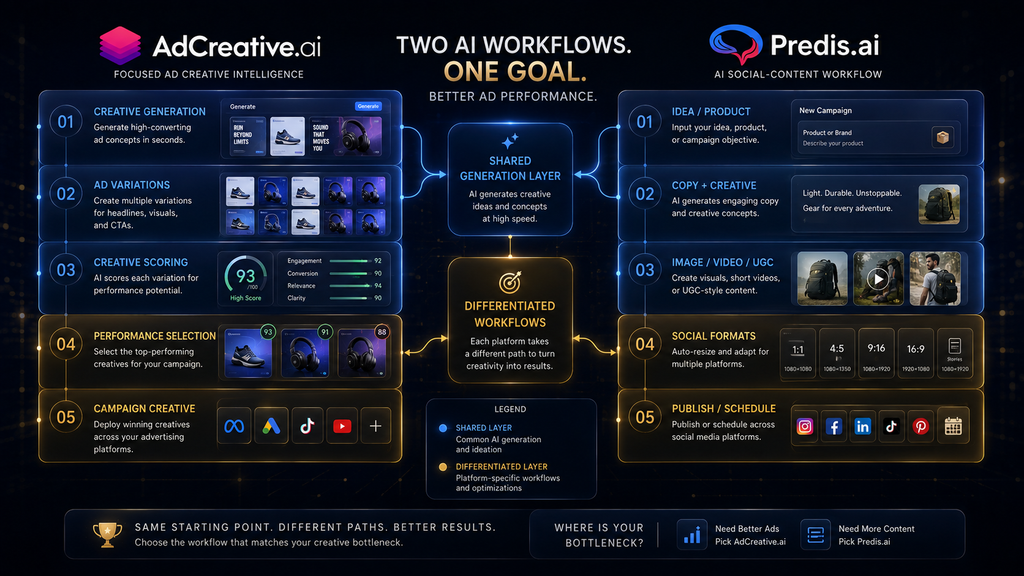
The platform’s current product suite includes ad creative generation, ad copy generation, product photoshoots, product videos, Instant Ads, Creative Insights, Competitor Insights, Creative Scoring, and advertising-platform integrations. Its official site describes the workflow as generating ad assets, gaining insights into creative performance, analyzing competitors, and scoring creatives before media spend.
That creates a particular operating model.
You start with a product, offer, campaign, audience, or advertising objective. The system helps produce creative directions and assets. You can generate variations before deciding which ones are worth downloading or deploying. The analysis layer then becomes part of the decision process rather than leaving the team to judge every creative purely by visual appeal.
This is an important distinction because advertising teams often have a different definition of “good creative” than a social-media team does.
A social-media manager may care about whether a post looks on-brand, fits the platform, communicates the message quickly, and maintains publishing consistency. A performance marketer may care about whether the creative gives the audience a reason to stop, communicates the offer, differentiates the product, and produces a measurable response when exposed to paid traffic.
Neither definition is wrong. They simply optimize different parts of the funnel.
AdCreative.ai’s Creative Insights feature is designed to analyze connected advertising creative performance, while its Creative Scoring feature is designed to evaluate creatives before advertising. The company also markets Competitor Insights for studying competitors’ advertising strategies.
There is an important caveat, however. A predictive score is not the same thing as real campaign performance. A platform can help prioritize creative candidates, but the market ultimately decides whether people click, purchase, register, or otherwise respond. That is why the strongest workflow treats AI scoring as a decision aid rather than a substitute for controlled testing.
This is also where the product’s credit model becomes interesting. AdCreative.ai says users can generate unlimited creatives, while credits are consumed when a generated ad creative is downloaded.
That changes how you should think about experimentation.
You can explore many concepts without treating every generation as a paid unit. The economic constraint appears later, when you decide which outputs are actually worth taking out of the system and using as finished assets.
For a performance-marketing team, that can be strategically useful because the workflow becomes:
Generate broadly → evaluate → shortlist → download usable assets → deploy → measure → learn.
The important part is not the arrows themselves. It is the separation between experimentation and final asset consumption.
What Predis.ai Is Really Optimized For
Predis.ai approaches the problem from a broader content-production perspective.
Its current feature set includes AI-generated social posts, ads, ecommerce product posts, videos, carousels, branded content, competitor analysis, content scheduling, multi-account publishing, approval workflows, and APIs for several content formats.
That makes Predis particularly interesting when content production and distribution are tightly connected.
Imagine a small ecommerce brand launching a new product. It does not need only one Facebook ad. It might need an Instagram post, an Instagram Reel, a carousel explaining the product, a TikTok-style video, a promotional post, several captions, and scheduled content for the next few weeks.
In that situation, the question becomes less about “Which ad generator makes the best single image?” and more about “How much of the content operation can I keep inside one workflow?”
Predis is built much closer to that second question.
Its official feature documentation describes a content scheduler that can create, design, schedule, and publish content, along with multi-platform publishing and content repurposing. The platform currently advertises connections to Instagram, Facebook, TikTok, LinkedIn, YouTube Shorts, Pinterest, Google Business, and X among its supported publishing destinations.
That broader operational scope is Predis’s major advantage.
It can also be useful for teams that need brand consistency across many pieces of content. Predis describes brand guidelines, customizable designs, team collaboration, permissions, approval flows, and APIs as part of its platform.
But breadth introduces its own trade-off.
A platform that tries to cover content ideation, design, video, social publishing, competitor research, and multiple content formats is solving a wider problem. That can be excellent for a small team that wants consolidation. It does not automatically mean it is deeper at every individual advertising task.
This is why feature-count comparisons are misleading.
More capabilities do not necessarily mean better advertising intelligence.
They may simply mean the product covers a wider portion of the marketing stack.
AdCreative.ai vs Predis.ai: Feature Comparison
The following comparison is based primarily on current first-party product documentation rather than older comparison articles, because both platforms have changed significantly over time.
| Capability | AdCreative.ai | Predis.ai |
|---|---|---|
| AI ad creative generation | Strong core capability | Strong capability |
| Ad copy generation | Yes | Yes |
| Static social content | Yes | Yes |
| Video content | Yes | Yes |
| Reels/short-form social content | Available within broader creative capabilities | Strong emphasis |
| Carousels | More advertising-oriented | Strong social-content capability |
| Creative performance insights | Strong emphasis | More social/content-oriented analytics |
| Creative scoring before advertising | Yes | Different evaluation/engagement-oriented approach |
| Competitor insights | Yes | Yes |
| Social scheduling | Not the core differentiator | Strong core capability |
| Multi-channel publishing | Advertising integrations | Strong social publishing workflow |
| Brand controls | Yes | Yes |
| Team collaboration | Available on higher plans/workflows | Strong emphasis |
| API | Enterprise/API capabilities | Multiple social-content APIs |
| Best fit | Paid advertising creative workflow | Broader social/content operation |
The table should not be interpreted as a quality score. It is a workflow map.
AdCreative.ai wins where advertising-specific creative production and evaluation are central. Predis wins where the content operation extends from ideation through creation, repurposing, scheduling, and publishing.
That distinction becomes even clearer when you look at the economics.
Don’t Compare the Prices Until You Understand What a Credit Buys
At first glance, Predis.ai appears substantially cheaper.
Its current Core plan is listed at $19 per month with 1,300 credits, one brand, no auto-posting, publishing to up to 10 channels, and 60 competitor-analysis runs per month. Its Rise plan is listed at $40 per month with 3,200 credits, up to four brands, auto-posting, publishing to 20 channels, and 130 competitor-analysis runs. Enterprise+ is currently listed at $212 per month with 10,000 credits, unlimited brands, auto-posting, 60 channels, and 600 competitor runs. Predis
AdCreative.ai currently lists its Starter monthly plan at $39 per month, with 10 credits, one brand, one user, unlimited generations, ad-platform integrations, Ad Creative Insight AI, and Competitor Insights access. Its Professional monthly plan is currently listed at $249 per month with 50 credits and 10 brands on the current pricing display. AdCreative.ai
If you stopped there, the comparison would appear almost absurdly one-sided.
It is not.
The platforms define credits differently.
AdCreative.ai says a credit is used when you download a generated ad creative, while generations themselves can be unlimited. AdCreative.ai Predis uses credits as a production resource across different content-generation activities, and its current pricing page gives estimates for the number of AI images and videos that its credit allowances can generate. Predis
That means one AdCreative.ai credit and one Predis.ai credit are not economically equivalent units.
This is one of the most important points in the entire comparison.
Suppose your team generates 100 possible concepts but only needs ten finished assets. A generation model that allows broad experimentation before consuming the final production allowance can behave very differently from one where each generation consumes the same underlying resource.
The correct metric is therefore not:
“How many credits do I get?”
It is:
“How much usable marketing output can my workflow produce before the subscription becomes a constraint?”
That is a much better purchasing question.
A Better Way to Calculate Value
For either platform, think in terms of cost per usable marketing asset, not cost per generation.
A simple internal model is:
Cost per usable asset = monthly software cost ÷ usable assets produced and actually deployed
You can make the model more sophisticated by including labor:
True cost per usable asset = software cost + human production time + review time + workflow overhead ÷ usable deployed assets
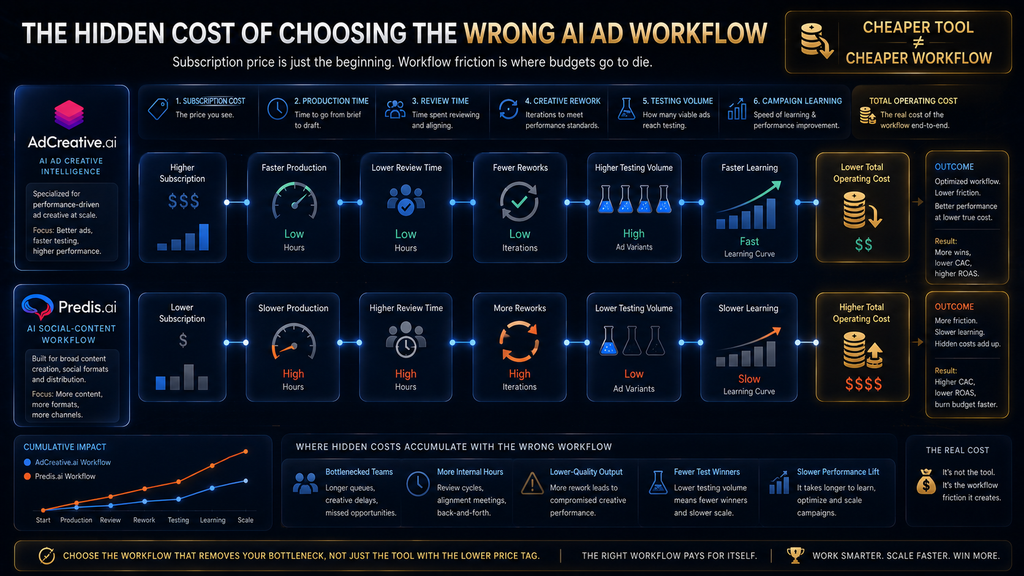
This matters because a $19 subscription can be more expensive operationally if your team spends hours exporting, editing, repurposing, and manually publishing the content elsewhere.
Likewise, a $39 or $249 subscription can be economical if it removes a bottleneck that is already costing your team substantially more in labor or missed testing opportunities.
The software subscription is only one line item.
The workflow is the actual cost center.
Where AdCreative.ai Has the Stronger Case
AdCreative.ai becomes more compelling when paid advertising is not an occasional activity but a recurring operating system.
If your business is constantly launching campaigns, refreshing creatives, testing new offers, or adapting creative for different audiences, the ability to generate many concepts and then use advertising-oriented insights becomes more valuable. The platform’s current product pages explicitly combine creative generation with Creative Insights, Competitor Insights, Creative Scoring, and ad-platform integrations.
This is particularly relevant when creative fatigue is a genuine business problem.
If one winning ad has been running for too long, the answer is rarely “make something prettier.” The team needs new hypotheses: different hooks, different product presentations, different value propositions, different visual structures, different calls to action, or different ways of framing the same offer.
A specialized advertising creative workflow can make that experimentation loop easier to repeat.
AdCreative.ai also becomes more interesting when the team wants to connect creative production with performance learning. Its Creative Insights functionality is designed to analyze connected ad accounts and identify patterns in creative performance, while Creative Scoring is positioned as a pre-launch evaluation mechanism.
That does not eliminate the need for actual campaign testing.
It changes where human attention is spent.
Instead of treating every generated creative as equally worthy of testing, the team can use the platform’s analytical layer as one input into deciding which candidates deserve further review.
AdCreative.ai is especially compelling when:
- paid advertising represents a meaningful share of your marketing activity;
- you need new ad concepts regularly rather than occasionally;
- creative fatigue is becoming a recurring problem;
- you want advertising-specific creative analysis;
- your workflow benefits from generating many concepts before selecting final assets;
- you need creative production tied more closely to advertising performance;
- you already have a separate system for broader social publishing;
- your team values specialization over software consolidation.
The final point is easy to underestimate.
Specialization can be an advantage when the specialized problem is expensive enough.
A performance marketing team does not necessarily need one application to do everything. It may be better served by a smaller number of tools that each perform a critical function exceptionally well.
Where Predis.ai Has the Stronger Case
Predis.ai becomes more compelling when the advertising creative is only one component of a much larger content machine.
Consider a small ecommerce company with one marketer.
That person may be responsible for product launches, Instagram posts, Reels, TikTok videos, LinkedIn updates, promotional graphics, captions, content scheduling, and competitor monitoring. Asking that person to use one platform for ad creatives, another for social posts, another for video, and another for scheduling creates a hidden operational tax.
Predis’s current product architecture directly addresses this kind of problem by combining content generation, social formats, editing, brand controls, competitor analysis, scheduling, and publishing.
That is not a minor convenience.
For a small team, workflow consolidation can be a strategic advantage.
Predis also has a strong case when the business needs many different formats rather than many variations of one advertising format. Its official feature pages emphasize posts, ads, ecommerce product content, videos, carousels, Reels, TikTok content, and other social formats.
The platform’s scheduling capability extends that advantage because the workflow does not have to stop at generation. Content can be planned and scheduled across multiple supported channels from the same environment.
Predis.ai is especially compelling when:
- social media is a major part of your acquisition strategy;
- you publish content across several platforms;
- you need posts, carousels, Reels, short videos, and ads;
- content scheduling is part of the same workflow;
- you manage several social accounts;
- you need broader content production rather than only advertising creatives;
- you want fewer separate tools;
- your team is small and operational simplicity matters.
For these users, Predis can be less about “AI-generated ads” and more about building a compact social-content department inside one platform.
That is a much stronger description of its value.
Which Is Better for Paid Advertising?
AdCreative.ai is the stronger choice when paid advertising is the primary creative problem.
The reason is not simply that it generates ads. Predis can generate ads too. The stronger distinction is the combination of advertising creative production with Creative Insights, Competitor Insights, Creative Scoring, and ad-platform-oriented workflows.
Imagine a performance marketer who has three campaigns running and needs to refresh creative every week.
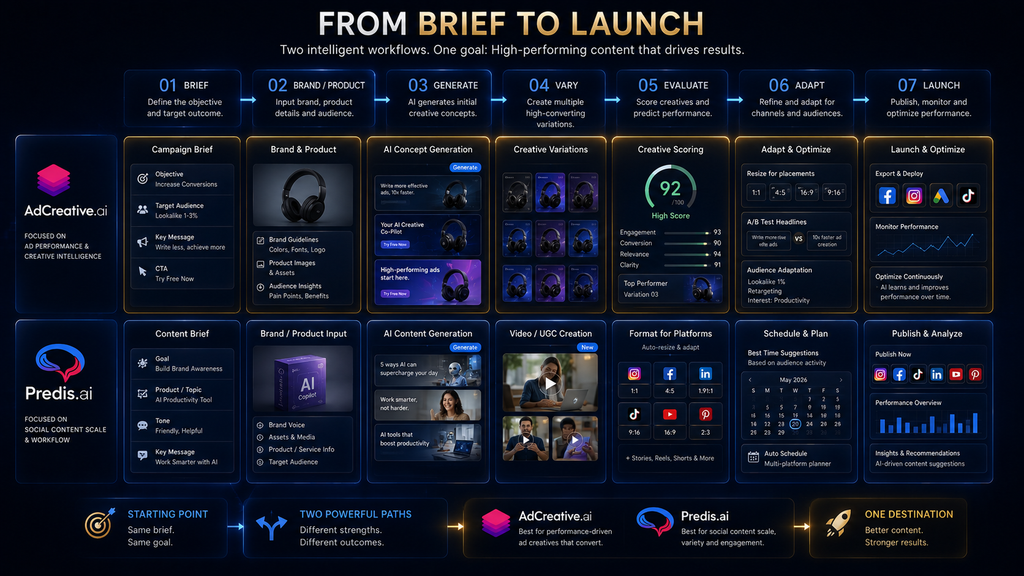
The marketer might generate several new concepts, review them, identify the strongest candidates, refine them, download the final assets, and then launch controlled tests. The most valuable part of the platform is therefore not the first generated image. It is the repeatability of the creative-testing system.
That is where AdCreative.ai’s specialization starts to make economic sense.
But there is a boundary.
If your paid-media problem is actually poor targeting, a weak offer, a broken landing page, or inadequate conversion tracking, generating more creatives will not magically fix the campaign. AI creative software can increase the number and speed of creative hypotheses; it cannot make a fundamentally uncompetitive offer attractive.
That is the reality check many “AI ad tool” comparisons skip.
Which Is Better for Social Media Content?
Predis.ai is the stronger choice when social publishing and multi-format content production are central to the job.
Its current platform is built around producing social content and managing the publishing workflow around it. Predis supports multiple content types and provides scheduling and multi-channel publishing capabilities, making it more naturally suited to a business that thinks in terms of a content calendar rather than a collection of paid-ad experiments.
That distinction becomes especially valuable when repurposing is important.
One campaign idea may become a Reel, a carousel, a static post, a TikTok video, a promotional graphic, and several captions. A content-centric platform can reduce the friction of converting one idea into multiple platform-specific assets.
This is fundamentally different from optimizing one advertisement.
The objective is content throughput plus consistency.
For creators and social-media managers, that can be the more important economic variable.
Which Is Better for Video?
This comparison requires more nuance because both platforms now include video capabilities.
AdCreative.ai’s current product suite includes AI video ads, product videos, UGC-style video capabilities, product videoshoots, and other advertising-oriented video tools.
Predis also places considerable emphasis on videos, Reels, TikTok content, YouTube Shorts, and social-video workflows, including creation and scheduling.
So the better question is not simply:
“Which one can make videos?”
Both can.
Instead ask:
“What role does video play in my marketing system?”
If video is primarily another advertising format, AdCreative.ai’s advertising orientation makes more sense.
If video is one component of a broader social publishing engine, Predis becomes more attractive.
That distinction prevents this article from turning into a generic video-tool comparison, which belongs to a different decision category.
Which Is Better for Ecommerce?
Both platforms have meaningful ecommerce use cases, but again the workflows differ.
AdCreative.ai’s current product suite includes product photoshoots, product videos, ecommerce-focused visual generation, advertising creatives, and Instant Ads.
Predis supports ecommerce product posts and broader product-content generation, while its platform also connects content creation with social publishing.
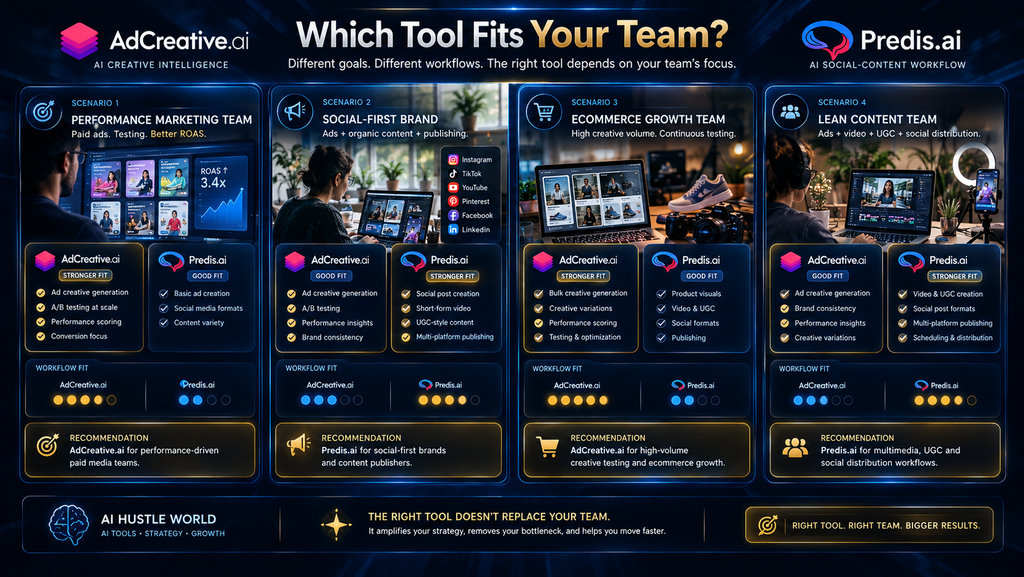
For an ecommerce business primarily concerned with paid acquisition, AdCreative.ai has the more obvious strategic fit.
For an ecommerce business using organic social as a major acquisition and retention channel, Predis may offer more operational value because the same environment can help produce and schedule a broader range of social assets.
A useful rule is:
Paid-store growth → lean AdCreative.ai.
Content-led-store growth → lean Predis.ai.
If your store depends heavily on both, the decision becomes more interesting.
Which Is Better for a Small Business?
For a small business, the answer depends on whether the owner has a creative problem or an operational problem.
If the owner says, “I have ads running, but my team cannot produce enough new creative concepts,” AdCreative.ai makes sense.
If the owner says, “I know I need to post consistently, but I don’t have time to create, edit, write, schedule, and publish content across five platforms,” Predis is probably closer to the actual need.
This distinction is more useful than simply saying one platform is “better for small businesses.”
Small businesses do not have one universal workflow.
A local service company posting three times per week has radically different requirements from an ecommerce store running paid acquisition campaigns every day.
The first may value content consolidation.
The second may value creative experimentation.
Which Is Better for Agencies?
Agencies introduce another dimension: complexity across clients.
AdCreative.ai’s current plans include multi-brand and multi-user capabilities at higher tiers, and its Professional and Ultimate plans are positioned toward teams and agencies.
Predis also supports multiple brands, team collaboration, approval workflows, multiple social channels, and social publishing.
So neither platform should automatically win the agency category.
Instead, ask what the agency sells.
A paid-media agency managing Meta and Google campaigns may get more strategic value from a platform centered on advertising creative production and analysis.
A social-media agency managing content calendars, client approvals, Reels, carousels, posts, and publishing may get more value from Predis’s broader content-management workflow.
An agency doing both may eventually find that the two products are complementary rather than directly competitive.
But that leads to an important question.
Does It Make Sense to Use Both?
Sometimes, yes—but only if the platforms occupy different jobs in your workflow.
Using both simply because both can generate AI creatives is wasteful. If five people on your team are creating the same five ads in two different platforms, you have not built a better workflow; you have built duplication.
A complementary setup is different.
For example, an agency could use Predis.ai to manage broader social content production and publishing while using AdCreative.ai for specialized paid-ad creative development and analysis. That division is conceptually reasonable because the tools would be solving different operational problems. Their current feature sets support that distinction.
But there is a second-order effect.
Every additional platform creates:
- another subscription;
- another login;
- another brand configuration;
- another learning curve;
- another approval process;
- another place for assets to live;
- another workflow to maintain.
Therefore, using both should require a measurable reason.
If one platform can adequately handle the entire workflow without creating a meaningful performance disadvantage, consolidation may be worth more than specialization.
The Creative Workflow Fit Matrix
A better way to make the decision is to score the problem rather than the software.
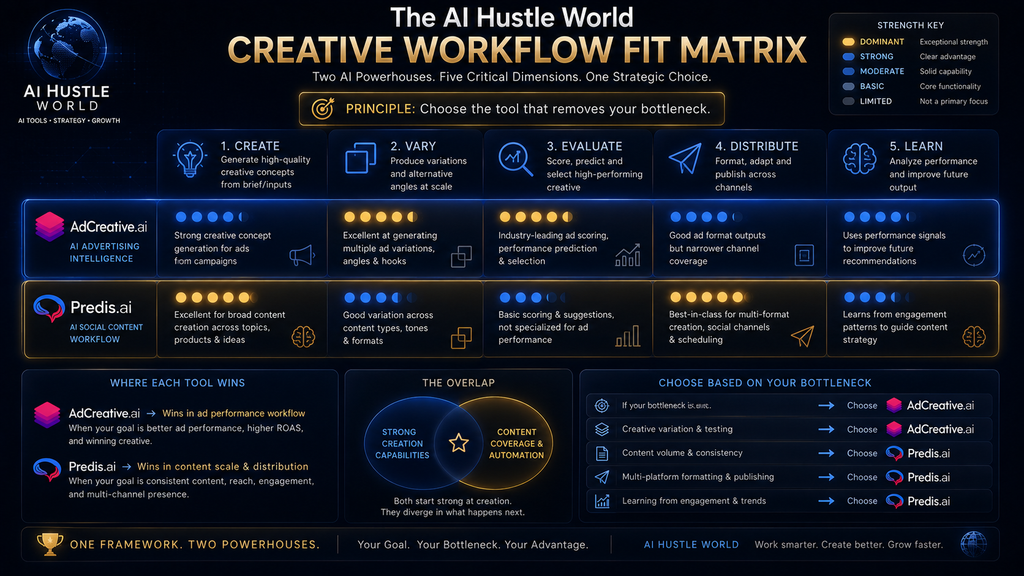
At AI Hustle World, the useful framework is the Creative Workflow Fit Matrix.
Instead of asking which platform has more features, evaluate six dimensions:
| Dimension | The question to ask |
|---|---|
| Advertising depth | How important is paid-ad creative production and optimization? |
| Content breadth | How many different content formats do you need? |
| Production volume | How many assets must your team create every week? |
| Publishing workflow | Do you need scheduling and publishing inside the same system? |
| Creative evaluation | Do you need specialized creative scoring or performance insights? |
| Operational simplicity | Would one broader platform eliminate several tools? |
This framework produces a much more useful result than a generic “winner” badge.
Consider a direct-response ecommerce brand that spends heavily on Meta ads. Advertising depth and creative evaluation may receive the highest weighting, while publishing breadth matters less because the brand already has a social-media system. That profile points toward AdCreative.ai.
Now consider a creator-led ecommerce business that publishes daily on Instagram, TikTok, YouTube Shorts, Pinterest, and Facebook. Production breadth and publishing workflow become dominant. That profile points toward Predis.ai.
Neither conclusion requires claiming that one product is universally superior.
The tool wins because the workflow requirement wins.
A Practical Decision Model
You can simplify the framework even further.
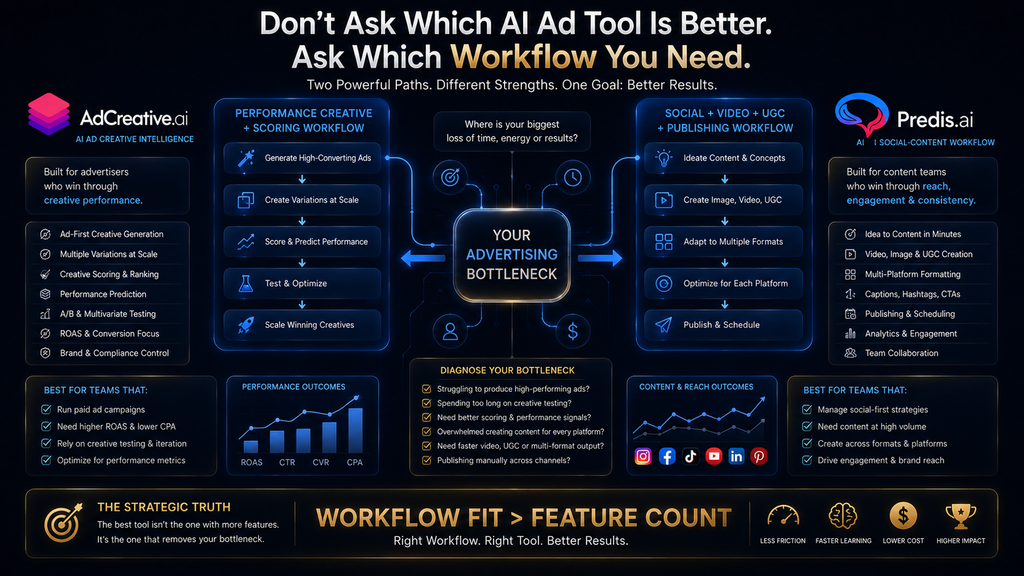
Choose AdCreative.ai if your biggest sentence sounds like this:
“We need more advertising creatives, better creative experimentation, and stronger performance-oriented insight.”
That is a specialized advertising problem.
Choose Predis.ai if your biggest sentence sounds like this:
“We need to create, repurpose, schedule, and publish a lot of content across multiple social channels.”
That is a content-operations problem.
Consider both if:
“We have a large social-content operation and a serious paid-ad creative operation, and each requires capabilities the other platform does not adequately replace.”
Choose neither if:
“Our campaigns are failing because we do not have a good offer, clear positioning, reliable measurement, or a functioning acquisition strategy.”
That last category deserves more attention than it usually receives.
The Most Expensive Mistake: Solving the Wrong Bottleneck
Marketing teams often diagnose a production problem when they actually have a strategy problem.
Suppose a business is generating five new ads every week but none of them performs. The instinct may be to buy another AI creative tool and generate twenty-five.
That can increase the volume of failure.
The problem may instead be the offer, audience, landing page, message-market fit, targeting, or measurement.
The opposite mistake also happens. A social-media manager may spend hours manually creating content because the team is convinced every post needs to be individually designed, even though the actual problem is the absence of a repeatable content system.
In that case, broader workflow automation can create more value than better individual design.
This is why automation should follow the bottleneck, not the other way around.
Buying software before identifying the constraint is one of the easiest ways to build an expensive technology stack that feels impressive but does not materially improve the business.
What Happens If You Choose the Cheaper Tool?
This is where the price comparison becomes misleading.
Predis’s current Core plan is $19 per month, while AdCreative.ai’s Starter monthly plan is $39. On price alone, Predis wins.
But imagine a paid-media team that already has a social scheduler and needs specialized advertising creative analysis.
The cheaper Predis subscription might simply become another general-purpose content tool while the team continues paying for the specialized functionality it actually needs elsewhere.
The business saved $20 on one subscription and potentially increased complexity.
Now reverse the situation.
Imagine a solo entrepreneur paying $39 for AdCreative.ai while separately paying for a scheduler, social-content tool, and video-content workflow. If Predis can replace several of those systems without materially reducing the quality of the advertising workflow, the broader platform may produce a better total cost of ownership.
The lesson is simple:
Subscription price is a procurement metric. Total workflow cost is a business metric.
Those are not the same thing.
What Happens If You Do Nothing?
There is another decision most software comparisons ignore: the cost of keeping the existing workflow.
If your current process is already working, switching platforms creates risk.
Someone has to learn the new interface. Existing templates may need to be recreated. Brand settings may need to be configured. Team members need to understand the new process. Existing approval habits may have to change. And during the transition, production can slow down.
If the current workflow is inefficient, those switching costs may be worth paying.
If the current workflow is already efficient, they may not be.
This creates a useful rule:
Do not switch because another platform looks better. Switch because your current workflow is demonstrably costing you more than the transition.
That is a much more rational purchasing standard.
Common Mistakes When Comparing AdCreative.ai and Predis.ai
Mistake 1: Choosing based on the cheapest monthly price
This ignores credit economics, labor, integrations, and workflow consolidation. A lower subscription price is not automatically a lower operating cost.
Mistake 2: Counting features instead of measuring bottlenecks
A platform can have fifty features you do not need and still be inferior to a platform with ten capabilities that directly solve your highest-cost problem.
Mistake 3: Assuming every AI-generated creative is equally valuable
Generation volume is not usable output. The important measurement is how many assets survive review, get deployed, and contribute useful learning or performance.
Mistake 4: Treating AI scores as campaign results
A predictive or evaluative score can support decision-making, but it cannot replace actual market feedback. Real campaigns still matter.
Mistake 5: Using both platforms without assigning responsibilities
If the same people are doing the same work in both systems, you are paying twice for overlapping production.
Mistake 6: Switching because the interface looks more modern
A beautiful interface is not a business case. The question is whether the new workflow produces better output, faster learning, lower operating cost, or some combination of the three.
Mistake 7: Ignoring publishing
If your team spends more time distributing content than creating it, a generation-only comparison misses the actual bottleneck.
The Traditional Workflow Still Exists for a Reason
AI tools can make creative production faster, but the traditional workflow developed around legitimate requirements.
A designer exists because visual hierarchy, brand consistency, composition, and judgment matter.
A copywriter exists because positioning and persuasion are not simply text-generation problems.
A performance marketer exists because someone has to decide what to test, interpret results, allocate budget, and understand the business context.
A social-media manager exists because publishing is not merely pressing a button; it involves timing, platform conventions, audience context, community interaction, and consistency.
AI can compress parts of those workflows.
It does not make the underlying responsibilities disappear.
That is why the best use of AdCreative.ai or Predis.ai is not to remove human judgment everywhere. It is to remove repetitive production work so human attention can move toward the decisions that actually change outcomes.
A Better Operating Model for AdCreative.ai
If you choose AdCreative.ai, do not use it as a machine for producing random advertisements.
Build a repeatable creative-testing system.
Start by defining the campaign objective and audience. Then identify several creative hypotheses rather than asking the AI to make “good ads.” Generate multiple directions, review the outputs against brand and campaign requirements, and use the platform’s available scoring and insight functionality as one input into prioritization.
The key is to preserve the distinction between creative generation and creative selection.
Generation creates possibilities.
Selection creates efficiency.
Testing creates evidence.
The strongest system connects all three.
After campaigns run, bring the learning back into the next creative cycle. Which hooks generated useful engagement? Which visual concepts repeatedly failed? Which offers produced clicks but poor downstream conversion? Which creative patterns are becoming fatigued?
That feedback loop is more valuable than simply generating more images.
A Better Operating Model for Predis.ai
If you choose Predis.ai, the strongest workflow is different.
Start with a content strategy rather than isolated posts. Define the themes, offers, products, campaigns, and recurring content categories that need to appear during the month. Then use the platform to turn those strategic inputs into multiple formats, apply brand controls, review the outputs, and schedule them across the relevant channels. Predis’s current product documentation specifically supports content creation, repurposing, scheduling, publishing, brand controls, and competitor analysis.
The key is to avoid confusing content automation with content strategy.
A platform can help you produce a month’s worth of posts.
It cannot decide whether those posts collectively tell the right story to the right audience at the right stage of the buying journey.
That remains a human responsibility.
The strongest Predis workflow therefore looks more like:
Strategy → content themes → generation → editing → approval → scheduling → performance review → next month’s strategy.
The software accelerates the middle of that chain.
It should not replace the beginning or the end.
Measuring Whether the Tool Is Actually Working
After choosing either platform, do not judge success by how many assets the AI generated.
That is a vanity metric.
Instead, measure the part of the workflow the software was purchased to improve.
For AdCreative.ai, useful operational metrics could include:
- time required to produce a new creative concept;
- number of usable creatives produced per campaign cycle;
- creative review time;
- percentage of generated concepts that survive review;
- time from idea to deployed test;
- number of meaningful creative hypotheses tested;
- creative refresh frequency;
- performance differences between creative concepts;
- cost of creative production relative to media spend.
For Predis.ai, useful metrics could include:
- content-production hours saved;
- number of usable posts produced per month;
- publishing consistency;
- number of platforms supported without additional manual work;
- time from idea to scheduled content;
- content repurposing rate;
- approval time;
- social engagement trends;
- cost per usable published asset;
- number of separate tools eliminated.
The point is to connect the subscription to an actual business constraint.
If the metric never improves, the software may not be solving the problem you thought it would.
Who Should Avoid AdCreative.ai?
AdCreative.ai is probably not the rational choice if your primary need is a broad social-media operating system rather than specialized advertising creative production.
If your business mainly needs a content calendar, social scheduling, multi-channel publishing, and a wide variety of everyday social formats, you may end up using only a fraction of the platform’s advertising-oriented capabilities.
It is also worth questioning the purchase if you are not producing enough paid advertising to benefit from specialized creative workflows. A bigger creative-production engine does not create demand by itself.
If your current advertising volume is tiny, the bottleneck may be strategy rather than production capacity.
Who Should Avoid Predis.ai?
Predis.ai is less compelling if your marketing operation is already highly specialized around paid advertising and you mainly want deeper advertising-creative production and evaluation.
If you already have a separate social publishing system, a separate content-management process, and a team focused primarily on paid campaigns, many of Predis’s broader social features may not materially improve your core workflow.
In that situation, broader functionality can become noise rather than value.
Again, the right question is not which platform has more.
It is which platform has more of what you actually need.
The Contrarian Take: You May Not Need an AI Ad Tool Yet
There is a temptation in 2026 to assume that every marketing team should have an AI creative platform.
I disagree.
The first question should be whether creative production is actually constraining growth.
If your team can already produce enough quality creative, your campaigns are not suffering from creative fatigue, and your social workflow is manageable, adding another platform may simply increase software overhead.
The purchase becomes much easier to justify when there is an identifiable constraint:
not enough creative volume, slow iteration, excessive production time, fragmented publishing, insufficient creative analysis, or an inability to keep up with channel demand.
Software should relieve a constraint.
It should not become another project.
The Final Decision: AdCreative.ai or Predis.ai?
If your operation is primarily a paid advertising machine, AdCreative.ai is the stronger strategic fit.
Its current product positioning combines ad creative generation with advertising-oriented insights, competitor intelligence, Creative Scoring, ad-platform integrations, and a credit model that allows unlimited generation before credits are consumed by downloaded creatives.
If your operation is primarily a social-content machine, Predis.ai is the stronger fit.
Its current platform combines content creation, ads, videos, carousels, brand controls, competitor analysis, scheduling, publishing, multi-channel workflows, and social-content APIs.
If you are an ecommerce business running both serious paid acquisition and a large organic content operation, the answer may be more nuanced. You may benefit from assigning each platform a specific responsibility, but only if the productivity gained is greater than the additional cost and operational complexity.
And if neither platform addresses your real bottleneck, do not buy either one.
That is a legitimate outcome of a good comparison.
The Creative Workflow Fit Test
Before subscribing, answer these six questions honestly:
- Is paid advertising the main reason I need more creative?
- Do I need specialized creative performance analysis, or mainly content production?
- How many formats do I need every month—ads only, or posts, Reels, carousels, videos, and other social assets too?
- Do I need content scheduling and publishing inside the same platform?
- Would a broader platform replace other subscriptions, or simply become another tool?
- What measurable bottleneck will disappear if I buy this software?
If your answers lean heavily toward paid advertising, creative testing, and performance analysis, AdCreative.ai deserves the stronger consideration.
If they lean toward social content, multi-format production, scheduling, publishing, and operational consolidation, Predis.ai deserves the stronger consideration.
If the answers are split down the middle, do not force a winner. Map the workflow first and decide whether one platform can cover the majority of the important work without creating a serious weakness elsewhere.
Final Thoughts
AdCreative.ai vs Predis.ai is not really a contest between two AI generators. It is a decision between two different ways of organizing creative work.
AdCreative.ai makes more sense when the center of gravity is advertising performance: producing ad concepts, generating variations, evaluating creatives, studying competitors, and improving the creative side of paid campaigns. Predis.ai becomes more compelling when the center of gravity is content operations: producing multiple formats, maintaining brand consistency, repurposing ideas, scheduling content, publishing across channels, and managing a broader social workflow.
The smartest buyer therefore does not ask which platform wins the feature race. They identify the most expensive bottleneck in their current workflow and choose the platform that removes it with the least additional complexity.
The best AI creative tool is not the one that generates the most. It is the one that makes the right part of your marketing system materially easier to run.
Frequently Asked Questions
Is AdCreative.ai better than Predis.ai?
AdCreative.ai is generally the stronger fit for teams focused primarily on paid advertising creatives, creative performance insights, competitor intelligence, and advertising-specific workflows. Predis.ai is generally stronger for broader social-content production, multi-format creation, scheduling, publishing, and content operations. The better choice depends on which workflow is more important to your business.
Is Predis.ai cheaper than AdCreative.ai?
The current entry-level monthly pricing is lower for Predis.ai: its Core plan is listed at $19/month, while AdCreative.ai’s Starter monthly plan is listed at $39/month. However, the platforms use different credit systems and measure production differently, so subscription price alone does not establish which one offers better value.
Which is better for Facebook and Instagram ads?
Both platforms can create social advertising content, but AdCreative.ai has the stronger advertising-specialization argument because its product combines ad creative generation with Creative Insights, Competitor Insights, Creative Scoring, and ad-platform integrations. Predis.ai is more compelling when those ads are part of a larger social-content and publishing workflow.
Which is better for social media management?
Predis.ai is the stronger fit when social management includes content creation, scheduling, publishing, multiple platforms, and multiple content formats. Its current scheduler supports publishing across major social channels and its platform combines scheduling with content generation and editing.
Can you use AdCreative.ai and Predis.ai together?
Yes, if they perform genuinely different jobs. A business could use Predis.ai for broader social-content production and publishing while using AdCreative.ai for specialized advertising creative workflows and analysis. Using both for the same creative-production tasks, however, is likely to add unnecessary cost and operational complexity.
Which one is better for a small business?
There is no universal winner. A small business heavily dependent on paid advertising may benefit more from AdCreative.ai, while a small business that needs frequent social content across several channels may benefit more from Predis.ai. The correct decision depends on the bottleneck, not the company size.
Should I switch from AdCreative.ai to Predis.ai just because Predis is cheaper?
Not automatically. Switching makes sense only if Predis solves a larger part of your workflow or reduces your total operating cost without sacrificing capabilities that are genuinely important to your advertising process. The subscription difference should be evaluated alongside labor, production volume, publishing needs, and the cost of changing workflows.
Which tool is better for high-volume creative testing?
AdCreative.ai has the stronger case when “high volume” means producing and evaluating many advertising concepts for paid campaigns. Its current workflow separates generation from downloading and includes advertising-oriented creative insights and scoring capabilities.
Which tool should I choose if I mainly create organic social content?
Predis.ai is generally the more natural fit because its product is built around broader social-content creation, multiple formats, scheduling, publishing, and competitor analysis.
What is the biggest difference between AdCreative.ai and Predis.ai?
The biggest difference is workflow orientation. AdCreative.ai is more tightly centered on advertising creative production and performance-oriented creative intelligence, while Predis.ai covers a broader social-content lifecycle from ideation and generation through editing, scheduling, and publishing.
Written by
Muntasir Ahmad Chowdhury
Founder, AI Hustle World
Muntasir Ahmad Chowdhury is the Founder of AI Hustle World, an independent publication dedicated to making Artificial Intelligence practical, trustworthy, and easy to understand. He researches AI tools, automation, customer service, productivity, and real-world business applications, helping readers make smarter technology decisions through research-driven, experience-backed content.
Expertise:
AI Tools • AI Automation • AI Customer Service • AI Productivity • Generative AI • AI Workflows
Get Smarter With AI
Enjoyed this guide? Get practical AI tools, tutorials, and honest reviews delivered to your inbox.
1 thought on “AdCreative.ai vs Predis.ai: Which AI Ad Tool Is Better?”