
AdCreative.ai Pricing: Which Plan Actually Makes Sense for Your Ad Spend?
Affiliate disclosure: This article contains affiliate links. If you sign up for AdCreative.ai through our links, AI Hustle World may earn a commission at no additional cost to you. Our recommendations are based on product fit, pricing, features, limitations, and practical value—not the commission we may receive.
AdCreative.ai pricing looks simple until you actually try to decide which plan makes sense. The headline numbers are easy enough to find: Starter begins at $39 per month, Professional at $249, and Ultimate at $999 on the current monthly pricing view. But those figures tell only part of the story because AdCreative.ai also changes the number of credits, brands, users, and capabilities available as you move between plan families.
That creates an important problem for anyone comparing plans. If you only compare the monthly subscription price, Professional can look absurdly expensive next to Starter, while Ultimate can look impossible to justify. If you only compare credits, however, you can miss the reason a growing team might actually need Professional or why an agency could rationally consider Ultimate.
The better question is not “Which AdCreative.ai plan is cheapest?” It is “Which plan gives me the production capacity I actually need without paying for capacity I will never use?”
That distinction matters because AdCreative.ai does not treat credits as the only unit of value. Credits determine how many generated creatives you can download, while brands, users, integrations, advanced features, and workflow capacity determine how comfortably the platform fits into a real advertising operation. AdCreative.ai itself says credits are consumed when a generated creative is downloaded, while generations themselves are unlimited.
So this pricing guide takes a different approach. Instead of simply reproducing the pricing table, we will break down the current plans, explain what the credit system really means, calculate the economics, examine monthly versus longer-term billing, and build a practical framework for deciding whether Starter, Professional, Ultimate, or Enterprise is appropriate for your situation.
AdCreative.ai Pricing at a Glance
The current monthly pricing page shows four broad purchasing categories: Starter, Professional, Ultimate, and Enterprise. Starter begins at $39 per month with 10 credits, Professional begins at $249 per month with 50 credits, Ultimate begins at $999 per month with 100 credits, and Enterprise is custom-priced.
| Plan | Current starting monthly price | Starting monthly credits | Typical positioning | Best fit |
|---|---|---|---|---|
| Starter | $39 | 10 | Small businesses | Solo marketers and one-brand businesses |
| Professional | $249 | 50 | Mid-sized businesses and high-volume teams | Growing teams and multi-brand operations |
| Ultimate | $999 | 100 | Agencies | Large creative operations and agencies |
| Enterprise | Custom | Tailored | Enterprise organizations | Governance, security, customization and large-scale needs |
These are the starting configurations, not the complete pricing ladder. AdCreative.ai currently offers additional credit configurations within Starter, Professional, and Ultimate, so a buyer should not assume that $39, $249, or $999 represents the only option inside each family.
The pricing page currently displays multiple billing modes as well. AdCreative.ai advertises 25% off for quarterly billing and 50% off for yearly billing on the pricing interface checked for this article. Those discounts are promotional pricing signals and can change, so they should be verified on the live checkout page before committing to a long billing period.
The first major takeaway is therefore straightforward: AdCreative.ai is not really a four-price product. It is a tiered production system with multiple credit levels and different operating capacities.
What Does AdCreative.ai Actually Charge You For?
The most important thing to understand about AdCreative.ai pricing is that credits are not the same thing as generations.
According to AdCreative.ai’s current FAQ, a credit is used when you download a generated ad creative. The platform says users can generate unlimited creatives, while credits are consumed when those creatives are downloaded.
That distinction changes the economics considerably.
Imagine that you are developing a Facebook campaign for a new product. You might generate dozens of variations while experimenting with layouts, images, headlines, colors, and messaging. You do not necessarily need to download every variation. The platform’s credit model means the economic constraint is tied to the finished outputs you choose to download rather than every experiment you run.
That is much closer to a selection-and-production model than a simple “number of AI generations” model.
It also means you should not evaluate the platform by asking, “How many designs can I generate?” The answer can effectively be much larger than the number of credits because generation is unlimited. The more useful question is, “How many finished creatives do I expect to download and use?”
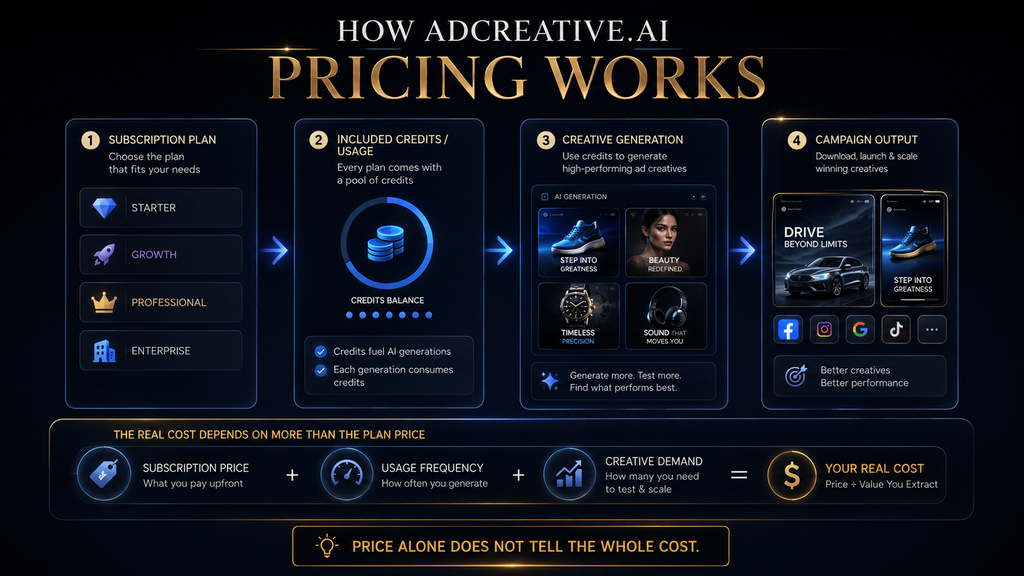
The practical pricing equation
A simple way to think about the economics is:
Monthly subscription cost ÷ finished downloadable creatives actually used
For example, if a $39 Starter subscription gives you 10 credits and you use all 10 downloads, the nominal subscription cost works out to about $3.90 per downloaded creative.
That calculation is useful, but it is not the whole value equation. The real value depends on what the software replaces or accelerates: design time, copywriting time, creative iteration, template production, resizing, campaign experimentation, and the operational friction involved in coordinating all of those tasks.
This is why a $39 plan can be excellent value for one advertiser and poor value for another.
A marketer who needs eight finished creatives every month and would otherwise spend several hours producing them may find the subscription inexpensive relative to the time saved. Someone who needs two finished creatives every month may have difficulty justifying even the entry-level subscription.
That is the first pricing principle to keep in mind:
Do not buy credits because they are available. Buy enough production capacity to support the workflow you already have.
AdCreative.ai Starter Pricing: Is $39 Actually a Good Deal?
The current Starter entry point is $39 per month for 10 credits, with one brand and one user shown on the monthly pricing interface. AdCreative.ai positions Starter toward small businesses.
At first glance, Starter is the obvious choice for anyone who wants to try the platform without making a large commitment. That is a reasonable conclusion, but it needs a little more nuance.
Starter is strongest when your advertising operation is relatively simple. You may be managing one company, one ecommerce store, one personal brand, or one client account, and you may be the only person responsible for producing the creative.
In that environment, the limitations of Starter are less important because you are not trying to coordinate a large production system. You primarily want a faster way to create and test advertising assets.
Who should consider Starter?
Starter makes the most sense for:
- Solo marketers managing one brand.
- Small businesses with moderate creative requirements.
- Freelancers testing AdCreative.ai with their own workflow.
- Ecommerce operators who need recurring ad variations.
- Creators who occasionally run paid campaigns.
- Small teams where one person controls the entire creative workflow.
The important word is one.
One brand. One primary user. A manageable volume of finished creatives.
Once your workflow starts requiring multiple brands or several collaborators, the question changes.
The Starter economics
At $39 for 10 credits, the simple maximum-utilization calculation is:
$39 ÷ 10 = $3.90 per credit.
But that number should not be interpreted as a literal “price per design” in every situation. The credit is tied to downloading a generated creative, while the platform also provides unlimited generation.
Suppose you generate 40 concepts, eliminate 25 immediately, refine 10, and ultimately download five. Your effective subscription cost attributable to those five finished outputs would be much higher than $3.90 each if you look only at that month’s usage.
That does not automatically make Starter poor value. It simply shows why utilization matters.
If you consistently use only two or three credits, you may be paying for unused capacity. If you consistently use all 10 credits and the platform is replacing meaningful manual work, the economics become much easier to defend.
The Starter reality check
Starter is not “the cheap version of Professional.”
It is better understood as the one-brand entry point for a relatively simple creative workflow.
That distinction becomes important when you start comparing the tiers.
If your goal is to test whether AI-assisted creative production actually fits your advertising workflow, the best starting point is usually not the most expensive plan. It is the lowest tier that gives you enough room to test the platform properly.
Want to Test AdCreative.ai Before Scaling?
Start by testing the workflow, creative generation process, and downloadable output against the work you already do. That gives you a better basis for choosing a plan than simply comparing subscription prices.
Explore AdCreative.aiAffiliate disclosure: We may earn a commission if you sign up through this link, at no additional cost to you.
AdCreative.ai Professional Pricing: What Are You Actually Paying More For?
Professional currently begins at $249 per month with 50 credits. The pricing interface positions it toward mid-sized businesses and high-volume ad teams, and the displayed configuration includes substantially more brand and user capacity than Starter.
This is where a simplistic cost-per-credit analysis starts to become misleading.
At the entry monthly prices, Starter costs $39 for 10 credits, while Professional costs $249 for 50 credits. The subscription price is therefore about 6.4 times higher, while the starting credit allocation is only five times higher.
If you evaluate only the arithmetic, Professional does not suddenly become a dramatically cheaper way to buy downloadable creatives.
That is not the point.
Professional exists because the operating environment becomes larger.
The current pricing interface shows Professional with a much larger brand allowance and up to 10 users in the displayed configuration, along with Pro features.
That changes the buying question from:
“How much does each credit cost?”
to:
“How much does it cost to operate a larger creative workflow?”
This distinction is easy to miss if you read only the headline pricing table.
Professional makes sense when complexity becomes the bottleneck
Imagine a company running three product lines across several advertising channels. The creative manager is not just producing images. They are coordinating brand assets, campaign variations, multiple stakeholders, ad accounts, templates, and recurring production.
In that situation, the additional capacity of Professional can be more valuable than the raw difference in credit count.
This is why our recommendation is not “Professional is the best value.”
Instead:
Professional is the plan to investigate when your advertising operation has outgrown a single-user, single-brand workflow.
That is a more defensible conclusion.
A Professional buyer should ask three questions
First, Do I genuinely need multiple brands or collaborators?
Second, Am I producing enough advertising creative that a structured production system will save meaningful time?
Third, Are the additional professional capabilities relevant to my workflow, or am I simply attracted to a larger credit number?
If the answer to the third question is “I just want more credits,” pause before upgrading.
There may be a more economical way to handle your actual workload.
Why Professional Can Be Expensive for a Solo Advertiser
A common mistake is to assume that more credits automatically equal better value.
They do not.
Suppose you are a solo ecommerce owner who needs 12 finished advertising creatives each month. Starter’s 10-credit entry configuration might be slightly restrictive, but jumping directly to Professional means moving from $39 to $249 per month.
That is a $210 monthly increase.
If the only thing you gain from that additional expenditure is enough credit capacity for two more downloads, the upgrade makes little economic sense.
Your better option could be to reassess how many final creatives you actually need, how much experimentation you are doing, and whether you can structure your production workflow around the available capacity.
This is an important reality check because AI tools can create a strange behavioral trap: once generation becomes cheap, users often generate far more than they can meaningfully test.
The software can increase creative output while simultaneously creating a new problem—creative excess.
You do not necessarily need 100 ads.
You need enough good candidates to test meaningful hypotheses.
That is why the correct pricing decision begins with your campaign strategy rather than the pricing page.
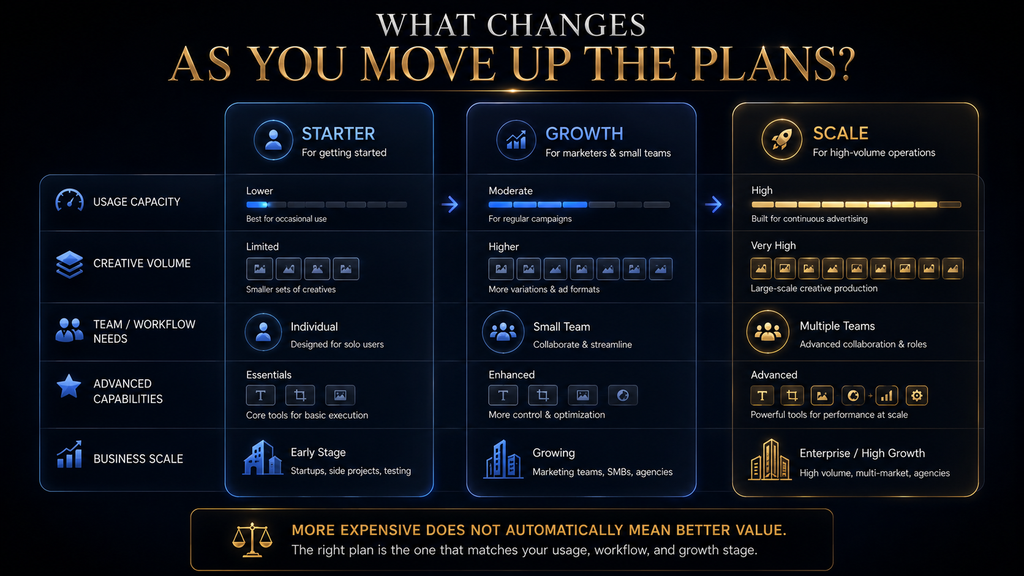
AdCreative.ai Ultimate Pricing: When Does $999 Make Sense?
Ultimate currently begins at $999 per month for 100 credits on the monthly pricing interface. AdCreative.ai positions the tier toward agencies, and the displayed configuration provides substantially greater brand and user capacity than the lower tiers.
The first reaction to $999 is understandable: that is a serious software expense.
But the wrong way to analyze it is to compare $999 with $39 and ask which subscription is cheaper.
Of course Starter is cheaper.
The better question is whether an agency or large creative operation can economically use the additional capacity.
Ultimate is not primarily a “more credits” purchase.
It is an organizational-scale purchase.
The current interface shows Ultimate supporting 25 brands and up to 20 users in the monthly/quarterly presentation, while its annual presentation shows a different current configuration display, which is another reason buyers should verify the exact plan details at checkout.
The agency scenario
Consider an agency managing 15 client brands.
The agency may have designers, media buyers, account managers, and creative strategists. The challenge is not simply creating one banner. The challenge is creating, organizing, reviewing, and iterating advertising creative across many accounts.
In that environment, the cost of a software subscription should be compared with the operational cost of the alternative.
If the platform reduces repetitive production work across multiple client accounts, a $999 subscription can potentially be rational.
But that is a conditional argument.
The agency still needs enough utilization to justify the expense.
Ultimate fails the “credit-only” test
At the entry monthly configuration, Ultimate is $999 for 100 credits.
That is approximately:
$9.99 per credit.
Professional’s entry configuration is $249 for 50 credits, or about:
$4.98 per credit.
Starter’s entry configuration is $39 for 10 credits, or:
$3.90 per credit.
So the nominal cost per starting credit actually increases as you move up the plan families.
That is one of the most important insights in this pricing analysis.
If you are looking at Ultimate and thinking, “I need more downloads, so this must be the best value,” the math says otherwise.
Ultimate needs to earn its price through the broader operating environment.
That includes larger brand capacity, user capacity, advanced functionality, and agency-scale workflows—not simply the number of credits.
The Full Credit Ladder Matters More Than the Headline Prices
One reason AdCreative.ai pricing articles become confusing is that the plan names hide multiple credit configurations.
The current pricing interface shows additional options inside each plan family. The monthly presentation currently shows Starter configurations of 10, 15, 30, and 50 credits; Professional configurations of 50, 75, and 100 credits; and Ultimate configurations of 100, 150, and 200 credits.
The displayed prices are currently:
| Plan family | Credit level | Monthly price shown |
| Starter | 10 | $39 |
| Starter | 15 | $89 |
| Starter | 30 | $139 |
| Starter | 50 | $189 |
| Professional | 50 | $249 |
| Professional | 75 | $339 |
| Professional | 100 | $400 |
| Ultimate | 100 | $999 |
| Ultimate | 150 | $1,099 |
| Ultimate | 200 | $1,399 |
These figures should be treated as a current pricing snapshot, not a permanent price guarantee. The live site is promotional and dynamic, and different AdCreative.ai pages can expose different billing views at the same time.
This is also why older software directories can be misleading.
Some third-party pages still display older Ultimate pricing or older plan structures. If you search for AdCreative.ai pricing independently, you may encounter numbers that do not match the current vendor interface.
For a purchasing decision, the live AdCreative.ai checkout should take precedence over an old directory listing.
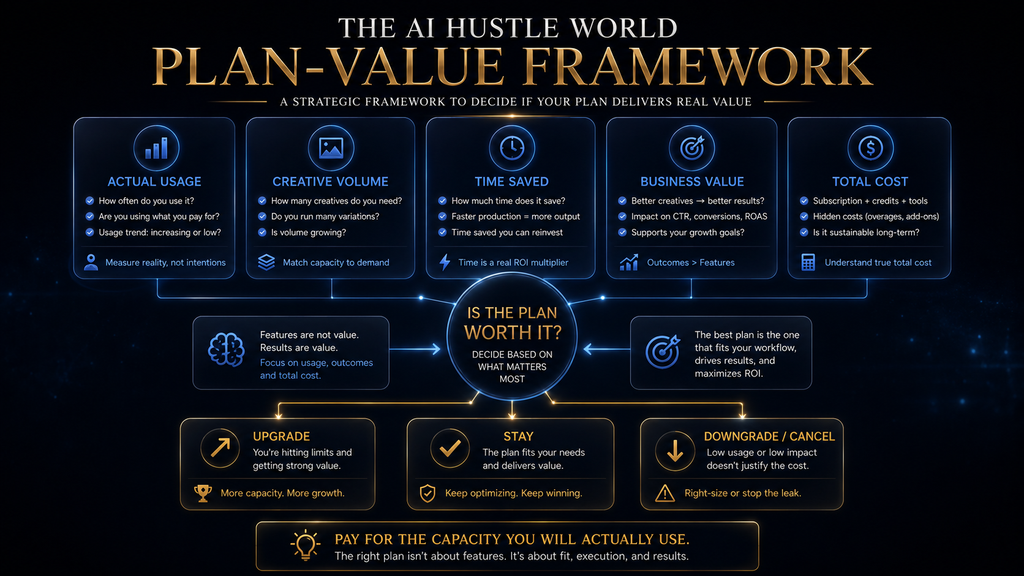
Monthly vs Quarterly vs Yearly: Which Billing Option Is Smarter?
AdCreative.ai currently advertises three billing modes: monthly, quarterly, and yearly. The current pricing interface advertises 25% off quarterly billing and 50% off yearly billing.
At first glance, yearly billing looks like the obvious winner.
If the software is half-price on an effective monthly basis, why would anyone pay monthly?
Because discount and flexibility are different forms of value.
If you already know that AdCreative.ai is going to remain part of your advertising workflow for the next 12 months, the annual option can be economically compelling.
If you are still determining whether the platform fits your creative process, monthly billing buys you flexibility.
The annual discount calculation
Using the current advertised entry-level figures:
Starter is shown at approximately $20 per month when billed yearly rather than $39 monthly.
Professional is shown at approximately $125 per month rather than $249 monthly.
Ultimate is shown at approximately $500 per month rather than $999 monthly.
The annual view therefore represents substantial advertised savings compared with paying the monthly rate for twelve months.
But there is an important caveat.
An effective monthly price is not the same thing as a month-to-month commitment.
You should not compare $20 annual effective monthly cost with $39 monthly cost as though both give you identical flexibility. One is a longer-term commitment with a lower effective rate; the other preserves a simpler exit option.
My recommendation
If you are uncertain:
Start with the shorter commitment.
If you have already tested the workflow and know the platform will be part of your advertising system:
Consider the longer billing period.
The mistake is not choosing monthly.
The mistake is committing annually before you know whether the workflow actually produces enough value.
What Happens During the AdCreative.ai Trial?
AdCreative.ai currently offers a 7-day trial and requires payment information at signup. The company’s help center says users are not charged during the trial period and can cancel. It also states that if a user forgets to cancel and is charged, the company offers a 100% refund within seven days of the charge for monthly plans and within 30 days for yearly plans, subject to contacting the company.
That policy makes the trial useful, but it does not mean you should treat the trial casually.
The best way to test a subscription product is to define the experiment before starting it.
Do not simply sign up, generate a few attractive images, and decide that the platform “looks good.”
Instead, use the trial to answer practical questions.
Can it produce creatives that fit your brand?
Can you produce usable variations quickly?
Does the creative workflow actually reduce your production time?
Are the generated outputs good enough to enter your normal review process?
Does the scoring or insight functionality change your decisions?
Can your team actually use the platform without adding another layer of operational friction?
Those are much stronger questions than “Did the AI generate something impressive?”
How to Test AdCreative.ai Without Wasting the Trial
A seven-day trial is short enough that random experimentation can consume it quickly.
A better approach is to build a miniature campaign test.
Day 1: Establish the baseline
Choose one real product or campaign.
Record how long your existing process takes to produce one usable advertising creative.
Do not try to make the baseline look worse than it is. The goal is to understand the actual opportunity cost of your current method.
Day 2: Generate variations
Use AdCreative.ai to create multiple creative concepts around the same campaign.
Do not judge every output independently. Look for patterns in quality, consistency, speed, and usefulness.
Day 3: Refine
Take the strongest concepts and improve them.
This is where you learn whether the platform is genuinely helping with production or merely producing attractive first drafts.
Day 4: Compare
Compare AI-assisted outputs with the creatives you would normally produce.
Look at message clarity, brand consistency, visual hierarchy, call-to-action clarity, and whether the creative actually communicates the product proposition.
Day 5: Examine workflow value
Ask whether the platform removed meaningful repetitive work.
If the answer is no, a larger subscription will not solve the problem.
Day 6: Calculate economics
Estimate:
Time saved × your reasonable hourly value
and compare that with:
monthly subscription cost
Then consider the value of increased testing capacity separately.
Day 7: Decide
Only after the test should you decide whether to continue.
This is much more reliable than choosing a plan based on the first few impressive outputs.
By this point, the important question is no longer whether AdCreative.ai has AI generation features. The question is whether those features can produce enough useful output, at enough scale, to justify the subscription you are considering.
Test the Workflow Before You Commit to a Bigger Plan
Use a real campaign during the trial and measure the things that matter: usable creative output, production time, iteration speed, and whether the platform improves your workflow enough to justify its cost.
Test AdCreative.ai With Your Own CampaignAffiliate disclosure: We may earn a commission if you sign up through this link, at no additional cost to you.
The Ad Spend Fit Test: Which Plan Should You Actually Choose?
Here is the framework I recommend using before selecting a plan.
The Ad Spend Fit Test
Evaluate your operation across four dimensions:
Creative volume: How many finished downloadable creatives do you realistically need each month?
Brand complexity: Are you working with one brand, several products, or multiple client brands?
Team scale: Are you the only user, or do designers, marketers, media buyers, and account managers need access?
Commitment confidence: Have you already proven the workflow, or are you still testing whether the software belongs in your stack?
The plan should follow those four variables.
If your creative volume is low, brand complexity is low, team size is one, and commitment confidence is low, Starter is the logical starting point.
If volume is increasing and your workflow has multiple users or brands, Professional becomes more relevant.
If you operate an agency with many client brands and a larger creative team, Ultimate may be worth evaluating.
If your organization needs custom governance, security, tailored AI models, fine-tuning, asset rights, APIs, or dedicated account management, Enterprise becomes the appropriate conversation.
The important point is that the plan should be a consequence of the workflow, not the other way around.
A Practical Plan Decision Matrix
| Your situation | Recommended starting point | Why |
| One brand, solo marketer, moderate creative volume | Starter | Lowest commitment and sufficient entry capacity |
| One brand, higher creative experimentation | Starter with higher credit level | More capacity without immediately moving to Professional |
| Multiple brands or growing marketing team | Professional | More organizational capacity |
| High-volume advertising team | Professional | Better fit for recurring multi-user production |
| Agency managing many client brands | Ultimate | Built around larger brand/user capacity |
| Large organization with governance/security requirements | Enterprise | Custom capabilities and enterprise controls |
| Unsure whether the product fits | Starter/trial | Validate workflow before scaling |
This matrix is intentionally conservative.
There is no prize for buying the largest plan.
A pricing decision is successful when you pay for the capacity you actually convert into useful output.
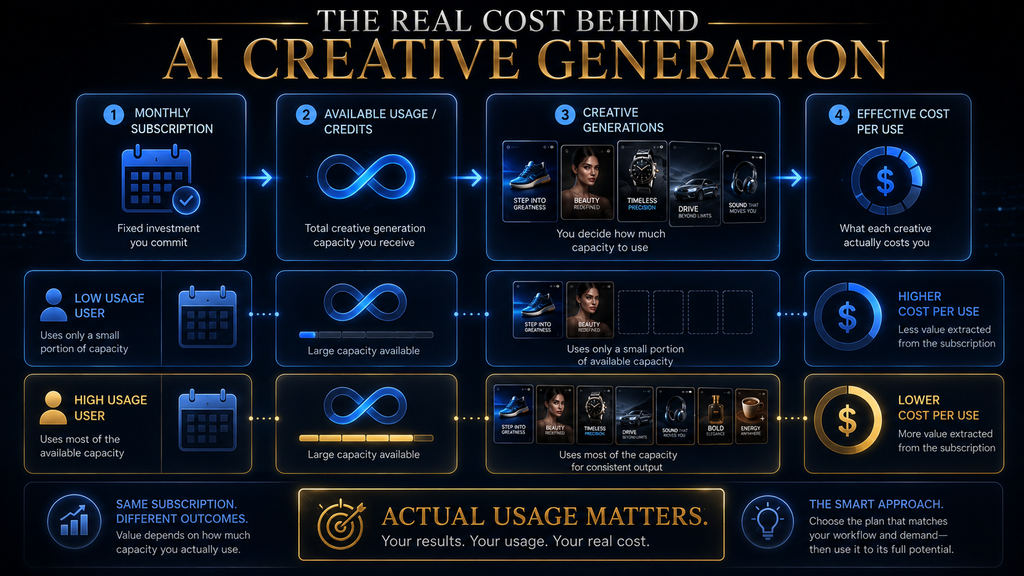
When Should You Upgrade From Starter to Professional?
Upgrade when the limitation is operational, not emotional.
If you are thinking about Professional simply because Starter feels small, that is not enough.
Look for concrete signals.
You repeatedly reach your credit limit.
You need more than one brand.
Other members of your team need access.
Your advertising operation has become frequent enough that production bottlenecks are costing real time.
You are using features or workflows that are genuinely valuable to your larger operation.
Your current subscription is becoming a constraint on an already-working process.
That last point is especially important.
Do not upgrade because you expect a bigger plan to create demand. Upgrade because demand already exists.
If your advertising business is not producing enough campaigns to use Starter meaningfully, Professional will not magically fix that.
When Should You Stay on Starter?
Stay on Starter if:
- You manage one brand.
- You are the primary user.
- You rarely exhaust your credits.
- You are still learning the platform.
- Your advertising volume is moderate.
- You do not need the broader team-oriented workflow.
- Your current subscription already handles your production requirements.
There is nothing inherently more professional about paying $249 instead of $39.
If Starter supports the workflow, Starter is doing its job.
When Does Professional Become Economically Rational?
Professional becomes easier to justify when the business has a recurring creative production requirement and multiple people or brands are involved.
For example, imagine a small performance marketing team managing six client campaigns. The team may have a designer, media buyer, and account manager who all need to interact with the creative workflow.
The value of Professional is not simply the additional downloads.
It is the reduction of coordination friction.
Instead of treating creative production as a sequence of isolated tasks—brief, design, revision, approval, export—the team can operate around a more centralized creative system.
That can create second-order value.
Faster iteration can lead to more tests.
More tests can generate more evidence.
More evidence can improve creative decisions.
Better decisions can improve campaign efficiency.
None of that guarantees better advertising performance, and it would be irresponsible to claim otherwise. But it explains why the economic value of a professional advertising platform can exceed the literal price of its downloadable outputs.
When Ultimate Is Probably the Wrong Choice
Ultimate is probably the wrong choice if you are:
- A solo creator.
- A single-brand ecommerce seller.
- A beginner experimenting with paid advertising.
- Producing only a handful of finished creatives each month.
- Buying primarily because the credit number looks impressive.
- Uncertain whether you will use the platform beyond the trial.
The $999 monthly starting price is simply too large to justify on the basis of curiosity.
Even if the annual effective price is substantially lower, the underlying principle remains the same: unused capacity is still unused capacity.
A discounted subscription can still be a bad purchase.
When Ultimate Can Make Sense
Ultimate becomes more defensible when the organization has the scale to use it.
An agency with numerous client brands is the clearest example.
Suppose the agency manages 20 active brands and each brand needs recurring creative testing. The organization may have dozens of people involved in creative production and campaign management.
At that point, the economic question becomes:
Can the system reduce enough repetitive work across enough accounts to justify the subscription?
That is a very different question from whether Ultimate is “expensive.”
Software should be evaluated against the cost of the workflow it replaces or improves, not simply against the price of a cheaper software tier.
What About Enterprise?
Enterprise is not simply a more expensive version of Ultimate.
AdCreative.ai’s current Enterprise offering is custom-priced and includes tailored credits and enterprise-oriented capabilities such as commercially safe AI models, global data governance protocols, personalized onboarding, AI fine-tuning with customer data, complete asset IP rights, security and privacy compliance, a digital asset management API, and a dedicated account manager.
That means Enterprise is relevant when procurement, governance, integration, security, or customization becomes part of the buying decision.
A small business should not contact enterprise sales because it sounds more sophisticated.
A large organization should not choose Ultimate simply because the public price is easier to understand.
The buying criteria are different.
The Hidden Cost of AdCreative.ai: Creative Overproduction
There is another cost that does not appear on the pricing page.
It is creative waste.
AI makes it easier to generate more variations than a team can intelligently evaluate.
That sounds like a benefit until the volume becomes excessive.
If your team generates 200 creative concepts but only has the resources to evaluate 20 properly, the additional 180 outputs do not automatically create value.
They can create noise.
This is why the best AdCreative.ai workflow is not:
Generate as much as possible.
It is:
Generate enough alternatives to test meaningful creative hypotheses.
That distinction should influence your plan selection.
A marketer who understands creative testing may get more value from 10 carefully selected downloads than another marketer gets from 50 random ones.
The subscription should support the testing strategy, not replace it.
AdCreative.ai Pricing vs Your Existing Creative Workflow
The strongest way to evaluate the platform is to compare it with what you already spend.
Consider four categories.
Design labor
How much time does your team spend creating ad variations?
Copy production
How much time is spent writing headlines, descriptions, hooks, and variations?
Creative iteration
How long does it take to produce a second, third, or tenth variation?
Coordination
How much time is lost moving assets between marketer, designer, media buyer, and client?
AdCreative.ai can potentially create value across all four.
But the amount of value depends on your workflow.
If you already have a highly efficient in-house creative team producing excellent assets quickly, the incremental value may be smaller.
If your current process is slow, fragmented, and heavily dependent on repetitive production work, the value proposition becomes stronger.
That is why “Is AdCreative.ai worth it?” cannot be answered independently from “How do you currently produce ads?”
A Simple ROI Model for AdCreative.ai
You can build a basic internal calculation before subscribing.
Start with:
Monthly creative-production hours
Multiply that by:
reasonable hourly labor value
Then estimate:
hours that AdCreative.ai could realistically remove or reduce
Now compare the resulting value with:
subscription cost
For example, suppose a small team spends 15 hours per month producing repetitive ad variations, and you value that labor at $25 per hour.
That represents $375 of monthly production capacity.
If the platform realistically reduces five hours of that work, the recovered capacity is worth approximately $125.
A $39 subscription could be easy to justify.
A $249 subscription would require additional value from greater creative output, testing capacity, team coordination, or other functionality.
A $999 subscription would require a fundamentally different scale of operation.
This is an illustrative model, not a promise of savings. Your actual economics will depend on labor costs, workflow quality, creative requirements, and how much of the process the platform genuinely changes.
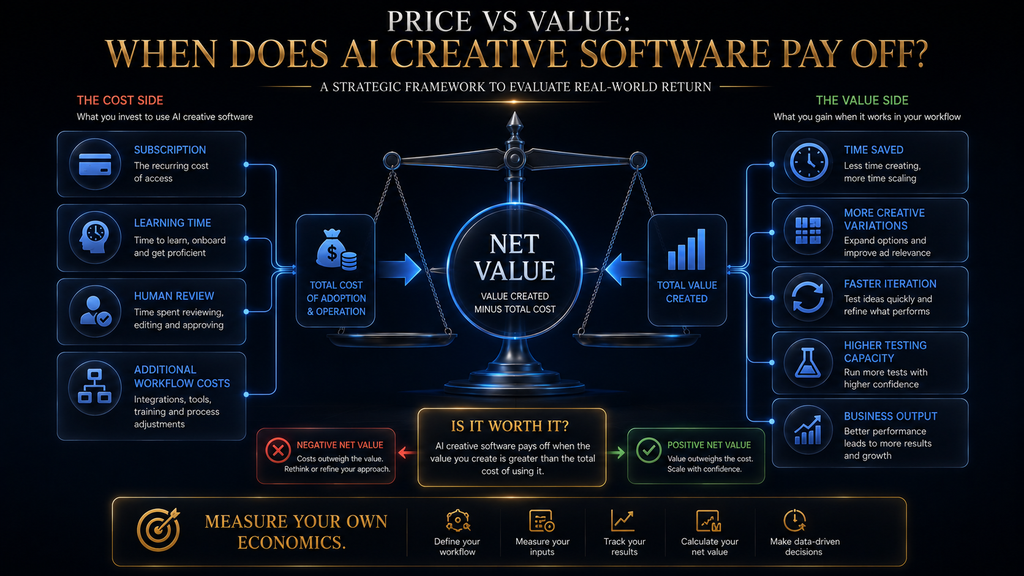
Do Not Confuse Creative Efficiency With Advertising Performance
This is one of the most important boundaries in the entire article.
A faster creative workflow does not automatically produce better advertising results.
AdCreative.ai may help you generate more variations, organize creative work, and evaluate certain creative characteristics. But campaign performance still depends on the offer, audience, landing page, positioning, media buying, budget, targeting, market conditions, and the quality of the underlying creative strategy.
The platform’s own marketing emphasizes performance-oriented creative and ROI, but those are vendor claims, not guaranteed outcomes for every advertiser.
The correct way to think about the tool is:
It can improve the production and decision-support layer.
It does not remove the need for advertising strategy.
The Case for Not Buying AdCreative.ai
A good affiliate article should explain when the reader should walk away.
You probably do not need AdCreative.ai if you create very few ads, already have a fast and effective design workflow, or rarely need creative variations.
You may also decide against it if the generated output does not meet your brand standards without extensive manual editing.
And if you are hoping that an AI creative platform will compensate for a weak offer or unclear marketing strategy, you are solving the wrong problem.
Software cannot fix a fundamentally weak proposition.
The same principle applies to creative testing. If you do not have enough traffic or budget to run meaningful experiments, generating more variations may not produce useful information.
In that situation, the limiting factor is not creative production.
It is statistical signal.
The Case for Buying It
The opposite is also true.
AdCreative.ai becomes more interesting when creative production itself is the bottleneck.
If your team constantly needs new advertising variations, spends too much time on repetitive production, manages several brands, or needs a more systematic way to move from concept to usable creative, the platform can become economically meaningful.
The strongest use case is therefore not “I want AI-generated ads.”
It is:
“My advertising operation needs more creative throughput and structured experimentation than my current process can efficiently provide.”
That is a much stronger buying thesis.
What Happens If You Do Nothing?
This question matters because the cost of a software decision is not only the subscription.
There is also the cost of maintaining the current system.
If your current creative process is working efficiently, doing nothing may be the correct decision.
But if your team is repeatedly delaying campaigns because creative production is slow, the status quo has a cost.
You may launch fewer tests.
You may recycle the same creative for too long.
You may spend more internal labor on repetitive design work.
You may delay campaign launches while waiting for revisions.
You may have fewer opportunities to learn which messages resonate.
The important point is not that AdCreative.ai automatically solves those problems.
It is that the status quo should be measured too.
If doing nothing is already inexpensive and effective, a subscription adds unnecessary complexity.
If doing nothing is quietly consuming significant time and opportunity, the economics change.
Common AdCreative.ai Pricing Mistakes
Mistake 1: Choosing by headline price
The cheapest plan is not automatically the best fit.
Look at brands, users, credits, workflow requirements, and commitment.
Mistake 2: Choosing by credit count alone
Credits are important, but they are not the complete product.
The surrounding operating capacity matters.
Mistake 3: Assuming more expensive means better value
Ultimate has a much higher entry price than Starter, but its value proposition is fundamentally different.
Mistake 4: Paying annually before testing
A large advertised discount does not make an untested workflow a good investment.
Mistake 5: Treating every generated creative as valuable
More output is not the same thing as more useful experimentation.
Mistake 6: Ignoring existing workflow costs
Compare the subscription with your current production time and operational friction.
Mistake 7: Assuming AI-generated creative equals campaign success
Creative production is one component of advertising performance, not the entire system.
Mistake 8: Trusting old pricing tables
AdCreative.ai’s pricing structure is dynamic, and third-party directories can display older figures. Check the current official pricing interface before purchase.
What Should You Measure After Buying?
If you subscribe, do not judge the platform only by how attractive the generated images look.
Track actual operational metrics.
Creative production time
How long does it take to go from campaign brief to usable creative?
Usable-output rate
Of the creatives generated, how many are actually good enough to download or use?
Revision time
How much manual editing is required before an output becomes acceptable?
Creative testing volume
How many genuinely different hypotheses can your team test?
Cost per usable creative
What does the subscription cost relative to the finished outputs you actually use?
Campaign-level performance
Where possible, evaluate the final advertising results separately from the production process.
This last distinction matters because a tool can be excellent at production efficiency without automatically improving campaign economics.
A Better KPI: Cost per Usable Creative
The simple cost-per-credit calculation is useful, but I recommend tracking a more practical metric:
Cost per usable creative = monthly subscription cost ÷ creatives actually approved for use
Suppose you pay $39 and download 10 creatives, but only four are good enough for your campaigns.
Your nominal credit cost is $3.90.
Your effective cost per usable creative is:
$39 ÷ 4 = $9.75
That tells you much more.
If you improve your workflow and five or six of those outputs become usable, your effective cost falls without changing the subscription price.
This is why user skill and workflow design matter.
The same software can have radically different economics in two different organizations.
A Second KPI: Creative Throughput per Hour
Another useful measurement is:
Usable creatives ÷ hours spent producing them
This helps answer whether the platform is actually improving your operation.
Imagine your old process produces four usable creatives in eight hours.
That is: 0.5 usable creatives per hour.
If your AI-assisted process produces eight usable creatives in six hours, you have not merely doubled output.
You have changed the economics of your production process.
Again, that does not guarantee better advertising performance. But it can create more capacity for testing and iteration.
The Strategic Value of More Creative Capacity
There is a second-order effect that is easy to overlook.
When creative production becomes faster, the organization may change how it thinks about advertising.
Instead of asking:
“Which one ad should we make?”
the team can ask:
“Which assumptions should we test?”
That is a meaningful shift.
A campaign might have competing hypotheses about:
- headline framing,
- product benefit,
- emotional angle,
- visual treatment,
- offer presentation,
- audience pain point,
- social proof,
- call-to-action.
A more efficient production system can make it easier to turn those hypotheses into actual tests.
But there is a danger.
If teams begin generating variations without a clear hypothesis, they create volume without learning.
The goal is not infinite creative.
The goal is useful experimentation.
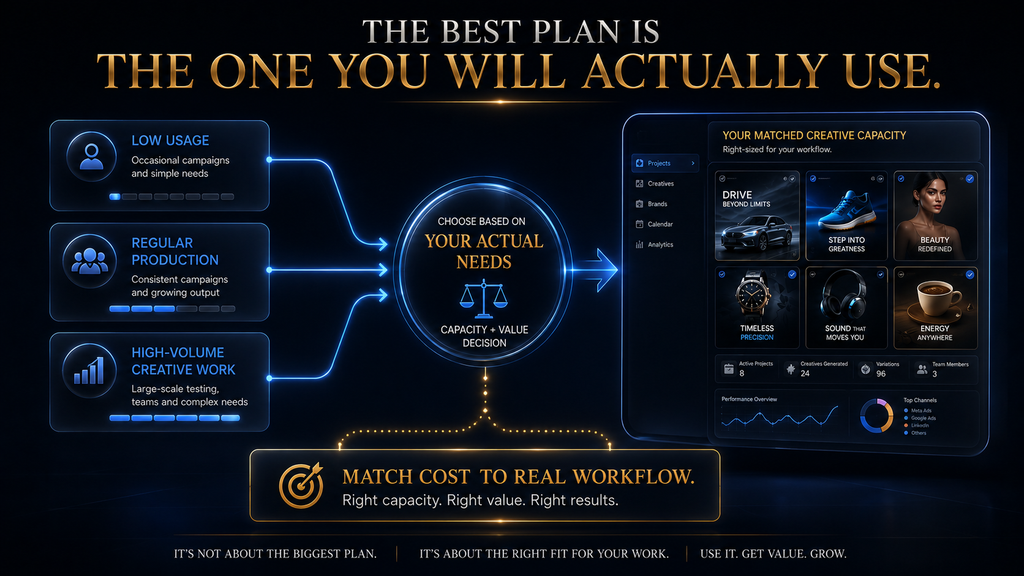
Is AdCreative.ai Worth It for Small Businesses?
For a small business, Starter is generally the most logical place to begin because the entry configuration is designed around a small-business workflow: 10 monthly credits, one brand, and one user at the current monthly starting price of $39.
The more important question is whether the business has enough recurring advertising activity to use the capacity.
If you run occasional campaigns and create only a few ads every couple of months, the subscription may not provide enough recurring value.
If you are running ongoing campaigns and regularly need creative variations, the equation becomes much more favorable.
Small businesses should also resist the temptation to jump directly to Professional simply because it offers more.
Start with the smallest configuration that lets you run a meaningful test.
Is AdCreative.ai Worth It for Freelancers?
Freelancers have a more interesting case.
If you work with several clients, the number of brands becomes more important than your personal creative volume.
A freelancer working with one client may find Starter adequate.
A freelancer managing multiple advertising clients may quickly encounter the limits of a one-brand workflow.
At that point, Professional becomes more relevant—not because the freelancer suddenly needs 50 downloads, but because the workflow is no longer a single-brand operation.
The economics should therefore be evaluated against client revenue supported by the workflow, not simply against the number of credits consumed.
Is AdCreative.ai Worth It for Agencies?
Agencies are where Ultimate becomes most interesting.
An agency’s economics are fundamentally different from a solo marketer’s because creative production is multiplied across client accounts.
The relevant questions become:
How many brands are managed?
How many people need access?
How many creative variations are produced?
How much manual production is required?
How much coordination happens between creative and media teams?
How quickly do clients expect new campaign concepts?
If the answer to several of these questions is “a lot,” Ultimate deserves serious evaluation.
If the agency is small and only manages a handful of brands, Professional may be sufficient.
The correct plan depends on operational scale, not the agency label.
AdCreative.ai Pricing: My Verdict
For most individual users and small businesses, Starter is the logical entry point because it keeps the financial risk relatively low while providing access to the core workflow.
For growing teams, Professional is justified when brands, users, creative volume, and operational complexity become meaningful constraints. It should not be purchased merely because it has five times the starting credits.
For agencies operating across many client brands, Ultimate can make sense as an organizational-scale tool, but the economics need to be justified by actual workflow utilization. Its higher price means it should be evaluated against team capacity and client operations rather than cost per credit alone.
For large organizations with governance, security, customization, data, API, or dedicated-support requirements, Enterprise is the appropriate category to investigate.
The most important conclusion is therefore slightly counterintuitive:
AdCreative.ai’s most expensive plan is not necessarily its best-value plan, and its cheapest plan is not necessarily the cheapest way to run a large creative operation. The right plan is the one whose capacity matches the scale and economics of your advertising workflow.
Final Thoughts
AdCreative.ai pricing becomes much easier to understand once you stop treating the subscription tiers as simple packages of AI generations.
The platform’s credit model is based around downloads, while the plan families also change the operating environment through brands, users, features, and workflow capacity. That means a serious buyer should evaluate the subscription as a production-system decision rather than a simple design-tool purchase.
Starter is the safest place to begin for a solo marketer or small one-brand business. Professional becomes more compelling when the workflow expands beyond one person or one brand. Ultimate is an agency-scale decision, and Enterprise is aimed at organizations that need capabilities beyond a standard public subscription.
Before paying for a long-term plan, run the product against a real campaign. Measure production time, usable creative output, revision effort, and the number of meaningful experiments you can actually support. If the platform saves time but produces no useful change in your workflow, the larger plans will not solve the problem.
And remember the most important pricing principle from this entire analysis: do not optimize for the largest number of credits. Optimize for the smallest amount of paid capacity that lets your advertising system work better.
If you have reached the point where you know your advertising workflow needs faster creative production, the next step is not automatically buying the biggest plan. Test AdCreative.ai against a real campaign, measure the output, and then choose the subscription level that matches your actual volume, brands, users, and workflow.
Ready to Find Your Best-Fit AdCreative.ai Plan?
Test the platform with a real campaign, measure your usable creative output and production time, then choose the plan that matches your advertising operation rather than simply choosing the largest credit allowance.
Start Your AdCreative.ai TestAffiliate disclosure: We may earn a commission if you sign up through this link, at no additional cost to you.
Frequently Asked Questions
How much does AdCreative.ai cost?
AdCreative.ai currently starts at $39 per month for Starter, $249 per month for Professional, and $999 per month for Ultimate on the monthly pricing view. Enterprise is custom-priced. The platform also offers additional credit configurations within each plan family.
Is AdCreative.ai free?
AdCreative.ai offers a 7-day free trial, but payment information is required at signup. The company’s help center says users are not charged during the trial and can cancel.
What is an AdCreative.ai credit?
According to AdCreative.ai, a credit is used when you download a generated ad creative. The company says you can generate unlimited creatives, while credits are consumed on downloads.
Which AdCreative.ai plan is best for beginners?
Starter is generally the most sensible starting point for beginners because it has the lowest monthly entry price and is positioned for small businesses. The better question is whether you have enough recurring advertising activity to use the included capacity.
Is AdCreative.ai Professional worth it?
Professional can be worth it for growing teams, high-volume advertisers, and organizations managing more brands or users. It is not automatically better value for a solo user simply because it includes more credits.
Is AdCreative.ai Ultimate worth $999?
Ultimate can make economic sense for agencies and larger creative operations that can use its expanded brand, user, and workflow capacity. For a solo marketer or small one-brand business, the price is difficult to justify unless the workflow has genuinely reached that scale.
Does AdCreative.ai have annual pricing?
Yes. The current pricing interface shows annual billing with a 50% advertised discount relative to the displayed monthly pricing, while quarterly billing is currently advertised at 25% off. Promotional terms can change, so verify the current checkout price before subscribing.
Should I choose monthly or yearly billing?
Choose monthly if you are still testing whether AdCreative.ai fits your workflow. Consider annual billing once you have already validated the product and expect to use it consistently enough to benefit from the lower effective monthly price.
Can I cancel AdCreative.ai?
AdCreative.ai’s help center provides a cancellation process through the account settings. The company’s subscription documentation also explains that users can manage their plans and renewal information from within the platform.
Is AdCreative.ai worth it for a small business?
It can be, particularly when a small business regularly needs new advertising creatives and would benefit from faster production. If advertising is occasional and creative requirements are minimal, the subscription may not provide enough recurring value.
Does AdCreative.ai guarantee better ROAS?
No software should be treated as a guarantee of better ROAS. AdCreative.ai markets its platform around performance-oriented advertising, but actual campaign results depend on many factors beyond creative generation, including the offer, audience, targeting, landing page, media buying, budget, and creative strategy.
Written by
Muntasir Ahmad Chowdhury
Founder, AI Hustle World
Muntasir Ahmad Chowdhury is the Founder of AI Hustle World, an independent publication dedicated to making Artificial Intelligence practical, trustworthy, and easy to understand. He researches AI tools, automation, customer service, productivity, and real-world business applications, helping readers make smarter technology decisions through research-driven, experience-backed content.
Expertise:
AI Tools • AI Automation • AI Customer Service • AI Productivity • Generative AI • AI Workflows
Get Smarter With AI
Enjoyed this guide? Get practical AI tools, tutorials, and honest reviews delivered to your inbox.
6 thoughts on “AdCreative.ai Pricing: Which Plan Is Right for You?”