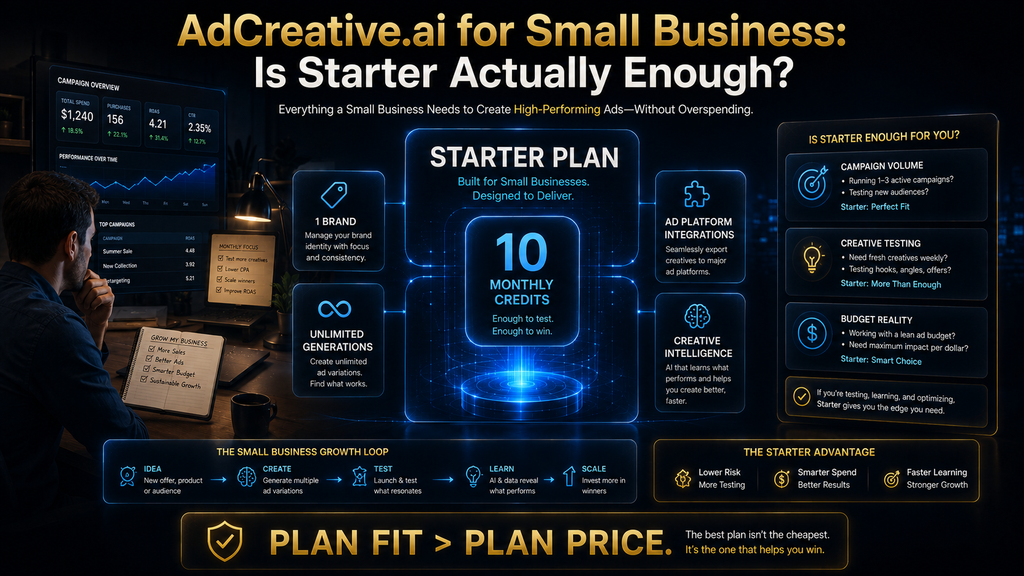
AdCreative.ai for Small Business: Is the Starter Plan Enough?
Running ads as a small business creates a problem that is easy to underestimate. You are not competing only against businesses with larger budgets; you are competing against businesses that can produce, review, refresh, and test creative at a much higher rate. A large brand can afford designers, media buyers, copywriters, editors, agencies, and dedicated testing budgets. A small business owner may be doing most of those jobs alone, often between customer calls, fulfillment, sales, bookkeeping, and everything else required to keep the business alive.
That is where a tool such as AdCreative.ai becomes interesting—but also where the buying decision becomes more complicated than “AI saves time.” The real question is whether the amount of creative production and testing you can realistically do with the entry-level plan is enough to justify another monthly software expense. If your advertising account is still small, paying for a sophisticated creative platform can easily become overhead rather than leverage.
So, is the AdCreative.ai starter-level offering enough for a small business? In many cases, yes—but only when the business has a genuine need for recurring ad creative and enough advertising activity to use that creative. For a company running a handful of campaigns with a small monthly budget, the limiting factor may not be creative production at all. It may be the lack of conversion data, weak offers, insufficient traffic, or simply not having enough budget to run meaningful tests.
That distinction matters throughout this review. AdCreative.ai can reduce the friction involved in producing advertising variations, but it cannot manufacture demand, fix a poor landing page, or turn an underfunded campaign into a statistically reliable testing program. The most sensible way for a small business to evaluate it is therefore not to ask whether the software is powerful enough. Ask whether your current advertising workflow is constrained by creative production enough for the software to pay for itself.
Affiliate Disclosure: AI Hustle World may earn a commission if you purchase a product through some links in this article. This does not change our editorial judgment or the price you pay.
What Does “Enough” Actually Mean for a Small Business?
For a small business, “enough” should not mean having access to every feature available on the platform. It should mean having enough capability to solve the specific bottleneck that is currently costing the business time, creative output, or advertising opportunities.
That sounds obvious, but it changes how you evaluate the product. A small e-commerce store with several active campaigns may need a steady stream of product-focused creative variations. A local service company running one lead-generation campaign may need only a few strong concepts every month. An agency serving ten small clients has an entirely different requirement, even if each individual client has a small advertising budget.
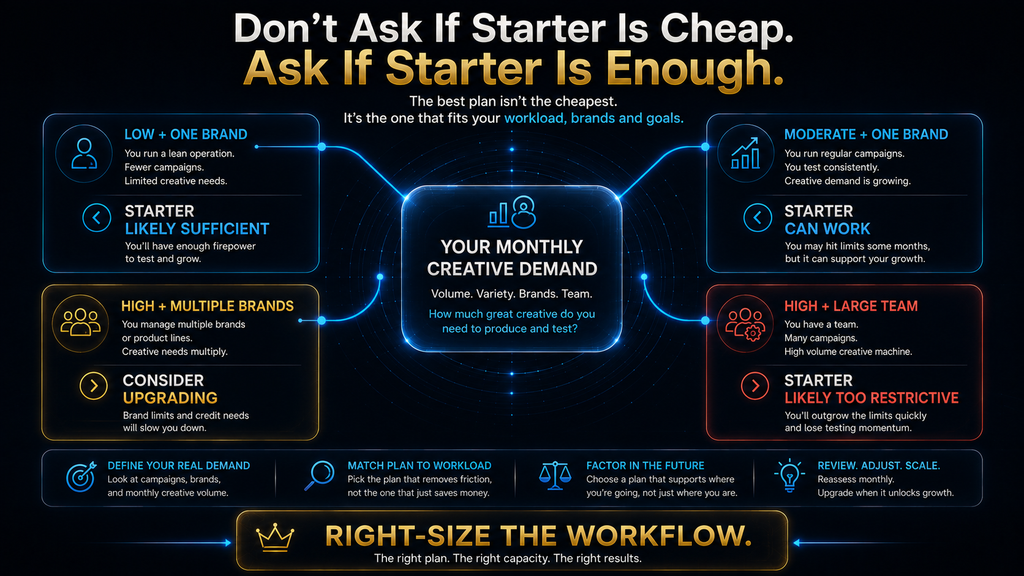
This is why the phrase “small business” is too broad to determine plan fit by itself. Revenue, advertising spend, number of active campaigns, creative refresh frequency, team size, and internal production capability all influence whether an entry-level AdCreative.ai plan makes economic sense.
The more useful question is therefore:
How much creative work does the business actually need to produce, evaluate, and refresh?
If the answer is “very little,” an AI creative subscription may not solve an important problem. If the answer is “we constantly need new concepts and variations, but creating them is slowing everything down,” the calculation changes quickly.
The hidden cost of doing creative manually
Small businesses often treat internal creative work as free because there is no separate invoice attached to it. That is misleading. If the owner spends three hours preparing ad concepts, finding suitable images, resizing creative, writing copy, making variations, and preparing files for campaigns, those hours have an economic cost even when nobody receives a design invoice.
The same applies when an employee is responsible for marketing alongside another role. If a sales employee spends half a day preparing campaign assets, the cost is not simply “four hours of work.” It is also four hours that employee was not prospecting, following up with leads, serving customers, or improving the sales process.
AdCreative.ai becomes more defensible when it replaces expensive friction rather than replacing something that was already fast and inexpensive. That is the first principle small businesses should keep in mind.
What AdCreative.ai Is Actually Solving
AdCreative.ai is primarily valuable to a small business when creative production and creative decision-making have become bottlenecks in the advertising workflow.
The platform is built around advertising creative rather than being a general-purpose business AI assistant. Its broader feature set includes AI-generated ad creatives, creative scoring, text generation, product-focused creative workflows, and integrations with advertising platforms. That means the relevant comparison is not simply “AdCreative.ai versus doing nothing.” It is usually AdCreative.ai versus the collection of tools and manual processes you currently use to create, evaluate, and deploy advertising creative.
That distinction becomes especially important for smaller companies because they often assemble marketing workflows from several inexpensive tools. A business might use Canva for design, ChatGPT for copy, stock photography for imagery, a spreadsheet for campaign tracking, and Meta Ads Manager for distribution. None of those tools necessarily feels expensive on its own. The problem is that the owner or marketer has to move between all of them.
The value proposition of AdCreative.ai is therefore partly about consolidation and workflow speed. If it allows the business to go from product or campaign information to multiple usable advertising concepts more efficiently, the software may earn its place in the stack. But if the existing workflow already produces enough creative and the business rarely needs new variants, consolidation alone may not justify the subscription.
This is one reason I would resist evaluating the platform by feature count. Small businesses do not need more software features; they need fewer expensive bottlenecks.
The Small-Business Advertising Problem Is Usually Not “We Need More Ads”
A common mistake is to assume that more creative automatically means better advertising performance. It does not.
A business can produce fifty ad variations and still have a bad campaign if the offer is weak, the audience is poorly defined, the landing page does not convert, or the product simply does not have enough demand. Creative volume becomes valuable only when the business has a process for deciding which creative deserves testing and enough traffic or spend to generate useful feedback.
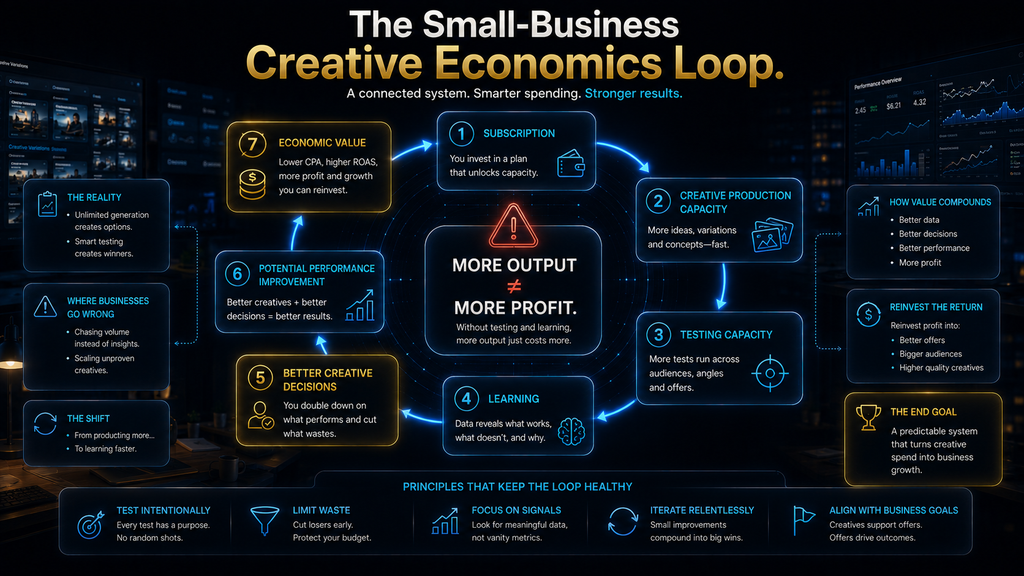
That creates a three-part relationship:
Creative supply → Testing capacity → Business signal
If any one of those is missing, adding more AI-generated creative has diminishing value.
Consider a local service business spending $300 a month on paid advertising. If it is already struggling to generate enough clicks and conversions to understand what is working, producing dozens of additional creative variations may create more assets than the campaign can meaningfully test. The business does not have a creative shortage. It has a signal shortage.
Now consider a small online retailer spending $3,000 a month across several campaigns and regularly refreshing creative because ad fatigue is becoming a concern. That business has a very different problem. Creative production may genuinely be limiting the number of concepts it can test, especially if the owner is currently creating everything manually.
The same subscription can therefore be wasteful for one company and useful for another.
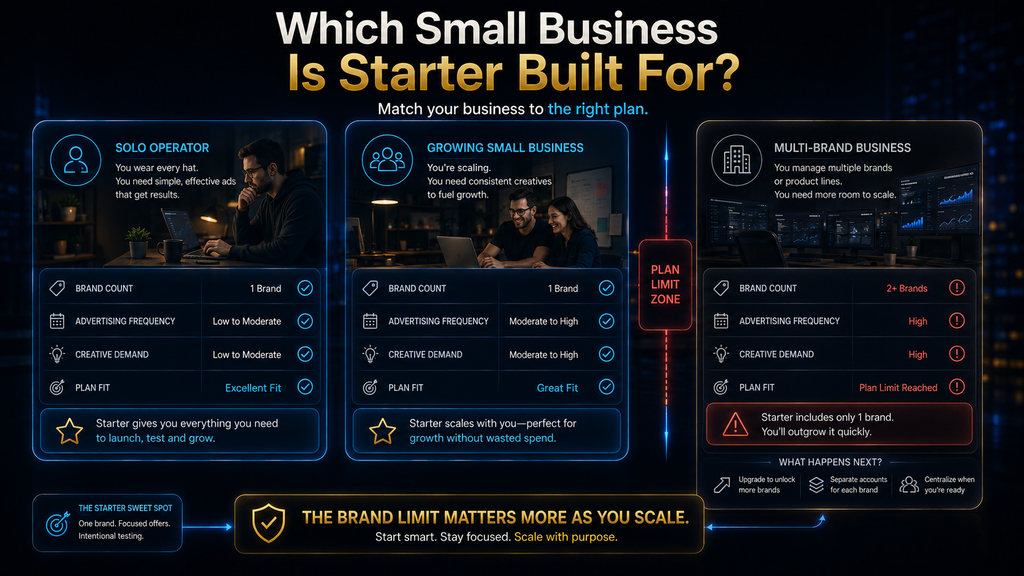
Who Is the AdCreative.ai Starter Plan Really For?
The entry-level plan is most likely to make sense for a small business that has moved beyond occasional advertising and has entered a repeatable creative-testing cycle.
That typically means the business has a real product or service, an established advertising channel, some budget allocated to paid media, and enough campaign activity that creative refreshes happen regularly. It does not need to be a large company. A five-person business can have a much stronger use case than a fifty-person company if advertising is central to its customer acquisition model.
A useful profile looks something like this:
| Business situation | Starter-level fit |
|---|---|
| Running occasional boosted posts | Low |
| Spending a small amount with one or two ads | Low |
| Testing multiple creative concepts monthly | Stronger |
| E-commerce store with frequent product promotion | Strong |
| Founder creates every ad manually | Stronger |
| Small marketing team with recurring creative needs | Strong |
| Agency managing several clients | Usually too narrow |
| Business with almost no paid traffic | Weak |
| Business with poor conversion fundamentals | Weak |
| Business already has a designer producing enough assets | Depends |
The key point is that advertising intensity matters more than company size.
A small business that spends $5,000 per month on paid acquisition may have a more compelling reason to automate creative than a much larger business that spends almost nothing on paid advertising.
The Economics: When Does the Subscription Start Making Sense?
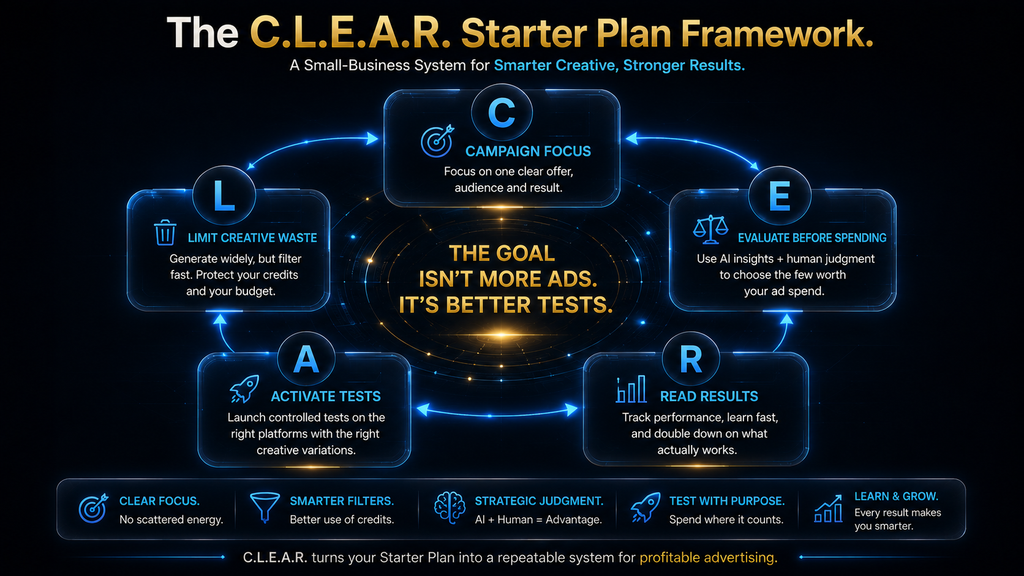
The cleanest way to evaluate AdCreative.ai for a small business is to calculate the value of the problem it solves.
Suppose the business spends $100 per month on software and uses the platform to save five hours of creative work. At first glance, that sounds attractive. But the five hours matter only if they are actually converted into something valuable.
There are three possible outcomes.
The first is labor savings. The business genuinely spends less time producing creative.
The second is output expansion. The same person can produce more legitimate creative concepts without working additional hours.
The third—and potentially most valuable—is testing improvement. The additional creative enables the business to test ideas it previously could not afford to produce manually.
The third category is where the economics can become much more interesting, but it is also the hardest to prove. A business should not assume that more creative equals more revenue. It should measure whether the additional production leads to better testing decisions and, eventually, better campaign economics.
A simple internal calculation can help:
Monthly software cost ÷ hours realistically saved = software cost per hour saved
But do not stop there. Also calculate:
Monthly software cost ÷ additional usable creatives produced
And, when sufficient campaign data exists:
Incremental advertising contribution ÷ software cost
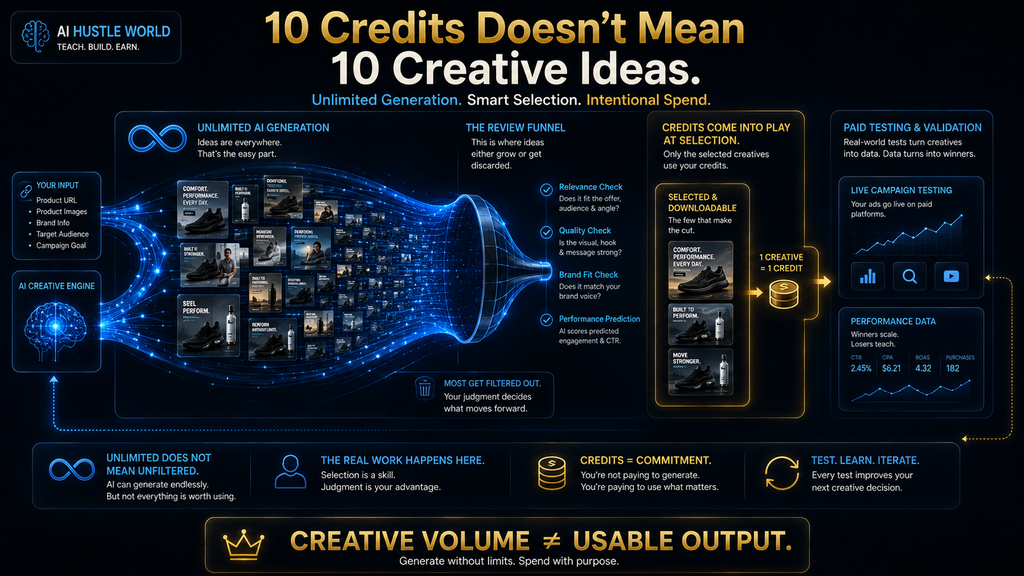
The word usable is critical. Generating 100 designs does not mean you received 100 valuable advertising assets. Some may be visually weak, strategically repetitive, poorly aligned with the brand, inaccurate, or unsuitable for the target audience.
The economics should therefore be based on usable output, not generation volume.
Why Creative Volume Can Become a Trap
AI makes creative production dramatically easier, but that creates a new operational problem: selection.
Before generative AI, producing ten advertising concepts could be expensive enough that the team naturally filtered ideas before production. With AI, the cost of producing another variation can fall sharply. That encourages businesses to generate first and think later.
For a small business, that can become counterproductive.
If you produce more creative than your team can properly review, organize, test, and learn from, the additional output creates operational noise. Someone still has to decide which concepts are worth using. Someone has to verify the offer, messaging, brand fit, product accuracy, formatting, and audience relevance. Someone has to monitor the actual campaign results.
This leads to an important principle for evaluating AdCreative.ai:
The value of AI creative generation is determined by what happens after generation.
A business with a disciplined testing workflow can extract much more value from creative automation than a business that simply generates designs and publishes whichever one looks attractive.
What the Starter Plan Needs to Do for a Small Business
For most small businesses, the entry-level offering does not need to replace the entire marketing department. It needs to accomplish four practical jobs.
First, it should reduce the time required to create credible concepts. The business should be able to move from a product, offer, or campaign brief toward actual creative directions without rebuilding every asset manually.
Second, it should make variation easier. One concept rarely tells you everything you need to know. The ability to explore different messaging, imagery, layouts, and positioning is more useful than generating endless versions of the same idea.
Third, it should help prioritize creative. A scoring or prediction feature can be useful as a filtering mechanism, provided the business understands that predictive scores are not actual campaign results.
Fourth, it should fit into the existing advertising workflow. If every generated asset requires extensive manual cleanup before it can be used, the apparent time savings shrink.
This is the standard I would use rather than asking whether the plan contains enough credits or features in isolation.
Creative Scoring Is Useful—but Small Businesses Should Not Treat It as a Crystal Ball
Creative scoring is one of the more interesting parts of the AdCreative.ai proposition because it attempts to give marketers an additional signal before spending advertising budget.
But the correct mental model is prioritization, not prediction certainty.
A creative score can help a marketer identify which concepts deserve closer inspection. It can potentially reduce the amount of manual filtering required when many concepts have been generated. What it cannot do is know exactly how a particular audience will respond under every real-world condition.
Actual performance depends on factors outside the creative itself: audience quality, offer strength, price, brand familiarity, placement, auction conditions, campaign structure, landing-page experience, seasonality, and competitive activity.
That means a small business should never interpret a high predicted score as permission to skip testing. If anything, the score is more useful as a pre-test filter.
Imagine that the business has twenty generated concepts. Instead of manually treating all twenty as equally worthy of attention, it can use available signals to narrow the review set, then apply human judgment before choosing what to test. That is a much more defensible workflow.
The important distinction is:
Prediction helps decide what to test. Performance data decides what actually worked.
AdCreative.ai vs Canva for a Small Business
Many small businesses will immediately ask whether they really need AdCreative.ai when they already have Canva.
That is a legitimate challenge.
Canva is often the better choice when the business needs broad design flexibility, presentations, social graphics, brand materials, documents, simple video, and manual creative control. It is a general-purpose visual design environment, and that versatility is a major advantage.
AdCreative.ai is more specialized around advertising workflows. The question is therefore not which tool is universally better. The question is whether the business needs design freedom or advertising-specific production and evaluation.
If the owner creates five ads a month and wants complete control over typography, layout, brand elements, and presentation materials, Canva may be more than sufficient. Paying for an advertising-specific platform could add complexity without solving a meaningful problem.
If the business is regularly producing paid-media concepts, needs more variations, wants advertising-focused workflows, and is spending enough on acquisition that creative testing matters, the specialized tool becomes easier to justify.
This is exactly why Article 4 in this cluster covers the broader AdCreative.ai-versus-Canva decision separately. This article should stay focused on the small-business economics and plan-fit question, rather than becoming another general comparison.
The Founder Test: Could You Produce Enough Creative Without It?
Here is a simple test I would recommend before subscribing.
Imagine AdCreative.ai did not exist.
Could you still produce the number of advertising concepts you genuinely need each month using your current tools?
If the answer is yes—and doing so does not consume meaningful time—then the software is probably not solving an urgent problem.
If the answer is technically yes, but producing those assets consumes ten or fifteen hours every month, you have a potential productivity case.
If the answer is no because you simply cannot produce enough variations to support your advertising strategy, you may have a stronger case still.
This is a much better way to approach the purchase than starting with the feature list.
A Small Business Should Measure Creative Throughput, Not Creative Count
One of the most misleading metrics in AI-assisted marketing is the number of assets generated.
A business might proudly report that it generated 200 creatives during the month. That sounds impressive until you ask how many were reviewed, how many were approved, how many were actually launched, and how many generated useful performance data.
A better measurement chain is:
Generated → Reviewed → Approved → Tested → Learned From
Every step reduces the total.
Suppose 100 concepts are generated. Maybe 40 are considered worth reviewing. Twenty-five survive brand and message checks. Ten are actually launched. Four produce enough signal to influence the next creative cycle.
The final number that matters is not 100.
It is the four that changed a decision.
That is the operating philosophy small businesses should use with any AI creative platform.
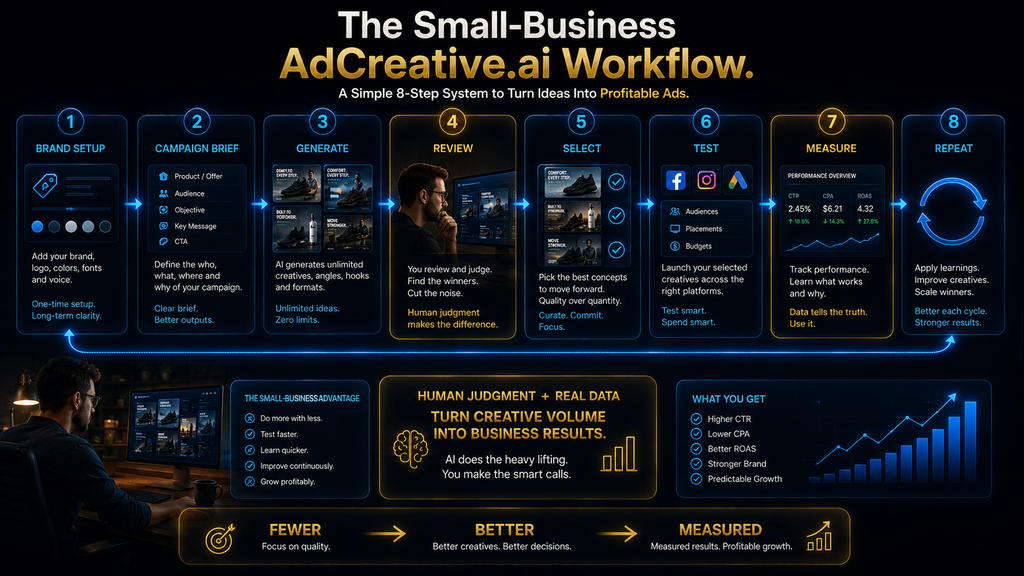
The Real Workflow: From Business Offer to Tested Creative
A strong small-business workflow starts before the AI tool is opened.
The business first needs a clear offer. What exactly is being sold? Who is it for? What problem does it solve? Why should someone choose it now rather than later? What proof exists? What objection is most likely to prevent the purchase?
Those answers become the raw material for creative development.
From there, the workflow can move into concept generation. AdCreative.ai can help produce different creative directions around the underlying offer rather than forcing the marketer to design every variation manually. This is where the tool can save meaningful time, particularly when the business wants to explore multiple angles.
The next stage is selection. This is where many inexperienced users make a mistake: they treat the generated output as finished work. It is not. The business still needs to check factual accuracy, brand consistency, offer terms, readability, visual hierarchy, and whether the concept makes sense for the audience.
Only after that should the strongest candidates move into paid testing.
The resulting campaign data then becomes the most important source of information for the next creative cycle. If one angle consistently outperforms another, that is more meaningful than an AI score alone. The next round of creative should build on what the market actually demonstrated.
Where Small Businesses Usually Waste the Most Money
The subscription fee itself is not necessarily the biggest risk.
The bigger risk is buying the software and changing nothing about the underlying workflow.
A founder can subscribe, generate dozens of creatives, download a few, and continue running the same campaigns with the same audience, offer, landing page, and testing process. In that situation, the business has added software cost without changing its operating model.
Another common failure is generating creative without a testing hypothesis. If every asset is different in five ways at once, the business may never understand why one performs better than another.
A better approach is to vary one meaningful dimension at a time when practical: hook, offer framing, visual treatment, proof mechanism, or audience angle. The objective is not scientific perfection—advertising rarely provides that—but enough structure to turn campaign activity into learning.
The third mistake is ignoring the landing page. If the ad promises a compelling solution and the landing page immediately creates confusion, improving the creative may increase clicks without improving profitable conversions. That can actually make the business worse off by sending more traffic into a broken funnel.
What Happens If You Do Nothing?
This is an important part of the decision because the alternative to buying software is not always “keep doing exactly what we do now.”
If creative production is genuinely a bottleneck and the business does nothing, the likely consequence is that the bottleneck remains. Campaign refreshes may happen less frequently. Promising concepts may never be produced. The founder may continue spending valuable hours on repetitive design work. Over time, that can limit the number of advertising experiments the company runs.
But there is another possibility.
If the business does not have enough advertising activity to justify additional creative, doing nothing may actually be the smarter decision. The money can remain available for media spend, landing-page improvements, customer research, better photography, conversion optimization, or another constraint that has a larger effect on revenue.
This is why “Should I buy AdCreative.ai?” cannot be answered independently of the business’s current bottleneck.
Sometimes the best AI-tool decision is not to buy the tool.
A Practical Starter-Plan Test for a Small Business
Rather than treating the first month as a commitment to AI-generated advertising, treat it as a controlled experiment.
Start with one product, service, or campaign. Do not immediately migrate the entire advertising operation.
Document the current workflow before introducing the tool. How long does it take to produce an acceptable creative? How many concepts are normally created? How many reach launch? What is the current cost per click, conversion rate, cost per acquisition, or other business-relevant metric?
Then create a defined batch of new concepts using the same underlying offer.
The purpose is not to prove that AI wins. The purpose is to determine whether the new workflow gives you something your old workflow could not efficiently provide.
A useful pilot looks like this:
| Stage | What to measure |
|---|---|
| Existing workflow | Time per usable creative |
| AI-assisted generation | Time to first usable concept |
| Review | Percentage rejected |
| Production | Number of genuinely usable variations |
| Launch | Number actually tested |
| Performance | Relevant campaign KPI |
| Learning | Decisions changed by the test |
| Economics | Value created versus software cost |
This creates a much more honest answer than “the AI generated 50 ads.”
The 30-Day Small-Business Evaluation Framework
If I were advising a small business owner evaluating the starter-level plan, I would structure the first month around four questions.
Week 1: Can it produce usable work?
The first test is not performance. It is production quality.
Can the business provide enough product information, brand guidance, imagery, and offer context for the system to produce creative that requires only reasonable editing? If every output needs extensive correction, the workflow may not be efficient enough.
Week 2: Can it increase creative breadth?
Now ask whether the tool allows the business to explore angles that would otherwise have been skipped because manual production was too slow.
This is where the platform’s value can become more apparent. A small team does not necessarily need hundreds of assets. It needs enough meaningfully different concepts to avoid repeatedly testing the same idea in slightly different packaging.
Week 3: Can the team select intelligently?
At this stage, introduce a stronger review process. Separate visually attractive creative from strategically useful creative.
A beautiful ad can still communicate the wrong proposition. A simple ad can outperform a sophisticated one because the message is clearer. Small businesses should be particularly careful here because limited budgets make poor creative selection more expensive.
Week 4: Did the workflow change anything?
Finally, compare the new process against the old one.
Did creative production take less time? Did the business test more concepts? Did the team discover a better-performing angle? Did campaign results improve? Did the owner recover enough time to justify the software?
If the answer is consistently no, there is little reason to keep paying simply because the technology is impressive.
The Starter Plan vs Spending the Same Money Elsewhere
This is the comparison that matters most.
Every software subscription competes against another possible use of the same money.
For a small business, that might include:
- additional ad spend
- professional product photography
- landing-page improvements
- email marketing
- customer research
- better analytics
- design support
- sales tools
- content production
- conversion-rate optimization
The right decision depends on marginal impact.
If spending the subscription amount on additional ad spend would simply send more traffic through an underperforming funnel, the software may be more valuable.
If the campaigns already perform well and creative production is the bottleneck, the case becomes stronger again.
But if the business has barely enough budget to generate meaningful campaign data, buying another creative tool may be premature. There is no strategic advantage in building an advanced creative-testing machine when there is not enough traffic to learn from it.
Three Small-Business Scenarios
Scenario 1: The Local Service Business
Imagine a local cleaning company that runs Facebook and Instagram ads. The owner spends a modest amount every month and mainly uses one or two offers.
The creative requirement is relatively low. The company may benefit more from stronger testimonials, better local targeting, improved lead handling, and a faster response process than from producing twenty new creative concepts.
For this business, an AdCreative.ai subscription may be difficult to justify unless creative production is genuinely slowing campaign experimentation.
Verdict: Probably not yet.
Scenario 2: The Growing E-Commerce Brand
Now imagine a small e-commerce company with several products, multiple customer segments, and a consistent paid-social budget. The team needs new creative regularly because different products require different messaging and campaigns need refreshes.
The founder currently spends hours coordinating product images, ad concepts, variations, and campaign assets.
This is a much stronger fit.
The business does not need AdCreative.ai because it is “small.” It needs it because creative throughput has become a growth constraint.
Verdict: Strong potential fit.
Scenario 3: The One-Person Marketing Operation
Consider a consultant or small B2B company with one person responsible for marketing. The company runs LinkedIn or Meta campaigns occasionally and produces only a few ads at a time.
The software could still help, but the opportunity cost is different. If advertising is not a major acquisition channel, the owner may receive more value from improving the offer, writing stronger case studies, building an email list, or conducting direct outreach.
The tool might save creative time, but saved time has little value if that time is not redirected toward something economically important.
Verdict: Useful only if paid advertising is a meaningful growth channel.
The Small-Business Decision Matrix
Here is the framework I would actually use before paying for the plan:
| Question | If “Yes” | If “No” |
|---|---|---|
| Do you run paid advertising regularly? | Continue evaluating | Probably wait |
| Do you need new creative regularly? | Stronger case | Weak case |
| Does manual production consume meaningful time? | Stronger case | Weak case |
| Do you have enough traffic to test creative? | Stronger case | Fix signal problem first |
| Do you have a clear offer? | Continue | Fix offer first |
| Can you review AI output critically? | Continue | Build review process |
| Can you measure campaign outcomes? | Stronger case | Improve measurement |
| Will saved time be used productively? | Stronger case | Savings may be theoretical |
| Do you already have sufficient design capacity? | Compare carefully | AI may help |
| Is creative the current bottleneck? | Strongest signal | Look elsewhere |
The final question deserves the greatest weight.
Is creative actually your bottleneck?
If not, the best plan in the world is still the wrong purchase.
What Small Businesses Should Not Expect From AdCreative.ai
A realistic evaluation also requires knowing where the platform stops.
It will not replace strategic positioning. It cannot determine whether your offer is compelling to the market with certainty. It cannot guarantee that a generated creative will outperform your existing winner. It cannot fix a broken checkout experience, weak sales follow-up, poor targeting, or insufficient advertising budget.
It also does not eliminate the need for human review.
Advertising contains too many contextual decisions for a small business to safely delegate everything to an automated generation system. Product claims, pricing, promotions, legal requirements, brand positioning, customer sensitivity, and market context all require judgment.
The right role for AI is narrower and more useful: expand the production and evaluation capacity of the person making the decisions.
That is a much healthier expectation than asking the software to run marketing on autopilot.
The Traditional Method Still Exists for a Reason
It is tempting to look at AI creative software and conclude that traditional design workflows are outdated. That is too simplistic.
Manual creative production exists because good advertising requires context. Designers and marketers make choices about hierarchy, visual emphasis, audience psychology, brand consistency, cultural meaning, and campaign objectives. They are not merely moving pixels around.
AI changes the economics of some of that work, especially repetitive production and variation. It does not eliminate the underlying need for creative judgment.
For a small business, this is actually good news. You do not need a full creative department to benefit from better creative operations. But you also should not assume that generating the asset is the same thing as solving the advertising problem.
The most efficient model is often hybrid: AI expands options; humans decide which options deserve money.
Common Mistakes Small Businesses Make With AI Creative Tools
Buying before identifying the bottleneck
This is the biggest mistake. A business hears that AI can generate ads quickly and assumes speed is the missing ingredient. It may not be.
Measuring generated assets instead of business outcomes
A high generation count looks impressive but tells you almost nothing about profitability.
Publishing everything that looks good
Visual quality is not the same as strategic relevance. Every creative still needs a reason to exist.
Testing too many variables simultaneously
If every ad changes the headline, image, offer, audience, landing page, and format, learning becomes difficult.
Ignoring campaign economics
A cheaper creative-production process is useful only if the resulting time or performance improvement has economic value.
Assuming AI prediction equals actual performance
Predicted scores can support prioritization. They should not be confused with real market results.
Treating the subscription as a marketing strategy
A tool is an input into a marketing system. It is not the system itself.
A Better Way to Think About the Starter Plan
The most useful mental model is not:
“How many features do I get?”
It is:
“How much additional advertising capacity do I unlock?”
That capacity can appear in several forms. You may produce creative faster. You may test more concepts. You may reduce dependence on external design help. You may give a small marketing team more room to experiment. Or you may simply recover several hours that can be redirected toward sales and customer acquisition.
But those benefits are not automatic.
The tool becomes valuable when the business has a system capable of absorbing the additional capacity.
If your campaign manager cannot review the output, the additional production is wasted. If your advertising budget cannot support testing, the additional variations are stranded. If your offer is weak, better creative may only expose that weakness to more people.
That is why the best small-business use case is not “AI makes ads.”
It is AI removes enough production friction that the business can run a better advertising learning loop.
The One Metric I Would Watch First
If a small business has to choose one operational metric during its initial evaluation, I would start with cost per usable tested creative.
Not cost per generated creative.
Not number of images created.
Not number of templates used.
Not even time saved by itself.
Cost per usable tested creative captures more of the real workflow. It forces the business to account for selection and actual deployment rather than celebrating raw AI output.
For example, if the business spends $100 on software and ends up with ten genuinely useful creatives that are actually tested, the software cost is effectively $10 per tested creative before considering labor savings and other benefits.
That number can then be compared with the previous workflow.
If manual production effectively cost $25 per tested creative in labor and outsourcing, the AI-assisted workflow may have a strong economic argument.
If the old process already cost $3 per tested creative, the subscription looks very different.
The exact figures will vary by business. The framework does not.
When the Starter Plan Is Probably Enough
The starter-level offering is probably enough when the business has a modest but recurring creative requirement, one or a few advertising channels, limited internal design resources, and a workflow where AI-generated variations can actually be reviewed and tested.
This is the sweet spot.
You do not need a huge creative department to benefit. In fact, a small team can sometimes gain more from the productivity improvement because each hour of skilled employee time has a large opportunity cost.
But the business should be far enough along that it has something to test. If there is no meaningful advertising activity, the plan can become a solution looking for a problem.
When You Should Skip It
You should probably skip or postpone AdCreative.ai if paid advertising is still experimental, your monthly ad budget is extremely small, your campaigns receive too little traffic to generate useful feedback, or your biggest marketing problem is somewhere else in the funnel.
The same applies if you already have a designer or agency producing enough quality creative and your main constraint is campaign strategy or conversion performance.
In those cases, adding another creative tool may create more workflow complexity than value.
A small business should be especially ruthless here because software subscriptions accumulate quietly. One $50 or $100 subscription rarely feels dangerous. Ten of them can materially change the company’s monthly operating cost.
The objective is not to build the most sophisticated marketing stack.
It is to build the smallest stack that removes the biggest constraints.
What About Agencies and Multi-Brand Operations?
A small agency should not automatically assume that this article’s starter-plan conclusion applies to it.
An agency might have only three employees but manage fifteen clients. Its creative demand is therefore much larger than its headcount suggests. Brand separation, campaign organization, approvals, asset volume, and client expectations can change the economics completely.
That use case deserves separate treatment, which is why the cluster includes an agency-specific article rather than folding agencies into this small-business guide.
For an owner-operated company managing its own advertising, the more important question remains simple: how much creative work does the business need, and how expensive is that work today?
A Practical “Buy or Don’t Buy” Checklist
Before subscribing, answer these questions honestly:
- We run paid advertising consistently.
- We need new creative on a recurring basis.
- Manual creative production consumes meaningful time.
- We currently lack enough design capacity.
- We have enough traffic or spend to test new creative.
- We have a clear offer and target customer.
- Someone can review AI-generated assets before launch.
- We can measure relevant campaign KPIs.
- We have a process for learning from campaign results.
- The expected time or performance benefit is worth more than the subscription cost.
If most of these statements are true, AdCreative.ai deserves a controlled trial.
If only two or three are true, I would be cautious.
The issue is not whether the software works. The issue is whether your business is structurally ready to benefit from it.
The Contrarian Take: Small Businesses May Benefit From AI Creative Less Than They Think
Here is the uncomfortable conclusion.
AI creative tools are often marketed as particularly valuable for small businesses because small teams cannot afford large creative departments. That argument is directionally correct, but it leaves out the other half of the equation.
Small businesses also tend to have smaller advertising budgets.
That means they may not have enough traffic to support a high-volume creative-testing strategy in the first place.
If you only have enough budget to test one or two concepts at a time, increasing creative production capacity may not be your highest-return investment. You might be better off improving the offer, strengthening the landing page, collecting better customer proof, or increasing the quality of your audience targeting.
This does not make AdCreative.ai a bad product.
It means the timing of the purchase matters.
AI creative becomes more economically attractive as the business moves from “we need to make an ad” toward “we need to continuously test and refresh advertising creative.”
That transition is the real threshold.
Final Thoughts
For small businesses, the question is not whether AdCreative.ai has enough features. The better question is whether the business has enough advertising activity for creative automation to become economically meaningful.
If you are running recurring paid campaigns, producing creative manually, and repeatedly finding yourself limited by the amount of time or design capacity available for testing, the starter-level offering can make sense. It can give a small team more creative throughput without requiring a full internal production department, particularly when the business already has a clear offer and enough campaign activity to turn additional creative into useful tests.
But if your advertising budget is tiny, your campaigns generate little data, or your real bottleneck is your offer, landing page, targeting, or conversion process, the subscription may be premature. In that situation, generating more creative does not solve the underlying constraint; it simply makes the business faster at producing assets it cannot properly evaluate.
My view is therefore straightforward: AdCreative.ai is a stronger small-business purchase when creative production is already a recurring operational problem, not when the business is merely hoping AI will make advertising easier.
The best test is not how many creatives the platform can generate. It is whether, after one controlled evaluation period, your business can produce more usable, tested, decision-changing creative for less total effort and cost than before.
If it can, the starter plan has earned its place.
If it cannot, keeping the subscription just because the technology is impressive is exactly the kind of software spending a small business should avoid.
FAQ
Is AdCreative.ai worth it for a small business?
It can be, particularly for a small business that runs paid advertising regularly and needs recurring creative variations. The strongest use case exists when manual creative production is already consuming meaningful time or limiting the number of concepts the business can test.
Is the AdCreative.ai starter plan enough?
For a small business with modest recurring creative needs, the entry-level offering may be enough. However, plan fit depends on creative volume, advertising activity, team size, and how much of the platform’s capabilities the business can realistically use.
How much should a small business spend on AI advertising software?
There is no universal number. The subscription should be evaluated against the economic value of time saved, additional usable creative produced, and any measurable improvement in advertising efficiency rather than against a generic software budget percentage.
Can AdCreative.ai replace Canva for a small business?
Not necessarily. Canva is a broad design platform, while AdCreative.ai is more specialized around advertising creative workflows. A small business that needs general-purpose design may still get more value from Canva, while a business focused heavily on recurring ad creative may benefit from a specialized advertising tool.
Does AdCreative.ai guarantee better ad performance?
No. AI-generated creative or predictive scoring cannot guarantee campaign performance. Actual results depend on factors including audience, offer, budget, placement, landing-page experience, market conditions, and campaign execution.
Should a small business generate lots of ads with AI?
Not automatically. The goal should be to produce enough genuinely different, usable concepts to support a disciplined testing process. Generating large quantities of creative without enough budget, traffic, or review capacity can create more noise than value.
What should a small business test first?
Start with one meaningful offer or campaign. Compare the existing creative workflow with an AI-assisted workflow, measure production time and usable output, then evaluate actual campaign results after the strongest concepts are tested.
Who should avoid AdCreative.ai?
Businesses with very little paid advertising activity, insufficient traffic for meaningful testing, strong existing creative capacity, or more urgent problems elsewhere in the marketing funnel may be better off postponing the purchase.
Is AdCreative.ai good for e-commerce small businesses?
It can be particularly relevant for e-commerce businesses that regularly need product-focused advertising creative and campaign variations. The value increases when the store has enough advertising activity to test and learn from those variations.
What is the biggest mistake when using AdCreative.ai?
Treating generated creative as finished advertising. AI can accelerate production, but the business still needs human review, clear testing logic, campaign measurement, and judgment about what deserves advertising budget.
Written by
Muntasir Ahmad Chowdhury
Founder, AI Hustle World
Muntasir Ahmad Chowdhury is the Founder of AI Hustle World, an independent publication dedicated to making Artificial Intelligence practical, trustworthy, and easy to understand. He researches AI tools, automation, customer service, productivity, and real-world business applications, helping readers make smarter technology decisions through research-driven, experience-backed content.
Expertise:
AI Tools • AI Automation • AI Customer Service • AI Productivity • Generative AI • AI Workflows
Get Smarter With AI
Enjoyed this guide? Get practical AI tools, tutorials, and honest reviews delivered to your inbox.