Evidence: Documentation reviewed
Last checked: September 2026
What was done: Written from official documentation and the published sources linked in this article. Not hands-on tested.
Files: None
Affiliate links: No
Complete Guide to Retrieval-Augmented Generation (RAG): How It Works, Architecture and Use Cases
Large language models are remarkably good at producing answers, but they have a fundamental weakness when an application needs information that sits outside the model’s learned knowledge. A company may have thousands of internal documents, a product team may maintain constantly changing technical documentation, or a support organization may need answers based on the latest policies and product versions. A general-purpose LLM does not automatically know those things simply because it is capable of explaining almost anything else.
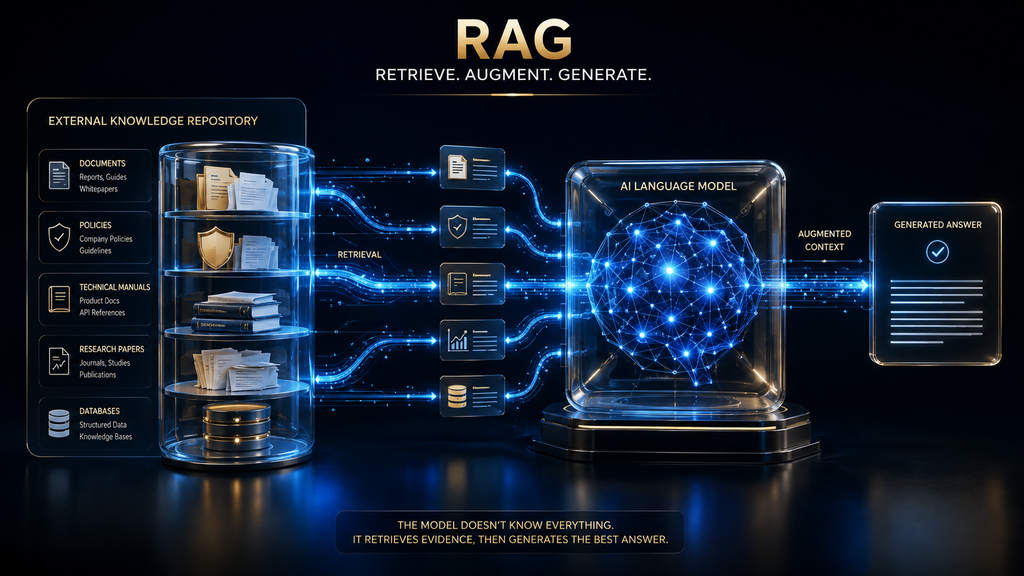
Retrieval-Augmented Generation (RAG) solves this problem by connecting a language model to an external knowledge source and retrieving relevant information at the moment it is needed. Instead of expecting the model to contain every piece of knowledge inside its parameters, a RAG application searches a separate collection of information, selects useful evidence, and provides that evidence to the model as context before generating the answer. AWS describes this architecture as a way of augmenting an LLM with external data such as internal documents, while Microsoft’s current RAG guidance treats retrieval and generation as separate stages that should be evaluated independently.
That basic idea is simple. Building a RAG system that works reliably is not.
The difficult part is rarely the final API call to the language model. The harder questions appear earlier: How should documents be prepared? How should they be divided? How can the system find the right passage when the user’s wording differs from the source? How should outdated documents be handled? What happens when several documents are relevant but only one is authoritative? How do permissions affect retrieval? And how do you determine whether a bad answer was caused by poor retrieval or by the model misinterpreting good evidence?
Those questions are what turn RAG from a simple AI demo into an actual information system.
This guide explains RAG from that broader perspective. It covers what RAG is, why organizations use it, how the architecture works from document ingestion through generation, where vector databases and embeddings fit, why retrieval quality matters, common failure modes, production considerations, major use cases, evaluation, economics, and the situations where RAG is—and is not—the right architecture.
What Is Retrieval-Augmented Generation?
Retrieval-Augmented Generation is an AI architecture that retrieves relevant information from an external knowledge source and supplies that information to a language model as context before the model generates its response.
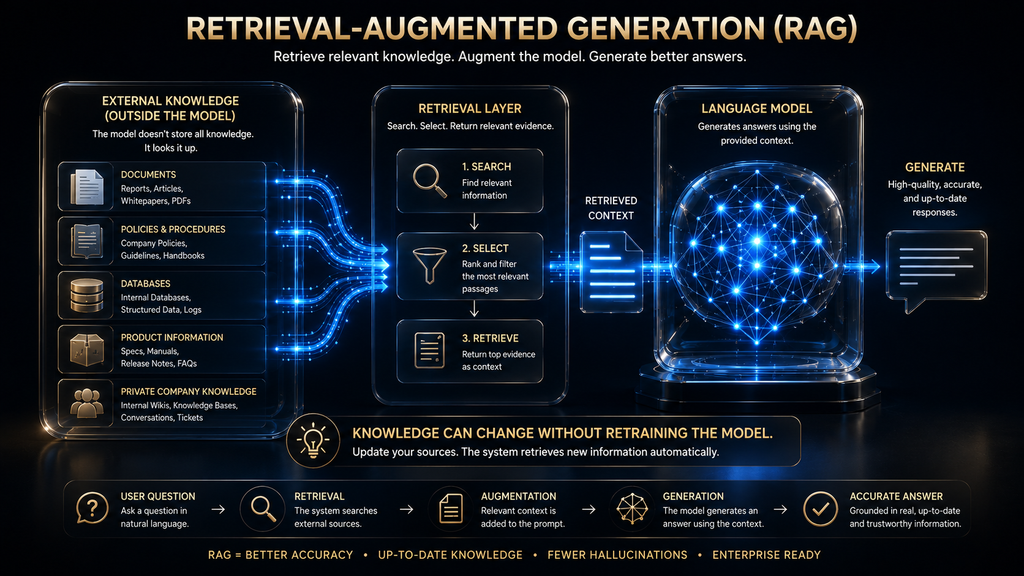
The key word is external. The model is not being retrained every time a document changes. Instead, the application maintains a separate knowledge layer that can be updated independently and searched when a user asks a question.
Imagine an employee asking an internal assistant, “What is our current parental leave policy for employees in Bangladesh?” A conventional language model might know generally about parental leave, but it has no reason to know the company’s current internal policy. A RAG system can search the organization’s authorized policy documents, retrieve the relevant section, and provide it to the model. The model then turns that evidence into a natural-language response.
This separation between the model and the external knowledge source is the architectural advantage of RAG. The language model remains responsible for understanding and generating language, while the retrieval layer gives it access to information that can be maintained outside the model itself. AWS’s production RAG guidance similarly describes the pattern as retrieving external or custom data and passing relevant context to a foundation model before generation.
It is important, however, not to turn that explanation into a promise that RAG automatically prevents hallucinations. RAG can improve grounding, but the final answer still depends on the quality of the source documents, the retrieval process, the context supplied to the model, and the model’s ability to interpret that context correctly.
That distinction is central to understanding the technology.
Why Do AI Applications Need RAG?
The strongest reason to use RAG is that knowledge and model behavior do not have to live in the same place.
A language model’s parameters contain information learned during training, but an organization’s current knowledge base is a different thing. Internal policies, product documentation, customer-support material, research files, technical manuals, and business procedures may change much faster than a model can reasonably be retrained. Even when the information existed publicly before training, there is no guarantee that the model will recall the exact version required for a particular application.
RAG introduces an external knowledge layer that can be updated without changing the underlying model. A company can add a new document, replace an obsolete version, remove information that should no longer be available, or reorganize its knowledge base while keeping the language-generation component largely unchanged.
That makes RAG particularly attractive for applications dealing with private, specialized, large, or frequently changing information. It is also useful when users need answers that can be connected back to source material rather than answers that exist only as model-generated prose.
The architecture therefore addresses a practical information problem rather than simply a model-capability problem.
How RAG Works: From Documents to Answers
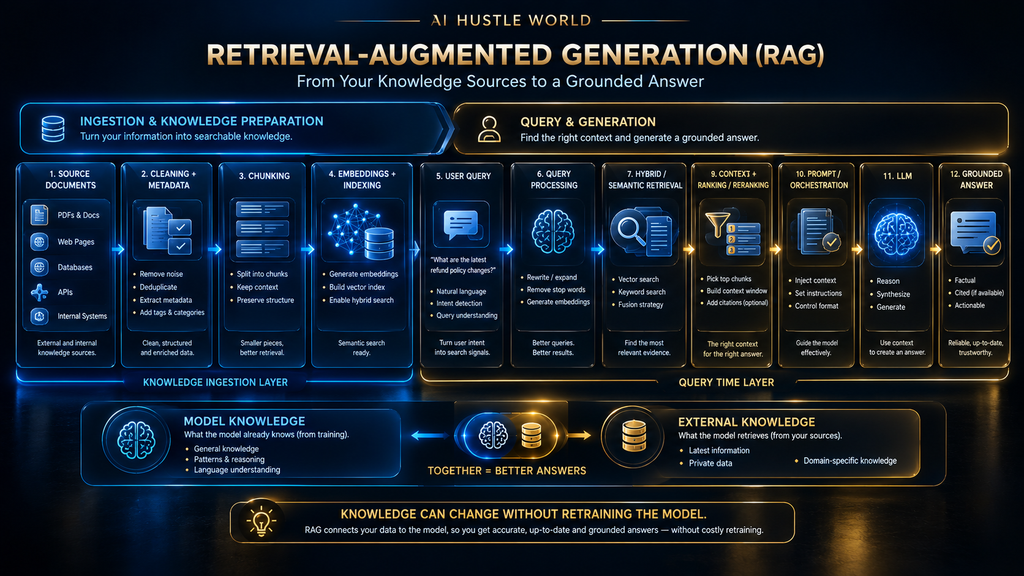
A useful RAG architecture has two major sides.
The first is the knowledge preparation pipeline, which happens before users begin asking questions. Documents are collected, processed, divided into useful pieces, represented for search, and indexed.
The second is the query-time pipeline, which begins when a user asks something. The application interprets the query, retrieves candidate information, applies filtering and ranking, constructs the context, and sends that context to the language model.
Keeping these two sides separate is important because many RAG failures begin before a user ever submits a query. If the underlying documents were badly extracted or poorly chunked, even an excellent retrieval algorithm may struggle to find the right evidence later.
AWS’s current RAG guidance describes a similar production flow involving document ingestion, embeddings, vector indexing, retrieval, ranking, orchestration, generation, guardrails, and access management.
1. Collect the Knowledge Sources
Every RAG system starts with information that the application needs to make available to the model.
That information might come from PDFs, Word documents, product manuals, help-center articles, internal wikis, websites, databases, support records, research papers, spreadsheets, or a combination of sources. The more heterogeneous the source collection becomes, the more important document processing becomes because different formats carry information in different ways.
A clean text document is relatively easy to process. A scanned contract with tables, footnotes, headers, signatures, and multiple versions is much harder. A product manual may contain diagrams whose meaning depends on nearby captions. A policy document may contain an exception several paragraphs after the rule it modifies.
The retrieval system cannot recover context that the ingestion process destroyed.
That is why RAG quality begins earlier than most people expect. Before worrying about embeddings, vector databases, or LLM prompts, the system has to answer a basic question: Did we preserve the information correctly when we brought it into the knowledge system?
2. Clean the Documents and Preserve Metadata
Raw documents are rarely ready for retrieval immediately. The ingestion process may need to remove irrelevant formatting, extract meaningful text, identify headings, preserve tables where possible, remove duplicate material, and retain metadata such as document title, source, date, version, department, product, region, and access permissions. Metadata becomes especially important when similar information exists in multiple versions.
Imagine a company has three versions of a remote-work policy. All three documents contain the words “remote work,” and all three may be semantically relevant to a user’s question. But only one is current. Without document dates or version metadata, a retrieval system may have difficulty distinguishing the authoritative document from an obsolete one.
The same problem appears in technical documentation. A troubleshooting instruction for Product Version 4 may look highly relevant to a question about Product Version 5 even though the underlying procedure has changed.
This is why retrieval should not be thought of as a pure similarity problem. The most similar document is not always the correct document. Authority, freshness, applicability, and permissions can matter just as much as semantic relevance.
3. Chunk Documents for Retrieval
Large documents usually need to be divided into smaller pieces called chunks before they can be retrieved effectively. The reason is straightforward: retrieval works better when it can identify a specific section that answers a question instead of returning an entire 300-page document. But chunking is not simply a matter of cutting text every fixed number of characters.
Suppose a policy document explains an eligibility rule in one paragraph and describes an important exception in the next. If the chunking process separates those two paragraphs, retrieval may return the rule without the exception. The resulting answer could therefore be technically based on the source while still being materially wrong.
The opposite problem is also possible. If chunks are excessively large, each retrieved result may contain large amounts of unrelated material, making it harder for the retrieval system and the language model to focus on the information that actually matters.
Good chunking therefore tries to preserve semantic completeness. A chunk should contain enough surrounding information to remain understandable when retrieved independently, while still being focused enough to match relevant queries precisely.
Chunking is important enough to deserve its own guide, How to Chunk Documents for RAG: Strategies for Better Retrieval, which is intentionally separate from this overview. That guide goes much deeper into fixed-size chunking, semantic boundaries, overlap, document structure, and chunk evaluation without forcing this guide to duplicate it.
4. Create Embeddings and Build the Search Index
Once documents have been divided into useful chunks, many RAG systems create embeddings for those chunks.
An embedding converts text into a numerical representation that captures aspects of its semantic meaning. The resulting vectors can then be compared with a vector representation of a user’s query.
This enables semantic search. For example, a document might say:
Employees may work remotely for up to three days per week.
A user could ask:
How many days can I work from home?
The two sentences do not share exactly the same wording, but their meaning is closely related. Semantic retrieval can identify that relationship even without an exact keyword match.
The embeddings themselves are not the answer. They are representations that make similarity-based retrieval possible.
Those representations are typically stored in an index or vector database together with the associated text and metadata. AWS describes the vector database in a RAG architecture as an index containing embeddings, associated text, and metadata that is optimized for search and retrieval.
This is where vector databases become important—but it is also where people often make a conceptual mistake. A vector database is a component of RAG, not RAG itself.
A RAG system still needs document processing, chunking, retrieval logic, ranking, context construction, generation, evaluation, and governance. Our guide Vector Databases Explained: How Semantic Search Stores and Retrieves Knowledge can therefore focus specifically on the database and indexing layer without duplicating the full RAG architecture.
5. The User Submits a Query
Once the knowledge base has been prepared, the system can handle user questions. Imagine the user asks:
“What are the current remote-work rules for employees working with international teams?”
That question contains several pieces of information. The system needs to identify the central subject, recognize relevant terminology, and potentially account for organizational or geographic context.
In simple applications, the original query may be sent directly to the retrieval system. More sophisticated systems may rewrite the query, expand it with related terms, generate alternative formulations, apply filters, or break a complex question into multiple retrieval tasks.
This is especially useful when the wording of the question differs substantially from the wording used in the source documents. A user might ask about “working from home,” while the documentation consistently uses “remote work.” A strong retrieval system needs to bridge that vocabulary gap.
6. Retrieve Candidate Information
The retrieval layer now searches the knowledge base for information that could answer the question. A basic semantic search system compares the query representation with stored document representations and returns the most similar candidates. The challenge is deciding how many candidates to retrieve.
If the system retrieves too few results, it may miss the passage containing the actual answer. If it retrieves too many, it may introduce irrelevant or contradictory information into the later stages of the pipeline.
This is the classic tension between recall and precision.
High recall means the system is good at finding relevant information, while high precision means the information it retrieves is mostly relevant. A practical RAG system needs both, because retrieving the right answer somewhere in a huge collection of irrelevant passages is not particularly useful.
Microsoft’s current RAG retrieval guidance recommends evaluating retrieval using established measures such as Precision@K, Recall@K, and Mean Reciprocal Rank. Precision@K examines the proportion of relevant results among the top results, Recall@K examines how much of the relevant material was retrieved, and MRR focuses on how highly the first relevant result appears.
7. Filter and Rank the Results
Similarity search is rarely enough on its own.
Suppose a knowledge base contains product documentation from five versions of the same product. A semantic search might identify several highly similar passages, but the application may need to restrict results to the version the user is actually asking about.
Metadata filtering can handle this kind of requirement.
The same principle applies to dates, regions, departments, document status, customer accounts, and access permissions. A retrieval result can be semantically relevant while still being inappropriate for the user’s situation.
After filtering, the system may rank or rerank the remaining candidates. A reranker can apply a more detailed relevance assessment to the candidate passages, helping the system determine which results deserve priority before they are passed to the model.
This matters because the highest-scoring embedding match is not necessarily the best evidence. Retrieval is ultimately trying to answer a more useful question than “Which text is mathematically similar?”
It is trying to answer: “Which available evidence is most appropriate for this user’s question?”
8. Select the Context
The retrieval system may have found several useful passages, but the language model does not necessarily need all of them. Context selection determines which retrieved material should actually reach the model. This is an important stage because more context is not automatically better context.
Suppose the system retrieves the current policy, an old policy, an HR FAQ, and several documents discussing related benefits. Giving the model everything may appear safer because “more information” sounds like a stronger grounding strategy. In practice, irrelevant or conflicting material can make the model’s task harder.
A better system selects the evidence that is both relevant and sufficient. The final context may contain the selected passages along with source names, document dates, identifiers, metadata, instructions, and other information that helps the model understand what it is seeing.
This is one of the places where good RAG engineering resembles good research: the objective is not to collect the largest possible pile of information. It is to assemble the smallest useful body of evidence that can support the answer.
9. The Prompt and Orchestration Layer
The retrieved context is then combined with the user’s question and the instructions that govern how the model should use the evidence. This layer is often called the orchestration or prompt layer. Its responsibilities can include deciding which retrieval method to use, assembling the final context, instructing the model to stay grounded in the provided material, handling conversation history, applying business rules, and determining how citations or source references should be presented.
For straightforward RAG, this layer can be relatively simple. For complex applications, it may coordinate multiple retrieval operations, different knowledge sources, database queries, authorization checks, or tool calls before the language model receives the final context. The important point is that orchestration is not merely “writing a good prompt.” It controls how the pieces of the system interact.
10. The Language Model Generates the Answer
Only after the relevant evidence has been retrieved and assembled does the language model generate the response.
The model receives the user’s question, the selected context, and the instructions governing how that context should be used. It can then summarize the material, explain it, compare information across sources, or answer the user’s question in a natural format.
This is where the generative capability of the LLM becomes especially valuable.
The user does not necessarily want a raw document excerpt. They want an explanation.
RAG allows the application to combine the model’s language capabilities with information that exists outside the model itself. But this is also where an important misconception needs to be addressed: the model can still make mistakes even when retrieval worked correctly.
A retrieved passage might contain an exception that the model overlooks. Two passages may contain related information that the model incorrectly combines. Or the model may make an inference that sounds reasonable but is not actually supported by the evidence.
This is why RAG has to be evaluated as a complete pipeline.
The Complete RAG Architecture
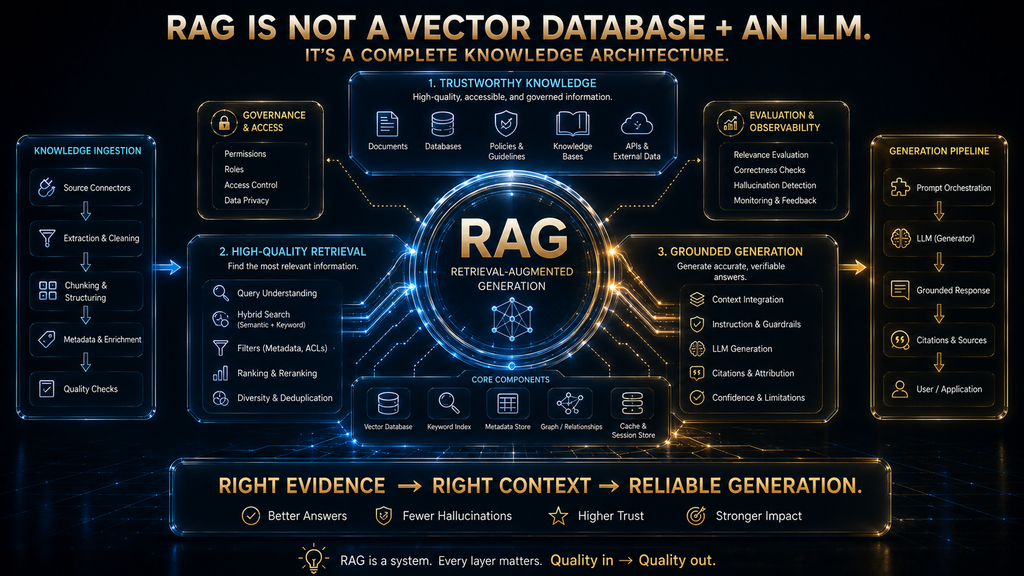
At a high level, the architecture can be understood as two connected pipelines. The offline or ingestion side takes source information, processes it, preserves metadata, chunks the content, creates searchable representations, and builds the index.
The online or query side takes a user’s question, processes the query, retrieves candidate evidence, applies filters and ranking, constructs the context, and sends the result to the language model for generation. Surrounding both sides are production concerns such as access control, monitoring, evaluation, freshness, cost management, security, logging, and failure handling.
That broader view is more useful than the simplified “database → LLM” diagram often used to introduce RAG. Production guidance from AWS similarly includes retrieval, vector indexing, orchestration, guardrails, user management, and other operational components around the foundation model.
The central lesson is that RAG is an application architecture, not a single technology.
Why Retrieval Quality Matters More Than Many Teams Expect
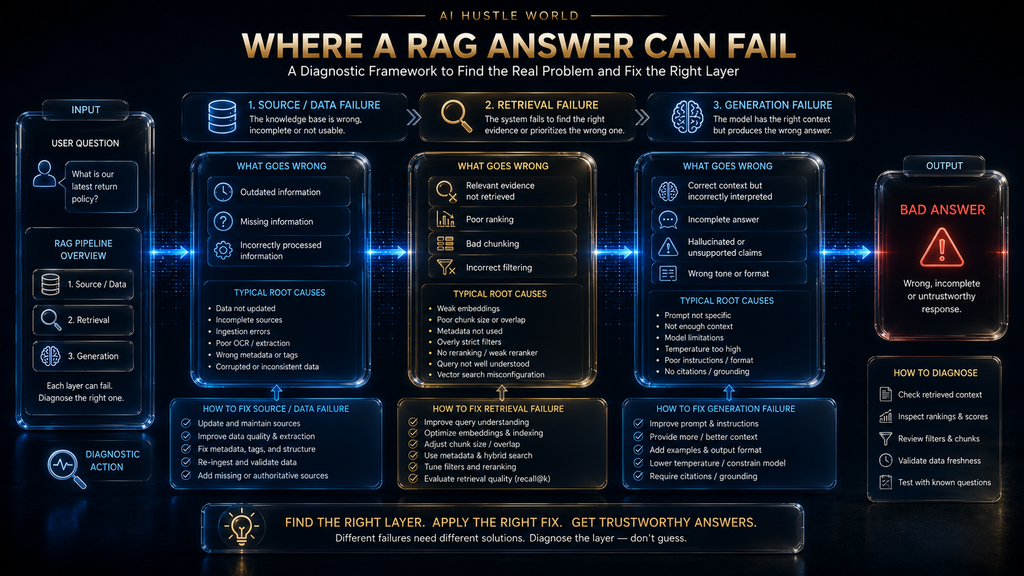
The quality of the final answer is constrained by the quality of the evidence available to the model. If the relevant document exists but the retrieval system does not find it, the model cannot reliably use it. This creates a fundamental distinction between retrieval failure and generation failure.
Imagine that a company’s current travel policy clearly states that employees can claim a particular expense. If the retrieval system returns an unrelated section about business travel, the model may generate a fluent answer that misses the relevant rule. The problem occurred before generation.
Now imagine that the correct paragraph is retrieved and placed clearly in the context, but the model interprets the rule incorrectly. The retrieval system worked, but generation failed.
These problems require different fixes.
A retrieval failure may require better chunking, improved search, query rewriting, metadata filters, better embeddings, or reranking. A generation failure may require changes to context formatting, instructions, model choice, or the way the application handles ambiguity.
Microsoft’s current evaluation guidance explicitly separates retrieval evaluation from system-level evaluation such as groundedness, relevance, and response completeness. That distinction is one of the most important ideas in production RAG.
Why More Context Is Not Always Better
A common reaction to poor retrieval is to retrieve more documents.
Sometimes that helps. Often, it only moves the problem.
If the correct passage is not appearing in the top five results, increasing the retrieval window to twenty may eventually surface it. But now the model has nineteen additional opportunities to encounter irrelevant, redundant, or conflicting information.
This creates a context-quality problem.
Consider a customer-support assistant that retrieves five documents about a product. One describes the current version, two describe older versions, one is a general troubleshooting guide, and another describes a related product. All five may contain similar language. Giving the model every passage does not necessarily make the answer safer.
The goal is not to maximize the amount of retrieved text. The goal is to maximize the usefulness of the evidence that reaches the model.
This is one reason chunking, ranking, metadata, and context selection matter so much. Each stage helps reduce the distance between “information that looks relevant” and “information that actually supports the answer.”
Standard RAG vs Advanced RAG vs Agentic RAG
Not every application needs the same level of retrieval complexity.
Standard RAG
A standard RAG pipeline typically follows a relatively predictable process: the user asks a question, the system searches the knowledge base, retrieves relevant content, places it into the prompt, and generates a response. This architecture is often enough for straightforward documentation assistants, internal knowledge bases, and question-answering systems.
Its main advantage is simplicity. A simpler architecture is usually easier to debug, evaluate, operate, and explain.
That matters because complexity has a cost. Adding more components does not automatically produce a better system.
Advanced RAG
Advanced RAG techniques are introduced when a basic retrieval pipeline has identifiable weaknesses. The system might combine semantic search with keyword search, rewrite queries, apply metadata filters, rerank candidates, compress context, or perform multiple retrieval operations.
Hybrid retrieval can be especially useful when exact terminology matters. Semantic search is good at understanding conceptual similarity, but exact names, product identifiers, codes, or technical terms can sometimes benefit from traditional keyword retrieval as well.
Reranking can help when the initial retrieval stage produces a reasonable candidate set but does not order the results well enough.
The principle should be problem-driven complexity. If a simpler retrieval strategy performs well on the application’s evaluation set, adding five more retrieval mechanisms is difficult to justify.
Agentic RAG
Agentic RAG takes the architecture further by allowing an AI system to decide how retrieval should happen rather than following one fixed sequence.
A complex research question may require several searches. One source may need to be consulted first so that the result can determine the next query. A question may need to be decomposed into multiple subquestions before the system can assemble a reliable answer.
Agentic retrieval can support those situations by allowing the system to plan and adapt its search process. The trade-off is complexity.
More dynamic behavior means more possible failure points, additional latency, more difficult evaluation, and potentially higher costs. For a simple company FAQ, that may be unnecessary. For a research assistant operating across multiple knowledge sources, it may be justified.
The right architecture is therefore determined by the difficulty of the information problem, not by how advanced the technology sounds.
RAG Use Cases
RAG is particularly useful when an AI application needs access to information that is private, specialized, extensive, or frequently updated.
Internal Knowledge Assistants
Organizations accumulate enormous amounts of information across policies, procedures, training documents, internal wikis, product documentation, and operational guides. Employees often know that an answer exists somewhere but do not know where to find it.
A RAG assistant can provide a natural-language interface to that information, allowing employees to ask questions instead of manually searching through multiple repositories. The strongest implementations also preserve source information so users can inspect the underlying documentation when the answer matters.
Customer Support
Customer support is a natural RAG use case because support information changes constantly.
Products receive new versions. Troubleshooting procedures change. Policies are updated. New frequently asked questions appear.
A RAG-based assistant can retrieve the relevant support material before generating a response, giving the model access to information that is maintained by the organization rather than relying solely on general model knowledge.
However, customer support also demonstrates why retrieval quality matters. Retrieving the wrong product version can produce an answer that sounds authoritative while being operationally useless.
Technical Documentation
Developers often work across large collections of reference material, API documentation, release notes, configuration guides, troubleshooting instructions, and implementation examples. A RAG system can search those sources and transform the relevant material into an explanation that is easier to consume. The architecture becomes especially useful when documentation is large enough that manually finding the right section takes longer than understanding the answer itself.
Research and Knowledge Discovery
Research environments can contain hundreds or thousands of papers, reports, transcripts, datasets, or internal documents. RAG can help researchers locate relevant passages and synthesize information across sources.
The important limitation is that generated synthesis should not replace source inspection when the underlying claim is important. A useful research assistant should help the researcher move from question to evidence to synthesis rather than encouraging the user to treat generated prose as unquestionable fact.
Policy and Compliance Information
Policy systems often contain rules that depend on region, employee category, effective date, business unit, or other conditions. That makes them a good example of why retrieval requires more than semantic similarity.
The system needs to determine not just whether a passage discusses the subject but whether that passage is applicable to the user’s circumstances and current enough to be authoritative. Access control is also critical because some policy or compliance information may be restricted to specific users or departments.
Product and Knowledge Bases
Companies with large product catalogs or technical ecosystems can use RAG to create assistants that understand product documentation without requiring every document to be encoded directly into the model. The knowledge base can be updated as products change, while the language model remains responsible for interpreting and explaining the retrieved material. This is one of the clearest examples of why separating knowledge from model behavior can be operationally useful.
RAG and Security
A RAG system that can retrieve internal information is also an information-access system. That creates a security problem that cannot be treated as an afterthought.
Imagine a company with a knowledge base containing HR policies, customer records, internal financial documents, and engineering documentation. A user asks a question that is semantically related to all four categories, but the user is authorized to access only one.
A naive retrieval system could return confidential information simply because it is relevant. This is why permissions and identity need to influence retrieval. AWS’s RAG guidance explicitly identifies identity and user management as important components of production systems and notes that access needs to be controlled at a fine-grained level.
Security also extends to document freshness and lifecycle management. If an employee should no longer have access to a document, removing the document from the source repository may not be enough if an outdated copy remains searchable inside the retrieval index.
That means RAG governance has to cover the entire information lifecycle, not just the final model response.
RAG and Data Freshness
One of RAG’s major advantages is the ability to update external knowledge without retraining the model. But that advantage only exists if the retrieval system actually reflects those updates.
Suppose a company changes its refund policy on Monday. The new document is uploaded to the source repository, but the retrieval index still contains only the old version. The model will continue receiving outdated information.
From the user’s perspective, the AI is wrong. From the model’s perspective, however, it may simply be following the evidence it was given.
This is why document synchronization, indexing schedules, version control, deletion handling, and freshness metadata become operational concerns in production RAG. The knowledge layer must be treated as a living system.
Why RAG Can Still Hallucinate
RAG is sometimes described as a solution to hallucinations, but that description is too simplistic. A RAG system can still generate an unsupported answer if the retrieval process fails, if the source is incorrect, if conflicting information is supplied, or if the model misinterprets the evidence. Consider three situations.
In the first, the correct source exists but is never retrieved. The model has no reliable evidence to use.
In the second, the wrong source is retrieved because an outdated document is more similar to the query than the current document. In the third, the correct source is retrieved, but the model draws a conclusion that the source does not actually support. These are different problems, and they require different solutions.
This is why a strong RAG system should be evaluated at both the retrieval layer and the generation layer rather than treating every bad answer as a generic hallucination problem. Microsoft’s current evaluation framework explicitly separates retrieval quality from groundedness, relevance, and response completeness, reinforcing this distinction.
How to Evaluate a RAG System
A RAG system should be evaluated as a pipeline rather than judged solely by whether the final answer “sounds right.” The first question is whether the system retrieved the information it needed.
The second is whether the final response accurately used that information. That distinction produces two broad categories of evaluation.
Retrieval evaluation
Retrieval metrics help determine whether the correct information appears in the results.
Precision@K, Recall@K, and Mean Reciprocal Rank are common measures. Precision@K focuses on the proportion of relevant results among the retrieved results, Recall@K examines whether relevant material was successfully found, and MRR considers the position of the first relevant result.
Generation evaluation
The final response needs its own evaluation. Relevant dimensions include groundedness, relevance, correctness, and completeness.
Groundedness asks whether the response stays supported by the retrieved context. Relevance asks whether it actually answers the user’s question. Completeness examines whether important parts of the expected answer were omitted.
Microsoft’s current RAG evaluation guidance explicitly treats groundedness, relevance, and response completeness as separate evaluation dimensions because a response can succeed on one dimension while failing on another. That is a much more useful approach than giving a RAG system one vague “accuracy score.”
Why RAG Evaluation Must Continue After Launch
A RAG system can deteriorate even when nobody changes the application code.
The knowledge base changes as documents are added, replaced, corrected, or removed. Users change the way they ask questions. Products evolve, policies are rewritten, and the distribution of queries changes as the application becomes more widely adopted.
Even the model or retrieval configuration may eventually change.
A benchmark that looked excellent during development therefore cannot guarantee that the system will behave equally well six months later. Microsoft’s RAG evaluation guidance specifically notes that document collections and user questions change over time and recommends revisiting evaluation continuously rather than treating it as a one-time activity.
This is particularly important for business-critical applications. A retrieval system may perform well on the questions used during development while quietly deteriorating on the questions real users ask in production.
A good evaluation program should therefore include a representative test set, retrieval measurements, response-quality measurements, failure analysis, and periodic re-evaluation as the underlying knowledge and query distribution evolve.
The Economics of a RAG System
RAG can reduce the need to retrain a model whenever external information changes, but it introduces its own infrastructure and operating costs.
Documents have to be collected, processed, cleaned, chunked, and indexed. Embeddings may need to be generated and regenerated when documents change. Search indexes and metadata have to be maintained, storage is required, and query-time retrieval can involve ranking or reranking before the final context reaches the model.
There are also operational costs beyond the retrieval pipeline itself. A production RAG application may require monitoring, evaluation, access controls, logging, testing, security reviews, and ongoing maintenance. Latency can increase because the system may perform several retrieval and processing operations before the language model generates the response, whereas a direct LLM interaction may require fewer steps.
That does not make RAG inefficient. It means that RAG should be evaluated as an information infrastructure investment rather than as a free add-on to an LLM. For an application that depends on current private or specialized knowledge, those additional costs may be justified because they provide a maintainable way to connect the model to external information. For a simple application that does not need such knowledge, the same infrastructure may be unnecessary.
RAG vs Fine-Tuning
RAG and fine-tuning are often discussed as though they are competing methods for teaching an AI system, but they solve different problems.
RAG primarily changes what information the model can access at inference time. Fine-tuning primarily changes how the model behaves.
Suppose a company wants an assistant to answer questions using its latest internal policies. RAG is a natural fit because the policies can remain in an external knowledge base and be updated independently.
Now suppose the company wants a model to consistently produce a particular structured output, follow a specialized task pattern, or adopt a particular style. Fine-tuning may be more appropriate because the core requirement concerns model behavior rather than access to changing information.
The two approaches can also work together. A specialized model can provide the desired behavior while RAG supplies current external knowledge.
The right decision depends on the problem being solved, not on which technology sounds more advanced.
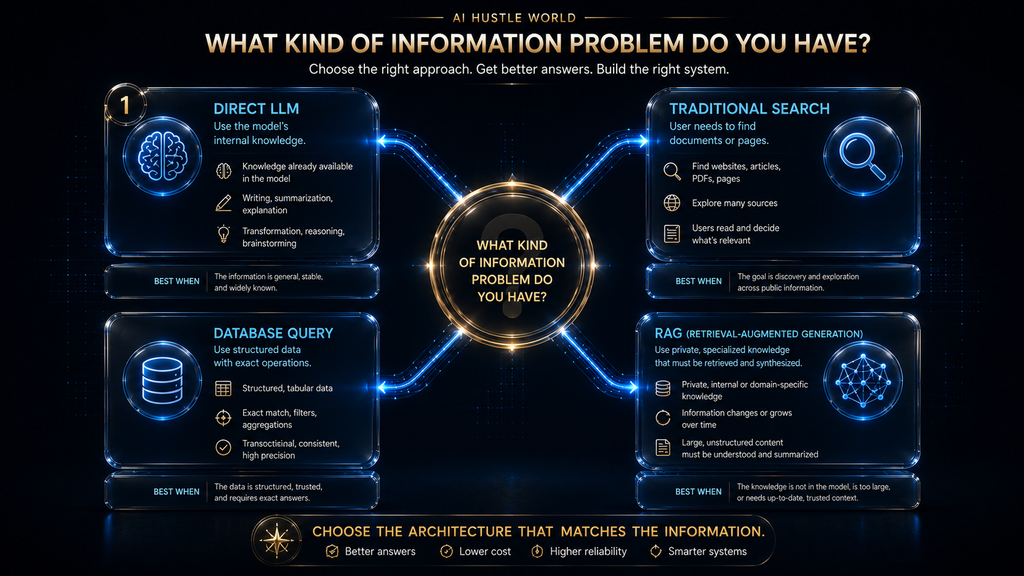
RAG vs Traditional Search
Traditional search and RAG are related, but they are designed around different user experiences. A search engine primarily helps the user find information. A RAG application retrieves information and then allows a language model to interpret and synthesize that information into an answer.
If someone wants to locate the official documentation for a specific API endpoint, traditional search may be sufficient. If they want to ask, “What changed between the authentication requirements in versions 3 and 4, and what does that mean for an existing implementation?” a retrieval-plus-generation architecture can provide a more useful experience.
The two approaches can also be combined.
A RAG system does not have to replace traditional search. Keyword search, semantic search, metadata filtering, and generation can all contribute to the same application.
RAG vs Database Queries
RAG is also not a replacement for structured databases. If someone asks, “How many orders were completed yesterday?” and the answer exists in a transactional database, the application should generally retrieve that number directly rather than asking a semantic search system to infer it from documents. RAG is more useful when the information is unstructured or semi-structured and the application needs to retrieve passages and synthesize them.
In a sophisticated business assistant, both systems may coexist. A database can provide exact numerical values, while RAG can retrieve the policies, explanations, and documentation needed to interpret those numbers.
The architecture should follow the nature of the information.
When Should You Use RAG?
RAG is a strong candidate when the application needs information that is private, specialized, frequently updated, large enough to be difficult to search manually, or important enough that users need access to supporting evidence. It is particularly useful when the knowledge can be maintained independently from the model and when the application benefits from natural-language interaction with that knowledge. But those conditions do not mean RAG is automatically the correct solution.
The first question should be whether the application actually has a knowledge-retrieval problem. If the task can be solved reliably with a database query, an API, traditional search, or direct model prompting, RAG may simply add complexity without enough benefit to justify it.
When RAG Is Not the Right Choice
RAG is not a universal architecture. If an application does not require external knowledge, retrieval adds infrastructure without solving a real problem. If the information is highly structured and can be retrieved exactly through a database, a direct query may be more reliable.
If the central challenge is model behavior, formatting, or specialized task performance, fine-tuning may be more appropriate. If the application needs broad real-time web discovery, a search-oriented architecture may be better.
And if the underlying knowledge base is unreliable, RAG will not magically make it trustworthy. It can actually make unreliable information easier for a language model to present convincingly.
That leads to a useful decision rule:
Do not adopt RAG because every modern AI application seems to use it. Adopt it when retrieval is genuinely the missing capability.
Common RAG Mistakes
Treating a Vector Database as the Whole RAG System
A vector database provides storage and retrieval capabilities, but it does not solve ingestion, chunking, query processing, ranking, context construction, generation, evaluation, or governance.
Using Arbitrary Chunk Sizes
Fixed-size chunks may be convenient, but document meaning does not always align with character or token boundaries. Important relationships can be lost when related content is separated.
Ignoring Metadata
Semantic similarity alone cannot reliably distinguish document versions, regions, effective dates, product variants, or user permissions.
Retrieving Too Much Context
More retrieved material can increase noise and make it harder for the model to identify the evidence that matters.
Assuming a Better LLM Fixes Bad Retrieval
If the correct evidence never reaches the model, switching to a more capable model may not solve the root problem.
Ignoring Document Freshness
A stale index can produce stale answers even if the model and retrieval code are functioning correctly.
Evaluating Only the Final Answer
Without separate retrieval and generation evaluation, it is difficult to determine where a failure occurred.
Adding Complexity Without Evidence
Hybrid search, reranking, query decomposition, and agentic retrieval can all be useful. None should be added simply because they sound sophisticated.
A Practical RAG Troubleshooting Framework
When a RAG system produces a poor answer, the most effective approach is to trace the failure backward through the information pipeline.
Start with the source. Was the correct information actually available? If not, retrieval cannot solve the problem.
If the information was available, inspect ingestion. Was the document extracted and cleaned correctly? Important tables, headings, relationships, or metadata may have been lost.
Then examine chunking. Was the relevant information stored in a useful retrieval unit? A poorly constructed chunk can make an otherwise correct document difficult to retrieve.
Next examine retrieval. Did the system actually return the relevant passage? If not, investigate the query representation, embeddings, search strategy, filters, ranking, and retrieval parameters.
If the correct passage was retrieved, inspect context construction. Did the model actually receive the useful evidence, or was it buried among irrelevant material?
Only after those stages should the investigation focus primarily on generation. Did the model correctly interpret the evidence it was given?
This sequence prevents teams from automatically blaming the LLM for failures that actually originated in the data or retrieval pipeline.
What a Production RAG System Really Looks Like
A simplified diagram might show a user asking a question, a vector database returning documents, and an LLM generating the answer. That is useful as an introduction, but it is not a realistic description of a mature production system.
A production architecture usually begins with multiple knowledge sources. Those sources are processed and cleaned before being chunked and indexed. Metadata and permissions are preserved. Query processing determines how the user’s request should be searched. Retrieval produces candidates, filters remove inappropriate information, ranking determines priority, and context selection decides what the model should actually see.
The generation layer then produces the response, potentially with source references. Around all of this are systems for authentication, access control, monitoring, evaluation, logging, freshness management, cost control, and failure handling.
This is why the most useful mental model for RAG is not “an LLM connected to a database.” It is a knowledge system in which an LLM is responsible for interpreting and communicating retrieved information.
The Future of RAG
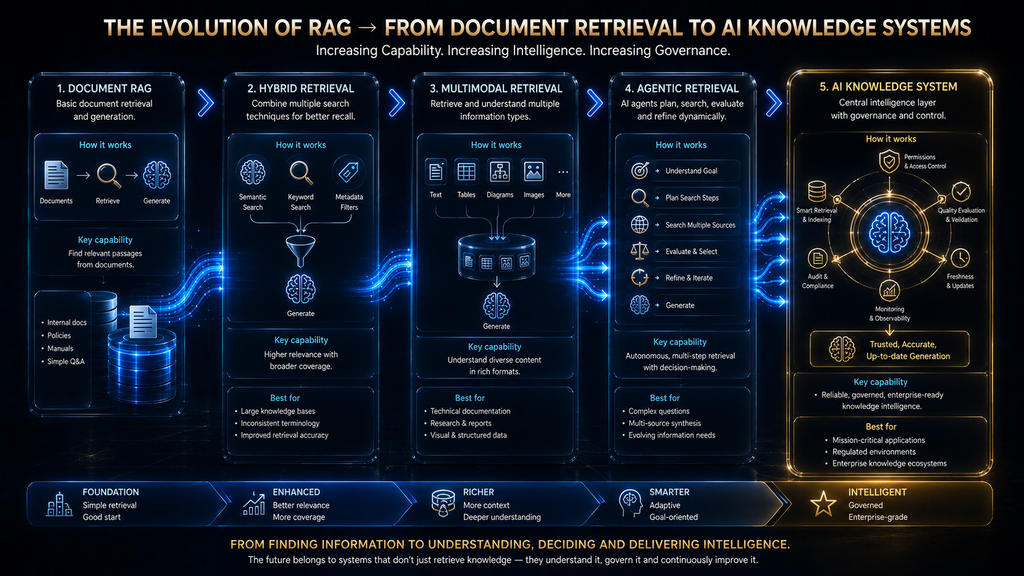
RAG is evolving from relatively simple document question answering into broader knowledge architectures.
Retrieval is becoming more sophisticated as systems combine semantic search with keyword search, metadata, reranking, query rewriting, and other methods. The objective is to improve the quality of the evidence before generation rather than simply making the language model larger.
Another important direction is dynamic retrieval. Agentic systems can decide when a question needs multiple searches, which source should be consulted, whether the first retrieval attempt was sufficient, and how several pieces of evidence should be combined.
Multimodal retrieval is also expanding the definition of a knowledge source. Important information may exist in diagrams, screenshots, tables, scanned documents, audio, video, or other formats rather than plain text alone.
This means future RAG systems will increasingly resemble broader AI knowledge systems rather than simple vector-search applications.
But the more capable these systems become, the more important evaluation and governance become. A system that can search more sources and perform more retrieval steps also has more opportunities to retrieve conflicting information, expose information that should remain restricted, or make an unsupported inference from several individually valid sources.
The future of RAG therefore should not be measured by how much information an AI can retrieve. It should be measured by how reliably the system can identify the right evidence, understand its context, respect its permissions, recognize uncertainty, and communicate what that evidence actually supports.
How to Decide Whether Your Application Needs RAG
Before building a RAG architecture, ask what problem the application is actually trying to solve. If the model already has the knowledge it needs and the task is primarily about reasoning, writing, classification, or transformation, adding retrieval may create unnecessary complexity. If the application needs private organizational information, constantly changing documentation, specialized domain knowledge, or a large body of external material, retrieval becomes much more compelling.
Then ask whether the user needs synthesis or simply discovery. If users need to find a document, search may be enough. If they need the system to compare several documents and explain the result, RAG may add substantial value.
Finally, ask whether the knowledge can be governed properly. A RAG system built on stale, contradictory, poorly indexed, or improperly permissioned information can produce answers that sound better while remaining unreliable.
The decision should therefore be based on the information architecture, not on AI fashion.
Final Thoughts
Retrieval-Augmented Generation is often reduced to a simple idea: retrieve some documents and give them to an LLM. That explanation is useful for understanding the concept, but it hides the part that determines whether a RAG application is actually reliable.
The quality of the final answer depends on a chain of decisions that begins long before the model generates a response. The source information has to be trustworthy and current. Documents need to be processed without losing important structure. Chunks need to preserve enough meaning to remain useful when retrieved independently. Search needs to find the right evidence rather than merely similar text. Metadata and permissions need to influence what can be retrieved. Ranking and context selection need to keep irrelevant information from overwhelming the useful evidence. And the final model response needs to be evaluated separately from the retrieval process.
That is why RAG should not be treated as a hallucination switch or as shorthand for “vector database plus LLM.” RAG is an information architecture for connecting generative AI to external knowledge.
Its strongest use cases appear when an application needs information that is private, specialized, large, frequently updated, or important enough to require source-aware answers. The architecture gives organizations a way to maintain that knowledge separately from the model while still allowing users to interact with it through natural language.
But RAG is not automatically the answer to every AI problem. A database query may be better for structured data. Traditional search may be better when the user simply needs to find a document. Fine-tuning may be more appropriate when the real problem is model behavior. And direct prompting may be all that is necessary when external knowledge is not involved.
The real decision is therefore much more practical: Does this application have a knowledge-retrieval problem that justifies building a retrieval architecture?
If the answer is yes, RAG provides a powerful bridge between an LLM and information that can evolve outside the model. If the answer is no, adding retrieval can create complexity without adding meaningful value.
The most important lesson is not that every AI application needs RAG. It is that a capable model is only as useful as the information it can reliably access when the task depends on knowledge outside the model itself.
Keep Building Your AI Knowledge
RAG is one way to adapt a model to your information; learn when fine-tuning is the better choice instead.
Compare RAG and Fine-Tuning →FAQ
What does RAG stand for?
RAG stands for Retrieval-Augmented Generation. It is an architecture that retrieves relevant information from an external knowledge source and provides that information to a language model as context before generating a response.
How does RAG work?
A RAG system first prepares external knowledge for retrieval by processing documents, creating searchable representations, and indexing the resulting information. When a user asks a question, the system retrieves relevant evidence, selects the appropriate context, and supplies it to the language model so the model can generate a response based on that information.
What is the main purpose of RAG?
The main purpose of RAG is to give a language model access to external information that may be private, specialized, large, or frequently updated without requiring the model itself to be retrained every time that information changes.
Is RAG the same as a vector database?
No. A vector database can be one component of a RAG architecture. A complete RAG system also involves data ingestion, document processing, chunking, retrieval, filtering, ranking, context construction, generation, evaluation, and often security and access control.
Does every RAG system require embeddings?
No. Embeddings are widely used for semantic retrieval, but RAG is an architectural pattern rather than a requirement to use one specific retrieval technology. Systems can combine semantic search, keyword search, metadata filtering, structured queries, and other retrieval methods.
Does RAG eliminate hallucinations?
No. RAG can improve grounding by giving the model relevant external evidence, but the system can still retrieve the wrong information, use outdated sources, or misinterpret correct evidence.
What is the difference between RAG and fine-tuning?
RAG primarily gives the model access to external information at inference time, while fine-tuning changes the model through additional training. RAG is particularly useful for changing or private knowledge, while fine-tuning is often used when the desired improvement concerns behavior, task performance, or output patterns.
What is agentic RAG?
Agentic RAG allows the system to make dynamic decisions about retrieval. It may determine which sources to search, whether additional retrieval is necessary, how to decompose a complex question, or how to combine evidence from multiple searches.
How should RAG be evaluated?
RAG should be evaluated at both the retrieval and generation levels. Retrieval can be measured with metrics such as Precision@K, Recall@K, and MRR, while generated responses can be evaluated for groundedness, relevance, correctness, and completeness.
Why can a RAG system give the wrong answer even when the correct document exists?
The correct document may exist but fail to appear in retrieval results, may be ranked too low, may be filtered out incorrectly, or may be supplied to the model alongside conflicting information. Even when the correct passage reaches the model, the model can still misunderstand it.
Is RAG always better than a normal LLM?
No. RAG introduces additional infrastructure, retrieval complexity, maintenance, evaluation, and potentially additional latency and cost. It is valuable when external knowledge is genuinely required, not simply because the application uses an LLM.
Written by
Muntasir Ahmad Chowdhury
Founder, AI Hustle World
Muntasir Ahmad Chowdhury is the Founder of AI Hustle World, an independent publication dedicated to making Artificial Intelligence practical, trustworthy, and easy to understand. He researches AI tools, automation, customer service, productivity, and real-world business applications, helping readers make smarter technology decisions through research-driven, experience-backed content.
Expertise:
AI Tools • AI Automation • AI Customer Service • AI Productivity • Generative AI • AI Workflows
Get Smarter With AI
Enjoyed this guide? Get practical AI tools, tutorials, and honest reviews delivered to your inbox.