Last Update: August 2026
How AI Models Understand Something You Never Explained?
You type: “Rewrite this email so it sounds confident but not arrogant.”
The AI doesn’t ask you what “this” means. It can usually identify the relevant text, infer what you mean by “confident but not arrogant,” preserve the important information and produce a revised version that sounds different from the original.
That feels like understanding.
But there is a catch.
The model doesn’t approach your sentence the same way you do. It doesn’t begin with a human-like mental dictionary, personal experience, emotions or an independent intention to communicate. Modern language models process language computationally: text is converted into tokens, those tokens are represented numerically, the representations are transformed using contextual relationships, and the model generates output by predicting likely next tokens. OpenAI describes LLMs in essentially these terms, emphasizing learned patterns and context-based prediction rather than human-style knowledge.
That doesn’t make the technology simple.
In fact, the interesting part is the opposite: a system trained to predict language can learn enough structure about language to produce behavior that looks remarkably like understanding.
This article explains how that happens, where the apparent understanding comes from, why context changes the model’s behavior, and where the analogy to human understanding breaks down.
The Short Answer: How Does AI Understand Language?
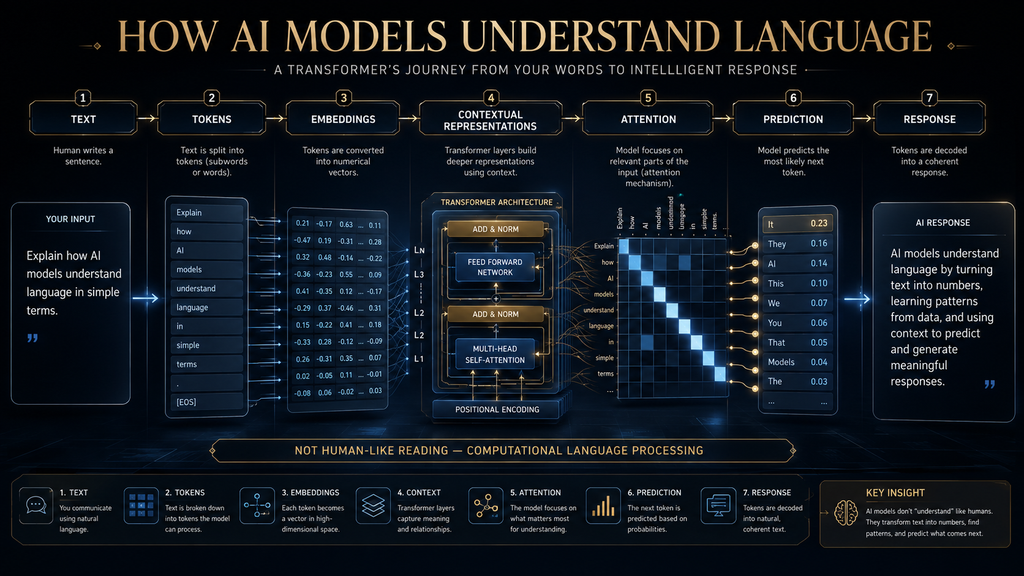
AI models process language by turning text into machine-readable representations, repeatedly transforming those representations using context, and predicting what language should come next.
A useful simplified pipeline is:
Text → Tokens → Embeddings → Contextual Representations → Attention/Transformation → Next-Token Probabilities → Output
That sequence is more accurate than saying:
“AI reads the words and understands their meaning.”
The model does not need a separate human-style interpretation stage before it can generate language. Instead, representations are progressively transformed as information from the surrounding context is incorporated.
That distinction is the foundation for understanding everything else in this article.
What Does “Understanding” Actually Mean in an AI Model?
When people say that an AI “understands language,” they usually mean that it can process language in a way that preserves useful relationships between words, phrases, instructions and context.
That is real capability.
But it is not necessarily human understanding.
A language model can distinguish the likely meaning of bank in “I deposited money at the bank” from “we walked along the river bank.” It can follow a multi-step instruction, preserve constraints in a rewrite and produce a coherent explanation. Those behaviors demonstrate that the model has learned useful representations and relationships from data.
What they do not establish by themselves is that the model experiences the world, forms intentions or understands language through human-like lived experience.
This is an important distinction because both extreme explanations are misleading. Saying “AI understands exactly like a human” overstates what the mechanism demonstrates. Saying “AI is only randomly guessing words” ignores the enormous amount of structure captured by modern neural networks.
A better description is:
Language models develop powerful computational representations of language that let them use context and learned relationships to produce highly capable language behavior.
Recent research into the mechanistic indicators of understanding in LLMs follows this middle ground: token representations evolve through transformer layers, incorporating contextual information before being converted into scores for possible next tokens.
Before LLMs: Why Did Computers Struggle With Human Language?
The difficulty becomes clearer if we look briefly at what came before modern language models.
Traditional software generally works best when humans translate a problem into explicit rules.
If a program needs to calculate payroll, for example, developers can define:
hours × rate = gross pay
and then specify the rules for taxes, deductions and other conditions.
Human language is much messier.
Consider:
“That meeting was interesting.”
Depending on context and tone, “interesting” could mean genuinely fascinating, mildly unusual, sarcastic or politely negative.
A programmer could create rules for some of those cases, but natural language contains too many variations to describe exhaustively with hand-written rules.
Earlier NLP systems therefore increasingly moved toward learning patterns from examples rather than manually specifying every linguistic rule. Modern LLMs push that idea much further by learning representations from enormous amounts of text.
The traditional method still matters, though. Rules are excellent when the correct behavior can be precisely defined. AI becomes more useful when the input is ambiguous, varied or difficult to encode manually.
That is why modern AI doesn’t eliminate traditional software logic. It changes where each approach is useful.
Step 1: Language Is Broken Into Tokens
Before a language model can process your sentence, the text has to be segmented into units called tokens.
A token is not necessarily a whole word. Depending on the tokenizer and language, it can represent a complete word, part of a word, punctuation or another text fragment. OpenAI’s current token documentation explicitly notes that tokens can range from a single character to a full word and that spaces and punctuation can also contribute to tokenization.
For example, a word such as:
understanding
might be represented as multiple pieces rather than one indivisible word.
The exact result depends on the tokenizer.
This matters because tokens are not meanings.
A token ID is essentially an identifier used by the model’s vocabulary. The number assigned to a token doesn’t mean that “4021” somehow contains the concept of the word it represents.
The model needs another stage to turn those discrete identifiers into useful numerical representations.
Step 2: Token IDs Become Numerical Representations
Neural networks operate on numbers, not strings of text.
So after tokenization, each token is associated with a numerical vector called an embedding.
Think of an embedding as a machine-usable representation of a token—not as a dictionary definition.
This distinction is important.
Suppose the model encounters:
dog
and:
cat
Their numerical representations can participate in learned relationships that help the network recognize patterns in how those concepts appear in language.
But the model does not have a simple internal entry saying:
DOG = furry animal that barks.
The information is distributed across learned parameters and representations.
IBM’s current explanation of LLMs describes tokens being mapped to vector embeddings and then transformed through successive transformer layers into richer contextual representations.
This gives us a useful distinction:
Token ID: identifies a token.
Embedding: gives the model a numerical representation it can operate on.
Hidden/contextual representation: the model’s progressively transformed representation of that token as the surrounding context is incorporated.
That third concept is where many beginner explanations become too shallow.
Step 3: The Representation Changes With Context
A token doesn’t have to carry exactly the same computational representation throughout the entire model.
Its representation can be transformed as the model processes the surrounding sequence.
Consider:
The dog barked loudly.
and:
The tree has rough bark.
The word bark appears in both sentences, but the surrounding language is different.
In the first sentence, nearby information connects bark with an animal and an action.
In the second, it connects bark with a physical part of a tree.
The model’s early representation provides a starting point. Transformer layers then repeatedly update representations using information from the sequence.
IBM describes these embeddings becoming richer contextual representations from layer to layer as the model processes the sequence.
This is a much better way to think about “meaning” inside a modern language model:
Meaning is not simply looked up from one fixed word definition. The model builds increasingly contextual representations as information flows through the network.
That is why context is not an optional feature of language understanding.
It is central to it.
Step 4: The Model Needs to Know Where Things Appear
There is another problem.
Language isn’t only about which tokens exist. It is also about their order and position.
Compare:
The dog chased the cat.
with:
The cat chased the dog.
The same important words appear in both sentences.
The relationship changes because their positions change.
Transformer architectures therefore need positional information alongside token representations. IBM’s explanation of positional encoding uses the same basic idea: without information about order, a transformer would struggle to distinguish sequences containing the same tokens in different arrangements.
Different modern architectures use different approaches to representing position, so it is better not to imply that every current model uses one identical positional-encoding method.
The beginner-level lesson is simpler:
A language model needs information about both the content of tokens and their position within the sequence.
Step 5: Self-Attention Lets Tokens Interact With Context
Now we reach the defining mechanism of the Transformer architecture.
The original 2017 Attention Is All You Need paper introduced the Transformer as an architecture based on attention rather than recurrent or convolutional sequence processing.
Self-attention allows the model to calculate relationships between token representations and use those relationships to update the information associated with each token.
Consider:
The judge issued a sentence after the verdict.
The word sentence can mean a grammatical sentence or a legal punishment.
But judge, issued and verdict strongly shift the interpretation toward the legal meaning.
IBM uses a similar example to explain how attention helps a transformer determine which surrounding tokens are more relevant when interpreting a token such as “sentence.”
At a technical level, attention uses learned query, key and value projections. Similarity between queries and keys is used to calculate attention weights, which determine how information from value vectors contributes to an updated representation.
You don’t need to memorize the equations to understand the core idea:
Self-attention allows the model to build contextual representations by relating different parts of the sequence to one another.
And this is one reason the Transformer was such a major architectural shift.
Attention Is Not Literally “Looking”
One common analogy says:
“The AI looks at the words it thinks are important.”
That is useful for a first introduction, but don’t take it literally.
The model does not consciously look at a word.
Attention is a mathematical operation over numerical representations.
The query, key and value vectors interact through learned transformations, producing weighted combinations that update the representations.
This distinction matters because attention maps are also easy to overinterpret. Research on transformer interpretability has shown that not every attention head cleanly corresponds to one human-readable linguistic function.
So “attention tells us exactly what the model is thinking” is not a defensible shortcut.
A better description is:
Attention is one mechanism through which information about different tokens is combined during representation processing.
The Hidden State: The Model’s Working Representation
There is another useful concept between embeddings and final prediction: the hidden state.
You can think of a hidden state as the model’s current numerical representation of information at a particular point in the network.
The important word is current.
It isn’t a permanent dictionary definition.
As the representation moves through transformer blocks, it is repeatedly transformed.
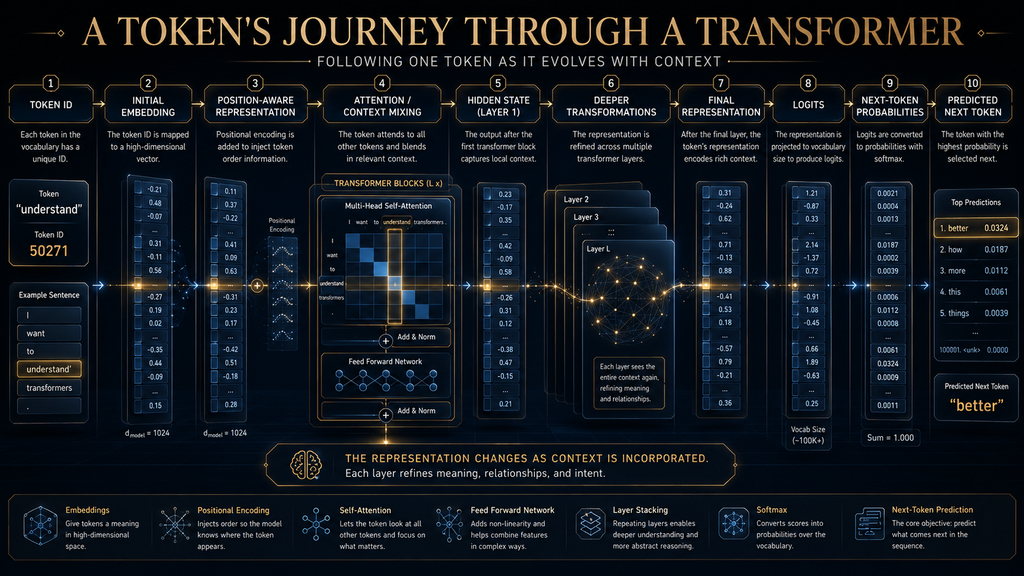
A simplified conceptual journey looks like:
Token ID
→ Initial embedding
→ Position-aware representation
→ Context mixing
→ Updated hidden state
→ Further transformation
→ Final representation
→ Output scores
Recent mechanistic research describes this as a token’s representation continuously evolving through the transformer until the final representation is used to produce logits for possible next tokens.
This gives beginners a much better mental model than saying:
“The AI turns words into numbers.”
It turns words into numbers and then repeatedly rewrites those numerical representations based on context and learned transformations.
What Happens Inside a Transformer Block?
A transformer isn’t just one giant attention calculation.
A simplified transformer block contains attention-related processing plus feed-forward neural-network transformations, with normalization and residual connections used as part of the architecture.
The exact details vary across model families, but the conceptual flow is:
Representations enter
→ attention mixes contextual information
→ feed-forward layers transform the information
→ residual pathways preserve and combine information
→ normalization stabilizes the computation
→ the updated representations move deeper into the network
This happens across many layers.
Each layer doesn’t simply repeat the exact same task. Different layers can transform representations in different ways, gradually producing a richer internal representation that can support the final prediction.
That is why saying:
“Attention understands the sentence.”
is incomplete.
Attention is one part of a much larger transformation process.
Step 6: The Model Turns Its Final Representation Into Probabilities
After the input has passed through the model’s layers, the final representation is converted into scores for possible next tokens.
These raw scores are commonly called logits.
A probability transformation then turns those scores into a distribution over possible tokens.
Imagine the model is processing:
After months of studying, she finally passed the…
Possible continuations could include:
- exam
- test
- course
- interview
The model doesn’t simply search a dictionary for the “correct” word.
It produces a probability distribution influenced by its learned parameters and the current context.
The next token is selected according to the model’s generation strategy.
Then that new token becomes part of the context for the next prediction.
And the process continues.
Step 7: Generation Is an Autoregressive Loop
This is where the response you see is actually constructed.
Suppose the model predicts:
exam
Now the sequence contains:
After months of studying, she finally passed the exam…
The model processes the relevant context and predicts another token.
Then another.
Then another.
This is autoregressive generation: each generated token becomes part of the context used to generate what follows.
IBM’s current inference explanation describes this as sequential decoding in which each new token depends on previously generated context.
Modern inference systems also use engineering techniques such as a KV cache so previously computed attention information doesn’t need to be recalculated from scratch for every generated token. That matters enormously for production speed and cost, but it is an implementation optimization rather than a new form of language understanding.
Why “Next-Token Prediction” Is Much More Powerful Than It Sounds
This is where the entire subject becomes interesting.
If an LLM predicts the next token, why can it summarize a report, translate a paragraph, rewrite an email or generate code?
Because language contains structure.
To predict what comes next across enormous amounts of varied text, a model benefits from learning relationships involving:
- grammar
- syntax
- semantic associations
- topic structure
- writing styles
- common factual patterns
- discourse structure
- programming patterns
- instruction formats
- relationships between concepts
A model that only memorized short phrases would fail quickly when the wording changed.
Instead, large models learn distributed representations that allow patterns to generalize across many contexts.
OpenAI’s current AI fundamentals explanation describes LLMs as learning patterns from large quantities of text and then using those patterns to generate and transform language.
So the better analogy is not:
“AI is just autocomplete.”
It is:
“AI uses next-token prediction as a training and generation objective that forces it to model a surprisingly large amount of structure in language.”
That doesn’t prove human-like understanding.
It explains why the behavior can nevertheless be sophisticated.
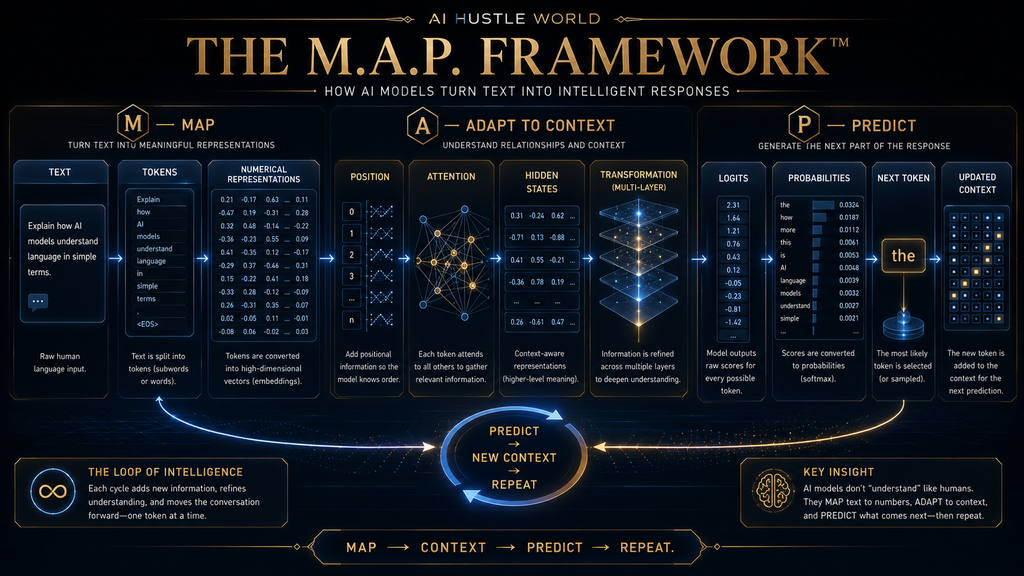
The M.A.P. Framework for Understanding Language Models
Here is the simplest mental model to carry forward.
M — Map
Text → tokens → numerical representations
The model turns human language into a form its neural network can process.
A — Adapt to Context
Representations → relationships → contextual hidden states
Transformer layers repeatedly transform those representations using information from surrounding tokens.
P — Predict
Final representation → token scores → probability distribution → next token
The model selects a next token according to its generation process, adds it to the sequence and repeats.
So:
MAP → CONTEXT → PREDICT → REPEAT
This is an AI Hustle World teaching framework, not an official machine-learning term.
Its purpose is to prevent a common misunderstanding: the model doesn’t first “understand everything” and then write an answer. The internal representation evolves through the computational process that ultimately supports prediction.
Training and Inference Are Different Jobs
Another major source of confusion is the belief that the model is learning from you every time it answers.
Training and inference are different processes.
During training
The model repeatedly makes predictions against training examples. A loss function measures error, and optimization methods update the model’s parameters so future predictions improve.
This is where the model acquires its learned parameters.
During inference
A trained model receives a new input and uses its existing parameters to generate output. The model’s learned parameters aren’t ordinarily updated simply because you asked it a question. IBM explicitly describes inference as running a trained model without updating its learned parameters.
This distinction matters because context is not automatically learning.
If you tell a chatbot your company sells accounting software and it uses that information later in the same interaction, that is context being used during inference. It doesn’t automatically mean the underlying model has permanently retrained itself on your company.
Some AI products add separate memory or retrieval systems, but those are application-level mechanisms and should not be casually equated with changing the underlying model.
For the deeper training question, Article #40 in your Master Sheet owns How AI Learns from Data: A Complete Beginner’s Guide.
Why Context Makes AI Seem Much Smarter
Consider these two requests:
Make this better.
and:
Rewrite this customer email for a frustrated first-time buyer. Keep the refund policy unchanged, remove defensive language, sound professional but human, and keep it under 120 words.
The second request gives the model more useful constraints.
It specifies:
- the task
- the audience
- the desired tone
- what must remain unchanged
- what should change
- the length constraint
The model is therefore solving a more constrained language-generation problem.
This doesn’t mean “more words = better prompt.”
A huge prompt filled with irrelevant material can create noise.
The better principle is:
Give the model the context that changes the decision.
That is a much more useful prompting principle than simply trying to make every prompt longer.
A Simple Experiment: Watch Context Change the Answer
Try this yourself.
Give an AI:
The animal didn’t cross the road because it was too tired.
Then ask:
What was tired?
Now change the sentence:
The animal didn’t cross the road because the road was too narrow.
Ask:
What was narrow?
Then change it again:
The animal didn’t cross the road because the driver was tired.
Ask:
Who was tired?
The experiment doesn’t prove that the model has human consciousness.
It demonstrates something more practical:
Changing the surrounding language changes the computational context and therefore changes the likely interpretation and continuation.
This is exactly why context, constraints and clear references are so important when you use AI.
Why AI Can Translate, Summarize and Rewrite Without a Separate “Meaning Engine”
Once the mechanism is clear, these capabilities become less mysterious.
For translation, the model has learned relationships across languages and can generate a sequence that fits the source context and target-language patterns.
For summarization, the model conditions its output on the source material and generates a shorter sequence that preserves the information requested by the task.
For rewriting, the model uses the original text plus instructions about tone, audience, structure and constraints to produce a new sequence.
For question answering, the model conditions its generation on the question and whatever context is available.
The important point is that a general language model doesn’t necessarily need a separate manually programmed “translation machine,” “summary machine” and “rewriting machine” for each language task.
A shared learned representation can support many different behaviors.
That flexibility is one of the reasons LLMs became such an important general-purpose AI interface.
Where the “Understanding” Analogy Breaks
This is the boundary that beginner explanations often skip.
A model can produce language that is contextually appropriate without having the same kind of relationship to the world that a human does.
Imagine reading:
The ice feels cold against my hand.
You can understand the statement while also knowing what cold feels like from experience.
A text-trained model can learn enormous amounts about how people describe cold, ice, skin and temperature.
But descriptions of an experience are not the same as having the experience.
That distinction is one reason recent research is careful about what “understanding” should mean when discussing LLMs.
The safest editorial position is therefore:
LLMs demonstrate sophisticated language processing and representation, but language fluency alone does not establish human-like comprehension or real-world grounding.
The Grounding Gap: Language Is Not the World
This gives us a second AI Hustle World framework.
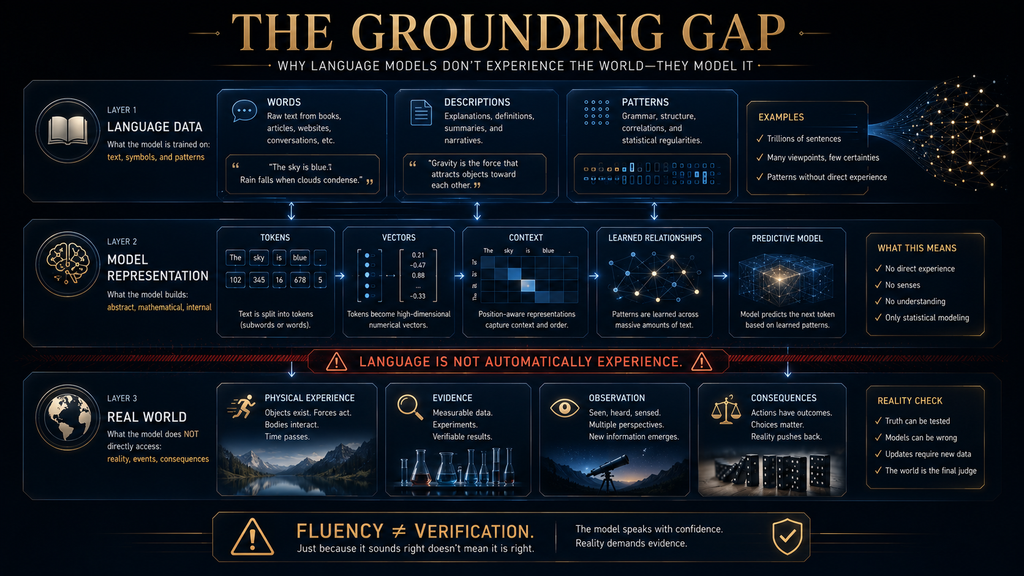
The Grounding Gap
Language patterns
→ Internal representations
→ Generated language
does not automatically equal:
Physical experience
→ real-world observation
→ verified truth
This distinction explains several surprising AI behaviors.
A model may be excellent at explaining how to repair a bicycle while never having physically held a bicycle.
It can describe what a storm sounds like while not hearing one.
It can discuss a historical event without having experienced the event.
That doesn’t make its language useless.
It means you need to understand what kind of evidence the model’s output represents.
Language competence is not automatically evidence of direct experience.
Why AI Can Sound Right and Still Be Wrong
One of the most important limitations of language models is hallucination: the production of plausible but false statements.
This is not simply a matter of the model being “stupid.”
OpenAI’s research argues that hallucinations are connected to the statistical nature of language-model pretraining and to evaluation systems that can reward guessing rather than appropriately expressing uncertainty.
The distinction is important.
A language model is trained extensively on examples of valid language.
It isn’t given a perfect database of truth labels attached to every statement it encounters.
That means some claims are easy to learn because they follow strong, repeated patterns.
Grammar is highly patterned.
Common phrases are highly patterned.
But obscure facts can be much harder.
If the model doesn’t have enough reliable information to distinguish a true claim from a plausible false one, fluent generation can still produce a confident answer.
So:
Plausibility ≠ truth.
And:
Fluency ≠ verification.
This is perhaps the single most important concept to understand if you use AI for research.
Why Hallucinations Matter More Than Grammar Errors
A strange spelling error is usually easy to notice.
A fabricated source that looks legitimate is much more dangerous.
That is because language models can be extremely good at producing the form of a correct answer even when the underlying claim is wrong.
OpenAI’s research notes that hallucinations remain a fundamental challenge even as model capabilities improve, and argues that appropriate uncertainty and abstention are important parts of trustworthy behavior.
This gives AI users a practical rule:
The higher the consequence of an error, the more independent verification the output deserves.
For brainstorming, rewriting or first drafts, an imperfect answer may be cheap to fix.
For medical, legal, financial, security or other high-consequence information, a polished response is nowhere near enough.
What AI Is Good at—and Where You Should Be Careful
The mechanism suggests a useful division.
AI is particularly useful for pattern-rich language work
Examples include:
- drafting
- rewriting
- summarization
- classification
- brainstorming
- extracting information
- transforming text between formats
- generating variations
- organizing large amounts of language
These tasks benefit from the model’s ability to identify and reproduce learned language patterns.
Human judgment becomes more important when grounding or consequences dominate
Examples include:
- deciding whether a factual claim is true
- interpreting ambiguous real-world situations
- making high-stakes decisions
- approving legal or financial conclusions
- determining whether a source is trustworthy
- judging sensitive cultural or interpersonal meaning
- taking actions where an error is expensive
The right question is therefore not:
“Can AI do this?”
It is:
“What part of this task is pattern-rich, and what part requires evidence, judgment or real-world grounding?”
That is a much better decision boundary.
What Happens If You Treat AI Fluency as Understanding?
The practical risk is overtrust.
If you assume that a fluent answer represents verified understanding, you may:
- accept unsupported claims
- fail to check sources
- provide too little context
- assume the model knows what “it” refers to
- mistake confidence for certainty
- use generated information in a high-consequence decision without validation
Nothing necessarily breaks immediately.
That is what makes this problem dangerous.
The output can look excellent while quietly containing an incorrect assumption.
Understanding the mechanism gives you a better operating rule:
Use AI for acceleration. Use evidence for important claims. Use human judgment where ambiguity or consequences are high.
How to Get Better Results From AI
You don’t need to become a machine-learning engineer to apply what you’ve learned.
You need to give the model better conditions for producing the output you actually want.
State the task clearly
Instead of:
Fix this.
say what needs to change and what must remain unchanged.
Supply relevant context
If “this,” “they” or “that number” refers to something important, make the reference explicit.
Define constraints
Length, tone, audience, structure and exclusions can substantially narrow the desired output.
Give source material when accuracy matters
If you want the model to summarize a specific document, provide the document or relevant evidence rather than asking it to reconstruct the information from memory.
Separate generation from verification
AI can produce a useful first draft without being the final authority on whether every claim is true.
Ask for uncertainty instead of forcing an answer
When appropriate, explicitly tell the system to identify missing information, state assumptions or ask for clarification.
These practices aren’t magic tricks.
They simply give the model better context and clearer constraints.
The Second-Order Effect: Language Is Becoming a Machine Interface
There is a larger consequence to all of this.
Traditional software often required people to learn the software’s interface.
You learned:
- menus
- commands
- syntax
- workflows
- buttons
- file structures
Language models increasingly allow users to describe desired outcomes in ordinary language.
That means language itself is becoming an interface to software.
The consequence is significant.
The bottleneck can move from:
“Do I know how to operate this software?”
to:
“Can I describe the result I want precisely enough for the system to produce it?”
That makes communication, context-setting and verification more valuable—not less.
AI lowers the technical barrier to interacting with software, but it does not remove the need to define the problem correctly.
The Complete Mental Model
At this point, the entire process can be reduced to one chain:
1. Text enters the system
The model receives a sequence of language.
2. Text becomes tokens
The tokenizer converts the sequence into processable units.
3. Tokens become numerical representations
Token IDs are mapped into embeddings.
4. Position and context are incorporated
The model needs information about order and relationships.
5. Transformer layers repeatedly transform the representations
Attention combines contextual information, while other neural layers further transform the hidden states.
6. The final representation produces scores for possible next tokens
Those scores are converted into a probability distribution.
7. A token is generated
The selected token becomes part of the growing output.
8. The loop repeats
The model generates another token using the updated context.
And eventually:
A sequence of predicted tokens becomes the answer you read.
That is the mechanism beneath the conversational experience.
Common Misconceptions About AI Language Understanding
Does AI understand words like humans do?
No. It processes numerical representations learned from language data and uses contextual relationships to generate or transform language.
Are tokens the same as words?
No. Tokens can be words, parts of words, punctuation or other text fragments depending on the tokenizer.
Do token IDs contain meaning?
No. A token ID primarily identifies a token in a model’s vocabulary. The useful linguistic representation comes from the learned embedding and subsequent transformations.
Does an embedding equal the meaning of a word?
Not exactly. An embedding is a numerical representation used by the network. Modern transformer processing then transforms representations using context.
What does attention actually do?
Attention mathematically combines information from different parts of a sequence according to learned relationships. It helps the model build contextual representations.
Does the model write the entire answer at once?
Autoregressive language models generate output sequentially, producing tokens one step at a time while incorporating the growing context.
Does next-token prediction mean AI is just autocomplete?
No. Next-token prediction is a core objective, but performing it well across huge and varied datasets requires the model to learn rich statistical structure in language.
Does AI know the answer before generating it?
Not in the simple human sense. During inference, the model uses its learned parameters and current context to calculate what token should come next.
Why does AI sometimes hallucinate?
Because producing plausible language and determining factual truth are different problems. OpenAI’s research also points to training and evaluation incentives that can encourage guessing when uncertainty should instead be expressed.
Does giving AI more context always make it better?
No. Relevant context can help, but irrelevant, contradictory or poorly structured context can make the task less precise.
Does every AI model understand language the same way?
No. Different models use different architectures, tokenizers, training methods, parameterizations and post-training techniques. The pipeline described here is a conceptual model of modern transformer-based language systems, not a claim that every AI system is identical.
Is AI understanding the same as human understanding?
No clear evidence supports treating the two as identical. AI models can exhibit sophisticated language processing and context-sensitive behavior, but human understanding is grounded in broader experience and interaction with the world. Current research continues to examine what should count as “understanding” in LLMs.
Final Thoughts
AI doesn’t understand language by opening a dictionary inside its head and looking up what every word means.
The process is more subtle.
Text is broken into tokens. Tokens receive numerical representations. Those representations are enriched with positional and contextual information as they move through transformer layers. Attention helps connect relevant pieces of the sequence, other neural layers transform the resulting representations, and the final representation is converted into probabilities for what token should come next.
That loop is repeated until an answer emerges.
The remarkable part is that a next-token prediction objective, applied at enormous scale, can produce representations capable of supporting translation, summarization, rewriting, coding, question answering and many other forms of language behavior.
But the limitation is just as important.
A fluent response is evidence that the model generated a language pattern that fits its context. It is not, by itself, evidence that the claim is true or that the model understands the world the way a human does.
Once you understand that boundary, AI becomes easier to use correctly.
You can give it better context instead of expecting it to infer everything. You can use it aggressively for pattern-rich work without treating every output as verified fact. And you can reserve human judgment for the places where ambiguity, evidence and consequences matter most.
The most useful mental model is therefore not:
AI understands language like a human.
It is:
AI builds increasingly rich representations of language from context and uses those representations to predict what comes next.
That is powerful enough to look remarkably like understanding.
But knowing how the mechanism works is what keeps that power useful instead of turning fluency into false confidence.
Understand AI Before You Depend on It
AI Hustle World publishes practical, research-driven guides that explain how AI works, where it helps, and where human judgment still matters.
Explore More AI Guides →Written by
Muntasir Ahmad Chowdhury
Founder, AI Hustle World
Muntasir Ahmad Chowdhury is the Founder of AI Hustle World, an independent publication dedicated to making Artificial Intelligence practical, trustworthy, and easy to understand. He researches AI tools, automation, customer service, productivity, and real-world business applications, helping readers make smarter technology decisions through research-driven, experience-backed content.
Expertise:
AI Tools • AI Automation • AI Customer Service • AI Productivity • Generative AI • AI Workflows
Get Smarter With AI
Enjoyed this guide? Get practical AI tools, tutorials, and honest reviews delivered to your inbox.
4 thoughts on “How AI Models Understand Language: Explained Simply for Beginners”