Evidence: Documentation reviewed
Last checked: August 2026
What was done: Written from official documentation and the published sources linked in this article. Not hands-on tested.
Files: None
Affiliate links: No
How AI Search Engines Find and Rank Information
Last updated: August 2026
Search used to be relatively easy to visualize: you typed a query, a search engine found matching pages, ranked them, and gave you a list of links. AI search changes the experience.
Ask a modern AI search engine a complicated question and you may receive a direct answer assembled from several websites, with citations attached to individual claims or sections. The system may interpret your question, search for related subtopics, retrieve different pieces of information, evaluate those results, and then generate a response from the evidence it selected.
That does not mean AI search has replaced traditional search with a mysterious new ranking formula. In many cases, it is better understood as an additional reasoning and retrieval layer built on top of search infrastructure. Google, for example, says AI Overviews and AI Mode use its existing Search systems and may use query fan-out to run multiple related searches; ChatGPT and Perplexity also describe workflows that involve query understanding, web retrieval, synthesis, and citations.
The important question, then, is not simply “How does AI rank websites?” It is:
How does information move from a user’s question to the evidence that eventually appears in an AI-generated answer?
Once you understand that journey, AI search becomes much less mysterious—and it also becomes easier to understand why traditional SEO, useful content, clear structure, source quality, and human verification still matter.
Quick Answer: How Do AI Search Engines Find and Rank Information?
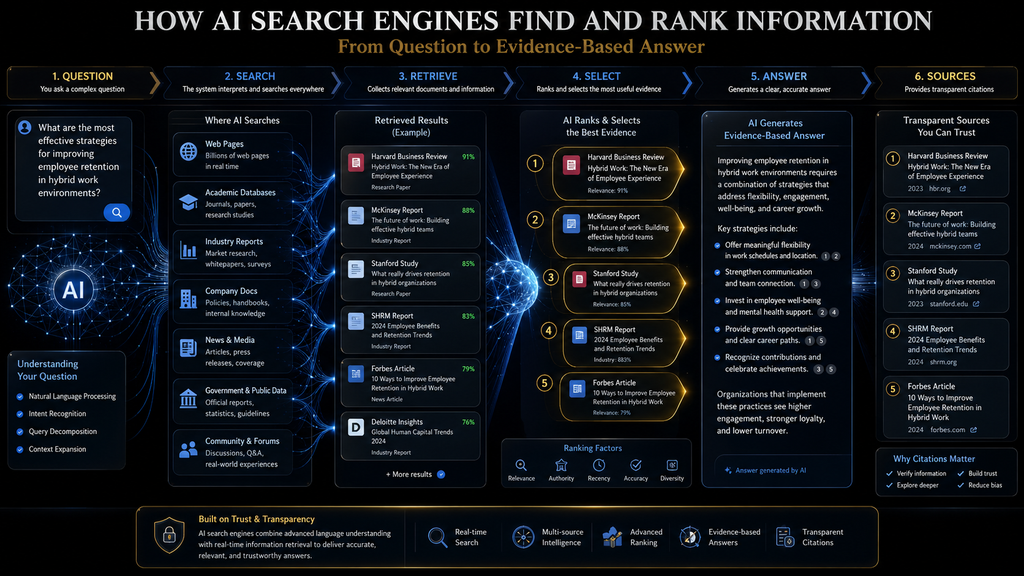
AI search engines generally work through several connected stages: they interpret the user’s information need, retrieve potentially relevant information, filter or rerank candidates, select useful evidence, and then use that evidence to generate an answer. The exact implementation differs by platform, and there is no publicly documented universal “AI ranking score” shared by Google, ChatGPT, Perplexity, and every other AI search system.
Google’s AI Search documentation describes AI Overviews and AI Mode as using Search systems to surface relevant links and says both may use query fan-out, where multiple related searches are performed across subtopics and data sources. Google also says the underlying Search fundamentals remain relevant to these AI experiences.
Perplexity describes a similar high-level experience: understand the question, search the web, synthesize relevant information, and provide citations. OpenAI says ChatGPT Search can rewrite a user’s question into one or more targeted queries, search the web, and return answers with source citations.
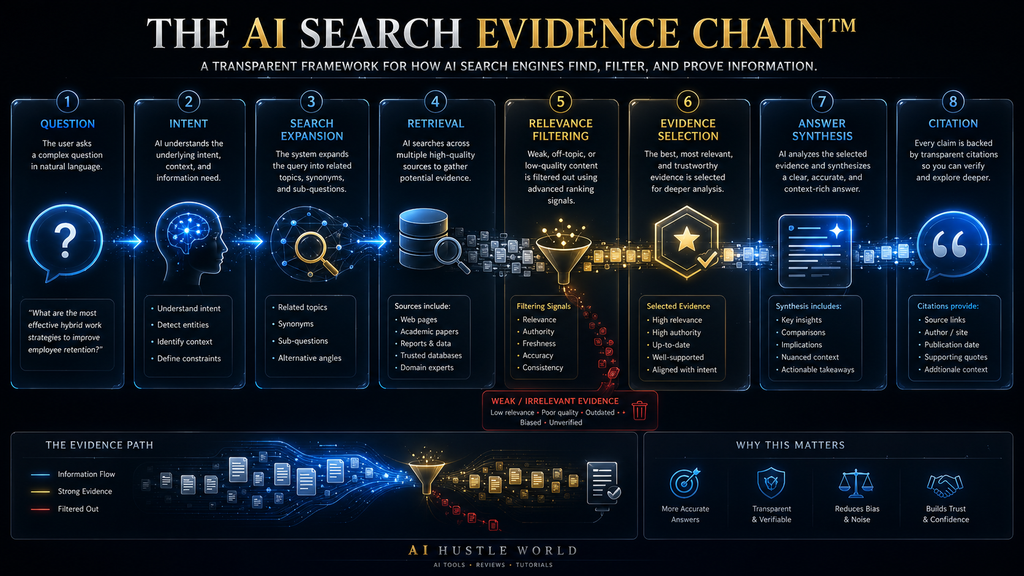
A useful way to understand the entire process is: Question → Intent → Search Expansion → Retrieval → Relevance Filtering → Evidence Selection → Answer Synthesis → Citation. That is an explanatory model, not a claim that every platform uses identical internal software.
What Is an AI Search Engine?
An AI search engine combines search and generative AI so that users can receive a synthesized response instead of having to inspect a list of results themselves.
Traditional search is primarily designed to help you find information. AI search adds another job: organize and explain information.
That distinction sounds small, but it changes the system’s requirements. A traditional search engine can focus heavily on identifying useful results for a query. An AI search system also needs to decide what information should be supplied to a language model, how different sources relate to one another, which evidence is relevant to the user’s specific question, and how that evidence can be turned into a coherent response.
The result is a different interaction model. You are no longer necessarily asking, “Which page should I open?” You are often asking, “Can the system investigate this information need for me and show me the evidence it used?”
That is why citations have become such an important part of AI search. Perplexity says every answer includes citations to original sources, while OpenAI warns that search results and citations can still be incomplete, outdated, or incorrect and recommends opening important sources for verification.
Traditional Search vs. AI Search
The easiest way to understand the difference is to compare what each system is primarily trying to produce.
| Dimension | Traditional Search | AI Search |
|---|---|---|
| Primary output | Ranked search results | Synthesized answer plus supporting sources |
| Query handling | Interprets the search query | Interprets intent, context, and potentially multiple information needs |
| Search behavior | Usually centered on the submitted query | May expand a complex question into related searches |
| Retrieval | Finds relevant pages/results | May retrieve pages, passages, chunks, or other evidence |
| Ranking | Orders results by relevance and other signals | May retrieve, filter, rerank, and select evidence before generation |
| User role | Investigates results | Reviews an answer and can inspect supporting sources |
| Generation | Usually limited | Central to the experience |
| Attribution | Primarily through result links | Often through citations attached to generated answers |
| Variability | Rankings can change | Answers and source selections can vary with the query, context, retrieval, and system |
| Verification | User compares sources | User should still verify important claims against sources |
The distinction is not absolute. Modern search engines already use machine learning to understand concepts, intent, freshness, passages, and other signals. Google, for example, documents systems such as RankBrain, neural matching, passage ranking, link analysis, and freshness systems.
So AI search is not the replacement of “old search” with something completely unrelated. It is better understood as search becoming increasingly capable of investigating and synthesizing information rather than merely presenting it.
The AI Search Evidence Chain
A useful AI Hustle World way to think about modern AI search is the AI Search Evidence Chain: Question → Intent → Search Expansion → Retrieval → Relevance Filtering → Evidence Selection → Answer Synthesis → Citation. Each stage has a different job.
The first stages determine what information is needed. The middle stages determine what information is available and relevant. The final stages determine how that information becomes an answer.
This distinction matters because failure can happen anywhere along the chain.
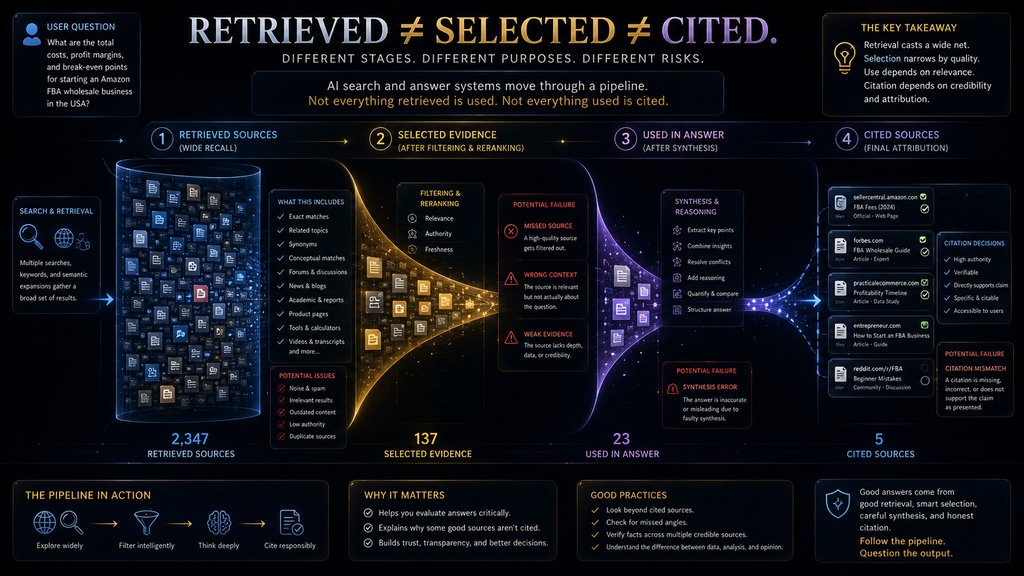
A highly authoritative page can exist but never be retrieved. A relevant page can be retrieved but not selected. A good source can be selected but summarized incorrectly. A correct answer can still have a weak citation if the cited page does not actually support the specific claim.
That is why saying “AI ranked my page lower” can sometimes be an incomplete explanation. The system may never have reached the page in the first place.
Stage 1: Discovering and Indexing Information
Before a search engine can retrieve a webpage, it needs some way to discover and process that information.
Google describes its traditional Search pipeline in three broad stages: crawling, indexing, and serving search results. Crawlers discover pages, Google processes and stores information in its index, and the system then retrieves relevant information when a user searches. Google also makes clear that crawling, indexing, and serving are not guaranteed for every URL.
This creates the first important distinction: Being published on the internet does not automatically mean being available to a search system. A page can fail to become useful search material because it is inaccessible to crawlers, blocked by technical controls, not indexed, duplicated with another page, or simply not considered useful enough to serve.
Google’s AI-search documentation makes this particularly clear for AI Overviews and AI Mode: to be eligible as a supporting link, a page must already be indexed and eligible to appear in Google Search with a snippet. Google says there are no separate technical requirements specifically for appearing in these AI features.
That is an important correction to the idea that publishers need some secret “AI-only” markup to enter AI search. They don’t. At least in Google’s system, the foundation remains Search.
Stage 2: Understanding What the User Actually Wants
Once a query enters an AI search system, the next problem is understanding the information need behind it. A keyword string and a question are not necessarily the same thing. Consider:
“best laptop”
Now compare it with:
“What is the best lightweight laptop for a university student who travels frequently, needs strong battery life, and has a budget under $1,000?”
The second query contains several dimensions:
- product category;
- audience;
- use case;
- portability;
- battery requirements;
- budget.
A useful search system needs to understand those constraints rather than treating every word as an isolated keyword.
Perplexity says its system uses AI to understand the context and nuances of a query before searching. OpenAI similarly explains that ChatGPT Search may rewrite a user’s original question into one or more targeted queries before sending them to search providers.
This is one reason natural-language search works so well for complex questions. The system is trying to identify the problem behind the words.
Stage 3: Query Expansion and Query Fan-Out
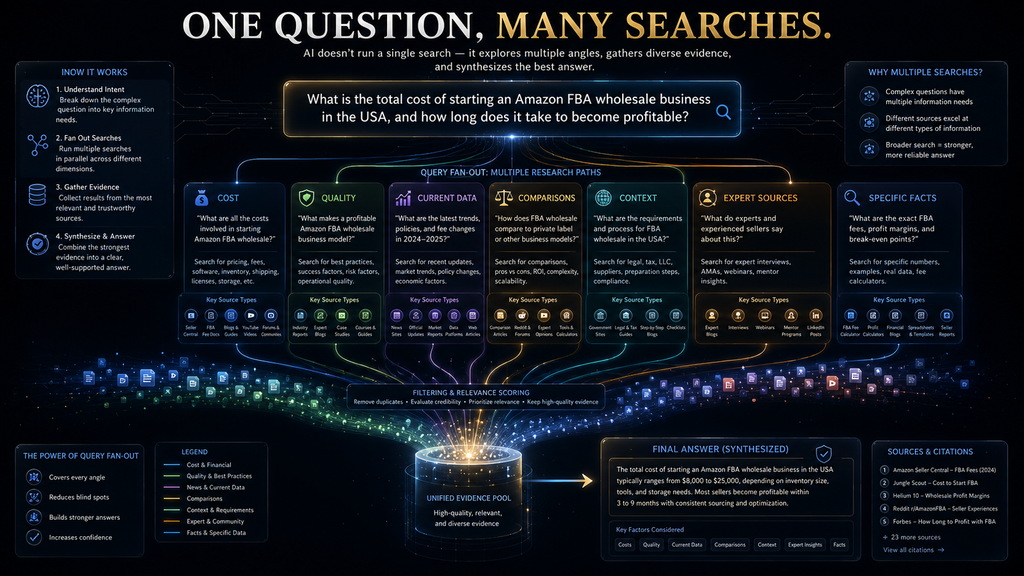
This is one of the biggest differences between modern AI search and the simple mental model of traditional search. For complicated questions, the system may not rely on one search query.
Google explicitly documents query fan-out in AI Overviews and AI Mode. It describes the technique as issuing multiple related searches across subtopics and data sources to develop a response. Google also says that while a response is being generated, its systems can identify additional supporting web pages.
Imagine asking:
“What is the best city for a remote worker who wants low living costs, reliable internet, warm weather, good healthcare, and a safe environment?”
There is no single obvious search query that perfectly represents the entire information need. A system could instead investigate several dimensions, such as:
- cost of living;
- internet quality;
- climate;
- healthcare;
- safety;
- remote-work suitability;
- local regulations.
Those searches can produce different sources.
One page may be excellent for cost-of-living information. Another may be stronger for healthcare. Another may provide government information about visas or residency.
The system then has to bring those pieces together. This changes the basic unit of search. Traditional SEO often encourages a mental model of: one query → one ranked page.
AI search can behave more like: one complex question → multiple information needs → multiple retrieval operations → multiple sources → synthesized answer. That is a major conceptual shift.
Stage 4: Retrieving Candidate Information
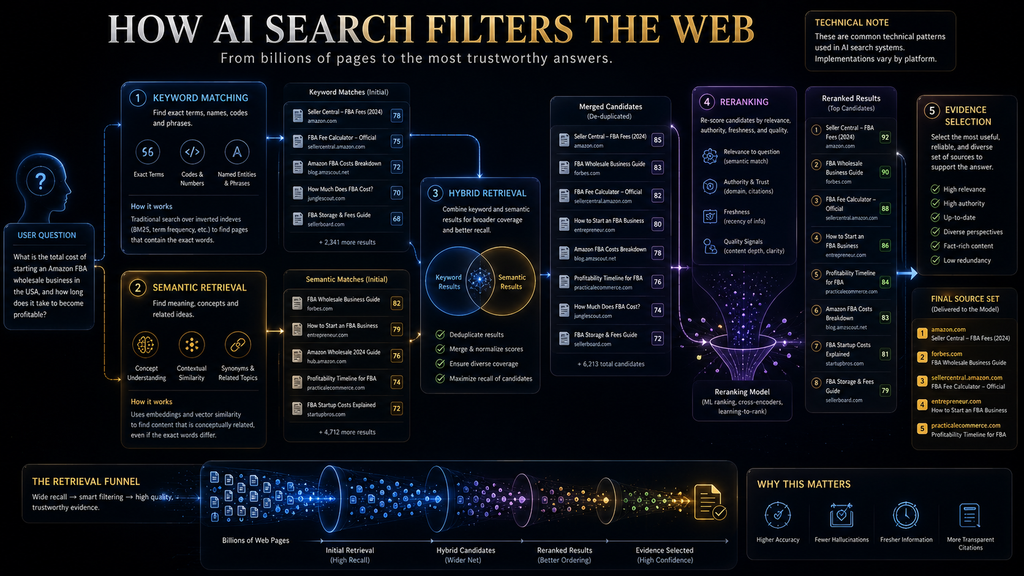
Once the system understands the question—or its individual sub-questions—it needs to find candidate information. This is where modern retrieval technology becomes important. There is no single retrieval architecture used identically by every AI search product, but modern AI search systems commonly use techniques that combine lexical and semantic retrieval.
Cloudflare’s current AI Search documentation provides a useful concrete example. Its managed search system can index content into both vector and keyword representations, retrieve through vector search, keyword search, or hybrid search, combine results, optionally rerank them, and then return the most relevant content for answer generation.
This is an example of a technical architecture—not proof that every consumer AI search engine uses the exact same implementation. But it illustrates an important principle:
Finding relevant information can involve more than matching the exact words in a query.
Keyword Search Still Matters
AI search has not made exact terms irrelevant. Keyword retrieval remains valuable when the query contains precise information such as:
- product names;
- model numbers;
- technical error codes;
- people;
- company names;
- dates;
- specific phrases;
- legal or technical terminology.
Suppose someone searches:
“ERR_CONNECTION_REFUSED timeout”
A semantic system might understand that the query concerns a network connection failure. But exact keyword matching can identify documents that literally contain the error code.
Cloudflare’s documentation illustrates this distinction directly: vector search is useful for semantic similarity, while keyword search can preserve exact terms that semantic retrieval might otherwise blur. Hybrid search combines the two.
The broader lesson is that meaning and exactness solve different retrieval problems.
Semantic Retrieval: Finding Meaning Beyond Exact Words
Semantic retrieval attempts to identify information that is conceptually related even when the wording differs. For example, someone might search:
“How do I make my AI-generated videos look more realistic?”
A relevant article might instead use:
“Techniques for improving realism in synthetic video.”
The exact vocabulary differs, but the underlying information need is similar.
Vector-based retrieval can represent queries and content in an embedding space so that semantically related material can be discovered even without exact phrase matching. Cloudflare’s documentation describes this mechanism as one of the retrieval modes in its AI Search system.
Google also documents neural matching and RankBrain as systems that help connect words with concepts and improve retrieval of relevant information even when exact query terms do not appear everywhere in the content. This is why writing solely for exact keyword repetition is an increasingly weak content strategy. The stronger objective is to cover the underlying information need clearly and completely.
Stage 5: Filtering and Re-Ranking the Candidates
Retrieval creates a pool of potentially useful information. It does not mean every retrieved item will appear in the final answer.
The system may need to determine which candidates are most useful for the particular question. This is where ranking and reranking come in.
Google’s traditional Search systems use many signals and systems to determine relevance and usefulness, including systems related to freshness, link analysis, neural matching, original content, and passage relevance. Google also explicitly documents passage ranking as a system that identifies individual sections of webpages to better understand their relevance to a query.
In a modern retrieval pipeline, reranking can provide another layer of filtering. Cloudflare’s documented AI Search architecture, for example, can use a cross-encoder to rescore retrieved results by considering the query and document together.
The critical distinction is:
Retrieved does not mean selected.
A page can be technically relevant enough to enter the candidate pool but not strong enough to survive the next stage.
What Makes Information More Likely to Be Useful?
There is no publicly documented universal formula that says:
AI visibility = relevance + authority + freshness + backlinks + X + Y.
Anyone presenting such a formula as a universal law is overstating what is known. Instead, several broad considerations matter depending on the platform and query.
Relevance
Does the information actually answer the user’s question?
Specificity
Does it address the exact problem rather than merely discussing the broad topic?
Quality
Is the information useful, accurate, and credible?
Freshness
Is the information current enough for a query where recent information matters?
Context
Does the information make sense for the particular situation?
Accessibility
Can the search system actually retrieve and process the content?
Evidence
Does the source provide information that can support the resulting claim? Google’s public documentation supports several of these concepts through its ranking systems, while individual AI search providers expose different portions of their own processes. The important editorial principle is to avoid turning documented mechanisms into imaginary universal ranking factors.
Freshness Matters—But Not for Every Query
One of the easiest AI-search myths to repeat is:
“AI search always prefers fresh content.”
That is too simplistic.
Google explicitly describes freshness systems that are designed for queries where users are expected to want recent information. A breaking-news query clearly has a freshness requirement; a timeless historical fact usually does not.
Imagine these two searches:
“Who wrote Pride and Prejudice?”
and:
“What happened in the latest OpenAI model release?”
The first is fundamentally stable. The second can become outdated quickly. A good search system therefore needs to understand not only what information is relevant, but whether time changes the meaning of relevance.
For publishers, this means constantly changing dates on an evergreen article does not automatically make it more useful. Freshness should reflect real change, not cosmetic updating.
Why Long Content Does Not Automatically Win
Another common misconception is that AI search prefers extremely long pages. There is no reason to assume that. Google explicitly documents passage ranking, which can identify relevant sections of a page rather than treating the entire document as one indivisible block.
That creates an important lesson for content creators. A 5,000-word article that vaguely discusses twenty subjects may be less useful for a specific question than a focused article containing a clearly written 400-word section that directly answers it. This does not mean short content is automatically better.
It means depth should be proportional to the information problem. A long article earns its length when each major section adds useful reasoning, evidence, examples, context, or decision value. That is why good structure matters more than simply hitting a word target.
Stage 6: Evidence Selection
After retrieval and filtering, the system needs to determine what information is actually useful for constructing the response. This is a subtle but important stage.
Imagine a webpage contains 4,000 words. Only one section may directly answer the user’s question.
The search system does not necessarily need to give the language model the entire page. Modern retrieval systems can work with smaller pieces of content, such as passages or chunks.
Cloudflare’s AI Search architecture, for example, explicitly describes chunking content during indexing and returning the most relevant chunks during retrieval. That means the useful unit of information may sometimes be smaller than the webpage itself. This is another reason clear headings, focused sections, explicit explanations, and well-organized information are valuable.
A search system can more easily identify:
Here is the section that answers the question.
than:
Somewhere in this enormous page there might be something relevant.
Retrieval Is Not the Same as Citation
This distinction deserves special attention. A source can be: discovered without being: retrieved. It can be: retrieved without being: selected.
It can be: selected without every part of it being: used. And information can be: used without every claim being: cited in the same way.
This is why “AI cited my competitor” is not always evidence that the competitor simply had a higher ranking position. The system may have selected a particular passage because it supported one part of the question.
Modern RAG research treats retrieval relevance, answer completeness, attribution, and agreement as distinct evaluation dimensions. The TREC 2025 RAG track, for example, evaluates retrieval-augmented systems across multiple layers rather than assuming that good retrieval automatically produces a good answer.
That distinction is fundamental.
Stage 7: Grounding the Answer in Retrieved Information
Once useful evidence has been selected, a generative model can use it as context when constructing the response. This is the basic idea behind retrieval-augmented generation, or RAG. At a high level: Retrieve external information → provide relevant context → generate an answer grounded in that information.
Google’s current guidance for generative AI search explicitly describes retrieval-augmented generation as part of how its AI search features use relevant pages from its Search index and then examine information from those pages to generate a response. Again, this does not mean every AI search product has the same architecture. It does mean the broader industry has converged around an important principle:
A generative model can become more useful for current or external information when it can retrieve relevant evidence rather than relying only on what it learned during training.
Stage 8: Generating the Answer
This is the stage users usually notice. The model takes the selected information and turns it into natural language. Depending on the question, it may:
- summarize;
- compare;
- explain;
- classify;
- synthesize;
- calculate;
- connect multiple sources;
- identify trade-offs;
- provide a recommendation;
- ask for clarification.
This is where AI search becomes much more than a ranked list. Traditional search primarily asks:
Which results should the user inspect?
AI search adds:
What can be explained from the evidence we retrieved?
That is powerful—but it also introduces another category of failure. The model can misunderstand or over-combine the retrieved information.
A Good Source Does Not Guarantee a Good Answer
Suppose the system retrieves three excellent sources. It can still produce a poor answer if it:
- misunderstands the question;
- combines incompatible claims;
- removes an important qualification;
- applies information to the wrong context;
- summarizes a source inaccurately;
- gives too much weight to one piece of evidence.
Research on RAG systems continues to study exactly this interaction between retrieval and generation. A 2026 study on retriever-generator alignment found cases where generated answers did not simply follow the highest-ranked retrieved documents, illustrating why the retrieval layer and generation layer need to be evaluated together.
This leads to a useful reality check:
AI search reduces the work of finding and synthesizing information; it does not eliminate the need to evaluate the resulting answer.
Stage 9: Citations and Attribution
Citations are the bridge between a generated statement and the underlying evidence.
Perplexity says its answers include citations linking to original sources. OpenAI likewise provides citations for web-search responses and explicitly tells users to review cited sources because search results and citations can sometimes be incomplete, outdated, or incorrect.
Google’s AI search features also provide supporting links so users can explore the underlying web content. Google says AI Overviews and AI Mode are designed to provide links that help users investigate information further.
But there is a critical distinction: A citation is evidence of attribution, not an automatic guarantee of truth. Suppose an AI answer says:
“Company X introduced feature Y in June.”
and attaches a source. You should still ask:
Does the cited page actually say that?
If it does not, the citation creates the appearance of verification without providing actual verification. That is why responsible AI search experiences need not only citations, but citation quality.
How Google, ChatGPT, and Perplexity Differ
The shared concepts are useful, but the platforms should not be treated as identical.
Google AI Overviews and AI Mode
Google integrates its AI experiences directly into Search. Its documentation says AI Overviews and AI Mode use Search systems, can use query fan-out, and can identify additional supporting pages while generating responses. Google also says the same foundational SEO practices remain relevant.
This means Google’s AI search is deeply connected to its existing crawling, indexing, ranking, and search ecosystem.
ChatGPT Search
OpenAI says ChatGPT can search the web when current information is useful, and its search system may rewrite the user’s question into one or more targeted queries. OpenAI also says search results are ranked using multiple factors and that placement is not guaranteed.
That makes query rewriting especially important to understand. The question you type is not necessarily the exact query sent to every search provider involved in the process.
Perplexity
Perplexity describes its system as interpreting the question, searching the web in real time, gathering information, synthesizing it, and citing the original sources. Its more advanced search modes can conduct research across multiple sources and searches.
The practical conclusion is straightforward:
There is a shared conceptual pipeline, but there is no reason to assume the three platforms select information using identical algorithms.
The Five Gates of AI Search Visibility
To make the entire process easier to remember, consider five practical gates.
Gate 1 — Can the system find the content?
This is discoverability and accessibility. If the content cannot be crawled or otherwise retrieved, nothing later matters.
Gate 2 — Is the content relevant?
This is retrieval. The system needs to identify information that actually addresses the query or one of its sub-questions.
Gate 3 — Is the information useful enough to select?
This is relevance, quality, context, and evidence. Being technically related to a topic is not enough.
Gate 4 — Can the information support the answer?
This is grounding. The selected material needs to provide usable evidence for what the model is going to say.
Gate 5 — Does the system expose the source?
This is citation and attribution. Even selected evidence does not guarantee that a specific URL will appear in the final response.
This five-gate model is an AI Hustle World explanatory framework, not a proprietary platform formula. Its purpose is to help readers reason about where visibility can succeed or fail.
Why AI Search Results Can Change
One of the most confusing aspects of AI search is that the answer can change even when the user’s question looks almost identical. That can happen because the system is working with a changing information environment. Possible causes include:
- updated webpages;
- different retrieved candidates;
- changing query interpretations;
- changing search indexes;
- different model behavior;
- different conversational context;
- freshness requirements;
- different source availability.
Google explicitly says AI Overviews and AI Mode can use different models and techniques, so the responses and links shown can vary. OpenAI similarly warns that search results and citations can be incomplete or incorrect and recommends reviewing sources.
This means AI search should not be understood as a permanent leaderboard. Traditional SEO already involves algorithmic change, but AI-generated answers add another layer of variability because the final response is generated dynamically.
Why There Is No Universal AI Ranking Formula
This is where many AI-search articles become misleading. It is tempting to create a list like:
- authority;
- backlinks;
- freshness;
- keywords;
- schema.
Then claim that these are the universal AI ranking factors. The public evidence does not justify that conclusion.
Google documents its own ranking systems and AI-search behavior. OpenAI documents different aspects of ChatGPT Search. Perplexity describes its own search-and-synthesis workflow. Technical search platforms such as Cloudflare document their own retrieval architectures.
The more defensible conclusion is:
AI search systems share broad technical patterns, but their proprietary retrieval, ranking, selection, and generation processes differ.
That distinction matters because it prevents publishers from chasing fake formulas.
What AI Search Means for Websites
Understanding the mechanism changes how you should think about content. The first implication is that being discoverable still matters.
Google says pages need to be indexed and eligible for normal Search to be eligible as supporting links in AI Overviews and AI Mode. It also recommends fundamental practices such as allowing crawling, using internal links, providing useful page experiences, keeping important information in text, and ensuring structured data matches visible content.
The second implication is that clear information architecture matters. If an article contains a strong answer but hides it inside an enormous block of vague prose, the information becomes harder for both humans and machines to use. The third is that original information matters more than generic summaries.
A page that simply repeats information available everywhere else gives the system little reason to prefer it as evidence. The fourth is that specific sections can have independent value. Google’s passage-ranking documentation is one reason to think about each major section as a useful information unit rather than treating the article as one giant keyword container.
And the fifth is perhaps the most important:
Traditional SEO has not disappeared.
Google explicitly says its existing SEO fundamentals remain relevant to AI features. There is no special AI-only technical requirement that replaces the fundamentals.
What AI Search Does Not Mean
AI search does not mean traditional search is dead.
Google’s AI features use its existing Search systems, including its index and ranking infrastructure. AI search extends what the user can do with retrieved information; it does not make crawling, indexing, relevance, and quality irrelevant.
AI search does not mean the number-one result is irrelevant.
A traditional search ranking can still matter because AI experiences may depend on underlying search infrastructure. But a high traditional ranking does not guarantee that a page will be cited in a particular generated answer.
AI search does not mean you need special “AI schema.”
Google explicitly says there are no additional technical requirements or special schema required for AI Overviews or AI Mode.
AI search does not mean freshness always wins.
Freshness matters when the query requires current information. It is not a universal ranking advantage.
AI search does not mean citations guarantee accuracy.
OpenAI explicitly warns that citations and search results can be incomplete, outdated, or incorrect. Important information should still be checked against the source.
AI search does not mean one universal ranking algorithm exists.
Different platforms expose different architectures and behaviors. The public evidence supports a shared family of techniques, not one universal formula.
Common AI Search Failure Modes
The most useful way to understand a complex system is often to study how it breaks.
Retrieval failure
The best source exists, but the system never retrieves it. This can happen because the content is difficult to discover, the query does not match the source effectively, or another result is considered more relevant.
Relevance failure
The retrieved source discusses the right general subject but does not answer the user’s actual question. For example, an article about AI safety may be retrieved for a question about AI privacy simply because both contain overlapping vocabulary.
Context failure
The information is technically correct but doesn’t apply to the user’s situation. A tax rule for one country, for example, can be accurate and completely useless for someone in another jurisdiction.
Freshness failure
The system retrieves information that was once accurate but is now outdated. This is particularly dangerous for news, software versions, prices, regulations, product specifications, and rapidly changing technology.
Synthesis failure
Several individually reasonable facts are combined into a conclusion that none of the sources actually support. This is a uniquely important generative-AI risk because the model is creating a new narrative from retrieved information.
Attribution failure
A citation appears next to a claim but does not actually support the claim. This is why citation presence alone should never be treated as proof.
Consensus failure
Sources disagree, but the generated answer presents one position without making the disagreement clear. For contested or high-stakes topics, this can be much more serious than a simple missing citation.
Why Source Quality Is a Pipeline Problem
A useful mental model is:
The quality of an AI answer depends partly on the quality of the evidence pipeline feeding it.
Consider two scenarios.
Scenario A
A highly authoritative source exists, but the system fails to retrieve it. The final answer may be incomplete.
Scenario B
The system retrieves a weak source and uses it confidently. The final answer may be wrong even though the retrieval technically succeeded.
Scenario C
The system retrieves several strong sources but combines them incorrectly. The final answer can still be misleading. This is why AI search quality is not purely a language-model problem.
It is a retrieval problem, a ranking problem, a context problem, a generation problem, and an attribution problem at the same time. Research into retrieval-augmented generation increasingly evaluates these components separately because strong retrieval does not automatically guarantee a complete or well-attributed answer.
What Happens If Publishers Ignore This Shift?
The immediate temptation is to react with more content. That is not necessarily the right response.
If AI search becomes better at synthesizing information, producing more generic pages can actually become less strategically useful. A website with hundreds of shallow articles may contain more URLs but offer fewer distinctive reasons for a search system—or a human reader—to prefer it.
The better response is to strengthen the information itself. That means asking:
- What does this page explain better than competing pages?
- What original evidence does it contain?
- What specific question does each section answer?
- Are important claims supported?
- Is the information current where freshness matters?
- Can readers easily verify the important facts?
- Are the page’s sections understandable without unnecessary context?
Google’s current AI-search guidance continues to emphasize the fundamentals of helpful, reliable, people-first content rather than a separate set of secret AI ranking tricks. This is strategically important.
AI does not eliminate the value of good information. It increases the importance of producing information worth retrieving.
The Second-Order Effect: The Unit of Competition Is Changing
Traditional SEO often encourages competition at the page or keyword level. AI search introduces a more granular competition. One article may be excellent for:
“What is query fan-out?”
Another may be stronger for:
“How does Google AI Mode retrieve sources?”
A third may provide the best explanation of:
“Why citations in AI answers can be wrong.”
An AI system can potentially use different sources for different parts of a single response. That means publishers may increasingly compete not only to have the best page, but to have the most useful evidence for particular information needs. This is not a reason to split every article into tiny pages.
It is a reason to make each important section genuinely useful. The strategic objective becomes:
Own a meaningful information need, not merely a keyword phrase.
How to Think About AI Search as a Content Creator
If you publish content, don’t begin with:
“How do I make AI cite me?”
Begin with:
“What evidence would a good answer need for this question, and does my page provide some of the strongest evidence available?”
That shift improves the content even if AI search never cites the page. Why? Because you’re focusing on:
- accuracy;
- specificity;
- usefulness;
- original analysis;
- clear explanations;
- trustworthy evidence;
- strong structure.
Those are valuable for humans and search systems alike. The irony is that the best response to AI search is not necessarily to write more “AI-friendly” content. It is to write better information.
A Practical Measurement Framework for AI Search
AI visibility is difficult to reduce to a single metric because a page can succeed in one part of the evidence chain and fail in another. A useful measurement framework therefore looks at several layers.
Discoverability
Can search engines crawl and index the important pages?
Traditional search visibility
Are the pages appearing for relevant queries?
AI visibility
Are the pages being surfaced or cited in relevant AI search experiences?
Citation quality
When the page is cited, does the cited section actually support the claim?
Referral traffic
Do AI-generated answers send visitors to the site?
Engagement
Do those visitors find the page useful?
Business outcome
Do the visitors produce meaningful outcomes such as leads, subscriptions, purchases, or returning readership? Google says AI-feature traffic is included within the overall Search Console web-search reporting, while other analytics tools can be used to examine conversions and engagement.
This matters because citation count alone is not a business KPI. A page with fewer citations but highly qualified referral traffic may be more valuable than a page appearing in many low-intent answers.
The Practical Workflow: How to Evaluate an AI Search Result
When an AI search engine gives you an answer, don’t stop at the generated paragraph. Use a simple verification process.
First, inspect the claim.
What exactly is the answer asserting?
Next, inspect the citation.
Does the cited source actually support that statement?
Then, inspect the date.
Is the source current enough for the question?
Compare important claims.
If the question matters, check whether another authoritative source agrees.
Finally, inspect the context.
Was a qualification or limitation removed when the source was summarized? This is particularly important for medical, financial, legal, security, scientific, and other high-consequence information. The more expensive the consequence of being wrong, the less appropriate it is to treat an AI-generated answer as the final authority.
The Future of AI Search: From Search Results to Research Systems
The direction of travel is already visible. AI search is moving from: find something toward: investigate something. Perplexity’s current description of its research capability says its system can conduct dozens of searches, read hundreds of sources, reason through the material, and produce a report.
OpenAI similarly describes Deep Research as a system that can plan, research, and synthesize complex questions into documented reports. These systems point toward a future where search becomes less like a directory and more like an interactive research layer. But that evolution also increases the importance of provenance.
As the system does more work on the user’s behalf, users need better ways to understand:
- where information came from;
- which sources were considered;
- why a source was selected;
- how claims were synthesized;
- where uncertainty remains.
In other words, the future of AI search is not just about better answers. It is also about better evidence visibility.
The AI Search Evidence Chain, Revisited
At the beginning, we described AI search as: Question → Intent → Search Expansion → Retrieval → Relevance Filtering → Evidence Selection → Answer Synthesis → Citation. Now the significance of each stage should be clearer. The question determines the information need.
Intent determines what the system believes the user actually wants. Search expansion can break complicated problems into smaller research tasks. Retrieval finds candidate evidence.
Filtering and reranking reduce the candidate pool. Evidence selection determines what information becomes context for the model. Generation turns that context into a human-readable answer.
Citation provides a path back to the underlying sources. And every stage can introduce uncertainty. That is the most important thing to understand.
Final Thoughts
AI search is easy to misunderstand because the final interface looks simple. You ask a question. An answer appears.
A few citations sit underneath it. Behind that simplicity, however, there can be a much more complicated chain of operations: understanding the information need, expanding a complex query, retrieving candidates, filtering and reranking evidence, selecting useful passages, grounding a generative model, and connecting the resulting claims back to sources.
The biggest mistake is to think of this as “Google ranking, but with AI.” That explanation is too shallow.
A better mental model is that traditional search helps identify information, while AI search increasingly investigates, selects, synthesizes, and explains information on the user’s behalf. The exact implementation differs across Google, ChatGPT, Perplexity, and other systems, but the evidence pipeline is the important concept to understand.
And that leads to one memorable takeaway:
AI search does not simply decide which page is best. It decides which evidence is useful enough to help construct an answer.
For publishers, that changes the question from “How do I rank?” to something more fundamental: “What information can my page provide that is genuinely useful, trustworthy, specific, and worth retrieving?” That is a much stronger foundation for understanding the next generation of search.
Understand AI Search Before You Optimize for It
See the journey from prompt to response to understand how AI systems produce answers.
See How AI Answers Questions →Frequently Asked Questions
How does an AI search engine find information?
An AI search engine can interpret the user’s question, retrieve relevant information from searchable sources, filter or rerank the results, select useful evidence, and use that evidence to generate a response. The exact process varies between platforms.
Does AI search use traditional search engines?
Some AI search systems are closely integrated with traditional search infrastructure, while others use their own retrieval systems or combinations of providers. Google explicitly says its AI Overviews and AI Mode use its Search systems, while ChatGPT Search and Perplexity describe their own web-search workflows.
What is query fan-out?
Query fan-out is a technique in which a complex user question is expanded into multiple related searches covering different subtopics or information needs. Google explicitly documents query fan-out for AI Overviews and AI Mode.
Does AI search rank webpages?
Yes, ranking and retrieval remain important, but the process is more complicated than simply assigning every page a single universal AI ranking position. Different systems retrieve, filter, rerank, select, and use information differently.
Does AI search always choose the highest-ranking Google result?
No. A traditional search ranking can influence what information is available, especially in Google’s own AI features, but it does not guarantee that a particular page will be cited in a generated response. Google says AI responses and links can vary.
Can AI search use more than one source?
Yes. AI search systems can retrieve and synthesize information from multiple sources. Google describes query fan-out across subtopics and data sources, while Perplexity describes searching and synthesizing information from multiple sources.
What is retrieval-augmented generation?
Retrieval-augmented generation, or RAG, is an approach in which a system retrieves external information and provides relevant material to a generative model so the model can produce an answer grounded in that retrieved context. Google explicitly references RAG in its documentation for generative AI search features.
Does getting cited by an AI search engine mean my content is authoritative?
Not automatically. A citation indicates that a source was used or surfaced, but it does not prove that every generated claim is correct. OpenAI specifically advises users to inspect sources because search results and citations can sometimes be incomplete, outdated, or incorrect.
Do I need special AI SEO markup to appear in Google AI search?
Google says there are no additional technical requirements or special schema required specifically for AI Overviews or AI Mode. Existing SEO fundamentals remain important.
Does longer content perform better in AI search?
Not automatically. The usefulness and relevance of the information matter more than length by itself. Google documents passage ranking, which can identify relevant sections within webpages.
Does freshness always help?
No. Freshness is especially important for queries where users expect recent information, such as breaking news or rapidly changing products. It is less important for stable facts.
Is traditional SEO still relevant for AI search?
Yes. Google explicitly says foundational SEO practices remain relevant to AI Overviews and AI Mode, including crawlability, internal linking, useful content, page experience, and making important information available in text.
Can AI search engines make mistakes even when they provide citations?
Yes. Retrieval, source selection, synthesis, and attribution are separate problems. A citation can point to a real source while the generated answer still misinterprets or overstates what that source says. OpenAI recommends checking important citations directly.
Related Guides
- AI SEO : What It Is, How It Works, and How Search Is Changing
- AI SEO vs Traditional SEO: What Actually Matters in 2026?
- How to Optimize Blog Posts for ChatGPT, Perplexity & Gemini
Written by
Muntasir Ahmad Chowdhury
Founder, AI Hustle World
Muntasir Ahmad Chowdhury is the Founder of AI Hustle World, an independent publication dedicated to making Artificial Intelligence practical, trustworthy, and easy to understand. He researches AI tools, automation, customer service, productivity, and real-world business applications, helping readers make smarter technology decisions through research-driven, experience-backed content.
Expertise:
AI Tools • AI Automation • AI Customer Service • AI Productivity • Generative AI • AI Workflows
Get Smarter With AI
Enjoyed this guide? Get practical AI tools, tutorials, and honest reviews delivered to your inbox.