Last updated: August 2026
AI Cybersecurity vs Traditional Security Tools: What Actually Improves?
The question facing security teams in 2026 is no longer whether AI belongs in cybersecurity. It already does.
The harder question is whether an organization should replace traditional security tools with AI-powered alternatives, add AI on top of the existing stack, or keep most of the traditional architecture and use AI only where it provides a measurable advantage.
That distinction matters because cybersecurity is not one problem. A firewall, endpoint protection platform, vulnerability scanner, SIEM, identity system, intrusion-prevention system, SOAR platform and AI security agent all solve different parts of the problem. Some of those jobs benefit enormously from AI’s ability to interpret context and adapt to changing patterns. Others benefit more from deterministic behavior: when a known malicious indicator appears, block it; when a policy violation occurs, deny it; when a known exploit is detected, trigger the predefined control.
NIST’s Cyber AI Profile makes essentially this broader point: organizations need to consider AI both as something that must be secured and as a capability that can improve cyber defense. Its current work identifies AI-enabled opportunities in advanced detection, analysis, response and proactive risk management while also highlighting governance, adversarial attacks, model drift and inaccurate results as challenges.
So the useful comparison is not:
AI = new, traditional = old.
It is:
Which security decisions become better with AI, and which decisions are better left deterministic?
That is the question this article answers.
AI Cybersecurity vs Traditional Security: The Real Difference
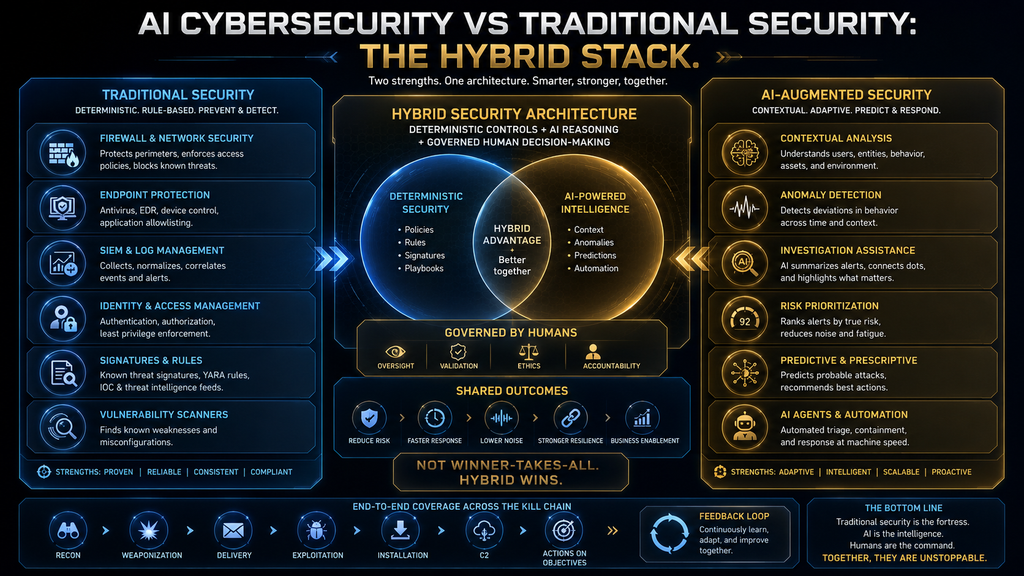
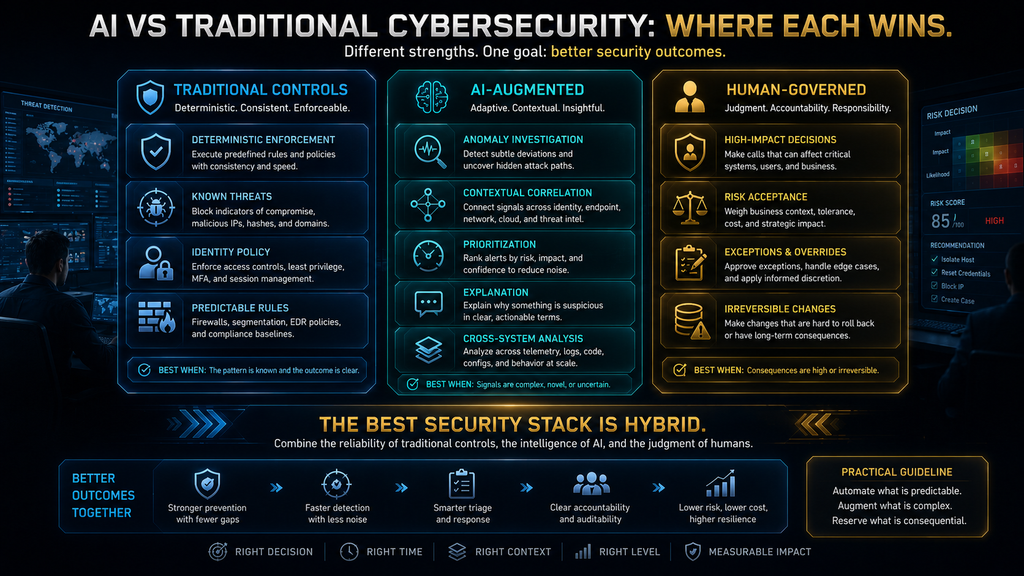
Traditional security tools are generally strongest at predictable, rule-based and repeatable controls, while AI adds more value when security work requires context, correlation, adaptation or large-scale investigation.
Traditional cybersecurity evolved around a practical assumption: many threats can be identified through known characteristics and controlled through policies. A firewall can allow or deny traffic based on rules. Antivirus can identify a known file signature. An intrusion-detection system can alert when traffic matches a known pattern. An identity system can block access when authentication requirements fail.
Those mechanisms are not outdated simply because AI exists.
They are valuable because they are deterministic.
If a security team knows exactly what condition should cause an action, deterministic logic can be extremely effective. There is little benefit in asking a probabilistic model to reason about something that can be expressed cleanly as a rule.
AI becomes more interesting when the security question is less obvious.
Why did this login occur? Are these seven alerts actually one incident? Does this vulnerability matter more on one asset than another? Is this unusual PowerShell activity malicious or a legitimate administrative task? Does a suspicious domain become more dangerous because the endpoint already shows signs of compromise?
Those questions require context.
That is where AI starts earning its place.
Why Traditional Security Tools Still Exist
Traditional security tools exist because cybersecurity needs predictability, enforceability and repeatability, not only intelligence.
Consider an access-control policy:
Only members of Group A may access System B.
There is little reason to use a large language model to make that decision. The requirement is explicit, the condition is measurable, and the consequences of inconsistency are high.
The same logic applies to many security controls. Organizations need systems that can enforce network policy, apply known signatures, validate authentication, inspect known indicators, quarantine files, collect logs, retain evidence and provide predictable audit trails.
Traditional controls also have a major advantage during incident response: analysts and auditors often understand why the control produced the result it did.
That matters.
A deterministic firewall rule can be inspected. A signature can be traced. A policy can be reviewed. A scheduled response can be reproduced.
NIST’s current Cyber AI work does not frame AI as a replacement for conventional cybersecurity foundations. Instead, the work explicitly discusses the relationship between AI-assisted mechanisms and traditional mechanisms in terms of their different purposes and objectives.
That is a more useful way to think about modernization.
The goal is not to make every control intelligent.
The goal is to make the overall system more capable without making it less controllable.
Where Traditional Tools Start to Struggle
Traditional controls become less effective when the security problem is no longer well described by a fixed set of known indicators.
Modern attacks can involve legitimate tools, compromised accounts, rapidly changing infrastructure, unusual combinations of normal activity, new attack paths and behavior that does not match previously defined rules.
A rule can identify:
“This known malicious file hash appeared.”
It is much harder for a static rule to answer:
“This activity is suspicious because a privileged account logged in from an unusual device, launched an uncommon process, contacted a newly observed domain and then accessed a system it almost never uses.”
That is a correlation problem.
The challenge is not that traditional tools are incapable of correlation. Modern SIEM, XDR and related platforms already perform extensive correlation. The difference is that AI can add a more flexible semantic layer on top of those relationships.
SentinelOne’s current comparison makes this distinction directly: traditional tools tend to rely on signatures, rules and known indicators, while AI-powered systems can learn patterns, adapt to new behavior and provide broader contextual analysis. That is a vendor explanation rather than an independent benchmark, but it accurately captures the architectural distinction we need to examine.
The question is therefore not whether traditional correlation is obsolete.
It is whether AI can improve the reasoning that sits above the correlation engine.
What AI Actually Adds
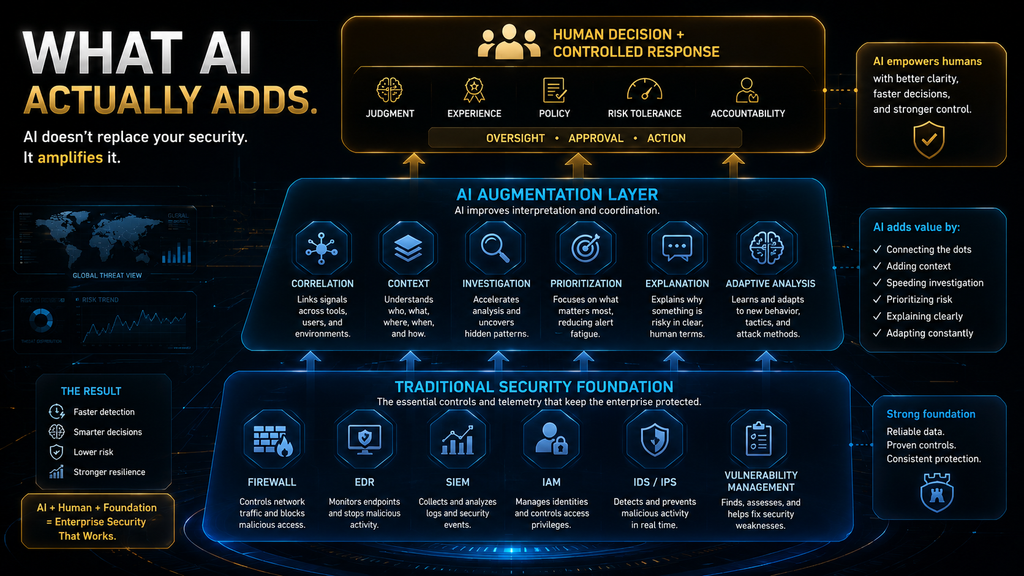
AI adds the most value when the security problem cannot be completely described in advance and analysts need help interpreting multiple signals at once.
The most important improvements usually fall into five areas: detection of unfamiliar patterns, contextual correlation, investigation, prioritization and automation.
Adaptive analysis
AI can identify relationships that may not have been encoded as a specific rule.
Contextual correlation
AI can connect identity, endpoint, network, cloud, vulnerability and threat-intelligence information.
Investigation
AI can gather evidence, summarize timelines and generate hypotheses for analysts to validate.
Prioritization
AI can help determine which alerts, vulnerabilities or incidents deserve attention first based on broader context.
Automation
AI agents can potentially move beyond predefined workflows and choose investigation steps dynamically, although that added flexibility also requires additional governance.
NIST’s Cyber AI Profile explicitly identifies advanced threat detection, advanced threat analysis, automated incident response and proactive risk management among the defensive opportunities for AI.
Those capabilities explain why organizations are adding AI.
They do not explain why organizations should replace everything else.
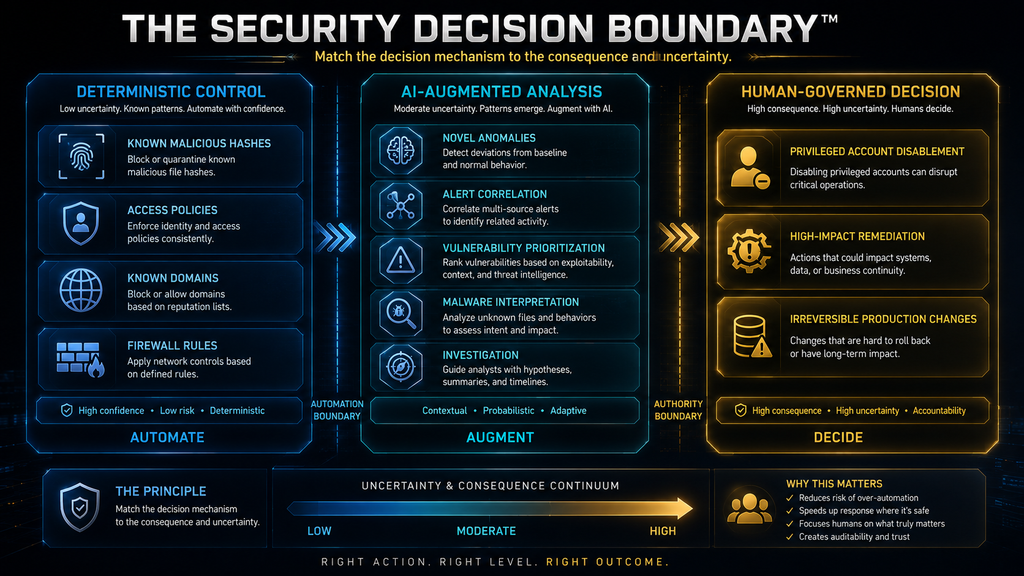
The Security Decision Boundary™
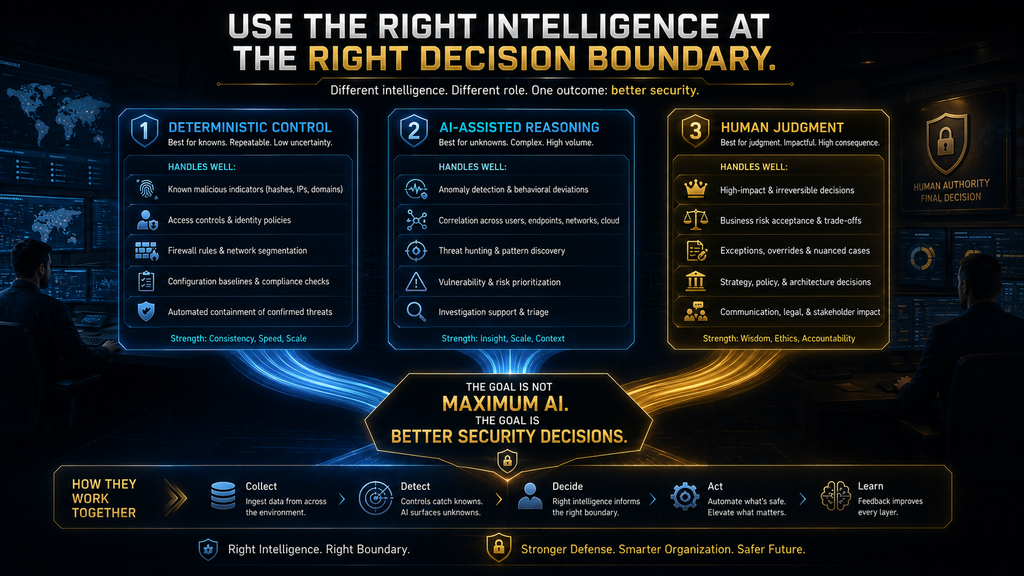
The most useful comparison is to decide which security tasks should be deterministic, which should be AI-assisted, and which should remain human-governed.
The AI Hustle World Security Decision Boundary™ is:
| Security task | Best default | Why |
|---|---|---|
| Known malicious hash | Traditional control | Deterministic and fast |
| Known malicious domain | Traditional + intelligence | Clear enforcement logic |
| Authentication policy | Traditional IAM control | High predictability required |
| Alert correlation | AI-assisted + traditional analytics | Context can change the meaning |
| Novel anomaly investigation | AI-assisted | Requires pattern and context reasoning |
| Vulnerability prioritization | Hybrid | Technical and business context both matter |
| Malware interpretation | Hybrid | AI can accelerate analysis; verification remains important |
| Incident recommendation | AI-assisted | Broad evidence can improve decision quality |
| High-impact account disablement | Human-governed | Consequence of error is high |
| Irreversible production change | Human-controlled | Requires authority and accountability |
This is the core comparison the article should leave with readers.
There are different technologies for different decision types.
AI Detection vs Rule-Based Detection
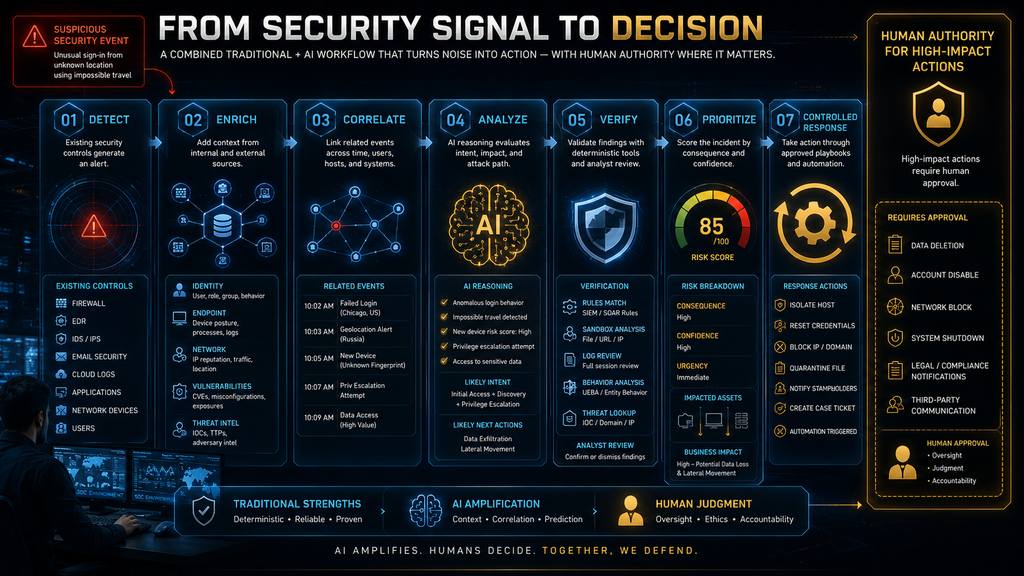
AI tends to outperform fixed rules when the attacker can vary the exact appearance of malicious behavior, while rules remain powerful when the malicious condition is known and unambiguous.
Imagine a traditional rule:
Block executable files arriving from an external sender.
That can be highly effective for a clearly defined policy.
Now imagine an attacker using a legitimate cloud service, a compromised account and a normal administrative tool to conduct an attack. The individual events may each appear legitimate.
The problem emerges from the relationship between them.
AI can help identify that relationship.
That does not make rule-based detection obsolete. In fact, the best detection systems often use both.
The deterministic layer catches what is known and enforceable.
The AI layer looks for what is unusual, correlated or difficult to encode as a static condition.
This produces a more resilient architecture than forcing everything through one technology.
The Best AI Cybersecurity Architecture Is Usually Hybrid
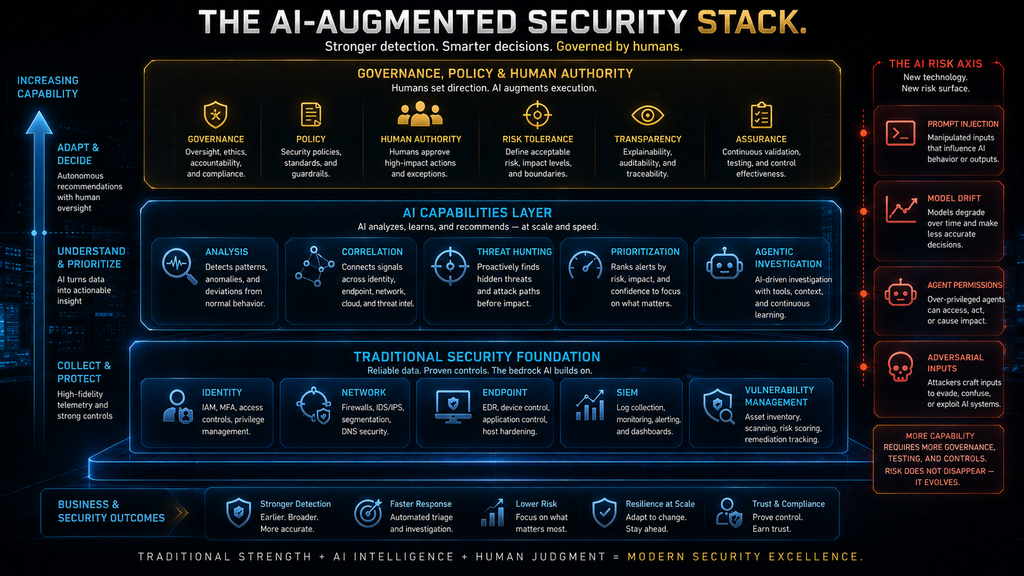
A hybrid security architecture uses traditional tools as the enforcement and telemetry foundation, AI as an analysis and prioritization layer, and human governance for consequential decisions.
The architecture can be thought of as four layers.
Foundation
Firewall, endpoint protection, identity and access management, SIEM, network controls, vulnerability management and other established controls.
AI augmentation
Correlation, contextual analysis, anomaly interpretation, alert triage, investigation, prioritization and explanation.
Governed automation
SOAR playbooks, AI agents and approved response workflows.
Human authority
Risk acceptance, exceptions, policy decisions, high-impact response and accountability.
This approach has an important advantage: AI can improve the parts of the security operation that need intelligence without weakening the controls that need predictability.
That is also consistent with the direction of NIST’s current Cyber AI Profile work, which treats AI-enabled defense as one focus area while separately addressing the need to secure AI systems and protect organizations from AI-enabled attacks.
Where AI Actually Improves Detection
There is a difference between detecting a known threat and recognizing a new combination of otherwise ordinary activity.
Traditional detection is excellent at the first problem.
AI becomes more valuable in the second.
Suppose an organization already knows that a particular malware family uses a specific domain. Blocking that domain is straightforward.
The harder case is when an attacker compromises an employee account, uses legitimate software, creates a new command channel and accesses a sensitive application without triggering a known signature.
The individual events may not be obviously malicious.
The pattern may be.
AI can help surface that pattern by considering behavioral context rather than isolated indicators.
That doesn’t mean AI automatically “understands the attacker.”
It means it can provide another analytical mechanism for identifying relationships that are difficult to encode manually.
Where Traditional Detection Still Wins
A comparison article becomes useless when it refuses to acknowledge where the supposedly inferior technology is better.
Traditional controls still have clear advantages when:
- the threat indicator is known;
- the policy is explicit;
- the response must be deterministic;
- low latency matters;
- the action is repetitive;
- auditability is critical;
- false unpredictability is unacceptable.
For example, if a security team has confirmed that a particular malicious IP should never be contacted, a deterministic block rule may be preferable to an AI-generated decision every time a packet appears.
Similarly, an identity policy that requires phishing-resistant authentication for privileged users does not need an AI reasoning layer to decide whether MFA is appropriate.
This is why a mature AI-security program should not ask:
“Where can we use AI?”
It should ask:
“Where does AI provide something the existing control cannot provide efficiently?”
That question creates much better architecture.
AI for Investigation vs Traditional Investigation
Traditional SOC investigation often requires analysts to move between systems.
Open the SIEM.
Search the endpoint.
Check the identity provider.
Look at the network logs.
Inspect the vulnerability record.
Search threat intelligence.
Build a timeline.
Read the ticket.
Then start the reasoning process.
AI can help compress the navigation burden.
It can collect context, correlate evidence, summarize timelines and suggest investigation steps. That can reduce the amount of manual work required before the analyst reaches a useful hypothesis.
But this creates an important distinction.
AI can reduce investigation effort without replacing investigative responsibility.
The analyst still needs to decide whether the hypothesis is supported.
This is particularly important because an AI-generated explanation can sound complete even when important evidence is missing.
That is why a good security AI should expose the underlying evidence rather than only present a narrative conclusion.
What Improves More: Detection or Investigation?
AI is currently most strategically valuable when it improves the investigation layer around existing detection capabilities rather than treating detection itself as the only problem.
Organizations already have many detection mechanisms.
The bottleneck often becomes:
What do we do with the signal?
This is where AI can help.
A 2026 IBM analysis describes the shift toward AI-assisted security operations as a response to faster attack cycles and increasingly complex threat environments, while emphasizing the need to combine AI capabilities with enterprise security infrastructure.
The implication is important.
Buying another detection engine may produce another stream of alerts.
Adding an intelligence layer that helps determine which existing signals belong together can improve the whole stack.
That is a fundamentally different value proposition.
AI vs Traditional Tools for Malware and Vulnerability Work
AI has a particularly interesting role in security-analysis workloads because those workloads combine structured and unstructured evidence.
A traditional vulnerability scanner is good at finding a technical condition.
An AI system can help explain what the condition means in a particular environment.
A malware sandbox can produce hundreds of behavioral events.
AI can help turn those events into an understandable investigation narrative.
A static-analysis tool can produce a list of potential code weaknesses.
AI can help cluster, explain and prioritize the findings.
But the deterministic layer should remain important.
Mandiant’s 2026 guidance on AI-assisted vulnerability management recommends combining probabilistic AI reasoning with deterministic security testing and strong guardrails rather than relying entirely on model output. (cloud.google.com)
This is an excellent example of why “AI-powered” does not mean “AI-only.”
Alert Triage Is Another Strong AI Use Case
Traditional alert triage often depends on rules, severity levels, analyst experience and manual enrichment.
AI can make this process more contextual.
Instead of seeing:
Severity: High
the analyst may see:
High priority because the affected identity is privileged, the endpoint is business-critical, related activity has appeared on two additional systems, and the destination domain has not previously been observed in the environment.
That is much more useful.
The underlying detection may still come from a traditional control.
AI improves the interpretation.
This distinction is crucial because it demonstrates that AI does not have to replace the security stack to improve security outcomes.
False Positives: AI Helps, but It Does Not Magically Eliminate Them
AI is often promoted as a solution to false positives.
That claim is too broad.
AI can reduce false positives when it has richer context than the underlying rule.
For example, a rule may flag an unusual login.
AI can consider whether the user is traveling, whether the device is known, whether the same behavior occurred before, and whether the account recently changed credentials.
That additional context can improve prioritization.
But AI can also create false positives.
A model may interpret legitimate but unusual activity as malicious, especially when the available context is incomplete.
The correct comparison is therefore:
rules can be too rigid; AI can be more adaptive; adaptive systems still need calibration.
The goal isn’t zero false positives.
It is better allocation of analyst attention.
Explainability: Traditional Tools Have a Hidden Advantage
AI systems often receive criticism for being hard to explain.
That criticism becomes more important in cybersecurity because security decisions can have significant consequences.
A traditional rule can often be expressed plainly:
If IP = X, block.
An AI system may instead provide:
The activity appears anomalous based on multiple contextual signals.
That sounds useful, but the analyst needs to know which signals mattered.
A security AI therefore needs to expose enough evidence for the analyst to challenge the recommendation.
This is one area where traditional tooling remains structurally attractive.
Deterministic logic is easier to audit.
The answer is not to avoid AI.
It is to require evidence-backed AI explanations rather than black-box recommendations whenever the consequence of error is significant.
NIST’s 2026 Cyber AI work highlights governance and usability as important considerations for operational AI defense, reinforcing the need to treat AI as an engineered security component rather than an opaque add-on.
Adaptability vs Predictability
This is one of the most useful ways to compare the two approaches.
Traditional security offers:
high predictability, lower adaptability.
AI-powered security can offer:
higher adaptability, lower deterministic predictability.
Neither is automatically superior.
Imagine a control protecting a payment system.
Predictability is valuable.
You may want a very clear rule governing which transaction patterns are automatically blocked.
Now consider threat hunting.
Adaptability is valuable.
You may want the system to recognize unusual combinations of behavior that nobody explicitly programmed.
The technology should match the decision.
That is the central theme of this article.
Speed: Where AI Actually Matters
AI can reduce security-analysis time dramatically when analysts are spending time collecting and synthesizing context.
An AI system can query multiple datasets, summarize thousands of events and propose an investigation path quickly.
That matters because attack timelines are getting shorter.
IBM’s 2026 research reports a rapid rise in AI-enabled attacks and found that organizations using AI and automation in security operations reduced breach costs by almost $2 million on average, according to its Cost of a Data Breach research. This is an IBM study and should be treated as research from the named study, not as a universal guarantee for every organization’s ROI.
The important implication is not:
“AI always saves $2 million.”
It is:
Automation and AI-assisted security can have measurable economic value when they reduce the time and labor required to detect, investigate, and contain incidents.
That is the economic case worth making.
AI Can Also Make the Security Stack More Complicated
Adding AI creates another layer to manage.
Organizations may now have:
- traditional security products;
- AI-enhanced versions of those products;
- security copilots;
- autonomous agents;
- model gateways;
- AI-specific monitoring;
- new permissions;
- new logging requirements;
- new data-governance obligations.
If AI simply creates another isolated dashboard, the organization may add complexity rather than reduce it.
This is why the best AI security investments often improve integration rather than simply adding another tool.
The architecture should ideally allow AI to consume and reason over existing security evidence instead of forcing analysts to move into yet another disconnected workflow.
Vendor materials increasingly position AI-ready platforms around unified data, multiple connectors and integrated security operations; Microsoft, for example, describes fragmented security estates with dozens of disparate tools as a major operational challenge in its current SIEM buyer guidance. That is a vendor claim and should be treated accordingly.
The general problem, however, is real:
More tools do not necessarily mean more security.
Sometimes they mean more places to look.
The AI Attack Surface Is a New Cost of AI Adoption
There is another trade-off that traditional-tool comparisons often omit.
Traditional tools have attack surfaces too, but AI systems add new concerns around model behavior, prompt injection, training or retrieval data, agent permissions, model drift and unexpected outputs.
NIST’s current Cyber AI work explicitly identifies adversarial attacks, unauthorized access, model drift, supply-chain concerns, and inaccurate or unexpected AI behavior among the challenges organizations need to manage.
That means organizations should not treat AI security tools as automatically safer because they are AI-powered.
They become new security components that themselves need securing.
This leads to an important architectural rule:
Every AI capability added to the security stack creates both defensive value and a new object that must be governed.
That is one of the reasons traditional controls remain relevant even in a highly AI-driven SOC.
The Hybrid Cybersecurity Stack
The strongest architecture is usually not a technology compromise. It is a functional division of labor.
| Layer | Primary job | Best fit |
|---|---|---|
| Identity & access | Enforce authorization | Traditional controls |
| Network enforcement | Allow/deny traffic | Traditional + intelligence |
| Endpoint security | Detect/block behavior | Hybrid |
| SIEM/data layer | Collect/correlate telemetry | Traditional + AI |
| Threat intelligence | Provide context | Hybrid |
| AI analysis | Explain/correlate/prioritize | AI |
| SOAR | Execute defined workflows | Traditional automation + AI input |
| AI agents | Investigate/coordinate | AI + strict governance |
| High-impact decisions | Risk acceptance/accountability | Human |
The goal is not to make every layer AI-powered.
It is to create a system where the right decision mechanism sits at the right layer.
That is the real meaning of AI augmentation.
When AI Is Worth Adding
AI is particularly attractive when the organization has one or more of these problems:
High analyst workload
Large numbers of alerts require repetitive enrichment and investigation.
Context fragmentation
Important evidence exists across multiple security systems.
Fast-changing attacks
Attackers frequently alter indicators and tactics.
Large vulnerability queues
Technical findings need environmental prioritization.
Skill constraints
Experienced analysts are spending too much time on routine tasks.
Large data volumes
Humans cannot inspect all relevant evidence manually.
Complex investigations
The important signal is the relationship among multiple otherwise-normal events.
These are problems where AI can provide a meaningful improvement.
When Traditional Tools Are Still the Better Choice
Traditional mechanisms remain preferable when the organization needs:
Deterministic enforcement
The condition and response are well defined.
Extremely predictable behavior
Unexpected model output would be a liability.
Low-cost known-threat coverage
A simple signature or rule already solves the problem.
Strong auditability
The decision needs to be easy to reproduce.
High-confidence policy enforcement
Authentication, access control and segmentation are good examples.
Irreversible controls
A human or deterministic rule should govern the most consequential actions.
The mistake is assuming that because AI can technically perform a task, it should.
Technology selection should follow the problem.
A Practical Decision Matrix
Use this framework when evaluating a security workload.
| Question | Mostly “Yes” | Recommended approach |
|---|---|---|
| Is the condition clearly defined? | Yes | Traditional |
| Is the response deterministic? | Yes | Traditional |
| Is context spread across many systems? | Yes | AI-assisted |
| Does the problem involve novel behavior? | Yes | AI-assisted |
| Is analyst investigation the bottleneck? | Yes | AI-assisted |
| Does the action have high consequences? | Yes | Human-governed |
| Can the result be independently verified? | Yes | AI can receive more autonomy |
| Is the action irreversible? | Yes | Strong human control |
| Is the environment rapidly changing? | Yes | AI augmentation becomes more useful |
| Is the model itself hard to validate? | Yes | Limit autonomy |
This is more useful than asking whether “AI security” is generally better than “traditional security.”
The answer depends on the workload.
What a Safe Migration Path Looks Like
Organizations do not need to replace their entire security estate to begin using AI.
A better approach is incremental.
Stage 1: Add AI to investigation
Use AI to summarize and contextualize existing alerts.
Do not change enforcement.
Stage 2: Add AI to prioritization
Allow AI to rank alerts, vulnerabilities and incidents based on broader context.
Keep human review.
Stage 3: Add AI to investigation workflows
Allow AI to gather evidence across approved systems.
Keep response authority restricted.
Stage 4: Automate low-risk actions
Permit predefined and reversible actions.
Stage 5: Expand authority selectively
Only after the system demonstrates reliable performance should higher-impact workflows be considered.
This approach creates operational evidence before organizational risk increases.
It also prevents the classic mistake of starting with the most ambitious use case simply because it looks impressive in a demonstration.
How to Measure Whether AI Actually Improved Cybersecurity
The most useful metrics are not “number of AI actions” or “percentage of security stack using AI.”
Measure the actual outcome.
Detection and investigation
- Mean time to detect
- Mean time to triage
- Mean time to investigate
- Mean time to contain
- Percentage of alerts correlated
- False-positive rate
- Duplicate-alert reduction
Vulnerability management
- Time to validate findings
- Time to prioritize
- Time to remediate
- Percentage of AI-generated findings confirmed
- Critical vulnerabilities outside remediation SLA
Analyst productivity
- Analyst-hours per incident
- Manual investigation steps removed
- Backlog reduction
- Cases handled per analyst
AI reliability
- Incorrect recommendations
- Human override rate
- Unsupported conclusions
- Escalations due to uncertainty
- Drift-related performance changes
Business outcome
- Incident cost avoided
- Downtime reduced
- Exposure window reduced
- Security capacity recovered
The crucial principle is:
Measure what became better, not what became automated.
AI ROI: How to Avoid a False Business Case
The cheapest AI tool is not necessarily the most valuable.
Suppose a security platform costs $100,000 a year but saves only a few hours of analyst time. That is not automatically a successful deployment.
Conversely, a more expensive platform may be justified if it reduces investigation time across a large SOC, improves prioritization, reduces breach costs, and allows the organization to delay hiring because existing analysts can cover more work.
A realistic AI-security ROI calculation should consider:
labor recovered + incident-cost reduction + reduced downtime + improved risk coverage
minus:
software cost + integration cost + infrastructure + training + governance + validation + residual risk.
The last term is frequently ignored.
AI that saves labor but introduces dangerous false decisions can have negative ROI.
Common Mistakes When Replacing Traditional Security With AI
The first mistake is replacing a deterministic control with a probabilistic one without a clear reason. If a firewall rule solves a problem reliably, an AI model may not improve it.
The second is assuming that higher detection rates automatically mean better security. A system that dramatically increases alerts can make analysts less effective.
The third is buying an AI security platform without fixing data quality and integration first. AI cannot reason accurately from incomplete telemetry.
The fourth is giving autonomous agents excessive permissions. More access does not make the model more intelligent; it increases the consequences of mistakes.
The fifth is ignoring explainability. Security teams need to know why a recommendation was made and what evidence supports it.
The sixth is treating a successful pilot as proof of production reliability. Real environments contain messy data, unusual business processes and attackers actively trying to break the system.
The seventh is measuring the wrong outcome. “We automated 70% of triage” is less useful than “mean investigation time fell from 42 minutes to 18 minutes without increasing false escalations.”
What Happens If You Do Nothing?
The answer is not that your organization will automatically be breached.
Traditional security can still be effective.
The risk is more operational.
As attackers automate more reconnaissance, exploitation, malware generation and social engineering, security teams may find that manual analysis becomes increasingly expensive relative to the speed of the threat. IBM’s 2026 research describes an environment in which AI-enabled attacks are accelerating and organizations using AI and automation report materially lower breach costs, although these results are based on IBM’s study rather than a universal guarantee.
The potential consequence of doing nothing is therefore a growing analysis gap.
You may continue detecting threats.
But you may take longer to understand them.
You may continue generating vulnerability findings.
But the remediation queue may grow faster than the team can prioritize it.
You may continue collecting logs.
But analysts may spend more time searching for meaning across fragmented systems.
AI is one response to that problem.
It is not the only response.
Process improvement, better integrations, stronger data architecture, identity security, cloud visibility and well-designed automation can also reduce the gap.
The decision should therefore be based on where the actual bottleneck exists.
AI Cybersecurity vs Traditional Tools: Who Wins?
There is no universal winner.
Traditional security wins when the problem is known, deterministic, repetitive, and highly sensitive to unpredictable behavior.
AI wins when the problem depends on context, pattern variation, correlation, investigation, prioritization or large-scale interpretation.
Hybrid wins when both are required.
That last category covers a large portion of real-world cybersecurity.
A vulnerability scanner finds the weakness.
AI helps understand the risk.
A SIEM collects the event.
AI helps correlate it.
An endpoint platform detects the suspicious process.
AI helps investigate why it matters.
SOAR executes the response.
AI may help decide which playbook is appropriate.
A human approves the action when the consequence is high.
That is not a compromise.
It is a more rational division of labor.
AI Hustle World Reality Check
The AI-versus-traditional-security debate is often presented as if one side must replace the other.
That is the wrong frame.
A firewall does not become useless because an LLM can reason about network events. An identity policy does not become obsolete because an AI model can identify unusual behavior. A vulnerability scanner does not stop being valuable because an agent can interpret scan results.
The real question is whether the existing tool is solving the problem adequately.
If it is, replacing it simply because AI is fashionable creates unnecessary cost and risk.
If the existing workflow is struggling because analysts cannot keep up with alert correlation, contextual investigation, vulnerability prioritization or rapidly changing attack patterns, then AI may create real leverage.
There is another reason to stay cautious.
AI is itself becoming part of the attack surface. NIST’s current Cyber AI work explicitly treats AI as both a defensive opportunity and a new class of cybersecurity risk, while its 2026 workshop report highlights governance challenges, AI attack surfaces, taxonomy issues, and the need for risk-based guidance.
So the strongest security architecture is not the most AI-heavy one.
It is the one where each security decision is handled by the mechanism best suited to its characteristics.
That is the real answer to the title question.
The Future of the Security Stack
The security stack is unlikely to become purely AI.
It is more likely to become AI-augmented and increasingly orchestrated.
Traditional controls will continue enforcing identity, access, segmentation, known threats, logging and policy.
AI will increasingly sit across those systems to interpret evidence, prioritize work, investigate anomalies and coordinate workflows.
Agents may eventually take on more action, but autonomy will probably remain graduated according to risk.
NIST’s current Cyber AI work already frames the future around three connected responsibilities: secure AI systems, use AI to defend, and defend against AI-enabled attacks.
That is a much better vision of the future than simply “everything becomes AI.”
The security stack becomes more capable, but the fundamental principle stays the same:
Use the simplest trustworthy mechanism for the job, and add AI where the problem actually requires adaptive reasoning.
Frequently Asked Questions
Is AI cybersecurity better than traditional cybersecurity?
Not universally. AI is generally more valuable for contextual analysis, correlation, investigation and adaptive detection, while traditional controls remain highly effective for deterministic enforcement, known threats, identity policies and predictable response workflows.
Will AI replace traditional cybersecurity tools?
Probably not as a general rule. AI is more likely to augment existing security tools by analyzing their data, improving prioritization and coordinating workflows.
What are traditional cybersecurity tools?
Traditional cybersecurity tools include firewalls, endpoint protection, signature-based antivirus, intrusion detection and prevention, SIEM, identity controls, vulnerability scanners and rule-based security automation.
What does AI add to cybersecurity?
AI can add adaptive pattern analysis, semantic interpretation, cross-system correlation, investigation support, prioritization and increasingly autonomous workflow execution.
Is AI more accurate than traditional security tools?
Accuracy depends on the task. Traditional tools can be more predictable for known conditions, while AI can identify complex or previously unmodeled relationships. The right comparison is task-specific rather than universal.
Can AI eliminate false positives?
No. AI can reduce false positives when it has richer contextual information, but it can also generate false positives. Effective security operations still require calibration and human validation.
Should organizations replace their SIEM with AI?
Usually not simply because an AI tool exists. SIEM remains valuable for telemetry collection, storage, search and correlation. AI can augment the SIEM by adding contextual analysis, investigation and prioritization.
What is an AI SOC?
An AI SOC is a security-operations model in which AI assists or automates activities such as detection analysis, triage, investigation, threat intelligence and response. It does not necessarily mean that humans are removed from security operations.
Are AI cybersecurity tools safer than traditional security tools?
Not automatically. AI tools introduce additional risks involving model behavior, data, permissions, prompt injection, adversarial manipulation and unexpected results. They need security controls of their own.
When should a company adopt AI cybersecurity?
AI becomes particularly attractive when alert volume, investigation workload, vulnerability queues, security-tool fragmentation or rapidly changing threats create a measurable operational bottleneck.
What is the safest way to adopt AI cybersecurity?
Start with low-risk analysis and prioritization, measure results, then expand into controlled automation. High-impact and irreversible decisions should retain stronger human governance.
Final Thoughts
The most useful conclusion is also the simplest.
AI cybersecurity is not a replacement category for traditional security. It is an additional decision and analysis layer.
Traditional tools remain essential because cybersecurity needs predictable controls. You need systems that enforce identity policy, block known threats, inspect traffic, collect telemetry, apply signatures, validate vulnerabilities and produce auditable outcomes.
AI becomes valuable where those systems encounter ambiguity.
When an alert is suspicious but not obviously malicious. When seven ordinary events become one unusual pattern. When thousands of vulnerability findings need environmental prioritization. When analysts need to understand why an event matters instead of simply knowing that the event occurred.
That is where AI can create real improvement.
The strategic mistake is to ask:
“Should we replace our traditional security tools with AI?”
The better question is:
“Which parts of our security operation are limited by lack of context, adaptive reasoning or analyst capacity—and which parts are already solved effectively by deterministic controls?”
Once the question is framed that way, the answer becomes much more practical.
Keep the controls that need to be predictable.
Augment the workflows that need more context.
Automate the tasks that are safe to automate.
And keep humans responsible for decisions where uncertainty, consequence, or accountability is too high to delegate blindly.
The future security stack will not be the most automated stack. It will be the stack that puts the right kind of intelligence at the right decision boundary.
Go From Comparison to the Right Security Stack
The next step is choosing the security tools that fit your actual environment, risk profile, and operational needs.
Explore AI Cybersecurity →Written by
Muntasir Ahmad Chowdhury
Founder, AI Hustle World
Muntasir Ahmad Chowdhury is the Founder of AI Hustle World, an independent publication dedicated to making Artificial Intelligence practical, trustworthy, and easy to understand. He researches AI tools, automation, customer service, productivity, and real-world business applications, helping readers make smarter technology decisions through research-driven, experience-backed content.
Expertise:
AI Tools • AI Automation • AI Customer Service • AI Productivity • Generative AI • AI Workflows
Get Smarter With AI
Enjoyed this guide? Get practical AI tools, tutorials, and honest reviews delivered to your inbox.
2 thoughts on “AI Cybersecurity vs Traditional Security Tools: What Actually Improves?”