Evidence: Documentation reviewed
Last checked: August 2026
What was done: Written from official documentation and the published sources linked in this article. Not hands-on tested.
Files: None
Affiliate links: No
Last Update: August 2026
How AI Detects Phishing, Social Engineering & Suspicious Messages
A phishing message used to be easier to recognize.
The email might contain obvious spelling mistakes, a strange-looking sender address, an awkward request from a supposed executive, or a link that clearly had nothing to do with the company being impersonated. Security awareness training could teach employees to look for those warning signs, and traditional email filters could combine them with reputation lists, attachment analysis and known malicious indicators.
That model is becoming less reliable.
Modern phishing can be grammatically clean, professionally written and personalized to the recipient. An attacker can imitate a familiar vendor, reference a real business process, use a recently registered domain that resembles a legitimate one, and create a message that makes sense in the context of what the target is doing. The attack may not even begin with email. It can arrive through SMS, messaging apps, social media, voice calls or a combination of several channels.
AI is making both sides of this contest more capable.
Attackers can use generative AI to produce convincing messages at scale, while defenders can use machine learning and newer AI systems to analyze message content, sender behavior, URLs, attachments, conversation history and contextual signals. NIST warns that AI is enabling increasingly convincing phishing attacks and recommends treating requests to click links, download files, transfer funds or provide sensitive information with particular caution.
The important shift is therefore not simply from traditional phishing detection to AI phishing detection. It is from detecting suspicious messages to evaluating whether the entire interaction is trustworthy.
That distinction matters because a sophisticated phishing message can look perfectly normal when examined in isolation. The sender may be familiar. The language may be professional. The request may be plausible. The link may not yet appear on a blacklist.
The suspiciousness emerges when the pieces are considered together.
A new payment instruction arrives from a familiar executive’s account, but the request changes the normal approval process. A login link uses a domain that looks almost identical to the company’s real domain. A text message references a package the recipient actually ordered, but directs them to a different payment page. A supposed IT administrator asks an employee to approve a login that does not match the employee’s normal authentication pattern.
Modern AI phishing detection is increasingly about connecting those signals and determining whether the requested action makes sense—not merely deciding whether the message “looks like phishing.”
Why Phishing Detection Has Become a Harder AI Problem
The fundamental problem with phishing is not that attackers send suspicious messages. It is that they send messages designed to look trustworthy.
Phishing works by borrowing credibility from something the target already recognizes: a bank, colleague, supplier, cloud service, delivery company, executive, government agency or familiar business process. The attacker then inserts a malicious objective into that trusted-looking interaction.
That objective might be stealing credentials, delivering malware, redirecting a payment, collecting personal information or persuading someone to disclose information that can be used in a later attack. NIST defines phishing as the use of convincing emails or other messages to trick people into opening harmful links or downloading malicious software, and notes that phishing can also occur through text and social media messages.
The traditional detection problem was therefore already more complicated than keyword matching. AI makes the problem both harder and more interesting because attackers can now produce convincing language more cheaply and personalize it at scale.
A 2024 human-subject study found that fully automated AI-generated spear-phishing emails achieved a 54% click-through rate in its experimental setting, matching the rate achieved by human-crafted spear-phishing emails; an AI-assisted human-in-the-loop condition reached 56%. The study had 101 participants, so its results should not be interpreted as a universal real-world click rate, but the finding demonstrates that AI-generated phishing can be persuasive enough to rival human-crafted attacks in controlled testing.
That creates an uncomfortable reality for defenders: poor grammar is no longer a dependable security control.
A July 2026 study published in Frontiers in Big Data similarly found that LLM-generated phishing emails can be grammatically correct and contextually coherent, creating problems for detection approaches that depend heavily on surface-level anomalies. The researchers also found that detectors can perform strongly within the conditions they were trained for while generalizing poorly to new models or domains.
In other words, the attacker does not need to make the message look suspicious. The defender has to determine whether something is suspicious despite the message looking legitimate. That is a much harder problem.
What AI Actually Looks For in a Suspicious Message
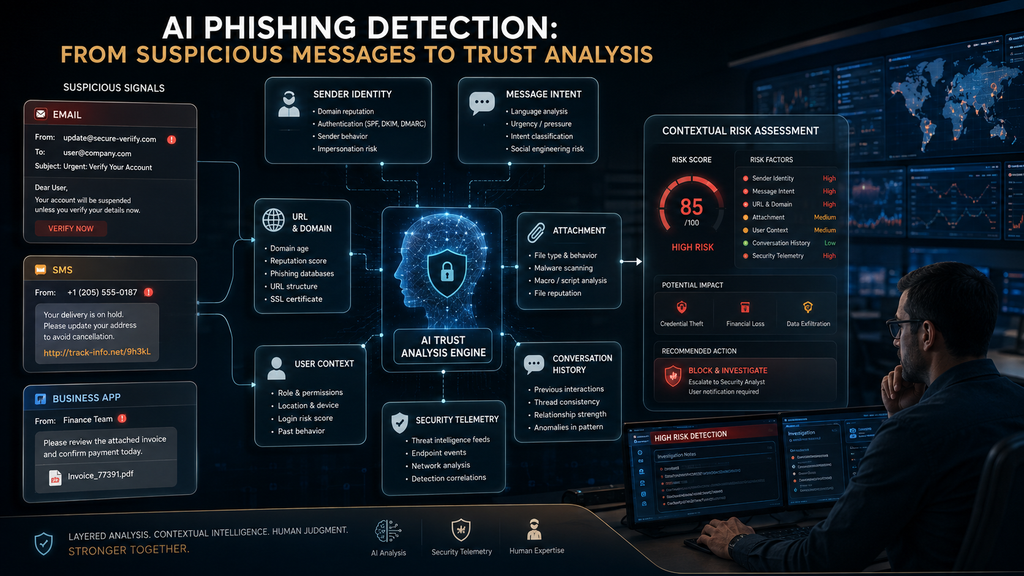
AI phishing detection works best when it combines multiple evidence sources rather than relying on a single clue.
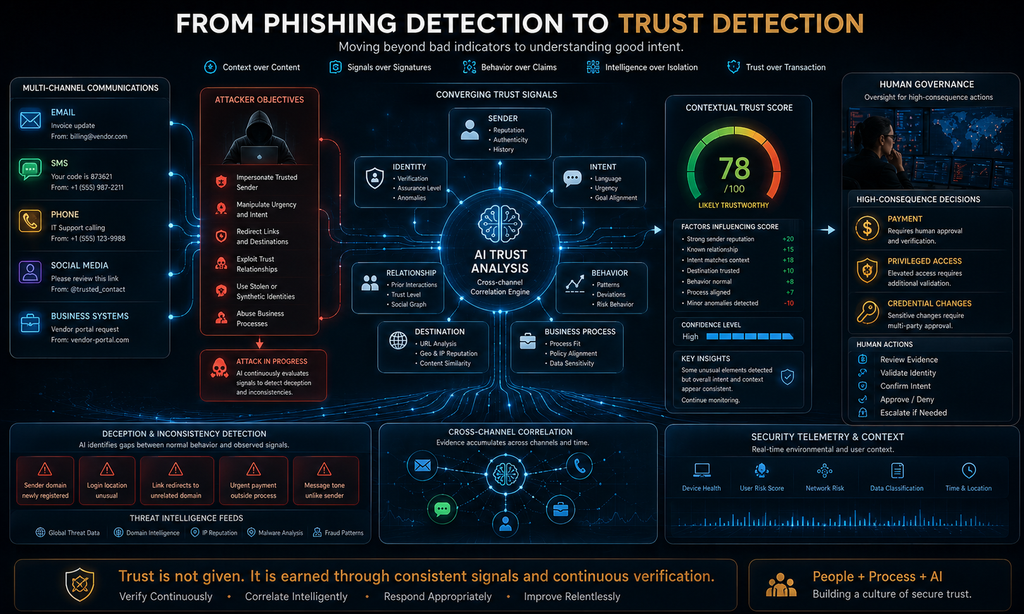
A modern detection system may evaluate the language and structure of a message, sender identity, domain reputation, URL characteristics, attachment behavior, previous communication patterns, authentication signals, user context and other security telemetry. The exact signals depend on the product and architecture, but the principle is consistent: context is more valuable than any isolated indicator.
Consider an email that says: “Please review the attached invoice and confirm payment by 3 PM.” There is nothing inherently malicious about that sentence. A language-only detector may find no obvious problem.
But imagine the same message comes from a newly registered look-alike domain, uses an attachment type the sender has never previously used, requests a bank-account change, arrives outside the normal vendor communication pattern and contains a link leading to infrastructure with a poor reputation. Now the message has a very different risk profile. The AI did not discover a magical “phishing word.”
It connected several weaker signals into a stronger assessment. That is the central mechanism behind modern AI-assisted detection.
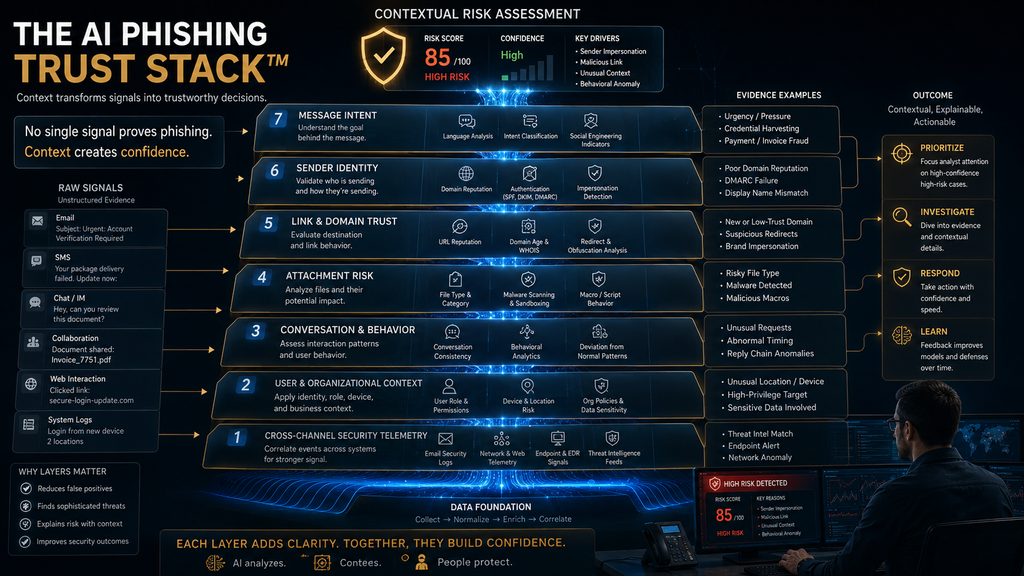
The AI Phishing Trust Stack
A useful way to understand this process is to think of a suspicious message as passing through several layers of trust evaluation. The AI Hustle World Phishing Trust Stack has seven layers:
- Message intent
- Sender identity
- Link and domain trust
- Attachment and payload risk
- Conversation and behavioral context
- User and organizational context
- Cross-channel and security telemetry
No single layer has to prove that the message is malicious. The objective is to determine whether the combined evidence creates enough risk to justify blocking, quarantining, escalating or requesting human verification. This is also why a good detection system should not treat every suspicious characteristic equally.
A strange-looking URL might be enough to quarantine an automated marketing email. The same URL might require more investigation if it appears in an internal conversation from a known employee whose account has recently shown suspicious authentication activity.
Risk is contextual. That is the first principle to understand before evaluating AI phishing tools.
Layer 1: AI Analyzes What the Message Is Trying to Make You Do
Modern AI can analyze a message semantically rather than merely looking for suspicious keywords. The system can ask a much more useful question: What action is this message trying to persuade the recipient to take? That action might be:
- clicking a login link,
- opening an attachment,
- transferring money,
- changing bank details,
- approving a request,
- sharing credentials,
- disclosing sensitive information,
- installing software,
- calling a number,
- bypassing a normal process.
This is important because social engineering is fundamentally about behavioral manipulation.
A message saying “Your account has been suspended” is not inherently malicious. The security concern emerges when the message uses that claim to push the recipient toward a risky action.
AI can therefore classify not only the subject matter but the intent behind the communication. This is especially valuable for attacks that avoid conventional phishing vocabulary.
A message does not need to say “verify your password” to be dangerous. It might say “Your security settings require confirmation before today’s payroll run,” with a button leading to a fraudulent authentication page.
The wording is different. The underlying objective is similar. This is where semantic analysis becomes more useful than simple keyword detection.
Layer 2: AI Evaluates Whether the Sender Is Actually Trustworthy
The sender field is one of the most important parts of a phishing investigation, but checking whether the address “looks right” is not enough. Attackers can impersonate display names, use look-alike domains, compromise legitimate accounts or register domains that resemble trusted organizations. An AI-powered system can evaluate multiple identity signals together.
For example, it may compare the visible sender identity with the underlying address, domain age or reputation, authentication results, previous communication patterns and the relationship between the sender and recipient. Suppose an employee regularly receives invoices from supplier.com. A new message arrives from supplier-support.com.
The display name is identical to previous messages. A conventional user may not notice the difference. An AI system can compare the new sender against historical communication and recognize that the relationship has changed.
The important point is that identity is not just an email address. It is a relationship.
Who normally communicates with this person? From which domain? About what subjects? With what frequency? Through which channels? Does the request match the historical relationship?
That broader context can expose impersonation that looks convincing at the surface level.
Layer 3: AI Examines Links and Domains
URLs remain one of the most valuable technical signals in phishing detection. But the traditional method of asking whether a URL appears on a blacklist has an obvious limitation. A newly created malicious domain may not have a history.
Attackers know this. AI-assisted detection can therefore combine multiple URL and domain signals rather than depending on reputation alone. The system may evaluate the relationship between the displayed link and the destination, domain characteristics, redirects, certificate information, historical reputation, hosting patterns and similarity to legitimate domains.
Consider three links: company.com/login company-secure-login.com company.com.account-verify.example. A human may recognize the second as suspicious, but the third can be more deceptive because the legitimate brand appears prominently within a longer URL. An AI system can parse the domain structure and identify which portion actually controls the destination.
It can also compare the domain against known organizational infrastructure. This matters because attackers increasingly exploit visual trust. The user sees a familiar brand.
The browser goes somewhere else. AI detection therefore needs to understand the technical destination rather than simply interpreting what the URL looks like.
Layer 4: Attachments Need Behavioral Analysis
Attachments introduce another detection problem.
A malicious document can appear to be an ordinary invoice, résumé, purchase order or internal report. Traditional antivirus systems can detect known malicious files, but previously unseen threats create a more difficult problem.
AI can contribute by examining structural and behavioral signals. Depending on the security architecture, the system may evaluate file type, metadata, embedded scripts, macros, unusual object relationships, known indicators and sandbox behavior. The key is that AI does not need to conclude: “This file is definitely malicious.”
It can instead identify a combination of characteristics that make the attachment sufficiently risky to require further inspection. For example, an invoice attachment from a known supplier may be routine. An invoice that suddenly contains executable content, arrives from an unfamiliar domain and asks the recipient to enable a security feature before viewing the document is materially different.
Again, the value comes from correlation. A file rarely tells the whole story.
Layer 5: AI Can Compare the Message With the Conversation
This is where AI can become particularly powerful. A phishing message may look completely legitimate when viewed alone but become suspicious when compared with the previous conversation. Imagine an employee has exchanged ten emails with a supplier over the last month.
The supplier normally sends invoices as PDF attachments. Suddenly, the conversation continues from the same thread, but a new message says:
“We have changed banks. Please use the new account information for all future payments.”
The email could be perfectly written. The sender could even be a legitimate compromised account. The critical anomaly is the change in behavior.
AI can compare the new message with the communication history and recognize that the request is inconsistent with the established relationship. This is particularly important for Business Email Compromise. The FBI describes BEC as a sophisticated scam in which attackers compromise legitimate business email accounts through social engineering or computer intrusion and use them to initiate unauthorized transfers.
The 2025 FBI IC3 Annual Report recorded 24,768 BEC complaints and approximately $3.05 billion in reported BEC losses for 2025. That makes BEC a strong example of why message analysis cannot stop at “Does this email look like a phishing email?” The better question is: Does this request fit the established business relationship?
Layer 6: User Context Changes the Risk Score
The same message can represent different levels of risk for different people. A password-reset email sent to an ordinary employee may be moderately suspicious. The same message sent to a privileged administrator may deserve much more aggressive treatment.
Why? Because the potential impact is different. AI can incorporate user context into the risk assessment.
Useful signals may include:
- user’s role,
- privilege level,
- recent authentication behavior,
- normal working hours,
- geographic patterns,
- device information,
- recent security alerts,
- access to sensitive systems,
- previous interactions with the sender.
This is one reason AI-powered detection can outperform static rules when implemented correctly. A rule might say: “Suspicious login link → medium risk.”
A context-aware system can say: “Suspicious login link + privileged user + unfamiliar device + unusual location + recently observed credential attacks → high risk.” The second assessment is much closer to how a skilled analyst reasons.
Layer 7: AI Can Correlate Across Channels
Phishing is no longer confined to the inbox.
The 2026 Verizon DBIR highlights the expansion of social engineering beyond email and reports that mobile-centric social engineering has a successful-click rate 40% higher than traditional email phishing in its analysis. The report also notes that 41% of social-engineering breaches involved social vectors beyond email.
That means organizations need to think beyond email security. An attack may begin with an SMS. The attacker may then move the conversation to WhatsApp.
A phone call may follow. The victim may finally receive an email containing the fraudulent payment instructions. Each message can look relatively harmless.
The campaign becomes obvious when the signals are connected. This is where cross-channel AI can provide an important advantage. Instead of analyzing: email.
SMS phone social media as separate events, a security system can potentially identify that they are part of the same social-engineering campaign. That is a much harder problem than traditional spam filtering. It is also a much more valuable one.
Phishing, Social Engineering, Smishing and BEC Are Not the Same Thing
These terms are often mixed together, but they describe different layers of the threat. Phishing generally refers to deceptive communications designed to trick a target into clicking, downloading, logging in or disclosing information. Spear phishing is more targeted and personalized.
Smishing applies the same basic social-engineering concept to SMS or messaging. Business Email Compromise focuses heavily on trusted business relationships, impersonation and unauthorized financial or information-related actions. Social engineering is the broader category: manipulating people into taking actions that benefit the attacker.
That distinction matters because different attacks require different evidence. A generic phishing email may be detected primarily through sender, URL and message analysis. A BEC attack may require communication history, payment workflow, organizational relationships and identity signals.
A smishing attack may require phone-number reputation, message content, URL analysis and mobile context. A voice-based attack may require voice authentication and transaction verification rather than traditional email analysis. There is no single “AI phishing detector” architecture that solves all of these equally well.
How AI Detects Social Engineering Rather Than Just Phishing
The most interesting shift is from message classification to intent analysis. Traditional security tools often ask: “Is this message malicious?”
Social-engineering detection needs to ask: “Is someone attempting to manipulate this person into violating a normal trust or decision process?” That is a more sophisticated question.
Imagine a CFO receives: “I’m boarding a flight. Please approve the wire now and don’t call because I won’t have service.”
There may be no malicious attachment. There may be no obviously malicious link. There may not even be a technical exploit.
The attack is the request itself. It uses authority, urgency and secrecy to bypass the organization’s normal controls. AI can analyze these linguistic and contextual signals, but the strongest defense still comes from combining them with business rules.
If company policy says that wire-transfer changes require secondary verification, an AI system can flag the message because the request conflicts with the established process. This is much more powerful than merely identifying suspicious language. The system is evaluating whether the requested behavior is consistent with the organization’s normal trust model.
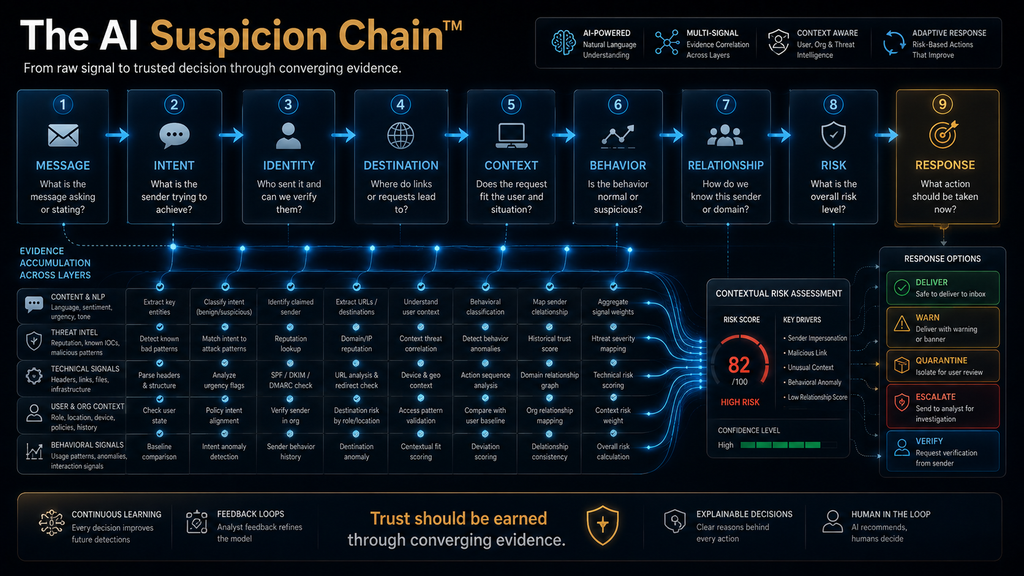
The AI Suspicion Chain
The AI Hustle World AI Suspicion Chain describes how a modern detection system can move from a message to a defensible risk assessment: Message → Intent → Identity → Destination → Context → Behavior → Relationship → Risk → Response. The important part is that the system should not jump directly from “message” to “block.” Each stage adds evidence.
A message asks for an unusual action. The sender identity is slightly inconsistent. The destination domain is unfamiliar.
The user normally does not receive this type of request. The conversation history shows a sudden change. The account recently authenticated from an unusual device.
Now the system has a much stronger basis for escalation. This layered approach also reduces one of the biggest problems in security automation: false positives. If every unusual message is blocked, legitimate communication suffers.
If only obvious phishing is blocked, sophisticated attacks pass through. The goal is to make the risk assessment more precise.
Why AI Should Not Automatically Block Everything Suspicious
This is one of the most important boundaries in AI phishing detection. A suspicious score is not the same thing as proof of malicious intent. Imagine an executive genuinely sends an urgent message requesting a financial document from a new device while traveling.
That may look anomalous. But it is not necessarily malicious. An overly aggressive AI system could block legitimate business operations.
That creates another problem: users begin learning that security controls frequently get in their way. Eventually they search for ways around them.
This is why the best systems use risk-based responses rather than a binary malicious/not-malicious decision. Low risk might mean allowing the message normally. Moderate risk might trigger additional warning or analysis.
High risk might quarantine the message. Very high risk could trigger automated containment and human investigation.
The response should match the confidence and consequence. This is particularly important for high-value workflows such as finance, identity administration and executive communications.
A Better AI Phishing Risk Model
A practical risk model should consider at least four variables:
- Likelihood: How strongly does the evidence indicate malicious intent?
- Impact: What happens if the message is malicious and the user acts on it?
- Confidence: How reliable is the available evidence?
- Reversibility: How easily can the organization recover if the system makes the wrong decision?
These variables matter because the same confidence level can justify different responses depending on impact. Suppose an AI system is 85% confident that a newsletter is malicious. Quarantining it is relatively low risk.
Now suppose the system is 85% confident that a message requesting a $500,000 payment is fraudulent. That should trigger stronger verification because the consequence of being wrong is much greater.
This produces a useful principle: The higher the consequence of the requested action, the stronger the verification required before trust is granted. AI should therefore help security teams allocate attention—not simply generate more blocks.
How AI Detects Suspicious Messages in Real Time
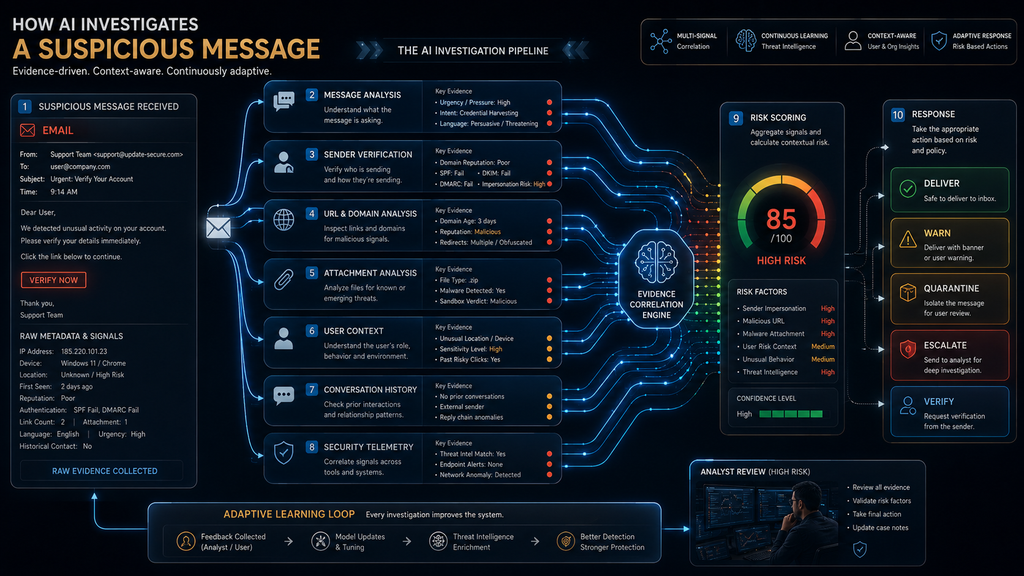
A modern workflow may look like this. A message enters the organization’s security system. The system extracts sender information, URLs, attachments and message content.
AI analyzes the semantic intent of the communication. Identity and authentication systems provide sender context. Domain and URL intelligence evaluate destinations.
Endpoint and identity telemetry provide additional context about the recipient. The system compares the message with previous communication patterns. A risk model combines those signals.
If the risk is low, the message may continue normally. If the risk is moderate, the system may add warnings or request additional analysis. If the risk is high, it can quarantine the message and send the incident to the SOC.
If the risk is critical, security automation can potentially block related infrastructure, revoke sessions or initiate incident response—provided those actions fall within the organization’s predefined authority. The important point is that AI is not replacing every component. It is becoming a reasoning and correlation layer across multiple controls.
What Happens When the Message Is Deliberately Designed to Fool AI?
This is where the technology becomes much more complicated. Attackers can adapt to detection. If they know that suspicious URLs are blocked, they can compromise legitimate websites.
If obvious urgency is flagged, they can write calmer messages. If poor grammar is a signal, they can use generative AI to produce polished language. If a domain reputation system is effective, they can use newly created infrastructure.
If a security system looks for specific phrases, attackers can change the wording. This creates an adversarial relationship.
The detector is learning patterns. The attacker is learning how to avoid them.
A July 2026 study of phishing detection illustrates the problem clearly. Two models exceeded 98% accuracy on clean test data, but both fell to roughly 64% accuracy under adversarial phishing conditions. The authors argue that clean-data accuracy therefore does not adequately predict real-world robustness.
That is an extremely important lesson for organizations evaluating AI security products. Do not ask only, “What is the model’s accuracy?” Ask: “Accuracy against what?”
Clean benchmark emails? Known phishing datasets? New campaigns?
AI-generated messages? Adversarially modified messages? Previously unseen domains?
Cross-channel attacks? A security model that performs beautifully on yesterday’s phishing dataset may perform much worse against tomorrow’s attacker.
Why “AI Accuracy” Is the Wrong Single KPI
Security vendors often advertise impressive detection rates. Those numbers can be useful, but they are incomplete. A model can achieve excellent accuracy while failing badly in the cases that matter most.
Suppose a detector is 99% accurate overall. If the 1% of missed messages disproportionately contain targeted attacks against privileged users, the practical security outcome may still be poor. Security teams should therefore evaluate:
- false positives,
- false negatives,
- detection latency,
- adversarial robustness,
- cross-model generalization,
- performance on new attack patterns,
- analyst review time,
- user friction,
- successful containment.
The 2026 Frontiers in Big Data research reinforces this point by showing that a stylometric detector can perform strongly in one environment while facing generalization challenges when the source model changes. The lesson is straightforward: A phishing detector should be evaluated as a continuously adapting security control, not as a one-time machine-learning benchmark.
AI-Generated Phishing Changes the Defensive Equation
Generative AI is not simply making phishing emails more grammatically correct. It changes the economics of personalization. Historically, writing a convincing spear-phishing message required time and research.
An attacker might need to examine the target’s public profiles, understand their role, identify their colleagues and construct a believable scenario. AI can accelerate parts of that process.
The 2024 spear-phishing study found that its AI system successfully gathered useful target information in 88% of cases and produced inaccurate profiles for 4% of participants within the study’s experimental setup. Again, these are study-specific results, not universal real-world rates, but they demonstrate how AI can reduce the effort required to personalize attacks.
That means the defender should not rely on personalization itself as evidence of legitimacy. In fact, highly relevant context can become a warning sign when the communication arrives unexpectedly.
A message that knows exactly which project you are working on may feel trustworthy. It can also mean the attacker has done their homework.
The Human Still Matters—But the Human’s Job Changes
AI does not eliminate the human element from phishing defense. It changes where human attention is applied. Traditional awareness programs often ask employees to identify suspicious messages manually.
That remains useful, but it has limitations. NIST’s Phish Scale exists specifically to help organizations assess how difficult phishing emails are for people to detect, recognizing that human phishing susceptibility depends on characteristics of the message and context. AI can move some of that analysis upstream.
Instead of asking every employee to make the same technical judgments, security systems can identify suspicious communications and reserve human attention for cases where context or consequence makes the decision important. That is a better division of labor. The machine handles scale.
The human handles ambiguity, business context and high-consequence judgment. The goal should not be: “Employees should never click phishing.”
The goal should be: “The organization should make it difficult for a single deceptive interaction to become a security incident.” That requires technical controls, user behavior, authentication, financial verification and incident response working together.
Business Email Compromise Shows Why Message Detection Alone Is Not Enough
BEC is an especially useful example because the malicious email may contain no obvious malware. The attacker may simply persuade someone to transfer money. The 2025 IC3 report recorded more than 24,000 BEC complaints and about $3.05 billion in reported losses.
Imagine a legitimate vendor sends an email from a compromised account. The email contains no malicious link. The sender domain is genuine.
The grammar is perfect. The thread is real. A message-level classifier could struggle because many of the classic phishing indicators are absent.
The anomaly is in the transaction request. The vendor suddenly asks for payment to a new bank account. That is why AI phishing defense should integrate with business workflows where possible.
The system needs to understand that: new bank account + unusual request + financial transaction + changed communication pattern creates a risk profile that is very different from an ordinary invoice. The FBI specifically recommends secondary channels or two-factor verification for requests involving changes to account information. This is an important boundary for AI: AI can identify that a request is suspicious, but organizations should not allow AI to become the sole authority for high-value financial decisions.
Smishing Changes the Detection Environment
Email security has decades of accumulated infrastructure. SMS and messaging platforms are different. Employees may use personal phones.
Organizations may have limited visibility into unmanaged devices. The user interface is smaller. Sender information may be less obvious.
Messages can arrive when people are distracted. And attackers can combine SMS with voice calls to create a more convincing narrative. The 2026 Verizon DBIR reports that mobile-centric social engineering has a successful-click rate 40% higher than traditional email phishing and highlights the increasing role of social and phone-based vectors.
The FTC also reported that consumers lost $470 million to scams that started with text messages in 2024, more than five times the amount reported in 2020. The implication is important: AI phishing detection cannot remain an email-only strategy. Organizations need to think about identity and trust across the communication ecosystem.
The Suspicious Conversation Problem
One of the most difficult scenarios for AI is a conversation that begins legitimately and becomes malicious later. Imagine:
- A real supplier contacts the employee.
- The employee responds.
- The attacker compromises the supplier’s account.
- The conversation continues normally.
- The attacker changes the payment destination.
- The employee receives the request inside a legitimate email thread.
There may be no new domain. No suspicious attachment. No obvious phishing language.
The attack is hidden inside a trusted relationship. AI can potentially detect the change because it can compare the new message against the historical conversation. This is a fundamentally different type of detection.
The system is not simply asking: “Is this email suspicious?” It is asking: “Has the behavior of this trusted relationship changed?” That is a much stronger conceptual model.
What AI Still Cannot Reliably Know
AI can analyze enormous quantities of communication, but it cannot automatically know the truth behind every business decision. A message requesting an urgent payment may be legitimate. A sudden change in a supplier’s bank details may be legitimate.
A CEO may genuinely send a message from an unfamiliar location. An employee may genuinely be traveling. A new domain may belong to a legitimate company.
A previously unknown attachment may be harmless. This is why security teams should resist the temptation to treat AI risk scores as absolute truth. A risk score is an evidence summary.
It is not reality itself. The best security architecture uses AI to identify where trust should be questioned, then applies stronger verification when the consequences justify it. That is especially important for:
- wire transfers,
- payroll changes,
- privileged access,
- password resets,
- MFA changes,
- vendor bank-account changes,
- sensitive document requests,
- executive impersonation.
Where Traditional Phishing Detection Still Wins
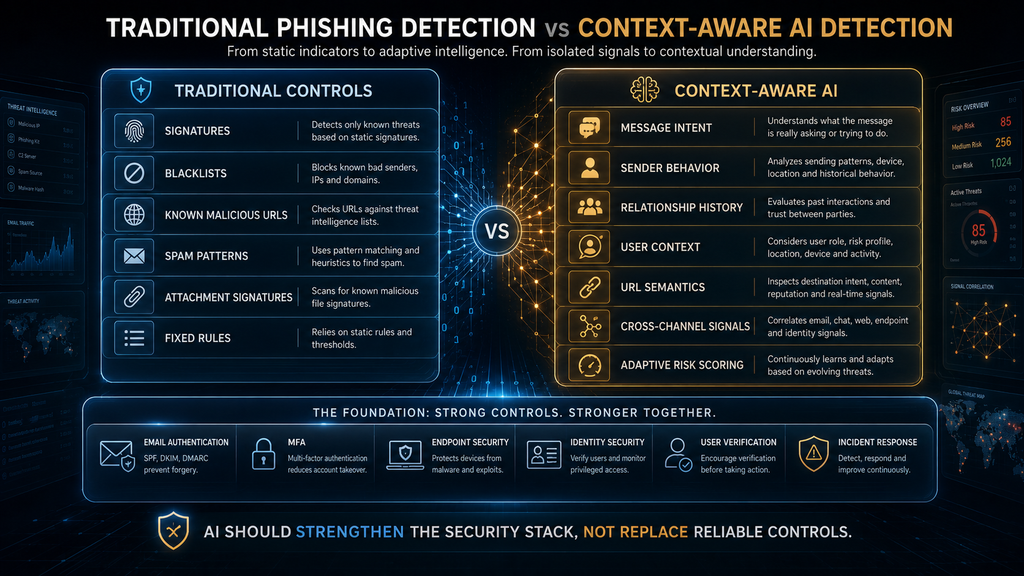
It would be a mistake to frame AI as a replacement for traditional security controls. Many traditional mechanisms remain extremely effective. Known malicious domains can be blocked by reputation systems.
Known malware can be identified through signatures. Email authentication can reduce spoofing. URL blocklists can stop previously identified infrastructure.
Attachment sandboxing can identify malicious behavior. Spam filters can remove obvious junk. These controls exist because they are often fast, predictable and inexpensive.
AI should not replace them simply because AI is newer. The stronger architecture is layered: traditional controls handle known and deterministic threats; AI helps interpret ambiguous, contextual and evolving threats. That is the same principle we should apply across cybersecurity more broadly.
Use the simplest reliable control that solves the problem. Use AI where the problem requires interpretation, correlation or adaptation.
Where AI Phishing Detection Can Fail
AI detection has several important failure modes.
False positives
A legitimate message can contain suspicious characteristics. Excessive blocking creates user friction and can damage trust in security controls.
False negatives
A sophisticated attacker can intentionally avoid the signals the model relies on.
Adversarial manipulation
Attackers can modify messages specifically to evade AI classifiers.
Data drift
Communication patterns change. Attackers change. Models trained on old campaigns may become less effective.
Context blindness
A model may not have access to the business context required to interpret a legitimate but unusual request.
Overconfidence
A model can produce a convincing explanation even when the evidence is weak.
Cross-channel gaps
An organization may detect the email but miss the phone call or messaging interaction that completes the attack.
Privacy concerns
Analyzing employee communication at scale can create legitimate privacy, compliance and governance questions. These limitations do not make AI useless. They define where AI needs surrounding controls.
The Human Verification Ladder
The AI Hustle World Human Verification Ladder connects AI risk assessment with the appropriate response.
| Risk situation | AI role | Human role | Typical response |
|---|---|---|---|
| Low-risk anomaly | Analyze | Minimal involvement | Deliver with normal controls |
| Moderate suspicion | Enrich and explain | Review when needed | Warning or additional verification |
| High-risk phishing | Correlate evidence | Analyst validation | Quarantine and investigate |
| High-impact social engineering | Analyze relationship and intent | Human approval | Independent verification |
| Critical financial or privileged request | Build evidence | Mandatory human decision | Secondary-channel verification |
| Confirmed malicious campaign | Correlate and automate | Incident-response oversight | Containment and remediation |
The important principle is that AI autonomy should increase as the action becomes more reversible and decrease as the consequence becomes more severe. That is a much more useful framework than saying that AI should either “automate everything” or “never make security decisions.”
A Practical AI Phishing Detection Workflow for Organizations
Organizations implementing AI phishing detection should begin with visibility. Before adding another AI layer, understand what information the existing environment can already collect. Can the organization see:
- email sender authentication?
- destination URLs?
- domain reputation?
- attachment behavior?
- identity events?
- endpoint telemetry?
- user role?
- historical communication?
- financial transaction context?
- mobile messaging activity?
If the answer is no, the AI system may have limited evidence to work with. The second step is integration. AI becomes more useful when it can correlate signals across security systems rather than analyzing message text in isolation.
The third step is risk classification. Organizations should define which actions are low, medium and high consequence. The fourth step is human escalation.
The system should know when to stop and ask for human verification. The fifth step is feedback. Security analysts should be able to mark false positives, missed attacks and incorrect reasoning so that detection logic and models can be evaluated and improved.
The sixth step is adversarial testing. Organizations should test the system against new phishing patterns, AI-generated messages, look-alike domains, compromised accounts and deliberately modified examples.
That final step is often overlooked. A detector that works on yesterday’s phishing is not necessarily a detector that works tomorrow.
How to Evaluate an AI Phishing Detection Tool
If you’re evaluating a product, don’t begin with the vendor’s headline accuracy number. Start with the problem you actually need to solve.
Does it analyze context?
A system that only reads message text may miss important identity and behavioral signals.
Does it understand user intent?
Can it identify what the attacker is trying to make the recipient do?
Does it analyze URLs and domains?
Can it identify look-alike domains and suspicious destinations?
Does it detect compromised legitimate accounts?
This is especially important for BEC.
Does it work across channels?
Can it handle email, SMS, collaboration platforms or other communication channels relevant to your environment?
Does it explain its decision?
Analysts need to understand why the message was classified as suspicious.
Can it integrate with existing controls?
AI should strengthen the security stack rather than create another isolated dashboard.
How does it handle false positives?
A high detection rate is meaningless if the system overwhelms analysts with unnecessary alerts.
How is adversarial robustness evaluated?
Ask for evidence beyond clean benchmark performance.
What happens when the model is uncertain?
A mature system should have an escalation path.
What Happens If You Do Nothing?
The risk is not simply that more phishing emails will arrive. The larger risk is that attackers will increasingly exploit trust relationships that traditional controls cannot easily evaluate. If an organization relies primarily on static signatures, blacklists and user awareness, sophisticated attackers may move toward:
- compromised legitimate accounts,
- personalized messages,
- look-alike infrastructure,
- SMS-based attacks,
- voice-assisted social engineering,
- multi-stage campaigns,
- payment manipulation,
- business-process abuse.
The 2026 Verizon DBIR’s finding that 41% of social-engineering breaches involved social vectors beyond email illustrates the direction of the problem. Doing nothing does not necessarily mean a breach will occur. It means the organization may remain dependent on controls that are increasingly challenged by attacks designed to look legitimate.
The strategic response is not “buy AI.” It is to improve the organization’s ability to evaluate trust at scale. AI can be one important part of that strategy.
The Economics of AI Phishing Defense
The economic case for AI is straightforward in one sense: human analysts cannot manually inspect every communication at enterprise scale. The problem is that security teams have finite attention. If an organization receives hundreds of thousands or millions of messages, even a tiny suspicious percentage can create a significant investigation workload.
AI can process those messages continuously and reserve human attention for the cases that require judgment. The economic value therefore comes from three areas:
- Scale: more communications can be analyzed.
- Speed: suspicious activity can be identified earlier.
- Analyst leverage: humans spend less time performing repetitive triage.
But there is another side. Poor AI can increase costs by generating false positives. An AI system that flags everything suspicious may technically improve sensitivity while making the SOC less effective.
The correct business metric is therefore not: “How many phishing messages did the AI detect?” It is: “How much risk did the organization reduce per unit of analyst attention and operational cost?” That is a far more meaningful ROI question.
AI Hustle World Reality Check
The market is moving quickly toward AI-powered phishing defense, but organizations should be skeptical of one particularly attractive promise: “AI can tell you whether a message is phishing.” Sometimes it can. That is not the whole problem.
The harder challenge is determining whether a request is trustworthy. A perfectly legitimate-looking email can be part of a fraudulent transaction. A genuine account can be compromised.
A real conversation can become malicious. A familiar supplier can suddenly request a new payment destination. A voice call can make an otherwise suspicious SMS appear credible.
This means the future of phishing defense is unlikely to be a single classifier sitting between the inbox and the user. It is more likely to become a trust-analysis layer connecting identity, communication, behavior, business context and security telemetry.
That is a more complicated architecture. It is also much closer to the actual problem organizations are trying to solve.
The AI Phishing Detection Framework
The complete model can be summarized as:
1. Understand the message.
What is it asking the recipient to do?
2. Verify the sender.
Is the identity genuine, expected and consistent with previous communication?
3. Inspect the destination.
Where do links, attachments and calls actually lead?
4. Understand the relationship.
Does the request fit the historical conversation and business process?
5. Add user context.
Is this normal for this recipient, role, device and behavior?
6. Correlate other signals.
What are identity, endpoint, network and threat-intelligence systems seeing?
7. Calculate risk.
How strong is the evidence and how severe would a mistake be?
8. Select the response.
Deliver, warn, quarantine, investigate or escalate.
9. Verify consequential decisions.
Use independent channels when money, credentials or privileged access are involved.
10. Learn from outcomes.
Feed analyst decisions and confirmed incidents back into the security process.
This framework captures the most important shift. AI phishing defense should not be designed around finding a single “phishing signal.” It should be designed around building enough evidence to make a trustworthy decision.
Common Mistakes When Using AI for Phishing Defense
One common mistake is treating AI as a replacement for email authentication, endpoint security or identity controls. AI works best as a layer that strengthens those systems.
Another mistake is focusing entirely on message wording. Language is useful evidence, but attackers can now generate polished text. Sender behavior, destination infrastructure and contextual relationships may be more informative.
Organizations also make the mistake of trusting vendor benchmark accuracy without testing the system against their own environment. A model trained on generic phishing datasets may behave differently when exposed to internal workflows, industry-specific language and legitimate-but-unusual business requests.
Another mistake is ignoring BEC because it does not always look like conventional phishing. A compromised legitimate account can produce a message with a perfect sender address and a real conversation history.
Finally, some organizations automate high-impact actions too early. Quarantining a suspicious email is very different from automatically disabling an executive’s account or blocking a legitimate business partner. Automation should follow consequence and reversibility, not excitement about what the technology can technically do.
Who Should Use AI Phishing Detection?
AI-powered phishing detection is particularly useful for organizations with large communication volumes, distributed workforces, complex vendor relationships, significant financial workflows or limited SOC capacity. It is also valuable when attackers routinely use personalized social engineering rather than generic spam.
Small organizations can benefit as well, but they should not assume that buying an AI security product eliminates the need for basic controls. Email authentication, multifactor authentication, secure identity management, endpoint protection, financial verification procedures and user awareness remain foundational.
The strongest implementation is layered. AI is the intelligence layer—not the entire security strategy.
Who Should Be Careful About It?
Organizations should be cautious about deploying AI detection without clear governance around privacy, data access and automated decision-making. Security teams should also be careful when a product requires broad access to employee communications or sensitive business data. Before deployment, determine:
- what data the system processes,
- where that data is stored,
- how long it is retained,
- whether it is used for model training,
- who can access the data,
- what automated actions the system can take,
- how decisions can be audited.
For highly regulated environments, these questions can matter as much as detection accuracy. Security should not become an excuse for uncontrolled data collection.
The Future of AI Phishing Detection
The next generation of phishing defense will likely become increasingly multimodal and contextual. Email content will be only one input. Systems may combine text, URLs, identity behavior, voice characteristics, device signals, conversation history and business-process context.
This matters because social engineering is becoming increasingly conversational. Attackers do not necessarily need one perfect message. They can build trust across several interactions.
A fake SMS can create urgency. A phone call can reinforce credibility. A follow-up email can provide the final malicious link.
The defender therefore needs to understand the campaign, not merely the message. AI is well suited to this type of correlation because it can process different signals and search for relationships that are difficult to see manually. But the same development creates a governance challenge.
The more data the AI sees, the more powerful its analysis becomes—and the greater the privacy and access-control requirements become. The future therefore requires two things at the same time: more contextual intelligence and stronger boundaries around that intelligence.
Second-Order Effect: Attackers Will Adapt to the Detector
There is another consequence worth considering. As AI detection becomes better at identifying common phishing patterns, attackers will adapt. Messages will become less obviously suspicious.
Domains will become more carefully chosen. Compromised legitimate accounts will become more valuable. Attackers may move further toward business-process manipulation rather than traditional credential phishing.
That means organizations should avoid building a defense strategy around a fixed list of AI-detectable characteristics. The detector must evolve. More importantly, the organization should strengthen the controls that remain difficult for phishing to bypass.
For example, a convincing payment request should still encounter independent payment verification. A convincing login message should still encounter strong multifactor authentication. A convincing password-reset request should still be constrained by identity controls.
This is the difference between detecting deception and making deception less damaging. The second objective is more durable.
The Most Important Shift: From Message Security to Trust Security
Phishing is often described as an email-security problem. That description is becoming too narrow. The real problem is trust.
Who is communicating? Why are they communicating? What are they asking you to do?
Is that request consistent with the relationship? Does the destination match the identity? Does the behavior match previous behavior?
What happens if the request is fraudulent? Can the action be independently verified? These are trust questions.
AI is increasingly useful because it can connect the evidence required to answer them. That is why the future of AI phishing defense should not be measured simply by how many malicious emails a system blocks.
A stronger measure is whether the organization can identify suspicious trust relationships before they become costly security incidents. That is the real opportunity.
Final Thoughts
AI is changing phishing defense because the attack itself is changing. The old model was relatively simple: identify suspicious messages, block known malicious links and teach employees to recognize obvious warning signs. That model still matters, but sophisticated social engineering is increasingly designed to defeat those assumptions.
Attackers can generate polished language. They can personalize messages. They can compromise legitimate accounts. They can move conversations across email, SMS, phone and social platforms. They can make a fraudulent request look like a normal business process.
That means the strongest AI phishing defense will not be the system that is best at recognizing a suspicious sentence. It will be the system that is best at understanding context. It should know whether the sender is trustworthy, whether the destination is legitimate, whether the request fits the relationship, whether the user’s behavior is normal and whether other security systems are seeing something unusual.
And when the evidence is ambiguous, it should know when to stop and ask a human. That last point is critical.
AI can analyze communication at a scale humans cannot match. It can correlate signals across security systems and identify relationships that would otherwise require hours of manual investigation. But the existence of an AI-generated risk score does not eliminate uncertainty.
For low-risk decisions, automation can be extremely valuable. For high-consequence decisions, independent verification remains essential. That is particularly true for financial transfers, privileged accounts, identity changes and sensitive business processes.
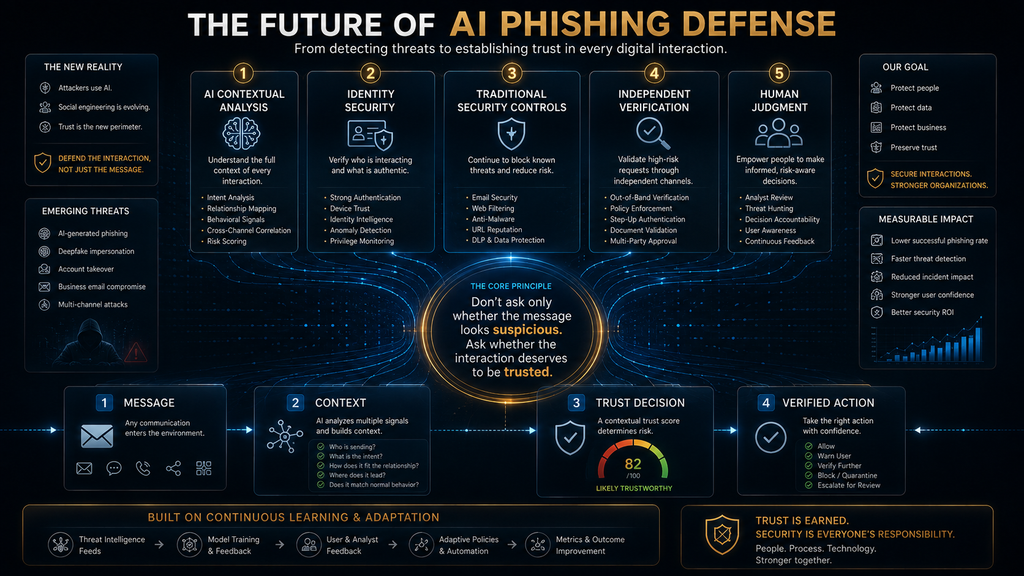
The most durable strategy is therefore not AI versus traditional phishing defense. It is: traditional controls for known threats + AI for contextual analysis + strong identity security + independent verification + human judgment where consequences are high. The central lesson is simple:
Don’t ask AI only whether a message looks suspicious. Ask whether the entire interaction deserves to be trusted.
That is the shift from phishing detection to trust detection. And it is likely to become one of the most important changes in modern cybersecurity.
Build a Smarter Defense Against AI-Powered Phishing
Modern phishing defense is no longer just about spotting suspicious emails. AI can help security teams analyze identity, intent, URLs, behavior, conversation history and cross-channel signals to identify attacks that look legitimate on the surface.
See How AI Analyzes Malware and Alerts →Frequently Asked Questions
How does AI detect phishing?
AI detects phishing by combining signals such as message intent, sender identity, URLs, domains, attachments, communication history, user behavior and security telemetry. Modern systems increasingly use contextual correlation rather than relying only on keywords or known malicious indicators.
Can AI detect phishing emails written by ChatGPT or other LLMs?
AI can help detect AI-generated phishing, but identifying whether text was written by an AI is not enough. Attackers can modify generated content, and detection models can perform differently across models and domains. Recent 2026 research found significant challenges in cross-model generalization for AI-generated phishing detection.
Can AI detect phishing without looking for bad grammar?
Yes. In fact, relying on grammar is increasingly weak because generative AI can produce polished, coherent messages. NIST warns that AI is enabling increasingly convincing phishing attacks.
Can AI detect Business Email Compromise?
AI can help detect BEC by analyzing sender behavior, conversation history, identity signals, unusual requests and changes to normal business processes. However, high-value requests such as payment changes should still use independent verification.
What is the difference between AI phishing detection and spam filtering?
Spam filtering generally focuses on unwanted or suspicious messages, while AI phishing detection is concerned with whether a communication is attempting to manipulate the recipient into a harmful action. The two capabilities can overlap, but phishing defense requires stronger identity, intent and contextual analysis.
Can AI detect phishing SMS messages?
Yes. AI can analyze SMS content, sender information, URLs, conversation patterns and other signals. This is increasingly important because Verizon’s 2026 DBIR found mobile-centric social engineering to have a 40% higher successful-click rate than traditional email phishing in its analysis.
Is AI phishing detection 100% accurate?
No. No security detection system should be treated as perfectly accurate. Recent adversarial research found phishing-detection models that exceeded 98% accuracy on clean data could fall to around 64% under adversarial conditions.
Should AI automatically delete suspicious messages?
Not necessarily. Lower-risk suspicious messages can be quarantined or warned about, but organizations should consider confidence, impact and reversibility before automating destructive actions.
Can AI detect phishing from legitimate compromised accounts?
It can help, but this is harder than detecting fake senders. When a legitimate account has been compromised, the system needs behavioral and contextual signals such as unusual requests, communication changes, authentication anomalies and suspicious destinations.
What is social-engineering detection?
Social-engineering detection looks for attempts to manipulate a person into violating normal security or business processes. It goes beyond identifying malicious links or attachments and considers urgency, authority, secrecy, unusual requests and relationship context.
Does AI replace employee security awareness training?
No. AI can reduce the amount of malicious communication reaching employees, but users still need to understand how to verify unexpected requests and report suspicious activity. NIST continues to emphasize user awareness and verification as part of phishing defense.
What is the biggest weakness of AI phishing detection?
The biggest weakness is that attackers adapt. A detector trained on known patterns can perform poorly against new or deliberately modified attacks, making continuous evaluation and layered security controls essential.
What should companies verify before buying an AI phishing detector?
Evaluate its detection approach, contextual signals, identity analysis, URL and attachment analysis, BEC capabilities, integration with existing security systems, explainability, false-positive performance, adversarial robustness, privacy controls and automated-response capabilities.
Related Guides
- Best AI Content Provenance & Detection Tools
- How AI Detects Financial Anomalies, Fraud & Leakage
- How AI Chatbots Work: From User Message to Intelligent Response
Written by
Muntasir Ahmad Chowdhury
Founder, AI Hustle World
Muntasir Ahmad Chowdhury is the Founder of AI Hustle World, an independent publication dedicated to making Artificial Intelligence practical, trustworthy, and easy to understand. He researches AI tools, automation, customer service, productivity, and real-world business applications, helping readers make smarter technology decisions through research-driven, experience-backed content.
Expertise:
AI Tools • AI Automation • AI Customer Service • AI Productivity • Generative AI • AI Workflows
Get Smarter With AI
Enjoyed this guide? Get practical AI tools, tutorials, and honest reviews delivered to your inbox.