
Evidence: Documentation reviewed
Last checked: September 2026
What was done: Written from official documentation and the published sources linked in this article. Not hands-on tested.
Files: None
Affiliate links: No
Last updated: September 2026. This guide was materially rebuilt using current NIST, CISA, MITRE ATT&CK and FBI sources, a clearer evidence-to-action methodology, and a corrected WordPress heading structure.
Cybersecurity is often described as a battle between attackers and defenders, but most day-to-day security work is a harder information problem. An organization produces login records, endpoint events, network flows, cloud changes, email metadata, payment activity and vulnerability findings faster than people can examine them. The difficult part is not collecting another alert. It is deciding which events belong together, which behavior is genuinely dangerous and which response is justified.
AI helps by finding patterns across that evidence, estimating risk and reducing the time between an event and a defensible decision. It can recognize a known malicious file, identify an unusual login sequence, connect several weak signals into one incident, summarize an investigation or recommend a containment step. Yet it cannot create missing telemetry, understand every business exception or accept responsibility when a legitimate account is blocked.
This distinction matters because “AI cybersecurity” now refers to three related but different problems: using AI to defend systems, protecting AI systems themselves and countering attackers who use AI. This guide concentrates on AI-enabled cyber defense while explaining where the other two problems change the risk. The central argument is simple: AI improves cybersecurity only when the evidence, inference, authority and verification chain all work together.
Quick answer: what is AI cybersecurity?
AI cybersecurity is the use of machine learning, behavioral analytics, language models, graph analysis and automated reasoning to help prevent, detect, investigate and respond to digital threats. These systems compare current activity with known malicious patterns, learned baselines, relationships and contextual evidence. Their practical value is speed and scale: they can review far more events than a human team and bring the most relevant evidence forward.
AI does not replace firewalls, identity controls, endpoint sensors, secure configuration, backups or incident ownership. Those controls produce the evidence and enforce the decisions on which AI depends. A model connected to incomplete logs or weak permissions can generate polished explanations while remaining blind to the attack that matters.
| Security job | What AI contributes | What still has to exist | Main failure to watch |
|---|---|---|---|
| Threat detection | Pattern recognition, anomaly scoring and event correlation | Useful telemetry, detection logic and incident context | Noise, blind spots or an incorrect baseline |
| Fraud detection | Behavior, device, identity, velocity and relationship analysis | Transaction controls, customer verification and appeal handling | Blocking legitimate customers or missing new fraud patterns |
| Phishing defense | Language, sender, link, attachment and communication-pattern analysis | Email authentication, user reporting and identity protection | Convincing messages from compromised trusted accounts |
| Malware analysis | File classification, behavior clustering and code summarization | Sandboxes, endpoint visibility and reverse-engineering expertise | Evasion, obfuscation or unsafe model-generated conclusions |
| SOC investigation | Evidence gathering, incident summaries and next-step recommendations | Case ownership, permissions and response playbooks | Confident automation based on incomplete evidence |
AI cybersecurity is a decision layer, not a magic security product
The phrase covers several technologies rather than one category of software. A spam filter that classifies a message, a bank model that scores a payment, an endpoint platform that correlates process behavior and a language-model assistant that summarizes an incident may all be called AI cybersecurity. They operate on different evidence, make different kinds of inference and carry different consequences when they are wrong.
The most useful way to define the field is by the decision being improved. Predictive models estimate whether an event belongs to a known or learned risk pattern. Anomaly systems estimate whether behavior differs materially from a baseline. Graph systems expose relationships among identities, devices, infrastructure and transactions, while generative systems translate technical evidence into queries, explanations or proposed actions. The label “AI” tells you very little until you know which of those jobs the system performs.
NIST’s preliminary Cyber AI Profile makes an important three-way distinction: securing AI system components, conducting AI-enabled cyber defense and thwarting AI-enabled cyber attacks. This article primarily addresses the second area, but responsible adoption cannot ignore the first or third. A defensive model may itself be exposed to poisoned data, evasion, prompt injection, excessive permissions or misleading tool output, while attackers use the same class of technology to make familiar schemes faster and more convincing.
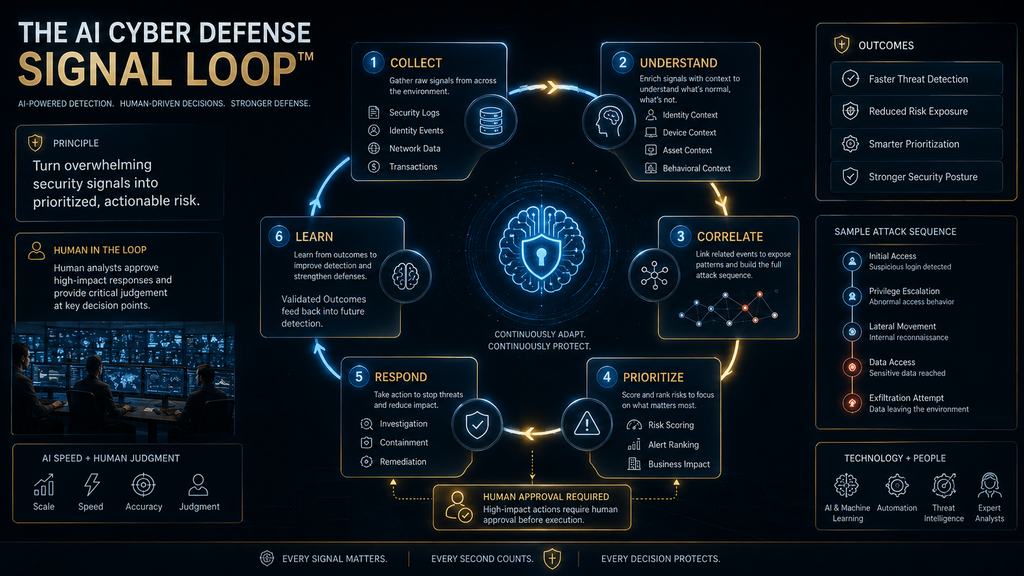
How we researched this guide
AI Hustle World reviewed authoritative material available through September 24, 2026, including NIST’s Cyber AI Profile and adversarial machine-learning taxonomy, CISA guidance, MITRE ATT&CK detection resources and FBI reporting on AI-enabled crime. We used vendor-neutral sources for the core mechanism and risk claims, then treated product capabilities as examples rather than proof that one system performs better than another. No controlled product benchmark or first-hand security test is claimed in this article.
Claims are separated by type. Standards and threat-taxonomy statements are presented as authoritative guidance; reported complaint and loss figures are attributed to the FBI; descriptions of how detection methods work are evidence-based synthesis; and recommendations about authorization, measurement and implementation are AI Hustle World analysis. This prevents a common editorial problem in cybersecurity explainers, where a vendor claim, an industry statistic and an author’s recommendation are blended into one unsupported conclusion.
The article’s original contribution is the AI Hustle World Evidence-to-Action Control Map. It classifies six security use cases by observable evidence, AI inference, possible action, required verification and the consequence of error. The method is reconstructable from the cited sources and the operating logic described in each section; it is a decision model, not a performance score or a claim that we tested every system.
Why this map is useful: most introductory pages list benefits such as faster detection and automated response, but they rarely show the full chain from telemetry to inference, action and verification across unlike security problems. The map gives writers, buyers and security teams a concise way to explain why the same “AI-powered” claim has very different meaning in phishing, fraud, malware, vulnerability management and SOC operations. Each classification can be challenged or updated without accepting an opaque ranking.How AI detects threats: from raw events to a security decision
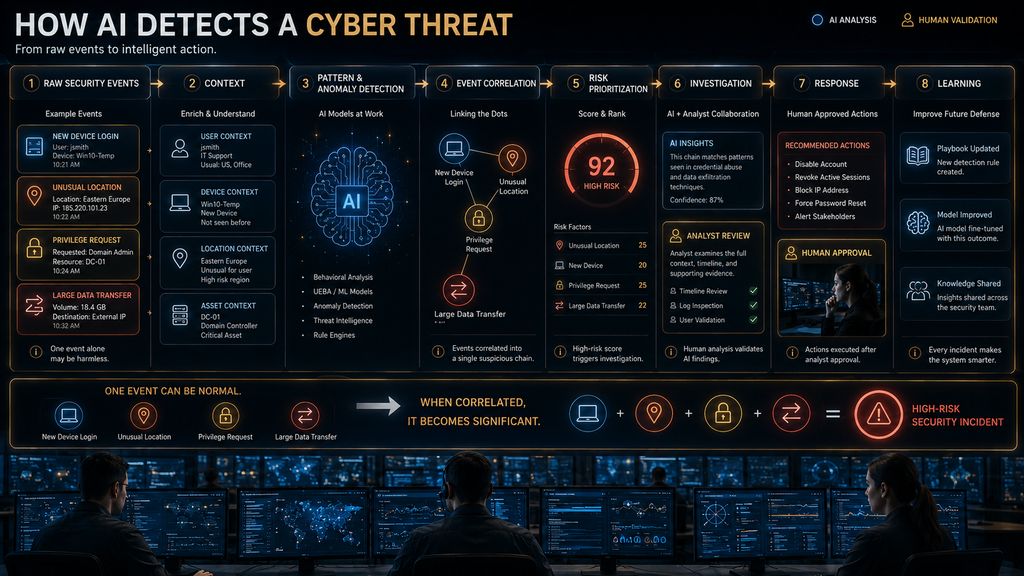
AI does not “see” an attack in the way an analyst understands one. It receives representations of events: a login from a new device, a process spawning another process, a domain contacted by an endpoint, an unusual payment sequence or an email whose sender behavior differs from established history. Detection begins with the quality, coverage and timing of those observations.
Collection determines what the model can know
Security data may come from identity providers, endpoints, networks, cloud control planes, applications, email systems, payment platforms and external threat intelligence. MITRE ATT&CK’s data-source model connects observable components to adversary techniques, reinforcing a basic truth: detection is constrained by what the defender can observe. If endpoint process creation is not logged, a model cannot reliably reconstruct a process chain from confidence alone.
More data does not automatically mean better detection. Duplicate records, inconsistent timestamps, missing identity context and high-volume low-value telemetry can make correlation harder. Before an organization asks whether an AI model is sophisticated, it should ask whether the data pipeline preserves the fields, relationships and retention period needed to investigate the relevant attack.
Context turns an event into a security signal
A login from another country may be suspicious for one employee and normal for a regional sales manager. A large file transfer may indicate exfiltration, a scheduled backup or an approved data migration. Context includes the identity’s role, device history, asset sensitivity, normal working hours, change records, known vulnerabilities and the sequence of surrounding activity.
AI is useful when it combines these weak pieces of evidence faster than a person could retrieve them manually. That is the mechanism behind AI-powered threat detection: the system is not merely searching for one bad event but estimating whether several events form a meaningful pattern. The inference is only as credible as the context that reaches it.
Correlation changes isolated alerts into an incident
An attacker may authenticate with valid credentials, create a new token, enumerate cloud resources and download data. Each action can occur legitimately on its own. Correlation models look across time, identities, devices and services to decide whether the sequence resembles a known attack path or a statistically unusual progression.
This is where graphs and behavioral models can add more than a simple rule. A graph can show that an identity, device, IP address and application share relationships across several events, while a behavioral model can compare the sequence with the entity’s history and its peers. The result should be a connected body of evidence, not merely a larger risk number.
Scoring is an estimate, not a verdict
Many systems assign a probability, anomaly score or severity based on the evidence. That score helps prioritize work, but it is not the same as proving malicious intent. A high score may reflect rare legitimate behavior, and a low score may hide a careful attacker who deliberately imitates normal activity.
The operational question is what happens next. Low-impact events may be enriched or queued; stronger evidence may trigger an analyst review, step-up authentication, process isolation or payment hold. The action boundary should depend on evidence quality, reversibility and business impact rather than on how confident the interface sounds.
The AI Hustle World Evidence-to-Action Control Map
The map below separates what a system observes from what it infers and what it is permitted to do. This matters because two products may both claim “AI detection” while one classifies a file and the other assembles a multi-system investigation. The consequence of error also changes: an incorrect email warning is inconvenient, while an incorrect autonomous account suspension can stop a critical business process.
| Use case | Observable evidence | AI inference | Possible action | Verification requirement | Consequence of error |
|---|---|---|---|---|---|
| Account compromise | Login history, device, IP, token, MFA and privilege activity | Behavior is inconsistent with the identity’s normal pattern or resembles takeover | Increase risk, challenge login, revoke session or open an incident | Confirm user context, travel, device ownership and related actions | Business interruption or continued unauthorized access |
| Network intrusion | Connections, DNS, protocol, flow, asset and process context | Traffic sequence resembles reconnaissance, command-and-control or lateral movement | Prioritize, block a destination, isolate a host or collect more evidence | Validate asset role, expected traffic and endpoint evidence | Missed intrusion or disruption of legitimate services |
| Payment fraud | Transaction, identity, device, location, velocity and relationship data | Transaction differs from legitimate behavior or connects to a fraud network | Approve, decline, hold or request additional verification | Use customer challenge, analyst review and appeal path | Financial loss or harm to a legitimate customer |
| Phishing | Sender history, authentication, language, link, attachment and communication graph | Message or sender behavior resembles impersonation, credential theft or malicious delivery | Warn, quarantine, remove message or restrict a compromised identity | Inspect headers, destination, attachment behavior and account history | User compromise or blocked legitimate communication |
| Malware | File structure, hash, code, process behavior, API calls and network activity | Artifact or execution pattern belongs to a malicious family or behavior class | Block, quarantine, detonate, enrich or escalate | Corroborate with sandbox, endpoint and threat-intelligence evidence | Infection persists or a legitimate file is removed |
| Vulnerability prioritization | Asset inventory, exposure, exploitability, business criticality and threat activity | A vulnerability presents material risk in this environment | Raise priority, assign remediation or apply a compensating control | Confirm reachability, asset owner, exploit path and operational constraints | Critical exposure remains or scarce remediation effort is misallocated |
The final two columns are the part many AI explanations omit. A model can improve detection while still producing an unsafe operating outcome if nobody defines who validates the evidence or how a mistaken action is reversed. The map therefore treats verification and error cost as part of the technology decision, not as administrative work to add later.
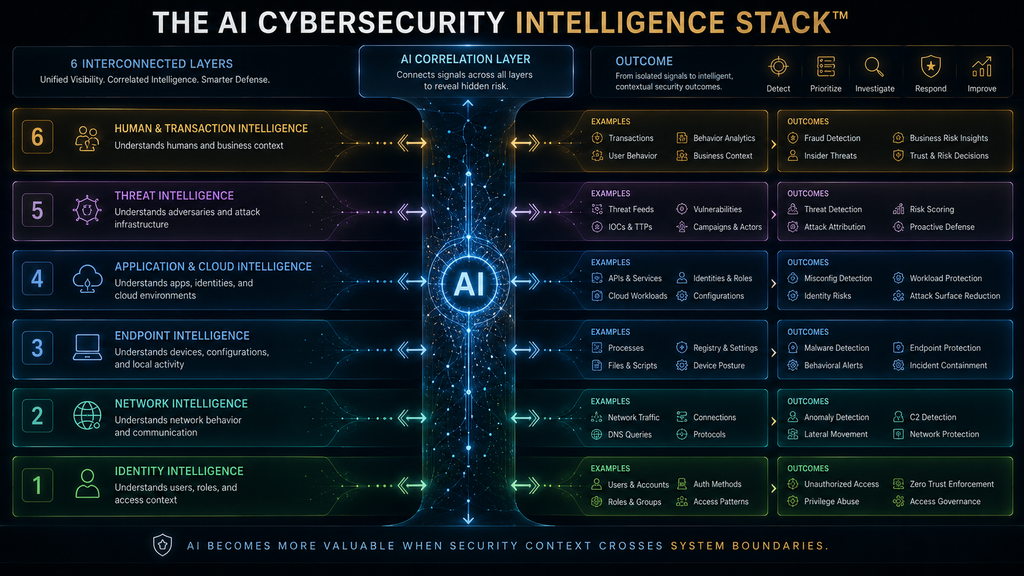
The detection methods underneath the AI label
Effective security systems rarely depend on one model. They combine deterministic controls with several analytical methods because attackers, evidence and consequences vary. Understanding that mixture prevents a buyer from assuming that generative AI replaced the detection engineering underneath the interface.
Rules and signatures remain valuable
A rule can detect an exact forbidden condition, and a signature can identify a known malicious artifact or pattern. These methods are explainable, fast and controllable, which is why they remain important for high-confidence indicators and policy enforcement. Their weakness is coverage: a rule only catches what someone defined, and a signature may fail when the artifact changes.
Supervised learning recognizes labeled patterns
Supervised models learn from examples labeled as malicious or legitimate. They can classify spam, malware, fraudulent transactions or suspicious domains when the training data represents the operational environment. Performance can deteriorate when attacker behavior, user behavior or data collection changes, so a strong evaluation must examine recent and out-of-distribution cases rather than one historical accuracy figure.
Anomaly detection finds departures from a baseline
Anomaly systems look for rare or unexpected behavior without requiring every attack to be labeled in advance. This is useful for compromised accounts, insider activity and novel attack paths, but rarity is not the same as malice. New employees, software deployments, seasonal workloads and emergency maintenance can all look abnormal.
The baseline also has a security boundary. If it is learned during an already-compromised period, malicious activity may become part of “normal.” If it is too broad, important differences disappear; if it is too narrow, normal variation creates noise. Baselines therefore need ownership, change awareness and periodic validation.
Graph analysis exposes relationships
Graph methods represent entities and connections: users authenticate to devices, devices contact domains, accounts transfer value and processes access files. They are useful when risk emerges from a network of weak relationships rather than one decisive event. Fraud rings, shared infrastructure, privilege paths and coordinated activity are natural graph problems.
Language models assist with investigation and interface work
Large language models can convert natural-language questions into searches, summarize evidence, explain detections, draft queries and coordinate approved tools. Their value is often in reducing retrieval and translation work rather than replacing the underlying detector. A fluent incident summary should point back to source events, timestamps and tool results so an analyst can distinguish retrieved evidence from generated explanation.
When a language model can take actions, the risk changes. Prompt injection, untrusted content, excessive tool permissions and hidden assumptions can influence the workflow. An agent that reads an email, queries identities and disables an account needs stronger authorization and logging than an assistant that only summarizes an alert.
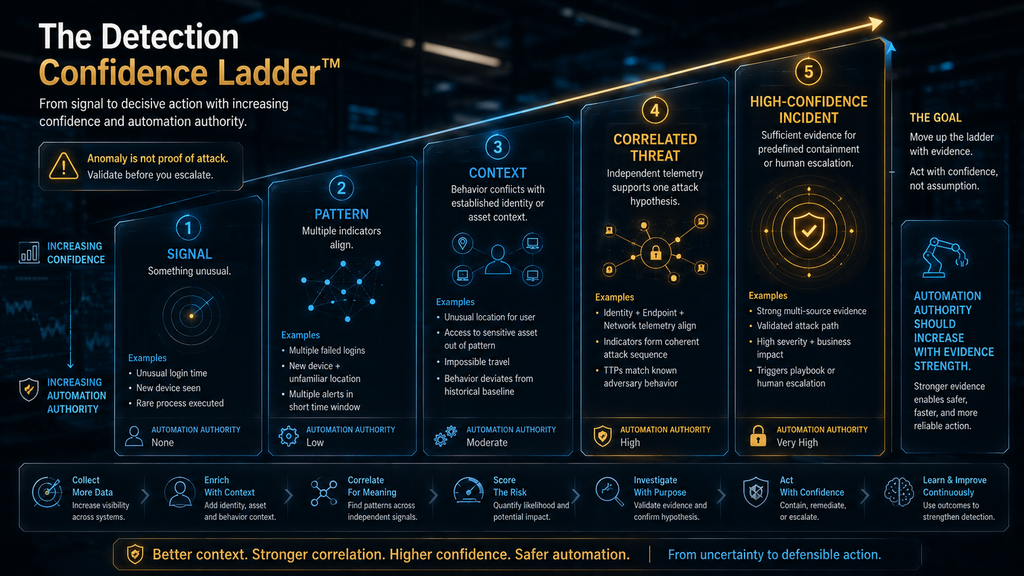
The Detection Confidence Ladder
A useful detection system should distinguish an unusual signal from a sufficiently supported incident rather than treating every anomaly as a confirmed attack. The AI Hustle World Detection Confidence Ladder has five levels:
Level 1 — Signal
Something unusual happened.
Level 2 — Pattern
Multiple indicators point in the same direction.
Level 3 — Context
The activity conflicts with established behavior, identity or asset context.
Level 4 — Correlated Threat
Multiple independent telemetry sources support the same attack hypothesis.
Level 5 — High-Confidence Incident
The evidence is strong enough to activate predefined containment or human escalation. This ladder is deliberately not a mathematical score. It is a decision framework.
A Level 1 signal might receive automated enrichment. A Level 5 incident might justify immediate containment under an approved policy. The crucial principle is:
Detection confidence should influence automation authority.
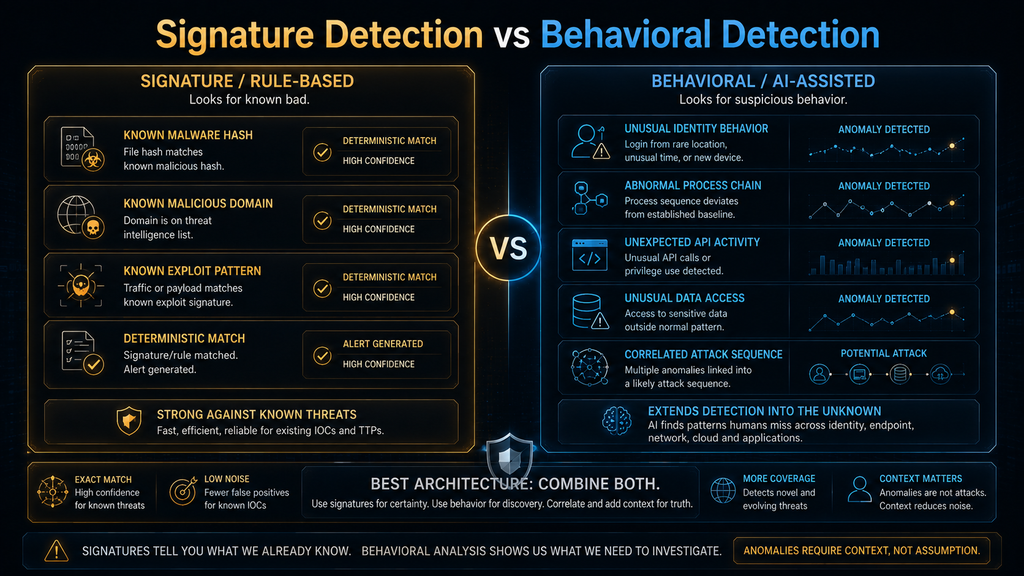
Signature Detection vs Behavioral Detection
Signature detection looks for known malicious patterns, while behavioral detection looks for activity that deviates from expected behavior or forms suspicious sequences. Both approaches remain useful.
Signature / rule-based detection
Strong when:
- the threat is known,
- indicators are stable,
- deterministic matching is possible.
Examples include:
- known malware hashes,
- malicious domains,
- known exploit signatures,
- explicit policy violations.
Behavioral / anomaly detection
Strong when:
- the exact attack is unknown,
- legitimate credentials are being abused,
- behavior changes over time,
- multiple weak signals need to be combined.
Examples include:
- impossible travel,
- unusual privilege escalation,
- abnormal API usage,
- unexpected process chains,
- unusual data access.
The mistake is turning this into a binary argument. Traditional controls are not obsolete. Behavioral AI is not universally better.
The strongest security architecture normally combines them. Known threats can be caught deterministically. Novel or ambiguous behavior can be analyzed statistically and contextually.
Why traditional security methods still exist
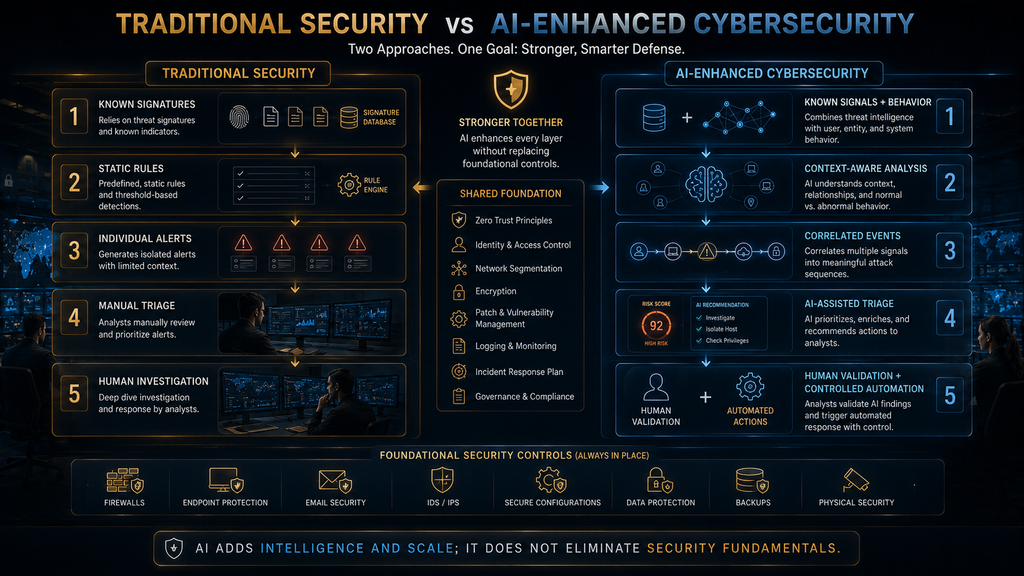
Traditional security methods exist because many controls should be deterministic. A user either has permission to access a resource or does not; a cryptographic signature either validates or fails; a backup either meets its recovery requirement or it does not. These are policy and engineering boundaries, not prediction problems, and converting them into probabilistic decisions can reduce assurance rather than improve it.
Rules and signatures also provide high-confidence explanations. If a known malicious hash appears on an endpoint or a forbidden protocol reaches a protected segment, a precise detection can be faster and easier to audit than a complex model. The weakness is that deterministic logic cannot describe every variation an attacker may use. AI adds value around that boundary by correlating behavior, ranking uncertainty and identifying cases that deserve closer inspection.
The strongest architecture assigns each method the job it can defend. Policy engines enforce approved access, signatures stop known artifacts, behavioral models search for unusual activity, graph analysis connects entities and language models help people retrieve and interpret evidence. An AI-generated recommendation can then lead to a deterministic control action under an explicit approval rule. This is less glamorous than a fully autonomous security story, but it is easier to test, explain and recover.
Consider a suspected account takeover. A model can combine unusual location, new device, abnormal resource access and token activity into a high-risk finding. Identity policy can require step-up authentication, and an analyst can revoke the session if the evidence remains convincing. The model contributes context; the identity platform enforces the boundary; the person owns the consequential exception. That division of labor is the practical relationship between traditional controls and AI cybersecurity.
How AI works across major cybersecurity use cases
Threat detection combines known patterns with behavior
Traditional detection and AI-enhanced detection are not opposites. Rules, signatures and access policies provide precise controls; behavioral and statistical models add coverage for variation, correlation and prioritization. The most credible design uses both, then tests whether the combined system improves detection without overwhelming the people who must investigate it.
MITRE ATT&CK’s guidance on detections and analytics focuses on building, testing and refining behavioral analytics against adversary techniques. That approach is more useful than treating “AI detected it” as an explanation. A detection should reveal the behavior, the data source and the reason the activity matters in the attack sequence.
Fraud detection evaluates behavior under time pressure
Fraud systems often make decisions in seconds, using transaction amount, merchant, device, location, account history, velocity and links to other entities. The model may estimate risk, but the operating policy decides whether to approve, decline, hold or request another verification step. That separation matters because model performance and customer treatment are not the same metric.
A false negative creates direct loss; a false positive may block a legitimate customer at a critical moment. The right threshold therefore depends on transaction value, reversibility, customer segment and the cost of additional verification. Organizations should measure prevented loss together with approval rate, challenge completion, appeal outcomes and harm to legitimate users.
The attacker side is also changing. The FBI’s 2025 Internet Crime Report summary recorded 22,364 complaints associated with artificial intelligence and nearly $893 million in reported losses, its first dedicated AI section. The agency describes AI as a force multiplier for impersonation, synthetic media and scalable deception, which means defenders must combine content analysis with identity, transaction and relationship evidence rather than trying to detect “AI-written” language alone.
Phishing detection must look beyond the words
Generative AI makes grammar and tone less useful as warning signs. A convincing message may still arrive from a newly registered domain, contain a deceptive link, request an unusual payment or come from a compromised legitimate account whose communication pattern has changed. Effective detection combines message content with authentication, sender history, link reputation, attachment behavior, conversation context and identity activity.
Our detailed guide to AI phishing and social-engineering detection explains why no single content classifier is enough. If the message passes filtering, identity controls and user reporting still matter; if an account is already compromised, a perfect domain-reputation check may provide little protection. The defensive system must follow the attack from message delivery to credential use and account behavior.
Malware analysis uses both static and behavioral evidence
Static analysis examines a file without running it: structure, strings, imports, metadata and code patterns may indicate its family or function. Dynamic analysis observes execution in a controlled environment, including process creation, file changes, registry behavior, API calls and network connections. AI can classify, cluster and summarize these signals, helping analysts prioritize samples and connect related behavior.
Attackers respond with packing, obfuscation, environment checks and behavior designed to evade analysis. A model may also inherit weaknesses from its training data or overgeneralize from superficial similarity. Our guide to how AI analyzes malware, vulnerabilities and security alerts examines those boundaries in more detail.
Vulnerability prioritization is a context problem
A vulnerability score alone does not tell a team what to fix first. Practical risk depends on whether the asset is exposed, whether the vulnerable component is reachable, whether exploitation is active, what privileges are available, what data or business process is affected and whether a compensating control exists. AI can combine that context to rank remediation work, but it should make the reasoning visible.
The danger is replacing one queue with another opaque queue. If a system raises an item to the top, the owner should be able to see the asset, path, threat evidence and consequence that produced the priority. Otherwise the organization may patch whatever has the highest model score while leaving an exploitable business-critical path unresolved.
AI in security operations: triage, investigation and response
The security operations center is where multiple AI methods converge. A platform may group alerts into incidents, enrich indicators, retrieve identity and asset context, propose hypotheses, draft queries, summarize a timeline and recommend a response. The objective is not to make analysts click faster; it is to reduce the time spent assembling evidence while improving the consistency of the decision.
Generative assistants are particularly useful for interface work. An analyst can ask for all authentication events around a compromised identity, request a timeline or generate a query for further hunting. The response becomes trustworthy only when it preserves provenance: which systems were queried, what records were returned, what time range was used and which statements are inference rather than observed fact.
Copilots and agents have different authority
A copilot generally assists a person who remains in control of the workflow. An agent may plan several steps, call tools and perform actions within defined permissions. The categories overlap, but the governance question is concrete: can the system only recommend isolation, or can it isolate the device; can it draft a firewall change, or can it deploy one?
Our guide to AI SOC agents and autonomous security operations examines this shift from response assistance to delegated execution. As autonomy increases, so must identity controls, least privilege, approval gates, tool allowlists, audit logs, rollback and testing with adversarial inputs. The most impressive demonstration is not an agent that acts quickly; it is an agent that acts within a boundary the organization can explain and reverse.
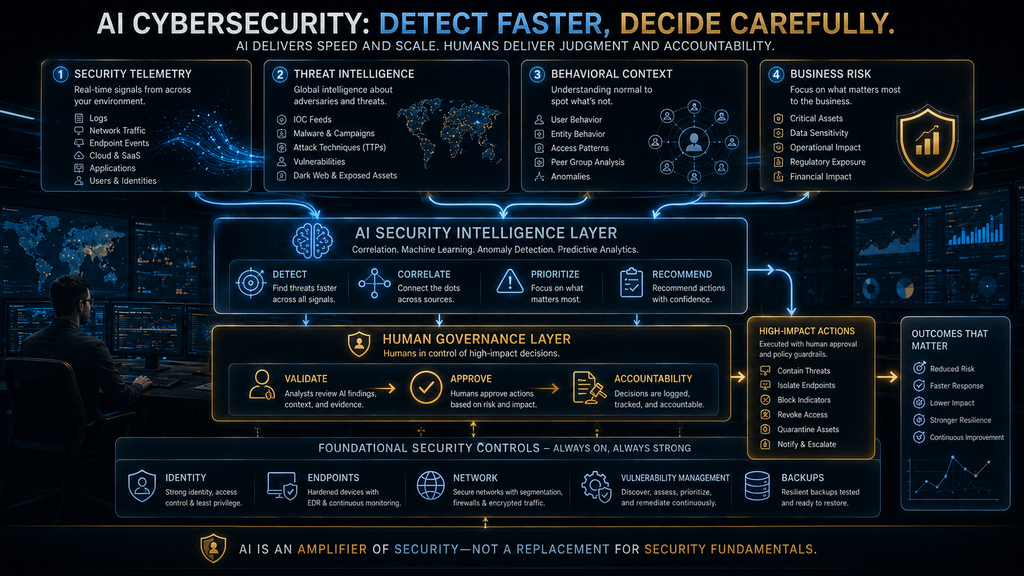
The Hybrid Cybersecurity Stack
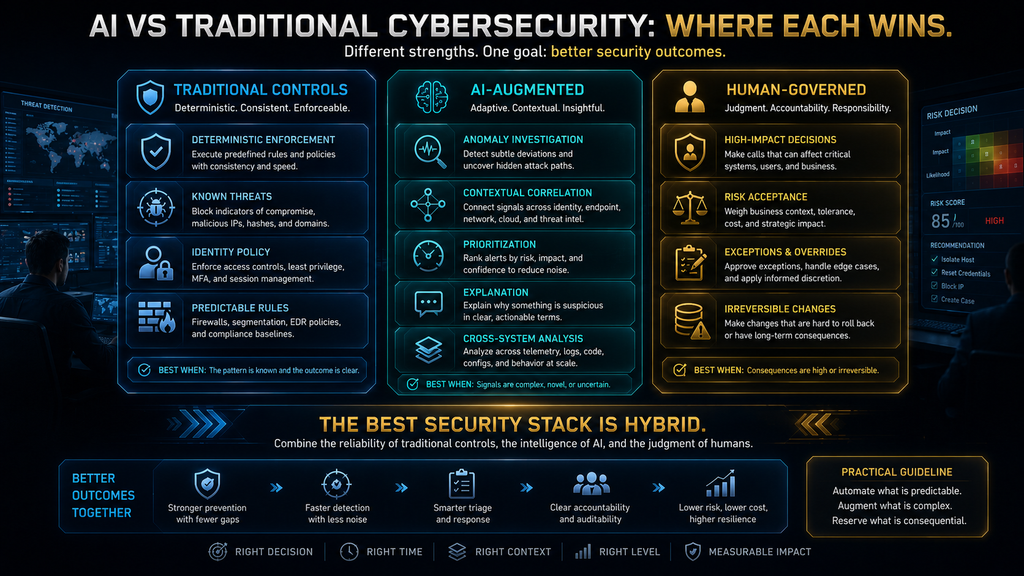
The strongest architecture is usually not a technology compromise. It is a functional division of labor.
| Layer | Primary job | Best fit |
|---|---|---|
| Identity & access | Enforce authorization | Traditional controls |
| Network enforcement | Allow/deny traffic | Traditional + intelligence |
| Endpoint security | Detect/block behavior | Hybrid |
| SIEM/data layer | Collect/correlate telemetry | Traditional + AI |
| Threat intelligence | Provide context | Hybrid |
| AI analysis | Explain/correlate/prioritize | AI |
| SOAR | Execute defined workflows | Traditional automation + AI input |
| AI agents | Investigate/coordinate | AI + strict governance |
| High-impact decisions | Risk acceptance/accountability | Human |
The goal is not to make every layer AI-powered. It is to create a system where the right decision mechanism sits at the right layer. That is the real meaning of AI augmentation.
A Practical Decision Matrix
Use this framework when evaluating a security workload.
| Question | Mostly “Yes” | Recommended approach |
|---|---|---|
| Is the condition clearly defined? | Yes | Traditional |
| Is the response deterministic? | Yes | Traditional |
| Is context spread across many systems? | Yes | AI-assisted |
| Does the problem involve novel behavior? | Yes | AI-assisted |
| Is analyst investigation the bottleneck? | Yes | AI-assisted |
| Does the action have high consequences? | Yes | Human-governed |
| Can the result be independently verified? | Yes | AI can receive more autonomy |
| Is the action irreversible? | Yes | Strong human control |
| Is the environment rapidly changing? | Yes | AI augmentation becomes more useful |
| Is the model itself hard to validate? | Yes | Limit autonomy |
This is more useful than asking whether “AI security” is generally better than “traditional security.” The answer depends on the workload.
Where AI cybersecurity fails—and why the failure is often upstream
AI failures are frequently described as model problems, but many originate earlier or later in the chain. Missing logs prevent observation; incorrect asset ownership removes context; a biased training set distorts inference; an aggressive threshold creates false positives; excessive permissions turn a bad recommendation into a harmful action. Fixing the model alone will not repair those operating failures.
False positives create more than alert fatigue
A false positive consumes investigation time and can interrupt legitimate activity. Repeated low-quality alerts also teach analysts to distrust the system, making them slower to act when a genuine detection appears. The relevant measure is not simply alert volume but how much review effort is required to reach a defensible disposition.
False negatives are hard to measure
A missed attack may remain invisible until another control, a customer, law enforcement or an incident investigation reveals it. This creates a dangerous reporting bias: the organization can count detected incidents but not every undetected one. Red-team exercises, replay tests, threat-informed validation and post-incident reviews help estimate the gap.
Drift changes what normal and malicious look like
User behavior, infrastructure and attacker techniques change. A model trained on one period or environment may lose relevance after cloud migration, new authentication policy, acquisition or seasonal workload. Monitoring must therefore include input distributions, alert composition, analyst dispositions and changes in confirmed incident coverage, not only whether the service remains available.
Attackers can target the AI system itself
NIST’s final adversarial machine-learning taxonomy covers attacks including poisoning, evasion, privacy compromise and abuse against predictive and generative AI. In a security context, an attacker may manipulate training data, shape inputs to avoid classification, extract sensitive model information or use untrusted content to influence an agent. Defensive AI therefore becomes part of the attack surface it is meant to protect.
CISA’s AI guidance hub similarly separates beneficial adoption from the need to secure AI systems and counter malicious use. The operating lesson is to threat-model the full pipeline: data collection, model or service, prompts, retrieval sources, connectors, tool credentials, human approvals and output consumers. A secure model connected to an overprivileged automation account is not a secure workflow.
Human judgment still owns consequence and ambiguity
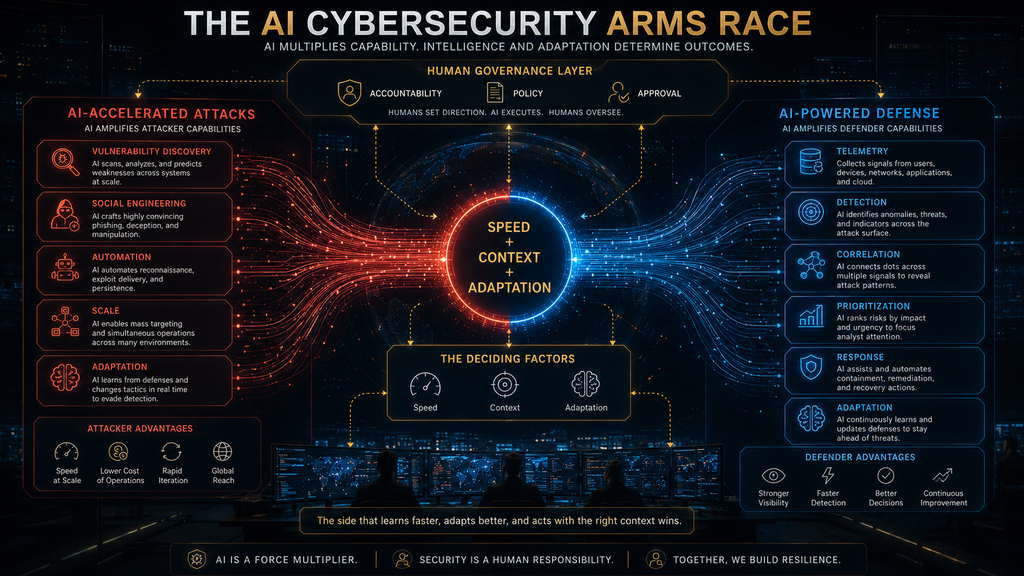
Human review is not required because people are always more accurate. It is required when the decision contains business context, legal consequence, safety impact or uncertainty that the system cannot own. An analyst may know that an unusual administrator action is part of emergency recovery, that a customer transaction involves a documented exception or that isolating a device would interrupt a clinical process.
The correct boundary depends on action impact and reversibility. Enriching an alert, grouping events and drafting a query are low-consequence tasks. Sending a user challenge or temporarily limiting a token may be acceptable under defined conditions. Deleting data, disabling a critical identity or changing a production control deserves stronger evidence, explicit authority and a reliable recovery path.
| Automation level | Appropriate work | Required control |
|---|---|---|
| Observe | Collect, normalize and enrich security events | Data quality, access control and retention policy |
| Recommend | Score risk, summarize evidence and propose next steps | Source trace, uncertainty and analyst review |
| Act with approval | Isolate a host, revoke a session or block an indicator after confirmation | Named approver, logged evidence and rollback |
| Act autonomously | Narrow, low-impact and reversible responses under tested conditions | Least privilege, explicit policy, monitoring, stop control and recovery |
This is also why AI cybersecurity and traditional security tools should not be framed as a replacement contest. Traditional controls enforce known boundaries and produce reliable evidence; AI helps interpret variation, prioritize attention and coordinate work. Removing the foundation because the decision layer became more capable would make the system less trustworthy.
How to implement AI cybersecurity without creating another control problem
The safest starting point is not “Where can we add AI?” It is “Which security decision is currently too slow, inconsistent or evidence-heavy?” A defined decision gives the project an owner, data requirement, failure condition and outcome metric. Without it, the organization may buy an assistant that produces more activity without improving protection.
1. Define the decision and its current failure
Choose one workflow such as account-takeover triage, phishing investigation, malware prioritization or vulnerability remediation. Document the present delay, handoffs, review burden and error cost. “Improve the SOC with AI” is not testable; “reduce the time required to assemble identity and endpoint evidence for high-risk login incidents without increasing wrongful account suspension” is.
2. Map the necessary evidence
List the telemetry, context and history required for that decision. Confirm source ownership, field quality, timestamps, entity identifiers, retention and access rights. If analysts routinely leave the current platform to find a critical piece of evidence, the AI workflow must either retrieve that source or declare the limitation.
3. Separate detection from action
Define what the system may observe, infer, recommend and execute. Start with evidence gathering and recommendation when the error cost is high, then consider greater automation only after the evidence trace and review results are reliable. Permissions should be narrower than the system’s theoretical capability.
4. Test known incidents and legitimate exceptions
Use a representative set of confirmed incidents, benign cases and difficult exceptions from the organization’s own history where policy allows. Measure whether the system retrieved the right evidence, reached a supportable conclusion and handled uncertainty. A product demonstration built around a clean scripted attack cannot reveal how the system behaves with incomplete logs or messy business exceptions.
5. Record corrections as operating evidence
When an analyst changes the conclusion, capture why: missing telemetry, incorrect entity mapping, stale intelligence, poor threshold, misunderstood business context or generated error. Those corrections reveal whether the problem belongs to data engineering, model behavior, workflow design or policy. A generic thumbs-down button is not enough.
6. Design rollback before autonomy
Every consequential automated action needs a recovery method, a responsible owner and an audit record. Test what happens when a host is isolated incorrectly, a token is revoked during critical work or a domain is blocked across the enterprise. Automation without recovery turns model error into operational risk.
How to measure whether AI improves cybersecurity
The number of AI-generated summaries, queries or closed alerts is an activity measure. It does not prove that attacks were found earlier or that analysts made better decisions. Measurement should follow the evidence-to-action chain and include both security outcomes and the new work created by the system.
| Measurement area | Useful questions | Misleading shortcut |
|---|---|---|
| Detection | Which confirmed incidents were detected, how early and with what evidence? | Total alerts generated |
| Precision | How many escalated cases were actionable, and how much review did false positives require? | One vendor accuracy percentage |
| Investigation | Did the system retrieve complete evidence and reduce time to a defensible conclusion? | Number of summaries produced |
| Response | Were approved actions timely, correct, reversible and properly logged? | Cases automatically closed |
| Coverage | Which identities, assets, cloud services and attack techniques remain outside visibility? | Volume of ingested data |
| Economics | What licensing, ingestion, integration, correction and governance work was added or removed? | Seat price alone |
False-positive rate needs operational context. A small percentage applied to millions of daily events can still create an impossible queue, while a higher rate in a narrow high-value workflow may be manageable. Track alerts per protected unit, analyst minutes per disposition, reopen rate, correction reasons and the proportion of cases that lacked enough evidence to decide.
False-negative measurement is harder because undetected events are not directly visible. Use purple-team exercises, detection replay, threat-informed testing, control comparisons and post-incident reconstruction to find misses. When another control catches an attack first, treat that as valuable evaluation evidence rather than as a reason to hide the AI system’s gap.
The economic reality: AI often moves work before it removes work
An AI tool may reduce manual evidence gathering while increasing data ingestion, connector maintenance, permission review, model monitoring and correction analysis. The correct comparison is total operating cost, not the number of analyst clicks removed. A platform that saves ten minutes per case but creates a new high-volume false-positive queue has not created useful efficiency.
Organizations should include licensing, data retention, integration, professional services, staff training, control testing and residual human review in the business case. They should also value avoided loss cautiously. If a vendor claims the system prevented an incident, ask what evidence shows the incident was real, what other controls contributed and whether the estimated impact is reproducible.
What happens if an organization does nothing?
Not every organization needs an AI security platform, but every organization must manage growing evidence volume and faster deception. Doing nothing may mean longer investigation, inconsistent triage and greater dependence on scarce specialists. It may also be the rational choice when basic asset inventory, access control, patching, backups and logging remain weak, because adding AI above missing fundamentals can make the security program look more mature than it is.
Small organizations often gain more from managed security outcomes than from owning an autonomous SOC workflow. A managed endpoint or detection service can provide telemetry, monitoring and escalation without requiring the business to build its own model governance. The right sequence is foundational controls, reliable evidence, accountable response and then AI where a specific decision bottleneck remains.
Where AI cybersecurity is heading
The market is moving from isolated classification toward coordinated investigation and action. Security assistants increasingly retrieve evidence across tools, generate queries and assemble timelines, while agents are being given bounded permissions to execute parts of a workflow. That shift makes identity, authorization and provenance as important as model capability.
Attackers are moving in the same direction. AI lowers the cost of tailoring phishing, producing synthetic media, translating scams, researching targets and modifying code. The FBI’s public guidance describes AI as increasing the speed, scale and automation of familiar crimes rather than creating an entirely separate criminal universe. Defenders should therefore strengthen identity, payment verification, communication controls and behavioral evidence rather than chase a universal “AI-generated” detector.
The durable advantage will come from evidence quality and disciplined authority. Models and product interfaces will change, but a security team will still need to know what happened, why the system believes it matters, who may act and how an incorrect action is recovered. The organizations that preserve that chain can adopt more capable automation without surrendering accountability.
Final thoughts
AI makes cybersecurity faster when it can connect trustworthy evidence to a defined decision. It can recognize patterns, expose relationships, prioritize cases, assemble investigations and support response at a scale that manual work cannot match. Its output remains an estimate shaped by data coverage, model behavior, thresholds, permissions and the context supplied by people.
The safest question is not whether a security product contains AI. Ask what it observes, what it infers, what it may do, how its conclusion can be checked and what happens when it is wrong. If those five answers are clear, AI can strengthen a security program. If they are hidden, the organization may be automating uncertainty rather than reducing risk.
See the Detection Chain in Action
Follow the evidence from raw telemetry to correlated behavior, risk prioritization and a response that people can verify.
Explore AI Threat Detection →Frequently asked questions
What is AI cybersecurity?
AI cybersecurity uses machine learning, behavioral analysis, graph methods, language models and automated reasoning to help prevent, detect, investigate and respond to digital threats. It is not one product category. The term can describe anything from a fraud classifier to a security-operations assistant, so the evidence and decision being improved should always be stated.
How does AI detect cyber threats?
AI analyzes observable events such as logins, processes, network connections, cloud changes and email activity. It compares them with known patterns, behavioral baselines and relationships, then estimates whether the activity deserves attention. Reliable detection still depends on telemetry quality, contextual information and a tested response process.
Can AI detect an attack it has never seen before?
AI can detect unusual behavior or attack components without having an exact signature for the complete attack. That does not mean it understands every novel threat. Legitimate rare behavior can create false positives, while an attacker who imitates normal activity may remain difficult to identify.
How is AI used in fraud detection?
Fraud systems analyze transactions, identities, devices, locations, velocity and relationships to estimate risk in real time. The model supplies a score or classification, while business policy determines whether to approve, decline, hold or request another verification step. Good measurement includes prevented loss and the harm caused to legitimate customers.
Can AI detect phishing written by another AI?
It can identify suspicious language and content, but writing style alone is not dependable evidence of AI authorship or malicious intent. Strong phishing detection also examines sender authentication, domain and link behavior, attachments, communication history and account activity. A compromised trusted account can produce a convincing message without obvious content clues.
Does AI replace traditional cybersecurity tools?
No. Firewalls, identity controls, endpoint sensors, email authentication, secure configuration, vulnerability management and backups enforce controls or generate the evidence AI needs. AI adds interpretation, prioritization and coordination; removing the foundation would reduce visibility and control.
What is the difference between a security copilot and an AI agent?
A copilot normally assists a person by retrieving, summarizing or recommending. An agent can plan several steps, use approved tools and potentially execute part of a workflow. Product labels overlap, so buyers should examine actual permissions, approval gates, execution logs and recovery controls.
What are the biggest risks of AI in cybersecurity?
Major risks include missing or poor-quality data, false positives, false negatives, model drift, opaque reasoning, excessive automation and attacks on the AI pipeline itself. Predictive models may face poisoning or evasion, while generative workflows add prompt injection and tool-permission concerns. These risks require controls across data, model, integration, authorization and human review.
How should a company start using AI for cybersecurity?
Start with one security decision that is slow, inconsistent or evidence-heavy, then map the telemetry, context, authority and error cost. Test the workflow on known incidents and legitimate exceptions before expanding automation. Organizations with weak asset inventory, logging or access control should strengthen those foundations first.
How do you choose an AI cybersecurity tool?
Choose by the control gap and evidence pipeline, not by the most impressive assistant. Confirm what data the product accesses, which security decision it improves, how it exposes evidence, what actions it can take and what it does not replace. Our comparison of the best AI cybersecurity tools organizes the market by those operating differences.
Related Guides
- How AI Detects Financial Anomalies, Fraud & Leakage
- What Is an AI Agent? A Beginner’s Guide to How Autonomous AI Works
- AI Buying Signals: How to Find B2B Prospects Who Are Ready to Buy
Written by
Muntasir Ahmad Chowdhury
Founder-AI Hustle World
Muntasir Ahmad Chowdhury is the Founder of AI Hustle World, an independent publication dedicated to making Artificial Intelligence practical, trustworthy, and easy to understand. He researches AI tools, automation, customer service, productivity, and real-world business applications, helping readers make smarter technology decisions through research-driven, experience-backed content.
Expertise:
AI Tools • AI Automation • AI Customer Service • AI Productivity • Generative AI • AI Workflows
Get Smarter With AI
Enjoyed this guide? Get practical AI tools, tutorials, and honest reviews delivered to your inbox.