Evidence: Documentation reviewed
Last checked: September 2026
What was done: Written from official documentation and the published sources linked in this article. Not hands-on tested.
Files: None
Affiliate links: No
Last updated: September 2026. This edition was rebuilt around current official documentation, clearer product boundaries, agentic-security governance and a new source-traceable control-coverage map.
Best AI Cybersecurity Tools in 2026: Threat Detection, SOC & Security Operations
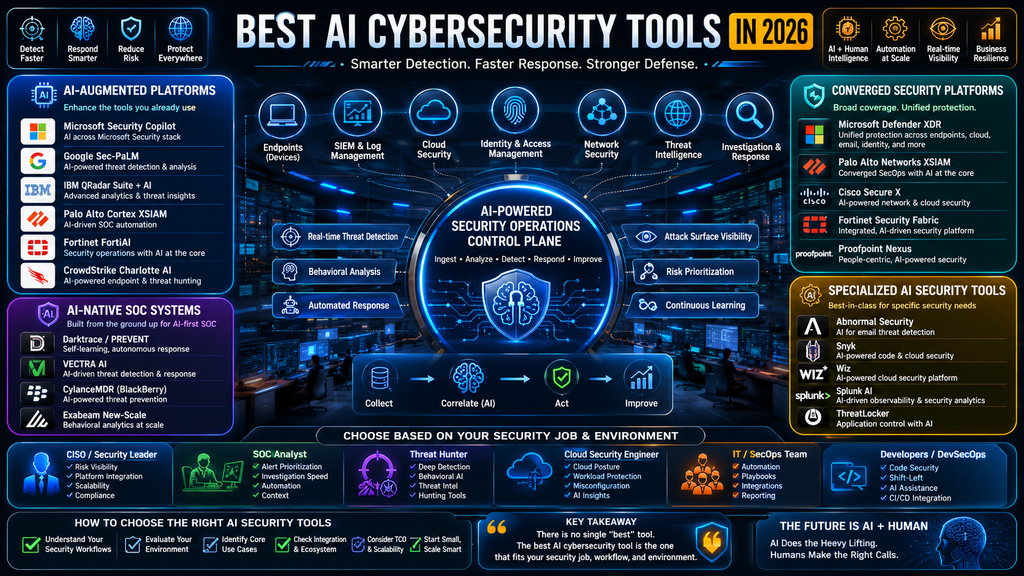
The best AI cybersecurity tool is not the product with the most impressive assistant or the largest number of automated actions. It is the product that can see the evidence your security team needs, reason across the part of the attack path you actually struggle with, and hand its conclusion to a person or response system under controls you are prepared to defend. A natural-language interface can make a weak security architecture easier to query, but it cannot create telemetry, ownership or authority that the organization never established.
This guide compares ten enterprise platforms across endpoint and XDR operations, SIEM and SOAR, behavioral detection, cloud security, autonomous alert investigation and threat intelligence. It does not claim that AI Hustle World conducted a controlled product benchmark, and it does not convert vendor marketing claims into invented performance scores. The goal is narrower and more useful: show which security job each platform is designed to improve, what evidence it needs, where its action boundary sits and what it still cannot replace.
Quick answer: which AI cybersecurity tool is best?
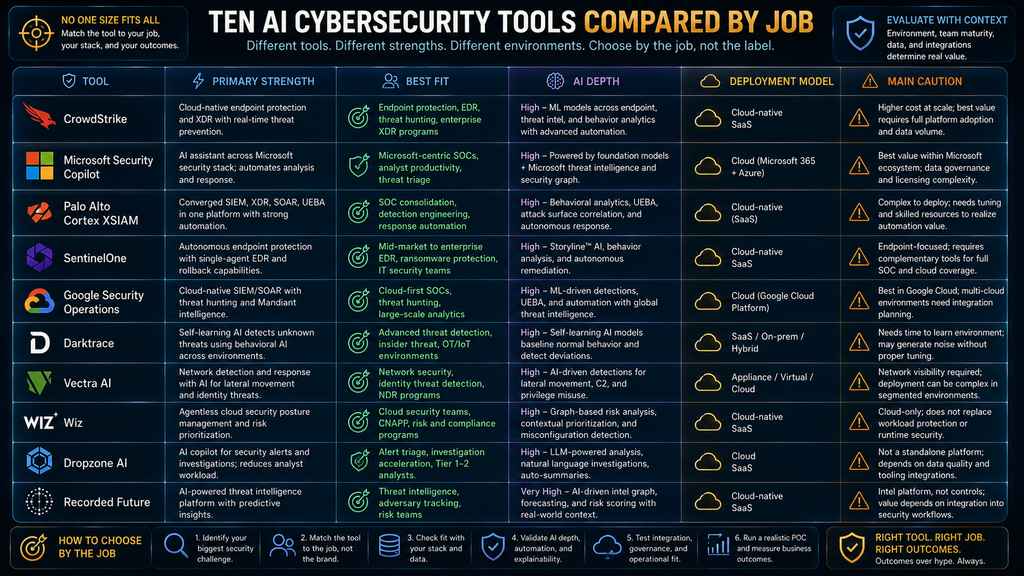
CrowdStrike Falcon with Charlotte AI is the strongest starting point for an endpoint- and XDR-centered organization already committed to Falcon. Microsoft Security Copilot is the natural ecosystem choice for teams operating through Defender and Sentinel, while Palo Alto Networks Cortex XSIAM is more compelling when the buying objective is to consolidate security operations around one data and automation plane. Google Security Operations fits teams that want Gemini-assisted investigation close to SIEM, SOAR and threat intelligence, and SentinelOne Purple AI is a serious option for endpoint-led teams moving from guided investigation toward governed agentic work.
The specialist choices solve different problems. Darktrace and Vectra AI concentrate on behavior across networks, identities, cloud and connected systems; Wiz centers cloud exposure, attack paths and AI application security; Dropzone AI adds investigation capacity over an existing stack; and Recorded Future supplies external intelligence context rather than replacing the SOC. None of those products is a universal substitute for the others, which is why a single overall ranking would create more confidence than useful information.
| Security problem | Strong first shortlist | Why it belongs there | What to verify |
|---|---|---|---|
| Endpoint/XDR investigation | CrowdStrike, SentinelOne | AI is embedded near endpoint telemetry, investigation and response | Cross-domain context, approval gates and response evidence |
| Microsoft security operations | Microsoft Security Copilot | Works alongside Defender, Sentinel and the Microsoft security ecosystem | Data readiness, licensing, capacity and non-Microsoft coverage |
| SOC platform consolidation | Palo Alto Cortex XSIAM | Unifies data, analytics, automation and incident operations | Migration burden, lock-in, retained specialist tools and action controls |
| SIEM/SOAR with AI investigation | Google Security Operations | Places Gemini close to security data, detections, playbooks and investigations | Ingestion design, data quality, response ownership and pricing |
| Behavioral network and identity detection | Darktrace, Vectra AI | Focuses on behavior and attack progression that signatures may miss | Noise, baselining period, encrypted traffic visibility and analyst trust |
| Cloud and AI application exposure | Wiz | Maps cloud configuration, identities, vulnerabilities, data and attack paths | Runtime depth, remediation ownership and overlap with existing CNAPP tools |
| Alert-investigation capacity | Dropzone AI | Adds an autonomous investigation layer across existing security systems | Connector coverage, evidence trace, uncertainty handling and review workload |
| External threat intelligence | Recorded Future | Adds contextual intelligence, indicator relationships and external-risk evidence | Source transparency, relevance to your threats and operational integration |
This market contains different security products wearing the same AI label
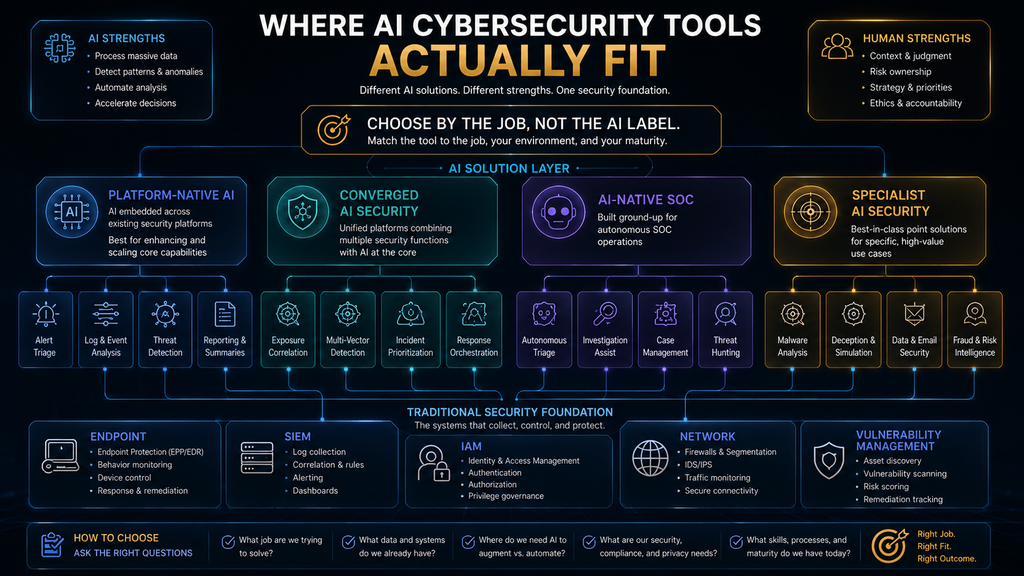
An AI cybersecurity comparison becomes misleading when it mixes three different questions. The first is how AI can help defend an organization; the second is how an organization should secure models, agents and AI applications; the third is whether a security product itself uses machine learning or generative AI somewhere in its interface. This article primarily owns the first question—AI-assisted and agentic defense—but includes Wiz because cloud and AI application exposure increasingly crosses the boundary between defending with AI and securing AI systems.
That boundary follows the direction of the NIST Cyber AI Profile, which separates securing AI systems, conducting AI-enabled cyber defense and thwarting AI-enabled attacks. If you need the underlying mechanisms before comparing vendors, start with our explanation of how AI detects threats, fraud and attacks. The present guide assumes that foundation and concentrates on the buying decision.
The market can be understood through four operating models. Platform copilots work inside an established ecosystem; converged operations platforms combine data, detection, investigation and response; behavioral systems model activity across a defined surface; specialist systems add one missing capability such as investigation capacity, cloud attack-path analysis or threat intelligence. The right question is therefore not “Which vendor has the best AI?” but “Which evidence and decision path must improve for our security operation to change?”
How we researched this guide
AI Hustle World reviewed official product pages, documentation, release information and plan or sales material available through September 24, 2026. Product statements are treated as vendor claims unless an independent source supports them; vendor case-study percentages and marketing benchmarks were not converted into comparative scores. We did not run identical incidents through all ten platforms, inspect proprietary detection logic or validate customer outcome claims, so this is a source-based decision guide rather than a laboratory ranking.
The comparison uses two authoritative ideas without pretending they provide a universal leaderboard. NIST’s Cybersecurity Framework and Cyber AI work help locate a product within governance, identification, protection, detection, response and recovery. MITRE ATT&CK Evaluations explicitly emphasize evidence-based fit against adversary behavior rather than declaring a ranked winner, which is the more defensible principle for a market where tools see different telemetry and own different response actions.
Each platform was classified by five reconstructable questions: which control plane it operates in, what evidence it can access, what analytical job the AI performs, how far it can move from recommendation to action, and which existing system or human responsibility remains necessary. The resulting Security-Control Coverage Map is AI Hustle World’s original contribution: a transparent synthesis of primary-source product claims into a buyer-readable operating model. It is not a performance benchmark, and every cell should be confirmed against the edition, license and deployment architecture offered to your organization.
Why this is more useful than a ranking: most tool lists place unlike products in one numbered ranking, while this guide shows the control plane, evidence dependency, action boundary and non-replacement condition for every platform. That makes the comparison useful even when product packaging changes, because it exposes the operational assumptions behind the recommendation. The map can also be audited: a reader can follow the linked official sources, challenge a classification and update a cell without accepting an opaque score.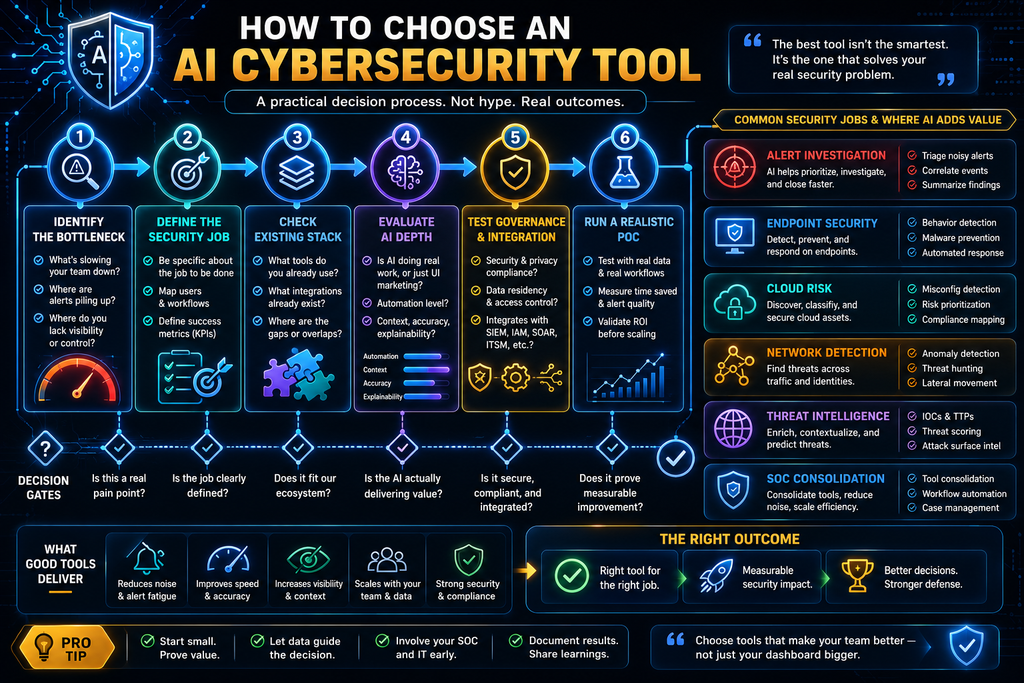
The AI Hustle World Security-Control Coverage Map
The map below is designed to stop a common procurement error: comparing visible AI features while ignoring the evidence pipeline underneath them. A security assistant connected to endpoint, identity, cloud and historical incident data is solving a different problem from a specialist that enriches indicators from external intelligence, even if both can summarize an alert in fluent language. The “does not replace” column matters because adding an AI layer often shifts work rather than removing the need for sensors, case ownership, approvals and recovery procedures.
| Platform | Primary control plane | Evidence dependency | AI role | Action boundary | Does not replace |
|---|---|---|---|---|---|
| CrowdStrike Falcon + Charlotte AI | Endpoint, XDR and Falcon data | Falcon telemetry, detections and connected security data | Hunting, investigation, agent creation and workflow reasoning | Configurable approval or autonomous actions through governed workflows | Security ownership, telemetry design and incident authority |
| Microsoft Security Copilot | Microsoft security ecosystem | Defender, Sentinel, Entra and permitted organizational context | Investigation, summarization, hunting support and guided response | Depends on integrated product permissions and workflows | Data governance, Sentinel architecture and non-Microsoft controls |
| Cortex XSIAM + AgentiX | Converged security operations | Centralized security data, analytics, incidents and integrations | Prioritization, investigation, workflow execution and agentic operations | Explicit agent permissions, approvals and governed execution | Migration planning, control ownership and retained specialist coverage |
| SentinelOne + Purple AI | Endpoint-led XDR and AI SIEM | Singularity telemetry and normalized third-party data | Triage, threat hunting, investigation and attack-timeline construction | Human-governed recommendations and agentic investigation features | Response policy, integration quality and accountable incident command |
| Google Security Operations + Gemini | SIEM, SOAR and threat intelligence | Ingested security events, detections, intelligence and playbooks | Natural-language investigation, summaries, detection and playbook assistance | Recommended actions and agentic workflows under configured controls | Data-pipeline engineering, detection ownership and response governance |
| Darktrace ActiveAI | Behavioral defense across enterprise domains | Continuous environment-specific behavioral telemetry | Baseline learning, anomaly detection, incident narrative and response | Proportionate autonomous response within configured boundaries | Asset ownership, business context and validation of abnormal behavior |
| Vectra AI | Network, identity, cloud and SaaS behavior | Behavioral signals and attack progression across covered surfaces | Detection, signal correlation, prioritization and analyst assistance | Primarily detection and response support through integrations | Endpoint prevention, full SIEM operations and remediation ownership |
| Wiz | Cloud and AI application exposure | Cloud configuration, identities, vulnerabilities, data and attack paths | Exposure correlation, prioritization and remediation guidance | Workflow-driven remediation with cloud-owner participation | SOC investigation, endpoint protection and business risk decisions |
| Dropzone AI | Autonomous alert investigation | Connected SIEM, EDR, identity, network and contextual sources | Recursive evidence gathering, investigation and case reporting | Human review of investigation conclusions and downstream actions | Underlying sensors, detection content and incident-response authority |
| Recorded Future AI | External threat intelligence | Intelligence Graph, external sources and organizational integrations | Contextualization, enrichment, hunting and intelligence synthesis | Feeds decisions and workflows rather than owning broad response | Internal telemetry, endpoint controls and complete incident investigation |
The map reveals why a feature checklist is not enough. Two vendors may both advertise “autonomous investigation,” but one reasons mainly over endpoint and XDR data while another gathers evidence across tools as a separate investigation layer. The useful proof-of-concept question is not whether both can produce a case summary; it is whether the summary exposes the right evidence, handles uncertainty and leads to an authorized next action in your operating model.
Tools that want to become the SOC control plane
The largest platforms are not merely selling an assistant. They are competing to become the place where security data is normalized, investigations are assembled and response authority is exercised. That can reduce handoffs, but it can also concentrate switching costs and operational risk. Evaluate these products as architecture decisions first and AI experiences second.
Palo Alto Networks Cortex XSIAM and AgentiX
Cortex XSIAM is the clearest fit when the buying project is about security-operations consolidation rather than adding another chat surface. Palo Alto positions the platform around centralized data, machine-learning detection, incident correlation, automation and response, while AgentiX adds a governed environment for agents that can reason, plan and execute workflows. The attraction is architectural: fewer boundaries between detection, investigation and action can remove the manual transfer work that often makes an otherwise strong SOC slow.
The same convergence creates the principal trade-off. Replacing or absorbing SIEM, XDR, SOAR and other operational functions changes data ingestion, retention, detection engineering, playbooks, staff responsibilities and commercial leverage at once. A convincing demonstration of an agent closing a case is not enough; the proof of concept must show which evidence the agent used, which tool permissions it held, how an analyst can interrupt it and whether the organization can reconstruct every consequential step afterward.
Shortlist XSIAM when duplicated platforms and fragmented case handling are already documented costs, and when the organization has executive support for a control-plane change. It is a weaker fit when the team mainly needs one missing specialist capability or cannot resource the migration and operating-model work that consolidation requires. Quote-based pricing makes the architecture especially important: compare three-year ingestion, retention, migration, services and staffing costs rather than a single license line.
Google Security Operations with Gemini
Google Security Operations places Gemini beside SIEM, SOAR, threat intelligence, detections and playbooks. Official documentation describes natural-language investigation, contextual summaries, recommended response actions and assistance with detection and playbook creation. That proximity matters because useful security reasoning depends less on conversational polish than on the quality and breadth of the evidence available to the model.
The product belongs on a shortlist when a team wants AI-assisted investigation over a broad security data layer and is willing to treat data engineering as part of the deployment. If ingestion filters omit a decisive event, entity resolution is weak or historical context is inconsistent, Gemini can explain the available record without seeing the complete incident. A proof of concept should therefore include a known investigation where relevant evidence lives in several sources, then check whether the platform connects those events without inventing a causal story.
Google’s growing use of agents for triage and detection engineering also changes the governance requirement. A system that recommends a query has a smaller blast radius than one that creates detection content or initiates response, so permission design must become progressively stricter as capability expands. Google Security Operations is not a shortcut around detection ownership; it is an opportunity to make detection, investigation and orchestration share a stronger evidence base.
Microsoft Security Copilot with Defender and Sentinel
Microsoft Security Copilot is most compelling when Defender, Sentinel, Entra and Microsoft 365 already contain the security and identity context an analyst uses each day. The assistant can support incident analysis, summarization, hunting and guided response across eligible Microsoft security experiences. Its advantage is therefore ecosystem proximity, not an abstract claim that one model is universally better at cybersecurity.
A Microsoft-heavy environment may reduce integration work because permissions, incidents and hunting workflows already sit near the assistant. A multi-vendor environment needs a more skeptical evaluation: confirm which third-party sources arrive with enough fidelity, which actions remain inside separate consoles and whether Copilot’s explanation can be traced back to the underlying evidence. Licensing and Security Compute Unit capacity must also be modeled against real usage patterns, because occasional investigation support and constant automated work create different consumption profiles.
Choose Security Copilot when the organization wants to improve work already happening in the Microsoft security stack, not when it hopes a copilot will repair weak Sentinel content or unclear incident ownership. The first proof-of-concept use case should be familiar and repeatable, such as turning a Defender incident into a sourced investigation brief with a proposed hunting query. Measure analyst corrections, missing evidence and follow-up steps instead of counting how quickly the first response appears.
Endpoint-led platforms moving toward agentic security operations
Endpoint platforms have a structural advantage in AI-assisted investigation: they already possess high-value telemetry and response mechanisms close to the affected device. Their limitation is equally structural. An incident rarely stays inside one endpoint, so the evaluation must show whether identity, cloud, network, email and external intelligence context reaches the investigation with enough detail to support a safe decision.
CrowdStrike Falcon with Charlotte AI
Charlotte AI sits on the Falcon platform’s endpoint, threat-intelligence and security-data foundation. CrowdStrike now describes capabilities that extend beyond conversational investigation into AgentWorks for building governed agents and Agentic SOAR for workflows. Importantly, official product information states that response actions are not automated by default; teams configure whether an action runs autonomously or requires approval.
That configurable boundary is more important than the number of available agents. A useful deployment can let Charlotte collect evidence, explain an incident and prepare an action while keeping containment behind a human gate until confidence and process maturity improve. The platform is strongest when Falcon is already a central operational system, because the AI can work near the telemetry and permissions instead of depending on a long chain of brittle connectors.
The lock-in question should still be explicit. If Falcon becomes the data foundation, agent environment, SIEM and response layer, an organization gains operational coherence but increases dependence on one vendor’s schemas, economics and control model. Shortlist CrowdStrike when endpoint and XDR operations are the primary bottleneck, then test a cross-domain incident to see how well Charlotte incorporates evidence that originates outside Falcon.
SentinelOne Singularity with Purple AI
Purple AI is SentinelOne’s agentic security analyst inside the Singularity platform. Current product material emphasizes triage, investigation and threat hunting over native and OCSF-normalized third-party data, while 2026 releases expanded one-click and agentic investigation capabilities. That makes Purple AI relevant to teams that want endpoint-centered operations without keeping the AI confined to a narrow endpoint alert.
The phrase “autonomous investigation” needs careful interpretation. Gathering evidence and constructing an attack timeline can reduce repetitive analyst work, but the output still needs to distinguish confirmed events, model inference and missing data. Ask the platform to investigate an alert with an ambiguous identity or incomplete cloud trail, then observe whether it states the uncertainty, seeks additional evidence or turns a plausible story into a confident verdict.
SentinelOne belongs on the shortlist when endpoint operations, alert volume and investigation capacity are connected problems. It is less persuasive when the main gap is external intelligence, cloud exposure or network behavior outside the platform’s strongest evidence path. Compare Purple AI with CrowdStrike on the telemetry you actually own and with a specialist investigation layer when your environment is intentionally multi-vendor.
Behavioral detection for attacks that cross product boundaries
Behavioral platforms earn their place when the security problem is not simply a missing signature. Identity abuse, lateral movement, encrypted command channels and the misuse of legitimate administration tools can look ordinary when each event is viewed alone. The value proposition is to model activity across time and entities, then elevate a smaller set of connected behaviors for investigation.
Darktrace ActiveAI Security Platform
Darktrace ActiveAI builds its case around environment-specific behavioral understanding across users, identities, devices, applications, workloads, operational technology and AI systems. Its Real-Time AI Analyst is positioned to correlate related activity, produce an incident narrative and support autonomous, proportionate response. This is materially different from a copilot that waits for an analyst to open a case and ask a question.
The difficult part is proving that “normal” has been learned usefully in your environment. A seasonal workload, a new integration or a privileged administrator performing an unusual maintenance task can all appear anomalous without being malicious. The proof of concept must therefore include ordinary change, known benign anomalies and at least one representative attack path; otherwise a polished incident narrative may conceal a high operational cost in tuning and review.
Darktrace is a strong candidate when broad behavioral visibility and autonomous containment are priorities across several enterprise domains. It is not automatically the best choice for a team whose immediate problem is endpoint prevention, cloud misconfiguration or threat-intelligence context. Phishing can also cross email, identity and network layers, so buyers with that concern should compare the platform’s behavioral coverage with the mechanism described in our guide to AI phishing and social-engineering detection.
Vectra AI Platform
Vectra AI focuses on attacker behavior across networks, identities, cloud and SaaS. Its Attack Signal Intelligence model is intended to correlate and prioritize behavior so analysts receive connected attack signals rather than an undifferentiated stream of anomalies. That positioning is attractive when identity compromise and lateral movement pass through surfaces that neither a single endpoint sensor nor a static rule can fully explain.
Vectra should be evaluated as a detection and prioritization layer, not described as a complete replacement for SIEM, endpoint prevention or incident command. Its value depends on the surfaces it can observe and the fidelity of those observations, including what remains visible when traffic is encrypted or activity shifts into a cloud control plane. Run the platform against an attack path that crosses identity and network events, then inspect whether it preserves the chronology and business context an analyst needs to act.
This is a good shortlist candidate when the organization already owns competent endpoint and case-management systems but lacks a reliable view of attack progression. It is a weaker answer when the real bottleneck is the labor required to investigate alerts after they are raised. In that situation, Vectra may improve signal quality while a different product or service is still needed to complete the investigation.
Specialist tools for cloud exposure, investigation capacity and threat intelligence
A specialist product is often a better purchase than a broad platform when the organization has one measurable gap and wants to preserve the rest of its architecture. The discipline is to keep the scope honest. A cloud exposure platform, an AI investigation layer and a threat-intelligence system can all improve security operations, but they intervene at different points in the evidence chain and produce different kinds of value.
Wiz for cloud and AI application security
Wiz belongs in this comparison because cloud risk is increasingly inseparable from AI deployment. Its platform maps cloud resources, identities, vulnerabilities, data and exposures through a security graph, while AI-SPM and AI application capabilities extend that context to models, pipelines, services and agents. The resulting question is not merely whether a vulnerability exists, but whether identities, reachability and sensitive data combine into a credible attack path.
That is a different job from autonomous SOC investigation. Wiz can help a cloud owner understand which exposure deserves attention and why, but it does not replace endpoint investigation, broad threat hunting or incident leadership. Buyers should map overlap with an existing CNAPP, CSPM, vulnerability-management or data-security platform before assuming that another graph will automatically reduce risk.
Shortlist Wiz when cloud architecture, attack paths and AI application exposure are the dominant unknowns. During the proof of concept, choose several findings that look severe in isolation and test whether the platform distinguishes a reachable, exploitable path from a disconnected configuration issue. The operational measure is not the number of findings discovered; it is whether cloud teams remediate the right paths faster without losing responsibility for the decision.
Dropzone AI for autonomous alert investigation
Dropzone AI addresses a narrower but painful bottleneck: the amount of analyst work required to investigate security alerts. The platform connects to existing sources such as SIEM, EDR, identity and network systems, gathers evidence and produces investigation findings in plain language. Its commercial logic is not “replace every security tool”; it is “use the tools you already have without requiring a person to repeat the same evidence-gathering routine for every case.”
That narrowness is useful because the proof of value can be concrete. Select a representative set of true positives, false positives and inconclusive alerts, preserve the original analyst notes, then compare evidence completeness, time to review, conclusion changes and escalation decisions. Do not use vendor-reported efficiency percentages as your result; calculate the work removed from your own queue and include the time analysts spend correcting or validating the AI investigation.
The main risk is mistaking a coherent report for a complete investigation. Connector permissions, data latency and missing context can all narrow what the system sees, while downstream response authority still belongs to a person or an explicitly governed workflow. Dropzone is most compelling for a lean, multi-tool SOC with adequate sensors but insufficient investigation capacity; it is less useful when alerts are poor because detection engineering or data collection is broken.
Recorded Future AI for threat-intelligence context
Recorded Future AI works from the Intelligence Graph and the company’s external threat-intelligence collection to help analysts contextualize indicators, actors, infrastructure and emerging risk. In a SOC that already detects suspicious activity, this context can answer the next question: what does this domain, identity leak, malware family or campaign mean for our organization? That is a different value proposition from generating another internal alert.
Source traceability is especially important in threat intelligence because an unsupported claim can misdirect priority or attribution. The proof of concept should require analysts to open the evidence behind an AI answer, inspect dates and sources, and distinguish a confirmed relationship from a model-generated synthesis. Measure whether the platform changes a decision—blocking infrastructure, escalating an incident or prioritizing exposure—rather than how many intelligence cards or summaries it produces.
Recorded Future is strongest when external context is the limiting layer in detection, vulnerability prioritization, brand protection or incident response. It does not replace internal telemetry or the human work of deciding what an intelligence signal means for your assets. Teams that mainly need malware triage or vulnerability-alert analysis should also review how AI supports those workflows in our guide to malware, vulnerability and security-alert analysis.
Choose the product by the broken decision, not the fashionable capability
A security purchase should begin with a decision that is currently late, weak or expensive. “We receive too many alerts” is not yet specific enough: the alerts may be noisy, investigations may be repetitive, evidence may be scattered or response approvals may be slow. Those causes lead to different shortlists, and buying the wrong layer can make the dashboard quieter without making the organization safer.
| Observed failure | Likely underlying gap | Shortlist direction | Proof required |
|---|---|---|---|
| Analysts open too many low-value alerts | Detection quality, correlation or prioritization | Vectra, Darktrace, XSIAM, endpoint/XDR platforms | Fewer reviewed cases without missed representative attacks |
| Good alerts take too long to investigate | Evidence gathering and case assembly | Dropzone, Purple AI, Charlotte AI, Security Copilot | Complete evidence trace with fewer analyst minutes and no lower decision quality |
| Cases stall between SIEM, SOAR and response tools | Fragmented control plane and ownership | XSIAM, Google Security Operations, Microsoft ecosystem | Reduced handoffs with auditable permissions and recovery |
| Identity and lateral movement appear too late | Behavioral visibility across attack progression | Vectra AI, Darktrace | Earlier connected signal on known cross-surface scenarios |
| Cloud teams cannot prioritize thousands of findings | Missing exposure and attack-path context | Wiz | Higher remediation rate for reachable, consequential paths |
| Detections lack external adversary context | Threat-intelligence enrichment | Recorded Future | More defensible prioritization tied to inspectable evidence |
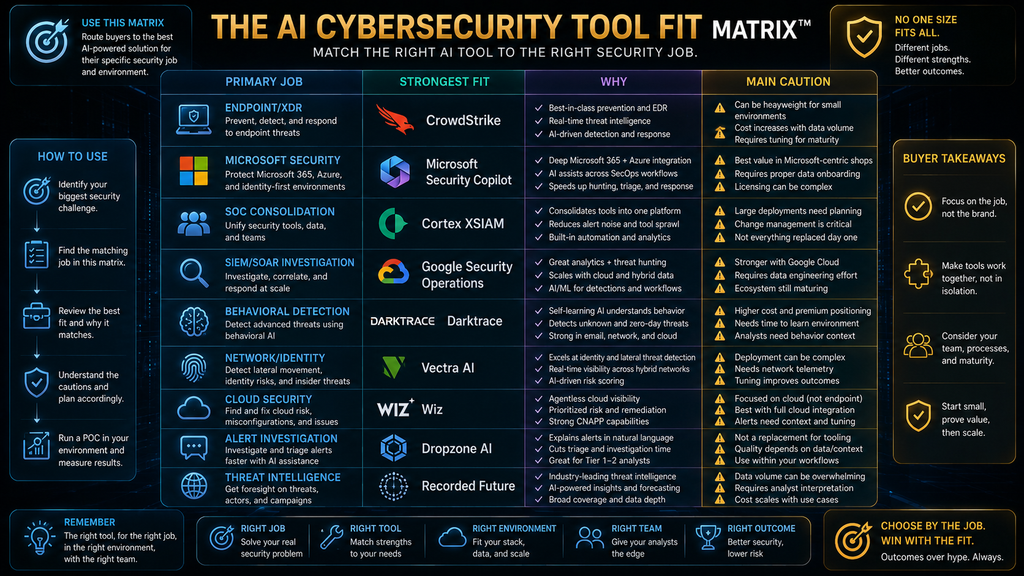
This decision map also protects against accidental overlap. If a new platform improves the same alert, uses the same telemetry and triggers the same response as an existing product, require evidence that it removes enough work or risk to justify another contract and integration. Our comparison of AI cybersecurity and traditional security tools explains why the newer interface is not automatically the stronger control.
Run the proof of concept like an incident review, not a product demonstration
The vendor should not choose every scenario. Select several closed incidents your team understands, remove conclusions that would leak the answer and preserve the original timeline, evidence, analyst actions and final disposition. Include a true positive, a false positive, an ambiguous case and a case with missing telemetry; a platform that looks excellent only when the evidence is complete has not been tested against ordinary security operations.
Evaluate the evidence chain in order: sensor coverage, data normalization, entity correlation, investigation reasoning, decision, action and audit record. When a conclusion is wrong, locate where it first became wrong. Missing sensor data demands a different remedy from faulty correlation, and a good conclusion followed by an unauthorized action is still a failed security outcome.
Measure correction burden, not response speed alone
Time to first answer is easy to demonstrate and often irrelevant. Record the minutes required to verify citations, reopen source events, correct entities, rewrite the case narrative and obtain approval for the next action. A system that drafts in thirty seconds but consumes twelve minutes of skeptical review may still be valuable, but the saving is smaller than the interface suggests and should be compared with the original process honestly.
Separate evidence, inference and recommendation
A defensible investigation should let the reviewer distinguish an observed event from a correlated inference and a proposed response. Ask the product to expose the source event, timestamp, entity relationship and confidence or uncertainty behind a material conclusion. If the system produces a fluent paragraph without an inspectable path back to evidence, it may improve readability while weakening accountability.
Test a failure and the recovery path
Disable a non-production connector, delay a data source or remove a permission that an automated workflow expects. The product should fail visibly, preserve the incomplete case, explain what evidence or authority is missing and route the decision to an owner. Silent partial success is more dangerous than an obvious failure because analysts may accept a conclusion that was built from an incomplete record.
Compare the total operating burden
Enterprise cybersecurity pricing is usually architecture-dependent, so a public monthly number would create false precision. Build a three-year cost model that includes data ingestion and retention, endpoint or identity licenses, AI or compute credits, integrations, migration, professional services, model or detection tuning, analyst training and the staff who will own approvals and exceptions. Also price the tools that can genuinely be retired; “consolidation” has no financial value when overlapping contracts remain because teams do not trust the new control.
| POC measure | What to record | Failure signal |
|---|---|---|
| Evidence completeness | Required sources found, timestamps preserved, entity links explained | Conclusion depends on unexposed or missing evidence |
| Decision quality | Correct disposition, changed analyst verdicts, unresolved uncertainty | Confident false conclusion or hidden ambiguity |
| Human effort | Investigation, verification, correction and approval minutes | Fast draft creates equal or greater review burden |
| Action governance | Permissions, approvals, denied actions, rollback and audit trail | Agent can exceed intended authority or action cannot be reconstructed |
| Operational resilience | Connector failure, latency, degraded mode and recovery behavior | Silent partial investigation or lost case state |
| Stack effect | Tools retired, integrations added, new owners and ongoing maintenance | Another dashboard without measurable work or risk removed |
Agentic security changes the authorization problem
A copilot that summarizes an incident can be wrong; an agent that disables an account, isolates an endpoint or changes a detection can be wrong at operational speed. The procurement standard must therefore rise as the system moves from answering to recommending, preparing and executing. Our guide to how autonomous SOC agents work explains that progression in detail, but the buying implication is simple: capability and authority should never expand as one undifferentiated setting.
CISA’s secure and verifiable technology guidance supports asking suppliers for evidence about product security rather than accepting capability claims alone. For agentic services, buyers should also examine identity, least privilege, tool allowlists, input boundaries, approval stages, execution logs, rollback, model and prompt changes, data retention and incident notification. An agent should have its own governed identity and a narrower permission set than the analyst it assists wherever the platform architecture allows it.
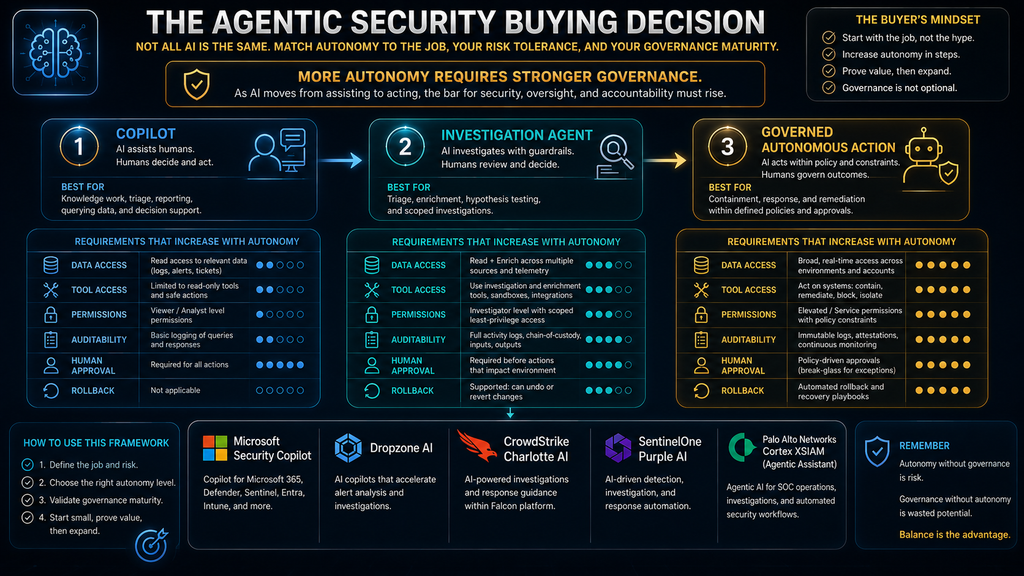
A practical autonomy ladder begins with read-only investigation, moves to drafted actions, then allows low-impact execution with approval before considering autonomous containment. Promotion between levels should require evidence from real cases, not a calendar date or vendor maturity label. Keep high-impact actions—privileged identity changes, destructive remediation, production isolation and public or regulatory communication—behind explicit human authority until the organization can prove a narrower boundary is safer.
Most small businesses should buy managed outcomes before an AI SOC platform
If you do not have a maintained asset inventory, centralized identity, endpoint protection, reliable backups and someone accountable for incidents, an enterprise AI security platform is unlikely to be the first missing control. The product may identify more work than the organization can perform, while configuration and alert-review responsibilities become another unmanaged risk. A managed security provider, managed detection and response service or stronger baseline controls may create more protection per dollar than licensing an advanced agentic interface.
A smaller team can still use AI productively, but the scope should be narrow and reversible. Examples include drafting a phishing analysis for human review, enriching a suspicious indicator, summarizing a closed incident or helping an administrator interpret a vendor alert. Avoid connecting a general consumer assistant to confidential logs or granting automated response authority because the organization lacks staff; limited oversight is a reason to narrow permissions, not expand them.
When your existing security stack may already be enough
Do not buy another platform when the current one already collects the right telemetry, detects representative attacks and supports the required response, but the team has not configured or staffed it properly. Many vendors have added investigation assistants, natural-language hunting and automation to products customers already own. Before opening a new procurement cycle, audit unused entitlements, broken connectors, stale detection content, unresolved data-quality issues and playbooks that were never assigned an owner.
The “do nothing” option should still be measured. If analysts are missing critical alerts, investigation queues are growing or cloud exposure cannot be prioritized, leaving the architecture unchanged has a cost. But the alternative may be a process repair, integration project or managed service rather than another AI license. The correct outcome of a disciplined comparison can be “improve the existing system and reassess in six months.”
Where AI cybersecurity platforms are moving next
The market is moving from isolated assistants toward agents that share a security data plane, call tools and complete bounded workflows. That shift makes integration depth, identity and auditability more important than model branding. The platform that can access the right evidence and act through governed interfaces may outperform a more capable general model that lacks operational context.
At the same time, security for AI systems is becoming part of ordinary enterprise defense. Cloud platforms are extending posture and attack-path analysis to models, data, pipelines and agents, while behavioral platforms are learning how AI services interact with people and infrastructure. Buyers should expect overlap between SOC, cloud security, identity, data security and AI governance, but overlap does not guarantee consolidation; it can also create a new round of duplicated controls with different labels.
The durable buying principle is evidence before autonomy. Models, agents and packaging will change quickly, but a security decision still needs observable events, a reasoned conclusion, an accountable owner, an authorized action and a recoverable audit trail. A product that strengthens that chain deserves attention. A product that hides it behind a confident answer is adding a new control risk.
Final thoughts
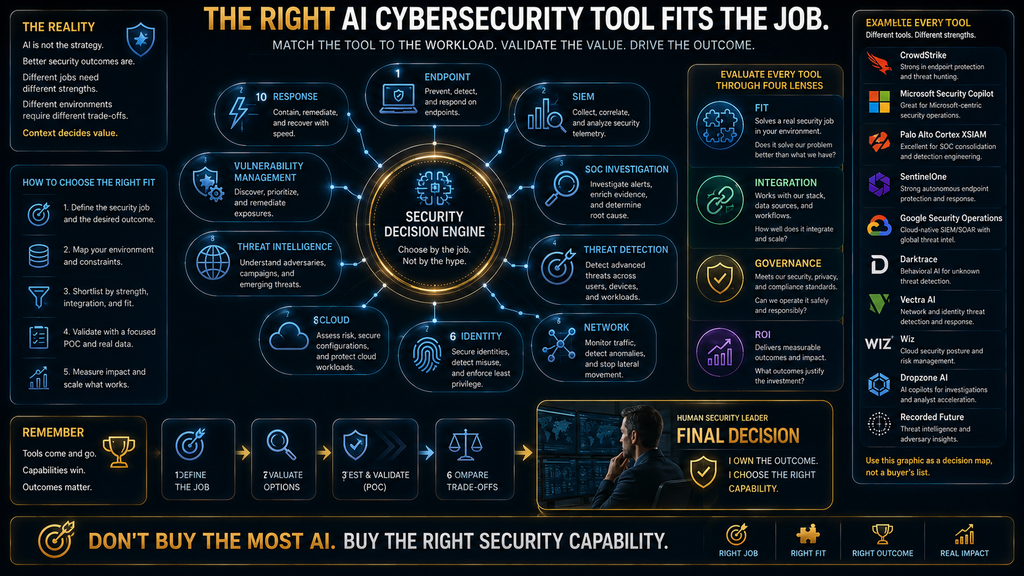
There is no honest single winner across this market because the ten products do not own the same security job. CrowdStrike and SentinelOne are strongest near endpoint-led operations; Microsoft, Google and Palo Alto compete more directly for security-operations context and control-plane influence; Darktrace and Vectra specialize in behavioral detection; Wiz maps cloud and AI exposure; Dropzone adds investigation capacity; and Recorded Future supplies external intelligence. Ranking them in one line would reward breadth and brand recognition while hiding the architecture each buyer must operate.
Start with the failed decision, map the evidence and authority required to fix it, then test the smallest credible shortlist on incidents your team already understands. Keep vendor claims separate from your measured results and require every consequential action to be attributable, bounded and recoverable. The best AI cybersecurity tool is the one that improves a real control without making the security team less able to explain what happened.
Understand the Detection Logic Before You Buy the Platform
See how AI connects telemetry, behavior and context to find attacks—and where human investigation still remains essential.
Explore AI Threat Detection →Frequently asked questions
What is the best AI cybersecurity tool in 2026?
There is no universal best tool because platforms operate on different evidence and control planes. CrowdStrike is a strong endpoint/XDR choice, Microsoft Security Copilot fits Microsoft-centered environments, Cortex XSIAM suits consolidation projects, Google Security Operations supports SIEM/SOAR-centered investigation, and specialist products may be stronger for behavior, cloud exposure, investigation capacity or threat intelligence. Choose the platform that improves a defined security decision in your architecture.
Which AI cybersecurity platform is best for a SOC?
Cortex XSIAM and Google Security Operations are strong control-plane candidates, while Microsoft Security Copilot, CrowdStrike Charlotte AI and SentinelOne Purple AI can be better when the SOC already operates heavily inside their respective ecosystems. Dropzone AI is a different type of option for teams that want to preserve a multi-vendor stack but automate more alert investigation. The best SOC platform depends on telemetry coverage, integration burden and the actions the system may safely perform.
Can AI cybersecurity tools replace security analysts?
They can remove portions of triage, evidence collection, summarization, hunting and playbook execution, but they do not remove accountability for consequential decisions. Analysts still need to validate uncertain findings, understand business impact, authorize high-risk actions and manage incidents that exceed the system’s data or permission boundaries. A useful deployment changes the analyst’s work rather than pretending ownership disappeared.
What is the difference between an AI security copilot and an AI SOC agent?
A copilot normally responds to an analyst, summarizes evidence or recommends a next step. An agent can pursue a goal through several actions, call approved tools and potentially execute part of the response workflow. The categories overlap as products evolve, so buyers should inspect actual permissions, approval gates, execution logs and rollback instead of relying on the product label.
Which AI cybersecurity tool is best for cloud security?
Wiz is the clearest specialist in this comparison for cloud exposure, attack-path analysis and AI application security. Cortex Cloud, Google and other broad platforms may also cover cloud workloads, while Vectra can contribute behavioral cloud detection. Compare the exact gap—posture, vulnerability prioritization, runtime detection, identity abuse or incident response—because “cloud security” contains several different control jobs.
Which tool is best for threat intelligence?
Recorded Future is the specialist recommendation here because its platform centers on the Intelligence Graph and external threat context. Google, CrowdStrike, Microsoft and Palo Alto also integrate threat intelligence into their operational platforms, which may be sufficient when enrichment is secondary to incident investigation. Evaluate whether the intelligence changes priority and whether analysts can inspect the sources behind an AI-generated conclusion.
How should an organization test an AI cybersecurity platform?
Use closed incidents with known timelines and include true positives, false positives, ambiguous cases and missing data. Measure evidence completeness, decision changes, analyst correction time, permissions, failed-connector behavior and auditability. Keep vendor demonstrations separate from your results, and do not allow production response actions until the lower-risk investigation workflow has been validated.
How much do enterprise AI cybersecurity tools cost?
Most enterprise products use quote-based pricing influenced by endpoints, users, data ingestion, retention, modules, AI credits, integrations and services. Compare three-year total operating cost rather than one license price. Include migration, professional services, training, ongoing tuning and the staff required to govern approvals and exceptions, then subtract only the tools and work that can genuinely be retired.
Are AI cybersecurity tools safe to connect to sensitive security data?
Safety depends on the product edition, contract, deployment, retention controls, encryption, model-training policy, regional handling, identity design and permissions. Use the minimum data and tool access required, verify tenant isolation and logging, and establish escalation and deletion procedures before adding production evidence. A familiar vendor name does not guarantee that every plan or integration has the same protections.
Should a small business buy an AI SOC platform?
Usually not before baseline controls and ownership are mature. A small organization often gains more from centralized identity, endpoint protection, tested backups, patching and a managed security or MDR service. If AI is adopted, begin with a narrow read-only or human-reviewed workflow and avoid autonomous production actions until someone can monitor failures and own the consequences.
Editorial note: AI Hustle World used AI-assisted research and drafting, then checked product classifications and material claims against official documentation and authoritative guidance available on September 24, 2026. We did not accept payment for inclusion, perform a controlled hands-on benchmark or independently validate vendor-reported performance outcomes. Product capabilities, packaging and pricing can change; verify current documentation, contracts and security controls before procurement.
Related Guides
- Best AI Product Management Tools in 2026: Research, Roadmaps & Product Ops
- What Is Model Context Protocol (MCP)?
- Best RAG Platforms and Tools for Building AI Knowledge Bases in 2026
Written by
Muntasir Ahmad Chowdhury
Founder-AI Hustle World
Muntasir Ahmad Chowdhury is the Founder of AI Hustle World, an independent publication dedicated to making Artificial Intelligence practical, trustworthy, and easy to understand. He researches AI tools, automation, customer service, productivity, and real-world business applications, helping readers make smarter technology decisions through research-driven, experience-backed content.
Expertise:
AI Tools • AI Automation • AI Customer Service • AI Productivity • Generative AI • AI Workflows
Get Smarter With AI
Enjoyed this guide? Get practical AI tools, tutorials, and honest reviews delivered to your inbox.