Last Updated: August 2026 — reviewed current threat-detection research, incident-response evidence and AI cybersecurity developments.
How AI-Powered Threat Detection Finds Attacks Faster
A security alert is not the same thing as a detected attack.
That distinction sounds minor, but it explains why many security teams still struggle even after investing heavily in security products. Modern organizations can collect enormous quantities of telemetry from endpoints, identities, networks, cloud infrastructure, applications and users. The problem is that malicious activity is usually buried inside legitimate activity, and attackers increasingly know how to make their behavior resemble normal business operations.
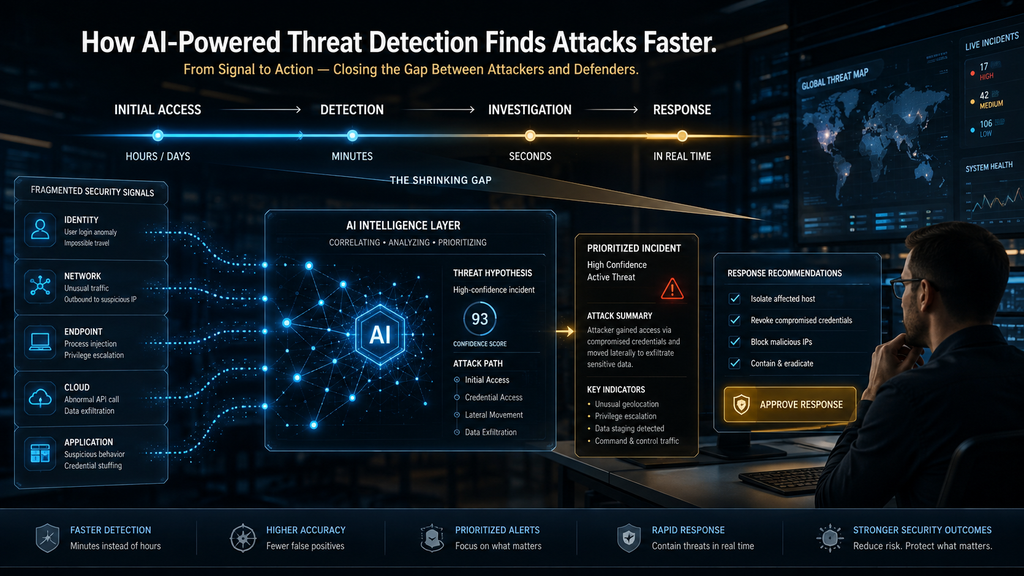
The pressure is getting worse because attackers are moving faster. Mandiant’s 2026 M-Trends research, based on more than 500,000 hours of frontline investigations conducted during 2025, found that the median time between initial access and handoff to a secondary threat actor fell from more than eight hours in 2022 to just 22 seconds in 2025. Mandiant also found that exploits represented 32% of initial infection vectors in its 2026 findings.
That does not mean every breach now unfolds in 22 seconds. The statistic refers specifically to the time between initial access and the identified handoff to another threat actor. The important lesson is the shrinking window available to defenders before an intrusion can become more difficult to contain.
AI-powered threat detection is designed to operate inside that window.
AI threat detection uses machine learning and related AI techniques to analyze security telemetry, identify unusual or malicious patterns, correlate events across systems and prioritize suspicious activity for investigation or response.
The technology is not magic, and it is not simply “faster antivirus.” Its real advantage is that it can help move the security workflow from isolated events to contextual explanations.
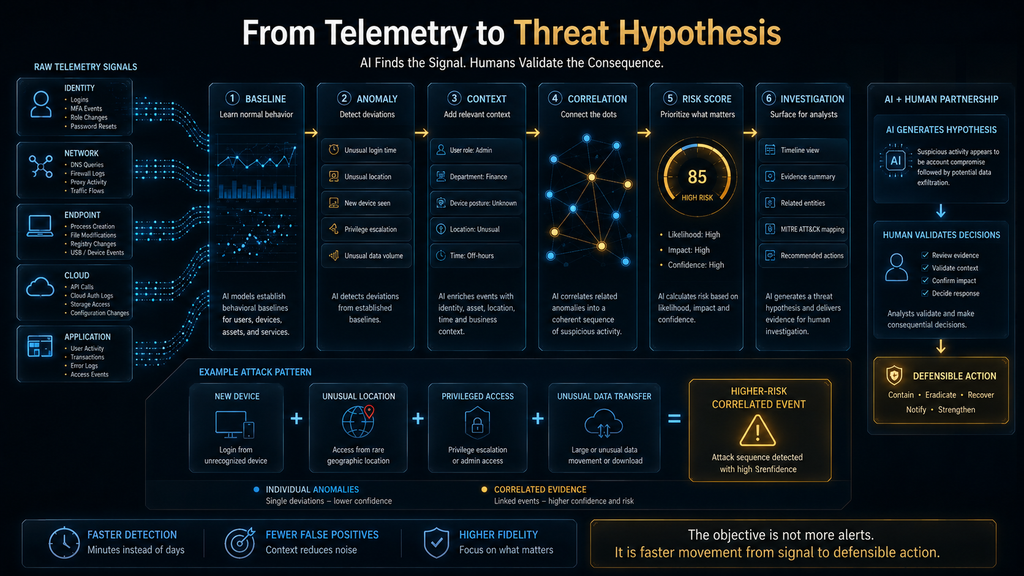
A login from an unusual location might be harmless. A login from an unusual location followed by a new device, a privilege escalation, an unfamiliar API call and an unusual transfer of sensitive data is far more interesting. AI can help connect those events, estimate their significance and move the investigation forward before an analyst has manually reconstructed the entire sequence.
That is the real question this article explores: how AI reduces the distance between the first meaningful security signal and a defensible security decision.
What AI-Powered Threat Detection Actually Means
AI-powered threat detection is the use of AI and machine-learning techniques to recognize suspicious behavior, malicious patterns and relationships across large volumes of security data.
That definition is intentionally broader than “AI detects malware.”
Threat detection can involve:
- identity events,
- network activity,
- endpoint behavior,
- cloud activity,
- application logs,
- email,
- authentication,
- file behavior,
- vulnerability data,
- threat-intelligence indicators,
- transaction signals.
The AI may perform different functions depending on the architecture. A conventional machine-learning model may classify network traffic or identify anomalous behavior. Another system may use statistical models to establish a baseline and flag deviations. An LLM may summarize an incident, connect evidence from multiple sources or help an analyst interpret an ambiguous case.
Those are different jobs.
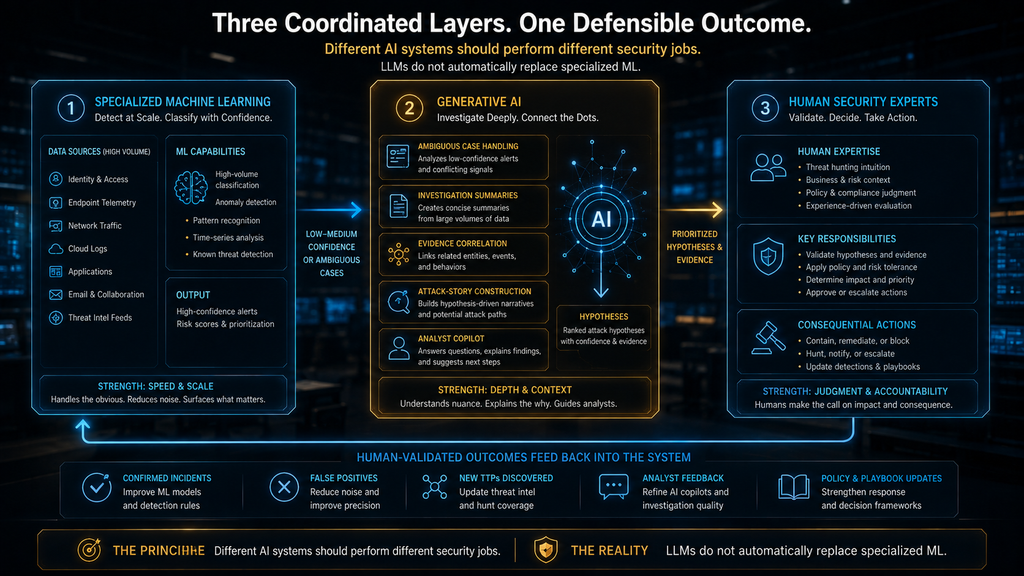
One of the most useful findings from recent research is that LLMs should not automatically be treated as replacements for conventional cybersecurity ML. A 2026 peer-reviewed study in Frontiers in Big Data compared LLM-based threat detection with conventional machine-learning classifiers on BODMAS and UNSW-NB15 datasets. The conventional ML models consistently outperformed the LLM-based approach on standard detection metrics, while the LLM proved more useful for ambiguous cases where contextual explanation was valuable. The authors therefore proposed a hybrid architecture combining conventional ML, LLM assistance and human oversight.
That is a much more credible model of AI security than the idea that one general-purpose language model should do everything.
For high-confidence, time-sensitive detection, specialized models can remain extremely useful. For investigation, explanation, summarization and ambiguous cases, generative AI may add another layer of value.
The strongest architecture may therefore look less like:
“Replace security ML with an LLM.”
and more like:
“Use the right AI capability for the right security job.”
Why Traditional Detection Has a Speed Problem
Traditional security controls remain valuable, but rules, signatures and manual investigation become harder to scale when attackers generate huge volumes of changing behavior.
Signature-based detection works well when you know what malicious activity looks like.
If a malware sample has a known hash, a malicious domain is already identified, or a specific attack pattern has a reliable indicator, deterministic detection can be extremely effective.
The difficulty appears when the attacker changes the artifact.
A new variant may not have the same hash. A compromised legitimate account may not generate a clearly malicious binary. A novel attack may not match an existing signature. A phishing campaign may use a legitimate service rather than an obviously malicious domain.
This is where behavioral and anomaly-based detection becomes useful.
Instead of asking:
the system can ask:
“Does this behavior fit what we normally expect?”
That difference is fundamental.
NIST research on machine-learning-based zero-day detection has examined this exact problem: signature-based methods can struggle when the specific attack is new, while ML approaches can capture statistical characteristics associated with malicious behavior. NIST also emphasizes that ML detection methods continue to face challenges involving accuracy, recall and robustness.
So AI doesn’t eliminate traditional detection.
It gives defenders another way to recognize risk when an exact signature is unavailable.
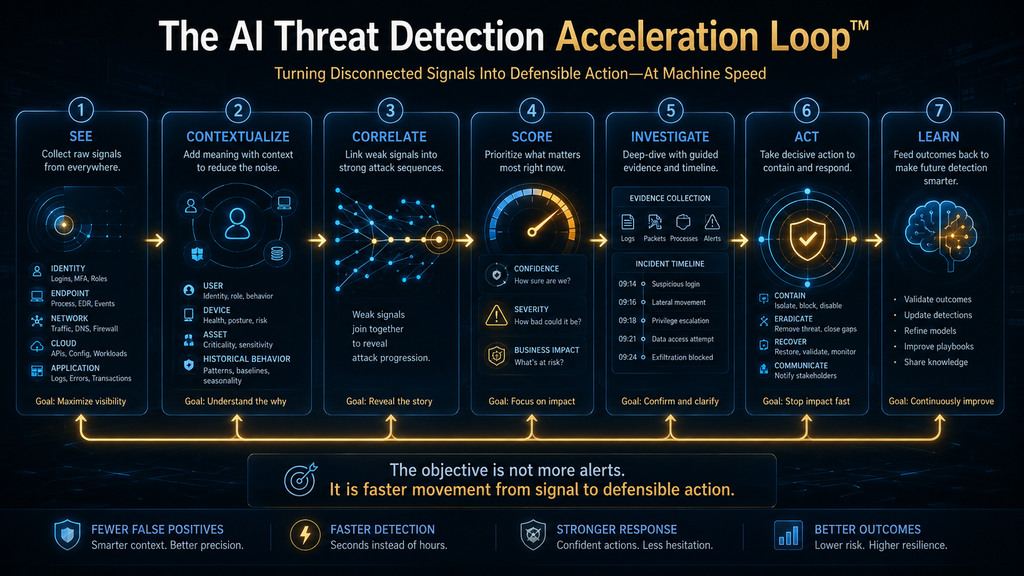
The AI Threat Detection Acceleration Loop™
The practical value of AI threat detection comes from shortening the path from raw telemetry to a high-confidence security decision.
The AI Hustle World AI Threat Detection Acceleration Loop™ is:
SEE → CONTEXTUALIZE → CORRELATE → SCORE → INVESTIGATE → ACT → LEARN
The sequence matters because detection alone is not enough.
A system can identify a suspicious event in milliseconds and still leave an analyst with hours of work before the event becomes actionable.
The actual security advantage appears when AI can accelerate several stages of the process.
SEE
Collect signals from multiple systems.
CONTEXTUALIZE
Determine who, what, where, when and what asset is involved.
CORRELATE
Connect apparently unrelated events into a possible attack sequence.
SCORE
Estimate confidence, severity and business impact.
INVESTIGATE
Gather evidence and build a threat hypothesis.
ACT
Recommend or execute the appropriate response within defined controls.
LEARN
Use confirmed outcomes to improve future detection and investigation.
This turns “AI detection” into a workflow rather than a model.
Step 1: SEE — Collect the Security Signals
AI cannot detect what the organization cannot observe, so effective AI threat detection starts with broad and relevant telemetry.
Depending on the environment, useful signals may come from:
- endpoint security,
- identity providers,
- network infrastructure,
- DNS,
- cloud services,
- applications,
- email systems,
- authentication logs,
- API gateways,
- databases,
- vulnerability scanners,
- threat-intelligence platforms.
The objective is not to collect everything indiscriminately.
A security team needs the signals that can explain what matters.
Consider a suspicious login.
Identity data may tell you:
new location.
Device telemetry may tell you:
unfamiliar device.
Network data may tell you:
connection to suspicious infrastructure.
Application telemetry may tell you:
access to a sensitive service.
Data-loss systems may tell you:
unusual download activity.
The individual signals are useful.
The combined context is much more useful.
This is why visibility architecture matters so much to AI cybersecurity.
If an organization has excellent endpoint telemetry but poor identity visibility, AI can only reason about the part of the attack it can see.
AI does not create missing evidence.
It processes available evidence.
Step 2: CONTEXTUALIZE — Understand What “Normal” Means
An anomaly has meaning only in relation to an expected baseline.
This is one of the most important ideas in AI threat detection.
Suppose an employee logs in from Singapore.
That might look anomalous if the person normally works in London.
But what if the person is traveling?
Now suppose the same account:
- signs in from Singapore,
- uses a previously unseen device,
- accesses a privileged application,
- changes authentication settings,
- downloads unusual amounts of data.
The interpretation becomes very different.
AI can use context such as:
- user identity,
- device history,
- location,
- time,
- privilege,
- asset criticality,
- historical access,
- peer behavior,
- application usage.
This allows a system to move beyond:
unusual
toward:
unusual for this identity, in this environment, under these conditions.
That is a major difference.
A good anomaly-detection system doesn’t simply find everything that is unusual.
It finds unusual behavior that is meaningfully unusual.
Step 3: CORRELATE — Connect Weak Signals
Correlation is often more valuable than detecting isolated anomalies because serious attacks usually unfold as sequences rather than single events.
Imagine the following sequence happens over ten minutes:
- An employee’s account signs in from a new region.
- The account uses a new device.
- A password-reset request appears.
- The account requests elevated permissions.
- The account begins accessing files it rarely uses.
- A large transfer begins.
Any one of these signals may be explainable.
Together, the probability of compromise becomes much more interesting.
This is where AI can reduce one of the biggest burdens on security analysts: reconstructing context manually.
Instead of forcing an analyst to search six separate systems, an AI-enabled detection platform can potentially assemble the sequence and highlight the relationships.
The system isn’t necessarily discovering a new type of attack.
It is reducing the time required to realize that several weak signals belong to the same story.
This is also where modern security platforms are heading. Google Security Operations’ 2026 product material describes AI-assisted workflows for autonomous detection generation, investigation and containment, along with retrospective threat hunting. Those are Google’s product capabilities and claims, not evidence that every AI security system provides the same level of automation.
Why Correlation Often Matters More Than Classification
Classifying a single event is useful, but correlating multiple events can provide the context required to understand whether the event represents a real threat.
Imagine an AI system labels a login:
“Anomalous — 92% confidence.”
That is helpful.
But an analyst still needs to know:
- What changed?
- Who is the user?
- What did they access?
- Was the device known?
- What happened immediately afterward?
- Which assets were affected?
- Does threat intelligence add context?
Now imagine the system instead presents:
The account authenticated from an unfamiliar device and location, requested elevated privileges eleven minutes later, accessed a normally unused production database and initiated an unusual transfer of records.
That is much closer to something a security team can act on.
The AI hasn’t merely classified an event.
It has built a threat narrative from correlated evidence.
That is one of the most important reasons AI can accelerate security operations.
Step 4: SCORE — Not Every Anomaly Deserves the Same Attention
AI threat detection must prioritize risk because security teams cannot investigate every unusual event with equal depth.
Consider a company with millions of security events every day.
If an AI system labels 200,000 of them “suspicious,” the organization hasn’t solved its security problem.
It has created another one.
The goal is to reduce:
attention spent per meaningful threat.
Risk scoring can consider:
- confidence,
- severity,
- user privilege,
- asset criticality,
- behavior deviation,
- threat intelligence,
- attack sequence,
- business exposure.
An unusual action on a low-value test machine is not necessarily equivalent to the same action on a privileged administrator’s workstation.
Context changes priority.
That is why the best AI security systems should be evaluated not simply by how many attacks they detect, but by how well they help a security team allocate attention.
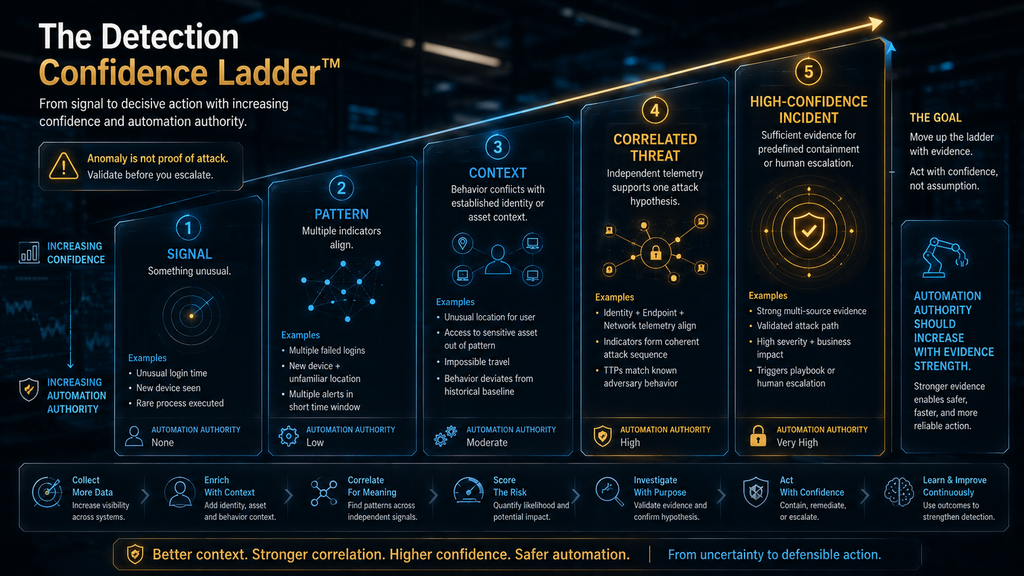
The Detection Confidence Ladder™
A useful detection system should distinguish an unusual signal from a sufficiently supported incident rather than treating every anomaly as a confirmed attack.
The AI Hustle World Detection Confidence Ladder™ has five levels:
Level 1 — Signal
Something unusual happened.
Level 2 — Pattern
Multiple indicators point in the same direction.
Level 3 — Context
The activity conflicts with established behavior, identity or asset context.
Level 4 — Correlated Threat
Multiple independent telemetry sources support the same attack hypothesis.
Level 5 — High-Confidence Incident
The evidence is strong enough to activate predefined containment or human escalation.
This ladder is deliberately not a mathematical score.
It is a decision framework.
A Level 1 signal might receive automated enrichment.
A Level 5 incident might justify immediate containment under an approved policy.
The crucial principle is:
Detection confidence should influence automation authority.
Step 5: INVESTIGATE — AI Can Shrink the Investigation Window
The speed advantage of AI threat detection is not limited to discovering a suspicious event; it can also accelerate the investigation required to understand what happened.
An analyst may traditionally need to:
- search logs,
- query identities,
- inspect endpoint events,
- check network activity,
- retrieve threat intelligence,
- reconstruct the timeline,
- compare previous behavior,
- identify affected assets.
AI can assist with these tasks by retrieving relevant evidence and organizing it into a coherent incident narrative.
A useful system might produce:
The account first showed anomalous behavior at 10:14. A new device was registered at 10:16. Privileged access occurred at 10:19. The account then accessed a production database not previously associated with this user, followed by an unusual data transfer at 10:27.
That isn’t the final security verdict.
It is a much better starting point for the analyst.
The distinction matters because explanation is not the same as evidence.
An AI-generated timeline should still be traceable to the underlying logs and events.
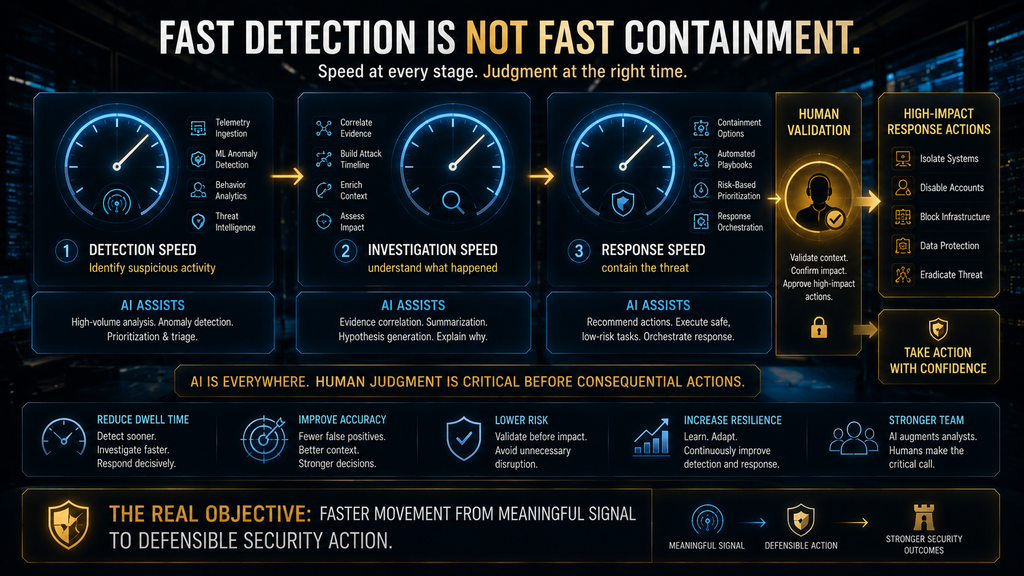
Fast Detection Is Not the Same as Fast Response
Detection speed, investigation speed and response speed are separate security metrics.
This is one of the most important distinctions in the article.
A system may identify a suspicious event in seconds.
But an analyst may need thirty minutes to determine whether the event is malicious.
Or the organization may require additional approval before containment.
So measure three different things:
Detection speed
How quickly did the system identify suspicious activity?
Investigation speed
How quickly could the team establish what was happening?
Response speed
How quickly did the organization contain or mitigate the threat?
An organization that improves only detection speed may see limited practical security improvement if investigation remains slow.
The most valuable AI systems therefore compress the entire chain.
Signal → Context → Correlation → Decision → Action
The objective isn’t to make one timestamp smaller.
It is to reduce the time required to reach an appropriate security action.
Signature Detection vs Behavioral Detection
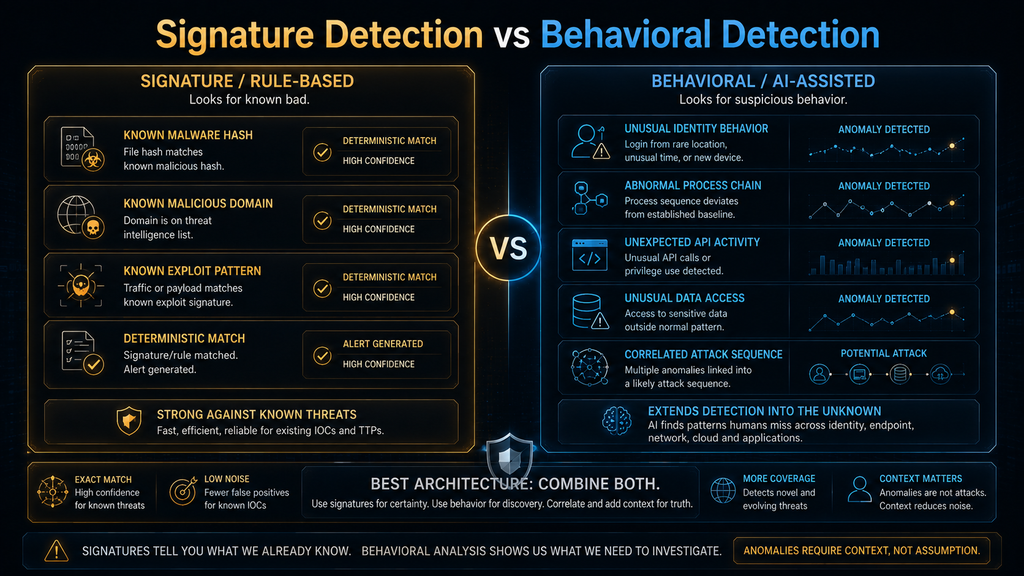
Signature detection looks for known malicious patterns, while behavioral detection looks for activity that deviates from expected behavior or forms suspicious sequences.
Both approaches remain useful.
Signature / rule-based detection
Strong when:
- the threat is known,
- indicators are stable,
- deterministic matching is possible.
Examples include:
- known malware hashes,
- malicious domains,
- known exploit signatures,
- explicit policy violations.
Behavioral / anomaly detection
Strong when:
- the exact attack is unknown,
- legitimate credentials are being abused,
- behavior changes over time,
- multiple weak signals need to be combined.
Examples include:
- impossible travel,
- unusual privilege escalation,
- abnormal API usage,
- unexpected process chains,
- unusual data access.
The mistake is turning this into a binary argument.
Traditional controls are not obsolete.
Behavioral AI is not universally better.
The strongest security architecture normally combines them.
Known threats can be caught deterministically.
Novel or ambiguous behavior can be analyzed statistically and contextually.
Can AI Detect Unknown Attacks?
AI can help identify suspicious behavior associated with previously unseen attacks, but it cannot guarantee that every unknown attack will be detected.
This distinction matters because “AI detects zero-days” is an attractive but misleading claim.
Suppose a new attack produces behavior that is significantly different from the established baseline.
A behavioral system may flag it.
That gives defenders an opportunity to investigate even without an existing signature.
But there are several possible outcomes.
The activity may be:
- a genuine attack,
- an unusual but legitimate workflow,
- a software deployment,
- a temporary configuration change,
- an entirely new behavior that the model does not understand.
The model can identify uncertainty.
It cannot eliminate uncertainty.
NIST’s work on adversarial ML and zero-day detection reinforces the broader point: ML can provide useful capabilities against unknown threats, but the methods remain subject to evasion, robustness and generalization challenges.
So the appropriate promise is:
AI can expand the detection surface beyond known signatures.
Not:
AI can guarantee detection of unknown attacks.
Identity Is Becoming Central to Threat Detection
Modern threat detection increasingly needs to understand whether legitimate identities are being used in illegitimate ways.
Attackers don’t always need to install obvious malware.
They may steal credentials and operate using legitimate accounts.
That creates a difficult detection problem.
From the network’s perspective, the traffic may appear normal.
From the identity system’s perspective, the account is valid.
From the application perspective, the user appears authenticated.
The suspicious behavior may only become visible when these signals are correlated.
AI can look for:
- unfamiliar device,
- unusual location,
- new access pattern,
- privilege escalation,
- unusual application sequence,
- deviation from peer behavior.
This is one reason identity intelligence belongs inside a modern AI threat-detection architecture.
The question changes from:
“Is this account valid?”
to:
“Is this valid account behaving like the legitimate user?”
That is a more difficult problem, but also a more useful one.
Endpoint, Network, Cloud and Identity Signals Must Work Together
The strongest threat detection architectures correlate signals across domains because attackers often move between them.
Imagine a sequence:
Identity compromise
→ endpoint access
→ cloud credential use
→ unusual API call
→ privilege escalation
→ data access.
A security platform focused only on the endpoint may see one piece.
An identity system may see another.
A cloud platform may see the third.
Correlation creates the attack narrative.
That is why security data integration matters so much.
The model does not need to “understand cybersecurity” in the abstract.
It needs access to the right evidence.
AI quality cannot compensate for missing telemetry.
Why Alert Fatigue Is a Detection Problem
An alert system that overwhelms analysts can reduce practical security even if its underlying detection model is technically capable.
This is easy to underestimate.
Suppose the system catches 99% of relevant suspicious activity but generates an enormous number of low-value alerts.
The security team still has a problem.
Analysts have limited attention.
Important events compete against less important ones.
That means threat-detection quality has two dimensions:
Detection capability
Can the system identify suspicious activity?
Operational usability
Can the security team process the result effectively?
The second dimension is often neglected.
An AI system that improves prioritization can therefore create significant value even if it doesn’t dramatically improve raw detection accuracy.
It may reduce the amount of analyst time spent investigating low-value events while increasing attention on high-impact threats.
The business outcome is better allocation of scarce security expertise.
Where Generative AI Helps—and Where Conventional ML Still Wins
Generative AI is particularly useful for interpreting and explaining security information, while conventional machine-learning models can remain stronger for specialized high-volume classification tasks.
This distinction is supported by the 2026 Frontiers in Big Data study discussed earlier. Its experiments found that conventional ML classifiers performed better than the tested LLM-based method on standard detection metrics, while the LLM was more useful when the task required contextual interpretation of ambiguous cases. The authors therefore proposed a hybrid model in which conventional ML handles high-confidence detection, LLMs assist with ambiguous cases and humans oversee consequential decisions.
That architecture makes sense operationally.
A specialized model can classify thousands of events quickly.
An LLM can then help an analyst answer:
What happened?
Why is it unusual?
What evidence supports the hypothesis?
Which related events should I investigate?
What should I check next?
This is more realistic than expecting a single generative model to become the entire SOC detection engine.
The future of AI cybersecurity may therefore be heterogeneous.
Different models perform different tasks.
The orchestration layer connects them.
Human operators retain accountability.
AI Threat Detection in the Real World
Current security platforms are increasingly combining machine learning, AI analysis, threat intelligence and automation into continuous detection workflows.
Google’s 2026 security announcements provide a useful example. Google AI Threat Defense is positioned as a continuously operating security system that uses AI to prioritize threats, model attack paths and accelerate remediation. Separately, Google Security Operations describes AI-assisted detection generation, investigation, containment and threat hunting. These are vendor capabilities, so they demonstrate the industry’s direction rather than serving as independent proof that every organization will achieve the same results.
Mandiant’s own 2026 research provides the operational rationale for this direction. Its data shows that attacker timelines can collapse from hours to seconds, making manual, sequential investigation increasingly difficult to rely on as the sole detection strategy.
The real-world lesson is not:
“Buy an AI security product.”
It is:
Security operations increasingly need systems that can compress large volumes of telemetry into usable investigation context before attackers move deeper into the environment.
Where AI Threat Detection Can Fail
AI threat detection can fail because security behavior changes, models can be manipulated, context can be incomplete and unusual activity is not automatically malicious.
False positives
An unusual event may be legitimate.
False negatives
Attackers may evade the detection model.
Model drift
Normal behavior changes over time.
Poor telemetry
Missing data creates blind spots.
Adversarial evasion
Attackers can modify behavior to avoid model detection.
Data poisoning
Training or reference information can be manipulated.
Explainability problems
Analysts may not understand why a system reached a conclusion.
Automation errors
A wrong containment action can cause operational damage.
NIST’s adversarial machine-learning work explicitly addresses attack categories including evasion and poisoning, showing that AI-based detection systems themselves are part of the security problem.
That is why threat-detection AI needs its own security controls.
The Model Is Now Part of the Attack Surface
Once AI participates in cybersecurity decisions, the AI system itself needs to be secured, monitored and governed.
Consider an AI security agent connected to:
- endpoint telemetry,
- identity platforms,
- cloud infrastructure,
- ticketing,
- threat intelligence,
- automated response systems.
The model now has access to sensitive information and potentially powerful actions.
That creates new questions:
- Who can interact with it?
- What data can it access?
- Can an attacker manipulate its inputs?
- Can an attacker influence its reasoning?
- What actions can it execute?
- Are high-impact actions subject to approval?
- Are agent decisions logged?
- Can actions be reversed?
NIST’s 2026 Cyber AI Profile work specifically addresses the need to secure AI systems used in cyber defense and to understand new attack surfaces associated with AI-enabled security.
This leads to a critical principle:
You cannot safely automate cyber defense without also securing the system performing the automation.
Should AI Automatically Block an Attack?
Automation is most appropriate when the action is low-risk, reversible and supported by strong evidence.
Automatic actions can make sense for:
- enriching alerts,
- adding context,
- tagging events,
- isolating low-risk artifacts,
- blocking clearly malicious indicators under established rules.
More consequential actions deserve stronger controls.
Examples include:
- disabling privileged accounts,
- isolating production systems,
- blocking legitimate business infrastructure,
- terminating active sessions,
- changing access policies.
A useful principle is:
The higher the operational consequence, the higher the required detection confidence and human oversight.
This is why the Detection Confidence Ladder™ is useful.
An anomaly can justify:
investigation.
A correlated, high-confidence incident may justify:
predefined containment.
Different evidence should lead to different authority.
A Practical AI Threat Detection Workflow
Organizations can introduce AI threat detection more safely by starting with a narrow operational problem and expanding only after measuring the results.
Step 1: Choose the bottleneck
Is your problem:
- excessive alert volume,
- slow investigation,
- identity anomalies,
- vulnerability prioritization,
- threat intelligence overload,
- endpoint detection?
Pick one.
Step 2: Map the available telemetry
Identify which sources contain the evidence required to investigate that problem.
Step 3: Establish a baseline
Understand normal behavior for users, devices, applications and systems.
Step 4: Start with AI-assisted analysis
Use AI to enrich alerts, summarize incidents, correlate evidence and prioritize events before granting it autonomous response authority.
Step 5: Establish approval policies
Define which actions can happen automatically and which require humans.
Step 6: Measure detection and investigation performance
Track both technical and operational outcomes.
Step 7: Expand carefully
Once the first workflow produces measurable value, extend AI to additional detection or investigation tasks.
This approach limits risk while creating a clear evidence base for wider adoption.
How to Measure Whether AI Actually Makes Detection Faster
A mature AI threat-detection program should measure the time from suspicious signal to appropriate action, not simply the amount of data processed by the model.
A useful KPI framework includes five layers.
| Area | KPI | What It Tells You |
|---|---|---|
| Detection | MTTD | How quickly suspicious activity is identified |
| Investigation | Mean Time to Investigate | How quickly analysts understand the event |
| Response | MTTR / containment time | How quickly the threat is mitigated |
| Quality | False-positive / false-negative indicators | Whether speed is being purchased at the expense of accuracy |
| Workload | Analyst minutes per incident | Whether AI actually reduces operational burden |
Then add business metrics:
- critical incidents contained before escalation,
- high-risk vulnerabilities prioritized,
- fraud losses prevented,
- repeat incidents reduced,
- analyst capacity recovered.
This is important because AI can technically increase detection speed while making the system harder to operate.
The right measure is:
How quickly can the organization move from meaningful signal to defensible action without unacceptable error?
AI Threat Detection ROI
The economic value of AI detection comes from reducing the cost and delay of security analysis while improving the organization’s ability to contain meaningful threats.
Consider a security operation receiving 50,000 alerts per month.
Reducing the number requiring manual investigation to 5,000 could be valuable.
But only if:
- important threats are still caught,
- false negatives remain acceptable,
- analysts actually use the saved capacity,
- response becomes faster,
- security risk decreases.
The ROI calculation is therefore broader than:
“We automated 90% of alerts.”
A better model is:
Analyst time recovered + investigation speed + response improvement + prevented loss − AI operating cost
That is the number leadership should care about.
Common Mistakes When Deploying AI Threat Detection
Treating AI as a Replacement for Security Fundamentals
AI cannot compensate for weak authentication, missing patches or poor access controls.
Measuring Raw Accuracy Without Context
A model can look good on a benchmark and still perform poorly in your environment.
Automating High-Impact Actions Too Early
Incorrect containment can create business disruption.
Ignoring Alert Quality
More detections are not necessarily better detections.
Forgetting the Human Workflow
AI should improve how analysts work, not create another dashboard they have to maintain.
Ignoring Model Security
An AI defense system is itself a security-sensitive system.
Assuming “Anomaly” Means “Attack”
Unusual behavior requires context.
Treating LLMs as a Universal Detection Engine
Recent research supports hybrid architectures rather than assuming generative AI is automatically superior at every security task.
AI Hustle World Reality Check
The cybersecurity market is understandably excited about AI threat detection.
The promise is compelling:
millions of signals analyzed continuously,
threats identified faster,
investigations automated,
analysts augmented,
attacks contained before they spread.
But there is a dangerous temptation to reduce the entire story to speed.
Faster is not automatically safer.
A system can process events rapidly and still produce weak decisions.
It can detect anomalies quickly and overwhelm analysts with false positives.
It can automate containment and accidentally disrupt legitimate business activity.
It can explain an incident convincingly while missing critical evidence.
And the model itself can become an attack surface.
The 2026 research is actually useful precisely because it pushes against the hype. The Frontiers study found that conventional ML outperformed the tested LLM approach on standard detection metrics, while the LLM’s strength appeared in contextual interpretation of ambiguous cases.
That is not a failure of generative AI.
It is a reminder that different AI systems are good at different security jobs.
The more credible architecture is therefore:
specialized detection + AI-assisted reasoning + human oversight + controlled automation.
And the objective isn’t:
“Let AI detect everything.”
It is:
“Make it harder for important security signals to disappear in the noise, and shorten the time required to understand what they mean.”
That’s a much more defensible promise.
The Future of AI Threat Detection
The next stage of AI threat detection will likely move from passive alert analysis toward continuous systems that observe, investigate, explain and recommend action across multiple security domains.
Imagine a system that detects an unusual identity event.
It immediately:
- checks device history,
- checks recent authentication,
- examines endpoint activity,
- searches for related network events,
- reviews privilege changes,
- compares threat intelligence,
- reconstructs the timeline,
- generates an attack hypothesis,
- determines confidence,
- recommends containment.
A human analyst receives not just:
“Suspicious login.”
but:
“High-confidence account-compromise hypothesis supported by five correlated signals across identity, endpoint and network systems.”
That changes the security workflow.
The analyst’s job becomes less about searching for pieces of evidence and more about evaluating the evidence and deciding what should happen next.
Google’s current security roadmap is already moving toward this model through AI-assisted detection generation, investigation, containment and threat hunting. Again, those are vendor capabilities, not universal industry outcomes.
The longer-term opportunity is therefore not merely AI-powered detection.
It is:
AI-powered security reasoning.
Detection tells you:
something might be wrong.
Reasoning helps answer:
what happened, how serious is it, what evidence supports that conclusion and what should we do next?
That is the larger shift.
Where This Article Fits in the Cluster
This article focuses specifically on threat-detection mechanics and speed.
The next articles go deeper:
AI SOC Agents Explained will explore autonomous investigation and security-operations agents.
AI Phishing Detection will explore malicious messages, impersonation and social engineering.
AI Malware & Vulnerability Analysis will explore files, code, vulnerabilities and security alerts.
AI Cybersecurity vs Traditional Security Tools will make the broader strategic comparison.
Best AI Cybersecurity Tools will handle commercial tool selection.
The purpose of this article is to explain how the detection engine works and why it can accelerate the security process.
FAQ
What is AI-powered threat detection?
AI-powered threat detection uses artificial intelligence and machine-learning techniques to analyze security data, recognize suspicious patterns, correlate events and prioritize activity that may represent an attack.
How does AI detect cyber threats?
AI can analyze telemetry from identities, endpoints, networks, applications, cloud environments and other systems. It can identify anomalies, compare behavior with expected patterns, correlate events and estimate risk.
Can AI detect unknown attacks?
AI-based behavioral detection can help identify suspicious activity that does not match a known signature, but it cannot guarantee detection of every unknown attack. False positives, false negatives and adversarial evasion remain important limitations.
Is AI better than signature-based threat detection?
Not universally. Signature-based detection remains highly effective for known threats, while behavioral AI can extend detection into unfamiliar patterns. The strongest approach often combines both.
Why does AI make threat detection faster?
AI can analyze large volumes of telemetry continuously, correlate signals across systems and reduce the manual work required to investigate suspicious events. The biggest speed gain may occur during investigation and triage rather than only at the moment of initial detection.
What is the difference between anomaly detection and threat detection?
Anomaly detection identifies behavior that differs from an expected baseline. Threat detection determines whether that behavior is likely to represent malicious activity. An anomaly is a signal for investigation, not automatic proof of an attack.
Can AI reduce security-alert fatigue?
It can help by enriching alerts, correlating events and prioritizing cases by contextual risk. The goal is to reduce low-value investigation work rather than simply increase the number of alerts processed.
Can AI automatically respond to threats?
Some systems can automate predefined responses, such as enrichment, blocking known indicators or isolating certain assets. High-impact actions should generally use stronger confidence requirements and appropriate human approval.
What is the biggest limitation of AI threat detection?
AI can make mistakes because of poor telemetry, changing behavior, model drift, adversarial manipulation, false positives and false negatives. It can also be difficult to determine whether an unusual event is actually malicious.
Can attackers evade AI detection?
Yes. Attackers can intentionally modify behavior, manipulate inputs or exploit weaknesses in machine-learning systems. NIST’s adversarial ML research documents techniques such as evasion and poisoning.
Should companies use LLMs as their main threat-detection engine?
Not automatically. Recent 2026 research found conventional ML models outperforming the tested LLM-based approach on standard detection metrics, while LLMs were useful for ambiguous, contextual cases. A hybrid architecture may therefore be more practical.
How do you measure AI threat-detection performance?
Useful measures include mean time to detect, investigation time, response time, false-positive rate, analyst workload and the number of meaningful incidents contained before they escalate.
Final Thoughts: The Real Advantage Is the Time Between Signal and Action
Security teams have always needed to detect threats.
AI doesn’t change that objective.
What it changes is the scale of information a security operation can process and the speed with which it can turn fragmented evidence into something an analyst can understand.
That distinction matters.
A suspicious login is only a signal.
An anomalous process is only a signal.
A strange DNS request is only a signal.
The real security value appears when the organization can connect those signals into context:
Who acted?
What changed?
What else happened?
Which assets were affected?
Does the behavior resemble an attack?
How confident are we?
What should happen next?
AI can help answer those questions much faster than manual investigation alone, especially when telemetry is large, fragmented and changing rapidly.
But the evidence doesn’t support a simplistic “AI replaces traditional detection” story.
The 2026 research showing conventional ML outperforming a tested LLM approach on standard detection metrics is a useful reminder that specialized models still matter, while generative AI can add value in contextual interpretation and ambiguous investigations.
The security market is therefore moving toward a more hybrid model.
Specialized detection systems identify suspicious patterns.
AI connects and explains the evidence.
Security agents can automate portions of investigation and response.
Humans remain accountable for consequential decisions.
And the entire system learns from validated outcomes.
That is a much more realistic future than an autonomous AI that somehow “knows” what every attack looks like.
The most important change is actually simpler.
Attackers are compressing the time between initial access and meaningful exploitation. Mandiant’s 2026 findings illustrate just how dramatically that window has narrowed.
Defenders therefore need to compress their own cycle:
signal → context → correlation → investigation → decision → response.
That’s where AI has the opportunity to create real security advantage.
Not because it makes cybersecurity automatic.
Not because it eliminates human analysts.
Not because one model can detect everything.
But because it can make the organization faster at understanding what matters.
That is the standard we should use when evaluating AI threat-detection systems.
Don’t ask only:
How many attacks can it detect?
Ask:
How quickly can it turn a meaningful signal into a defensible security action, and how much unacceptable error does that speed introduce?
That is the real trade-off.
And that is why the AI Hustle World view is:
Fast detection is valuable. Fast, context-aware and defensible detection is better.
Build a Faster, Smarter Threat Detection Strategy
AI can help security teams process more telemetry, connect weak signals and reduce the time required to investigate suspicious activity. The strongest strategy combines AI-scale analysis with reliable security fundamentals, clear automation boundaries and human accountability.
Written by
Muntasir Ahmad Chowdhury
Founder, AI Hustle World
Muntasir Ahmad Chowdhury is the Founder of AI Hustle World, an independent publication dedicated to making Artificial Intelligence practical, trustworthy, and easy to understand. He researches AI tools, automation, customer service, productivity, and real-world business applications, helping readers make smarter technology decisions through research-driven, experience-backed content.
Expertise:
AI Tools • AI Automation • AI Customer Service • AI Productivity • Generative AI • AI Workflows
Get Smarter With AI
Enjoyed this guide? Get practical AI tools, tutorials, and honest reviews delivered to your inbox.
5 thoughts on “How AI-Powered Threat Detection Finds Attacks Faster”