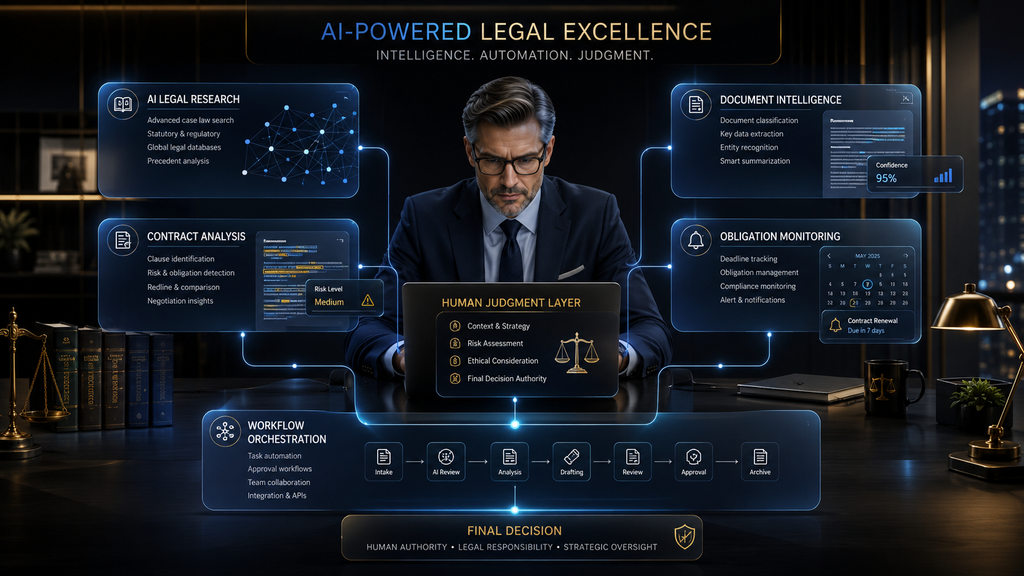
Legal AI Has Moved Beyond the Experiment
For years, the most repeated question about artificial intelligence and law was whether AI would replace lawyers. That question made for attention-grabbing headlines, but it was never the most useful way to understand what was actually happening inside legal work. The more important question is now much more practical: which parts of legal work should AI perform, which parts should AI assist, and which decisions still require accountable human judgment?
That distinction matters because AI is no longer sitting outside the legal workflow as an experimental technology. It is increasingly being used to retrieve information, summarize documents, classify material, compare contracts, extract structured information, generate drafts and support ongoing legal operations. Thomson Reuters’ 2026 Future of Professionals research reports that 74% of surveyed professionals now use AI several times a week, while its legal-sector research describes AI as a present-day business reality that is already affecting client expectations, pricing, talent and firm strategy.
At the same time, adoption does not mean that legal AI has become infallible. Stanford Law researchers evaluating two AI-driven legal research systems found hallucinations in more than 17% of their test queries, although the systems performed better than the general-purpose GPT-4 system included in the study. The finding is important because it moves the discussion away from the simplistic idea that a tool becomes trustworthy merely because it was built specifically for lawyers.
The practical lesson is that legal AI should be understood as workflow technology, not as an artificial lawyer. A system can be excellent at locating documents while being poor at making a legal judgment. It can identify a clause while missing the significance of an exception elsewhere in the agreement. It can produce a polished research summary while still requiring the lawyer to verify every authority that will influence a consequential decision.
This article builds a practical framework for understanding that difference. It explains what AI legal tech actually includes, how it works inside legal workflows, where it is useful, why different legal tasks require different AI approaches, where the technology fails, how human review should be allocated, and what legal teams should evaluate before putting AI into production.
The AI Hustle World position is straightforward: automate information processing where the risk is controlled, use AI to concentrate professional attention on the decisions that matter, and never confuse faster output with transferred accountability.
What Is AI Legal Tech?
AI legal tech is the use of artificial intelligence within legal and legal-adjacent workflows to retrieve, classify, analyze, extract, compare, generate or monitor information and work products.
That definition is deliberately broader than “ChatGPT for lawyers.” Legal technology was already using automation, machine learning, document analysis and technology-assisted review long before the current generative-AI wave. The American Bar Association’s Formal Opinion 512 notes that lawyers have long used AI-based technologies such as technology-assisted review in electronic discovery; the current generation of generative systems expands the range of language-intensive tasks that can be assisted, but it sits on top of an existing legal-technology foundation rather than replacing it.
Modern AI legal technology can therefore include several different technical approaches. A system may use machine learning for classification, retrieval systems for finding authoritative material, generative models for drafting and summarization, specialized extraction models for turning documents into structured fields, or agentic orchestration for coordinating several steps of a workflow.
That distinction is important because the word AI hides meaningful differences between tasks. The system that identifies every contract containing an automatic-renewal clause is solving a different problem from the system that drafts an explanation of a court decision. The first may depend heavily on extraction accuracy and document coverage. The second depends more heavily on source grounding, synthesis and professional verification.
The Law Society makes this distinction particularly well in its current guidance on AI-assisted contract review. A small collection of documents might be handled with a generative-AI summarization workflow, while hundreds or thousands of documents may require a different system designed for large-scale extraction and classification. It also warns that generative AI is not necessarily the right technology for strict data-extraction tasks.
That is the first principle to remember: Do not choose an AI because it is impressive in general. Choose the technology because its capabilities and failure modes fit the legal task.
ABA Formal Opinion 512, Stanford Law School legal-AI reliability research, NIST Generative AI Profile, Law Society AI contract-review guidance and Thomson Reuters Future of Professionals 2026 legal report.
The Five Layers of AI Legal Work
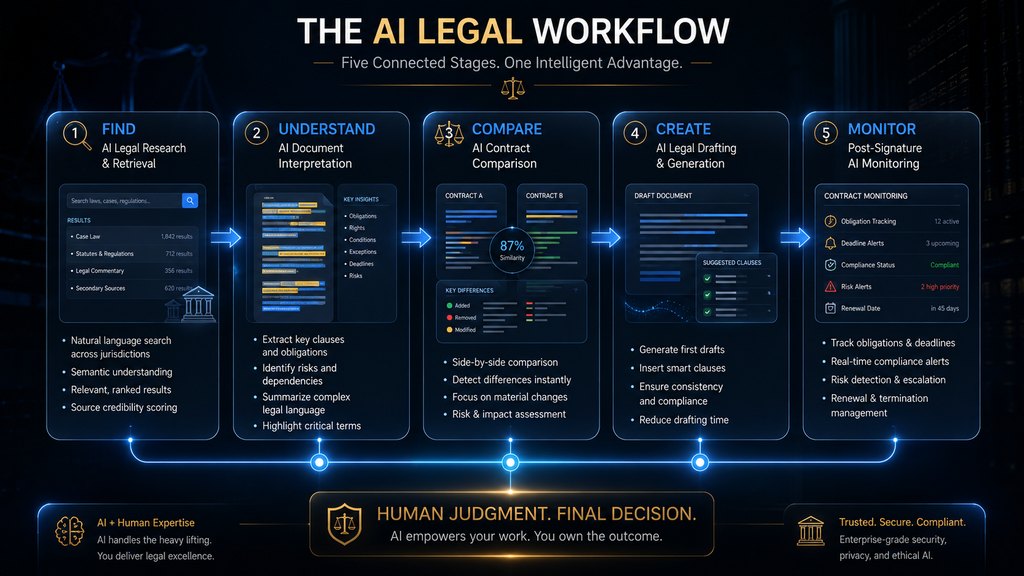
A useful way to understand the legal-AI landscape is to stop starting with products and start with the job the system is performing. AI Hustle World’s framework for this pillar is Find, Understand, Compare, Create and Monitor. These five layers describe the progression from locating information to turning legal information into ongoing operational action.
Find: Retrieve the Information That Matters
The first job is finding relevant information.
A lawyer may need to locate cases, statutes, regulations, contract provisions, internal precedents, previous agreements, correspondence, evidence, policies or obligations. Legal databases already solve much of this problem through structured search and indexing, but AI can make interaction more natural and can help connect concepts that are expressed differently across documents.
A user can describe a legal issue in ordinary language, and an AI-enabled research system may retrieve potentially relevant authorities, passages or documents. That can reduce the time spent constructing searches and manually sorting through large result sets.
But retrieval is not the same as legal analysis. Finding a document does not establish that the document is authoritative, current, applicable to the relevant jurisdiction or factually analogous to the matter being considered. A system can therefore be useful at the retrieval stage while still requiring substantial professional judgment later.
This is one reason professional-grade legal AI should make its source material visible and traceable wherever possible. Thomson Reuters’ 2026 research notes that 41% of surveyed professionals lack access to AI tools specifically designed for professional work and built on verified professional content.
The distinction is subtle but consequential: the legal value of an AI answer depends partly on what the system was actually able to find before it started generating the answer.
Understand: Turn Documents Into Usable Information
The second layer is understanding.
Here AI can help summarize documents, classify them, identify clauses, group similar material, surface issues and convert unstructured text into structured information. This is particularly useful when legal teams have more material than people can reasonably inspect line by line.
Imagine an in-house team receives 1,500 supplier agreements and needs to identify which ones contain a particular termination provision. The immediate problem is not necessarily legal interpretation. It is information triage. An AI system can potentially identify candidate agreements, locate relevant provisions and organize the results for human review.
The danger appears when a useful extraction result is mistaken for a complete legal conclusion.
A system might identify a termination clause accurately while missing a related exception elsewhere in the agreement. It might summarize a contract correctly at a high level while omitting a commercially significant qualification. It might classify a document correctly while overlooking an unusual provision that changes the practical risk.
That means accuracy at one layer does not automatically guarantee completeness at another.
The human reviewer needs to know what the system was asked to identify, what it may have missed and what downstream decision depends on the result.
Compare: Surface Differences, Deviations and Patterns
The third layer is comparison.
Legal work contains an enormous amount of comparative analysis. Lawyers compare contract versions, preferred language against negotiated language, one agreement against another, current documents against precedents and transaction documents against internal playbooks.
AI can make this process much faster by identifying differences and highlighting provisions that deserve attention.
The important value is often not that AI makes the final decision. It is that AI reduces the amount of material a professional needs to inspect before reaching that decision.
Consider a contract that contains 80 provisions. If an AI system identifies 12 provisions that materially deviate from an organization’s review playbook, the lawyer can concentrate on those areas rather than manually searching the entire agreement for every possible deviation.
But “different” does not mean “wrong.”
A negotiated clause may differ from the preferred position because the commercial circumstances justify it. A clause may look unusual but be acceptable in context. Another clause may appear standard while becoming problematic because of a definition or exception elsewhere in the document.
That is why the right relationship between AI and legal expertise is often:
AI narrows the review surface; the professional determines what the difference means.
Create: Generate a First Version of the Work
The fourth layer is creation.
Generative AI can produce summaries, first drafts, correspondence, clause alternatives, research outlines, internal explanations and other forms of text transformation. This is the capability most closely associated with modern large language models.
It is also the capability that creates the greatest temptation to over-automate.
A generated draft can be valuable because it eliminates the blank page. It can help a lawyer explore possible language, organize an argument or transform complex material into a usable first version. But fluent language is not evidence of legal correctness.
The ABA’s Formal Opinion 512 is important here because it does not treat generative AI as an exemption from professional responsibility. Lawyers using generative AI remain subject to duties involving competence, confidentiality, communication, supervision, candor toward tribunals and reasonable fees.
The practical consequence is that generation should usually be treated as production assistance rather than automatic legal authority.
The better question is not “Can AI draft this?” It is “What level of human review is appropriate before anyone relies on this draft?”
Monitor: Turn Legal Documents Into Ongoing Operations
The fifth layer is monitoring.
A contract does not stop mattering when it is signed. It can create renewal dates, notice requirements, reporting obligations, insurance requirements, service-level commitments, payment conditions, compliance duties and termination rights.
Those requirements can remain buried in documents even when the legal team understands them perfectly.
AI-enabled contract intelligence can help turn those provisions into structured operational information. The system may identify obligations, associate them with dates or responsible teams, and support reminders or downstream workflows.
That changes the question from “What does this contract say?” to “What does this contract require us to do?”
The distinction is strategically important because it moves legal AI from document analysis toward legal operations. The Law Society specifically identifies automated reminders of key contract expiry dates as one practical example of how technology can improve contract management.
How AI Legal Tech Actually Works
The biggest mistake when evaluating legal AI is to focus only on the model.
A practical legal-AI system is better understood as a chain involving source data, retrieval or grounding, an AI model, workflow controls, human review and some form of audit or action layer.
That means the real system is closer to:
Source material → retrieval and grounding → AI processing → structured result → human review → action and audit
The model is important, but it is only one component.
Source Material Determines the Starting Point
Legal AI can only work with the information available to it.
Depending on the workflow, that information might come from legal research databases, contracts, policies, case files, emails, internal knowledge repositories, regulatory sources or transaction documents.
This creates a basic but frequently overlooked principle:
A highly capable model cannot reliably compensate for missing or inappropriate source material.
If the system does not have the relevant contract, it cannot analyze that contract. If it retrieves the wrong jurisdiction, a beautifully written answer can still be useless. If an internal policy is missing from the context, the system may produce an answer that conflicts with the organization’s actual requirements.
This is why data access and permissions should be treated as part of legal-AI design rather than as implementation details.
Retrieval and Grounding Connect the Model to Evidence
Grounding means giving the AI system relevant source material to use when producing its output.
One common architecture is retrieval-augmented generation, or RAG. In simplified form, the system receives a question, retrieves relevant documents or passages, provides those materials to the model and then generates an answer based on the retrieved context.
This can reduce some forms of unsupported generation because the model has relevant evidence available.
But grounding is not a magic anti-hallucination switch.
The Stanford research on legal AI is useful precisely because it evaluated specialized legal research tools and still found hallucinations. The study’s results demonstrate that even systems designed around legal research can make unsupported claims or otherwise fail to provide completely reliable answers.
Grounding should therefore be treated as a risk-reduction mechanism, not a guarantee.
The practical question is whether the system lets the professional inspect the evidence behind the answer.
The Model Interprets, Classifies or Generates
Once relevant information is available, the model performs the task.
Depending on the workflow, that might mean:
- summarizing a document;
- identifying clauses;
- classifying agreements;
- comparing versions;
- extracting fields;
- identifying potential risks;
- drafting language;
- answering a question from a controlled knowledge base.
The important point is that these outputs have different failure modes.
A summary can omit context. An extraction system can miss a field. A comparison system can fail to identify a subtle difference. A generative model can create unsupported language. A research system can retrieve the wrong authority.
Treating all these outputs as one generic category called “AI accuracy” makes evaluation less useful.
Workflow Controls Determine What Happens Next
Professional systems may add templates, approval rules, permissions, routing, document taxonomies, structured fields, version control, logging and integrations.
Those controls are often what separates a demonstration from a production workflow.
A model that produces a good answer in a chat window may not be sufficient for a legal department that needs:
- role-based access;
- document-level permissions;
- source citations;
- review queues;
- audit trails;
- approval stages;
- version histories;
- integration with existing systems.
The technology therefore needs to be evaluated as a workflow system, not simply as a model.
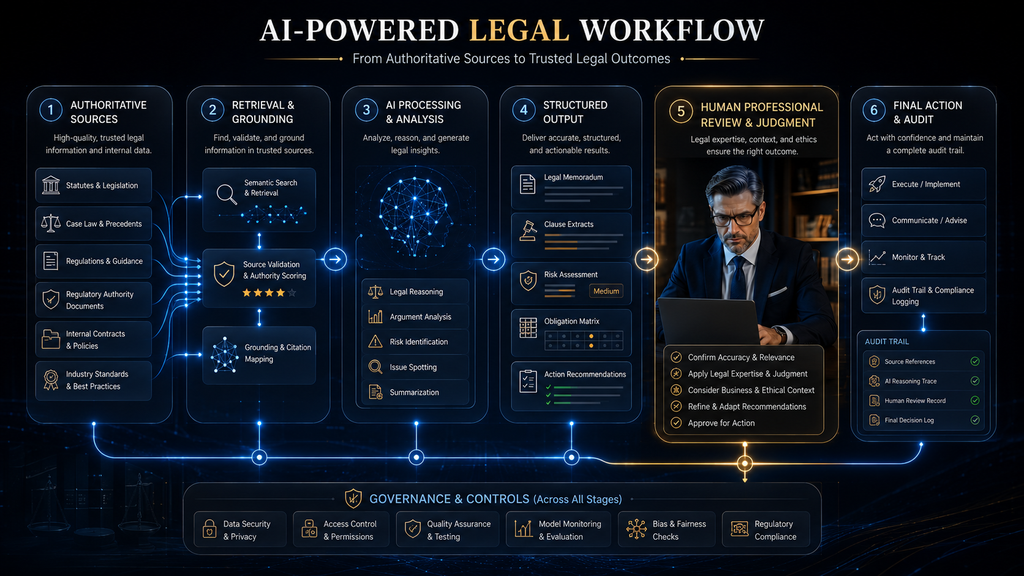
Human Review Closes the Loop
The appropriate level of review depends on the consequence of being wrong.
A formatting task may require only a quick inspection. Extracting a contract renewal date may require validation before the information is used to trigger an important operational action. A legal research conclusion used in a filing or client advice may require substantive professional verification.
This is where the question “Should humans review AI?” becomes too simplistic.
The better question is:
What kind of human review does this particular task require?
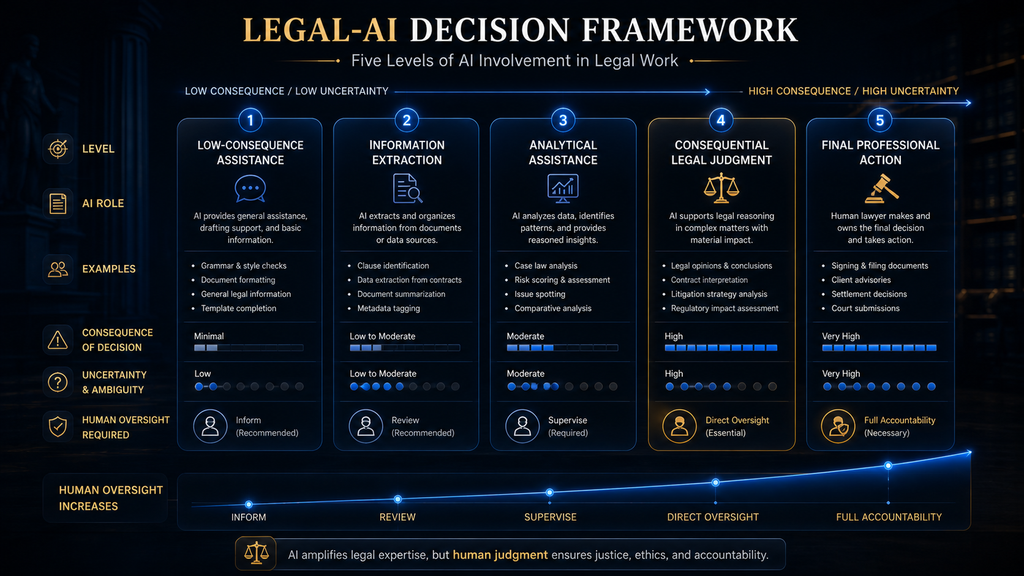
The AI Legal Risk Ladder
AI Hustle World’s second core framework for this article is the AI Legal Risk Ladder. The principle is that human review should become stronger as the consequence of error, uncertainty and irreversibility increase.
| Workflow level | Typical AI role | Human responsibility | Example |
|---|---|---|---|
| Low consequence | Automate or assist | Routine inspection | Reformatting known text |
| Information extraction | Process and organize | Validate important fields | Contract dates and parties |
| Analytical assistance | Surface issues and patterns | Interpret and decide | Contract-risk flags |
| Consequential legal judgment | Support only | Substantive professional review | Legal position or advice |
| Final professional action | Assist within controlled workflow | Human accountability | Filing, approval or binding decision |
This is not a universal legal rule, and the exact controls depend on jurisdiction, organization, matter and professional obligation. It is an AI Hustle World decision framework for thinking about automation proportionately.
The key idea is that review intensity should not be uniform.
If an organization requires a lawyer to manually verify every low-risk formatting change with the same effort used to validate a consequential legal conclusion, much of the potential productivity gain disappears. If the organization applies almost no review to high-consequence decisions, it creates a different and potentially more serious problem.
The objective is to place human judgment where it has the greatest marginal value.
AI Legal Research: Faster Discovery Does Not Transfer Legal Judgment
Legal research is one of the clearest examples of the difference between assistance and authority.
A conventional research workflow might involve identifying the legal question, determining relevant jurisdictions, locating primary authorities, reviewing cases and statutes, comparing factual contexts, synthesizing the law, applying it to the facts and verifying citations.
AI can accelerate several of those steps.
It can help formulate searches, identify potentially relevant authorities, summarize cases, compare passages and organize research material. This can make the first stages of research substantially faster.
But the final legal conclusion still depends on whether the authorities are real, current, relevant and properly interpreted.
That is why legal research AI requires source verification.
Stanford’s evaluation of legal research systems found that both systems tested hallucinated more than 17% of the time. The result does not mean the systems are useless; it means that their usefulness exists inside a workflow where professionals understand the possibility of failure and verify consequential outputs.
The ABA’s guidance reinforces the professional side of the equation. Lawyers remain responsible for their professional obligations when using generative AI, including competence, confidentiality, communication, supervision and candor toward tribunals.
That leads to a practical workflow:
Question → retrieval → source review → AI synthesis → citation verification → legal judgment
The unsafe shortcut is:
Question → AI answer → trust
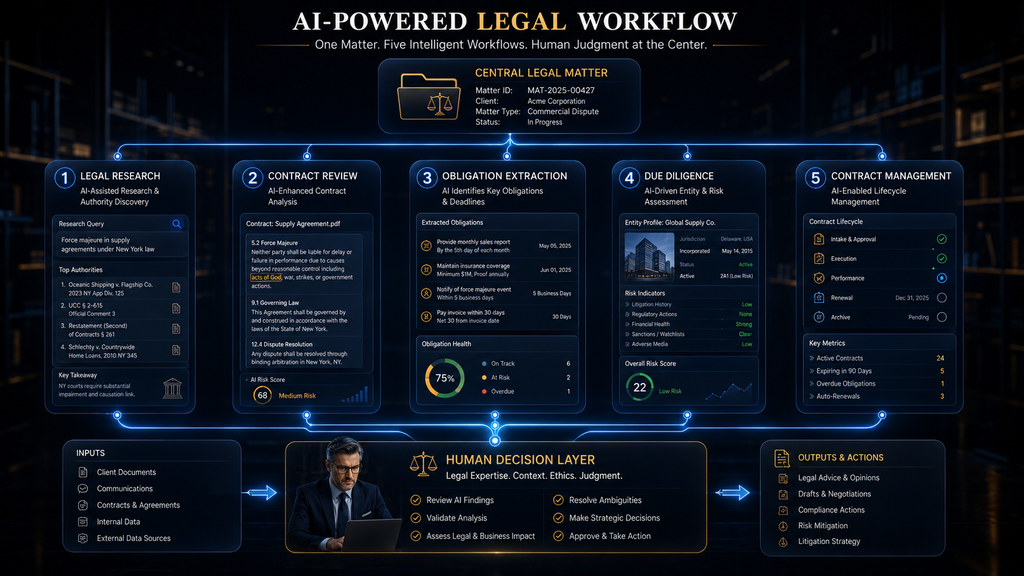
AI Contract Review: From Reading Every Word to Finding What Deserves Attention
Contract review is a different AI problem because the source material is usually a defined set of documents, and the question is often not simply what the law says but what a particular agreement requires and how its terms compare with a preferred position.
A contract-intelligence workflow can involve document ingestion, classification, clause identification, extraction, comparison, risk flagging, review, redlining and approval.
AI can help at several of these stages.
It can identify clauses relating to termination, indemnity, liability, confidentiality, intellectual property, governing law, data protection, renewal, payment or service levels. It can compare negotiated language against a playbook and highlight provisions that depart from preferred terms.
But a risk flag is not a legal conclusion.
Suppose an AI system identifies a limitation-of-liability clause as unusual. The useful question is not simply whether the clause is unusual. It is whether the difference matters in the specific commercial and legal context.
A provision that is unusual may be entirely acceptable in one transaction. A seemingly standard provision may create risk because of an exception elsewhere in the agreement.
The Law Society’s current contract-review guidance captures this broader principle: different document volumes and tasks can call for different AI technologies, and strict extraction may be better suited to a specialized machine-learning workflow than a generative system.
AI Obligation Extraction: When a Contract Becomes Operational Data
A signed agreement contains more than legal language. It contains commitments that someone in the organization may eventually have to perform.
A supplier agreement might require quarterly reports, annual certifications, specific insurance coverage, notice before renewal, service-level performance or data deletion after termination.
If those requirements remain buried inside prose, the legal team may understand the contract while the operational team still fails to act on it.
AI can help bridge that gap by extracting obligations and turning them into structured information.
The workflow becomes:
Contract → obligation → responsible party → deadline → evidence → action
That is a significant conceptual change.
The technology is no longer merely helping a lawyer read faster. It is helping an organization operationalize what its legal documents require.
This is one of the strongest long-term opportunities in contract intelligence, but it also creates a new failure mode: a missed extraction can become an operational failure.
That is why the accuracy of obligation extraction must be judged according to the consequence of omission, not merely the average percentage of correctly extracted fields.
AI Due Diligence: Why Document Volume Changes the Value Equation
Due diligence can involve thousands of documents across contracts, corporate records, employment materials, intellectual-property information, regulatory documents, litigation records and other transaction material.
The fundamental challenge is often one of attention.
There may be more information than the human team can reasonably inspect with equal depth.
AI can help classify documents, identify relevant material, locate provisions, compare agreements and surface potential exceptions. This allows professionals to spend more time investigating the documents and issues that appear consequential.
But due diligence also illustrates why average accuracy can be a misleading metric.
Missing an irrelevant document may waste time. Missing the agreement that contains a change-of-control restriction can have much greater consequences.
The evaluation question therefore becomes:
What does the system tend to miss, and what happens when it misses it?
That question is more useful than simply asking whether a vendor reports a high accuracy percentage.
AI Contract Management: What Happens After the Signature?
Contract intelligence becomes more strategically interesting when it continues after negotiation and signature.
A contract can contain renewal windows, notice periods, reporting requirements, payment conditions, insurance requirements, service-level obligations and compliance commitments. If those terms are not connected to operational processes, their existence inside a contract does not guarantee that the organization will act on them.
AI-enabled contract management can help identify those requirements and connect them to ongoing workflows.
That can transform contract management from document storage into operational intelligence.
The key chain becomes:
Contract language → obligation → owner → date → action → outcome
This is one reason the Law Society identifies automated reminders around key contract expiry dates as a practical benefit of technology-assisted contract management.
Why One AI System Is Not Automatically the Right Tool for Every Legal Task
A common procurement mistake is to ask whether a platform is “good at legal AI.”
That question is too broad to be useful.
A system can be excellent at one legal task and poorly suited to another.
Generative AI is naturally useful for creating and transforming language. Retrieval systems are important when authoritative source material matters. Classification and extraction systems can be more appropriate when the objective is to identify structured information consistently across large document collections.
The Law Society explicitly warns against assuming that generative AI is the right solution for every contract task. For strict extraction, a machine-learning system specifically designed for that purpose may be more appropriate.
This creates a useful procurement principle:
Do not ask which AI is best. Ask which architecture is best for the failure mode you can afford.
Where Legal AI Creates Real Value
The strongest use cases tend to share a common characteristic: they contain significant information-processing work that can be separated from the final professional judgment.
AI can be particularly valuable when the workflow involves high document volume, repetitive patterns, search and triage, structured extraction, comparison, first-pass analysis or continuous monitoring.
The value is not necessarily that AI makes a lawyer unnecessary.
The value is that AI can reduce the amount of professional attention consumed by work that does not require full professional judgment at every step.
That can increase capacity.
It can also improve consistency in some repetitive workflows, make large document collections more searchable and create operational visibility that is difficult to maintain manually.
But those benefits need to be measured rather than assumed.
Thomson Reuters’ 2026 professional-services research found that only 18% of surveyed professionals said their organizations track AI ROI, while 40% said they did not know whether ROI was measured.
That is a warning against buying AI simply because competitors are buying AI.
A legal organization should be able to explain what changed after implementation.
The Economics of AI Legal Work
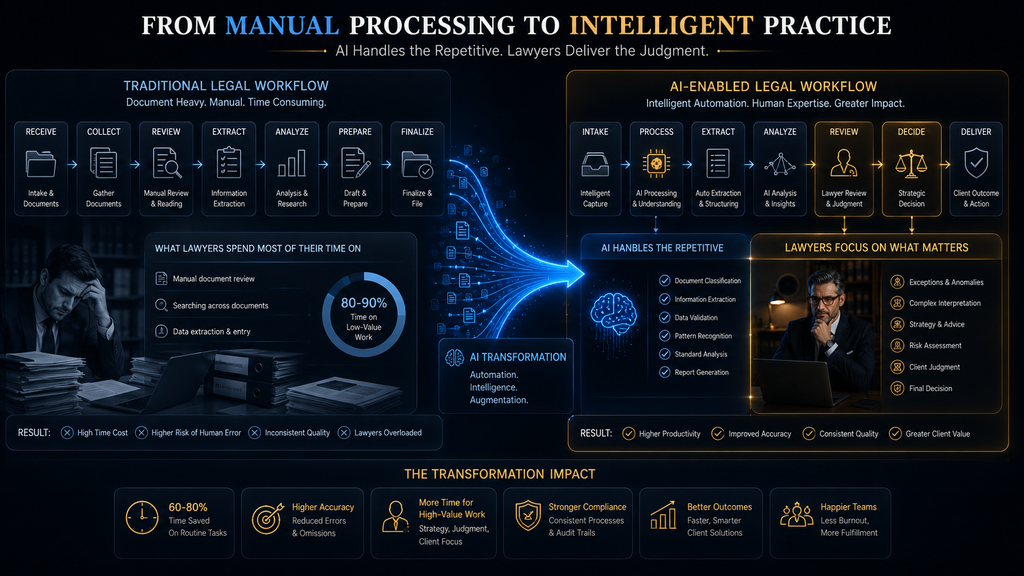
The simplistic economic argument for AI is that it saves time.
The more important argument is that it can change where expensive human attention is deployed.
Consider a hypothetical document-review workflow. Before AI, a professional team might spend most of its time locating, sorting, comparing and summarizing documents before reaching the small number of issues that actually require expert judgment. With AI assistance, some of the information-processing burden can be compressed so that professionals spend more of their time reviewing exceptions, interpreting risk and advising clients.
The numbers in that example are illustrative rather than measured results. The economic principle is what matters: AI can change the distribution of work between machine processing and professional judgment.
That creates a second-order effect for the legal industry.
If a task that historically required ten hours of human effort can be completed with substantially less manual processing, clients may increasingly question whether they should pay for time consumed by the old workflow rather than value produced by the new one.
Thomson Reuters’ 2026 legal report illustrates the pressure. Seventy-one percent of surveyed in-house legal professionals expect outside firms to change their commercial models as AI usage increases, while only 28% of law firms report having changed pricing structures in response to AI.
The long-term question is therefore not simply whether AI saves hours.
It is whether legal organizations can redesign the relationship between effort, expertise, pricing and outcomes.
The Real Risk Is Not That AI Is Always Wrong
The most dangerous legal-AI error may not be an obviously bad answer.
An obviously wrong answer is often easy to reject.
The harder problem is an answer that is mostly correct but wrong in the one place that matters.
Imagine a system processing 1,000 contracts and correctly identifying almost every obligation. That sounds impressive. But if the missed items happen to involve automatic renewal, regulatory reporting or termination rights, the practical risk can be much larger than the average accuracy number suggests.
This is why legal-AI evaluation should include more than accuracy.
A serious evaluation should examine:
| Evaluation dimension | Why it matters |
| False positives | Determines how much unnecessary review the system creates |
| False negatives | Shows what important information the system may miss |
| Error severity | Distinguishes minor mistakes from consequential failures |
| Source traceability | Allows professionals to inspect the evidence |
| Consistency | Reveals whether similar inputs produce stable results |
| Coverage | Determines which documents, jurisdictions and clauses are supported |
| Reviewability | Determines how easily humans can correct errors |
| Workflow integration | Determines whether the AI actually saves operational effort |
| Auditability | Supports accountability and post-matter investigation |
This is an AI Hustle World analysis derived from the broader evidence base, rather than a universal legal evaluation standard.
Privacy and Confidentiality Are Part of Legal AI Quality
A legal AI system cannot be evaluated solely on the quality of its answers.
The data entering the system may itself be confidential, privileged or commercially sensitive.
The organization therefore needs to understand how information is processed, who can access it, how permissions work, whether information is retained, what sources ground outputs, whether activity is logged and how the system can be audited.
The ABA’s Formal Opinion 512 emphasizes that lawyers using generative AI must consider their duties to protect client information and comply with other applicable professional obligations.
NIST’s Generative AI Profile provides a broader risk-management framework intended to help organizations incorporate trustworthiness considerations into the design, development, use and evaluation of generative-AI systems.
For legal teams, those principles translate into practical questions about confidentiality, access, security, source integrity, auditability and governance.
The important point is that data governance is not a separate issue from AI performance.
If a system cannot safely handle the information required for the workflow, it may be technically impressive and operationally unusable.
The Shadow-AI Problem: Adoption Can Outrun Governance
One of the most important developments in legal AI is not happening inside vendor demonstrations. It is happening when professionals use tools that their organizations have not formally approved.
Thomson Reuters reports that 34% of law-firm professionals say they use AI tools their firms have not authorized. Its research describes this as a governance risk because organizations cannot properly monitor or control tools that employees are using outside approved systems.
This creates an uncomfortable management reality.
An organization can prohibit AI formally while employees continue experimenting with it informally.
That does not eliminate the risk. It can make the risk harder to see.
The strategic choice therefore may not be AI versus no AI.
Increasingly, it can become controlled AI adoption versus uncontrolled AI experimentation.
That does not justify rushing into every new product. It means organizations need a deliberate approach that gives professionals safe, useful alternatives to unmanaged experimentation.
Agentic Legal AI: The Next Workflow Layer
The next evolution is increasingly agentic.
A conventional chatbot may respond to a request such as “summarize this contract.” An agentic system can potentially coordinate a sequence of actions: locate the relevant agreement, extract provisions, compare them against a playbook, retrieve supporting policies, prepare a review summary and route material issues to a human.
That changes the unit of automation.
Instead of automating an isolated task, the organization begins automating a workflow sequence.
Current commercial developments indicate that this direction is already moving into legal technology. Reuters reported in August 2026 that Google was expanding its Gemini platform into legal workflows, including legal-focused AI agents designed to connect with professional software and data.
But agentic capability creates an important governance distinction:
An agent can execute a workflow without becoming the legal decision-maker.
An organization might authorize an agent to gather information, classify documents, prepare a draft and route exceptions while requiring a professional to approve a final legal position.
Capability does not automatically create authorization.
That distinction will become increasingly important as systems gain the ability to take actions rather than merely generate text.
Why Human Judgment Still Matters
It is tempting to describe human involvement as a temporary limitation that will disappear as models improve.
That is too simplistic.
Some legal work is difficult not because the information is unavailable but because the decision requires context, trade-offs, professional responsibility and consequences that cannot be reduced to a single correct textual answer.
A lawyer may need to decide whether a commercially unusual clause is acceptable given the client’s negotiating position. A litigator may need to determine which factual distinction changes the relevance of a precedent. An in-house legal team may need to balance legal risk against operational realities.
These are judgment problems.
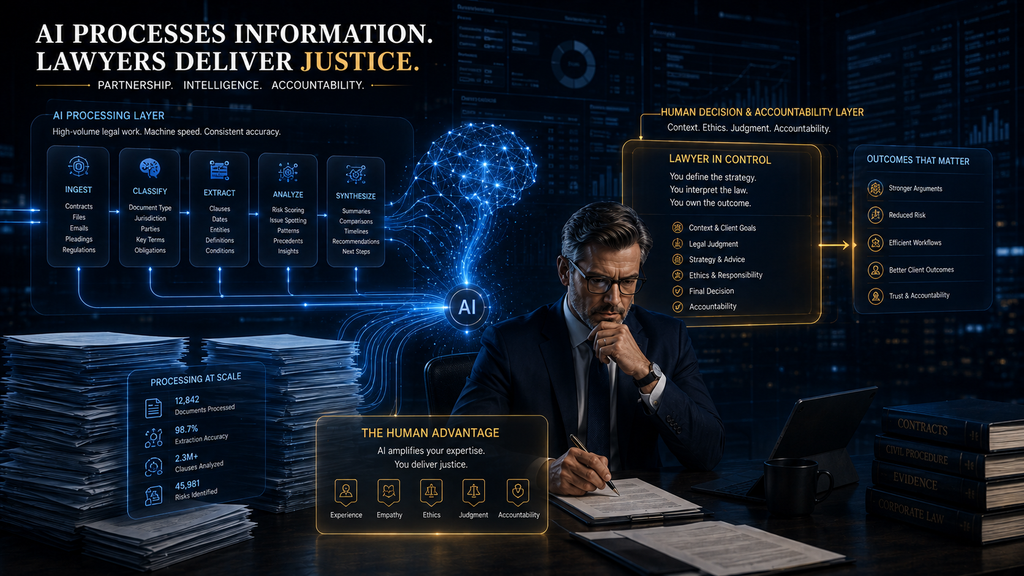
AI can inform those decisions.
It does not automatically become accountable for them.
The ABA’s professional guidance makes this explicit by keeping existing duties in place when lawyers use generative AI.
The better vision of AI-enabled legal work is therefore not the removal of judgment.
It is the repositioning of judgment.
Professionals spend less time searching, copying, sorting and comparing, and more time interpreting, challenging, advising and deciding.
The Traditional Method Exists for a Reason
A mature AI strategy should also ask why the old workflow existed.
Manual contract review was not created because lawyers enjoyed reading every page. It exists because someone had to understand the entire agreement and take responsibility for the consequences.
Manual legal research exists because legal conclusions require authoritative sources and professional interpretation.
Human due diligence exists because transactions contain exceptions that may not fit standard patterns.
Manual contract management exists because contractual obligations have consequences beyond the document itself.
AI can change the economics of these processes without invalidating the reasons they were built.
The goal is therefore not to destroy the control system.
It is to remove unnecessary processing while preserving the control points that protect the decision.
That distinction is central to responsible automation.
A Practical Framework for Deciding What to Automate
Before automating a legal workflow, start with the task rather than the technology.
Ask whether the work is repetitive enough to benefit from automation, whether the inputs are sufficiently consistent, whether the output can be verified, what the cost of a false positive would be, what the cost of a false negative would be, whether the system has authoritative context and who owns the final decision.
The false-negative question deserves particular attention.
If an AI system misses a formatting issue, the consequence may be negligible. If it misses a contract renewal, a regulatory obligation or a material limitation-of-liability provision, the consequence can be significant.
That means a task with a high theoretical automation potential may still require strong controls.
| Legal task | Appropriate AI role | Human review | Primary concern |
| Formatting known material | Automate | Light | Transformation errors |
| Document summarization | Assist | Moderate | Omission and context |
| Clause identification | Process | Structured validation | False negatives |
| Contract comparison | Analyze | Substantive review | Missed differences |
| Obligation extraction | Process | High for consequential fields | Extraction errors |
| Research discovery | Assist | High | Wrong or unsupported authority |
| First-pass drafting | Generate | Substantive | Unsuitable or inaccurate language |
| Risk analysis | Assist | High | Automation bias |
| Final legal conclusion | Support | Professional judgment | Consequential error |
| Filing or binding action | Controlled assistance | Human approval | Professional responsibility |
This table is an AI Hustle World decision framework, not a substitute for applicable professional rules or organizational policies.
How to Evaluate an AI Legal Technology System
The evaluation should begin with the workflow you want to improve.
A vague objective such as “use AI for contracts” makes success difficult to measure. A specific objective such as “identify non-standard termination provisions in supplier agreements and route them to legal review” creates a testable workflow.
The next step is defining the source material. Determine what information the system needs, where that information comes from, whether it is authoritative and whether the AI can access it under appropriate permissions.
Then define acceptable failure.
Ask what happens when the system misses something, when it produces too many false positives, when it generates an unsupported answer and when a human reviewer disagrees with it.
Representative testing should include ordinary documents and difficult documents. A polished vendor demonstration does not tell you how a system behaves when documents are unusually long, poorly formatted, inconsistent, jurisdictionally complex or full of exceptions.
Traceability should also be tested.
Can the user see where the answer came from? Can the organization determine which documents the system processed? Can a reviewer understand why something was flagged? Can administrators audit usage?
Finally, measure the business outcome.
Useful KPIs may include review time per document, false-positive rate, false-negative rate, human correction rate, turnaround time, cost per matter, adoption rate and the percentage of work that still requires escalation.
The purpose of measurement is not to prove that AI is good.
It is to determine whether the workflow became better.
What Happens If a Legal Organization Does Nothing?
The consequences of inaction are increasingly different from simply being behind on a technology trend.
Thomson Reuters’ 2026 legal research reports that 32% of in-house legal professionals are already reconsidering or expect to reconsider relationships with firms that do not demonstrate clear AI-enabled value within the next 12 months. The same research reports that 38% of law-firm professionals face significant or some financial pressure to move faster on AI.
At the same time, organizations that adopt AI recklessly can create confidentiality, governance and professional-responsibility problems.
The strategic challenge is therefore not simply speed.
It is controlled speed.
Legal teams need to understand which workflows create meaningful opportunities, which tools fit those workflows, what evidence supports the technology’s claims, how errors behave and where professional accountability remains non-negotiable.
Doing nothing may create competitive pressure.
Doing everything may create operational risk.
The intelligent position is somewhere between those extremes.
A Second-Order Effect: How AI Could Change Legal Training
There is another consequence that deserves more attention.
Legal careers have historically developed through repeated exposure to foundational work: reading cases, reviewing documents, researching questions, preparing drafts, checking citations and organizing evidence.
If AI removes too much of that work without replacing the learning mechanism, junior professionals may become faster before they become sufficiently experienced.
Thomson Reuters’ 2026 research reports that 48% of professionals fear AI could negatively affect the development of independent judgment, and legal professionals expect the timeline to trusted judgment to extend by nearly two years.
That creates a management question that legal organizations should not ignore:
If AI removes some of the work through which professionals traditionally learned, what replaces the learning process?
The answer may involve supervised AI use, deliberate review exercises, exposure to failure cases, staged responsibility and training on how to challenge AI outputs rather than simply accept them.
This is one of the reasons human review should not be treated merely as a safety brake.
It can also be a training mechanism.
The Real Competitive Advantage May Be Workflow Design
The legal-AI market is filling with powerful models, specialized applications and increasingly autonomous systems.
That can lead organizations to ask the wrong question:
Which model is smartest?
The more useful question is:
Which workflow are we redesigning, and what should become better because of AI?
A strong workflow determines what information enters the system, what the AI can access, what output it produces, how errors are caught, who reviews them, what action follows and how the outcome is measured.
That means a moderately capable model inside a well-designed workflow can sometimes create more practical value than a more powerful model placed inside a poorly controlled process.
The competitive advantage is therefore unlikely to come from simply owning more AI tools.
It will come from designing better legal workflows around the capabilities and limitations of those tools.
The AI Legal Technology Stack
A mature legal-AI environment can be understood as six connected layers.
The first is authoritative information, including legal authorities, contracts, organizational policies and matter data.
The second is retrieval and access, which determines what information the AI can actually use.
The third is intelligence, where models classify, summarize, compare, extract or generate.
The fourth is workflow, where rules, routing, approvals and integrations determine what happens next.
The fifth is human judgment, where professionals interpret evidence, handle exceptions and make consequential decisions.
The sixth is governance, covering permissions, confidentiality, monitoring, evaluation, auditability and accountability.
Weak AI implementations often focus almost entirely on the third layer.
Strong implementations treat all six as part of the system.
Who Should Use AI Legal Tech?
AI legal technology is particularly attractive for organizations that have substantial information-processing workloads and a clear ability to verify outputs.
That can include law firms handling large document collections, in-house legal teams managing substantial contract portfolios, transaction teams conducting due diligence, legal operations teams, compliance functions and professionals who spend significant time searching, comparing or organizing legal information.
The strongest candidates are generally workflows where the input is sufficiently structured, the repetitive processing burden is high and the final decision can be clearly separated from the information-processing stage.
Organizations should be more cautious where the task involves novel legal questions, extremely sensitive information, high-consequence decisions or outputs that cannot be independently verified.
The answer is not to avoid AI in those environments.
It is to increase the level of control.
Who Should Be Careful About Using It?
AI legal technology deserves additional caution when the workflow involves highly sensitive client information, uncertain jurisdictional issues, consequential filings, novel legal interpretations, irreversible actions or situations where an error could be difficult to detect before harm occurs.
The right response is not necessarily “do not use AI.”
It may instead be:
- use a controlled enterprise environment;
- restrict the system’s permissions;
- require source-grounded outputs;
- increase human review;
- prohibit autonomous actions;
- maintain audit logs;
- test the system on representative cases;
- establish escalation procedures.
The more consequential the workflow, the more important these controls become.
AI Legal Tech vs. Traditional Legal Technology
It is also useful to distinguish AI legal technology from conventional legal software.
Traditional legal technology often follows explicit rules. A document-management system stores documents. A calendar records deadlines. A conventional search system matches terms against indexed content. A workflow system routes tasks according to predefined rules.
AI can make systems more adaptive.
It can interpret natural language, identify patterns, classify documents, summarize information and generate new content.
But traditional software has a major advantage that should not be overlooked: predictability.
A deterministic rule such as “send a reminder 90 days before this date” does not need a language model.
Using AI simply because AI is available can make a workflow more complex without making it better.
This is another core AI Hustle World principle:
Use automation because it improves the workflow, not because the automation happens to be AI.
What the Best Legal AI Systems Will Likely Do Differently
The strongest systems are likely to become less focused on isolated chatbot interactions and more focused on controlled workflows.
They will increasingly connect authoritative content, organizational knowledge, documents, structured data and action systems.
They will also need to become easier to evaluate.
A professional should be able to understand what the system knows, what it does not know, what evidence supports its output, where uncertainty exists and what human action is expected next.
This is particularly important as agentic systems become more capable.
An AI that can take actions needs stronger controls than an AI that only generates text.
The future therefore belongs not simply to more capable models but to more accountable systems.
Frequently Asked Questions
What is AI legal tech?
AI legal tech refers to artificial-intelligence systems used within legal workflows to retrieve, classify, analyze, extract, compare, generate or monitor legal information and work products. It includes more than generative AI and can involve retrieval, machine learning, document intelligence, specialized extraction and agentic workflow systems.
Is AI legal tech the same as ChatGPT?
No. ChatGPT is a general-purpose AI product, while AI legal tech is a broader category of technology designed or configured for legal workflows. Some legal products may use similar foundation models, but professional legal systems can add authoritative content, retrieval, permissions, workflow controls, auditability and specialized functions.
Can AI replace lawyers?
AI can automate and accelerate parts of legal work, but that does not mean it automatically replaces professional legal judgment or accountability. The ABA’s Formal Opinion 512 makes clear that lawyers remain responsible for applicable professional obligations when using generative AI.
Can AI perform legal research?
AI can assist with legal research by helping retrieve, organize, compare and summarize information. However, consequential research requires verification of authorities and professional judgment. Stanford’s empirical evaluation demonstrates why specialized legal research systems still require appropriate human oversight.
Is legal-specific AI automatically safer than general AI?
No. Legal-specific systems can be better suited to legal workflows and may provide specialized content, retrieval and controls, but specialization does not guarantee accuracy. The Stanford research found meaningful hallucination rates even in specialized legal research systems.
What is AI contract review?
AI contract review uses AI to help identify, extract, classify, compare or flag provisions in agreements. It can reduce first-pass review effort, but the appropriate level of human verification depends on the task and the consequences of an error.
What is contract intelligence?
Contract intelligence goes beyond simply reading an agreement. It can include clause analysis, structured extraction, comparison, obligation identification, risk flagging and post-signature operational workflows.
What is AI due diligence?
AI due diligence uses document-intelligence and related AI capabilities to help review large collections of transaction documents, classify material, identify relevant provisions and surface potential issues for human investigation.
What is agentic AI in legal work?
Agentic AI refers to systems that can coordinate multiple steps or tools within a workflow rather than simply answering one prompt. In legal settings, an agent may gather information, analyze documents, prepare outputs and route exceptions while remaining subject to human authorization and governance.
Can lawyers put confidential information into AI tools?
Lawyers should not assume that any AI tool is appropriate for confidential information. They need to understand the system’s data handling, permissions, retention and security arrangements and comply with applicable professional obligations. The ABA’s Formal Opinion 512 specifically addresses confidentiality and other professional responsibilities when lawyers use generative AI.
Final Thoughts: AI Does Not Remove Legal Judgment. It Changes Where Legal Judgment Matters.
The most useful way to understand AI legal tech is not as an artificial lawyer waiting to replace the human one.
It is better understood as a new processing and workflow layer that can increasingly retrieve information, analyze documents, extract structured data, compare provisions, generate first drafts, monitor obligations and coordinate multi-step work.
That distinction matters because AI’s strengths and weaknesses are not evenly distributed across legal tasks.
A system may be excellent at finding information while requiring careful verification of what it found. It may be effective at identifying contractual provisions while still needing a professional to decide what those provisions mean commercially. It may be capable of generating a persuasive first draft while remaining unsuitable as the final authority for a consequential legal conclusion.
The current evidence supports both sides of that reality. Legal-AI adoption is accelerating, professional expectations are changing and organizations are under increasing pressure to demonstrate value from AI. At the same time, professional obligations, confidentiality requirements and empirical evidence of AI errors make uncontrolled automation a poor strategy.
The strategic opportunity is therefore not to automate everything.
It is to allocate work intelligently.
Let machines handle more of the processing that machines are good at. Let professionals spend more time on context, exceptions, interpretation, negotiation, strategy and accountability. Build controls around the areas where mistakes matter most. Measure whether the redesigned workflow actually creates better outcomes.
The legal organizations that benefit most from AI are unlikely to be those that simply purchase the largest number of tools.
They will be the organizations that understand the relationship between data, AI capability, workflow design, human judgment and governance.
That is the real shift in legal technology.
AI does not eliminate the need for legal judgment. It makes the organization more deliberate about where that judgment should be spent.
Build the Right Legal AI Workflow Before You Buy Another Tool
The best legal AI strategy starts with the workflow, not the model. Use the AI Legal & Contract Intelligence series to understand contract review, legal research, obligation extraction, due diligence and AI-enabled contract operations before making technology decisions.
Explore the Legal AI Workflow GuideEditorial resource. AI Hustle World does not provide legal advice. Technology and legal requirements should be evaluated for your specific workflow and jurisdiction.
Written by
Muntasir Ahmad Chowdhury
Founder, AI Hustle World
Muntasir Ahmad Chowdhury is the Founder of AI Hustle World, an independent publication dedicated to making Artificial Intelligence practical, trustworthy, and easy to understand. He researches AI tools, automation, customer service, productivity, and real-world business applications, helping readers make smarter technology decisions through research-driven, experience-backed content.
Expertise:
AI Tools • AI Automation • AI Customer Service • AI Productivity • Generative AI • AI Workflows
Get Smarter With AI
Enjoyed this guide? Get practical AI tools, tutorials, and honest reviews delivered to your inbox.
4 thoughts on “AI Legal Tech Explained: How AI Is Changing Legal Research, Contracts & Workflows”