Evidence: Documentation reviewed
Last checked: August 2026
What was done: Written from official documentation and the published sources linked in this article. Not hands-on tested.
Files: None
Affiliate links: No
This is general information, not legal advice. Not written or reviewed by a lawyer. For a decision that carries legal risk, speak to a qualified professional.
AI Legal Research
A lawyer does not need artificial intelligence to tell them that legal research is time-consuming. The harder problem is deciding which parts of that work can safely be accelerated and which parts still require the lawyer’s own judgment.
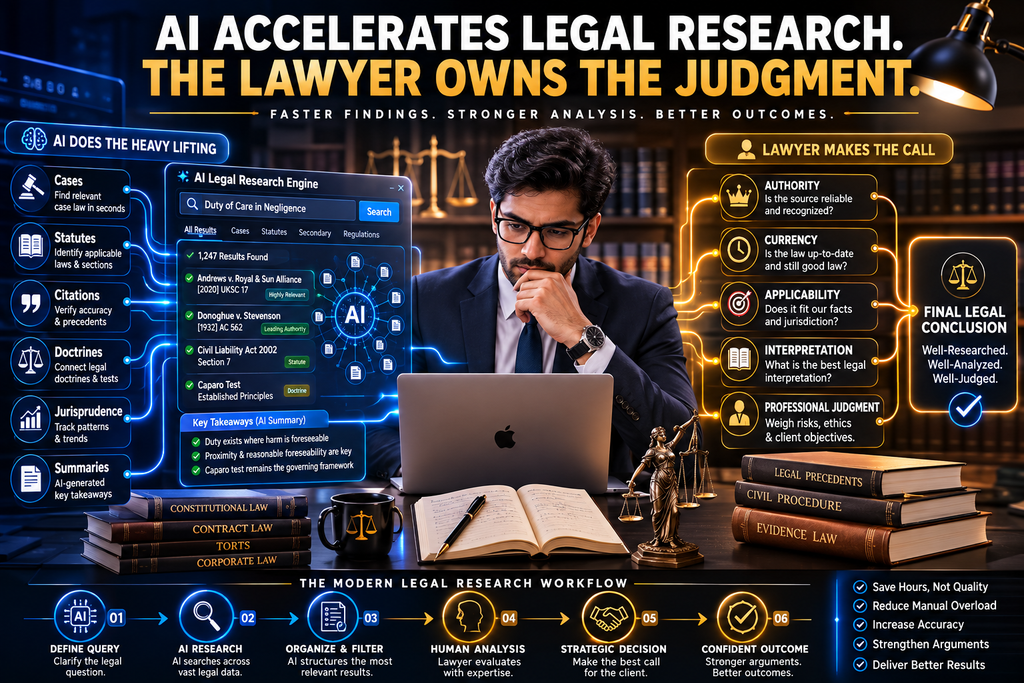
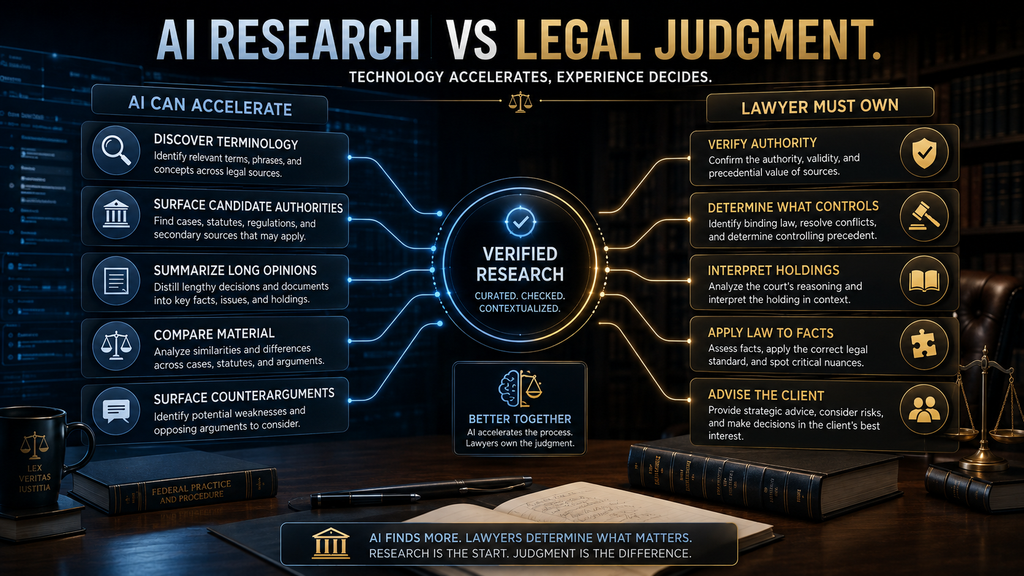
Consider a lawyer preparing for a motion involving a question of state law. The traditional workflow might involve identifying the precise legal issue, finding the relevant statute, searching cases, reading the strongest authorities, checking subsequent treatment, comparing factual circumstances, identifying adverse authority and then turning all of that material into an argument. AI can now help with several of those steps. It can surface terminology, summarize long opinions, suggest related cases, organize authorities and expose possible counterarguments in a fraction of the time a first-pass manual search might take.
But there is a dangerous point where efficiency can quietly become delegation.
If an AI system says a court adopted a particular rule, the lawyer still needs to determine whether the court actually said that. If the system provides a case citation, the lawyer needs to establish that the case exists, that the quotation is accurate, that the cited passage supports the proposition and that the authority is still relevant and controlling. If the system identifies ten cases, the lawyer still has to decide which authorities matter to the client’s actual problem.
That distinction is becoming more important as legal professionals move from experimenting with AI toward incorporating it into everyday work. Thomson Reuters’ 2026 Future of Professionals research found that 74% of surveyed professionals use AI several times a week, while 48% are concerned about AI’s effect on the development of independent professional judgment. Among legal professionals specifically, the report says the expected timeline to trusted judgment is being extended by nearly two years.
The issue, then, is not whether lawyers should use AI for legal research. That question is becoming increasingly outdated.
The better question is where AI should sit inside the legal research workflow.
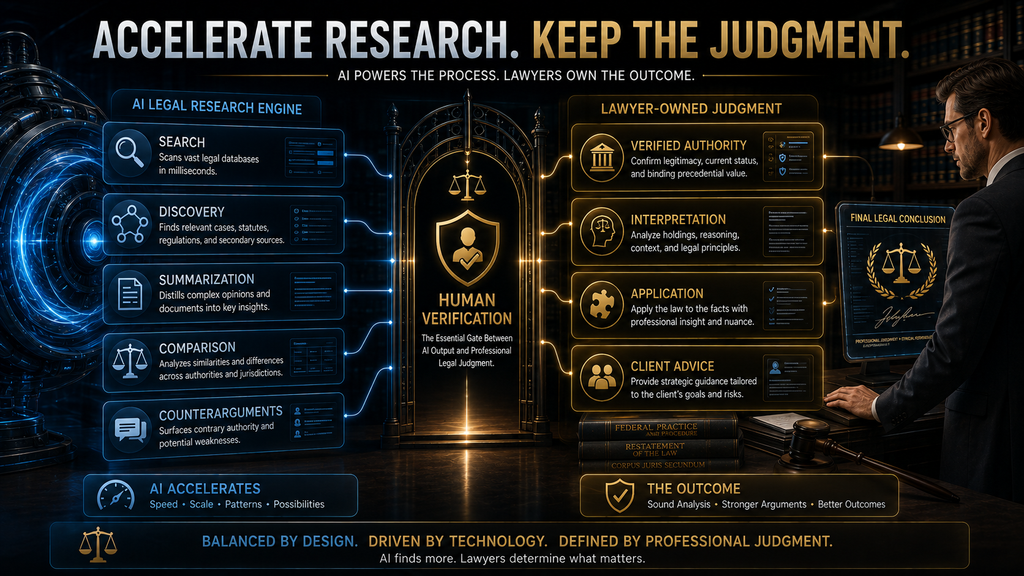
The strongest model is not lawyer versus AI. It is lawyer plus AI, with a deliberate boundary between research acceleration and professional judgment.
This article explains that boundary, shows what AI can realistically do at each stage of legal research, explains why verification remains essential even when using legal-specific AI systems, and builds a practical workflow lawyers can use without turning a language model into an unsupervised decision-maker.
What Is AI Legal Research?
AI legal research is the use of artificial intelligence to help lawyers discover, organize, summarize, compare and reason about legal information while the lawyer remains responsible for evaluating the underlying authorities and applying the law.
That definition matters because “AI legal research” can describe very different technologies. A general-purpose chatbot may help brainstorm search terms or explain a legal concept in plain language. A legal research platform may combine large language models with proprietary legal databases, retrieval systems, citation networks and authority-validation features. A traditional legal database may also incorporate AI-powered search without becoming a generative-AI system.
These systems should not be treated as interchangeable.
A general-purpose model is fundamentally a language-generation system. A legal research platform can add a retrieval layer designed to connect generated responses to legal authorities. That can substantially improve reliability, but it does not turn the generated answer into an authority itself.
A 2025 Stanford Law School study provides an important reality check. Researchers conducted what they described as the first preregistered empirical evaluation of leading AI legal research tools and found that legal-specific systems from LexisNexis and Thomson Reuters hallucinated less than GPT-4, but still hallucinated at meaningful rates. The study reports that each of the two legal research systems hallucinated more than 17% of the time in the tested setting.
That finding changes how the workflow should be designed. The output of AI legal research should normally be treated as research material to verify, not as a substitute for the authority being researched.
Why Legal Research Is Different From Ordinary Information Search
Legal research is not simply a more sophisticated version of Google search because legal authority has hierarchy, jurisdiction, procedural context, temporal validity and different levels of binding force.
Suppose an AI system finds a federal appellate decision that appears to answer a question. That does not immediately establish that the decision governs the lawyer’s problem. The lawyer may need to determine whether the case is from the relevant circuit, whether the issue is controlled by a state supreme court decision, whether the cited proposition was actually part of the holding, whether the facts are materially distinguishable, whether a later decision limited the case, and whether a statute has since changed the governing rule.
That is why legal research has historically required more than retrieving relevant text. The lawyer is constructing an authority map. The map answers questions such as:
- What law governs?
- Which authority has the highest weight?
- Which authorities are binding?
- Which authorities are persuasive?
- What exactly did each court decide?
- What facts mattered?
- What later developments changed the analysis?
- Where is the law unsettled?
- What arguments can reasonably be made from the available authority?
AI can accelerate the construction of that map. It should not be allowed to silently decide what the map means.
Why the traditional workflow exists
The traditional legal research process can feel inefficient because it contains repeated reading, searching and cross-checking. Those activities exist for a reason: legal conclusions depend on context, not merely textual similarity.
A case containing the words “reasonable notice” is not automatically relevant to every dispute involving reasonable notice. A statute containing the phrase “commercially reasonable” does not automatically answer a question arising under every statutory scheme. A judicial opinion’s discussion of a legal principle may be dicta rather than the holding. A case that looked favorable five years ago may have been narrowed or superseded.
Manual research developed around these problems.
AI’s opportunity is therefore not to eliminate the logic of legal research. It is to reduce the mechanical friction involved in moving through that logic.
That distinction becomes the foundation of a responsible AI workflow.
The Five Layers of AI Legal Work
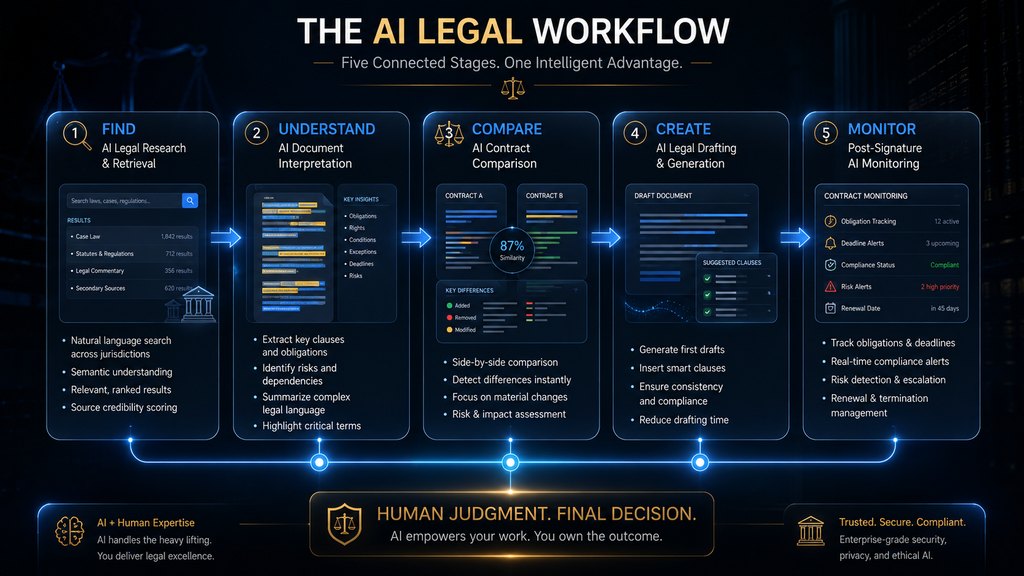
A useful way to understand the legal-AI landscape is to stop starting with products and start with the job the system is performing. AI Hustle World’s framework for this guide is Find, Understand, Compare, Create and Monitor. These five layers describe the progression from locating information to turning legal information into ongoing operational action.
Find: Retrieve the Information That Matters
The first job is finding relevant information.
A lawyer may need to locate cases, statutes, regulations, contract provisions, internal precedents, previous agreements, correspondence, evidence, policies or obligations. Legal databases already solve much of this problem through structured search and indexing, but AI can make interaction more natural and can help connect concepts that are expressed differently across documents.
A user can describe a legal issue in ordinary language, and an AI-enabled research system may retrieve potentially relevant authorities, passages or documents. That can reduce the time spent constructing searches and manually sorting through large result sets.
But retrieval is not the same as legal analysis. Finding a document does not establish that the document is authoritative, current, applicable to the relevant jurisdiction or factually analogous to the matter being considered. A system can therefore be useful at the retrieval stage while still requiring substantial professional judgment later.
This is one reason professional-grade legal AI should make its source material visible and traceable wherever possible. Thomson Reuters’ 2026 research notes that 41% of surveyed professionals lack access to AI tools specifically designed for professional work and built on verified professional content.
The distinction is subtle but consequential: the legal value of an AI answer depends partly on what the system was actually able to find before it started generating the answer.
Understand: Turn Documents Into Usable Information
The second layer is understanding.
Here AI can help summarize documents, classify them, identify clauses, group similar material, surface issues and convert unstructured text into structured information. This is particularly useful when legal teams have more material than people can reasonably inspect line by line.
Imagine an in-house team receives 1,500 supplier agreements and needs to identify which ones contain a particular termination provision. The immediate problem is not necessarily legal interpretation. It is information triage. An AI system can potentially identify candidate agreements, locate relevant provisions and organize the results for human review.
The danger appears when a useful extraction result is mistaken for a complete legal conclusion.
A system might identify a termination clause accurately while missing a related exception elsewhere in the agreement. It might summarize a contract correctly at a high level while omitting a commercially significant qualification. It might classify a document correctly while overlooking an unusual provision that changes the practical risk.
That means accuracy at one layer does not automatically guarantee completeness at another. The human reviewer needs to know what the system was asked to identify, what it may have missed and what downstream decision depends on the result.
Compare: Surface Differences, Deviations and Patterns
The third layer is comparison.
Legal work contains an enormous amount of comparative analysis. Lawyers compare contract versions, preferred language against negotiated language, one agreement against another, current documents against precedents and transaction documents against internal playbooks.
AI can make this process much faster by identifying differences and highlighting provisions that deserve attention.
The important value is often not that AI makes the final decision. It is that AI reduces the amount of material a professional needs to inspect before reaching that decision.
Consider a contract that contains 80 provisions. If an AI system identifies 12 provisions that materially deviate from an organization’s review playbook, the lawyer can concentrate on those areas rather than manually searching the entire agreement for every possible deviation.
But “different” does not mean “wrong.”
A negotiated clause may differ from the preferred position because the commercial circumstances justify it. A clause may look unusual but be acceptable in context. Another clause may appear standard while becoming problematic because of a definition or exception elsewhere in the document.
That is why the right relationship between AI and legal expertise is often: AI narrows the review surface; the professional determines what the difference means.
Create: Generate a First Version of the Work
The fourth layer is creation.
Generative AI can produce summaries, first drafts, correspondence, clause alternatives, research outlines, internal explanations and other forms of text transformation. This is the capability most closely associated with modern large language models.
It is also the capability that creates the greatest temptation to over-automate.
A generated draft can be valuable because it eliminates the blank page. It can help a lawyer explore possible language, organize an argument or transform complex material into a usable first version. But fluent language is not evidence of legal correctness.
The ABA’s Formal Opinion 512 is important here because it does not treat generative AI as an exemption from professional responsibility. Lawyers using generative AI remain subject to duties involving competence, confidentiality, communication, supervision, candor toward tribunals and reasonable fees.
The practical consequence is that generation should usually be treated as production assistance rather than automatic legal authority. The better question is not “Can AI draft this?” It is “What level of human review is appropriate before anyone relies on this draft?”
Monitor: Turn Legal Documents Into Ongoing Operations
The fifth layer is monitoring.
A contract does not stop mattering when it is signed. It can create renewal dates, notice requirements, reporting obligations, insurance requirements, service-level commitments, payment conditions, compliance duties and termination rights.
Those requirements can remain buried in documents even when the legal team understands them perfectly.
AI-enabled contract intelligence can help turn those provisions into structured operational information. The system may identify obligations, associate them with dates or responsible teams, and support reminders or downstream workflows.
That changes the question from “What does this contract say?” to “What does this contract require us to do?”
The distinction is strategically important because it moves legal AI from document analysis toward legal operations. The Law Society specifically identifies automated reminders of key contract expiry dates as one practical example of how technology can improve contract management.
Where AI Actually Helps in Legal Research
AI is most useful when it reduces the time required to orient, explore, organize and pressure-test a legal research problem without taking ownership of the final legal conclusion. The first major benefit is speed.
A lawyer facing a new issue may spend significant time simply determining the vocabulary used by courts and statutes. Different jurisdictions can describe similar doctrines differently. Older cases may use terminology that does not appear in newer decisions. A client may describe a business problem using commercial language rather than legal terminology.
AI can help bridge that vocabulary gap.
For example, instead of starting with a single search phrase, a lawyer can ask an AI system to identify alternative terminology associated with the issue, related doctrines, potentially relevant statutory language and questions that should be investigated. The lawyer can then use those suggestions to build a more comprehensive search strategy.
This is an important use of AI because the system is not being asked to decide the law. It is being asked to help the lawyer search more intelligently.
The same principle applies to long authorities. A lawyer may use AI to obtain an initial summary of a lengthy opinion, identify sections that appear relevant or compare several decisions at a high level. The summary is useful because it reduces orientation time. The original opinion remains necessary because the lawyer needs to verify what the court actually decided.
AI can also help expose relationships among authorities. Given a set of cases, it may identify recurring factual distinctions, competing interpretations or areas where courts appear to disagree. That can give the lawyer a faster route to the questions that deserve closer reading.
The strategic value is therefore not simply “AI reads cases faster.” It is AI reduces the amount of time the lawyer spends figuring out where to look next.
The AI Legal Research Judgment Boundary
The most useful way to think about responsible AI legal research is to draw a boundary between research acceleration and professional judgment.
AI can often assist with the left side of that boundary. The lawyer must retain ownership of the right side.
| Legal research activity | AI can assist with | Lawyer must retain responsibility for |
|---|---|---|
| Issue framing | Suggest related questions and terminology | Define the actual legal question |
| Initial discovery | Surface potentially relevant authorities | Determine which authorities deserve attention |
| Search expansion | Generate synonyms and related doctrines | Decide whether the search is sufficiently comprehensive |
| Case summarization | Produce an initial overview | Read and verify the authority |
| Authority comparison | Organize similarities and differences | Determine which distinctions legally matter |
| Citation suggestions | Identify candidate citations | Confirm the citation and supporting proposition |
| Counterargument discovery | Surface adverse authorities and arguments | Evaluate their strength |
| Legal analysis | Generate hypotheses or possible interpretations | Determine what the law actually means |
| Application to facts | Identify potentially analogous facts | Apply law to the client’s circumstances |
| Client advice | Help structure an explanation | Make and communicate the professional judgment |
The distinction is subtle but critical. AI can participate in the reasoning process without becoming the owner of the reasoning. That is the model firms should build around.
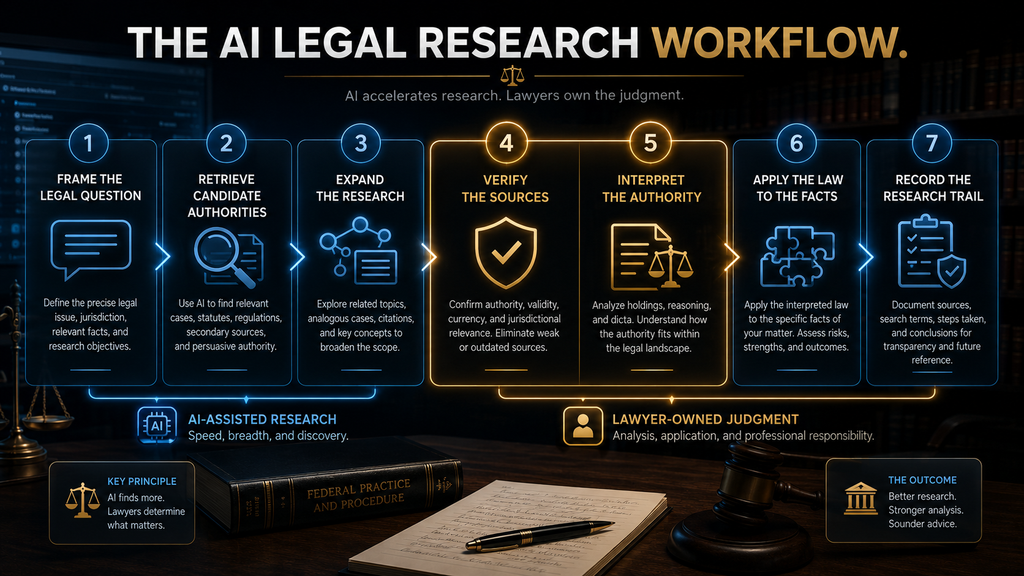
A Practical AI Legal Research Workflow: Frame → Retrieve → Expand → Verify → Interpret → Apply → Record
AI legal research works best when it is treated as a connected workflow rather than a single prompt.
The AI Hustle World framework for this article is Frame → Retrieve → Expand → Verify → Interpret → Apply → Record. Each stage has a different purpose, and skipping one can undermine the stages that follow.
Frame the legal question before opening the AI tool
The quality of legal research begins with the question being researched.
A vague question such as “Can this contract be enforced?” is usually too broad. The lawyer needs to define the jurisdiction, relevant law, procedural context, factual issue, time period and precise proposition that needs to be established.
A stronger research question might ask whether a particular contractual provision is enforceable under the governing state’s current law, given a particular factual circumstance and a specific procedural posture. That framing does two things.
First, it gives the lawyer a better research target. Second, it reduces the chance that an AI system will produce an impressive answer to the wrong question.
This is one of the most important differences between professional AI use and casual chatbot use. The lawyer should define the problem before the model helps explore it. A well-framed research question may specify:
- jurisdiction;
- relevant court level;
- governing statute or doctrine;
- date or legal cutoff;
- factual context;
- precise legal proposition;
- desired authority types;
- known adverse authority;
- whether the objective is discovery, verification or argument development.
The AI can then operate inside a defined research problem instead of inventing the problem itself.
Retrieve Candidate Authorities
Once the issue is framed, AI can help locate candidate authorities. This is where legal-specific research platforms can become particularly valuable because they can connect natural-language questions to legal databases and authority relationships rather than relying only on a model’s internal knowledge.
But even here, the word candidate matters. A retrieved authority is not automatically a verified authority.
The lawyer should treat the first AI-generated set as a research pool that requires refinement. Some cases will be central. Some will be marginal. Some may address the issue only indirectly. Others may appear relevant because of similar language while actually involving a different statutory framework or procedural question.
A good workflow therefore asks the AI to explain why each authority may matter rather than simply producing a list of cases. For example, instead of asking:
“Find cases supporting this argument.”
a better research instruction is:
“Identify potentially relevant primary authorities addressing this issue in the specified jurisdiction and explain the proposition each authority appears to address. Separate binding authorities from persuasive authorities and identify any cases that appear adverse.”
That request creates a research map rather than a pile of citations. The lawyer then moves from the AI-generated map to the underlying sources.
Expand the Research Before Narrowing It
One of AI’s most underused legal-research capabilities is research expansion.
Experienced lawyers know that a legal question can hide behind several different formulations. A lawyer searching only one phrase can miss relevant authority because courts may describe the same concept differently.
AI can help generate alternative terminology, related doctrines, statutory language, historical terminology and adjacent legal questions. This is particularly useful at the beginning of unfamiliar research.
Imagine a lawyer researching whether a company can terminate a particular contractual arrangement. The client’s language might center on “termination rights,” while cases may discuss repudiation, material breach, anticipatory breach, contractual termination provisions or conditions precedent.
A language model can help identify that broader vocabulary. But the lawyer still determines which terms actually belong in the research strategy. That distinction prevents another common mistake: allowing AI-generated terminology to become an unverified research universe.
AI expands the search. The lawyer decides where the search goes.
Use AI to Search for the Argument Against You
One of the strongest uses of AI in legal research is adversarial research.
Lawyers are naturally tempted to search for authorities supporting their client’s position. That is understandable, but it creates a confirmation-bias problem.
A better workflow deliberately asks the system to attack the emerging argument. After identifying the strongest supporting authorities, the lawyer can ask:
“What authorities or doctrines could undermine this position?”
Then:
“Which of those authorities appear controlling rather than merely persuasive?”
And finally:
“What factual or doctrinal distinctions might limit those authorities?”
This turns AI into a pressure-testing system.
The value is not that the model’s answer is automatically correct. The value is that it may surface a line of research the lawyer has not yet explored.
The lawyer then verifies the authorities independently. That produces a more reliable workflow than asking AI to repeatedly confirm the original thesis.
Summarize Cases, but Never Confuse a Summary With the Case
AI-generated summaries can save substantial reading time, particularly when a lawyer is triaging a large number of potentially relevant authorities. But summaries are compression. Compression necessarily removes information.
A case summary may omit procedural posture, factual limitations, qualifying language, the precise holding, the court’s treatment of an earlier decision or a later part of the opinion that changes the meaning of an apparently favorable passage. The safest use of AI summarization is therefore triage. Use the summary to decide:
“Is this authority worth reading?”
Then read the authority. The dangerous workflow is:
“The AI summarized the case, so I now know what the case says.”
Those are not equivalent statements. A useful internal rule is:
AI summary = navigation aid. Original authority = evidence.
Verify Before You Rely
Verification is the point at which an AI-assisted research process becomes a professional legal research process. The lawyer should verify at least five things: existence, text, meaning, currency and applicability.
Verify that the authority exists
Does the case, statute, regulation or rule actually exist? This sounds almost absurdly basic until you examine what happened in the early generative-AI legal cases.
In Mata v. Avianca, lawyers submitted nonexistent judicial opinions and fake quotations generated by ChatGPT. The Southern District of New York emphasized that technological assistance itself was not improper, but lawyers retain a gatekeeping responsibility for the accuracy of court filings. The court imposed sanctions after the attorneys failed to adequately verify the authorities.
That case remains important because the underlying failure was not simply “the AI hallucinated.” The deeper failure was: The research workflow did not contain an effective verification gate.
Verify the actual text
If AI provides a quotation, find the quotation in the original authority. Do not verify only the case name. Do not verify only the citation.
Open the actual authority and locate the language. A citation that exists can still be paired with a quotation that does not.
Verify the proposition
This is more demanding than citation checking.
Suppose the cited opinion contains the quoted sentence. That still does not prove that the opinion supports the legal proposition for which the lawyer intends to cite it.
The lawyer needs to read enough surrounding context to determine whether the statement is actually part of the court’s reasoning and whether the proposition has been characterized accurately.
Verify currency
The law may have changed after the case the AI found. A statute may have been amended. A precedent may have been overruled, limited or distinguished.
A regulation may have changed. A later appellate decision may have altered the relevant interpretation. This is why legal research cannot stop at retrieval.
Verify applicability
Even current authority can be the wrong authority for the problem. The court may not have jurisdiction. The factual circumstances may be materially different.
The authority may be persuasive rather than binding. The issue may arise under a different statutory scheme. Applicability is where legal research becomes legal analysis.
Why Legal AI Still Needs Verification
It is tempting to assume that legal-specific AI has solved the hallucination problem because it can retrieve from authoritative legal databases. The evidence does not support that assumption.
The Stanford study found that legal research systems substantially reduced hallucinations compared with general-purpose GPT-4 but still produced hallucinated responses at meaningful rates. The researchers specifically described the systems’ providers’ claims about eliminating or avoiding hallucinations as overstated.
This produces an important distinction between better reliability and reliability without verification. Legal AI can be better engineered for legal work. That does not mean the lawyer can remove the verification layer.
The practical consequence is straightforward: the more consequential the legal proposition, the stronger the verification requirement should be. A brainstorming question may tolerate a looser first-pass workflow. A proposition going into a court filing should not.
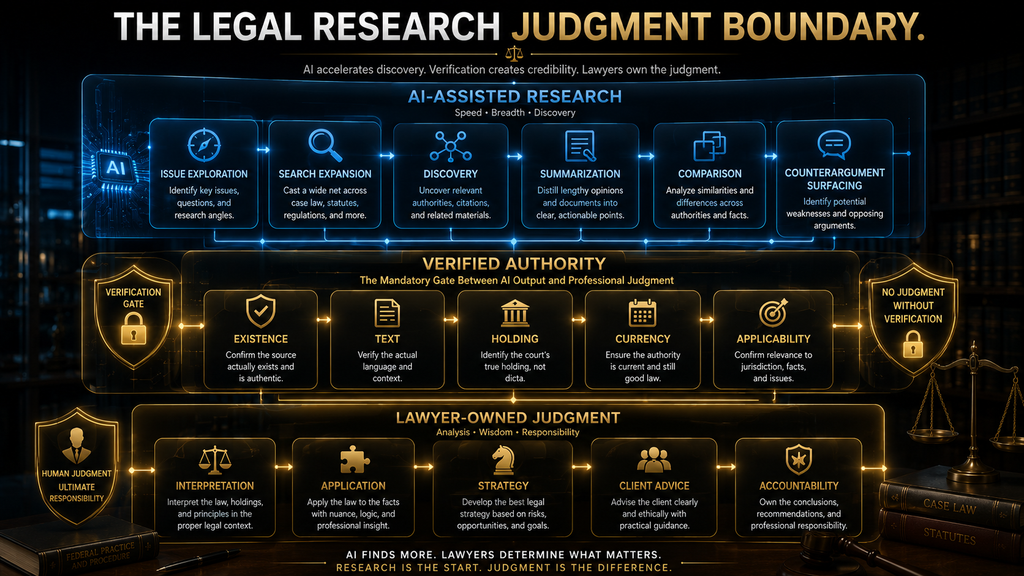
The 2026 Lesson: Verification Cannot Simply Be Delegated
A recent California appellate decision makes this boundary even clearer.
In Del Biaggio v. Bansen, decided July 10, 2026, the California Court of Appeal sanctioned attorney Carlton Floyd $1,500 after an appellate brief contained misstatements of legal authority associated with AI use. The court specifically found that the verification protocol described by counsel was insufficient to satisfy the lawyer’s personal obligation to review the principal authority underlying the argument.
The facts are especially useful because the problem was not simply that AI produced inaccurate material.
Counsel had a process in which a paralegal was involved in verification. The court still concluded that the attorney had an obligation to personally review the principal legal authority. The court also criticized the delay in correcting the misstatements.
That is an important evolution from the 2023 Mata lesson. Mata taught lawyers that AI-generated authorities can be fabricated. Del Biaggio reinforces a more sophisticated rule: Even having a verification process is not enough if the process does not put appropriate professional responsibility on the lawyer.
The implication for AI-assisted legal research is substantial. You cannot solve a judgment problem simply by adding another person to the workflow. The workflow has to put the right decision with the right professional.
The Difference Between Citation Verification and Legal Verification
A lawyer can verify a citation and still produce bad research. That is because legal verification operates at multiple levels.
| Verification level | What the lawyer is checking |
|---|---|
| Citation | Does the authority exist and is the citation accurate? |
| Quotation | Does the quoted language actually appear in the source? |
| Context | Does the surrounding discussion support the interpretation? |
| Holding | Did the court actually decide the proposition being asserted? |
| Authority | Is the source binding, persuasive or otherwise relevant? |
| Currency | Has later law changed its force? |
| Applicability | Does the authority fit the jurisdiction, facts and legal question? |
This is why a lawyer should not use “I clicked the citation” as the definition of verification. Verification is a legal reasoning task, not merely a hyperlink check.
Interpreting the Authority Is Where Human Judgment Becomes Central
Once the lawyer has verified the authority, the next task is interpretation. This is where AI can still assist, but the balance shifts strongly toward human judgment.
Suppose three cases address the same general issue. One appears favorable, one adverse and one ambiguous. AI can summarize all three and even create a comparison table. But the lawyer needs to decide whether the apparently favorable case is actually stronger because of the jurisdiction, whether the adverse case can be distinguished, and whether the ambiguous decision reveals uncertainty that needs to be disclosed to the client.
This is not merely a text-processing problem. It is a judgment problem. Legal judgment involves weighting authority against authority, facts against facts, risk against risk and legal possibilities against the client’s objectives.
That is precisely why Thomson Reuters’ 2026 research is so relevant. Its report describes AI as a force multiplier while emphasizing that judgment, relationships and accountability remain human. It also found that nearly half of surveyed professionals are concerned about AI’s effect on independent judgment development.
The concern is not that AI makes lawyers less intelligent overnight. The concern is that repeatedly skipping the reasoning steps can weaken the development of the reasoning itself.
Apply the Verified Law to the Actual Facts
The next stage is application. This is where a generic legal answer becomes legal work. An AI system may correctly explain the governing rule and still provide little useful advice because the client’s facts do not fit the assumptions embedded in the cases.
Suppose a court says that a contractual restriction is enforceable under certain circumstances. The client’s agreement may contain additional language, the parties may have behaved differently, the governing jurisdiction may apply another statutory exception or the procedural posture may change what matters.
Application therefore requires the lawyer to connect three things:
- The authority.
- The client’s facts.
- The decision that needs to be made.
AI can help identify factual analogies and distinctions, but the lawyer decides which ones are legally material. This is another reason not to ask AI to jump directly from a client’s confidential facts to a final legal conclusion. The workflow should move through the intermediate stages.
Record the Research Trail
A mature AI-assisted legal research workflow should preserve enough information for the lawyer or firm to understand how the conclusion was reached. The exact recordkeeping requirements will vary by firm, jurisdiction, matter and tool, but the general principle is useful. If AI helped generate candidate authorities, the lawyer should know which authorities were ultimately verified.
If AI generated a summary that influenced the research direction, the underlying authority should remain accessible. If a material conclusion was produced with AI assistance, the final work product should still be traceable to the authoritative sources supporting it. This is valuable for quality control as well as professional responsibility.
It also creates an institutional learning system. When a research error occurs, the firm can ask: Where did the workflow fail? Was the issue incorrectly framed?
Did retrieval miss the authority? Did AI misstate the authority? Did the lawyer fail to verify it?
Did the verification process fail? Did the final application overstate what the authority established? Without a research trail, those questions are harder to answer.
General-Purpose Chatbots vs Legal Research AI
The right tool depends on the task.
A general-purpose chatbot can be useful for research orientation, terminology expansion, brainstorming, summarization and generating questions for further investigation. It becomes much less suitable as the sole source for authoritative legal research because its language-generation capabilities do not inherently guarantee that every legal proposition is grounded in a current primary source.
Legal research platforms can add important safeguards by connecting AI outputs to legal databases and citation systems. That makes them better suited to authority-driven research, but the Stanford evidence shows that even these systems can produce hallucinated or inaccurate responses.
Traditional legal databases and primary sources therefore remain essential. The most defensible architecture is usually hybrid:
- AI for discovery and synthesis.
- Legal databases for authoritative retrieval.
- Primary sources for final verification.
- Lawyer judgment for interpretation and application.
That is not a failure of AI. It is an appropriate division of labor.
What AI Should Not Be Asked to Decide
The most important boundary is not whether AI can technically produce an answer. It is whether the answer represents a professional decision that should remain under lawyer control.
AI should not independently decide which law governs a matter and then be treated as the final authority. It should not determine that a case is controlling without lawyer verification. It should not be allowed to convert an uncertain legal question into a confident conclusion merely because the language sounds persuasive.
It also should not independently determine what legal advice a client should receive. The lawyer can ask AI to expose possible interpretations. The lawyer can ask AI to challenge a position.
The lawyer can ask AI to identify missing research. But the lawyer remains accountable for the conclusion. That distinction is especially important when the consequence of being wrong is high.
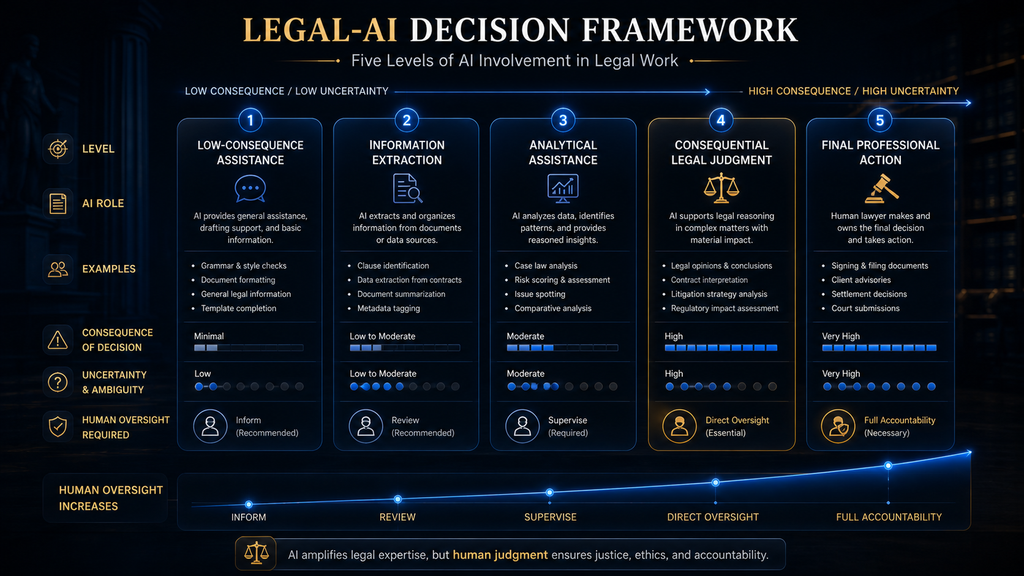
The AI Legal Risk Ladder
AI Hustle World’s second core framework for this article is the AI Legal Risk Ladder. The principle is that human review should become stronger as the consequence of error, uncertainty and irreversibility increase.
| Workflow level | Typical AI role | Human responsibility | Example |
|---|---|---|---|
| Low consequence | Automate or assist | Routine inspection | Reformatting known text |
| Information extraction | Process and organize | Validate important fields | Contract dates and parties |
| Analytical assistance | Surface issues and patterns | Interpret and decide | Contract-risk flags |
| Consequential legal judgment | Support only | Substantive professional review | Legal position or advice |
| Final professional action | Assist within controlled workflow | Human accountability | Filing, approval or binding decision |
This is not a universal legal rule, and the exact controls depend on jurisdiction, organization, matter and professional obligation. It is an AI Hustle World decision framework for thinking about automation proportionately.
The key idea is that review intensity should not be uniform.
If an organization requires a lawyer to manually verify every low-risk formatting change with the same effort used to validate a consequential legal conclusion, much of the potential productivity gain disappears. If the organization applies almost no review to high-consequence decisions, it creates a different and potentially more serious problem.
The objective is to place human judgment where it has the greatest marginal value.
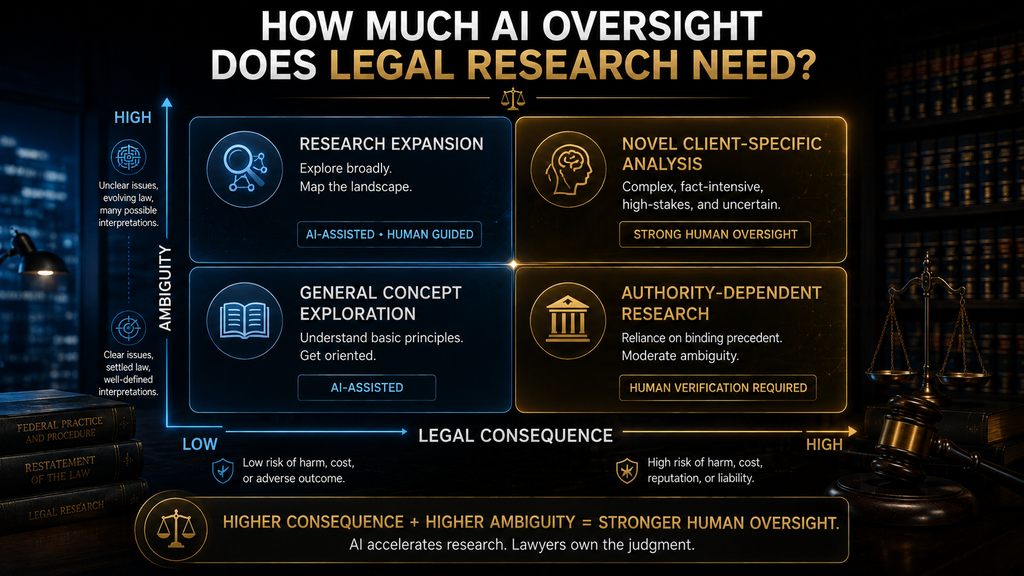
A Risk-Based Model for AI-Assisted Legal Research
Not every research task requires the same amount of human intervention. A useful way to manage AI is to scale oversight according to consequence and ambiguity.
| Research situation | AI role | Required human oversight |
|---|---|---|
| General legal concept orientation | High | Basic source checking |
| Search-term expansion | High | Review relevance |
| Initial case discovery | High | Verify authorities |
| Long-opinion summarization | High | Read source before relying |
| Case comparison | Moderate to high | Verify distinctions and holdings |
| Novel legal question | Moderate | Extensive independent research |
| Client-specific legal analysis | Moderate | Lawyer-led analysis |
| Court filing | Limited to assistive work | Direct lawyer verification |
| High-consequence legal advice | Assistive only | Lawyer owns conclusion |
This is more useful than a blanket rule such as “never use AI for legal research.” A blanket prohibition throws away valuable productivity gains.
A blanket permission creates unacceptable risk. The better answer is risk-calibrated use.
Confidentiality Changes the Workflow
Legal research can involve confidential client information, which creates a separate boundary around AI use.
The ABA’s Formal Opinion 512 emphasizes that lawyers must consider confidentiality obligations when using generative AI and understand how the tool handles information entered into prompts. The ABA’s discussion specifically highlights the risk that client information could be disclosed or accessed inappropriately depending on how the system processes and retains data.
This means there is a meaningful difference between:
“What is the general legal test for X?”
and:
“Here are the confidential facts of my client’s dispute; tell me whether we can win.”
The first question may be research-oriented and relatively abstract. The second introduces matter-specific information that may be protected by confidentiality obligations. A responsible workflow therefore asks before every sensitive AI interaction: Does this tool have an appropriate security and data-governance posture for this information?
The answer should come from the firm’s approved technology policy, the tool’s actual terms and configuration, applicable professional obligations and, where appropriate, client communication or consent. The ABA has also emphasized that lawyers need a reasonable understanding of AI tools’ capabilities and limitations and must review AI outputs for accuracy. The lesson is simple: Do not solve a research problem by creating a confidentiality problem.
Competence Means Understanding the Tool
AI competence does not mean that every lawyer needs to become a machine-learning engineer. It means the lawyer needs enough understanding to use the technology responsibly. That includes knowing what the system can do, what sources it uses, what its limitations are, how it handles information, what kinds of errors it can make and what level of verification is appropriate.
ABA Formal Opinion 512 explicitly connects AI use to the lawyer’s duty of competence and says lawyers must consider their obligations when using generative AI, including competence, confidentiality, communication, supervision, candor toward tribunals and reasonable fees. That creates an interesting shift. Technology competence is becoming part of legal competence.
A lawyer does not need to trust AI because it is sophisticated. The lawyer needs to understand when sophistication does and does not translate into reliability.
Supervision Matters Even When the AI Is Doing the Work
AI systems do not eliminate supervision obligations. If a junior lawyer uses AI to generate a research memo, the supervising lawyer remains responsible for reviewing the work appropriately. If a paralegal uses AI to identify cases, the supervising lawyer needs a workflow that ensures the final authorities are accurate and suitable.
And if the AI itself performs much of the mechanical research, the same principle applies. The software is not a licensed professional. The lawyer is.
That distinction becomes especially important in light of Del Biaggio v. Bansen, where the California Court of Appeal concluded that the attorney’s verification protocol did not satisfy his obligation to personally review the principal legal authority underlying his argument.
The practical implication is that firms should define who owns the verification decision, not simply who clicked the search button.
Use AI to Challenge Your Reasoning, Not Just Confirm It
There is a powerful way to improve AI-assisted legal research: deliberately make the system disagree with the initial position. Once the lawyer has developed a preliminary argument, the AI can be instructed to identify:
- the strongest opposing authority;
- assumptions the argument depends on;
- factual weaknesses;
- alternative interpretations;
- jurisdictional differences;
- potential procedural problems;
- missing research;
- and arguments opposing counsel could make.
This turns AI into a structured adversarial research assistant. But there is an important boundary. The AI’s objections are hypotheses to investigate, not automatically valid counterarguments.
The lawyer still needs to verify the underlying authority and assess its weight. The goal is not to make the AI the opposing lawyer. The goal is to make it harder for the actual lawyer to overlook an opposing argument.
Why “AI Says the Case Supports Me” Is a Weak Research Standard
Legal reasoning often fails when people search only for confirming evidence. AI can amplify this problem because language models are extremely good at producing coherent explanations of the premise provided to them. If a lawyer asks:
“Find authorities confirming that this clause is unenforceable.”
the system is being pushed toward a conclusion. A better question is:
“Identify the strongest authorities on both sides of this issue, explain the factual and doctrinal differences, and identify which authorities appear binding in the specified jurisdiction.”
The second prompt produces a more balanced research starting point. This is a broader principle for professional AI:
The best prompt is not necessarily the one that produces the most convenient answer. It is the one that exposes the most decision-relevant uncertainty.
That is particularly important in law.
AI Can Compress Research Time Without Compressing Legal Reasoning
This distinction deserves emphasis because it captures the real productivity opportunity. A lawyer can spend less time searching for vocabulary, scanning long documents, organizing candidate cases and generating research paths. That does not mean the lawyer should spend less time understanding the authorities that ultimately matter.
The productivity gain should come from removing low-value friction, not from eliminating high-value reasoning. Thomson Reuters’ 2026 research describes AI as a force multiplier and reports widespread professional adoption, while simultaneously highlighting concerns about judgment development. That suggests a better productivity metric than “hours saved.”
The meaningful metric is:
How much research time did AI remove without increasing the lawyer’s verification burden or reducing research quality?
If AI produces a preliminary research map in ten minutes but requires an hour to untangle unsupported claims, the nominal time saving is misleading. If AI helps the lawyer identify the right authorities in ten minutes and the lawyer then spends focused time reading and applying those authorities, the productivity gain is real.
Measuring AI Legal Research Properly
Law firms should measure more than AI usage. A responsible AI research program should track both efficiency and reliability.
| KPI | What it measures | Why it matters |
|---|---|---|
| Initial research time | Speed of orientation | Shows workflow efficiency |
| Verified authority rate | Quality of retrieved sources | Tests reliability |
| Citation error rate | Incorrect or unsupported citations | Measures legal risk |
| Missed-authority rate | Important authorities AI failed to surface | Tests research completeness |
| Verification time | Human audit burden | Shows the real cost of AI |
| Rework rate | How much output requires correction | Measures output quality |
| Research coverage | Breadth of relevant authority considered | Reduces blind spots |
| Matter-level usefulness | Whether AI improved the actual work | Connects technology to outcomes |
The most useful metric may be net research time saved after verification. That metric forces the organization to account for the human work required to validate AI output. It also discourages firms from rewarding employees simply for generating large amounts of AI-assisted material.
The goal is better legal work. Not more AI-generated text.
What Happens If Lawyers Do Nothing?
There is a real downside to refusing to engage with AI-assisted research entirely. If competing firms use AI to reduce research friction, identify authorities faster and analyze larger volumes of material, lawyers who rely exclusively on older workflows may gradually face a productivity disadvantage.
Thomson Reuters’ 2026 research indicates that AI adoption is already widespread among professionals and that organizations with deliberate AI strategies report substantially better outcomes than organizations without active strategies. The report found that 66% of professionals in organizations with a named AI strategy said AI was meeting or exceeding expectations for creating value, compared with 22% where there was no active strategy.
But the opposite extreme is also dangerous.
If firms simply hand research tasks to AI without designing training and verification processes, junior lawyers may perform fewer of the activities through which research judgment traditionally develops. Thomson Reuters reports that 48% of professionals are concerned about AI’s impact on independent judgment development and notes that legal professionals expect the timeline to trusted judgment to stretch by nearly two years.
That creates a strategic dilemma.
Do not preserve every manual task just because it is traditional. But do preserve the reasoning those tasks were teaching.
A strong firm therefore uses AI to remove repetitive work while deliberately giving developing lawyers opportunities to learn how authorities are found, evaluated, distinguished and applied.
The New Role of Junior Lawyers
This may be one of the most important second-order effects of AI legal research.
Historically, junior lawyers often learned research by doing it repeatedly. They searched databases, read cases, compared authorities, drafted research memos and gradually developed an internal sense of which arguments were strong, weak, unusual or likely to matter.
AI can compress that learning process. A junior lawyer may now receive a polished research summary without experiencing the underlying research process. That creates a potential training problem.
The answer is not to prohibit AI. The better approach is to redesign the learning process. For example, a supervising lawyer might ask a junior lawyer to first develop an independent research hypothesis, then use AI to expand it, then compare the AI-generated authority set with independently discovered authorities, and finally explain where the two approaches differed.
That turns AI into a training instrument rather than a shortcut around learning. The junior lawyer still develops judgment, but AI becomes part of the exercise.
A Firm-Level Implementation Model
A responsible law firm should not begin by buying the maximum number of AI tools. It should begin by defining the research workflow. A practical implementation can be organized around five layers.
Approved tools
Determine which AI systems are permitted for legal research and which are prohibited for confidential matter information.
Approved use cases
Define tasks where AI can be used freely, tasks requiring review and tasks requiring special approval.
Verification standard
Create a minimum verification protocol for citations, quotations, holdings, currency and applicability.
Training
Teach lawyers how the approved systems work, where they fail and how to use them effectively.
Audit and improvement
Track errors, successful use cases, time savings and recurring failure modes, then update the workflow. This turns AI adoption from an individual experimentation problem into an institutional quality system.
A Simple Three-Level AI Research Policy
For smaller firms, the policy can be even simpler.
Green: Low-risk research assistance
Use AI for general legal concepts, terminology expansion, research-question generation and brainstorming. The lawyer still verifies relevant authorities before relying on them.
Yellow: Authority-dependent research
Use approved legal AI for case discovery, summaries, comparisons and counterargument research. The lawyer must verify every material authority before using it in advice or work product.
Red: Consequential final judgment
Do not delegate the final decision about governing law, legal advice, court representations or material client conclusions to AI. The lawyer owns the conclusion.
This framework is intentionally simple because the purpose of a policy is to be followed. A 60-page AI manual that nobody remembers is weaker than a short policy embedded into the workflow.
Common Mistakes Lawyers Make With AI Legal Research
Treating AI output as a research result
An AI answer is usually a starting point rather than the final research result. The result is the verified authority and the lawyer’s analysis of it.
Searching only for favorable cases
This creates confirmation bias. AI should also be used to search for adverse authority and alternative interpretations.
Checking only that the case exists
A real case can still be cited for a proposition it does not support. Verify the holding and context.
Ignoring jurisdiction
A highly relevant case from the wrong jurisdiction may have less practical value than a less obvious authority from the controlling court.
Ignoring procedural posture
The same legal issue can have different significance depending on whether the court was deciding a motion to dismiss, summary judgment, a preliminary question or an appeal.
Trusting summaries without reading primary authority
Summaries are useful for navigation. They are not a replacement for the source.
Putting confidential facts into an unapproved tool
The efficiency gain is not worth creating a confidentiality problem.
Assuming legal AI cannot hallucinate
The empirical evidence says otherwise. Legal-specific systems can be substantially better than general-purpose models while still producing errors.
Delegating verification to someone who cannot make the final professional judgment
The 2026 Del Biaggio decision demonstrates why this boundary matters.
Measuring success by the number of AI-generated pages
More text does not equal better research. The real objective is a stronger, verified legal position.
A Practical Prompt Structure for Lawyers
Prompting should support the research method rather than become the method itself. A useful legal research prompt can specify:
- Jurisdiction: Identify the relevant state, federal district, circuit or other governing forum.
- Question: State the precise legal issue.
- Time boundary: Identify the relevant date or cutoff.
- Authority: Ask for primary authority where available.
- Research purpose: Specify whether the task is discovery, comparison, counterargument generation or summarization.
- Output discipline: Ask the system to distinguish authority from analysis and to flag uncertainty.
- Verification requirement: Require citations to underlying sources rather than unsupported assertions.
For example:
“I am researching [specific legal issue] under [jurisdiction]. Identify potentially relevant primary authorities from [time period]. For each authority, explain the legal proposition it appears to address, distinguish binding from persuasive authority, identify potentially adverse authorities and flag any point that requires independent verification. Do not treat the generated explanation as a substitute for the underlying authority.”
The important feature is not the exact wording. It is the workflow embedded in the instruction. The prompt tells AI to surface research, not to assume the lawyer’s professional role.
The Strongest AI Legal Research Workflow in Practice
A lawyer working on a new matter can make the process concrete.
Start by writing the legal question independently. Then ask AI to expand the terminology and identify potentially relevant doctrines. Use the expanded terminology to search an approved legal research system and collect candidate authorities. Ask AI to organize those authorities into themes, identify potentially adverse decisions and highlight factual distinctions worth investigating.
At that point, stop treating the AI output as authoritative. Open the primary sources. Verify the citations.
Read the relevant passages. Confirm the holdings. Check the authority’s current status.
Determine which sources actually control. Then build the legal analysis from the verified material.
Finally, ask AI to pressure-test the argument by identifying potential weaknesses and counterarguments. Verify any new authorities it produces before incorporating them.
That workflow is slower than asking one chatbot question. It is also dramatically safer and more useful.
The goal is not maximum automation. The goal is maximum useful acceleration without surrendering legal judgment.
A Decision Matrix: When to Trust AI More and When to Trust the Workflow Less
The right level of AI involvement depends on two variables: consequence and ambiguity. When both are low, AI can take a larger role in the early workflow. When either becomes high, human review should increase.
| Consequence | Ambiguity | Recommended AI role |
|---|---|---|
| Low | Low | Strong research assistance |
| Low | High | Exploration with lawyer review |
| High | Low | Structured AI assistance with rigorous verification |
| High | High | AI as research support only; lawyer-led analysis |
This is an important improvement over simplistic “AI yes/no” policies. A straightforward request to summarize a public statute has different risk characteristics from asking AI whether a novel issue should be raised in a court filing.
The technology may be identical. The required oversight should not be.
The Economics of Verification
Verification is often described as the cost of AI. That is the wrong framing. Verification is the cost of professional reliability.
Traditional legal research already involved reading primary sources, checking citations, comparing cases and confirming current law. AI does not invent the need for verification.
It changes where the time is spent. Instead of spending most of the time locating material, the lawyer may spend more time evaluating a smaller set of AI-surfaced candidates. That can be a genuine productivity improvement.
The economics become favorable when AI reduces low-value retrieval work without increasing the amount of high-value verification work beyond what the matter requires. This is why a good AI legal research workflow should measure net time saved, not raw generation speed.
What the Best Legal AI Systems Will Eventually Do
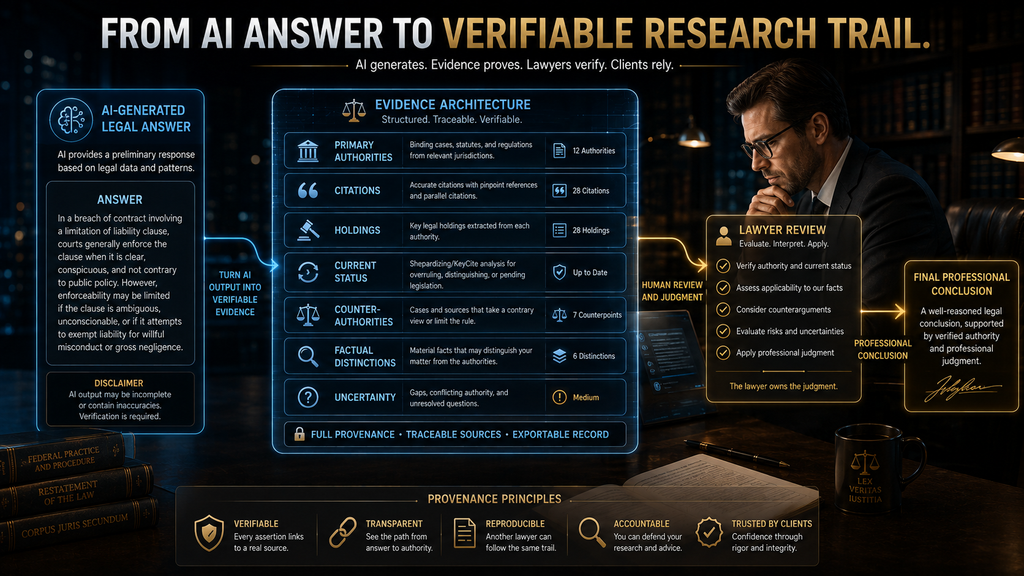
The future of legal AI is unlikely to be determined simply by which model writes the most convincing prose. The more important competition will be around grounding, authority, provenance, verification and workflow integration. A useful future legal research system should increasingly be able to show:
- where an answer came from;
- which authority supports each proposition;
- what authority contradicts it;
- how current the authority is;
- whether the source is binding;
- what factual assumptions the analysis depends on;
- and where uncertainty remains.
That changes the interface from: “Here is an answer.” to: “Here is the research trail behind the answer.” That is much closer to what lawyers actually need.
The Second-Order Effect: Legal Research May Become More Analytical
There is a potential upside hidden inside all of this. If AI handles more of the mechanical discovery work, lawyers may have more time for higher-value analysis. Instead of spending hours finding the tenth relevant case, a lawyer may spend that time asking whether the first nine cases reveal a meaningful doctrinal split.
Instead of manually summarizing twenty opinions, the lawyer may spend more time comparing the factual assumptions behind the strongest authorities. Instead of searching endlessly for terminology, the lawyer may focus on how the legal issue interacts with the client’s commercial objective. That could make legal work more analytical.
But it will happen only if firms deliberately redirect the saved time toward judgment rather than simply increasing workload. If AI saves two hours and the organization immediately fills those two hours with two additional matters, the lawyer may become more productive without becoming more thoughtful. That is an implementation choice, not a technological inevitability.
Why Human Judgment May Become More Valuable, Not Less
As retrieval becomes cheaper, judgment can become the scarce resource. If every lawyer can quickly obtain a large set of potentially relevant authorities, the competitive advantage shifts toward knowing:
- Which authorities matter?
- Which distinctions matter?
- Which uncertainties matter to the client?
- Which risks are acceptable?
- What should the client actually do?
This is the difference between information and professional value. AI can increase the amount of information available to the lawyer. It does not automatically increase the lawyer’s ability to make a good decision from that information.
The strongest lawyers will therefore not necessarily be the ones who use the most AI. They will be the ones who understand where AI creates leverage and where judgment remains the bottleneck.
Who Should Use AI Legal Research?
AI-assisted legal research is particularly useful for lawyers and legal teams dealing with large volumes of authorities, repetitive research tasks, unfamiliar terminology, broad initial discovery, comparative analysis or research-heavy workflows. It can be especially valuable when the lawyer already understands the legal problem and needs to reduce the time required to explore it.
It is also useful for in-house legal teams that need to orient themselves quickly around unfamiliar issues, provided the underlying authorities are independently verified. The common thread is that AI is helping an existing professional workflow move faster.
Who Should Be More Cautious?
Extra caution is appropriate when the legal issue is novel, highly consequential, jurisdiction-specific, factually complex or likely to result in a court filing. Caution is also warranted when confidential client information is involved and the firm’s approved technology environment is unclear.
AI may still have a role in these situations, but the lawyer should narrow the system’s responsibility and strengthen the verification process. The more expensive an error becomes, the less sensible it is to optimize solely for speed.
The One Rule Worth Remembering
If there is only one principle to take away from this article, make it this: Use AI to make the research process faster; never use it to make yourself less responsible for the research conclusion. That rule explains why AI can safely help generate search terms but should not decide what law controls. It explains why AI can summarize a case but should not replace reading the case.
It explains why AI can identify a possible argument but should not determine what advice the client receives. And it explains why an AI-generated citation is a lead until a lawyer verifies it. This is not an anti-AI position.
It is the opposite. It is a design principle for using AI where it creates the most value without crossing the boundary where professional judgment becomes indispensable.
Final Thoughts
AI is changing legal research, but the biggest change is not that lawyers can ask machines questions about the law. The bigger change is that the economics of research are shifting from retrieval toward evaluation.
AI can help lawyers discover terminology, identify candidate authorities, summarize long decisions, compare cases, surface adverse arguments and organize large amounts of research. Legal-specific systems can improve the grounding of those workflows, and current professional research shows that AI adoption is already becoming routine rather than experimental.
But the evidence also gives lawyers a reason to be disciplined.
Legal AI systems still make mistakes. The Stanford study found meaningful hallucination rates even among leading legal research systems, while recent court decisions continue to demonstrate that lawyers can face consequences when AI-generated legal authorities are not properly verified.
The lesson from Mata v. Avianca was that lawyers cannot submit fabricated authorities simply because a machine produced them. The lesson from Del Biaggio v. Bansen is even more relevant to today’s workflows: a lawyer’s responsibility for reviewing important legal authority cannot simply be transferred to an AI system or delegated away through an inadequate verification process.
That is why the strongest AI legal research workflow is neither fully manual nor fully automated. It is structured. Frame the legal question before asking AI to help.
Retrieve candidate authorities using the right research environment. Expand the search with alternative terminology, doctrines and counterarguments. Verify every authority that matters by checking its existence, text, meaning, currency and applicability.
Interpret the verified authorities through actual legal judgment. Apply those authorities to the client’s facts and objectives. Record enough of the research trail to support quality control and accountability.
That workflow changes the role of AI. It is no longer pretending to be the lawyer.
It becomes something more useful: a research accelerator that expands the lawyer’s capacity without owning the lawyer’s judgment. And that distinction will matter even more as AI becomes better.
The better these systems become at finding and synthesizing information, the easier it will be to forget that legal work is not simply information retrieval. It is the disciplined process of deciding which authority governs, what it means, how confidently it applies and what a client should do about it.
The future lawyer therefore does not need to choose between AI and traditional legal research. The smarter choice is to combine them deliberately.
Let AI handle more of the mechanical search. Let lawyers spend more time on the reasoning that actually carries professional responsibility.
The goal is not to remove the lawyer from legal research. It is to remove everything from legal research that does not require the lawyer’s judgment.
Want to Build a Smarter AI-Powered Research Workflow?
AI can dramatically reduce the time spent searching, organizing, and analyzing information—but the right workflow matters. Explore more practical AI research strategies, tools, and productivity systems from AI Hustle World.
Compare AI Legal Tools →FAQ
What is AI legal research?
AI legal research uses artificial intelligence to help lawyers discover, organize, summarize, compare and analyze legal information. The lawyer remains responsible for verifying authorities and making the final legal judgment.
Can lawyers use AI for legal research?
Yes. AI can assist with legal research, and the ABA has specifically addressed lawyers’ use of generative AI. However, lawyers must account for duties including competence, confidentiality, supervision and candor toward tribunals.
Can AI replace legal research databases?
Not reliably for professional legal research. AI can accelerate discovery and synthesis, but authoritative legal databases and primary sources remain important for verifying the law.
Can AI hallucinate legal cases?
Yes. Research has found hallucinations even in legal-specific AI research systems, although they performed better than general-purpose GPT-4 in the Stanford evaluation.
How should lawyers verify AI-generated legal research?
Lawyers should verify that the authority exists, confirm the exact text, determine whether the authority actually supports the proposition, check its current status and evaluate whether it applies to the relevant jurisdiction and facts.
Should lawyers verify every AI-generated citation?
Any citation that will materially support legal advice, work product or a court filing should be independently verified before reliance. The consequences of failing to verify AI-generated authority have already appeared in court decisions.
Can lawyers use ChatGPT for legal research?
A general-purpose AI model can be useful for research orientation, terminology, brainstorming and other preliminary tasks, but it should not be treated as an authoritative legal database or final source of law.
Is legal-specific AI safer than general-purpose AI?
Legal-specific systems can be more reliable because they can use legal-source retrieval and specialized databases, but they are not error-free. Empirical testing has found hallucinations in leading legal research systems.
Should lawyers use AI to summarize court cases?
Yes, as a research and triage aid. The lawyer should still read the underlying authority before relying on the summary for a material legal proposition.
Can AI find counterarguments?
Yes. One of the useful applications of AI is asking it to identify adverse authorities, alternative interpretations and weaknesses in a preliminary legal argument. Those outputs still require verification and professional evaluation.
Related Guides
- How AI Answers Questions: From Prompt to Response Explained
- AI Conversation Analysis vs Manual Research: Where AI Actually Adds Value
- AI Copyright Explained: What Businesses Need to Check Before Publishing
Written by
Muntasir Ahmad Chowdhury
Founder, AI Hustle World
Muntasir Ahmad Chowdhury is the Founder of AI Hustle World, an independent publication dedicated to making Artificial Intelligence practical, trustworthy, and easy to understand. He researches AI tools, automation, customer service, productivity, and real-world business applications, helping readers make smarter technology decisions through research-driven, experience-backed content.
Expertise:
AI Tools • AI Automation • AI Customer Service • AI Productivity • Generative AI • AI Workflows
Get Smarter With AI
Enjoyed this guide? Get practical AI tools, tutorials, and honest reviews delivered to your inbox.