Evidence: Documentation reviewed
Last checked: August 2026
What was done: Written from official documentation and the published sources linked in this article. Not hands-on tested.
Files: None
Affiliate links: No
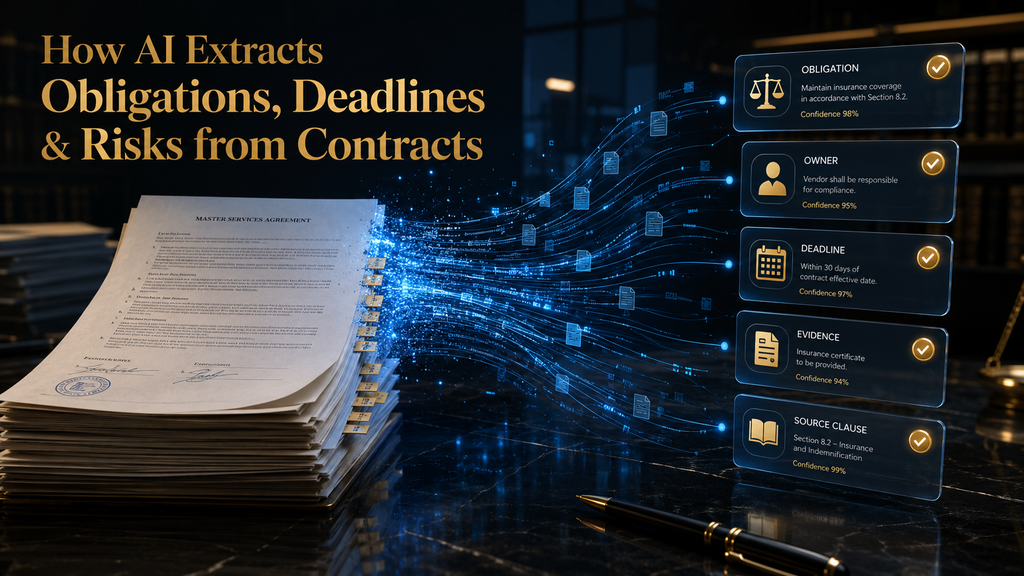
How AI Extracts Obligations, Deadlines & Risks from Contracts
A signed contract is often treated as the end of a legal process. For the people who must actually perform it, it is the beginning of an operational one. A supplier must deliver a report, a buyer must give notice before a renewal window closes, finance must pay against a milestone, security must provide an annual certificate, and a contract manager must know whether a new obligation has been completed. Yet the information needed to do those jobs is usually distributed across dense prose, schedules, exhibits, incorporated policies, and amendments. The result is a familiar failure: everyone assumes the agreement is being followed until a missed deadline, an unexpected renewal, or a dispute proves otherwise.
This is where AI contract extraction can be genuinely useful. It can help find relevant language, convert it into structured fields, preserve the source clause, and route a human-approved obligation into a task, calendar, or contract-management workflow. The value is not that AI can produce another polished summary of a 70-page agreement. The value is that it can help change the agreement from a static file into a controlled record of who needs to do what, under what conditions, and by when.
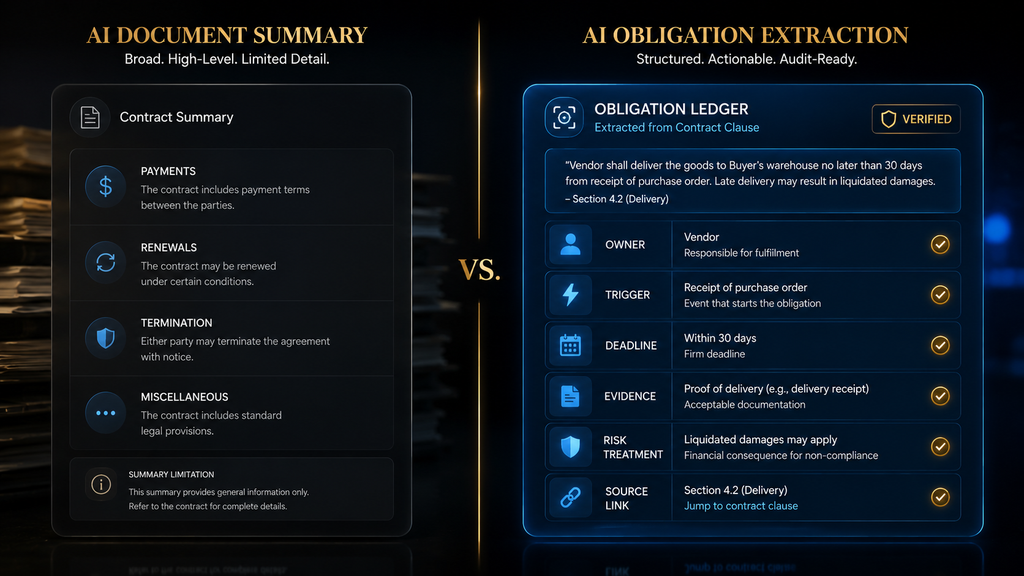
That distinction matters. A summary may tell a leadership team that an agreement includes “data-security and reporting commitments.” An operational record must say which party has the duty, what evidence satisfies it, whether it repeats, when it is due, what event starts the clock, what exceptions apply, and where the authoritative language appears. If one of those links is missing, the output may sound helpful while remaining unsafe to act on.
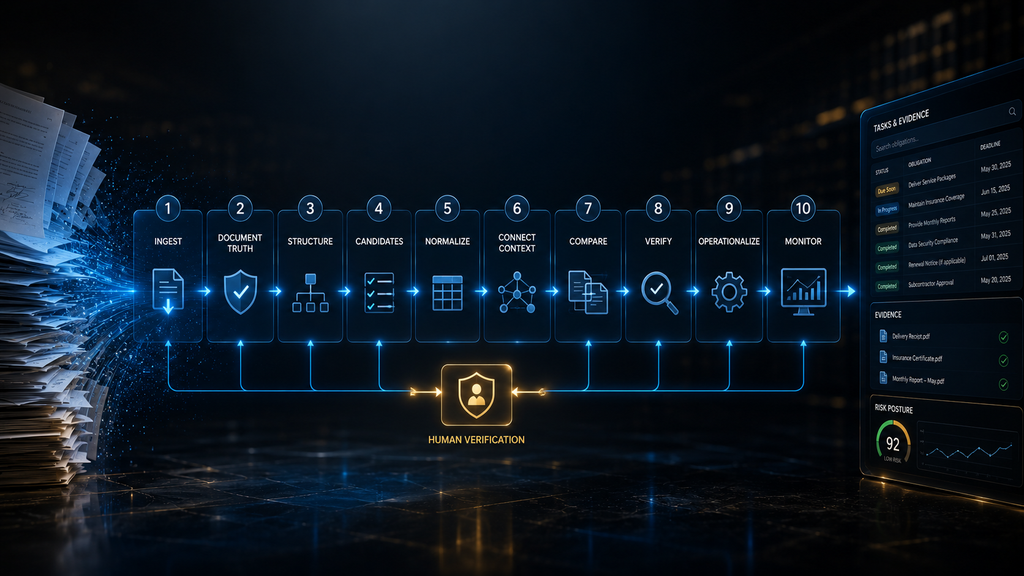
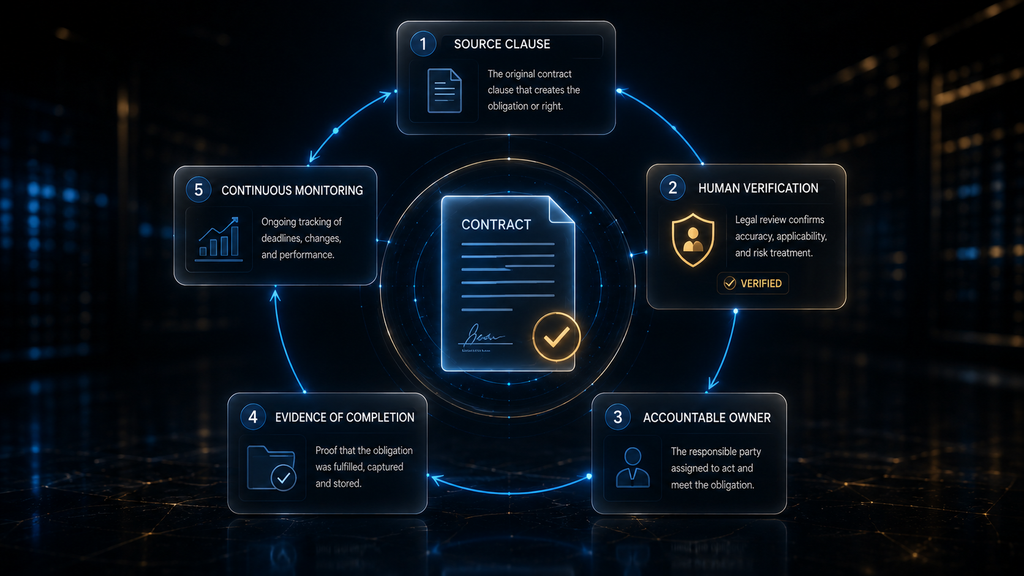
The practical model is therefore not contract text → AI answer. It is contract text → structured candidate → source verification → assigned owner → monitored action. We call this the AI Contract Obligation Pipeline. It gives legal, procurement, finance, compliance, and operations teams a way to use AI for the repetitive work of discovery and organization without pretending that the system has replaced legal interpretation or business judgment.
This article owns that post-signature operational problem. It is not a general overview of legal AI, a guide to pre-signature redlines, a legal-research workflow, a due-diligence playbook, or a buyer’s guide to legal tools. Those are separate questions. Here, the question is narrower and more consequential: how can an organization extract obligations, deadlines, and risks from contracts in a form people can safely act on?
Throughout this article, claim types are explicit. Research finding refers to an independent or authoritative source. Vendor-documented workflow describes what a product’s documentation says it does, not an independent proof of performance. AI Hustle World analysis is our reasoning from the evidence. Any named contract scenario is an illustrative example, not a real client matter.
The short answer: AI makes contracts operational when it produces verified, traceable records
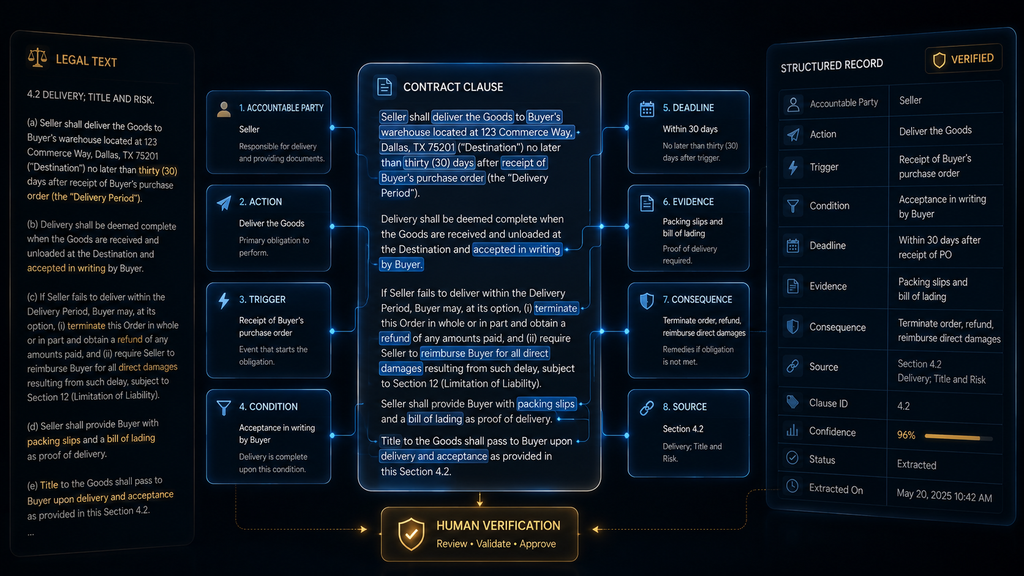
AI extracts obligations, deadlines, and risks from contracts by combining document processing, clause detection, information extraction, temporal reasoning, and comparison against a policy or playbook. A strong system does not stop at identifying the phrase “Supplier shall maintain insurance.” It records the supplier as the accountable party, the insurance requirement as the action, the required coverage and evidence as conditions, any recurring renewal as a schedule, the source clause and schedule as evidence, and the human reviewer’s approval before a task is created.
That is a materially different outcome from simple document search. Search helps a reviewer find the word insurance. Extraction tries to form a usable obligation record. Monitoring then connects that record to a real owner, due date, evidence requirement, reminder, escalation rule, and completion status. Each step has a different error profile, which is why a good workflow uses controls at every step rather than asking one model to make a final decision.
The technology is already being applied this way. Vendor-documented workflow: ServiceNow describes a process in which AI-extracted obligations are reviewed, edited, approved or rejected by a contract manager; approved items become obligation records and can generate tasks. Its documentation also exposes the original snippets and metadata that led to each extraction, which is the right design principle even if an organization uses another platform. ServiceNow’s contract-obligation workflow is useful as a concrete example of the architecture, not as a universal benchmark.
The most important rule is simple: an AI finding without a source location and a named reviewer is a lead, not an operational fact. Source traceability protects the team from a subtle but common problem: an output that is broadly plausible yet incomplete because it omitted a definition, exception, schedule, or amendment.
Why the traditional method exists, and why it breaks at portfolio scale
Manual contract abstraction did not arise because lawyers enjoy copying dates into spreadsheets. It exists because a contract is a connected system of promises, permissions, restrictions, conditions, and consequences. A human reviewer understands that “within 30 days after receipt of written notice” is not a due date until notice is actually received; that “except as set out in Schedule C” can reverse the apparent meaning of a clause; and that a definition in one section can change the practical scope of a duty somewhere else.
In a traditional workflow, a lawyer, paralegal, contract manager, or business owner reads the agreement, highlights relevant language, records key terms in a summary or spreadsheet, places dates on a calendar, and tells the appropriate business function what to do. This can be highly reliable when the reviewer knows the contract type, has time to follow cross-references, and works with a manageable number of agreements. It also creates an audit trail of professional judgment that can be essential in high-stakes matters.
The method breaks down when the work becomes repetitive and distributed. A company with hundreds of supplier agreements may have renewal periods expressed in several drafting styles, insurance certificates stored in separate locations, and obligations whose owners are not members of legal. The critical risk is not only a reviewer missing a sentence. It is the handoff failure between a sentence found in a contract and the person who must perform it six months later.
AI Hustle World analysis: AI’s best contribution is reducing the raw-document hunting and normalization work, so human experts can spend more time deciding what a clause means, whether the business should accept the exposure, and how the obligation should be performed. This is a better goal than claiming that AI “reads contracts like a lawyer.” It respects why the traditional process exists while acknowledging that people should not have to rediscover the same recurring operational terms across every executed agreement.
Doing nothing has a cost beyond lost speed. A static contract repository preserves documents but not necessarily the knowledge required to perform them. As staff change roles, institutional memory moves from the agreement to individual inboxes and private spreadsheets. The organization becomes reactive: it searches the contract only after a counterparty complains, an invoice is disputed, or a renewal is already difficult to stop.
What counts as an obligation, a deadline, and a risk?
An obligation is a binding or operationally required commitment within the agreement. It may require someone to act, refrain from acting, provide evidence, maintain a condition, make a payment, or give notice. It is not merely any sentence containing the word shall. A clause may assign a duty without that exact word, grant a right rather than create a duty, impose a prohibition, establish a condition precedent, or defer the meaningful requirement to a schedule.
For an extraction to be useful, the system needs more than an isolated sentence. It needs a structured answer to the following questions.
| Field | Operational question | Example |
|---|---|---|
| Accountable party | Who owes the duty? | Supplier |
| Action | What must happen? | Maintain cyber-liability insurance |
| Object or scope | What is covered? | Services performed under the agreement |
| Trigger | What starts the obligation or clock? | Contract execution, invoice receipt, written notice |
| Condition or exception | When does the duty apply or not apply? | Except for approved subcontractors |
| Deadline or cadence | When is it due? | Before service start; annually thereafter |
| Evidence | What proves completion? | Certificate of insurance |
| Consequence | What follows if it is not met? | Suspension, cure right, fee, termination right |
| Source | Where is the controlling language? | Section 7.2 and Schedule C, page 34 |
| Review status | Has a qualified person approved it? | Approved with amendment checked |
Research finding: obligation mining is treated as a distinct legal-language task because long sentences and legal context make it difficult to identify duties accurately. The NOMOS study in the ACL legal-NLP workshop specifically notes that identifying obligations depends on more than clear language; it also depends on context and the reader’s knowledge. More recent legal-language research models obligations using structured elements such as the subject, deontic modal, action, object, counterparty, and temporal condition. That research supports the basic design of an obligation ledger: it is not arbitrary data entry, but a practical representation of the elements required to perform and verify a contractual duty.
Deadlines are similarly misunderstood. A contract can contain an effective date, term end, expiration date, renewal date, payment date, delivery milestone, cure period, notice period, reporting cadence, audit window, and date that only applies after an event. A good system must distinguish a fixed calendar date from a relative time rule, a lifecycle date from a performance deadline, and a counterparty’s deadline from the organization’s own responsibility.
Risk is different again. AI can extract what the contract says, but it cannot identify legal or commercial risk in a vacuum. A $5 million liability cap may be an accepted position for one business, an unacceptable exception to policy for another, and irrelevant to a third. Risk requires a benchmark: a fallback playbook, approved clause language, an internal policy, a regulatory requirement, a financial threshold, or a business owner’s stated risk tolerance. AI Hustle World analysis: the more a tool’s risk score is separated from an explicit benchmark, the more it should be treated as a prioritization hint rather than a conclusion.
The AI Contract Obligation Pipeline: from text to accountable work
The AI Contract Obligation Pipeline is a verification-first framework for moving from executed contract text to a reliable operating record. It is deliberately longer than “upload, summarize, export” because the short version conceals the controls that make the output usable.
| Pipeline stage | What the system does | What a person must decide |
|---|---|---|
| 1. Ingest | Collect native files, scans, amendments, schedules, and metadata | Is this the complete and executed contract set? |
| 2. Establish document truth | Identify the governing version, signature status, hierarchy, and effective dates | Which document controls if versions conflict? |
| 3. Recover structure | Recognize sections, tables, definitions, exhibits, and cross-references | Is the source text and OCR reliable enough? |
| 4. Find candidate language | Locate duties, prohibitions, dates, rights, thresholds, and consequence clauses | Which candidates are relevant to the use case? |
| 5. Extract and normalize | Populate structured obligation, deadline, and risk fields | Is each field faithful to the actual clause and defined terms? |
| 6. Connect context | Attach definitions, exceptions, schedules, amendments, and citations | Is the extracted item complete enough to act on? |
| 7. Compare and prioritize | Test against a playbook, policy, or risk taxonomy | Does the deviation matter in this commercial context? |
| 8. Verify and approve | Present source-linked candidates to a human reviewer | Approve, edit, reject, or escalate? |
| 9. Operationalize | Assign owner, create task, calendar entry, evidence requirement, and reminder | Who is accountable and what completion standard applies? |
| 10. Monitor and learn | Track performance, changes, exceptions, and error patterns | What needs escalation, retraining, or process repair? |
1. Ingest the entire contract package, not a convenient excerpt
AI can only analyze what it receives. That sounds obvious, but it is one of the most damaging sources of error in contract operations. A master services agreement may be incomplete without the statement of work, data-processing addendum, service-level schedule, order form, amendment, and referenced policy. An extraction that looks correct within the uploaded PDF may still be wrong when the omitted amendment changes the term or liability position.
Start by grouping documents into a contract package and recording basic provenance: contract identifier, counterparty, source repository, upload date, document type, version, signature state, and relationship to other documents. If the organization cannot confidently answer which documents form the executed agreement, it should not automate obligations from that agreement without a review gate. This is a data-governance problem before it is an AI problem.
Scanned documents require an additional caution. Optical character recognition can confuse numbers, punctuation, names, and table structure. A single misread percentage, dollar sign, date, or reference number can alter the apparent obligation. Use a visual quality check for low-confidence pages, images, handwritten amendments, dense tables, and poorly scanned exhibits. The pipeline should retain a link to the page image or native document, not only OCR text.
2. Establish document truth before extracting obligations
The contract’s governing order is part of its meaning. Consider a customer agreement that says the master agreement governs unless an order form “expressly states otherwise,” while a later data-security addendum supersedes inconsistent security provisions. An AI system that processes the first document it sees may accurately extract a clause that is no longer controlling.
Create a simple hierarchy record before large-scale extraction: executed master agreement, schedules and exhibits, order forms, amendments, addenda, and related policies. Record how the agreement handles conflicts, whether there are effective dates for each document, and whether the documents were actually signed or incorporated. A reviewer should resolve genuine conflicts; the system should not silently choose an answer because one file was uploaded last.
This is also where defined terms matter. “Affiliate,” “Confidential Information,” “Services,” “Business Day,” and “Change in Control” may have meanings that are narrower or broader than ordinary language. Extraction should preserve the defined term and link to its definition. Replacing it with a conversational paraphrase too early can make a concise obligation record less legally accurate.
3. Recover structure and follow the contract’s connections
Contracts are not flat text. Their hierarchy, headings, numbered sections, tables, exhibits, and cross-references tell the reader which words modify which other words. The clause “Supplier shall maintain the insurance described in Schedule C” is incomplete until Schedule C is retrieved. The phrase “subject to Section 12.4” may contain the exception that determines whether the obligation applies at all.
This gives rise to a practical standard: clause completeness. An extracted record is clause-complete only when it includes the related material required to understand the duty’s scope, trigger, exception, deadline, and consequence. It does not mean that every related sentence must be copied into a task description. It means that the person approving or performing the task can reach the connected source material without redoing the entire review.
High-quality systems often combine layout-aware document processing with semantic retrieval. Layout processing identifies pages, tables, headings, and clauses. Retrieval finds potentially related definitions, schedules, and references. A language model can then interpret the candidate material into a normalized record. AI Hustle World analysis: these layers are safer than asking a general chatbot to “read this contract and list everything important,” because the system has a clearer job at each stage and the reviewer has better evidence to inspect.
4. Identify candidate obligations without confusing rights, duties, and background text
The identification phase searches for more than modal verbs. It looks for language of obligation, prohibition, condition, payment, delivery, reporting, audit, records retention, privacy, insurance, notice, renewal, termination, service levels, remedies, and exceptions. It also recognizes that a duty can be distributed across a clause: one sentence creates the general obligation, another supplies the timetable, and a third states the cure period.
Candidate detection should be deliberately broad. It is better to put a plausible low-confidence item into a review queue than to treat the first pass as complete. However, broad detection must be paired with classification. An entitlement to audit is not the same as an obligation to provide records. A statement of intent is not necessarily a binding commitment. A recital may describe a commercial purpose without imposing performance requirements.
The system should label the deontic type where possible: obligation, prohibition, permission/right, condition, representation, or remedy. This lets reviewers focus on what needs active management. It also prevents a common automation mistake: creating a task for a party simply because the contract mentions that party near an action word.
5. Normalize the finding into a durable record
Normalization converts uneven legal drafting into a common operating language. “The Vendor shall, at its sole cost, no later than ten Business Days following Customer’s written request, furnish evidence reasonably satisfactory to Customer” and “upon request, Provider will provide supporting documentation within ten business days” may refer to broadly similar work. A normalized ledger can group them as document-production obligations while preserving the original wording and each contract’s specific conditions.
Do not normalize away legal meaning. Keep both a plain-language action label and a faithful source excerpt. Preserve important qualifiers such as “reasonable,” “material,” “solely,” “except,” “unless,” “to the extent,” and “subject to.” A workflow can assign an owner to “Provide security documentation after written request,” but the record must also retain that the timing is measured in Business Days, the recipient must make a written request, and the agreement may define what counts as satisfactory evidence.
This is the point at which teams should create their own controlled taxonomy. Common obligation types may include payment, delivery, service level, reporting, audit cooperation, confidentiality, data protection, insurance, compliance, renewal notice, records retention, subcontractor approval, and incident notification. The taxonomy should be small enough to use consistently and extensible enough to add a category when the business encounters a recurring requirement that does not fit.
6. Compare extracted terms to an explicit risk benchmark
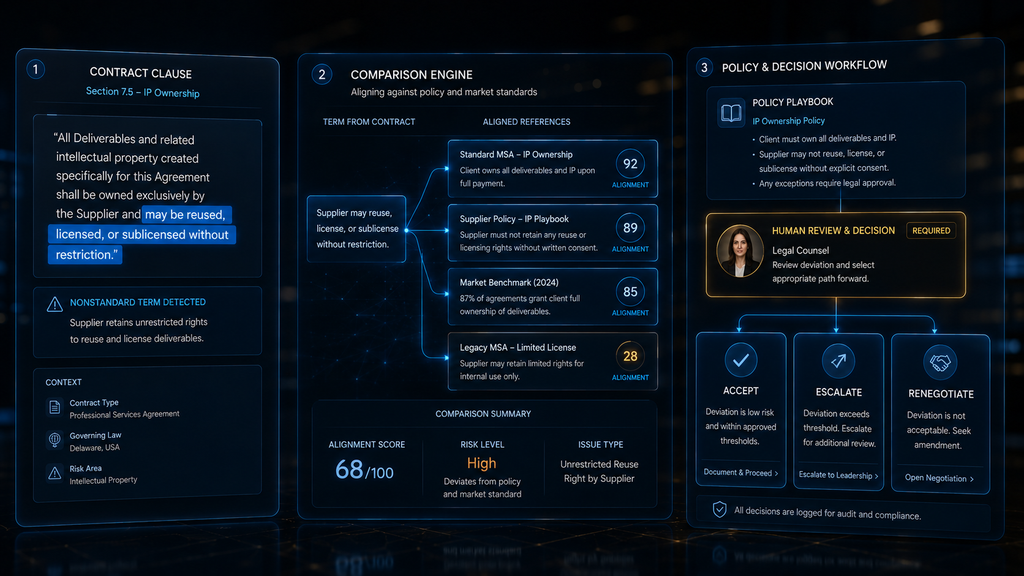
Risk flagging is useful when it answers a precise question. Does the agreement require insurance below the organization’s standard? Does a renewal notice period differ from the expected 90 days? Is the liability cap missing, unlimited, or outside the approved range? Is a data-security obligation broader than the internal security policy can support? These are comparison questions, not questions that language fluency alone can settle.
Vendor claim: current contract-review providers describe capabilities for extracting terms, comparing language against a playbook, tracking obligations and deadlines, and surfacing risks. For example, Thomson Reuters’ August 2026 buyer’s guide describes these functions and advises buyers to examine grounding, security, integrations, and attorney oversight. Treat vendor descriptions as evidence of available product patterns, not as a guarantee of accuracy, savings, or legal sufficiency for every contract type.
The risk layer needs a visible rule. Instead of displaying “High risk” with no explanation, show a reason such as “renewal notice is 30 days; policy threshold is 60 days,” “liability cap is absent,” “indemnity is unilateral,” or “reporting duty has no assigned owner.” Then link the specific clause, playbook rule, exception history, and reviewer decision. A transparent exception is easier to defend and improve than a mysterious score.
7. Verify before an extraction becomes work
Human verification is not a ceremonial click at the end. It is the moment when the system’s plausible interpretation is checked against the contract, the business context, and the proposed action. The reviewer should be able to see the original source text, page and section, related definition or schedule, extracted fields, rule that generated the risk flag, confidence signal, and change history.
The five-point verification test is practical enough to use at scale:
- Existence: Does this obligation, deadline, or risk issue actually exist in the controlling agreement?
- Fidelity: Does the normalized record preserve the meaningful wording, qualifiers, and exception?
- Accountability: Is the correct contracting party and internal owner identified?
- Timing: Is the trigger, date calculation, cadence, and notice method correct?
- Context: Does the risk treatment match the applicable playbook and commercial reality?
If the reviewer cannot complete one of these checks from the screen, the workflow has not retained enough context. The answer is not to make the reviewer trust the model harder; it is to improve traceability and send the item for deeper review.
How AI interprets deadlines: dates are easy; time logic is not
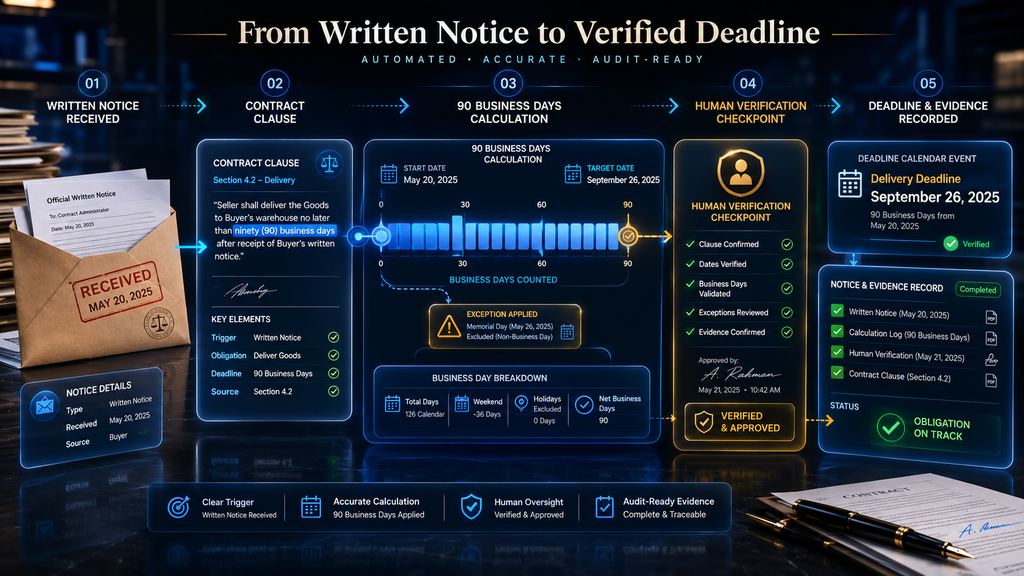
AI can recognize calendar dates, but contract operations need temporal reasoning. A system must know whether “30 days” means calendar days or Business Days; whether day zero is the receipt of an invoice, a notice, a breach, or an effective date; whether notice must be written; whether the deadline moves on a weekend; and whether a cure period runs before a remedy can be invoked. It must also distinguish the date a contract was signed from the date it became effective.
Research finding: legal-language research treats temporal conditions as first-class elements because contractual obligations often have interdependent deadline logic. A 2026 ACL paper on deontic-temporal contract representation uses examples such as “within X days,” “by date Y,” “during term,” and “upon event Z,” and emphasizes the importance of relations between clauses. That is exactly why a date-only extraction field is insufficient for many contract workflows.
Consider four common deadline patterns.
| Deadline pattern | What the record must contain | Why simple extraction fails |
|---|---|---|
| Fixed date | Date, time zone if relevant, party, action, source | The date may describe an end date rather than a required action |
| Relative date | Trigger event, counting convention, period, calculated date, status of trigger | There is no usable calendar date until the trigger occurs |
| Recurring requirement | Start point, frequency, recurrence rule, evidence, stop condition | “Annually” is ambiguous without a starting date and end-of-term rule |
| Notice window | Event, latest and earliest notice dates, delivery method, recipient, consequence | Missing the latest date may extend the contract or waive a right |
Illustrative example: a renewal clause is a timeline, not just a date
Assume an agreement has a three-year initial term ending on June 30, 2029. It renews automatically for one-year periods unless either party gives written notice at least 90 days before the end of the then-current term. A date extractor may identify June 30, 2029 and “90 days.” That still leaves important questions: Is the notice deadline April 1 or April 2 under the governing calculation rule? Does the agreement require email, courier, or notice to a designated address? Does the date fall on a weekend? Is the internal owner permitted to terminate, or must the business obtain approval first? Does the customer have a commercial reason to renew even if legal can terminate?
The obligation ledger should therefore produce at least two records: a lifecycle record for the end of the initial term and an action record for the latest notice date. The action record should include the method and recipient requirements, the internal decision owner, a reminder sequence, and the source clause. A calendar reminder without the notice requirements can create false confidence; the team may remember the date and still deliver an ineffective notice.
Relative deadlines need event data, not fabricated calendar dates
“Within 15 Business Days after receipt of a valid invoice” is not a deadline on the contract-signature date. It is a conditional performance rule. An AI system can store the formula and classify it as a finance obligation, but it should not insert a calendar date until a valid invoice and receipt timestamp are known. When those events occur, the system can compute a candidate due date using the contract’s definition of Business Day and the organization’s approved calendar logic.
This design avoids a costly shortcut: turning every temporal phrase into a static date during onboarding. Static dates become stale, unclear, or wrong. Event-driven obligations should remain in a “pending trigger” status, with the required event source identified. That source may be an accounts-payable system, service desk, registered notice mailbox, project milestone tool, or manual confirmation. The integration is part of the control, not a mere convenience.
Notice and cure periods deserve a higher review tier
Notice periods and cure periods commonly affect rights, remedies, renewals, and termination. They are not ordinary calendar reminders. A missed notice window can remove an option; a miscalculated cure period can cause a premature escalation; an incorrect notice recipient can invalidate an otherwise timely communication. Mark these items as high-consequence even if the language looks standard.
For these obligations, use a dual-control pattern: the AI proposes the timeline, a reviewer verifies the clause and calculation, and the internal business or legal owner confirms the intended action. The calendar entry should preserve the source link and a concise checklist for delivery method, addressee, approval requirement, and evidence of sending. An automated reminder may prompt the work, but it should never be treated as proof that the legal requirement was satisfied.
How AI identifies risks: extraction is evidence; risk is a judgment against a standard
Risk extraction is often marketed as if a model can discover danger directly from a contract. In reality, the model is usually doing one or more of four things: identifying a known clause type, comparing language to a preferred version, detecting an unusual pattern, or finding an absence where a standard clause was expected. Each can be valuable, but none is a final legal assessment.
An effective risk taxonomy separates the source of the flag from its impact. A text deviation might be a nonstandard limitation-of-liability clause. A policy deviation might be a privacy obligation that exceeds internal capability. An operational risk might be an annual certification with no known owner. A portfolio risk might be 300 contracts with the same short renewal notice period. A legal risk may require lawyer assessment because enforceability, jurisdiction, negotiation history, or an amendment changes the analysis.
| Risk signal | Useful AI role | Required human context |
|---|---|---|
| Nonstandard clause | Locate language that differs from the playbook | Is the variation commercially acceptable? |
| Missing clause | Compare required categories against contract type | Was the issue intentionally handled elsewhere? |
| One-sided duty | Identify asymmetry in obligations or remedies | Does leverage, price, or law justify it? |
| Unlimited or uncapped exposure | Find relevant language and thresholds | Does a carve-out or insurance program change the result? |
| Deadline concentration | Aggregate upcoming dates across the portfolio | Which dates need a decision rather than a reminder? |
| Unassigned obligation | Detect a record without internal accountability | Which team has authority and capacity to perform it? |
The risk score should be explainable. A score of 82 with no rationale may appear precise but does not tell a reviewer what to fix. A better output says, “Flagged because the agreement contains an automatic renewal; latest non-renewal notice is 45 days before term end; the standard policy is 90 days; no internal owner has been assigned.” That gives the team a choice: accept the deviation, renegotiate, allocate resources, or set heightened monitoring.
AI Hustle World analysis: the most valuable risk signal may be operational invisibility rather than unusual wording. An ordinary contract clause can be high risk if no one is responsible for fulfilling it. Conversely, a heavily negotiated deviation may be low operational risk when the organization has deliberately accepted it and documented the controls. This is why contract AI should connect legal data to work management rather than sit only inside a searchable repository.
The Obligation Ledger: the operational record a contract summary cannot replace
The output of the pipeline should be an Obligation Ledger: a controlled, source-linked dataset of verified obligations, deadlines, and risk decisions. It can live in a CLM, legal-operations platform, enterprise workflow tool, or carefully governed database. The location matters less than the fields, approval logic, ownership model, and audit trail.
| Ledger field | Example value |
|---|---|
| Contract and version | MSA-2048, Amendment 2 included |
| Obligation ID | MSA-2048-SEC-07 |
| External party | Northstar Cloud Ltd. |
| Internal accountable owner | Security compliance manager |
| Obligation | Maintain cyber-liability insurance and provide certificate |
| Trigger and cadence | Before service commencement; annually on renewal |
| Deadline | Pending service start; recurring annual review |
| Evidence | Certificate showing required coverage |
| Risk treatment | High-consequence; missing certificate escalates to legal and procurement |
| Source | Section 7.2; Schedule C, pages 31–34 |
| Verification | Approved by contract manager on date; legal escalation not required |
| Status | Active, awaiting evidence, complete, overdue, or retired |
The ledger should preserve two versions of the obligation. The first is a concise, usable instruction for the accountable owner. The second is the source-backed record for review, audit, dispute preparation, and future interpretation. Mixing them into one long paragraph causes people to ignore the task; separating them without a link creates an audit gap. The two views should be different presentations of the same controlled record.
The ledger also creates a feedback loop. If reviewers repeatedly correct the same extraction field—say, notice recipients in leases or payment triggers in statements of work—that pattern tells the organization where prompts, templates, OCR, data mapping, or reviewer guidance need improvement. The goal is not to force a model toward a vanity accuracy rate. The goal is to reduce recurring, meaningful errors in the contracts the organization actually uses.
A worked example: turning a supplier agreement into monitored work
The following is an illustrative example. A company signs a 42-page software-services agreement with a vendor. Legal has completed the negotiation. Procurement wants the agreement recorded, finance wants payment terms, security wants evidence of compliance, and the business team wants to avoid an accidental renewal. Without a pipeline, a contract manager creates a one-page summary and sends emails to the relevant teams. That may work this quarter, but the obligations will be hard to find next year.
The AI-enabled workflow begins by ingesting the executed master agreement, order form, data-processing addendum, security schedule, and one amendment. The system identifies a conflict clause in the order form and links the amendment to the pricing schedule. A reviewer confirms that all documents were signed and that the amendment changes the implementation milestone but not the initial term.
The system then identifies candidate records. It finds a payment clause: “Customer shall pay undisputed invoices within 30 days following receipt of a valid invoice.” It finds a security clause: “Provider shall maintain the certifications listed in Schedule 2 and shall provide current evidence upon Customer’s written request.” It finds an incident-notification clause: “Provider shall notify Customer without undue delay and in no event later than 48 hours after confirming a Security Incident.” It finds renewal language: automatic annual renewal unless notice is given at least 60 days before term end. It also finds a limitation-of-liability clause with a negotiated carve-out for confidentiality and data-protection obligations.
At this point, the system should not announce that the contract has four obligations and one high risk. It should create candidates with source locations, confidence indicators, and related references. The payment candidate is tagged as event-driven: it is pending receipt of a valid invoice, and the terms “undisputed” and “valid” are retained. The security candidate is linked to Schedule 2 because the schedule contains the actual certification list. The incident candidate is marked high consequence and escalated for security and legal review because the clock begins after a defined confirmation event. The renewal candidate has a calculated internal decision date before the formal notice deadline. The liability candidate is routed as a risk-decision record rather than a recurring operational task.
The contract manager verifies party names, source hierarchy, and basic field fidelity. Security confirms it can satisfy the certificate request process and appoints an internal owner. Finance maps the invoice trigger to accounts payable but confirms that the agreement’s Business Day definition does not change the current AP calculation. Procurement receives the renewal record, sets a 120-day pre-decision reminder, and identifies the executive who will decide whether to renew. Legal reviews the liability carve-out, documents that it was negotiated and accepted, and records the owner responsible for any future material change.
Now the agreement is operational. The security obligation has an evidence repository link and an annual renewal cadence. The incident-notification obligation has a 48-hour alert protocol, an internal escalation list, a source clause, and a requirement to verify whether the event meets the defined threshold before reporting. The payment obligation becomes active when AP receives an invoice and draws its due date from the source event. The renewal record appears in a portfolio dashboard long before the deadline. The liability record remains visible for risk reporting, but it does not create a meaningless task each month.
This scenario demonstrates the central lesson: the AI did not “manage the contract.” It helped construct a structured first pass. People established the controlling documents, confirmed the legal and commercial meaning, named accountable owners, and chose the workflow. That is what makes the result credible.
Human-verification safeguards for consequential contract work
The right level of review should depend on consequence, ambiguity, and reversibility. A low-stakes recurring document request in a well-standardized supplier template may be safely batch-reviewed with spot checks and exception routing. A termination notice, change-of-control right, data-breach notification, regulatory reporting duty, or large payment milestone should receive higher scrutiny because a single error can be difficult or impossible to reverse.
The case for verification is not anti-AI. It is a requirement for trustworthy automation. The American Bar Association’s Formal Opinion 512 says lawyers using generative AI must consider duties including competent representation, protection of client information, supervision, meritorious claims, and candor. It specifically recognizes contract review and due diligence among the tasks AI may assist with. While the opinion is directed to lawyers and is not a universal operational manual, its core discipline applies broadly: understand a tool’s limits and independently review outputs where accuracy matters.
Research finding: the need for verification is not solved merely by using a specialized legal interface. A preregistered Stanford evaluation of leading AI legal research tools found that retrieval-based legal systems reduced hallucinations relative to a general-purpose model but still produced meaningful errors. The study examined legal research rather than contract-obligation extraction, so its figures should not be transferred as a contract-accuracy statistic. Its transferable lesson is narrower and important: grounding and specialization improve the workflow but do not remove the need for evidence, supervision, and task-specific evaluation.
The following safeguards are practical for an obligation-extraction program.
Build a consequence-based review policy
Define review tiers before volume arrives. For example, Tier 1 may include low-value, clearly formatted metadata that can be auto-populated and sampled. Tier 2 may include routine obligations requiring a contract-manager approval. Tier 3 may include deadline calculations, data, security, payment, renewal, and compliance obligations that require an accountable business owner plus legal or specialist confirmation. Tier 4 may include termination, litigation, regulatory, material financial, or safety issues that must not be actioned without dedicated expert review.
The point is not to make every contract slow. It is to concentrate human attention where an error matters most. A system that treats all output as equally reliable will either over-automate consequential work or waste expert time checking trivial metadata with the same intensity.
Require source provenance on every record
Every approved operational record should preserve document ID, version, page, clause, excerpt, related reference, extraction date, reviewer, review date, and change history. When a new amendment arrives, the system should mark potentially affected records for review rather than silently retain old data. If the system cannot cite a source, it should use a status such as “unverified candidate” and prevent automatic task creation.
This design aligns with the NIST Generative AI Profile, which warns about automation bias—excessive deference to automated systems—and emphasizes information integrity, traceability, and transparent levels of vetting. In contract operations, provenance is not a nice-to-have explanation. It is how a later reviewer can discover whether a task was based on the right source and version.
Separate extraction approval from performance approval
Approving that “an obligation exists” is not identical to approving that it has been fulfilled. A contract manager may validate the record; security may validate a certificate; finance may validate a payment; legal may decide whether a notice was properly given. Those approvals should be distinct. Otherwise, a checkbox can blur the line between data accuracy and contract performance.
Use an evidence standard for each obligation type. A recurring insurance duty may require a current certificate. A reporting duty may require a submitted report and an acceptance record. A notice duty may require delivery confirmation under the contract’s notice clause. A payment obligation may require an AP-system reference and exception status. The workflow should capture evidence appropriate to the duty rather than marking it “complete” because a reminder was dismissed.
Test the system on your own contracts before trusting a vendor score
Vendors may publish accuracy claims based on selected document sets, field definitions, or conditions. Do not assume those results map to your contract estate. Assemble a representative evaluation set that includes your common contract types, scans, amendments, schedules, nonstandard language, different jurisdictions, and known difficult clauses. Have qualified reviewers produce or validate a reference set. Then measure the system against that reference set using fields and error costs that matter to your business.
For each obligation type, track precision (how many extracted items were correct), recall (how many true items were found), field-level accuracy for party, trigger, and deadline, source-link completeness, and reviewer correction rate. Weight errors by consequence. Missing an annual $200 document request is not equivalent to missing a 30-day termination notice. Evaluation is not a one-time procurement exercise; re-run it when document mix, prompts, OCR, integrations, templates, or model versions change.
Where extraction fails: the failure modes that deserve explicit controls
No contract-AI article should imply that errors only occur when the model “hallucinates.” Many failures are ordinary systems failures: bad input, incomplete documents, poor mapping, unclear ownership, stale records, or mistaken assumptions about what a score means. Naming the failure modes helps teams build controls before a deadline is missed.
| Failure mode | What goes wrong | Control |
|---|---|---|
| Incomplete package | Amendment or schedule is missing | Document-completeness and version gate |
| OCR corruption | Number, name, table, or date is misread | Visual inspection for low-confidence pages and critical fields |
| Wrong party | Duty is assigned to the customer instead of the supplier | Party-normalization and reviewer confirmation |
| Lost exception | Main rule is extracted without the carve-out | Clause-completeness check and linked references |
| Wrong trigger | Deadline is tied to signature rather than receipt of notice | Temporal-review tier and event-source mapping |
| Cross-reference failure | Schedule or definition is not retrieved | Structured reference resolution with reviewer fallback |
| False risk flag | Unusual language is acceptable under the playbook | Visible rule, rationale, and approval history |
| Risk blindness | Important exposure is not in the taxonomy | Periodic taxonomy and playbook review |
| Source detachment | Output cannot be traced to a clause | Block approval or auto-task creation without provenance |
| Stale record | Amendment changes a term but ledger remains unchanged | Change-detection and affected-record review |
The source-detachment failure deserves special attention. A model can generate a clean sentence that sounds like an obligation, and a busy reader can accept it because it matches their expectation. If the system cannot show where that sentence came from, the reader is being asked to trust a conclusion without the evidence needed to validate it. That is not contract intelligence; it is unsupported narrative.
The second-order effect is equally important. A poor extraction does not just create one wrong row. It may create a calendar entry, send a notification, assign a person, trigger a workflow, change a dashboard, or lead a team to believe compliance has been achieved. Automation magnifies both correct and incorrect inputs. The more connected the workflow becomes, the stronger its review gate and audit trail must be.
How to implement a verification-first program without buying a giant platform first
An organization does not need to start with an enterprise-wide autonomous contract program. Start with a defined problem, a bounded contract population, a clear owner, and a reference standard. The first use case should be repetitive enough to benefit from normalization but important enough that a structured result changes real work.
Start with one decision, not “all contract intelligence”
Good initial questions include: “Which supplier contracts renew in the next 180 days and require a decision?” “Which agreements require current insurance certificates?” “Which customers have payment milestones with no internal owner?” “Which agreements require periodic security reports?” These questions determine the fields, source documents, reviewer roles, integrations, and quality metrics. A vague project objective such as “use AI to analyze our contracts” invites scope creep and makes success impossible to measure.
Choose a population of perhaps 50 to 200 related contracts rather than the entire repository. Include normal cases and known difficult cases. Build a baseline by documenting how long the manual process takes, how many items are found, how often evidence is missing, and how many deadlines or reminders exist today. The purpose is not to prove that humans are slow; it is to have a credible before-and-after comparison.
Create the ledger and playbook before automating extraction
Decide what a good record looks like first. Define controlled obligation types, required fields, source-link format, review tiers, status values, evidence standards, escalation rules, retention policy, and owner roles. Write the risk playbook in plain language: what counts as a deviation, which exceptions are permitted, who can accept them, and what must be documented.
This is where many projects reverse the right order. They buy a system, upload a repository, receive a large set of fields, and only then ask what the fields mean operationally. The result is a beautiful dashboard of unowned data. A smaller, well-governed ledger with five high-value obligation types is more useful than a broad extraction catalog no one trusts.
Keep AI, workflow, and system-of-record responsibilities separate
The AI layer proposes or extracts candidates. The contract repository or source-of-truth stores approved records and documents. The workflow layer assigns work, sends reminders, collects evidence, and escalates exceptions. The analytics layer reports coverage, completion, upcoming risk, and quality. These may be separate tools or features within one platform, but their responsibilities should remain conceptually distinct.
This separation makes failure easier to diagnose. If a renewal was missed, was the date extracted incorrectly, was the record not approved, was no owner assigned, did the reminder fail, or did the owner ignore a valid notice task? Without distinct stages and audit records, the organization cannot repair the process; it can only blame “the AI” or “the system.”
Use conservative automation gates
For an initial program, let AI create review candidates, not final commitments. Allow automatic creation only for lower-consequence metadata after documented testing. For higher-consequence obligations, require approval before any task or external action occurs. No AI-generated output should send a legal notice, waive a right, accept a deviation, certify compliance, or communicate externally without the organization’s authorized human process.
This is not a failure to use automation. It is a way to use it where it has leverage: gathering, organizing, routing, and monitoring. As evidence accumulates on a stable contract type and field, the organization may safely increase automation for low-risk elements. Automation should earn expanded authority through measured performance, not obtain it by default.
Design the handoff to the business team
Legal teams often own the agreement but do not own performance. Every approved record therefore needs two accountability dimensions: the contractual party that owes the duty and the internal business owner who will make sure the organization performs or monitors it. The internal owner should be a person or role with authority, access to the required evidence, and a clear escalation path.
Give owners tasks in the language of their work. “Provide SOC 2 Type II report to customer per Section 9.4” is more useful to security than “Contract obligation #1037.” Include the deadline, evidence required, source link, and contact for interpretation. Avoid dumping full legal clauses into task tools without a plain-language summary; people should be able to act quickly while retaining access to the authoritative text.
Protect contract data from the beginning
Contracts may contain confidential commercial terms, personal data, security information, trade secrets, and privileged material. Before uploading documents to any AI system, assess where the data is stored, whether it may be used for model training, how access is controlled, how long it is retained, whether data is encrypted, how exports work, what audit logs exist, and how deletion or legal holds are handled. Contract sensitivity may require a private deployment, a vendor agreement, redaction, role-based access, or a decision not to use a particular tool.
The ABA’s AI guidance is especially relevant when lawyers handle confidential client information, but the underlying operational question applies to every organization: can you explain what happens to the documents and outputs after they leave the repository? For a broader foundation, AI Hustle World’s guide to AI privacy risks before sharing personal information helps teams frame the question before adding contract data to a workflow.
Measure outcomes that show whether the workflow is actually safer and more useful
Time saved matters, but it is not enough. A faster workflow that misses a renewal notice, assigns the wrong owner, or produces large correction queues may be worse than a slower manual process. Measure both throughput and reliability.
| KPI | What it reveals |
|---|---|
| Time from contract ingestion to approved ledger | Whether extraction and review reduce onboarding friction |
| Obligation recall on the reference set | Whether important items are being missed |
| Field-level correction rate | Which fields or contract types cause rework |
| Source-link completeness | Whether outputs are auditable and verifiable |
| Percentage of obligations with an assigned owner | Whether the ledger becomes actionable work |
| On-time completion rate | Whether reminders and accountability improve performance |
| Missed-deadline incidents | Whether the system reduces the problem it was built to solve |
| Exception and escalation rate | Whether risk treatment is visible rather than buried |
| Amendment impact turnaround | Whether the program handles change, not only initial ingestion |
Report errors by type and consequence. If 8% of low-risk category labels need correction but no deadlines are missed, that calls for a different response than a 1% error rate concentrated in notice calculations. AI Hustle World analysis: a credible business case often comes from improved visibility, fewer handoff failures, and earlier decisions—not from a speculative promise that AI will eliminate review time.
For teams beginning with a manual pilot, use the same discipline in a spreadsheet or task system. The important design elements are source links, ownership, verification status, and measurement. As the volume and integrations grow, a dedicated CLM or workflow platform may become appropriate. AI Hustle World’s article on a daily AI workflow for managing work without feeling overwhelmed is a useful companion for turning reminders and reviews into a sustainable operating rhythm.
Who should use AI contract extraction, and who should slow down?
AI-assisted extraction is a strong fit for in-house legal teams, procurement groups, finance operations, vendor-management teams, compliance programs, and contract-management functions that handle repeatable agreement types and need visibility after signature. It is particularly useful where the same field must be found across many documents: renewals, payment terms, reporting duties, insurance requirements, service levels, or standard security obligations.
Teams should move more slowly when the contracts are highly bespoke, the document set is incomplete, the legal consequences of error are unusually high, the source material is poor quality, or there is no qualified reviewer and owner. A startup with 20 varied contracts may gain more from a disciplined manual ledger than from a complex implementation. A regulated or highly sensitive business may need an approved data environment and specialist review before automation is acceptable. The question is not whether AI is fashionable; it is whether the workflow improves the organization’s ability to perform and prove the commitments it has made.
The future: contract intelligence will be judged by closed-loop performance, not extraction demos
The next useful step for contract AI is not simply extracting more fields. It is connecting verified contract data to the systems that create the triggering events, the people who perform the work, the evidence that proves completion, and the change records that update the agreement. A deadline engine that knows when an invoice was received, a task workflow that knows who owns a report, and a repository that can show the controlling clause are far more valuable together than a chat interface that can summarize a contract on request.
That future also raises the bar for governance. As systems gain permission to create tasks, make recommendations, and trigger downstream actions, organizations need clearer role boundaries, test suites, exception handling, and continuous monitoring. NIST’s AI-risk guidance frames this well: validity and reliability are not one-off claims, and human intervention may be necessary when a system cannot detect or correct errors. The goal is useful automation with defensible controls, not autonomous activity for its own sake.
Final Thoughts
AI contract extraction becomes valuable when it helps an organization keep promises it has already made. The winning workflow is not a black box that announces whether a contract is risky. It is a disciplined pipeline that finds candidate obligations, attaches the source, preserves conditions and timing, compares terms to explicit standards, gives qualified people a clear review role, and turns approved records into accountable work.
The memorable takeaway is this: a contract is operational only when its commitments are traceable, verified, owned, and monitored. AI can make that transition faster and more consistent. It should never be allowed to hide the evidence or replace the judgment required when the consequence of error is high.
Build AI Workflows That Preserve Human Judgment
From contract intelligence to everyday decision support, the strongest AI systems make the source, the limits, and the human decision-maker visible.
Read More AI Hustle World Guides →Frequently asked questions
Can AI reliably extract all obligations from a contract?
No system should be assumed to find every obligation in every agreement. AI can accelerate a first pass and improve consistency for defined contract types, but performance depends on document quality, drafting style, language, schedules, amendments, OCR, cross-references, prompts or models, and the fields being extracted. Use a representative reference set to measure recall and require human verification for high-consequence findings.
Can AI calculate contract deadlines automatically?
It can identify fixed dates and propose calculations for relative dates, but a reliable calculation must include the trigger event, counting convention, Business Day definition, time zone where relevant, notice method, and any exception or holiday rule. For notices, cure periods, renewal windows, and deadlines with material consequences, a human should verify both the source clause and the calculation before action is taken.
What is the difference between an obligation and a risk flag?
An obligation records what a party must do, avoid, provide, or maintain. A risk flag indicates that the obligation or related clause may require attention because it differs from a playbook, lacks an owner, contains an unusual term, creates a deadline concentration, or poses legal or commercial exposure. The obligation is a source-backed fact to verify; the risk flag is a prioritized comparison against a defined standard.
Does a contract summary replace an obligation ledger?
No. A summary is useful for orientation, but it usually does not contain the fields, source connections, approval history, evidence standards, owners, reminders, and status changes needed to manage performance. Use the summary to understand the agreement and the ledger to run the agreement.
What should happen when a contract is amended?
Treat the amendment as a change event. Identify the affected clauses and ledger records, compare old and new language, route the changes to qualified reviewers, update the source links and effective dates, retire obsolete records, and notify owners whose tasks or deadlines changed. Do not assume an amendment is a separate file that can sit beside the original agreement without changing operational data.
Can a small business use this approach without a contract-lifecycle-management platform?
Yes. Begin with a controlled ledger in a secure, access-managed system and a repeatable review process. Keep the contract source, clause link, owner, deadline logic, evidence requirement, and approval status in one governed workflow. A dedicated platform becomes more valuable as contract volume, integrations, reporting needs, and permission requirements increase.
What is the single biggest red flag in AI contract extraction?
An output that cannot show its source clause is the biggest red flag. Even a fluent and plausible answer should not become a task, risk decision, calendar date, or external action until a reviewer can trace it to the controlling agreement and see the context that may qualify it.
Written by
Muntasir Ahmad Chowdhury
Founder, AI Hustle World
Muntasir Ahmad Chowdhury is the Founder of AI Hustle World, an independent publication dedicated to making Artificial Intelligence practical, trustworthy, and easy to understand. He researches AI tools, automation, customer service, productivity, and real-world business applications, helping readers make smarter technology decisions through research-driven, experience-backed content.
Expertise:
AI Tools • AI Automation • AI Customer Service • AI Productivity • Generative AI • AI Workflows
Get Smarter With AI
Enjoyed this guide? Get practical AI tools, tutorials, and honest reviews delivered to your inbox.