Evidence: Documentation reviewed
Last checked: August 2026
What was done: Written from official documentation and the published sources linked in this article. Not hands-on tested.
Files: None
Affiliate links: No
How AI Contract Review Works: Clauses, Risk Flags & Redlines
A 60-page agreement can contain hundreds of provisions, definitions, exceptions, cross-references and negotiated changes. Yet the legal team reviewing it may not actually be worried about 60 pages. They may be worried about five clauses, two missing protections and one sentence that quietly changes who carries the risk.
That is the real problem AI contract review is trying to solve.
It is not simply about reading a contract faster. It is about finding the parts of an agreement that deserve attention, explaining why they matter, comparing them against an accepted position and helping a professional decide what should happen next.
That distinction is important because a system can be very good at recognizing that a contract contains an indemnification clause while still being poor at determining whether the clause satisfies the organization’s requirements. It can find a liability cap while missing the exception that makes the cap ineffective for a particular category of claims. It can produce a polished redline while changing a defined term or cross-reference somewhere else in the agreement.
Current research is making that distinction increasingly visible. A 2026 benchmark from LegalOn tested 11 AI models across 3,282 contract-review comparisons and 21 precision-critical guidelines, reporting recurring failures involving exact clause requirements, numerical thresholds, cross-references, multi-part conditions and absence checks. Because the benchmark was produced by a vendor with a commercial interest in the category, its results should be treated as vendor research rather than neutral industry consensus. The underlying failure categories, however, are highly relevant to understanding why contract review is harder than general document summarization.
Independent research points in a similar direction. The August 2026 ContractScrub benchmark found that frontier models performed surprisingly poorly on final contract-scrubbing tasks involving issues such as incorrect defined terms, references and inconsistent language; only one tested model reached a 0.75 macro-average recall threshold. The researchers’ broader conclusion is particularly useful: strong performance on general AI benchmarks does not automatically translate into reliable performance on narrow, precision-sensitive contract work.
So the useful question is not simply, “Can AI read a contract?” It is: How does AI move from a document full of legal language to a defensible finding about a specific provision, and where should a human take over?
AI Contract Review Is a Pipeline, Not a Single AI Prompt
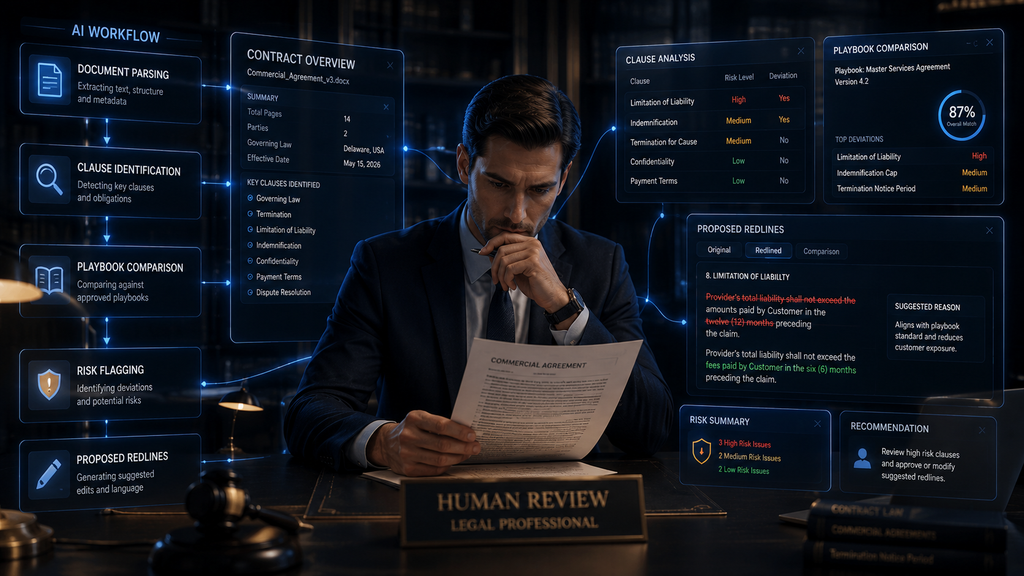
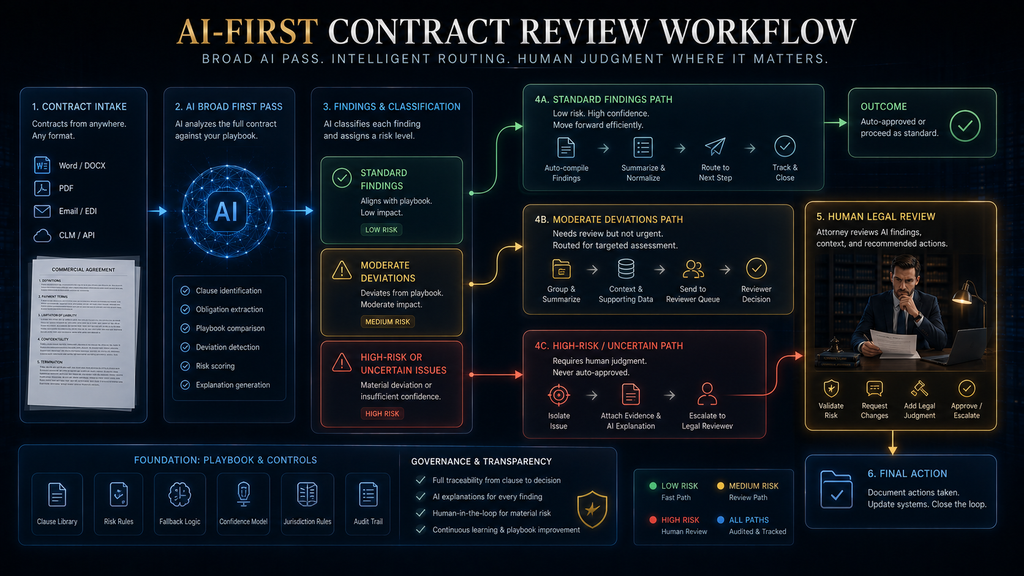
The simplest way to understand AI contract review is as a sequence of increasingly consequential decisions.
The document first has to be understood structurally. The system then needs to identify relevant clauses and concepts, compare those provisions against some defined standard, determine whether a deviation matters, explain the finding, suggest a possible change and route uncertain or consequential issues to a human reviewer.
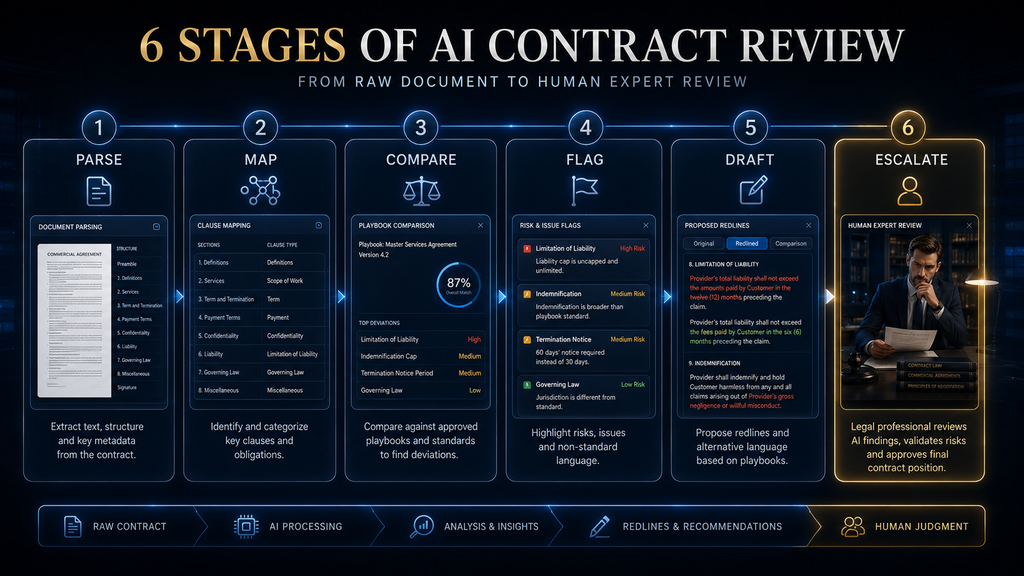
AI Hustle World’s practical framework for this workflow is Parse → Map → Compare → Flag → Draft → Escalate.
This is an editorial framework rather than a universal technical architecture used by every vendor. Its purpose is to expose the individual stages that are often hidden behind a button labeled “Review Contract.”
| Stage | What the system is trying to accomplish | Typical failure |
|---|---|---|
| Parse | Turn the document into usable text and structure | OCR, formatting or section errors |
| Map | Identify clauses, definitions and relevant concepts | Missing or misclassified provisions |
| Compare | Evaluate language against a defined standard | Wrong benchmark or missed detail |
| Flag | Identify deviations and explain their significance | False positives or false negatives |
| Draft | Suggest language that addresses the issue | Overbroad or inconsistent redlines |
| Escalate | Send uncertain or consequential issues to a human | Automation bias or inadequate review |
The important insight is that better contract review does not necessarily come from asking one increasingly powerful model to do all six jobs at once. It can come from designing the workflow so that each job is handled in a way that matches its particular failure mode. That is one reason specialized contract-review systems can behave differently from simply pasting an agreement into a general-purpose chatbot.
Step 1: The System Has to Parse the Contract Before It Can Review It
The first hidden problem is document ingestion.
Contracts do not always arrive as clean text files. They may be PDFs, scanned documents, Word files, documents containing tables, agreements with schedules and exhibits, or collections of related files where the main agreement depends on attachments.
A contract-review system therefore may need to identify text, headings, sections, page structure, tables, definitions and document relationships before higher-level analysis begins. This stage is easy to overlook because users see the finished result rather than the preprocessing. But an error here can propagate through everything that follows.
If a scanned page is poorly recognized, a provision may be extracted incorrectly. If a table is interpreted badly, numerical thresholds can change. If section boundaries are lost, the system may struggle to understand where one obligation ends and another begins. If a definition is separated from the provision that uses it, later reasoning can become less reliable.
The Law Society’s current guidance on AI-assisted contract review makes this distinction particularly useful. It notes that different tasks and document volumes may call for different technologies and specifically cautions against assuming that generative AI is the appropriate tool for strict data extraction.
That leads to a basic principle: AI cannot reliably reason over information it failed to ingest correctly.
Step 2: Clause Identification Is More Than Keyword Search
Once the document has been parsed, the system needs to determine what is inside it. A traditional keyword search might look for words such as “indemnify,” “termination,” “confidentiality” or “liability.” AI-based systems can go further by recognizing that different contracts may express the same concept in very different language.
One agreement might say that a party “shall defend, indemnify and hold harmless.” Another might use different drafting conventions while creating a similar allocation of risk. A third might bury the relevant concept inside a longer provision.
This is where natural-language processing and modern language models can be useful. But recognizing a topic is not the same as evaluating a legal provision. Finding an indemnification clause answers: Does something related to indemnification appear here?
It does not answer: Does this indemnification provision satisfy our preferred position? That second question requires a standard. And the standard is where contract-review intelligence becomes much more interesting.
Step 3: The Playbook Tells the System What “Good” Looks Like
A contract-review AI does not inherently know what your organization considers acceptable. That sounds obvious, but it is one of the most important facts about the technology.
A software company may prefer a particular liability cap. A healthcare organization may have specific data-protection requirements. A procurement team may require certain termination rights. A law firm may use a client-specific review position.
The AI needs those standards in some form if it is expected to distinguish ordinary language from unacceptable language. This is where a contract playbook becomes valuable.
A playbook can contain preferred positions, fallback positions, escalation rules and provisions that should not normally be accepted. It can transform abstract legal preferences into review criteria that a workflow can apply repeatedly.
That means the system is no longer merely asking:
“What does this clause mean?”
It is asking:
“How does this clause compare with the standard we are supposed to apply?”
This is a fundamental shift.
The useful intelligence is not only inside the model. It is also inside the standards the workflow gives the model to apply.
LegalOn’s 2026 benchmark makes this distinction central to its own methodology, arguing that contract review requires structured, provision-level checks rather than asking a general-purpose model to evaluate an entire agreement in one undifferentiated pass. Its benchmark is vendor-produced and therefore should not be treated as independent proof of superiority, but its methodology illustrates an important architectural principle.
Step 4: The System Compares the Clause With the Required Position
Suppose a company’s playbook says that a supplier agreement should contain a liability cap equal to a defined multiple of fees, with specific exceptions handled separately. The AI now has a much more precise task. It needs to locate the liability provision, identify the relevant amount, determine how the cap operates, identify exceptions and compare the result with the playbook.
That is much harder than recognizing the phrase “limitation of liability.” This is why contract review is often a precision problem rather than a comprehension problem.
A system can understand the general meaning of a provision and still fail the actual review requirement. The difference can be a number, a qualifier, an exception, a defined term or an additional condition.
The 2026 LegalOn benchmark specifically reports failures involving quantitative thresholds, multi-part requirements and exact provision-level checks. Again, the benchmark is a company-produced study, but the failure categories are useful because they demonstrate the kinds of details that can defeat broad contract summarization.
Independent research also supports the broader concern. ContractEval, a 2025 benchmark for clause-level legal-risk identification, evaluated four proprietary and 15 open-source language models using commercial-contract data. The researchers found differences in correctness and effectiveness across models and identified trade-offs involving reasoning modes and model efficiency.
The lesson is not that one model is permanently “good” or “bad.” It is that model capability, task design and workflow architecture all influence contract-review performance.
Step 5: Risk Flags Need Evidence Behind Them
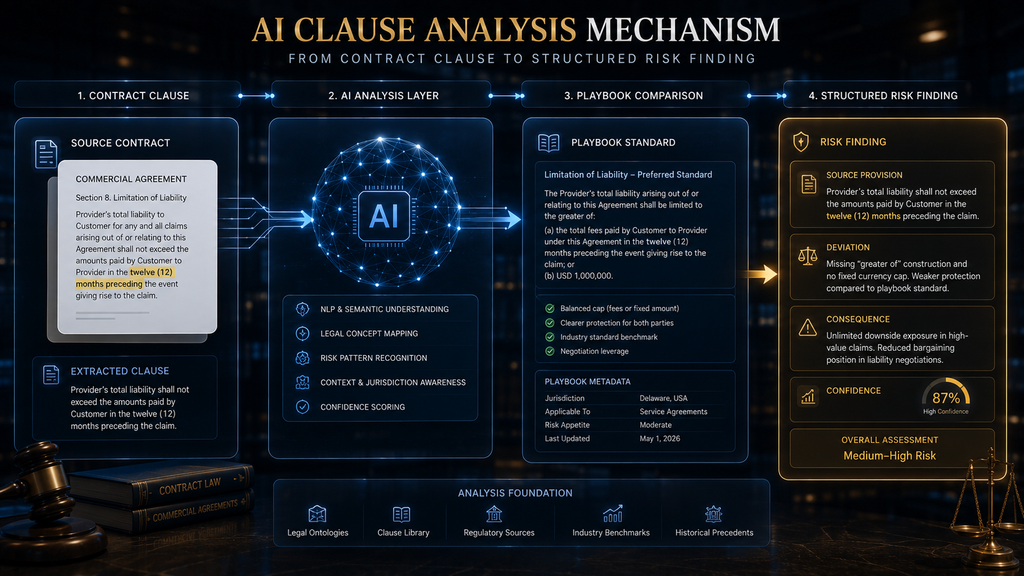
A red, yellow or green label can look useful. By itself, it is not enough. Imagine an AI system marks a limitation-of-liability provision as “high risk.” A lawyer still needs to know why.
Is the cap too low? Is there no cap? Are certain claims excluded?
Does an exception effectively make part of the liability uncapped? Is the provision inconsistent with another clause? Is the issue simply that the wording differs from the organization’s preferred language even though the commercial outcome is acceptable?
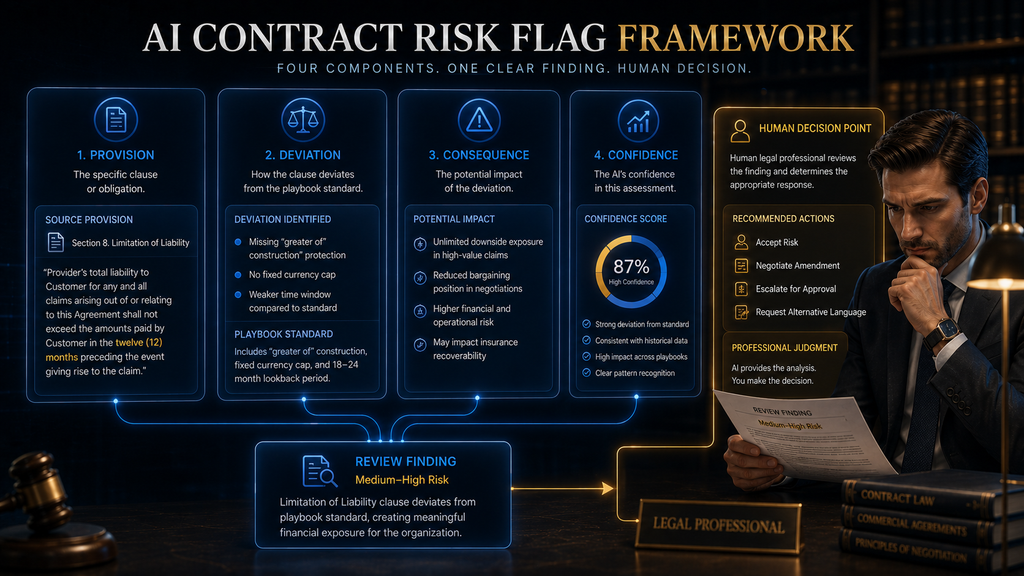
A useful risk flag therefore needs more than a color. AI Hustle World’s second framework for this workflow is: Risk Flag = Provision + Deviation + Consequence + Confidence.
The provision identifies what the system found. The deviation explains how it differs from the expected position. The consequence explains why the difference matters. Confidence tells the reviewer how much uncertainty remains.
This is an AI Hustle World analytical framework, not a claim that every commercial platform literally calculates risk using this formula. Its purpose is to establish a better standard for judging AI output.
A risk flag without evidence encourages automation bias. A risk flag tied to the source language gives the professional something they can challenge.
Why “High Risk” Is Not the Same as “Bad Clause”
This is where AI contract review can become dangerous if the workflow is designed badly. Legal and commercial review is contextual.
A clause can deviate from a playbook and still be acceptable because the transaction has unusual economics. A client may deliberately accept a weaker position in exchange for a lower price. A counterparty may have significant negotiating leverage. A particular provision may be offset by protections elsewhere in the agreement.
That means an AI system should generally be treated as a risk-surfacing mechanism, not a machine that declares the final legal answer. The professional’s job is not merely to confirm that the AI found the clause.
The professional has to determine whether the flagged difference actually matters. This is where human review creates value rather than merely slowing automation down.
The Difference Between Finding a Clause and Proving a Clause Meets the Standard
One of the most useful distinctions in AI contract review is between presence and compliance. Suppose a playbook requires a contract to provide a 30-day review period. An AI system that finds the words “review period” has completed the first task.
It has not necessarily completed the second. It still needs to determine whether the period is actually 30 days, whether the requirement applies to the relevant situation, whether another provision modifies it and whether the drafting contains conditions that change its effect. The same problem appears with missing protections.
If the playbook says a particular notice provision must exist, the system must do more than fail to find the relevant phrase. It needs sufficient confidence that the required protection is genuinely absent.
LegalOn’s benchmark specifically identifies absence checks as a recurring challenge for general-purpose models. Its research also highlights exact clause identification, numerical thresholds, cross-reference validation and multi-part requirements as important failure modes. These findings are vendor research and should be treated accordingly, but they illustrate a real structural difficulty in contract analysis.
Finding something is one task. Proving that the contract satisfies a precise requirement is another.
Cross-References Make Contract Review Harder
Contracts are not collections of independent paragraphs.
Definitions affect later clauses. Schedules can modify the main agreement. Statements of work can depend on master agreements. Exceptions can override general rules. A liability provision can interact with indemnification. A data-processing obligation may be incorporated by reference rather than repeated inside the main contract.
That creates a problem for simplistic AI review. A clause can look acceptable in isolation and become problematic when another provision is considered.
For example, a liability cap might appear straightforward until an exception elsewhere excludes certain claims from the cap. A termination provision might look reasonable until a renewal clause creates a different operational consequence. A confidentiality provision might appear complete while a definition elsewhere narrows the information covered.
This is why clause-level analysis and contract-level reasoning are not the same capability. The more the review depends on relationships between provisions, the more important it becomes to understand how the AI system represents those relationships and how the human reviewer can verify them.
Multi-Part Requirements Are Easy to Underestimate
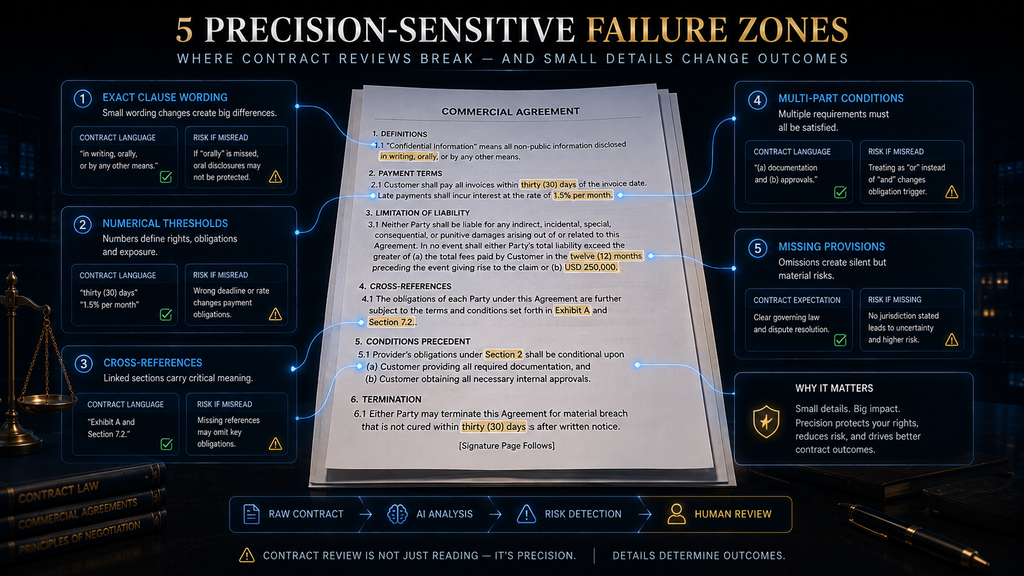
Legal review often involves conditions joined by “and.” A playbook might require a provision to contain:
- a specific right;
- a specific notice period;
- a specific exception;
- and a specific procedural condition.
A system that recognizes three of the four conditions may still incorrectly classify the provision as compliant. This is not necessarily a failure of basic language comprehension. It is a failure of requirement decomposition.
A reliable workflow should therefore break complex standards into discrete checks rather than relying on a single holistic judgment. That is one of the strongest lessons from current contract-review benchmarking. The question is not merely:
“Does the AI understand this clause?”
It is:
“Can the workflow verify every condition that matters?”
Redlining Is a Separate Problem From Risk Detection
This distinction is frequently lost in discussions about AI contract review. Finding a problem and fixing a problem are different tasks. Suppose an AI correctly identifies an overly broad indemnity.
The next question is what language should replace it. That requires the system to know the desired negotiating position, preserve the agreement’s drafting style, avoid breaking defined terms, maintain cross-references and produce language that is commercially plausible. A good redline therefore involves at least four decisions.
First, the system needs to identify the problematic language. Second, it needs to determine the desired position. Third, it needs to generate a change that moves the provision toward that position without unnecessarily rewriting unrelated language. Finally, a human needs to determine whether the proposed change is actually appropriate.
That last step matters because there may be several defensible ways to draft the same commercial protection. There is rarely one universally correct redline.
A Good Redline Should Be Minimal, Traceable and Context-Aware
The goal of an AI redline should not be to make a contract “more protective” at any cost. Aggressive language can create negotiation friction, undermine a commercial relationship or introduce inconsistencies elsewhere in the agreement. A better redline is connected directly to the identified issue.
If the system flags a liability cap because the amount exceeds the approved threshold, the proposed revision should address that threshold rather than rewriting the entire limitation-of-liability section. If the issue is a missing notice period, the system should propose language that addresses the missing requirement without unnecessarily changing unrelated rights. This is why redline quality should be evaluated separately from risk-detection quality.
An AI can correctly identify a problem and still produce a poor proposed solution. That distinction should be part of any serious evaluation.
Why Generic AI Can Look Better Than It Performs
Large language models are exceptionally good at producing coherent language. That creates a subtle problem in legal work. A fluent explanation can feel authoritative even when it is incomplete.
A model may describe a liability clause accurately at a high level while missing the numerical threshold that determines whether the provision satisfies the organization’s standard. It may identify the presence of confidentiality language while failing to recognize that an exception undermines the protection.
ContractScrub provides a useful independent warning. The benchmark was specifically designed around final contract-scrubbing errors such as incorrect defined terms, incorrect references and inconsistent language. The researchers found that frontier models could perform strongly on general benchmarks while performing surprisingly poorly on these narrower contract tasks.
That is a crucial distinction for procurement and implementation. General intelligence is not the same thing as contract-review reliability.
What AI Contract Review Does Well
AI is particularly useful when the workflow contains large amounts of repetitive information processing and the criteria for review can be defined clearly. Recurring agreement types are often a natural candidate because the organization may already know which clauses matter, what positions are preferred and which deviations require escalation. AI can help identify relevant provisions, organize documents, compare language against a playbook, surface unusual terms and prepare a first-pass review.
It can also create consistency in the process by applying the same review criteria repeatedly, although consistency should not be confused with correctness. A consistently wrong rule is still wrong. The real value comes when consistent machine processing is combined with appropriate standards and human review.
Where AI Contract Review Becomes More Difficult
The harder cases are usually those where the contract contains unusual structures, novel risk allocation or substantial context outside the document. Highly negotiated agreements can contain carefully balanced trade-offs that are difficult to reduce to a standard playbook. Complex transaction documents may also depend on several related agreements.
Jurisdiction-specific issues can require legal interpretation beyond the language contained in the document. Highly regulated industries can introduce requirements that change the importance of particular clauses. And contracts with unusually high consequences create a different tolerance for missed issues.
The practical principle is not that AI should never be used in these situations. It is that automation should become more conservative as uncertainty and consequence increase.
Human Review Should Be Designed Around Exceptions
The goal of AI contract review should not be to make lawyers recheck everything manually. That would eliminate much of the efficiency opportunity. The better model is exception-based review.
The system handles the repetitive first pass, then routes issues based on severity, uncertainty and complexity. A reviewer might therefore spend most of the time on unusual liability provisions, missing protections, cross-reference conflicts, commercially significant deviations and proposed redlines rather than manually reading every standard clause with equal intensity.
The American Bar Association’s Formal Opinion 512 is important here. It states that lawyers using generative AI remain responsible for applicable professional obligations, including competence, confidentiality, communication, supervision, candor toward tribunals and reasonable fees. The opinion also explains that AI may assist with contract review, due diligence, document review and drafting, but its use does not remove the lawyer’s professional responsibilities.
The practical implication is straightforward.
AI can reduce the amount of review work. It does not automatically transfer responsibility for the result.
The Right Human-Review Question Is Not “Did AI Get It Right?”
A better question is: “What should a human verify before this output becomes actionable?” For a low-consequence extraction task, the answer may be a quick spot check. For a risk flag involving a material liability provision, the answer may require the reviewer to inspect the original clause, related definitions and cross-references.
For an AI-generated redline, the reviewer may need to compare the proposed change with the playbook, the commercial context and the rest of the agreement. This makes review proportional rather than uniform.
| Review situation | AI contribution | Appropriate human focus |
|---|---|---|
| Standard clause with clear criteria | Identify and classify | Spot-check accuracy |
| Known deviation from playbook | Explain and flag | Confirm business significance |
| Missing protection | Search and flag absence | Confirm the requirement and document coverage |
| Cross-clause issue | Surface related provisions | Interpret interaction |
| High-risk negotiated provision | Analyze and suggest | Make the substantive decision |
| AI-generated redline | Draft proposed language | Validate legal and commercial consequences |
The exact review standard should depend on the organization’s risk tolerance, matter type and professional obligations.
The Contract Playbook Is a Form of Organizational Knowledge
There is another strategic benefit here. A mature playbook does more than instruct AI. It captures institutional knowledge.
When an experienced legal team documents its preferred positions, fallback language and escalation rules, it creates a reusable representation of how the organization approaches recurring contract issues. AI can then help apply that knowledge consistently.
This means contract intelligence is not simply an automation project. It can become a knowledge-management project.
That distinction matters because a team with no defined review standards may struggle to automate effectively. The AI cannot infer every commercial preference simply from the fact that lawyers have historically negotiated contracts in a particular way.
The organization first needs to make at least some of those preferences explicit.
The Hidden Work Before Automation Begins
This is why implementing AI contract review often exposes weaknesses that existed before the AI arrived. If different lawyers disagree about the preferred liability cap, the AI will not magically resolve the disagreement. If the playbook contains outdated language, automation can make the outdated rule easier to apply.
If contract templates are inconsistent, extraction and comparison can become more difficult. If the organization cannot define what constitutes an escalation, the workflow may produce too many or too few alerts. AI can accelerate a good process.
It can also accelerate a badly defined process. That is why implementation should begin with workflow clarity, not tool selection.
A Practical Implementation Workflow
The first step is to define the agreement types that are actually suitable for assisted review. A recurring vendor agreement with known review criteria is a different automation candidate from a one-off strategic transaction.
The next step is to establish the standards that matter. Preferred language, acceptable fallback positions and escalation conditions should be explicit enough to test.
Then the organization should separate different kinds of checks. Some requirements may be deterministic, such as whether a date falls within a specified range. Others require semantic interpretation, such as whether an exception materially changes the protection provided by a clause.
The document-ingestion layer should then be tested separately. Poor OCR or structural parsing can undermine every later stage.
Clause identification should be tested next, followed by risk detection, absence checks, cross-reference handling and redline generation. Each capability should be measured independently rather than assigning the entire system one overall “accuracy” score. That makes it possible to discover where the workflow is genuinely strong and where human review needs to remain heavier.
How to Test an AI Contract-Review System Before Production
A vendor demonstration is not enough. A serious evaluation should use representative documents from the actual workflow, including ordinary agreements, difficult agreements, unusually drafted provisions and edge cases. The organization should construct a known test set containing both acceptable and unacceptable provisions.
Then test the system separately on clause identification, requirement satisfaction, missing-clause detection, numerical thresholds, cross-reference handling, risk explanation and redline quality. The results should be measured using both false positives and false negatives. False positives tell you how much unnecessary review the system creates.
False negatives are often more important because they show what the system misses. The severity of the missed issue should also be recorded.
Missing a minor formatting inconsistency and missing a material limitation-of-liability exception should not count equally in a practical evaluation. The newly published ContractScrub benchmark is useful precisely because it focuses on narrow contract-scrubbing capabilities rather than relying only on general language-model benchmarks.
What Should Be Measured?
A useful production scorecard should include at least five dimensions. Detection quality measures whether the system finds the relevant clauses. Decision quality measures whether it correctly determines whether those clauses satisfy the required standard.
Explanation quality measures whether the finding is traceable to the source language. Redline quality measures whether the proposed change actually addresses the issue without creating new problems. Human-effort reduction measures whether the workflow meaningfully reduces review burden without increasing correction work.
A sixth metric should be added for high-stakes environments: Severity-weighted false negatives. A system that misses three trivial issues and one critical issue should not be described simply as having “four errors.” The business consequences are different.
Why Benchmarking Needs to Be Task-Specific
Contract review is not one task. It is a collection of tasks. Clause identification, extraction, risk assessment, missing-provision detection, cross-reference validation and redlining all require different capabilities.
ContractEval demonstrates this at the model-evaluation level, while ContractScrub demonstrates it at the contract-scrubbing level. The broader implication is that organizations should resist reducing AI contract-review performance to a single model score.
The right benchmark is the one that resembles the work you actually need the system to perform. If your legal team spends most of its time checking numerical thresholds, test numerical thresholds. If missing protections are the major concern, test absence detection.
If the workflow ends with negotiated redlines, test redlines separately. The benchmark should mirror the risk.
Privacy Is Part of Contract-Review Architecture
There is another layer that cannot be separated from the technical workflow: the data itself. Contracts can contain confidential commercial terms, customer information, intellectual property, personal data and other sensitive material. The Law Society specifically warns about the risks of using public generative-AI chatbots for contract work and emphasizes the difference between public tools and enterprise systems that have gone through organizational approval and risk assessment.
The ABA likewise requires lawyers to consider confidentiality and other professional duties when using generative AI. That means “Can this AI review my contract?” is only half the question.
The other half is: “Is this an approved environment for the information contained in the contract?” A technically capable system can still be the wrong production choice if its data-handling model does not satisfy the organization’s requirements.
AI Contract Review Does Not Automatically Mean Faster Review
It is tempting to promise dramatic time savings. The safer approach is to examine where time is actually being spent. If a lawyer currently spends substantial time locating clauses, comparing versions and checking repetitive provisions, AI may reduce that processing burden.
But if the AI produces so many false positives that every flag requires extensive manual investigation, the workflow may not improve much. Likewise, if generated redlines require substantial correction, drafting time may simply move from the original document to AI-output review. That is why the meaningful metric is not: “How quickly did the AI produce an answer?”
It is: “How quickly did the legal team reach a reliable, reviewable decision?” That is a much harder metric, but it is also the one that matters.
The Economics Are Really About Attention
The economic value of AI contract review is therefore best understood as an attention-allocation problem.
Imagine a legal team reviewing hundreds of similar agreements. The highest-value human contribution is unlikely to be manually locating every standard confidentiality provision.
It is more likely to be deciding whether an unusual liability position is acceptable, negotiating an important exception, resolving a cross-clause conflict or advising the business on the consequences. AI can potentially absorb more of the repetitive information-processing layer so that human time is concentrated on those higher-value decisions.
That does not mean every organization will achieve the same savings. The value depends on contract volume, agreement complexity, current review time, playbook maturity, tool performance, reviewer cost and the amount of correction required.
Vendor research can provide useful directional evidence, but vendor-reported efficiency numbers should not be treated as universal outcomes. LegalOn, for example, reports strong adoption and time-saving findings in its 2026 in-house survey, but those figures are based on vendor-sponsored research.
The right organization-specific calculation is: review volume × current manual effort × reviewer cost × safely automatable share − AI and review overhead. The final term matters. If AI creates a large verification burden, the economics change.
Common Mistakes That Undermine AI Contract Review
The first mistake is treating a general-purpose chatbot as a complete contract-review system simply because it can summarize an agreement. Summarization and precision review are different tasks, and current research shows why narrow contract evaluation deserves its own testing.
The second mistake is deploying AI without a meaningful playbook. Without a defined standard, the system can identify differences but has less basis for determining whether those differences are acceptable.
The third mistake is trusting the risk label instead of inspecting the evidence. A reviewer should be able to trace the finding back to the actual contract language.
The fourth mistake is ignoring missing provisions. Absence checks can be harder than finding clauses that are clearly present.
The fifth mistake is treating clauses as independent when the agreement contains significant cross-references and exceptions. The sixth mistake is generating redlines before defining the desired negotiating position. The seventh mistake is evaluating the model on easy contracts and assuming the result will transfer to difficult ones.
The eighth mistake is measuring average accuracy without weighting the consequences of missed issues. The ninth mistake is assuming that because a workflow uses a powerful foundation model, the entire workflow is automatically reliable. The final mistake is automating final approval simply because the preceding stages appear to work well.
When AI Contract Review Is a Strong Fit
AI contract review is most attractive when the organization has meaningful contract volume, recurring agreement types, identifiable review criteria and a workflow where human reviewers can verify exceptions. Vendor agreements, procurement contracts, recurring commercial agreements, NDAs and other relatively standardized documents can be reasonable candidates depending on the organization’s requirements. The strongest candidates usually share another characteristic: the legal team knows what it is looking for.
That makes the workflow testable. The team can define acceptable positions, construct test cases, measure false negatives and determine where escalation should occur.
When More Caution Is Appropriate
A one-off strategic agreement with unusual risk allocation is a different proposition. So is a highly negotiated transaction where commercial context is as important as the document language. The same is true for matters involving unusual jurisdictions, highly regulated activities or extremely consequential provisions.
The answer is not necessarily to abandon AI. Instead, the workflow can shift toward stronger human involvement, narrower automation and more explicit source verification. The general principle is simple: The more difficult the judgment and the higher the consequence of being wrong, the less appropriate fully automated decision-making becomes.
The Best Contract-Review AI May Be the System That Knows When to Stop
This is perhaps the most important practical insight. A useful AI system does not need to pretend that every contract is easy. It needs to know when the evidence is strong enough to proceed and when the matter should be escalated.
Consider two systems. The first confidently labels every clause green, yellow or red. The second identifies a potential issue, shows the underlying provision, explains the deviation, highlights related language and says that the matter requires professional review because the interaction between clauses is uncertain.
The second system may appear less autonomous. In a high-stakes legal workflow, it may actually be more useful.
Good automation is not measured by how much work the machine refuses to hand back. It is measured by whether the machine handles the right work and returns the right exceptions.
The Future of AI Contract Review Is More Structured, Not Just More Intelligent
As foundation models improve, it will be tempting to assume that every contract-review problem will eventually disappear through better reasoning. The evidence suggests a more complicated future. Better models will certainly help.
But the ContractScrub results show that strong general capabilities do not automatically solve narrow contract-scrubbing problems. LegalOn’s benchmark likewise argues that architecture and task decomposition matter alongside model intelligence. ContractEval shows that model characteristics and evaluation design affect clause-level legal-risk performance.
That suggests the future is likely to involve better combinations of models, retrieval, structured checks, playbooks, document intelligence and human escalation. The model will remain important. But the system around the model will remain important too.
A Practical Decision Framework for Legal Teams
Before adopting AI contract review, a legal team should be able to answer several questions in plain language. What contract types are being reviewed? Which provisions matter most?
What does the organization consider acceptable? Which deviations require escalation? Which findings can be verified quickly?
What happens when the system misses something? Can reviewers inspect the source language? Can the system handle cross-references?
How are missing clauses tested? How are redlines evaluated? What happens to confidential contract data?
How will performance be measured after deployment? If those questions cannot be answered, the organization may not have an AI problem yet. It may have a workflow-definition problem.
The Most Useful Mental Model
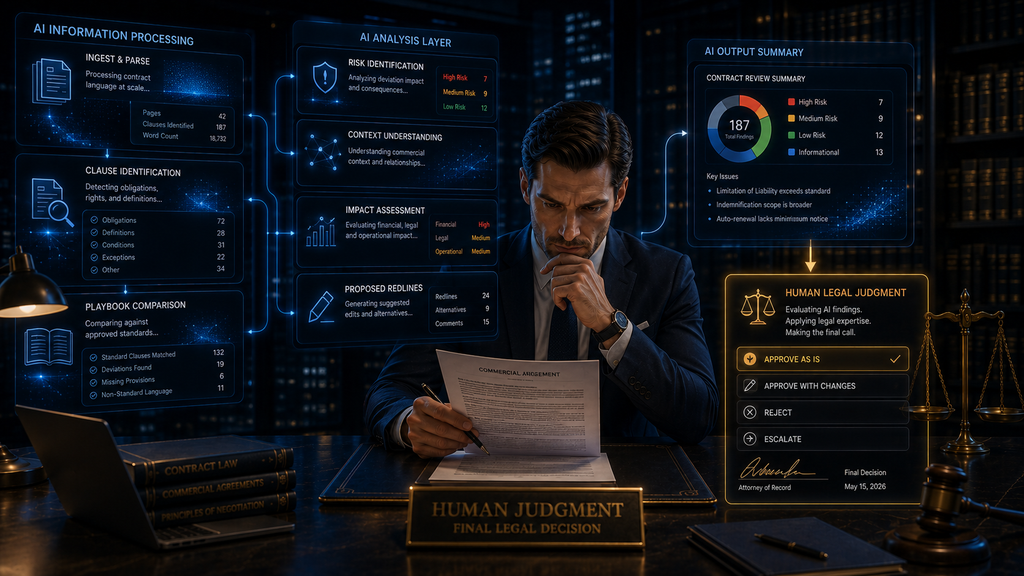
The best way to think about AI contract review is not as an artificial lawyer sitting beside a human lawyer. It is closer to an intelligent review layer that sits between the raw agreement and the professional decision. The contract enters as unstructured legal language.
The system converts it into a structured representation. Relevant provisions are identified. Those provisions are compared against defined standards.
Potential deviations are surfaced. The system explains what it found. Possible revisions can be proposed.
A human then decides which findings actually matter and which changes should be accepted. That is a much more realistic picture of what useful AI contract review looks like.
Final Thoughts: The Real Value Is Not Faster Reading
AI contract review is often marketed as though the core breakthrough is that a machine can read a contract in seconds. That is not really the interesting part.
The more important capability is turning a long agreement into a structured review surface: these are the relevant provisions, these are the deviations, this is why they matter, this is what the organization normally expects, this is the language that may need changing, and these are the issues that still require professional judgment. That is a much more useful model of automation.
The technology is strongest when the work contains repetitive information processing, recognizable patterns and clearly defined standards. It becomes more difficult when the contract depends on unusual context, complex relationships between provisions or judgment that cannot be reduced to a simple rule.
Current research reinforces that boundary. ContractScrub shows that frontier models can struggle with seemingly mundane final-review tasks. ContractEval demonstrates meaningful differences in clause-level legal-risk performance across model types. Vendor benchmarks such as LegalOn’s highlight the importance of structured, precision-oriented evaluation rather than assuming that general-purpose model capability automatically transfers to contract review.
The smartest way to deploy AI in contract review is therefore not to ask how much of the lawyer’s job can be removed. It is to ask how much repetitive processing can safely disappear while the quality of professional attention improves.
That is where the real value lies. AI should make the contract smaller as a review problem, not make the lawyer smaller as a decision-maker.
Understand the Workflow Before You Automate It
AI contract review becomes useful when document intelligence, review standards, risk detection and human judgment work together. Keep exploring the practical side of legal AI before choosing where automation belongs in your workflow.
Explore More Legal AI Workflows →Editorial resource. AI Hustle World does not provide legal advice. Evaluate AI systems, legal requirements and professional obligations for your specific workflow and jurisdiction.
Frequently Asked Questions
What is AI contract review?
AI contract review uses artificial intelligence to help identify, classify, compare and analyze provisions in agreements. Depending on the system, it can also flag deviations from a contract playbook, identify missing protections and suggest redline language for human review.
How does AI contract review work?
A typical workflow involves document ingestion, structural parsing, clause identification, comparison against defined review standards, risk detection, explanation, suggested changes and human escalation. Different products implement these stages differently, and strict extraction tasks may call for different technology from generative drafting tasks.
Can AI identify risky contract clauses?
Yes, AI can help identify provisions that deserve attention, but identifying a risky clause is not the same as making a final legal judgment. The quality of the result depends on the document, the review criteria, the model, the workflow architecture and the human-review process.
Can AI detect missing clauses?
It can attempt to identify missing protections, but absence checks are particularly challenging because the system must establish that a required provision is genuinely absent rather than merely overlooked. Current contract-review benchmark research identifies absence checks as a meaningful failure mode.
Can AI generate contract redlines?
Yes. AI systems can propose changes to contract language, but redline generation is a separate problem from risk detection. A useful redline needs to address the identified issue while preserving definitions, cross-references, commercial intent and the rest of the agreement.
Does AI contract review replace lawyers?
It can automate or accelerate parts of contract review, but it does not automatically replace professional legal judgment. The ABA states that lawyers using generative AI remain subject to existing professional obligations, including competence, confidentiality and appropriate review of AI output.
What is a contract-review playbook?
A contract-review playbook defines the organization’s preferred positions, fallback positions and escalation rules for important provisions. It gives an AI system or human reviewer a specific standard against which contract language can be evaluated.
Is AI contract review accurate?
Accuracy varies substantially by task, document type, system architecture and evaluation method. Recent research shows that frontier models can perform surprisingly poorly on narrow contract-scrubbing tasks even when they perform strongly on broader AI benchmarks.
Should companies use ChatGPT to review contracts?
A general-purpose AI tool may be useful for limited, low-risk tasks, but organizations should not assume that a general chatbot is equivalent to a controlled contract-review workflow. The Law Society specifically cautions against assuming generative AI is appropriate for every contract-review task and highlights data-protection considerations when using public tools.
What should companies test before adopting AI contract review?
They should test representative contracts for clause identification, precise requirement checks, missing-provision detection, numerical thresholds, cross-reference handling, risk explanations and redline quality. False negatives and the severity of missed issues should be measured rather than relying on a single overall accuracy figure.
Sources and Further Reading
- CUAD: An Expert-Annotated NLP Dataset for Legal Contract Review: Hendrycks et al., 2021. A dataset of contract clauses labelled by lawyers.
- Large Legal Fictions: Profiling Legal Hallucinations in Large Language Models: Dahl et al., 2024. Measures how often general-purpose LLMs hallucinate on legal queries.
Related Guides
- AI Contract Management vs Traditional CLM: Where AI Adds Real Value
- What Is a Large Language Model (LLM)? How LLMs Really Work
- What Is an AI Agent? A Beginner’s Guide to How Autonomous AI Works
- How to Use AI Tools Safely: A Complete Learning Path
Written by
Muntasir Ahmad Chowdhury
Founder, AI Hustle World
Muntasir Ahmad Chowdhury is the Founder of AI Hustle World, an independent publication dedicated to making Artificial Intelligence practical, trustworthy, and easy to understand. He researches AI tools, automation, customer service, productivity, and real-world business applications, helping readers make smarter technology decisions through research-driven, experience-backed content.
Expertise:
AI Tools • AI Automation • AI Customer Service • AI Productivity • Generative AI • AI Workflows
Get Smarter With AI
Enjoyed this guide? Get practical AI tools, tutorials, and honest reviews delivered to your inbox.