Evidence: Documentation reviewed
Last checked: 6 October 2026
What was done: Based on AdCreative.ai’s official pricing, product and help pages. Not hands-on tested. Prices re-checked on AdCreative.ai’s site.
Files: None
Affiliate links: Yes
AdCreative.ai Review: Features, Pricing, and Whether It’s Worth It in 2026
Affiliate disclosure: AI Hustle World may earn a commission if you sign up for AdCreative.ai through our affiliate link. This does not increase your cost. Our recommendation is based on the product’s capabilities, pricing, workflow fit, limitations, available evidence, and likely value for different types of advertisers.
If you run paid advertising regularly, there is a point where the problem stops being “How do I make an ad?” and becomes “How many different ads can I realistically produce, evaluate, and test before the next campaign starts?”
That distinction is important. One campaign might need several concepts, multiple headlines, different product treatments, several aspect ratios, audience-specific angles, and enough variations to learn which creative actually works. When you multiply that requirement across products, platforms, campaigns, and testing cycles, creative production can become the bottleneck long before media buying does. That is the problem AdCreative.ai is trying to solve.
AdCreative.ai has evolved beyond the narrow idea of an AI banner generator. Its current platform combines AI-generated ad creatives and copy with creative scoring, creative insights, competitor insights, product imagery, video and UGC-oriented generation, brand management, and advertising-platform integrations. The company positions the product as an end-to-end creative-performance workflow rather than simply a place to generate attractive graphics. But that broader feature set creates a more difficult question than “Does AdCreative.ai make good ads?”
The real question is whether the platform creates enough value through creative throughput, performance-oriented analysis, workflow integration, and testing capacity to justify its subscription for your particular advertising model. And the answer is not the same for everyone.
For a performance marketer producing creative variations every week, AdCreative.ai can make a compelling case. For someone who creates a handful of advertisements occasionally and mainly wants flexible graphic-design control, the economics are much harder to justify. The difference is not simply about whether the AI is “good”; it is about whether the problem the platform solves is expensive enough for you to pay to solve it. That is the lens we will use throughout this review.
AdCreative.ai at a Glance
AdCreative.ai is best understood as an AI-powered advertising production and optimization platform designed for marketers who need to generate, evaluate, and iterate on advertising creatives at scale. The platform currently includes AI ad creative generation, AI copy generation, creative scoring and insights, competitor insights, product and image generation, video and UGC-related capabilities, brand management, advertising-platform integrations, and higher-tier features for teams and enterprises. That makes it meaningfully different from a general-purpose design application.
A traditional design tool starts with a blank canvas and gives you the tools to build something. AdCreative.ai starts closer to the advertising objective: provide the product, brand context, campaign information, or creative input, and then generate multiple advertising possibilities that can be reviewed, scored, refined, and eventually moved into the advertising workflow.
The distinction becomes especially important when volume increases. If you need one polished banner, a conventional design workflow may be perfectly reasonable. If you need dozens of variations across several campaigns, the cost of manually producing each variation becomes part of the marketing economics.

Quick verdict
AdCreative.ai is worth considering if you run paid advertising frequently and the cost of producing enough creative variations is becoming a bottleneck.
It is less compelling if your primary need is general graphic design, highly bespoke art direction, or occasional ad creation. Its strongest value proposition is not “AI makes beautiful designs”; it is the combination of speed, variation, performance-oriented scoring, and advertising workflow integration.
The biggest caution is pricing and billing discipline. The platform’s current pricing structure is substantially more expensive at the higher tiers than general-purpose design software, while independent review platforms contain a noticeable volume of complaints about billing, trial conversion, refunds, and customer-service experiences. That does not prove that every customer will have a poor experience, but it is significant enough that a serious buyer should understand the commercial terms before starting a trial.
Test AdCreative.ai on One Real Ad Brief
Use the free trial to generate creatives for a product you actually advertise, then compare them with the ads you run today.
Start the AdCreative.ai Trial →Affiliate disclosure: We may earn a commission if you subscribe through this link, at no additional cost to you.
What Is AdCreative.ai?
AdCreative.ai is an AI advertising platform focused on creating advertising assets and helping marketers make better decisions about those assets. Its current product scope includes static ad creatives, ad copy, AI-generated images, product-oriented imagery, video and UGC-style assets, creative scoring, creative insights, competitor insights, brand management, and connections to advertising platforms. The important part is not the size of that feature list. The important part is how those capabilities fit together.
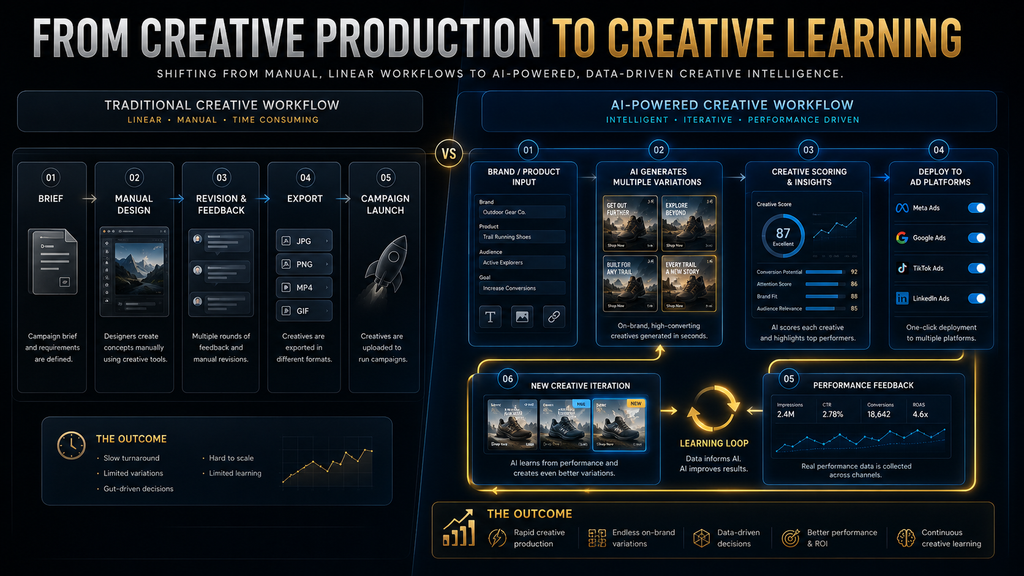
Imagine an ecommerce company launching a new product. A conventional process might involve writing a brief, sending it to a designer, creating several concepts, revising those concepts, producing different sizes, preparing copy, exporting the assets, uploading them into an advertising platform, launching the campaign, and then returning to the designer when performance data suggests that the creative needs to change. AdCreative.ai is attempting to compress much of that workflow into a single system.
You can create a brand, provide assets and information, generate multiple creative directions, use AI-generated copy and imagery, evaluate creatives with its scoring and insight tools, and connect advertising accounts for a more integrated workflow. The platform’s documentation says account connections can also allow the system to use historical advertising information for more personalized creative recommendations and insights. That does not mean every step becomes automatic or that human judgment disappears. It means the software is designed to reduce the amount of repetitive production work surrounding the advertising decision. That distinction is the foundation of a realistic AdCreative.ai review.
The Problem AdCreative.ai Is Actually Solving
The hardest part of advertising creative is often not producing the first idea. It is producing enough useful variations to learn which ideas deserve more budget.
Suppose you have a product with three major selling points: price, convenience, and a specific outcome. You might want separate creative concepts around each selling point, then several visual treatments for each concept, then different copy variations for different audiences. Suddenly, one campaign can become dozens of assets.
A human creative team can handle that, but the economics change when the demand becomes continuous. More concepts require more hours, more revisions require more coordination, and more exports require more production overhead. If the business is running campaigns across multiple products or clients, the creative queue can grow faster than the team can process it. AdCreative.ai’s proposition is essentially that AI can absorb much of the repetitive production layer.
The strategic advantage is therefore not simply “AI saves time.” The more important advantage is that lower production friction can make more experimentation economically feasible. That is a very different claim. If producing one additional creative costs almost nothing in time, you can afford to explore more angles. If every additional variation requires another hour of design and another round of revisions, the business naturally produces fewer variations. This is where the platform’s economics become interesting.
How AdCreative.ai Works
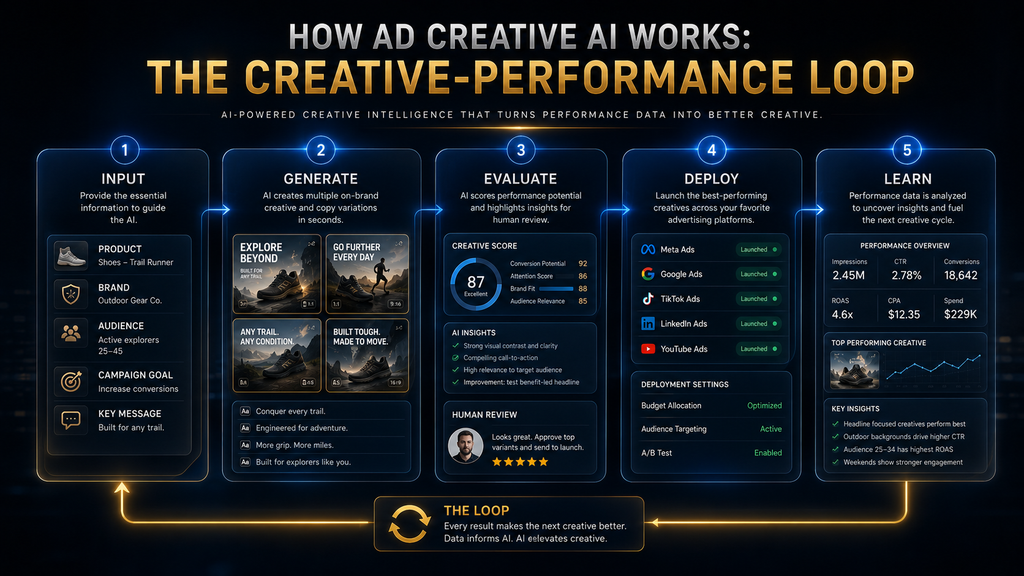
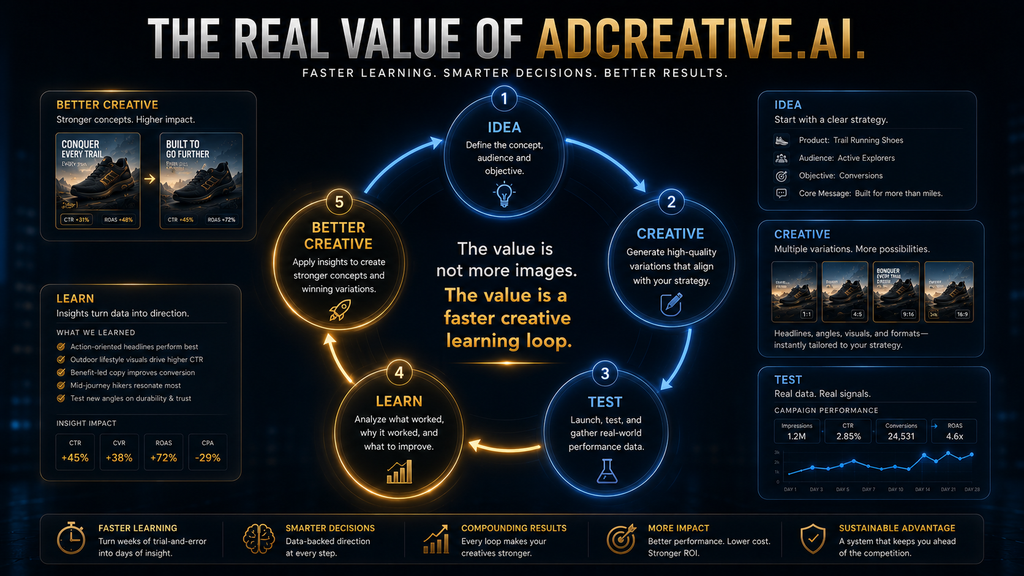
At a high level, AdCreative.ai can be understood as a five-stage creative-performance loop: Input → Generate → Evaluate → Deploy → Learn
The first stage is the information the system needs about the brand, product, campaign, or creative objective. The second stage is asset generation. The third stage uses scoring and insight features to help prioritize or understand the creative. The fourth stage connects the work to advertising operations. The fifth stage is the performance feedback that can inform subsequent creative decisions. That loop matters because a standalone image generator stops after the second stage. AdCreative.ai is trying to continue beyond generation.
1. Give the system the advertising context. The quality of an advertising creative depends heavily on the information behind it. A product name alone does not tell the system what matters. Stronger inputs can include the product’s positioning, target customer, brand assets, selling points, visual identity, and campaign context. AdCreative.ai’s brand system is designed around storing information such as logos, colors, descriptions, and advertising-account connections. The company describes brands as a foundation for its creative workflow. This is important because AI generation without brand context tends to produce generic work.
A serious advertising workflow is not trying to create something merely attractive. It is trying to create something recognizable, relevant, and aligned with a particular commercial objective.
2. Generate multiple creative directions. Once the inputs are available, the platform can generate advertising creatives and other marketing assets. The benefit here is variation. Instead of asking a designer to manually construct every version, the marketer can generate multiple possibilities and then decide which ones deserve attention.
This is where AI can be genuinely useful without pretending to replace creative strategy. The human still needs to understand the audience, offer, positioning, and campaign objective. The AI is primarily reducing the cost of translating those decisions into many visual and textual variations.
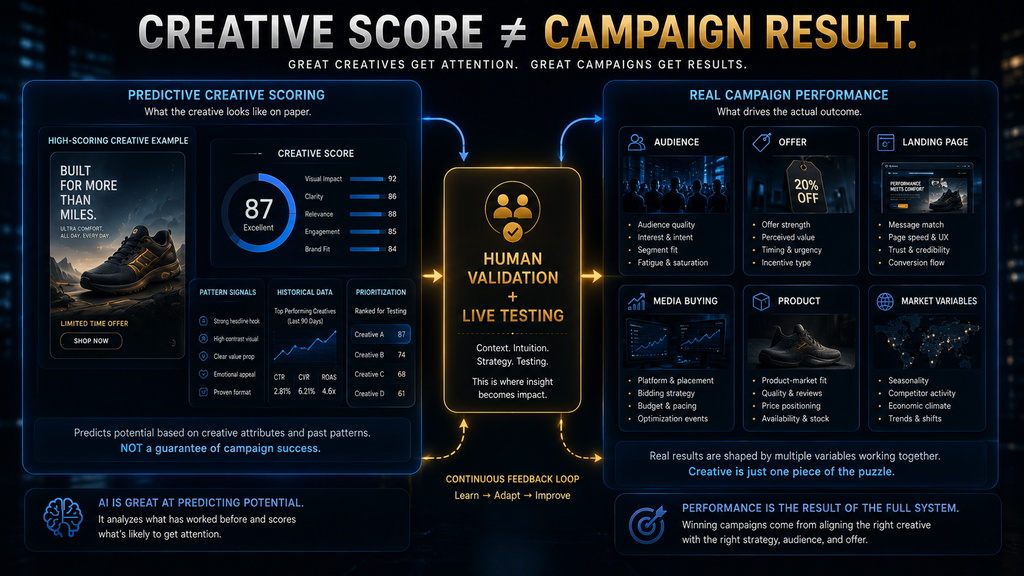
3. Evaluate the creative. This is where AdCreative.ai tries to move beyond generic design software. Its Creative Scoring system is designed to evaluate advertising creatives and provide performance-oriented scores. The company says its system uses hundreds of data points and a large advertising dataset to estimate likely performance characteristics. That does not mean a high score guarantees a high-performing campaign. It means the score can function as an additional decision signal. That distinction should never be lost.
4. Connect the advertising workflow. AdCreative.ai supports advertising-platform integrations, allowing users to connect advertising accounts and, depending on the workflow, move from creative generation toward campaign deployment and performance analysis. This can reduce a surprisingly tedious part of the process. Without integration, the workflow often becomes: generate → download → rename → organize → upload → create campaign → assign creative → launch. With greater integration, some of that friction can be reduced. The value becomes greater when creative volume is high.
5. Learn from performance
The final stage is where the platform’s positioning becomes more interesting. The company says connected advertising accounts can provide historical data that helps personalize creative recommendations and insights. In theory, that creates a feedback loop: Creative → Campaign → Performance data → Insight → New creative That is closer to how a serious advertising organization operates. But the human still needs to interpret the data. A campaign can underperform because of creative, targeting, offer, landing page, pricing, audience quality, media buying, or some combination of those factors. AI can reduce the cost of producing and analyzing creative. It cannot remove the need to diagnose the entire marketing system.
What Features Actually Matter?
AdCreative.ai has a long feature list, but not every feature has equal strategic importance. If you are evaluating the platform as a buyer, I would prioritize five areas: creative generation, creative scoring, brand management, advertising integrations, and the ability to produce different types of marketing assets. The rest should be judged according to your workflow rather than treated as automatically valuable.
AI Ad Creative Generation
This is the foundation of the product. AdCreative.ai is designed to produce advertising creatives quickly rather than requiring users to manually construct each design from scratch. The company positions the platform around generating multiple creative variations and supporting different advertising needs. The practical advantage is throughput. If a marketer needs ten concepts, the value is not that the tenth concept is necessarily better than a designer’s tenth concept. The value is that producing ten concepts becomes dramatically easier.
That creates room for testing. The limitation is equally important: generation speed does not guarantee creative quality. AI-generated creative can still require editing, selection, brand review, factual review, and strategic judgment. A marketer who treats every generated output as publication-ready is likely to waste time rather than save it. The correct workflow is closer to: Generate more → reject aggressively → refine the strongest → test in the market. That is a much healthier way to use the platform.
AI Ad Copy
AdCreative.ai also includes AI-powered text and headline generation. Its current product pages position copy generation alongside visual creative generation. This matters because visual and textual creative should not be treated as separate systems. A strong ad has a relationship between the image, headline, offer, audience, and call to action. If a marketer creates the image in one tool, the copy in another, and the campaign structure somewhere else, maintaining consistency becomes harder.
AdCreative.ai’s integrated approach can therefore reduce workflow fragmentation. But again, AI-generated copy should not be treated as strategy. A machine can produce ten headlines faster than a human. It does not automatically know which customer objection is most important, which claim is defensible, or which promise could damage trust. The marketer still owns those decisions.
Creative Scoring AI: Useful Signal or Marketing Gimmick?
This is arguably the most interesting part of the entire platform. AdCreative.ai’s Creative Scoring system is intended to help users assess creatives before spending advertising budget. The company describes the system as using hundreds of data points and a very large advertising dataset, while its product positioning focuses on predicting performance characteristics such as conversion or engagement potential. The idea is straightforward. If you have twenty candidate creatives, you do not necessarily want to spend the same amount of money testing all twenty. A predictive score could theoretically help you prioritize which concepts deserve more attention.
That can be useful. But there is a critical difference between prediction and proof. A score is not a campaign result. A creative that receives a high score can still fail because the offer is weak, the landing page is poor, the audience is wrong, the product is overpriced, or the campaign objective does not match the creative. Likewise, a creative with a modest predicted score could outperform expectations in a particular niche because the underlying idea connects unusually well with that audience.
The correct way to use Creative Scoring is therefore as a prioritization mechanism, not as a substitute for live testing. That distinction is one of the most important things to understand before buying the platform.
A better way to interpret a creative score. Think of the score as answering: “Which creatives deserve more attention before we spend meaningful budget?” Do not interpret it as: “Which creative is guaranteed to win?” Those are fundamentally different questions. The first can be useful. The second is unrealistic.
AdCreative.ai Pricing in 2026
AdCreative.ai’s current pricing is expensive enough that the right plan depends heavily on how frequently you produce advertising creative. The official pricing pages currently show a monthly structure built around credits and brands. The headline monthly pricing currently displayed includes $39 for Starter, $249 for Professional, and $999 for Ultimate, while the site also advertises lower effective pricing for longer billing periods. The platform’s current pricing pages describe the plans approximately as follows: Our AdCreative.ai pricing guide compares each plan against typical ad budgets.
| Plan | Headline monthly price | Monthly credits | Brand capacity | Best fit |
|---|---|---|---|---|
| Starter | $39 | 10 | 1 | Small businesses and lower-volume advertisers |
| Professional | $249 | 50 | Multiple brands | Mid-sized businesses and high-volume teams |
| Ultimate | $999 | 100 | Larger brand capacity | Agencies and larger creative operations |
| Enterprise | Custom | Tailored | Tailored | Larger organizations with advanced requirements |
The exact billing presentation can vary depending on whether the page is showing monthly, quarterly, or annual billing. The official pages also advertise substantial discounts for longer commitments. Because pricing pages can change and third-party directories may lag behind the current product, verify the final price and billing interval on the official checkout page before subscribing. This is particularly important because some third-party software directories still display older pricing information.
The credit system is more important than the headline price
The most useful pricing detail is not actually the $39 or $249 figure. It is what the credits represent. AdCreative.ai’s current pricing FAQ explains that a credit is used when a generated ad creative is downloaded, while users can generate unlimited creatives. That distinction changes the economics. You can potentially generate many concepts without consuming the same number of credits that you would consume by downloading every concept. In practical terms, the platform encourages a workflow where generation is cheap but final asset selection matters.
That is actually sensible. If every experiment consumed a credit, users would be incentivized to generate less. If generation is effectively unlimited while downloaded creatives consume credits, the platform encourages broad exploration followed by selective production. For a high-volume advertiser, that can be valuable. For a low-volume advertiser, however, the subscription itself may be the bigger issue.
Is the $39 Starter Plan Worth It?
The Starter plan is the most obvious entry point for a small advertiser because it currently lists 10 monthly credits and one brand. The official pricing pages also describe unlimited generation and access to the platform’s AI assets. The question is not whether $39 is expensive in isolation. The question is whether you create enough advertising creative to make a specialized platform useful. If you run paid ads every week and repeatedly need new creative, $39 may be a reasonable experimentation cost. If you create two or three advertisements every few months, the same subscription can be difficult to justify. Our guide to AdCreative.ai for small business looks at whether the Starter plan is enough.
This is why generic “worth it” reviews often miss the point. The same software can be an excellent investment for one advertiser and unnecessary overhead for another.
Is the Professional Plan Worth $249?
The Professional plan is where the economics become much more serious. At the current headline monthly price, you are no longer buying a casual design tool. You are making a recurring operational investment. The official page positions Professional toward mid-sized businesses and high-volume advertising teams, with 50 monthly credits and broader brand/user capacity. At this level, the product needs to save meaningful time or improve creative operations enough to justify the recurring expense.
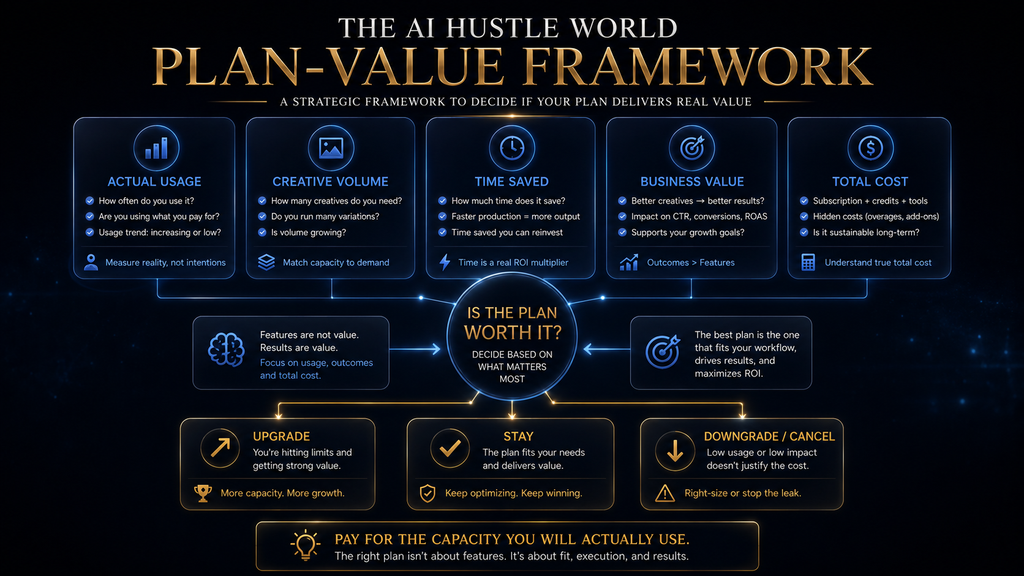
A useful calculation is: Monthly value created = production hours saved + testing capacity created + workflow savings + attributable performance improvement You should not assume all of those benefits will occur. Instead, measure them. Suppose your team currently spends twenty hours each month producing and adapting advertising creatives. If AdCreative.ai reduces that to ten hours while maintaining acceptable quality, the time savings have measurable economic value. If the saved time can be redirected into campaign analysis, landing-page optimization, customer research, or additional creative testing, the value becomes larger. That is a much stronger basis for purchasing the Professional plan than simply believing the marketing promise.
The Ultimate Plan Is a Different Purchase
The Ultimate plan is currently displayed at a headline monthly price of $999, with larger credit and brand capacity and positioning for agencies and broader marketing teams. The same pricing pages also show lower effective rates under longer billing commitments. At that level, the question is no longer “Is this a good AI tool?” It is: Can this become part of the economics of my creative operation? An agency managing many client brands may be able to justify a high subscription because the software is supporting repeated production across many accounts. A single small business probably cannot. This is exactly why a universal “best plan” recommendation would be misleading.
The Full Credit Ladder Matters More Than the Headline Prices
One reason AdCreative.ai pricing articles become confusing is that the plan names hide multiple credit configurations. The current pricing interface shows additional options inside each plan family. The monthly presentation currently shows Starter configurations of 10, 15, 30, and 50 credits; Professional configurations of 50, 75, and 100 credits; and Ultimate configurations of 100, 150, and 200 credits. The displayed prices are currently:
| Plan family | Credit level | Monthly price shown |
| Starter | 10 | $39 |
| Starter | 15 | $89 |
| Starter | 30 | $139 |
| Starter | 50 | $189 |
| Professional | 50 | $249 |
| Professional | 75 | $339 |
| Professional | 100 | $400 |
| Ultimate | 100 | $999 |
| Ultimate | 150 | $1,099 |
| Ultimate | 200 | $1,399 |
These figures should be treated as a current pricing snapshot, not a permanent price guarantee. The live site is promotional and dynamic, and different AdCreative.ai pages can expose different billing views at the same time. This is also why older software directories can be misleading. Some third-party pages still display older Ultimate pricing or older plan structures. If you search for AdCreative.ai pricing independently, you may encounter numbers that do not match the current vendor interface. For a purchasing decision, the live AdCreative.ai checkout should take precedence over an old directory listing.
Monthly vs Quarterly vs Yearly: Which Billing Option Is Smarter?
AdCreative.ai currently advertises three billing modes: monthly, quarterly, and yearly. The current pricing interface advertises 25% off quarterly billing and 50% off yearly billing. At first glance, yearly billing looks like the obvious winner. If the software is half-price on an effective monthly basis, why would anyone pay monthly? Because discount and flexibility are different forms of value. If you already know that AdCreative.ai is going to remain part of your advertising workflow for the next 12 months, the annual option can be economically compelling. If you are still determining whether the platform fits your creative process, monthly billing buys you flexibility.
The annual discount calculation. Using the current advertised entry-level figures: Starter is shown at approximately $20 per month when billed yearly rather than $39 monthly. Professional is shown at approximately $125 per month rather than $249 monthly. Ultimate is shown at approximately $500 per month rather than $999 monthly. The annual view therefore represents substantial advertised savings compared with paying the monthly rate for twelve months. But there is an important caveat. An effective monthly price is not the same thing as a month-to-month commitment.
You should not compare $20 annual effective monthly cost with $39 monthly cost as though both give you identical flexibility. One is a longer-term commitment with a lower effective rate; the other preserves a simpler exit option.
My recommendation. If you are uncertain: Start with the shorter commitment. If you have already tested the workflow and know the platform will be part of your advertising system: Consider the longer billing period. The mistake is not choosing monthly. The mistake is committing annually before you know whether the workflow actually produces enough value.
Free Trial: What You Actually Get
AdCreative.ai currently offers a 7-day free trial, and its help documentation says users are required to provide a credit card at signup. The company says users are not charged during the trial and can cancel before the trial ends. It also states a refund policy for certain post-trial charges, including a stated seven-day refund window for monthly plans and a longer window for yearly plans. The current product pages also advertise 10 credits as part of the trial experience. Our AdCreative.ai free trial guide shows what the trial credits actually cover.
This makes the trial useful, but only if you approach it like an evaluation rather than casually clicking through the product. A seven-day trial is long enough to answer several important questions:
Can it produce creatives that are actually usable for your brand? Can you create enough variations to improve your workflow? Does the output require so much editing that the time savings disappear? Does the scoring system add useful information? Do the available integrations fit your workflow? And, most importantly, would you still want the product if the trial ended today? Those are the questions that matter. The worst way to use the trial is to generate random images for six days and then decide whether the software “looks cool.”
A Practical Trial Test
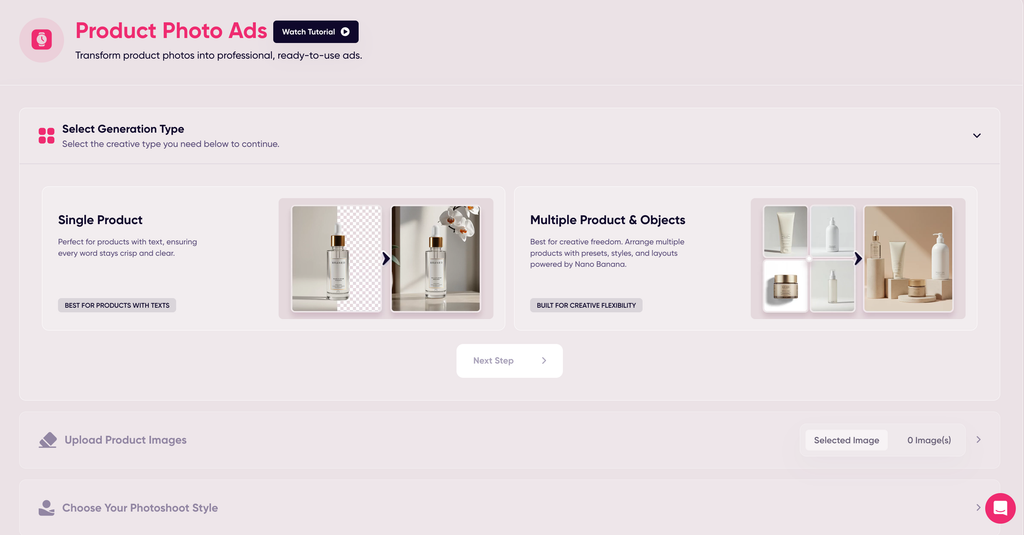
If you are considering subscribing, use the trial to reproduce a small piece of your real advertising workflow. Start with one product or service that you already understand well. Prepare the brand assets, product information, target audience, and core offer. Generate several different creative directions rather than repeatedly asking for superficial variations of the same concept. Then evaluate the outputs using four criteria:
- Strategic relevance: Does the creative communicate the right selling idea?
- Brand fit: Does it actually look and feel like your business?
- Production quality: Can you publish it with limited editing?
- Testing value: Does the platform give you enough useful variation to test meaningful hypotheses?
The final question is the most important. If you discover that the tool creates fifty versions of essentially the same idea, you have not gained fifty useful experiments. You have gained fifty variations of one idea. That is not the same thing.
What Happens When the Seven-Day Trial Ends?
The most important practical point is that the trial has a deadline. AdCreative.ai’s official help documentation says a credit card is required during sign-up and explains that the payment details support uninterrupted access to the service. The sign-up documentation also tells users to start the free trial after entering payment information. That means you should treat the trial like a subscription decision with a seven-day evaluation window, not like an indefinitely available free account.
If you decide the platform is not right for you, cancel before the trial ends. If you decide it is right for you, understand which plan you are moving into and whether its credit allowance matches your expected workload. The important point is that the decision should happen before the renewal event, not after it. This is also why the trial should not be started casually just because you are curious.
If you are not prepared to spend an hour or two actually evaluating the workflow, there is little value in starting the clock.
What If You Forget to Cancel?
This is one of the most common questions around free trials with payment information, and the answer needs to be precise. AdCreative.ai’s documentation makes clear that payment details are collected at sign-up and that the trial is connected to continued paid access if you do not cancel. The right response is not panic. It is planning. If you know you do not want to continue, cancel during the trial. If you decide to stop, our guide to cancelling an AdCreative.ai subscription explains how to avoid surprise renewals.
If you are unsure, put a reminder on your calendar for well before the seven-day deadline. That gives you time to review your results, check the plan you would move to, and make a deliberate decision rather than relying on memory.
AdCreative.ai also publishes a refund policy with eligibility conditions. Its current documentation says refunds may be available within seven days for monthly plans and 30 days for yearly plans when the platform has not been used, while the policy also says credits expire at the end of the billing cycle and do not roll over. That does not mean you should treat the refund policy as a substitute for cancellation.
The safer approach is simple: Know when the trial ends. Decide before it ends. Cancel if you do not want the subscription.
What Users Like About AdCreative.ai
Independent reviews provide useful evidence because they reveal where the platform creates practical value outside the vendor’s own marketing copy. G2 currently shows AdCreative.ai at 4.3 out of 5 from 956 reviews across its AdCreative.ai product family listing, with the individual product showing 794 reviews. Recent reviews praise ease of use, creative quality, speed, and the ability to generate professional-looking advertising assets without relying entirely on an external agency. That aligns with the platform’s core proposition.
Users who benefit most tend to appreciate the reduction in creative production friction. Instead of starting from zero every time a campaign needs another concept, they can use AI to create a broader pool of candidates. That can be particularly valuable for marketers who understand advertising strategy but do not have a large in-house design team. There is also a useful distinction in the current G2 feedback: some users describe the generated creatives as close to usable, while others frame the product more as an idea-generation tool than a complete replacement for final creative production.
That distinction is worth taking seriously. The best AI advertising tool does not necessarily need to eliminate the designer. It may simply need to eliminate the repetitive first 70% of the work.
What Users Complain About
The biggest caution in the current review landscape is billing and subscription experience. Trustpilot currently shows a 3.4 out of 5 TrustScore from 4,474 reviews, with a substantial proportion of recent one-star reviews. Its current review summary highlights complaints involving unexpected subscription charges, refund delays, and trial conversion, while also showing positive reviews that praise customer support and the product itself. Capterra presents a more mixed picture, currently showing 3.3 out of 5 from 169 reviews, with recurring criticism around billing, customer service, value, and particular limitations in creative output. If you decide to stop, our guide to cancelling an AdCreative.ai subscription explains how to avoid surprise renewals.
The existence of negative reviews does not establish that AdCreative.ai deliberately misleads customers. Reviews are individual accounts, and they can reflect misunderstandings, account-specific circumstances, or different expectations. But the pattern is large enough that it should not be ignored. The sensible conclusion is not “AdCreative.ai is a scam.” The sensible conclusion is: Treat the trial-to-paid transition and refund terms as part of the product evaluation, not as an administrative detail.
That is especially important because the company itself confirms that a credit card is required to start the trial and that users need to cancel before the trial ends to avoid the normal subscription transition.
Compare a Creative Batch Before You Scale Spend
Generate a batch for one campaign and measure its click-through rate against your existing ads before you increase your budget.
Test a Creative Batch →Affiliate disclosure: We may earn a commission if you subscribe through this link, at no additional cost to you.
Is AdCreative.ai Actually Better Than Canva?
We have a dedicated AdCreative.ai vs Canva article, so we will not turn this review into a full comparison. The strategic distinction, however, is important enough to establish. Canva is fundamentally a broad design platform. AdCreative.ai is fundamentally an advertising-focused creative production platform. If you need presentations, social graphics, documents, thumbnails, brand assets, simple video editing, and a flexible design environment, Canva’s breadth is a major advantage. If your primary job is repeatedly producing advertising variations and evaluating them through a performance-oriented workflow, AdCreative.ai’s specialization becomes more relevant. We compare the two directly in AdCreative.ai vs Canva.
The mistake is assuming that specialization automatically makes it better. It makes it better for a particular problem. That is the decision readers should make.
Where AdCreative.ai Is Strongest
AdCreative.ai is strongest when creative volume is high, the advertising objective is clear, and the marketer benefits from rapidly exploring multiple variations. That makes several use cases particularly compelling.
Performance marketing teams. Performance marketers often need a continuous supply of new creative because campaign fatigue, audience differences, and platform dynamics can change what works. For these teams, creative throughput is not a luxury. It is part of the operating model. AdCreative.ai can potentially reduce the production bottleneck by making it easier to create and evaluate more candidate creatives. The key word is candidate. The marketer still needs to select, edit, test, and learn.
Ecommerce brands. Ecommerce businesses are another natural fit because product advertising requires repeated creative production around individual products, offers, audiences, and seasonal campaigns. The platform currently includes product-image and product-ad capabilities in addition to standard creative generation. This creates an appealing workflow for stores that regularly need fresh product advertising. But again, the value increases with volume. A store selling one product with one stable campaign may not need the same level of creative infrastructure as a store managing hundreds of products.
Agencies. Agencies can potentially benefit even more because one workflow can support multiple client brands. The current higher-tier plans are explicitly positioned around larger brand and user capacity. The economics are straightforward: if a platform saves several hours of creative production across many client accounts every week, a higher subscription can be easier to justify. But agencies should also calculate the cost of review. AI output still requires human approval. If the agency spends almost as much time correcting generated creatives as it previously spent creating them, the theoretical productivity gain disappears.
Small businesses. Small businesses are a more complicated case. The lower-tier plan makes experimentation accessible, but a small business still needs enough recurring advertising demand to justify another software subscription. If the owner runs paid advertising every week but lacks a dedicated designer, the product can be attractive. If the business only runs occasional campaigns, a broader design platform may offer better overall value.
Where AdCreative.ai Is Weaker
The platform becomes less attractive when the core problem is not volume but creative specificity. Highly art-directed campaigns often depend on exact visual decisions that cannot be reduced to generic optimization patterns. Luxury branding, complex visual storytelling, culturally specific creative direction, and campaigns built around a distinctive artistic identity may require more manual control than an AI advertising generator naturally provides. This is not a failure of AI. It is a mismatch between optimization and authorship.
AdCreative.ai is designed to accelerate advertising production. A professional designer is often being hired to make deliberate creative choices that may have nothing to do with producing the statistically familiar visual pattern. The two approaches can coexist. The strongest workflow may actually use AI to produce breadth and humans to provide judgment.
The Hidden Cost of AI-Generated Creative
There is an economic trap in AI creative software that is easy to miss. Generating more assets can create more review work. If a designer creates ten concepts, the team may understand them quickly because the designer has already filtered them. If an AI produces one hundred concepts, somebody has to inspect those outputs and decide which ones are strategically meaningful. This creates what we can call the selection tax. Plan data for other tools is in our AI Tool Pricing Database.
The more inexpensive generation becomes, the more important curation becomes. That is why “unlimited generations” should never be interpreted as “unlimited value.” More output only helps if your organization can turn that output into better decisions.
The AI Hustle World Value Stack
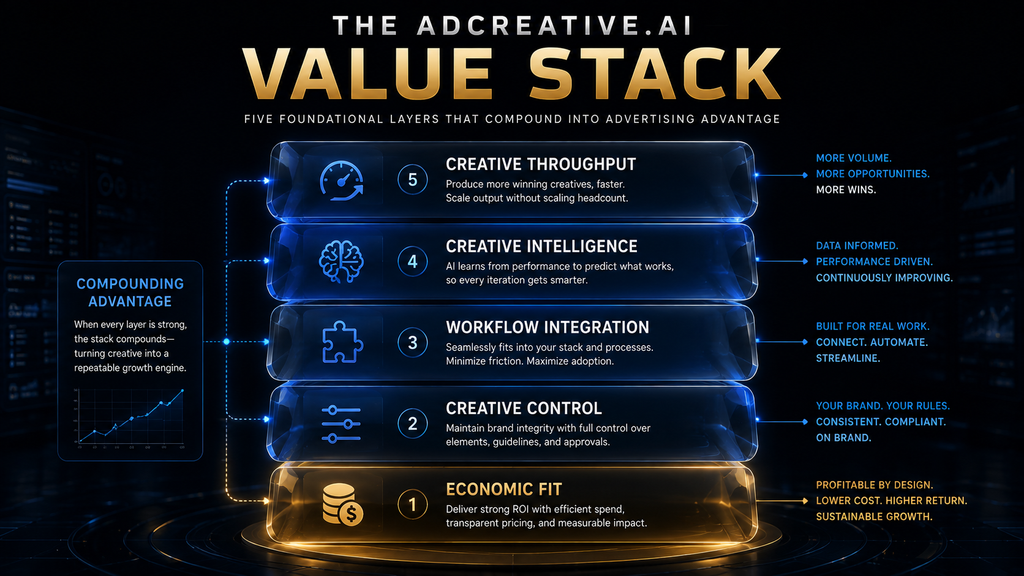
A useful way to evaluate AdCreative.ai is to score it across five layers rather than judging the software from its feature list.
- 1. Creative Throughput. How much more creative can you produce in the same amount of time? This is the platform’s most obvious advantage.
- 2. Creative Intelligence. Does scoring and insight help you prioritize, diagnose, or improve creative decisions? This is where AdCreative.ai attempts to move beyond generic design software.
- 3. Workflow Integration. Does the platform reduce the friction between creating assets and actually using them in advertising campaigns? Integrations and account connections matter here.
- 4. Creative Control. Can your team get the exact result required without fighting the AI? This is where human designers still matter.
5. Economic Fit. Does the combination of time savings, creative volume, and potential performance improvement justify the subscription? This is the final filter. A platform can score highly on the first four and still fail the fifth. That is why the “worth it” question must be answered at the business level rather than the feature level.
How to Calculate Whether AdCreative.ai Is Worth It
Do not start with the subscription price. Start with the current cost of your creative workflow. Estimate how many hours your team spends each month on:
- brainstorming creative concepts
- creating initial designs
- resizing or adapting assets
- writing ad copy
- producing variations
- exporting and organizing assets
- preparing campaign uploads
- reviewing creative performance
- requesting revisions
Then estimate which of those activities the platform can realistically reduce. For example, imagine a small marketing team spends 25 hours per month on creative production. If a tool reduces that workload to 15 hours, the saving is ten hours. If those ten hours are worth $30 per hour internally, the direct time value is $300 per month. That does not prove the software is worth $249. You still need to consider:
- quality-control time
- editing time
- subscription cost
- integration limitations
- creative testing results
- whether the saved time is actually redeployed productively
If those ten saved hours simply disappear into lower workload, the economic value is different from a situation where those ten hours are used to produce more campaigns and improve revenue. This is why ROI should be measured by reallocated productive capacity, not just time saved.
A Better KPI Framework
If you use AdCreative.ai, track the workflow before and after implementation. Useful metrics include:
- Creative production time: How long does it take to move from campaign idea to usable creative?
- Creative volume: How many genuinely distinct creative concepts can the team produce per campaign?
- Approval rate: What percentage of generated creatives survive human review?
- Edit time: How much work is required before an AI-generated creative becomes publishable?
- Testing velocity: How many new creative hypotheses can the team test each month?
- Creative fatigue: How quickly do existing assets lose effectiveness?
- Cost per tested concept: How much does it cost to produce and test a new creative hypothesis?
- Performance outcomes: CTR, CPC, conversion rate, CPA, ROAS, or whichever metrics actually matter to the campaign objective.
This framework prevents a common mistake: declaring an AI tool successful because it produced 500 images. Five hundred images are not a marketing outcome. A better outcome might be producing twelve genuinely different creative hypotheses in the time it previously took to produce three.
What Happens If You Do Nothing?
This is an important part of the buying decision because software should not be evaluated in isolation. If your current creative workflow is already fast, affordable, and producing enough useful testing volume, adopting AdCreative.ai may create little incremental value. You may simply add another subscription and another tool to manage. But if creative production is currently limiting how often you test new ideas, doing nothing has a cost too. You may continue launching campaigns with too few creative variations, keep designers trapped in repetitive production work, or delay new tests because the creative queue is full.
The decision is therefore not: AdCreative.ai versus zero cost. It is: AdCreative.ai versus the cost and limitations of your current workflow. That is a much more honest comparison.
The Traditional Design Workflow Still Exists for a Reason
It is tempting to interpret AI creative software as evidence that traditional design is obsolete. That would be a mistake. Traditional creative production exists because advertising is not merely a pattern-recognition problem. It is also a communication, positioning, cultural, aesthetic, and brand problem.
A skilled designer can deliberately break conventions. A creative director can reject a statistically attractive concept because it weakens the brand. A copywriter can recognize that a technically persuasive claim would damage credibility. A strategist can understand why a campaign needs to feel different from every competitor even if a familiar design pattern might produce a short-term response. AI is very good at increasing the number of options. Human expertise remains particularly valuable when the question is which options should exist in the first place. The strongest model is therefore not AI versus humans. It is AI for production scale and humans for consequential judgment.
A Contrarian View: More Optimization Can Make Ads Look More Alike
There is another second-order effect worth considering. If advertising AI systems increasingly learn from large datasets of existing campaigns and optimize toward patterns associated with performance, marketers may gradually converge on similar visual conventions. That does not mean every AdCreative.ai output will look identical. The larger issue is strategic. If every advertiser is optimizing toward historically successful patterns, distinctive creative can become harder to maintain. This creates a tension between performance familiarity and brand differentiation.
For a direct-response campaign, familiar patterns may be exactly what you want. For a premium brand, cultural campaign, or long-term brand-building strategy, you may intentionally want something less predictable. That is why a good advertising workflow needs both optimization and creative direction.
AdCreative.ai and Brand Control
Brand consistency is one of the more important areas to evaluate during the trial. The platform’s brand functionality allows users to store information such as logos, colors, descriptions, and advertising connections. That can reduce the problem of repeatedly reintroducing brand context. But brand consistency is more than matching colors. A brand has a visual language, hierarchy, tone, image philosophy, customer promise, and relationship with its audience. A creative can use the correct logo and still feel completely wrong. This is another reason to treat AI output as a production candidate rather than an automatic final asset.
AdCreative.ai for Teams
Team value comes from more than user count. A team benefits when the platform creates a common creative workflow. Brand information can be centralized, creative production can become more repeatable, and marketers can work from a shared system rather than passing files through multiple disconnected tools. The value increases when several people need access to the same brand assets and creative process. But teams should establish governance early.
Someone should own final creative approval. Someone should verify claims. Someone should decide whether an AI-generated image accurately represents the real product. And someone should monitor whether the team is producing meaningful creative variation rather than hundreds of superficial versions. Automation without governance creates scale without control.
Product Accuracy Matters More Than Aesthetics
For product advertising, one of the most important quality checks is whether the generated image still represents the real product accurately. A visually beautiful advertisement can become commercially useless if the AI changes product details, proportions, colors, packaging, features, or other characteristics that matter to customers. This is particularly important for ecommerce. The more realistic the generated asset appears, the more carefully it should be checked against the real product.
The goal is not simply to produce an attractive image. The goal is to produce an attractive image that does not misrepresent what the customer will actually receive.
AdCreative.ai for Ecommerce
AdCreative.ai has expanded its product capabilities into AI product imagery and product advertising, making ecommerce one of the platform’s more obvious use cases. The opportunity is straightforward. An ecommerce company can start with a product asset and generate different visual contexts, campaign concepts, and advertising variations without organizing a new photoshoot for every idea. That can dramatically reduce the cost of creative experimentation. But ecommerce brands should still validate product accuracy, claims, pricing, promotional details, and platform-specific requirements before launch. The AI can accelerate the production process. It should not become the final compliance department. Our guide to the AdCreative.ai Shopify integration covers the store side in detail.
AdCreative.ai for Shopify Stores
This section is based on AdCreative.ai’s integration documentation and public product pages. It was not hands-on tested with a live store.
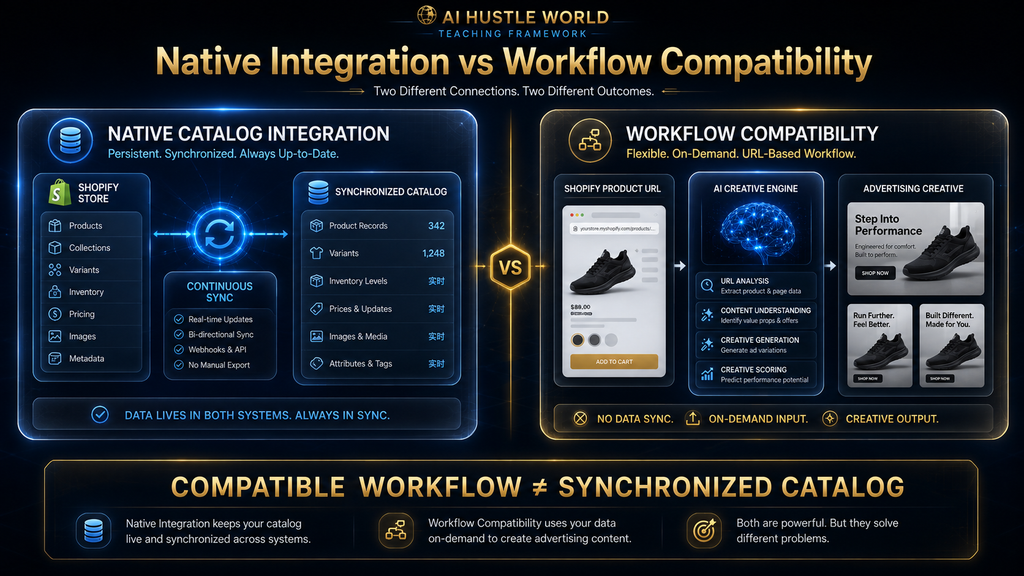
The Most Important Distinction: URL Analysis Is Not Catalog Synchronization
This is probably the single most important point in the entire article. AdCreative.ai’s Instant Ads feature allows you to paste a website or product link and have the system analyze the page. The company says the system can extract product details, pricing and tone, identify selling points, and generate advertising creative from the webpage.
For a Shopify merchant, that can be extremely convenient. A Shopify product page already contains much of the information an advertising system needs to understand what is being sold, so using the product URL can reduce the amount of manual briefing required before creative generation. But a URL workflow is still different from a native catalog synchronization layer.
Imagine that a Shopify product changes from $79 to $59 because of a weekend promotion. A URL-scanning workflow can analyze the page when you generate new creative, assuming the updated information is accessible to the scanner. A true catalog synchronization system would go further by maintaining an ongoing relationship between the product record and the creative system, potentially detecting changes and updating downstream assets or workflows. Those are fundamentally different operating models.
That is why describing AdCreative.ai as “Shopify-integrated” without qualification can create the wrong expectation. It can fit naturally into a Shopify product workflow, but that is not the same thing as saying Shopify and AdCreative.ai maintain a continuously synchronized native catalog connection.
What the Official Integration Documentation Tells Us
The strongest evidence comes from AdCreative.ai itself. Its current Help Center has an Account Integrations collection specifically described as the place to manage external paid advertising accounts. The collection includes documentation for connecting ad accounts, pushing creatives, Google Analytics and related advertising-platform functionality. Shopify is not presented there as a core account integration.
AdCreative.ai also documents connecting advertising accounts to brands inside the platform. Once connected, those accounts can be used to push creatives toward the relevant advertising platforms, and the platform can use advertising data as part of its creative intelligence workflow.
That is an important distinction because it tells us what AdCreative.ai considers an “integration” in its current documentation. In this part of the product, integration primarily means connecting advertising accounts and performance data, not synchronizing an e-commerce store’s product database. This does not make the platform less useful for Shopify merchants. It simply means that the Shopify connection should be thought of as a workflow relationship rather than a documented first-party catalog integration.
AdCreative.ai for Agencies
Agencies have a different reason to consider the platform: creative operations at scale. One agency may manage several brands, each with different audiences, offers, visual systems, and campaign calendars. The problem is no longer producing one ad. It is managing a continuous creative pipeline across clients. The higher-tier plans are positioned toward agencies and larger operations with substantially greater brand and user capacity. For an agency, the right measurement is not “How many creatives can the AI make?”
It is: How much client-serving creative capacity does the platform add without lowering quality? If the answer is significant, the economics can work. If the agency still needs to manually rebuild most AI outputs, the subscription may simply shift work around rather than remove it.
AdCreative.ai for Small Business: Is the Starter Plan Enough?
For a small business the question is narrower than “is AdCreative.ai good”: it is whether the $39 Starter plan, with 10 download credits and one brand, covers the advertising you actually run.
When the Starter Plan Is Probably Enough
The starter-level offering is probably enough when the business has a modest but recurring creative requirement, one or a few advertising channels, limited internal design resources, and a workflow where AI-generated variations can actually be reviewed and tested. This is the sweet spot. You do not need a huge creative department to benefit. In fact, a small team can sometimes gain more from the productivity improvement because each hour of skilled employee time has a large opportunity cost.
But the business should be far enough along that it has something to test. If there is no meaningful advertising activity, the plan can become a solution looking for a problem.
When You Should Skip It
You should probably skip or postpone AdCreative.ai if paid advertising is still experimental, your monthly ad budget is extremely small, your campaigns receive too little traffic to generate useful feedback, or your biggest marketing problem is somewhere else in the funnel. The same applies if you already have a designer or agency producing enough quality creative and your main constraint is campaign strategy or conversion performance. In those cases, adding another creative tool may create more workflow complexity than value. For a wider view of tools for smaller teams, see our list of the best AI tools for small business owners.
A small business should be especially ruthless here because software subscriptions accumulate quietly. One $50 or $100 subscription rarely feels dangerous. Ten of them can materially change the company’s monthly operating cost. The objective is not to build the most sophisticated marketing stack. It is to build the smallest stack that removes the biggest constraints.
Who Should Use AdCreative.ai?
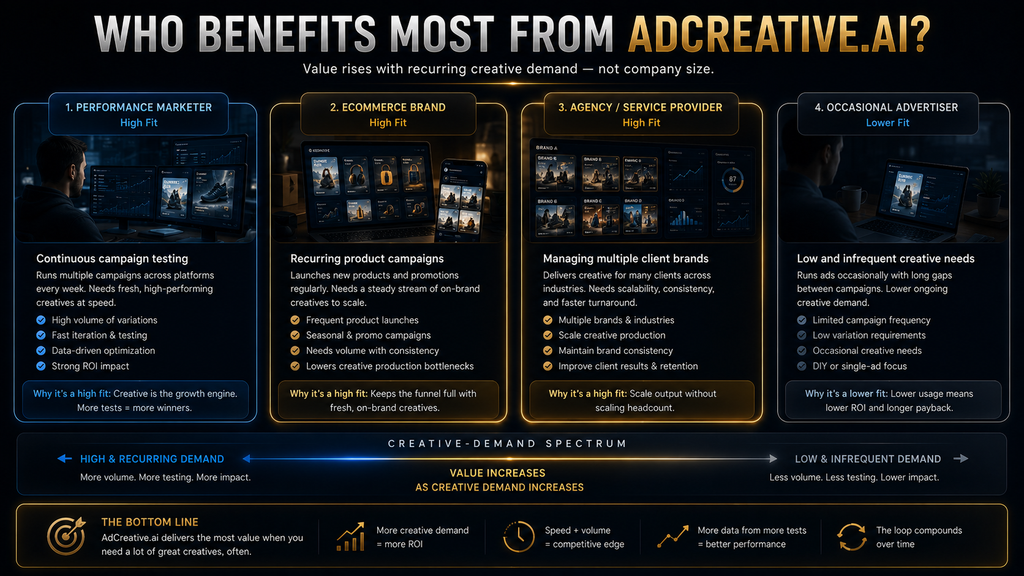
AdCreative.ai is a strong candidate for businesses and teams that regularly run paid campaigns and need more creative variation than their current workflow can comfortably produce. It is particularly worth testing if you: For a wider view of tools for smaller teams, see our list of the best AI tools for small business owners.
- run paid social or digital advertising continuously;
- frequently need new creative variations;
- have limited design capacity;
- operate multiple products or campaigns;
- manage multiple client brands;
- want a more integrated creative-production workflow;
- want predictive creative scoring as an additional prioritization signal;
- are willing to review and refine AI output rather than publish everything automatically.
The common thread is creative demand. If you have a lot of creative demand, the platform has a problem worth solving.
Who Should Avoid It?
You should probably look elsewhere if you mainly need a general-purpose design tool, create advertisements only occasionally, or require highly bespoke creative direction with extensive manual control. It may also be a poor fit if you are unwilling to monitor subscription billing carefully or if the current pricing is materially above the value of your existing workflow. And if your organization does not have someone capable of reviewing AI-generated creative, the platform’s speed can become a liability. More creative does not automatically mean better creative. See the best AdCreative.ai alternatives for other budgets and use cases.
AdCreative.ai Pros and Cons
The simplest summary is that AdCreative.ai is strongest when you need volume and workflow efficiency, while its biggest weaknesses appear when you need maximum creative control or very low software costs.
| Pros | Cons |
| Rapid creative generation | Higher tiers are expensive |
| Designed specifically around advertising | AI output may still need editing |
| Creative scoring and insight features | Predictive scores are not guaranteed campaign results |
| Multiple asset-generation capabilities | More generated assets create more review work |
| Advertising-platform integrations | Billing/trial complaints appear across review platforms |
| Useful for high-volume testing | Less compelling for occasional advertisers |
| Strong potential for agencies and ecommerce | Human creative direction remains necessary |
| Brand-oriented workflow | General design tools may offer broader creative flexibility |
The important point is that most of these are trade-offs, not absolute strengths or weaknesses. A high-volume advertiser may see the $249 Professional plan as operational infrastructure. A casual advertiser may see the same price as excessive.
AdCreative.ai vs Doing Everything Manually
The manual alternative has one enormous advantage: control. A designer can deliberately create exactly what the campaign requires, and a strategist can shape every visual decision around the brand. But manual production also has a cost. Every new creative requires time. Every revision requires time. Every new format requires time. Every new campaign creates another production queue. AdCreative.ai changes the equation by making variation cheaper. That does not mean the AI workflow is always better. Our AdCreative.ai vs Predis.ai comparison covers one of its closest rivals.
It means the organization can potentially move the human team upward in the value chain: less repetitive production, more creative direction, testing strategy, campaign analysis, and customer understanding. That is the strongest argument for using AI here. The goal is not to remove creative people. The goal is to stop spending their most expensive hours on the most repetitive work.
AdCreative.ai vs a General AI Image Generator
A general AI image generator can produce impressive visuals. But impressive visuals are not automatically advertising creatives. Advertising requires a product, offer, audience, hierarchy, message, brand context, and campaign objective. AdCreative.ai’s advantage is therefore not necessarily that its underlying image generation is always more visually impressive than every general-purpose image model. Its advantage is that the platform is built around the advertising workflow. That distinction is worth paying for only if you actually need the workflow.
What About the Appier Acquisition?
AdCreative.ai entered a larger corporate environment when Appier announced an agreement to acquire it for a total transaction value of $38.7 million, including a $27.3 million base amount, in February 2025. Appier described the acquisition as a strategic move to strengthen its generative-AI advertising and marketing capabilities. For customers, the acquisition is interesting because it places AdCreative.ai within a larger AdTech and MarTech organization. But the acquisition should not be treated as proof that the product is better.
Corporate ownership can provide resources, technology, distribution, and integration opportunities. It does not eliminate the need to evaluate the actual product you are buying. The product’s current capabilities and your workflow fit remain more important than the ownership story.
How We Would Evaluate AdCreative.ai Before Paying
If I were evaluating the platform for a real advertising operation, I would not spend the trial period exploring every menu. I would pick one real campaign. Then I would establish a baseline. How long does the current workflow take? How many creative concepts are normally produced? How much editing is required? How many creatives actually reach launch? How quickly can the team create a new concept after the first one fails?
Then I would reproduce the same workflow inside AdCreative.ai. The question would not be whether the AI produced something impressive. The question would be whether the entire workflow became meaningfully faster or more productive. That is a much harder test. It is also the right one.
A Simple AdCreative.ai Decision Matrix
| Your situation | Recommendation |
| You run paid ads every week and need constant creative refreshes | Strong candidate |
| You manage several ecommerce products | Worth testing |
| You run an agency with multiple client brands | Strong candidate if production volume is high |
| You are a small business running occasional campaigns | Test carefully before subscribing |
| You primarily need general graphic design | Probably not the best fit |
| You need highly bespoke art direction | Use AI as an assistant, not a replacement |
| You want guaranteed ad performance | Not the right expectation |
| You already have an efficient creative team | Measure incremental value first |
| Creative production is your biggest advertising bottleneck | Potentially high value |
Common Mistakes to Avoid
The first mistake is assuming that the highest-scoring creative will automatically win. Creative scoring can help prioritize ideas, but live campaign performance remains the real test. The second mistake is generating hundreds of variations without a hypothesis. More variations are useful only when they represent meaningful differences in audience angle, message, offer, visual treatment, or creative concept. The third mistake is publishing AI-generated assets without human review. Product accuracy, claims, branding, visual quality, and platform requirements still need to be checked.
The fourth mistake is buying the most expensive plan because it adds more capacity. Higher capacity only matters if your organization can use it productively. The fifth mistake is evaluating the subscription against zero cost instead of your current workflow. If your team is already spending significant money and time on creative production, the relevant comparison is between two operating models.
The sixth mistake is ignoring billing terms during the free trial. The company’s documentation explicitly says a card is required at signup and explains the trial and refund conditions, while independent review platforms contain numerous complaints about unexpected charges and refund experiences. Read the terms and set your own cancellation reminder rather than relying entirely on an email notification.
The Real ROI Question
The most useful way to think about AdCreative.ai is not as an AI design subscription. Think of it as a potential creative experimentation infrastructure. If it allows a team to test more meaningful ideas without increasing production costs proportionally, it can create value even when no single AI-generated creative is extraordinary. That is the deeper opportunity. Advertising performance is rarely improved by one magical image. It improves through repeated learning: audience response, offer response, message response, creative response, landing-page response, and eventually better decisions.
A platform that reduces the cost of that learning loop can be valuable. A platform that merely generates more images is much less interesting.
What the Evidence Says in 2026
The evidence paints a mixed but coherent picture. The product itself is established and has expanded significantly beyond simple ad generation. Current official pages show a broad suite of creative, copy, scoring, insight, imagery, video, brand, and integration capabilities. Users on G2 generally rate the platform positively, with the current listing showing a 4.3/5 average and frequent praise for ease of use, speed, and creative production. At the same time, Capterra and Trustpilot reveal a more complicated customer-experience picture, especially around billing, refunds, subscription conversion, customer support, and value.
The correct conclusion is therefore neither “AdCreative.ai is amazing” nor “AdCreative.ai is terrible.” The more defensible conclusion is: The product can be genuinely useful, but its value is highly dependent on advertising volume, workflow fit, creative expectations, and subscription economics. That is a much more useful answer for a buyer.
Is AdCreative.ai Worth It in 2026?
Yes, for the right advertiser. No, as a universal recommendation. If your business continuously runs paid campaigns and creative production is limiting how many useful concepts you can test, AdCreative.ai deserves serious consideration. Its combination of creative generation, copy generation, scoring, insights, brand management, and advertising integrations creates a workflow that is more specialized than a general design platform. The strongest case is for performance marketers, ecommerce teams, agencies, and businesses with recurring creative demand.
The weaker case is for people who create ads occasionally, already have a highly efficient creative team, primarily want broad design functionality, or expect AI to replace professional creative judgment.
The pricing is also a genuine consideration. Starter is relatively accessible compared with the higher tiers, but Professional and Ultimate represent meaningful recurring operating costs. The official pricing pages should be checked at the time of purchase because billing interval and promotional pricing can change the effective amount. And the billing-review evidence means prospective users should take the trial transition seriously rather than treating it as a trivial administrative detail.
Our bottom line
AdCreative.ai is most valuable when you have an expensive creative bottleneck, not when you simply want another AI design tool. That is the distinction I would keep in mind before paying for it.
Should You Try AdCreative.ai?
If you are already running paid advertising and can identify a real creative-production bottleneck, the free trial is the logical next step because it gives you an opportunity to evaluate the workflow against your own campaign rather than relying on generic demonstrations.
Use one real product. Build real creative concepts. Compare the output with your current workflow. Measure how much editing is required. Evaluate whether the scoring system adds useful prioritization. Check the integrations. And before the trial ends, make a deliberate decision about whether the ongoing subscription makes economic sense. If the platform merely creates more assets, you may not need it. If it helps you create, evaluate, and test substantially more useful creative with the same team, then the value proposition becomes much stronger.
Final Thoughts
AdCreative.ai is an interesting example of where AI advertising software is heading. The value is no longer simply in asking a machine to make a picture. The more important opportunity is connecting creative production, creative evaluation, advertising workflow, and performance feedback into a single operating loop. That is a meaningful idea because advertising is an iterative discipline. You do not know which creative will win simply because it looks good on a screen. You learn through structured experimentation, measurement, and repeated refinement. Whatever tool you use, generated ads still have to comply with Meta’s Advertising Standards and Google Ads policies, so review every creative before it goes live.
AdCreative.ai can reduce the production friction around that process. But it cannot eliminate the need for judgment. You still need to understand your customer. You still need a strong offer. You still need good positioning. You still need to recognize when an AI-generated creative is generic, misleading, inaccurate, or simply wrong for your brand. And you still need to test what happens in the real market rather than assuming a prediction is a result.
That is why I would not recommend AdCreative.ai simply because it has a large feature set. I would recommend testing whether it changes the economics of your creative workflow. If it lets you produce meaningful creative hypotheses faster, evaluate them more intelligently, and move from idea to campaign with less friction, the subscription can make sense. If it simply gives you another place to generate images that still require extensive editing, the value proposition becomes much weaker.
The software is not the strategy. The strategy is building a faster learning loop between creative ideas and real customer response. AdCreative.ai is potentially valuable because it can shorten that loop.
Decide Whether AdCreative.ai Fits Your Ad Budget
Compare the plan credits with how many creatives you need each month and what you spend on ads before you subscribe.
Compare AdCreative.ai Plans →Affiliate disclosure: We may earn a commission if you subscribe through this link, at no additional cost to you.
Frequently Asked Questions
Is AdCreative.ai worth it?
AdCreative.ai can be worth it for advertisers who regularly need a high volume of creative variations and can use the platform’s generation, scoring, insight, and integration features. It is less compelling for occasional advertisers or people who mainly need general-purpose design capabilities.
Is AdCreative.ai free?
AdCreative.ai offers a 7-day free trial, and its current product pages advertise 10 credits for the trial experience. The company requires a credit card during signup and states that users are not charged during the trial itself.
How much does AdCreative.ai cost?
The current official pricing pages display headline monthly prices of $39 for Starter, $249 for Professional, and $999 for Ultimate, with lower effective pricing available under certain longer billing options. Pricing can change, so verify the final amount and billing interval before subscribing.
What is a credit in AdCreative.ai?
According to the current official pricing FAQ, a credit is used when a generated ad creative is downloaded. The platform says users can generate unlimited creatives, while the included credits renew according to the subscription plan.
Does AdCreative.ai generate ad copy?
Yes. AdCreative.ai currently offers AI-powered ad copy and headline generation alongside its visual creative tools.
What is Creative Scoring AI?
Creative Scoring AI is AdCreative.ai’s predictive creative-evaluation system. The company says it evaluates creatives using a large advertising dataset and hundreds of data points to provide performance-oriented scores. These scores should be treated as predictive signals rather than guarantees of campaign performance.
Can AdCreative.ai replace a designer?
It can reduce repetitive creative-production work, but it should not automatically be treated as a complete replacement for professional designers or creative directors. Human review remains important for brand consistency, strategic direction, product accuracy, quality control, and final approval.
Is AdCreative.ai good for ecommerce?
It can be a strong fit for ecommerce businesses that regularly need product advertising variations. The platform currently includes product-ad and product-image generation capabilities, although businesses should still verify generated assets against the real product before publishing.
Is AdCreative.ai good for agencies?
Agencies can benefit when they manage enough brands and creative volume to justify the higher-tier economics. The platform’s higher plans are positioned around larger brand and user capacity, making agency workflow one of its more natural use cases.
Does AdCreative.ai guarantee better ad performance?
No. Creative scoring and vendor-reported performance claims should not be interpreted as guarantees. Real campaign performance depends on creative, offer, audience, media buying, landing page, product, pricing, and other factors.
Written by
Muntasir Ahmad Chowdhury
Founder, AI Hustle World
Muntasir Ahmad Chowdhury is the Founder of AI Hustle World, an independent publication dedicated to making Artificial Intelligence practical, trustworthy, and easy to understand. He researches AI tools, automation, customer service, productivity, and real-world business applications, helping readers make smarter technology decisions through research-driven, experience-backed content.
Expertise:
AI Tools • AI Automation • AI Customer Service • AI Productivity • Generative AI • AI Workflows
Get Smarter With AI
Enjoyed this guide? Get practical AI tools, tutorials, and honest reviews delivered to your inbox.