Evidence: Documentation reviewed
Last checked: August 2026
What was done: Based on each vendor’s official product and pricing pages. Not hands-on tested.
Files: None
Affiliate links: Yes
Best AdCreative.ai Alternatives in 2026 (For Every Budget and Use Case)
Affiliate Disclosure: AI Hustle World may earn a commission if you sign up for a product through certain links in this article. This does not affect our editorial judgment. We recommend tools based on their capabilities, limitations, pricing, workflow fit, and usefulness for the specific job they are designed to solve.
If you are looking for an AdCreative.ai alternative, the obvious mistake is to start by asking which platform has the most AI features. That sounds sensible, but it is usually the wrong question. The better question is what is actually wrong with your current creative workflow: do you need more design control, more creative volume, better video production, social publishing, predictive performance intelligence, or automated production across hundreds of variations?
That distinction matters because the strongest alternatives to AdCreative.ai are not interchangeable. Canva is fundamentally different from Pencil. Pencil is solving a different problem from Creatify. Predis.ai makes more sense for a social-first operation, while Abyssale becomes interesting when creative automation and programmatic production are the bottleneck. The Brief sits somewhere else again, connecting creative production with broader campaign workflows, brand governance, publishing, and optimization. Current product documentation confirms that these platforms are increasingly expanding beyond simple image generation, which makes a feature-count comparison less useful than a workflow comparison.
So this guide takes a different approach. Instead of declaring one universal winner, it maps the best AdCreative.ai alternatives to the specific constraint they are better equipped to solve. If you already know why you want to leave AdCreative.ai, you can jump directly to the relevant tool; if you are still unsure, the framework near the end will help you make the decision without choosing a platform simply because its demo looks impressive.
The Short Answer: Which AdCreative.ai Alternative Is Best?
For most users, Canva is the strongest broad alternative, Pencil is the strongest choice for performance-oriented creative intelligence, Predis.ai is the better fit for social-first teams, Creatify is the strongest specialist for AI video ads, The Brief is compelling for teams that want a broader advertising lifecycle, and Abyssale is particularly attractive for high-volume template and API-driven creative automation.
That does not mean these tools are objectively better than AdCreative.ai. It means they become better choices when your underlying problem changes. AdCreative.ai remains particularly relevant when you want advertising-specific creative generation combined with creative scoring, ad-platform integrations, and a workflow built around producing and evaluating advertising variations rather than simply designing content. Its current product pages emphasize AI-generated ad creatives, performance scoring, custom templates, ad-platform integrations, and competitor insights.
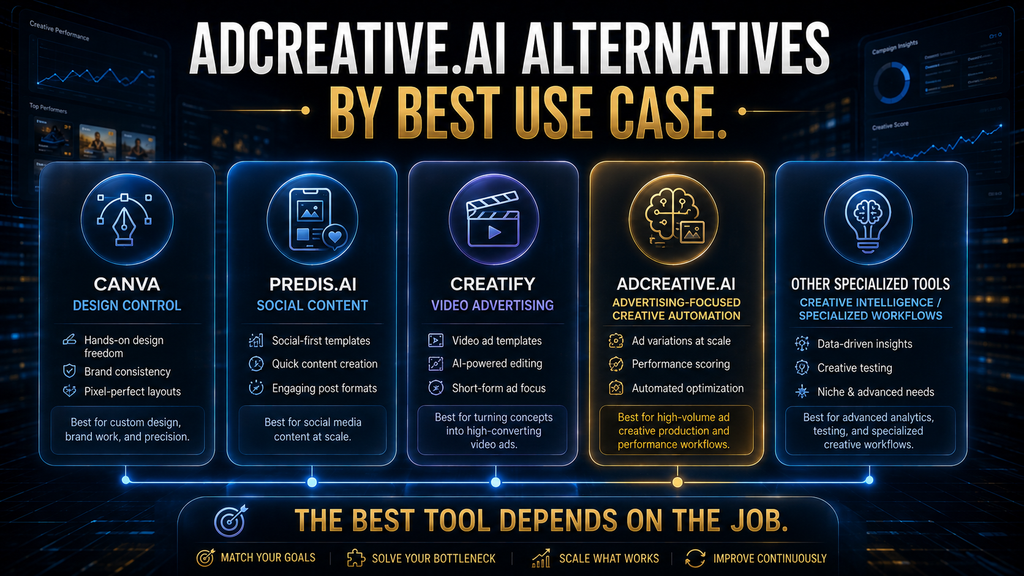
Here is the practical map:
- Canva: best when design control, flexibility, and a broader creative ecosystem matter more than specialized advertising automation.
- Pencil: best when predictive intelligence and performance-informed creative generation are central to the workflow.
- Predis.ai: best when paid advertising sits alongside a large organic social-content operation.
- Creatify: best when video ads, AI actors, URL-to-video, and high-volume short-form production are the priority.
- The Brief: best when the team wants creative automation connected to campaign discovery, creation, launch, optimization, and governance.
- Abyssale: best when repeatable templates, bulk production, programmatic generation, and APIs matter more than AI-generated campaign concepts.
The important part is what happens after you make that choice. A cheaper subscription is not necessarily cheaper operationally if your designers spend another two hours fixing every output. Likewise, a more sophisticated platform is not necessarily better if its additional capabilities never address the bottleneck that is costing your team time or money.
Why People Look for AdCreative.ai Alternatives
People rarely switch advertising software because they suddenly dislike the interface. They switch because the platform no longer fits the way their advertising operation works.
Test AdCreative.ai Before You Switch Away
Use the free trial on one campaign and see whether your problem is the tool or the way you brief it.
Test AdCreative.ai Free →Affiliate disclosure: We may earn a commission if you subscribe through this link, at no additional cost to you.
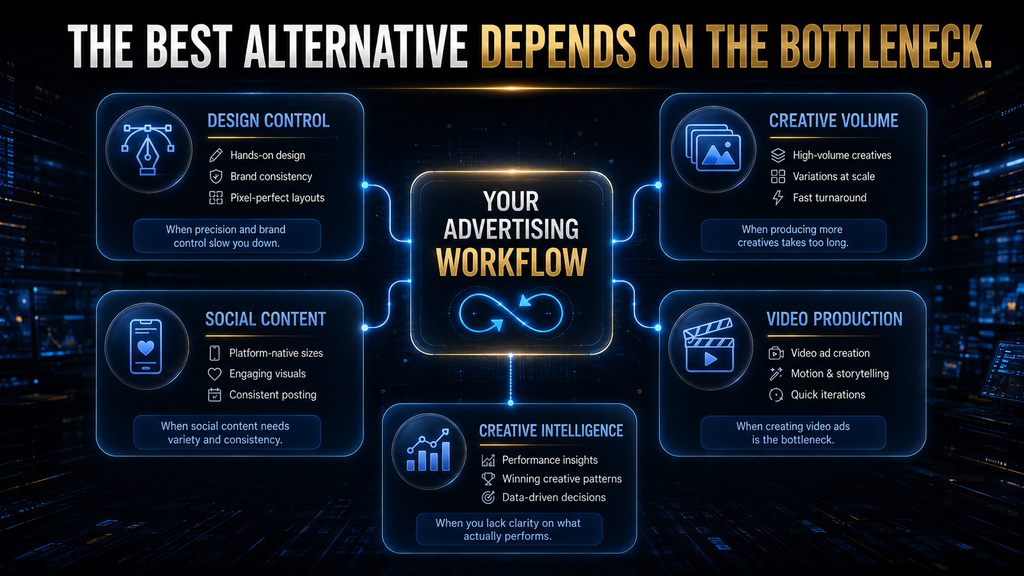
A small ecommerce brand may discover that it needs more control over the visual design of every product ad. A social-media agency may realize that it needs one system for ads, reels, carousels, captions, scheduling, and competitor analysis. A performance team may want stronger predictive intelligence, while a DTC brand may care far more about producing dozens of UGC-style video ads from product pages. This is why “best AdCreative.ai alternative” is an unusually broad search query. The person asking it could be trying to solve six completely different problems.
The more useful question is: What do you need the alternative to do that AdCreative.ai is not doing well enough for you? That question immediately changes the shortlist.
If your problem is design control. Start with Canva. Canva has historically been strong because it gives users direct control over the final asset rather than asking them to accept an AI-generated result as the finished product. That distinction remains important even as Canva has expanded aggressively into AI-powered advertising. Canva Grow now combines AI ad generation, direct publishing to Meta, TikTok, and LinkedIn, editable creative, and performance insights, while Canva AI continues to emphasize conversational creation and direct editing.
If your problem is creative performance intelligence. Look closely at Pencil. Pencil combines ad generation with performance prediction and can connect advertising-account data to its creative workflow. Its current plans include AI-generated text, image, video, and advertising assets, real-time insights and scores, and the ability to launch and track ads across several major advertising channels.
If your problem is social-content volume. Look at Predis.ai. Predis.ai is designed around a broader social-content workflow, including ads, videos, posts, publishing, brand consistency, competitor analysis, and content generation. Its current product pages explicitly position it around generating large numbers of variations and publishing across multiple channels rather than treating advertising creative as an isolated activity.
If your problem is video production. Look at Creatify. Creatify’s URL-to-video workflow can pull information and media from a product page, generate a script, select assets, create previews, and render a video ad. Its current product also includes AI actors, product ads, AI shorts, ad templates, and tools for producing many video variations.
If your problem is campaign-level workflow. Look at The Brief. The Brief has evolved from Creatopy into a broader advertising platform built around Discover, Create, Launch, and Optimize. Its current product combines creative editing and automation with brand controls, publishing, ad serving, analytics, localization, and campaign optimization features.
If your problem is production at scale
Look at Abyssale. Abyssale is particularly interesting when the creative operation is repetitive and structured: templates, product feeds, multiple sizes, multiple formats, and programmatic generation. Its REST API can generate images, video, GIFs, PDFs, and HTML5 creatives, including batch generation across formats. That is the fundamental distinction this article is built around: an alternative should be selected because it removes a specific constraint, not because it has a longer feature list.
The 6 Best AdCreative.ai Alternatives in 2026
1. Canva — Best for Design Control and Broad Creative Work
Canva is the most obvious alternative for users who feel that AdCreative.ai is too specialized or that they need more control over the creative itself. We compare the two directly in AdCreative.ai vs Canva.
For years, Canva’s advantage was straightforward: it made professional-looking design accessible without requiring a professional designer for every asset. That remains important, but Canva’s advertising capabilities have expanded significantly. Canva Grow now allows users to generate ads from prompts and website/product information, edit those ads inside Canva, publish directly to major advertising platforms, and review performance insights in the same ecosystem. Canva That changes the old comparison. It would be inaccurate to describe Canva simply as “a manual design tool” while AdCreative.ai is “the AI advertising tool.” Canva is now actively moving into the advertising workflow itself.
Why Canva is a strong alternative
The biggest advantage is control. If the AI creates an initial concept but your designer wants to change the composition, typography, imagery, spacing, brand treatment, or individual elements, Canva’s editing environment is built for that kind of intervention.
That becomes especially valuable for brands where the advertisement is part of a larger visual identity system. A fashion brand, SaaS company, agency, or creator business may not want every asset to look like it came from an advertising generator. It may want the ad to look unmistakably like the brand.
Canva also benefits from being much broader than advertising. The same environment can support social posts, presentations, documents, videos, thumbnails, graphics, and other marketing assets. Canva’s current Pro offering also includes AI ad creation and bulk creative capabilities through Canva’s broader ecosystem.
Where Canva is better than AdCreative.ai. Canva becomes the better choice when creative control is more important than advertising specialization. Suppose your marketing team produces ten paid ads, twenty social posts, a presentation, several landing-page graphics, YouTube thumbnails, and email visuals every month. Buying a specialized advertising platform may solve only one part of that workflow. Canva can potentially become the broader creative environment around the entire operation. Its current free plan also makes the barrier to experimentation low, while the Pro plan adds additional content and AI capabilities.
Where Canva is weaker. The trade-off is that Canva’s flexibility can also create more responsibility. A powerful editor does not automatically produce better advertising decisions. Someone still has to decide which concepts deserve testing, how many variations to create, which creative differences are strategically meaningful, and what the campaign data says afterward. Canva Grow is changing this by adding AI-generated advertising and performance feedback, but teams specifically seeking advertising-centric predictive scoring may still prefer a platform such as Pencil or AdCreative.ai.
Best fit. Choose Canva if your priority is design control + broad creative production + brand flexibility. Avoid making it your primary AdCreative.ai replacement if your main problem is not design but the need for advertising-specific creative intelligence and high-volume performance-oriented iteration.
2. Pencil — Best for Predictive Creative Intelligence
Pencil is one of the most interesting alternatives because it attacks a problem that many AI design tools still treat as secondary: which creative is actually likely to perform?
Pencil describes itself as an AI platform for both ad generation and prediction. Its system can use brand assets, advertising guidelines, and performance information to generate creative ideas, while connected ad-account data can feed insights back into the creative workflow. Pencil also supports multiple ad formats and channels, including Meta, TikTok, Google, YouTube, and LinkedIn. Pencil Help Center That makes it a particularly strong option for performance-marketing teams that do not simply need more assets. They need a tighter connection between creative production and performance evidence.
Why Pencil is different
Imagine two teams. Team A produces 100 creative variations but has no structured way to learn which visual patterns, messages, or formats consistently work. Team B produces fewer variations but feeds performance data back into its creative process and uses that information to influence what it produces next. The second team may be operating the more sophisticated system even if it generates fewer assets. That is where Pencil’s positioning becomes interesting. Its value is not merely “AI makes ads faster.” The deeper proposition is that AI can participate in a continuous cycle of generation, prediction, launch, measurement, and improvement. Our AdCreative.ai free trial guide shows what the trial credits actually cover.
Pencil’s current pricing starts at $14 per month for its Core plan with 50 generations, while its Growth plan is $55 per month for 250 generations; enterprise-oriented Pro pricing is custom. The company also offers a free guided experience for creating six ads. Pencil
Where Pencil is better than AdCreative.ai. Pencil is especially compelling if predictive creative intelligence is the reason you are considering a switch. It also has a broader agent-oriented workflow than a simple generator. Its current Agent Framework can support tasks such as audience research, headline development, image generation, campaign ideas, ad generation, and scripting. For a mature performance team, this can be more strategically valuable than simply generating another batch of attractive banners.
Where Pencil is weaker. The biggest issue is that predictive systems can create a false sense of certainty if marketers forget what a prediction actually is. A creative score is not a guaranteed campaign result. Real advertising performance depends on audience, offer, landing page, media buying, market conditions, placement, frequency, competition, timing, and many other variables that no creative model can fully isolate. Pencil itself emphasizes the importance of connecting ad accounts and providing strong brand assets, which reveals an important limitation: the intelligence is only as useful as the context and data feeding the system.
Best fit. Choose Pencil if your operation already spends enough on advertising that creative prediction, performance data, and iterative learning can materially affect decisions. For a beginner running occasional campaigns, its sophistication may be unnecessary.
3. Predis.ai — Best for Social-First Marketing Teams
Predis.ai becomes attractive when your advertising workflow does not live separately from your organic social operation. That distinction is easy to underestimate. Many small businesses do not have a dedicated paid-media creative team and a separate social-content team. The same person may be responsible for Instagram posts, Facebook content, promotional graphics, reels, product videos, captions, scheduling, and paid ads. In that environment, a tool designed around the entire social-content workflow can be more useful than a specialist advertising generator. Our AdCreative.ai vs Predis.ai comparison covers one of its closest rivals.
Predis.ai currently positions itself around generating ads, videos, social posts, copy, headlines, and calls to action from prompts, product URLs, or images. It also supports brand settings, publishing, competitor analysis, and bulk content generation. Predis
Why Predis.ai is compelling. Its biggest advantage is workflow breadth around social content. A campaign might begin with an organic Instagram concept, turn into a carousel, become a short video, generate a promotional variation, and eventually become a paid advertisement. Predis.ai is designed for this kind of interconnected social workflow rather than requiring the marketer to move between several specialized applications. Its current Core plan is listed at $19 per month with 1,300 monthly credits, while higher plans increase brands, publishing capacity, competitor runs, and credits.
For a small marketing team, that can be more economical than maintaining separate tools for social ideation, content generation, scheduling, and advertising creative.
Where Predis.ai is better than AdCreative.ai. Predis.ai is the more compelling choice when social media is the center of gravity. If you are producing organic posts every day and paid ads are only one component of the operation, the broader social system can create less operational friction. It is also designed to produce different content formats from similar inputs, which can make repurposing easier. The current platform supports product ads, UGC-style videos, social creatives, and bulk variations.
Where Predis.ai is weaker. The trade-off is specialization. A social-content platform can produce a large amount of marketing material, but that does not necessarily mean it provides the same depth of advertising-specific performance intelligence as a platform built around creative scoring. This is where buyers often make a mistake: they see that two tools can both generate an advertisement and conclude that they are substitutes. They are substitutes only if the workflow around the advertisement is also interchangeable.
Best fit. Choose Predis.ai if you need social content + ads + scheduling + repurposing in a connected workflow. If your entire business is performance advertising and your team cares deeply about creative scoring rather than social publishing, another alternative will probably fit better.
4. Creatify — Best for AI Video Ads
Creatify is the clearest choice on this list when the creative bottleneck is video. The reason is simple: video has traditionally been expensive to produce at volume. Even a short advertising video can require a concept, script, product footage, actors or creators, voiceover, editing, captions, multiple revisions, and several aspect ratios. If the objective is to test ten creative concepts, the traditional production model becomes painfully slow. Creatify attacks that production problem directly.
Its URL-to-video workflow can take a product URL, extract information and media, generate a script, create video previews, and render a final video. The platform also provides AI avatars, product ads, AI shorts, an ad-flow editor, batch generation, and other advertising-specific tools. Creatify.ai
Why Creatify stands out. The important advantage is not simply that Creatify generates video. It reduces the number of manual stages between product information and testable video creative.
That matters enormously for ecommerce. If a retailer has 100 products and wants to test several video angles for each, a workflow based on traditional filming is structurally difficult to scale. A URL-driven system can potentially turn the product catalog itself into the starting point for creative production. Creatify’s current pricing lists a free plan with 10 monthly credits, Starter at $39 per month for 100 credits, and Pro at $99 per month for 300 credits, with enterprise options beyond that.
Where Creatify is better than AdCreative.ai. Creatify is the better choice when video is the dominant creative format. It is particularly compelling for DTC brands, ecommerce marketers, TikTok advertisers, Instagram advertisers, and teams producing UGC-style creative at volume. The platform currently advertises 1,500 realistic AI actors on Pro, hundreds of AI ad templates, multiple AI media models, and tools for generating video variations.
Where Creatify is weaker. Video generation can create its own bottleneck: quality control. Generating a video is not the same as generating a convincing advertisement. The script still needs a strong proposition. The opening seconds still need a reason to continue watching. The product claims need to be accurate. The visuals need to support rather than distract from the message. This means Creatify can dramatically reduce production friction while leaving the strategic advertising problem intact. That is not a failure of the platform. It is an important boundary condition for AI-generated video.
Best fit. Choose Creatify if your advertising team thinks primarily in video concepts, UGC, product videos, short-form ads, and rapid creative testing. Do not choose it simply because video generation sounds more advanced. If 90% of your campaigns are static display or social graphics, the additional video capability may not solve your actual problem.
5. The Brief — Best for Creative Automation Across the Advertising Lifecycle
The Brief, formerly known as Creatopy, deserves separate consideration because it is no longer simply a banner-design alternative. The platform has expanded around four broad stages: Discover, Create, Launch, and Optimize. Its current product includes creative generation, brand controls, collaborative editing, resizing, localization, ad serving, analytics, and AI-supported campaign workflows. The Brief This makes The Brief particularly relevant for teams that feel their problem is bigger than “we need a better ad generator.”
Why The Brief is different
Imagine a marketing team that has already solved creative generation. Its real problem is fragmentation. The team researches competitors in one place, creates ads in another, sends files to another person for approval, exports them into an advertising platform, localizes them manually for several markets, and then checks performance in yet another dashboard. At that point, buying another generator does not solve the problem. The problem is the number of disconnected stages.
The Brief is designed to reduce that fragmentation. Its current plans include the Ad Studio, AI generation, export formats, brand kits, collaboration, publishing, ad serving, analytics, localization, and more advanced enterprise capabilities. The individual Pro plan is listed at $29 per month when billed annually, while Ultra is $79 per month annually and team plans start at $49 per seat per month annually. AI-powered ad generation – The Brief AI
Where The Brief is better than AdCreative.ai. The Brief is particularly compelling for teams that need a broader advertising operating environment. Its brand controls and approval workflows can matter more to an agency or larger organization than another AI image model. Its ability to support hundreds of formats, localization, publishing, analytics, and feed-driven production also makes it more appropriate for structured creative operations.
Where The Brief is weaker. The broader the platform becomes, the more important implementation becomes. A small advertiser may not need a full advertising lifecycle system. Paying for a large operational platform before the underlying advertising process is mature can create unnecessary complexity. That is a recurring theme across this entire category: more automation is not automatically more efficiency. If your workflow is small, simple, and stable, a simpler tool may create less friction.
Best fit. Choose The Brief if you need creative production + brand governance + collaboration + publishing + campaign workflow. It is particularly interesting for agencies and growing marketing organizations rather than someone who simply needs a handful of ad creatives every month.
Compare It Against the Alternative You Are Considering
Run the same product and brief through AdCreative.ai and your alternative, then compare usable creatives per credit.
Run a Side-by-Side Test →Affiliate disclosure: We may earn a commission if you subscribe through this link, at no additional cost to you.
6. Abyssale — Best for High-Volume Creative Automation
Abyssale is a different kind of alternative. It is less about replacing every creative decision with generative AI and more about making repeatable creative production programmable. That distinction makes it particularly powerful for teams that already know what their designs should look like but need to produce thousands of variations efficiently. Its current REST API can generate images, video, GIFs, PDFs, and HTML5 creatives programmatically. The system allows templates to be populated with different text, images, colors, and other layer values, while batch generation can create multiple formats asynchronously. Abyssale
Why Abyssale matters. Consider a retailer with 5,000 products. The problem is not necessarily that the company lacks creative ideas. The company may already have the template, brand rules, product data, promotional messaging, and required advertising dimensions. What it lacks is a practical way to turn those inputs into thousands of consistent assets. That is where template-driven automation can beat generative AI.
Abyssale can take a structured design and programmatically change the underlying elements while preserving the design system. Its documentation explicitly supports multi-format generation and programmatic workflows, making it particularly relevant to ecommerce catalogs, dynamic advertising, SaaS integrations, and large-scale production.
Where Abyssale is better than AdCreative.ai. Abyssale becomes compelling when the requirement is repeatability and scale rather than creative ideation. If your team needs 100 product banners with different products, prices, images, headlines, and dimensions, the question is not “which AI makes the prettiest ad?” The question is “which system can reliably generate the entire asset set without creating manual work?” That is a very different problem.
Where Abyssale is weaker. The limitation is equally clear: a highly automated template system does not replace strategic creative thinking. If you need an AI to propose radically different concepts, hooks, messaging approaches, or campaign ideas, a predictive or generative advertising platform may be more appropriate. Abyssale is strongest when the creative system is already defined and the bottleneck is execution at scale.
Best fit
Choose Abyssale if your organization needs programmatic, template-driven, API-based, multi-format creative production. For a solo marketer creating ten campaign assets a month, it may be far more infrastructure than necessary.
AdCreative.ai vs Canva: The Short Answer
For most people who need to design occasional advertisements, social media graphics, branded content, or marketing materials, Canva is the more versatile and economical starting point. Its broad design ecosystem, templates, brand controls, AI tools, collaboration capabilities, and large asset library make it useful far beyond advertising.
For marketers whose primary problem is advertising creative production at scale, AdCreative.ai is the more specialized choice. It is designed around generating advertising variations, producing ad copy and imagery, evaluating creatives with its scoring system, and helping teams move more quickly from campaign idea to multiple testable assets. The important distinction is therefore control versus advertising-specific production velocity. Canva generally gives you more control over the overall design environment, while AdCreative.ai is designed to push the workflow toward advertising output, creative variation, and performance-oriented evaluation.
| Category | AdCreative.ai | Canva |
|---|---|---|
| Primary purpose | Advertising creative production | Broad visual communication and design |
| Best for | Paid-ad teams and performance marketers | Creators, marketers, businesses, and designers |
| Ad generation | Strong, specialized | Strong, but part of a broader platform |
| General design flexibility | Moderate | Excellent |
| Templates | Advertising-focused | Extremely broad |
| AI generation | Advertising-focused | Broad creative AI ecosystem |
| Creative scoring | Core capability | More focused on design/ad insights rather than the same specialized scoring workflow |
| Brand control | Strong | Very strong |
| Collaboration | Stronger for advertising workflows | Strong across many content types |
| Content beyond ads | Limited compared with Canva | Excellent |
| High-volume ad testing | Strong fit | Possible, but more manual |
| Ease for beginners | High | Very high |
| Best strategic role | Creative production and testing engine | Design and visual communication platform |
The table makes the distinction easier to see, but it still does not answer the most important question: which workflow are you actually trying to build?
AdCreative.ai vs Predis.ai: The Short Answer
Choose AdCreative.ai when advertising creative production, creative performance analysis, and ad-specific optimization are central to your workflow. Choose Predis.ai when you need a broader system for creating, repurposing, scheduling, and publishing social and marketing content across multiple channels. That is the simplest answer, but it needs qualification.
AdCreative.ai currently positions its platform around generating advertising assets, ad copy, product visuals, video ads, Instant Ads, Creative Insights, Competitor Insights, and Creative Scoring. Its official product pages describe the platform as a system for generating ad assets, analyzing creative performance, studying competitors, and scoring creatives before media spend.
Predis.ai has a broader content-operations orientation. Its current feature set includes social media posts, ads, ecommerce product posts, videos, reels, carousels, brand guidelines, collaboration, competitor analysis, scheduling, publishing, and APIs for multiple content formats. Its scheduler can connect multiple major social platforms and manage creation, scheduling, and publishing from one workflow. So if your team says, “We need more advertising creatives to test and better intelligence around those creatives,” AdCreative.ai is the more natural fit.
If your team says, “We need to keep Instagram, TikTok, LinkedIn, Facebook, Pinterest, YouTube Shorts, and other channels consistently supplied with content,” Predis.ai becomes much more compelling. The mistake is buying one because it has a longer feature list when the real question is where your workflow is breaking.
How These Alternatives Actually Compare
At this point, the temptation is to ask which platform wins. That is still the wrong question. The better comparison is which platform wins for a specific creative operating model.
| Platform | Best fit | Main advantage over AdCreative.ai | Main trade-off |
|---|---|---|---|
| Canva | General creative teams | Maximum design flexibility and broad creative ecosystem | Less specialized around performance-first advertising |
| Pencil | Performance marketers | Predictive intelligence + generation + performance data | More sophisticated than many small teams need |
| Predis.ai | Social-first teams | Social content, ads, scheduling and repurposing | Less focused on specialized predictive ad intelligence |
| Creatify | Video-first advertisers | URL-to-video, AI actors and high-volume video production | Primarily solves the video problem |
| The Brief | Agencies and mature teams | Broader advertising lifecycle and automation | More operational complexity |
| Abyssale | High-volume production | API/template automation and scalable asset generation | Better for structured production than creative ideation |
| AdCreative.ai | Performance-focused creative teams | Creative scoring + ad generation + advertising integrations | Less compelling when the bottleneck is broader design, social, video, or programmatic production |
The table is useful because it exposes something that ordinary “top alternatives” articles often hide: there is no universal replacement. A platform can be technically more capable and still be the wrong purchase.
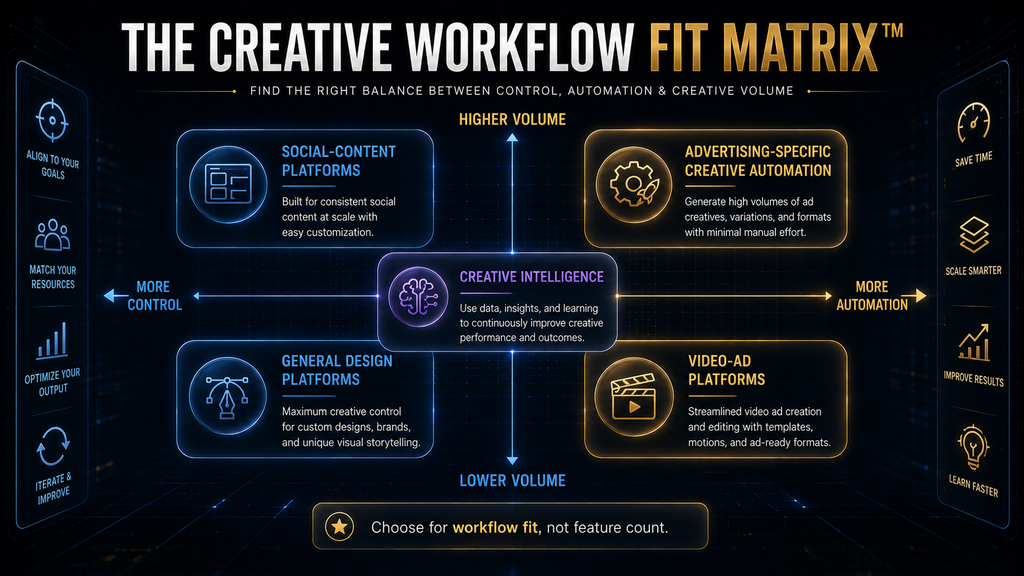
The Most Important Decision: What Is Your Creative Bottleneck?
This is the framework I would use before switching platforms. Our guide to AdCreative.ai for small business looks at whether the Starter plan is enough.
The Creative Bottleneck Fit Framework
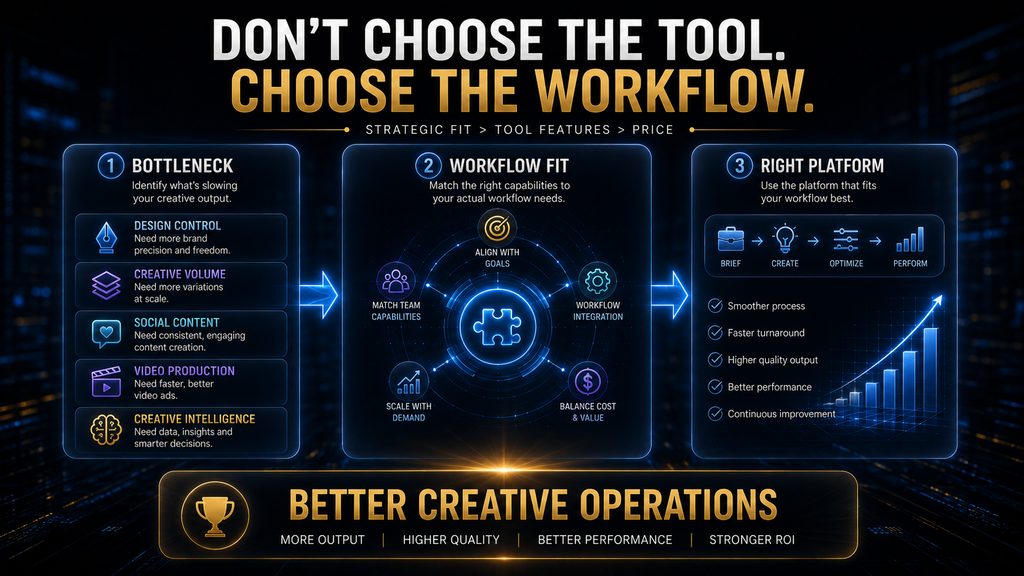
Think about your advertising workflow as five possible constraints: Control → Volume → Intelligence → Format → Operations If control is the constraint, move toward Canva. If intelligence is the constraint, examine Pencil. If social volume is the constraint, Predis.ai becomes more attractive. If video production is the constraint, Creatify deserves priority. If operations and campaign management are the constraint, look at The Brief. If structured asset production at scale is the constraint, Abyssale may be the better fit.
AdCreative.ai remains attractive when your central requirement sits closer to advertising-specific creative generation and performance-oriented creative evaluation. Its Creative Scoring system currently claims more than 90% accuracy in performance prediction and can incorporate data from connected advertising accounts such as Meta, Google, and LinkedIn. Those are vendor claims, so they should be treated as such rather than as guarantees of campaign performance. The framework is intentionally simple because complexity can obscure the actual buying decision.
Before switching, complete this sentence: “Our advertising team is currently losing the most time because ______.” If the answer is “design revisions,” look at Canva. If it is “we do not know which creative direction is likely to work,” look at Pencil. If it is “we are producing social content and ads separately,” look at Predis.ai. If it is “video production is too slow,” look at Creatify. If it is “the workflow between creative, publishing, and optimization is fragmented,” look at The Brief.
If it is “we need thousands of structured variations,” look at Abyssale. That is much more reliable than comparing 40 feature checkboxes.
The Cheapest Alternative Is Not Always the Cheapest Workflow
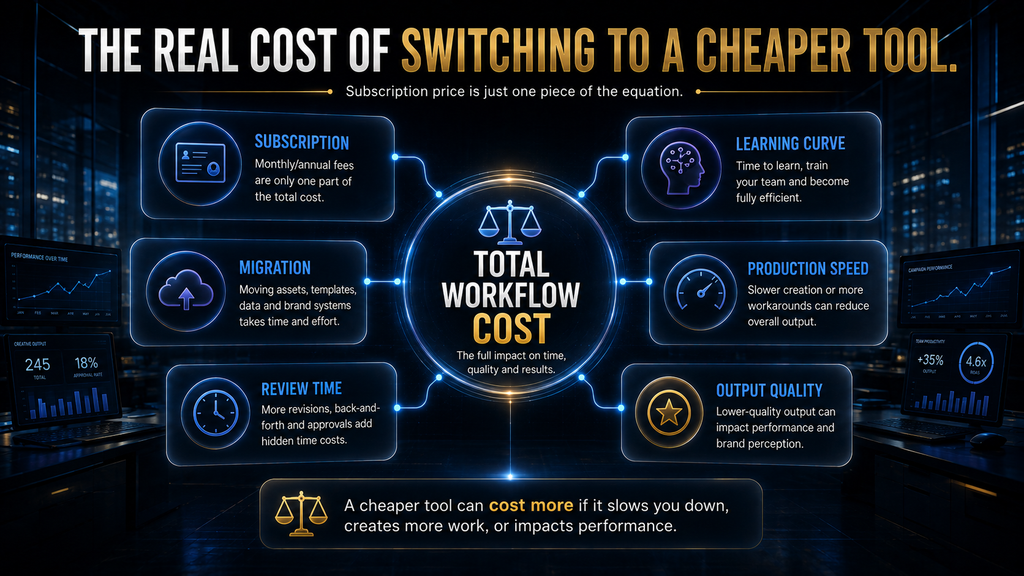
Price is one of the first things people look at when searching for alternatives, but subscription price is only one component of the economics.
Suppose one platform costs $15 per month but every generated asset requires 10 minutes of manual cleanup. Another costs $40 per month but produces assets that require only two minutes of review. If a team produces 100 assets every month, the difference in labor can dwarf the difference in subscription cost. This is why the correct calculation is: Software cost + production labor + revision time + review time + switching cost + unused capability.
That final component is frequently ignored. A sophisticated platform can look like a bargain because it has dozens of capabilities, but if your team uses three of them, the remaining functionality is not value. It is unused capacity. The same principle applies in the other direction. A cheap tool can become expensive if it forces the team to stitch together four additional services for copywriting, resizing, scheduling, analytics, and publishing.
A simple ROI test
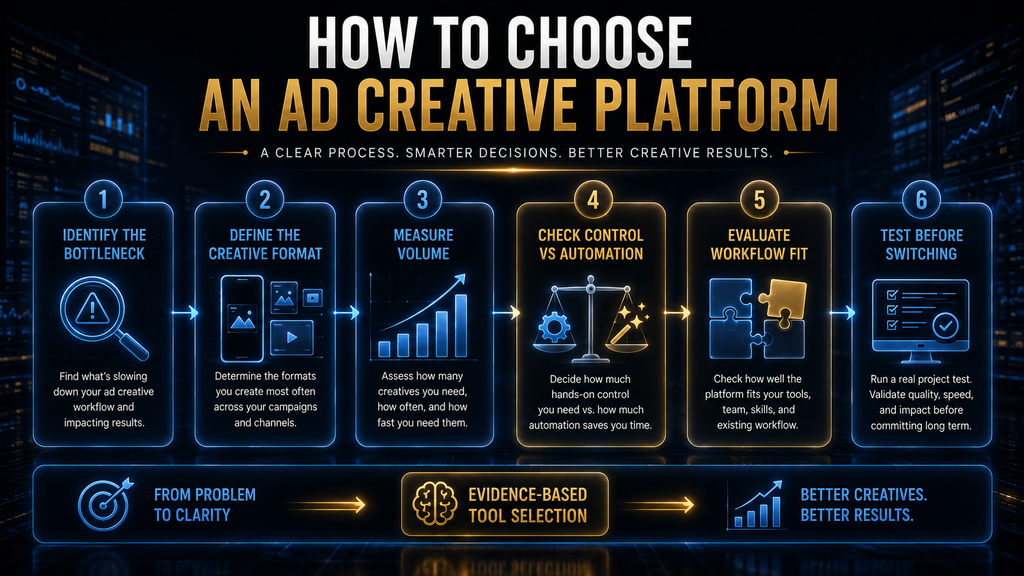
Take one campaign you have already produced. Do not create a fictional test campaign designed to make the new tool look impressive. Use a real campaign with real constraints: the actual brand, actual product, actual dimensions, actual number of variations, and actual review requirements. Then measure: Plan data for other tools is in our AI Tool Pricing Database.
- time to first usable creative;
- number of manual revisions;
- number of usable variations;
- time required to create additional sizes;
- time required to create another concept;
- time required for brand approval;
- time required to prepare assets for launch;
- and the cost of any additional tools needed to finish the workflow.
That experiment tells you far more than a feature comparison.
Why the Traditional Creative Workflow Still Exists
AI advertising tools sometimes create the impression that the traditional workflow was inefficient because marketers lacked better software. That is too simplistic.
Traditional creative production exists because advertising contains several different kinds of work that are difficult to collapse into one automated process. Someone has to understand the brand, interpret the brief, decide what the advertisement should communicate, select the right visual language, evaluate whether the concept is strategically appropriate, check factual claims, and decide whether the final asset is actually worth putting in front of customers. Automation is excellent at compressing repetitive execution. It is much less reliable when the problem is ambiguous.
That is why the strongest modern workflow is usually not AI replaces the creative team. It is AI reduces the amount of low-value production work so the creative team can spend more time on the decisions that actually matter.
The distinction becomes especially important for brands with reputational risk. A generated image can be technically polished and strategically wrong. A generated headline can be persuasive and factually misleading. A predicted performance score can be useful and still fail to account for a sudden change in audience behavior. Human judgment remains the final layer precisely because advertising is not only a production problem.
When You Should Not Switch From AdCreative.ai
This is the part many alternatives articles leave out because it is less commercially convenient. If AdCreative.ai is already producing the volume you need, its creative scoring is useful to your decision-making, your team does not need a broader social publishing platform, and you are not experiencing meaningful problems with brand control or production workflow, switching may simply create unnecessary work.
The same applies if the alternative is cheaper but does not materially improve the process. Saving $20 or $30 per month is not a meaningful optimization if the team loses several hours learning a new platform, rebuilding templates, moving assets, recreating brand settings, and adjusting its production process. There is also a more subtle reason to stay: workflow familiarity has economic value. Every mature creative operation develops conventions around naming, review, approval, file organization, brand rules, campaign structure, and performance analysis. Changing the software can disrupt those conventions even when the replacement looks better in a demo. So if your current system works, the burden of proof belongs to the alternative.
When You Should Actually Switch
The case for switching becomes stronger when the problem is structural rather than cosmetic. If your designers spend too much time manually controlling layouts, Canva becomes more compelling. If your advertising team wants performance prediction and deeper connections between creative generation and advertising data, Pencil deserves serious consideration. If your business creates large volumes of organic social content alongside paid advertising, Predis.ai may reduce more workflow friction than a specialist ad generator. The full AdCreative.ai review has the complete verdict.
If video is becoming the dominant advertising format, Creatify can make a stronger case. If the organization is struggling with disconnected discovery, production, publishing, localization, and optimization stages, The Brief may address the underlying problem more directly. And if the operation already has standardized designs and simply needs to produce massive numbers of variants programmatically, Abyssale may be the most rational choice. The important word is structural. Do not switch because another platform has a prettier homepage or a new AI feature. Switch when your existing platform is preventing the team from doing something that materially matters to the business.
The Hidden Cost of Switching Tools
There is a cost that does not appear on most pricing pages: migration friction. Your team may need to recreate brand settings, templates, workflows, permissions, naming conventions, asset libraries, saved prompts, campaign structures, integrations, and approval processes. Someone has to learn the new interface, determine which features behave differently, and establish a new quality-control standard. For a solo creator, that cost may be negligible. For an agency managing multiple brands, it can become significant. Our AdCreative.ai pricing guide compares each plan against typical ad budgets.
This is why the right alternative is not necessarily the tool with the highest score in an abstract comparison. It is the platform that creates enough incremental value to justify the operational cost of changing the system around it. A practical switching threshold is therefore: Do not switch because the alternative is better. Switch because it is better enough to change your economics. That is a much harder standard—and a much more useful one.
What Happens If You Do Nothing?
Doing nothing is also a decision. If your current workflow is inefficient and you continue using it unchanged, the cost may not remain constant. Creative production can become more expensive as campaign volume grows. Designers can spend more time on repetitive variations. Teams can reduce the number of concepts they test simply because they cannot produce them quickly enough. That creates a second-order effect: the production bottleneck can eventually become a learning bottleneck.
Imagine that your team has 30 viable creative hypotheses but can only afford to produce five. The obvious cost is the five assets you never produced. The less obvious cost is the information you never collected from those experiments. On the other hand, if your advertising volume remains small, the cost of doing nothing may be negligible. A business running two campaigns a quarter does not necessarily need an elaborate creative automation stack. This is why the “do nothing” option belongs in every software decision.
Common Mistakes When Choosing an AdCreative.ai Alternative
Mistake 1: Choosing the tool with the most AI features. Feature volume is one of the weakest indicators of product fit. A tool with image generation, video generation, AI copywriting, analytics, scheduling, avatars, templates, competitor research, and automation may look unbeatable. But if your actual bottleneck is producing ten branded display variations quickly, most of those features are irrelevant. The correct tool is the one that solves the expensive problem.
Mistake 2: Comparing generated images instead of workflows. A single impressive output proves almost nothing. You should compare how each platform handles the complete process: input, generation, editing, variations, brand consistency, approval, export, launch, measurement, and iteration. The better-looking first image can still belong to the worse workflow.
Mistake 3: Ignoring revision time. AI-generated creative is not automatically finished creative. If the generated output consistently requires significant changes, your team may simply have moved the production work from “creating” to “fixing.” That can still be useful, but you need to measure the actual time saved.
Mistake 4: Treating performance prediction as a guarantee. Creative scoring can be useful for prioritization, but it should not be confused with certainty. A predicted score is a decision-support signal. The market remains the final test.
Mistake 5: Buying for future volume. This is especially common with small businesses. A company sees that it might eventually produce hundreds of ads and buys a platform designed for that future operation. Six months later, the company is still producing twenty ads per month. Buy for existing demand with credible near-term growth, not an imaginary future workload.
Mistake 6: Switching before defining the problem. This is the most expensive mistake. If you cannot clearly explain why the current platform is failing your workflow, you are not ready to choose an alternative. You are simply shopping for features.
A Better Way to Test an Alternative Before Paying
The most reliable test is a controlled creative-workflow experiment. Take one real campaign and rebuild it in the alternative. Use the same product, same audience, same core message, same brand assets, and approximately the same number of creative concepts. Do not judge the platform only by how impressive its first output looks. Instead, ask five questions. How quickly did we reach a usable first creative? This measures initial production friction.
How much manual correction did the output require? This reveals whether AI actually removed work or merely changed its location. How easily could we produce meaningful variations? Ten versions that differ only cosmetically are less useful than five versions that test genuinely different hypotheses. How easily could the team move those assets into its existing advertising process? An excellent creative trapped inside a disconnected workflow is still operationally expensive. Did the platform change what we could realistically test? This is the most important question because it measures whether the tool changes your actual marketing capability rather than simply your production speed.
That last question is where many software comparisons stop too early. The objective is not to generate more ads. The objective is to learn faster which advertising ideas deserve more money.
Which Alternative Is Best for Each Budget?
Budget should influence the decision, but it should not dominate it.
If your budget is very limited. Start with Canva or the free entry points available from several specialized platforms. Canva currently has a free plan, while Creatify offers a free tier and Pencil provides a free guided experience for six ads. For a beginner, that makes experimentation relatively inexpensive.
If you can spend around $20–$40 per month. This is where several serious options become available. Predis.ai’s current Core plan is $19 per month, The Brief’s Pro plan is $29 per month when billed annually, AdCreative.ai’s Starter plan is listed at $39 monthly, and Creatify’s Starter plan is $39 monthly. At this level, choose according to workflow rather than price alone.
If you are spending around $50–$100 per month. The decision becomes more about operational maturity. Pencil’s Growth plan is $55 monthly, The Brief’s Ultra plan is $79 monthly when billed annually, and Creatify’s Pro plan is $99 monthly. At this point, the value of better performance intelligence, higher creative volume, video production, publishing, or team workflows can justify the higher subscription—but only if you actually use those capabilities.
If you are an agency or enterprise operation. Do not choose based on the lowest advertised price. Your real requirements are likely to involve multiple brands, permissions, approvals, data governance, asset management, APIs, production volume, and integrations. Pencil, The Brief, AdCreative.ai, and Abyssale all offer paths into more advanced workflows, but their strengths are different. At this level, the buying decision should be based on total workflow economics and governance, not a consumer-style feature comparison.
Should You Try an Alternative Before Canceling AdCreative.ai?
Yes—if you are seriously considering switching, test the alternative before cancelling your existing subscription. The reason is simple: your current workflow is your baseline. If you cancel first, you lose the ability to make a controlled comparison. You will be judging the new tool against memory rather than against actual production data. Run one campaign through both systems if your budget allows it. Measure production time, usable output, revision time, variation quality, brand consistency, and how easily the assets move into your advertising workflow. If you decide to stop, our guide to cancelling an AdCreative.ai subscription explains how to avoid surprise renewals.
If the alternative clearly wins on the metric that matters most to your business, the switch becomes much easier to justify. If it does not, you have learned something valuable without making an unnecessary migration.
The Contrarian Take: You May Not Need an AdCreative.ai Alternative at All
There is a strong temptation in AI software markets to assume that the newest tool is automatically the better tool. That is dangerous. For a wider view of tools for smaller teams, see our list of the best AI tools for small business owners.
Advertising software is particularly vulnerable to this because demonstrations are visually persuasive. A new platform can generate an impressive ad in seconds, and suddenly the old workflow feels obsolete. But a marketing system should be judged by outcomes and economics, not by how impressive a ten-second product demo looks. Sometimes the best AdCreative.ai alternative is better use of AdCreative.ai. If the platform is already producing usable creative, the scoring is useful, and the team understands how to integrate it into a disciplined testing process, switching may simply restart the learning curve.
The more mature your marketing operation becomes, the more valuable continuity can be. The goal is not to own the most advanced AI advertising stack. The goal is to build the most effective creative-learning system your business can actually operate.
What I Would Choose by Use Case
If I were advising different teams rather than trying to declare one winner, my recommendations would look like this.
For a solo creator or small business. Start with Canva if you need broad design flexibility and are still developing your creative process. It gives you a low-friction environment in which the same tool can support ads, social content, presentations, graphics, and other marketing work. Canva’s free tier also makes experimentation relatively easy.
For a performance marketer. Look at Pencil if creative performance intelligence is a genuine part of your decision process. Its combination of generation, performance data, predictive insights, and ad-account connectivity is much closer to the needs of a performance-oriented operation than a general design platform.
- For a social media agency. Look at Predis.ai. If your team is simultaneously producing organic posts, reels, promotional content, ads, and scheduled social content, the broader workflow can be more valuable than a specialist advertising generator.
- For ecommerce video advertising. Choose Creatify if video is the main bottleneck. Its URL-to-video workflow and AI actor ecosystem make it particularly relevant when you need to turn products into many short-form advertising concepts quickly.
- For agencies and larger marketing teams. Evaluate The Brief if your biggest problem is fragmentation between discovery, creation, publishing, and optimization. Its current platform is designed around the broader campaign lifecycle rather than only creative generation.
- For catalog-heavy businesses. Evaluate Abyssale if your creative requirements are highly structured and repetitive. When the problem is producing thousands of on-brand variations from known templates and data, programmatic generation can be more valuable than increasingly sophisticated creative ideation.
For teams already satisfied with performance-focused creative generation
Stay with AdCreative.ai unless an alternative solves a specific problem that matters enough to justify switching. Its current offering still combines AI creative generation, creative scoring, ad-platform integrations, custom templates, and competitor insights, making it a strong fit for the performance-advertising use case it was built around.
A Simple Switching Checklist
Before moving away from AdCreative.ai, answer these questions honestly:
- What specific problem is causing us to consider switching?
- How frequently does that problem occur?
- How much employee time does it consume?
- Does the alternative solve that problem directly or merely offer more features?
- Will the new platform reduce production time after revisions are included?
- Can it maintain our brand standards?
- Can our team actually learn and adopt it?
- Does it integrate with our existing advertising workflow?
- Will we lose anything important by leaving AdCreative.ai?
- Does the expected improvement justify the switching cost?
If you cannot answer the first three questions, you probably should not switch yet.
Final Thoughts
The best AdCreative.ai alternative is not the platform with the most impressive AI demo. It is the platform that removes the constraint currently preventing your advertising team from producing, testing, learning, or scaling creative effectively. Whatever tool you use, generated ads still have to comply with Meta’s Advertising Standards and Google Ads policies, so review every creative before it goes live.
That is why the alternatives in this guide are deliberately different. Canva wins when control matters. Pencil wins when performance intelligence matters. Predis.ai wins when social content and advertising need to live together. Creatify wins when video production is the bottleneck. The Brief becomes more compelling when the entire advertising workflow is fragmented, while Abyssale stands out when structured creative production needs to operate at programmatic scale. And sometimes the right answer is to stay with AdCreative.ai.
That is not a failure of the alternatives. It is the correct outcome of a good buying decision. If your current system already works, the alternative needs to create enough measurable improvement to justify the subscription, migration, learning curve, and operational disruption. The memorable takeaway is simple: Don’t choose an AdCreative.ai alternative because it is more advanced. Choose it because it solves your specific creative bottleneck better. That is the difference between buying another AI tool and actually improving the advertising operation.
Decide Whether You Still Need an Alternative
Check AdCreative.ai’s credits and features against your ad spend and workflow before you commit to a switch.
Review AdCreative.ai Plans →Affiliate disclosure: We may earn a commission if you subscribe through this link, at no additional cost to you.
Frequently Asked Questions
What is the best AdCreative.ai alternative in 2026?
There is no single best alternative for every user. Canva is the strongest broad option for design control, Pencil is particularly strong for predictive creative intelligence, Predis.ai fits social-first teams, Creatify is specialized around video advertising, The Brief targets broader advertising workflows, and Abyssale is especially useful for programmatic creative automation.
Is Canva better than AdCreative.ai?
Canva can be better if your priority is design flexibility and broader creative production. AdCreative.ai is more specialized around advertising creative generation and performance-oriented scoring, so the better choice depends on whether your bottleneck is creative control or advertising-specific automation. Canva Grow now also includes AI ad generation, direct publishing, and performance insights, making the comparison closer than it used to be.
Is Pencil better than AdCreative.ai?
Pencil can be the better choice for teams that place significant value on predictive creative intelligence and performance data. It connects creative generation with advertising-account information and provides performance insights, but those predictions should still be treated as decision-support signals rather than guarantees.
Is Predis.ai cheaper than AdCreative.ai?
Predis.ai currently lists its Core plan at $19 per month, while AdCreative.ai lists its Starter plan at $39 per month on monthly billing. However, the products are not directly equivalent: Predis.ai is broader around social content and publishing, while AdCreative.ai is more specialized around advertising creative and performance workflows. Predis.ai lists its current plans on its pricing page.
Is Creatify a good AdCreative.ai alternative?
Creatify is a strong alternative when video ads are your primary requirement. Its platform supports URL-to-video generation, AI actors, product ads, short-form video creation, and high-volume video workflows. You can compare the current numbers in the AdCreative.ai pricing section.
What is the best AdCreative.ai alternative for ecommerce?
The answer depends on the ecommerce workflow. Creatify is particularly compelling for video-heavy product advertising, while Abyssale can be a stronger choice when the operation needs large numbers of structured, template-driven product creatives generated programmatically. Our guide to the AdCreative.ai Shopify integration covers the store side in detail.
What is the best free alternative to AdCreative.ai?
Canva has a free plan, while Creatify also offers a free plan with monthly credits, and Pencil offers a free guided experience for creating six ads. The best free option depends on whether you need design flexibility, video generation, or performance-oriented creative experimentation.
Should I cancel AdCreative.ai before testing another tool?
No. If possible, test the alternative while your current workflow remains available. Recreate a real campaign in both systems and compare production time, revisions, usable variations, brand consistency, and workflow integration before making the final decision.
Is an AdCreative.ai alternative worth switching to?
It can be, but only when the alternative solves a meaningful structural problem. A lower subscription price or a longer feature list is not enough; the alternative should produce a measurable improvement in the workflow that matters to your advertising operation.
Written by
Muntasir Ahmad Chowdhury
Founder, AI Hustle World
Muntasir Ahmad Chowdhury is the Founder of AI Hustle World, an independent publication dedicated to making Artificial Intelligence practical, trustworthy, and easy to understand. He researches AI tools, automation, customer service, productivity, and real-world business applications, helping readers make smarter technology decisions through research-driven, experience-backed content.
Expertise:
AI Tools • AI Automation • AI Customer Service • AI Productivity • Generative AI • AI Workflows
Get Smarter With AI
Enjoyed this guide? Get practical AI tools, tutorials, and honest reviews delivered to your inbox.