
How AI Answers Questions: The Complete Journey from Prompt to Response
Last updated: August 2026
When you type a question into an AI assistant and receive a polished answer a few seconds later, it is tempting to imagine a single machine “looking up” the answer and sending it back.
That is not a good mental model.
A modern AI answer can involve several layers working together: your prompt, the surrounding context, tokenization, a neural language model, additional reasoning or computation, retrieval systems, external tools, safety and product instructions, and finally the generation and presentation of the response. Which layers are involved depends on the AI product and the request.
The simplest useful way to understand it is this:
An AI answer is produced by a pipeline, not by a single lookup.
A model may generate language from patterns learned during training, while an AI application can add context, retrieve current information, call tools, or perform additional computation before presenting the final response. OpenAI’s own documentation describes ChatGPT as a service capable of tasks such as summarization, coding, research, image work, and multi-step tasks across tools; it also distinguishes ordinary model knowledge from information obtained through search or other tools.
Understanding that distinction makes almost everything else about AI easier to understand—including tokens, hallucinations, reasoning, web search, prompt quality, and why two answers to the same question can differ.
What Actually Happens When You Ask an AI a Question?
At a high level, the journey looks like this:
Your input → context → tokens → model processing → reasoning or tool use when needed → token generation → response assembly → final answer
That sequence is a teaching model rather than a universal technical specification. Different AI systems implement these stages differently, and some requests may skip entire stages. A simple rewriting request may require no web search at all, while a question about today’s events may trigger retrieval before the answer is generated.
The crucial distinction is between the model and the AI application surrounding the model.
A language model is the component that generates and processes language. An AI assistant is a larger system that can provide the model with instructions and context, connect it to tools, retrieve information, manage the interaction, and turn the model’s output into the experience you see.
That is why saying “ChatGPT is just a language model” is incomplete. The product can do considerably more than the underlying model could do in isolation. OpenAI documents capabilities including web search, data analysis, deep research, image handling, and multi-step tool use.
The AI Response Pipeline™
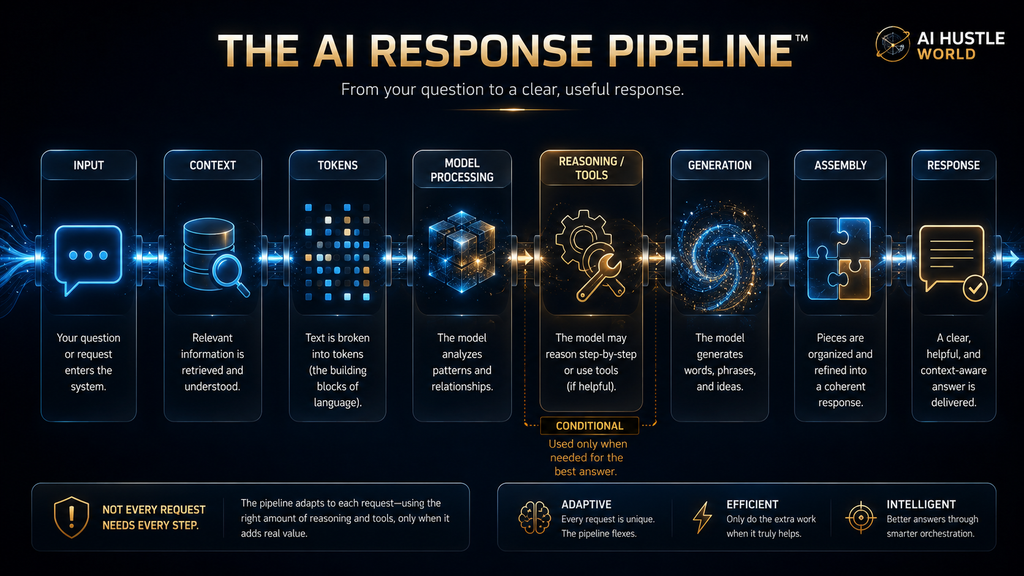
To make the process easier to follow, think of an AI answer as passing through eight major stages:
- Input — you provide a question, instruction, file, image, or other supported information.
- Context — the system determines what additional information and instructions are available.
- Tokenization — text is converted into tokens the model can process.
- Model processing — the neural network analyzes relationships among the available tokens.
- Reasoning and tools — depending on the task, additional computation, retrieval, or tools may be used.
- Generation — the model produces output tokens sequentially.
- Assembly — the application turns those outputs and tool results into a usable response.
- Delivery — you see the final answer through the AI product’s interface.
The important part is that not every AI question follows exactly the same path.
Ask an AI to rewrite a paragraph you supplied, and the system may primarily work with your provided context. Ask for the latest information about a company, and a search-enabled system may retrieve current sources first. Ask an AI agent to complete a task, and the system may repeatedly alternate between reasoning, tool calls, observations, and additional generation.
That is the foundation for understanding modern AI assistants.
Step 1: Your Question Enters the System
Everything begins with an input.
That input might be a simple sentence:
Or something much more complicated:
“Compare these three business plans, identify the biggest financial risks, and recommend which one makes sense for a small company.”
The second request contains multiple jobs. The system has to understand the instruction, identify the supplied material, determine what the user is asking for, and decide what kind of response would satisfy the request.
The input can also contain more than text. Modern AI systems can work with different modalities, including images and other forms of information depending on the product. OpenAI describes ChatGPT and its foundation models as working across text, images, audio, and video in different contexts.
So “prompt” should not be understood only as a sentence typed into a chat box.
It is better understood as the information and instruction the system receives for a particular task.
Step 2: The System Builds the Context
The model does not necessarily see only the latest sentence you typed.
The surrounding application may provide additional context.
That can include:
- earlier messages in the conversation;
- system-level instructions;
- developer instructions;
- information supplied by the application;
- uploaded documents;
- retrieved information;
- tool results;
- other context available to the particular product.
This is why the same sentence can produce different answers in different conversations.
Consider:
“Rewrite this professionally.”
By itself, that request is ambiguous.
But if the conversation already contains a rough business email, the system has enough context to understand what “this” refers to.
Context therefore acts as the bridge between what you just said and what you mean within the current interaction.
This is also where an important distinction appears: context is not automatically the same thing as persistent memory. A system can have information available for the current interaction without that information becoming a permanent memory about the user.
Your August cluster includes a separate article dedicated to AI memory, so this article should only establish the distinction rather than consume that topic. The Master Sheet places “How AI Memory Works: Context Windows vs Long-Term Memory” in the later August cluster.
Step 3: Your Text Is Broken Into Tokens
Before a language model can process ordinary text, the text has to be represented in units the model works with.
These units are called tokens.
A token is not necessarily a complete word. Depending on the tokenizer and language, it can represent a whole word, part of a word, punctuation, spaces, or other pieces of text. OpenAI’s documentation explicitly describes tokens as the building blocks models process and notes that words can be split into multiple tokens.
For example, a sentence such as:
“AI can summarize documents.”
might be divided into several tokens rather than being treated as five complete words.
The exact tokenization depends on the model and tokenizer.
This matters for three reasons.
First, models operate on tokens rather than the abstract concept of “words.”
Second, the number of tokens affects how much information can fit into the model’s available context.
Third, tokenization helps explain why language models can generate partial words, punctuation, code fragments, and other structures rather than operating only at the word level.
Your dedicated What Are AI Tokens? article can go much deeper into this mechanism; here, the important point is simply that the model cannot process your sentence as an undifferentiated block of English.
Step 4: Tokens Become Numerical Representations
Tokens themselves are not meaningful to a neural network in the way words are meaningful to humans.
They are mapped into numerical representations that the model can manipulate mathematically.
This is one reason AI systems are fundamentally different from a traditional database.
A database might store:
“Paris is the capital of France.”
as a discrete record.
A neural language model does not simply maintain a giant collection of sentences and retrieve one matching sentence whenever you ask a question. During training, its parameters are adjusted to learn patterns and relationships from large amounts of data. OpenAI describes this learning process as analyzing relationships in training data and using what is learned to predict subsequent tokens during generation.
That distinction is essential.
The model’s learned parameters are not equivalent to a searchable encyclopedia.
They encode statistical structure learned during training.
Step 5: The Transformer Processes Relationships Between Tokens
This is where the underlying neural architecture becomes important.
Modern language models commonly use architectures derived from the Transformer, introduced in the 2017 research paper Attention Is All You Need. The paper proposed a sequence-processing architecture based entirely on attention mechanisms rather than recurrent or convolutional sequence processing.
You do not need to understand the mathematics to understand the basic idea.
The model needs to determine how different parts of the available context relate to one another.
Consider:
“The company rejected the proposal because it was too expensive.”
What does “it” refer to?
The model needs to use relationships across the sentence to interpret the structure.
Attention mechanisms help transformer models calculate relationships among elements in the sequence. That does not mean the model is literally paying attention in the human psychological sense. It means the architecture uses learned mathematical operations to determine how information from different positions contributes to the representation being processed.
This is one reason context matters so much.
The model isn’t merely reading each word independently.
It processes the relationships between the tokens available to it.
For a deeper explanation of this language-understanding layer, your existing How AI Models Understand Language article is the appropriate supporting resource.
Step 6: The Model Uses What It Learned During Training
A major beginner misconception is that an AI model “looks up the answer in its training data.”
That is not an accurate description of normal generation.
Training happens before you ask the question.
During training, a model processes large amounts of information and adjusts its internal parameters so that it becomes better at predicting patterns in the data. OpenAI describes this as learning relationships among information and using those learned relationships to generate responses.
When you later ask a question, the model is performing inference.
It is using its learned parameters together with the current input and available context to produce an output.
This gives us one of the most important distinctions in the entire article:
Training
The model learns patterns.
Inference
The model uses what it has learned to generate an output for a particular input.
The model is not normally retraining itself from scratch every time you ask:
“What is photosynthesis?”
It is applying the capabilities acquired during training to the context presented at inference time.
Training vs. Answering: The Difference Most Beginners Miss
Imagine teaching a person thousands of examples of how language works.
Later, you ask that person to complete a sentence they have never seen before.
They do not need to have memorized that exact sentence.
They can use patterns they learned from previous examples.
A language model operates differently from a human, but the analogy illustrates the distinction between memorization of individual answers and learning statistical patterns.
OpenAI describes its models as learning patterns and relationships from large amounts of information and using those patterns to predict what comes next.
This also explains why a model can produce a response it has never literally encountered during training.
It can generate a new sequence from learned relationships.
That is one of the reasons generative AI can write new explanations, transform existing material, generate code, summarize information, and combine concepts.
Step 7: The System May Decide That the Model Needs More Than Its Own Learned Information
This is where modern AI assistants become substantially more sophisticated than the simplistic “prompt in, prediction out” model.
Some questions can be answered from the information already available to the model.
Others require external information.
Consider:
“What happened in the latest central bank announcement?”
A model cannot reliably answer a genuinely current question from old training information alone.
A search-enabled AI system can instead retrieve current information.
OpenAI’s current ChatGPT documentation explains that ChatGPT can search the web for current information and may rewrite a user’s question into one or more targeted queries before sending them to search providers. It can then use those search results in the response and provide citations.
This creates two fundamentally different workflows.
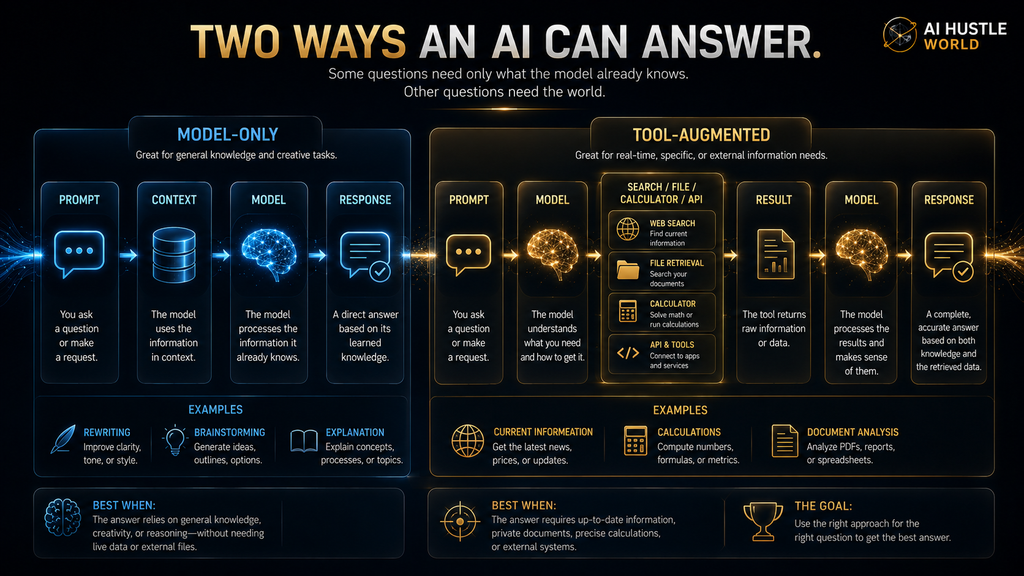
Model-Only Answers vs Tool-Augmented Answers
Model-only workflow
Prompt → Context → Model → Generated response
This is appropriate for many tasks such as:
- rewriting supplied text;
- brainstorming;
- explaining concepts;
- summarizing information already provided;
- transforming content;
- generating creative material.
Tool-augmented workflow
Prompt → Context → Model → Tool/Retrieval → New information → Model → Response
This becomes useful when the task needs:
- current web information;
- calculations;
- document retrieval;
- database access;
- external APIs;
- code execution;
- specialized tools.
OpenAI’s current platform documentation describes tool mechanisms including web search, file search, function calling, and remote MCP connections.
The important lesson is that the model does not have to do every job itself.
A strong AI system can be valuable precisely because it knows when to use another system.
Step 8: Retrieval Can Bring New Information Into the Context
Suppose you ask an AI assistant:
“Summarize this 100-page PDF and tell me which section discusses pricing.”
If the system has access to the file, it does not necessarily need to put every page into the model’s immediate context.
A retrieval system can identify relevant portions of the document and provide those portions to the model.
The same principle applies to web search.
The search layer can find relevant information, after which selected material can become part of the context used to construct the answer.
This is broadly related to retrieval-augmented generation, often shortened to RAG.
RAG should not be confused with the language model itself.
It is an architecture for supplying external or retrieved information to a generative model.
That distinction is important because it explains why a model can answer a question using information that was not part of its original training.
Step 9: Reasoning Can Add Another Layer
The phrase “AI just predicts the next token” is useful as a foundation, but it becomes too simplistic when applied to every modern AI system.
Some models and systems can perform additional computation for difficult reasoning tasks before producing their final response.
For example, reasoning-oriented models may spend additional computation working through a problem before producing the user-facing answer. Anthropic’s documentation describes extended-thinking systems that use additional internal reasoning tokens for difficult tasks.
The practical difference is:
Simple generation:
Input → generate response
Reasoning-oriented generation:
Input → additional computation → generate response
Tool-assisted reasoning:
Input → reasoning → tool → result → further reasoning → final response
This does not mean an AI has human consciousness or human thought.
“Reasoning” here describes a computational process that can improve performance on certain tasks.
That distinction matters.
We can legitimately say that modern AI systems can perform sophisticated computational reasoning.
We should not turn that into the claim that they experience thoughts the way humans do.
Why “Next-Token Prediction” Can Produce Intelligent-Looking Answers
This is one of the most interesting questions in AI.
If the model is ultimately generating tokens, why can it write software, explain mathematics, translate languages, summarize documents, or reason through complex problems?
Because predicting language well at scale requires learning far more than superficial word associations.
The model has to capture statistical relationships involving:
- grammar;
- syntax;
- semantics;
- facts and concepts;
- writing patterns;
- discourse structure;
- programming patterns;
- relationships between entities;
- common reasoning structures.
OpenAI describes the training process as learning relationships among information and using those relationships to predict what comes next.
The important insight is that “predicting the next token” describes the immediate generation mechanism, not the full complexity of everything the model had to learn to make that prediction useful.
A model that has learned enough structure to predict language extremely well can exhibit capabilities that look much broader than simple autocomplete.
That is why calling a modern language model “just autocomplete” is technically catchy but strategically misleading.
It describes one part of the mechanism while ignoring the scale and complexity of the learned representation.
Step 10: The Model Generates the Response One Token at a Time
Once the system has enough context to answer, the language model begins producing output.
It does not normally write the entire answer as one indivisible object and then reveal it.
Autoregressive language generation proceeds sequentially.
The model predicts a likely next token, adds that token to the growing sequence, and then uses the updated sequence as part of the context for generating the next token.
This continues until the response reaches an appropriate stopping point.
OpenAI’s documentation describes this basic generation process as predicting subsequent words/tokens from learned patterns.
That means an answer like:
“The best way to learn AI is…”
is not necessarily stored as a completed sentence somewhere inside the model.
The system generates the sequence progressively.
This is also one reason the exact wording of a response can vary.
There can be multiple plausible ways to continue a sequence.
Why the Same Question Can Produce Different Answers
Two requests that look identical to a human do not necessarily produce identical computational conditions.
Differences can arise from:
- conversation context;
- model version;
- system instructions;
- available tools;
- retrieved information;
- generation settings;
- randomness;
- reasoning configuration;
- changing external information.
OpenAI explicitly notes that there is an inherent element of randomness in generation because multiple plausible continuations can exist.
Now add web search.
The retrieved sources can change.
Add a different conversation.
The context can change.
Add a different model.
The learned behavior can change.
So:
Same prompt does not necessarily mean same computational state.
That is why you should not interpret every variation between AI responses as evidence that the system “forgot” something.
Sometimes the underlying conditions were simply different.
What Happens When the Question Is Ambiguous?
Ambiguity creates another important problem.
Consider:
“What’s the best AI tool for writing?”
Best for whom?
A novelist?
A blogger?
A developer?
A student?
A marketing team?
A technical researcher?
There is no objectively correct answer until the criteria are defined.
This is why context and prompt quality matter.
A stronger question might be:
“Which AI writing tool is best for a beginner who publishes SEO articles and needs long-form drafting, research assistance, and editing?”
Now the system has a more constrained information problem.
OpenAI’s prompting guidance emphasizes clear instructions and sufficient context because they can improve the quality of generated results. The underlying reason is straightforward: less ambiguity gives the model a clearer target to satisfy.
This is why prompt engineering should not be treated as magic wording.
Good prompting is largely about reducing ambiguity and supplying the right context.
Your dedicated prompt articles should handle the detailed techniques; this article only needs to establish the mechanism.
Does AI Actually Understand Your Question?
This question needs a careful answer.
AI systems can process language in highly sophisticated ways, but that does not mean they possess human-like understanding, consciousness, or subjective experience.
A language model can represent relationships between words, concepts, patterns, and contexts well enough to produce remarkably useful responses.
The Transformer architecture was explicitly designed around mechanisms that allow models to process relationships within sequences.
But none of that establishes that the model experiences meaning the way a human does.
A useful distinction is:
Functional understanding:
The system processes information in a way that allows it to perform useful language tasks.
Human understanding:
A person has subjective experience, intentions, beliefs, background knowledge, and lived context.
AI can demonstrate the first without establishing the second.
That distinction prevents both extremes: treating AI as a simple autocomplete box and treating it as a human mind.
Why AI Can Be Confident and Still Be Wrong
One of the most important realities of generative AI is that fluency is not proof.
A response can be:
- grammatically excellent;
- logically structured;
- highly detailed;
- confidently written;
and still contain false information.
OpenAI explicitly warns that ChatGPT can produce incorrect or misleading outputs, that confidence does not guarantee reliability, and that users should verify important information.
This happens because the generation system is optimized to produce useful language from the information and patterns available to it. It is not automatically a truth-verification engine.
A model can therefore generate a plausible statement even when the statement is unsupported.
That is the fundamental reason behind AI hallucinations.
Hallucination Is Not Simply “AI Making Random Mistakes”
Hallucination is better understood as a failure of the answer-generation pipeline.
The model may lack the required information.
The question may be ambiguous.
The available context may be insufficient.
The system may retrieve weak or conflicting information.
The model may incorrectly synthesize several pieces of evidence.
Or the generated response may simply contain an error.
OpenAI’s guidance specifically notes limitations including knowledge cutoffs, lack of access to some information, over-simplification, bias, and the possibility of confident incorrect answers.
That is why the correct response to hallucination is not simply:
“AI is bad.”
The better question is:
Which part of the information pipeline failed, and how can that failure be reduced?
Search Changes the Information Available to the Model
Consider two questions.
Question A
“Explain what a transformer is.”
A model may be able to answer using its learned knowledge.
Question B
“What did the latest research paper published yesterday conclude about transformer efficiency?”
Now freshness matters.
A search-enabled system can retrieve current sources and use those sources as part of the answer.
OpenAI documents that ChatGPT can search the web for current information, may rewrite a question into targeted queries, and can provide citations to the sources it used.
This creates a critical distinction:
Training gives a model learned capabilities; retrieval can give an AI system access to additional information at answer time.
Those are not the same thing.
Search Does Not Automatically Make an AI Answer Correct
Adding search improves access to information.
It does not guarantee perfect reasoning.
OpenAI explicitly warns that search results and citations can sometimes be incomplete, outdated, or incorrect and recommends opening cited sources to verify important claims.
Imagine an AI retrieves three articles.
One is outdated.
One misunderstands the issue.
One is authoritative.
The model still has to decide how to use those sources.
This means retrieval creates a better evidence supply, not an automatic truth machine.
The quality of the final answer still depends on retrieval, source selection, interpretation, synthesis, and verification.
This is also why your separate How AI Search Engines Find and Rank Information article should own the detailed search-ranking mechanism rather than this article. The Master Sheet places that article immediately before this one in the AI Basics sequence.
Tools Change What an AI Can Do
A language model is good at manipulating information.
A tool can perform an operation that the model itself should not be trusted to perform purely from generated text.
Consider a calculation.
You ask:
“What is 17.5% of $4,800?”
A model may calculate it correctly.
But a calculator or code tool can perform the arithmetic deterministically.
Now consider:
“Find the latest sales figures in this spreadsheet.”
A file-search or data-analysis system can retrieve and calculate from the actual data.
Or:
“Check the latest information on this regulation.”
A web-search system can retrieve current sources.
OpenAI’s current platform documentation lists tools such as web search, file search, function calling, and remote MCP.
This leads to an important principle:
The strongest AI systems increasingly combine language generation with specialized tools instead of asking the language model to imitate every capability through text generation alone.
AI Assistants Are Bigger Than the Model
This is probably the most important conceptual upgrade from the older version of this article.
Think about an AI assistant as a stack.
At the center is the model.
Around it can be:
- instructions;
- context management;
- memory features;
- retrieval;
- web search;
- file search;
- calculators;
- code execution;
- APIs;
- safety systems;
- user-interface logic;
- output formatting.
The model is therefore one critical component inside a larger system.
This distinction becomes even more important as AI agents become more capable. Your Master Sheet already separates What Is an AI Agent?, How AI Agents Use Tools, and Model Context Protocol into dedicated articles.
Those topics should not be swallowed by this article.
Instead, this article establishes the foundation:
An AI assistant can combine a model with context and external capabilities.
The Difference Between an AI Assistant and an AI Agent
A normal AI assistant might answer:
“Here are three options.”
An agentic system may be able to go further:
“I compared the options, checked the relevant data, created the spreadsheet, and sent the result.”
The difference is not simply intelligence.
It is system architecture and ability to act through tools.
The assistant article therefore needs to establish the basic response pipeline without turning into a full agent tutorial.
The dedicated AI-agent articles in your Master Sheet can then own autonomous planning, tool execution, and multi-step task completion.
Why Context Limits Matter
Every model has a finite amount of information it can process within a particular context window.
That creates a practical constraint.
If you give an AI:
- a long conversation;
- several large documents;
- dozens of instructions;
- many retrieved passages;
the system has to manage all of that information within its available context.
This is one reason retrieval can be useful.
Instead of placing every possible document into the model’s immediate context, a retrieval system can identify the information most relevant to the current question.
Context therefore has two competing requirements:
More context can provide more useful information.
But:
More context can also introduce noise, redundancy, and processing constraints.
That is why simply dumping everything into an AI is not always the best strategy.
The better objective is relevant context, not maximum context.
What Makes an AI Answer Better?
There is no single magic ingredient.
A useful answer usually depends on several parts of the pipeline working together.
Clear input
The system needs to know what you actually want.
Relevant context
The model needs the information required to understand the task.
Appropriate model capability
Different models and configurations can perform differently on different tasks.
Good retrieval when external information is required
Current or specialized questions may need external evidence.
Appropriate tools
Calculations, files, APIs, and other deterministic operations can be delegated to specialized systems.
Strong generation
The model needs to turn the available information into a coherent answer.
Verification
High-consequence claims should be checked against authoritative evidence.
That last point is particularly important.
AI Hustle World’s editorial position should remain simple:
Use AI for speed and synthesis; use evidence and human judgment where accuracy and consequences matter.
A Practical Example: One Question, Several Possible Pipelines
Imagine you ask:
“What is compound interest?”
The system may answer primarily from learned knowledge.
The pipeline is roughly:
Question → context → model → response
Now ask:
“What is the current average savings-account interest rate in the United States?”
The answer depends on current information.
A search-enabled system may use:
Question → search → current sources → model → cited response
Now ask:
“Calculate how much $10,000 becomes after five years at 5% annual compound interest.”
A system could use:
Question → model/tool → calculation → response
Finally, ask:
“Analyze this 50-page financial report, compare its revenue growth with last year, and explain the biggest risks.”
The pipeline can become:
Question + file → retrieval → relevant sections → analysis → reasoning → response
The interface looks almost identical in all four cases.
The underlying workflow does not have to be.
That is the central idea of this article.
Why Prompt Quality Matters More Than People Think
A prompt is not a secret command that unlocks an AI’s hidden intelligence.
It is a way of specifying the information problem.
Compare:
“Write about AI.”
with:
“Explain how large language models generate answers for a beginner audience. Use one concrete example, distinguish training from inference, and explain why the model can still hallucinate.”
The second prompt provides:
- subject;
- audience;
- scope;
- required distinctions;
- example requirement;
- failure mode.
That gives the system a much clearer target.
OpenAI’s guidance similarly recommends clear instructions and sufficient context when prompting models.
Good prompting is therefore less about finding a magical phrase and more about communicating the task precisely.
Why Giving AI More Information Can Sometimes Make the Answer Worse
More context is not automatically better context.
Imagine asking an AI to summarize a contract while supplying:
- the contract;
- five unrelated emails;
- an old version;
- a completely different agreement;
- dozens of irrelevant notes.
The model now has more information—but also more opportunities for confusion.
The practical objective should be:
Give the model the information it needs, not every piece of information you happen to have.
This is particularly important for long-context workflows and retrieval systems.
Good context is:
relevant + accurate + current + organized
not simply:
large.
The Hidden Problem: The Model Can Only Work With What Reaches It
This creates a useful way to diagnose AI failures.
Suppose the correct information exists on the internet.
But the AI doesn’t retrieve it.
The model cannot use information it never received.
Suppose the correct information is in a 200-page document.
But the relevant section is never retrieved or supplied.
Again, the model may produce an incomplete answer.
Suppose the correct source is retrieved but the model misunderstands it.
Now the failure is in interpretation or synthesis.
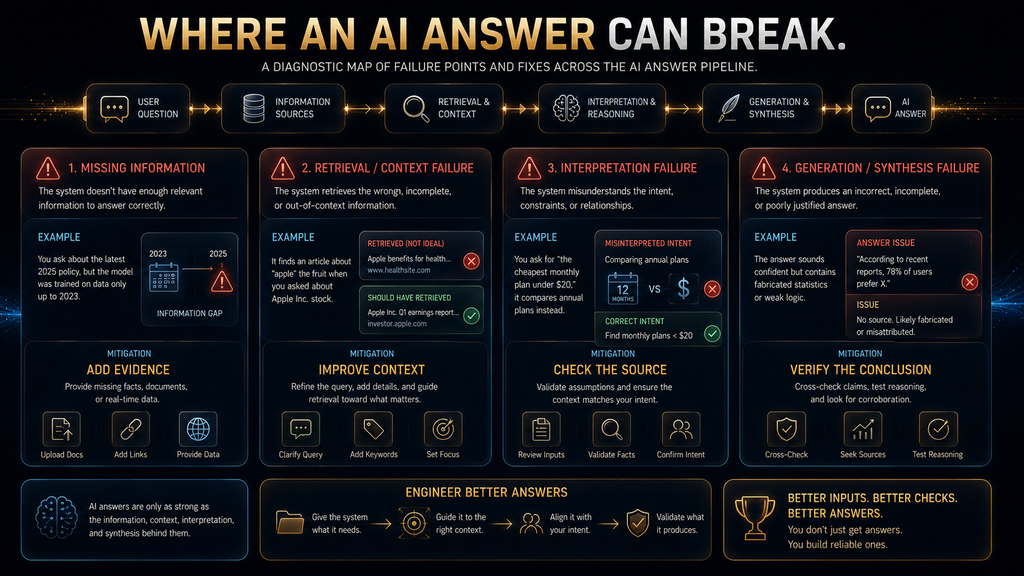
This gives us a powerful diagnostic framework:
Missing information → retrieval/context problem
Wrong interpretation → reasoning/understanding problem
Incorrect generation → model/output problem
Outdated information → freshness problem
Unsupported claim → verification problem
Not every AI mistake has the same cause.
The Four Main Ways an AI Answer Can Fail
1. The system lacks the information
The required fact was never available through the model or tools.
2. The system has the information but fails to retrieve or use it
The relevant evidence exists but does not reach the generation stage.
3. The system receives the information but interprets it incorrectly
The source may be good, but the answer misrepresents it.
4. The system has useful evidence but generates an incorrect conclusion
This is a synthesis or generation failure.
This distinction is more useful than simply saying:
“AI hallucinated.”
It tells you what needs to be fixed.
How to Use AI Without Treating It as an Oracle
The safest mental model is neither:
“AI knows everything.”
nor:
“AI is useless because it can be wrong.”
The better model is:
AI is a powerful information-processing system whose reliability depends on the task, the available context, the model, the tools, and the quality of verification.
For low-risk tasks such as brainstorming, rewriting, outlining, and summarizing user-provided material, you may accept more uncertainty.
For high-risk tasks involving:
- medical decisions;
- legal obligations;
- financial decisions;
- security;
- safety;
- scientific claims;
the verification standard should be much higher.
OpenAI explicitly recommends checking important information and using authoritative sources when accuracy matters.
A Simple Verification Framework for AI Answers
When the consequence of being wrong matters, use this six-step check:
Verify the claim
What exactly is the AI asserting?
Examine the evidence
Where did the information come from?
Review the context
Does the source actually apply to your situation?
Identify uncertainty
Are there qualifications, competing interpretations, or missing information?
Find independent support
Can another authoritative source confirm the important point?
Yield to authoritative sources
When the stakes are high, the AI should help you understand the evidence—not replace the evidence.
This framework is intentionally simple.
The objective is not to turn every casual AI interaction into a research project.
It is to teach users when verification becomes necessary.
What AI Is Actually Doing When It “Answers”
At this point, the entire process can be compressed into one practical explanation.
When you ask an AI a question, the system first receives your input and determines what information is available around it. Text is represented as tokens, and the model processes relationships among those tokens using its learned neural architecture. Depending on the task and product, the system may then perform additional reasoning, retrieve information, call tools, or use other external capabilities. The model generates an output token by token, and the surrounding application assembles that output into the final response.
That is fundamentally different from a traditional database query.
The system is not necessarily retrieving a prewritten answer that exactly matches your question.
It is constructing a response from learned patterns and whatever context or external information is available to it.
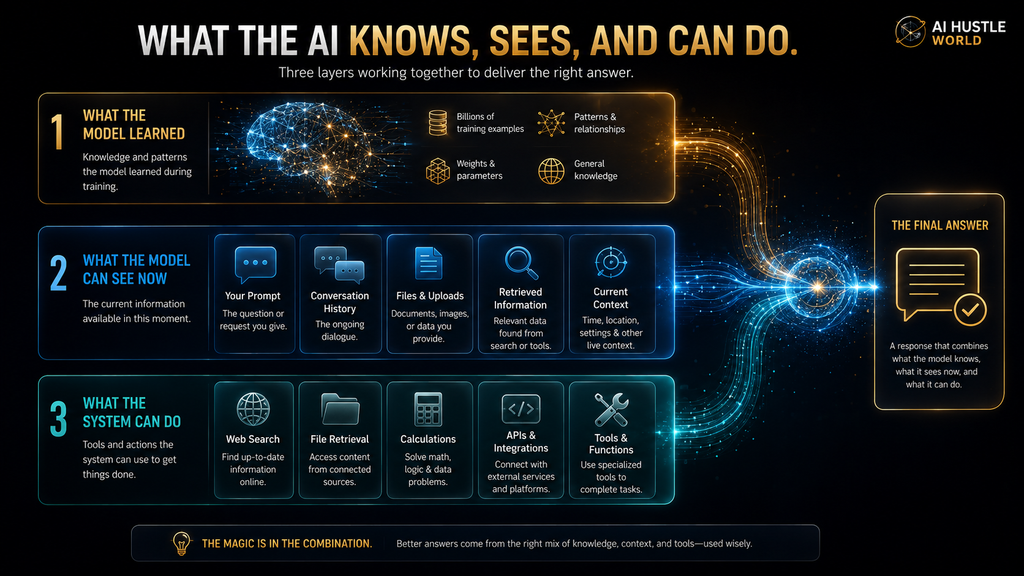
Three Layers You Should Never Confuse
A useful final mental model is to separate three layers.
Layer 1: What the model learned
This comes primarily from training.
It gives the model its learned capabilities and statistical knowledge.
Layer 2: What the model can see right now
This is the current context.
It can include your prompt, conversation, files, instructions, retrieved material, and tool outputs.
Layer 3: What the system can do
This is the surrounding product capability.
It may include search, calculators, code execution, file retrieval, APIs, memory features, or other tools.
These three layers explain why two AI products can feel completely different even when they use similar underlying model technology.
The model may be similar.
The surrounding system can be very different.
What This Means for the Future of AI
The trajectory of AI is increasingly moving away from the idea of a standalone chatbot that simply generates text.
Modern systems can combine:
models + context + retrieval + tools + reasoning + actions
That progression matters because the value of AI increasingly comes from orchestration.
A model that can explain something is useful.
A model that can explain something, retrieve current evidence, analyze a document, calculate a result, call an API, and present the findings coherently can become part of a much larger workflow.
This is also why the distinction between AI assistants and AI agents is becoming important.
The more an AI system can plan, use tools, observe results, and continue working toward an objective, the less useful it becomes to think of it as simply “a chatbot.”
Your later AI-agent cluster can own that deeper topic; this article provides the foundation for understanding why such systems are possible in the first place.
Common Questions About How AI Answers Questions
Does AI search the internet every time I ask a question?
No. It depends on the AI product, its configuration, and the request. A model can answer from its learned capabilities and current context, while a search-enabled system can retrieve current web information when appropriate. OpenAI explicitly distinguishes responses made without search from responses that use search or deep research.
Does AI store every answer somewhere and retrieve it later?
Not in the simple database sense. Language models learn statistical patterns in their parameters during training and generate responses from those learned patterns plus the context available at inference time.
What is the difference between a token and a word?
A token is a unit processed by the model and can represent a whole word, part of a word, punctuation, spaces, or other text pieces. Therefore one word is not necessarily one token.
Why does AI sometimes give different answers to the same question?
Different answers can result from randomness in generation, different context, model versions, instructions, available tools, retrieved information, or other system conditions. OpenAI explicitly notes that multiple plausible continuations can introduce variation.
Does AI understand language like a human?
AI can process linguistic relationships and perform sophisticated language tasks, but that does not establish human-like consciousness or subjective understanding. Transformer models use mathematical mechanisms such as attention to process relationships among tokens.
Why does AI hallucinate?
AI can produce incorrect information because generation is not automatically the same as verification. Missing information, ambiguity, weak context, retrieval problems, incorrect synthesis, and model limitations can all contribute to unreliable answers. OpenAI explicitly warns that confident responses can still be incorrect.
Can AI use current information?
Yes, when the particular AI system has access to current-information tools such as web search. OpenAI’s ChatGPT Search can search the web, rewrite queries into targeted searches, and provide cited sources.
Does using search guarantee a correct AI answer?
No. Search can provide newer and more relevant evidence, but the system still has to select, interpret, synthesize, and present that information. OpenAI recommends checking cited sources because search results and citations can sometimes be incomplete, outdated, or incorrect.
What is retrieval-augmented generation?
Retrieval-augmented generation, or RAG, is an approach where relevant external information is retrieved and supplied to a generative model as context for producing an answer. It is one way of extending a model with information beyond what is directly available from its learned parameters.
Can AI use tools?
Yes. Depending on the system, AI can use tools for tasks such as web search, file retrieval, function calling, calculations, code execution, and external services. OpenAI’s current platform documentation lists several tool mechanisms for building these workflows.
Is AI just predicting the next word?
That is an important part of autoregressive language generation, but it is an incomplete description of a modern AI system. The model generates tokens sequentially, while the broader system may also provide context, retrieval, reasoning, tools, instructions, and other capabilities.
Does a better prompt always produce a correct answer?
No. A clearer prompt can reduce ambiguity and improve the likelihood of a useful response, but it cannot eliminate model limitations, missing information, or factual errors.
Final Thoughts
The easiest way to misunderstand AI is to imagine that a question goes into a mysterious machine and a stored answer comes out.
The reality is more interesting.
Your input becomes part of a context. Text is represented as tokens. A neural model processes relationships among those tokens using learned patterns. Depending on the task, the surrounding AI system may retrieve information, invoke tools, perform additional reasoning, or bring new context into the process. The model then generates the response progressively, and the application assembles everything into the answer you see.
That explains both the power and the limitations of modern AI.
The same system that can produce remarkably useful explanations can also produce confident mistakes. The same model that can answer from learned knowledge can become more capable when connected to search or tools. And the same prompt can produce different results because the model’s context, retrieval, computation, or generation conditions can change.
So the most useful mental model is not:
AI knows the answer.
It is:
AI constructs an answer from what it has learned, what it can currently access, and what the surrounding system allows it to do.
Once you understand that distinction, tokens, prompts, hallucinations, AI search, reasoning, RAG, tools, assistants, and agents all start fitting into the same picture.
AI is not simply an answer machine. It is an information-processing pipeline—and the quality of the final answer depends on every important stage of that pipeline.
Keep Building Your AI Understanding
AI becomes much easier to use when you understand what happens behind the interface.
Explore more AI Hustle World guides to understand the technology, evaluate its limitations, and build smarter AI-powered workflows.
Explore More AI Guides →Written by
Muntasir Ahmad Chowdhury
Founder, AI Hustle World
Muntasir Ahmad Chowdhury is the Founder of AI Hustle World, an independent publication dedicated to making Artificial Intelligence practical, trustworthy, and easy to understand. He researches AI tools, automation, customer service, productivity, and real-world business applications, helping readers make smarter technology decisions through research-driven, experience-backed content.
Expertise:
AI Tools • AI Automation • AI Customer Service • AI Productivity • Generative AI • AI Workflows
Get Smarter With AI
Enjoyed this guide? Get practical AI tools, tutorials, and honest reviews delivered to your inbox.
5 thoughts on “How AI Answers Questions: From Prompt to Response Explained”