Evidence: Documentation reviewed
Last checked: September 2026
What was done: Written from official documentation and the published sources linked in this article. Not hands-on tested.
Files: None
Affiliate links: No
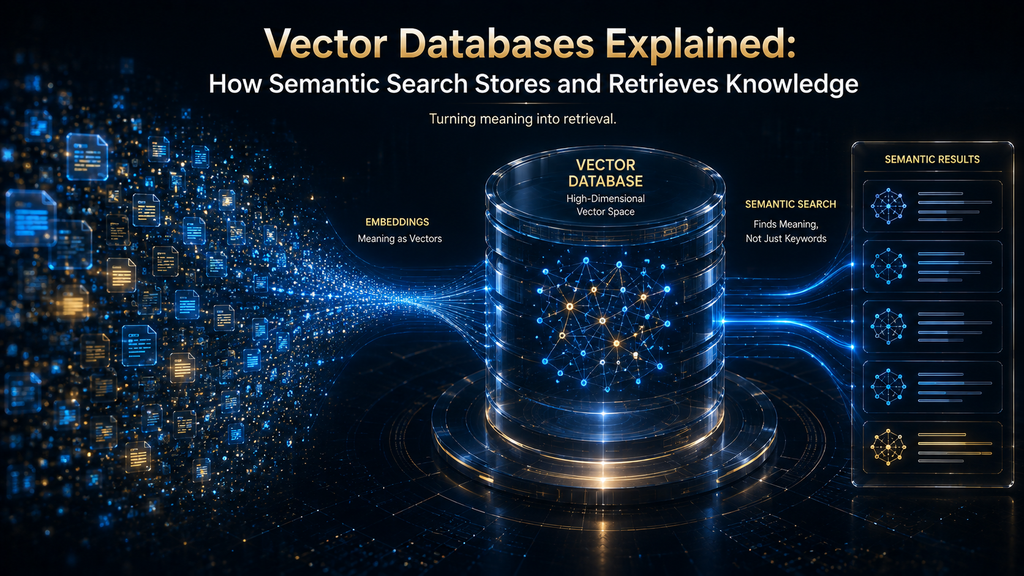
Vector Databases Explained: How Semantic Search Stores and Retrieves Knowledge
Search becomes difficult when the words people use to describe a problem are different from the words used in the information they need. A customer might search for “I was charged twice,” while a support system may store the relevant article under “duplicate transaction handling”; an employee might ask “Can I work from home after having a baby?” while the policy document uses formal language about parental leave and remote-work eligibility. Traditional keyword search can work surprisingly well when terminology overlaps, but it becomes less reliable when meaning matters more than exact wording. Vector search addresses that gap by representing information as numerical vectors and finding records whose representations are mathematically similar to the representation of a user’s query.
A vector database is the infrastructure that stores, indexes, filters, and retrieves those vector representations so applications can use semantic search at practical scale. It does not create the meaning by itself, and it does not replace the embedding model that produces the vectors. It also does not guarantee that the closest result is the correct result. In a production application, vector retrieval sits inside a larger system that may include document processing, chunking, embeddings, metadata filtering, keyword search, reranking, access controls, and application-specific rules.
That distinction is important because vector databases are often described too simply. The technology is sometimes presented as if the architecture were just “put documents into a vector database and ask questions.” Real systems are more complicated. The quality of the final retrieval depends on the source material, the way information is divided, the embedding model, the index, the similarity metric, the query, the filters, the ranking strategy, and the evaluation process.
The practical question is therefore not simply whether a vector database is powerful. It is whether semantic retrieval solves a real information problem well enough to justify the additional infrastructure, complexity, and operating cost.
What Is a Vector Database?
A vector database is a database or database-oriented system designed to store vector representations and retrieve records based on similarity between those representations. The vectors are generally produced by embedding models, which convert information such as text, images, audio, products, or other objects into numerical representations that can be compared mathematically.
A vector itself is not meaningful to a human reader. It may contain hundreds or thousands of numerical dimensions, but the individual numbers are not normally interpreted as simple labels such as “this is about refunds” or “this is about employee benefits.” Instead, the useful property is the position of the vector relative to other vectors in the same representation space. When an embedding model has been trained appropriately for the task, related concepts tend to occupy nearby regions of that space, allowing a retrieval system to search for records that are semantically similar.
This makes vector databases particularly useful for workloads where the application needs to answer a question such as, “What information is most related to this?” rather than, “Which records contain this exact word?” Semantic document search, retrieval-augmented generation, recommendation systems, similar-product discovery, duplicate detection, image retrieval, multimodal search, and knowledge discovery can all benefit from this approach. The common thread is not the presence of AI for its own sake; it is the need to identify relationships between representations.
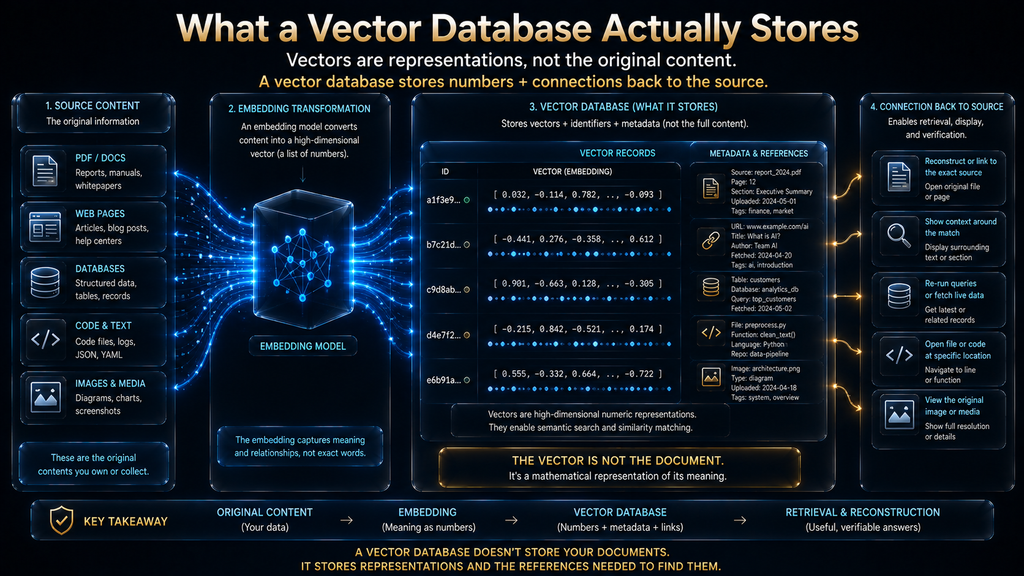
A production vector database usually stores more than the vector itself. The record may include the original text or a reference to the original object, a document identifier, metadata, timestamps, versions, categories, tenant information, access-control information, and other fields needed to determine whether a retrieved result is actually usable. This becomes critical once semantic retrieval moves beyond a demonstration and into a real application.
Consider an internal company assistant. Two policy documents may be semantically almost identical, but one could apply to employees in the United States and another to employees in the United Kingdom. A vector similarity calculation cannot know which jurisdiction applies unless the retrieval system incorporates that information. The vector tells the system something about semantic similarity; metadata and business rules provide the constraints that similarity alone cannot express.
That is the first principle to keep in mind: A vector database is a retrieval system for representations, not a substitute for information architecture.
Why Semantic Search Became Necessary
Traditional search exists for good reasons, and understanding those reasons makes it easier to understand what vector search actually changes.
Keyword search is extremely effective when the relationship between a query and the desired result is expressed through literal terms. If someone searches for a product SKU, an error code, a person’s name, a legal clause number, or a precise technical identifier, exact matching can be exactly what the user needs. A search engine does not need to infer that ORA-00942 is related to an Oracle database error if the user has already supplied the exact identifier.
Keyword search also has an important advantage: it is relatively transparent. If a page contains the words the user searched for, the relationship between the query and the result is easy to understand. Search systems can use term frequency, field weighting, phrase matching, and other lexical signals to determine which documents are likely to be useful. For many information-retrieval tasks, that remains a strong foundation.
The problem appears when the vocabulary of the query and the vocabulary of the source do not line up. Imagine a company’s knowledge base contains an article called “Account Credential Recovery Procedures.” An employee asks, “I forgot my password and can’t log in.” The user is expressing a need; the document is expressing a formal procedure. The concepts overlap, but the exact wording may not.
Semantic search tries to bridge that gap by comparing representations of meaning rather than depending entirely on literal word overlap. Instead of asking whether the document contains the exact terms from the query, the retrieval system asks whether the document’s representation is close to the query’s representation in the embedding space.
That sounds like a straightforward improvement, but it creates a different kind of problem. Once the system begins retrieving based on semantic similarity, similar does not necessarily mean correct. A document about password recovery for administrators might be highly similar to a customer’s password-reset question while still being the wrong document. A five-year-old policy might be semantically almost identical to today’s policy while being operationally obsolete.
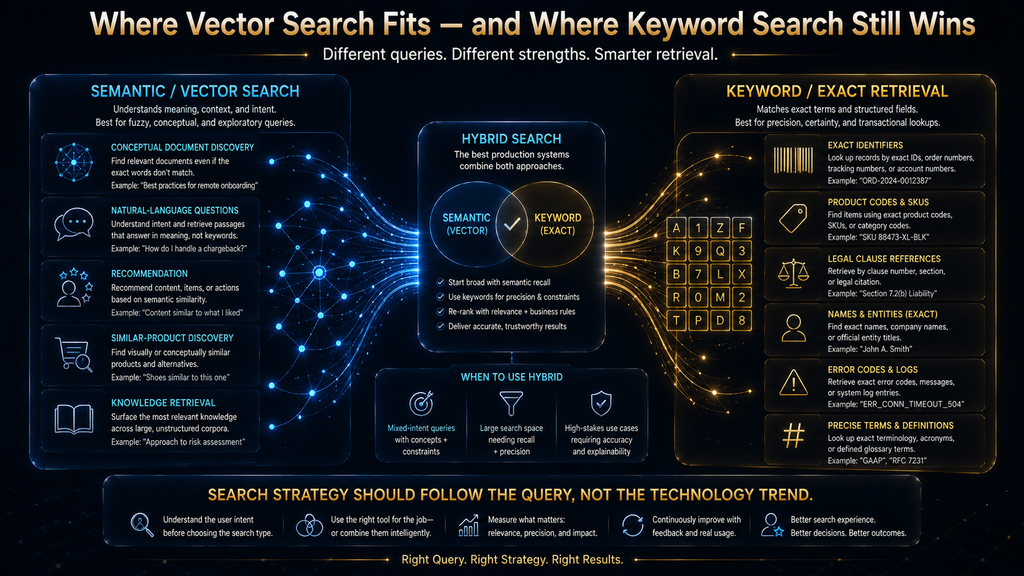
This is why modern retrieval systems increasingly combine signals rather than declaring one method the winner. Keyword search is good at exact terminology. Vector search is good at semantic relationships. Metadata is good at constraints. Reranking can improve ordering. Business rules can enforce requirements that neither lexical nor semantic similarity can understand on its own.
The important architectural shift is therefore not “keyword search is dead.” It is that retrieval can now combine different kinds of evidence about what makes a result useful.
Embeddings Are the Bridge Between Language and Vector Search
A vector database cannot perform meaningful semantic retrieval unless the information has first been converted into a representation that captures useful relationships. That is the job of an embedding model.
An embedding model receives an input such as a sentence, paragraph, image, or other supported object and produces a numerical vector. The model is trained so that certain relationships between inputs are reflected in the resulting representations. Depending on the model and training objective, semantically related inputs may produce vectors that are relatively close together, while unrelated inputs are farther apart.
This is why the choice of embedding model matters so much. A vector database can search millions of vectors efficiently, but it cannot compensate for an embedding model that represents the wrong distinctions for the application’s retrieval task. If two concepts that need to remain separate are represented too similarly, retrieval can repeatedly confuse them. If related concepts are represented too differently, relevant information may never become a strong candidate.
Suppose an organization is building a legal-document search system. A general-purpose embedding model may understand that “termination,” “ending an agreement,” and “contract cancellation” are related. But the application may need to distinguish between termination for convenience, termination for cause, expiration, suspension, and non-renewal. Whether the embedding representation preserves those distinctions sufficiently is an empirical question, not something the database can solve afterward.
The same principle applies to specialized terminology. A technical knowledge base may contain internal acronyms, product names, proprietary system terminology, or domain-specific expressions that a general embedding model does not represent as effectively as a domain-adapted system. The database can store the resulting vectors, but the representation quality originates upstream.
This creates a useful diagnostic rule when evaluating retrieval failures: If the right information was never represented correctly, improving the database index may not solve the problem.
That is why embedding strategy deserves its own architectural decision. Our guide to how embeddings work in RAG and semantic search covers that topic in depth, so this article focuses on their role in the retrieval architecture rather than duplicating that deeper treatment.
What a Vector Database Actually Stores
A practical vector-search record usually combines a numerical representation with enough contextual information to make the result useful.
Imagine a knowledge-base passage stored as a record. The vector represents the passage semantically, while the remaining fields tell the application what that passage actually is, where it came from, which document it belongs to, whether it is current, and who is allowed to access it.
A simplified record might contain:
| Field | Role in retrieval |
|---|---|
| Vector | Enables similarity search |
| Text or object reference | Supplies the actual retrieved content |
| Document ID | Connects the result to its source |
| Chunk ID | Identifies the specific retrievable passage |
| Metadata | Enables filtering and contextual constraints |
| Version | Helps manage changing information |
| Timestamp | Supports freshness decisions |
| Tenant ID | Supports multi-tenant isolation |
| Access scope | Helps enforce permissions |
| Source URL or reference | Supports traceability and citation |
The exact schema varies by architecture, but the principle is consistent: the vector is the retrieval signal, not the entire knowledge record.
This distinction becomes particularly important in RAG systems. A language model does not normally need a vector itself. It needs useful source content that can be inserted into its context. The vector is used to locate that content.
Suppose a user asks, “What is our current annual leave policy for employees in Bangladesh?” The system may embed the query and search the vector index. It could find several highly similar passages about annual leave, but the application then needs to determine which passages belong to the correct country, employee population, and current policy version.
A system that retrieves the semantically closest document but ignores those constraints can produce a convincing answer from the wrong evidence. That is not a vector-search success.
It is a retrieval architecture failure.
How Semantic Retrieval Works From Query to Result
The user sees a search box and a result. Behind that simple interaction, a semantic retrieval system may perform several distinct operations.
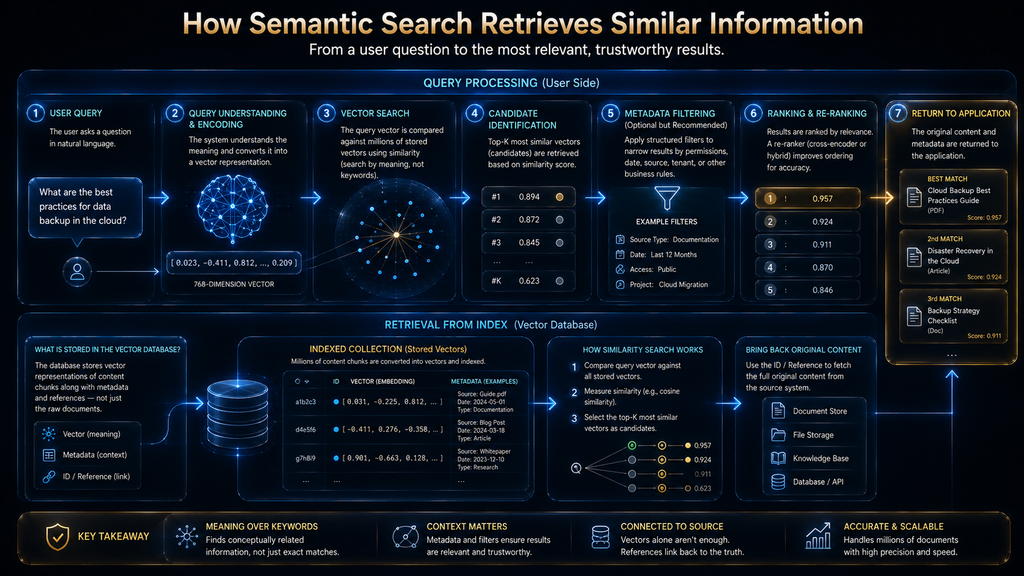
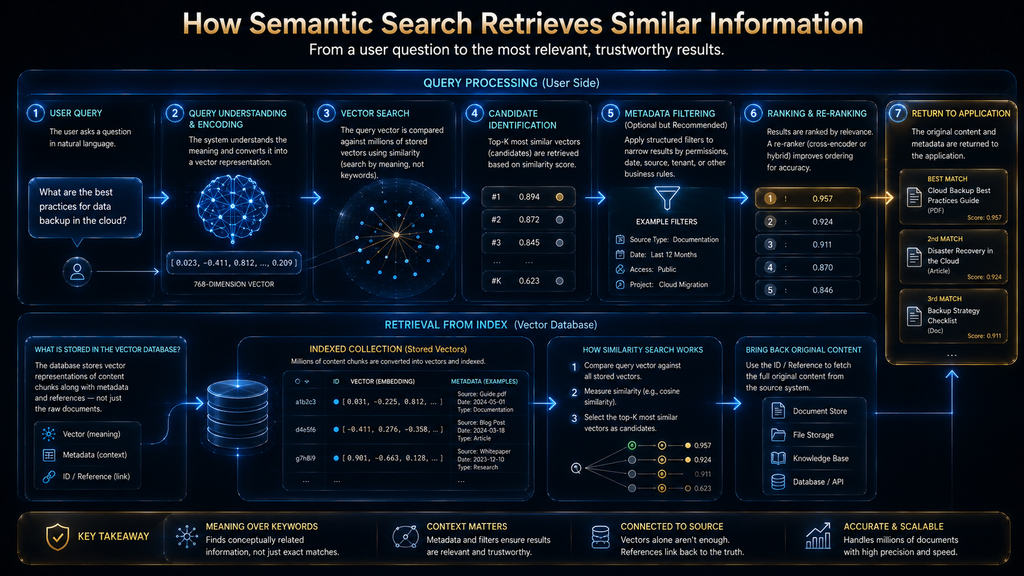
The first step is query processing. The user’s question may be cleaned, normalized, expanded, classified, or otherwise transformed before retrieval. In some systems, the original query is embedded directly; in others, the application may generate one or more search queries designed to improve recall.
The system then generates a vector representation of the query using an embedding model compatible with the stored vectors. The query vector becomes the object against which the database searches.
The vector database then executes a similarity search. Depending on the architecture, this may involve exact nearest-neighbor comparison or an approximate nearest-neighbor index designed to find strong candidates without comparing the query against every stored vector in full.
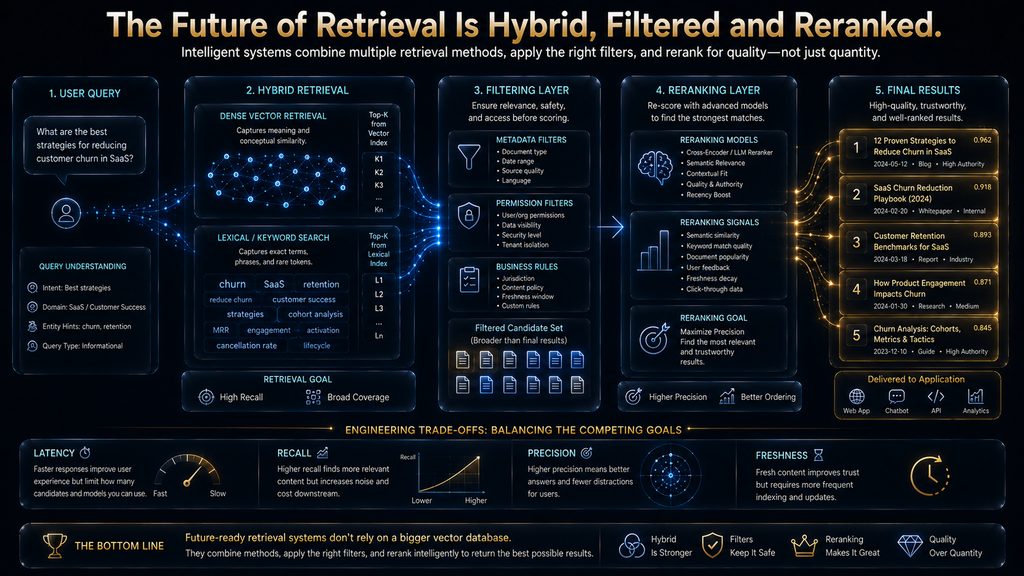
At this stage, the system has a candidate set rather than a guaranteed final answer. Metadata filters may remove records that do not meet requirements such as tenant, region, product, date, document type, or access scope. Hybrid retrieval may add candidates from keyword search. A reranking model may then examine the candidates in greater detail and reorder them.
Finally, the application decides what to do with the selected results. In a RAG workflow, relevant passages may be assembled into context for an LLM. In a recommendation system, similar products may be displayed to the user. In a semantic search engine, the retrieved records may simply become the search results.
The vector database is therefore one layer in a pipeline that looks more like this: source information → preparation → chunking or object creation → embedding → vector storage and indexing → query processing → similarity retrieval → filtering and/or hybrid retrieval → ranking or reranking → application response. The exact architecture can vary, but the important point is that the vector database is neither the beginning nor the end of the process.
Why Vector Indexing Matters
The mathematical problem behind vector search is deceptively simple: given a query vector, find the stored vectors that are closest to it. The difficulty is scale.
If a system contains a few thousand vectors, comparing a query against every vector may be perfectly reasonable. As the collection grows to millions or hundreds of millions of vectors, performing a full comparison for every query can become expensive in terms of computation and latency. This is where vector indexes become important.
Approximate nearest-neighbor, or ANN, methods attempt to reduce the amount of search work by organizing vectors in ways that allow the system to explore promising candidates rather than exhaustively examining the entire collection.
This creates a fundamental engineering trade-off. Exact search can provide the strongest possible recall because the system evaluates the entire candidate space, but the computational cost can increase substantially with dataset size. Approximate search can dramatically reduce the amount of work, but it introduces the possibility that the mathematically nearest result will not be found.
That trade-off means vector-search performance cannot be evaluated through speed alone.
Imagine two systems. System A returns results in 15 milliseconds but frequently misses the relevant document. System B returns results in 35 milliseconds and consistently places the relevant document among the top five candidates. If the application is an internal research assistant, System B may be far more useful even though its raw latency is higher.
The correct question is therefore not:
How fast is the vector database?
It is:
How much retrieval quality can we achieve at the latency and cost the application can actually tolerate?
That shift from infrastructure benchmarking to workflow performance is one of the most important decisions a team can make.
HNSW and IVFFlat Illustrate the Core Trade-Off
Two widely discussed approximate-nearest-neighbor approaches are HNSW and IVFFlat. They are useful not because every application must choose between them, but because they demonstrate the broader principle that vector indexes involve trade-offs.
HNSW, or Hierarchical Navigable Small World, organizes vectors through a graph structure with multiple layers. Search can navigate through that graph toward promising regions rather than comparing the query against every vector. This approach can provide strong search performance and recall characteristics, but it generally comes with higher memory requirements and more expensive index construction than simpler approaches.
IVFFlat, or Inverted File with Flat vectors, divides vectors into groups and searches selected groups rather than the entire collection. The number of groups searched affects the balance between speed and recall. Searching more groups can increase the chance of finding relevant vectors, but it also increases the amount of computation required for the query.
The pgvector project documents both approaches and explicitly describes their trade-offs. Its documentation notes that exact nearest-neighbor search provides perfect recall, while HNSW and IVFFlat trade some recall for speed; it also describes HNSW as offering a better speed-recall trade-off in many situations while requiring more memory and slower construction, with IVFFlat generally using less memory and building faster.
Those details matter because they prevent a common mistake: treating an index type as a universal “best” setting.
There is no meaningful answer to “Is HNSW better?” without knowing the workload. The relevant questions are how much data exists, how frequently it changes, how much memory is available, what latency target matters, how much recall the application needs, how much query traffic is expected, and whether filtering will significantly affect the candidate set.
Index selection is therefore a workload decision, not a popularity contest.
Similarity Metrics: What Does “Close” Actually Mean?
A vector database needs a mathematical definition of similarity or distance to determine which records are close to a query.
Different systems and embedding models may use measures such as cosine similarity, Euclidean distance, or inner product. The exact mathematics matters because it determines how the system interprets the geometry of the vector space.
Cosine similarity focuses on the angle between vectors rather than their raw magnitude. This can be useful when the direction of the representation is more important than its length. Euclidean distance measures straight-line distance between points. Inner product measures the interaction between the components of two vectors and can be appropriate for certain embedding models and retrieval objectives.
The key point is that there is no universal metric that is automatically correct for every embedding model. The embedding model and similarity function need to be compatible with the assumptions under which the representations were created.
This is another reason why “just use a vector database” is inadequate architectural advice. The database can execute the mathematical comparison, but the application still needs to understand what that comparison means.
If the similarity function is poorly matched to the representation, the system can return technically valid nearest neighbors that are not the neighbors the application actually wants.
Metadata Filtering Changes the Retrieval Problem
Pure semantic similarity is rarely enough for production systems because real-world information contains constraints.
A company may need to search only documents belonging to a particular customer. A support application may need to retrieve articles for a particular product version. An enterprise assistant may need to restrict results according to the employee’s permissions. A healthcare application may need to distinguish between regions, facilities, document types, or operational contexts.
Metadata filtering adds those constraints to the retrieval process.
Consider a company with 500,000 knowledge-base passages shared across ten customers. A query such as “How do I configure the reporting API?” might produce semantically relevant passages from several customers. Without tenant filtering, the vector search can identify information that is conceptually correct but operationally inaccessible.
The problem becomes even more serious when sensitive information is involved. Retrieval quality and authorization are different concerns. A result can be highly relevant and still be prohibited from being shown to the user.
This is why access control should not be treated as an afterthought added to the vector database. The retrieval architecture needs to understand the relationship between semantic search and authorization from the beginning.
There is also a performance dimension. Applying filters to approximate-nearest-neighbor retrieval can change the effective candidate pool. A vector index may identify a set of nearby vectors, after which filtering removes some of them. If too many candidates are discarded, the system may return fewer useful results than expected.
The pgvector documentation discusses this issue directly for approximate indexes and describes iterative scanning as one approach to obtaining enough qualifying results under filtering conditions. The broader lesson is simple: retrieval is not merely “find nearby vectors.” It is “find nearby vectors that satisfy the application’s rules.”
Why Hybrid Search Often Makes More Sense Than Vector-Only Search
Semantic search is powerful, but production retrieval often benefits from combining semantic and lexical signals.
Imagine an engineer searches for ERR_CONNECTION_RESET nginx. The query contains both conceptual meaning and exact identifiers. The user wants documentation about a network connection problem, but they also want information specifically associated with the exact error string and software component.
A semantic system can recognize related networking concepts, but lexical retrieval has an advantage because it can match the exact identifier. If the system relies only on semantic similarity, it may retrieve broad networking articles that are conceptually relevant but fail to surface the specific error documentation.
The opposite problem occurs with natural-language questions that contain little exact vocabulary. Someone asking “Why did my subscription payment fail after I changed my card?” may benefit from semantic retrieval because the relevant article might use terms such as “billing authorization,” “payment method update,” and “transaction decline.”
Hybrid search allows the system to use both forms of evidence. Exact matching contributes lexical precision, while embeddings contribute semantic recall.
This does not mean hybrid search is automatically superior in every application. It introduces additional complexity and requires sensible weighting, ranking, evaluation, and maintenance. But for many production workloads, the underlying information problem naturally contains both exact and semantic components.
A useful architectural principle follows: Use each retrieval signal for the type of evidence it is good at providing rather than forcing one retrieval method to solve every query.
Reranking: Why the First Retrieval Pass Is Often Not Enough
A vector database is often best understood as a candidate generator rather than the final judge of relevance.
The first retrieval stage may return dozens of potentially relevant records. A second-stage reranker can examine those candidates using a richer model and determine which ones are most relevant to the exact query.
This is useful because approximate vector retrieval is optimized for efficient candidate discovery. It does not necessarily have the same contextual understanding as a more computationally expensive reranking model.
Consider a question about refund eligibility for annual subscriptions. The first retrieval stage may find documents about refunds, cancellations, subscriptions, and billing. A reranker can examine the actual relationship between the query and each candidate and potentially determine that one document specifically addresses annual-plan refund eligibility while another merely discusses payment disputes.
The trade-off is computational cost and latency. Reranking additional candidates requires more processing, so the system needs to determine whether the improvement in ranking quality justifies the extra work.
This creates another layered architecture: broad retrieval first, deeper relevance judgment second. That architecture is often more practical than trying to make the vector database itself perform every form of relevance reasoning.
Vector Search in RAG: Where the Database Fits
Retrieval-augmented generation is one of the most visible applications of vector search, but it is important not to confuse the two concepts.
RAG is an application architecture in which information is retrieved and supplied to a language model as context before or during generation. A vector database can provide the retrieval infrastructure, but RAG can also be built using other search technologies and combinations of retrieval systems.
In a typical RAG pipeline, documents are collected and prepared, divided into retrievable units, converted into embeddings, and stored with relevant metadata. When the user asks a question, the query is embedded and used to retrieve candidate passages. Those passages may be filtered, combined with lexical results, reranked, and then assembled into context for the language model.
The language model does not “search the vector database” in the same way a human browses a database. The application performs retrieval and then supplies selected evidence to the model.
This distinction matters when diagnosing failures. If the correct passage never appears in the retrieved candidates, changing the model’s wording or generation prompt may not solve the underlying retrieval problem. If the correct passage is retrieved but the model ignores or misinterprets it, the failure belongs to a different layer.
That separation is one of the reasons a production RAG system should be evaluated as a pipeline rather than as a single AI feature.
The Most Dangerous Assumption: The Nearest Vector Must Be Correct
Semantic similarity is a ranking signal, not a truth detector. This is perhaps the most important limitation to understand.
Suppose an organization has two documents: a current employee expense policy and an older policy that was replaced six months ago. Because both documents discuss reimbursement rules, their embeddings may be extremely close. A user asks, “How much can I claim for travel?” The older document may be one of the strongest semantic matches even though it is no longer authoritative.
The vector database has not made a mistake in the mathematical sense. It found a highly similar record.
The mistake occurred because the application treated similarity as equivalent to authority.
This is why metadata, versioning, source ownership, freshness, and document governance matter so much. The retrieval system needs additional information to distinguish “very similar” from “valid for this request.”
The same problem appears in multi-region organizations. A global company may have policies that are semantically identical except for country-specific requirements. Without geographic or organizational metadata, semantic search can produce a result that looks perfect to the model but applies to the wrong jurisdiction.
A good retrieval system therefore asks two questions: Is this information relevant? and Is this information valid in this context?
Vector similarity primarily helps with the first. The second requires architecture beyond the vector itself.
The Source Data Problem
Vector search can make a poor knowledge base easier to search without making it better. This is an uncomfortable but important reality.
If a company has duplicate documents, contradictory policies, outdated instructions, poorly extracted PDFs, missing sections, inconsistent naming, or unclear document ownership, vector retrieval will faithfully operate on that underlying material. It may even make the problem more visible because users can now discover semantically related information that they previously struggled to find.
This means knowledge governance is not separate from retrieval quality. It is one of its foundations.
Imagine a support organization with three versions of a troubleshooting guide. One was published last year, one was updated three months ago, and one is a draft created by a product team. All three discuss the same technical problem. A vector database can retrieve all three because they are semantically relevant. Unless the system has version, status, ownership, or publication metadata, it has little basis for determining which one should be presented first.
The right response is not necessarily a more sophisticated embedding model. It may be better document governance.
That leads to a contrarian conclusion that is worth remembering: Some “vector-search problems” are actually information-management problems wearing an AI label.
Chunking Determines What the Vector Represents
Documents are often too large to treat as a single retrieval unit, especially in RAG and knowledge-search applications. They are therefore divided into smaller passages or chunks before embeddings are generated.
Chunking affects retrieval because the embedding represents the chunk rather than the entire original document. If a chunk contains a coherent idea, the resulting vector can provide a useful representation of that idea. If the chunk cuts through a concept or combines unrelated topics, the representation may become less useful.
Consider a 40-page employee handbook. Embedding the entire handbook as one vector creates a representation of a very broad collection of concepts. A query about parental leave may retrieve the handbook, but the system still has to locate the relevant section. Dividing the handbook into meaningful passages allows the retrieval system to identify smaller pieces of evidence.
But smaller is not always better. If a policy statement is separated from the conditions that qualify it, retrieval may return an incomplete passage. The system may technically retrieve the relevant words while missing the surrounding qualification that changes their meaning.
This is why chunking should be treated as an information-retrieval decision rather than a simple preprocessing step. The goal is not to create the smallest possible pieces; it is to create retrieval units that preserve enough context while remaining specific enough to match useful queries.
Our guide How to Chunk Documents for RAG: Strategies for Better Retrieval covers this issue directly. This article therefore establishes why chunking matters without turning this guide into a duplicate treatment of chunking strategy.
Vector Databases and Traditional Databases Are Not Natural Enemies
The idea that organizations must choose between a traditional database and a vector database is misleading.
A traditional relational database is excellent at structured relationships, transactions, constraints, exact filtering, aggregation, and deterministic queries. Vector search addresses a different problem: retrieving objects according to similarity in a representation space.
In many applications, both capabilities belong together.
A customer-support system might store customer accounts, billing records, permissions, and product configurations in a relational database while using vector search to retrieve relevant support documentation. A product catalog might use conventional fields for price, inventory, brand, and category while using vector similarity to find products with similar descriptions or images.
This is why systems such as PostgreSQL with pgvector can be attractive. Instead of automatically introducing a completely separate database architecture, a team can evaluate whether vector capabilities inside its existing database environment meet the retrieval requirements. The pgvector project supports vector similarity search and approximate indexes such as HNSW and IVFFlat, along with filtering and other capabilities.
The correct architectural question is not “Which database is more modern?” It is “Which combination of storage and retrieval capabilities solves the application’s actual requirements with acceptable complexity?” That distinction can prevent unnecessary infrastructure.
When a Dedicated Vector Database Makes Sense
A dedicated vector-search system becomes more compelling when semantic retrieval is central to the application and the workload has requirements that justify specialized infrastructure. High query volumes, large vector collections, strict latency requirements, sophisticated filtering, distributed workloads, multimodal retrieval, specialized operational requirements, or complex indexing needs can all push an architecture toward dedicated vector infrastructure. The key word is requirements.
A company does not need a dedicated vector database simply because it has embeddings. It needs one when the workload benefits enough from specialized capabilities to justify the operational and financial cost.
For a small internal knowledge base with moderate usage, an existing database may be sufficient. For a consumer application serving millions of semantic searches, the economics and performance requirements may look very different.
The decision should therefore be based on measurements rather than assumptions.
Before introducing a new database, establish the current baseline. Measure query volume, retrieval latency, candidate recall, filtering behavior, update frequency, storage requirements, and operational burden. Then compare realistic architectures against the workload.
This approach is less exciting than choosing a new technology first, but it produces better engineering decisions.
When a Vector Database Is Probably the Wrong Choice
Vector infrastructure is a poor fit when the application does not have a meaningful semantic-retrieval problem.
If users primarily search exact identifiers, product codes, invoice numbers, error messages, or structured attributes, a conventional search or database system may be more appropriate. Adding embeddings could increase complexity without materially improving the result.
A vector database is also questionable when the dataset is tiny and the retrieval requirements are simple enough that exhaustive comparison is inexpensive. There is little value in introducing an elaborate ANN architecture merely because the technology is available.
Another warning sign is the inability to define success. If a team cannot explain what semantic retrieval is supposed to improve, it becomes difficult to determine whether the added system is producing value. “AI-powered search” is not itself a business outcome.
The same applies when the source material is poorly governed. If the underlying documents are contradictory and no authority rules exist, improving semantic retrieval may simply make contradictory information easier to find.
In these cases, the right decision may be to improve the search problem before improving the search infrastructure.
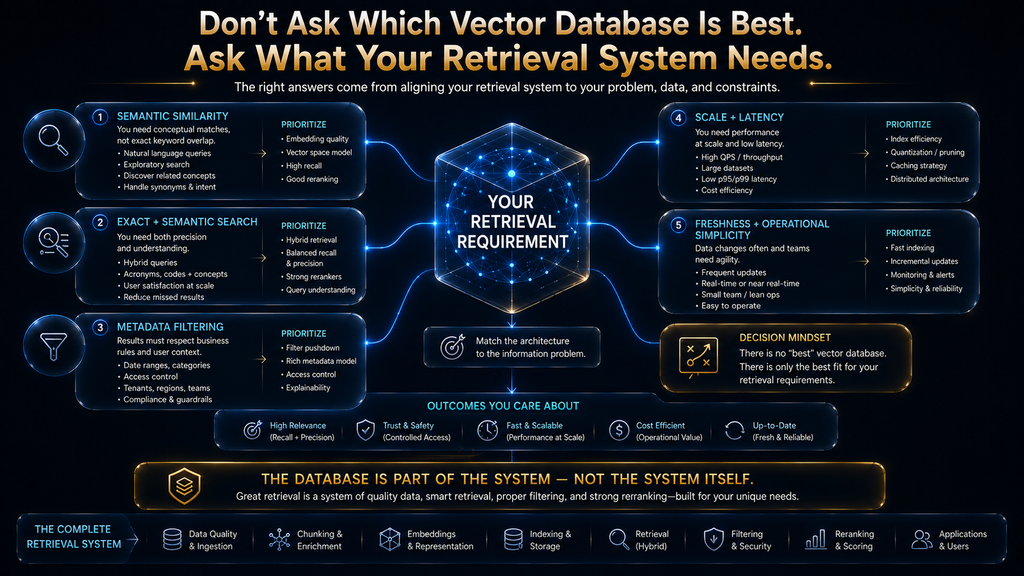
A Practical Vector Database Decision Framework
A useful way to decide whether vector infrastructure belongs in an application is to evaluate the problem across five dimensions.
| Decision area | Question to answer |
|---|---|
| Search need | Do users need to find information by meaning rather than exact wording? |
| Representation | Does the embedding model represent the distinctions that matter? |
| Retrieval | Can the system retrieve the right candidates with acceptable recall and latency? |
| Constraints | Can it enforce permissions, tenancy, versions, dates and other business rules? |
| Outcome | Does improved retrieval create a measurable improvement in the actual workflow? |
This framework deliberately avoids starting with product names.
That is important because the database should follow the retrieval problem rather than define it. If the application cannot demonstrate a meaningful semantic-search requirement, the technology choice is premature.
If the requirement is real, the next step is to establish a retrieval baseline and test the architecture using representative queries. That is where meaningful engineering decisions begin.
A Real-World Example: Customer Support
Consider a software company with 100,000 support articles and internal troubleshooting documents.
Customers do not necessarily use the same language as the support team. A customer may ask, “Why did my dashboard suddenly stop updating?” while the documentation says “Delayed analytics synchronization following credential expiration.”
A pure keyword search may or may not connect those concepts depending on the surrounding terms. A semantic retrieval system can represent the customer’s question and documentation in the same vector space and search for related passages.
But the system still needs to handle important constraints. The article may apply only to a particular software version. Some troubleshooting instructions may be intended for internal support staff rather than customers. Certain articles may have been superseded. Some customers may have access only to specific product tiers.
The vector database can help identify relevant candidates, but the application must combine similarity with those constraints. If the system retrieves a highly relevant article for the wrong software version, the result may be worse than no result at all because the customer could follow an obsolete procedure with confidence. The value of vector search therefore comes from improving the complete support workflow, not from maximizing similarity scores.
Another Example: Product Recommendations
The same concept appears outside RAG.
Imagine an e-commerce system where a shopper views a particular running shoe. The application may want to find visually or semantically similar products even when the product descriptions do not share many exact words.
The product image, description, category, materials, intended activity, and other characteristics can be represented as vectors. Similarity search can then identify products whose representations are close to the viewed item.
But again, similarity is not the final decision.
A product may be highly similar but out of stock. Another may be similar but outside the user’s price range. Another may be unavailable in the user’s country. Another may belong to a category the user has already rejected.
A production recommendation system therefore combines semantic similarity with structured constraints and business objectives. This example demonstrates a broader principle: vector search usually generates possibilities; application logic determines usefulness.
Another Example: Enterprise Knowledge Search
Enterprise search is one of the clearest examples of where vector retrieval can help and where it can fail.
Employees rarely phrase questions exactly as documents are written. They may ask conversational questions such as “Who approves travel expenses over $2,000?” while the relevant policy document contains formal language about delegated financial authority.
Semantic retrieval can improve discovery because the system does not need the user to know the document’s exact terminology.
But enterprise information is heavily contextual. The answer may depend on department, employee level, geography, fiscal year, or organizational policy. If the retrieval system ignores those dimensions, it can produce a document that sounds relevant but applies to someone else.
This is why enterprise semantic search is often as much a metadata problem as a vector problem.
The organizations that get the most value from the technology are not necessarily those with the most advanced vector indexes. They are often the organizations that have done the harder work of defining document ownership, versions, access rules, taxonomy, and evaluation criteria.
The Economics of Vector Retrieval
The financial cost of vector search extends beyond the database subscription or hosting bill.
Documents need to be processed and embedded. Embeddings consume compute or API budget. Vectors require storage. Indexes consume memory and compute resources. Query traffic creates ongoing retrieval costs. Reranking adds another computational layer. Updates can trigger additional embedding and indexing work.
There is also engineering cost. Someone has to build the ingestion pipeline, handle document changes, monitor failures, manage permissions, evaluate retrieval quality, tune indexes, investigate incorrect results, and maintain compatibility when embedding models or application requirements change. This is why the cheapest vector database on paper is not necessarily the cheapest architecture overall.
Imagine Architecture A costs $500 per month in infrastructure but requires substantial engineering effort to maintain. Architecture B costs $900 but integrates with the team’s existing database and reduces operational overhead. If the engineering difference is significant, the second architecture may have lower total cost of ownership even though its infrastructure bill is higher.
The relevant economic metric is therefore not simply database cost. It is something closer to:
Total retrieval cost = infrastructure + embedding + query processing + reranking + storage + engineering + maintenance + failure cost
The last term is easy to overlook. Poor retrieval can create manual work, incorrect recommendations, support escalations, or unreliable AI responses. Those costs can outweigh the infrastructure bill.
Latency Is a Business Variable, Not Just an Engineering Metric
Latency matters because retrieval happens inside a user workflow.
A search system used by an analyst may tolerate a few seconds if the result saves ten minutes of manual research. A customer-facing search box may need much lower latency because users expect an immediate response. A real-time recommendation system may operate under even tighter constraints.
This means there is no universally correct latency target.
The more useful measurement is whether latency is appropriate for the value created by the retrieval. A slightly slower system with much better recall may be worthwhile in research applications. A slightly less accurate system with dramatically lower latency might be preferable for a high-volume autocomplete or recommendation workflow.
Teams should therefore measure latency at realistic percentiles rather than relying only on averages. Average latency can look excellent while a significant minority of requests experience unacceptable delays.
In production, p95 and p99 behavior can matter because those are closer to the slow experiences users actually encounter.
The same principle applies to cost. A retrieval system that is cheap per query but requires several downstream model calls may not be cheap at the application level.
What Happens When the Knowledge Base Changes?
Vector systems create a maintenance requirement that traditional search teams need to understand.
When source documents change, their representations may need to change as well. If a policy is updated substantially, the corresponding vector record may need to be regenerated. If a document is deleted, its vector must not remain retrievable. If metadata changes, the retrieval record needs to reflect the new state.
Embedding-model changes create an even larger consideration.
If a team changes its embedding model, the resulting vectors may occupy a different representation space. Existing and newly generated vectors may not be directly interchangeable in the same retrieval system without careful migration and evaluation.
This means embedding models should not be treated like interchangeable API settings. They can become part of the data architecture.
The same is true of indexing. Changes to the vector collection, distribution, metadata filters, query patterns, or workload can alter the performance characteristics of an index.
A production vector database therefore needs lifecycle management rather than one-time configuration.
Vector Search Failure Modes
There are several distinct ways a semantic retrieval system can fail, and identifying the correct failure category matters because each problem requires a different solution.
The relevant document exists but is not retrieved
This is a retrieval recall problem. The issue may involve the embedding model, chunking, similarity metric, index configuration, query formulation, or filtering.
The correct document is retrieved but ranked too low
This is a ranking problem. Hybrid retrieval, candidate-set size, reranking, or ranking logic may need improvement.
The right document is retrieved but is outdated
This is a knowledge-governance or freshness problem. Versioning, timestamps, source authority, and lifecycle rules may be more important than vector tuning.
The correct information is retrieved but is incomplete
This may be a chunking or context-construction problem. The relevant passage may not contain enough surrounding information to support the answer.
The right information is retrieved but the model gives the wrong answer
This is a downstream generation problem. Changing the vector index may have little effect if retrieval is already adequate.
The correct result is retrieved for the wrong user
This is an authorization problem and potentially a security problem. Semantic relevance does not override access control.
These distinctions prevent a common debugging failure: changing the database every time an AI application produces a bad answer.
A Better Debugging Method
When a retrieval-based application fails, start by asking whether the necessary evidence existed in the source system.
If it did not, the problem is upstream. The system cannot retrieve information that was never present.
If it existed, ask whether it was transformed into a useful retrieval unit. Poor extraction or chunking can make valid source material difficult to retrieve.
Next, ask whether the embedding representation captures the relevant relationship. If not, changing the index will not solve the fundamental problem.
Then inspect the candidate retrieval stage. Was the correct passage present among the candidates? If not, investigate query formulation, similarity settings, index configuration, filters, and embedding quality.
If the correct passage was present but ranked too low, investigate ranking or reranking. If the correct passage reached the model but the final answer was wrong, investigate context construction and generation. This layered diagnostic method is much more efficient than treating “AI search” as one black box.
Measuring Vector Search Properly
A vector database should be evaluated using metrics that reflect the actual retrieval task.
Recall@K asks whether relevant information appears within the top K retrieved results. This is especially important for RAG because a model cannot use evidence that never reaches the candidate set.
Precision@K asks how much of the retrieved result set is actually relevant. High recall with very poor precision can create unnecessary context and make downstream ranking more difficult.
Mean Reciprocal Rank (MRR) can help evaluate where the first relevant result appears in the ranking. This is useful when users or downstream applications strongly prefer the most relevant result to appear near the top.
Normalized Discounted Cumulative Gain (NDCG) can be useful when multiple retrieved results have different degrees of relevance and ranking order matters.
But infrastructure metrics are equally important. Teams should monitor latency, throughput, resource consumption, index build time, update time, storage, and cost.
Then comes the metric that matters most: Does retrieval quality improve the application outcome?
For a RAG assistant, that might mean answer accuracy, citation correctness, groundedness, task completion, or reduced manual research time. For enterprise search, it could mean faster information discovery. For recommendations, it could mean engagement, conversion, or another relevant product metric.
A technically excellent vector index that does not improve the business workflow is not a successful optimization.
A Four-Layer KPI Framework
For practical evaluation, vector retrieval can be measured across four layers.
| Layer | Example metrics | What it tells you |
|---|---|---|
| Retrieval coverage | Recall@K | Whether useful evidence is being found |
| Ranking quality | Precision@K, MRR, NDCG | Whether useful evidence is being prioritized |
| Infrastructure | p95/p99 latency, throughput, cost | Whether the system can operate economically |
| Application outcome | Answer quality, task completion, conversion, time saved | Whether retrieval creates real value |
This structure prevents teams from optimizing the wrong thing.
Suppose an index change reduces average retrieval latency from 50 milliseconds to 20 milliseconds but reduces Recall@10 from 94% to 82%. The system became faster while becoming materially worse at finding relevant evidence. If the application depends on high retrieval coverage, that may be a bad trade.
Conversely, increasing recall from 94% to 96% might not justify doubling query cost if the additional results rarely improve downstream answers. The correct optimization point depends on the application.
Common Mistakes When Building Vector Search
One of the most common mistakes is starting with infrastructure instead of the user problem. Teams see vector databases, embeddings, and RAG becoming popular and assume they need to build the stack first. The result can be an impressive technical demonstration without a clearly defined retrieval objective.
Another mistake is assuming that semantic search is inherently better than keyword search. It is not. Exact identifiers and specialized terminology often benefit from lexical matching, and many strong retrieval systems combine both approaches.
A third mistake is ignoring metadata. Without document version, tenant, access scope, product, region, or other relevant context, semantic similarity can produce plausible but invalid results.
A fourth mistake is failing to evaluate retrieval separately from generation. If the application produces a wrong answer, teams sometimes immediately modify the prompt or language model. If the relevant evidence never entered the context, that work is addressing the wrong layer.
Another common mistake is optimizing for benchmark speed without measuring recall. Retrieval is useful only when it finds the information the application needs.
Finally, teams often underestimate maintenance. Embeddings need updating when source content changes. Indexes need monitoring. Metadata needs governance. Permissions need testing. Retrieval quality can drift as documents, users, queries, and products change.
The result is a system that can degrade even when the core application code has not changed.
Why Evaluation Must Continue After Launch
A vector-search system can become worse without any obvious software failure.
The document collection changes. New content is added. Old content is removed. Users develop new ways of asking questions. Product terminology changes. The embedding model changes. Index parameters are tuned. Access policies evolve.
Each of those changes can alter retrieval behavior.
Imagine a support system that performed extremely well during development because its test set reflected the company’s original product documentation. Six months later, the product has introduced three new features, renamed several concepts, and accumulated thousands of new support articles. The original evaluation set may still show excellent performance while real user queries increasingly produce weaker results.
This is why retrieval evaluation should be treated as an ongoing operational discipline rather than a launch checklist. The relevant question is not simply: “Did the vector database work when we deployed it?”
It is: “Does the retrieval system continue to find the right information as the knowledge base and user behavior change?” That distinction becomes increasingly important as the system becomes business-critical.
Who Should Use Vector Databases?
A vector database is a strong candidate when the application’s central information problem involves finding things by similarity or meaning. That includes semantic document search, RAG systems, recommendation engines, similar-product discovery, image or multimodal retrieval, duplicate detection, knowledge discovery, and large collections of unstructured information.
The stronger signal is not simply dataset size. It is the nature of the query.
A million exact lookups do not automatically justify semantic retrieval. Conversely, a much smaller dataset can benefit significantly if users ask complex natural-language questions and traditional search repeatedly misses the intended information.
This distinction matters because infrastructure decisions are often made from scale assumptions rather than workload characteristics. A useful starting question is therefore: What kind of question are users asking the system to answer?
If the answer is primarily “find the exact record matching these identifiers,” vector search may add little. If the answer is “find the information that means roughly what this question means,” vector retrieval becomes much more relevant.
Who Should Avoid It?
Organizations should be cautious about vector infrastructure when semantic similarity is not central to the workflow, when exact search already performs adequately, when the dataset and traffic are small enough that simpler approaches are sufficient, or when the team cannot define a measurable improvement.
They should also be cautious when the underlying knowledge is poorly governed. Adding semantic retrieval before resolving document ownership, versioning, access rules, and source authority can make the system more complicated without making the answers more trustworthy.
There is also a human-capability consideration. A vector database introduces operational responsibilities. Teams need people who understand retrieval evaluation, embeddings, indexing, metadata, access controls, and system maintenance. If the organization cannot support that operational burden, a simpler architecture may be more sustainable.
This is not an argument against vector search. It is an argument against adopting specialized infrastructure because it looks like the modern thing to do.
What Happens If You Do Nothing?
If an organization genuinely has a semantic-retrieval problem and does nothing, users may continue to struggle with search terminology. Employees may browse documents manually, support teams may answer questions that could have been self-served, and knowledge may remain difficult to discover even when it exists somewhere in the organization.
Over time, those inefficiencies can become expensive because they repeat across thousands of interactions.
But there is an equally important alternative scenario. If the current search system already performs adequately, doing nothing may be the better decision. Introducing vector infrastructure creates its own costs, and those costs need to be justified by measurable improvements.
The correct comparison is therefore not “old technology versus new technology.” It is current workflow performance versus expected improved workflow performance. That framing keeps the decision grounded in outcomes rather than technology enthusiasm.
The Second-Order Effects of Better Retrieval
Better semantic retrieval can produce effects that are not immediately obvious.
When employees can find information more easily, the organization may discover that knowledge which was previously trapped in documents is suddenly being reused more frequently. That can increase the value of existing documentation without requiring the organization to create entirely new knowledge.
But better retrieval can also expose inconsistencies. If a search system suddenly surfaces five conflicting procedures for the same process, the problem is not necessarily that search became worse. Search may have revealed a governance problem that was previously hidden by poor discoverability.
There is also a trust effect. Users who consistently receive relevant information may begin relying on the system more heavily. That raises the stakes of retrieval errors because users may become less skeptical of plausible results.
The second-order effect is therefore both positive and cautionary: better retrieval increases the value of knowledge, but it also increases the importance of knowing which knowledge deserves to be trusted. That is especially important in RAG systems, where retrieved content can directly influence generated answers.
The Future of Vector Retrieval Is Probably Hybrid
The long-term direction of retrieval is unlikely to be a simple replacement of keyword search with vector search. Instead, systems are increasingly likely to combine multiple retrieval signals according to the needs of the query and application.
A query containing an exact product identifier may benefit heavily from lexical matching. A broad natural-language question may benefit more from semantic retrieval. A regulated enterprise system may need metadata and authorization rules to dominate both. A complex RAG workflow may retrieve broadly, rerank deeply, and then select only the strongest evidence for generation.
This layered approach reflects how information actually works.
Meaning matters, but so do exact terms. Similarity matters, but so does authority. Relevance matters, but so do permissions. Speed matters, but so does recall. Infrastructure efficiency matters, but so does the business outcome.
The future is therefore less about finding one perfect retrieval method and more about combining retrieval mechanisms intelligently according to the information problem.
A More Useful Way to Think About Vector Database Architecture
Instead of viewing the vector database as the center of the system, think of it as one layer in an evidence pipeline. The source layer determines what information exists. The preparation layer determines whether that information is clean, current, structured, and retrievable.
The embedding layer determines how meaning is represented. The vector index determines how efficiently candidate representations can be found. The metadata layer determines which candidates are allowed or appropriate.
The ranking layer determines which candidates deserve priority. The application layer determines how retrieved information is used. The evaluation layer determines whether the complete system works.
This model makes architectural troubleshooting much easier because every failure has somewhere to belong. If documents are outdated, fix governance. If concepts are poorly represented, investigate embeddings.
If relevant vectors are not being found, investigate retrieval. If relevant candidates are ranked poorly, investigate ranking. If the correct evidence is retrieved but the answer is wrong, investigate generation.
If the correct evidence is shown to the wrong user, investigate authorization. The vector database remains important, but it is no longer treated as a magical black box.
A Practical Implementation Path
For a team building semantic search for the first time, the best approach is usually to start with a narrow, measurable use case rather than building a generalized vector platform.
Begin by collecting real user questions. Do not rely entirely on synthetic examples because synthetic queries often make the system look better than it will perform in production. Include ambiguous questions, exact identifiers, short queries, long questions, terminology variations, outdated-document scenarios, and cases where several documents appear relevant.
Then establish a baseline using the existing search system. This is critical because it gives the team something to beat.
Next, prepare the source material carefully. Identify authoritative documents, remove obvious duplicates, preserve useful metadata, establish version information, and decide what units of information should be searchable. If the knowledge base is poorly structured, address those problems before assuming embeddings will fix them.
Generate embeddings for the chosen retrieval units and store them alongside the source references and metadata. Start with a straightforward retrieval configuration rather than optimizing every parameter immediately.
Then evaluate the system against the real query set. Measure recall, ranking quality, latency, and downstream outcomes.
Only after that should the team begin tuning index parameters, hybrid retrieval, reranking, filters, or more specialized infrastructure. This sequence matters because every architectural addition should answer a specific question: What measured problem are we solving by adding this layer? If there is no clear answer, the layer may not be necessary.
A Vector Database Should Earn Its Complexity
One of the strongest conclusions from the entire topic is that infrastructure complexity has an opportunity cost.
Every additional system requires deployment, monitoring, backups, permissions, upgrades, debugging, documentation, and specialized knowledge. Those costs may be justified when the system produces significant value, but they should not be ignored.
A simple architecture that delivers 95% of the required retrieval quality may be better than a sophisticated architecture that delivers 97% while creating twice the operational burden. The correct decision depends on the application’s economics and risk tolerance.
This is especially true for early-stage projects. Teams often build for hypothetical scale long before they understand the actual workload. A system designed for billions of vectors may be technically impressive but operationally unnecessary if the application has only a few hundred thousand records and modest traffic.
Start with the problem you have. Measure the workload. Then scale the architecture when the evidence says you need to.
Final Thoughts
Vector databases are valuable because they make semantic retrieval practical: they provide infrastructure for storing vector representations, indexing them, finding similar records, and combining those results with the metadata and retrieval logic required by real applications.
But the database itself is not the source of intelligence. The embedding model determines how information is represented, the source data determines what knowledge exists, chunking determines what retrieval units look like, the index determines how efficiently candidates can be found, metadata determines whether those candidates are valid, ranking determines what rises to the top, and evaluation determines whether the complete system actually improves the workflow.
That is why choosing a vector database should never begin with a feature checklist. Begin with the retrieval problem.
Determine whether users genuinely need semantic search. Establish what the existing system gets wrong. Measure whether embeddings improve retrieval. Test whether the vector index can deliver sufficient recall at acceptable latency and cost. Add metadata, hybrid search, reranking, or specialized infrastructure only when the evidence shows that each layer solves a real problem.
The most sophisticated retrieval stack is not automatically the best one. The best architecture is the simplest system that can reliably retrieve the right knowledge, under the right constraints, at a cost and latency the real application can support.
And that is the real value of a vector database: not “having vectors,” but turning meaning-based representations into useful, searchable evidence inside a larger information workflow.
Choose the AI Guide That Solves the Right Problem
Now that you know how vector databases work, compare the ones most teams evaluate for RAG.
Compare Vector Databases for RAG →Frequently Asked Questions
What is a vector database?
A vector database is a system designed to store numerical representations of information and retrieve records based on similarity between those representations. It is commonly used for semantic search, RAG, recommendations, similar-item discovery, and other workloads where finding conceptually related information matters.
How does a vector database work?
An embedding model converts source information and user queries into vectors. The vector database indexes the stored vectors and searches for representations that are mathematically similar to the query, after which the application may apply filters, hybrid retrieval, reranking, and other rules before using the results.
What is the difference between a vector database and an embedding model?
An embedding model creates the vector representation, while the vector database stores and retrieves those representations. The model determines how information is represented; the database provides infrastructure for searching those representations.
Does a vector database understand language?
Not in the same way a language model does. It searches numerical representations generated by an embedding model and uses mathematical similarity to identify related records.
What is semantic search?
Semantic search retrieves information according to conceptual or meaning-based relationships rather than relying exclusively on exact word matches. It is particularly useful when users describe a concept differently from the language used in the source documents.
Does vector search replace keyword search?
No. Keyword search remains valuable for exact terms such as product IDs, error codes, names, SKUs, and technical identifiers. Many production retrieval systems combine keyword and semantic search.
What is HNSW?
HNSW, or Hierarchical Navigable Small World, is an approximate-nearest-neighbor indexing approach that organizes vectors into a graph structure to make similarity search more efficient. It trades some of the characteristics of exhaustive exact search for improved practical performance.
What is IVFFlat?
IVFFlat is an approximate vector-indexing approach that divides vectors into groups and searches selected groups instead of comparing against every stored vector. The number of groups searched affects the trade-off between retrieval quality and query cost.
Does every RAG system need a vector database?
No. RAG requires a retrieval mechanism, but that mechanism can use different technologies. Depending on the workload, an existing database, search engine, vector-capable relational database, or specialized vector system may be sufficient.
Can PostgreSQL be used for vector search?
Yes. PostgreSQL can support vector similarity search through the pgvector extension, which supports exact search and approximate indexing approaches including HNSW and IVFFlat.
Related Guides
- Best RAG Platforms and Tools for Building AI Knowledge Bases in 2026
- How AI Memory Works: Context Windows vs Long-Term Memory
- How to Reduce Hallucinations with RAG: A Practical Guide
Written by
Muntasir Ahmad Chowdhury
Founder, AI Hustle World
Muntasir Ahmad Chowdhury is the Founder of AI Hustle World, an independent publication dedicated to making Artificial Intelligence practical, trustworthy, and easy to understand. He researches AI tools, automation, customer service, productivity, and real-world business applications, helping readers make smarter technology decisions through research-driven, experience-backed content.
Expertise:
AI Tools • AI Automation • AI Customer Service • AI Productivity • Generative AI • AI Workflows
Get Smarter With AI
Enjoyed this guide? Get practical AI tools, tutorials, and honest reviews delivered to your inbox.