Evidence: Documentation reviewed
Last checked: September 2026
What was done: Written from official documentation and the published sources linked in this article. Not hands-on tested.
Files: None
Affiliate links: No
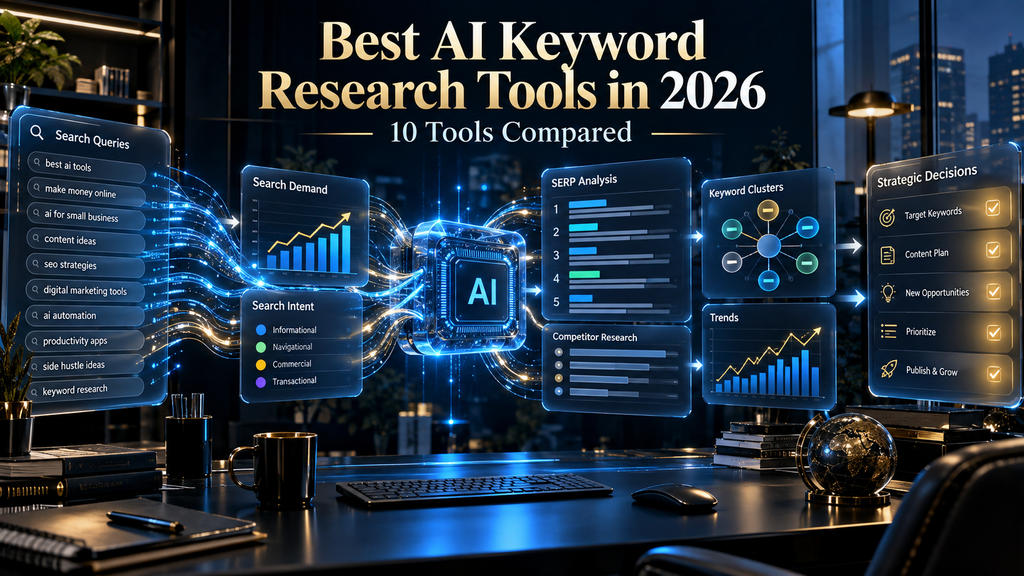
Best AI Keyword Research Tools in 2026: 10 Tools Compared
Keyword research used to be one of the more mechanical parts of SEO. You started with a topic, collected keyword ideas, checked search volume and competition, chose a few targets, and moved into content production. That workflow still works at a basic level, but AI has changed the economics of the process: generating keyword ideas is now extremely easy, while deciding which ideas deserve attention has become much harder.
That distinction is the foundation of this comparison. An AI assistant can give you hundreds of plausible search queries in seconds, but a plausible query is not automatically a valuable keyword. You still need evidence of demand, an understanding of search intent, a realistic view of the SERP, some assessment of ranking feasibility, a reason for the page to exist, and a way to decide whether several related queries belong together or should become separate pieces of content.
This is also why “AI keyword research” should not be reduced to a chatbot producing a list of phrases. The strongest modern workflows connect AI-assisted discovery and analysis to actual SEO data. Ahrefs, for example, describes AI keyword research as particularly useful for brainstorming, clustering, intent analysis, and repetitive research tasks, while warning that general-purpose chatbots without a reliable data connection can produce unsupported SEO metrics.
The practical question, therefore, is not simply which tool has the biggest keyword database. It is which tool helps you make the best decisions for your particular website, market, resources, and business model.
In this guide, we compare 10 strong options across those dimensions and use the AI Hustle World Keyword Decision Score to create a more useful way of thinking about keyword research.
Quick Answer: What Is the Best AI Keyword Research Tool in 2026?
For most serious SEO users, Ahrefs and Semrush are the strongest all-around choices, but neither is automatically the right answer for everyone. Ahrefs is particularly strong for deep keyword intelligence, competitive research, SERP analysis, traffic potential, and large-scale keyword discovery. Its current Keywords Explorer combines keyword ideas, search volume, Keyword Difficulty, Traffic Potential, Parent Topic, clustering, AI-assisted brainstorming, and other research functions; Ahrefs currently reports 110 billion keywords discovered and 28.7 billion filtered keywords. (Ahrefs)
Semrush is arguably the strongest option for users who want keyword research inside a wider SEO and marketing ecosystem. Its Keyword Magic Tool currently advertises more than 27.3 billion keywords, with search volume, Keyword Difficulty, search intent, CPC, SERP features, topic groups, filters, and keyword-list organization built into the workflow. (Semrush)
However, the strongest tool for a specific problem may be a specialist. LowFruits is more compelling when your primary goal is finding weak SERPs and low-competition opportunities. Keyword Insights is stronger when the bottleneck is clustering thousands of queries into sensible content groups. Google Trends is unusually useful when freshness, seasonality, or momentum matters. Google Keyword Planner remains valuable for demand validation even though it was built for advertising rather than as a complete organic SEO platform. (Keyword Insights)
So the answer depends on the bottleneck. The best keyword research tool is the one that removes the most expensive research problem without adding unnecessary complexity or cost.
Why Keyword Research Has Changed in the AI Era
The old keyword workflow was built around scarcity. Research took time, so the number of ideas a human could investigate was naturally limited. That constraint has largely disappeared.
Today, an AI system can produce keyword variations, questions, entities, modifiers, subtopics, comparisons, audience-specific phrases, and content angles almost instantly. The resulting problem is not a lack of ideas. It is an excess of them.
Consider a hypothetical topic such as “AI writing tools.” An AI system might produce “best AI writing tools,” “AI writing software,” “AI article writer,” “AI blog writer,” “AI copywriting tools,” “AI writing tools for students,” “AI writing tools for SEO,” “free AI writing tools,” and dozens or hundreds of related variations.
That looks productive until you ask the questions that actually matter. Do these queries represent different search intents? Should each become a separate page? Which have meaningful demand? Which SERPs are dominated by major sites? Which have commercial value? Which topics have weak or outdated results? Which can your site realistically cover better than what already exists?
This creates a useful distinction: AI has lowered the cost of keyword discovery without eliminating the cost of keyword judgment. In fact, it arguably makes judgment more valuable because bad decisions can now be made at much greater speed.
Google’s current guidance for AI search is consistent with this broader direction. Its systems still rely on fundamental Search practices, while its documentation emphasizes useful, original, non-commodity content rather than creating large volumes of pages simply because many query variations can be generated.
That changes how keyword research should be approached. The goal is not to discover every possible phrase. The goal is to identify the smallest set of strategically useful search opportunities that can support genuinely valuable content.
What Is an AI Keyword Research Tool?
The phrase “AI keyword research tool” covers several different categories, and treating them as interchangeable leads to poor comparisons.
Some platforms are broad SEO suites with AI features layered into existing keyword databases. Others focus on SERP-based clustering. Some concentrate on low-competition discovery. Others are primarily designed for autocomplete expansion, trend validation, or demand research.
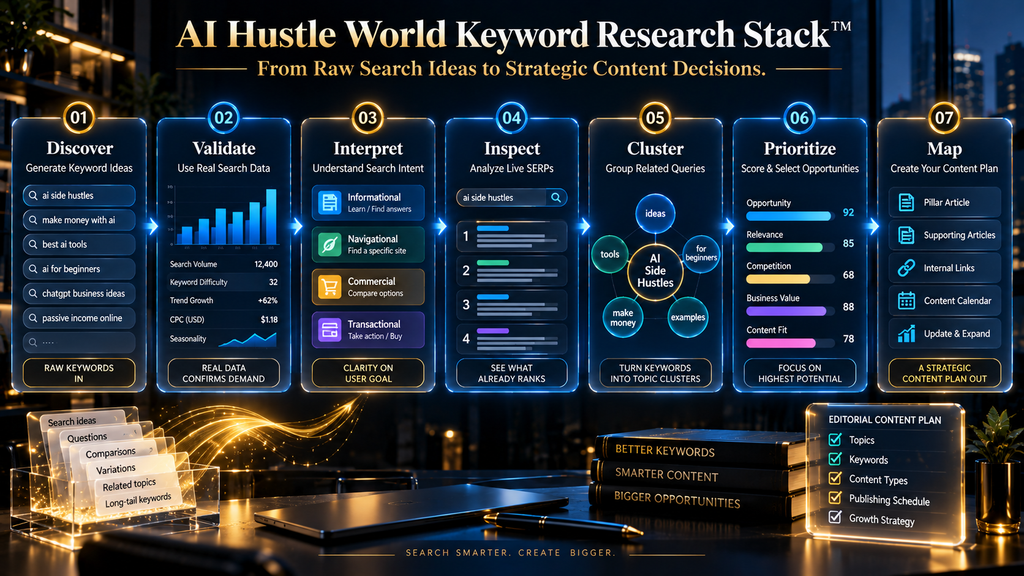
For this article, an AI keyword research tool is valuable when it helps improve one or more meaningful stages of the research process: Discovery → Validation → Interpretation → SERP Analysis → Clustering → Prioritization → Content Mapping.
AI is particularly useful for the repetitive or high-volume portions of that chain. It can expand ideas, identify patterns, classify large datasets, summarize competing pages, and help researchers work through far more information than they could manually.
But it should not be confused with evidence.
A keyword generated by AI is a candidate. A keyword supported by real search data and competitive evidence is a research finding.
That difference is essential.
The AI Hustle World Keyword Decision Score
Most keyword tools give you metrics. The problem is that metrics do not automatically produce decisions. That is why this article uses the AI Hustle World Keyword Decision Score, built around five questions that should be answered before a keyword becomes a serious content target.
KDS = Demand × Intent × Feasibility × Business Value × Information Gain
| Factor | What it asks |
|---|---|
| Demand | Is there credible evidence that people search for this topic? |
| Intent | Do we understand what the searcher actually wants? |
| Feasibility | Can this website realistically compete for the query? |
| Business Value | Would winning the query create meaningful value? |
| Information Gain | Can we provide something genuinely useful, original, or better? |
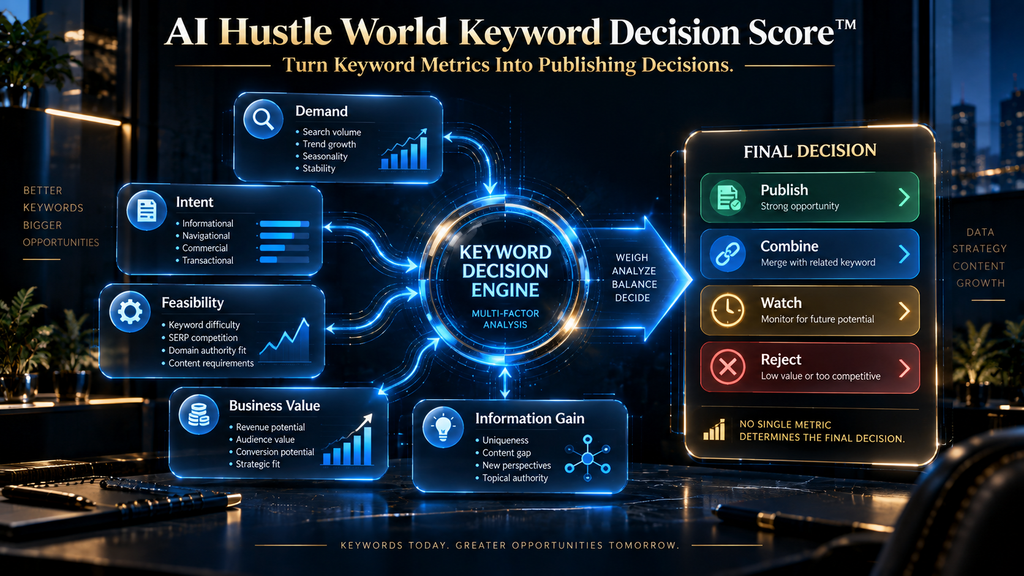
The multiplication is deliberate because weakness in one dimension can undermine the entire opportunity.
A keyword with massive demand but extreme competition may be a poor target for a young site. A low-competition term may still be weak if it attracts people with no meaningful connection to the business. A commercially valuable keyword may not justify a new page if the SERP is already excellent and there is no credible information advantage to exploit.
This is why keyword volume is a research input, not a publishing decision.
The 10 Best AI Keyword Research Tools in 2026
1. Ahrefs — Best for Deep Keyword Intelligence and Competitive Research
Ahrefs remains one of the strongest choices when keyword research is inseparable from competitor analysis. Its Keywords Explorer is designed around detailed keyword analysis rather than simple suggestion generation, and its current product combines search volume, Keyword Difficulty, Traffic Potential, Parent Topic, SERP information, keyword ideas, clustering, and AI-assisted brainstorming.
Its data scale is also significant. Ahrefs currently says its keyword index contains 28.7 billion filtered keywords from 110 billion keywords discovered in total, with 2.7 billion keywords in the United States alone.
One of the more strategically useful metrics is Traffic Potential. Instead of assuming that a keyword’s search volume directly predicts the traffic a page could receive, Ahrefs estimates how much traffic the top-ranking page gets for the query. That reflects an important SEO reality: ranking for a keyword is not the same as receiving a proportionate share of its total search volume.
Ahrefs is also increasingly connecting traditional keyword research with AI-assisted workflows. Its current materials describe AI keyword suggestions, clustering, and other AI-powered research capabilities, while its broader platform now extends into AI-visibility analysis as well.
The weakness is not capability. It is the possibility of overbuying. A highly sophisticated SEO intelligence platform can be an excellent investment for an agency or established publisher and poor economics for someone who only needs a few content ideas every month.
Best for: serious SEO professionals, publishers, agencies, competitive research, mature sites. Main trade-off: considerable depth and breadth can mean more complexity and cost than beginners require.
2. Semrush — Best All-Around Keyword Research Ecosystem
Semrush is particularly strong when keyword research needs to connect to everything else happening in an SEO department.
Its Keyword Magic Tool currently provides access to more than 27.3 billion keywords and organizes related terms into topic-specific subgroups. The platform provides metrics including search volume, Keyword Difficulty, search intent, CPC, and SERP features, while also allowing researchers to filter, sort, save, and organize keyword lists by project.
That organizational layer matters. Keyword research is rarely finished when you find a good phrase. The real work often involves sorting thousands of candidates into themes, questions, transactional queries, informational opportunities, and other meaningful groups.
Semrush is therefore particularly attractive to agencies and marketing teams that want one ecosystem rather than a collection of disconnected tools. Its broader product environment covers keyword research, competitor intelligence, position tracking, content-related workflows, and other marketing functions.
Independent testing also illustrates the platform’s breadth. Zapier’s 2026 review highlights Semrush’s granular keyword information, SERP-feature analysis, keyword gap research, keyword clustering-related workflows, and integration with other research systems, while noting that its depth can be overwhelming for less experienced users. (Zapier)
The central drawback is value efficiency. Breadth only creates ROI when you actually use the breadth.
Best for: agencies, marketers, growing publishers, in-house SEO teams. Main trade-off: excellent ecosystem, but potentially more platform than a small website needs.
3. Google Keyword Planner — Best for Google-Native Demand Research
Google Keyword Planner is not an AI-first keyword platform, but it remains one of the most useful components in a keyword research stack because it provides data directly from Google’s advertising ecosystem.
Google says Keyword Planner can generate keyword suggestions, provide monthly search estimates, show advertising cost information, organize keywords into categories, and provide traffic estimates for planned campaigns. It can begin with keywords, websites, or both. (Google Help)
For SEO researchers, its strongest role is often validation rather than complete competitive analysis. An AI assistant might generate 100 keyword candidates, but Keyword Planner gives you a way to investigate whether those concepts have measurable search activity rather than relying on the AI model’s confidence.
There is an important limitation, however. Google Keyword Planner is designed around advertising campaigns. Advertising competition, CPC, and campaign forecasts are not equivalent to organic SEO difficulty or guaranteed organic traffic. Google itself notes that campaign performance depends on factors including bidding, budget, ad quality, location, customer behavior, and the industry involved.
That makes Keyword Planner particularly useful as one layer in the research stack. Best for: beginners, demand validation, low-budget research, PPC-informed SEO planning. Main trade-off: valuable first-party demand information, but not a complete organic SEO intelligence platform.
4. LowFruits — Best for Low-Competition and Weak-SERP Opportunities
LowFruits takes a more specialized approach. Instead of trying to cover every component of SEO, it focuses heavily on identifying opportunities where the SERP may be vulnerable.
That makes it particularly interesting for smaller websites.
A new site often does not lose because its content is inherently bad. It loses because it chooses keywords where nearly every meaningful ranking position is occupied by powerful domains with strong authority, extensive backlinks, recognized brands, or years of accumulated relevance.
A weak-SERP approach changes the question. Rather than asking, “Which keywords have the most searches?” the researcher can ask, “Which worthwhile keywords have an actual opening?”
This is strategically powerful because competition should be judged by the pages you need to beat, not by a single abstract difficulty number. LowFruits fits that philosophy well.
The limitation is specialization. It is not intended to be everything an enterprise SEO team might need, and that is actually one reason it can work so well alongside a broader platform.
Best for: newer sites, niche publishers, low-competition strategies, long-tail opportunities. Main trade-off: powerful specialization, limited breadth compared with major suites.
5. Keyword Insights — Best for SERP-Based Keyword Clustering
Keyword Insights becomes particularly valuable after discovery.
Imagine starting with 5,000 keywords. The problem is no longer finding more. It is deciding how those terms should become content.
Keyword Insights’ clustering system analyzes live, country-specific SERPs and groups keywords when the ranking URLs are sufficiently similar. Its current product supports clustering large keyword lists and reports associated metrics including ranking URLs, average rank, search intent, potential traffic, difficulty, and SERP features. (Keyword Insights)
That makes clustering more than a spreadsheet exercise.
Suppose “best AI resume builders,” “AI resume builder,” and “best resume AI tools” repeatedly produce substantially overlapping search results. That is evidence that Google may understand those queries as closely related search tasks. Creating three independent articles might therefore be less effective than creating one stronger resource that comprehensively serves the intent.
Keyword Insights explicitly positions its clustering around this SERP-based principle and also provides intent classification, including informational, commercial, and transactional categories. Its most important value is therefore architectural.
Best for: content teams, large keyword sets, topical planning, clustering, avoiding unnecessary page duplication. Main trade-off: specialist strength in clustering rather than full-spectrum SEO intelligence.
6. SE Ranking — Best for Balanced Value
SE Ranking occupies the middle ground between lightweight research tools and highly sophisticated enterprise platforms.
Its Keyword Research system currently provides keyword difficulty, monthly search volume, CPC, related keywords, low-search-volume keywords, advertising competition, and top-ranking organic and paid pages. Its documentation also explains that its displayed search-volume figures are based on Google Keyword Planner data and can therefore differ from estimates shown by other providers. (SEMrush Help Center)
That transparency about data differences is worth noticing because keyword metrics are not standardized across providers. Two platforms can display different volumes or difficulty estimates for the same phrase without either necessarily being “wrong”; their datasets, sampling methods, update cycles, and models can differ.
SE Ranking is therefore appealing when the user wants broad capability without maximizing complexity. It can cover a lot of the research process without requiring a large enterprise workflow.
Its weakness is that specialized requirements may eventually expose the difference between “good across many jobs” and “best at one difficult job.” Best for: small businesses, freelancers, growing publishers, value-conscious SEO teams. Main trade-off: balanced capability rather than extreme specialization.
7. KWFinder — Best for Beginner-Friendly Long-Tail Research
KWFinder is attractive for users who want keyword research to remain understandable.
That sounds like a small advantage until you consider how many people abandon SEO tools because the interface presents dozens of metrics without explaining which ones actually matter. For a beginner researching a small number of content ideas, a more focused experience can be more productive than a giant database.
Its strongest use case is long-tail discovery and straightforward keyword evaluation. A user can begin with a topic, discover specific variations, and narrow toward phrases that fit the site’s size and content strategy.
The important lesson is broader than KWFinder itself: software complexity should match research complexity. A solo blogger publishing four carefully researched articles a month does not necessarily need to replicate the workflow of a 20-person SEO agency. At the same time, simpler tools can eventually feel restrictive as competitive analysis and large-scale content planning become more important.
Best for: beginners, bloggers, small publishers, long-tail research. Main trade-off: easy entry and focused research versus less depth for advanced users.
8. Moz Keyword Explorer — Best for Straightforward Keyword Prioritization
Moz Keyword Explorer remains relevant because keyword research should eventually produce a shortlist, not an enormous database.
The value of a prioritization-oriented workflow is that it helps convert “interesting” keywords into “worth pursuing” keywords. That is especially useful for users who want a more accessible path from discovery to decision.
The strategic principle is important here. A keyword is not valuable because it looks impressive in a database. It is valuable because it fits a real search intent, can be competitively approached, supports the business, and justifies the creation of a strong page.
Moz is therefore best positioned for users who prefer approachable SEO research and practical prioritization over maximum complexity. The limitation is that the advanced researcher may eventually want broader datasets, more sophisticated competitive analysis, or more specialized workflows.
Best for: small teams, accessible keyword research, structured prioritization. Main trade-off: simplicity and usability versus maximum research depth.
9. KeywordTool.io — Best for Broad Keyword Expansion
KeywordTool.io is particularly useful when the first problem is discovering how people might phrase a search.
Its model centers heavily on autocomplete-style discovery across platforms. Current coverage includes Google, YouTube, Bing, Amazon, eBay, App Store, Instagram, Reddit, Pinterest, TikTok, Naver, Etsy, and other sources. (Keyword Tool)
That makes it useful when you are starting from a vague topic rather than a well-developed keyword set. It can expose variants and questions that may not appear in your initial thinking.
However, expansion is not validation. Autocomplete can show that a phrase exists within a suggestion environment; it does not automatically establish organic ranking feasibility, business value, or whether a separate page should exist. KeywordTool.io therefore works best as a discovery layer that feeds into deeper validation and SERP analysis.
Best for: seed expansion, question discovery, autocomplete research, multi-platform keyword ideation. Main trade-off: excellent breadth of ideas, limited usefulness as the entire decision framework.
10. Google Trends — Best for Trends, Momentum, and Seasonality
Google Trends solves a different problem from conventional keyword databases. Its core value is understanding direction.
Google Trends lets users explore current search interest and investigate how topics behave over time, including what is trending and how interest changes geographically or across periods. (Google Trends)
This is important because a keyword database can hide movement behind averages.
Suppose two topics have similar historical interest. One might be stable; the other might be rapidly increasing because a new product, technology, event, or cultural shift has created fresh demand. Conversely, an established phrase might have been declining for months even though its historical volume still looks attractive.
For a rapidly changing category such as AI, trend validation becomes especially useful because terminology can evolve faster than traditional keyword datasets update their assumptions.
Google Trends is not a replacement for competitive SEO research. It is the context layer that tells you whether the market itself is moving.
Best for: seasonality, emerging topics, trend validation, geographic interest. Main trade-off: excellent temporal context, but not a full keyword competition platform.
A Better Comparison: Which Tool Solves Which Problem?
Rather than declaring one universal winner, it is more useful to map each tool to the problem it solves best.
| Research problem | Strongest choice |
|---|---|
| Deep competitive keyword intelligence | Ahrefs |
| Broad SEO ecosystem | Semrush |
| Google-native demand validation | Google Keyword Planner |
| Low-competition opportunities | LowFruits |
| SERP-based keyword clustering | Keyword Insights |
| Broad SEO value | SE Ranking |
| Beginner long-tail research | KWFinder |
| Accessible keyword prioritization | Moz Keyword Explorer |
| Autocomplete expansion | KeywordTool.io |
| Trend and seasonality validation | Google Trends |
This is more useful than a simple 1-to-10 ranking because the tools are not solving identical problems.
Trying to rank Google Trends against Ahrefs as though they were direct substitutes would produce a misleading conclusion. One is primarily a trend-analysis environment; the other is a comprehensive search-intelligence platform.
The AI Hustle World Keyword Research Stack
A modern keyword workflow works best when each stage answers a different question.
Discover
Start with seed topics, competitor pages, customer language, AI-assisted brainstorming, autocomplete suggestions, forums, product categories, and other sources of potential demand. The goal is breadth, not immediate selection.
Validate
Use real search data to determine whether the candidates have credible demand. Google Keyword Planner can contribute here, while platforms such as Ahrefs and Semrush provide additional SEO-oriented metrics.
Interpret
Determine what the searcher actually wants. A phrase such as “AI accounting software” could represent a product comparison, a conceptual question, a vendor search, or a broad market-research query depending on the SERP and surrounding context.
Inspect
Look at the actual search results.
This is where many automated workflows become weak. A metric can tell you that a keyword appears difficult, but the SERP tells you why.
Cluster
Decide which keywords represent one underlying search task and which genuinely need separate pages. SERP-based tools such as Keyword Insights are particularly useful here.
Prioritize
Bring business value and feasibility into the equation. A keyword should earn its place in the editorial calendar.
Map
Connect the selected cluster to a real page, content brief, service, product, category, or business objective. That final step is what turns keyword research into strategy.
Search Volume Is Not Search Opportunity
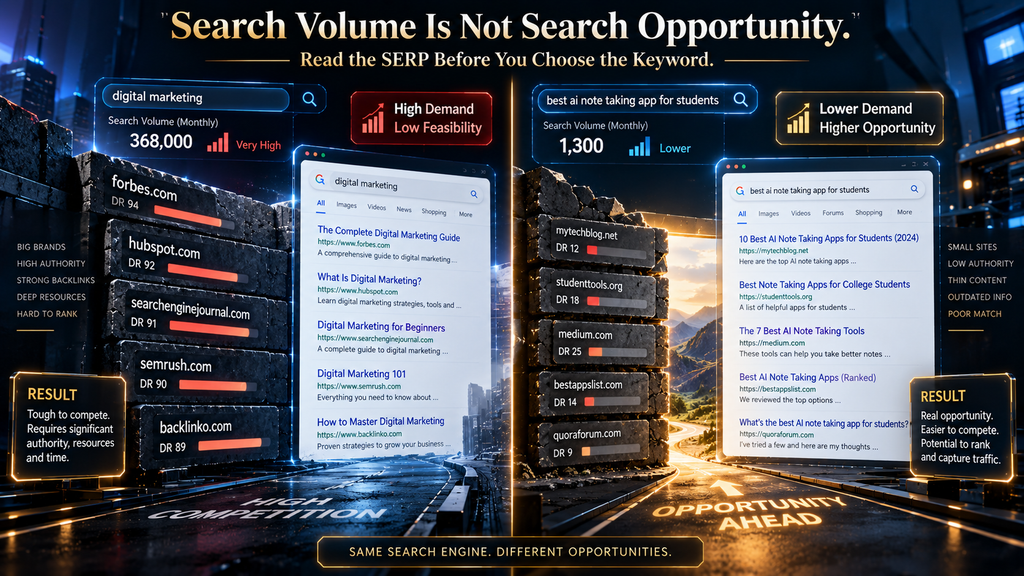
Search volume is one of the first numbers people notice. It should not be the last number they see. A keyword with 30,000 searches sounds better than a keyword with 800 searches, but that comparison ignores virtually everything that makes SEO difficult.
The 30,000-search query may have ten extremely authoritative results, strong brand dominance, multiple SERP features, heavy commercial competition, and little room for a new publisher. The 800-search query may have weak or outdated results, fragmented intent, smaller competing domains, or an audience that has much stronger commercial relevance. The smaller query could therefore be the better opportunity.
Ahrefs’ Traffic Potential metric is a useful example of why volume alone can be insufficient. The platform looks at traffic flowing to the top-ranking page rather than assuming that raw search volume directly equals obtainable traffic.
The correct mental model is:
- Search volume tells you that demand may exist.
- SERP analysis tells you whether the opportunity is accessible.
Why Keyword Difficulty Is Useful but Not Enough
Keyword Difficulty is valuable because it compresses a complicated competitive landscape into a number. That makes it convenient. It also makes it easy to misuse.
Every major platform calculates its metrics differently. SE Ranking explicitly notes that its search-volume data can differ from Google Keyword Planner, Semrush, and other tools because providers use different data sources, samples, and update cycles.
A difficulty score should therefore be treated as decision support, not a physical law. The real SERP remains more important.
Look at the ranking domains. Examine the quality and relevance of the pages. Check whether the results actually satisfy the dominant intent. Look for stale content, weak explanations, thin pages, mismatched results, forum content, or other signals that suggest an opening.
The best keyword researchers do not ask only: “What is the difficulty?” They ask: “What exactly would I have to beat?” That is a much more intelligent competitive question.
AI Keyword Generation Is Not Keyword Validation
This deserves its own section because it is one of the easiest mistakes to make in 2026.
A language model is very good at generating plausible phrases. It understands vocabulary, semantic relationships, common questions, audience segments, and language patterns.
But plausible is not the same as measured.
A chatbot might suggest a keyword and attach a search-volume estimate because the number sounds reasonable. Unless that system is connected to actual SEO data, there is no reason to treat the number as empirical evidence.
Ahrefs makes this exact distinction in its 2026 discussion of AI keyword research, noting that general-purpose chatbots can make up SEO data when they do not have access to a reliable underlying dataset. AI is therefore best used as the research accelerator, not the evidence itself.
Use AI to produce candidates. Use real data to verify them. Use the SERP to understand them. Use judgment to decide them.
Keyword Clustering Is Bigger Than a Formatting Problem
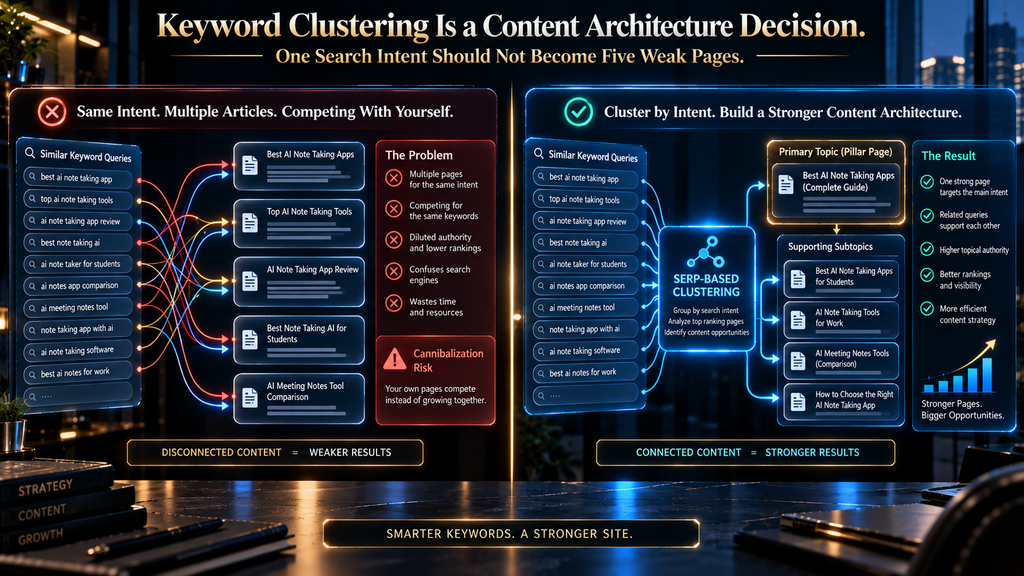
Clustering is often treated like an organizational convenience. It is actually an architectural decision.
Suppose a site discovers 1,000 related keywords. It could theoretically create 1,000 pages.
That would be disastrous.
Many of those queries will overlap. Some will represent exactly the same search task. Others will be variations of the same question that should be addressed inside a stronger page. Only a smaller subset will represent genuinely independent intents.
This is why clustering can protect the site’s architecture. Keyword Insights explicitly uses live, country-specific SERPs to group keywords where the ranking URLs are the same or similar. That methodology is valuable because it grounds clustering in observed search behavior rather than only in lexical similarity.
It also helps answer one of the most important editorial questions: Does this keyword deserve another page? That question should come before the content brief.
Why the “Biggest Database” Is the Wrong Winner
Database size is an impressive marketing number. It is also an incomplete measure of value. Ahrefs reports 110 billion discovered keywords and 28.7 billion filtered keywords, while Semrush reports more than 27.3 billion keywords in Keyword Magic Tool.
Those numbers demonstrate extraordinary coverage. They do not tell you which platform is best for your particular research problem. A beginner could have access to billions of keywords and still make poor decisions.
A specialist tool with a much narrower dataset can be enormously valuable if it identifies weak SERPs or clusters content more effectively. The real question is not: “How many keywords can the tool show me?”
It is: “How efficiently can the tool help me turn a large universe of possibilities into a small number of defensible actions?” That is a better measure of research quality.
Free vs Paid Keyword Research Tools
The free-versus-paid debate is often framed as though everyone eventually needs a premium subscription. That is not true.
A small website can often build an effective research workflow using Google Keyword Planner, Google Trends, Search Console data once available, manual SERP analysis, and one lightweight tool. Google itself provides keyword discovery and monthly-search estimates through Keyword Planner, while Trends adds temporal context.
The argument for premium software becomes stronger as the cost of manual research rises. An agency handling many clients benefits from speed. A large publisher benefits from massive datasets and scalable clustering.
An affiliate site benefits from deeper competitive research and commercial opportunity analysis. A mature B2B website may benefit from competitor intelligence and historical data. The economic principle is simple:
Do not buy software because it is impressive. Buy it because the problem it solves is expensive.
When Should a Beginner Pay for a Keyword Tool?
A beginner should usually pay when the manual workflow has become the bottleneck, not simply because a premium tool exists.
If you are publishing a few articles per month in a narrow niche, a large platform may be unnecessary. The time saved may not justify the subscription.
But once you are researching dozens of topics, comparing competitors regularly, building content clusters, managing multiple sites, or making SEO decisions that directly affect revenue, the economics change. This is why there is no shame in starting with a simpler stack. The right software at the wrong stage is still the wrong software.
When Premium Keyword Research Becomes Worthwhile
Premium tools become easier to justify when the opportunity cost of weak research is high.
An agency might spend hours manually comparing competitors, collecting keyword data, organizing reports, and identifying content gaps. A sophisticated platform can reduce that research burden.
A growing publisher may be deciding between hundreds of possible topics. Better competitive intelligence can help prevent the team from wasting weeks producing content around terms it was never positioned to win.
A commercial site might identify a keyword with modest traffic but extremely valuable buyer intent. In that situation, traffic volume becomes secondary to business value.
This is where keyword research becomes an economic discipline rather than just an SEO task. The value of the tool should be measured against the cost of bad decisions.
Common Keyword Research Mistakes in 2026
One common mistake is choosing keywords almost entirely by search volume. This creates the appearance of opportunity without answering whether the website can actually compete or whether the traffic would be commercially useful.
Another is treating a difficulty score as definitive. Metrics help narrow the field, but the actual SERP remains the evidence you need before committing substantial editorial resources.
A third mistake is accepting AI-generated statistics without verification. AI can dramatically accelerate ideation, but empirical claims require actual data.
A fourth mistake is creating a page for every keyword variation. This is especially dangerous now because AI makes it easy to generate endless variations. A large list can quickly become a large collection of overlapping pages.
A fifth mistake is confusing related keywords with related intent. Two phrases can contain similar words while requiring different content, while two phrases with different wording can represent essentially the same search task.
A sixth mistake is buying tools before defining the research problem. A premium platform cannot solve a strategy problem simply by producing more data.
A seventh mistake is ignoring trends. Historical keyword metrics can look attractive even when current interest is changing direction. Google Trends exists precisely to help researchers understand this temporal dimension.
A Practical Keyword Research Process for 2026
Start with a broad discovery stage. Use your business topics, competitor content, customer questions, AI brainstorming, autocomplete sources, keyword databases, forums, product categories, and Search Console data where available.
Next, reduce the candidate list using actual evidence. Remove irrelevant terms, ambiguous terms, obviously mismatched intent, and keywords whose competitive environment is fundamentally incompatible with the site’s current authority.
Then inspect the SERPs for the remaining opportunities. Look beyond the difficulty score and examine what Google is actually rewarding.
After that, cluster related terms according to intent and SERP overlap. The objective is to determine the right number of pages, not the maximum number of pages.
Once the clusters exist, prioritize them using the five dimensions of the Keyword Decision Score. Demand should matter, but so should feasibility, business value, intent clarity, and information gain.
Finally, map each winning cluster to an actual content asset. At that point, your research has produced something more valuable than a keyword list. It has produced an editorial decision.
How to Choose Your Tool by Website Type
New or Small Website
A small website usually benefits from simplicity. Google Keyword Planner can provide initial demand signals, Google Trends can reveal momentum and seasonality, and a focused specialist tool can help identify realistic opportunities.
The biggest mistake at this stage is spending money on data you do not yet have the capacity to use.
Growing Publisher
A growing content site begins to benefit from more sophisticated competitor analysis, clustering, content-gap research, and historical data. Ahrefs, Semrush, or SE Ranking become more attractive as the number of content decisions increases.
Agency
Agencies generally benefit from platforms that reduce research time across multiple clients. Semrush and Ahrefs are particularly well suited to broad workflows, while specialist tools such as Keyword Insights can add value for large-scale clustering.
Niche Website Focused on Low Competition
LowFruits becomes especially interesting when the business strategy is built around finding weak SERPs rather than chasing the largest keywords.
Large Content Operation
The bigger the keyword universe, the more valuable clustering and structured prioritization become. Keyword Insights can be particularly useful here because its workflow is designed around SERP-based grouping and large-scale content planning.
The Future of Keyword Research Is Moving From Keywords to Search Tasks
One of the biggest misconceptions about AI search is that keywords no longer matter. They still matter. What is changing is their role.
Search systems are becoming better at understanding language, context, intent, entities, and relationships between concepts. Google says its AI-search experiences continue to rely on core Search systems and emphasizes useful, original content rather than mechanical query variation targeting.
That means modern keyword research increasingly operates at three levels.
- Query level: What exact language are people using?
- Intent level: What are they actually trying to accomplish?
- Topic level: What broader concepts, entities, and related questions should the content address?
The strongest research tools are moving in the same direction.
Ahrefs is combining keyword databases with AI-assisted clustering and intent analysis. Semrush is combining keyword discovery with intent, grouping, SERP features, and broader SEO workflows. Keyword Insights is explicitly connecting clustering to live SERP similarity and intent.
The future is therefore unlikely to be “SEO without keywords.” It is more likely to be SEO where keywords are one layer of a broader search-intelligence system.
The Second-Order Effect: Research Quality Becomes a Competitive Advantage
There is a deeper consequence to the rise of AI-assisted keyword research. When everyone can generate thousands of keywords, the raw volume of ideas stops being a meaningful advantage. The competitive advantage shifts toward selection quality.
Two publishers may have access to the same keyword database. One publishes 200 pages because the metrics look attractive. The other publishes 50 pages after identifying the strongest intents, weakest SERPs, clearest commercial opportunities, and largest information gaps.
The second site may produce less content but create a stronger information architecture. That is the paradox of AI-assisted SEO: More automation can make restraint more valuable. The teams that learn how to reject weak opportunities may outperform the teams that learn only how to generate them faster.
The AI Hustle World Decision Rule
Before committing to a keyword, ask:
- Is there real demand?
- Do we understand the dominant intent?
- Does the current SERP reveal an achievable opening?
- Does winning this search create meaningful value?
- Can we produce something that deserves to rank?
- Does this keyword need its own page at all?
That final question is increasingly important. The correct answer to a keyword is sometimes not “publish an article.” It may be “add this section to an existing article.”
It may be “combine this with another cluster.” It may be “ignore this keyword.”
It may even be “wait and watch the trend.” A mature keyword research process must be able to produce all of those decisions.
Which AI Keyword Research Tool Should You Actually Choose?
Choose Ahrefs when deep keyword intelligence, competitive research, traffic potential, and detailed SEO analysis are your highest priorities. Its scale and current AI-assisted research capabilities make it one of the strongest choices for advanced users.
Choose Semrush when you want keyword research embedded in a broad SEO and marketing ecosystem. Its huge keyword database, grouping, intent, filtering, SERP-feature analysis, and project organization make it particularly strong for teams.
Choose Google Keyword Planner when demand validation and budget-conscious research are the priority. It is particularly useful as a first-party Google data layer rather than as your entire organic SEO system.
Choose LowFruits when finding realistic low-competition opportunities matters more than having every possible SEO feature. Choose Keyword Insights when your keyword list has become too large to organize manually and clustering is the main bottleneck. Choose SE Ranking when you want broad SEO capability with a strong emphasis on overall value and accessibility.
Choose KWFinder when you are relatively new to SEO and want approachable long-tail research rather than an overwhelming enterprise environment. Choose Moz Keyword Explorer when you prefer straightforward keyword research and prioritization.
Choose KeywordTool.io when you need broad autocomplete-based discovery across search and content platforms. Choose Google Trends when the central question is not simply “how much interest exists?” but “how is that interest changing?”
Final Thoughts
The keyword research market has entered an unusual phase. AI can now generate an enormous number of ideas almost instantly, SEO platforms contain billions of queries, clustering can be automated at scale, and search systems are becoming better at interpreting meaning rather than simply matching strings.
That sounds like keyword research should be getting easier. In one sense, it is. In the more important sense, it is becoming harder to make good decisions inside the abundance of information.
The strongest keyword research tools in 2026 therefore should not be judged only by database size, AI features, number of filters, or the length of their feature pages. Their real value lies in how effectively they help a researcher move from possibility to evidence, evidence to interpretation, and interpretation to action.
That is why the AI Hustle World Keyword Decision Score puts demand, intent, feasibility, business value, and information gain in the same decision. And it is why the best keyword workflow is not: Generate → Publish. It is: Discover → Validate → Interpret → Inspect → Cluster → Prioritize → Map.
The best AI keyword research tool is the one that improves that process at the point where your current workflow is weakest. Because in 2026, the competitive advantage is no longer finding more keywords. It is knowing which ones are worth saying yes to—and which ones should never become another page.
Choose Your Keyword Research Stack
Find the tools and strategies that fit your SEO workflow, budget, and research bottleneck.
Read the AI SEO Guide →Frequently Asked Questions
What is the best AI keyword research tool in 2026?
Ahrefs and Semrush are the strongest overall choices for many professional SEO users, but there is no universal winner. The best platform depends on whether your primary bottleneck is competitive intelligence, broad SEO management, low-competition discovery, clustering, demand validation, or trend analysis.
Can ChatGPT replace an SEO keyword research tool?
Not by itself. AI assistants are excellent for brainstorming, expansion, classification, clustering, and research assistance, but they should not be trusted to invent or estimate empirical SEO metrics without access to reliable underlying data.
Is Ahrefs better than Semrush for keyword research?
There is no universal answer. Ahrefs has exceptional depth in keyword and competitive intelligence, while Semrush provides a particularly broad ecosystem around keyword research, intent, grouping, SERP features, competitor analysis, and wider marketing workflows.
Are free keyword research tools enough for beginners?
Often, yes. Google Keyword Planner and Google Trends can provide useful demand and trend information, while a lightweight tool can handle discovery. The need for premium software increases as the number and financial value of SEO decisions grow.
Is search volume the most important keyword metric?
No. Search volume is useful evidence of demand, but a strong keyword decision also considers intent, competition, feasibility, business value, traffic potential, and whether the site can create meaningful information gain.
What is keyword clustering?
Keyword clustering is the process of grouping related search terms that can potentially be addressed by the same page or content asset. SERP-based clustering improves this process by examining which queries produce similar ranking pages rather than grouping terms only because they contain similar words.
Why should I inspect the SERP manually?
Because keyword difficulty is an estimate, while the SERP is the actual competitive environment. Manual inspection lets you see the authority of ranking domains, intent alignment, content quality, freshness, SERP features, and whether there are genuine weaknesses that a new page could exploit.
Should every keyword become a separate article?
No. Many related queries represent the same underlying search task. Creating separate pages for every variation can produce overlapping content and an unnecessarily fragmented site architecture. The right number of pages should be determined by intent and evidence, not by the number of keywords discovered.
Should I use more than one keyword research tool?
Sometimes. Different tools solve different problems. A practical stack might combine a broad SEO platform with Google Trends, Google Keyword Planner, or a specialist clustering or low-competition tool. The goal should be a reliable research process rather than the maximum number of subscriptions.
Will keyword research still matter as AI search grows?
Yes, but its role is broadening. Exact query matching is only one part of modern search; understanding intent, topical relationships, entities, content quality, and the underlying search task is becoming increasingly important. Google’s current AI-search guidance still emphasizes foundational SEO while encouraging useful, original content.
Related Guides
- AI SEO vs Traditional SEO: What Actually Matters in 2026?
- Pinterest Niche Ideas for a Faceless AI Content Account
- How AI Search Engines Find and Rank Information: A Beginner’s Guide
Written by
Muntasir Ahmad Chowdhury
Founder, AI Hustle World
Muntasir Ahmad Chowdhury is the Founder of AI Hustle World, an independent publication dedicated to making Artificial Intelligence practical, trustworthy, and easy to understand. He researches AI tools, automation, customer service, productivity, and real-world business applications, helping readers make smarter technology decisions through research-driven, experience-backed content.
Expertise:
AI Tools • AI Automation • AI Customer Service • AI Productivity • Generative AI • AI Workflows
Get Smarter With AI
Enjoyed this guide? Get practical AI tools, tutorials, and honest reviews delivered to your inbox.