Evidence: Documentation reviewed
Last checked: September 2026
What was done: Written from official documentation and the published sources linked in this article. Not hands-on tested.
Files: None
Affiliate links: No
How to Optimize Your Website for Google AI Overviews and AI Search
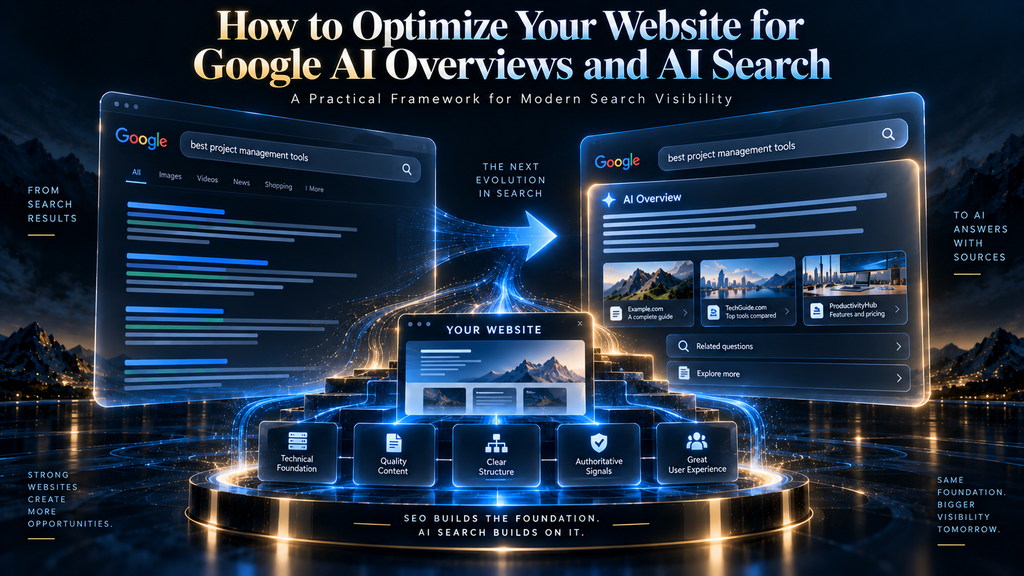
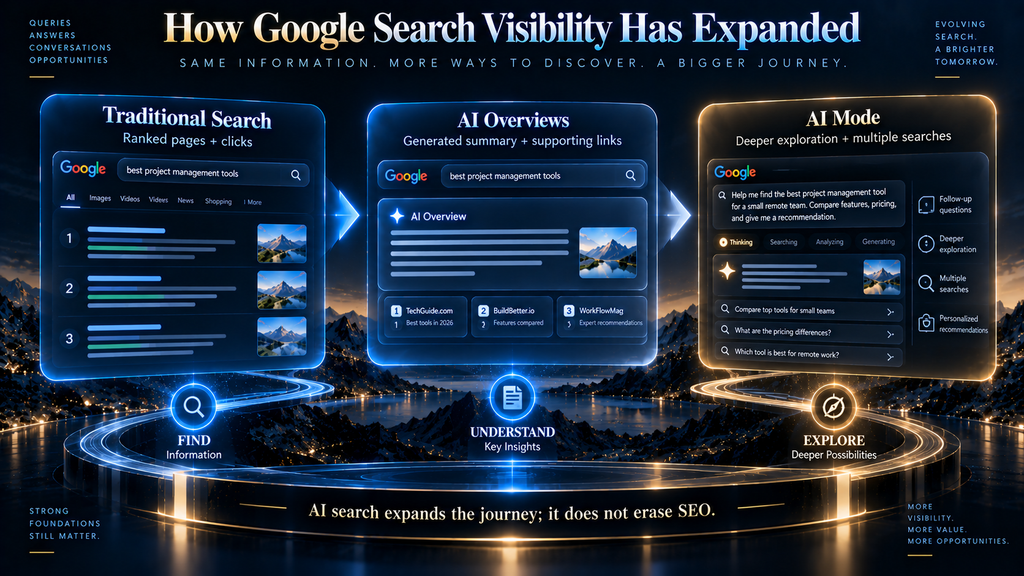
Google Search is no longer limited to the familiar model of a search box followed by a ranked list of blue links. AI Overviews can summarize information directly within the results page, while AI Mode can handle more complex questions and use multiple searches and sources to construct a response. Google describes these experiences as part of Search rather than a completely separate search engine, which is an important distinction because it means the fundamentals that make a website accessible, understandable, relevant, and useful remain central to AI search as well.
That distinction cuts through a lot of the noise surrounding GEO and “AI SEO.” You do not need to rebuild your website into a special AI-only format, stuff pages with prompts, or create hundreds of tiny articles designed around hypothetical questions. Google’s current guidance says that its generative AI features are rooted in core Search systems, and pages still need to be indexed and eligible to appear in normal Search before they can be eligible as supporting links in AI Overviews and AI Mode. Google also says there are no additional technical requirements specifically for generative AI features.
The real optimization challenge is therefore broader than rankings but much less mysterious than the industry sometimes makes it sound. A strong website must make it easy for Google to access the information, understand the subject, retrieve the relevant material, use it to answer a question, and provide the page as a useful supporting source. The stages overlap, and none of them guarantees a citation or a visit, but together they provide a far better operating model than chasing isolated AI-search “hacks.”
Quick Answer: What Should You Do to Appear in Google AI Overviews and AI Mode?
Start with conventional SEO fundamentals, because Google still depends on them. Make your important pages crawlable and indexable, keep the main information available in text, use clear site architecture and internal links, align each page with a real user need, provide original and useful information rather than commodity summaries, support significant claims with trustworthy evidence, and keep important business information accurate. Google explicitly recommends many of these established practices for its generative AI search features and says publishers do not need special AI markup, special files, or a different page format to qualify.
Then improve the quality of the information system around the page, not just the page itself. A page should sit inside a logical topic cluster, answer the central question while addressing the important supporting considerations, make important facts easy to understand, and give the user a reason to continue to the website rather than stopping at the generated answer. For ecommerce and local businesses, this also means maintaining accurate product and business data through the relevant Google systems.
Finally, measure the result instead of assuming the optimization worked. As of August 31, 2026, Google’s Generative AI performance report is available to websites worldwide and provides data about generative-AI impressions in Search, including which pages receive the impressions and where those impressions originate by country, device, and date.
The entire process can be summarized as: Access → Index → Understand → Retrieve → Answer → Evidence → Context → Trust → Visibility → Business Outcome. That is the operating model behind the rest of this guide.
What AI Overviews and AI Mode Actually Change
To optimize for a system, you first need to understand what changed in the system.
Traditional search is comparatively easy to visualize. A user enters a query, Google evaluates relevant pages, results are ranked, and the user chooses which source to visit. The publisher’s major objective is to make the page eligible, relevant, competitive, and attractive enough to earn the click.
Generative search introduces additional steps between the user’s question and the website. Google explains that AI Overviews and AI Mode can use retrieval-augmented generation and query fan-out to gather relevant information from multiple searches and sources before producing an answer. Query fan-out means a complicated question can lead to related searches covering different dimensions of the underlying information need. (Google Help)
That matters because the exact wording of the user’s first query is no longer the entire problem. Imagine someone asks: “What is the best AI note-taking tool for a five-person remote agency?”
The visible query contains one decision, but a useful answer probably depends on several supporting questions. How accurate is transcription? Does it distinguish speakers? Does it support the team’s meeting platform? How good are summaries? Does it integrate with project-management tools? What happens to customer data? What does it cost for five people? How difficult is implementation? What happens when the team grows?
A strong article does not need a separate URL for every possible question. It needs to understand the decision architecture behind the query and provide enough useful information to help the reader make the decision.
This is where AI search creates a genuine content opportunity. The winning page is increasingly not the page that repeats the user’s phrase most often. It is the page that understands what the user needs to know before the question is actually solved.
The First Principle: Eligibility Comes Before Visibility
A page cannot become a useful AI-search source if Google cannot reliably access the information in the first place.
Google’s current documentation says that pages need to be indexed and eligible to appear in ordinary Search to be eligible as supporting links in AI Overviews and AI Mode. It also states that there are no additional technical requirements specifically for generative AI features.
That makes the first part of the optimization process almost refreshingly ordinary.
Review robots.txt rules and indexing directives. Check canonical URLs and redirects. Make sure your important pages are actually indexed. Verify that critical content is available when Google processes the page. Review internal links so important resources are discoverable rather than isolated behind several layers of navigation. Check that mobile users can actually access the main content, and make sure the page does not depend entirely on an interaction that prevents the important information from being exposed clearly.
JavaScript deserves the same nuanced treatment. JavaScript itself is not a special AI-search problem; the issue is whether the content users and search systems need can be rendered and processed reliably. Treating every technical issue as “GEO optimization” makes diagnosis harder, not easier.
The practical lesson is that AI-search optimization starts with ordinary technical SEO because there is no separate technical escape hatch.
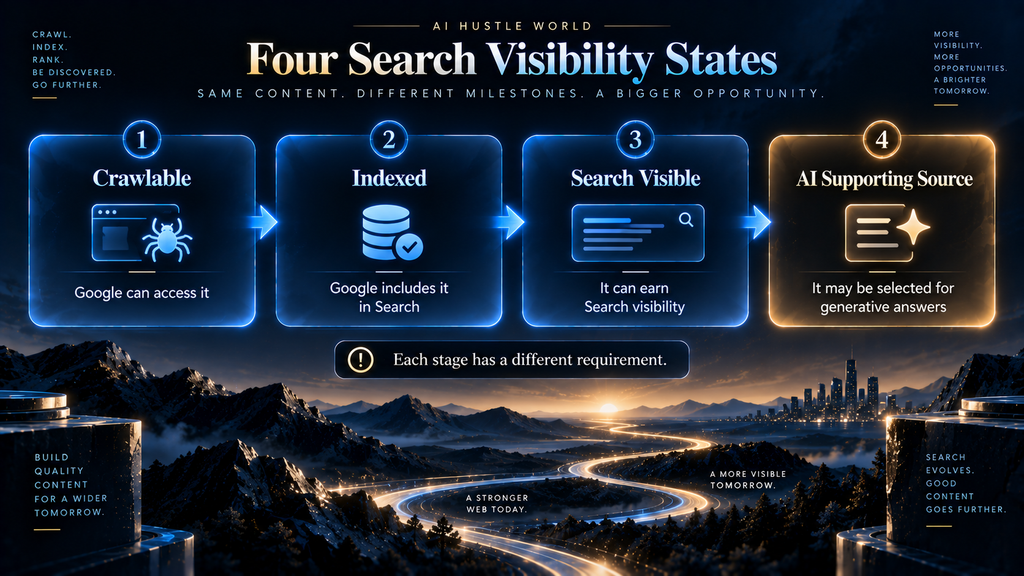
Why Crawlable, Indexed, Ranked, and Cited Are Four Different Things
One of the most useful concepts to explain to a website owner is that these states are sequential but not equivalent. A page can be crawlable without being indexed. It can be indexed without ranking prominently.
It can rank for a conventional search without being selected as a supporting source in an AI-generated answer. It can also be cited in a generative answer without being the first organic result for the associated query.
This distinction becomes especially important when someone says, “My page ranks on page one, so why doesn’t AI Overview cite me?” Ranking is evidence that Google considers the page relevant enough to surface for certain searches, but it is not a promise that the page will become part of a particular generated response. Generative experiences can retrieve multiple sources, perform additional searches, and produce a response according to the needs of the question.
The reverse can also happen. A page that does not appear to dominate the traditional results may still become useful in a generative response because it contains a specific piece of information that answers one component of the user’s broader question.
That is why “AI visibility” should never be interpreted as just another ranking position.
The AI Hustle World AI Search Visibility Chain
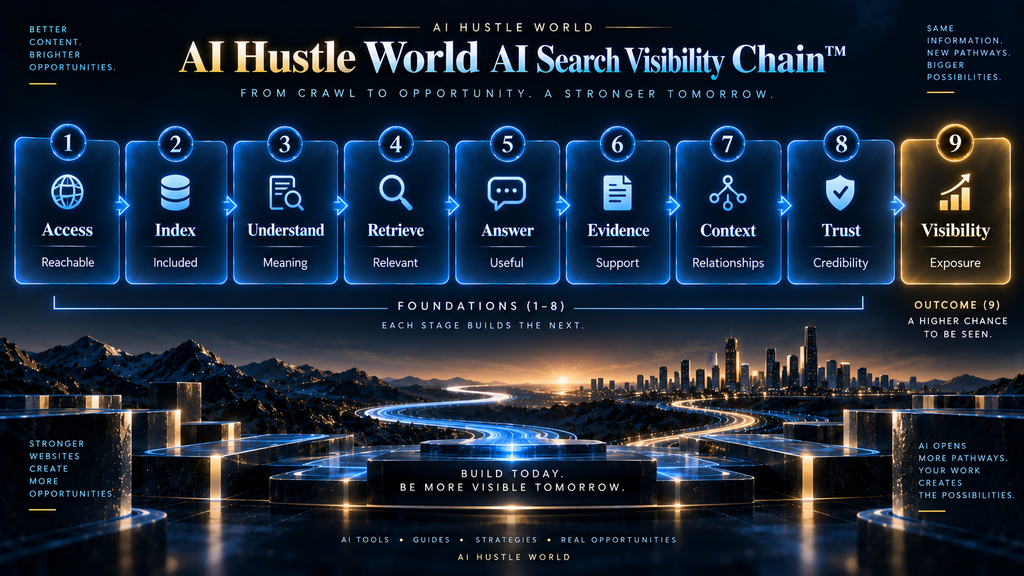
The most useful way to operate this strategy is to think about nine stages that a page needs to move through before it can become meaningful generative visibility.
| Stage | The Question | What You Control |
|---|---|---|
| 1. Access | Can Google reach the page? | Crawl rules, rendering, hosting reliability |
| 2. Index | Can Google include the page in Search? | Indexing directives, canonicalization, quality |
| 3. Understand | Does Google understand the page and its subject? | Clear topic, structure, entities, context |
| 4. Retrieve | Can the content satisfy an underlying information need? | Relevance, topical coverage, usefulness |
| 5. Answer | Is the important information clear enough to use? | Explanations, structure, direct answers |
| 6. Evidence | Why should the information be trusted? | Sources, testing, data, documentation |
| 7. Context | How does this page relate to the broader topic? | Internal links, clusters, site architecture |
| 8. Trust | Can users understand who produced the information and why? | Authors, methodology, transparency |
| 9. Visibility | Does the page actually appear in generative Search? | Measured through Google’s reporting |
The first eight stages are primarily things a publisher can influence. The ninth is the outcome of those efforts interacting with Google’s systems and user behavior. That distinction prevents a major strategic mistake: doing eight things correctly and then assuming the ninth is guaranteed.
The chain also makes troubleshooting easier. If a page is not indexed, there is no point debating whether its wording is “GEO optimized.” If it is indexed but poorly organized, adding more citations is unlikely to solve the core problem. If it is well structured and well supported but still receives little AI visibility, the next investigation becomes competitive relevance, topic coverage, source selection, or simply whether the relevant queries are producing generative results at all.
This is a much stronger way to think about AI search than one giant list of ranking factors.
Make the Information Easy to Understand Without Making the Writing Robotic
One of the strangest side effects of the AI-search boom has been the explosion of advice telling writers to reduce every article to tiny chunks, rigid question-answer blocks, and repetitive formatting patterns. That is not what Google is asking publishers to do.
Google’s current guidance says there is no ideal page length, no requirement to break content into tiny pieces, and no need to rewrite existing content into a special format solely for generative AI search. Google says its systems can understand nuance across content and does not require exact matching of every search variation.
What matters is clarity.
If the reader asks whether Google AI Overviews require special schema, the article should answer that clearly. If the page is explaining how to improve internal linking, the reader should understand both what to do and why the structure matters. If the subject is complex, the page should be allowed to develop the reasoning rather than forcing every concept into a 40-word paragraph.
This produces an important editorial rule for AI Hustle World: Answer important questions directly, but develop the answer with evidence, context, examples, and implications. That gives you answer-ready content without sacrificing editorial quality.
Optimize for the Information Need Behind the Query
Keyword research still has a role, but the keyword should be treated as evidence about intent rather than a script for what the article must repeat. Suppose a visitor searches for: “How to choose the best AI SEO tool.” A weak page might use the phrase repeatedly and then provide a list of tools with feature summaries.
A stronger page would explain how to evaluate such tools in the first place. Does the platform help with technical SEO, content optimization, keyword discovery, AI visibility monitoring, internal linking, competitive analysis, or reporting? Which functions matter for a small site versus an enterprise website? Which tools overlap? Which features are genuinely useful, and which merely automate tasks that are better handled manually?
The second approach is more useful because it addresses the decision, not merely the wording of the search.
Google’s query fan-out model reinforces this way of thinking. The system can explore related subtopics to satisfy the original question, so content that naturally covers the important dimensions of the user’s problem has a better chance of being useful across multiple search formulations. That does not mean you should try to predict Google’s private query-expansion logic word for word.
You should instead ask: What would a knowledgeable person need to know to answer this question responsibly? That is a much more durable optimization target.
Build Topic Coverage Without Creating Content for Every Possible Query
Query fan-out creates an obvious temptation: if Google can generate related searches, perhaps a publisher should create hundreds of pages to cover every variation. That is the wrong conclusion.
Google explicitly warns against creating content primarily to manipulate rankings or generative AI responses and says there is no need to create pages for every imagined long-tail variation. The correct strategy is to distinguish between subtopics that belong inside one authoritative resource and subtopics that represent genuinely different search intent.
For example, a comprehensive guide about optimizing for Google AI Overviews should probably explain crawlability, indexing, content structure, query intent, internal linking, evidence, and measurement because those ideas are necessary to understand the core problem. But a separate article comparing AI SEO tools may deserve its own page because the reader’s intent has shifted from learning a strategy to choosing software.
This creates a healthier content architecture. The objective is not maximum URL count. It is maximum useful coverage with minimum redundancy.
Originality Is Becoming a Search Advantage
AI has lowered the cost of producing competent summaries. That changes the economics of publishing.
When a generic explanation can be generated in seconds, the value of publishing another generic explanation falls.
Google’s current guidance emphasizes unique, non-commodity content and first-hand perspectives where applicable. The underlying logic is straightforward: information that simply reproduces what can already be found everywhere contributes less than information that adds a new perspective, documented experience, original research, meaningful evidence, or useful interpretation.
Imagine two websites covering AI SEO tools. Website A summarizes the vendors’ feature pages and produces a conventional “10 best tools” list. Website B explains how the tools were evaluated, compares the same workflow across products, documents limitations, distinguishes vendor claims from observations, and explains which type of user should choose each option.
Both articles may contain the same basic facts. Website B provides more decision value.
That does not guarantee an AI citation, because Google still controls source retrieval and selection. But it makes the page more useful as a source and more valuable to readers. In an environment increasingly saturated with commodity AI-generated text, that distinction becomes strategically important.
Evidence Should Be Part of the Content, Not Decoration at the End
AI-search content often makes strong claims about how AI systems behave without showing where those claims came from. That is dangerous.
When you explain Google’s own requirements, use Google’s documentation. When you report a result from an independent dataset, identify the study and its methodology. When a software company claims its tool can produce a particular result, label it appropriately as a company or vendor claim rather than presenting the statement as an independently verified fact.
This becomes particularly important for claims about AI visibility.
For example, Ahrefs reported in February 2026 that the presence of an AI Overview correlated with a 58% lower average click-through rate for the top-ranking page in its December 2025 dataset of 300,000 keywords. That is a meaningful observation, but it is still an Ahrefs study based on a defined sample rather than a universal law describing every Google query. (Ahrefs)
The same discipline should apply in the opposite direction. Google has said visits from result pages containing AI Overviews can be higher quality in some contexts, but that does not mean every website will experience higher-quality traffic. A responsible article can hold both observations at once because the underlying behavior varies by query, intent, topic, and user journey.
The standard should therefore be: State the fact, identify the source, explain the scope, and do not inflate the conclusion.
Do Not Confuse Google’s Guidance With Industry Folklore
The fastest-growing area of AI-search advice contains some of the weakest distinctions between documented behavior and speculation. A tactic gets repeated by ten blogs, becomes a checklist item in a SaaS tool, and eventually gets treated as an algorithmic fact. That is exactly how myths become “best practices.”
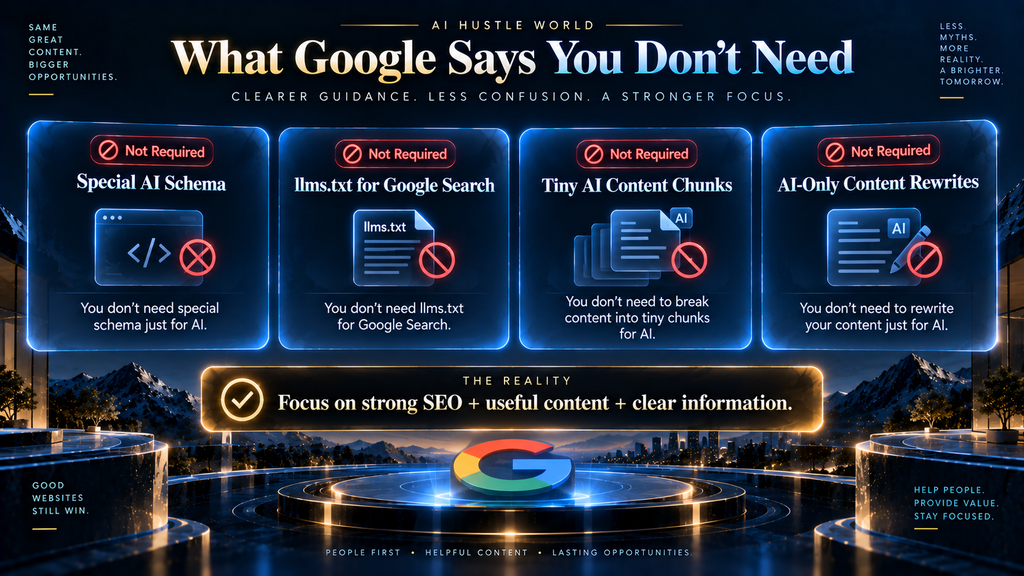
Google’s current guide gives publishers several useful negative signals. It says special AI markup is not required, llms.txt is not required for Google Search’s generative AI features, content does not need to be broken into tiny pieces, there is no special AI-only rewriting requirement, and publishers should not create content for every possible query variation simply to manipulate generative visibility. Google also discourages tactics such as inauthentic mentions.
That does not mean every tactic outside Google’s documentation is automatically useless. It means you should not present speculative tactics as requirements.
Structured data is a good example. Proper structured data can still support supported Search features, but Google does not say that a special AI schema gets a page into AI Overviews or AI Mode. Treat schema according to its actual Search purpose rather than turning it into a mystical GEO requirement.
The same rule applies to llms.txt.
If another platform chooses to use such a file for a different purpose, that is a separate question. It should not be represented as a Google AI Overview requirement when Google says it is not one.
Build Internal Links That Explain the Site
Google recommends making content easy to discover through internal links. For a serious site, the value of those links goes beyond crawling. Think of your website as an information graph.
A broad AI SEO guide can point to a dedicated guide about Google AI Overviews. That implementation guide can point to keyword research resources, AI SEO tools, and related optimization articles. A comparison article can then connect back to the broader strategic page.
The links tell users how the ideas relate. They also create a more coherent topical structure for the site.
For AI Hustle World, this matters particularly because related topics can easily become cannibalistic. An article about AI SEO, an article comparing SEO/AEO/GEO, and an article specifically about Google AI Overviews should not attempt to answer exactly the same question. Each should own a distinct intent and then connect naturally to the others.
This is where internal linking becomes a strategic tool rather than a quota exercise.
Use Images and Video to Extend the Information
Google’s current generative-AI guidance also recognizes that AI search can surface relevant images and video and recommends high-quality visual content where appropriate. Important information should still be available in text, but publishers should not treat visual media as irrelevant to modern search.
The key is to give the visual a genuine editorial job. A process can benefit from a process diagram. A complicated framework can benefit from a visual model.
A product comparison can benefit from a well-designed matrix. A software tutorial can benefit from screenshots or demonstrations. The image should help the reader understand something, not merely occupy the space between paragraphs.
That distinction matters because publishing seven decorative AI-generated graphics does not make an article more authoritative. A single well-designed explanatory diagram can contribute more than five generic images if it actually resolves a point of confusion.
Ecommerce and Local SEO Need Their Own Layer
A website selling products or serving local customers operates under different information requirements from a publisher writing a long-form guide.
Google’s current guidance specifically discusses Merchant Center and Business Profile information as relevant to generative AI search. Product listings and local-business information can become part of AI-driven Search experiences, which means the accuracy of these systems matters alongside the quality of the website’s written content.
For ecommerce, that means product names, attributes, availability, pricing, and other commercial information should remain accurate across the relevant Google systems. A beautifully written blog post cannot compensate for inconsistent product information.
For local businesses, the same logic applies to business information. Address, hours, phone number, services, and other important details should be accurate and maintained. If the website says one thing and the business profile says another, the business has created an information problem that no clever AI-copywriting strategy can solve.
For publishers and B2B companies, the emphasis shifts more heavily toward expertise, evidence, useful content, and decision support. The underlying rule is the same: Make the information you want Google to represent accurate and unambiguous.
The New 2026 Advantage: Measure Generative Visibility Directly
For a long time, AI-search measurement relied heavily on manual observation. Marketers would type queries into an AI system, record whether the brand appeared, take screenshots, and attempt to infer broader patterns from a small sample.
That is still useful for qualitative analysis, but Google has now introduced first-party reporting.
As of August 31, 2026, Google’s Generative AI performance report has rolled out to all websites worldwide. Google says the report shows how a website performs in generative AI features in Search, including AI Overviews and AI Mode, and allows publishers to see changes over time, identify pages receiving the highest or lowest generative-AI impressions, and understand where those impressions originate by device and country.
That should fundamentally change how publishers approach optimization. Instead of asking only: “Do I think this page is appearing?” you can begin asking: “Which pages are actually receiving generative-AI exposure?” That distinction moves AI-search strategy from anecdotal observation toward measurable experimentation.
How to Use Search Console Without Turning It Into a Vanity Dashboard
The existence of a generative-AI report does not mean every increase in impressions should be celebrated as a business success.
Start by identifying which pages receive generative-AI impressions. Look for patterns across topics, page types, countries, and devices. Then compare that information against conventional Search performance and your site’s analytics.
Suppose your “AI SEO tools” content receives substantial generative visibility while a broad educational guide receives almost none. That difference is interesting, but the next question is not automatically “How do we make the educational guide more GEO optimized?” The better question is what is different between the pages. Perhaps one covers commercial comparison criteria more thoroughly. Perhaps it contains more original evidence. Perhaps the topic simply triggers different types of generative queries.
Google’s report is therefore best used as a diagnostic instrument. It tells you where the outcome is changing.
It does not give you the full causal explanation. You still need editorial judgment, competitive analysis, and controlled improvements to understand why.
AI Visibility Is Not One Metric
One of the biggest strategic mistakes in AI search is trying to reduce everything into a single “AI visibility score.” Different stages of the customer journey represent different forms of value.
| Visibility Stage | What It Tells You | Example Metric |
|---|---|---|
| Search exposure | Can people encounter the page? | Organic impressions |
| AI exposure | Is the page visible in generative Search? | Generative AI impressions |
| Mention | Is the brand or concept represented? | Brand mention frequency |
| Citation | Is the website shown as a source? | Citation count |
| Referral | Did the user reach the site? | Sessions / visits |
| Engagement | Did the visitor find value? | Engaged sessions, return visits |
| Business outcome | Did visibility create economic value? | Leads, signups, sales |
The table matters because one metric can easily create a false story. A page could receive many AI impressions and few clicks.
Another could receive relatively few impressions but generate valuable leads. A third could receive frequent citations while sending almost no measurable referral traffic.
Bing’s AI Performance reporting illustrates this distinction especially clearly. Bing reports pages cited in AI-generated answers, grounding queries, page-level citation activity, and citation trends, while explicitly stating that its AI Performance metrics do not measure rankings, authority, importance, traffic, or engagement. (Search – Microsoft Bing)
Even more importantly, Bing warns that changes in citation volume are observational and cannot automatically be attributed to one specific content update, model change, or other event. That is exactly the mindset website owners need.
The Business Case for AI Search Optimization
The economic value of AI search depends on where your business makes money.
A publisher may care about maintaining discovery and building a trusted brand even when some answers satisfy readers without a click. A SaaS company may value appearing during the comparison stage because being included in a recommendation can influence which tools enter the buyer’s shortlist. An ecommerce company may care about product discovery and qualified purchase journeys. A local business may value being surfaced when someone asks for a recommendation in a specific area.
That makes a universal ROI claim difficult to defend. The right question is: Which part of the customer’s decision journey could generative search influence for my business? Then measure that stage.
For example, suppose an AI search feature surfaces your consulting firm while a potential client is researching solutions. The first measurable result may not be a direct click. The prospect may search your brand separately later, visit through another channel, or contact you after several days. That means last-click attribution can understate the value of the initial exposure.
But the opposite problem also exists. A business can become obsessed with “AI visibility” while generating no meaningful commercial impact.
The answer is not to reject AI visibility metrics. It is to place them inside the complete customer journey.
Should You Expect AI Overviews to Reduce Traffic?
There is no defensible universal answer.
Google has emphasized that AI features can help users explore complicated questions and has said visits from result pages containing AI Overviews can be higher quality in some circumstances. At the same time, third-party research has found substantial CTR declines associated with AI Overviews. Ahrefs’ February 2026 study reported a 58% lower average CTR for the top-ranking page when an AI Overview was present compared with its comparison sample.
Those observations can coexist because they are measuring different things and because search behavior varies across intents.
A simple informational query may be largely satisfied by the AI answer, reducing the need for a click. A complex commercial query may require deeper research and lead to a higher-quality visit. A navigational query behaves differently again.
This is why the correct response is neither optimism nor panic. Measure the impact by query class, page type, and business outcome. If an AI Overview reduces visits to a particular informational article but increases branded searches or qualified leads elsewhere, the business should understand the complete effect rather than judging the channel on one page’s CTR.
The “GEO Hack” Problem
The AI-search industry is still young enough for weak evidence to spread quickly. You will find advice promising that a particular number of words, headings, FAQs, citations, entities, or keyword placements can make a page more likely to appear in an AI response.
Some of these practices may correlate with good content. The problem is the leap from correlation to guaranteed algorithmic mechanism.
Google’s current documentation gives us a useful correction. It explicitly says there is no special generative-AI markup requirement, no need to chunk content into tiny pieces, no need to rewrite content specifically for AI, and no requirement to target every long-tail variation.
That does not mean structure, clarity, headings, and concise explanations are unimportant. It means their value comes primarily from making information more useful and comprehensible—not from satisfying an imaginary “AI formatting score.”
That distinction should influence every content decision.
Write clearly because clear information is valuable. Do not write unnaturally because you hope an AI system will reward the formatting.
Who Should Prioritize Google AI Search—and Who Should Wait?
Not every website needs the same level of investment.
The strongest candidates are websites whose customers ask complicated questions, compare alternatives, research solutions, or seek recommendations before taking action. SaaS businesses, B2B organizations, publishers, ecommerce companies, agencies, local businesses, and affiliate sites can all have meaningful exposure to this behavior.
The opportunity is especially relevant when the purchase or decision journey includes a significant research phase. If customers regularly ask “which is best,” “what should I choose,” “how does X compare with Y,” or “what should I do about Z,” then generative search can potentially influence consideration before a visitor reaches your website.
The priority should be much lower for a website that still has serious foundational problems. If important pages are not indexed, the site has weak architecture, the content is thin, or the business does not know what topics it actually wants to own, an advanced AI-search initiative is premature.
The correct sequencing is:
Foundation first. Visibility second. Optimization third. Scale last.
That prevents AI-search investment from becoming an expensive distraction.
What Happens If You Do Nothing?
The consequence is not that your existing SEO suddenly stops working. The more realistic risk is that your competitors become visible earlier in the decision process.
Consider a customer who asks Google which three platforms are best for their business. Your competitor appears in the answer, while your company does not. Even if your website still ranks normally for your own brand and several conventional queries, the competitor has already gained attention during the moment when the customer is constructing a shortlist.
That matters because search is increasingly involved in consideration, not just navigation. The risk is therefore not “AI will destroy your website.”
It is: Other sources may become part of the answer before your site becomes part of the user’s decision. That is a much more precise reason to take generative visibility seriously.
Common Mistakes That Waste Time
Treating GEO as a replacement for SEO
Google’s current documentation directly contradicts this framing. Foundational SEO remains relevant because generative AI features still depend on Search systems and indexed content.
Creating pages for every imaginable prompt
This creates redundancy without necessarily creating information value, and Google warns against producing content primarily to manipulate Search or generative AI systems.
Writing tiny paragraphs because “AI likes chunks”
Google says there is no requirement to break content into tiny pieces or use a special format for generative AI Search.
Treating llms.txt as a Google requirement
Google says it does not use llms.txt for Search generative-AI visibility.
Assuming special schema gets you into AI Overviews
There is no special structured-data requirement specifically for Google generative AI features. Structured data can still have other legitimate Search uses, but that is different from treating it as an AI citation key.
Focusing on citations instead of business results
Citations indicate source exposure, not revenue. Bing explicitly states that its citation metrics do not measure traffic, engagement, rankings, or importance.
Publishing commodity AI summaries
When everyone can generate a summary, another generic summary creates little differentiation. Google’s own guidance emphasizes unique, valuable content and first-hand perspectives where appropriate.
Claiming causality from one before-and-after observation
AI systems change, user demand changes, competitors change, and content changes. Bing specifically cautions that citation trends are observational and cannot be automatically attributed to one event.
A Practical Decision Matrix for Website Owners
| Your Current Situation | Primary Priority | Why |
|---|---|---|
| Important pages are not indexed | Technical SEO | AI visibility cannot compensate for basic Search ineligibility |
| Pages are indexed but poorly aligned with intent | Content strategy | Retrieval requires useful topical relevance |
| Content is useful but difficult to navigate | Information architecture | Users and systems need clear relationships and hierarchy |
| Content ranks but is generic | Originality + evidence | Commodity summaries are easy to replace |
| Strong content but weak generative visibility | Measure + investigate | Identify topic, query, and competitive gaps before changing everything |
| AI visibility is strong but referrals are weak | UX + conversion strategy | Visibility is not the same as business value |
| Ecommerce product information is inconsistent | Merchant data | Generative systems need accurate product information |
| Local business details are outdated | Business Profile + site data | Recommendation quality depends on accurate business information |
| Site is already strong across the above | Continuous experimentation | The remaining variable is how Google and users respond |
This matrix is more useful than saying every website needs the same GEO checklist because it ties the strategy to the actual constraint.
The AI Search Readiness Audit
A useful audit does not need to be complicated, but it should be honest.
Technical readiness
Are important pages crawlable, indexable, canonicalized correctly, and accessible across devices? Are essential pieces of information available to Google in the page content? Have you accidentally excluded your site or important content from Google’s generative AI features? Google now provides a Search generative AI control through Search Console, so that setting should be checked as part of the diagnostic process.
Content readiness
Does each important page solve a specific problem? Does it contain enough depth to support the reader’s decision? Does it explain mechanisms and trade-offs instead of making unsupported recommendations? Is there evidence for important factual claims?
Information architecture readiness
Can a visitor move naturally from broad concepts to detailed information? Are related pages connected? Does each article have a distinct search intent? Are important pages supported by meaningful internal links?
Trust readiness
Can readers see who created the information? Are source types clear? Are vendor claims identified? Is the methodology transparent when testing is involved? Are limitations acknowledged instead of buried?
Measurement readiness
Can you monitor traditional Search performance, generative-AI impressions, site engagement, and business outcomes separately? A website that performs well across these areas has stronger AI-search readiness even though no checklist can guarantee a citation.
A 30-Day Implementation Plan
Days 1–7: Fix the Foundation
Begin with your most commercially or strategically important pages. Verify indexing, crawlability, canonicalization, redirects, rendering, internal links, and mobile accessibility. Review the Search generative AI control in Search Console and confirm that the property is included in Google’s generative AI features. Google says the control is globally available as of August 31, 2026, with inclusion as the default state.
Do not redesign the entire website simply because AI search exists. The first week should be about removing obvious barriers that prevent your current content from participating in Search.
Days 8–14: Upgrade the Highest-Value Content
Choose a small set of pages that matter most to your audience and business. Review each one for intent alignment, depth, evidence, originality, examples, limitations, and clarity.
Ask a simple question: Would a knowledgeable reader bookmark this page because it genuinely helped them make a decision? If the answer is no, fix the substance before worrying about AI visibility.
Days 15–21: Strengthen the Topic Architecture
Map the relationships between your important pages. Add internal links where they improve navigation or context. Consolidate genuinely redundant pages. Identify gaps in major topic clusters, but create new pages only where the search intent is distinct enough to justify a separate resource.
The goal is a website that looks like a coherent knowledge system rather than a collection of disconnected SEO targets.
Days 22–30: Measure and Iterate
Use Google’s Generative AI performance report to establish a baseline. Google says the report provides generative-AI impression data for Search and allows breakdowns by page, country, device, and date.
Compare generative visibility with conventional Search performance and your own analytics. Identify which page types receive exposure and which important pages do not. Then choose the next round of improvements based on observed patterns rather than speculation.
This creates an ongoing optimization loop: Measure → Diagnose → Improve → Measure again.
The “AI Search Readiness vs AI Visibility” Distinction
This is an important distinction for management teams because it separates what the company controls from what the search platform controls.
AI Search Readiness is controllable
You can improve the technical foundation, information architecture, content quality, evidence, internal linking, business information, page experience, and trust.
AI Visibility is partly external
Google decides whether a generative feature appears, which sources are retrieved, which information is selected, how the answer is synthesized, and which links are ultimately displayed. The distinction prevents unrealistic expectations.
A site owner can make a page significantly better and still see fluctuating AI visibility because the surrounding search environment changes. Google can change models and retrieval behavior. User demand can change. Competitors can publish stronger information. A query can stop triggering an AI Overview.
A mature strategy therefore focuses heavily on readiness and then measures visibility rather than promising it.
The Second-Order Effect: Search Optimization Is Becoming Information Optimization
The deeper change here is not simply that Google can write answers. It is that the value of well-organized knowledge is increasing. A website with strong information architecture, clear explanations, original evidence, accurate business information, useful comparisons, and strong internal relationships can serve several audiences at once: human visitors, conventional search systems, answer-oriented experiences, and generative systems.
That is a more durable asset than a page optimized around one keyword. It also changes how companies should think about content teams. The old model often asked: What keyword should we target next?
The stronger model asks: What important customer question have we not answered well yet? That shift changes research, editorial planning, internal linking, measurement, and eventually the economics of the whole content operation.
What Traditional SEO Still Gets Right
There is a tendency to treat traditional SEO as obsolete because it was built for “old search.” That misses why many SEO principles existed in the first place. Crawlability mattered because search engines could not rank what they could not access.
Internal linking mattered because search engines needed to discover and understand site structure. Useful content mattered because users needed good answers. Clear titles mattered because relevance needed to be communicated.
Structured information mattered because machines needed help interpreting certain types of content. Trust mattered because search quality depends on reliable information.
Those problems did not disappear when AI-generated answers arrived. They became part of a larger system.
That is why the best approach is not to throw away traditional SEO. It is to extend its logic into the new information journey.
Where Human Judgment Becomes More Important
AI systems are becoming better at retrieving and synthesizing information, but that does not eliminate the need for editorial judgment. In fact, areas involving ambiguity, consequences, competing priorities, and genuine trade-offs may demand more judgment than before. Consider a question such as: “Should my company automate customer support with AI?”
The answer is not just a list of features. Someone needs to evaluate support volume, customer expectations, escalation requirements, privacy, error tolerance, implementation cost, employee roles, and the consequences of automation failure. A generic AI summary can describe those factors.
A strong expert publication helps the reader weigh them. That is why AI Hustle World should continue emphasizing mechanisms, decision criteria, trade-offs, limitations, and honest recommendations rather than simply producing answer-shaped text.
The competitive advantage is not avoiding AI. It is using AI while preserving human judgment where the decision actually demands it.
Final Thoughts
Google AI Overviews and AI Mode do not require website owners to abandon everything they know about SEO. The more important change is that search visibility now has more stages. A page needs to be accessible and indexable, but it also needs to make sense in context, answer the underlying information need, provide enough substance to be useful, and offer information that is worth retrieving and representing in a generated response. Google’s own guidance continues to emphasize foundational SEO, useful content, internal linking, accessible information, relevant visuals, and accurate business data rather than a separate collection of mysterious AI-only requirements.
The biggest strategic mistake is therefore to optimize for the appearance of being “AI-friendly” instead of improving the quality of the website itself. You do not need to turn every article into short robotic fragments, create a page for every hypothetical prompt, install speculative markup, or fill your content with AI terminology. You need to make your information clearer, deeper, more useful, more trustworthy, and better connected.
The measurement side of the equation is also becoming much stronger. Google’s worldwide Generative AI performance report now gives website owners direct visibility into generative-AI impressions, while Bing provides separate reporting for pages cited in AI-generated answers and the grounding queries associated with those citations. That means the next stage of AI-search strategy should be less about guessing and more about disciplined experimentation: identify the pages gaining visibility, understand what they have in common, improve the pages that matter, and measure the results again.
The durable strategy is simple enough to state but difficult enough to execute well: build the best information system you can, then make it easy for Google to access and understand that system. Search interfaces will continue to change, models will change, and the way answers are generated will change with them. A website built around genuine usefulness, evidence, clear architecture, expert judgment, and accurate information has a much better chance of surviving those changes than one built around whatever GEO trick happens to be popular this month.
Keep Building for the AI Search Era
Explore practical AI SEO strategies, tools, and search insights designed to help you build a stronger digital presence.
Read the AI SEO Guide →FAQ
1. Does Google AI Overviews replace traditional SEO?
No. Google says its generative AI features are rooted in core Search ranking and quality systems, and foundational SEO practices remain relevant. Pages also need to be indexed and eligible to appear in Search to be eligible as supporting links in AI Overviews and AI Mode.
2. How do I get my website into Google AI Overviews?
There is no guaranteed submission process or special AI markup that forces inclusion. Google recommends maintaining strong technical SEO, useful and original content, clear information architecture, internal links, strong page experience, and accessible information. Your pages must also be indexed and eligible for ordinary Search.
3. Do I need special schema for AI Overviews?
No special Schema.org markup is required specifically for Google’s generative AI features. Structured data can still be useful for other supported Search features when implemented correctly, but it should not be treated as a secret AI Overview ranking signal.
4. Is llms.txt required for Google AI Search?
No. Google’s current documentation says llms.txt is not required for Google Search’s generative AI features and is not used by Google Search for that purpose. Other AI systems may make different choices, but that is a separate issue from Google AI Overviews and AI Mode.
5. Should I create shorter articles so AI can understand them?
No. Google says there is no ideal page length and no requirement to break content into tiny pieces for generative AI search. The better approach is to make the information clear, logically structured, and sufficiently detailed to solve the user’s actual problem.
6. Does ranking number one guarantee an AI Overview citation?
No. Traditional rankings and generative source selection are different outcomes. A page can rank strongly and still not be selected for a particular AI response, while another page may be retrieved because it provides information that is especially useful for one part of a complex question. Google’s AI systems can retrieve information through multiple related searches and sources.
7. How can I measure my Google AI Search visibility?
Google’s Generative AI performance report in Search Console provides generative-AI impression data for AI Overviews and AI Mode. As of August 31, 2026, Google says this reporting is available worldwide and can be analyzed by page, country, device, and date.
8. Does an AI citation mean I will receive traffic?
No. A citation indicates that the page was included as a visible source, not that a user clicked it. Bing’s AI Performance documentation explicitly distinguishes citation activity from traffic, engagement, rankings, authority, and importance.
9. Should I optimize every page for every AI query variation?
No. Google says there is no need to capture every possible long-tail variation, and it warns against creating content primarily to manipulate Search or generative AI responses. Build comprehensive resources around genuine information needs and create separate pages only when there is a meaningful difference in search intent.
10. What is the most important thing I can do for AI Search visibility?
Create a website that is technically accessible and genuinely useful. That means strong SEO foundations, clear information architecture, valuable and original content, credible evidence, meaningful internal relationships, accurate business information where relevant, and a measurement process that shows whether your pages are actually appearing in generative Search. No single GEO trick can replace those foundations.
Related Guides
- How AI Search Engines Find and Rank Information: A Beginner’s Guide
- AI SEO vs Traditional SEO: What Actually Matters in 2026?
- Best AEO & GEO Tools for AI Search Visibility in 2026
Written by
Muntasir Ahmad Chowdhury
Founder, AI Hustle World
Muntasir Ahmad Chowdhury is the Founder of AI Hustle World, an independent publication dedicated to making Artificial Intelligence practical, trustworthy, and easy to understand. He researches AI tools, automation, customer service, productivity, and real-world business applications, helping readers make smarter technology decisions through research-driven, experience-backed content.
Expertise:
AI Tools • AI Automation • AI Customer Service • AI Productivity • Generative AI • AI Workflows
Get Smarter With AI
Enjoyed this guide? Get practical AI tools, tutorials, and honest reviews delivered to your inbox.