Evidence: Documentation reviewed
Last checked: September 2026
What was done: Written from official documentation and the published sources linked in this article. Not hands-on tested.
Files: None
Affiliate links: No
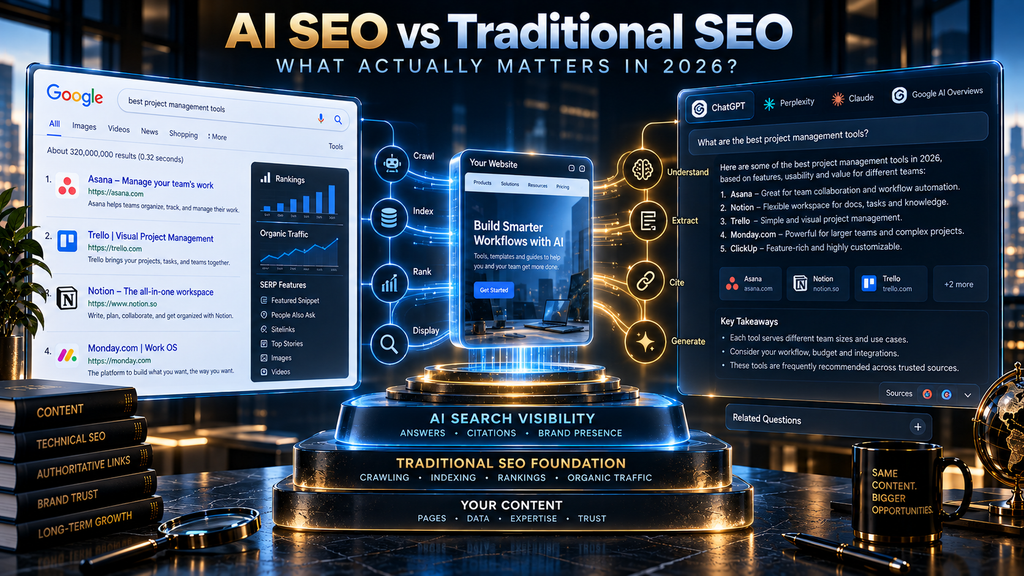
AI SEO vs Traditional SEO: What Actually Matters in 2026?
The SEO Debate Is Asking the Wrong Question
For years, SEO strategy could be reduced to a familiar operating model: identify what people search for, create the best page for that topic, make the page accessible to search engines, build authority around it, and improve its ability to earn rankings and clicks. The model was never as simple as “put the keyword on the page,” but the commercial objective was relatively clear because the search result itself was the gateway to discovery. A better ranking generally meant greater visibility, greater visibility created more clicks, and clicks created the opportunity to convert that attention into business value.
The rise of AI-generated search experiences has complicated that relationship without making the underlying foundations disappear. Google now describes AI features as part of its broader Search ecosystem rather than as a completely detached system, while AI experiences can expand a complex question into related searches, retrieve information from multiple sources, and synthesize that information into an answer. ChatGPT Search and Perplexity operate differently at the product level, but they create a similar strategic complication: the user can receive a synthesized answer before deciding which individual website deserves a visit.
This is why the popular comparison between “traditional SEO” and “AI SEO” is too crude to be useful. It suggests that marketers are choosing between an old discipline and a new one, when the more accurate reality is that the existing search foundation has been extended by a new visibility layer. A website still needs to be discoverable, crawlable, indexable, relevant, useful and technically sound; what has changed is what can happen after that information enters the retrieval system. The competitive question is no longer limited to whether a URL ranks for a query, but whether the information contained on that URL can become part of an answer, be selected as evidence, be cited, influence how a brand is described, and ultimately contribute to a business outcome.
That distinction matters because it changes where companies should spend money, how content teams should work, what SEO professionals should measure, and even what “good visibility” means. The organizations that understand this early will not abandon traditional SEO in pursuit of fashionable AI terminology; they will use the established foundation as infrastructure and build a second layer around answer visibility, evidence, retrieval and influence.
Quick Answer: What Actually Matters in 2026?
Traditional SEO still matters because the underlying search infrastructure has not disappeared; AI SEO matters because visibility now extends beyond the ranking of a page into the retrieval, citation and synthesis of information inside AI-generated answers. Google explicitly says that its AI search features are rooted in its existing Search systems and that established SEO practices remain relevant, while its technical guidance continues to emphasize crawlability, indexability, internal links, useful content, page experience and other foundational principles.
The practical implication is that most businesses should stop thinking in terms of replacing one system with another. Instead, they should think about two connected layers of visibility. The first layer is the search infrastructure that makes information available and understandable to search systems; the second is the answer visibility layer that determines whether that information is useful when an AI system retrieves, compares and synthesizes sources for a more complex question.
This distinction also changes how SEO performance should be interpreted. A first-page ranking remains valuable, but it is no longer a complete measure of influence because a page can now contribute to the answer without appearing as the conventional “winner” of a single keyword. Conversely, a brand can be mentioned in an AI answer and receive no meaningful commercial value from it. The 2026 SEO problem is therefore not simply “how do we rank?” but “how does useful information move from our website into the modern search-and-answer journey, and where does that visibility create value?”
Why “Traditional SEO vs AI SEO” Is the Wrong Mental Model
The first problem with the debate is the word traditional. It implies that conventional SEO belongs to a pre-AI era in which search engines were essentially matching keywords to documents, while AI search represents a completely different technological system. That description is no longer accurate. Google’s ranking systems have incorporated machine-learning approaches for years, and Google explicitly describes systems such as neural matching and passage ranking as part of Search.
What has changed is not that search suddenly became intelligent. It is that the interface increasingly performs more of the interpretation and synthesis that previously fell to the user.
Consider a conventional search journey. A buyer searches for the best project-management software for a growing consulting firm, receives a set of pages, opens several of them, compares pricing, checks features, evaluates integrations, and eventually decides which vendor seems credible. The search engine primarily organizes candidate information; the user performs much of the reasoning.
Now consider the same buyer asking an AI search system for a recommendation and specifying team size, workflow, budget, required integrations and implementation constraints. The system may expand the question into several related searches, retrieve different sources for different parts of the decision, synthesize the information and return a structured answer with citations. Google’s explanation of query fan-out illustrates precisely this kind of behavior in its AI search experience.
The consequence is subtle but strategically important: the user’s question can become larger than any individual keyword, while the answer can depend on information scattered across multiple documents. That means SEO remains responsible for getting a website’s information into the retrieval ecosystem, but the marketer now has another problem to solve: making the information sufficiently relevant, clear, distinctive and evidence-rich to survive the selection and synthesis process.
The winning strategy is therefore not “SEO versus AI SEO.” It is SEO infrastructure plus AI-era visibility intelligence.
What Traditional SEO Actually Built — and Why It Still Matters
Traditional SEO is often caricatured as keyword optimization, but serious SEO has always been an information-access discipline as much as a keyword discipline. Search engines need to discover pages, crawl them, understand their content, interpret their relationships to other pages and determine which information is relevant and useful enough to surface. Google’s current guidance continues to reinforce these fundamentals for websites appearing in AI search experiences.
This is why the dramatic claim that “AI has killed SEO” is strategically dangerous. A company that responds to AI search by ignoring technical SEO, reducing investment in internal linking or abandoning site architecture has not adapted to the new environment; it has simply weakened the infrastructure that allows its information to participate in that environment at all.
Crawlability and indexability remain the starting point
A search system cannot reliably use information that it cannot access. Google’s technical requirements continue to emphasize that Googlebot needs to be able to access the page, the server should return an appropriate response, and the content must be indexable; importantly, Google also notes that satisfying these technical conditions does not guarantee that a page will actually be indexed.
That distinction becomes more important, not less, as businesses chase AI visibility. There is little strategic value in investing heavily in an AI monitoring platform while important pages are blocked, orphaned, duplicated, poorly rendered or buried inside an incoherent site structure. The first responsibility of SEO remains making valuable information available to the retrieval system.
Internal links are still part of the information model
Internal linking also deserves a more sophisticated interpretation. It is not merely an old-fashioned authority-transfer tactic; it helps search engines discover important pages and understand how the information on a site is organized. Google recommends logical site structure and internal links to important pages using concise, relevant anchor text.
That has direct implications for AI-era search. A large knowledge base covering dozens of related topics becomes more useful when its concepts are connected coherently rather than published as a collection of isolated articles. The site begins to function as a knowledge structure rather than a pile of URLs, making it easier for both humans and search systems to navigate relationships among concepts such as tools, use cases, implementation steps, comparisons, limitations and outcomes.
Page experience still matters because the website remains part of the journey
AI search may change discovery, but it does not eliminate the website. Users still visit pages to inspect methodology, compare products, validate claims, read documentation, evaluate a company and complete transactions. Google’s page-experience guidance continues to emphasize factors such as Core Web Vitals, secure delivery, mobile usability and avoiding intrusive experiences.
This matters commercially because an AI mention is not the same thing as a successful acquisition. If the user follows a citation and lands on a page that loads poorly, hides the answer, aggressively interrupts the experience with ads or fails to explain the product clearly, the visibility has not been converted into useful engagement. The AI layer may open a door, but the website still has to provide a credible destination.
The Fundamental Shift: From Ranking Pages to Supplying Answers
The most important conceptual change in AI-era SEO is the unit of visibility.
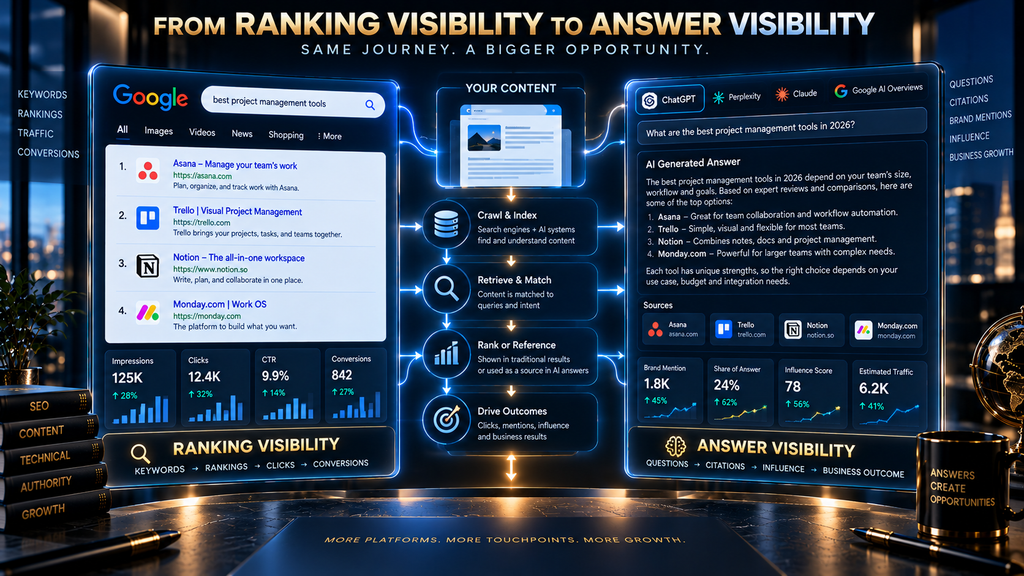
Traditional SEO tends to ask whether a page ranks for a query. AI search increasingly raises a different question: whether information from that page is retrieved and used to construct an answer. Those two questions overlap, but they are not identical.
A page might rank highly for a broad informational query yet contribute little to a highly specific recommendation generated for a complex buying scenario. Another page might not dominate conventional rankings for the exact wording of that scenario but may contain a particularly strong piece of evidence—such as a benchmark, pricing table, technical comparison or original study—that an AI system can use when assembling the answer.
This is where the distinction between ranking visibility and answer visibility becomes useful. Ranking visibility is still about the prominence of a URL in search results; answer visibility concerns whether the information inside a source becomes part of the answer the user receives. Once those are separated, many confusing AI SEO debates become easier to evaluate.
The change can also be seen in the nature of the search query itself. A traditional keyword such as “best CRM software” describes a broad topic. A modern AI interaction might ask which CRM is appropriate for a 30-person B2B services company with a long sales cycle, limited implementation resources and a particular integration stack. That question contains more context, more constraints and more implied subquestions. AI systems are designed to work with this complexity, which means the SEO opportunity is increasingly about covering the decision problem, not merely matching a phrase.
That does not mean keyword research is obsolete. Keywords remain valuable evidence about market language, demand and search behavior. The strategic improvement is to treat them as one input into a larger model of questions, decisions, entities, evidence and relationships.
What AI Search Changes in the Content It Selects
Once a system is generating an answer, the content on a page has to do more than establish broad topical relevance. It needs to contain information that can be accurately retrieved and incorporated into a response.
Recent 2026 research offers useful evidence here. A controlled retrieval study involving 252,000 trials across six large language models found that topical relevance and document position were strong drivers of first citation, while explicit price and recent timestamps also helped under some conditions. A separate study examining more than 21,000 citations found that highly influential pages tended to be longer, more structured, semantically aligned and rich in extractable evidence such as definitions, numbers, comparisons and procedures. The research also distinguished between a page merely being selected as a citation and a page actually exerting influence over the generated answer.
That distinction should change how content teams think about “AI-friendly” writing. It does not mean turning every article into a collection of tiny answer snippets, adding dozens of robotic FAQ headings or stripping away useful explanation in the hope that shorter sentences will be extracted more easily. Those are formatting interpretations, not a strategy.
The more durable principle is that important information should be explicit and evidentially useful. Definitions should actually define the term. Comparisons should establish the criteria being compared. Procedures should explain what to do and under what conditions. Numbers should have context. Claims about performance should have enough supporting detail to allow a reader—or a retrieval system—to understand what the claim actually means.
This is also why generic AI-generated content is unlikely to become the ultimate competitive advantage. When thousands of websites can produce a plausible explanation of the same generic topic, the scarce resource is no longer text generation. It is meaningful information that adds something the market did not already have.
The AI Hustle World DUAL-LAYER SEO Framework
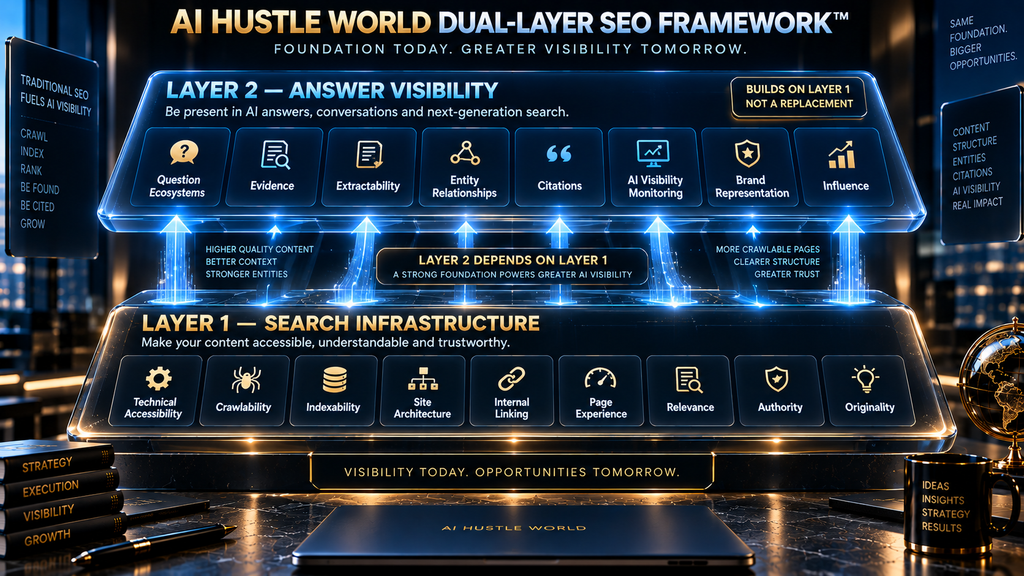
The central framework for this article is designed around that distinction. Layer 1 makes information discoverable and structurally useful; Layer 2 makes that information more capable of participating in AI-mediated answers. Treating both as part of one system avoids the false choice between “old SEO” and “new SEO.”
Layer 1: Search Infrastructure
The first layer contains the fundamentals that allow information to enter the search ecosystem in a reliable way. Technical accessibility, crawlability, indexability, site architecture, internal linking, page experience, topical relevance, original content and established authority signals all belong here. Google continues to make clear that these foundations remain relevant to AI features.
The strategic mistake is to interpret this layer as “the boring stuff we already did.” Infrastructure determines what information a search system can discover and how confidently it can understand the relationships among your pages. A highly intelligent answer engine does not somehow compensate for information that the underlying retrieval process cannot reliably reach.
Layer 1 therefore answers a basic but indispensable question: Can the search ecosystem access and understand our information?
Layer 2: Answer Visibility
Layer 2 begins after the foundation is in place. It concerns whether your information is positioned to be useful when an AI system is constructing an answer for a complex question.
That means expanding the content model beyond keywords to include question ecosystems, decision contexts, evidence, entities, comparisons, citations and answer-level monitoring. It also means paying attention to whether third-party sources describe your company accurately, whether your most important claims are supported by evidence and whether competitors are repeatedly becoming the sources AI systems rely upon instead.
Layer 2 answers a different question: When the system is trying to answer a real user’s question, are we supplying information worth retrieving and using?
The two layers should not be treated as independent projects. A technically excellent website with no meaningful evidence has limited answer influence; a brilliant research asset on a poorly accessible website may never become visible at scale. The advantage comes from building the two layers as one information system.
What Has Not Changed: The Foundations That Still Create Visibility
One of the biggest practical benefits of this framework is that it prevents companies from overreacting to the arrival of AI search. Several foundational principles remain economically important because they solve problems that AI does not remove.
Relevance still matters, even when the interface changes
An answer system still has to determine which information is relevant to a user’s question. The 2026 citation research cited earlier reinforces this point, with topical relevance emerging as one of the strongest drivers of citation behavior in the controlled test environment.
That means a page that tries to cover everything indiscriminately is not automatically more valuable. Relevance depends on whether the information actually addresses the problem the user is trying to solve. A page about accounting software may be useful for a broad category query, but the strongest source for a question about accounting software for construction firms might be a narrower resource containing construction-specific workflows, job-costing requirements and implementation considerations.
The principle has not changed. Search visibility still depends on being meaningfully relevant; AI simply makes the context of relevance more complex.
Originality matters more because generic information is abundant
Google’s people-first guidance emphasizes useful, reliable and original content, including substantial coverage and original research or analysis where appropriate. It also warns against creating content primarily for search engines or generating large quantities of repetitive material.
AI makes this principle economically sharper.
A generic “what is CRM?” article is easy to reproduce. A proprietary customer benchmark showing how long CRM migrations take across different company sizes is not. A generic “SEO tips” article can be generated at enormous scale; an original dataset documenting thousands of search-result changes is much harder to replicate. The scarce asset becomes proprietary knowledge, not prose.
That means content strategy should increasingly ask what information the company can uniquely contribute. The answer may be original research, first-party data, implementation findings, customer patterns, expert interviews, industry benchmarks, pricing analysis or a distinctive analytical framework.
Authority remains useful, but “authority” needs a better definition
Search authority is often reduced to third-party link metrics, but the more useful 2026 interpretation is broader. A credible site should be consistently understandable as a source of reliable information within a topic, and the claims it makes should have a relationship to evidence and external context.
AI search increases the importance of this because generated answers are often built from multiple sources rather than one page. Perplexity, for example, describes source evaluation and provides source labels that can reflect categories such as government, academic and trusted sources, while its broader search process involves retrieving and synthesizing information with citations.
The lesson is not that a particular badge or label guarantees AI visibility. It is that source credibility remains part of the information selection problem. The more consequential the user’s question, the less sustainable it becomes to rely on unsupported claims and generic positioning.
What Must Be Reinterpreted for AI Search
The foundations remain, but several familiar SEO activities now need to be understood differently.
Keyword research becomes question-and-decision research
A keyword tells you something about what people search for; it does not necessarily tell you everything about the decision they are trying to make.
Suppose a company sells AI customer-support software. Traditional keyword research may uncover “AI customer support,” “AI chatbot for customer service,” “customer service automation” and “AI support tools.” Those terms are useful, but they do not fully describe the situations in which buyers need information.
The decision ecosystem may include questions about deflection rate, escalation thresholds, human handoff, knowledge-base maintenance, hallucination risk, integration cost, staffing economics, resolution quality and implementation time. A genuinely useful content strategy maps that ecosystem without automatically turning every question into a separate URL.
Google’s guidance around AI search is particularly relevant here because its explanation of query fan-out shows how a single complex user request can be expanded into multiple searches. At the same time, Google warns against responding by mass-producing pages for every possible fan-out query.
The right response is therefore not more pages by default. It is stronger topical coverage with better information architecture.
Content depth becomes more about evidence than word count
Depth is often misunderstood as length.
A 4,000-word article full of general statements can contain less useful information than a 1,800-word guide containing a precise comparison, original data, implementation steps and a transparent discussion of limitations. The 2026 research on citation influence supports this broader view by finding that influential pages often contained structured, semantically aligned evidence rather than benefiting simply from superficial formatting changes.
That is why AI-era content should be evaluated by asking whether it contains decision-grade information. Can the reader distinguish the products? Can the system identify the conditions under which the recommendation changes?
Can it extract the relevant number? Can it understand the methodology behind the claim?
Can the evidence be traced back to a credible source? Those are better questions than “Did we hit 3,000 words?”
What Is Genuinely New in AI SEO?
Once the traditional foundation and its reinterpretations are separated from the genuinely new capabilities, the picture becomes much clearer.
AI visibility monitoring is a new operational requirement
Conventional SEO platforms can tell you a great deal about rankings, impressions, clicks and keyword movements. Those metrics remain useful, but they do not fully answer what happens inside AI-generated answers.
AI visibility monitoring is concerned with questions such as whether a brand appears, which sources are cited, how competitors are represented, what claims are being attributed to the business, and how those representations change across important prompts and topics.
This creates a different kind of competitive intelligence. Instead of asking only “Where do we rank?”, the team begins asking “Whose information is the system using when it explains this market?”
That is a much broader visibility problem.
Citation intelligence changes the role of the content asset
A conventional backlink tells you that another page linked to your site. An AI citation can indicate that information from your page was selected as evidence in an answer.
Those are not the same event.
The strategic implication is that content should be evaluated partly by the evidence density it contains. A page with original benchmark data, specific product comparisons, credible methodology and clearly stated findings may have greater value in an AI retrieval environment than a page that merely repeats commonly known advice.
This is one reason the distinction between citation selection and citation influence matters. A source can appear in the citations without materially shaping the answer, so simply counting mentions can produce an inflated sense of performance. The more sophisticated question is whether the information from that source actually affects what the user is told.
Entity representation becomes strategically important
Search systems have always had to understand concepts and entities, but AI interfaces make the consequences more visible because they can summarize how an organization is described. For a business, that means the web should communicate a reasonably consistent picture of who the company is, what category it belongs to, whom it serves, what its products actually do, what differentiates them, and what evidence supports those claims.
This is not a license to manufacture artificial mentions across the internet. It is a reason to make the organization’s information ecosystem coherent. Product pages, documentation, articles, author information, third-party references and company profiles should not tell contradictory stories about the same entity.
The Actual Workflow: How AI SEO Changes an SEO Team’s Work
The easiest way to understand the transition is to examine the work itself rather than the terminology.
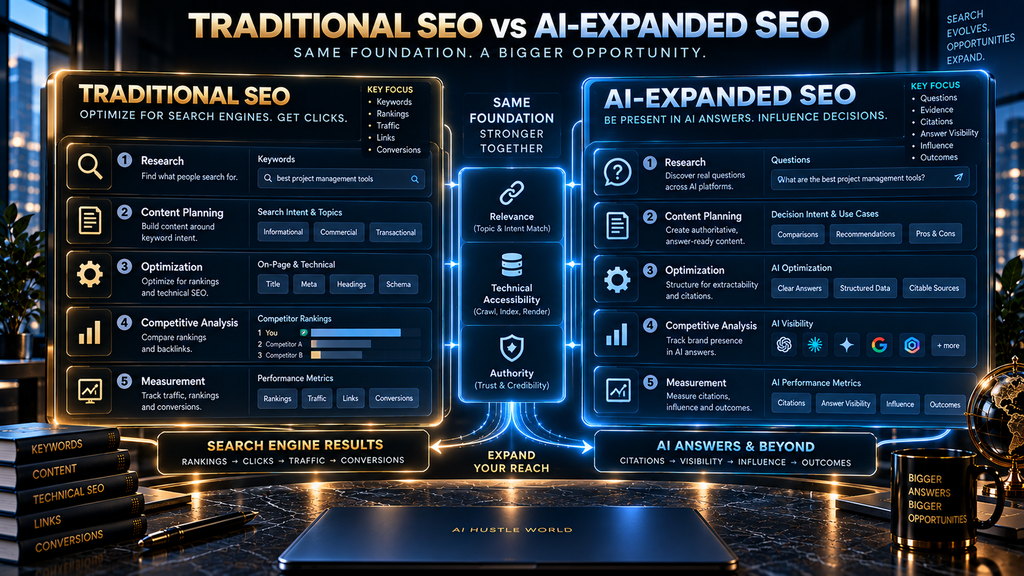
A conventional content strategist might begin with keyword research, identify a cluster, create a content brief, publish the article, build internal links and monitor rankings. An AI-aware strategist still does those things, but the research process expands to include the questions surrounding the decision, the information required to answer them, the evidence that competitors currently own, and the places where AI systems may need to retrieve that evidence.
Likewise, the content itself becomes more deliberate. A strong page should not merely mention the topic repeatedly; it should define important concepts, explain mechanisms, compare alternatives on explicit criteria, make relevant numbers visible, distinguish fact from opinion and provide enough context that important claims remain intelligible even when extracted from the page.
The post-publication process also changes. Instead of checking only ranking movement and organic traffic, teams can audit how important questions are being answered across relevant AI search systems, which competitors are being cited, which sources recur, and whether the brand is being described accurately. This creates a feedback loop that can influence future content investment.
In other words, AI SEO is less about adding a few new optimization tricks and more about extending the SEO operating system from ranking management into information management.
Should You Move Your SEO Budget Toward AI SEO?
This is where hype creates the most expensive mistakes.
A company with poor indexing, weak content architecture and thin topical coverage does not have an “AI SEO problem.” It has a foundational search problem. Moving budget from technical SEO and content quality into AI visibility software may give the team more dashboards while leaving the underlying business constraint untouched.
A company with a mature organic program has a different situation. Once the site has a strong technical foundation, meaningful topical authority and a body of useful content, it becomes rational to invest in monitoring how those assets perform in AI-mediated search. At that point, AI visibility work is not replacing established SEO; it is extending its measurement surface.
The investment decision should therefore follow the bottleneck, not the trend.
| Business situation | Sensible priority |
|---|---|
| Important pages are not consistently indexable | Fix technical SEO first |
| Content is generic or repetitive | Improve originality and usefulness |
| Strong rankings but little differentiation | Invest in proprietary evidence |
| Strong organic foundation | Add AI visibility monitoring |
| Complex, research-heavy buying journey | Prioritize answer visibility |
| Large content library with duplication | Consolidate and strengthen existing assets |
| Heavy dependence on organic acquisition | Add broader visibility measurement |
| Early-stage site with limited resources | Focus on fundamentals before specialized tools |
There is also an important economic argument here. Specialized AI visibility tools are only useful when the information they produce changes a decision. If nobody changes content, architecture, positioning or investment based on the monitoring output, the software is producing measurement theater rather than business value. The right test is not whether a tool generates sophisticated reports; it is whether those reports help the company acquire or protect valuable demand.
The Biggest Mistake: Optimizing for the Interface Instead of the Information
The current AI SEO market is full of advice about writing “for ChatGPT,” “for Perplexity” or “for AI overviews.” Much of it confuses interface-specific tactics with durable information quality.
The strongest long-term strategy is not to write one article for Google, a second version for ChatGPT and a third for Perplexity. That creates unnecessary fragmentation and risks turning content into a collection of mechanical compromises.
A better approach is to build an information asset that is genuinely useful to the human reader and then remove the barriers that prevent search systems from discovering, understanding and verifying it.
That means the page should answer the user’s real problem, not simply satisfy the shape of an imagined AI extraction pattern. It should contain clear explanations, meaningful structure, explicit evidence and useful context. Those qualities help humans because they make the material easier to understand; they help retrieval systems because they make the underlying information easier to identify.
This convergence is important. The best AI-search content is not “robot writing.”
It is excellent information that machines can also work with.
What Happens If You Do Nothing?
The most realistic risk is not that a traditional SEO program suddenly stops producing rankings. Google continues to operate traditional Search systems alongside its AI experiences, and its documentation explicitly says that established SEO practices continue to matter. The risk is more gradual: your competitors may become more influential in the answer layer while your business remains visible primarily through conventional rankings.
Imagine two companies selling similar B2B software. Both maintain good technical SEO and rank well for high-value category queries. One company publishes original benchmark studies, maintains detailed comparison pages, documents implementation constraints and develops authoritative evidence around its market. The other company continues publishing broadly optimized but mostly generic content.
Over time, the first company has more information that an AI system can use when answering specific customer questions. The second company may still rank, but it has fewer distinctive assets capable of becoming evidence.
That is how strategic displacement may happen. Not necessarily through a dramatic ranking collapse, but through competitors becoming increasingly present at earlier stages of the decision process.
The AI SEO Myths Marketers Need to Drop
“Traditional SEO is dead.”
The available evidence does not support that conclusion. Google explicitly states that its AI features are grounded in Search and that established SEO best practices remain relevant.
“Just add lots of FAQs.”
FAQs are useful when they answer legitimate user questions. They are not a guaranteed mechanism for AI visibility, and turning every article into an artificial question bank can reduce clarity rather than increase usefulness.
“Every AI query needs its own page.”
Not necessarily. Google explicitly cautions against creating large quantities of content for every fan-out query, reinforcing the importance of useful, consolidated resources when one strong page can address several related questions.
“Keywords no longer matter.”
They still reveal language, demand and intent. The change is that keywords are now one component of a larger understanding of the user’s problem.
“Formatting is the secret to AI citations.”
Formatting can affect usability and extraction, but recent research suggests that topical relevance and the presence of useful, structured evidence are more fundamental than superficial formatting tricks.
“More AI-generated content means more visibility.”
Google’s own guidance emphasizes people-first usefulness and warns against scaled content created primarily for search manipulation. The strategic advantage is moving in the opposite direction: less commodity information, more differentiated evidence.
The New Content Moat: Proprietary Information
There is a reason original evidence deserves so much attention in this discussion. Language is cheap. Information is not.
A generic article can be produced in seconds. A five-year proprietary benchmark cannot. A surface-level software comparison can be generated rapidly; a database of real implementation outcomes requires research, access, methodology and maintenance. That difference creates a moat.
The organizations best positioned for AI search may therefore be those that treat content as an information asset rather than a publishing quota.
A SaaS company might publish anonymized implementation benchmarks. A marketing agency might analyze thousands of campaigns. A cybersecurity firm might publish threat intelligence. An e-commerce business might build proprietary pricing or category research. A recruitment company might publish salary benchmarks and skills-demand data.
These assets can serve several purposes simultaneously: conventional search acquisition, AI citations, sales enablement, thought leadership, PR and customer education. That is a far stronger business case than producing another generic article simply because a keyword tool says the phrase has volume.
Measuring AI SEO Properly
The conventional SEO dashboard usually ends with rankings, impressions, clicks and conversions. Those metrics remain important, but AI-mediated search requires additional layers of measurement.
A useful model is Presence → Citation → Influence → Outcome.
Presence tells you whether your brand or information appeared in the answer. Citation tells you whether the source was explicitly referenced. Influence asks the more difficult question: did the cited information actually shape the answer? Outcome then connects visibility to something commercially meaningful, such as qualified traffic, branded demand, leads, sales conversations or revenue.
This hierarchy is important because these stages should not be treated as equivalent.
A brand could appear in fifty low-value AI answers without creating meaningful demand. Another brand might appear in five highly relevant purchasing questions and become one of the principal cited sources. The second could have far greater commercial value despite producing lower “mention volume.”
This also explains why attribution will become increasingly difficult. A user may first encounter a brand through AI search, later conduct a branded Google search, return directly, and eventually convert through another channel. Treating the final session as the only meaningful interaction can understate the role of AI visibility.
The answer is not to invent revenue for every AI mention. It is to recognize that visibility can influence demand before it becomes directly attributable traffic.
Why the Best SEO Strategy in 2026 Is More Integrated, Not More Complicated
There is a tendency to respond to every search evolution by creating another acronym, another tool category and another specialist workflow. That is not necessarily progress.
A strong organization should ideally have one coherent information system serving multiple discovery environments. The same high-quality content architecture should support conventional search, AI Overviews, AI Mode, ChatGPT Search, Perplexity and other emerging interfaces where the underlying source material is drawn from the web.
Google’s current documentation makes this integration particularly clear: there is no separate technical checklist that magically transforms a conventional website into an AI-search website. Established fundamentals still matter.
The real sophistication comes from what you add on top of those fundamentals: better question research, stronger proprietary evidence, answer-level monitoring, entity consistency and outcome measurement. That is a better use of resources than constructing completely separate content systems for every AI platform.
The Future SEO Team: From Rank Managers to Information Strategists
The SEO role is consequently becoming broader.
Technical SEO specialists will still need to understand crawling, rendering, indexing, structured data, site architecture and performance. Content strategists will still need to understand intent, topical coverage, editorial quality and internal linking. The difference is that both roles increasingly need to understand how information is retrieved and represented beyond the conventional results page.
A mature team may eventually treat search visibility, AI visibility and brand information integrity as one connected system. The team will monitor important questions, inspect competing sources, identify missing evidence, improve content, strengthen entity relationships and measure changes in how the market perceives the brand through search interfaces.
That is a significant shift in responsibility. The job is no longer simply to make pages rank. It is to make the organization’s information difficult to ignore when someone—or something—needs to answer a valuable question about the market.
A Practical 2026 Implementation Plan
The transition does not require rebuilding the entire SEO program.
Begin by auditing the existing foundation. Look for indexing problems, weak internal architecture, orphaned content, outdated pages, poor user experience and places where valuable information is difficult for both humans and search systems to access. The objective is to ensure that the first layer of the DUAL-LAYER framework is functioning properly.
Then audit the content itself from an evidence perspective. Which pages contain original research? Which make claims without explaining their basis? Where do important comparisons lack explicit criteria? Which buyer questions are only partially answered? Which competitors are publishing information your company cannot currently match?
The next step is to build a question-and-evidence map around the business’s highest-value decisions. The goal is not to generate hundreds of new URLs; it is to identify where the existing site can become more useful and where genuinely new information would create strategic differentiation.
Finally, establish a monitoring process for the AI environments that matter to your audience. Track a stable set of commercially important questions, record which sources appear, note where the brand is missing or inaccurately represented, and use those findings to prioritize content and evidence development.
The process should be iterative. Observe → diagnose → improve the information → monitor again. That is substantially more valuable than simply checking whether the brand appeared in one AI answer this week.
What the Future Looks Like: Search Becomes an Information Supply Chain
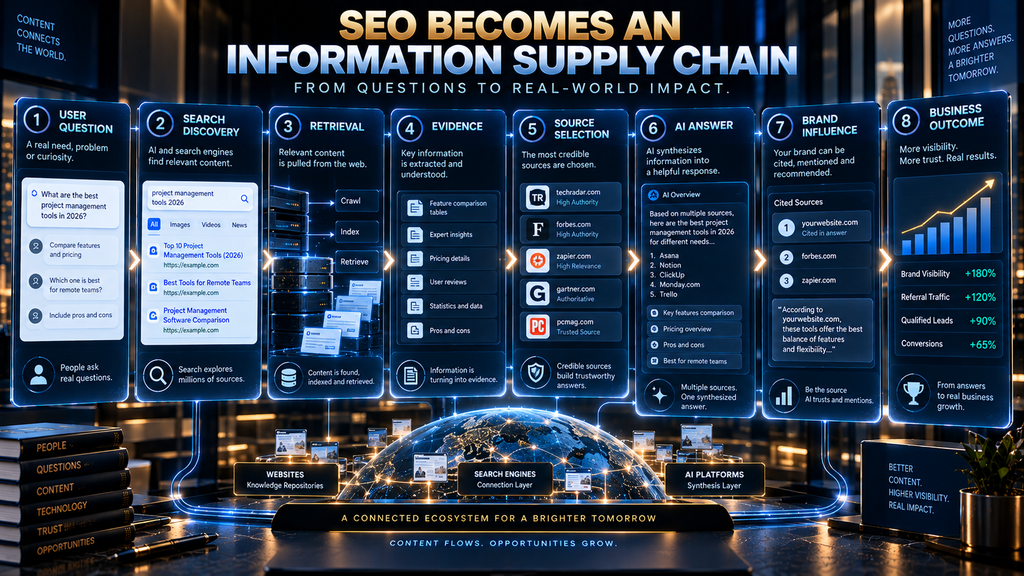
The deeper change is bigger than “AI search.” Search is gradually evolving from a system that primarily organizes documents into a system that increasingly assembles answers from information distributed across documents and sources. That creates an information supply chain.
A user supplies a question. The system expands the problem. Retrieval finds candidate sources. Evidence is evaluated. Information is synthesized. Citations identify supporting sources. The user decides whether the resulting answer is trustworthy enough to act upon.
A business can participate at several points in that chain.
It might provide the original data. It might provide the methodology. It might publish the definitive explanation. It might provide the most useful comparison. It might become the cited expert source. It might become the brand the answer recommends.
The most valuable SEO asset may therefore be the one that supplies the missing piece of information that makes the answer better. That is why the long-term opportunity is not simply “ranking in AI.”
It is becoming part of the information the AI needs.
The Strategic Bottom Line
The 2026 SEO environment is not asking businesses to choose between traditional SEO and AI SEO. It is rewarding businesses that understand how the two layers fit together.
The first layer remains the infrastructure: accessible pages, sensible architecture, strong internal linking, useful content, relevance, technical quality, authority and originality. Google continues to reinforce the importance of those foundations, including for its AI search features.
The second layer is where the new strategic work happens. Businesses must understand the questions their customers are asking, the evidence those decisions require, the sources AI systems currently rely on, how their brand is represented, where competitors are gaining answer visibility, and whether those appearances translate into meaningful business outcomes.
That leads to a much more durable conclusion than “AI SEO is replacing SEO.”
SEO is not disappearing. The definition of search visibility is expanding.
The companies that adapt well will not throw away everything that worked before. They will keep the infrastructure, improve the information, build original evidence, monitor answer visibility and connect the whole system back to business value.
That is what actually matters in 2026.
Final Thoughts
The most important thing to understand about AI SEO in 2026 is that the web has not stopped being the underlying information infrastructure. Google still needs pages to be accessible and indexable, AI systems still retrieve information from the web, and businesses still need technically sound websites and genuinely useful content. What has changed is what happens after retrieval: information can now be selected, synthesized and represented inside an answer before the user ever evaluates a conventional list of results.
That means the old SEO model is incomplete, but it is not obsolete.
The smarter model is layered. Build the search infrastructure first, then build the answer visibility layer on top of it. Make information easy to discover, worth retrieving, clear enough to interpret, strong enough to trust and distinctive enough to influence the answer. Then measure not only where pages rank, but whether the organization’s information is becoming part of the decisions its customers are making.
That is the real evolution of SEO. Not from SEO to AI SEO. From ranking pages to managing information visibility across the entire search journey.
Build Your AI Search Strategy
Explore practical AI SEO guides, tools, and search-visibility strategies for building a stronger organic presence in the AI-search era.
Read the Google AI Search Guide →Frequently Asked Questions
Is traditional SEO still relevant in 2026?
Yes. Google explicitly states that its AI features remain connected to its core Search systems and that established SEO best practices continue to apply. Crawlability, indexability, internal links, useful content, structured information and page experience remain important foundations.
Is AI SEO replacing SEO?
No. It is more accurate to treat AI SEO as an expansion of SEO into additional visibility mechanisms, particularly retrieval, citation, answer representation and monitoring. The traditional foundation remains necessary because AI search still depends on accessible information from the web.
Do keywords still matter?
Yes. Keywords remain valuable for understanding demand, language and search intent. The strategic difference is that marketers should now combine keyword research with questions, decision contexts, entities and evidence rather than treating keywords as the entire content strategy.
Should every AI-search query have a dedicated article?
No. Creating a separate article for every possible question can lead to unnecessary duplication and thin content. Google has specifically warned against producing large amounts of content around query fan-out variations and emphasizes useful, original information instead.
What makes content more useful for AI search?
Content becomes more useful when it is relevant, original, clearly structured and rich in information that can be understood independently, such as definitions, numbers, comparisons, procedures and supporting evidence. Recent research has found these qualities associated with citation and influence in controlled retrieval settings.
Are backlinks still important for AI SEO?
There is no evidence supporting the claim that backlinks have suddenly become irrelevant. Search systems continue to use link-related signals alongside many other factors, while broader source credibility remains relevant to information selection.
Do FAQs guarantee AI citations?
No. FAQs can improve usability when they answer real questions, but there is no evidence that adding FAQ sections guarantees citation in AI-generated answers. The underlying usefulness and quality of the information matter more than the presence of a particular formatting pattern.
What should a small business prioritize first?
A small business should normally build a sound technical and content foundation before investing heavily in specialized AI visibility software. Strong information architecture, useful content, clear positioning, original evidence and a technically accessible site provide a stronger base for both conventional and AI-mediated discovery.
How should AI SEO performance be measured?
A practical hierarchy is Presence → Citation → Influence → Outcome. Start by determining whether the brand appears, then whether its sources are cited, then whether those sources actually shape answers, and finally whether the visibility contributes to meaningful business outcomes.
What is the biggest AI SEO opportunity in 2026?
For many businesses, the biggest opportunity is not publishing more content but creating information that competitors cannot easily reproduce. Original research, proprietary data, benchmarks, detailed methodologies and evidence-rich comparisons can become valuable assets across traditional search, AI citations, sales enablement and brand authority.
Related Guides
- How AI Search Engines Find and Rank Information: A Beginner’s Guide
- Common Mistakes People Make When Using AI Website Builders
- Best AI Tools for Writing Blog Posts (Free & Paid)
Written by
Muntasir Ahmad Chowdhury
Founder, AI Hustle World
Muntasir Ahmad Chowdhury is the Founder of AI Hustle World, an independent publication dedicated to making Artificial Intelligence practical, trustworthy, and easy to understand. He researches AI tools, automation, customer service, productivity, and real-world business applications, helping readers make smarter technology decisions through research-driven, experience-backed content.
Expertise:
AI Tools • AI Automation • AI Customer Service • AI Productivity • Generative AI • AI Workflows
Get Smarter With AI
Enjoyed this guide? Get practical AI tools, tutorials, and honest reviews delivered to your inbox.