
Evidence: Documentation reviewed
Last checked: September 2026
What was done: Written from official documentation and the published sources linked in this article. Not hands-on tested.
Files: None
Affiliate links: No
How to Start a Faceless Instagram Page With AI Tools
You do not need to show your face to build a serious Instagram page. You do, however, need to give people a reason to recognize the account, trust the content, and come back for more. That distinction is easy to miss because “faceless Instagram” is often presented as a shortcut: choose a niche, ask AI to generate posts, publish every day, and wait for the followers to arrive. The software can make production dramatically easier, but it cannot solve the more important problem of deciding what the page should actually be about or why someone should care.
Consider what happens when a beginner follows the usual advice. They create an account, open an AI writing tool, generate a few motivational captions, use a design template, produce a handful of Reels, and publish them under a vaguely defined theme such as “success,” “AI,” “money,” or “self-improvement.” Technically, the account is active. Strategically, almost nothing has been built. There is no clear audience, no distinctive promise, no repeatable content system, and no reliable way to tell whether a post succeeded because the topic was useful, the hook worked, the format was right, or the content simply happened to receive a temporary burst of distribution.
That is the real challenge of building a faceless Instagram page with AI. The difficult part is not removing your face from the content. The difficult part is building a recognizable media system that can operate without your face. AI can remove a remarkable amount of repetitive production work, but it works best as an accelerator for research, scripting, design, editing, repurposing, and workflow management—not as a substitute for positioning, judgment, originality, and audience understanding.
This guide walks through that system from the ground up. You will learn how to choose an angle without turning the article into another giant niche list, set up the account so the page communicates a clear promise, build a repeatable content engine, decide what AI should and should not do, choose between Reels and carousels, understand the Instagram signals that actually matter, diagnose weak performance, and scale only after you have evidence that your content system deserves to be scaled.
What Is a Faceless Instagram Page?
A faceless Instagram page is an account where the creator does not rely on their own face or on-camera presence as the primary identity of the content.
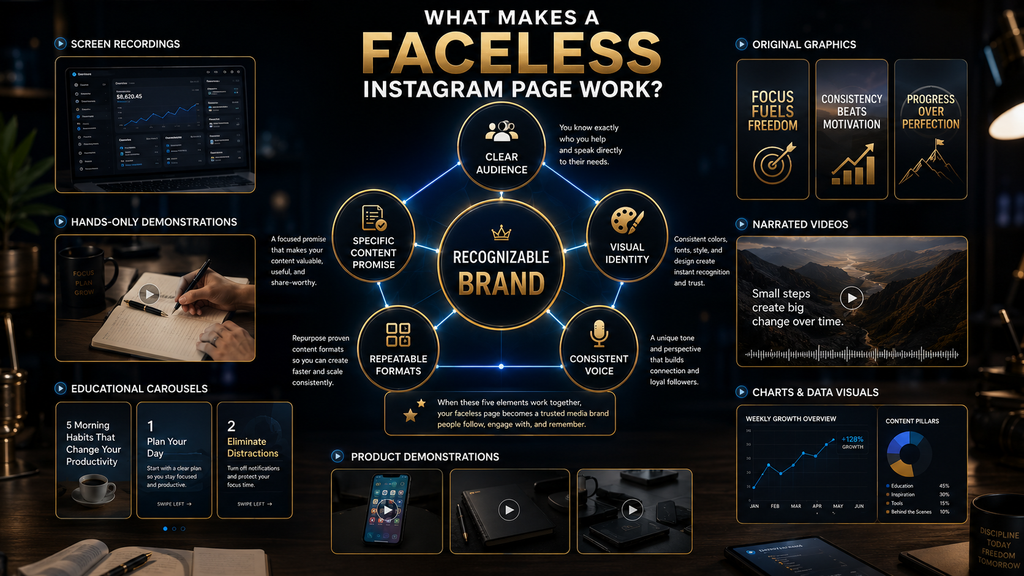
That can take many forms. A page can use screen recordings, product demonstrations, text-led videos, animations, charts, illustrations, photography, stock footage, hands-only demonstrations, narrated videos, educational carousels, or original visual storytelling. The defining feature is not a specific format; it is that the creator’s physical appearance is not the central distribution or branding mechanism.
This matters because “faceless” is sometimes confused with “anonymous,” and the two are not identical. You can run a faceless page with a highly recognizable brand, a consistent visual identity, an editorial voice, and a clear subject-matter position. In that situation, the audience may not know what you look like, but they can still immediately recognize what the account stands for.
A faceless page can also be built around a fictional or AI-generated persona, but that creates an important distinction from ordinary AI-assisted content creation. Instagram announced in August 2026 that its existing “AI creator” label is being renamed “AI-generated profile,” with the new label intended to help users understand when the person featured on a profile is generated or substantially created with AI. Instagram also said that profiles featuring AI-generated people that are not properly disclosed may face reduced reach, while ordinary use of AI for things such as captions, graphics, editing, or other creative assistance is not what the label is designed for. (TechCrunch)
That distinction is especially important for anyone building a faceless page today. A page that uses AI to help create its videos is not automatically the same thing as a page built around a synthetic person presented as though they were real. Those are different strategies, and they carry different trust and platform considerations.
Does Instagram Require You to Show Your Face?
No. A creator does not need to appear on camera for an Instagram page to provide useful or engaging content.
The bigger question is what will replace the face as the account’s recognition anchor. On a personal brand, the creator’s appearance often provides continuity. On a faceless account, that continuity must come from something else: a recurring subject, a recognizable editing language, a consistent visual identity, a distinctive narration style, a strong point of view, or some combination of these elements.
This is why a faceless account should not feel faceless in the broader sense. The page should still have a personality. The personality simply belongs to the brand rather than the person appearing on screen.
A technology education account, for example, might use dark editorial graphics, a consistent blue-and-gold visual system, screen recordings of tools, and a calm explanatory voice. A cooking account might use overhead shots of ingredients and hands without ever showing the creator’s face. A business education page might use diagrams, charts, animated text, and narrated case studies. None of these accounts needs a visible personality to become recognizable because the content itself creates the identity.
The practical lesson is that “I don’t want to show my face” is not a content strategy. It is a production constraint. The strategy begins with what you want the audience to remember.
Why Faceless + AI Can Work — and Where It Breaks
The strongest case for combining AI with a faceless Instagram model is operational leverage.
A traditional creator might spend hours researching a topic, outlining a script, writing captions, designing visuals, editing a Reel, generating a cover, preparing alternative hooks, and organizing the publishing queue. AI can shorten many of those tasks dramatically. A single creator can research more ideas, test more hooks, create more visual variations, turn long-form information into short-form assets, and batch repetitive production work without needing a large team.
But lower production friction creates a second problem: everyone else gets the same advantage.
When the cost of producing an acceptable-looking Reel drops, acceptable-looking Reels become less valuable as a competitive advantage. A creator who can generate twenty generic AI videos is no longer particularly differentiated when thousands of other accounts can do the same thing.
That changes where the advantage comes from. The competitive layer moves upstream toward topic selection, audience understanding, framing, originality, editing judgment, credibility, and consistency.
This is the central reality of AI-assisted faceless content:
AI can make average content faster. It does not automatically make your content worth following.
The distinction becomes obvious when you compare two hypothetical accounts. The first produces generic “five AI tools you need” videos with nearly identical hooks, synthetic visuals, and interchangeable captions. The second focuses specifically on practical AI workflows for small business owners, uses original demonstrations, explains why each workflow works, shows where it fails, and maintains a consistent visual identity. Both may use the same AI tools. The second has a much stronger reason to exist.
This is why the workflow in this article starts with positioning before production.
Step 1: Choose a Content Angle Before You Choose Your Tools
One of the worst ways to start a faceless Instagram account is to begin with a list of AI tools and then ask, “What can I make with these?” Tools are downstream. The first decision is the audience and problem you want to serve.
A broad topic such as “fitness” is not a content angle. Neither is “AI,” “money,” “motivation,” or “business.” Those subjects can contain thousands of unrelated audiences and content expectations.
A stronger angle narrows the relationship between the subject and the audience. Instead of “AI,” you might focus on practical AI workflows for freelancers. Instead of “fitness,” you could focus on apartment-friendly strength training for busy professionals. Instead of “business,” you could explain simple operating systems for first-time online business owners.
The goal is not to make the niche as small as possible. The goal is to make the page’s content promise easy to understand.
A useful test is this: if a stranger sees ten posts from your account, can they describe what the page helps them with in one sentence? If the answer is no, the account is probably too broad or too inconsistent.
Another useful test is whether you can generate at least fifty genuinely useful content ideas without forcing the topic. This matters because faceless pages often fail through content exhaustion. A niche can appear attractive until you discover that the first fifteen posts were easy and the next fifty require increasingly repetitive ideas.
You should also examine whether the subject can be communicated effectively without a visible personality. Some topics naturally benefit from demonstrations, examples, diagrams, screen recordings, or narrated explanations. Others depend heavily on personal experience, social proof, or on-camera trust. Neither category is impossible, but the second generally requires more deliberate brand-building if the creator remains off camera.
Step 2: Define the Page in One Sentence
Before creating your first post, write a single sentence that defines the account. A useful template is: “This page helps [specific audience] achieve [specific outcome] through [content angle].” For example:
This page helps small business owners use practical AI workflows to reduce repetitive marketing work.
That sentence immediately constrains your content choices. A post about a complex machine-learning benchmark may be interesting, but if it does not help that audience achieve the promised outcome, it probably does not belong on the page.
This is also where many faceless accounts accidentally become content warehouses. They publish motivation on Monday, AI tools on Tuesday, business quotes on Wednesday, productivity on Thursday, and finance facts on Friday because all five topics fit their broad personal interests. The account may have activity, but the audience has no consistent reason to associate the page with a particular expectation.
A strong faceless page should feel less like “here are things I found interesting” and more like “this account consistently solves this category of problem for me.”
That clarity becomes especially important when AI is involved because AI can generate endless plausible ideas. Without a strong editorial filter, endless idea generation becomes endless noise.
Step 3: Set Up the Account Like a Brand, Not a Placeholder
The account setup should communicate your content promise before someone reads a single post.
Choose a username that is easy to remember and reasonably aligned with the page identity. Your profile image should remain recognizable at small sizes; this might be a logo, symbol, illustrated mark, or other simple brand asset depending on the account.
The bio should explain what the page is about in plain language. Avoid filling the bio with vague phrases such as “helping you become your best self” when the content is actually about AI tools, career advice, or business systems. Specificity builds understanding faster.
A simple profile structure might look like:
- What the page covers: Practical AI workflows for small businesses
- What the audience gets: Tools, tutorials, and time-saving systems
- Optional action: Follow for weekly workflows
The visual identity should also be established before the content library becomes large. Decide on typography, a restrained color system, thumbnail style, recurring visual elements, and the level of visual complexity you want. Faceless accounts benefit from consistency because the visual system often becomes part of the account’s identity.
This does not mean every post needs to be identical. Consistency should exist at the brand level, not at the template level. If every carousel is exactly the same template with different text, the page can begin to feel automated even when the information is useful.
The objective is recognizable variation: the audience should feel that different posts belong to the same publication without feeling that the same post has been copied twenty times.
Step 4: Build the Content Engine Before You Start Posting at Scale
Once the account is positioned, build a system that can continuously turn ideas into publishable content.
The mistake is to treat every Instagram post as a separate project. That approach becomes exhausting quickly, especially for a solo creator.
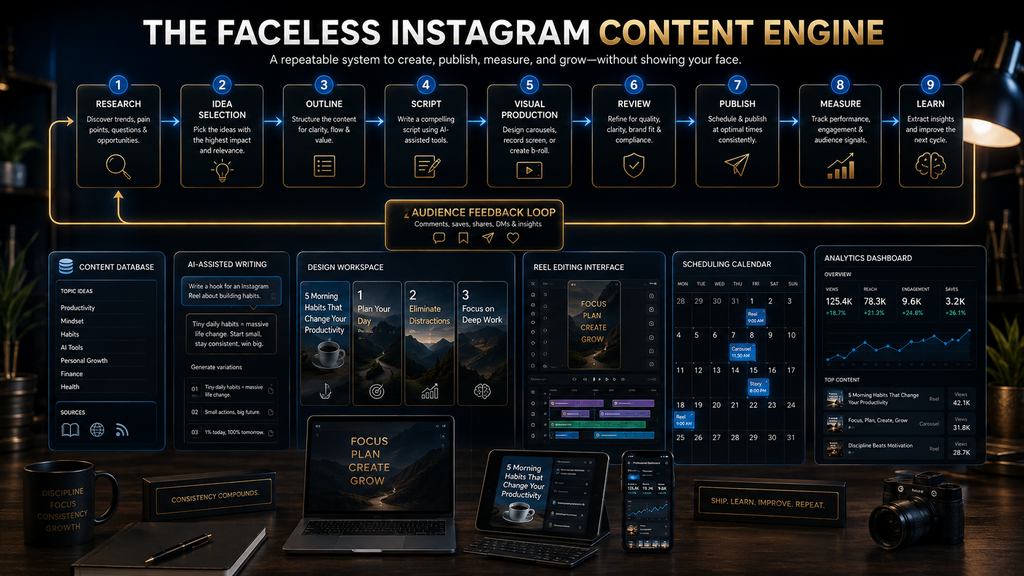
A stronger system separates the work into stages: Research → Idea Selection → Outline → Script → Production → Review → Publish → Measure → Learn. This structure makes AI much more useful because different tools can support different stages instead of one AI application being asked to “make an Instagram post.”
For example, research might produce twenty potential ideas. You select the five that best fit the audience. Those five become outlines. Two or three formats are chosen based on the content. AI helps create draft scripts and visual concepts. You review and refine the strongest versions. Production is then batched so that similar work happens together instead of switching mentally between research, design, editing, and publishing all day.
The result is a content engine rather than a pile of posts.
That difference becomes more significant as the page grows. If one Reel performs well, you should be able to understand what made it useful and create related content. If another performs badly, you should be able to diagnose the weakness. Without a system, each post becomes an isolated experiment and the account learns very slowly.
Step 5: Create Three to Five Content Pillars
Content pillars give you enough variety to avoid repetition without destroying the page’s focus. For a practical AI account, for example, the pillars might be: AI Tutorials — showing how to accomplish a specific task. AI Workflows — combining tools or steps into a repeatable process.
AI Mistakes & Reality Checks — explaining where popular advice fails. Tool Comparisons — helping the audience choose between approaches. AI Trends & Changes — explaining developments that actually matter to the audience.
Notice that these are not just topics. They are different content jobs.
This distinction is useful because “AI tools” by itself is not a pillar. It is a subject. A pillar should answer what kind of value the audience receives from that subject.
The pillars also give AI a useful constraint. Instead of asking an AI system for “50 Instagram ideas,” you can ask for ten ideas specifically for the “AI Mistakes & Reality Checks” pillar aimed at small business owners who have limited technical knowledge. Better inputs create more useful outputs because the system is operating inside a clearly defined editorial boundary.
Step 6: Decide What AI Should Do and What You Should Do
This is one of the most important decisions in the entire workflow.
The strongest AI-assisted Instagram accounts do not automate every part of content creation. They assign tasks according to the strengths of the tool and the strengths of the human.
| Task | AI’s Best Role | Human’s Best Role |
|---|---|---|
| Idea generation | Produce angles and variations | Decide which ideas deserve attention |
| Research | Find themes, questions and starting points | Verify facts and judge relevance |
| Outline | Organize possible structure | Choose the argument and narrative |
| Script drafting | Create first versions | Add originality, examples and judgment |
| Visual concepts | Generate layouts and creative options | Preserve brand consistency |
| Voice generation | Produce narration | Review tone and accuracy |
| Editing | Accelerate repetitive production | Make pacing and creative decisions |
| Analytics | Surface patterns | Interpret what those patterns mean |
| Publishing | Schedule and organize | Own the strategy and editorial calendar |
The principle behind this table is simple:
Automate production before you automate judgment.
AI is excellent at helping with repetitive work. It is much less reliable as the sole decision-maker for questions such as whether an idea is genuinely interesting, whether a claim is misleading, whether a trend matters to your audience, or whether a piece of content actually sounds like your brand.
That is why the best faceless workflow is not fully automated. It is selectively automated.

Step 7: Use AI to Multiply Research, Not Just Generate Captions
Many creators use AI for the most visible task—writing captions—while ignoring the much more valuable research layer.
AI can help you turn a broad subject into a structured idea bank. It can identify common questions, categorize customer pain points, suggest opposing viewpoints, create comparison angles, transform one topic into multiple content formats, and surface recurring objections.
Suppose your page is about helping small businesses use AI for customer support. Instead of repeatedly asking for “Instagram post ideas,” you could build an idea database around questions such as:
What tasks should be automated? Where does automation create risk? Which customer questions are repetitive?
What information needs a human review? How can a business measure the value of an AI support workflow? What happens when the knowledge base is outdated?
That produces better content because the ideas originate from problems rather than from the desire to fill a posting calendar. The human’s job is then to decide which questions deserve a post, which deserve a Reel, which require a carousel, which require an external source, and which are not useful enough to publish.
Step 8: Choose Between Reels and Carousels
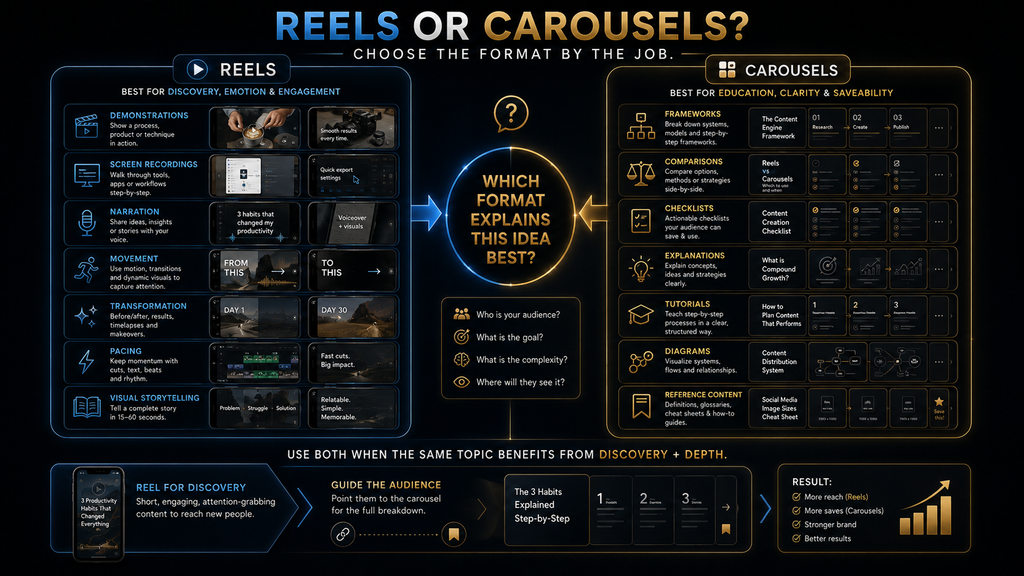
There is no universal rule that every new faceless page should be Reels-only or carousel-only. The better question is: Which format communicates this specific idea better?
Reels are naturally useful when movement, demonstration, narration, pacing, before-and-after transformation, screen recording, or visual storytelling adds value. A tutorial showing how to complete a task in an AI tool is often better demonstrated than explained through static slides.
Carousels are strong when the audience needs to absorb a structured explanation, comparison, checklist, framework, sequence, or collection of related ideas. A “five mistakes to avoid” post, a decision framework, or a step-by-step visual tutorial can benefit from allowing the reader to move through the information at their own pace.
Many strong pages use both. The mistake is not using one format too much in itself; the mistake is forcing every idea into the same format because that is the easiest production workflow.
A useful operating model is to assign a default role to each format. For example, Reels can be the primary discovery and demonstration format, while carousels become the deeper educational or reference format. Your exact mix should be determined by your audience response and your production capacity rather than by a magical ratio.
Step 9: Design Better Hooks
A hook is not simply a dramatic first sentence. It is the opening promise that tells the viewer why the content deserves attention.
Weak hooks usually describe the topic:
“Here are five AI tools for Instagram.”
A stronger hook introduces a problem, tension, curiosity gap, or useful outcome:
“You do not need five AI tools to run an Instagram page. You probably need two that do different jobs.”
The second version creates a reason to continue because it challenges the viewer’s existing expectation.
Good hooks also match the content that follows. If the opening promises a transformation and the video delivers a generic list, the viewer learns that the account’s hooks cannot be trusted. A hook should not merely increase the chance of an initial stop; it should set an accurate expectation for the content.
For a faceless page, this is especially important because the creator’s face is not carrying the viewer through the first seconds. The content itself has to make the case.
AI can generate hook variations quickly, which is useful. The creator still needs to select the one that is most relevant to the audience and most faithful to what the content actually delivers.
Step 10: Make the Content Visually Recognizable Without Making It Repetitive
Faceless pages often rely heavily on graphics, templates, stock footage, AI-generated visuals, screenshots, or screen recordings. This makes visual identity more important but also makes visual sameness a real risk.
A strong visual system should establish recurring elements such as typography hierarchy, spacing, framing, icon style, cover treatment, or color accents. These should operate as design principles rather than as a single rigid template.
For example, every post might use the same headline typography and caption structure while allowing the central visual composition to change. A tutorial can use screenshots. A comparison can use a split layout. A framework can use a diagram. A case study can use a chart.
This is where AI design tools are valuable: they can generate variations inside an existing brand system. What they should not do is force your entire account into the same visual style merely because that style is easy to reproduce.
Your goal is recognition, not uniformity.
Step 11: Build a Sustainable Posting Rhythm
One of the most persistent problems in social media advice is the search for a magic posting frequency. There is no universal number that guarantees growth.
Instagram itself provides creators with Best Practices guidance covering creation, engagement, reach, monetization, and guidelines, including advice around posting frequency, attention, Reels length, engagement metrics, and reach. The company has also described these recommendations as something it continues to update rather than a fixed formula that applies identically to every account. (About Facebook)
For a new faceless page, a more sensible starting point is to establish a cadence that allows enough publishing volume to generate learning without forcing low-quality production. A practical operating range might look like this:
| Stage | Suggested Cadence | Main Goal |
|---|---|---|
| Launch | 3–5 strong pieces per week | Establish consistency and gather baseline data |
| Early learning | 4–7 pieces per week if sustainable | Test topics, hooks and formats |
| Established system | Sustainable cadence based on results | Scale repeatable winners |
These are operating recommendations, not Instagram requirements. A creator who can produce three excellent pieces every week while maintaining a clear editorial identity may have a stronger business than someone producing fourteen weak posts because they believe daily publishing is mandatory.
The correct question is not, “How often does Instagram want me to post?” It is: “How frequently can I publish enough quality experiments to learn while maintaining the quality that makes people want to follow the account?”
Step 12: Understand What Instagram Is Actually Responding To
Trying to “beat the Instagram algorithm” is usually a sign that the creator is treating a complex recommendation system like a single secret formula.
Meta’s documentation describes ranking systems that collect potential content, apply filtering rules, predict actions people may take, combine those predictions into scores, and then apply additional rules around factors such as diversity and integrity. Meta has also described thousands of signals across Facebook and Instagram, including interactions, viewing behavior, post characteristics, and a person’s history with an author.
That means there is no responsible public formula such as “saves are always worth X and likes are always worth Y.” Instead, think about the system in terms of the evidence your content gives it. Does someone stop scrolling because the topic is relevant?
Do they watch enough to understand the idea? Do they save the post because they expect to need it later? Do they share it with another person?
Do they interact meaningfully? Do they visit your profile because the content created additional interest? Those behaviors provide stronger insight than simply staring at follower count.
Meta’s published ranking information specifically identifies predicted actions such as likes, saves, profile taps, comments, and video-watching behavior as inputs to the Feed ranking process. (Meta AI)
The important point is not to manipulate one metric. It is to make content that gives users a genuine reason to respond.
Step 13: Stop Treating Every View as Success
Views can be exciting, but views alone are not a complete measure of whether a faceless account is getting better. Imagine two Reels.
The first gets 30,000 views but produces almost no profile interest, saves, shares, or repeatable audience response. The second gets 8,000 views but produces unusually strong profile visits, saves, shares, and follows from people who clearly match the account’s target audience.
The first looks better on the surface. The second may be much more valuable.
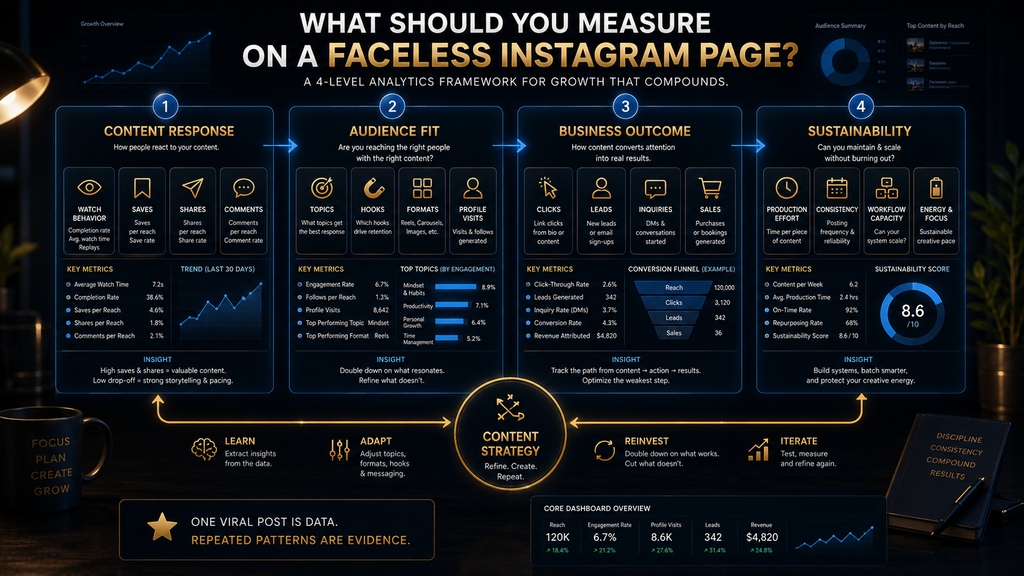
This is why the measurement framework should move from content response to audience fit and eventually to business outcome.
At the content level, look at behaviors such as watch behavior, saves, shares, comments, and profile actions. Then ask whether those responses are concentrated around particular topics, hooks, formats, or audience problems.
Once a pattern appears, test it again.
That second step matters. One successful Reel can be an outlier. A pattern across several related pieces of content is much stronger evidence.
The F.A.C.E.L.E.S.S. Instagram System
At this point, the pieces can be turned into a repeatable AI-assisted operating framework.
Focus
Define the audience and the problem before opening your AI tools. A clear focus gives the entire content system a filter for deciding what belongs and what does not.
Account
Build the profile around the content promise. Your username, bio, profile image, visual language, and page description should make the subject understandable without requiring several posts to explain it.
Content Engine
Create repeatable pillars, formats, idea banks, research workflows, production templates, and a publishing queue. The objective is to remove unnecessary decision-making from repetitive tasks without removing editorial control.
Enhance With AI
Use AI where it saves time: research, ideation, scripting, variations, visual concepts, editing, transcription, repurposing, analytics summaries, and administrative organization. Keep the highest-value judgment calls under human control.
Learn From Signals
Study what people actually do with the content. Do not rely on follower count or a single viral post to determine whether the strategy works.
Evolve
When a topic, format, or hook repeatedly produces stronger responses, investigate why and create related experiments. Improvement comes from patterns, not from random novelty.
Stay Original
Avoid becoming a repost account, a generic AI content factory, or a page whose only recognizable feature is that every post looks machine-generated. Original thinking, original demonstrations, useful synthesis, and genuine editorial judgment become more valuable as production gets cheaper.
Scale Carefully
Batch the parts of the process that are already working. Do not automate a weak content strategy merely because automation is available.
The framework is intentionally simple because the objective is not to give you another complicated social-media methodology. It is to establish a sequence: clarity first, production second, learning third, scale last.
How to Use AI Across the Entire Workflow
Once the account’s strategy is clear, AI can reduce a surprising amount of operational friction.
During research
Ask AI to identify recurring audience questions, objections, misconceptions, competing viewpoints, and content opportunities. Use those outputs as research leads rather than automatically treating them as facts.
During planning
Give the system your page definition and content pillars, then request ideas that match a specific audience and problem. This produces much more useful output than requesting hundreds of generic Instagram ideas.
During scripting
Have AI produce several structures or hook variations, then rewrite the selected version to add your own voice, examples, evidence, and judgment.
During design
Use AI to generate visual directions, layout ideas, illustration concepts, background assets, or design variations that fit your established brand system.
During editing
AI can accelerate transcription, captioning, clipping, cleanup, voice generation, and repetitive editing tasks. Your final review should still determine pacing, emphasis, accuracy, and whether the content feels human rather than assembled.
During analytics review
AI can summarize what happened across a set of posts, but it should not be allowed to invent causal explanations. “This Reel received more shares” is a fact. “The blue background caused the increase” is an unsupported conclusion unless you actually tested that variable.
That distinction is crucial. Analytics tools are good at finding patterns; humans are still responsible for interpreting the evidence carefully.
A Practical Weekly Workflow for a Solo Creator
Suppose you want to publish five pieces of content each week.
Instead of building them individually from Monday through Friday, you might spend one session researching and selecting ten candidate ideas. From those, choose five that fit your current priorities. Develop the hooks and outlines in one batch, then script the selected posts together. Produce the visuals and videos in another batch, review everything in a final quality-control pass, and schedule the finished content.
This approach has two major benefits.
First, batching reduces mental switching. You do not have to move from research mode into design mode and back into strategy mode every few hours.
Second, it creates a more consistent content library. When you see five upcoming posts at once, you can notice duplication, missing topics, uneven content pillars, or an overreliance on one format before those posts reach the audience.
AI becomes much more useful inside this workflow because it can operate on a structured queue. Instead of generating isolated outputs, it helps transform the same research material through several stages.
What Your First 30 Days Should Look Like
The first month should be treated as a learning period rather than a race to a follower milestone.
Your first objective is to establish the account’s identity and create a baseline for audience response. Publish enough high-quality content to generate meaningful signals, but do not change your entire strategy after one weak post.
During the first week, prioritize account setup, visual identity, content pillars, and your first batch of ideas. Your initial content should make it obvious what the account is about.
During weeks two and three, focus on testing. Try variations in hooks, topics, content depth, visual treatment, and format while staying within the same overall positioning.
During week four, review the library as a whole. Which topics consistently attracted stronger responses? Which formats required disproportionate effort without producing useful signals? Which hooks produced strong initial attention but weak follow-through? Which posts generated saves or shares even without large view counts?
The point is not to find “the viral post.” The point is to begin identifying repeatable patterns.
Days 31–60: Turn Patterns Into a System
By the second month, you should have enough material to identify promising directions.
Suppose three of your strongest posts explain specific AI workflows, while generic tool lists perform poorly. That is evidence worth acting on. You might shift your content mix toward workflow demonstrations while reducing generic lists.
Suppose carousels produce fewer views than Reels but significantly more saves. That does not mean carousels are failing. It may mean they are serving a different job in the content system.
Suppose posts on one subject repeatedly attract profile visits from the right audience. That topic deserves deeper exploration even if another subject occasionally produces a larger reach spike.
This is the stage where AI becomes particularly useful for analysis. You can give a structured set of post-level observations to an AI system and ask it to identify recurring patterns, cluster similar content, summarize what changed, and generate hypotheses for future tests.
The crucial word is hypotheses.
Analytics can tell you what happened. They do not automatically tell you why it happened.
Days 61–90: Scale What You Can Explain
By the third month, the objective should shift from experimentation alone to systemization. You should know which content pillars are strongest, which formats are easiest to produce at quality, which hooks consistently attract attention, and which topics generate valuable audience actions. Now you can start increasing efficiency.
Batch similar content. Build reusable templates. Create prompt libraries for specific tasks. Automate scheduling. Create standard review checklists. Organize your research database. Develop a repeatable process for turning one strong topic into several original assets.
This is where the phrase scale carefully becomes important.
Do not interpret a successful workflow as permission to produce ten times more content immediately. First ask whether the successful content can be reproduced without losing quality. Then increase volume gradually while monitoring whether audience response remains strong.
Scaling a good system is useful. Scaling a weak system is simply a faster way to produce more weak content.
Common Mistakes That Destroy Faceless Instagram Accounts
Starting With Tools Instead of a Problem
A creator discovers an impressive AI video generator and decides to build an entire account around whatever the tool can produce. That is backwards. Tools should support the strategy, not define it.
Choosing a Niche Because It Looks Profitable
A topic may look attractive because other accounts have large audiences or monetize well, but that does not mean you can build a credible content system inside it. You need enough expertise, curiosity, or research capacity to produce useful material consistently.
Publishing Generic AI Content
AI can create polished content that says almost nothing new. The content may look professional while providing little reason to save, share, or follow.
Using the Same Template for Everything
Consistency is useful; visual cloning is not. When every post feels mechanically identical, the account can lose its sense of editorial quality.
Changing the Niche Every Week
Early experimentation should happen inside a stable positioning framework. Constantly changing the subject prevents you from collecting meaningful evidence about what the audience actually wants from the page.
Chasing Followers Instead of Audience Fit
A large follower number is not useful if most of those followers have no reason to engage with future content. The objective is not simply to maximize the number attached to the account. It is to build an audience that responds to the account’s actual subject.
Over-Automating Too Early
Scheduling posts is useful. Automating every editorial decision is dangerous. The more immature the strategy, the more harmful it can be to multiply it at scale.
Buying Engagement
Artificial engagement can make an account’s dashboard look healthier while giving you worse information about what real audiences want. It also creates the risk of building strategy on signals that do not represent genuine interest.
Treating One Viral Post as a Strategy
A viral post can be an interesting data point without representing a repeatable content model. Study why it worked, test adjacent ideas, and look for patterns before rebuilding the entire account around it.
Assuming AI Content Is Automatically Allowed
Platform rules evolve. Creators using AI should understand how the platform distinguishes ordinary AI-assisted creation from more consequential uses such as synthetic identities. Instagram’s August 2026 “AI-generated profile” change is a current example of why assumptions about disclosure should not be based on older advice.
AI-Generated Content and Instagram’s 2026 Disclosure Rules
This deserves its own section because the conversation around AI-generated social media has changed.
Instagram’s latest policy update is specifically concerned with profiles featuring AI-generated people, not with every creator who touches an AI tool. Instagram said its “AI creator” label is being renamed “AI-generated profile” to make the disclosure clearer. The company also said that profiles featuring AI-generated people without appropriate disclosure may have their reach limited, while creators who use AI for editing photos, creating graphics, polishing captions, or similar creative assistance do not need that particular profile label simply because AI was involved in production.
For a faceless creator, this distinction makes the strategic choice important. A page built around screen recordings, illustrations, original graphics, text-based storytelling, product demonstrations, or narration can remain a normal creator account while using AI heavily behind the scenes.
A page built around a synthetic human influencer is different. In that case, the artificial identity itself is part of the product, and transparency becomes much more important.
The safest long-term approach is not to hide AI involvement when disclosure is required or make a synthetic identity appear deceptively real. Instead, build the brand around the value of the content itself.
This is also another reason to avoid constructing the entire account around an AI persona simply because synthetic people are easy to generate. A synthetic personality may create an initial novelty effect, but it also creates additional trust and policy considerations that a conventional faceless editorial brand does not necessarily have.
When Should You Automate the Account?
Automation becomes useful when you have already learned what should happen.
A good example is scheduling. Once you know your content calendar and have reviewed the posts, scheduling can remove an unnecessary manual task.
Another useful automation is production organization. A workflow can automatically move approved scripts into a design queue, generate draft captions, organize asset folders, or prepare publishing metadata.
A less useful automation is deciding which topics deserve to be published without human review. That decision affects the strategic identity of the account and should generally remain under human control.
Think of automation as a way to remove friction from a validated process. Do not use it as a way to avoid making strategic decisions.
Can One Piece of Content Become Multiple Instagram Posts?
Yes, and this is one of the highest-leverage ways to use AI. Suppose you research the topic “How small businesses can use AI to summarize customer-support conversations.”
That research could become a short Reel explaining the basic workflow, a carousel showing the five-step process, a visual mistake checklist, a case-study post, and a second Reel demonstrating a specific tool. The important point is that these should not be identical copies.
The Reel might prioritize the transformation. The carousel might explain the process. The mistake post might address risk. The case study might show application. Each asset serves a different editorial purpose.
This is repurposing as reinterpretation, not duplication. Cross-platform repurposing has its own guide; the principle here is simple: use AI to extract multiple content opportunities from strong research without turning the audience feed into five copies of the same post.
What Should Success Look Like at 90 Days?
A healthy 90-day result is not necessarily a specific follower number. A more meaningful outcome is that you understand your page.
You know which audience problem is strongest. You know which content pillars deserve more attention. You know which formats you can produce at high quality. You know which hooks consistently create stronger responses. You know which posts lead people to explore your profile. You know what should be automated and what still requires human attention.
You also have a growing library of evidence.
That evidence matters because the biggest advantage of operating a faceless Instagram page is not simply that you can publish without appearing on camera. It is that you can build a repeatable content business around a subject without making your physical presence the center of the distribution model.
By that point, AI should feel less like a novelty and more like infrastructure. It should help you research faster, create more efficiently, organize your workflow, and test more intelligently.
Who Should Build a Faceless Instagram Page With AI?
This model works especially well for someone who has expertise or genuine curiosity in a subject but does not want to become an on-camera creator. It can also work for a small business that wants to build an educational content arm, a marketer who wants to test multiple content angles, or a creator who prefers writing, design, research, or screen-based demonstrations to personal video.
It is less attractive for someone who expects AI to generate the entire strategy automatically. If the only reason you are interested is that AI makes content cheap, you are entering a market where the same advantage is available to everyone else.
The strongest candidates are people who are willing to learn from the audience and refine the system over time. That is the difference between content production and content operations.
The AI Hustle World Decision Framework: What to Automate, What to Keep Human
Before adding another tool, ask what part of the workflow you are actually trying to improve.
If the bottleneck is research, a new video editor will not solve it. If the bottleneck is visual production, generating more scripts will not help. If the content itself is weak, increasing publishing frequency will simply expose the weakness faster.
A simple decision rule is:
| If your problem is… | Improve… |
|---|---|
| Too many ideas but no direction | Positioning and content pillars |
| Constantly starting from zero | Templates and batching |
| Writing takes too long | AI-assisted outlining and drafting |
| Visual production is slow | Design systems and AI-assisted creation |
| Editing is repetitive | Automated or AI-assisted editing |
| Content gets views but no audience growth | Positioning, hooks and audience fit |
| Saves/shares are weak | Usefulness and content depth |
| Results are inconsistent | Testing discipline and topic selection |
| Production is overwhelming | Workflow design and selective automation |
| You do not know what is working | Better measurement and pattern analysis |
Notice what this framework does not say. It does not say:
“Buy another AI tool.”
It asks:
“Which constraint is actually limiting the account?”
That question will save more time than most tool recommendations.
The Reality Check: Faceless Does Not Mean Easy
The appeal of faceless Instagram is understandable. You do not have to worry about camera confidence, appearance, filming yourself, or building a content strategy around your personal identity.
That advantage is real.
But the absence of a face also removes some of the natural trust and recognition that personal brands receive. A faceless page therefore has to compensate through stronger editorial identity, visual consistency, useful information, repeatable quality, and a recognizable promise.
AI makes production much easier, but it also makes mediocre content much easier to produce. That is why the strongest strategy is not: “How much content can I make with AI?”
It is: “How much better can I make the content system because AI handles the repetitive parts?” That small change in thinking has large consequences.
Final Thoughts
Starting a faceless Instagram page with AI tools is absolutely viable, but the opportunity is often misunderstood. The winning advantage is not that you can produce content without showing your face, and it is certainly not that AI allows you to publish hundreds of generic posts with almost no effort. The real advantage is that one person can build a recognizable media brand around a clear audience problem while using AI to reduce the repetitive cost of research, scripting, design, editing, organization, and experimentation.
The most important decision happens before the first post. Choose the audience, define the problem you want to solve, establish a clear content promise, and create a visual identity that can replace the recognition normally provided by a personal face. From there, build a content engine rather than treating every post as an isolated task, and use AI according to the job it performs best.
The creators who do this well will not necessarily be the ones using the most advanced tools or publishing the most frequently. They will be the ones who learn faster, recognize patterns, maintain quality, and use automation to strengthen a system that already works.
The goal is not to build an Instagram account that looks automated. The goal is to build an Instagram brand that uses AI intelligently enough that the audience never has to think about the machinery behind it.
Build Smarter With AI
Not sure what to post about? Explore niche ideas that work for a faceless AI content account.
Find Your Faceless Instagram Niche →Frequently Asked Questions
Can I really grow an Instagram page without showing my face?
Yes. A faceless account can build an audience through educational content, demonstrations, storytelling, graphics, screen recordings, voiceovers, animations, photography, and other formats. The account still needs a recognizable identity and clear value proposition, because the creator’s face is not available to perform that branding role.
Is AI-generated content allowed on Instagram?
AI use itself is not a simple yes-or-no category. Instagram’s current policy distinguishes ordinary AI-assisted creation from profiles featuring AI-generated people. In August 2026, Instagram announced that its “AI creator” label would become “AI-generated profile” and said undisclosed AI-generated profiles could face reduced reach, while ordinary uses such as creating graphics, editing images, or polishing captions are not what the profile label is intended to cover.
How many times should I post each week?
There is no universal frequency that guarantees growth. A better starting point for a new account is a sustainable range of roughly three to five strong pieces per week, increasing toward four to seven when production quality can be maintained. Treat that as an operating strategy, not as an Instagram requirement. Instagram itself provides creator guidance around posting frequency and other practices through its Professional Dashboard.
Should I focus on Reels or carousels?
Use the format that best communicates the specific idea. Reels are particularly useful for demonstrations, narration and visual storytelling, while carousels are often effective for frameworks, explanations, checklists and reference-style content. Many faceless accounts can benefit from using both rather than forcing every idea into one format.
What AI tools do I need to start?
You do not need a huge stack. A practical system can often begin with one strong AI assistant for research and drafting, one capable design tool, one video editor, and Instagram’s own publishing and analytics features. Add tools only when you can identify a specific bottleneck they will remove.
Can AI run my entire Instagram page?
Technically, AI can assist with a large portion of the workflow, but that does not mean it should control the entire strategy. Content selection, factual verification, positioning, originality, brand voice, and interpretation of audience behavior still benefit heavily from human judgment.
Why does my faceless account get views but not followers?
Usually, reach is not the same thing as positioning. A post may attract people without clearly communicating what the account consistently offers. Review whether the content gives viewers a strong reason to visit the profile, whether multiple posts serve the same audience problem, and whether the page description makes the account’s value obvious.
Should I make an AI-generated person the face of my faceless account?
You can, but that is a different strategic choice from simply using AI to create content. An AI-generated person becomes part of the profile identity and therefore creates additional disclosure, trust and platform considerations. Instagram’s current “AI-generated profile” policy is specifically relevant to such accounts.
What matters more: followers or engagement?
Neither number should be viewed in isolation. What matters is whether your content consistently generates meaningful audience responses and attracts the type of people you actually want. Meta’s published ranking documentation describes systems that predict actions including likes, saves, comments, profile taps, and video-watching behavior rather than relying on follower count alone.
How long does it take to grow a faceless Instagram page?
There is no reliable universal timeline. Growth depends on topic, audience demand, content quality, competition, consistency, distribution, and whether the creator learns from performance. A better objective for the first 90 days is to establish a repeatable content system and identify patterns that consistently produce useful audience response rather than chasing a specific follower milestone.
Sources and Further Reading
- Disclosures 101 for Social Media Influencers: US Federal Trade Commission guidance on disclosing paid and affiliate relationships.
- Our Approach to Labeling AI-Generated Content and Manipulated Media: Meta. How Instagram and Facebook label AI-generated content.
Related Guides
- How to Repurpose Content Across YouTube, Pinterest, and Instagram
- Pinterest Niche Ideas for a Faceless AI Content Account
- How to Start a Faceless YouTube Channel in 2026
- How to Turn Articles Into Social Media Content With AI
- 15 Faceless YouTube Channel Niche Ideas That Actually Work in 2026
Written by
Muntasir Ahmad Chowdhury
Founder, AI Hustle World
Muntasir Ahmad Chowdhury is the Founder of AI Hustle World, an independent publication dedicated to making Artificial Intelligence practical, trustworthy, and easy to understand. He researches AI tools, automation, customer service, productivity, and real-world business applications, helping readers make smarter technology decisions through research-driven, experience-backed content.
Expertise:
AI Tools • AI Automation • AI Customer Service • AI Productivity • Generative AI • AI Workflows
Get Smarter With AI
Enjoyed this guide? Get practical AI tools, tutorials, and honest reviews delivered to your inbox.