Best RAG Platforms and Tools for Building AI Knowledge Bases in 2026
Building an AI knowledge base sounds deceptively simple. Connect your documents, let an AI system index them, ask questions, and receive answers with citations. The reality becomes much more complicated as soon as the knowledge base contains hundreds or thousands of documents, information changes regularly, different users have different permissions, or the system needs to support more than a polished demo.
That is why choosing a RAG platform in 2026 is no longer simply a matter of asking which product has the most integrations or the most impressive AI features. The important question is whether the platform can reliably turn your organization’s information into useful retrieval context, keep that information current, preserve the right access boundaries, and give your application enough control to produce trustworthy answers.
The market has also become unusually difficult to compare because “RAG platform” can describe very different things. A managed RAG service, an enterprise search platform, a visual application builder, an orchestration framework, a cloud knowledge-base service, and an internal AI knowledge product may all appear in the same search results even though they solve different problems. Current RAG comparisons reflect exactly this problem: the category now spans orchestration frameworks, document processing, vector databases, reranking systems, managed APIs, and complete application platforms.
This guide takes a different approach. Instead of pretending that one platform is universally best, it explains the underlying RAG stack first, separates the major platform categories, evaluates the leading options against the problems they are actually designed to solve, and then gives you a practical framework for deciding whether you should buy a managed platform, assemble your own stack, or choose something in between.
What Is a RAG Platform?
A RAG platform is a software system that helps an application retrieve relevant information from external knowledge sources and use that information to generate grounded responses with a large language model.
The important distinction is that a RAG platform is not simply a vector database. A vector database stores and retrieves representations of information, while a broader RAG platform may also handle document ingestion, parsing, chunking, embeddings, indexing, retrieval, reranking, prompt construction, citations, model connections, access controls, evaluation, APIs and application deployment. Amazon Bedrock Knowledge Bases, for example, can connect knowledge sources, configure embeddings and storage, retrieve relevant information, and integrate that retrieved context into generative AI applications.
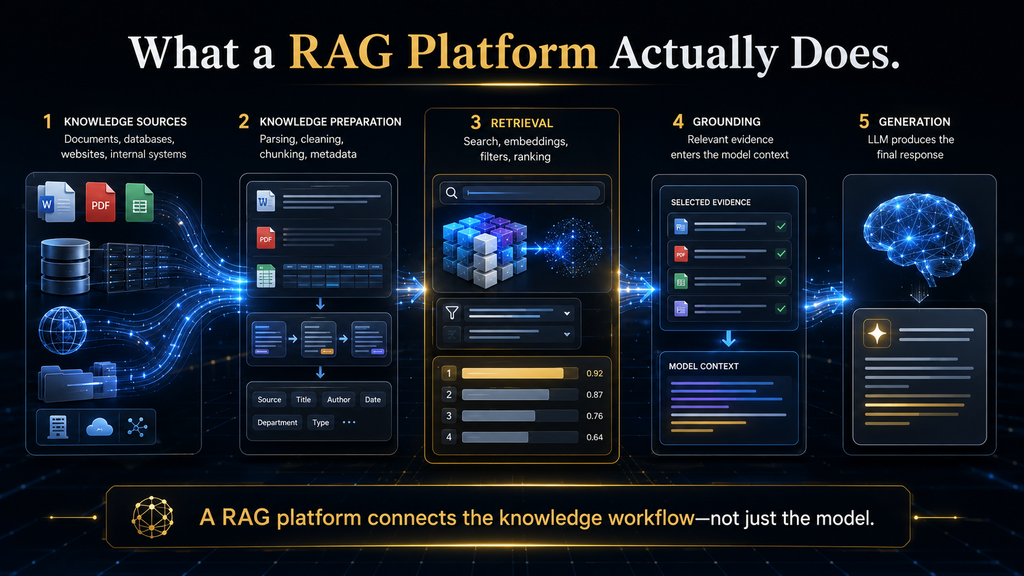
The easiest way to understand the distinction is to follow the information rather than the product category. A document enters the system, is processed into usable pieces, receives a representation suitable for retrieval, gets indexed, and later becomes part of a retrieval operation when a user asks a question. The retrieved material is then passed into the generation layer so the language model can answer using evidence that was not necessarily present in its original training data.
That means the quality of a RAG system is determined by a chain of decisions rather than one magical AI feature. Poor document parsing can damage retrieval before a vector database ever sees the content. Bad chunking can separate a definition from the qualification that makes it meaningful. Weak retrieval can return plausible but irrelevant passages. Excessive context can overwhelm the model. Missing permissions can expose information that the user should never have retrieved in the first place.
A useful RAG platform therefore has to solve a systems problem, not just a chatbot problem.
RAG Platform vs Vector Database vs Framework vs AI Knowledge Base
The first decision is to understand what you are actually buying, because many poor platform choices begin with comparing products that operate at different layers of the stack.
A vector database is primarily retrieval infrastructure. It stores vectors and associated metadata and provides mechanisms for similarity or hybrid retrieval. That makes it an important component of RAG, but it does not automatically give you document ingestion, application orchestration, user interfaces, evaluation workflows, or enterprise knowledge management.
A RAG framework is different again. Frameworks such as LangChain and LlamaIndex are designed to help developers assemble applications from components. They can provide abstractions for connecting data sources, retrieval systems, models and application logic, but using a framework does not mean you have purchased a finished knowledge-base product.
An AI knowledge-base platform generally moves closer to the application layer. It may provide connectors, document synchronization, search, conversational answers, citations, permissions and a user-facing experience. This is useful when the goal is not merely to build retrieval infrastructure but to make organizational knowledge accessible to employees, customers or application users.
A managed RAG platform sits somewhere between these categories. It may abstract away substantial infrastructure while exposing APIs that developers can use to build their own experiences. Vectara is an example of this type of positioning, while cloud platforms such as Amazon Bedrock and Azure AI Search offer broader infrastructure capabilities that can be used to build RAG systems.
These categories overlap, but they should not be treated as interchangeable. A five-person startup building a support assistant and a multinational company trying to make information from SharePoint, databases and internal applications available to thousands of employees may both say they need “RAG,” yet the correct architecture for each could be completely different.
That distinction matters because buying the wrong layer creates either unnecessary engineering or unnecessary constraints.
Why RAG Platforms Became Necessary
Before managed RAG tooling became accessible, building a knowledge-grounded AI application often meant assembling a pipeline yourself. Developers had to identify source systems, extract documents, parse different file formats, clean the content, decide how to chunk it, generate embeddings, choose a vector store, implement retrieval, experiment with ranking, construct prompts, connect an LLM, build citations, manage updates, monitor failures and eventually create an evaluation system.
There is a good reason teams historically built these components themselves: they needed control.
A company with unusual data, strict security requirements or a highly specialized retrieval problem may benefit from owning the entire pipeline. The engineering effort buys flexibility. Developers can choose the parser, embedding model, database, reranker and model independently, change individual components when requirements evolve, and tune the system around the actual workload.
The problem is that most organizations do not want to spend their competitive advantage maintaining retrieval infrastructure. They want the AI application built on top of the knowledge system.
RAG platforms emerged largely because the infrastructure beneath a knowledge-grounded application became repeatable enough to package. Instead of rebuilding ingestion, indexing and retrieval every time, a team can purchase or adopt a platform that handles some of those responsibilities.
This changes the economic question.
The choice is no longer simply: “Which technology is technically better?”
It becomes: “Which parts of the RAG system should we own, and which parts should we outsource?”
That is the decision underneath almost every platform comparison.
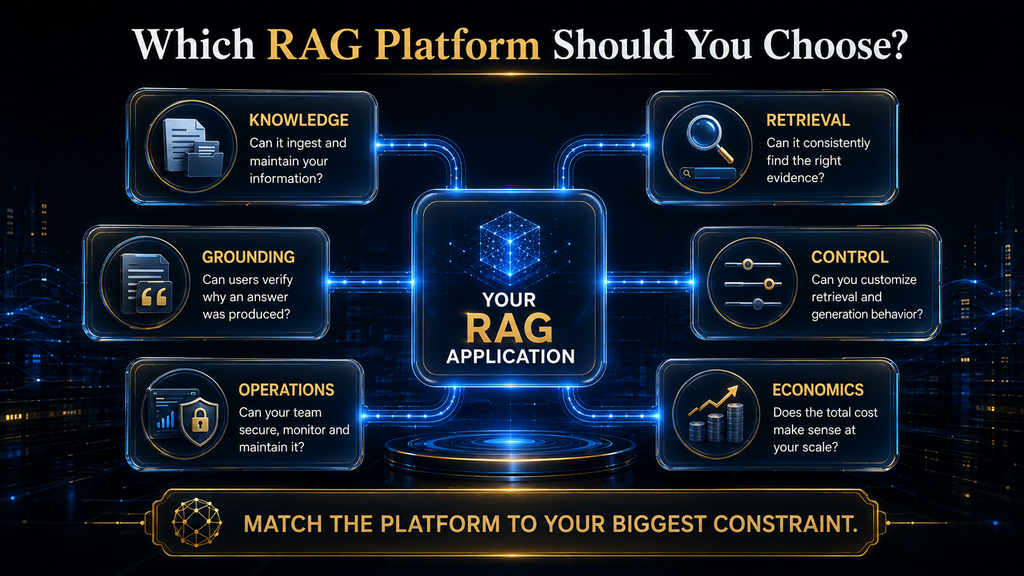
The Six Things That Actually Matter
The strongest RAG platform is not the one with the longest feature list. It is the one that performs well across the capabilities that matter for your particular knowledge system.
1. Knowledge ingestion and freshness
A knowledge base is only useful if the system can reliably get information into the retrieval layer and keep it synchronized.
This sounds mundane until you encounter the real-world messiness of organizational information. A company might have PDFs, web pages, Word documents, spreadsheets, support tickets, product manuals, database records and documents stored in SaaS systems. Some change daily; others may be updated once a year. Some contain clean text, while others depend on tables, diagrams or layout to make sense.
Modern managed platforms increasingly treat ingestion as a first-class part of the RAG system. Amazon Bedrock Knowledge Bases supports unstructured sources including text, Markdown, HTML and PDFs, while also supporting multimodal documents containing elements such as tables, charts, diagrams and images.
But ingestion capability should not be confused with ingestion reliability.
The question is not simply whether a platform can import a PDF. The more important questions are whether it can detect changes, handle failures, preserve useful metadata, avoid creating duplicate knowledge, process difficult documents appropriately, and tell you when the knowledge base is no longer synchronized with the source of truth.
This is one reason a beautiful first demo can be misleading. A platform may perform extremely well when you manually upload ten clean documents. That tells you very little about what happens six months later when the source material has changed 400 times.
2. Retrieval quality
Retrieval is the heart of RAG because the language model cannot generate a grounded answer from evidence it never receives.
A platform may advertise semantic search, vector search, hybrid search, reranking or advanced retrieval, but those labels are not themselves proof of quality. What matters is whether the system consistently retrieves the information needed to answer real questions.
For simple queries, many systems can look excellent. The harder cases are more revealing: questions containing several concepts, terminology that appears differently in the source documents, requests that require combining information from multiple sources, and queries where the most semantically similar passage is not actually the most useful one.
This is why retrieval should be evaluated using representative questions rather than marketing screenshots. A strong system should be tested against the actual questions users will ask, including questions where the correct response is “the knowledge base does not contain enough information.”
That last case is particularly important. A retrieval system that confidently returns weak evidence can be more dangerous than one that admits uncertainty.
3. Grounding and citations
A good RAG platform should make it possible to understand where an answer came from.
Citations are not merely a user-interface feature. They provide an audit trail between the generated answer and the retrieved evidence. When a user can inspect the underlying document, page, chunk or source, they have a way to challenge an answer instead of treating the model’s prose as unquestionable.
Azure AI Search’s current RAG architecture illustrates how this layer is evolving. Its agentic retrieval system can return grounding data, citations and execution metadata alongside retrieved content, allowing an application to decide how that evidence should be passed to an LLM.
But citations themselves need evaluation. A citation that technically points to a relevant document but does not support the specific statement is not trustworthy grounding. The platform should therefore be judged on citation correctness, not simply whether a citation icon appears beside the answer.
4. Control
Convenience is valuable, but convenience becomes expensive when your application reaches the boundaries of what the platform allows.
Control can exist at many levels: embedding models, chunking strategy, retrieval parameters, metadata filters, reranking, prompts, model selection, source handling, authentication, deployment and application logic.
A highly managed platform may intentionally hide many of these details because that is how it provides a simpler experience. That can be an advantage for a team that wants to move quickly. It becomes a limitation when the retrieval problem is unusual or the organization needs to reproduce the system outside the vendor’s environment.
This is why “more control” should not automatically be treated as “better.” Control has an engineering cost. If your team does not need that control, buying it can create complexity without producing additional value.
5. Operations and governance
Production RAG is not just a search problem. It is also an operations problem.
Someone needs to know when a connector stops synchronizing, when ingestion fails, when retrieval quality drops, when a source becomes stale, when a permission changes, and when a model update affects answer behavior. Enterprise systems may additionally require auditability, tenant isolation, authentication and permission-aware retrieval.
Microsoft’s current Azure AI Search documentation is a useful illustration of this direction. Its newer agentic retrieval architecture incorporates knowledge bases, knowledge sources, query planning and retrieval, while Microsoft’s documentation also emphasizes permission-aware knowledge scenarios through the broader Microsoft Foundry ecosystem.
The operational lesson is simple: the system that works on launch day is not the system you have six months later unless somebody maintains it.
6. Economics
RAG economics are often misunderstood because the visible platform price is only one part of the cost.
A real deployment can incur costs from:
- document processing
- embeddings
- storage
- retrieval
- reranking
- model inference
- API usage
- bandwidth
- monitoring
- support
- engineering time
A cheap platform with weak retrieval may also create indirect costs. If users have to ask the same question repeatedly, if the application requires additional model calls to compensate for poor retrieval, or if engineers spend weeks maintaining a pipeline, the nominally cheaper platform may become more expensive.
The correct question is therefore not: “What is the monthly subscription?”
It is: “What does it cost to deliver a reliable answer at the volume and quality our application requires?”
That is a much more useful measure of total cost of ownership.
The AI Hustle World RAG Platform Fit Framework
Rather than ranking platforms with a single overall score, use six dimensions to diagnose what your system actually needs:
Knowledge → Retrieval → Grounding → Control → Operations → Economics
The first three describe whether the system can turn information into trustworthy answers. The second three determine whether you can operate that system sustainably.
A small support team might place more weight on knowledge connectors, deployment speed and maintenance. A developer building an AI research product might care far more about retrieval control, APIs and model flexibility. An enterprise may prioritize permissions and governance before almost anything else.
This framework changes how you interpret feature comparisons.
Suppose Platform A supports 150 connectors but provides limited retrieval customization. Platform B supports 40 connectors but gives developers deep control over retrieval and ranking. Platform A is not automatically better because 150 is larger than 40. If your organization only needs five of those connectors but depends heavily on custom retrieval, the extra 145 connectors have almost no economic value.
A feature matters only when it solves a real constraint in your workload.
The Best RAG Platforms and Tools in 2026
The following options should not be viewed as ten identical products competing for one trophy. They represent different approaches to building and operating knowledge-grounded AI systems.
Amazon Bedrock Knowledge Bases — Best for AWS-Centered Managed RAG
Amazon Bedrock Knowledge Bases is a strong choice when a company already operates heavily inside AWS and wants managed RAG capabilities without assembling every retrieval component independently.
AWS describes Knowledge Bases as a way to integrate proprietary information into generative AI applications, retrieve relevant data, and use that information to improve generated responses. Its current documentation also distinguishes managed knowledge bases from approaches where customers configure their own vector stores.
The advantage is ecosystem alignment. If your organization already uses AWS identity, storage, networking, models and operational tooling, keeping the knowledge layer inside that environment can reduce architectural fragmentation.
It also reduces the amount of infrastructure your team has to assemble. AWS positions its managed knowledge-base approach around faster implementation and less infrastructure management, which is particularly attractive when the business wants the application rather than another internal platform project.
The trade-off is that AWS’s breadth can make the overall ecosystem feel more complex than a narrowly focused RAG product. Teams that simply want to upload documents and launch a small knowledge assistant may find a specialized platform easier to reason about.
Best fit: AWS-native organizations, enterprise RAG applications, teams that value managed infrastructure and cloud integration.
Less attractive when: you want a minimal, vendor-neutral setup or have little reason to build around AWS.
Azure AI Search — Best for Enterprise Search and Microsoft-Centered RAG
Azure AI Search is particularly compelling when retrieval itself is a strategic part of the application rather than something the team wants hidden behind a simple chatbot interface.
The platform supports full-text, vector, hybrid and multimodal search, and Microsoft’s current documentation now includes agentic retrieval specifically for RAG scenarios.
The distinction between classic and agentic retrieval is important. Classic RAG can use a simpler architecture in which an application sends a query to search and then passes the returned context to an LLM. Microsoft’s newer agentic retrieval approach can use an LLM to decompose a complex question into focused subqueries, execute those queries and combine the results before they are used to generate a response.
That architecture is especially relevant when users ask questions that are too complicated for one straightforward retrieval query. Instead of assuming that one vector search can solve everything, the system can treat retrieval as a planning problem.
The trade-off is complexity. Agentic retrieval introduces additional components and, depending on the specific feature, some capabilities remain in preview. Microsoft’s documentation explicitly distinguishes generally available API functionality from preview capabilities and warns that preview features are not recommended for production workloads without appropriate consideration.
Best fit: Microsoft-heavy enterprises, sophisticated search applications, organizations that need strong retrieval control and enterprise integration.
Less attractive when: your goal is simply to create a lightweight knowledge chatbot with minimal infrastructure.
Vectara — Best for Managed RAG Infrastructure
Vectara is positioned around the idea of making grounded generative search available without forcing every team to build the entire retrieval pipeline themselves.
That makes it attractive for organizations that understand the value of retrieval but do not want to become experts in every underlying component. A managed service can absorb infrastructure decisions that would otherwise become part of the development team’s workload.
The appeal is particularly strong when the application needs to move from prototype to production without creating a large internal retrieval engineering effort.
The trade-off is the same one that accompanies most managed platforms: the less infrastructure you own, the less freedom you may have to modify it at a deep level. That does not make the platform inferior; it simply means the buyer should know where the abstraction boundary is before committing.
Best fit: teams that want managed RAG capabilities through an application-oriented service.
Less attractive when: retrieval infrastructure itself is a strategic capability your engineering team wants to own.
Dify — Best for Visual RAG Application Building
Dify occupies a different part of the market because its value is not simply the retrieval engine. It provides a visual environment for building AI applications and workflows, making it attractive to teams that want to experiment with knowledge-based applications without constructing every component from scratch.
That makes it particularly useful for prototyping internal assistants, document-based applications and AI workflows where the team wants to see the entire application logic rather than work exclusively through low-level APIs.
The key advantage is accessibility. A team can reason about the application at a higher level and iterate quickly. That can dramatically shorten the distance between “we have a collection of documents” and “we have an AI application that can use them.”
The limitation is that visual abstraction can eventually become a constraint if the system needs highly specialized retrieval behavior or unusual infrastructure requirements. The right question is therefore not whether Dify can build a RAG application; it is whether its abstraction level remains appropriate as your application becomes more sophisticated.
Best fit: rapid prototyping, internal AI applications, teams that want visual workflow control.
Less attractive when: you require extremely low-level control over every part of the retrieval stack.
RAGFlow — Best for Document-Centric RAG Workflows
RAGFlow is particularly interesting for teams whose primary problem is making complex documents useful to RAG systems.
This matters because document understanding is often underestimated. A PDF may contain tables, headings, footnotes, figures and layout relationships that disappear when the document is treated as a simple text file. If those relationships carry meaning, naive extraction can damage the knowledge before retrieval begins.
A document-centric approach can therefore be valuable when the quality of the source material is the primary bottleneck.
The important caveat is that document parsing alone does not guarantee a good RAG application. Retrieval, evaluation, model behavior, permissions and production operations still matter. RAGFlow should therefore be considered as part of a broader architecture rather than as a substitute for the entire discipline of RAG engineering.
Best fit: document-heavy knowledge systems, teams dealing with complex source files and organizations that want more control over document-oriented RAG.
Less attractive when: your problem is primarily enterprise-wide search across many business systems rather than document-centric retrieval.
LangChain — Best for Developers Who Want Maximum Orchestration Flexibility
LangChain is frequently included in RAG-tool lists, but it is important to classify it correctly.
It is not simply a turnkey AI knowledge-base product. It is a development framework that helps developers assemble applications involving models, tools, retrieval systems and workflows.
That distinction changes the buying decision.
If your team is comfortable engineering software and wants to decide how the pieces fit together, a framework can be more powerful than a fully managed platform. You can select the retrieval store, embedding model, model provider, parsing system and other components according to the application’s needs.
But that flexibility comes with responsibility. Your team becomes responsible for more of the architecture. You must think about deployment, observability, updates, evaluation and failures that a managed product might abstract away.
This is why frameworks should not be scored against managed RAG platforms as though they were identical products. A framework gives you the building blocks; a managed platform attempts to give you more of the building.
Best fit: experienced development teams building custom AI applications.
Less attractive when: your organization wants a ready-to-use knowledge system rather than an engineering framework.
LlamaIndex — Best for Data-Centric RAG Applications
LlamaIndex takes a similarly developer-oriented position, with a strong emphasis on connecting applications to data.
That makes it useful when the difficult part of the application is not simply generating text but structuring access to proprietary information. Developers can use it as part of a custom RAG architecture rather than accepting a fixed end-to-end product.
Its value becomes clearer when you think about RAG as a data problem. The language model is only one component; the application needs mechanisms for transforming source information into representations that can be retrieved effectively.
The same warning applies as with other frameworks: flexibility does not eliminate engineering. If you choose a framework because you want control, you need to be prepared to own the consequences of that control.
Best fit: data-intensive RAG applications, developers who want composability and customization.
Less attractive when: the organization wants a fully managed knowledge-base product with minimal engineering.
Glean — Best for Enterprise Knowledge Discovery
Glean belongs to another category entirely: enterprise knowledge and search.
The value proposition is not necessarily “build your own RAG application.” It is closer to “make organizational knowledge easier for employees to discover and use.”
That distinction is strategically important.
If the company already has information distributed across SaaS applications, collaboration systems and internal repositories, building a custom RAG application may solve only part of the problem. The larger challenge is often connecting those systems, respecting their permissions and presenting useful information in a way employees will actually adopt.
Enterprise knowledge products can therefore make sense when the desired outcome is employee productivity rather than a custom AI product.
The limitation is equally clear: a company building a specialized customer-facing RAG application may need more control than an enterprise knowledge platform is designed to provide.
Best fit: large organizations trying to improve internal knowledge discovery.
Less attractive when: you are building a highly customized RAG product as part of your own software.
Guru — Best for Curated Organizational Knowledge
Guru represents another useful category: organizational knowledge systems that combine curated information with AI-assisted retrieval.
This approach can be valuable when the organization does not merely want an AI system to search whatever information exists. It wants a more intentional knowledge-management layer where important information can be maintained, validated and made accessible.
That distinction matters because RAG can amplify both good and bad knowledge. If the source repository is full of obsolete documents, contradictory policies and duplicate material, improving retrieval may simply make the wrong information easier to retrieve.
A knowledge-management platform can therefore be attractive when human curation is an important part of the operating model.
Best fit: teams that need structured internal knowledge alongside AI-assisted retrieval.
Less attractive when: the application requires a highly customized developer-controlled RAG architecture.
Notion AI — Best for Teams Already Living in Notion
Notion AI makes the most sense when Notion is already a significant part of the organization’s knowledge environment.
That is a recurring pattern in AI software selection: the best platform is often the one that fits the system where information already lives.
If employees already write documentation, project information and internal knowledge in Notion, adding AI capabilities directly to that environment can remove the friction of creating another knowledge layer.
The limitation is that the value declines when the organization’s authoritative knowledge is distributed across many systems outside that environment. In that case, the platform may become one part of the knowledge ecosystem rather than the complete answer.
Best fit: Notion-centered teams that want AI-assisted access to existing workspace knowledge.
Less attractive when: the organization has a complex, heterogeneous information architecture.
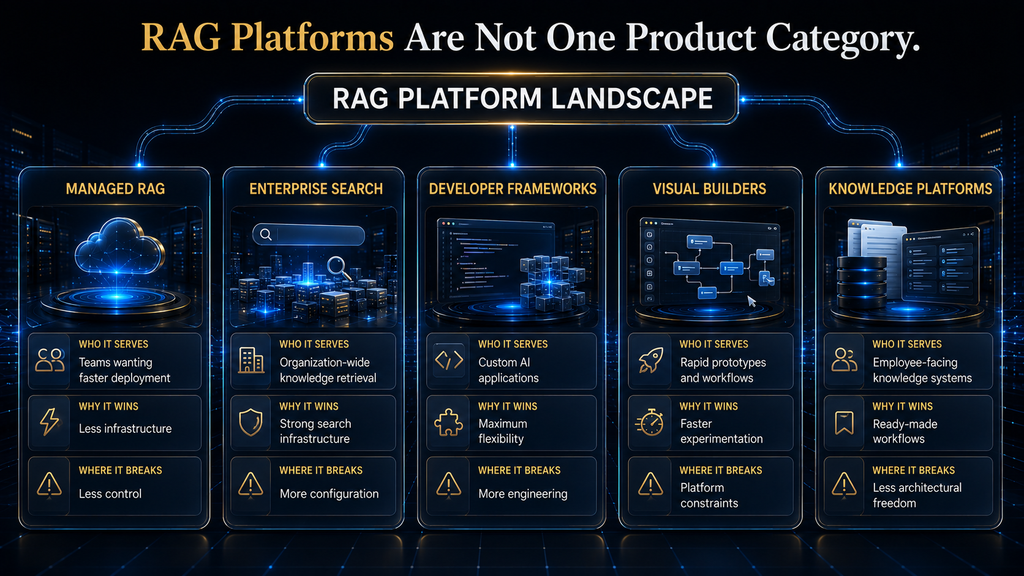
The Most Important Comparison: Managed vs Build-Your-Own
The most consequential decision is not which brand appears first on a comparison list. It is how much of the RAG architecture your team wants to own.
A managed platform can reduce the time between project approval and working application. It can absorb infrastructure complexity, provide integrated ingestion and retrieval, and reduce the number of components your team has to operate.
A custom stack gives you control over the components that matter to your application. You can change the embedding model, retrieval architecture, vector store, reranker or model provider without waiting for a platform to expose the necessary capability.
Neither approach is universally superior.
The managed route is generally stronger when time-to-value and operational simplicity dominate. The custom route becomes stronger when control, specialization and long-term architectural independence dominate.
The danger is choosing based on engineering ideology.
A development team may choose a completely custom stack because “we can build it ourselves,” only to spend months maintaining infrastructure that provides no differentiation. Another organization may choose a highly managed product because it looks easy, only to discover later that the platform cannot support a critical retrieval or permission requirement.
The right answer is the smallest architecture that can satisfy the real requirements.
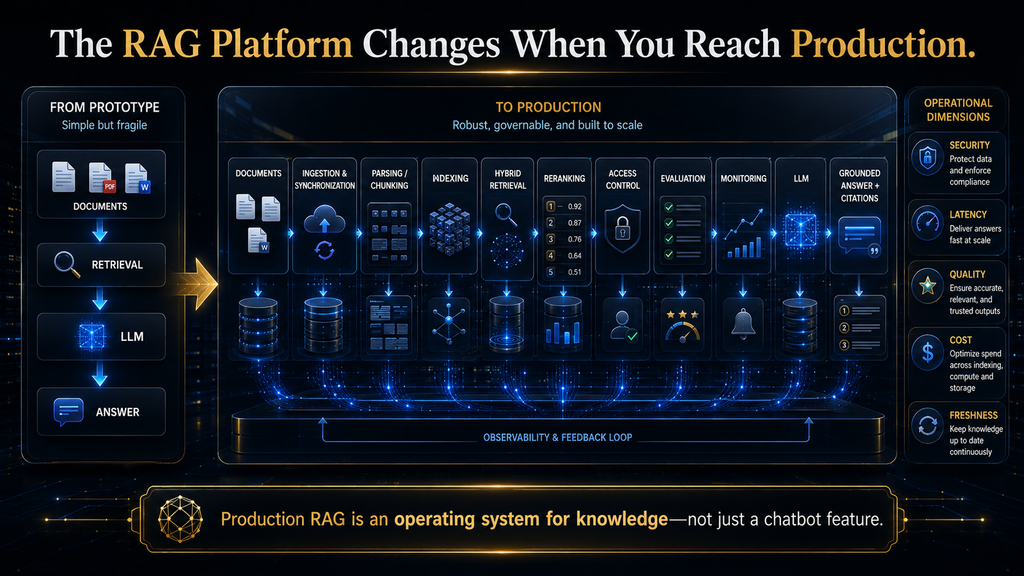
How a Production RAG Knowledge Base Actually Works
Understanding the workflow makes platform differences easier to evaluate.
The process begins with source acquisition. Documents or records enter from systems such as cloud storage, websites, databases, collaboration platforms or application APIs. At this point, metadata such as document ownership, timestamps, permissions and source identifiers can become just as important as the document text itself.
The next stage is content preparation. The platform extracts usable information, removes or preserves structural elements where appropriate, and divides large sources into retrievable units. This is where document quality and chunking strategy can have a major impact on everything downstream.
The system then creates embeddings or other retrieval representations and stores them alongside the associated content and metadata. Depending on the platform, retrieval may combine vector similarity with lexical search, semantic ranking, metadata filtering or other mechanisms.
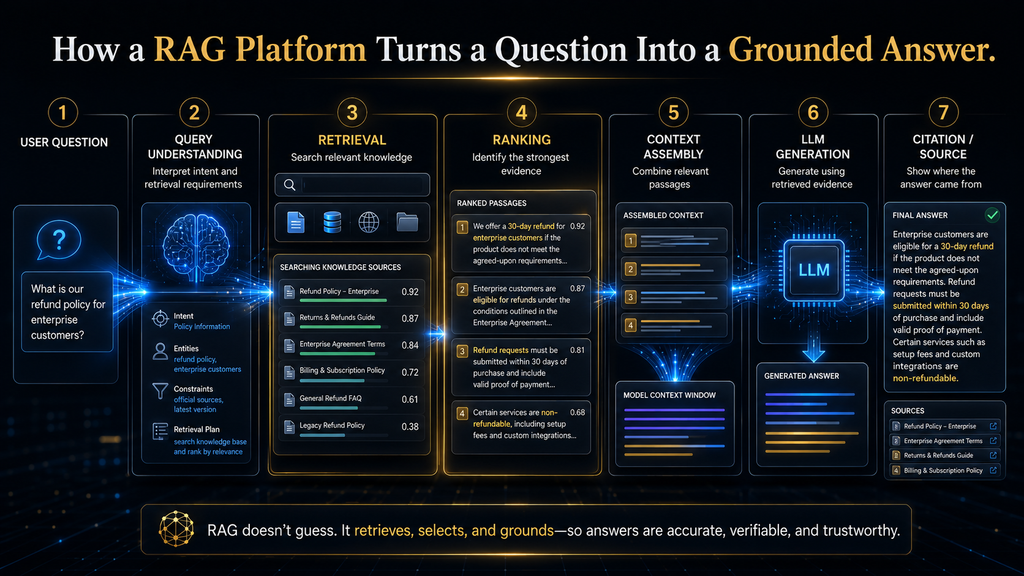
When the user asks a question, the system converts the request into one or more retrieval operations. A simple system may issue a single search query. More sophisticated architectures can decompose complex questions into multiple subqueries, execute them in parallel, rerank the results and combine them into a grounding set. Microsoft’s current agentic retrieval architecture is an example of this evolution.
Finally, the retrieved context is passed to the language model. The model generates an answer based on that evidence, ideally with citations that allow the user to inspect the source.
This explains why a RAG platform cannot be evaluated by its chatbot interface alone. The visible answer is the final stage of a much longer pipeline.
What Happens When the Retrieval Layer Is Weak?
This is where many RAG projects go wrong.
Imagine an employee asks: “What is our current remote-work policy for employees who move to another country?”
Suppose the knowledge base contains three relevant documents: the original remote-work policy, an updated international-employment policy and a regional HR exception.
A simplistic retrieval system may find the original policy because it contains the words “remote work.” The result sounds plausible, but it does not answer the actual question correctly because the relevant information is distributed across documents.
A stronger retrieval architecture may need to recognize several concepts, retrieve multiple sources, rank them appropriately and preserve enough context for the model to reconcile them.
This is the difference between semantic similarity and useful retrieval.
The closest text is not necessarily the best evidence.
That is why platform comparisons should not stop at “supports vector search.” Almost every serious RAG system now does something in that direction. The meaningful question is how well the entire retrieval pipeline handles the ambiguity and complexity of real user questions.
Why Hybrid Search Matters
Pure semantic retrieval is powerful, but it is not always sufficient.
Consider a user searching for a specific product code, legal clause, error message, employee ID or technical identifier. Exact lexical matching can be extremely valuable in those situations. A semantically similar phrase may actually be less useful than a passage containing the exact identifier.
Hybrid retrieval attempts to combine different signals rather than assuming one search mechanism is best for every query.
Azure AI Search currently supports full-text, vector and hybrid search, while its newer retrieval architecture adds semantic ranking and more complex query planning.
This is a broader principle for choosing platforms: retrieval should match the information problem.
If users ask broad conceptual questions, semantic retrieval may be highly effective. If they search for exact identifiers, lexical retrieval can matter. If they ask complex questions across multiple concepts, query decomposition and reranking may become more important.
A good platform gives you enough retrieval capability to handle the distribution of questions your users actually ask.
Permissions Are Part of Retrieval Quality
One of the most dangerous mistakes is treating security as something that happens after retrieval.
For an enterprise knowledge system, the correct retrieval result is not simply the most relevant document. It is the most relevant document that the current user is authorized to access.
Consider a company where employees can search a common knowledge environment, but salary information, legal documents and executive discussions have restricted access. If the retrieval system finds a highly relevant confidential document and only afterward asks whether the user should see it, the architecture is already creating unnecessary risk.
Permission-aware retrieval therefore needs to be considered part of the knowledge architecture.
Microsoft’s current documentation explicitly discusses permission-aware knowledge capabilities around its broader AI search ecosystem, while Azure AI Search’s retrieval APIs include mechanisms for enforcing permissions in relevant scenarios.
The broader lesson is important: a highly accurate answer from unauthorized information is a system failure, not a successful retrieval.
Knowledge Freshness Is a Hidden Competitive Advantage
Many organizations focus heavily on initial accuracy and overlook freshness.
Imagine that a company updates its refund policy every few months. The knowledge base contains the old policy, the new policy and several customer-support documents that reference both. A retrieval system can return a highly relevant passage that is simply outdated.
This problem is not solved by a better LLM.
It is a knowledge-lifecycle problem.
A serious platform should therefore make it possible to understand where information came from, when it was last synchronized, whether ingestion succeeded, and how outdated material is handled.
This is also where automated synchronization can create genuine value. The goal is not automation for its own sake; the goal is to reduce the distance between the source of truth and the information an AI system uses.
If your knowledge changes frequently, a platform with excellent retrieval but weak synchronization may be a poor production choice.
The Economics of Buying vs Building
A useful platform comparison should account for engineering opportunity cost.
Suppose a company can build a custom RAG system using open-source components at a lower direct software cost. That sounds attractive until the organization calculates the ongoing work required to maintain ingestion, retrieval, monitoring, authentication, evaluation, upgrades and incident response.
Now consider the opposite scenario. A company buys an enterprise platform with extensive capabilities but uses only a small fraction of them. It may be paying for infrastructure and governance capabilities that its actual workload does not require.
Neither calculation can be reduced to a monthly subscription.
The more useful model is:
Total RAG Cost = Platform + Infrastructure + Models + Data Processing + Engineering + Operations
That equation is not meant as accounting precision. It is a decision framework.
A platform is economically attractive when the capabilities it provides eliminate enough internal work or improve enough business value to justify its total cost.
This is why a $500 monthly service can sometimes be economically superior to a “free” open-source stack, while a large enterprise platform can be economically wasteful for a small application.
A Practical Evaluation Process
Before committing to a platform, build a small evaluation rather than relying on the vendor’s demonstration environment.
Start with a representative knowledge set. Do not choose only the cleanest documents. Include the types of information that create real problems: long PDFs, policy documents, tables, duplicate material, frequently updated content and documents containing terminology your users actually use.
Then create a question set that reflects real usage. Include straightforward factual questions, multi-document questions, ambiguous queries, questions requiring exact terminology, questions where the answer does not exist, and questions that should be blocked by permissions.
Next, evaluate the retrieval layer separately from the generated answer.
If the system gives a wrong answer, ask whether the evidence retrieved was wrong or whether the model misinterpreted correct evidence. Those are different failures and require different fixes.
Then test freshness. Change several source documents and measure how long it takes before the knowledge base reflects the update.
Test permissions with intentionally restricted content. Test failure handling by disconnecting a source or submitting malformed documents. Finally, measure cost at the expected scale rather than the demo scale.
This process gives you evidence that a feature list cannot provide.
A Simple RAG Platform Evaluation Matrix
| Evaluation area | What to test | Why it matters |
|---|---|---|
| Knowledge ingestion | File types, connectors, parsing, updates | Determines whether the source material enters the system correctly |
| Retrieval | Semantic, lexical, hybrid, reranking | Determines whether useful evidence is actually found |
| Grounding | Citations, source metadata, evidence mapping | Makes answers easier to verify |
| Freshness | Sync frequency, update propagation, failures | Prevents stale knowledge from becoming operational truth |
| Permissions | User-level access and restricted sources | Prevents unauthorized information retrieval |
| Control | Models, retrieval settings, APIs, metadata | Determines how far the platform can be customized |
| Operations | Monitoring, logs, failures, administration | Determines production maintenance burden |
| Economics | Usage, storage, models, engineering | Reveals total cost rather than headline price |
| Deployment | Cloud, self-hosted, hybrid | Determines infrastructure and compliance fit |
| Portability | Export, APIs, data ownership | Reduces long-term lock-in risk |
The table is useful because it prevents a common evaluation mistake: allowing ten attractive product features to outweigh one unacceptable architectural limitation.
Common Mistakes When Choosing a RAG Platform
Choosing the platform before defining the knowledge problem
The most common mistake is beginning with a product list.
Start with the sources, users, questions, permissions and update frequency instead. Once those requirements are clear, the appropriate platform category usually becomes much easier to identify.
Treating a demo as proof of production quality
A polished demo proves that the vendor can produce a polished demo.
It does not prove that your documents will parse correctly, your retrieval will remain accurate, your permissions will work, or your knowledge will stay synchronized.
Assuming more connectors means a better platform
Connectors are useful only when they connect to information you actually need.
A platform with 100 connectors may be less useful than one with ten excellent connectors for the systems that contain your authoritative data.
Optimizing for answer quality without evaluating retrieval
A model can sometimes produce a convincing answer even when the retrieval evidence is weak.
Always inspect the retrieved context. Otherwise you may optimize the wrong layer.
Ignoring negative queries
Your system needs to know when it does not have enough evidence.
If every question produces an answer, you may accidentally optimize for confidence instead of correctness.
Ignoring stale information
A document that was accurate six months ago can become dangerous when presented as current policy.
Freshness should be tested like any other system requirement.
Treating security as a checkbox
“Enterprise security” is too vague to be useful.
Ask exactly how identity, permissions, restricted sources, metadata and retrieval enforcement work in the architecture you plan to deploy.
Building everything yourself because you can
Technical control is not free.
If the custom components do not create differentiated value, the engineering burden may outweigh the benefits.
Buying everything because you cannot
The opposite mistake is equally expensive.
A managed platform should simplify the architecture, not become an excuse to outsource decisions your team actually needs to control.
Who Should Use a Managed RAG Platform?
Managed RAG platforms are generally strongest when the organization values speed, operational simplicity and a predictable path from data to working application.
They are especially attractive when the RAG layer is important but not itself the company’s competitive advantage. A support team does not necessarily want to become experts in vector indexing, retrieval evaluation and ingestion pipelines. It wants customers to find accurate answers.
The same applies to an internal business team that wants employees to query company documentation. If the business problem is knowledge access rather than retrieval infrastructure, outsourcing some of the underlying complexity can be rational.
The key is that managed does not mean “no engineering.” Production systems still need data governance, evaluation, permissions and monitoring.
Who Should Build Their Own RAG Stack?
A custom stack becomes more attractive when retrieval behavior is itself part of the product.
This can happen when the application requires unusual data sources, specialized ranking, custom models, strict infrastructure requirements, highly specific latency characteristics or portability across multiple environments.
It is also more attractive when the organization already has strong engineering capability and expects RAG infrastructure to become a reusable internal platform.
But custom development should have a reason.
If the team is rebuilding standard ingestion and retrieval components simply because the components are available as open source, the project may create technical ownership without creating strategic differentiation.
When You Should Avoid a RAG Platform Entirely
There is another decision that comparison articles rarely emphasize: sometimes RAG is not the right answer.
If the information you need is already structured in a reliable database, a direct database query may be more accurate than semantic retrieval.
If the knowledge base contains only a few stable documents, a simple application-level retrieval mechanism may be sufficient.
If the task requires deterministic calculations, sending retrieved text to an LLM may be unnecessary.
If the business cannot establish a reliable source of truth, adding a RAG layer may simply make inconsistent information easier to access.
And if the users are asking questions whose answers require human judgment rather than document retrieval, no RAG platform can remove that ambiguity.
The best AI architecture is not necessarily the one with the most AI.
What Happens If You Choose the Wrong Platform?
The consequences usually appear gradually rather than immediately.
At first, the application works. Then the knowledge corpus grows. More users arrive. Documents become more diverse. Permissions become complicated. Someone asks for a retrieval behavior the platform does not support.
The team now faces a decision: redesign the application around the platform’s limitations, build workarounds around the platform, or migrate away from it.
That is why platform selection should consider the next constraint, not only today’s requirements.
You do not need to predict everything your application will ever need. You do need to identify the constraints that are likely to become important within the expected life of the system.
For a small prototype, that may simply mean having an API and an export path.
For an enterprise system, it may mean identity integration, permissions, auditability and architectural portability.
The goal is not to eliminate lock-in. Some level of vendor dependence is normal.
The goal is to avoid accidental lock-in around capabilities that are strategically important to you.
The Future of RAG Platforms Is Moving Beyond Simple Search
The next generation of RAG platforms is increasingly treating retrieval as an intelligent process rather than a single similarity query.
Azure’s current agentic retrieval architecture is a strong example. Instead of treating the user’s question as one fixed search request, it can use an LLM to decompose complex questions into focused subqueries, execute them, semantically rerank results and combine the retrieved evidence.
This points toward a broader evolution.
RAG systems are increasingly combining:
- semantic retrieval
- lexical search
- metadata filtering
- reranking
- query planning
- multimodal retrieval
- permissions
- citations
- evaluation
- agentic orchestration
The interesting competition will therefore move away from “Who has vector search?” because vector search is becoming a baseline capability.
The more important question will be:
Who can turn a difficult user question into the right retrieval strategy while keeping the evidence trustworthy, current and authorized?
That is a much harder engineering problem.
Second-Order Effect: Knowledge Quality Becomes AI Quality
There is a deeper consequence to the growth of RAG platforms.
As organizations increasingly use AI systems to interact with internal knowledge, the quality of that knowledge becomes part of the AI system’s operational quality.
This changes the traditional relationship between documentation and software.
Historically, an outdated internal document might be annoying because an employee searched for it and found the wrong information. In an AI-enabled organization, that same outdated document can become evidence used by an automated assistant, support workflow or agent.
The problem therefore scales.
Poor knowledge management no longer simply slows humans down. It can propagate incorrect information through automated systems.
That means organizations adopting RAG should eventually think about knowledge governance, ownership, freshness and source authority as infrastructure concerns rather than documentation housekeeping.
The RAG platform can retrieve information perfectly and still produce a poor system if the underlying knowledge is wrong.
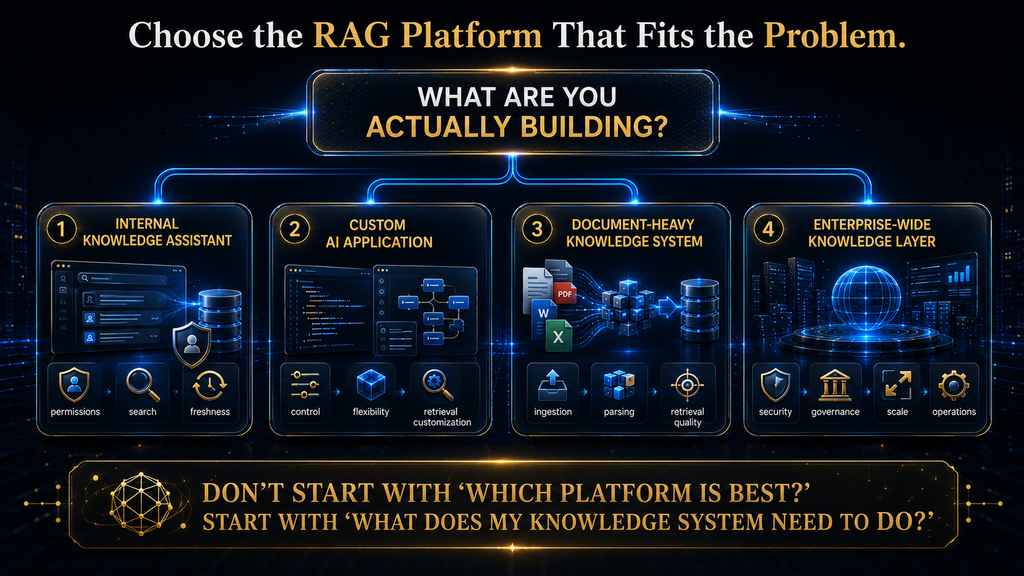
Our Honest Take: There Is No Universal Best RAG Platform
After separating the categories, the idea of a single “best RAG platform” becomes difficult to defend.
A developer building a highly customized application may reasonably prefer a framework such as LangChain or LlamaIndex. An AWS-heavy enterprise may gain more from Bedrock Knowledge Bases. A Microsoft-centered organization with sophisticated retrieval requirements may find Azure AI Search more compelling. A document-heavy team may prioritize a platform focused on document-centric RAG. An internal knowledge team may be better served by an enterprise knowledge product rather than a developer framework.
The correct choice depends on the problem.
That is not an unsatisfying answer. It is the most useful answer because it prevents a category error that can cost months of engineering work.
The best platform is the one that makes your most important constraint easier to solve without creating a worse constraint somewhere else.
A Practical Decision Guide
If your organization is already deeply invested in AWS, start by evaluating Amazon Bedrock Knowledge Bases and the surrounding AWS architecture.
If your organization is heavily invested in Microsoft, especially Azure and enterprise search, Azure AI Search deserves serious consideration.
If you want a managed RAG service and do not want to own much of the retrieval infrastructure, evaluate managed RAG providers such as Vectara.
If you want to build visually and move quickly, a platform such as Dify may be a better starting point than assembling a custom stack immediately.
If your primary problem is complex documents, investigate document-centric platforms such as RAGFlow.
If your team is a strong software-development organization and wants architectural control, evaluate frameworks such as LangChain or LlamaIndex alongside the underlying retrieval infrastructure.
If your real problem is enterprise-wide internal knowledge discovery, consider whether an enterprise knowledge platform such as Glean or Guru is more appropriate than building a custom RAG application.
If your team already lives inside Notion, evaluate whether extending that existing knowledge environment creates more value than introducing another platform.
The important part is to validate these assumptions against your own data and user questions before committing.
Final Thoughts
RAG platforms have matured from collections of experimental components into a broad software category that now spans managed infrastructure, cloud search services, developer frameworks, visual application builders and enterprise knowledge systems. That maturity is useful, but it has also made the buying decision harder because products that look similar in a search result can solve fundamentally different problems.
The strongest way to choose is to work backward from the knowledge system you actually need. Identify where the information lives, how often it changes, what users will ask, which information requires permissions, how much retrieval control your application needs, how much infrastructure your team wants to own, and what the system can realistically cost at production scale.
Then evaluate platforms against those constraints rather than allowing a feature checklist to make the decision for you.
Most importantly, remember that RAG quality is a chain. Better embeddings cannot rescue badly parsed documents. A powerful vector database cannot compensate for poor retrieval design. Excellent retrieval cannot fix stale or unauthorized knowledge. And a sophisticated platform cannot turn an unreliable source of truth into reliable organizational knowledge.
Choose the platform that fits the knowledge problem, the retrieval problem and the operating model—not the platform with the longest feature list.
Frequently Asked Questions
1. What is the best RAG platform in 2026?
There is no single best RAG platform for every organization because different platforms solve different parts of the RAG problem. Amazon Bedrock Knowledge Bases is well suited to AWS-centered organizations, Azure AI Search is strong for Microsoft-oriented enterprise retrieval, developer frameworks such as LangChain and LlamaIndex offer greater architectural control, while enterprise knowledge platforms can be better when the primary goal is internal knowledge discovery.
2. What is the difference between a RAG platform and a vector database?
A vector database is primarily a storage and retrieval component for vector representations and associated metadata. A broader RAG platform can include document ingestion, parsing, chunking, embeddings, retrieval, reranking, citations, model integration, APIs, security and application workflows.
3. Is a RAG platform necessary to build a RAG application?
No. Developers can assemble a RAG application from individual components such as document processors, embedding models, vector databases, retrieval libraries and language models. A RAG platform becomes valuable when the time and operational cost saved by managed capabilities outweigh the value of controlling every component yourself.
4. Is managed RAG better than building RAG yourself?
Neither approach is universally better. Managed RAG is generally attractive when speed, simplicity and reduced infrastructure responsibility matter most, while a custom RAG stack is more appropriate when retrieval control, specialized architecture, portability or infrastructure ownership are strategically important.
5. What should I test before choosing a RAG platform?
Test the platform using representative documents and real user questions rather than relying on a vendor demo. Evaluate retrieval quality, answer grounding, citations, document freshness, permissions, failure handling, latency, operating requirements and total cost at the scale you expect to reach.
6. Why do RAG systems sometimes give wrong answers even when the documents contain the answer?
The problem may occur before generation. The relevant information may not have been parsed correctly, may have been split into poor chunks, may not have been retrieved, or may have been outranked by less useful content. A language model cannot reliably use evidence that the retrieval pipeline fails to provide.
7. Does a RAG platform reduce hallucinations?
A well-designed RAG system can reduce hallucinations by giving the model relevant external evidence, but RAG does not guarantee factual answers. Retrieval quality, source quality, context selection, model behavior and application safeguards all influence the final result.
8. Should an AI knowledge base use vector search only?
Not necessarily. Vector search is useful for semantic similarity, but lexical search, metadata filtering, hybrid retrieval and reranking can be important for exact terminology, identifiers, structured constraints and complex queries. Modern search architectures increasingly combine multiple retrieval signals rather than relying on one mechanism.
9. How important are citations in a RAG knowledge base?
Citations are highly valuable because they allow users to inspect the evidence behind an AI-generated response. However, simply displaying a citation does not guarantee trustworthy grounding; the cited material should actually support the statement being made.
10. When should a company avoid using a RAG platform?
A company should reconsider RAG when the underlying information is already available through a reliable structured system, the knowledge corpus is extremely small and stable, the task requires deterministic computation rather than document retrieval, or the organization cannot establish a trustworthy source of truth. In those cases, a simpler architecture may be more reliable.
Build Your RAG Knowledge System With the Right Foundation
Choosing a RAG platform is only one part of the architecture. Learn how retrieval, vector databases, embeddings, chunking, grounding, and evaluation fit together before you make your next platform decision.
Explore AI Knowledge GuidesWritten by
Muntasir Ahmad Chowdhury
Founder, AI Hustle World
Muntasir Ahmad Chowdhury is the Founder of AI Hustle World, an independent publication dedicated to making Artificial Intelligence practical, trustworthy, and easy to understand. He researches AI tools, automation, customer service, productivity, and real-world business applications, helping readers make smarter technology decisions through research-driven, experience-backed content.
Expertise:
AI Tools • AI Automation • AI Customer Service • AI Productivity • Generative AI • AI Workflows
Get Smarter With AI
Enjoyed this guide? Get practical AI tools, tutorials, and honest reviews delivered to your inbox.