Evidence: Documentation reviewed
Last checked: September 2026
What was done: Written from official documentation and the published sources linked in this article. Not hands-on tested.
Files: None
Affiliate links: No
How to Reduce Hallucinations with RAG
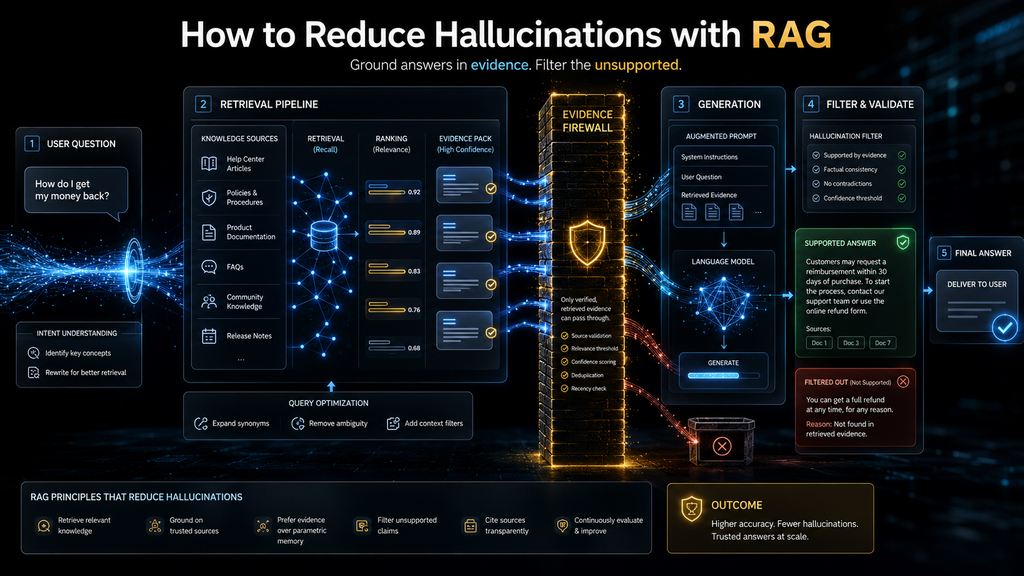
Retrieval-Augmented Generation (RAG) is often presented as one of the most practical ways to make AI systems more reliable. Instead of asking a language model to answer entirely from what it learned during training, RAG gives the model access to external information at the time of the question. The system retrieves relevant documents or passages, places them into the model’s context, and asks the model to generate an answer grounded in that material. In principle, this gives the model something much better than a guess: evidence.
But there is an important catch. RAG can reduce hallucinations without eliminating them.
A RAG system can still produce an unsupported answer even when the correct information exists somewhere in its knowledge base. The retriever may fail to find the right passage, the chunk may contain too little context, the search system may rank a merely related passage above the useful one, the source itself may be outdated, or the language model may generate details that were never supported by the retrieved evidence. In other words, adding retrieval does not turn an AI system into a truth machine; it creates an evidence pipeline that must itself be designed, tested and controlled.
This distinction matters because it changes how you troubleshoot the problem. If an AI assistant gives a wrong answer, the instinct is often to change the prompt or switch to a more powerful model. Sometimes that helps, but sometimes the model is not the real problem at all. The correct document may never have reached the model in the first place. Other times, retrieval works perfectly and the model simply goes beyond what the evidence says. Those are two very different failures and require two very different fixes.
The most reliable approach is therefore to treat hallucination reduction as a pipeline problem. You need trustworthy source material, strong retrieval, sufficient context, faithful generation, and a verification or abstention layer that prevents the system from confidently answering when its evidence is inadequate.
This guide explains how those layers work, where RAG systems fail, what you should fix first, and how to build a practical reliability process around them.
What Is a RAG Hallucination?
A RAG hallucination occurs when a generated answer contains information that is unsupported, contradicted, or insufficiently justified by the evidence available to the system. The important point is that the problem can originate at different stages of the RAG pipeline, so calling every wrong answer a “model hallucination” hides the real cause.
Consider a company building an internal HR assistant. The knowledge base contains the company’s parental-leave policy, but the assistant answers a question using an older version of the policy. The language model may generate the answer fluently and even attach a citation to the retrieved document. Yet the answer is still wrong because the underlying evidence was outdated. In another situation, the current policy might be retrieved correctly, but the model could add a specific eligibility condition that the policy never stated. The first failure is primarily a retrieval and source-governance problem; the second is a generation-grounding problem.
That distinction is central to designing reliable RAG systems. Research on hallucination mitigation increasingly treats RAG as one component of a broader reliability architecture rather than a complete solution by itself. Recent surveys distinguish different types of hallucination and examine mitigation across retrieval, generation and reasoning rather than assuming that a single technique can solve the problem.
A useful way to think about the problem is to separate the major failure modes into five categories:
| Failure mode | What went wrong | Typical intervention |
|---|---|---|
| Source failure | The knowledge base contains outdated, incomplete or conflicting information | Clean, update and version sources |
| Retrieval failure | The correct evidence exists but was not retrieved | Improve chunking, search, embeddings, filters or reranking |
| Context failure | Relevant evidence was retrieved but supplied poorly or incompletely | Improve context assembly and source metadata |
| Generation failure | The model adds unsupported information or misinterprets evidence | Strengthen grounding and generation constraints |
| Verification failure | An unsupported answer reaches the user without adequate checking | Add claim verification, thresholds or human review |
The practical implication is simple: before changing the model, find out which failure actually occurred. Otherwise, you can spend time and money optimizing the wrong part of the system.
Why RAG Reduces Hallucinations but Does Not Eliminate Them
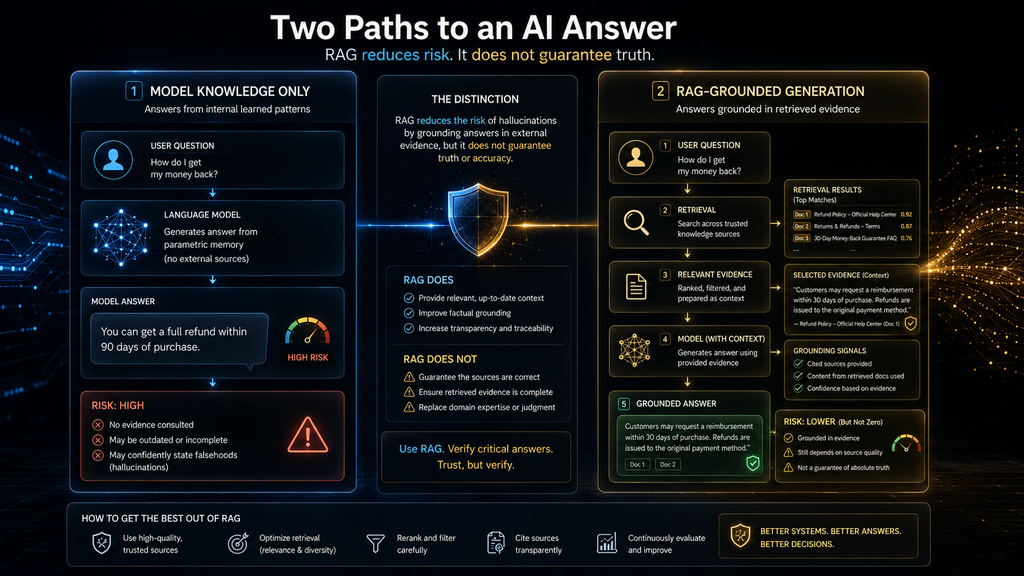
RAG reduces hallucinations primarily by changing where the model gets information for a particular answer. A conventional language model generates from patterns and knowledge encoded in its parameters, while a RAG system can retrieve current or domain-specific information from an external collection and place that information into the model’s context. This gives the model a reference point that can be more relevant and more current than its internal knowledge.
That is a meaningful improvement, especially for private company information, technical documentation, product catalogs, policies and other knowledge that may not have been present in the model’s training data. Microsoft’s current RAG guidance describes the purpose of retrieval as grounding model outputs in relevant, curated information and recommends combining data preparation with appropriate search and ranking techniques to improve the quality of that grounding.
However, the model still has to use the retrieved information correctly. Retrieval does not directly write the answer. It supplies evidence to another probabilistic system that interprets the evidence and produces language. If the evidence is incomplete, ambiguous or contradictory, the model still has room to make an unsupported inference. Even when the evidence is excellent, the model can phrase a stronger claim than the source justifies.
This is why the phrase “RAG prevents hallucinations” is too strong. A more accurate statement is that RAG can reduce certain classes of unsupported answers by giving the model external evidence, but the overall reliability of the system depends on the quality of the entire retrieval-and-generation pipeline.
The difference becomes particularly important in high-stakes applications. Imagine a financial policy assistant that retrieves a document saying a particular approval is required above a certain threshold. If the model answers that the approval is always required, it has converted a conditional statement into an absolute one. The source was correct. Retrieval was successful. The failure occurred during interpretation and generation.
The reverse can also happen. Suppose the policy clearly says the approval is required, but the retriever returns a neighboring section discussing a different approval process. The model may produce a plausible answer from the wrong context. In that case, telling the model to “only use the provided context” will not solve the fundamental problem because the correct context was never retrieved.
That is why hallucination reduction should begin with diagnosis rather than prompting.
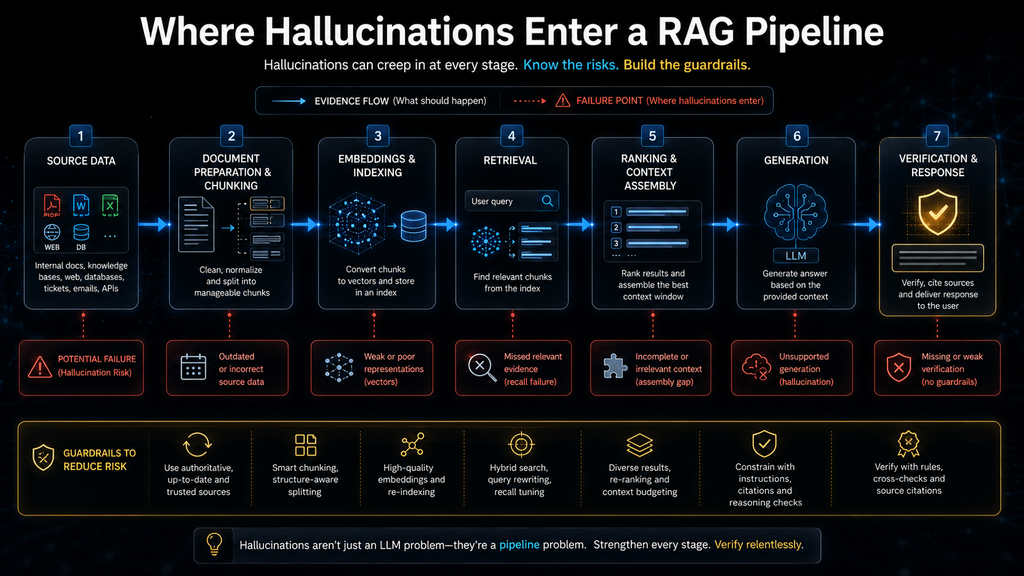
The RAG Reliability Chain: Where Hallucinations Enter
A useful RAG pipeline can be understood as a sequence beginning with source documents and ending with a user-facing answer: Source data → document preparation → chunking → embeddings/indexing → retrieval → filtering/reranking → context assembly → generation → verification → response. Each stage creates a different opportunity for failure.
The first stage is the source itself. If the source is wrong, stale or incomplete, retrieval can only reproduce the problem more efficiently. The next stages determine whether useful information can be found and whether the retrieved evidence arrives in a form the language model can interpret. Finally, the generation and verification stages determine whether the model stays within the evidence boundary.
This is the reason a RAG system can appear excellent during a few demonstrations and still fail badly in production. A handful of successful answers only prove that the complete pipeline can work for those questions. They do not tell you what happens when users ask ambiguous questions, use unfamiliar terminology, refer to old versions of documents, ask for information that does not exist, or combine several topics in one request.
A reliable system must therefore be designed around failure containment, not merely successful retrieval.
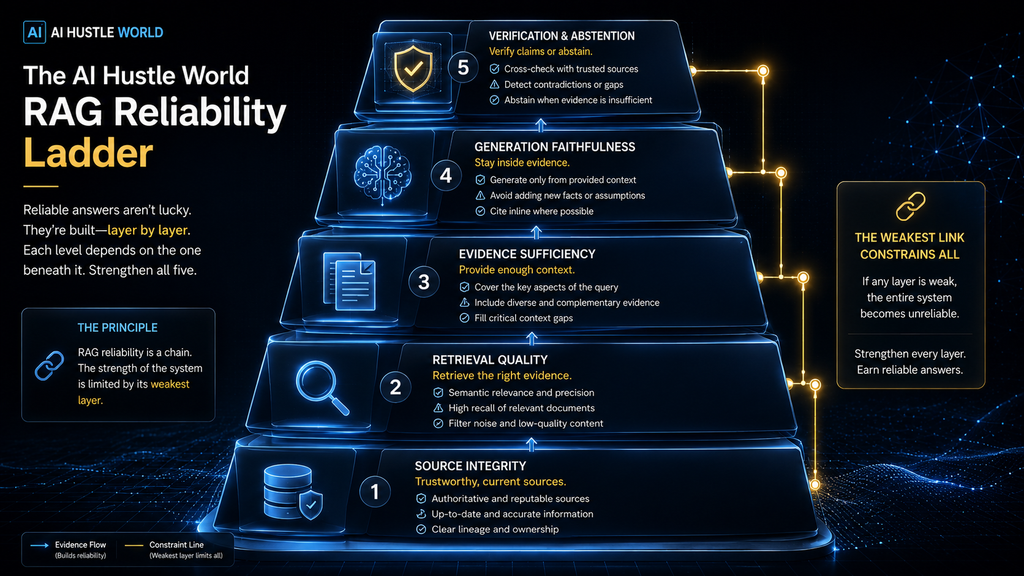
The AI Hustle World RAG Reliability Ladder
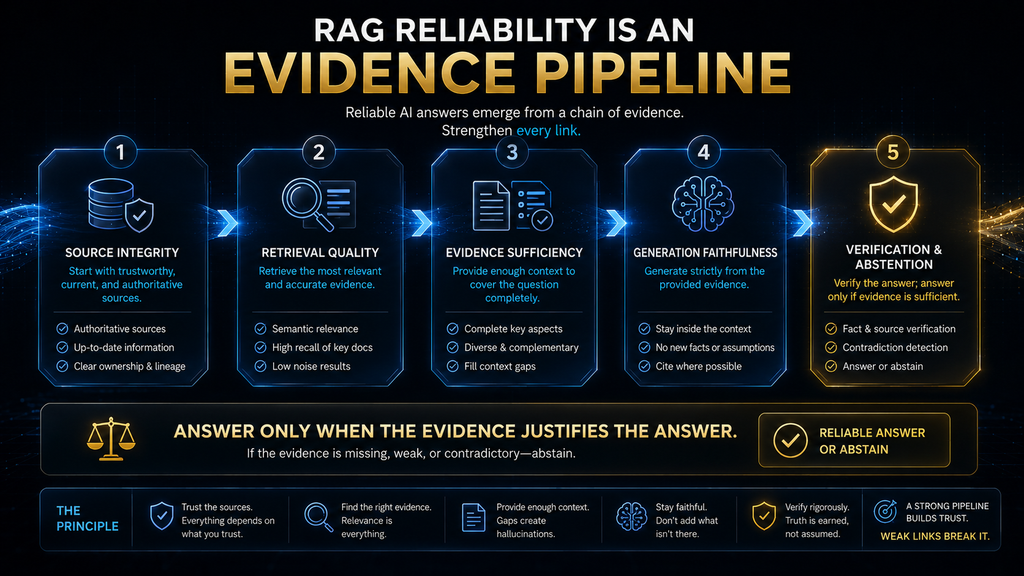
The easiest way to operationalize this idea is to treat RAG reliability as five connected layers.
1. Source Integrity
The information entering the system must be trustworthy, current, complete and appropriately versioned. If two documents contradict one another, the system needs enough metadata or governance to distinguish which one should be trusted.
2. Retrieval Quality
The system must find the evidence that actually answers the question. This is where chunking, embeddings, keyword search, semantic search, hybrid retrieval, metadata filtering and reranking become important.
3. Evidence Sufficiency
Finding one relevant sentence is not always enough. The model may need surrounding definitions, conditions, exceptions, dates or related sections to answer correctly. The retrieved context therefore needs to be sufficient, not merely similar.
4. Generation Faithfulness
The model must represent the retrieved evidence accurately instead of adding unsupported details, merging unrelated passages or turning conditional information into absolute statements.
5. Verification and Abstention
The system needs a mechanism for identifying weakly supported answers and refusing or qualifying an answer when the evidence is insufficient. A reliable AI system is not one that answers every question; it is one that knows when its evidence does not justify an answer.
The important insight is that the weakest layer can determine the reliability of the entire system. Improving embeddings will not repair outdated documents. Better prompts will not recover evidence that retrieval missed. A citation generator will not make an unsupported claim true.
Start With the Source: Bad Knowledge Produces Bad Answers
One of the easiest RAG mistakes is to treat the knowledge base as a neutral container. It is not. The content inside the retrieval system determines the evidence the model has available, so source quality is part of model quality from the user’s perspective.
Suppose a support organization uploads three years of product documentation without tracking versions. A customer asks about the current refund policy. The retriever may find a highly similar passage from an older policy because its wording matches the query better than the current document. The language model can then generate a perfectly coherent answer from the wrong version.
The system has not really “hallucinated” in the traditional sense. It has retrieved the wrong truth.
This is why document governance matters. Sources should be cleaned, organized, updated and, where relevant, associated with metadata such as publication date, product version, department, document type, authority level or status. Microsoft’s RAG guidance specifically recommends cleaning and curating data, organizing information, auditing grounding data and using metadata filtering to prioritize appropriate sources.
The same principle applies to duplicates. If the knowledge base contains several copies of the same document with slightly different revisions, similarity search may return several near-identical passages while pushing the truly important material down the ranking. More documents do not automatically mean more useful evidence.
A smaller, carefully maintained knowledge base can therefore outperform a larger collection full of duplicates, stale material and irrelevant content. The goal is not to maximize the number of documents available to the model. The goal is to maximize the quality of the evidence available for the questions users actually ask.
Why Chunking Can Cause Hallucinations
Chunking is usually discussed as a retrieval optimization problem, but it is also an evidence-quality problem. If a document is split too aggressively, the retrieved chunk may contain a conclusion without the condition that makes the conclusion meaningful.
Imagine a policy document containing this structure: “Employees may request reimbursement for approved expenses.” Several paragraphs later, the document explains that the rule applies only to expenses submitted within 30 days and supported by receipts. If the first sentence is isolated into a small chunk, a retrieval system may find it easily for a reimbursement-related query while failing to retrieve the surrounding conditions.
The model now has technically relevant information but insufficient context.
This is one reason document structure matters. Headings, section relationships, definitions, exceptions and neighboring content can determine whether a chunk is actually useful. The solution is not simply to make chunks larger. Large chunks introduce their own problem because they can contain too much unrelated material, reducing retrieval precision and consuming valuable context.
The right question is therefore not, “How many tokens should every chunk contain?” It is, “What information must remain together for this piece of content to retain its meaning when retrieved independently?”
That principle connects directly to our guide to chunking documents for RAG, which covers document chunking in greater depth. Here, the important point is its relationship to hallucination: poor chunk boundaries can remove the evidence needed to interpret a statement correctly.
Improve Retrieval Before Blaming the Model
When the correct evidence exists but the system repeatedly fails to find it, the retrieval layer deserves attention before the generation model.
Semantic retrieval is powerful because it can identify conceptually related passages even when the query and document use different words. But semantic similarity is not the same thing as answer correctness. A passage can be semantically related to a question without containing the exact fact needed to answer it.
This is especially visible with technical identifiers, product codes, legal terms, error messages, names, version numbers and other exact-match information. A user may ask about “Error E1042,” while a semantically similar document discussing a different error receives a strong vector similarity score. The language model may then make a plausible but incorrect connection.
This is one reason hybrid retrieval can be valuable. Keyword retrieval can preserve exact lexical signals while semantic retrieval captures conceptual similarity. Microsoft’s current guidance recommends considering keyword, vector, hybrid and semantic approaches based on the search problem rather than assuming that one method is universally best.
Metadata filtering can add another layer of control. If the question is about the 2026 version of a product, retrieval should not treat a 2022 document as equally eligible simply because the wording is similar. If the question concerns an internal finance policy, documents from unrelated departments should not compete on the same footing.
Reranking is useful when the initial retrieval stage produces a reasonable candidate set but the ordering is poor. It is important to understand this boundary: reranking can improve which candidates rise to the top, but it cannot rescue information that never entered the candidate set in the first place.
That distinction is strategically important because teams sometimes keep tuning rerankers when the actual problem is poor chunking or inadequate retrieval recall.
Retrieval Quality Is Not the Same as Evidence Sufficiency
Finding the correct document is only half the job.
A retrieved passage can be relevant but still fail to contain enough information to answer the question accurately. This is especially common with questions involving conditions, exceptions, comparisons or multi-step procedures.
Imagine asking an internal knowledge assistant, “Can I cancel the subscription after the trial ends and still receive a refund?” A retrieval system might correctly find the cancellation policy and the refund policy, but if the context contains only one of those sections, the model has an incomplete evidence set. It may combine what it knows about refunds with the retrieved cancellation information and produce an answer that sounds reasonable but is not fully grounded.
The solution is to think about evidence sufficiency, not just relevance.
The system needs enough context to establish the answer, including relevant exceptions where those exceptions materially change the result. This does not mean dumping the entire knowledge base into the context window. More context can actually make reasoning harder by increasing noise and introducing competing information.
A better design retrieves a manageable set of high-quality evidence, preserves source identity and surrounding context where necessary, and then constructs the model input so the relationship between the question and the evidence is clear.
Why “Use Only the Context” Prompts Are Not Enough
A common RAG prompt looks something like this:
Answer the user’s question using only the provided context. If the answer is not in the context, say you don’t know.
That is a useful baseline instruction, but it should not be mistaken for a complete hallucination-control mechanism.
The prompt cannot determine whether the retriever selected the right documents. It cannot automatically identify whether two passages refer to different product versions. It cannot guarantee that a conditional statement will not be paraphrased as an absolute claim. And it cannot force the model to notice every contradiction inside a large context.
Prompting is therefore best understood as one control layer inside the system, not the system’s entire safety mechanism.
The stronger architecture combines retrieval controls with generation constraints. The model should receive clearly structured evidence, source information and instructions about how to treat missing or conflicting information. The application should also define what happens when evidence is insufficient instead of simply hoping that the model follows the prompt perfectly.
This is where the distinction between “answer generation” and “evidence-based answer generation” becomes important. The objective is not merely to produce fluent language. It is to produce a response whose claims can be traced back to appropriate evidence.
Give the AI Permission to Say “I Don’t Know”
One of the most effective ways to reduce unsupported answers is also one of the least glamorous: make abstention an acceptable outcome.
Many AI systems are implicitly optimized to answer every question. If the user asks something, the system produces something. That behavior is useful for conversational interaction, but it is dangerous in knowledge-intensive applications where an unsupported answer is worse than no answer.
Consider a medical-device support assistant. If the knowledge base contains no information about a particular configuration, a responsible system should not improvise a plausible procedure simply because the user expects an answer. It should explain that the available documentation does not establish the procedure and direct the user to an appropriate source or human specialist.
The same principle applies to enterprise policies, compliance systems, technical troubleshooting and financial information. In these environments, knowing when not to answer is part of intelligence.
Abstention does not necessarily mean returning a useless message. The system can explain that it could not find sufficient evidence, identify the closest relevant sources, ask the user to clarify the question, or recommend a human review path when the consequence of an incorrect answer is high.
The design challenge is deciding when the evidence is insufficient. That requires retrieval signals, grounding checks, evaluation data or application-specific thresholds rather than a vague instruction to “be careful.”
Citations Are Useful, but a Citation Does Not Prove the Answer
Adding citations to a RAG response is valuable because it makes the evidence visible and gives the user a way to inspect the source. But citations should not be confused with proof of correctness.
Imagine an answer stating, “Customers can cancel at any time and receive a full refund,” followed by a citation to the company’s refund policy. If the policy actually says refunds are available only within 30 days, the citation exists but does not support the complete claim.
This is why citation presence and citation support are different concepts.
Google Cloud’s grounding documentation makes this distinction explicit. Its grounding check evaluates whether claims in an answer are supported by supplied reference facts and produces support scores and citations; it describes perfect grounding as requiring every claim in the answer to be supported by one or more reference facts.
That concept is useful even if you never use Google’s tooling. A well-built RAG architecture should ask not merely, “Did we attach a citation?” but, “Does the cited evidence actually entail the claim we just made?”
That shift moves citation handling from a user-interface feature into a reliability mechanism.
Claim-Level Verification Changes the Problem
Once you start thinking in terms of claims rather than whole answers, hallucination reduction becomes much easier to reason about.
Suppose a response contains four factual statements. Three are supported by the retrieved context, while the fourth adds a specific number that does not appear anywhere in the evidence. Looking at the answer as one block might make the response appear mostly correct. Looking at it as four claims exposes the unsupported detail.
This is the logic behind faithfulness evaluation approaches. Ragas, for example, defines faithfulness as the factual consistency of a generated answer with the retrieved context and describes calculating it by examining whether the claims in the answer can be supported by that context.
Google’s grounding system takes a similar claim-oriented approach by connecting claims to supporting facts and producing support scores.
The practical lesson is that verification should happen at the level of meaningful claims whenever the application justifies the extra complexity. A response can be generally relevant while still containing one dangerous unsupported statement.
This becomes particularly important when answers contain numbers, dates, product specifications, legal conditions, technical instructions or other details where a small hallucination can materially change the outcome.
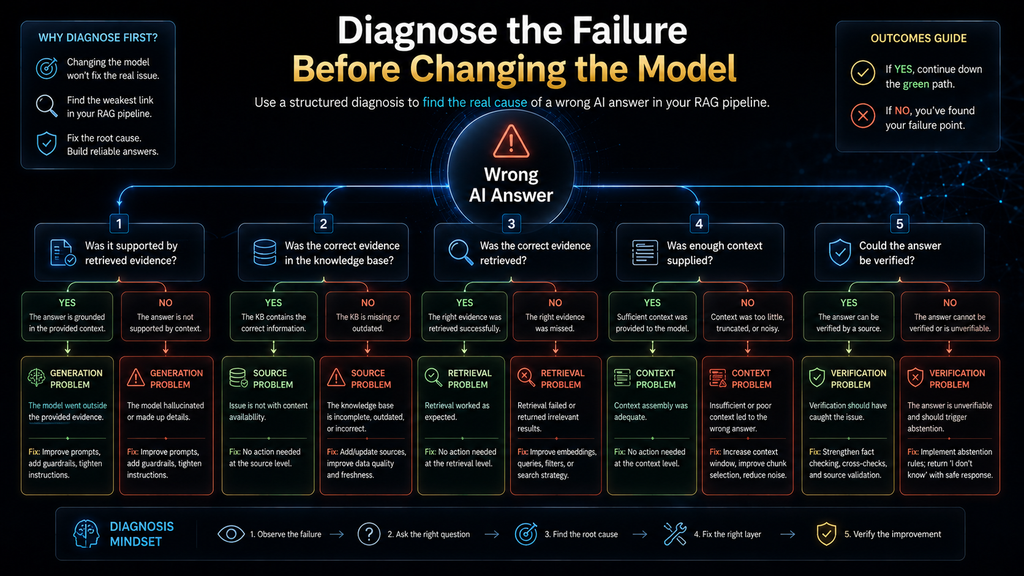
A Practical Hallucination-Diagnosis Workflow
When a RAG system produces a wrong answer, do not immediately change the model or prompt. Instead, trace the failure backward through the pipeline.
Start by asking whether the generated claim is actually supported by the retrieved context. If the answer is no, determine whether the correct evidence existed in the knowledge base. If it did not exist, the problem is source coverage. If it existed but was not retrieved, investigate chunking, embeddings, query formulation, keyword matching, metadata filters and reranking. If the correct evidence was retrieved but the model still generated an unsupported claim, investigate context construction, prompting, generation behavior and verification.
This diagnostic flow can be summarized as:
| Diagnostic question | If the answer is “No” | Likely intervention |
|---|---|---|
| Does the answer match the retrieved evidence? | The model went beyond the evidence | Generation constraints and verification |
| Was the correct evidence present in the knowledge base? | The source collection is incomplete | Improve source coverage |
| Was the correct evidence retrieved? | Retrieval failed | Chunking, search, embeddings, query strategy |
| Was enough context retrieved? | Evidence was incomplete | Context expansion and retrieval strategy |
| Was the correct version prioritized? | Source governance failed | Metadata and version filtering |
| Could the answer be verified? | Verification is weak | Claim-level grounding checks |
| Was the system allowed to abstain? | The application forced an answer | Add an abstention policy |
This is much more useful than a generic recommendation to “improve your RAG pipeline” because it gives engineers and practitioners a sequence for finding the actual bottleneck.
The Most Common RAG Hallucination Mistakes
Treating RAG as a truth guarantee
The first mistake is conceptual. RAG provides access to evidence; it does not guarantee that the evidence is correct, complete or correctly interpreted. If the team believes RAG has “solved hallucinations,” it may stop investing in evaluation precisely when evaluation becomes more important.
Using semantic search for everything
Semantic search is excellent for conceptual similarity, but exact identifiers and structured information can require lexical signals. Hybrid retrieval is often a better fit for workloads where users alternate between conceptual questions and exact terms.
Retrieving too much information
More context is not automatically better. Large amounts of irrelevant or conflicting information can make it harder for the model to identify the evidence that matters. Retrieval should optimize for useful evidence, not maximum document volume.
Retrieving too little information
The opposite mistake is equally damaging. A highly precise chunk may omit the definition, condition or exception needed to interpret it. Retrieval systems should therefore be evaluated not only for whether they find relevant text, but whether they find enough of the relevant information.
Ignoring document versions
If policies, manuals or product specifications change over time, version information becomes part of retrieval quality. A highly relevant outdated document can be more dangerous than a less similar current document.
Assuming citations equal grounding
A citation that points somewhere relevant does not prove that every claim in the response is supported. Claim-level support is a stronger standard.
Trying to prompt away every problem
Prompting matters, but it cannot repair missing evidence. If retrieval is broken, increasingly elaborate prompts can create the illusion of progress without addressing the actual failure.
Forcing the system to answer
A system that is never allowed to abstain is structurally encouraged to guess when evidence is weak. That may improve superficial answer rates while reducing reliability.
Evaluating only successful questions
A RAG system can look excellent when tested with questions that are easy to retrieve and answer. Production users will ask ambiguous, impossible, outdated and adversarial questions as well. Those cases need to be part of the test set.
A Practical RAG Hallucination-Reduction Blueprint
A strong implementation does not require every possible technique from day one. It requires putting the controls in the right order.
Start by auditing the source collection. Remove duplicates, identify outdated documents, preserve useful metadata and establish which sources are authoritative. If the source layer is unreliable, improvements further down the pipeline will have limited value.
Next, build retrieval around the actual information behavior of your users. Use semantic search for conceptual queries, lexical signals for exact identifiers and hybrid retrieval when the workload requires both. Add metadata filtering when factors such as version, date, department, product or authority materially affect the answer.
Then evaluate whether your chunks preserve meaning. A chunk should contain enough context to make the information useful without becoming so broad that retrieval loses precision. This is where the chunking strategy from the previous article becomes an important part of hallucination control.
After retrieval, consider reranking if the initial candidate set is good but the ordering is inconsistent. Reranking is especially useful when several passages are relevant and the system needs to identify which ones deserve priority.
The next step is context construction. Preserve source identity and relevant metadata, remove unnecessary duplication and provide the model with enough evidence to answer the question without overwhelming it. The context should make it easier for the model to distinguish one source from another and understand which evidence is relevant.
Generation should then be constrained around evidence. The model should be encouraged to distinguish between what the sources establish and what they do not establish. If the evidence does not answer the question, the application should have a defined behavior for that situation rather than relying on the model’s improvisational instincts.
Finally, add verification appropriate to the risk of the application. For low-risk use cases, lightweight grounding and citation checks may be sufficient. For higher-risk systems, claim-level verification, contradiction detection, human review or stronger thresholds may be justified.
The key is sequencing. Do not build a sophisticated verification layer on top of a fundamentally broken retrieval system and expect it to compensate for everything.
A Decision Matrix: What Should You Fix First?
When hallucinations appear, the right intervention depends on the failure pattern.
| What you observe | Most likely problem | What to investigate first |
|---|---|---|
| The answer cites irrelevant documents | Retrieval quality | Search method, embeddings, chunking |
| The right document exists but never appears | Retrieval recall | Query transformation, chunking, indexing |
| The right document appears but the wrong passage is prioritized | Ranking | Reranking and metadata |
| The answer uses an outdated policy | Source governance | Versioning and freshness filters |
| The model combines unrelated documents | Context construction | Context ordering and source separation |
| The model invents details despite strong evidence | Generation faithfulness | Grounding instructions and verification |
| The system answers questions with no supporting evidence | Abstention failure | Evidence thresholds and refusal behavior |
| Citations exist but do not support claims | Attribution failure | Claim-level citation verification |
| Answers vary dramatically for similar questions | Pipeline instability | Retrieval consistency and generation controls |
| Performance looks good in demos but fails in production | Evaluation gap | Broader test set and failure analysis |
This matrix also helps prevent a common engineering mistake: changing multiple components simultaneously. If you replace the embedding model, chunking strategy, retriever and generation model at the same time, you may improve the score without learning which change actually solved the problem. Controlled iteration makes the system easier to understand and maintain.
How to Measure Whether Hallucinations Are Actually Falling
You cannot reliably improve hallucination rates if you do not measure them.
The first step is to create a representative test set containing the questions users actually ask. It should include straightforward questions, multi-part questions, ambiguous questions, questions requiring exact identifiers, questions involving multiple documents, questions about outdated information and questions that the knowledge base cannot answer.
Then separate retrieval performance from generation performance. If the correct evidence was not retrieved, blaming the model is misleading. If the correct evidence was retrieved but the answer introduced unsupported claims, the retrieval system should not receive all the blame.
Ragas provides a useful conceptual model for this separation. Its evaluation documentation describes metrics such as context precision and context recall for retrieval, along with faithfulness and answer relevancy for generated responses. More recent Ragas documentation continues to define faithfulness as the consistency of the response with retrieved context and provides evaluation workflows for measuring and improving RAG systems.
For an operational RAG system, a practical measurement framework can include:
| KPI | What it tells you |
|---|---|
| Retrieval recall | Whether necessary evidence is being found |
| Context precision | Whether retrieved material is actually useful |
| Faithfulness / groundedness | Whether generated claims are supported by context |
| Answer relevance | Whether the response actually addresses the question |
| Citation support rate | Whether citations genuinely support the claims they accompany |
| Abstention accuracy | Whether the system refuses when evidence is insufficient and answers when evidence is sufficient |
| Unsupported claim rate | How often the model introduces information not established by evidence |
| Human escalation rate | How often cases require review |
| End-to-end task success | Whether the system actually solves the user’s problem |
The exact metric mix should depend on the application. A customer-support assistant and a research assistant do not have identical reliability requirements.
The most important point is to measure the pipeline as a pipeline.
A high retrieval score with poor faithfulness means the system is finding evidence but failing to use it correctly. Strong faithfulness on a narrow test set with poor retrieval recall can indicate that the model behaves well whenever it receives the right context but frequently misses that context in real use. Those are different engineering problems.
What Happens If You Do Nothing?
The cost of ignoring RAG hallucinations is not simply that users occasionally see an incorrect answer.
The larger risk is that users begin to trust an unreliable system because it usually sounds confident and often includes citations. That creates a dangerous middle ground: the system is accurate enough to encourage adoption but unreliable enough to create failures that users may not notice.
In a customer-support environment, this can create incorrect instructions. In an internal knowledge system, employees may make decisions based on outdated policies. In technical support, an invented troubleshooting step can waste time or make a problem worse. In research workflows, unsupported claims can be copied into downstream documents and become harder to trace back to their original source.
There is also a second-order effect. Once an AI assistant becomes part of a workflow, its answers may stop being treated as suggestions and start becoming inputs to other systems. A hallucinated statement can therefore propagate beyond the original interaction.
That is why reliability should be designed before the system becomes deeply embedded in business processes. The later an organization discovers that its RAG assistant cannot distinguish between supported evidence and plausible invention, the more expensive the correction becomes.
Who Should Use a Strongly Grounded RAG Architecture?
RAG with layered hallucination controls is especially valuable when the knowledge changes regularly, when the system needs access to private or domain-specific information, or when answers need to be traceable to external sources. Examples include internal company knowledge assistants, technical documentation systems, customer-support knowledge bases, research assistants and enterprise search experiences.
The architecture is less valuable when the task is primarily creative and does not depend on factual grounding. If someone is using an LLM to brainstorm fictional character names, retrieval and claim verification may add unnecessary complexity. The reliability controls should match the consequences of being wrong.
The important decision is not whether every AI system needs a sophisticated RAG pipeline. It is whether the cost of an unsupported answer justifies the additional evidence controls.
That is the broader AI Hustle World position: useful automation should increase capability without hiding uncertainty.
The Contrarian Take: Better Models Are Not Always the First Fix
There is a persistent assumption in AI development that hallucinations are primarily a model-quality problem. When the system produces unreliable answers, teams often look for a newer model with stronger reasoning or better instruction following.
That can be the right move in some situations, but it is frequently the wrong first move for RAG.
If the correct evidence is not retrieved, a more capable model cannot reliably reason from evidence it never received. If the source collection contains conflicting policies, a stronger model may simply become better at producing a confident answer from ambiguous information. If the application has no abstention path, an intelligent model can still be pressured into answering a question that the knowledge base cannot support.
The more useful question is therefore not: “Which model hallucinates the least?” It is: “At which stage does this system lose the connection between the user’s question and trustworthy evidence?” That question produces a much more actionable engineering path.
Why Traditional Search Still Has a Role in RAG
There is another important lesson here. The rise of embeddings and semantic search can make traditional keyword retrieval look outdated, but exact lexical matching exists for a reason.
Traditional search is extremely good at certain classes of information: product codes, names, error messages, document identifiers, version numbers and exact phrases. Users often combine these precise signals with conceptual language in the same question.
A modern RAG system should therefore not treat keyword search as something it has “replaced.” In many workloads, the strongest architecture combines lexical and semantic signals, then uses filtering and ranking to identify the best evidence. Microsoft’s current guidance explicitly recommends choosing among keyword, vector, hybrid and semantic search based on the workload rather than applying a single search method everywhere.
This is a useful example of a broader engineering principle: new technology does not automatically invalidate the reason the old technology existed.
Traditional search exists because exact matching solves problems that semantic similarity does not always solve well. RAG becomes more reliable when it uses that insight instead of forcing every query through the same retrieval mechanism.
A Production Checklist for Reducing RAG Hallucinations
Before deploying a RAG assistant, ask whether the system can answer these questions confidently:
| Area | Reliability question |
|---|---|
| Sources | Are the documents accurate, current and authoritative? |
| Versions | Can the system distinguish current and outdated information? |
| Chunking | Do retrieved chunks preserve enough meaning to stand alone? |
| Retrieval | Can the system find evidence when users use different wording? |
| Exact search | Can it handle codes, names and identifiers? |
| Metadata | Can it filter by version, source, date or other relevant attributes? |
| Ranking | Can it prioritize the strongest evidence when several passages match? |
| Context | Does the model receive enough evidence without excessive noise? |
| Generation | Is the model instructed to stay within the evidence boundary? |
| Abstention | Can the system decline to answer when evidence is insufficient? |
| Citations | Do citations actually support the claims they accompany? |
| Verification | Are important answers checked before being returned? |
| Evaluation | Is there a representative test set containing failure cases? |
| Monitoring | Are production failures captured and analyzed? |
A system does not need a perfect score on every dimension before launch. But it should know which risks it accepts and why.
The Future of RAG Reliability
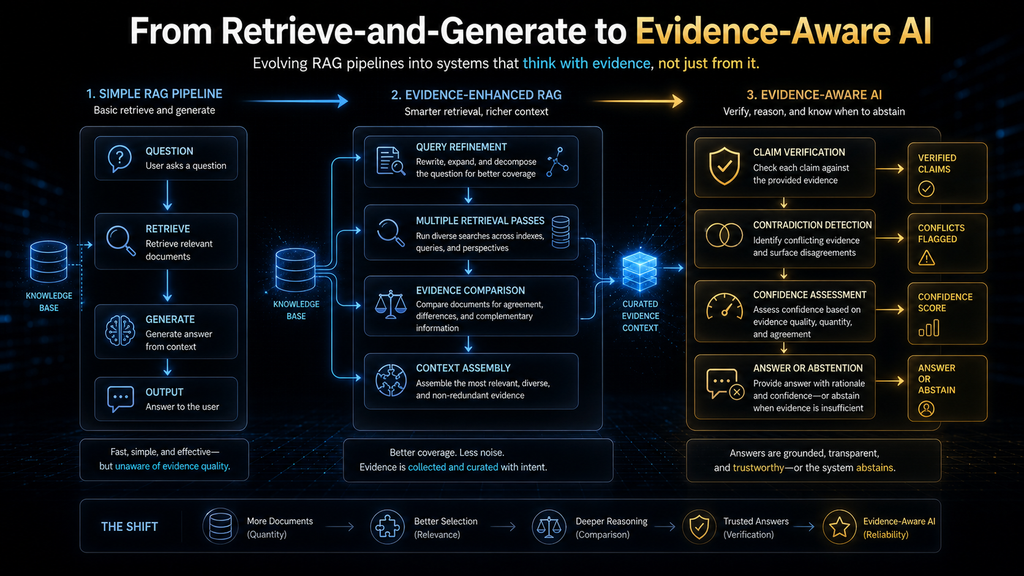
The next stage of RAG development is likely to move beyond simple “retrieve and generate” architectures toward systems that actively reason about evidence quality.
Instead of retrieving a fixed number of chunks and immediately generating an answer, future systems can increasingly use adaptive retrieval, query decomposition, iterative search, source prioritization, contradiction detection and verification loops. The goal is to make retrieval responsive to the difficulty of the question rather than treating every query as equally simple.
This creates an interesting second-order effect. As RAG systems become more capable of deciding what evidence they need, the distinction between retrieval and reasoning becomes less rigid. An agent may recognize that the first set of documents is insufficient, formulate another query, retrieve additional evidence and compare conflicting sources before answering.
That sophistication also increases the importance of evaluation. A more complex system has more opportunities to fail in ways that are difficult to see from the final answer alone. Observability, traceability and claim-level evaluation therefore become more important as RAG systems become more autonomous.
The future of reliable RAG is not simply better retrieval. It is a system that can reason about whether its retrieval is good enough to justify an answer.
Final Thoughts
Retrieval-Augmented Generation is one of the strongest practical approaches for reducing unsupported AI answers because it gives a language model access to external evidence at response time. But its real value appears only when retrieval, context, generation and verification are designed as one reliability system.
The most important lesson is that hallucinations do not have a single cause. A wrong answer may come from outdated source material, poor chunking, failed retrieval, weak ranking, insufficient context, generation beyond the evidence or a missing abstention mechanism. Treating all of these failures as “the model hallucinated” makes diagnosis harder and encourages teams to reach for the wrong solution.
The AI Hustle World RAG Reliability Ladder provides a better way to think about the problem: Source Integrity → Retrieval Quality → Evidence Sufficiency → Generation Faithfulness → Verification & Abstention. If a system fails, walk down that ladder until you find where the connection between the user’s question and trustworthy evidence was broken.
And there is one principle worth carrying into every RAG project:
The goal is not to make the AI answer every question. The goal is to make the AI answer only when the available evidence justifies the answer.
Build a More Reliable AI Knowledge System
Fewer hallucinations start with checking that retrieval returns the right evidence, so learn the metrics and failure checks.
Measure Retrieval Quality →Frequently Asked Questions
1. Does RAG completely eliminate AI hallucinations?
No. RAG can reduce hallucinations by giving a language model access to external evidence, but it does not guarantee that the retrieved information is correct, complete or properly interpreted. Hallucinations can still occur when retrieval fails, sources are outdated, context is incomplete, or the model generates claims that go beyond the evidence.
2. Why does RAG still hallucinate when relevant documents are available?
The existence of a relevant document does not guarantee that the correct passage will be retrieved or that the model will use it faithfully. A system may retrieve the wrong chunk, omit an important condition, mix information from different sources or introduce unsupported details during generation.
3. What is the best way to reduce hallucinations in a RAG system?
There is no single technique that solves the problem. The strongest approach is layered: maintain trustworthy source data, improve chunking and retrieval, use appropriate search and ranking methods, construct sufficient context, constrain generation, allow abstention and verify important claims.
4. Can better prompts prevent RAG hallucinations?
Better prompts can encourage the model to use retrieved evidence and avoid unsupported claims, but prompting cannot fix missing or incorrect retrieval. If the correct evidence never reaches the model, the prompt cannot recover it. Prompting should therefore be treated as one layer of the reliability architecture rather than the entire solution.
5. Does reranking reduce hallucinations in RAG?
Reranking can reduce hallucination risk when the initial retrieval system finds several reasonable candidates but places weaker evidence above stronger evidence. However, reranking cannot recover information that was never retrieved into the candidate set, so it should not be treated as a replacement for good chunking and retrieval.
6. Should a RAG system say “I don’t know” when retrieval fails?
Yes, especially when the consequences of an incorrect answer are significant. If the available evidence cannot support a reliable response, an explicit abstention or clarification path is generally safer than forcing the model to produce a plausible answer.
7. Are citations enough to prevent RAG hallucinations?
No. Citations improve traceability, but a citation can exist without actually supporting the claim made in the response. Stronger systems evaluate whether the generated claims are genuinely supported by the cited or retrieved evidence.
8. How do you measure hallucinations in a RAG system?
Useful measurements include faithfulness or groundedness, unsupported claim rate, citation support, retrieval recall, context precision, answer relevance and abstention behavior. Ragas, for example, separates retrieval-oriented metrics such as context precision and recall from generation-oriented metrics such as faithfulness and answer relevance.
9. What is the difference between retrieval failure and generation hallucination?
Retrieval failure occurs when the system does not provide the model with the evidence needed to answer correctly. Generation hallucination occurs when the model produces unsupported information even though relevant evidence was available in its context. The distinction matters because each failure requires a different intervention.
10. Can hybrid search improve RAG answer reliability?
Yes, particularly for workloads that contain both conceptual questions and exact terms such as product names, codes, error messages or version numbers. Combining lexical and semantic retrieval can provide broader coverage than relying exclusively on either approach, although the best strategy depends on the specific knowledge base and query patterns.
Sources and Further Reading
- Seven Failure Points When Engineering a Retrieval Augmented Generation System: Barnett et al., 2024. A case-study paper cataloguing where RAG systems break.
- Self-RAG: Learning to Retrieve, Generate, and Critique through Self-Reflection: Asai et al., 2023. A framework where the model decides when to retrieve and critiques its own output.
Written by
Muntasir Ahmad Chowdhury
Founder, AI Hustle World
Muntasir Ahmad Chowdhury is the Founder of AI Hustle World, an independent publication dedicated to making Artificial Intelligence practical, trustworthy, and easy to understand. He researches AI tools, automation, customer service, productivity, and real-world business applications, helping readers make smarter technology decisions through research-driven, experience-backed content.
Expertise:
AI Tools • AI Automation • AI Customer Service • AI Productivity • Generative AI • AI Workflows
Get Smarter With AI
Enjoyed this guide? Get practical AI tools, tutorials, and honest reviews delivered to your inbox.