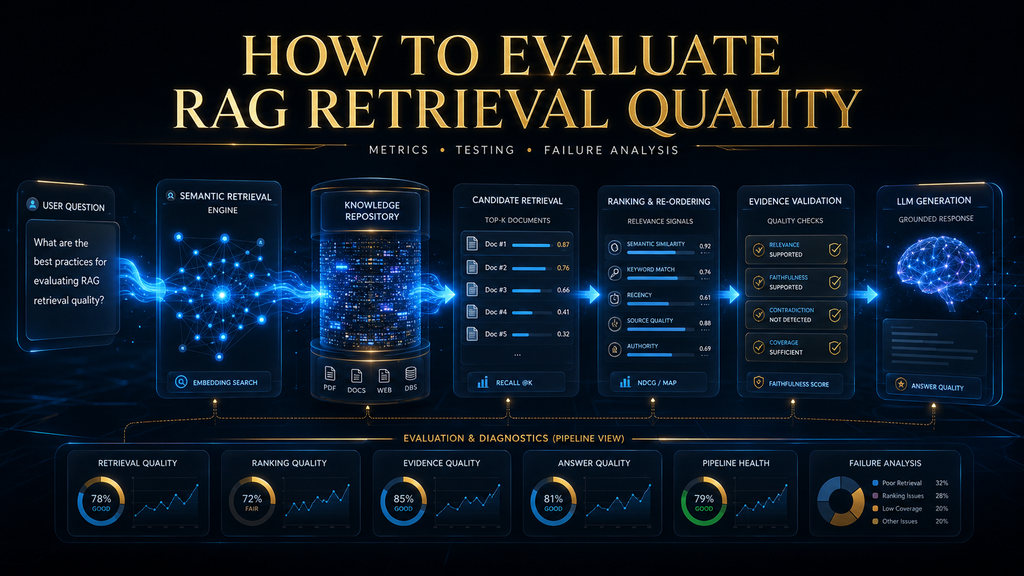
How to Evaluate RAG Retrieval Quality: Metrics, Testing and Failure Analysis
Your RAG System Is Giving Wrong Answers. But Where Did It Actually Fail?
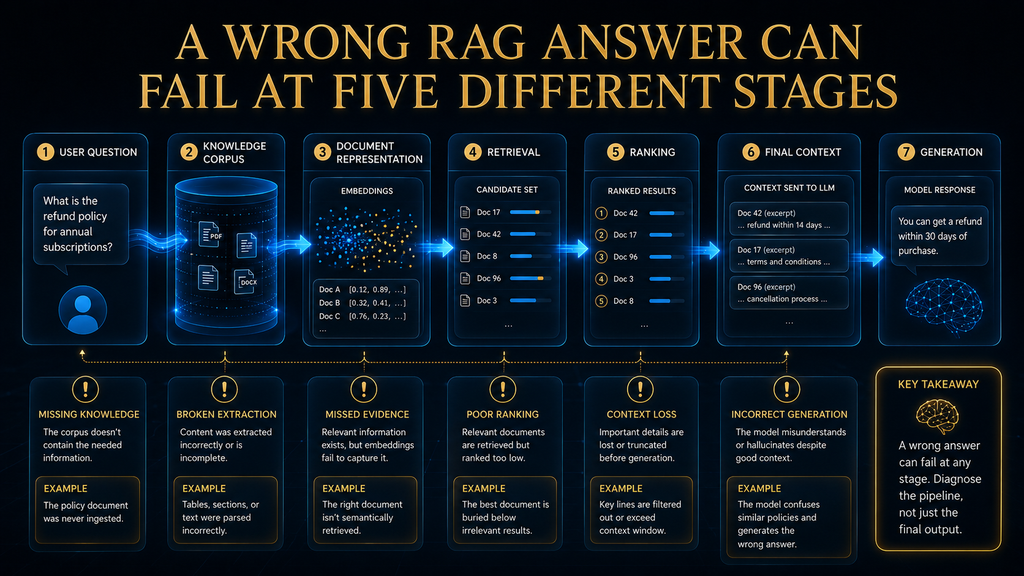
A RAG system can produce a completely wrong answer even when the language model itself is capable of answering the question correctly. The problem may be that the right document was never retrieved, that the relevant passage was buried below the retrieval cutoff, that a metadata filter removed the evidence, that the document was poorly chunked, or that the model received the correct evidence but failed to use it. From the user’s perspective, all of these failures look identical: the AI gave a bad answer.
That is why evaluating a RAG application by looking only at the final response is dangerous. You may spend weeks changing prompts or swapping language models when the real problem is retrieval. Conversely, you may keep tuning embeddings and vector-search settings when the retriever is already doing its job and the generator is the component actually failing.
The right approach is to treat RAG evaluation as a diagnostic problem, not simply a scoring exercise. You need to know whether the required evidence exists, whether your system can find it, whether it ranks that evidence appropriately, whether real-world filters and constraints interfere with retrieval, and whether the generation layer can actually use what retrieval supplied. Modern research reflects this modular view: RAGChecker, for example, was designed specifically to diagnose retrieval and generation separately rather than reducing the entire system to a single end-to-end score.
This distinction becomes increasingly important as RAG applications move from demonstrations into production. A small internal prototype may survive occasional retrieval mistakes because a human knows when to double-check an answer. A customer-support assistant, enterprise knowledge system, compliance workflow or technical documentation assistant has a different tolerance for failure. In those systems, evaluation needs to tell you not only how often something goes wrong, but what kind of failure you are dealing with and what engineering decision should follow.
That is the central idea behind this guide. Rather than giving you a list of RAG metrics and leaving you to figure out what they mean, we will build a practical evaluation system around three questions: Did we retrieve the right evidence? Did we retrieve enough of it and rank it well? And can we distinguish retrieval failures from failures that happen after retrieval?
What Does RAG Retrieval Quality Actually Mean?
RAG retrieval quality is the ability of a retrieval system to return the evidence that is relevant, sufficient, appropriately ranked and valid for a user’s query before that evidence reaches the language model.
That definition is deliberately broader than “semantic similarity.” A vector database can return highly similar passages while still failing the user’s task. A chunk might contain words that are semantically close to the question but omit the sentence that actually answers it. Another chunk may contain the correct information but refer to an outdated version of a policy. A third may be highly relevant in general but belong to another customer or department and therefore be unusable.
This is why retrieval quality has several dimensions. Coverage asks whether the necessary evidence was found at all. Ranking quality asks whether the strongest evidence appeared early enough to influence the generation step. Applicability asks whether the retrieved material is valid for the user’s context, including permissions, dates, versions and other constraints. Robustness asks whether the system continues to behave sensibly when the question is ambiguous, unanswerable, conversational, unusually phrased or dependent on difficult document formats. Operational quality then adds latency and cost to the equation.
Consider an employee asking an internal assistant, “What is our current parental leave policy?” Suppose the company’s knowledge base contains three policy versions: a 2023 policy, a 2025 revision and a 2026 policy currently in force. If the system retrieves the 2023 document because it is semantically similar, a conventional relevance score might look acceptable while the actual answer is wrong. The retrieval problem is not simply that the system failed to find relevant text. It failed to identify the relevant and authoritative version.
That is the difference between evaluating retrieval as a mathematical subsystem and evaluating retrieval as part of a working information system.
Why Final Answer Accuracy Is Not Enough
The most important conceptual mistake in RAG evaluation is assuming that the final answer tells you exactly what happened inside the pipeline.
It does not.
A simplified RAG workflow contains at least four meaningful stages: the user query is interpreted, candidate information is retrieved, retrieved material is assembled into context, and the language model generates an answer from that context. Each stage can introduce a different type of error. If the final answer is wrong, the evaluation system needs enough visibility to determine which stage deserves attention.
Imagine that a customer asks, “Can I return this product after 45 days?” The company’s policy document clearly states the answer, but the retrieval system returns a general shipping policy instead. The generator then produces a plausible response based on that irrelevant context. Improving the language model will probably not solve the underlying problem.
Now change the scenario. Suppose retrieval returns the exact return-policy paragraph, but the model says that returns are allowed when the paragraph clearly says they are not. Retrieval has now done something important: it delivered the evidence. The failure has moved downstream.
There is a third possibility. The answer is correct, but the model never actually relied on the retrieved evidence. It simply knew the answer from its pretrained knowledge. In a casual demonstration, that may look like success. In a production system, it can conceal a broken retrieval pipeline, particularly when the knowledge base contains information that changes over time.
This is why a useful evaluation architecture should record at least the query, retrieved documents or chunks, their ranking, filters, final context, generated answer and evaluation judgment. Without that intermediate evidence, you are often debugging a black box.
Research such as RAGChecker reinforces this point by evaluating retrieval and generation at a finer granularity and using diagnostic signals to identify different sources of failure.
The practical implication is simple: never let end-to-end answer quality be your only RAG metric.
Start With the Evaluation Dataset, Not the Metric
The quality of a RAG evaluation depends heavily on the quality of the questions you test against.
A common mistake is to take a handful of questions, run them through the system, manually inspect the answers and declare the retriever “good enough.” That approach feels efficient, but it creates a weak feedback loop because the test set is usually too small, too clean and too similar to the examples the team already expects.
A serious evaluation set should represent the kinds of questions the application is actually expected to receive. That includes easy questions, ambiguous questions, paraphrases, exact identifiers, multi-document questions, difficult retrieval cases and questions that the knowledge base cannot answer. Enterprise-oriented research has specifically highlighted the importance of tailoring benchmark question distributions to expected application traffic rather than blindly generating questions from documents. The DataMorgana work, for example, focuses on generating enterprise RAG benchmarks that can be customized around expected traffic and question categories.
The evaluation dataset should also contain ground-truth retrieval information, not just a reference answer. If your expected answer is “Employees receive 20 days of annual leave,” that tells you what the model should say, but it does not necessarily tell you which document or passage should have been retrieved.
For retrieval evaluation, a useful test record can contain the following:
| Evaluation field | What it tells you |
|---|---|
| User query | What the system was asked |
| Expected answerability | Whether the knowledge base should answer it |
| Relevant document IDs | Which source documents matter |
| Relevant chunk IDs | Which passages contain required evidence |
| Relevance level | Whether each candidate is direct, partial or irrelevant |
| Required filters | Which access, date, version or tenant constraints apply |
| Reference answer | What a correct response should contain |
| Query category | What type of retrieval problem is being tested |
| Difficulty | How challenging the case is |
| Failure label | What went wrong when the system fails |
This structure is more valuable than simply storing a question and expected answer because it allows you to isolate the retrieval layer.
What Makes a Good RAG Evaluation Dataset?
A good dataset should resemble production traffic rather than the contents of your documentation.
That distinction matters because a knowledge base can contain thousands of perfectly reasonable questions that real users will never ask. If you generate one question from every document, you may produce a benchmark that is statistically neat but operationally misleading. The DataMorgana research makes this exact point: synthetic questions generated directly from random documents can have unrealistic terminology or insufficient diversity compared with the questions users are expected to ask.
Your dataset should therefore contain query slices.
A policy assistant might include straightforward policy questions, questions using informal language, questions containing department-specific terminology, questions referring to an older policy version, questions requiring two documents, and questions where the requested information does not exist. A technical documentation assistant might add error codes, product names, version numbers, configuration snippets and troubleshooting sequences.
The purpose is not to make the benchmark artificially difficult. It is to prevent a high aggregate score from hiding weaknesses that matter to the actual application.
For example, suppose a retrieval system achieves a 90% success rate across 1,000 test questions. That sounds excellent until you discover that it performs at 97% on general questions but only 61% on exact product identifiers, which account for 30% of your production traffic. The aggregate number is technically accurate but strategically misleading.
Evaluation needs distribution, not just averages.
The Core Retrieval Metrics You Should Understand
There is no single “best” RAG retrieval metric. Different metrics answer different questions, and the useful combination depends on whether you care most about finding all relevant evidence, ranking the best evidence early, minimizing noise or supporting multi-document reasoning.
The most important metrics are Precision@K, Recall@K, Hit Rate, Mean Reciprocal Rank (MRR), NDCG, Mean Average Precision (MAP), context precision and context recall. They overlap in purpose, but they are not interchangeable.
Understanding that difference is more useful than memorizing their formulas.
Precision@K: How Much of What You Retrieved Is Actually Useful?
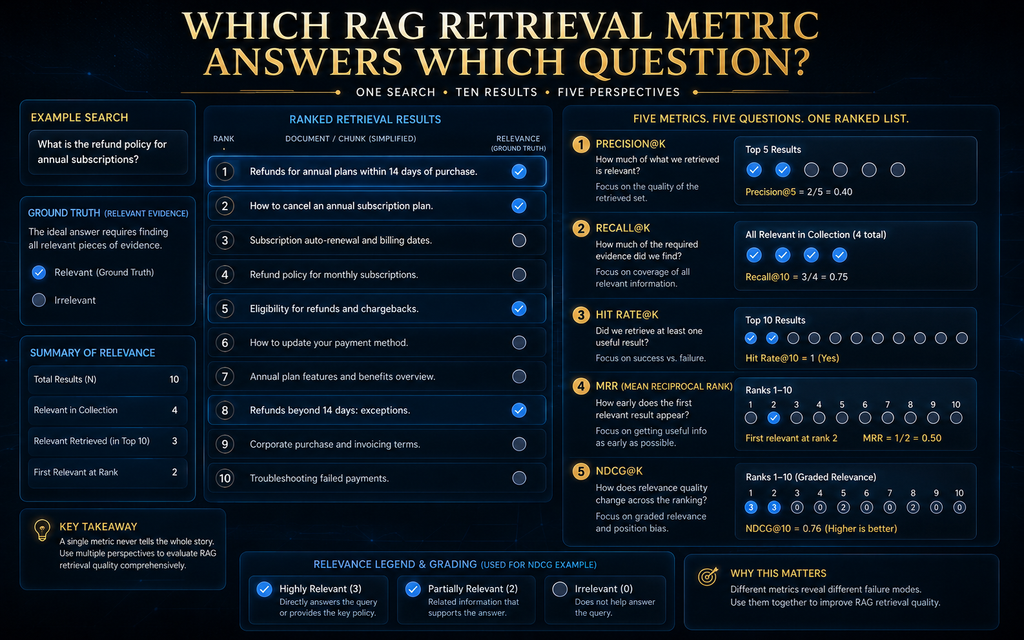
Precision@K measures the proportion of the top K retrieved results that are relevant.
If a system retrieves five passages and four are relevant, Precision@5 is 0.8, or 80%. The metric answers a straightforward question: “How much noise did the retrieval system put into the top K?”
That makes precision particularly useful when your RAG system tends to flood the language model with loosely related material. If increasing top-k from 5 to 15 raises recall but causes a large drop in precision, the system may be retrieving more evidence at the cost of more distracting context.
The important limitation is that precision says nothing about relevant evidence that never appeared in the result set. A system can have excellent precision because it returns only three highly relevant documents while completely missing a fourth document required to answer a multi-part question.
That is why precision should almost never be interpreted without recall.
Recall@K: Did We Find the Evidence We Needed?
Recall@K measures how much of the relevant evidence was retrieved within the first K results.
Suppose a question requires three specific evidence passages and your top-five results contain two of them. Your retrieval has achieved partial coverage even if every retrieved passage is relevant. Recall tells you about what you missed, whereas precision tells you about what you included unnecessarily.
This distinction is especially important in RAG because many questions cannot be answered correctly from a single passage. A system may retrieve one excellent chunk and still fail because another necessary piece of evidence never reaches the context window.
Context recall is similarly concerned with whether the retrieved context contains enough information to support the reference answer. RAG evaluation frameworks such as Ragas expose context-recall metrics specifically for this purpose.
The engineering implication is powerful: if Recall@K is poor, changing the generator should not be your first move. You should investigate corpus coverage, chunking, query formulation, embedding behavior, search strategy, top-k and filtering.
Hit Rate: Did We Find at Least One Relevant Result?
Hit Rate, often expressed as Success@K, asks a simpler question: Did the top K results contain at least one relevant item?
This can be very useful for question-answering systems where a single passage is sufficient to answer the query. It is also easy to communicate to nontechnical stakeholders.
However, Hit Rate can hide substantial differences between systems. If the correct result appears first in one system and tenth in another, both may receive the same Hit Rate@10 score.
That is why Hit Rate works well as a baseline metric but should be paired with ranking metrics when the position of the evidence matters.
Ranking Matters More Than Many Teams Realize
Retrieval is not simply about finding relevant information. It is about finding the right information early enough.
Imagine that your retriever returns ten passages and the relevant passage is ranked tenth. Technically, retrieval succeeded if your top-k is ten. Operationally, however, the result may be much less useful than a system that ranks the same passage first.
Why? Because many RAG systems limit how much retrieved material enters the final context. Even when all ten passages are technically available, the language model may pay more attention to some positions than others, and additional irrelevant material can dilute the useful evidence.
This is where ranking metrics become important.
Mean Reciprocal Rank: How Quickly Do We Find the First Good Result?
MRR focuses on the position of the first relevant result. If the correct passage is first, the reciprocal rank is 1. If it is second, it is 0.5. If it is fifth, it is 0.2.
That makes MRR particularly intuitive for retrieval systems where getting one strong result near the top is valuable.
Suppose two configurations both achieve the same Recall@10. One usually puts the first relevant chunk in positions one or two; the other usually places it around positions seven or eight. Recall says they are similar. MRR exposes the ranking difference.
This can be especially useful when testing rerankers. If adding a reranker produces little change in Recall@10 but materially improves MRR, the retriever may not be discovering more evidence, but it is doing a better job of bringing useful evidence forward.
That can still be a meaningful improvement because it may allow you to reduce the number of chunks passed downstream without losing answer quality.
NDCG: Useful When Relevance Is Not Binary
Not every retrieved passage is simply “relevant” or “irrelevant.”
Imagine asking an internal assistant, “What are the requirements for our remote-work policy?” One passage might directly describe the eligibility requirements. Another might explain the approval process. A third might discuss remote-work security. All three may be useful, but they are not equally relevant to the exact question.
NDCG, or Normalized Discounted Cumulative Gain, is useful when you want to account for different levels of relevance and the position of each result. Highly relevant results receive more value when they appear near the top.
This makes NDCG particularly useful for richer retrieval evaluation than binary relevance alone.
It is also a good reminder that retrieval quality is fundamentally a ranking problem. A retriever is not merely searching for text that resembles a query; it is constructing an ordered list of evidence candidates.
Where Context Precision and Context Recall Fit
Modern RAG evaluation frameworks often introduce metrics that are closer to the actual RAG pipeline than traditional document-retrieval metrics alone.
Context precision asks whether relevant retrieved chunks are appropriately ranked among the retrieved context, while context recall focuses on whether the retrieved material contains the information required to support the expected answer. These concepts are represented directly in Ragas’ evaluation metrics.
The value of these measures is that they connect classic retrieval ideas to the actual context supplied to the generator.
That connection matters because the retrieval system does not exist in isolation. A retriever may return ten documents, but the generator might ultimately receive only five chunks after deduplication, filtering, reranking or context-window constraints. Evaluating the raw search result alone can therefore overstate what the model actually had available.
This is why the evaluation trace should preserve the transition from retrieved candidates → reranked candidates → final context.
If the correct passage appears in the initial retrieval results but disappears during reranking or filtering, calling that a “retrieval failure” is too simplistic. You need to identify the stage at which the evidence was lost.
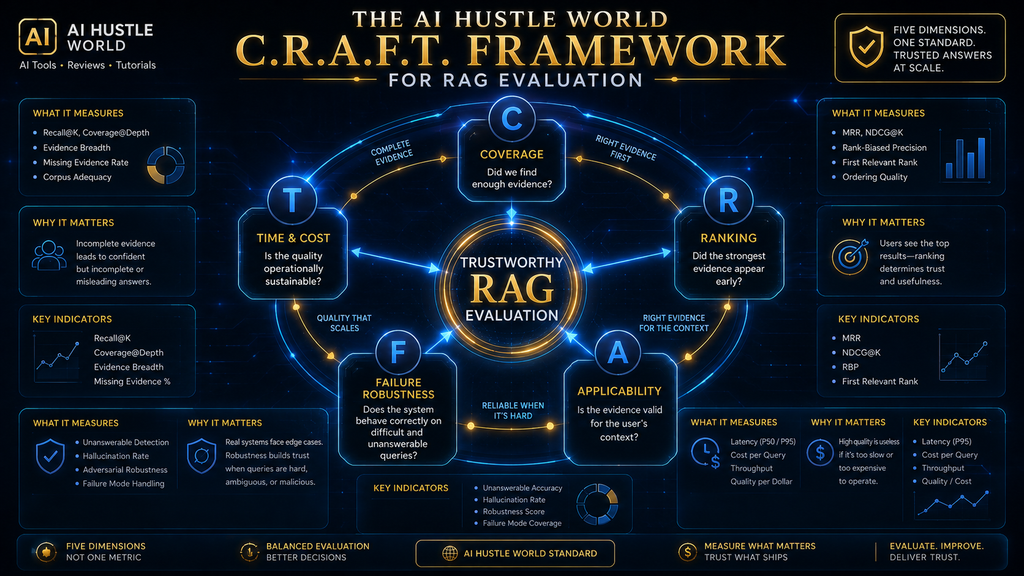
The AI Hustle World C.R.A.F.T. Framework for RAG Evaluation
Metrics are useful, but a production team needs a way to organize them around decisions. For that reason, this article uses an original framework: C.R.A.F.T. — Coverage, Ranking, Applicability, Failure Robustness, and Time & Cost.
The framework is designed to answer a broader question than “What is our retrieval score?” It asks whether the retrieval system is capable of supporting the actual job it was built to perform.
Coverage
Coverage asks whether the retrieval system found enough of the evidence required to answer the question.
Recall@K, Hit Rate and context recall are useful signals here, but the exact measurement should depend on the task. A simple factual question may need one authoritative passage. A multi-part question may require several pieces of evidence from different documents.
The critical point is that coverage should be evaluated against required evidence, not merely against semantic similarity.
Ranking
Ranking asks whether the strongest evidence appeared early enough to matter.
Precision@K, MRR, NDCG and context precision can help answer this question. Ranking is particularly important when your system uses a limited top-k, reranking stage or context budget.
A ranking improvement can sometimes be more valuable than retrieving more documents. If the system already discovers the right evidence but buries it under weaker matches, improving ordering can reduce both noise and downstream cost.
Applicability
Applicability asks whether retrieved evidence is valid for the user’s actual context.
This is where conventional benchmark metrics often become insufficient. You need to test access permissions, tenant boundaries, document versions, dates, product variants, geographic restrictions and source authority.
A document can be perfectly relevant and still be the wrong answer source.
This is one reason enterprise RAG evaluation should not be reduced to vector similarity or generic benchmark performance.
Failure Robustness
Failure robustness asks what happens when the question is difficult, incomplete, ambiguous or impossible to answer from the knowledge base.
This includes unanswerable queries, multi-turn questions, hard negatives, exact identifiers, long questions, noisy documents, table-heavy sources and other production-specific cases.
Research is increasingly showing why these cases matter. UAEval4RAG argues that RAG evaluation has historically focused too heavily on answerable questions and introduces a framework for evaluating appropriate rejection of unanswerable requests.
Time & Cost
Time and cost ask whether the retrieval quality is economically and operationally sustainable.
A retriever that produces excellent results but takes several seconds for every query may not be acceptable for an interactive product. Likewise, increasing top-k and adding multiple reranking stages may improve retrieval while dramatically increasing token usage and inference costs.
A good evaluation system therefore measures quality and operational performance together.
The Most Important RAG Evaluation Question: What Failed?
Imagine a support assistant answers a question incorrectly.
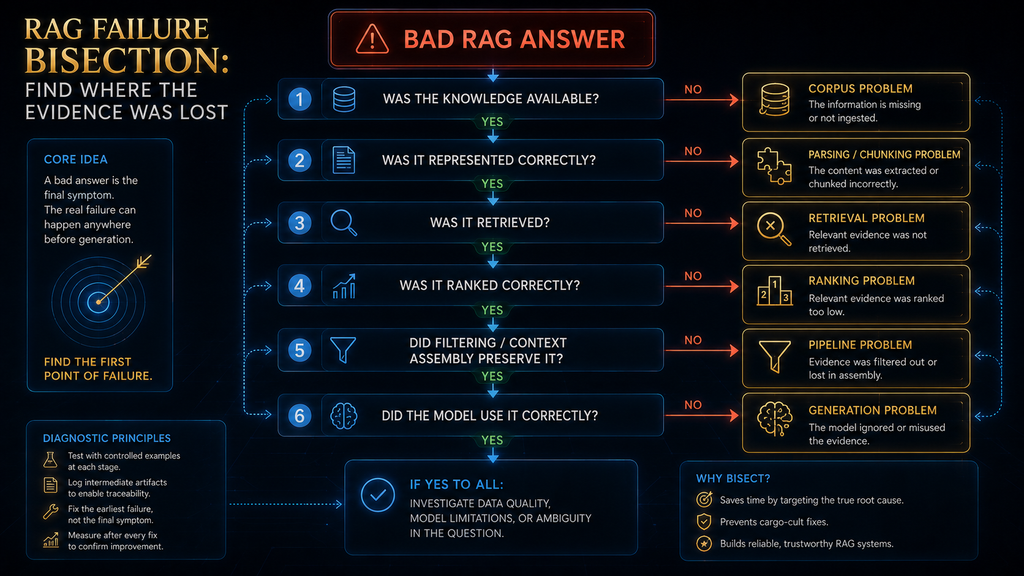
Before changing anything, ask:
Was the necessary information present in the knowledge base?
If it was not, retrieval cannot solve the problem. You have a corpus-coverage or knowledge-availability issue.
If the information existed, ask:
Was it represented correctly in the indexed content?
If a PDF parser dropped a table, if a heading became detached from its explanation, or if chunking separated the answer from its qualifying condition, the retrieval system may be working correctly against a broken representation.
If the evidence was represented correctly, ask:
Was it retrieved?
If not, investigate the retrieval layer: query formulation, embeddings, lexical matching, hybrid search, candidate count, index behavior and related factors.
If it was retrieved, ask:
Was it ranked highly enough?
This is where reranking, search weighting and top-k become relevant.
If it was ranked correctly, ask:
Did filters or downstream context assembly remove it?
This catches metadata and permission problems that can be invisible in a simple vector-search benchmark.
Finally, ask:
Did the generator correctly use the evidence?
If the answer is no, stop changing the retriever. The evidence reached the model; the failure has moved downstream.
This sequence is the RAG Failure Bisection method: instead of treating every incorrect answer as one generic failure, progressively isolate the stage where the evidence was lost or misused.
A Practical Failure-Analysis Matrix
The matrix below turns common evaluation patterns into engineering decisions.
| Observed evaluation pattern | What it may mean | What to investigate first |
|---|---|---|
| Low Recall@K, reasonable precision | Relevant evidence is being missed | Corpus coverage, chunking, embeddings, query formulation, top-k |
| High recall, low precision | Too much irrelevant context | Ranking, reranking, chunk size, filters |
| Good Recall@K, poor MRR | Correct evidence exists but ranks too low | Reranking and search weighting |
| Good retrieval, bad final answer | Retrieval may not be the problem | Context assembly, prompting, generator behavior |
| Strong unfiltered retrieval, weak filtered retrieval | Constraints are damaging retrieval | Metadata, permissions, filtering/index design |
| Exact identifiers perform poorly | Semantic retrieval may be insufficient | Lexical or hybrid retrieval |
| Answerable queries perform well, unanswerable queries poorly | System over-retrieves or over-answers | Abstention and confidence thresholds |
| Offline benchmark strong, production weak | Test distribution is too clean | Query slices, production traces, drift |
| Single-turn strong, multi-turn weak | Conversational context is not being represented well | Query rewriting and conversation-aware retrieval |
| Text retrieval strong, table/PDF retrieval weak | Representation/extraction problem | Parsing, structure-aware chunking, retrieval method |
The important point is that these are diagnostic patterns, not universal laws. A low-recall result does not automatically prove that embeddings are bad. It tells you which class of causes deserves investigation first.
That distinction prevents evaluation from becoming another source of cargo-cult optimization.
Why Unanswerable Questions Belong in Your Test Set
A RAG system should not be rewarded simply for finding something whenever a user asks a question.
Sometimes the correct behavior is to say that the knowledge base does not contain enough information to answer.
This is harder than it sounds because retrieval systems are designed to find the nearest available evidence. If a user asks a question that does not exist in the corpus, the system may still find something semantically similar and present it to the language model. The model then has a plausible-looking context from which to construct an answer.
That can be worse than returning nothing.
UAEval4RAG specifically addresses this problem, noting that conventional RAG evaluation often focuses on answerable requests while overlooking whether systems appropriately reject unanswerable requests. Its evaluation covers six categories of unanswerable queries and reports that no single configuration consistently optimized both answerable and unanswerable performance across the tested knowledge bases.
This has a practical consequence: your benchmark should contain questions where the correct result is not to retrieve a misleading answer.
For an HR assistant, that might be a question about a benefit the company does not offer. For a product assistant, it might ask about a model that does not exist. For a policy system, it might ask about a rule that is simply absent from the current policy corpus.
A strong system should know the difference between: “I found weakly related information.”
and: “I found sufficient evidence to answer.”
Those are not equivalent states
Multi-Turn RAG Requires a Different Kind of Test
A single-turn benchmark can make a conversational RAG system look better than it really is.
Consider a conversation that starts with, “What is our travel reimbursement policy?” The user then asks, “What about contractors?” followed by, “Does the same limit apply outside the country?” The later questions may be incomplete when viewed independently, but perfectly understandable in context.
If your evaluation set tests only standalone questions, you are not measuring this retrieval challenge.
The mtRAG benchmark was created specifically to study multi-turn conversational RAG and found that even state-of-the-art systems struggle with later turns, unanswerable questions, non-standalone queries and multiple domains.
That means conversational systems need evaluation cases where the query depends on previous turns.
The test should distinguish between a retrieval failure and a query-understanding failure. If the retriever receives “What about contractors?” without the relevant conversational context, the retrieval system may be perfectly capable of searching the corpus but unable to infer what “what” refers to.
This is why the evaluation trace should record both the raw user utterance and the actual retrieval query produced by the system. If a query-rewriting layer exists, evaluate it as a separate component.
Hard Negatives: The Tests That Expose Weak Ranking
Easy negatives are not enough.
If the question is about parental leave and your corpus contains documents about automobile maintenance, almost any retrieval system can identify which documents are irrelevant. That does not tell you much about ranking quality.
The more useful test is a hard negative: a passage that looks relevant but does not actually answer the question.
For example, imagine a knowledge base contains:
- the company’s general leave policy;
- maternity leave policy;
- parental leave policy;
- unpaid leave policy;
- contractor leave policy.
A query asking about parental leave should distinguish the exact policy from several highly similar documents.
That is where retrieval quality becomes interesting.
Hard negatives are particularly useful for evaluating whether embeddings, lexical retrieval, hybrid search and reranking are actually discriminating between closely related candidates rather than merely finding the right topic.
This also explains why aggregate semantic similarity scores can be misleading. A score of 0.91 may sound impressive until you discover that the top four documents all score between 0.89 and 0.92 and only one actually contains the answer.
Exact Identifiers Expose a Different Retrieval Problem
Semantic search is excellent at capturing meaning, but many enterprise queries depend on exact strings.
Users ask about:
- product codes;
- model numbers;
- error messages;
- account identifiers;
- version numbers;
- legal citations;
- technical configuration parameters.
A purely semantic retrieval system may understand the general meaning of an error code while failing to prioritize the exact document containing that code.
That is why exact-identifier queries deserve their own evaluation slice.
If semantic retrieval performs strongly on natural-language questions but poorly on exact codes, the correct conclusion is not necessarily that the embedding model is bad. It may indicate that the retrieval architecture needs a lexical component or a hybrid approach that combines semantic and exact-term matching.
This is also an example of why the right metric depends on the task. A general Recall@10 number may look healthy while exact identifier retrieval is unacceptable for a support product whose most important queries are error codes.
Evaluating Retrieval on Tables, PDFs and Complex Documents
Real-world knowledge is rarely stored as clean paragraphs.
Documents contain tables, headings, footnotes, captions, columns, lists, figures and other structures that can be damaged during extraction and chunking. If your evaluation set contains only clean text, you may never discover that your production parser has destroyed the information your retriever needs.
T²-RAGBench was designed specifically around this problem. It contains 23,088 question-context-answer triples for evaluating RAG on real-world text-and-table data and requires systems to retrieve the correct context before performing the downstream reasoning task. The benchmark deliberately moves beyond settings where the correct context is simply handed to the model.
This distinction is crucial.
Suppose a financial report contains a table showing quarterly revenue. The answer to a user’s question may depend on the relationship between the row label, column heading and numerical value. If extraction separates those elements into unrelated chunks, a semantic retriever may retrieve all the right words while still failing to preserve their relationship.
That is not necessarily an embedding failure.
It may be an information representation failure.
Your evaluation should therefore contain difficult document types whenever those formats matter to the real application.
Evaluate Multi-Document Questions Differently
Some questions can be answered from one passage.
Others cannot.
Consider:
“How did our pricing change between the 2025 and 2026 product plans, and what feature was added in the newer version?”
The answer may require two documents and potentially three separate pieces of evidence. A retriever that finds only the 2026 pricing page may appear successful because it retrieves highly relevant information, yet it has not retrieved enough evidence to answer the comparison accurately.
This is why coverage needs to be measured at the evidence level, not only at the document level.
For multi-document questions, your evaluation record should identify all required sources or evidence units. The system should then be evaluated on whether it retrieved the complete set necessary for the task.
Research on multi-hop and deeper search increasingly points toward this issue. A 2025 benchmark for deep search over heterogeneous enterprise data, for example, evaluates source-aware, multi-hop questions over documents, meeting transcripts, Slack messages, GitHub content and URLs, and reports retrieval as a major bottleneck because systems often fail to collect all necessary evidence before reasoning.
The lesson is straightforward: one relevant document does not necessarily equal sufficient retrieval.
Don’t Confuse Retrieval Quality With Context Utilization
There is another subtle failure mode that can waste enormous amounts of engineering time.
Suppose your retriever finds the exact paragraph needed to answer a question. The paragraph reaches the model. The model still produces the wrong answer.
If you immediately replace the embedding model, increase top-k or switch vector databases, you may be optimizing the wrong layer.
The retrieval evaluation should therefore include a point at which you can say:
The required evidence was successfully retrieved and supplied to the generator.
Once that condition is established, the investigation moves downstream.
This distinction is increasingly relevant because research is showing that language models do not always use retrieved context reliably. Recent work on context utilization reports that models can ignore relevant context and can also be distracted by irrelevant information, especially under more realistic conditions.
That gives us an important operational rule:
Do not keep tuning retrieval after retrieval has already demonstrated that it can deliver the necessary evidence.
Human Evaluation Still Matters
Automated metrics are essential because manual evaluation does not scale, but automated evaluation should not be mistaken for perfect ground truth.
Human evaluators are expensive, but they can answer questions that automated systems struggle with, particularly in specialized domains where relevance depends on context, authority, nuance or business rules.
LLM-based judges can help scale evaluation. They can assess semantic relevance, groundedness, answer quality and other properties that are difficult to capture with deterministic metrics. Research frameworks such as RAGChecker also explicitly investigate how automated evaluation signals correlate with human judgments rather than assuming that any metric is automatically reliable.
The practical approach is to combine the two.
Use human-reviewed examples to establish a trusted evaluation foundation. Automate large-scale regression testing with deterministic metrics and model-based judges. Then periodically sample results for human review and compare the automated judgments against those human judgments.
This creates calibration rather than blind trust.
If an LLM judge consistently marks borderline answers as correct, your evaluation system can become confidently wrong. The answer is not to abandon automated evaluation; it is to continuously validate the evaluator itself.
How to Compare Two RAG Retrieval Configurations
One of the easiest ways to produce misleading RAG evaluation results is to compare two systems without controlling the experiment.
Suppose you replace the embedding model and simultaneously change chunk size, top-k, reranking and the language model. The new system scores better, but you have no idea which change produced the improvement.
A better experiment starts with a fixed dataset and fixed evaluation methodology. Establish the current configuration as the baseline. Then change one major retrieval variable at a time and record how the relevant metrics move.
Imagine the baseline produces:
| Metric | Baseline |
|---|---|
| Recall@5 | 72% |
| Precision@5 | 81% |
| MRR | 0.64 |
| Hit Rate@5 | 79% |
| p95 retrieval latency | 420 ms |
You test a reranker and obtain:
| Metric | Reranked |
|---|---|
| Recall@5 | 73% |
| Precision@5 | 84% |
| MRR | 0.78 |
| Hit Rate@5 | 80% |
| p95 retrieval latency | 690 ms |
At first glance, the improvement may seem modest because Recall barely changed. But MRR increased substantially, which tells you that the system is ranking relevant evidence much earlier. Precision also improved, suggesting that the reranker is reducing noise.
The trade-off is latency.
That is a meaningful engineering result because you can now ask whether the additional 270 ms is worth the ranking improvement for the product.
This is what evaluation should do: turn system changes into decisions.
Why You Should Not Optimize for One Metric
Optimizing one metric aggressively can damage another.
Increasing top-k often increases the chance that relevant evidence appears somewhere in the retrieved set. But it also introduces more irrelevant material. That can reduce precision, increase token consumption and potentially make generation less reliable.
Similarly, an aggressive relevance threshold can improve precision while eliminating borderline evidence that was actually necessary for a difficult query.
The goal is therefore not: “Maximize Recall@K.”
It is: Find the smallest, highest-quality evidence set that reliably contains what the task requires.
That is a much more useful optimization objective.
In a customer-support system, you may prefer a slightly lower recall if it produces a much cleaner context and a more reliable answer. In a legal or compliance application, you may accept more retrieval noise because missing relevant evidence is much more costly.
There is no universal threshold that applies to every RAG system.
The Economics of Retrieval Quality
Retrieval evaluation is not only an accuracy problem.
Every additional retrieved chunk can increase:
- reranking computation;
- context length;
- language-model input tokens;
- latency;
- inference cost;
- potential distraction.
Suppose a system retrieves five chunks and each contains roughly 500 tokens. Increasing top-k to twenty does not simply quadruple the amount of retrieved information. It can also increase the amount of text that the generator must process, while introducing additional opportunities for contradictory or irrelevant material.
Now suppose a reranker improves retrieval quality but adds 250 milliseconds and additional compute cost per request. Whether that is worthwhile depends on the value of a successful answer and the application’s latency requirements.
A useful business metric is therefore cost per successful grounded answer, not simply cost per query.
If a cheaper retriever produces a correct answer 70% of the time while a more expensive architecture produces a correct grounded answer 90% of the time, the second system may be substantially more economical when failed answers trigger human intervention or customer-support escalation.
This is why retrieval evaluation belongs in product economics rather than being isolated inside the machine-learning team.
Offline Evaluation vs. Production Evaluation
Offline evaluation is controlled. Production evaluation is real.
You need both.
Offline evaluation is ideal when comparing embedding models, chunking strategies, top-k values, rerankers, hybrid-search weights or other architectural changes. Because the same test set is used repeatedly, you can measure whether a configuration actually improved the system.
Production evaluation catches things that a curated benchmark cannot.
Users phrase questions differently. New documents arrive. Old documents become stale. Search traffic changes. New product versions appear. Permissions change. Users ask questions that the engineering team never anticipated.
A mature RAG evaluation loop therefore looks like:
Production interaction → failure identified → trace preserved → failure diagnosed → test case added → fix evaluated offline → regression test passes → deployment → production monitoring
This turns every important failure into a permanent improvement to the system.
The idea is consistent with current evaluation tooling that separates offline evaluation from online evaluation and supports feeding production traces back into evaluation datasets.
The long-term advantage is bigger than quality improvement.
Your evaluation dataset becomes organizational memory.
How to Build a RAG Regression Suite
Once a failure is discovered, do not simply fix it and move on.
Turn it into a test.
Suppose a policy assistant once retrieved an outdated document instead of the current policy. After fixing the metadata filter, add that question to the regression suite with the correct document version explicitly labeled.
If a support assistant once failed to retrieve an error code because the semantic embedding ranked a conceptually similar passage higher, preserve that exact query and add several paraphrases.
If a conversational assistant failed when a user asked a follow-up question containing “they” or “that limit,” preserve the entire conversation context rather than storing only the final sentence.
The regression set should gradually become harder because it represents the real mistakes your system has already made.
That is much more valuable than endlessly generating synthetic “easy” questions.
Common RAG Evaluation Mistakes
Mistake 1: Measuring Only Final Answer Accuracy
This hides whether retrieval or generation caused the failure.
Better approach: evaluate retrieval and generation separately, then evaluate the end-to-end result.
Mistake 2: Using a Tiny Handwritten Test Set
A small test set often reflects the team’s expectations rather than actual user behavior.
Better approach: combine curated expert cases, production traces and carefully controlled synthetic cases.
Mistake 3: Testing Only Answerable Questions
This rewards systems for confidently answering questions they should reject.
Better approach: include answerable, partially answerable and unanswerable cases. UAEval4RAG provides strong research support for this evaluation dimension.
Mistake 4: Looking Only at Aggregate Scores
A strong average can conceal catastrophic performance for an important query class.
Better approach: slice results by query type, language, source, difficulty, version, permissions and document format.
Mistake 5: Treating Similarity Score as Relevance
A high similarity score does not prove that a passage contains the required evidence.
Better approach: validate against labeled relevance or task-specific evidence requirements.
Mistake 6: Changing Five Things at Once
You cannot determine what caused the improvement.
Better approach: maintain a baseline and change one major variable per experiment whenever practical.
Mistake 7: Ignoring Latency and Cost
A quality improvement that doubles latency may not be acceptable.
Better approach: include operational KPIs in the evaluation report.
Mistake 8: Blaming Retrieval for Every Wrong Answer
Sometimes the retriever did exactly what it was supposed to do.
Better approach: inspect whether the required evidence reached the final context before modifying retrieval.
A Practical RAG Retrieval Evaluation Workflow
If you are building a RAG system today, the following sequence is a sensible starting point.
Define the job before defining the score
Write down what the system is supposed to retrieve and what constitutes a successful result. A support bot, policy assistant and research system will have different retrieval requirements.
Build a representative evaluation set
Include real user questions where possible, supplemented by expert-written edge cases and controlled synthetic cases. Make sure the distribution resembles expected traffic rather than simply mirroring the document corpus. Enterprise benchmark research supports this traffic-aware approach.
Label evidence, not just answers
Identify which documents or chunks are required for each question and whether the question is answerable from the corpus.
Establish a baseline
Record Recall@K, Precision@K, Hit Rate and ranking metrics appropriate to the application. Also record latency and cost.
Add difficult slices
Include hard negatives, exact identifiers, multi-document questions, unanswerable questions, version-sensitive queries, permission-sensitive queries and complex document formats when relevant.
Evaluate retrieval independently
Inspect whether the required evidence was retrieved before judging the generated response.
Diagnose the failure stage
Use the RAG Failure Bisection sequence: corpus → representation → retrieval → ranking → filtering/context → generation.
Change one major variable
Test chunking, embeddings, hybrid search, top-k, reranking or query rewriting independently where practical.
Compare against the baseline
Look for both improvements and regressions. A new configuration that improves overall recall but destroys performance for an important production slice may not be a better system.
Convert important failures into regression tests
Every expensive or embarrassing failure should make the evaluation suite stronger.
Monitor production
Use real traces to discover new query types and failure modes, then feed the important cases back into offline evaluation.
This workflow prevents evaluation from becoming a quarterly benchmarking exercise. It makes evaluation part of the development lifecycle.
A Decision Matrix for Choosing What to Measure
The right metric depends on the failure you are trying to understand.
| Your main question | Start with | Why |
|---|---|---|
| Are we missing necessary evidence? | Recall@K / Context Recall | Measures coverage |
| Are we returning too much noise? | Precision@K / Context Precision | Measures retrieval cleanliness |
| Is the correct evidence too far down the list? | MRR / NDCG | Measures ranking quality |
| Can we find at least one useful source? | Hit Rate@K | Simple success signal |
| Are multiple sources required? | Evidence coverage / Recall@K | Tests completeness |
| Are exact codes failing? | Identifier-specific hit rate | Exposes lexical weaknesses |
| Are filters causing failures? | Filtered Recall@K | Tests real retrieval constraints |
| Are unsupported questions producing answers? | No-answer / rejection metrics | Tests abstention behavior |
| Are conversations failing? | Multi-turn slice metrics | Tests contextual retrieval |
| Is retrieval good but the answer bad? | Groundedness / answer evaluation | Moves diagnosis downstream |
| Is quality too expensive? | Quality + latency + cost | Measures practical viability |
This is the key difference between measurement and evaluation.
Measurement tells you what happened.
Evaluation tells you what the result means.
Who Should Use a Formal RAG Evaluation System?
A formal evaluation process becomes increasingly valuable as the cost of failure rises.
It is especially useful for teams building enterprise search, customer support assistants, technical documentation systems, internal knowledge assistants, policy systems, research tools and other applications where answers must be grounded in a changing external knowledge base.
A tiny prototype does not need a hundred evaluation metrics. It does, however, benefit from a small golden dataset and basic retrieval-versus-generation separation.
The bigger the system becomes, the more important systematic evaluation becomes because manual intuition does not scale with system complexity.
You should also be cautious about applying heavyweight evaluation infrastructure where it is unnecessary. If your application has a tiny static corpus and low-risk use case, a simple curated regression set may provide more value than a complicated automated judging pipeline.
The objective is not to maximize evaluation sophistication.
The objective is to reduce uncertainty about system behavior.
When Should You Avoid Over-Engineering RAG Evaluation?
There is a temptation in AI engineering to turn every problem into a sophisticated benchmark.
That can be counterproductive.
If you have 30 documents, 20 known questions and a simple internal prototype, you probably do not need a giant evaluation platform with dozens of automated judges. A carefully reviewed dataset with retrieval labels, a few basic retrieval metrics and manual inspection may be enough.
The evaluation system should grow with the risk and complexity of the application.
The important threshold is not “How advanced is our RAG architecture?” It is:
How expensive is it when we are wrong, and how difficult is it to understand why we were wrong?
That is the real reason to invest in deeper evaluation.
A Contrarian View: Your Best RAG Benchmark May Be the Failures You Already Have
There is a common assumption that a sophisticated benchmark must be large and academically designed.
For production teams, that is not always true.
A carefully diagnosed collection of 200 real failures may be more valuable than 20,000 generic questions that do not resemble your traffic.
Why? Because real failures expose the exact boundary conditions of your system.
One failure may reveal that a metadata filter removes documents belonging to a particular region. Another may reveal that your parser loses table headings. Another may expose a weakness in exact identifier retrieval. Another may reveal that a particular conversational pattern causes the query rewriter to drop important context.
Each failure becomes a test of something you actually care about.
Over time, the evaluation set becomes a map of the system’s weaknesses.
That is a much more strategic asset than a single benchmark score.
What Happens If You Do Nothing?
Without a structured evaluation system, RAG development tends to become a cycle of anecdotal debugging.
Someone sees a bad answer and changes the prompt. Another failure appears, so the team increases top-k. Latency gets worse, so a reranker is added. Some answers improve while others regress, and nobody can confidently explain which change produced the difference.
Eventually, the system contains a collection of architectural decisions that were individually reasonable but were never evaluated together.
The deeper problem is not simply that the system may be inaccurate.
It is that the team loses causal understanding of its own AI system.
That makes every future optimization more expensive because engineers must rediscover what previous experiments already taught them.
A regression suite prevents that institutional memory from disappearing.
How RAG Evaluation Should Connect to KPIs
A useful evaluation dashboard should contain three layers rather than one giant score.
Retrieval quality
Track the metrics that describe evidence retrieval:
- Recall@K
- Precision@K
- Hit Rate
- MRR
- NDCG
- Context Recall
- Context Precision
- evidence coverage for multi-document questions
Operational performance
Track:
- p50 retrieval latency;
- p95 retrieval latency;
- p99 retrieval latency;
- reranking latency;
- retrieval failures;
- index freshness;
- cost per retrieval;
- total context tokens.
Product outcomes
Track:
- successful grounded-answer rate;
- unsupported-answer rate;
- no-answer accuracy;
- human escalation rate;
- correction rate;
- user feedback where available;
- cost per successful answer.
This hierarchy matters because a retrieval metric should ultimately connect to something meaningful.
If Recall@5 increases from 78% to 84% but successful grounded answers do not improve, the retrieval change may not matter to the product.
If MRR increases and allows you to reduce context size while maintaining answer quality, the metric has a direct operational consequence.
The goal is not to win the benchmark. The goal is to improve the system.
Why the Traditional Information-Retrieval Metrics Still Matter
RAG did not invent retrieval evaluation.
Before language models became central to AI applications, information-retrieval systems already had to answer fundamental questions: Did we find the relevant documents? Did we miss important ones? Did we rank useful results early?
Precision, recall, MRR, MAP and NDCG exist because those problems are fundamental to search.
RAG adds another layer because the retrieved information is subsequently consumed by a generative model.
That means the correct evaluation architecture is not “old retrieval metrics versus new LLM metrics.” It is retrieval metrics plus generation and grounding evaluation, each applied to the stage where it provides useful information.
This is why frameworks such as RAGChecker are valuable conceptually: they treat RAG as a modular system and provide diagnostic signals across retrieval and generation rather than assuming that a single response-level metric explains everything.
The traditional metrics remain relevant because the first responsibility of a retriever has not changed:
Find the right evidence.
Future of RAG Evaluation: From Scores to System Diagnosis
RAG evaluation is likely to become more granular as RAG systems themselves become more complex.
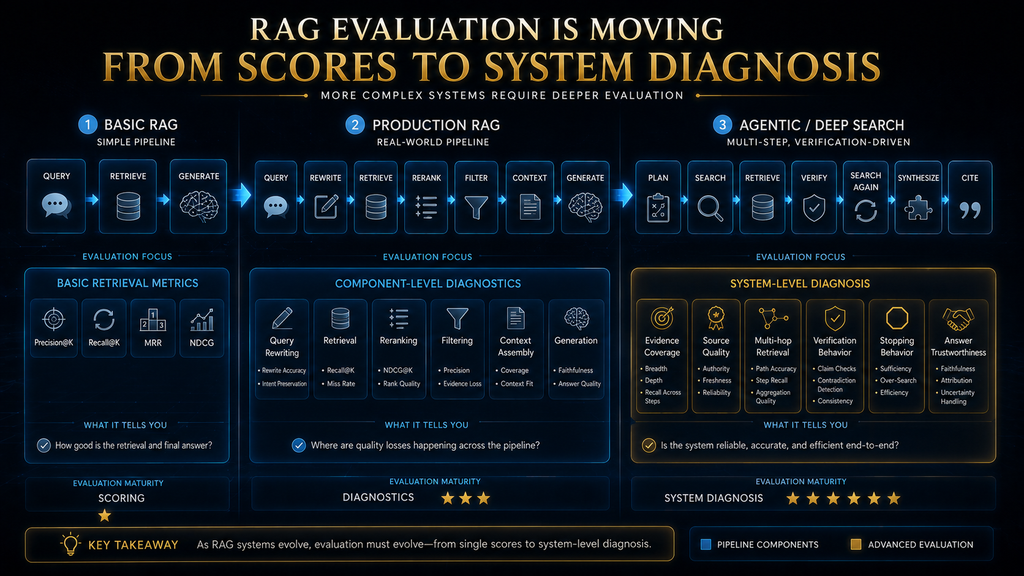
The simple retrieve-then-generate architecture is increasingly being supplemented by query rewriting, multi-step retrieval, reranking, agents, tool use and deeper search. Once a system can decide what to search for, search multiple sources and perform iterative retrieval, a single Recall@K number becomes less informative.
Future evaluation will increasingly need to ask:
- Did the system choose the right retrieval strategy?
- Did it search deeply enough?
- Did it retrieve all required evidence?
- Did it stop searching at the right time?
- Did it recognize when the corpus was insufficient?
- Did it use the correct source?
- Did it preserve permissions and provenance?
- Did it avoid redundant retrieval?
- Did it make the final answer traceable to supporting evidence?
Research is already moving in this direction. The Deep Search benchmark over heterogeneous enterprise data evaluates multi-hop retrieval across different enterprise artifact types and identifies retrieval as a major bottleneck. Sub-question coverage research likewise argues that open-ended questions often require evaluation of how well a system covers different facets of a question rather than simply whether it produces a generally acceptable answer.
The implication is significant: future RAG evaluation will increasingly resemble system observability rather than static benchmarking.
The Second-Order Effect: Your Evaluation Dataset Becomes a Competitive Asset
There is a strategic benefit to good evaluation that is easy to overlook.
Every production failure that you diagnose and convert into a regression case increases the organization’s understanding of its own information environment.
Over time, your dataset begins to encode:
- how users actually ask questions;
- which documents are authoritative;
- where the corpus is incomplete;
- which query types are difficult;
- which sources conflict;
- which retrieval strategies work;
- which failures have already been solved.
That knowledge is difficult to reproduce quickly.
A competitor can adopt the same embedding model, vector database or reranker. It is much harder to replicate a mature evaluation dataset built from years of domain-specific production behavior.
In that sense, evaluation is not merely quality assurance.
It is accumulated product intelligence.
The RAG Evaluation Checklist
Before calling a RAG retrieval system “production-ready,” ask whether you can answer these questions with evidence rather than intuition.
| Evaluation question | Can you answer it? |
|---|---|
| Do we know which queries the system is expected to answer? | ✓ / ✗ |
| Do we have labeled relevant evidence for important test cases? | ✓ / ✗ |
| Do we measure retrieval separately from generation? | ✓ / ✗ |
| Do we measure both coverage and ranking? | ✓ / ✗ |
| Do we test hard negatives? | ✓ / ✗ |
| Do we test unanswerable questions? | ✓ / ✗ |
| Do we test multi-document questions? | ✓ / ✗ |
| Do we test production-specific filters and permissions? | ✓ / ✗ |
| Do we test exact identifiers where relevant? | ✓ / ✗ |
| Do we test difficult document formats? | ✓ / ✗ |
| Do we track latency and cost? | ✓ / ✗ |
| Do we compare new configurations against a baseline? | ✓ / ✗ |
| Do important production failures become regression tests? | ✓ / ✗ |
| Do we periodically validate automated evaluations against humans? | ✓ / ✗ |
| Can we identify whether a bad answer came from retrieval or generation? | ✓ / ✗ |
If several answers are “no,” the system may still work, but your ability to prove that it works—and explain when it does not—is limited.
The Most Useful Mental Model for RAG Evaluation
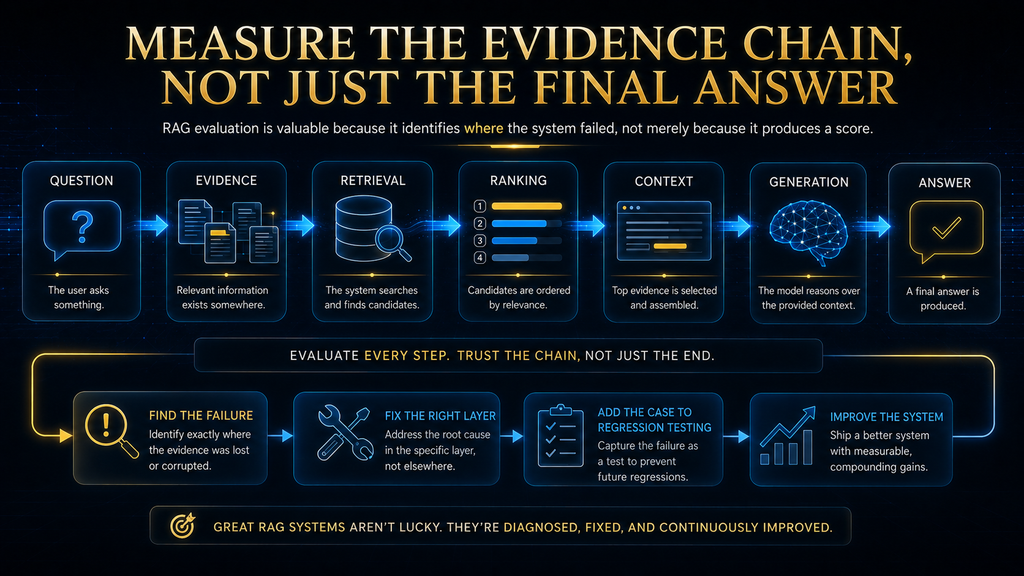
Think of the evaluation process as a chain of evidence.
The user asks a question.
The system needs to understand that question.
The knowledge base needs to contain the relevant information.
That information needs to be represented in a retrievable form.
The retriever needs to find it.
The ranking system needs to put it in a useful position.
Filters need to preserve it.
Context assembly needs to deliver it.
The generator needs to use it correctly.
The final answer needs to remain faithful to the evidence.
A failure anywhere in that chain can produce the same visible symptom: a bad answer.
That is why the best RAG evaluation strategy is not the one with the most metrics.
It is the one that gives you the clearest path from failure to diagnosis to action.
Final Thoughts
A RAG system should not be judged by a single number because retrieval quality is not a single property. A system can retrieve highly relevant documents but miss important evidence, achieve high recall while flooding the model with noise, find the right passage but rank it too low, or retrieve everything correctly and still produce a poor answer because the generation layer failed to use the context.
The practical solution is to evaluate RAG as a chain of decisions. Start with Coverage: did the system find enough of the evidence required for the task? Move to Ranking: did the strongest evidence appear early enough? Check Applicability: was the information current, authorized and appropriate for the user’s context? Test Failure Robustness with unanswerable, multi-turn, hard-negative and difficult-document cases. Then bring in Time and Cost so that quality improvements remain economically and operationally realistic.
Most importantly, do not stop at the score. When a RAG answer fails, trace the evidence backward until you know where the failure occurred. If the knowledge was missing, improve the corpus. If the representation was broken, fix extraction or chunking. If the evidence existed but was not retrieved, investigate the retrieval layer. If it was retrieved but ranked poorly, investigate ranking. If filters removed it, fix the constraint logic. If the correct evidence reached the model and the answer was still wrong, stop tuning retrieval and investigate generation.
That diagnostic discipline is what separates a RAG system that merely appears to work from one that can be measured, improved and trusted.
The most useful takeaway is simple: a good RAG evaluation system does more than tell you whether your retrieval is good. It tells you what to fix when it is not.
Frequently Asked Questions
1. What is RAG retrieval quality?
RAG retrieval quality describes how effectively a retrieval system finds the evidence needed to answer a user’s question and places that evidence in a useful position for the generation stage. It includes more than semantic similarity: a strong system needs sufficient coverage, appropriate ranking, correct filtering and reliable behavior across different query types.
2. What is the best metric for evaluating RAG retrieval?
There is no single best metric for every RAG system. Recall@K is useful for measuring whether required evidence is being found, Precision@K helps measure retrieval noise, MRR and NDCG evaluate ranking quality, and context-oriented metrics can assess whether the final retrieved context contains sufficient evidence for the answer.
3. What is Precision@K in RAG?
Precision@K measures how many of the top K retrieved results are relevant. For example, if four of the top five retrieved passages are relevant, Precision@5 is 80%. It is useful for identifying retrieval systems that return too much irrelevant context, but it should be evaluated alongside recall because high precision can still occur when important evidence is missing.
4. What is Recall@K in RAG?
Recall@K measures how much of the relevant evidence appears within the top K retrieved results. It is especially useful for detecting situations where the retriever returns some relevant information but fails to retrieve everything needed to answer the question.
5. What is the difference between MRR and NDCG?
MRR focuses primarily on the position of the first relevant result, making it useful when finding one strong result quickly matters. NDCG can account for multiple results with different levels of relevance and therefore provides a richer view of ranking quality when several retrieved items may contribute differently to the task.
6. How do you build a RAG evaluation dataset?
Start with representative user questions and label whether each question is answerable from the knowledge base, which documents or chunks contain the necessary evidence, and what a successful answer should contain. Then add difficult cases such as paraphrases, hard negatives, multi-document questions, unanswerable requests, exact identifiers, version-sensitive queries and multi-turn conversations where those cases reflect the real application.
7. Should RAG retrieval and generation be evaluated separately?
Yes. Separating retrieval from generation makes failure diagnosis much easier. If the correct evidence never reaches the model, changing the language model or prompt is unlikely to solve the underlying retrieval problem; if the correct evidence reaches the model but the answer is still wrong, the investigation should move downstream.
8. Can LLMs reliably evaluate RAG systems?
LLM judges can be useful for scaling semantic evaluation, but they should not be treated as infallible ground truth. Human-reviewed examples remain important for calibration, particularly in specialized domains where relevance, authority or correctness requires nuanced judgment.
9. How do you test unanswerable questions in RAG?
Include questions whose answers are genuinely absent from the knowledge base and define the expected behavior before running the test. The evaluation should distinguish between correctly rejecting an unsupported request and incorrectly producing an answer from weakly related retrieved material; research such as UAEval4RAG specifically addresses this dimension of RAG evaluation.
10. How often should a production RAG system be evaluated?
Evaluation should happen continuously at different levels. Run regression tests whenever important retrieval components change, monitor production traces for new failure patterns, and periodically review automated evaluations against human judgments. The goal is to make production failures feed back into the evaluation dataset rather than treating evaluation as a one-time benchmark.
Go Deeper Into AI Systems
RAG retrieval is only one part of building reliable AI systems. Explore more practical guides from AI Hustle World covering RAG, vector databases, embeddings, AI tools, automation, and modern AI workflows.
Keep learning how these systems work, where they fail, and how to use them more effectively in real-world applications.
Explore AI Hustle World →Written by
Muntasir Ahmad Chowdhury
Founder, AI Hustle World
Muntasir Ahmad Chowdhury is the Founder of AI Hustle World, an independent publication dedicated to making Artificial Intelligence practical, trustworthy, and easy to understand. He researches AI tools, automation, customer service, productivity, and real-world business applications, helping readers make smarter technology decisions through research-driven, experience-backed content.
Expertise:
AI Tools • AI Automation • AI Customer Service • AI Productivity • Generative AI • AI Workflows
Get Smarter With AI
Enjoyed this guide? Get practical AI tools, tutorials, and honest reviews delivered to your inbox.