Evidence: Documentation reviewed
Last checked: September 2026
What was done: Written from official documentation and the published sources linked in this article. Not hands-on tested.
Files: None
Affiliate links: No
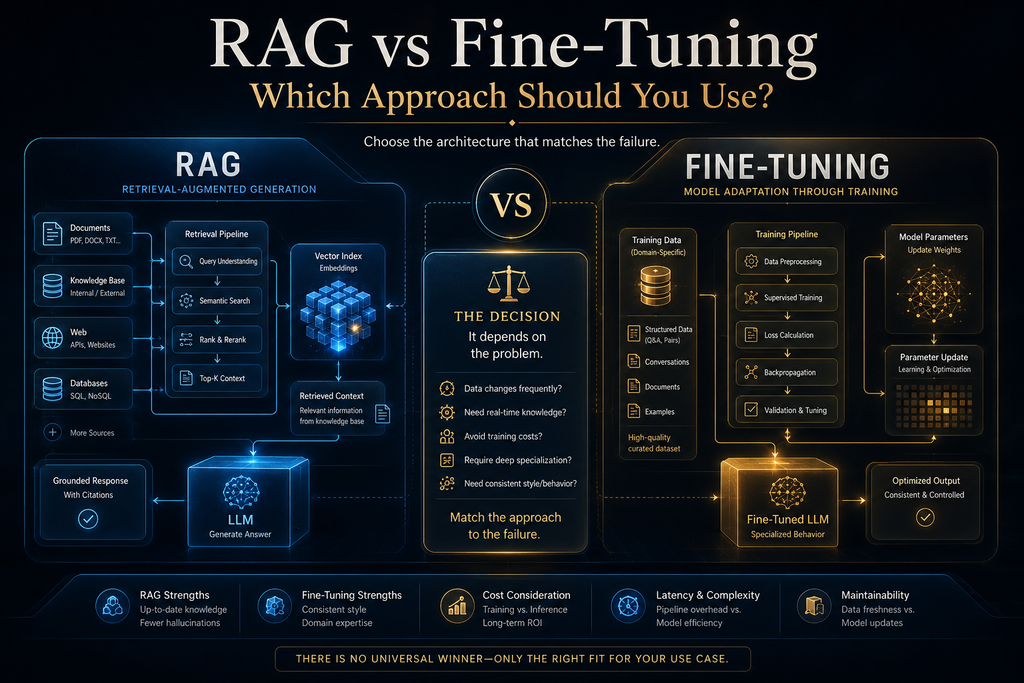
RAG vs Fine-Tuning: Which Approach Should You Use?
Choosing between Retrieval-Augmented Generation (RAG) and fine-tuning sounds like a straightforward technical comparison until you actually have to build the system.
A team has an AI assistant that gives incomplete answers, so someone recommends RAG. Another team wants more consistent outputs, so someone recommends fine-tuning. A third person suggests using both. All three recommendations can be correct, but they solve different problems—and choosing the wrong one can leave you with a more complicated system that still fails for the same underlying reason.
The better question is not “Is RAG better than fine-tuning?” It is “What exactly needs to change in our AI system?” If the model needs access to information it does not reliably have, retrieval is usually the more direct intervention. If the model already has enough information but struggles to perform a task consistently, changing its learned behavior through fine-tuning may make more sense. When both information access and behavior need improvement, a hybrid architecture can combine the two.
There is also a fourth option that gets ignored in most comparisons: neither. Sometimes the real problem is poor prompting, weak retrieval configuration, inadequate source data, a badly chosen model, missing tool integration, or a task that should be handled by a conventional database or deterministic application logic. Adding RAG or fine-tuning before diagnosing that problem is how AI projects accumulate unnecessary complexity.
This guide breaks down RAG and fine-tuning from that first-principles perspective. Instead of treating them as rival technologies, we will examine what each one changes, how each works, where each fails, what they cost to operate, when they should be avoided, when they should be combined, and how to make the decision using a practical framework.
The Core Difference Between RAG and Fine-Tuning
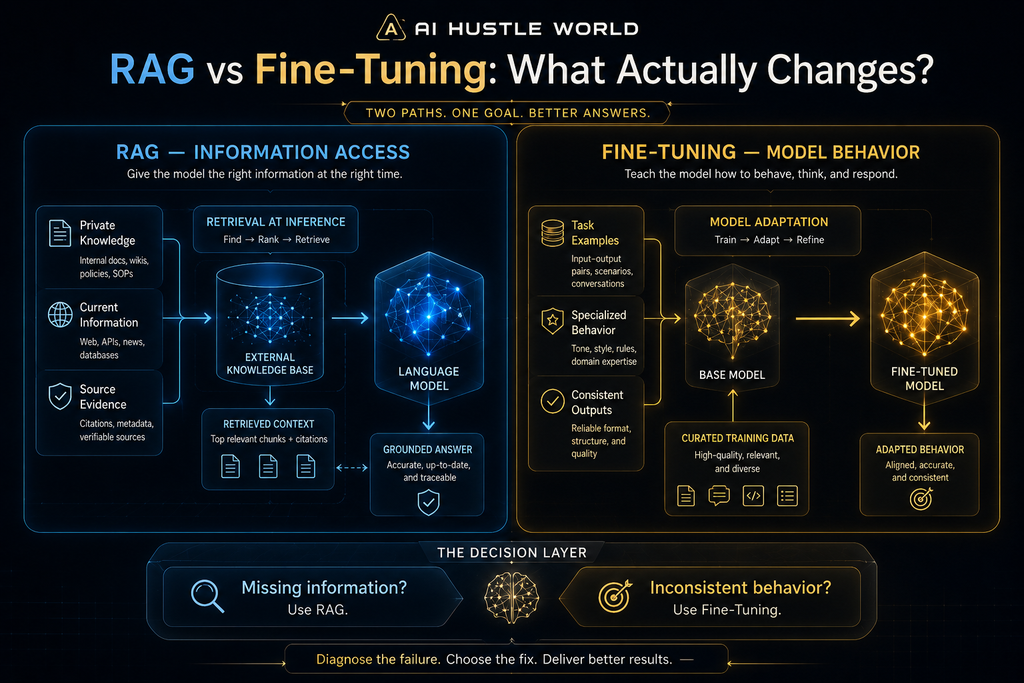
RAG primarily changes the information available to a model at inference time, while fine-tuning changes the model itself by adapting its learned parameters to a particular task, behavior, or domain.
That distinction is simple, but it explains much of the practical difference between the two approaches. In a RAG system, the underlying language model remains the same while an external retrieval system searches a knowledge source and places relevant information into the model’s context before generation. The model can therefore work with information that was not contained in its original training data, including private documents and information that has changed since the model was trained.
Fine-tuning works at a different layer. Instead of retrieving a document every time a question arrives, you provide training examples that cause the model’s parameters to adapt toward a desired behavior or task. The result is not simply a model with a temporary piece of information in its context; it is an adapted model whose behavior has been influenced by the training process.
This is why the familiar shortcut—RAG is for knowledge and fine-tuning is for behavior—is useful but incomplete. A company’s knowledge base may contain thousands of facts, but the real engineering question is whether those facts need to be dynamically retrieved or whether the model actually needs to learn a repeatable behavior. Conversely, a model may have access to the right information through RAG and still produce inconsistent classifications, formatting, tone, or task execution. In that case, better retrieval alone may not solve the problem.
The distinction becomes even more important when the information changes. If a company’s product prices, internal policies, inventory, or regulatory documents change regularly, storing those facts inside model behavior creates a maintenance problem. A retrieval system can update the underlying knowledge source without requiring the model itself to be retrained every time a document changes.
Fine-tuning is therefore better understood as model adaptation, while RAG is better understood as knowledge access and grounding. Neither is inherently more advanced. They simply operate on different parts of the system.
Think in Layers: Where Does the Problem Actually Live?
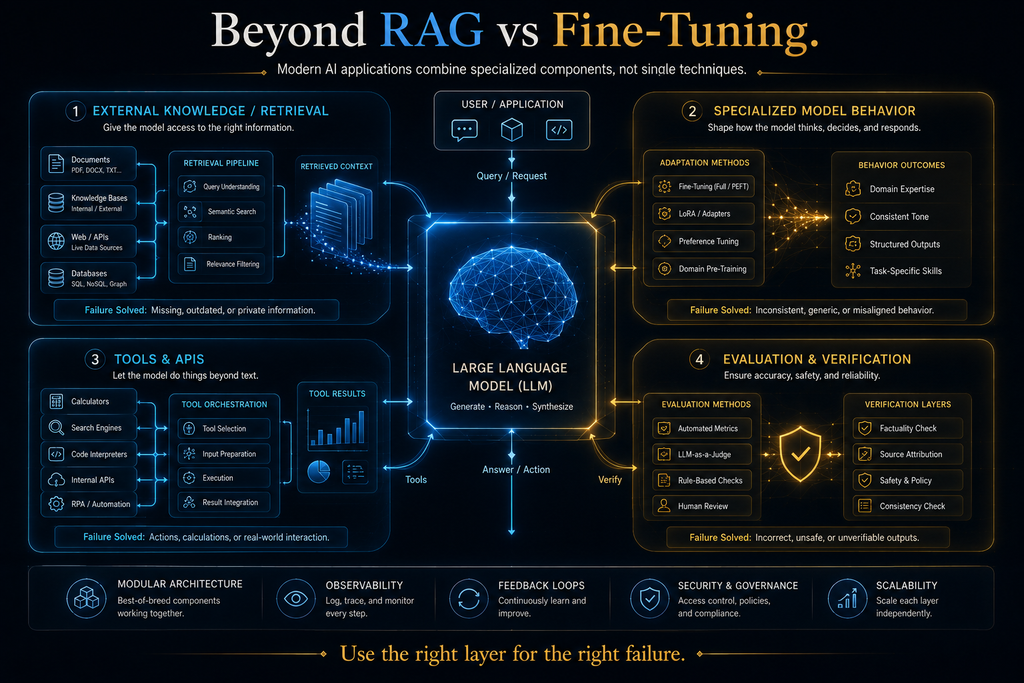
Before choosing an architecture, it helps to think of an AI application as a set of layers rather than a single model.
At the bottom is the information layer: documents, databases, product catalogs, policies, manuals, records, websites, APIs, and other sources of truth. Above that is the retrieval or tool layer, which determines what information the system can access for a particular request. The next layer is the model, which interprets instructions and produces an output. Around all of this are evaluation, security, business rules, monitoring, and human review.
RAG primarily operates between the information layer and the model. It determines what evidence is brought into the model’s context when the user asks a question. Fine-tuning operates inside the model layer by modifying how the model responds to certain types of inputs.
That gives us a useful diagnostic question: Is your AI failing because it does not have the right information, or because it does not reliably use what it already knows?
Consider a customer-support assistant for a software company. Suppose the assistant knows how to write clearly, but the company’s pricing page changed yesterday and the model has no access to that updated information. Fine-tuning the model does not directly solve the freshness problem. The missing capability is access to current information, so a retrieval layer is the more logical intervention.
Now consider a different problem. The assistant has access to the correct support documentation and can retrieve the relevant article, but it frequently returns responses in inconsistent formats. Management wants every ticket classified into one of eight categories and returned in a predictable structure. In that case, the problem may be behavioral rather than informational. Better retrieval cannot automatically teach the model to perform that specialized classification task consistently.
This distinction should guide the entire decision.
How RAG Works
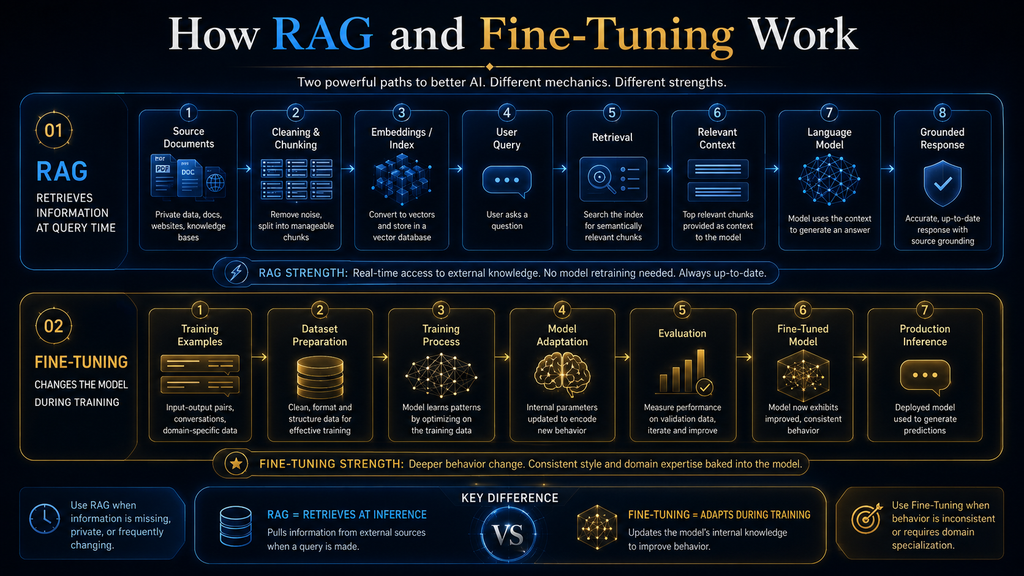
RAG works by retrieving relevant external information and supplying that information to a language model as context before the model generates its answer.
The important word is retrieving. A RAG system does not normally put an entire knowledge base into the model. That would be inefficient, expensive, and often impossible. Instead, the system processes the user’s question, searches an indexed knowledge source, selects relevant pieces of information, and constructs a context package that the language model can use.
A production RAG workflow generally begins before the first user question is ever asked. Documents have to be collected, cleaned, divided into useful chunks, represented in a searchable form, indexed, and associated with metadata. Depending on the architecture, the system may use vector search, keyword search, hybrid search, reranking, metadata filtering, or several of these techniques together.
When the user asks a question, the system transforms the query into a representation suitable for retrieval. It then searches the knowledge system and identifies candidate passages. Those passages may be reranked so that the most useful evidence appears first, after which the system assembles an appropriate context for the language model.
The model then generates an answer based partly on that retrieved context. In a stronger production architecture, the process can continue with verification, citation checks, confidence assessment, or an abstention mechanism when the available evidence is insufficient.
That last part matters because RAG does not magically make a model truthful. It gives the model access to evidence. If the wrong evidence is retrieved, if the source itself is wrong, if important information was omitted during indexing, or if the model generates claims that go beyond the evidence, the system can still fail.
This is why RAG is an architecture rather than a single feature.
Why RAG Exists in the First Place
The traditional alternative to RAG was largely to rely on the model’s pretrained knowledge, prompts, and whatever information could fit directly into the request context. That approach works surprisingly well for general questions, but it has a structural weakness: the model’s internal knowledge is not a live company database.
A language model may know a great deal about a subject, yet still be unsuitable as the sole source of truth for a business application. Company policies change. Product catalogs change. Prices change. Employees leave. Documentation gets revised. New research appears. Private information is not necessarily present in public training data at all.
The conventional solution in software engineering has always been to keep changing information in an external system and retrieve it when needed. RAG applies that familiar principle to language-model generation.
This is also why RAG should not be thought of simply as “giving an AI a database.” The difficult part is deciding which information matters for a particular question, retrieving it accurately, fitting it into the model’s context, and controlling what the model does with it. That is where the engineering work lives.
How Fine-Tuning Works
Fine-tuning adapts an existing model by training it on task-specific examples so that its learned behavior becomes better suited to a particular use case.
Instead of retrieving a document and placing it into context for every request, fine-tuning changes the model’s parameters through additional training. The training examples demonstrate the behavior you want the model to reproduce, and the optimization process adjusts the model toward those patterns.
Imagine a company receiving thousands of customer messages that need to be categorized into a fixed set of support categories. A fine-tuning dataset could contain representative examples of customer messages paired with the desired classifications. The objective is not to store the company’s entire knowledge base inside the model. The objective is to make the model better at the classification task.
The same principle can apply to structured outputs, specialized language patterns, domain-specific tasks, formatting conventions, and other repeatable behaviors. Parameter-efficient techniques such as LoRA can reduce the resources required for some fine-tuning workflows, but the underlying concept remains the same: the model is being adapted through training rather than supplied with a new document at inference time.
That distinction has major operational consequences.
A RAG system can potentially change its knowledge by changing the documents available to retrieval. A fine-tuned model cannot simply “forget” yesterday’s training examples because you replaced a PDF. If the information encoded into the model needs substantial modification, you may need another training process or a different architecture around the model.
Fine-tuning therefore makes the most sense when the desired improvement is fundamentally about how the model performs, rather than simply what information it can access.
RAG and Fine-Tuning Solve Different Failure Modes
One of the biggest mistakes teams make is treating poor AI output as a single problem called “model quality.” It is not.
Suppose an AI assistant gives a wrong answer. There are many possible reasons. The knowledge base might contain the wrong information. The correct document might exist but never be retrieved. The retrieval system might return a related but incomplete passage. The context might be too large or poorly assembled. The model might ignore relevant evidence. The prompt might be ambiguous. The model might understand the evidence but fail to follow a required output format. Or the task might simply require a capability that the chosen model does not perform well.
These failures look similar from the user’s perspective because they all end with “the AI gave me a bad answer.” From an engineering perspective, however, they require completely different interventions.
RAG is strongest when the missing capability is access to external evidence. Fine-tuning becomes more attractive when the missing capability is repeatable specialized behavior.
That leads to a more useful diagnostic model:
| Failure you observe | More likely intervention |
|---|---|
| Model lacks access to private documents | RAG |
| Information changes frequently | RAG |
| Answers need source references | RAG |
| Relevant knowledge exists outside the model | RAG |
| Retrieval consistently misses relevant information | Improve RAG before fine-tuning |
| Model has information but follows the wrong output pattern | Fine-tuning candidate |
| Repetitive classification task | Fine-tuning candidate |
| Specialized response behavior | Fine-tuning candidate |
| Current knowledge + specialized behavior | Hybrid |
| Problem is mainly prompt quality | Improve prompting first |
| Problem is wrong model choice | Evaluate a better model first |
| Exact structured business data is required | Database/API/tool may be better |
The table is not a set of absolute laws. It is a diagnostic starting point.
When RAG Is the Better Choice
RAG is generally the stronger starting point when the central requirement is access to external, private, current, or source-verifiable information.
Frequently changing knowledge
If the information changes often, RAG has a fundamental advantage because the knowledge source can be updated independently of the language model.
Consider an online retailer whose product inventory and prices change every day. It would be operationally awkward to retrain a model whenever a price changes. A retrieval or direct database architecture can query the current information when the customer asks a question.
The same principle applies to company policies, employee handbooks, technical documentation, internal procedures, product specifications, and other knowledge that evolves over time. The deeper lesson is not simply that “RAG is good for fresh data.” It is that information that changes independently of model behavior should usually remain outside the model whenever practical.
Private organizational knowledge
A company may have years of internal documentation that was never part of a public model’s training data. RAG provides a mechanism for connecting the model to that private information without treating the model’s weights as the company’s permanent knowledge repository.
This can be particularly valuable when different users need access to different information. A retrieval system can apply permissions, metadata filters, document-level controls, or other access policies before information is passed to the model.
That makes the architecture more adaptable than attempting to encode every employee’s accessible knowledge into one model.
Answers that require evidence
RAG is also a strong candidate when the user needs to know where the answer came from.
A customer may want the policy document supporting an answer. An employee may need the section of an internal handbook used by an assistant. A researcher may need the source passages behind a generated summary.
Fine-tuning by itself does not provide that same direct relationship between an individual generated claim and an external source document. A model can be trained on information, but that does not automatically give the user a traceable source for every future statement.
That makes retrieval particularly valuable in applications where auditability and source grounding matter.
When RAG Is Not the Answer
RAG is powerful, but it is increasingly used as a default solution to problems that are not retrieval problems.
Suppose you build a RAG system for a document-classification workflow and discover that the model still produces inconsistent labels. Adding more documents to the retrieval system may not help. The problem may be that the model needs stronger task-specific behavior rather than more information.
Likewise, if a system already retrieves the correct passages but the model repeatedly misunderstands the desired output format, adding another vector database will not fix the underlying issue.
This is where teams can waste significant engineering time. They improve chunking, change embeddings, tune retrieval thresholds, add reranking, increase context, and switch vector databases when the actual problem is simply that the model needs to perform a specialized task more consistently.
Better retrieval cannot solve a behavior problem. That sentence is worth remembering because it prevents a surprising amount of unnecessary RAG engineering.
When Fine-Tuning Is the Better Choice
Fine-tuning becomes more compelling when the model needs to learn a consistent task or behavioral pattern that prompting alone is not delivering reliably enough.
Repetitive classification
Classification is one of the clearest examples.
Imagine an organization that receives thousands of support tickets every week and wants every ticket categorized into a fixed taxonomy. If the model understands the language but struggles to apply the organization’s classification rules consistently, fine-tuning can be worth investigating.
The training data can demonstrate how representative inputs map to desired outputs. Over time, the model becomes adapted to that particular task rather than being asked to infer the desired behavior from a long prompt every time.
The economic case can become especially interesting at high volume because even a small improvement in consistency can matter when multiplied across thousands or millions of interactions.
Structured output
Fine-tuning can also be useful when an application repeatedly requires a particular output behavior.
For example, an organization may need a model to transform messy incoming text into a standardized structure. Prompting can often achieve this, particularly with modern models, so fine-tuning should not automatically be the first step. But when the task is repeated at scale and the desired behavior is stable, model adaptation may become worthwhile.
The important condition is stability.
If the desired format changes every week, investing heavily in model adaptation may create more maintenance work than value. If the task remains stable for a long period and occurs at high volume, the economics can look very different.
Specialized behavior and tone
Fine-tuning may also be useful when the model needs to behave consistently according to a specialized communication pattern.
This does not mean fine-tuning is automatically necessary to make a model “sound professional.” Modern models can often follow tone instructions effectively through prompting. The justification becomes stronger when the desired behavior is complex, repetitive, and difficult to maintain through instructions alone.
This is why the right comparison is not: “Can fine-tuning change tone?” It can.
The better question is: “Is the improvement in behavioral consistency valuable enough to justify creating and maintaining a training pipeline?” That is an ROI question, not a capability question.
Fine-Tuning Is Not a Replacement for a Knowledge Base
This is where one of the most persistent misconceptions needs to be corrected. If you have a 5,000-page internal knowledge base, fine-tuning the model on that material does not automatically turn the model into a reliable, searchable database.
The model may learn patterns from the training data, but that is different from maintaining an explicit relationship between a question and a current source document. Updating a knowledge repository also becomes more complicated if information is effectively embedded into model behavior.
Imagine a company’s HR policy changes every quarter. If those policies are treated as model-training material, each substantial change potentially creates a new model-maintenance problem. With RAG, the document can remain an external source and the retrieval system can bring the current policy into context.
This does not make RAG perfect. The retrieval system still needs to be maintained, evaluated, secured, and updated. But the architecture matches the nature of the problem more directly.
The practical rule is therefore:
If the information behaves like a database, treat it like a database before treating it like model behavior.
That is one of the strongest architecture principles in this entire comparison.
RAG vs Fine-Tuning for Accuracy
There is no universal winner for “accuracy” because accuracy is not a single property of an AI system.
A RAG system can improve factual performance when the model needs external evidence, but it can also fail if retrieval is poor. A fine-tuned model can improve task consistency, but that does not automatically make it a better source of current factual information.
Consider two systems.
The first retrieves the correct policy document but generates a response that violates the required format. Its retrieval accuracy may be excellent while its task performance is poor.
The second produces perfectly formatted responses but uses outdated information. Its behavioral consistency may be excellent while its factual reliability is poor.
Calling one system “more accurate” without defining the evaluation target hides the actual engineering problem. A better measurement framework separates at least these dimensions:
- Retrieval relevance: Did the system find the right evidence?
- Context sufficiency: Was enough useful evidence supplied?
- Groundedness: Does the generated answer stay supported by the supplied evidence?
- Task success: Did the model perform the intended task correctly?
- Format compliance: Did it produce the required structure?
- Factual correctness: Are the substantive claims actually correct?
- User outcome: Did the answer solve the user’s real problem?
This distinction is particularly important for commercial decisions because vendors can describe their systems as “more accurate” while measuring completely different things.
RAG vs Fine-Tuning for Hallucinations
RAG can reduce some hallucination risks because it gives the model external evidence to work from, but RAG does not eliminate hallucinations.
The retrieval system itself can fail. The knowledge base may contain outdated information. The correct passage may not be retrieved. The retrieved passages may contradict one another. The context may omit an important qualification. The model may then produce a plausible statement that is not actually supported by the evidence.
Fine-tuning has a different relationship with hallucination. Fine-tuning may improve behavior for a particular task, but it does not automatically turn a model into a reliable factual database.
This creates an important boundary condition: Neither RAG nor fine-tuning should be treated as a substitute for evaluation and verification. If the application is high consequence, the architecture may need explicit verification, source attribution, confidence thresholds, deterministic checks, human review, or an ability to abstain when the available evidence is insufficient.
The best architecture is therefore often not: RAG → answer but something closer to: retrieve → assess evidence → generate → verify → answer or abstain. The exact implementation varies by application, but the principle is consistent: adding technology to a pipeline does not remove the need to control failure modes.
RAG vs Fine-Tuning for Data Freshness
Freshness is one of the clearest architectural differences.
RAG allows knowledge to remain external to the model, which makes it naturally suited to information that changes independently of the model. Fine-tuning creates a stronger relationship between the model’s learned behavior and the training material, so changes to information can create a retraining or model-versioning problem.
That does not mean fine-tuning can never work with changing information. A fine-tuned model can be combined with tools, retrieval, APIs, or databases. In fact, this is one reason hybrid systems are becoming important.
The deeper point is that freshness and behavior are different dimensions.
A model can be fine-tuned to follow a company’s support style while RAG provides the current product documentation. The model’s behavior remains specialized while its factual context comes from an external knowledge source.
That combination is often more logical than trying to force one technique to do both jobs.
RAG vs Fine-Tuning for Privacy and Security
Privacy is more complicated than simply declaring one architecture “more private.”
RAG can keep sensitive knowledge in controlled external systems and retrieve only the information needed for a particular request. That can support granular access control when the retrieval architecture is designed properly.
However, retrieved content eventually reaches the model context, so the security of the model provider, application layer, logging system, prompts, connectors, and surrounding infrastructure still matters.
Fine-tuning has its own considerations. If sensitive information is included in training data, the organization has to manage the training process, model versions, access, retention, evaluation, and deployment appropriately.
The correct question is therefore not: “Is RAG private?” It is: “Where does sensitive information live, who can retrieve it, where does it travel, and how is access controlled throughout the complete workflow?” That is a much more useful security question.
RAG vs Fine-Tuning: Cost Is More Complicated Than “RAG Is Cheaper”
RAG is often described as the cheaper option because it avoids model retraining. Fine-tuning is often described as expensive because it introduces training infrastructure and data preparation.
Both statements contain some truth, but neither is a sufficient cost model. A RAG system may require:
- document ingestion;
- cleaning and parsing;
- chunking;
- embedding generation;
- vector storage;
- metadata management;
- retrieval infrastructure;
- reranking;
- context construction;
- additional inference tokens;
- monitoring;
- evaluation;
- access-control integration;
- ongoing knowledge-base maintenance.
A fine-tuning system may require:
- dataset creation;
- data cleaning;
- annotation;
- training;
- evaluation;
- training compute;
- model hosting;
- deployment;
- version management;
- regression testing;
- retraining when behavior needs to change.
The economics therefore depend heavily on the workload.
Suppose a company has a small, stable classification task running at extremely high volume. Fine-tuning may have a compelling ROI because the behavior is stable and the model is repeatedly performing the same task.
Now consider a company with a large knowledge base that changes every week. RAG may be economically superior because updating external information is much easier than continuously retraining the model.
The real question is: Which recurring cost structure matches the workload?
The Hidden Cost: Complexity
Direct infrastructure cost is only part of the equation. Every additional component in an AI architecture creates another failure surface.
A sophisticated RAG system might include ingestion pipelines, parsers, chunking strategies, embedding models, vector databases, hybrid search, rerankers, access controls, caching, model APIs, evaluation systems, observability, and verification.
That can be justified when the application needs those capabilities. But if a simple model plus a strong prompt solves the task, building the entire architecture is poor engineering.
Fine-tuning has a similar hidden cost. The training run itself may not be the biggest problem. Dataset maintenance, evaluation, version control, deployment, regression testing, and retraining can become the real operational burden. This is why the best AI architecture is not the one with the most sophisticated components.
It is the smallest architecture that reliably solves the actual problem.
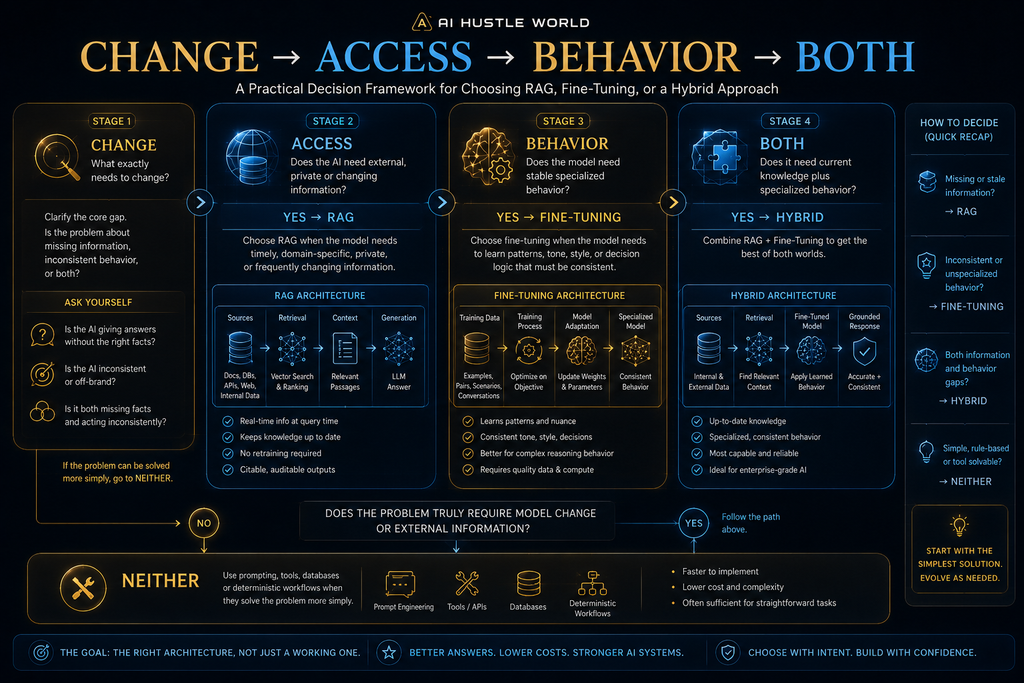
The AI Hustle World CHANGE–ACCESS–BEHAVIOR Framework
To make the RAG vs fine-tuning decision easier, AI Hustle World can use a simple framework:
CHANGE
First ask: What exactly needs to change in the system?
If the answer is unclear, stop here. Do not choose RAG or fine-tuning yet. Define the failure in observable terms.
- Instead of saying: “The AI isn’t good enough.”
- Say: “The assistant cannot answer questions about documents updated after January.”
- Or: “The model understands the task but classifies similar support tickets inconsistently.”
The second versions are actionable because they identify a specific failure.
ACCESS
Next ask: Does the system need access to information it currently cannot reliably access? If yes, investigate RAG, databases, APIs, search, or tool integration. This includes private documents, changing information, source-grounded answers, internal policies, product information, and large external knowledge collections.
BEHAVIOR
Then ask: Does the model already have enough information but fail to perform the desired task consistently? If yes, investigate prompting, model selection, structured outputs, or fine-tuning. Fine-tuning becomes more compelling when the behavior is stable, repetitive, measurable, and valuable enough to justify training and maintenance.
BOTH
Finally ask: Does the system need both current knowledge and specialized behavior? If yes, a hybrid architecture may be appropriate. For example, a customer-support assistant could use RAG to retrieve current product documentation while a fine-tuned model provides consistent classification or response behavior.
This framework prevents the conversation from starting with technology. It starts with the problem.
RAG vs Fine-Tuning: The Decision Matrix
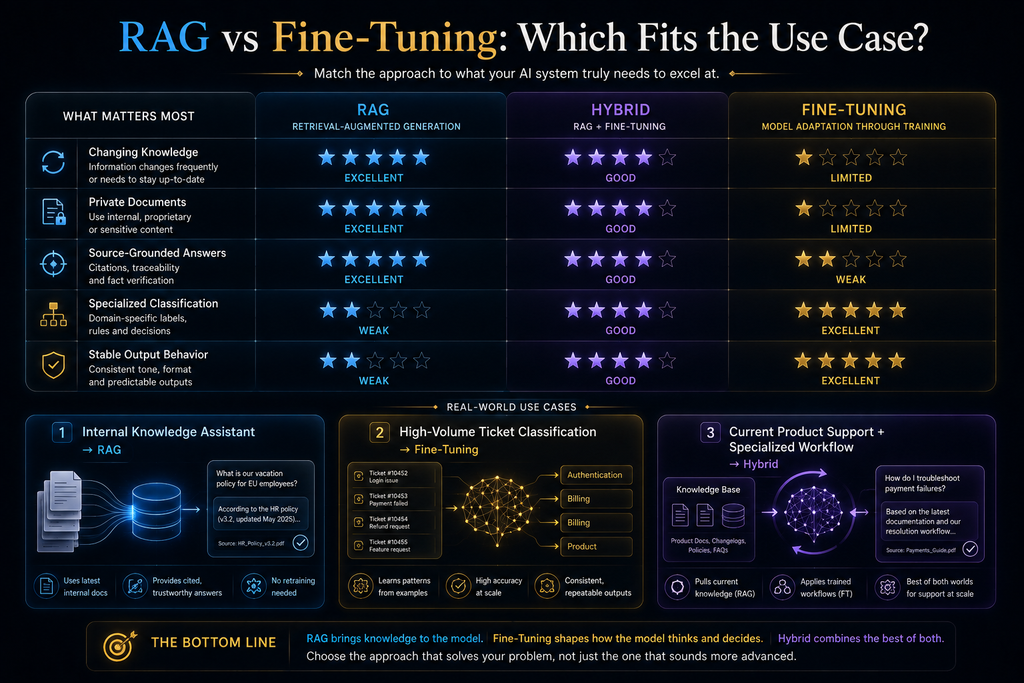
The following matrix is designed as a practical decision aid rather than a universal scoring system.
| Requirement | RAG | Fine-Tuning | Hybrid |
|---|---|---|---|
| Frequently changing knowledge | Excellent fit | Poor fit alone | Excellent fit |
| Private document access | Excellent fit | Possible | Excellent fit |
| Source citations | Strong | Weak alone | Strong |
| Large document collections | Strong | Poor fit alone | Strong |
| Current company policies | Strong | Poor fit alone | Strong |
| Specialized classification | Possible | Strong | Strong |
| Consistent output behavior | Moderate | Strong | Strong |
| Stable task-specific behavior | Moderate | Strong | Strong |
| Specialized tone/style | Possible | Strong candidate | Strong |
| Grounded factual answers | Strong candidate | Weak alone | Strong |
| Knowledge + behavior specialization | Limited alone | Limited alone | Excellent fit |
| Knowledge updates without retraining | Strong | Weak | Strong |
| Simple implementation | Moderate | Moderate | More complex |
| High-volume repetitive workflow | Depends | Strong candidate | Depends |
| Auditability through external sources | Strong | Limited | Strong |
| Need for external databases/APIs | Strong | Not sufficient alone | Strong |
The important word in this table is candidate. None of these columns should be interpreted as an automatic architectural decision.
When You Should Use RAG
RAG is generally worth serious consideration when several of these conditions are true:
- Your information exists outside the model.
- The information changes over time.
- Users need answers from private documents.
- The answer needs source evidence.
- You have a meaningful knowledge base.
- Users ask unpredictable questions across that knowledge base.
- You need to update knowledge without retraining the model.
- Retrieval can reasonably identify the evidence required for the task.
A particularly strong RAG use case is an internal knowledge assistant where employees ask questions across policies, technical documentation, procedures, and company resources. The key characteristic is not simply “documents.” It is that the documents are the source of truth and the model is the reasoning/interface layer around them.
When You Should Use Fine-Tuning
Fine-tuning deserves consideration when:
- The task is stable.
- The desired behavior is measurable.
- The model repeatedly performs the same specialized task.
- Prompting does not provide sufficient consistency.
- You have enough high-quality training examples.
- The expected benefit justifies the training and maintenance cost.
- The problem is primarily behavioral rather than knowledge-access related.
A high-volume classification workflow is a good example. So is a specialized transformation task where the input varies but the desired output pattern remains highly consistent.
The strongest candidates usually have repeatability. If every request is completely different and depends on changing external information, fine-tuning alone is unlikely to be the right architecture.
When You Should Use Both
The hybrid approach becomes attractive when the model needs current information and specialized behavior at the same time. Imagine a technical-support assistant for a complex software product.
The knowledge changes constantly because documentation, product versions, troubleshooting procedures, and known issues are updated. That makes RAG useful for retrieving current evidence. At the same time, the company may want every support interaction classified, summarized, prioritized, and formatted according to a specific internal workflow. That is a behavioral requirement.
Trying to make RAG perform the entire job would place too much responsibility on retrieval and prompting. Trying to make fine-tuning store all the product knowledge would create a difficult knowledge-maintenance problem.
A hybrid architecture allows the two systems to specialize. RAG handles access to changing knowledge. Fine-tuning handles specialized behavior.
That does not mean hybrid is automatically better. It also means maintaining two complex mechanisms rather than one. The organization should therefore use it only when the additional complexity produces a measurable benefit.
Prompt Engineering Before Fine-Tuning
One of the easiest mistakes is jumping from “prompting isn’t perfect” directly to “we need fine-tuning.”
Modern language models can often follow surprisingly sophisticated instructions without additional training. Before fine-tuning, test whether the behavior can be improved through:
- clearer task definitions;
- better examples;
- structured output requirements;
- explicit constraints;
- better context;
- improved model selection;
- tool use;
- retrieval;
- or better evaluation.
The purpose is not to avoid fine-tuning at all costs. The purpose is to establish a baseline. If a better prompt improves performance from unacceptable to reliable, fine-tuning may add complexity without enough incremental value.
If prompting produces inconsistent results despite strong examples and evaluation, and the task is repeated at meaningful scale, fine-tuning becomes much more interesting. That is a much more disciplined progression than treating fine-tuning as the next level after prompting.
The Real Workflow for Choosing an Architecture
A practical architecture decision should happen in stages.
Step 1: Define the failure
Do not start with a technology. Record several real examples of the system failing and categorize what went wrong.
Step 2: Define the success metric
Determine what improvement actually matters.
For one system it might be factual correctness. For another it might be classification accuracy, formatting compliance, response time, citation support, or cost per successful task.
Step 3: Identify whether the problem is information or behavior
Ask whether the model lacks information or fails to use available information appropriately. This is the central diagnostic step.
Step 4: Test the simplest intervention
Try prompt improvements, model selection, better data, tool integration, or retrieval improvements where appropriate. Do not train or rebuild infrastructure before establishing that the simpler approach is insufficient.
Step 5: Introduce RAG when the information-access problem is real
Evaluate retrieval independently from generation. You should know whether the correct evidence is actually being retrieved before blaming the language model.
Step 6: Evaluate fine-tuning when the behavioral problem remains
Use a high-quality evaluation dataset and compare the fine-tuned system against the strongest non-fine-tuned baseline. The question is not whether the fine-tuned model looks impressive. The question is whether it produces a meaningful, repeatable improvement.
Step 7: Consider hybrid architecture only when both layers matter
If current external knowledge and specialized behavior are both essential, combine the approaches. Otherwise, resist the temptation to build a more complicated architecture simply because it appears more sophisticated.
Step 8: Calculate the operational economics
Measure not only development cost but also recurring costs, maintenance, latency, monitoring, updates, and engineering time.
Step 9: Re-evaluate after deployment
AI systems change. The knowledge base changes, user behavior changes, models change, and business requirements change.
The architecture should therefore be treated as a decision that can be revisited—not a permanent declaration of technological identity.
Common Mistakes Teams Make
Fine-tuning a model to store frequently changing facts
This is one of the clearest architectural mismatches.
If information changes frequently, storing it in model behavior creates an update problem. Use an external source when the information needs to remain current and traceable.
Assuming RAG automatically prevents hallucinations
RAG can provide evidence without guaranteeing that the answer is supported by that evidence. The retrieval pipeline needs evaluation, and the generation layer needs appropriate constraints and verification.
Using RAG to solve a behavior problem
If the correct documents are already being retrieved and the model still cannot consistently perform the task, adding more retrieval infrastructure may be solving the wrong problem.
Fine-tuning before creating a proper evaluation set
Without a reliable baseline, you cannot tell whether fine-tuning actually improved the system.
A few impressive examples are not enough. Evaluation should represent the real distribution of tasks and include difficult edge cases.
Choosing technology before defining success
“Let’s build RAG” is not a business requirement. “Employees need answers from current internal policies with source references” is a requirement. The second statement gives engineers something they can actually design and measure.
Ignoring maintenance
A system that works beautifully during a demo can become expensive in production.
RAG requires knowledge and retrieval maintenance. Fine-tuning requires model and dataset maintenance.
The architecture must be evaluated as a living system.
What Happens If You Choose the Wrong Approach?
Choosing the wrong architecture does not always produce an obvious failure. Sometimes the system works well enough to survive testing while accumulating technical debt underneath.
If you use fine-tuning where you really need RAG, you may end up retraining whenever knowledge changes. Your team may struggle to explain where a particular answer came from, and updates can become tied to model versions instead of ordinary knowledge-management workflows.
If you use RAG where the real problem is specialized behavior, the opposite can happen. Engineers may keep modifying prompts, retrieval settings, chunk sizes, ranking strategies, and context construction in an attempt to make the model behave consistently. The system becomes increasingly elaborate while the underlying behavioral problem remains.
If you use either approach when neither is needed, you have created unnecessary infrastructure.
That may sound harmless, but complexity compounds. More components mean more monitoring, more failure modes, more vendor dependencies, more deployment decisions, more testing, and more things that future engineers have to understand.
The cost of the wrong architecture is therefore not just the initial implementation. It is the complexity you carry forward after the original decision.
RAG vs Fine-Tuning for Latency
Latency is another area where simplistic comparisons fail.
RAG introduces retrieval work before generation. Depending on the architecture, that can include query processing, vector search, keyword search, reranking, metadata filtering, network calls, and context assembly.
Fine-tuning does not automatically remove latency either. The final response still depends on the underlying model, generation length, infrastructure, network conditions, and deployment configuration.
A fine-tuned smaller model may sometimes offer attractive economics and latency for a specialized task, while a well-optimized RAG system can also perform efficiently. The correct evaluation is therefore workload-specific. Measure:
- time spent retrieving;
- time spent reranking;
- time spent assembling context;
- model generation latency;
- token volume;
- throughput;
- cache effectiveness;
- and total end-to-end response time.
The important number is user-perceived end-to-end latency, not whether an architecture diagram contains a retrieval box.
RAG vs Fine-Tuning for Scalability
Scalability also depends on what is scaling.
A RAG system has to scale its retrieval infrastructure, knowledge ingestion, storage, indexing, and model inference. A fine-tuned system has to scale model inference and maintain the adapted model and training pipeline.
For a rapidly expanding document collection, retrieval architecture becomes increasingly important. For an enormous volume of repetitive requests, the economics of specialized model inference may become more important.
This is another reason there is no universal winner. The architecture should scale according to the dominant workload constraint.
Economics: Think in Cost per Successful Outcome
A useful way to evaluate RAG versus fine-tuning is to stop thinking exclusively in terms of infrastructure cost. Instead ask: How much does it cost to produce one successful outcome?
For a support assistant, that could mean a correctly resolved customer issue. For an internal knowledge assistant, it could mean a useful answer that an employee can act on without manually searching multiple documents. For a classification system, it could mean a correctly categorized ticket.
This changes the calculation.
A slightly more expensive architecture may still be better if it dramatically reduces human correction. Conversely, a technically impressive architecture may be economically poor if users still have to verify or rewrite most outputs.
The ultimate ROI question is therefore: Does the architecture reduce the total cost of completing the task while maintaining the required level of reliability?
Who Should Prefer RAG?
RAG is generally a strong candidate for organizations that:
- manage large document collections;
- need answers from private information;
- work with frequently changing knowledge;
- need citations or source traceability;
- need retrieval across multiple sources;
- want to update knowledge without retraining;
- or are building internal knowledge assistants and document-based AI systems.
It is particularly attractive when the external knowledge source is clearly the source of truth.
Who Should Prefer Fine-Tuning?
Fine-tuning is more attractive when:
- the task is stable;
- the desired behavior can be demonstrated through examples;
- the workflow occurs frequently enough to justify optimization;
- prompting alone is not sufficiently consistent;
- the output pattern is relatively stable;
- and the organization can support the training and evaluation lifecycle.
Fine-tuning is less attractive when the primary challenge is constantly changing factual knowledge.
Who Should Avoid Both?
Avoid making either technology your first move when:
- you have not clearly defined the failure;
- the model itself is inappropriate for the task;
- better prompting may solve the issue;
- the data source is poor;
- retrieval has not been evaluated;
- the task is better handled by a database or deterministic rule;
- the workload is too small to justify the additional engineering;
- or nobody can define how success will be measured.
This is not anti-RAG or anti-fine-tuning. It is simply good systems engineering.
A Practical Example: Internal Company Assistant
Consider a company building an internal assistant for employees. Employees ask questions such as: “What’s our current leave policy?” “Which process should I follow for a damaged shipment?”
“What is the latest procedure for approving a supplier?” The information lives across internal documents and changes periodically.
RAG is the natural first architecture because the assistant needs access to the company’s current knowledge. The documents can be indexed, retrieved, filtered according to access rules, and supplied to the model as context.
Now suppose employees also want every answer classified by department and risk level, with a consistent structured output used by another workflow.
That introduces a behavioral requirement. The company might begin with prompting and structured outputs. If those are insufficient and the classification behavior is stable enough to justify training, fine-tuning could be added. The resulting system is no longer an ideological choice between RAG and fine-tuning.
It is a layered architecture: external knowledge → RAG → specialized model behavior → structured workflow. That is the more useful way to think about modern AI systems.
A Second Example: Customer Support Classification
Now consider a completely different business.
A company receives 100,000 support messages each month and wants to classify every message into a fixed taxonomy. The model does not need a 10,000-document knowledge base to perform the classification. It primarily needs to understand the organization’s categories and consistently map incoming text to the correct label. A fine-tuning experiment may therefore make more sense than building a full RAG pipeline.
The important variables are:
- how stable the taxonomy is;
- how much labeled training data exists;
- how well the current model performs;
- how expensive human correction is;
- and whether the expected improvement justifies training and maintenance.
If the taxonomy changes constantly, however, the architecture may need to change as well. Again, the correct answer depends on what is changing.
A Third Example: Product Support With Current Information
Now combine the two. A customer asks: “Does the current version of your software support this integration, and if it does, what steps should I follow?” The answer depends on current product documentation, but the company may also want the assistant to respond in a specific troubleshooting structure.
RAG can provide the current product evidence. Fine-tuning may improve specialized support behavior. This is a textbook hybrid candidate.
The system does not need the model to memorize every product update. It needs the model to behave like a specialized support agent while accessing current evidence. That is exactly where hybrid architecture earns its complexity.
How to Evaluate the Decision Before Committing
Do not make this decision from a demo. Build a representative evaluation set.
For RAG, include questions where:
- the answer is clearly present;
- the answer requires combining multiple sources;
- the relevant document is difficult to retrieve;
- similar documents compete with each other;
- information is outdated in one source but current in another;
- the answer should be “I don’t know” because evidence is insufficient.
For fine-tuning, include:
- common cases;
- difficult edge cases;
- ambiguous examples;
- formatting requirements;
- examples outside the exact training pattern;
- and cases where the correct behavior differs from superficial similarity.
Then compare the baseline against the proposed architecture. For a RAG system, evaluate retrieval and generation separately. For a fine-tuned system, evaluate task performance against the strongest non-fine-tuned baseline. For a hybrid system, evaluate whether the combination creates enough incremental improvement to justify the additional complexity.
This prevents a common mistake: measuring the new system against nothing.
The Measurement Framework
A useful production dashboard can divide performance into four layers.
Retrieval metrics
Measure whether the right evidence is being found. Useful indicators include retrieval relevance, recall-oriented measures, ranking quality, and the proportion of queries where the necessary evidence appears among retrieved candidates.
Generation metrics
Measure whether the model produces a correct and useful answer from the available evidence. This includes groundedness, factual correctness, citation support, instruction adherence, and task completion.
Operational metrics
Measure what the architecture costs to run. Track latency, token consumption, retrieval cost, infrastructure cost, throughput, failure rate, and maintenance workload.
Business metrics
Finally, measure whether the system actually creates value. Examples include:
- reduction in human handling time;
- successful task completion;
- reduced support escalation;
- fewer corrections;
- improved employee search efficiency;
- reduced operational cost;
- or increased throughput.
A technically elegant RAG pipeline that saves nobody time is not a successful AI system. Likewise, a fine-tuned model with impressive benchmark numbers but no meaningful production benefit is not a worthwhile investment.
The Second-Order Effects Nobody Talks About
Architecture decisions create consequences beyond the immediate system.
RAG encourages organizations to improve their information architecture because the AI becomes dependent on the quality of the underlying knowledge sources. Poor documents, contradictory policies, duplicate content, and outdated files become visible problems.
That can be a positive second-order effect. Building a useful RAG system may force a company to clean up information that was already difficult for humans to navigate.
Fine-tuning creates a different incentive. It encourages organizations to formalize desired behaviors through high-quality examples. That can reveal inconsistencies in internal workflows because teams must decide what the model should actually do.
Both technologies can therefore expose organizational problems that existed before AI.
There is another consequence: architecture choices influence organizational dependency. A RAG system may create dependencies around vector databases, embedding models, retrieval services, and document pipelines. A fine-tuned system may create dependencies around model providers, training infrastructure, datasets, and model versions.
This does not mean dependencies are bad. It means they should be intentional.
The Contrarian Take: RAG Is Not Automatically the “Safer” Choice
There is a tendency to frame RAG as the responsible alternative to fine-tuning because the model can cite external information. That is directionally useful but incomplete.
A RAG system can produce a confident answer from the wrong document. It can retrieve outdated information. It can surface a document the user is not supposed to access if authorization is poorly implemented. It can also give the appearance of evidence while generating a claim that the evidence does not actually support.
The presence of retrieved text is therefore not the same thing as reliability. The same applies to fine-tuning. A specialized model may become more consistent without becoming more truthful.
The more mature position is: RAG and fine-tuning are mechanisms. Reliability comes from the complete system around them.
That includes source quality, retrieval quality, model behavior, evaluation, access control, monitoring, verification, and human judgment where consequences are high.
Why Traditional Systems Still Matter
AI architecture does not replace every conventional system. If the question is: “What is the current balance of account 8392?” the best system may be a database query.
If the question is: “Has the customer’s payment failed three times in the last seven days?” a deterministic query or workflow may be better. If the requirement is: “When an order enters this status, send this notification.”
A workflow engine may be more reliable than asking a language model to infer the rule. The language model becomes valuable when interpretation, natural-language interaction, summarization, reasoning, classification, or flexible communication is required.
This is why the best architecture may combine AI with conventional software rather than replacing everything with RAG or fine-tuning. The goal is not to maximize the amount of AI in the system. The goal is to use AI where it creates an advantage.
The Final Decision: RAG, Fine-Tuning, Both, or Neither?
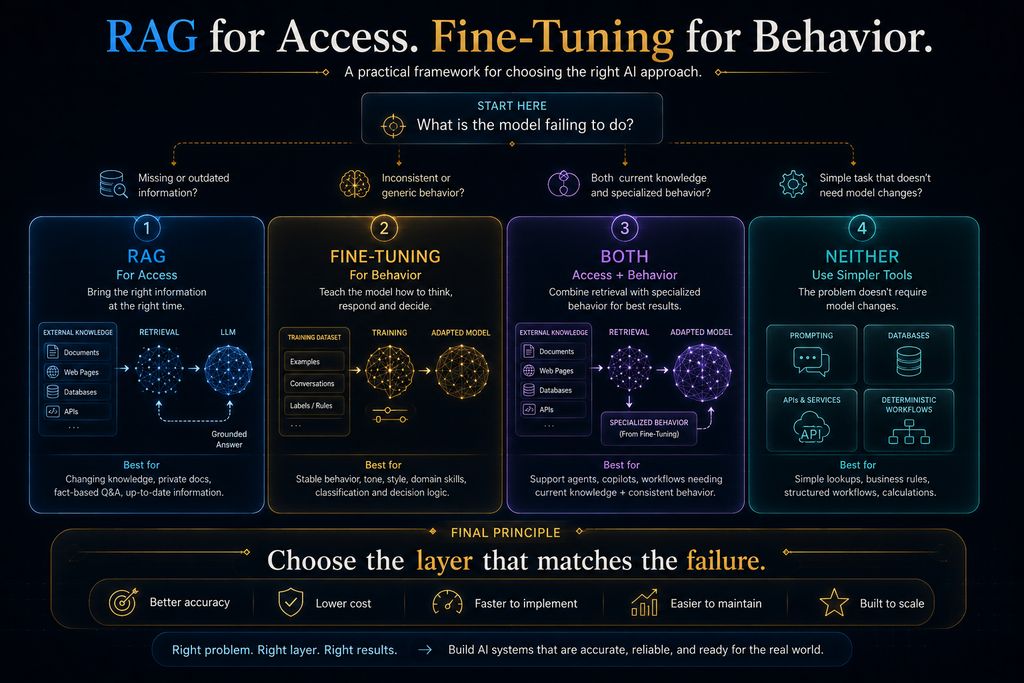
If you need a simple rule, start here:
Choose RAG when the problem is access to information. Choose fine-tuning when the problem is stable specialized behavior. Choose both when you genuinely need current information and specialized behavior. Choose neither when the problem can be solved more simply elsewhere.
The decision becomes clearer when you stop comparing technologies and start comparing failure modes.
| If your primary problem is… | Start by investigating… |
|---|---|
| Missing external knowledge | RAG |
| Frequently changing information | RAG |
| Private documents | RAG |
| Source-grounded answers | RAG |
| Specialized classification | Fine-tuning |
| Stable behavioral patterns | Fine-tuning |
| Consistent specialized outputs | Fine-tuning |
| Current knowledge + specialized behavior | Hybrid |
| Poor prompts | Prompt improvement |
| Wrong model | Model evaluation |
| Exact structured data | Database/API |
| Deterministic workflow | Automation/rules |
| Unknown problem | Diagnose first |
This approach also gives you a useful stopping rule. If you cannot explain what problem RAG or fine-tuning is solving, you are not ready to implement either one.
A Practical Architecture Checklist
Before committing engineering resources, answer these questions:
- What specific failure are we trying to fix?
- Is the missing capability information, behavior, or both?
- Where does the source of truth live?
- How frequently does that information change?
- Does the user need evidence or citations?
- Can the current model solve the task with better prompting?
- Has retrieval quality been tested separately from generation quality?
- Is the desired behavior stable enough to justify fine-tuning?
- Do we have enough high-quality examples to evaluate or train against?
- What does the simplest successful architecture look like?
- What will the architecture cost to operate six months from now?
- How will we measure whether it actually improved the business outcome?
If you cannot answer several of these questions, the correct next step is probably architecture discovery, not implementation.
Future Outlook: The Real Battle Is Not RAG vs Fine-Tuning
The industry is gradually moving away from the idea that one technique must replace another.
Modern AI systems increasingly behave like layered systems in which different components perform different jobs. A model may use retrieval for external knowledge, tools for deterministic actions, fine-tuning for specialized behavior, structured outputs for downstream workflows, and evaluation systems to control reliability.
That means the future question is less likely to be: “Should we use RAG or fine-tuning?” and more likely to be: “Which combination of model behavior, external knowledge, tools, and controls produces the best outcome for this task?”
This is a more mature way to think about AI architecture because it reflects how complex software systems have always been built. Databases, APIs, business logic, search systems, machine-learning models, and user interfaces each have different responsibilities.
AI systems are moving in the same direction. RAG and fine-tuning should therefore be treated as specialized architectural tools, not competing ideologies.
Final Thoughts
RAG versus fine-tuning is often presented as a competition between two AI technologies, but that framing creates the wrong starting point. The real decision is about where your AI system is failing and which layer should be changed to fix it.
If the model needs access to current, private, or externally verifiable information, RAG gives you a way to bring that knowledge into the generation process without turning every document update into a model-training problem. If the model already has sufficient information but repeatedly struggles with a stable specialized task or behavior, fine-tuning can make sense because the problem is no longer primarily about information access. When both conditions exist, combining retrieval with model adaptation can produce a stronger system—but only when the additional complexity earns its place.
The most important discipline is to avoid choosing the technology first. Define the failure, establish a measurable baseline, test simpler interventions, and then introduce RAG or fine-tuning only when the evidence points in that direction.
The best AI architecture is not the one with the most sophisticated technology. It is the one that changes the right layer of the system to solve the actual problem.
And that is the decision rule worth carrying forward:
RAG for access. Fine-tuning for behavior. Both when both are necessary. Neither when the problem belongs somewhere else.
Keep Building Your AI Knowledge
If you decide retrieval is the right layer, the complete guide covers how RAG works, where it fails and how to build it.
Read the Complete RAG Guide →FAQ
Is RAG better than fine-tuning?
Neither is universally better. RAG is generally better suited to providing external, private, or frequently changing information, while fine-tuning is better suited to adapting a model to stable specialized behaviors or tasks. The right choice depends on the problem you are trying to solve.
Should I use RAG or fine-tuning for company knowledge?
RAG is usually the better starting point when company knowledge changes over time or needs to remain traceable to source documents. Fine-tuning may complement RAG when the model also needs specialized behavior.
Can fine-tuning replace RAG?
Fine-tuning does not generally replace RAG when an application needs reliable access to large amounts of changing external knowledge. Fine-tuning can adapt behavior, but an external retrieval or database layer may still be needed for current information.
Can RAG replace fine-tuning?
RAG can sometimes eliminate the need for fine-tuning when the real problem was simply missing information. It does not automatically solve stable behavioral problems such as specialized classification, formatting, or task consistency.
Can you use RAG and fine-tuning together?
Yes. A hybrid architecture can use RAG to provide current external knowledge while using a fine-tuned model for specialized behavior. The additional complexity is justified only when both capabilities are genuinely required.
Does RAG eliminate hallucinations?
No. RAG can reduce some hallucination risks by supplying relevant evidence, but the system can still fail because of poor sources, retrieval errors, incomplete context, or unsupported generation.
Is fine-tuning more expensive than RAG?
Not necessarily. Fine-tuning introduces training and model-maintenance costs, while RAG introduces retrieval, storage, indexing, ingestion, and context-related costs. The cheaper option depends on workload, scale, update frequency, and operational requirements.
Is RAG faster than fine-tuning?
There is no universal answer. RAG introduces retrieval steps, while fine-tuning does not automatically guarantee faster inference. End-to-end latency depends on the model, retrieval architecture, context size, infrastructure, caching, and workload.
Should I fine-tune before trying RAG?
Not if your primary problem is missing or changing external information. Diagnose the failure first. If the model lacks access to the right knowledge, retrieval is usually the more direct intervention.
What is the simplest way to decide between RAG and fine-tuning?
Ask what needs to change. If the system needs better access to information, investigate RAG. If it needs more consistent specialized behavior, investigate fine-tuning. If it needs both, investigate a hybrid approach; if neither describes the problem, look for a simpler solution first.
Sources and Further Reading
- PEFT: Hugging Face documentation on parameter-efficient fine-tuning methods.
- Optimizing LLM Accuracy: OpenAI guide to choosing between prompt engineering, RAG and fine-tuning.
Written by
Muntasir Ahmad Chowdhury
Founder, AI Hustle World
Muntasir Ahmad Chowdhury is the Founder of AI Hustle World, an independent publication dedicated to making Artificial Intelligence practical, trustworthy, and easy to understand. He researches AI tools, automation, customer service, productivity, and real-world business applications, helping readers make smarter technology decisions through research-driven, experience-backed content.
Expertise:
AI Tools • AI Automation • AI Customer Service • AI Productivity • Generative AI • AI Workflows
Get Smarter With AI
Enjoyed this guide? Get practical AI tools, tutorials, and honest reviews delivered to your inbox.