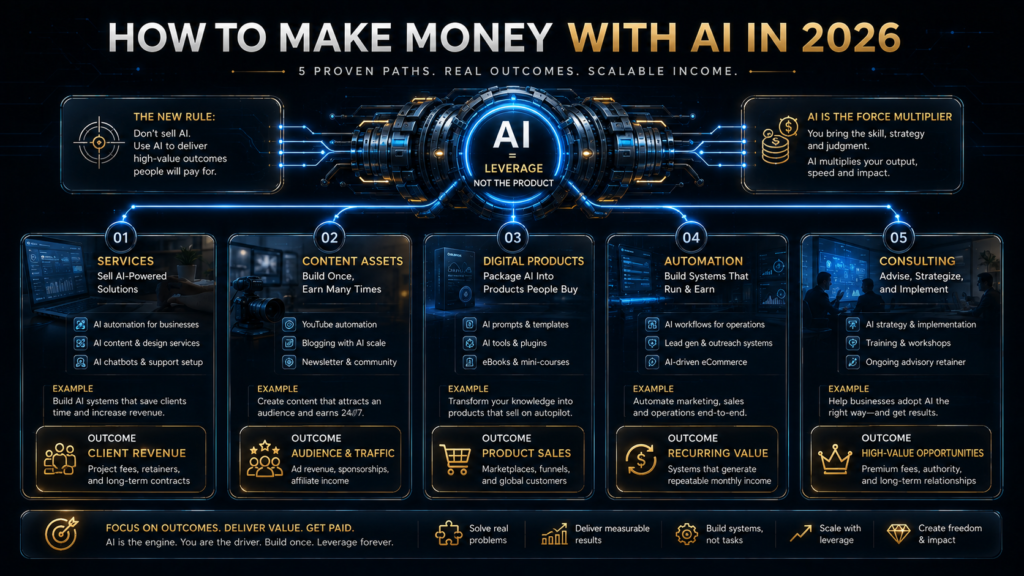
Last updated: August 2026
How to Make Money With AI in 2026: 12 Practical Methods for Beginners
Artificial intelligence has made it dramatically easier to produce things that people already buy: articles, videos, graphics, research, software, marketing assets, digital products and business services.
But that does not mean AI itself is a business.
That distinction is where most “make money with AI” advice goes wrong.
You do not get paid because you used ChatGPT, Claude, Gemini or another AI tool. You get paid because you solved a problem that someone values enough to buy.
AI simply changes the economics of how you solve it.
A freelance writer can research and draft faster. A designer can generate more concepts. A video editor can reduce repetitive work. A consultant can analyze information faster. A small business can deploy a chatbot without building an entire software team.
The opportunity is therefore bigger than “find an AI side hustle.”
The better question is:
Which problem can you solve with AI faster, better or more efficiently than you could before?
This guide breaks down 12 practical ways beginners can use AI to create income in 2026, from service-based work that can generate revenue sooner to slower, more scalable models such as content, digital products and education.
The methods are deliberately not ranked by imaginary income promises. They are compared by starting difficulty, speed to market, dependence on an audience, scalability and the kind of human value you still need to add.
AI Hustle World takeaway: AI lowers the cost of producing things. It does not eliminate the need to create something people actually value.
The 12 Ways to Make Money With AI
The best method depends on whether you need cash flow now, a scalable asset later, or a higher-value service business.
| Method | Best for | Startup cost | Time to market | Scalability | Main challenge |
| AI content writing | Writers and marketers | Low | Fast | Medium | Differentiation |
| AI-assisted blogging | Long-term builders | Low | Slow | High | Traffic |
| YouTube content | Creators | Low–Medium | Medium | High | Consistency + originality |
| Digital products | Creators with useful knowledge | Low | Medium | High | Distribution |
| AI freelancing | Beginners who need clients | Low | Fast | Medium | Client acquisition |
| Social media management | Marketing-minded users | Low | Fast | Medium | Retention |
| AI graphic design | Visual creators | Low | Fast | Medium | Taste + originality |
| Affiliate marketing | Audience builders | Low | Medium–Slow | High | Trust + traffic |
| Online courses | Subject-matter experts | Low–Medium | Medium | High | Expertise + distribution |
| AI chatbots | Technical/service providers | Low–Medium | Medium | High | Implementation |
| AI video editing | Editors and creators | Low–Medium | Fast | Medium | Quality control |
| AI consulting | Experienced professionals | Low | Medium | High | Credibility |
The table reveals an important pattern.
The fastest route to revenue is usually selling a service.
The most scalable routes often take longer because they depend on distribution, audience or product-market fit.
That is why a beginner should not automatically choose the method with the largest theoretical income ceiling.
Choose according to the constraint you actually have.
Before You Start: What AI Can and Cannot Do for Your Income
AI is excellent at compressing certain kinds of work.
It can help you research, summarize, draft, brainstorm, classify, translate, design, edit, analyze and automate repetitive tasks.
But AI does not automatically solve three problems that determine whether a business succeeds:
Demand: Does anybody actually want what you are selling?
Distribution: Can you reach those people?
Trust: Why should they choose you rather than another provider?
This explains why so many AI side-hustle attempts fail.
Someone discovers an AI tool, generates something, uploads it somewhere and waits for money.
The missing step is value creation connected to demand.
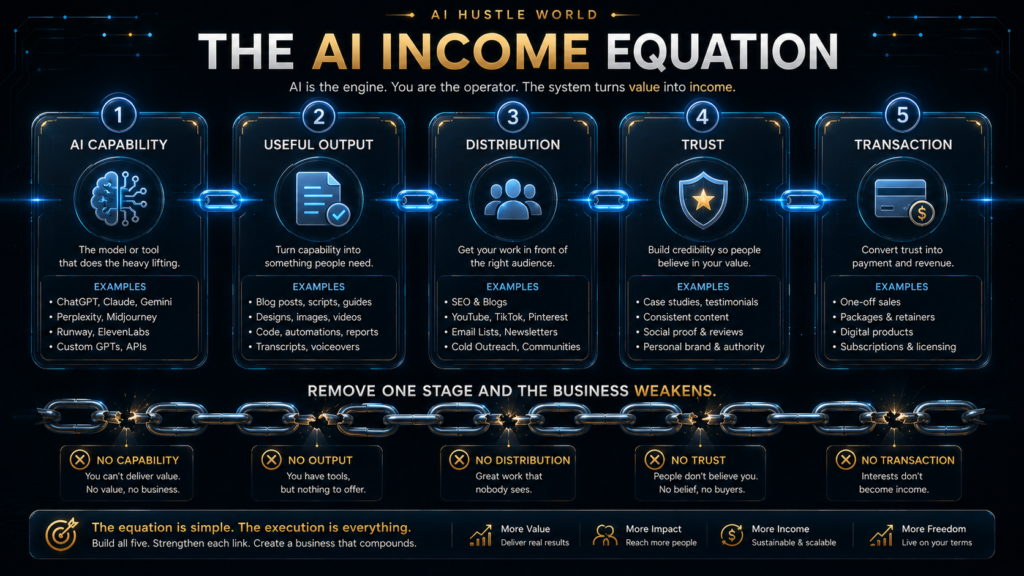
A useful mental model is:
AI capability → Useful output → Distribution → Trust → Transaction
Remove any one of those stages and the business becomes weaker.
The AI Income Ladder
Not every AI income model behaves the same way.
Think of the opportunities as three levels.
Level 1: Sell a service
You use AI to help deliver work for another person or business.
Examples:
- content writing
- graphic design
- video editing
- social media management
- chatbot implementation
- consulting
Advantage: You do not need a large audience before you can earn.
Disadvantage: Your income is connected to clients and delivery capacity.
Level 2: Sell a product
You create something once and sell it repeatedly.
Examples:
- templates
- guides
- ebooks
- digital resources
- courses
- specialized toolkits
Advantage: Higher scalability.
Disadvantage: Creating the product is often easier than getting buyers.
Level 3: Build an audience or owned asset
You create content that compounds over time.
Examples:
- blog
- YouTube channel
- newsletter
- educational platform
- niche media brand
- affiliate website
Advantage: Audience and distribution can become long-term assets.
Disadvantage: This usually takes longer before revenue becomes meaningful.
This is why the beginner decision is often not:
“Which AI business is best?”
It is:
“Do I need cash flow, a product, or an audience?”
1. AI-Assisted Content Writing
Best for: Beginners with strong writing, research or editing ability.
Content writing is one of the simplest ways to use AI commercially because businesses already understand the underlying service.
They buy:
- blog posts
- newsletters
- product descriptions
- landing pages
- email sequences
- social posts
- case studies
- scripts
- editorial support
AI changes the production process.
It does not change the fact that the client cares about the finished result.
How the model works
The workflow looks like:
Client brief → Research → AI-assisted draft → Human editing → Fact checking → Brand adaptation → Delivery
The important stage is between the draft and the delivery.
Raw AI output is not your product.
Your product is the edited, researched, useful final result.
Google’s current guidance explicitly warns against generating large amounts of AI content without adding value, and Google’s spam policies treat scaled content created primarily to manipulate rankings as abuse.
That means a content-writing business based entirely on “generate 50 articles a day” is strategically fragile.
A better positioning is:
Use AI to increase your research and production capacity while keeping human editorial judgment responsible for the final work.
A beginner could start with one narrow offer:
“I create SEO blog posts for SaaS companies.”
Or:
“I write YouTube scripts for technology channels.”
Or:
“I create product descriptions for ecommerce brands.”
Specific offers are easier to sell than:
“I do AI content.”
Where the money actually comes from
Your advantage is not speed alone.
If AI allows you to produce an article four times faster but every competitor has the same advantage, speed becomes a commodity.
Your defensibility comes from:
- niche knowledge
- research quality
- editing
- brand voice
- fact checking
- original insights
- subject expertise
- reliability
Beginner launch path
Start with one content type and one market.
Create three excellent samples.
Then approach businesses that already publish that type of content.
Do not start by building a huge agency.
Start by proving that somebody will pay you.
Common failure
The most common mistake is selling “AI-generated content” as though the AI itself is the value.
It isn’t.
The customer buys the outcome, not the model.
2. Start a Blog With AI
Best for: People willing to build a long-term content asset.
Blogging is slower than freelancing because traffic must be built before advertising, affiliate revenue or product sales become meaningful.
But the model has a powerful advantage:
An article can keep working after you finish writing it.
AI can help throughout the production system:
Research → outline → source organization → drafting → editing → content refresh → repurposing
But AI-generated volume is not a strategy by itself.
Google’s current guidance says generative AI can be useful for research and adding structure, but producing many pages without adding value can fall under its scaled-content-abuse policy.
What makes an AI-assisted blog valuable?
A useful blog has at least one defensible advantage:
- first-hand experience
- original frameworks
- better research
- unique datasets
- expert analysis
- strong comparisons
- practical implementation
- better explanations
- real examples
The weak model is:
Keyword → AI article → publish → repeat
The stronger model is:
Search need → Research gap → Original angle → Evidence → Explanation → Implementation
That distinction is central to AI Hustle World’s own editorial standard.
How to monetize
A blog can eventually combine:
- display advertising
- affiliate commissions
- digital products
- consulting
- sponsorships
- email marketing
- services
The important word is eventually.
Do not treat a new blog like an ATM.
Traffic takes time to accumulate, rankings take time to establish, and trust takes even longer.
Who should choose blogging?
Choose this method if you are comfortable with delayed results and want to build an owned media asset.
Avoid making it your only income strategy if you urgently need revenue.
3. Create YouTube Content With AI
Best for: Creators who can consistently produce useful or entertaining videos.
AI can reduce the production burden across an entire YouTube workflow:
Topic research → Outline → Script → Voice → Visual assets → Editing → Captions → Thumbnail → Publishing
That makes video creation more accessible.
But accessibility increases competition too.
The major mistake is assuming that AI can simply generate an endless stream of videos and YouTube will monetize them.
It cannot.
YouTube’s current monetization policy says content that is repetitive, mass-produced, templated or offers little original value can be ineligible for monetization. It specifically warns against generic AI-generated content that looks mass-produced without original insight or perspective.
What works better
Use AI for production leverage while making the editorial idea yours.
For example:
Weak:
AI-generated “10 facts about X” videos with the same template every day.
Stronger:
Original analysis of X with your own research, narrative, examples and explanation.
The difference is not the tool.
It is the value added around the tool.
Good beginner niches
Consider areas where information or explanation genuinely matters:
- software tutorials
- educational content
- business explainers
- product comparisons
- career education
- productivity
- niche hobbies
- storytelling
- industry analysis
A better first goal
“How much can YouTube pay me?”
Ask:
“Can I produce 20 genuinely useful videos in one niche?”
That is a much better test of whether the business is viable.
For a full faceless workflow, AI Hustle World’s separate articles on AI video tools for faceless YouTube channels and how to start a faceless YouTube channel cover the production layer in greater depth.
4. Sell AI-Assisted Digital Products
Best for: People who can turn knowledge, workflows or useful resources into products.
Digital products have one attractive property:
You create the underlying product once and can potentially sell it many times.
Examples include:
- templates
- checklists
- planners
- spreadsheets
- design resources
- educational guides
- research packs
- business documents
- prompt workflows
- niche toolkits
- mini-courses
But there is an important strategic correction:
AI makes creating digital products easier. It does not automatically make them valuable.
If everyone can generate a 20-page ebook in 10 minutes, a generic 20-page ebook becomes less valuable.
Your product needs a reason to exist.
A strong digital product formula
Specific buyer + specific problem + specific outcome
For example:
Weak:
“100 AI Prompts”
Stronger:
“50 AI Workflows for Real Estate Agents to Turn Property Listings Into Weekly Social Content.”
The second product has a defined audience, problem and outcome.
Where to sell
Depending on the product, you can use:
- your own website
- Etsy
- course platforms
- creator storefronts
- marketplaces
Platform rules matter.
For example, Etsy currently allows seller-prompted AI creations but requires sellers to disclose AI use in the listing description, while AI prompt bundles are specifically excluded from what Etsy considers seller-designed products.
If you’re publishing books through Amazon KDP, Amazon currently requires disclosure of AI-generated text, images or translations, while AI-assisted content does not need the same disclosure.
So “AI product” is not a single business model.
The platform, product type and creation process matter.
Best beginner strategy
Do not create 50 products.
Create one product that solves one narrow problem.
Then improve it based on actual buyer questions and behavior.
For AI Hustle World, this topic connects directly with the site’s separate guide on AI tools for creating and selling digital products.
5. Freelancing With AI
Best for: Beginners who want to start with services rather than build an audience.
Freelancing is probably the most straightforward model in this article.
Why?
Because you don’t need thousands of followers.
You need:
A buyer + a problem + a service + proof that you can deliver.
AI can help you compete by reducing production time.
You can sell:
- writing
- research
- design
- presentations
- video editing
- social media
- translation
- data organization
- automation
- chatbot setup
- marketing support
The important shift
Do not sell the AI.
Sell the service.
Instead of:
“I use ChatGPT to create content.”
Sell:
“I create weekly SEO content for B2B SaaS companies.”
AI remains behind the scenes.
The customer cares about the finished asset.
The three-stage freelance path
Stage 1: Learn
Choose one service and become competent.
Stage 2: Prove
Create a small portfolio.
Stage 3: Sell
Reach potential clients through marketplaces, LinkedIn, email or direct outreach.
The biggest bottleneck is often Stage 3.
Beginners spend weeks learning tools and almost no time learning sales.
That is backwards.
A mediocre workflow with clients can be improved.
A perfect workflow with no clients earns nothing.
How AI improves freelance economics
Suppose a task previously required three hours and AI-assisted processes reduce production to one hour.
You have not necessarily tripled your price.
You’ve potentially increased your capacity.
That means the economic advantage comes from:
More output per hour + better quality + faster turnaround.
That is leverage.
6. Manage Social Media With AI
Best for: Marketers and people comfortable with content operations.
Businesses need a constant flow of:
- posts
- captions
- ideas
- graphics
- short videos
- content calendars
- repurposed content
- audience responses
AI can reduce the production burden.
A practical workflow might look like:
Brand strategy → content pillars → weekly ideas → AI-assisted drafts → human editing → graphics → scheduling → analytics
The mistake is letting AI become the strategy.
A client does not need 30 generic posts.
They need content that supports a business objective.
What you can sell
Instead of offering:
“AI social media management.”
Offer something concrete:
“I turn one weekly article into 5 LinkedIn posts, 5 Instagram posts and 3 short-form video concepts.”
That is easier to understand and easier to measure.
Useful KPIs
Track:
- publishing consistency
- reach
- engagement rate
- saves/shares
- click-through rate
- leads
- conversions
Followers are not the only metric.
A business cares about outcomes.
Where this model fails
It fails when the workflow becomes:
Generate 30 generic posts → schedule → repeat.
That produces activity without much differentiation.
AI should increase the quality and speed of the content operation, not turn a brand into a content factory with no point of view.
7. Offer AI Graphic Design Services
Best for: Visually oriented creators and marketers.
AI image generation has significantly reduced the cost of creating visual concepts.
That creates an opportunity for services such as:
- social-media graphics
- ad creatives
- thumbnails
- presentation visuals
- marketing graphics
- product mockups
- concept visuals
- branded content
But raw generation is becoming commoditized.
The more valuable skill is the ability to turn generated material into useful communication.
That means:
Brief → Concept → Generate → Select → Edit → Brand → Format → Deliver
Why human judgment matters
An AI model can generate ten images.
It cannot automatically know which one best communicates the client’s offer.
That requires:
- visual hierarchy
- taste
- brand consistency
- audience understanding
- typography
- composition
- conversion thinking
The output is not the image.
The output is the communication objective being achieved.
Beginner offer
Choose one niche.
For example:
YouTube thumbnail design for business channels
or:
Social-media graphics for local restaurants
or:
Presentation visuals for consultants
Niche specialization makes your portfolio much more coherent.
8. Affiliate Marketing With AI
Best for: People building content, reviews, social audiences or niche websites.
Affiliate marketing works differently from freelancing.
You do not necessarily sell your own service.
You refer customers to another company’s product and earn a commission when qualifying actions occur.
AI can help with:
- topic research
- content outlines
- comparison tables
- product research
- email drafts
- social content
- repurposing
- keyword clustering
- editorial workflows
But affiliate marketing is often misunderstood as:
“Publish AI articles containing affiliate links.”
That is not a durable strategy.
The real asset is trust.
People use affiliate recommendations when they believe the publisher has helped them make a good decision.
That means useful comparisons, real limitations, honest opinions and clear disclosures matter.
The FTC says affiliate relationships should be disclosed clearly and conspicuously, close enough to the recommendation that readers understand the relationship.
What makes AI-assisted affiliate content stronger?
Weak:
“Best 10 AI tools” followed by affiliate links.
Stronger:
“Which AI research tool should a solo marketer choose if they care about citations, monthly cost and research depth?”
The second article helps someone make a decision.
Decision support is where affiliate content earns trust.
Best channels
You can build affiliate traffic through:
- search
- YouTube
- newsletters
- communities
- social media
- comparison websites
Do not rely exclusively on one traffic source.
9. Create and Sell Online Courses
Best for: People who already know something useful.
Courses are often presented as an easy AI side hustle:
“Use AI to create a course in one day.”
That is backwards.
Creating the course is not the main problem.
Teaching something useful is.
AI can accelerate:
- curriculum planning
- lesson outlines
- examples
- worksheets
- quizzes
- slide creation
- transcripts
- editing
- course marketing
But the underlying knowledge still needs to be credible and organized.
What makes a course worth buying?
A learner should move from:
Current state → Desired state
For example:
Not:
“Learn AI.”
But:
“Build your first AI-assisted content workflow in seven practical sessions.”
The narrower outcome is easier to understand.
The traditional method still exists for a reason
People have bought courses for decades because structured learning saves time.
They are not buying a pile of information.
They are buying:
- sequencing
- explanation
- examples
- exercises
- confidence
- feedback
- a clear path
AI can reduce course-production costs.
It cannot automatically create the learner’s transformation.
10. Build AI Chatbots for Businesses
Best for: Technically capable beginners or service providers willing to learn implementation.
This is one of the more advanced methods in the list.
Instead of selling content, you sell a business system.
Examples:
- website FAQ chatbot
- lead-qualification assistant
- appointment assistant
- customer-support bot
- internal knowledge assistant
- document Q&A system
- sales pre-qualification workflow
The business value can be much higher because the system is tied directly to a business process.
The workflow
A typical implementation looks like:
Business problem → Information source → Conversation design → Model/tool selection → Integration → Testing → Monitoring
That final step matters.
Chatbots can produce wrong or incomplete answers.
A business system therefore needs:
- escalation rules
- knowledge boundaries
- fallback responses
- testing
- human handoff
- monitoring
Beginner path
Don’t start by promising:
“I will automate your entire customer service department.”
Start with:
“I will build an FAQ and lead-qualification assistant for your website.”
Solve one small process well.
Then expand.
Why this method has a higher ceiling
A content service saves time.
A business automation system can potentially save time and change the operating process.
That is why AI automation services can command stronger project economics than simple content generation.
But they also require more technical skill and responsibility.
11. Offer AI Video Editing Services
Best for: Creators, editors and people comfortable with visual storytelling.
Video production contains many repetitive tasks:
- cutting clips
- removing pauses
- captions
- resizing
- background cleanup
- voice generation
- B-roll organization
- thumbnails
- short-form repurposing
AI can accelerate these tasks.
But editing is not just cutting.
A strong editor understands:
pacing + narrative + attention + clarity + emotion
That is why simply exporting an AI-generated video is not the same as delivering an editing service.
A strong beginner service
Instead of:
“AI video editing.”
Offer:
“I turn one long YouTube video into five Shorts with captions, hooks and platform-specific formatting.”
Now the customer understands the outcome.
Why repurposing is interesting
Repurposing takes one source asset and creates multiple distribution assets.
That creates a straightforward business proposition:
One piece of content → many pieces of content
AI reduces the labour required to perform that transformation.
The human still decides what deserves to be retained.
12. Offer AI Consulting
Best for: People who already have professional or industry expertise.
Consulting is the most expertise-dependent method in this list.
It can involve:
- AI workflow audits
- tool selection
- process redesign
- automation strategy
- AI adoption
- training
- policy development
- internal knowledge workflows
- marketing workflow optimization
The important distinction is:
Consulting is not teaching someone how to use ChatGPT.
Good consulting connects AI capabilities to a business problem.
For example:
Weak:
“I teach companies AI prompting.”
Stronger:
“I audit a sales team’s research and reporting workflow and identify where AI can reduce repetitive work without compromising human review.”
That is a business problem.
What the consultant is selling
Not prompts.
Not models.
Not software.
The consultant sells:
Diagnosis + recommendation + implementation path + confidence.
Why this model is harder
You need credibility.
Clients are trusting you with decisions that may affect:
- costs
- employees
- customer experience
- data
- compliance
- operations
That makes consulting a poor starting point for someone with no real-world expertise.
It can be an excellent second-stage business after you’ve learned a domain deeply.
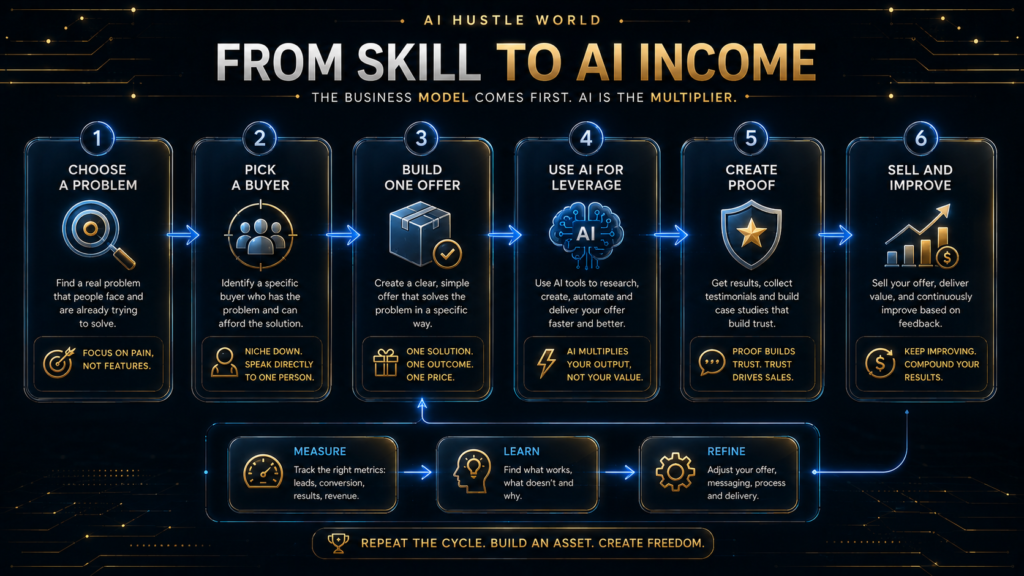
Which AI Income Method Should a Beginner Choose?
Don’t choose based on hype.
Choose based on your starting position.
| Your situation | Best starting methods |
| Need revenue quickly | Freelancing, content, design, editing |
| Strong writing skills | Content writing, blogging, affiliate content |
| Comfortable on camera or with storytelling | YouTube |
| Strong visual skills | Graphic design, video editing |
| Have useful knowledge | Courses, consulting, digital products |
| Want a scalable asset | Blog, YouTube, digital products |
| Technical / willing to learn automation | Chatbots, AI workflows |
| Strong marketing ability | Social media, affiliate marketing |
| Have existing audience | Courses, digital products, affiliate marketing |
| No experience yet | Start with a service and build skills |
This reveals the first major strategic decision:
Services vs assets
Services can produce revenue sooner but require ongoing delivery.
Assets can scale better but usually require patience.
A beginner often benefits from combining them:
Service for cash flow → asset for long-term leverage.
For example:
Freelance content writing → niche blog → digital product → affiliate revenue
or:
Video editing → YouTube channel → audience → course
or:
Social-media service → content brand → digital products
That is a more realistic path than trying to create “passive income” on day one.
The AI Money Matrix
Here is the AI Hustle World framework I would use to evaluate any new AI income opportunity.
| Dimension | Question |
| Problem | What painful or valuable problem does this solve? |
| Buyer | Who already spends money on this problem? |
| Leverage | What part does AI make faster or cheaper? |
| Human value | What still requires judgment or expertise? |
| Distribution | How will customers discover you? |
| Trust | Why will they believe you? |
| Economics | How much value does one customer create? |
| Repeatability | Can the process be delivered repeatedly? |
| Defensibility | What stops everyone else copying it? |
| Scale | Can revenue grow without the same increase in labour? |
This is deliberately different from asking:
“Which AI tool should I use?”
The tool is downstream.
The business model comes first.
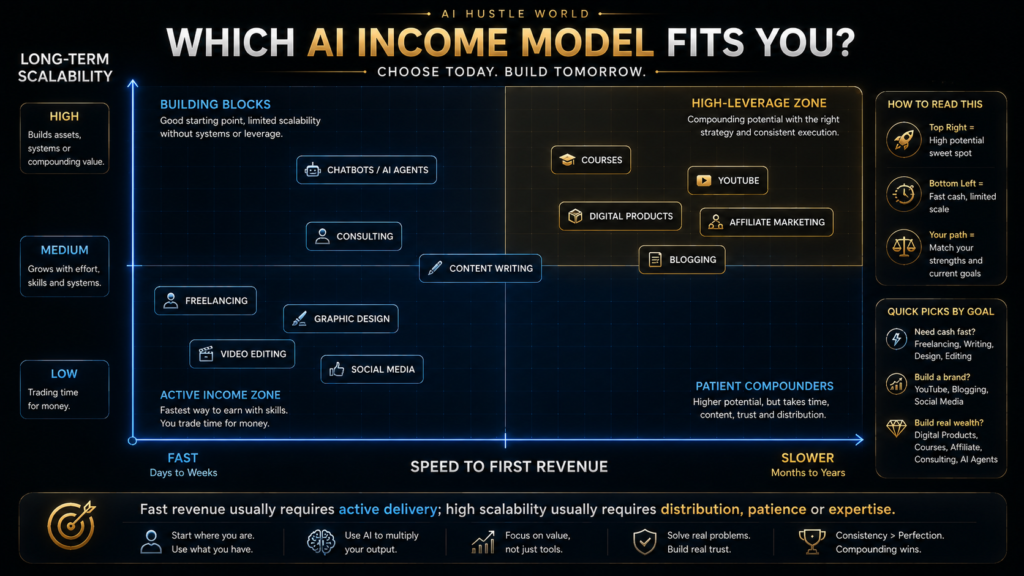
Fastest vs Most Scalable AI Income Models
A beginner should understand the trade-off between speed and scalability.
Faster revenue
Service businesses usually have the shortest path because you can sell before building a large audience.
Examples:
- writing
- editing
- design
- social media
- freelancing
Moderate speed
Productized services, chatbots and courses usually require more setup but can create higher-value offers.
Slower but more scalable
Blogs, YouTube channels, newsletters, affiliate sites and digital-product businesses often require substantial distribution before the economics become attractive.
This creates an important principle:
The more scalable the model, the more likely you are to pay for that scalability with time, audience building or upfront product development.
There is no magical model where AI gives you all three:
fast revenue + zero skill + zero audience + unlimited scale.
That is marketing language, not business strategy.
How Much Can You Really Make With AI?
This is where most articles become unreliable.
You’ll find websites claiming that beginners can quickly make thousands of dollars per month.
Those figures are not useful without context.
Income depends on:
- skill
- niche
- offer
- pricing
- client acquisition
- audience
- geography
- competition
- quality
- consistency
- operating capacity
One person can make nothing.
Another can build a substantial business.
The AI tool alone does not determine the result.
A better way to measure potential is through the unit economics.
For a service business:
Revenue = Clients × Average Revenue Per Client
For a product business:
Revenue = Visitors × Conversion Rate × Average Order Value
For affiliate marketing:
Revenue = Qualified Traffic × Conversion Rate × Commission
For YouTube:
Revenue = Monetized Reach × Effective Revenue Per View + Other Revenue Streams
For consulting:
Revenue = Projects × Average Project Value
Those formulas tell you where to improve.
If you have traffic but low conversions, you have an offer problem.
If you have a great offer but no traffic, you have a distribution problem.
If you get clients but spend too much time delivering each project, you have an efficiency problem.
AI can help with the third problem.
It cannot solve the first two automatically.
A 30-Day Beginner Launch Framework
Trying 12 methods at the same time is one of the fastest ways to achieve none of them.
Choose one.
Week 1: Pick the problem
Choose:
- one market
- one problem
- one offer
For example:
Market: local service businesses
Problem: inconsistent social media
Offer: monthly AI-assisted social content package
Week 2: Build proof
Create:
- three sample outputs
- one simple portfolio
- one clear offer
- one pricing structure
Do not spend the entire week designing a logo.
Your logo is not the bottleneck.
Proof is.
Week 3: Start distribution
Reach potential buyers through:
- direct outreach
- freelance marketplaces
- communities
- referrals
- relevant content
Track outreach volume and responses.
Week 4: Improve the offer
Look at:
- replies
- objections
- calls
- proposals
- conversions
- delivery time
Then improve the weakest stage.
This is a real business loop:
Offer → Market → Feedback → Improvement → Repeat
AI can accelerate almost every part except the willingness to do the loop.
What to Measure
Your AI income model needs a small KPI system.
Service business
Track:
Prospects → Replies → Calls → Proposals → Clients → Revenue
Also track:
Delivery time → Revision rate → Profit per project
If you’re working ten hours for a project that barely pays, increasing the number of clients will make the problem worse.
Content business
Track:
Publishing → Traffic → Engagement → Email subscribers → Conversions
Do not judge a blog or YouTube channel only by total views.
Track whether attention becomes an owned audience or revenue-producing action.
Digital products
Track:
Visits → Product-page conversion → Average order value → Refund rate
The product does not have a traffic problem if nobody knows it exists.
It has a distribution problem.
Consulting and chatbots
Track:
Qualified leads → Discovery calls → Proposals → Close rate → Project value → Renewal/expansion
The objective is not simply more leads.
It is better-qualified opportunities.
Common Mistakes to Avoid
1. Chasing “passive income”
Most income streams require active work before they become semi-automated.
AI can reduce labour.
It does not remove the need for business development, distribution or maintenance.
2. Learning tools instead of selling outcomes
You can spend months learning AI products and still have no customers.
Learn enough to solve a problem.
Then sell the solution.
3. Using AI to produce generic content at scale
This is increasingly risky for both audience trust and search visibility.
Google explicitly warns against scaled content created primarily to manipulate rankings, including mass AI-generated pages without added value.
4. Ignoring originality on YouTube
YouTube’s current monetization rules emphasize original, authentic content and restrict mass-produced, repetitive or low-value content.
5. Selling generic digital products
A generic product is easy to create.
That is precisely why it is difficult to defend.
Solve a specific problem for a specific buyer.
6. Making unsupported income claims
Don’t tell customers:
“This system will make you $10,000.”
Tell them what the system does.
The FTC emphasizes that advertising claims must be truthful, non-deceptive and evidence-based.
7. Forgetting disclosures
Affiliate relationships and sponsored recommendations need clear disclosure.
The FTC specifically says affiliate relationships should be disclosed clearly and conspicuously.
8. Using other people’s intellectual property
AI doesn’t erase copyright or platform rules.
Before selling AI-generated books, images, graphics or other materials, check the platform’s current policy and make sure the underlying material is legally usable.
Amazon KDP, for example, requires disclosure of AI-generated text, images and translations.
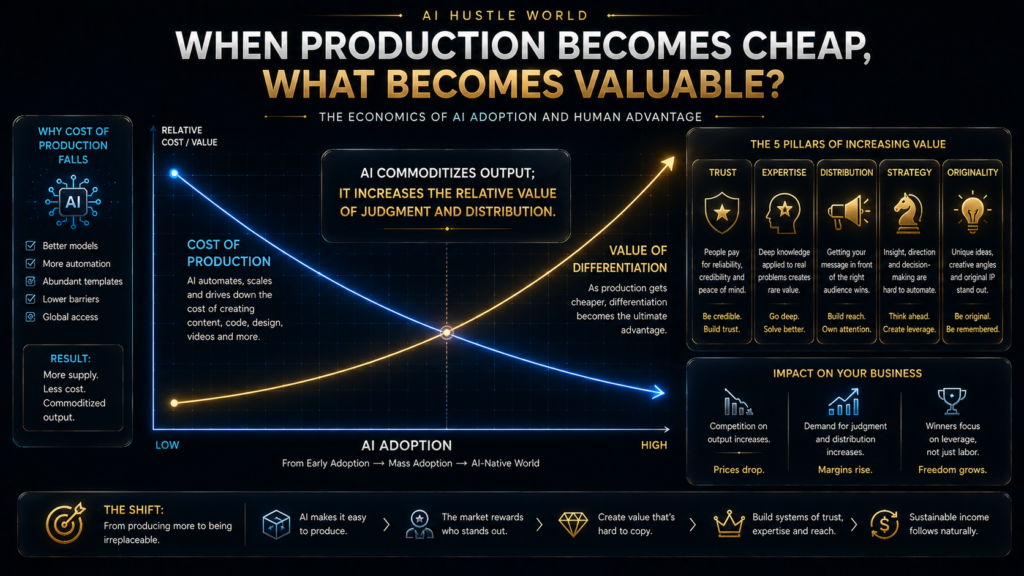
The Second-Order Effect of AI Income Opportunities
There is a deeper shift happening.
AI makes production cheaper.
That creates two opposing effects.
First-order effect
More people can produce:
- articles
- graphics
- videos
- code
- presentations
- digital products
Second-order effect
Because production becomes easier, production itself becomes less scarce.
That means the value shifts toward:
- taste
- strategy
- distribution
- trust
- niche expertise
- original data
- relationships
- customer understanding
- implementation
This is why “I know how to use AI” will become less differentiated over time.
The stronger position is:
“I understand this customer problem and I can use AI to solve it better.”
That is the real moat.
What Happens If You Do Nothing?
There is no rule saying everyone must build an AI business.
You can choose not to.
But AI is reducing the cost of many knowledge-work tasks, which means people who use it effectively can potentially produce more with the same amount of time.
The risk is not necessarily that AI will immediately replace you.
The more practical risk is that:
someone doing comparable work with better AI-assisted economics may become easier to hire.
That is why the most defensible response is not to chase every AI tool.
It is to develop a skill where AI makes you more capable.
The Best Beginner Strategy in 2026
After looking at the economics of these 12 models, the strongest beginner strategy is usually:
Start with a service.
Then:
Use AI to make the service more efficient.
Then:
Turn what you learn into an asset.
That can mean:
Service → Audience → Product
or:
Service → Workflow → Productized Service
or:
Service → Expertise → Consulting
or:
Service → Content → Affiliate/Advertising
This creates a progression from immediate value to long-term leverage.
Frequently Asked Questions
Can I make money with AI without coding?
Yes.
Many AI income models do not require programming, including writing, design, video editing, social media management, affiliate marketing, digital products and some forms of content creation.
What matters is whether you can solve a problem people are willing to pay for.
Can I make money with AI with no money?
You can start many service-based models with very little upfront cost because free or low-cost tools can handle part of the production process.
But “no money” does not mean “no investment.”
You still invest:
- time
- learning
- internet access
- communication
- outreach
- experimentation
The scarce resource at the beginning is often not money.
It is consistency.
Is AI freelancing legitimate?
Yes, when you are selling a legitimate service and adding real value.
The weak approach is delivering raw machine output.
The stronger approach is using AI as part of a professional workflow while remaining responsible for research, accuracy, editing, communication and the final result.
Is AI-generated content allowed on YouTube?
AI itself is not the central issue.
YouTube’s current monetization rules focus on whether content is original, authentic and valuable rather than repetitive or mass-produced. Generic AI-generated content that lacks original insight can be ineligible for monetization.
Can I sell AI-generated books?
Amazon KDP allows AI-generated content but currently requires disclosure of AI-generated text, images and translations. AI-assisted content is treated differently.
Always verify the current KDP rules before publishing.
Can I sell AI-generated art?
Some platforms allow it with conditions.
Etsy currently permits seller-prompted AI creations but requires disclosure in relevant listings. It also does not treat AI prompt bundles as seller-designed products.
Is affiliate marketing with AI legal?
Affiliate marketing itself is legitimate, but disclosures and advertising rules matter.
The FTC says material relationships such as commissions should be disclosed clearly and conspicuously so consumers understand the recommendation.
Which AI method makes money fastest?
Service businesses generally provide the shortest route because you can sell an existing skill before building a large audience.
That does not mean they guarantee fast income.
Client acquisition remains the bottleneck.
Which method has the highest long-term scalability?
There is no universal winner.
Audience-based businesses, digital products, software and automation services can scale differently.
The more important question is whether you have the distribution and capabilities required to support the model.
Should I try all 12 methods?
No.
Start with one.
The purpose of this article is to help you choose a path, not encourage you to start twelve businesses at once.
Final Thoughts
AI has created new leverage, but it has not changed the fundamental economics of business.
People pay for useful outcomes.
AI simply changes how efficiently you can produce those outcomes.
That is why the strongest opportunities in 2026 are not necessarily the most glamorous ones.
Writing, editing, design, social media, research and video services can still be valuable because businesses already buy them.
Digital products, blogs, YouTube channels and courses can become scalable because one piece of work can reach many people.
Chatbots, automation and consulting can become high-value because they connect AI to actual business processes.
But every model has a bottleneck.
Services need customers.
Content needs distribution.
Products need buyers.
YouTube needs originality and consistency.
Affiliate marketing needs trust.
Consulting needs expertise.
Automation needs implementation quality.
So don’t start with:
“What can AI make me money from?”
Start with:
“What problem can I solve that people already care about?”
Then ask:
“Where can AI give me leverage?”
That order matters.
Because AI is not the business.
The valuable problem you solve is the business.
And the people who understand that distinction will be far better positioned than those simply collecting AI tools and chasing the newest “passive income” promise.
Ready to Build Your AI Income Strategy?
The best AI income opportunity isn’t the one with the biggest promise. It’s the one that matches your skills, your resources, and a problem people are already willing to pay to solve.
Continue exploring AI Hustle World for practical AI tools, workflows, business models, and strategies designed to turn AI into useful leverage.
Explore AI Hustle World →AI Hustle World — AI Tools • Reviews • Tutorials
Written by
Muntasir Ahmad Chowdhury
Founder, AI Hustle World
Muntasir Ahmad Chowdhury is the Founder of AI Hustle World, an independent publication dedicated to making Artificial Intelligence practical, trustworthy, and easy to understand. He researches AI tools, automation, customer service, productivity, and real-world business applications, helping readers make smarter technology decisions through research-driven, experience-backed content.
Expertise:
AI Tools • AI Automation • AI Customer Service • AI Productivity • Generative AI • AI Workflows
Get Smarter With AI
Enjoyed this guide? Get practical AI tools, tutorials, and honest reviews delivered to your inbox.
3 thoughts on “How to Make Money With AI in 2026: 12 Practical Methods”