Evidence: Documentation reviewed
Last checked: September 2026
What was done: Written from official documentation and the published sources linked in this article. Not hands-on tested.
Files: None
Affiliate links: No
AI Buying Signals: How to Find B2B Prospects Who Are Ready to Buy
The Prospect Who Looked Ready—but Wasn’t
Imagine a sales representative opening the CRM on Monday morning and finding an account that appears almost impossible to ignore. The company fits the ideal customer profile, recently raised funding, hired a new VP of Sales, and has several employees visiting the company’s website. One of those visitors spent time on the pricing page, another downloaded a report, and the account’s intent score has suddenly jumped into the platform’s “high intent” category.
On the surface, this looks like exactly the kind of account sales teams want to find.
The representative reaches out with a personalized message, references the company’s recent growth, and suggests a conversation. There is no response. A second email produces nothing. A LinkedIn message goes unanswered, and after several weeks the account quietly falls back into the prospecting queue.
The problem was not necessarily the data. The problem was the conclusion drawn from the data.
The company really did raise funding. The executive really was hired. Employees really did visit the website. The activity was real, but the interpretation was incomplete. None of those events, individually or collectively, proved that the company had approved a project, allocated budget, selected a buying team, or reached the point where a sales conversation was welcome.
This is the distinction that gets lost in a lot of modern prospecting technology: a buying signal is evidence of a potentially important change, not proof that a buyer is ready to purchase.
That distinction becomes even more important as AI makes it possible to monitor thousands of companies continuously. When the cost of detecting signals falls dramatically, the scarce resource is no longer information. It is human attention. A sales team can easily become overwhelmed with “high-intent” accounts if the system is optimized to find activity rather than determine which activity actually changes the likelihood of a meaningful buying conversation.
The real opportunity for AI buying signals is therefore not to create another stream of alerts. It is to build a decision layer between raw market activity and sales action.
That means asking a harder question than “Who showed intent?” Which accounts have changed in a way that makes our solution more relevant now, and is the evidence strong enough to justify spending human sales time on them?
Quick Answer: What Are AI Buying Signals?
AI buying signals are observable behaviors, events, or changes that provide evidence that a B2B account may have entered a more relevant buying window. AI can monitor those signals across first-party activity, company events, hiring, technology changes, research behavior, engagement, CRM history, and other sources, then combine them with account fit, intent, timing, and corroborating evidence to determine which prospects deserve attention.
The key word is evidence.
A funding announcement is evidence. A new executive is evidence. Multiple people researching a category is evidence. A technology migration is evidence. A sudden increase in hiring is evidence. None of these events is automatically a buying decision.
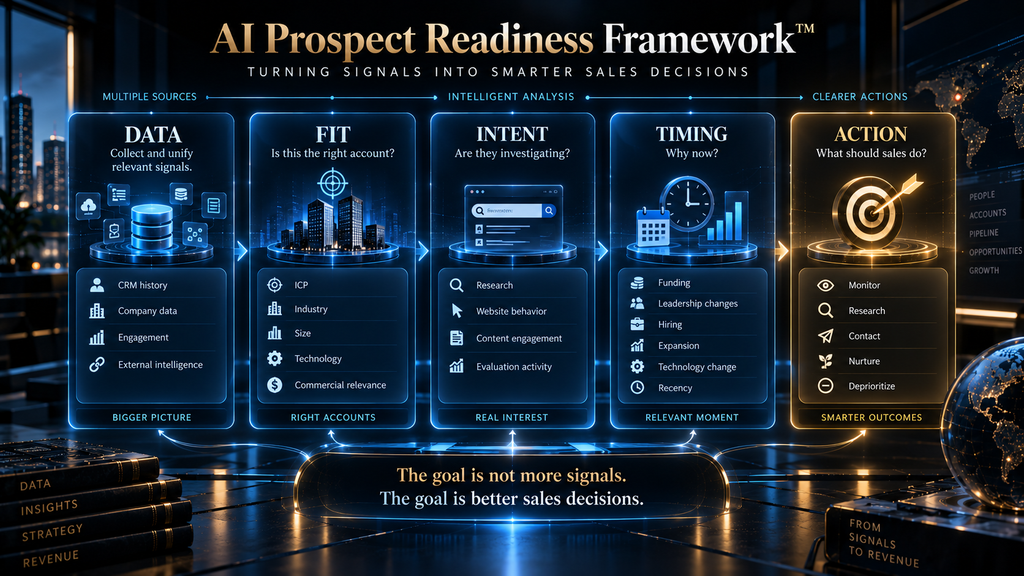
A useful AI buying-signal system therefore needs to move through five questions: DATA → FIT → INTENT → TIMING → ACTION. This is the AI Prospect Readiness Framework.
Raw data tells the system what is happening. Fit determines whether the account is commercially relevant. Intent asks whether there is evidence of interest or problem investigation. Timing determines whether the evidence is recent and meaningful enough to matter now. Action converts the resulting assessment into a specific sales decision.
That final step is what separates buying-signal intelligence from a database full of interesting facts.
What This Article Actually Owns
The B2B prospecting landscape already contains substantial information about lead generation, data enrichment, scraping, qualification, intent data, and sales automation. AI Hustle World also covers several of those subjects directly, including AI lead qualification, lead generation, data enrichment, scraping, and the broader AI prospecting workflow. This article builds on those foundational topics, so it does not simply repeat how to find leads or how to qualify them.
This article owns a narrower and more valuable question: How do you recognize that an account’s circumstances have changed enough to justify sales attention now? That means the focus here is on signal quality, signal interpretation, signal stacking, account-level context, timing, readiness, and the decision that should follow.
It does not attempt to become another generic list of lead-generation tools. It does not replace the broader article about building an AI B2B prospecting workflow, and it does not attempt to become a full lead-qualification tutorial. Those topics have their own dedicated guides, including our lead generation tools comparison.
The distinction matters because a good topical cluster is not created by publishing several articles that answer the same question with slightly different wording. Each article needs a distinct search intent and a clear boundary around what it owns.
Why Buying Signals Matter in the First Place
The fundamental sales problem existed long before AI: a company can be a good customer without being a good prospect today.
Traditional outbound prospecting often starts with a target market. Sales teams define company size, industry, geography, technology environment, job titles, and other characteristics, then build a list of accounts that match those conditions. This approach exists for a good reason. Fit is observable, relatively stable, and operationally useful, so it provides a practical way to divide a large market into a manageable universe.
The limitation is that fit changes slowly while buying circumstances can change quickly.
A company may remain a perfect ICP match for three years without having any reason to purchase your product. Then, within a few weeks, it might hire a new executive, expand into a new market, replace an existing technology platform, receive new funding, increase headcount, lose a key employee, or launch an initiative that suddenly creates the exact problem your product solves.
Traditional prospecting can identify the company. Buying-signal intelligence tries to identify the moment when the company becomes more relevant.
This is why buying signals should not be viewed as a replacement for ICP targeting. They are an additional layer that answers the timing question that firmographic targeting cannot answer by itself.
Fit Is Not Intent, and Intent Is Not Readiness
One of the easiest ways to build a bad AI prospecting system is to collapse several different concepts into one score.
An account can have excellent fit but almost no current intent. Another account can show substantial intent but have poor commercial fit. A third account may have both strong fit and strong intent but still lack the budget, internal authority, or timing required to become a realistic opportunity.
These distinctions become clearer when viewed as separate layers.
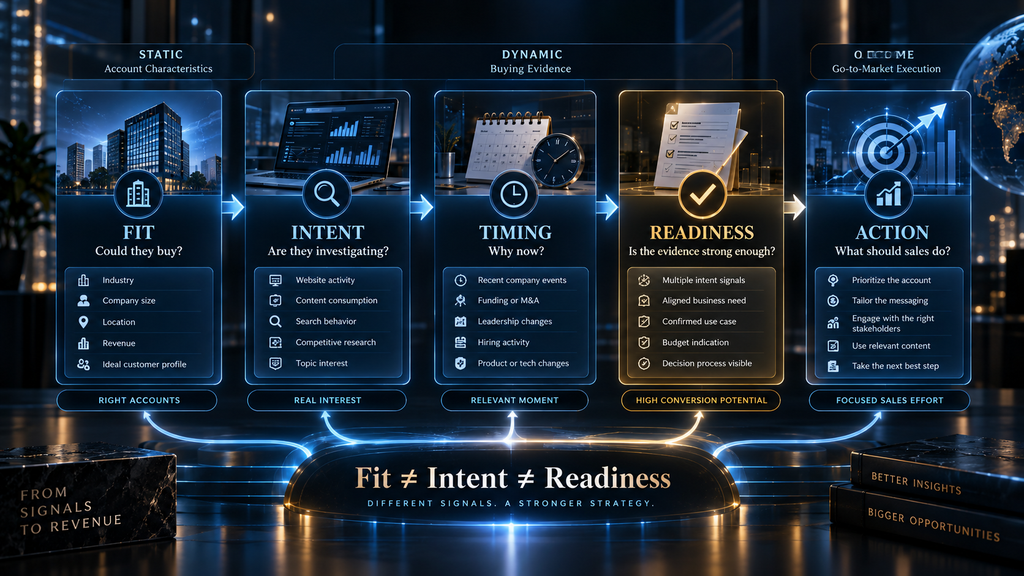
| Layer | Question | Example |
|---|---|---|
| Data | What do we know? | 800 employees, SaaS, U.S., Salesforce |
| Fit | Could this company realistically buy? | Matches ICP and deal economics |
| Intent | Is there evidence of interest or problem research? | Multiple employees researching the category |
| Timing | Why might this matter now? | New executive, expansion, active initiative |
| Readiness | Is the combined evidence strong enough to justify attention? | Strong fit + relevant change + recent corroboration |
| Action | What should sales do? | Research stakeholders and initiate relevant outreach |
The practical mistake is usually made between intent and readiness.
A company can research a category without buying anything. Employees can consume content for educational reasons, benchmark existing systems, prepare for a future initiative, or investigate a problem that has not yet received executive approval.
That is why a useful system should never tell sales simply, “This account has intent.” It should explain what changed, why it matters, how confident the system is, and what the representative should do with that information.
The AI Prospect Readiness Framework
The central framework for this article is:
DATA → FIT → INTENT → TIMING → ACTION
The framework deliberately starts before the buying signal itself because signal interpretation without a reliable account foundation is fragile.
DATA: What do we actually know?
AI begins with evidence from multiple sources. Depending on the business, this may include CRM history, website activity, company news, hiring data, technology information, research behavior, engagement history, public announcements, and other commercial signals.
The first principle is simple: garbage in still produces garbage out, even when AI is involved. If company identities are duplicated, contacts are attached to the wrong accounts, technology information is stale, or CRM history is incomplete, the system can construct an apparently sophisticated interpretation from incorrect inputs.
Data quality is therefore not a boring technical prerequisite. It directly determines the reliability of the buying-signal layer.
FIT: Is this account commercially relevant?
Fit establishes whether the account belongs in the potential customer universe. That can include industry, company size, geography, technology environment, business model, estimated buying capacity, use case, or any other characteristic that predicts whether the product can realistically create value.
Fit should not be confused with readiness. A company can have perfect fit and still deserve no immediate sales attention.
INTENT: Is someone investigating something relevant?
Intent introduces behavioral or research evidence. The system might observe repeated visits to relevant pages, category research, competitor comparisons, content engagement, product interactions, or multiple contacts from the same company investigating a particular subject.
The question is not simply whether someone is active. The question is whether the activity is commercially meaningful.
TIMING: Why might this matter now?
Timing is where company-change signals become especially important.
A new executive, funding event, expansion, hiring surge, restructuring, product launch, technology migration, or strategic announcement can alter the account’s circumstances. Timing helps determine whether the observed evidence represents a current business condition or merely historical information.
ACTION: What should happen next?
The final stage converts intelligence into a decision. The output might be immediate account research, personalized outreach, stakeholder mapping, monitoring, nurture, or no action at all.
That last possibility deserves more attention than it usually receives. A mature AI system should be comfortable recommending “not yet.”
The B2B Buying Momentum Ladder
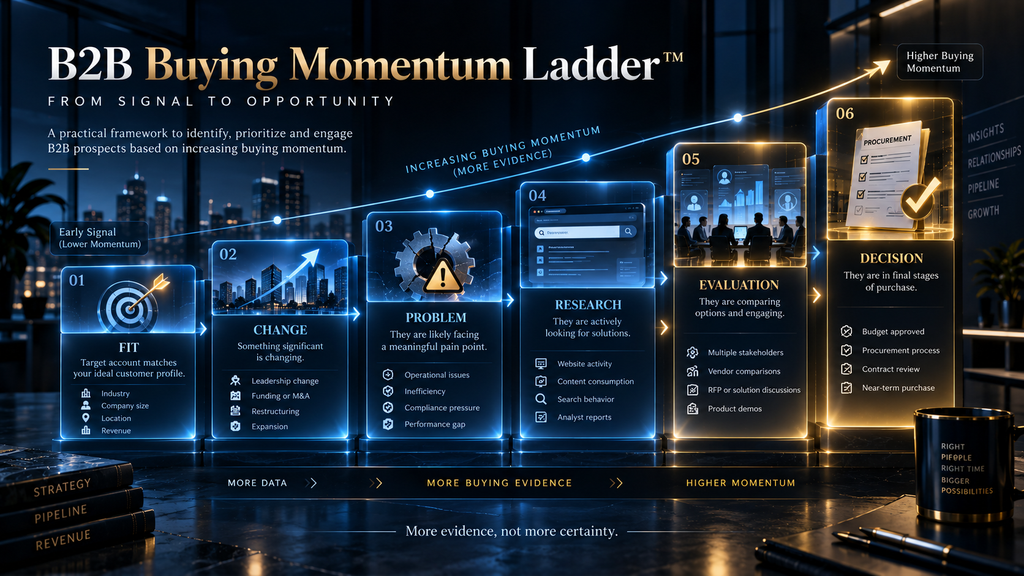
The readiness framework tells us what dimensions to evaluate. The next question is how an account progresses from ordinary fit toward credible buying readiness.
A useful model is: FIT → CHANGE → PROBLEM → RESEARCH → EVALUATION → DECISION.
This is not a claim that every B2B purchase follows a perfectly linear journey. Complex buying groups rarely behave that neatly. The ladder is instead a diagnostic model for understanding how evidence tends to become progressively stronger.
Fit
The account resembles the type of organization that benefits from the product. This is necessary but weak evidence of timing.
Change
Something material has shifted. The company raises capital, changes leadership, enters a new market, restructures a department, adopts a new technology, or significantly changes hiring. Change matters because purchasing often follows changing circumstances.
Problem
There is evidence that the change creates or intensifies a problem the product can address.
This is a crucial step that many signal systems skip. A company can expand without needing your solution. The system needs to establish a plausible relationship between the business change and the problem your product solves.
Research
Someone begins investigating the problem, category, vendors, or alternatives. This provides behavioral evidence that the problem is not merely theoretical.
Evaluation
The account shows evidence consistent with an active solution search. This might include multiple stakeholders engaging with relevant material, competitor research, pricing activity, technical evaluation, procurement involvement, or other evidence appropriate to the category.
Decision
The organization begins taking actions consistent with an actual purchasing process.
This is the strongest stage, but it is also the stage at which the sales team often has the least opportunity to create awareness. If competitors have already been evaluated and procurement is involved, the account may be highly valuable but strategically late.
That is why buying-signal intelligence should not be designed only to detect decision-stage behavior. Its greater strategic value is identifying the transition into a problem and evaluation state early enough for sales to become relevant without becoming intrusive.
The 10 Major Categories of B2B Buying Signals
There is no universal list of signals that works equally well for every product. A signal’s value depends on the business problem being solved, the typical buying journey, the sales cycle, and the economics of the account.
Still, most useful B2B signals can be organized into ten broad categories.
1. First-Party Behavioral Signals
First-party signals originate from interactions with your own business. Website visits, pricing-page activity, demo requests, product usage, webinar attendance, content downloads, email engagement, repeat sessions, and multiple visitors from one company can all provide evidence.
The strength of first-party data is context. You know what the prospect interacted with, when the activity occurred, and how it relates to your own product.
Its weakness is incomplete visibility. Buyers can conduct substantial research without ever visiting your website, particularly in categories where evaluation begins through peer recommendations, communities, analyst content, or competitors.
First-party behavior should therefore be treated as high-value evidence, not complete evidence.
2. Third-Party Intent Signals
Third-party intent data attempts to reveal research activity happening outside your own digital properties. This can include category research, content consumption, comparison activity, review-site behavior, or other indicators of interest.
The advantage is reach. Third-party signals can reveal accounts that have not yet interacted with your brand.
The limitation is interpretation. A company researching “sales automation” may be exploring dozens of possibilities, conducting market research, educating employees, or preparing for a project that will not receive funding. Vendor-generated intent scores can therefore be useful prioritization inputs without being treated as objective proof of buying readiness.
A sensible system uses third-party signals as one evidence layer within a broader account model.
3. Company-Change Signals
Company events are powerful because they reveal changes in business circumstances. Funding, acquisitions, mergers, executive appointments, geographic expansion, new product launches, restructuring, major partnerships, and other strategic events can alter what an organization needs.
HubSpot’s current buying-signal material similarly identifies research intent, recent news, sales engagement, marketing engagement, and company-level events such as executive hires, funding, and product launches as useful signal inputs. The mistake is to equate the event with purchase intent.
A funding round is not “buying intent.” It is a change in available resources. The system still has to determine whether those resources are likely to be directed toward an area relevant to the product.
4. Hiring Signals
Hiring activity can reveal strategic investment.
A sudden increase in sales hiring may indicate commercial expansion. New security roles may indicate a growing security function. A cluster of RevOps positions may indicate operational complexity. Hiring in a new country can signal geographic expansion.
The interesting information is often not a single job posting but the pattern. AI can compare current hiring with historical hiring, examine which functions are growing, identify changes in seniority, and determine whether the hiring pattern aligns with a business event. That creates a much more useful signal than simply saying, “Company has an open job.”
5. Job-Change and Leadership Signals
Leadership transitions can change priorities surprisingly quickly.
A new CRO may bring a different sales methodology. A new CIO may begin standardizing technology. A new CFO may introduce stronger purchasing controls. A new head of marketing may reevaluate the company’s demand-generation stack.
The signal becomes more useful when the system understands what the executive is responsible for and what the organization is doing simultaneously. A leadership change alone is an observation. A leadership change combined with relevant hiring, technology movement, and research activity is a hypothesis worth investigating.
6. Technology Signals
Technology adoption and migration can reveal operational priorities. Examples include implementing a new CRM, adopting a marketing automation platform, replacing an incumbent system, expanding a data stack, or adding complementary technology.
Technology signals are particularly useful when the vendor’s product integrates with, replaces, or becomes more valuable alongside the technology being adopted. But technology data has a major boundary condition: presence does not equal dissatisfaction.
A company using a competitor does not necessarily want to replace it. A technology migration may be unrelated to the problem you solve. AI should therefore use technology signals as contextual evidence rather than automatically converting them into competitive displacement opportunities.
7. Competitive Signals
Competitive research can reveal when an account is evaluating alternatives. A company comparing vendors, engaging with competitor-related content, hiring people with experience in a competing platform, or publicly discussing an incumbent may deserve attention. Competitive signals are particularly useful because they can reveal the existence of a category-level project before a prospect directly engages with your company.
The danger is overreaction. If a prospect is evaluating a competitor, the correct response is not necessarily “attack the competitor.” The first question should be why the account is evaluating the category at all and what business problem is driving the evaluation.
8. Pain and Problem Signals
The strongest signals are often not explicit purchase signals at all. They are evidence that a problem has become more expensive, visible, or urgent.
A company might publicly discuss operational inefficiency, customer-service problems, slow reporting, hiring challenges, compliance requirements, missed revenue targets, or difficulties scaling a process. These signals can be especially valuable because they connect directly to the problem rather than merely indicating generic interest.
The system should therefore ask: What changed in the customer’s business that makes this problem more consequential? That question moves buying-signal intelligence closer to real sales reasoning.
9. Buying-Committee Signals
Complex B2B purchases rarely belong to one person. Forrester’s 2026 research indicates that typical B2B decisions involve numerous internal stakeholders and external influencers, with larger buying groups associated with more complex and strategic purchases. This makes multi-contact activity a potentially powerful signal.
One employee researching a category is ambiguous. Five people across finance, operations, IT, and the business function engaging with different aspects of the same problem creates a much stronger account-level pattern.
The system should therefore track breadth of engagement across the account, not simply the activity of the loudest individual.
10. Direct Purchase Signals
The closest signals to actual buying activity include requests for pricing, demo requests, procurement conversations, vendor questionnaires, technical evaluation, implementation questions, security reviews, or direct discussions about purchasing. These are usually high-value signals because they are closer to a commercial decision.
But they also illustrate why timing matters. By the time a prospect requests a security questionnaire, the buying process may already be well advanced. The system should ideally detect the earlier signals that preceded this stage rather than waiting for the most obvious event.
Which Buying Signals Actually Matter?
Signal strength should be evaluated against more than volume. A useful signal is generally stronger when it is relevant, recent, specific, corroborated, and connected to a plausible business problem. Consider two accounts.
Account A has visited your blog eight times over three months. Account B has visited your pricing page twice this week, hired a new executive responsible for the problem you solve, increased hiring in the relevant department, and has three stakeholders engaging with related content.
Account A may actually have generated more activity. Account B is usually the more interesting sales opportunity.
This illustrates why raw activity counts can be misleading. A buying-signal system should optimize for decision value, not engagement volume.
Why One Signal Is Rarely Enough
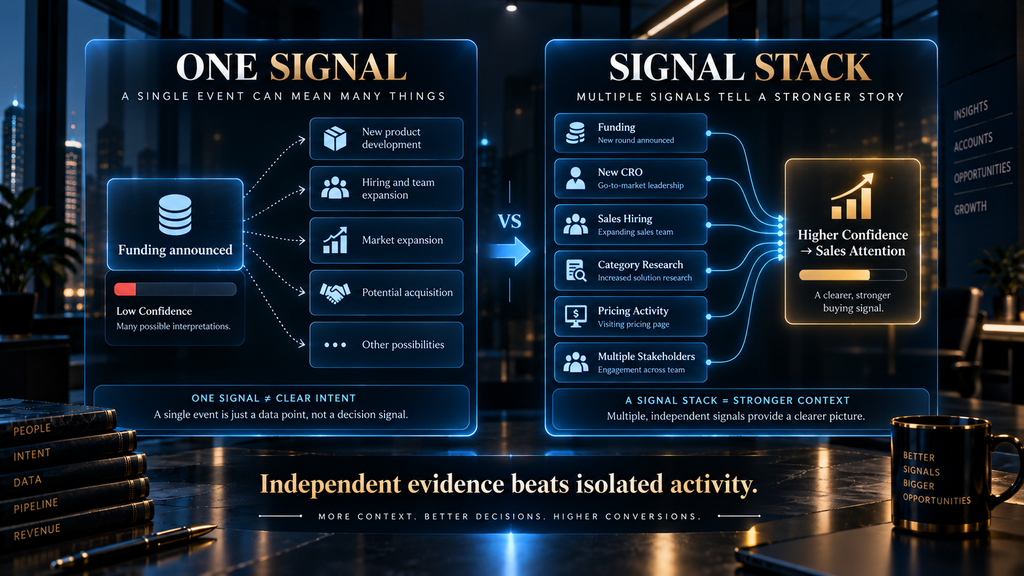
The strongest buying-signal systems work through signal stacking. Signal stacking means combining independent pieces of evidence that collectively support a more credible interpretation. Suppose a SaaS company raises $20 million.
That event tells you the company has new capital, but not what it will spend it on. Now suppose the company also hires a new CRO. That suggests a potential change in commercial strategy. Then it opens 30 new sales positions.
Now the commercial expansion hypothesis becomes stronger. Then several employees research sales forecasting and pipeline management.
Now there is behavioral evidence related to a potential operational problem. Then the company visits your pricing page.
Now there is first-party evidence connecting the account to your solution. None of the signals proves that a purchase will happen.
Together, however, they create a substantially stronger case for sales attention. This is the basic logic behind signal stacking, and current buying-signal guidance from Clay similarly emphasizes combining signals, assessing urgency, enriching the account, and routing the result into an appropriate sales action.
The Signal Confidence Model
Signal stacking creates another important question: How confident should the system be? A practical conceptual model is: Confidence = Relevance × Recency × Corroboration × Account Fit.
This should not necessarily be treated as a literal mathematical formula. Its value is that it forces the system to consider four dimensions rather than simply counting events.
A highly relevant event from yesterday may deserve significant attention. A weakly relevant event from two years ago should not.
Similarly, five copies of the same data point do not equal five independent signals. If five data vendors all obtain their information from the same underlying source, the apparent corroboration may be artificial.
That is an important technical and strategic distinction. Five sources are not necessarily five pieces of evidence.
Freshness: The Signal Has a Shelf Life
A signal that was meaningful six months ago may have little relevance today.
This is obvious with certain events. A company that announced a major expansion last year may already have completed the initiative. A new executive who joined twelve months ago is no longer a new executive. A product launch from eighteen months ago may have nothing to do with the company’s current priorities.
Behavioral signals can decay even faster.
A pricing-page visit from yesterday may deserve attention. The same visit from nine months ago probably should not carry the same weight.
Signal decay therefore needs to be part of the system’s logic. The question should not be: “Has this account ever shown a buying signal?” It should be: “What evidence is currently active, and how recently did the underlying circumstances change?”
Account Intent Is More Valuable Than Isolated Contact Intent
A contact can be interested without the account being ready. That person might be doing research for a future initiative, evaluating vendors for another department, benchmarking the market, or simply learning about a topic. Account-level intent becomes more meaningful when evidence begins to converge across multiple people and data sources.
Imagine one employee visits your product page. That is interesting.
Three employees from different departments research the same category. More interesting.
Those contacts are joined by a new executive, relevant hiring, and a company announcement describing the exact operational challenge your product addresses. Now the account has a coherent story.
This is why modern sales intelligence increasingly emphasizes combining CRM information with external data and multiple dimensions of fit, intent, engagement, and account context rather than treating individual activities in isolation.
SIGNAL → CONTEXT → CONFIDENCE → ACTION
This is the operational framework that turns the previous ideas into something sales teams can actually use.
Signal: What happened?
The system detects an event. For example, the company hired a new VP of Sales.
Context: Why could it matter?
The company is simultaneously expanding the sales team and entering two new markets.
Now the executive hire is not an isolated event. It is part of a broader commercial change.
Confidence: How strong is the interpretation?
The system finds supporting evidence: increased sales hiring, recent category research, engagement from multiple stakeholders, and a compatible technology environment. The system can therefore assign greater confidence to the hypothesis.
Action: What should sales do?
Instead of automatically sending an email, the system recommends researching the new executive’s priorities, identifying the relevant operational stakeholders, reviewing the current technology stack, and creating a message connected to the company’s expansion. That is a meaningful sales recommendation. “High intent: 87” is not.
The Signal-to-Action Matrix
A useful system should map different evidence patterns to different actions.
| Evidence pattern | Interpretation | Recommended action |
|---|---|---|
| Strong fit, little activity | Good potential but weak timing | Monitor |
| Strong fit + one weak signal | Possible early interest | Continue observation |
| Strong fit + relevant company change | Timing may have improved | Research account |
| Strong fit + recent research | Problem/category investigation | Monitor and enrich |
| Multiple recent signals | Increasing readiness | Prioritize |
| Strong multi-source signal stack | Credible buying window | Personalized outreach |
| Direct evaluation activity | Active buying process | Engage quickly |
| Previously strong signals now declining | Momentum may have changed | Reassess |
| Negative business signals | Purchasing capacity may be constrained | Lower priority |
This is one of the most important differences between a signal system and an alert system. An alert system asks: Did something happen? A decision system asks: Given everything we know, what should happen next?
The Practical AI Buying-Signal Workflow
The workflow begins with the ICP, not the AI model.
Before collecting signals, define the characteristics of accounts that are genuinely worth pursuing. If the ICP is vague, the signal layer will simply produce a larger volume of ambiguous prospects.
Next, identify the business events that tend to precede successful purchases. This requires examining existing customers and asking what changed before they became opportunities. Did they raise capital? Hire executives? Expand? Replace technology? Increase headcount? Encounter a regulatory requirement? Build a new department?
This customer-history analysis is important because it turns generic “buying signals” into signals that are relevant to your specific business model.
The next stage is data collection. Connect the sources that provide useful evidence: CRM activity, first-party behavior, company news, hiring, technology data, external intent, social or public information where appropriate, and other sources relevant to the category.
AI can then normalize entities, deduplicate companies, connect contacts to accounts, classify events, identify changes, and enrich the account. The next layer is interpretation.
The system should ask whether the event is relevant to the problem being solved, whether it is recent, whether independent evidence supports the interpretation, whether the account fits commercially, and whether the evidence is strong enough to justify human attention. Only after that should the system decide what to do.
A Better Architecture for AI Prospecting
A useful architecture can be understood as six connected layers.
Layer 1: Account foundation.
CRM records, firmographics, company identity, existing relationships, customer history, and technology context establish the account.
Layer 2: Signal detection.
The system monitors internal and external data for relevant changes and behaviors.
Layer 3: Signal interpretation.
AI classifies events, determines relevance, connects related signals, and creates a business hypothesis.
Layer 4: Readiness scoring.
The account is evaluated across fit, intent, timing, recency, corroboration, and negative evidence.
Layer 5: Sales decision.
The system determines whether the account should be contacted, researched, monitored, nurtured, or deprioritized.
Layer 6: Feedback.
Actual sales outcomes return to the system so that future prioritization can improve.
That final layer is what turns static scoring into an adaptive system. If high-scoring accounts repeatedly fail to convert while certain lower-scoring patterns produce opportunities, the organization should learn from those outcomes rather than defending the original scoring model.
The Feedback Loop Most Teams Miss
The best buying-signal system should learn from sales outcomes.
Suppose the system consistently prioritizes accounts with funding events. Sales reviews show that funded companies rarely convert unless there is also relevant hiring activity.
That is useful feedback. The model should reduce the standalone weight of funding and increase the importance of the funding-plus-hiring combination. Now suppose another pattern emerges: companies with a new executive and three or more engaged stakeholders convert unusually well.
That pattern should become more prominent. This creates a continuous loop: Signals → Interpretation → Priority → Sales Action → Outcome → Model Improvement.
Without the outcome layer, the organization is not really learning. It is simply generating increasingly sophisticated predictions without testing whether those predictions improve commercial results.
What Should Be Automated?
AI is particularly well suited to the parts of prospecting that involve scale and repetitive analysis. It can continuously monitor accounts, detect events, summarize company changes, enrich records, match contacts to companies, identify patterns, compare current behavior with historical behavior, score evidence, and route accounts. This can remove a large amount of manual research from sales representatives.
A representative should not have to spend twenty minutes every morning checking whether hundreds of accounts raised funding, changed executives, opened new positions, altered their technology stack, or became active on relevant channels. The machine is better at watching. The human is generally better at deciding what the observation means when the consequences are significant.
What Should Not Be Fully Automated?
The most important boundary is between evidence processing and relationship judgment.
AI can tell a salesperson that a company hired a new CRO. It can even construct a reasonable hypothesis about why that might matter.
But it cannot always know whether the CRO is empowered to change the relevant technology, whether the organization already selected a vendor, whether the company’s current strategy is confidential, or whether contacting the executive now would be commercially inappropriate. Those judgments require context that may not exist in the available data.
The appropriate model is therefore not “AI replaces sales research.” It is: AI compresses the search space so human judgment can be applied where it has the highest value.
A Realistic Example: From 5,000 Accounts to 40 Priorities
Consider a B2B software company with 5,000 accounts that broadly match its ICP.
A traditional prospecting system may divide those accounts among representatives according to territory, company size, or industry. The problem is that those characteristics do not tell representatives which accounts are changing right now.
An AI buying-signal system monitors the full account universe.
Over the course of a week, it detects several hundred events. Most are discarded because they are irrelevant, stale, weak, duplicated, or associated with accounts outside the ICP.
The system then identifies approximately 150 accounts with meaningful signal activity. After applying fit, timing, relevance, corroboration, and negative evidence, the list falls to 40 accounts. Those 40 accounts are not necessarily “guaranteed buyers.”
They are simply the accounts where the evidence currently provides the strongest reason for human investigation. One account has a new CRO, rapid sales hiring, expansion into a new geography, multiple stakeholders researching sales-operations topics, and recent first-party engagement.
Another has a funding event but no other relevant activity. Another has excellent fit and frequent website traffic but no meaningful change in business circumstances.
The system should not treat all three equally. The first account deserves active research. The second deserves monitoring. The third may remain in the broader prospecting pool.
This is what readiness-based prospecting looks like in practice.
Why the Traditional Method Still Exists
It would be a mistake to conclude that traditional prospecting is obsolete. Firmographic targeting, territory planning, account lists, outbound sequences, referrals, events, and relationship-driven selling continue to exist because they solve problems that signal intelligence does not.
Sales teams need a stable market universe. Territories need ownership. Reps need repeatable processes. Managers need forecasting structures. Companies cannot build a commercial strategy entirely around events that may or may not occur.
The problem is not traditional prospecting itself. The problem is asking traditional prospecting to answer a question it was never designed to answer: Which of these otherwise suitable accounts is becoming more likely to need us now? AI buying signals are valuable precisely because they can sit on top of the stable prospecting foundation rather than attempting to destroy it.
The Biggest Trade-Off: Coverage vs Precision
More signals do not automatically create better intelligence.
Adding more data sources increases coverage, but it can also increase noise. A system that detects everything may become less useful than a smaller system that detects fewer but more meaningful events.
This creates a fundamental trade-off between coverage and precision. High coverage means the system misses fewer potential opportunities but may produce more false positives.
High precision means the sales team receives fewer alerts, but some legitimate opportunities may never reach the queue. The right balance depends on the cost of missing an opportunity versus the cost of wasting sales time.
For enterprise sales, where a representative may spend hours researching one account, precision can be extremely valuable. For high-volume transactional sales, broader automated coverage may make more economic sense.
There is no universal optimal signal threshold. The correct threshold is an economic decision.
Another Trade-Off: Speed vs Interpretation
AI can make prospecting dramatically faster, but speed can become dangerous when it removes context. A system that sees a funding announcement and immediately triggers outreach may beat a human researcher by several hours. It may also send the wrong message several hours faster.
The right objective is not maximum automation speed. It is maximum useful speed. That means fast detection followed by enough interpretation to prevent obviously poor actions.
Common Mistakes When Building AI Buying Signals
Mistake 1: Treating a signal as proof
This creates false confidence. Every signal should be treated as evidence whose meaning depends on context.
Mistake 2: Using generic signals without customer evidence
A signal that sounds commercially interesting may have little predictive value for your particular product. Your own historical opportunities should help determine which patterns deserve attention.
Mistake 3: Counting duplicated evidence as corroboration
Multiple vendors reporting the same event do not necessarily create multiple independent signals. The system needs to understand data provenance.
Mistake 4: Ignoring negative signals
A company experiencing layoffs, budget cuts, restructuring, or a hiring freeze may become less likely to purchase even if older positive signals remain visible.
Mistake 5: Ignoring signal decay
Old events can make dead accounts look alive.
Mistake 6: Scoring activity instead of relevance
A highly active account is not automatically a highly relevant account.
Mistake 7: Optimizing for the number of alerts
The objective is not to produce more alerts. It is to improve the quality of sales decisions.
Mistake 8: Sending generic outreach after sophisticated research
There is little value in spending significant effort identifying why an account is changing and then sending: “Just wanted to see if you have 15 minutes this week.” The intelligence should influence the conversation.
The Reality Check: AI Cannot See Everything
Even an excellent buying-signal system operates with incomplete information.
Budget approvals may be private. Internal politics are often invisible. Procurement decisions can happen behind closed doors. A company can announce an initiative without revealing its vendor strategy. A buyer may deliberately avoid public research because the purchase is strategically sensitive.
There is also the problem of data bias.
Large companies with strong digital footprints generate more observable signals than smaller or quieter organizations. Companies with less public information can therefore appear less active even when they are highly engaged in a private buying process.
This means AI buying signals should always be treated as probabilistic intelligence, not complete visibility into buyer behavior.
The Honest Opinion: Most “Intent Scores” Are Too Easy to Misunderstand
A single number is attractive because it creates the illusion of certainty. “Account score: 91.” The problem is that the number hides the reasoning.
Was the score high because someone visited the pricing page? Because a third-party provider observed research activity? Because the company hired an executive? Because the account is simply a strong ICP fit?
Those are very different situations. A sales representative should be able to answer three questions immediately:
Why is this account prioritized? What evidence supports that priority? What should I do next?
If the system cannot answer those questions, the score may be operationally convenient but strategically weak. A transparent 78 with a clear explanation can be more useful than an opaque 94.
What Happens If You Do Nothing?
This is another part of the buying-signal decision that deserves attention. Without signal intelligence, sales teams generally continue working from some combination of static account lists, inbound activity, referrals, territory rules, and individual research.
That does not mean the business stops selling. The cost is opportunity timing.
Sales representatives may discover accounts after competitors have already entered the conversation. They may spend too much time on accounts that are excellent fits but inactive. They may miss early business changes that make their product newly relevant. They may also over-contact prospects simply because the CRM says they are “high priority.”
The opportunity cost is therefore not merely fewer leads. It is misallocated sales attention. For organizations with high-value accounts and limited representative capacity, that can become a significant economic problem.
Measuring Whether AI Buying Signals Actually Work
A buying-signal system should be evaluated as a decision system, not a data product. The first question is whether prioritized accounts convert better than comparable accounts that were not prioritized. That means measuring more than open rates.
A useful KPI framework includes:
| KPI | What it tells you |
|---|---|
| Signal precision | How often high-priority signals prove relevant |
| Signal-to-opportunity rate | How often signal-prioritized accounts become opportunities |
| Meeting conversion | Whether signal-informed outreach generates meetings |
| Pipeline per sales hour | Whether human time is being allocated more efficiently |
| Time-to-action | How quickly sales responds to relevant changes |
| False-positive rate | How often “high intent” turns out to be noise |
| Opportunity velocity | Whether signal-informed opportunities progress faster |
| Disqualification rate | Whether the system prevents wasted sales effort |
| Win rate | Whether better timing translates into commercial outcomes |
| Revenue per prioritized account | Whether prioritization improves economic value |
The most important measurement is often comparative. Do signal-informed accounts outperform similar accounts that did not receive signal-based prioritization?
If the answer is no, the organization should not simply add more data. It should investigate the reasoning model.
Building a Signal Evaluation Scorecard
Before adding a new signal to the system, evaluate it against a consistent set of questions.
- Relevance: Does this event have a logical connection to the problem we solve?
- Specificity: Does it reveal something meaningful, or is it common across almost every company?
- Recency: How quickly does the signal lose value?
- Reliability: How trustworthy is the underlying source?
- Independence: Does this signal add new evidence or duplicate information we already have?
- Actionability: Can sales actually do something useful because of it?
- Economic value: Does the signal improve prioritization enough to justify the cost of collecting and processing it?
This last question is often forgotten. A technically impressive signal that does not change sales decisions is not necessarily a valuable signal.
The Economics of Buying-Signal Intelligence
The economic argument for AI buying signals is fundamentally about human attention.
Imagine a sales representative responsible for 500 accounts. If meaningful research takes 15 minutes per account per week, manually monitoring the entire portfolio would require an enormous amount of time.
AI can continuously monitor the broader universe and reduce it to a smaller set of accounts that deserve investigation. The value therefore comes from improving the expected return on sales time.
A simple conceptual model is: Signal ROI = Incremental Pipeline Value − Signal System Cost. But a more useful operational question is: How much additional qualified pipeline does each hour of AI-assisted research produce?
Suppose a team spends the same number of representative hours prospecting before and after implementing signal intelligence. If the system produces more qualified opportunities from those hours, the economic case becomes much stronger.
This also explains why “more leads” is often the wrong success metric. If the system doubles the number of prospects but does not improve opportunity quality, it has increased workload rather than value.
A Practical Implementation Plan
The best implementation is usually narrower than organizations initially imagine.
Start with one segment of the ICP and one clearly defined business problem. Do not attempt to monitor every possible event across the entire market on day one.
Next, study existing opportunities and wins. Look backward and identify what changed before successful deals entered the pipeline. This provides a starting hypothesis for which signals may actually matter.
Then define the signal taxonomy. Separate company changes, behavioral signals, technology signals, hiring signals, competitive signals, pain signals, and buying-committee signals rather than throwing everything into one undifferentiated score.
After that, establish freshness rules and negative signals. Decide which events should decay quickly and which remain meaningful longer. Define circumstances that should lower account priority.
The next step is signal stacking. Determine which combinations of evidence are stronger than individual signals.
Finally, create action rules. Every priority tier should have a corresponding behavior: monitor, research, contact, escalate, nurture, or deprioritize.
This makes the system operational rather than theoretical.
The Minimum Viable AI Buying-Signal System
A sophisticated system does not need to begin with dozens of integrations. A practical first version can work with: Account data + CRM history + first-party engagement + a small number of high-value external signals + clear scoring logic + human review. The purpose of the first version is not to maximize coverage.
It is to discover whether signal-informed prioritization actually improves sales outcomes. Once the team understands which signals correlate with useful opportunities, additional sources can be introduced selectively. This is preferable to purchasing a large collection of data sources before knowing whether the resulting information will change sales behavior.
The Feedback Model
The system should eventually learn from four kinds of outcomes.
- Positive outcome: the signal led to a meaningful conversation or opportunity.
- Neutral outcome: the account was relevant but not ready.
- Negative outcome: the signal was misleading or irrelevant.
- Unknown outcome: insufficient evidence exists to determine whether the signal mattered.
These distinctions are important because “did not close” does not necessarily mean “bad signal.”
A strong early-stage signal may correctly identify an account that eventually buys twelve months later. If the system evaluates only immediate conversion, it may incorrectly discard useful early indicators.
Signal evaluation therefore needs to consider the sales cycle.
Who Should Use AI Buying Signals?
AI buying signals are most useful when four conditions exist: a reasonably clear ICP, enough account volume to create a prioritization problem, meaningful differences in buying timing, and sales representatives whose time has substantial economic value. Enterprise SaaS, complex B2B services, technology platforms, consulting, account-based sales, and other high-consideration categories are natural candidates.
The approach is less compelling when every potential buyer is already known personally, the market is extremely small, the purchase is almost entirely transactional, or the sales process is too short for signal interpretation to materially change the outcome. There is also a data maturity requirement.
If the CRM is inaccurate, account ownership is unclear, the ICP is undefined, and sales representatives do not follow a consistent process, buying-signal AI will not magically solve those problems. It will simply make them operate faster.
Who Should Avoid It?
Organizations should be cautious about implementing complex signal infrastructure when the expected value of better prioritization is small.
A local business with 100 total potential customers does not necessarily need an elaborate AI intent system. A company where every sales opportunity already comes through a small number of known relationships may gain little from continuous external monitoring.
The technology should follow the decision problem. Not the other way around.
The Second-Order Effect: Sales Teams May Become More Selective
If AI buying signals work properly, the long-term effect may be fewer outbound touches rather than more.
That sounds counterintuitive because sales technology has historically been associated with increasing activity. But if the system becomes better at identifying when an account is genuinely relevant, the economic value of indiscriminate outreach falls.
Representatives can spend more time on fewer accounts. Messages can become more contextual. Research can become deeper.
Sales managers can evaluate prioritization quality rather than simply measuring activity volume. This could gradually change what “sales productivity” means.
Instead of asking: How many prospects did the representative contact? Organizations may increasingly ask: How effectively did the representative allocate attention to the accounts where timing and relevance were strongest?
Another Second-Order Effect: The CRM Becomes a Learning System
Traditional CRMs are primarily historical records. They tell you what happened. An AI buying-signal layer can make the CRM increasingly predictive and adaptive by connecting historical outcomes with current market changes.
Over time, the system can learn which patterns tend to precede opportunities, which signals are misleading, which combinations matter, how long different signals remain useful, and which actions produce better results. That creates a transition from: Record keeping → Monitoring → Prediction → Decision support → Learning. The strategic value compounds because every sales outcome can improve future prioritization.
Final Thoughts
AI buying signals can make B2B prospecting dramatically more intelligent, but only when organizations resist the temptation to equate more data with more certainty.
The real challenge is not detecting that something happened. Modern systems can already detect an enormous number of events across companies, people, websites, technologies, hiring activity, research behavior, and business news. The harder problem is determining whether those events represent a meaningful change, whether that change relates to the problem your product solves, whether independent evidence supports the interpretation, whether the evidence is still fresh, and whether the resulting confidence is strong enough to justify spending scarce sales time.
That is why the most useful model is not a generic intent score. It is a chain of reasoning: DATA → FIT → INTENT → TIMING → ACTION.
And operationally: SIGNAL → CONTEXT → CONFIDENCE → ACTION.
The strongest AI prospecting systems will not necessarily identify the largest number of “hot” accounts. They will identify the accounts where the evidence is strongest, explain why those accounts deserve attention, recommend an appropriate response, and continuously learn from what happens afterward.
That changes the role of AI in sales. It does not replace the salesperson’s judgment. It makes that judgment more selective.
And ultimately, that is what buying-signal intelligence should accomplish: not finding more prospects, but identifying which prospects have a credible reason to act now—and helping sales understand why.
Build the Data Layer Behind Your Prospecting Workflow
An AI prospecting workflow is only as reliable as the account, contact, enrichment, and verification data feeding it.
Compare Lead Data Tools →Frequently Asked Questions
What is an AI buying signal?
An AI buying signal is an observable event, behavior, or change that may indicate a B2B account has become more likely to evaluate or purchase a product or service. AI systems can collect signals from first-party engagement, company events, hiring, technology changes, research behavior, CRM activity, and external data, then combine those signals to help prioritize accounts.
What are the most important B2B buying signals?
There is no universal ranking because signal value depends on the product and buying process. Common high-value categories include first-party behavioral activity, relevant company changes, leadership changes, hiring patterns, technology changes, competitive research, problem-related activity, multi-stakeholder engagement, and direct evaluation or purchase activity.
Is a website visit a buying signal?
A website visit can be a signal, but it is usually weak by itself. Its value increases when the visit is recent, relevant, repeated, connected to important pages, and supported by other evidence from the same account.
Is funding a buying signal?
Funding can be a useful company-change signal because it may alter an organization’s resources and priorities. It is not proof of purchase intent, however, because the new capital may be allocated to areas unrelated to the product being sold.
What is signal stacking?
Signal stacking means combining multiple independent signals to produce a stronger account-level interpretation. For example, a new executive, relevant hiring, category research, and first-party engagement may collectively provide much stronger evidence than any one of those events alone.
How does AI determine whether a buying signal matters?
AI can evaluate relevance, recency, account fit, signal strength, corroborating evidence, historical patterns, and potentially negative evidence. The goal is to determine whether the event changes the probability that the account deserves sales attention.
What is the difference between intent data and buying signals?
Intent data generally describes evidence of research or interest in a topic, category, or solution. Buying signals can include intent data but also encompass broader business events such as leadership changes, funding, hiring, expansion, technology adoption, and direct purchase activity.
Should buying signals be scored?
Scoring can be useful for prioritization, but the score should not replace the underlying explanation. Sales teams should ideally be able to understand which signals contributed to a priority level, how recent they are, and what action the system recommends.
How fresh should a buying signal be?
It depends on the signal and the sales cycle. Behavioral activity may decay quickly, while some strategic company events can remain relevant for longer. A strong system should apply signal-specific freshness rules rather than treating every historical event as equally important.
Can AI tell whether a prospect is ready to buy?
AI can estimate whether an account appears to be entering a stronger buying window, but it cannot guarantee that a purchase will occur. Budget, internal politics, procurement, competing priorities, stakeholder alignment, and other factors may remain invisible to the system.
Should every buying signal trigger outreach?
No. Some signals should lead to monitoring, some to account research, and some to immediate outreach. A mature system should also be able to recommend no action when the evidence is weak, contradictory, stale, or commercially irrelevant.
Should buying signals be evaluated at the contact or account level?
Both levels can be useful, but account-level interpretation is particularly important for complex B2B purchases. Activity from several stakeholders can provide stronger evidence than the behavior of one contact, especially when combined with company-level changes.
What should sales teams automate?
AI is well suited to continuous monitoring, signal detection, data enrichment, account matching, classification, prioritization, summarization, and routing. Human judgment should remain important for ambiguous interpretations, strategic accounts, messaging, relationship management, and decisions where an incorrect action could damage the opportunity.
What is the biggest mistake when using AI buying signals?
The biggest mistake is treating a signal as proof of intent. The purpose of buying-signal intelligence is to improve the probability and quality of sales decisions, not to create artificial certainty.
Sources and Further Reading
- The Short Life of Online Sales Leads: Harvard Business Review. Research on how quickly firms contact web leads and how that affects qualification.
- Legitimate interests: UK Information Commissioner’s Office guidance on relying on legitimate interests as a lawful basis.
Written by
Muntasir Ahmad Chowdhury
Founder, AI Hustle World
Muntasir Ahmad Chowdhury is the Founder of AI Hustle World, an independent publication dedicated to making Artificial Intelligence practical, trustworthy, and easy to understand. He researches AI tools, automation, customer service, productivity, and real-world business applications, helping readers make smarter technology decisions through research-driven, experience-backed content.
Expertise:
AI Tools • AI Automation • AI Customer Service • AI Productivity • Generative AI • AI Workflows
Get Smarter With AI
Enjoyed this guide? Get practical AI tools, tutorials, and honest reviews delivered to your inbox.