
Best AI Content Provenance and Detection Tools: What They Actually Do
The hardest part of verifying AI-generated content is not finding a tool that says “AI detected.” The hard part is determining what that result actually proves.
Imagine a company receives a product image from an outside agency. The agency says it was generated with AI, the designer says they heavily edited it, the marketing manager says the final version is substantially different from the original, and the platform where it was published has stripped the file’s metadata. Six months later, the legal or compliance team needs to establish how that image was created.
A conventional AI detector might analyze the finished image and return a probability. A watermark detector might find a signal from a supported AI generator. A provenance system might reveal a signed record showing where the asset came from and what transformations were recorded. Those three systems can all be looking at the same file while answering three different questions.
That distinction is the foundation of this entire category.
AI detection asks what the content appears to be. Watermarking asks whether a recognizable embedded signal exists. Provenance asks what verifiable information was recorded about the content’s origin and history.
The best solution for an organization is therefore rarely the tool with the highest advertised detection percentage. It is the system that produces the most useful evidence for the decision the organization actually needs to make.
That is the lens we will use throughout this guide.
The AI Hustle World Framework: TRACE
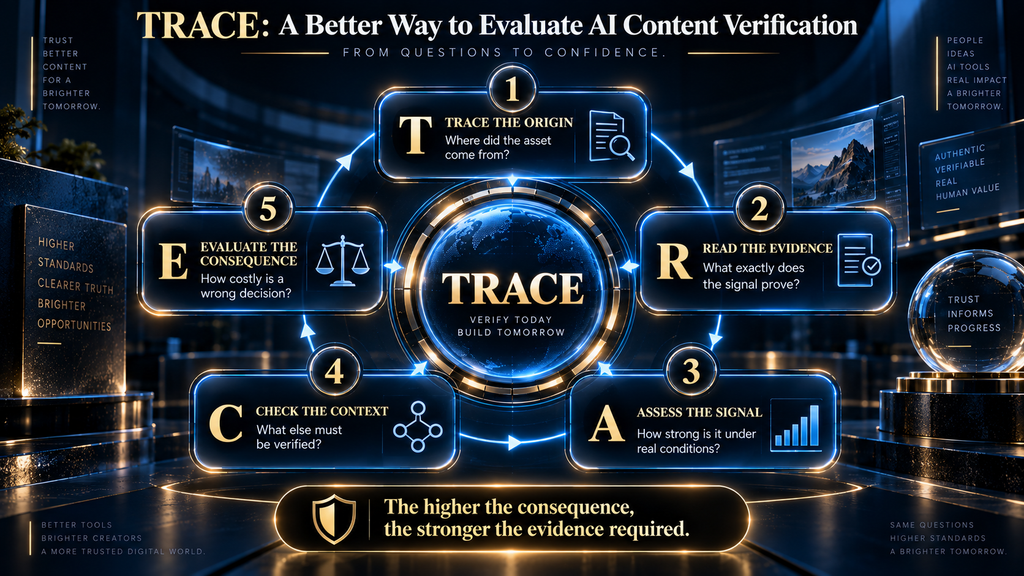
For this article, AI Hustle World uses a simple framework called TRACE to evaluate AI content verification systems. TRACE = Trace the origin → Read the evidence → Assess the signal → Check the context → Evaluate the consequence.
The purpose of TRACE is not to create another generic checklist. It changes the way you evaluate the entire market because it forces you to ask whether a verification technology produces evidence that is appropriate for the decision being made.
T — Trace the Origin
Start with the strongest question available: Where did this asset come from? If the organization knows the source, creator, application, generation system, editing workflow, and relevant timestamps, it already possesses evidence that a detector cannot reconstruct from the final file alone.
This is where provenance becomes strategically important. C2PA’s Content Credentials model is designed to preserve verifiable assertions about the origin and history of digital content through signed provenance information.
R — Read the Evidence
The next question is not whether a tool produced a result, but what kind of evidence produced that result.
A detector probability is an inference. A watermark match is evidence of a supported signal. A cryptographically signed provenance record is evidence that a particular provenance assertion was created and signed by a participating system.
These are not equivalent forms of evidence, even if a dashboard displays them next to one another.
A — Assess the Signal
Every signal has boundaries.
A detector may perform differently across languages, content lengths, writing styles, image types, compression levels, or manipulated material. A watermark may be detectable only when the originating AI system uses that watermark technology. Metadata may disappear during ordinary file processing.
TRACE therefore asks: How strong is this signal under the conditions in which the asset actually exists?
C — Check the Context
A verification result without context can be misleading.
A piece of text might contain AI-assisted editing without being entirely machine-generated. An image might be AI-generated but then extensively edited by a human. A photograph might have valid provenance but depict an event described incorrectly by the publisher.
Context determines what the evidence means.
E — Evaluate the Consequence
Finally, ask what happens if the organization gets the decision wrong. If a marketing team is merely deciding whether to review a social-media image, a probabilistic detector may be perfectly reasonable as a screening tool. If an employer is deciding whether to discipline someone, or a publisher is deciding whether to accuse a contributor of fabricating work, the evidentiary threshold should be much higher.
This is the central decision principle of the article: The higher the consequence of being wrong, the less acceptable it is to rely on a single probabilistic signal. That is the part most “best AI detector” articles miss.
Why AI Content Verification Became Necessary in the First Place
Before generative AI became widely accessible, content verification generally focused on questions such as authorship, source authenticity, plagiarism, manipulation, copyright, and editorial credibility. The traditional methods were not perfect, but they worked reasonably well because the production process left recognizable human and institutional traces.
A journalist could point to the photographer who took an image. A company could identify the designer who created a campaign graphic. A publisher could trace a manuscript through an editor. A photographer could provide the original RAW file. A newsroom could compare a submitted image against the original source.
Generative AI complicates that chain because the distinction between creator, tool, editor, and final publisher becomes less obvious.
One person may generate an image with an AI model, modify it in Photoshop, place it inside a presentation, export the presentation as a PDF, screenshot the relevant page, crop the screenshot, and upload it to a social network. By the end of that chain, the final asset may bear little technical evidence of its original creation process.
The traditional verification model was essentially based on reconstructing the chain manually.
That model still matters. In fact, it is one reason provenance technology exists.
The problem is that manual reconstruction does not scale.
A large publisher, marketplace, social platform, university, advertising agency, or enterprise may process thousands or millions of digital assets. It cannot conduct a human forensic investigation every time an image or document enters the system.
That creates the market opportunity for automated verification. But automation introduces a new problem: automation can estimate, classify, and verify signals, but it cannot automatically turn uncertainty into certainty. That is why understanding the underlying mechanisms matters more than comparing marketing claims.
AI Detection, Watermarking and Provenance Are Not the Same Thing
The market becomes much easier to understand once the three technologies are separated.
| Technology | Primary question | Evidence type | Main strength | Main weakness |
|---|---|---|---|---|
| AI detection | Does this content resemble AI-generated output? | Statistical/model inference | Can analyze existing content without prior provenance | Can produce false positives and false negatives |
| Watermark detection | Does the content contain a known embedded AI signal? | Embedded signal | Can identify supported AI-generated content even after some transformations | Usually ecosystem-specific |
| Provenance | What recorded information exists about the asset’s origin and history? | Signed metadata/credentials | Provides traceable creation and modification information | Depends on participating systems and preservation |
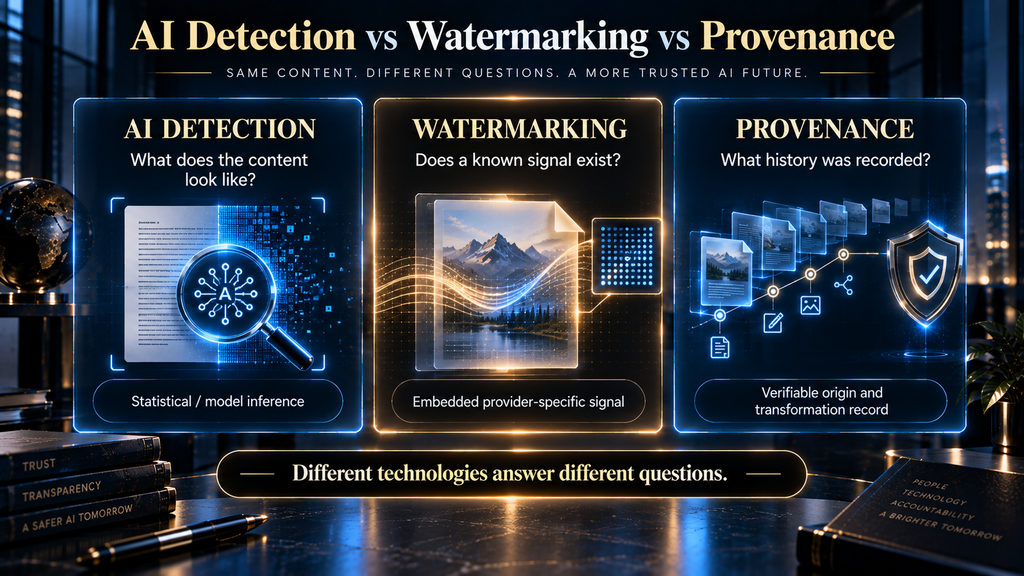
The distinction is more than technical terminology.
Suppose a detector says an article has an 80% probability of being AI-generated. That does not tell you which AI system created it, when it was created, whether a human substantially rewrote it, or whether the detector is misclassifying a human writer’s style.
Now imagine a provenance record showing that a supported system created the asset. That is a very different kind of evidence. It can establish a recorded event associated with the content, although it still does not prove that every claim contained in the content is true.
Now consider a watermark. A positive watermark result can indicate that the relevant generation system embedded a detectable signal, but it does not necessarily provide the complete production history.
The technologies overlap, but they should not be treated as interchangeable.
How AI Detection Actually Works
AI detection is fundamentally a classification problem.
The system receives an existing piece of content and attempts to determine whether characteristics of that content resemble patterns associated with AI-generated material. Depending on the detector, those characteristics can involve linguistic structure, statistical patterns, model-derived representations, token behavior, stylistic consistency, or other signals.
The important point is that the detector is looking backward. It sees the finished product and attempts to infer the process that produced it.
That is fundamentally different from provenance, which attempts to record information during the production process. This explains both the appeal and the weakness of AI detectors.
Their appeal is that they can work after the fact. If you receive an article from an unknown contributor and have no metadata, no generation logs, and no Content Credentials, a detector may still be able to analyze the text.
Their weakness is that the original generation process is no longer directly observable.
Research continues to demonstrate this boundary. A 2025 ACL study examining AI-generated and humanized text found that paraphrasing and “humanization” techniques could substantially affect detector performance, illustrating why detection should not be treated as a universal forensic test.
Another 2025 study evaluating several AI-output detectors found useful discrimination under its experimental conditions but also reported false-positive risks, reinforcing the need to interpret detector results within their intended operating conditions rather than treating them as absolute proof. The practical lesson is straightforward: a detector can be useful without being definitive. That sounds like a small distinction, but it changes how the technology should be deployed.
Why AI Detectors Can Flag Human Content
A detector does not possess a magical “AI sensor.” It identifies patterns. That means a human-authored piece can sometimes resemble the patterns the detector associates with machine-generated text.
Highly structured writing, repetitive syntax, predictable phrasing, formulaic business language, short sentences, standardized academic prose, or heavily edited content can all create conditions where an inference-based system becomes uncertain. The problem is particularly serious when organizations use detector outputs as disciplinary evidence.
Consider an employee who writes highly polished reports using a standardized corporate style. A detector flags several passages as likely AI-generated. If management interprets the score as proof, the employee may be forced to prove a negative: that a machine did not write the text.
That reverses the evidentiary burden.
A more responsible approach is to treat the result as a trigger for review. The organization can examine document history, drafts, source notes, revision records, collaboration logs, or other evidence before reaching a conclusion.
This is not merely an ethical preference. It is a logical response to uncertainty.
Why AI Detectors Can Miss AI-Generated Content
The opposite problem is equally important.
AI-generated material can be modified after generation. A user may rewrite sentences manually, use another AI model for paraphrasing, translate the content, restructure the document, introduce human-written material, or combine several sources.
Once the output changes, the detector is no longer analyzing the original generation distribution. This is one reason the idea of a universal AI detector is difficult to sustain.
A detector designed around one class of generated output may perform differently when the output is transformed. Research into AI-generated text detection has repeatedly highlighted adversarial and non-adversarial transformations that can reduce detection effectiveness.
The same principle applies visually.
An AI-generated image can be cropped, resized, filtered, screenshot, compressed, or incorporated into another composition. Some watermarking technologies are explicitly designed to survive selected transformations, but no single signal should be assumed to survive every possible transformation indefinitely.
The market therefore has a basic asymmetry:
Detection starts with the artifact and tries to infer the past. Provenance starts with recorded events and tries to preserve the past.
That is why provenance becomes increasingly attractive as AI-generated content enters professional workflows.
What Content Provenance Actually Does
Content provenance is best understood as a chain-of-custody system for digital media, although that analogy should not be taken too literally. A provenance system can record assertions about how an asset was created or modified and associate those assertions with the asset in a verifiable format.
C2PA is the major open standard associated with this approach. Its purpose is to make provenance assertions about digital content verifiable and tamper-evident rather than simply storing ordinary editable metadata.
That distinction matters. Ordinary metadata might say: Created with application X. But metadata alone does not necessarily provide a strong guarantee that the information was not changed.
C2PA uses signed manifests and cryptographic mechanisms to establish a verifiable relationship between provenance information and the associated content. This does not mean the resulting content becomes automatically truthful.
Instead, the system provides stronger evidence about what was asserted to have happened to the asset. That is a much more precise proposition.
The Difference Between Authenticity and Truth
This is one of the most important concepts in the entire article. A piece of content can be authentic in terms of provenance while still being false in terms of its claims.
Imagine a camera captures a genuine photograph. The photograph has valid provenance showing that it came from the camera and was subsequently edited.
That establishes useful information about the asset. It does not establish that the caption attached to the photograph is accurate.
Similarly, an AI-generated image can have perfectly valid provenance. The provenance may accurately establish that an AI system generated it.
That does not make the fictional scene depicted in the image a real event. OpenAI’s documentation makes this distinction explicit: provenance signals can provide useful information about origin, but they should not be interpreted as guarantees of accuracy, legality, or contextual truth. This creates four separate questions that organizations should avoid collapsing into one:
- Where did the content originate?
- Was it altered, and how?
- Is the provenance evidence valid?
- Are the claims or context surrounding the content true?
A mature verification system answers the first three more effectively than a generic detector. The fourth still requires contextual verification.
How C2PA and Content Credentials Fit Into the Workflow
C2PA is important because provenance becomes much more useful when different tools can communicate using a common framework.
Without a standard, each software vendor could create its own proprietary record of content history. That would make provenance fragmented and difficult to interpret across organizations.
C2PA attempts to create an interoperable standard. The underlying model can include information about an asset’s creation, modifications, and other relevant actions, with provenance assertions packaged into signed manifests. That makes provenance particularly interesting for organizations that operate across multiple stages of the content supply chain.
Consider a commercial campaign. An AI image generator produces the first image. A designer modifies it. A marketing team adds typography. The final asset is approved and distributed.
In a provenance-aware workflow, those actions can potentially form part of an auditable history rather than disappearing into disconnected applications. That is the strategic value.
The technology is not merely trying to identify AI. It is attempting to make digital production history more observable.
Watermarking: The Missing Layer Between Detection and Provenance
Watermarking occupies an interesting middle ground. Instead of storing the signal exclusively in external metadata, a watermarking system attempts to embed information into the content itself.
Google’s SynthID is a prominent example. Google describes SynthID as a technology that embeds imperceptible watermarks into supported AI-generated images, audio, text, and video. Its documentation also describes resilience against certain modifications and transformations.
This creates an important advantage.
Metadata can be removed without intentionally attacking the content. A social platform can resize an image, a user can convert a PNG into a JPEG, or a workflow can export a document into another format.
An embedded signal can potentially survive some of those transformations. But watermarking is not a universal AI detector. If an image was generated by a system that does not use SynthID, the absence of a SynthID signal tells you very little about whether another AI system was involved.
The correct interpretation is therefore:
A positive provider-specific watermark can be strong evidence of involvement from that supported system. A negative result does not prove human creation.
That distinction should appear prominently in any enterprise policy built around AI verification.
Why Provenance and Watermarking Work Better Together
The real strength appears when the technologies are layered. Imagine an organization receives an image.
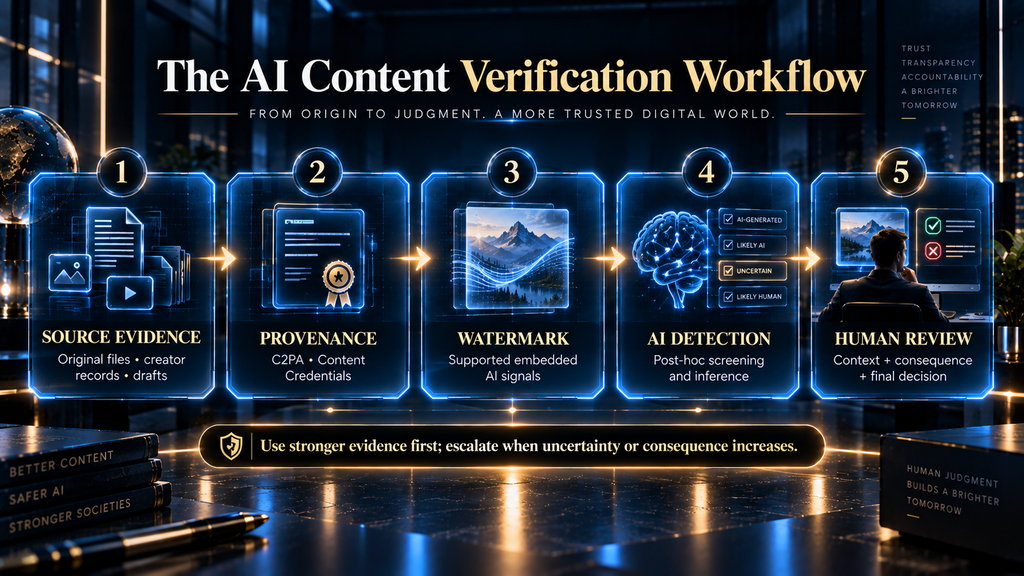
First, the system checks for Content Credentials. If valid provenance exists, it may reveal information about the creation and editing history.
Next, it checks supported watermark signals. If a recognized watermark exists, that adds another independent signal about AI-system involvement.
If neither signal is available, an AI detector may still analyze the content and provide an inference. Finally, a human reviewer interprets the available evidence against the actual context.
This creates a hierarchy of evidence rather than a binary classifier. The important thing is that the layers should not be treated as equally authoritative.
A cryptographically verifiable provenance record can answer a different and often more concrete question than a model’s probability estimate. A watermark can provide a strong provider-specific signal without providing the full content history. A generic detector can provide useful screening where no stronger evidence exists.
That is why TRACE starts with origin and evidence before moving toward inference.
The AI Content Verification Stack
A practical organization can think about verification as a stack rather than a single product.
Layer 1: Source Evidence
The strongest starting point is often the organization’s own records: original files, project records, creator information, drafts, production logs, and documented workflows. This is frequently overlooked because it is not marketed as an “AI tool.” Yet a well-maintained production record can be more informative than a detector score.
Layer 2: Provenance
Next comes C2PA or another supported provenance mechanism that can provide verifiable information about creation and modification. This layer becomes particularly valuable when content moves between trusted systems.
Layer 3: Watermarking
Watermark verification can identify embedded signals from supported AI systems and can complement provenance when metadata has been removed or when a provider-specific signal is especially useful.
Layer 4: AI Detection
Generic AI detection fills an important gap when provenance and watermarking are unavailable. Its role should primarily be screening and escalation, not unquestionable judgment.
Layer 5: Human Review
Human review remains the final interpretive layer when the consequences are meaningful. This is not an admission that the technology failed. It is recognition that verification and judgment are different tasks.
A Real-World Example: A Marketing Agency
Consider a marketing agency producing 500 social assets for a client.
Some images are traditional photographs. Some are generated with AI. Others are hybrid compositions. Several are modified manually. The client wants to know which assets contain AI-generated material because its internal policy requires disclosure for certain campaign assets.
A simplistic approach would run all 500 images through an AI detector. That sounds efficient, but it creates several problems.
The detector may identify some traditional images as suspicious. It may miss heavily edited AI-generated assets. It may provide no information about which AI system was involved. It also cannot reliably reconstruct the editing history.
A TRACE-based workflow would approach the problem differently.
The agency first preserves the original assets and associates each asset with the project record. It then checks provenance where available. Supported watermark signals are checked where relevant. Generic detection is used on assets without stronger evidence. Finally, exceptions are reviewed by a human.
The result is not necessarily more automated. It is more defensible.
That distinction matters because the client’s real requirement was not “detect AI.” It was “establish whether our disclosure policy applies.” The correct tool was therefore determined by the decision, not by the technology category.
Another Example: A Publisher Investigating a Suspicious Image
Now consider a newsroom receiving a dramatic photograph allegedly showing a major event. The image has no obvious provenance information. A generic detector returns a high probability that it is AI-generated.
Should the newsroom publish an accusation? No. The detector has produced a lead, not a complete finding.
The newsroom should investigate the original source, contact the contributor, examine file history, search for earlier versions, compare the image with known sources, inspect provenance if available, check supported watermark signals, and evaluate the surrounding claims. The detector can accelerate the investigation by telling the newsroom where to look.
It should not replace the investigation. This is the Reality Check that should govern the category: a detector is most valuable when it helps a human investigate efficiently; it becomes dangerous when organizations pretend the detector has already completed the investigation.
How the Tools Should Be Compared
Because the market combines fundamentally different technologies, the conventional “feature comparison” approach is insufficient. A better comparison evaluates each solution across six dimensions.
| Dimension | What matters |
|---|---|
| Evidence | Does the tool provide inference, provenance, watermark evidence, or multiple signals? |
| Coverage | What content types and AI ecosystems can it actually evaluate? |
| Resilience | What happens after editing, compression, cropping, paraphrasing, or conversion? |
| Integration | Can it work inside the organization’s existing content workflow? |
| Governance | Can results be logged, reviewed, challenged, and audited? |
| Decision fit | Is the evidence appropriate for the consequence of the decision? |
This last criterion is the most important. A tool can be technically impressive but operationally wrong.
For example, a lightweight detector may be excellent for triaging thousands of low-risk submissions but inappropriate for employment decisions. A provenance platform may be overkill for a small creator who only wants to check whether one image contains a supported AI watermark.
The best tool is therefore contextual.
Who Should Use AI Detection Tools?
AI detection is most useful when an organization needs rapid screening at scale.
Universities may use detection as one input when reviewing unusual submissions. Publishers can use it to identify content requiring editorial investigation. Platforms can use automated classification as part of broader trust-and-safety systems. Businesses can use it to prioritize assets for manual review.
But organizations should establish a policy before deployment. The policy should specify what a detector result means, what it does not mean, when human review is required, what evidence can override the result, and how users can challenge a decision.
Without those rules, the technology can quietly evolve from a screening mechanism into an automated authority. That is a governance failure, not a detection failure.
Who Should Prioritize Provenance?
Provenance is particularly valuable for organizations that control or influence the content-production pipeline. Large publishers, creative agencies, media organizations, brands, camera manufacturers, software vendors, and enterprise content teams have a strong incentive to preserve creation history because they can capture provenance information before the asset leaves their systems. This is the key economic advantage of provenance.
You do not have to spend as much effort reconstructing the past if your workflow records important events as they happen. For organizations producing large volumes of content, that can eventually become more efficient than repeated forensic investigation.
Who Should Care Most About Watermarking?
Watermarking becomes especially useful when an organization works heavily with AI systems that provide recognizable embedded signals. If a company uses a particular AI ecosystem extensively, checking that ecosystem’s watermark can provide a valuable additional verification layer. However, organizations should avoid creating policies such as: “No watermark means no AI.”
That rule is technically indefensible because watermark coverage is ecosystem-dependent and because signals can be affected by subsequent transformations. A better policy is: “A detected supported watermark is evidence of involvement from the relevant system; an absent watermark is inconclusive.” That wording is much more defensible.
The Economics of Verification
Verification has a cost, but so does the absence of verification. Suppose a company processes 100,000 content assets per year. A manual review of every asset may be economically impossible.
A fully automated system might reduce review costs dramatically, but if it produces a significant number of false positives, the organization may spend those savings dealing with disputes, escalations, reputation damage, or incorrect decisions. This is why ROI should not be measured simply by how many assets a tool can scan. The more useful measurement is: How much risk does the verification system remove per unit of operational cost?
That changes the business case. For low-risk content, automated detection may provide inexpensive triage.
For high-risk content, provenance and documented human review may have a higher cost per asset but dramatically reduce the expected cost of a wrong decision. The optimal system is therefore usually tiered.
A Practical Risk-Based Verification Model
A useful implementation model is to assign content to three risk levels.
| Risk level | Typical content | Recommended verification |
|---|---|---|
| Low | Internal drafts, brainstorming, low-impact social content | Automated screening where useful |
| Medium | Published marketing assets, customer-facing content, external submissions | Provenance/watermark checks + automated screening + review for exceptions |
| High | Legal evidence, major news claims, employment decisions, sensitive public communications | Provenance + source verification + multiple signals + documented human review |
The exact classification should be customized to the organization. The principle should not.
Verification intensity should increase with the consequence of error. That is the most economically rational way to deploy these technologies.
The Failure Modes You Need to Design Around
The first failure mode is false certainty. A detector gives a percentage, and the organization interprets it as a fact.
The second is coverage illusion. A company tests one provider’s watermarking technology and assumes that the result represents the entire AI ecosystem.
The third is provenance loss. A company establishes Content Credentials at creation but ignores the platforms and transformations that later strip or alter provenance information.
The fourth is workflow fragmentation. The verification system operates separately from content production, meaning employees do not actually use it consistently.
The fifth is decision mismatch. A low-cost screening tool is used for a high-consequence decision simply because it is available.
The sixth is evidence destruction. Teams overwrite original files, discard drafts, or convert assets before verification takes place.
The seventh is vendor dependency. An organization becomes dependent on one proprietary detection system without understanding what happens if that vendor changes its model, coverage, pricing, or verification methodology.
These are not merely technical problems. They are implementation problems.
Why the Traditional Method Still Matters
There is a temptation to assume that once AI verification tools mature, organizations will no longer need human source checking. That would be a mistake. Traditional verification exists because content authenticity has always been contextual.
Journalists verify sources because an image alone does not tell the entire story. Editors examine drafts because authorship involves process. Businesses retain project records because disputes often require reconstruction of events. Legal teams preserve documentation because evidence must be explainable.
AI does not eliminate those needs. It increases the scale and complexity of the problem.
The best modern approach therefore combines traditional verification with machine-assisted signals rather than replacing one with the other. AI verification should make traditional verification faster and more systematic, not obsolete.
What Happens If You Do Nothing?
For organizations that publish relatively little digital content, doing nothing may appear reasonable. The problem is that the cost of verification usually becomes visible only after an incident.
A disputed image can create a reputational crisis. A false accusation based on a detector can damage employee trust. An undocumented AI-generated asset can create contractual problems. A publisher unable to establish where an image came from may spend significant resources reconstructing its origin after publication.
There is also an opportunity cost.
Without provenance, organizations remain dependent on forensic reconstruction. Without standardized processes, every investigation becomes a new project.
That does not mean every organization needs enterprise-grade provenance infrastructure immediately. It means organizations should at least understand which content requires traceability and preserve the evidence accordingly.
The worst strategy is not necessarily having no AI detector. It is discovering after a serious incident that there was no usable evidence trail at all.
Common Mistakes When Choosing an AI Content Verification Tool
One of the biggest mistakes is buying the product with the strongest-looking accuracy claim.
Accuracy is meaningful only in context. You need to know what content was tested, which languages were represented, how the samples were generated, what transformations were applied, and how the evaluation was conducted.
Another mistake is comparing a detector with a provenance system as if they were direct competitors. They are not.
One primarily estimates characteristics of existing content. The other preserves information about content history.
A third mistake is assuming that “AI-generated” is a single category. AI-generated text, images, video, audio, synthetic photography, AI-assisted editing, and hybrid human-AI workflows can create very different verification problems. A fourth mistake is ignoring privacy.
If employees or customers upload confidential documents to a third-party detection service, the organization needs to understand what happens to those files, whether they are retained, whether they are used for model improvement, and who can access the information. A fifth mistake is failing to define the action that follows a detection result. If nobody knows what an 87% probability should trigger, the organization has purchased a number rather than a governance process.
Privacy Should Be Part of the Product Decision
AI verification can involve sensitive material. A company may want to inspect unpublished product designs, legal documents, employee writing, confidential presentations, or customer-submitted files. Uploading those materials to an external detection service can create a separate information-governance risk.
Therefore, tool selection should consider not only detection quality but also:
- Data retention policies
- Training or model-improvement use
- Encryption
- Access controls
- Data residency requirements
- Deletion mechanisms
- API security
- Enterprise administration
- Audit logging
This is especially important because the organization may be using a verification tool precisely because it cares about trust. A system that creates an unnecessary confidentiality risk undermines that objective.
How to Build a Verification Workflow From Scratch
Start with the asset categories rather than the vendors.
List the types of content the organization produces and receives: text, images, audio, video, documents, presentations, or other digital assets. Then classify those assets by risk.
Next, identify which assets the organization can control at creation time. Those are the best candidates for provenance because the company can capture relevant information before the asset leaves the workflow.
Then identify external content where provenance may not exist. That is where detection and watermark verification become more important.
After that, establish the review threshold.
For example, a low-risk asset may be automatically cleared when no suspicious signal appears. A medium-risk asset may be escalated when detection results conflict with provenance. A high-risk asset may require human verification regardless of automated results.
The workflow should also preserve the original asset before transformation whenever practical. Finally, document the decision.
A good verification process should allow someone months later to answer: What did we check, what did we find, what did we believe the evidence meant, and why did we make the final decision? That is what turns a collection of AI tools into a governance system.
How to Measure Whether the System Is Actually Working
Verification systems need operational KPIs. The obvious metric is detection accuracy, but that is only one component. A more useful measurement framework includes:
| KPI | What it tells you |
|---|---|
| False-positive rate | How often legitimate content is incorrectly escalated |
| False-negative rate | How often relevant AI-generated content is missed |
| Review escalation rate | How much content requires human investigation |
| Mean verification time | How quickly a case can be resolved |
| Provenance coverage | What percentage of assets carry usable provenance information |
| Signal conflict rate | How often detector, watermark, provenance, and contextual evidence disagree |
| Evidence retention rate | Whether original verification evidence remains available |
| Decision reversal rate | How often human review overturns automated classification |
| Cost per verified asset | Operational economics of the program |
| Incident reduction | Whether verification actually reduces real-world problems |

The most important KPI may be decision reversal rate. If automated systems frequently classify content one way and human reviewers consistently overturn those decisions, the organization has evidence that its automation threshold is too aggressive. Conversely, if human review rarely changes outcomes in a well-controlled low-risk workflow, automation may be appropriately calibrated.
The objective is not maximum automation. It is maximum useful automation at an acceptable error cost.
The Contrarian View: AI Detection May Become Less Important Than Provenance
Here is the uncomfortable prediction. The long-term winners in AI content verification may not be the companies that build the smartest detector. They may be the companies that make it easier for the content ecosystem to preserve trustworthy production history from the beginning.
That is because detection is inherently fighting an information-loss problem. Once the original production process disappears, the detector has to infer what happened from the remaining artifact.
Provenance takes the opposite approach. It tries to preserve evidence before it disappears.
That does not make detection obsolete. There will always be content that enters an organization without provenance, and there will always be a need to investigate legacy material.
But as provenance adoption expands, the relative value of post-hoc detection may change. The market could gradually move from: “Can we guess whether AI made this?” toward: “Can the content itself provide verifiable evidence about how it was made?” That is a much more powerful question.
The Second-Order Effect: Provenance Could Change How Content Is Produced
The deeper consequence of provenance is not merely better verification. It could change production behavior. If creators know that content-generation and editing events can become part of an auditable record, organizations may begin designing workflows around traceability from the start.
That could affect procurement. Companies may prefer software that preserves provenance. It could affect contracts.
Clients may begin asking agencies to deliver provenance information alongside campaign assets. It could affect publishing. Newsrooms and platforms may increasingly display origin information to audiences.
It could affect AI product competition. Vendors may compete not only on model quality but also on how transparently their systems participate in the broader content-authenticity ecosystem. In other words, provenance can create a feedback loop.
Better traceability encourages more transparent workflows, which creates more usable evidence, which makes provenance more valuable. That is why this category should be viewed as part of digital infrastructure rather than merely another AI detection niche.
What the Best AI Content Verification Strategy Looks Like in Practice
There is no single “best AI content verification tool” for every organization.
A publisher with millions of incoming images has a different problem from a small agency producing marketing graphics. A university reviewing student assignments has a different risk profile from a social platform moderating billions of uploads. An enterprise managing internal documents has different privacy requirements from a public-facing media organization.
The strongest strategy is therefore layered.
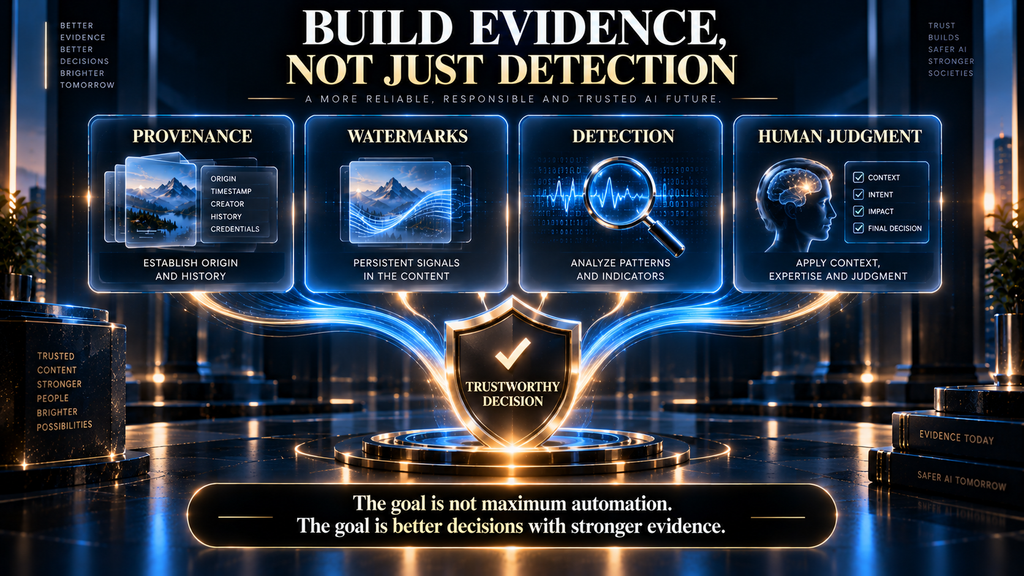
Use provenance when you can establish the content history at the source. Use watermark verification when the relevant AI ecosystem supports it. Use AI detection when you need post-hoc screening and no stronger signal exists. Then use human judgment when the evidence is ambiguous or the consequence of being wrong is high.
This is exactly what TRACE is designed to enforce. The framework also prevents a common procurement mistake: buying a tool first and figuring out the problem later. Start with the decision.
Then determine the evidence required. Then choose the technology that produces that evidence.
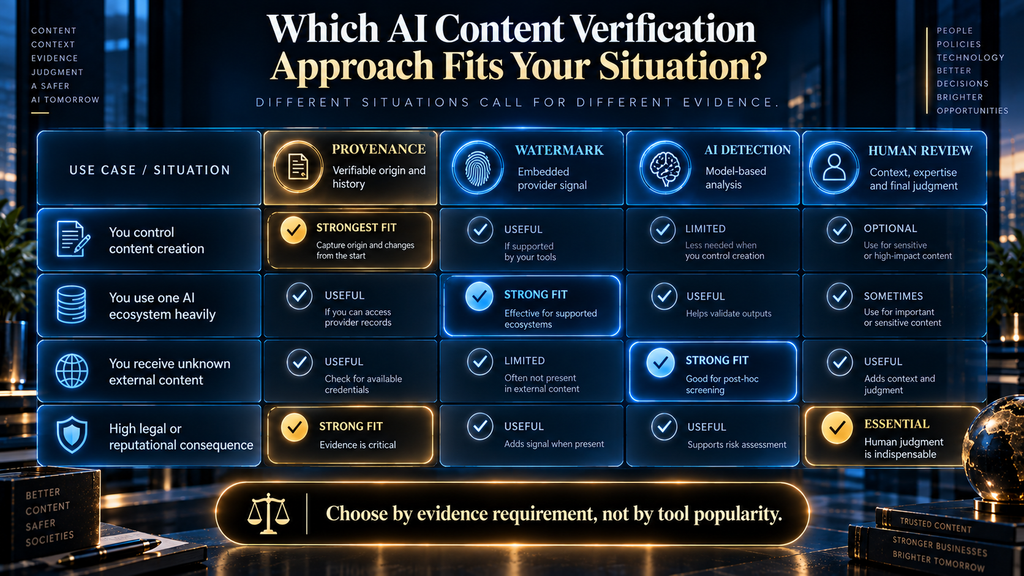
Decision Matrix: Which Approach Should You Choose?
| Your situation | Best starting point | Why |
|---|---|---|
| You control content creation | Provenance | You can preserve origin and history before information is lost |
| You use one major AI ecosystem heavily | Provenance + provider watermark | Multiple signals can reinforce each other |
| You receive unknown external content | Detection + source investigation | Provenance may not be available |
| You process huge content volumes | Automated detection + escalation | Screening reduces manual workload |
| Content has high reputational or legal consequences | Provenance + multiple signals + human review | A single classifier is too weak |
| You need an audit trail | Provenance and evidence retention | Historical reconstruction becomes easier |
| You mainly need quick low-risk screening | AI detection | Lower implementation complexity |
| You need to verify AI involvement across many ecosystems | Layered approach | No single provider-specific signal has universal coverage |
Notice what is missing from the table: a universal winner. That is intentional. A mature buying decision is about fitness for evidence, not popularity.
What to Look for in Commercial Tools
When evaluating vendors, ask questions that expose the actual capability beneath the marketing language.
What exactly does the product detect? “AI content” is too broad. Ask whether the system detects text generation, synthetic images, AI editing, specific provider watermarks, provenance credentials, or some combination.
What happens when content is transformed? Ask about compression, cropping, screenshots, paraphrasing, translation, editing, and format conversion.
Does the system explain its result? A percentage without meaningful evidence may be difficult to defend operationally.
Can the tool integrate with your workflow? API availability, batch processing, CMS integration, cloud storage support, and enterprise controls can matter more than a marginal difference in benchmark performance.
What happens to submitted data? Privacy should be evaluated before confidential content is uploaded.
Can you preserve the evidence? A useful system should allow organizations to retain relevant verification information for later review.
How does the vendor handle uncertainty? Vendors that communicate limitations clearly are often more useful to enterprise buyers than vendors that imply certainty the technology cannot realistically provide.
These questions reveal whether you are buying a genuine verification capability or simply a polished classification interface.
When You Should Avoid AI Detection Entirely
There are situations where a detector should not be the primary mechanism. If the organization already has strong provenance information, using a generic detector to override that evidence may introduce unnecessary uncertainty. If the content is extremely short, the available evidence may be too limited for meaningful statistical inference.
If the decision is highly consequential, a detector should not be the sole basis for the outcome. If the organization cannot explain how the detector’s result will affect a decision, it should not automate that decision yet. And if the tool requires sensitive material to be uploaded without acceptable privacy controls, the verification benefit may not justify the data-governance risk.
The strategic lesson is important: Not every verification problem needs a detector. Sometimes the better answer is better documentation.
The Future of AI Content Verification
The market is moving toward a world where AI-generated content will not necessarily be unusual enough to identify by appearance. As generation quality improves, trying to visually or linguistically recognize AI output becomes increasingly difficult. That increases the value of machine-readable provenance.
C2PA’s continued development reflects this broader direction, with the ecosystem working toward practical implementation of Content Credentials across digital content workflows. At the same time, watermarking technologies such as SynthID demonstrate how AI providers can embed signals directly into generated content across multiple modalities. The likely future is therefore not one universal detector.
It is an ecosystem in which:
- Creation systems can attach provenance.
- AI systems can embed detectable signals.
- Editing software can preserve content history.
- Platforms can verify credentials.
- Organizations can retain evidence.
- Humans can interpret ambiguous cases.
The winning infrastructure will be the infrastructure that makes these layers work together.
The Bigger Shift: From AI Detection to Content Transparency
The phrase “AI detection” makes the problem sound binary. Human or AI. Real or fake.
Authentic or synthetic. But real production workflows are not binary.
A photograph can be real but AI-enhanced. A marketing article can be human-written but AI-edited. A video can contain real footage and synthetic scenes. An illustration can be AI-generated and then extensively modified by a human artist.
Trying to force every asset into a two-category classification discards useful information. Provenance offers a better model because it can describe a sequence.
It can tell us more about what happened, rather than forcing us to guess what category the final artifact belongs to. That is the deeper reason this technology matters.
A Practical Buying Checklist
Before purchasing an AI content provenance or detection platform, an organization should be able to answer the following questions.
- What exact content types do we need to verify?
- Which AI ecosystems do our creators and suppliers actually use?
- Do we control content creation or mostly receive external assets?
- Do we need detection, provenance, watermark verification, or a combination?
- What happens when metadata is removed?
- What happens after compression, cropping, paraphrasing, or editing?
- How will automated results trigger human review?
- What decisions are too consequential for automated classification?
- What data will we upload to the vendor?
- How long is submitted content retained?
- Can verification results be exported and audited?
- Can the system integrate with our existing content workflow?
- What evidence does the vendor provide beyond a percentage score?
- How will we measure false positives and false negatives?
- What is the cost per verified asset?
- What happens if the vendor changes its model or detection methodology?
If the vendor cannot answer these questions clearly, the organization probably does not yet understand what it is buying.
Final Recommendation: Build Evidence, Not Just Detection
The strongest AI content verification strategy is not to find the tool that promises to identify the most AI-generated content. It is to build a system that preserves the best available evidence and uses automation proportionately.
For controlled workflows, prioritize provenance because it records information at the point where the history is created. For supported AI ecosystems, add watermark verification because embedded signals can complement external provenance. For unknown or legacy content, use AI detection as a screening mechanism. For consequential decisions, combine these signals with source investigation and human review.
The AI Hustle World TRACE framework gives organizations a practical way to make that decision:
Trace the origin. Read the evidence. Assess the signal. Check the context. Evaluate the consequence.
That framework matters because technology should follow the decision, not the other way around.
Final Thoughts
The AI content verification market is often presented as a race to build a detector that can finally tell humans and machines apart. That framing is too narrow.
The real problem is not simply identifying whether AI was involved. Modern content creation is becoming a mixture of human direction, machine generation, automated editing, manual refinement, and platform transformation. Trying to reduce that entire process to a single AI probability score throws away the information organizations actually need.
The more durable model is evidence.
Provenance can preserve information about origin and transformation. Watermarking can provide embedded signals from supported AI systems. Detection can help identify content that deserves investigation when no stronger evidence exists. Human reviewers can interpret those signals in context when the decision matters.
That is why the best verification system is not necessarily the one that detects the most. It is the one that helps an organization make better decisions with stronger evidence.
And that is the central lesson of TRACE: do not ask whether a tool can tell you that content is AI-generated. Ask what the tool can actually prove, what it cannot prove, and whether that level of evidence is strong enough for the decision you are about to make.
That is the difference between buying an AI detector and building a trustworthy content-verification system.
Memorable takeaway: The future of AI verification is not better guessing. It is better evidence.
Build a More Reliable AI Content Verification Process
AI detection alone cannot tell the whole story. A stronger approach combines provenance, watermarking, detection signals, source evidence, and human judgment according to the consequences of getting the decision wrong.
Use the AI Accuracy Framework →Frequently Asked Questions
What is the difference between AI detection and content provenance?
AI detection estimates whether existing content resembles AI-generated output, while content provenance records verifiable information about where an asset came from and what happened to it during its lifecycle. Detection is primarily inferential; provenance is primarily evidence-based.
Are AI content detectors reliable?
AI detectors can be useful for screening and prioritization, but they should not be treated as infallible proof. Research has demonstrated both useful detection performance and important weaknesses involving false positives, paraphrasing, humanization, and other transformations.
What is C2PA?
C2PA is an open technical standard for content provenance and authenticity. It provides a framework for associating digital assets with verifiable, signed provenance information about their creation and subsequent actions.
What are Content Credentials?
Content Credentials are provenance information associated with digital content through systems implementing the C2PA standard. They can communicate information about an asset’s creation and modification history when participating tools record those events.
What is AI watermarking?
AI watermarking embeds a detectable signal into AI-generated content. Technologies such as Google’s SynthID are designed to embed imperceptible watermarks into supported AI-generated images, video, audio, and text.
Does the absence of a watermark prove that content was made by a human?
No. A missing watermark only means that the particular supported watermark was not detected. The content could have been generated by another AI system, created before the relevant watermarking technology existed, or transformed in a way that affected detection.
Can provenance prove that an image is real?
No. Provenance can provide evidence about an asset’s origin and recorded history, but it does not automatically establish that the image depicts a real event or that the claims surrounding it are accurate.
Should businesses use AI detectors for employee or hiring decisions?
Extreme caution is warranted. Because detector outputs are probabilistic and can produce false positives, they should not normally be treated as sole proof for high-consequence employment decisions. A stronger process combines available evidence with human review.
Which is better: AI detection or provenance?
Neither is universally better because they solve different problems. Detection is useful when you need to analyze content after the fact; provenance is stronger when you can preserve creation history from the beginning. In mature workflows, they are complementary rather than competing technologies.
What is the best AI content verification strategy for a business?
For most businesses, the strongest approach is layered: preserve original files and workflow records, use provenance where available, verify supported watermarks, use AI detection for screening when stronger evidence is unavailable, and require human review when the consequences of error are significant.
Related Guides
- How AI Detects Phishing, Social Engineering & Suspicious Messages
- How AI Analyzes Malware, Vulnerabilities & Security Alerts
- Best AI Image Generators in 2026: Free & Paid Tools Compared
Written by
Muntasir Ahmad Chowdhury
Founder, AI Hustle World
Muntasir Ahmad Chowdhury is the Founder of AI Hustle World, an independent publication dedicated to making Artificial Intelligence practical, trustworthy, and easy to understand. He researches AI tools, automation, customer service, productivity, and real-world business applications, helping readers make smarter technology decisions through research-driven, experience-backed content.
Expertise:
AI Tools • AI Automation • AI Customer Service • AI Productivity • Generative AI • AI Workflows
Get Smarter With AI
Enjoyed this guide? Get practical AI tools, tutorials, and honest reviews delivered to your inbox.
2 thoughts on “Best AI Content Provenance & Detection Tools”