How AI Interview Analysis Works
Interview research has always had an awkward imbalance: collecting the conversations can be relatively straightforward, but turning those conversations into reliable findings can take far longer than expected. A researcher may spend an hour conducting an interview and then several more hours cleaning the transcript, reading it carefully, coding relevant passages, comparing responses, identifying themes, selecting supporting quotes, and eventually turning everything into a coherent research finding.
That becomes increasingly difficult when the study contains ten, twenty, fifty, or hundreds of interviews. The organization may have plenty of qualitative evidence, but the evidence becomes trapped inside recordings and transcripts. Researchers can only read, code, compare, and synthesize so much material manually before time pressure starts influencing the depth of analysis.
AI interview analysis is changing this workflow. Modern AI systems can transcribe recordings, separate speakers, identify recurring topics, suggest codes, surface themes, analyze sentiment, retrieve relevant quotes, compare multiple interviews, and help researchers synthesize large amounts of conversational data. But describing the technology as “AI reads interviews and finds insights” hides the most important part of the process.
The real question is how AI moves from an unstructured human conversation to a finding that a researcher can actually trust.
That process involves several distinct analytical layers. Transcription creates the textual foundation. Speaker identification adds structure. Coding organizes meaningful pieces of evidence. Theme analysis connects related codes. Sentiment analysis adds another layer of interpretation. Quote extraction makes evidence easier to retrieve. Cross-interview analysis reveals patterns that are difficult to see one transcript at a time. Human validation then determines whether those patterns actually answer the research question.
That last step matters more than it may appear. AI can make qualitative analysis dramatically faster, but faster analysis is not automatically better analysis. Research still requires context, methodological judgment, awareness of contradictions, and the ability to distinguish a recurring signal from a meaningful finding.
This guide explains how AI interview analysis works from beginning to end, what happens at each stage, where AI creates genuine value, where it can misinterpret qualitative evidence, and how researchers can build a workflow in which AI accelerates analysis without quietly replacing human judgment.
What Is AI Interview Analysis?
AI interview analysis is the use of artificial intelligence to process and analyze interview recordings or transcripts in order to identify structured information such as topics, codes, themes, sentiment, entities, quotations, patterns, differences, and potential research insights.
That definition is deliberately broader than AI transcription.
Transcription answers a relatively simple question: What was said?
Interview analysis asks much harder questions: What was this participant talking about? What ideas repeatedly appear across interviews? Which experiences are similar or different? What problems are participants describing? What evidence supports a particular conclusion? Are there contradictions that challenge the emerging interpretation?
A modern AI interview-analysis workflow can connect these stages. For example, a researcher may upload a set of interviews, generate speaker-labeled transcripts, search the entire dataset for a concept, ask the system to identify recurring themes, retrieve supporting quotations, compare sentiment between participant groups, and then review the underlying evidence before writing the final findings.
Speak AI currently describes a workflow that includes transcription, speaker labeling, thematic analysis, sentiment by speaker, quote extraction, cross-interview pattern analysis, and natural-language querying of transcripts. Those are vendor-described capabilities, so they should be understood as product features rather than independent evidence about the universal accuracy of AI interview analysis.
The broader category is therefore best understood as an analytical layer built on top of conversational data.
That distinction is important because a transcript can be perfectly accurate while the interpretation built on top of it is still incomplete, misleading, or wrong.
Analyze More Than One Interview at a Time
The biggest productivity gain appears when AI helps researchers move from isolated transcripts to structured evidence across an entire interview dataset. Speak AI provides tools for transcription, themes, sentiment, quotes, cross-interview analysis, and natural-language exploration.
See Speak AIAffiliate disclosure: AI Hustle World may earn a commission if you sign up through this link, at no additional cost to you.
AI Interview Analysis Is More Than Transcription
One of the most common misunderstandings is treating transcription and analysis as if they were the same task.
They are not.
Imagine a 45-minute customer interview in which a participant discusses onboarding, pricing, integrations, support, and the reason they ultimately decided not to purchase a product. A transcription system can convert that conversation into text. It may also identify speakers and timestamps, making the transcript easier to navigate.
But the transcript does not tell the research team what matters.
The researcher still needs to determine which statements relate to the research question, which ideas recur, whether several statements represent the same underlying issue, whether the participant contradicts themselves, whether an apparently positive comment contains a hidden objection, and whether the experience described by one participant appears elsewhere in the dataset.
AI interview analysis attempts to assist with that second layer.
A useful way to think about the difference is that transcription turns sound into searchable text, while analysis turns searchable text into structured evidence.
That distinction also explains why the quality of the transcript matters so much. Errors introduced during transcription can affect every analytical stage that follows. If a product name is consistently misrecognized, a search may miss relevant passages. If speakers are incorrectly identified, sentiment or opinions may be attributed to the wrong participant. If an important sentence is transcribed incorrectly, a theme or quote built from that sentence can become unreliable.
The analytical pipeline therefore starts before “analysis” appears on the screen.
The AI Interview Analysis Workflow
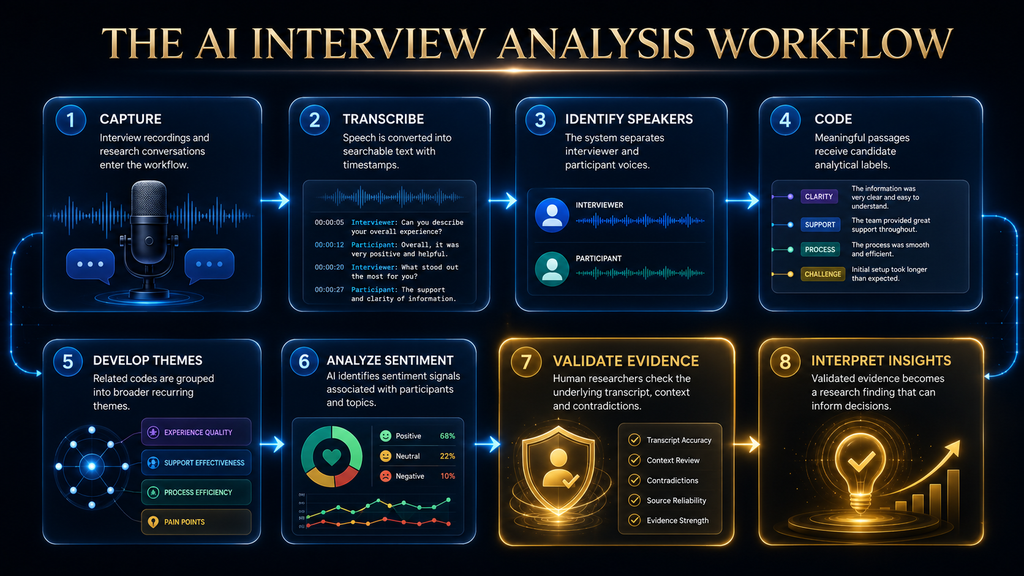
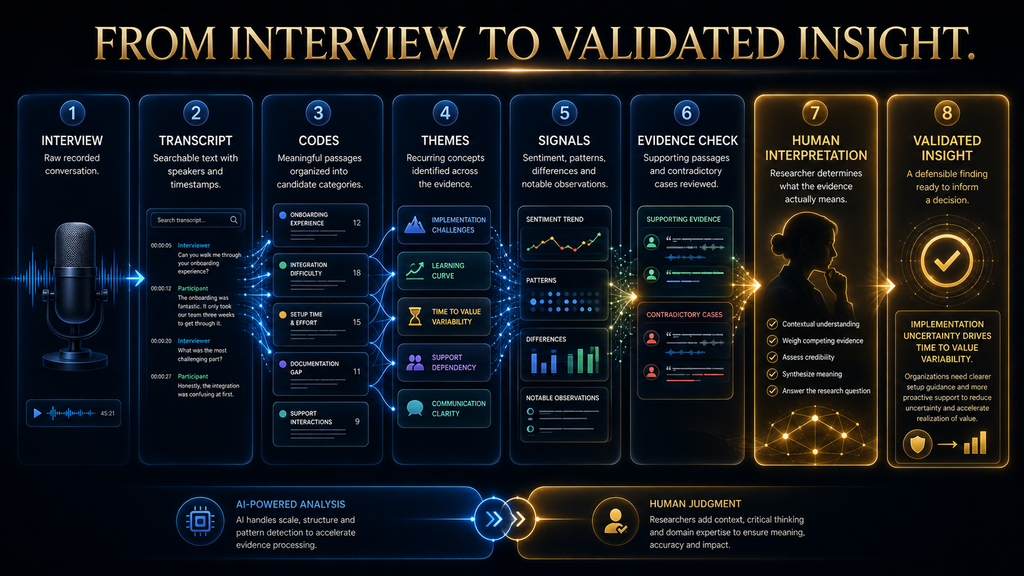
A strong AI-assisted workflow can be understood as a sequence of connected stages: capturing the interview, transcribing the conversation, identifying speakers, preparing the transcript, coding meaningful passages, developing themes, analyzing sentiment and other signals, retrieving evidence, comparing interviews, validating findings, and finally interpreting what the evidence means.
The stages are connected because an error or assumption at one stage can influence the next.
If the recording is poor, transcription quality can suffer. If transcription is poor, coding becomes less reliable. If coding is inconsistent, themes become harder to interpret. If themes are accepted without reviewing the underlying evidence, the final research conclusion may look polished while resting on weak foundations.
AI can accelerate many of these stages, but the workflow still needs to preserve traceability between the final insight and the original conversation.
Stage 1: Capture the Interview Data
Every analysis begins with source material.
That source may be an audio recording, video recording, existing transcript, or collection of interview documents. The format matters because the analytical system needs enough information to understand what was said and, depending on the task, who said it and when.
For straightforward one-on-one interviews, the process may appear simple. A researcher uploads the recording and receives a transcript. In more complicated environments, however, multiple people may speak, participants may interrupt each other, audio quality may vary, or the recording may contain background noise.
These details can become important later.
An AI system cannot recover context that was never captured clearly in the first place. Better microphones, clear recording practices, consistent interview procedures, and well-organized metadata can therefore improve the overall analytical workflow even before AI is introduced.
This is an important principle: AI interview analysis does not eliminate the importance of good research operations. It increases the value of having clean research inputs.
Stage 2: Convert Speech Into a Transcript
The next stage is transcription.
Automatic speech recognition converts spoken language into written text so that the interview becomes searchable, analyzable, and easier to compare with other interviews.
Modern transcription systems can also provide timestamps and speaker labels. This matters because an analytical system needs more than a large block of text. It needs some understanding of the structure of the conversation.
Consider a sentence such as “That was actually the biggest problem for us.”
The sentence alone tells us very little.
The preceding exchange might reveal that “that” refers to pricing, implementation, customer support, or a missing feature. A timestamp allows the researcher to return to the original conversation and inspect the surrounding context.
This is why transcript-based AI analysis should not be treated as a process of stripping the conversation down into isolated sentences. A good workflow preserves enough context to make the evidence traceable.
Stage 3: Identify Who Said What
Speaker identification, sometimes called speaker diarization, assigns sections of the transcript to different speakers.
In a typical interview, the system may distinguish the interviewer from the participant. In group interviews or focus groups, the problem becomes more complicated because several people may speak throughout the recording.
Speaker identification is analytically important because many research questions depend on participant-level differences.
Suppose a study contains ten interviews with customers and ten interviews with employees. If the system cannot reliably distinguish speakers, later analysis of sentiment, opinions, objections, or experiences can become distorted.
Speaker-level analysis also makes it possible to ask more specific questions, such as whether a particular theme appears across participants or whether it is concentrated among a particular group.
This is one reason modern interview-analysis platforms increasingly emphasize speaker-aware transcription rather than treating the entire recording as one undifferentiated text stream. Speak AI, for example, describes speaker-labeled transcription as part of its current interview-analysis workflow.
Stage 4: Clean and Prepare the Transcript
A transcript should not automatically be treated as perfect simply because an AI system produced it.
Names, product terminology, technical vocabulary, acronyms, locations, numbers, and specialized phrases can all create transcription challenges. Some errors may be obvious. Others may look completely plausible while subtly changing meaning.
Researchers should therefore establish an appropriate level of transcript review based on the importance of the study.
For a low-stakes exploratory analysis, reviewing every sentence may be unnecessary. For research supporting a major product decision, academic publication, legal-sensitive conclusion, or high-impact business decision, the standard should be higher.
The goal is not necessarily to manually correct every word.
The goal is to ensure that the portions of the transcript supporting important findings are accurate enough to justify those findings.
That principle becomes especially important when AI extracts quotations for reports or presentations. A quote that looks useful but contains a transcription error can undermine the credibility of the entire research output.
Stage 5: Identify Meaningful Passages Through Coding
Coding is where interview analysis begins to move beyond transcription.
In qualitative research, coding involves assigning meaningful labels to sections of data. A researcher may identify a statement about difficulty setting up a product and assign a code such as “implementation friction.” Another statement about unclear instructions might receive a code such as “documentation problem.”
AI can assist with this first-pass coding process by identifying passages that appear related and suggesting labels.
The advantage is speed.
A researcher working manually through hundreds of pages may spend significant time finding relevant passages and organizing them under preliminary codes. An AI system can perform an initial pass across a much larger dataset and return candidate passages or categories quickly.
But there is an important difference between AI-generated coding and validated research coding.
AI-generated codes are suggestions.
The researcher still needs to determine whether the label accurately describes the passage, whether two codes should be combined, whether a code is too broad or too narrow, and whether the coding framework actually reflects the research question.
Recent research is beginning to examine this exact workflow. A 2026 methodological study investigated ChatGPT 4.5 as a coding assistant for qualitative interview data and found that AI could assist with thematic coding but also highlighted the need to examine where automated coding loses cultural and emotional nuance.
That makes coding one of the clearest examples of where AI can reduce repetitive work without making the researcher unnecessary.
Stage 6: Move From Codes to Themes
Codes are not the same as themes.
This distinction is essential.
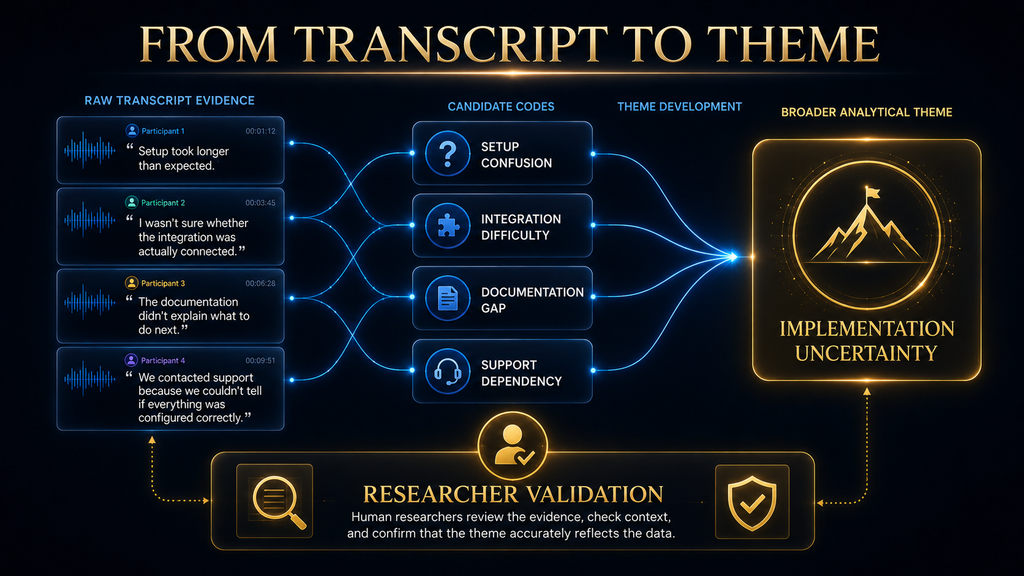
Suppose a research team interviews customers about a new software product. Across the transcripts, the AI identifies codes such as “unclear setup instructions,” “integration difficulty,” “configuration confusion,” and “lack of onboarding guidance.”
Those codes may belong to a broader theme such as implementation uncertainty.
The theme provides a higher-level interpretation of several related observations.
This is where AI interview analysis becomes more interesting and more dangerous at the same time.
A system can identify semantic relationships between statements very quickly. It can group similar language and identify concepts that repeatedly appear. But semantic similarity is not the same thing as methodological significance.
A theme should matter in relation to the research question.
If every interview participant was explicitly asked about pricing, then “pricing” appearing in every transcript does not automatically mean pricing is the most important theme. It may simply reflect the structure of the interview guide.
Likewise, a topic that appears only three times could be extremely important if those three instances reveal a serious usability problem, a critical safety issue, or a previously unknown customer behavior.
This creates one of the most important rules in AI-assisted interview analysis:
Frequency can show recurrence, but recurrence does not automatically prove importance.
The researcher still has to interpret the evidence.
Stage 7: Analyze Sentiment and Tone
Sentiment analysis adds another layer to interview analysis.
AI systems can classify portions of text according to positive, negative, neutral, or more detailed sentiment categories. Some systems can also analyze sentiment at the speaker level or examine sentiment associated with particular topics.
This can be useful when the research dataset is large.
For example, a team could compare how participants discuss a product before and after a particular experience, identify topics associated with more negative language, or find conversations where enthusiasm and dissatisfaction appear together.
But sentiment needs to be treated carefully.
A sentiment score is not a direct measurement of a person’s internal emotional state.
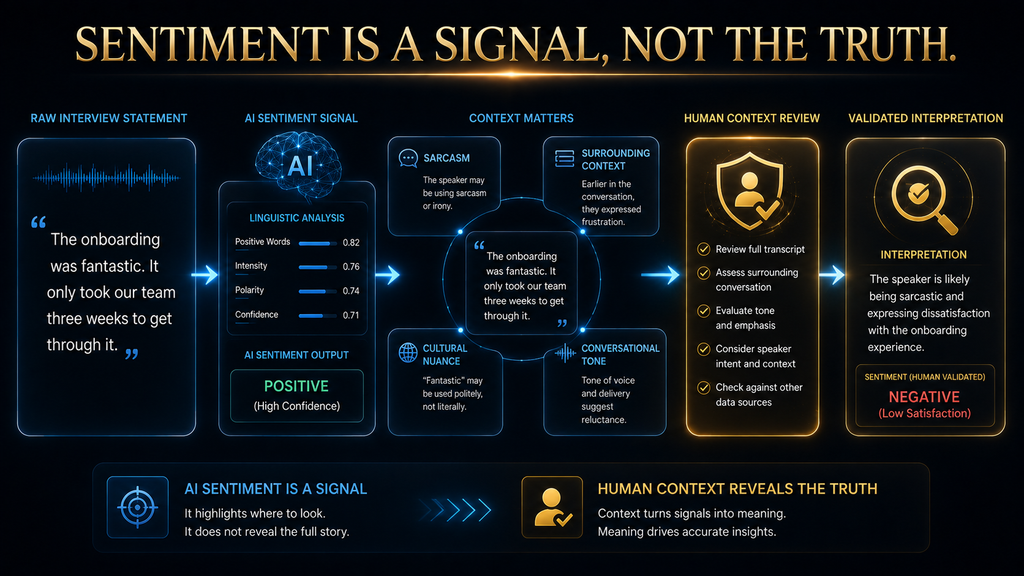
Consider a participant saying, “The onboarding was fantastic. It only took our team three weeks to get through it.”
The literal words include “fantastic,” but the surrounding context may indicate sarcasm or frustration. A model that relies heavily on surface-level linguistic signals may interpret the sentence differently from a human researcher who has read the entire exchange.
Cultural context can create another problem. Expressions of politeness, disagreement, enthusiasm, frustration, or uncertainty vary between people and communities.
This is why sentiment should be treated as a signal that helps direct attention, not as an unquestionable psychological measurement.
A useful workflow is to use sentiment analysis to identify interesting passages and patterns, then inspect the actual transcript before drawing conclusions.
Stage 8: Extract Quotes and Supporting Evidence
Once themes have been identified, researchers often need evidence to support them.
That means finding the strongest participant quotations.
This is another area where AI can remove a large amount of mechanical work. Instead of manually searching hundreds of transcript pages for every mention of a theme, a researcher can ask the system to retrieve relevant quotations associated with a topic, participant, keyword, or analytical category.
Speak AI currently describes quote extraction by theme, speaker, or keyword, including timestamps that can be used to trace the quotation back to the original conversation.
But quote extraction creates a new responsibility.
A quotation should not be evaluated only because it sounds persuasive.
The researcher should inspect the surrounding context and verify that the quotation genuinely supports the finding. Removing a sentence from its conversational context can change its meaning, especially when participants use qualifiers such as “sometimes,” “usually,” “in our case,” or “but.”
The strongest AI-assisted workflow therefore creates a chain of evidence:
Finding → Supporting theme → Relevant passage → Original context
That chain makes the research more defensible.
Stage 9: Compare Multiple Interviews
One interview can tell you what one person experienced.
A collection of interviews can reveal patterns.
This is where AI interview analysis can create some of its most meaningful productivity gains.
Instead of opening each transcript separately and searching for the same concept repeatedly, researchers can analyze the dataset as a connected body of evidence.
For example, a research team might discover that implementation problems appear across 40% of interviews, but the problem is concentrated among first-time customers. Another analysis might reveal that experienced customers mention the same feature positively while new customers describe it as confusing.
That is more useful than simply saying “customers talked about onboarding.”
The value comes from comparing who experienced what, how often, under what circumstances, and with what consequences.
Speak AI describes cross-interview analysis that can compare theme frequency and sentiment across a larger interview dataset.
However, cross-interview analysis should not automatically be treated as statistical generalization. A qualitative dataset can reveal meaningful patterns without being representative of an entire population.
The correct conclusion might be:
“Several participants described this recurring experience.”
It should not automatically become:
“Most customers experience this problem.”
The difference depends on study design, sampling, and evidence.
Stage 10: Search for Contradictions
One of the most valuable uses of AI is also one of the easiest to overlook: finding evidence that challenges the emerging interpretation.
Suppose the first ten interviews suggest that customers dislike a particular onboarding process.
A weak workflow asks the AI to summarize why customers dislike it.
A stronger workflow also asks:
Which participants had a positive experience?
Which participants disagreed with this pattern?
Are there cases where the opposite behavior occurred?
What characteristics distinguish the positive and negative experiences?
This changes AI from a confirmation machine into an analytical search assistant.
Contradictory cases can be especially valuable because they force the researcher to refine an overly broad theme.
Maybe customers do not actually dislike the onboarding process.
Maybe the problem only occurs when a certain integration is required.
Maybe experienced users find the process easy while new users struggle.
Maybe the underlying problem is not complexity but uncertainty.
The final insight becomes more precise because the researcher looked for evidence that could disprove the first interpretation.
The AI Interview Analysis Ladder
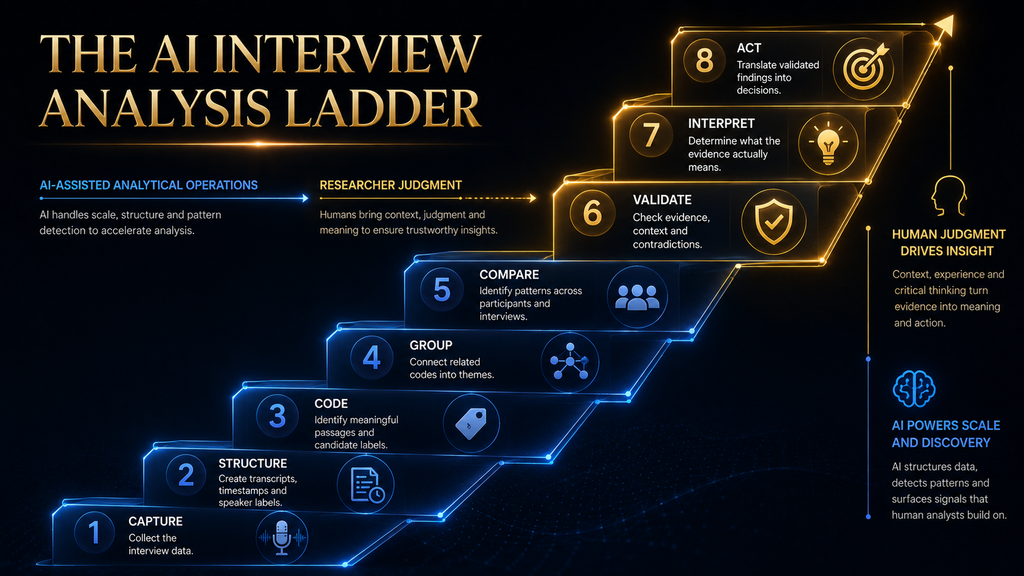
A useful way to understand the complete workflow is to think of AI interview analysis as an eight-level ladder.
At the first level, AI helps capture and organize the raw conversation. At the second level, it structures the material through transcription, timestamps, speaker identification, and searchable text. At the third level, it codes meaningful passages. At the fourth level, it groups related codes into candidate themes.
The fifth level is comparison, where the system looks across participants, interviews, groups, topics, and sentiment signals. The sixth level is validation, where researchers trace findings back to the underlying evidence and actively search for contradictions. The seventh level is interpretation, where the research team decides what the evidence means in relation to the original question. The eighth level is action, where validated findings influence a product decision, research conclusion, customer strategy, policy, or other real-world outcome.
The important point is that AI becomes progressively less sufficient as the workflow moves toward interpretation.
AI can perform enormous amounts of mechanical organization quickly. It can also generate useful analytical suggestions. But the closer the process gets to deciding what the evidence means, the more important context and human judgment become.
AI Can Find a Pattern Without Understanding Its Meaning
This is one of the most important limitations to understand.
AI systems are exceptionally good at identifying relationships in language. They can recognize that different participants are discussing similar concepts even when they use different words.
But identifying a linguistic pattern is not identical to understanding the social, cultural, organizational, or psychological meaning behind that pattern.
Imagine that several participants use words such as “fine,” “okay,” “works,” and “no problem” when describing a product.
A superficial analysis might classify these statements as positive or neutral.
A researcher who understands the interview context might notice that the participants are actually expressing low enthusiasm rather than genuine satisfaction.
The opposite can happen too. A participant might use strong negative language while describing a problem that they ultimately consider minor.
This is why context remains central.
NIST’s AI Risk Management Framework specifically warns that representing complex human phenomena through data-driven systems can remove necessary context and emphasizes the need to clearly define human roles and responsibilities in human-AI configurations.
That principle applies directly to interview analysis.
Why a Theme Is Not Automatically an Insight
The distinction between theme and insight deserves special attention because AI tools can make the transition look deceptively easy.
Imagine that an AI system analyzes twenty product interviews and identifies “pricing,” “support,” “integration,” and “onboarding” as recurring themes.
Those are useful analytical categories.
But they are not necessarily insights.
An insight explains something meaningful about the relationship between evidence, context, behavior, or underlying need.
For example, the theme might be onboarding.
The stronger insight might be:
“New customers are not primarily struggling with the number of onboarding steps; they are uncertain whether the integration has been configured correctly, which causes them to contact support even after completing the setup.”
That statement contains more analytical value because it explains a mechanism.
It connects the theme to behavior.
It also suggests a potential action.
This is why AI should not be evaluated solely by whether it produces “themes.” The real question is whether the workflow helps researchers move from raw conversational evidence to validated explanations that can support decisions.
Go Beyond Transcription With AI Interview Analysis
If your research workflow involves interviews, transcripts, recurring themes, participant sentiment, or large collections of qualitative data, Speak AI can help organize and analyze that evidence in one workflow.
Explore Speak AIAffiliate disclosure: AI Hustle World may earn a commission if you sign up through this link, at no additional cost to you.
An Illustrative Example: From 20 Interviews to One Product Insight
Consider a fictional SaaS company that interviews twenty customers after launching a new onboarding experience.
The interviews contain hundreds of comments about setup, documentation, integrations, support, pricing, and feature discovery.
The AI first transcribes the interviews and identifies speakers. It then groups recurring concepts and suggests preliminary codes such as “setup confusion,” “documentation gap,” “integration difficulty,” “support dependency,” and “feature discoverability.”
At first glance, the company might conclude that onboarding is simply “too complicated.”
But the researcher investigates the supporting passages.
A pattern emerges.
Several participants successfully completed the setup but were not confident that they had completed it correctly. They opened support tickets because the product did not clearly communicate whether the integration was active. Other participants who had previous experience with similar software did not experience the same problem.
The deeper theme is therefore not simply “complex onboarding.”
It is implementation uncertainty among less experienced users.
That distinction changes the product response.
The company might not need to remove onboarding steps. It might instead need stronger completion indicators, clearer confirmation messages, better integration-status visibility, and more contextual guidance.
The AI accelerated the discovery process by finding relevant passages, connecting related concepts, and highlighting recurring patterns.
But the final insight emerged through human interpretation of the evidence.
That is the real model for effective AI-assisted interview analysis.
Where AI Creates the Most Value
The strongest value proposition is not that AI magically becomes a better researcher.
It is that AI can reduce the amount of repetitive analytical labor surrounding research.
Searching a large transcript collection is repetitive.
Finding every passage related to a topic is repetitive.
Grouping similar passages is repetitive.
Generating a first-pass code list is repetitive.
Finding candidate quotations is repetitive.
Comparing mentions of a topic across many interviews is repetitive.
Creating an initial summary of a large evidence set is repetitive.
These tasks can consume substantial researcher time even though they are not necessarily the highest-value parts of the research process.
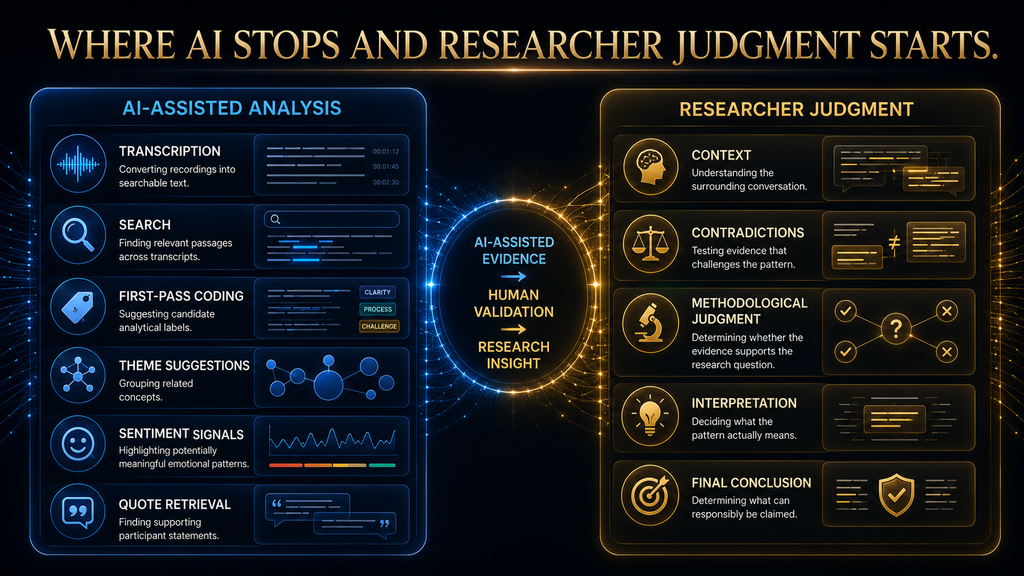
AI can therefore create leverage by moving researchers more quickly through the mechanical stages and giving them more time for interpretation, methodological decisions, questioning assumptions, and communicating findings.
That is a more defensible productivity argument than saying AI simply “replaces manual research.”
Where Human Researchers Still Add the Most Value
Human researchers become particularly important when the question involves ambiguity, context, contradiction, cultural nuance, methodological judgment, or consequential interpretation.
A researcher can decide whether a theme actually matters to the research question.
A researcher can recognize that two apparently similar statements mean different things.
A researcher can identify an unusual case that deserves attention even though it appears only once.
A researcher can challenge an AI-generated conclusion.
A researcher can determine whether the sample supports the strength of a claim.
A researcher can recognize when an interview participant is being sarcastic, uncertain, polite, evasive, or contradictory.
A researcher can decide what the findings mean for the actual decision being made.
NIST’s guidance on human-AI interaction emphasizes defining and differentiating human roles and responsibilities and notes that AI systems can remove context when complex human phenomena are converted into measurable representations.
The implication for interview research is straightforward: human oversight should not be treated as a ceremonial final check. It should be integrated into the analytical workflow.
The Biggest Mistakes to Avoid
One mistake is assuming that a clean transcript means the analysis is reliable. Transcription accuracy is necessary, but it does not guarantee correct interpretation.
Another mistake is treating AI-generated themes as final. Candidate themes should be reviewed, refined, merged, separated, and tested against the underlying evidence.
A third mistake is confusing frequency with importance. A topic mentioned repeatedly can be significant, but a rarely mentioned issue can also reveal a critical problem.
Another common mistake is trusting sentiment scores without reading the underlying statements. Language is contextual, and emotional meaning is not always captured by surface-level linguistic classification.
Quote extraction creates another risk. Researchers should verify quotations against their original context before publishing them.
Researchers should also avoid prompting AI exclusively toward a predetermined conclusion. If the instruction assumes that customers are dissatisfied, the analysis may become an exercise in finding evidence for dissatisfaction rather than testing whether dissatisfaction actually exists.
Finally, researchers should avoid allowing a polished AI-generated summary to replace familiarity with the underlying dataset. The more consequential the conclusion, the stronger the requirement for evidence traceability and human review.
A Practical AI Interview Analysis Workflow
A practical workflow starts with the research question rather than the AI tool.
Before uploading anything, define what the research is trying to discover. Decide what constitutes useful evidence and identify the participant groups that may need to be compared.
Then prepare the interview dataset. Organize recordings, transcripts, participant metadata, interview dates, relevant segments, and any group classifications that will be useful later.
Next, transcribe the interviews and review enough of the output to establish that the system is handling terminology and speakers adequately.
After transcription, use AI to generate a first-pass analytical layer. Ask it to identify candidate codes, themes, recurring topics, sentiment patterns, relevant quotations, and possible contradictions.
Do not immediately accept the results.
Create a validation stage in which researchers review the most important themes against the original transcript. Check whether the evidence actually supports the interpretation and whether contradictory cases have been considered.
Then refine the coding and thematic structure.
After validation, synthesize the findings into research conclusions. Each major finding should have a clear connection to supporting evidence.
Finally, translate validated findings into action. Depending on the research, that might mean changing a product feature, modifying an onboarding flow, adjusting messaging, changing a customer-support process, informing an academic argument, or conducting another round of research.
This workflow keeps AI in a useful role: accelerating evidence handling while preserving human responsibility for interpretation.
How to Evaluate the Quality of AI Interview Analysis
Speed is useful, but it should not be the primary quality metric.
A better evaluation framework asks several questions.
Can the team find evidence faster? If AI reduces the time required to locate relevant passages, it has created retrieval value.
Can the team analyze a larger dataset? If researchers can meaningfully examine more interviews without sacrificing methodological rigor, AI has created scale value.
Are important findings traceable? A strong system should make it possible to move from a finding back to supporting evidence.
Does human review change the result? If researchers regularly discover major errors in AI-generated themes, the workflow needs stronger validation.
Are contradictions being surfaced? A useful system should help researchers find evidence that challenges an emerging interpretation rather than simply reinforcing it.
Does the analysis improve decisions? The ultimate test is whether better evidence changes or improves a real research or business decision.
This is a much stronger definition of ROI than simply measuring how quickly a tool can generate a summary.
AI Interview Analysis ROI: What Should You Measure?
A useful way to think about the economics is:
AI Interview Analysis ROI = Time Saved + Evidence Coverage + Retrieval Quality + Decision Value − Validation Cost
Time saved measures how much repetitive analytical work has been reduced.
Evidence coverage measures whether the research team can realistically examine more of the dataset rather than analyzing only a small subset.
Retrieval quality measures how reliably the system can locate relevant passages, quotations, themes, and participant-level evidence.
Decision value measures whether the resulting research leads to better product, customer, academic, operational, or strategic decisions.
Validation cost acknowledges that AI output still requires review.
That final variable is important. A tool that produces thousands of impressive-looking findings but requires researchers to manually verify every one may not actually create much efficiency.
The objective is not maximum AI output.
The objective is maximum useful evidence per unit of researcher effort.
Privacy and Governance Matter Before Analysis Begins
Interview data can contain personal information, confidential business information, customer details, employee experiences, research-participant information, or other sensitive material.
That means AI interview analysis should include a data-governance layer.
Before uploading interviews to an AI service, researchers should understand what information is being processed, who can access it, how data is retained, what deletion controls exist, and what contractual or organizational requirements apply.
Research consent also matters.
If participants agreed to an interview for one purpose, researchers should not automatically assume that the recording can be sent to any third-party AI service for any analytical purpose.
Sensitive information may need to be removed or protected before analysis.
NIST’s AI Risk Management Framework emphasizes managing AI risks throughout design, deployment, use, and evaluation, while its guidance on human-AI interaction highlights the importance of defined human responsibilities, context, transparency, and oversight.
The practical lesson is simple: the research workflow should decide what data can safely enter the AI system before the AI system decides what to do with it.
How Speak AI Fits Into This Workflow
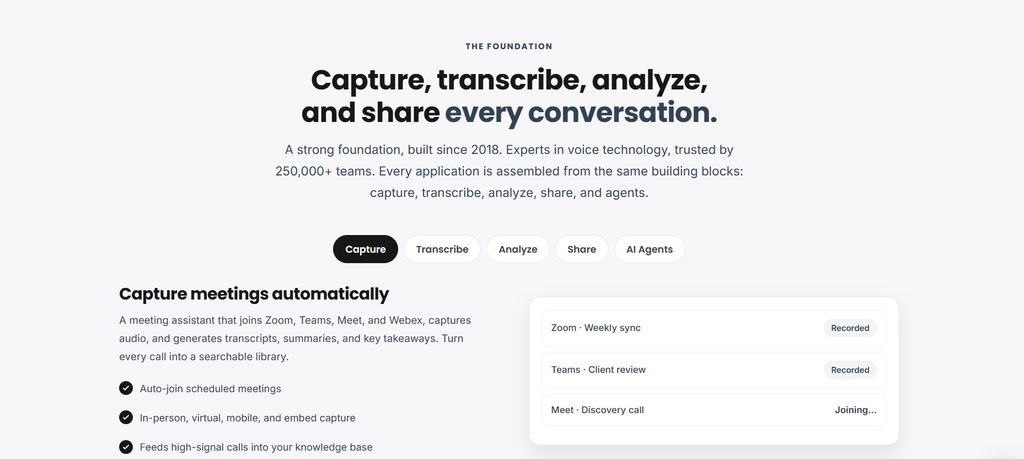
Speak AI is a useful practical example because its current interview-analysis offering spans several of the stages described above.
Its product page describes AI transcription with speaker labeling, thematic analysis, sentiment by speaker, quote extraction, cross-interview pattern analysis, and custom natural-language prompts against transcripts.
That makes the platform relevant for teams that need to move beyond simple transcription and into structured analysis of larger interview datasets.
However, the correct way to evaluate a tool like Speak AI is not to ask whether it can “replace qualitative research.”
The better question is:
Which parts of the research workflow can it accelerate without weakening the researcher’s ability to validate and interpret the evidence?
Speak AI itself states that its AI analysis is intended to accelerate and inform coding while researchers validate, refine, and interpret the identified themes.
That is also the most sensible way to think about AI interview analysis generally.
The tool should help researchers get from recordings to candidate evidence faster.
The researcher should remain responsible for deciding what that evidence actually means.
When AI Interview Analysis Makes the Most Sense
AI interview analysis becomes increasingly valuable as the volume of qualitative data increases.
A researcher conducting three interviews for a small exploratory project may not need an elaborate automated workflow. The researcher can read the transcripts directly and maintain close familiarity with the material.
The economics change when the dataset contains dozens or hundreds of interviews.
At that scale, AI can become valuable as a research accelerator because it can search, organize, classify, compare, and retrieve information across a dataset much faster than a person can perform those mechanical operations manually.
The strongest use cases include UX research, customer discovery, market research, product research, academic qualitative studies, employee research, customer insight programs, and consulting projects involving large interview datasets.
But scale alone is not enough.
The research team also needs a clear question, a sensible analytical framework, and enough expertise to validate the output.
AI cannot compensate for a poorly designed study.
When AI Interview Analysis Needs More Caution
Some research environments demand greater human involvement.
If the subject matter is highly sensitive, culturally nuanced, ethically complex, or consequential, AI output should be treated as an assistive layer rather than an autonomous analytical authority.
This does not mean AI cannot be used.
It means the workflow should become more conservative.
Researchers may need stronger transcript review, more detailed evidence tracing, more manual thematic validation, tighter data controls, and more explicit documentation of how AI was used.
The principle is not “never use AI for sensitive research.”
The better principle is:
The higher the interpretive and ethical stakes, the stronger the human validation requirement should be.
What the Future of AI Interview Analysis Looks Like
The next stage of AI interview analysis is unlikely to be simply better summarization.
The more interesting direction is the development of persistent research intelligence.
Instead of analyzing each interview as an isolated document, organizations may increasingly build searchable evidence libraries containing interviews, customer conversations, focus groups, surveys, support interactions, research notes, and other qualitative material.
That creates a shift from one interview at a time to continuous evidence analysis.
A product team could ask how a particular customer problem has changed over the last year. A market researcher could compare themes across multiple studies. A UX team could examine whether a usability issue appears across different customer segments. An organization could search previous research before commissioning another study.
But this future also increases the importance of governance.
The more conversational evidence an organization stores and analyzes, the more important it becomes to understand permissions, privacy, retention, provenance, methodological context, and human accountability.
AI can make the research repository more searchable.
It does not automatically make the research more trustworthy.
The Real Advantage of AI Interview Analysis
The strongest case for AI interview analysis is not that researchers can stop doing research.
It is that researchers can spend less time performing repetitive evidence-handling tasks and more time thinking about the evidence.
That distinction matters.
If an AI system can locate every passage related to onboarding across fifty interviews, the researcher can spend more time determining why onboarding is a problem.
If AI can identify candidate themes, the researcher can spend more time testing whether those themes actually answer the research question.
If AI can retrieve quotations, the researcher can spend more time deciding which quotations genuinely support the finding.
If AI can identify contradictory cases, the researcher can spend more time refining the interpretation.
This is where AI becomes strategically useful.
It does not eliminate the analytical process.
It changes where human effort is concentrated.
A Better Mental Model: AI as an Analytical Research Assistant
The most useful mental model is not “AI researcher.”
It is AI analytical research assistant.
An assistant can search the transcript collection, organize evidence, suggest codes, identify patterns, retrieve quotations, compare participants, and surface questions that deserve investigation.
The researcher remains responsible for the research design, interpretation, validation, methodological judgment, and final conclusions.
This model also creates a healthier relationship with uncertainty.
Instead of asking the AI:
“What are the final themes?”
the researcher can ask:
“What candidate themes appear in this dataset, what evidence supports each one, which interviews contradict them, and what should I investigate further?”
That is a much stronger analytical prompt because it turns AI into a tool for exploration rather than an authority that delivers supposedly final truth.
Frequently Asked Questions About AI Interview Analysis
What is AI interview analysis?
AI interview analysis uses artificial intelligence to process interview recordings or transcripts and identify structured information such as topics, codes, themes, sentiment, quotations, patterns, and potential insights. Unlike transcription alone, interview analysis attempts to help researchers interpret and organize the content of conversations.
Is AI interview analysis the same as transcription?
No. Transcription converts spoken language into text, while interview analysis works with that text to identify patterns, themes, sentiment, quotations, codes, and other analytical signals. Transcription is usually an input to the analysis rather than the complete analytical process.
How does AI find themes in interviews?
AI can examine transcript passages for semantic relationships, recurring concepts, similar statements, and patterns across participants. It can then suggest candidate codes and group related concepts into potential themes. Researchers should review and refine those themes because semantic similarity and frequency do not automatically establish analytical importance.
Can AI analyze sentiment in interviews?
Yes. AI systems can classify sentiment and identify linguistic patterns associated with positive, negative, or neutral language, and some tools can provide speaker-level sentiment analysis. However, sentiment should be treated as a signal rather than a direct measurement of a participant’s internal emotional state because context, sarcasm, cultural expression, and ambiguity can affect interpretation.
Can AI replace qualitative researchers?
AI can automate or accelerate portions of qualitative analysis, including transcription, search, first-pass coding, pattern detection, and evidence retrieval. It should not automatically replace researchers because interpretation requires context, methodological judgment, validation, and consideration of contradictory evidence.
How accurate is AI interview analysis?
There is no single accuracy number that applies to all AI interview-analysis systems or all research tasks. Performance depends on recording quality, transcription accuracy, language, terminology, analytical task, dataset, model, and human review. For important findings, researchers should validate AI-generated analysis against the original transcript.
What is the difference between an AI-generated theme and a research insight?
An AI-generated theme is a candidate pattern or concept identified across interview data. A research insight goes further by explaining what the evidence means in relation to the research question, context, participant behavior, or decision being made. Human interpretation is often necessary to make that transition responsibly.
Is AI interview analysis useful for large datasets?
Yes. One of its strongest potential advantages is helping researchers search, organize, compare, and synthesize larger collections of qualitative data. The value becomes more significant as the number of interviews increases and manual evidence retrieval becomes a major bottleneck.
What should researchers check before using AI to analyze interviews?
Researchers should consider transcript quality, speaker identification, data privacy, participant consent, the AI system’s data-handling practices, the intended analytical task, human-review requirements, and how findings will be traced back to source evidence. The more sensitive or consequential the research, the stronger these controls should be.
Final Thoughts
AI interview analysis is best understood as a layered workflow rather than a single AI feature.
The process starts with a conversation and gradually turns that conversation into searchable and structured evidence. Transcription creates the textual foundation. Speaker identification adds structure. Coding organizes meaningful passages. Theme analysis connects related concepts. Sentiment analysis provides another analytical signal. Quote extraction makes supporting evidence easier to retrieve. Cross-interview analysis exposes patterns that may be difficult to see when every transcript is treated separately.
But the final step is not “AI generates the answer.”
The final step is human interpretation.
That is where researchers decide whether a pattern is meaningful, whether a theme actually answers the research question, whether contradictory evidence changes the conclusion, whether a quotation represents the participant fairly, and whether the resulting finding is strong enough to influence a decision.
Current research supports a cautious but useful position. AI can serve as a coding and analysis assistant, while methodological investigations continue to show the importance of human oversight when qualitative meaning becomes culturally or emotionally nuanced. likewise emphasizes that AI systems can lose context when complex human phenomena are converted into measurable representations and that human roles and responsibilities in AI-assisted decision-making should be explicitly defined.
The strategic advantage, then, is not replacing the researcher.
It is moving the researcher away from repetitive searching, sorting, and first-pass organization and toward the work machines still struggle to perform reliably: asking better questions, understanding context, challenging assumptions, interpreting evidence, and deciding what the evidence actually means.
The best AI interview-analysis workflow does not remove the human from the loop.
It gives the human a better loop to work in.
Turn Interview Data Into Usable Evidence
If your team works with interviews, focus groups, customer research, or large qualitative datasets, Speak AI is worth exploring when you need more than basic transcription and want a structured way to analyze conversations at scale.
Try Speak AIAffiliate disclosure: AI Hustle World may earn a commission if you sign up through this link, at no additional cost to you.
Written by
Muntasir Ahmad Chowdhury
Founder, AI Hustle World
Muntasir Ahmad Chowdhury is the Founder of AI Hustle World, an independent publication dedicated to making Artificial Intelligence practical, trustworthy, and easy to understand. He researches AI tools, automation, customer service, productivity, and real-world business applications, helping readers make smarter technology decisions through research-driven, experience-backed content.
Expertise:
AI Tools • AI Automation • AI Customer Service • AI Productivity • Generative AI • AI Workflows
Get Smarter With AI
Enjoyed this guide? Get practical AI tools, tutorials, and honest reviews delivered to your inbox.
3 thoughts on “How AI Interview Analysis Works: Transcripts, Themes & Insights”