Evidence: Documentation reviewed
Last checked: August 2026
What was done: Written from official documentation and the published sources linked in this article. Not hands-on tested.
Files: None
Affiliate links: Yes
AI Conversation Analysis vs Manual Research: Where AI Actually Adds Value
AI can process hundreds of conversations in the time it takes a researcher to work through a fraction of them. But speed alone does not make research better. The real advantage appears when AI handles repetitive analytical work while humans remain responsible for context, validation, interpretation, and decisions.
Affiliate disclosure: This article contains affiliate links. If you choose to use a recommended tool through one of our links, AI Hustle World may earn a commission at no additional cost to you. Our recommendations are based on research, usefulness, workflow fit, limitations, and practical value rather than commission.
Imagine a research team has just completed 80 customer interviews. The interviews contain valuable information about onboarding, product frustrations, feature requests, purchasing decisions, customer expectations, and reasons people abandon the product. The recordings are sitting in a folder, the transcripts are becoming increasingly difficult to navigate, and the research team has a deadline in two weeks. The obvious temptation is to ask an AI system to analyze everything. Upload the interviews. Ask for the major themes. Generate a summary. Pull the strongest quotes. Turn the findings into a presentation.
That sounds efficient. It can also go badly. The opposite approach has its own problem. A researcher can manually read every transcript, code the conversations, compare participants, refine themes, search for contradictory evidence, retrieve supporting quotations, and build the final analysis. That approach can produce excellent research, but the workload rises sharply as the number of conversations increases. This creates the real strategic question behind AI conversation analysis: Where does AI genuinely create research leverage, and where does replacing manual analysis create more risk than value?
The answer is not “AI is better.” It is not “humans are better.” The more useful answer is that different parts of conversation research have different economics and different requirements for judgment. AI is exceptionally useful when the task involves repetitive processing across a large body of material. Human researchers remain disproportionately valuable when the task requires contextual interpretation, cultural understanding, methodological judgment, contradiction analysis, or accountability for a conclusion.
That distinction becomes even more important as AI conversation-analysis platforms increasingly combine transcription, thematic analysis, sentiment analysis, search, quote extraction, and cross-interview comparison into a single workflow. Speak AI, for example, currently positions its interview-analysis workflow around exactly these capabilities and explicitly describes AI-generated themes as a starting point that researchers should review and validate. The opportunity, therefore, is not to remove the researcher. It is to remove enough repetitive processing that the researcher can spend more time doing the work that actually requires research judgment.
What Is the Difference Between AI Conversation Analysis and Manual Research?
AI conversation analysis uses machine-learning and language-model capabilities to transform recorded or transcribed conversations into searchable, structured, and analyzable information. Manual research relies primarily on human researchers to read, code, compare, interpret, and synthesize the underlying conversations. The important distinction is not simply that one uses software and the other uses people. It is where analytical labor happens. For research teams, see AI qualitative research explained.
In a conventional qualitative workflow, the researcher may listen to recordings, review transcripts, highlight relevant passages, assign codes, group related codes into themes, compare participants, identify contradictions, select quotations, and develop the final interpretation. The researcher repeatedly moves between individual pieces of evidence and the broader research question. AI can accelerate many of those mechanical operations.
A modern AI-assisted workflow can transcribe recordings, identify speakers, attach timestamps, detect keywords and topics, classify sentiment, search across many interviews, identify candidate themes, retrieve quotations, and answer questions about the dataset. Speak AI’s current research-interview workflow includes speaker-labeled transcription, thematic analysis, cross-interview AI chat, sentiment analysis, quote extraction, and cross-interview comparison. But those capabilities do not automatically answer the most important research question: What does this evidence actually mean?
That remains a different problem. A transcript can tell you what someone said. A theme can tell you what several people appeared to discuss. A sentiment score can indicate whether language appears positive or negative. None of those outputs automatically tells you why participants behaved that way, whether the pattern is strategically important, whether an apparent contradiction is meaningful, or whether the research design itself introduced bias. That is where the distinction between processing and interpretation becomes fundamental.
Run the Same Data Both Ways
Analyze one set of interviews by hand and with Speak AI, then compare the themes, the time spent and the gaps.
Test AI Against Your Own Analysis →Affiliate disclosure: We may earn a commission if you subscribe through this link, at no additional cost to you.
Why Manual Qualitative Research Exists in the First Place
Manual research is sometimes described as outdated because AI can process text faster. That is the wrong framing. Manual qualitative research exists because human conversations contain meaning that cannot always be reduced to literal words or frequency counts.
A participant might say, “The product is okay,” while spending five minutes explaining workarounds, hesitation, frustration, and uncertainty. A purely literal interpretation might classify the statement as neutral. A researcher listening to the full conversation may recognize that “okay” actually means “usable, but frustrating enough that I am considering alternatives.” The researcher is not merely reading the sentence. The researcher is interpreting the sentence within a context. That context may include the participant’s previous answer, the researcher’s question, the participant’s emotional state, the product experience being discussed, cultural conventions, organizational circumstances, and information revealed elsewhere in the interview.
Manual analysis is therefore slow partly because good interpretation is expensive. That is not necessarily a flaw. The real problem appears when the same interpretive process contains large amounts of work that does not require the researcher to exercise their highest-value judgment. Transcribing the same conversation repeatedly is rarely the most valuable use of a senior researcher’s time. Searching 150 transcripts for every mention of “onboarding” is useful, but the mechanical retrieval itself is not where most of the intellectual value lies.
Comparing keyword frequency across 80 interviews can be useful, but the strategic question is what the differences mean. This is where AI becomes interesting. The goal is not to eliminate the expensive part of research. The goal is to eliminate the repetitive part.
The Core Principle: Automate Processing, Protect Judgment
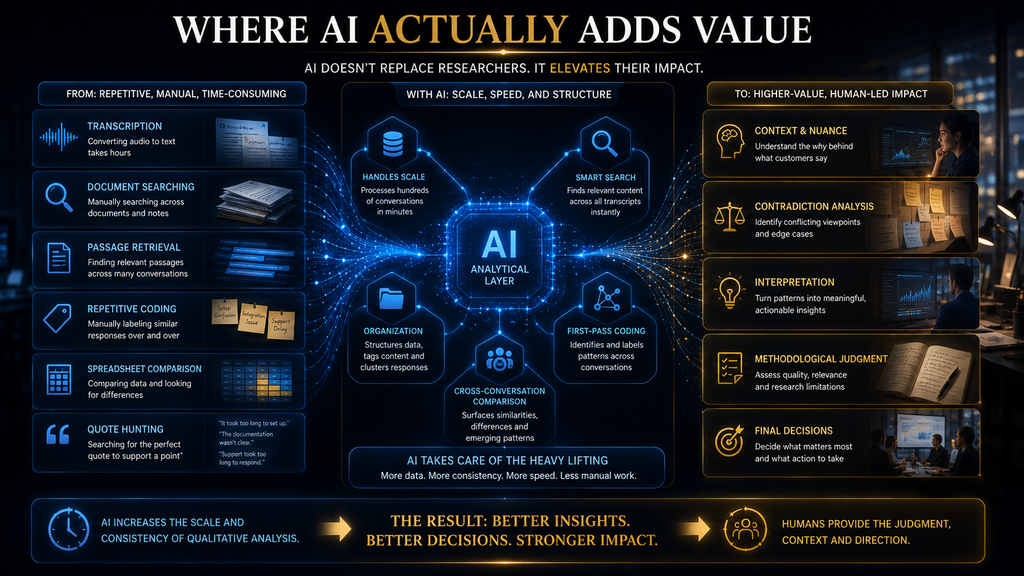
The most useful way to evaluate AI conversation analysis is to divide research into two layers. The first layer is processing. The second layer is judgment. Processing includes activities such as transcription, indexing, searching, organizing, classifying, retrieving, grouping, and generating candidate patterns. Judgment includes deciding what matters, determining whether a pattern is meaningful, understanding context, challenging assumptions, interpreting contradictions, assessing methodological quality, and deciding what conclusion the evidence actually supports.
AI is increasingly capable in the first layer. Humans remain essential in the second. That distinction creates an AI Hustle World principle for conversation research: Use AI aggressively where the work is repetitive and evidence-rich. Use human judgment aggressively where the work is contextual, ambiguous, consequential, or difficult to reverse. This is more useful than the simplistic idea that AI should either replace manual research or remain completely outside it.
Where AI Conversation Analysis Creates Real Value
The strongest AI use cases are not necessarily the most glamorous ones. They are often the boring tasks that consume disproportionate amounts of research time. Transcription is one example. Search is another. Cross-conversation comparison is another. Quote retrieval is another. First-pass coding is another. These tasks can become particularly expensive when the dataset grows because the amount of work increases even when the underlying research question remains unchanged. If a researcher needs to find every conversation mentioning a product’s cancellation process, the question does not become intellectually harder simply because there are 300 interviews instead of 30. The mechanical workload does. AI can attack that workload directly.
1. Transcription: The First Major Efficiency Gain. AI transcription is often the easiest place to see the difference between manual and AI-assisted research. Manual transcription requires someone to listen to recorded speech and convert it into text. The task can be valuable because it exposes researchers directly to the material, but it is also time-consuming and repetitive. AI transcription changes the economics by converting audio or video into searchable text automatically. Modern platforms can also add speaker labels and timestamps, which makes later analysis much more practical. Speak AI currently states that its research-interview workflow supports automatic transcription, speaker diarization, timestamps, and transcription across 70+ languages.
The benefit is not merely saving typing time. Searchability changes what researchers can do with the dataset. Once conversations are structured as searchable text, a researcher can locate a specific phrase, topic, participant, or time period without manually reopening every recording. That creates a compounding advantage. The transcript becomes an analytical index into the original conversation. However, transcription accuracy still matters. Names, technical terminology, accents, overlapping speakers, background noise, domain-specific vocabulary, and multilingual conversations can create errors that propagate into later analysis.
That means researchers should not think of transcription as a solved problem simply because AI performs it automatically. The practical rule is straightforward: Automate transcription, but verify evidence that will materially affect the final conclusion.
2. Search and Retrieval: Turning a Transcript Library Into Evidence. Search may be one of the most underrated advantages of AI conversation analysis. Consider a research team with 200 interviews. A traditional workflow might involve a collection of documents stored in folders. Researchers search individual transcripts, copy relevant passages into notes, record participant identifiers, and repeat the process for each research question. That works. It becomes increasingly inefficient as the repository grows. AI-assisted search can treat the entire conversation library as an evidence base.
Instead of opening interviews individually, researchers can ask questions across the dataset or search for concepts and phrases across multiple conversations. Speak AI currently describes cross-interview search that allows users to search keywords, phrases, or concepts across all interviews and compare responses. This changes the workflow from document-by-document analysis to dataset-level interrogation. That distinction is strategically important. A researcher might initially ask: “What did participants say about onboarding?” Then: “Which participants described onboarding as confusing?”
Then: “Did those complaints occur mainly among new customers?” Then: “Do enterprise customers describe the same problem?” Then: “Which specific onboarding step appears most frequently in negative conversations?” The researcher is not simply generating summaries. They are interrogating the evidence. AI makes that interrogation faster.
3. Cross-Conversation Comparison Is Where AI Becomes More Valuable. A single conversation provides a story. A collection of conversations provides a pattern. That sounds obvious, but the analytical workload involved in moving from one to the other is substantial. Suppose ten customers complain about setup. A researcher can manually compare those conversations. Now suppose 500 customers discuss setup. The question is no longer whether manual analysis is theoretically possible. It is whether the research team can perform it at the speed and cost required to make the findings useful.
AI can help identify recurring themes, compare topic frequency, examine sentiment patterns, filter groups, and surface differences across conversations. Speak AI’s current Explore functionality allows users to analyze keywords, sentiment, topics, speakers, and entities across recordings, with filters for folders, dates, speakers, sentiment, tags, and categories. This is an important distinction between individual interview analysis and conversation intelligence. The latter is fundamentally about relationships across conversations.
4. First-Pass Coding Can Become Much Faster. Coding is one of the central activities in qualitative research. A researcher identifies meaningful sections of text and assigns labels that help organize the evidence. Manual coding offers substantial control. It also becomes laborious when a dataset contains hundreds of interviews. AI can provide candidate codes or classifications that researchers then refine. This is an important point because the best use of AI is not necessarily “AI decides the code.”
It can be: AI proposes → researcher reviews → researcher modifies → framework becomes stronger. Speak AI explicitly describes this approach in its current interview-analysis materials, explaining that AI can accelerate mechanical coding work while researchers maintain control over analytical decisions and manually refine, merge, or reorganize codes. That is much closer to a defensible research workflow. The machine handles the first pass. The researcher remains accountable for the coding framework.
5. Theme Discovery Can Reveal Patterns Researchers Might Otherwise Miss. Theme discovery is more complicated than keyword counting. A theme is not simply a word that appears frequently. It represents a meaningful pattern in the dataset that helps answer the research question. AI can nevertheless be useful for identifying candidate themes. A researcher might not realize that seemingly different complaints—slow setup, confusing documentation, unclear instructions, and repeated support requests—are all manifestations of the same broader problem. AI can group related language and surface candidate patterns.
Speak AI’s current theme functionality identifies recurring themes across recordings, classifies mentions, and counts how often themes appear and who raised them. That can be extremely useful for discovery. But discovery is not the same as interpretation. A frequent theme might be operationally unimportant. A rare theme might be strategically critical. The researcher still needs to decide what deserves attention.
6. Sentiment Analysis Is Useful, but It Is Not Emotional Understanding. Sentiment analysis can help researchers process large conversation datasets quickly. A system can identify positive, negative, and neutral language and allow teams to look for broad changes across participants, products, periods, or topics. Speak AI currently describes sentiment scoring at both document and sentence levels, including positive, negative, and neutral categories and a compound score ranging from -1 to +1. That can be useful. Imagine a customer-success organization analyzing thousands of support calls. A shift in negative sentiment around a particular product release could provide an early signal worth investigating.
But sentiment should not be mistaken for emotional understanding. Sarcasm is difficult. Ambivalence is difficult. Cultural expressions are difficult. A participant can be positive about one aspect of a product while intensely frustrated by another. The sentence-level score may be technically correct while the strategic interpretation is wrong. The right role for sentiment analysis is therefore signal detection. It tells researchers where something interesting may be happening. It does not eliminate the need to understand why.
7. Quote Extraction Saves Time but Requires Verification. Researchers often need direct quotations for reports, presentations, articles, product decisions, or academic publications. Finding strong quotations manually can take significant time. AI can identify candidate quotes based on themes, topics, keywords, or speakers. Speak AI currently describes extracting verbatim quotes by theme, speaker, or keyword, including timestamps and speaker attribution. This is a valuable workflow improvement. But quotation accuracy deserves special attention. A quote is evidence. If AI alters wording, truncates context, combines phrases, or incorrectly attributes a statement, the researcher’s credibility can be damaged.
A 2025 study published in Scientific Reports found that generative AI performance in qualitative analysis included problems with quote selection and hallucination, including changes to words or phrases, truncation, and combinations of text that altered meaning. The researchers concluded that GenAI could assist with themes, keywords, and basic narrative, but was not yet reliable enough to replace rigorous human thematic analysis. The operational rule should therefore be strict: AI may find the quote. The researcher verifies the quote against the original evidence.
8. AI Can Make the Dataset More Interrogable. One of the biggest conceptual changes created by AI conversation analysis is that a dataset becomes easier to interrogate repeatedly. Traditional research often creates a report. AI-assisted research can create something closer to a living evidence repository. The difference matters. A report might answer the research questions that were known at the beginning of the project. A searchable conversation repository allows researchers to ask new questions later. A product team might initially analyze onboarding.
Three months later, the same repository could be used to investigate pricing objections. Later, it could be used to understand feature requests. Later still, researchers could compare conversations before and after a product change. The value of the dataset therefore increases because the evidence becomes reusable. This is one of the strongest strategic reasons to build an AI-assisted conversation-analysis workflow rather than treating each research project as a one-time document-production exercise.
The Manual Approach Still Wins in Several Important Areas
The efficiency argument for AI becomes dangerous if it turns into the assumption that every research task should be automated. There are several areas where human researchers retain a substantial advantage. The first is context. The second is cultural meaning. The third is ambiguity. The fourth is contradiction. The fifth is methodological judgment. The sixth is accountability. These are not minor edge cases. They sit at the center of serious qualitative research.
Context Is Where AI Can Flatten Meaning
Words do not exist independently of conversations. A participant might say: “I wouldn’t say the product is difficult.” That sounds positive. But imagine the preceding discussion revealed that the participant had spent two hours watching tutorials, contacted support three times, and created a workaround with a spreadsheet. The phrase is no longer straightforward. The participant may be avoiding direct criticism. They may be comparing the product with something even worse.
They may simply use the word “difficult” differently from other participants. A human researcher can revisit the entire conversation and interpret the statement accordingly. AI may still identify useful signals, but the context must remain accessible. That is why a strong AI workflow should make it easy to move from an AI-generated finding back to the exact supporting passages and, where necessary, the original recording.
Cultural Meaning Is a Serious Boundary Condition
AI systems operate across languages and cultures, but multilingual capability does not automatically equal cultural understanding. A 2026 methodological study examining ChatGPT-assisted thematic analysis of Roman Urdu mental-health interviews found that AI could perform surface-level coding effectively while flattening cultural and emotional nuance. The researchers identified multiple categories of coding errors and emphasized the importance of human-in-the-loop oversight for interpretive depth and validity. This is not merely an academic concern.
The same issue can appear in customer research, employee interviews, community research, international market studies, and any dataset where meaning depends heavily on local language or cultural context. An AI system may recognize the literal meaning of a phrase while missing the social meaning behind it. That creates a particularly dangerous failure mode because the output can look perfectly reasonable. The mistake is not obvious. It is plausible. And plausible mistakes are often more dangerous than obvious ones.
AI Errors Can Be Systematic, Not Random
This is one of the most important reasons not to treat AI coding as automatically objective. A 2025 study by Ashwin, Chhabra, and Rao examined LLM-based coding of open-ended interview data involving Rohingya refugees and Bengali hosts in Bangladesh. The researchers found that LLM coding errors could introduce systematic bias because the errors were not random with respect to characteristics of the people being studied. That finding changes how researchers should think about validation.
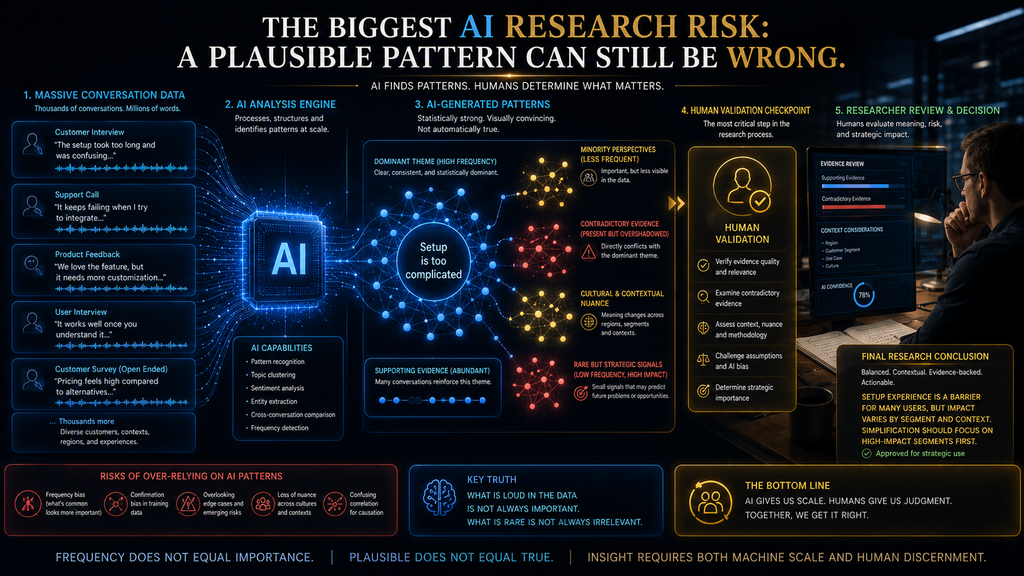
If an AI system makes random mistakes, a large enough sample might sometimes reduce their impact. If the errors are systematic, scale can actually make the problem worse. The model may consistently interpret a particular kind of participant statement in the wrong way. It may consistently flatten certain cultural expressions. It may consistently overemphasize familiar concepts while underrepresenting less familiar ones. That means “the AI analyzed all 500 interviews” is not evidence that the conclusion is reliable. It may simply mean that the same analytical bias was applied 500 times.
The Interesting Counterpoint: AI and Humans Can Still Converge on Themes
The research is not uniformly negative. A 2026 study in the International Journal of Qualitative Methods compared human thematic analysis with four independent AI-assisted analyses using Claude Code. The study found a form of hierarchical convergence: individual codes could differ while higher-order themes remained relatively stable. The implication is that AI does not necessarily need to reproduce every human code exactly to contribute meaningfully to thematic analysis. Another 2026 study examining whether AI could replicate human qualitative analysis reported strong overlap between AI-generated and human-derived themes in its research context. The authors also described AI as capable of integrating individual and group-level constructs into broader themes. Our guide to how AI finds themes, patterns and sentiment across conversations goes deeper on the method.
These findings matter because they prevent the discussion from becoming ideological. The evidence does not support “AI is useless.” It also does not support “AI has replaced qualitative researchers.” The more defensible conclusion is that AI can produce useful analytical convergence in some contexts, but reliability depends on the task, dataset, prompting or workflow, research design, and human validation. That is a much more useful conclusion for businesses and researchers making actual tool decisions.
The Best Mental Model: AI as a Research Analyst, Not the Research Director
A practical way to understand the role of AI is to imagine hiring a very fast junior research analyst. That analyst can read a huge amount of material. They can search quickly. They can organize information. They can propose patterns. They can prepare candidate quotations. They can compare groups. They can generate summaries. But you would not automatically let that analyst publish a high-stakes conclusion without review. You would ask:
What evidence supports this? What did you exclude? What contradicts this finding? How did you define the theme? Could another interpretation explain the same evidence? Which participants are underrepresented? What assumptions did you make? That is the mindset organizations should bring to AI conversation analysis. The AI can dramatically expand processing capacity. The researcher remains responsible for analytical quality.
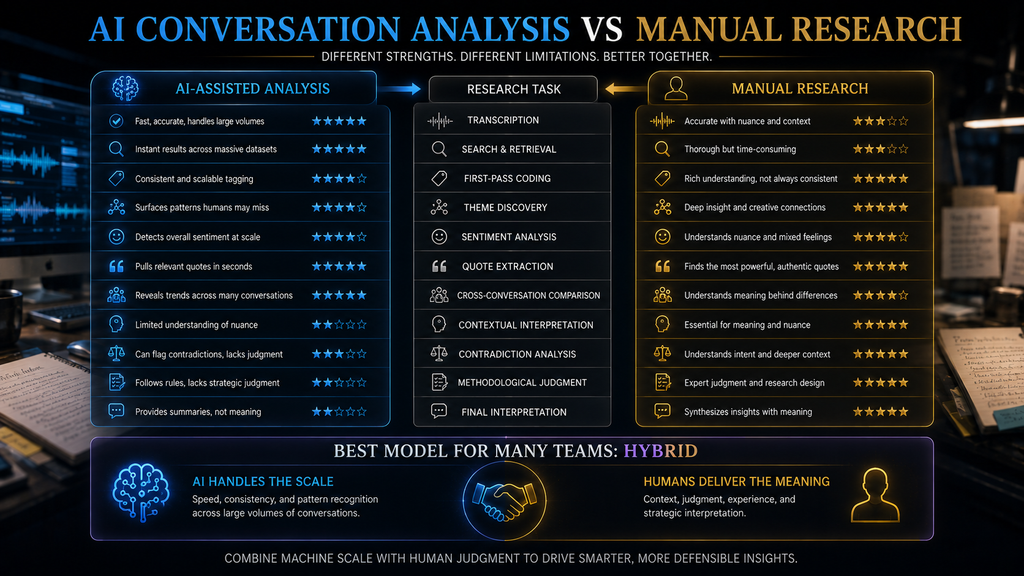
AI Conversation Analysis vs Manual Research: A Practical Comparison
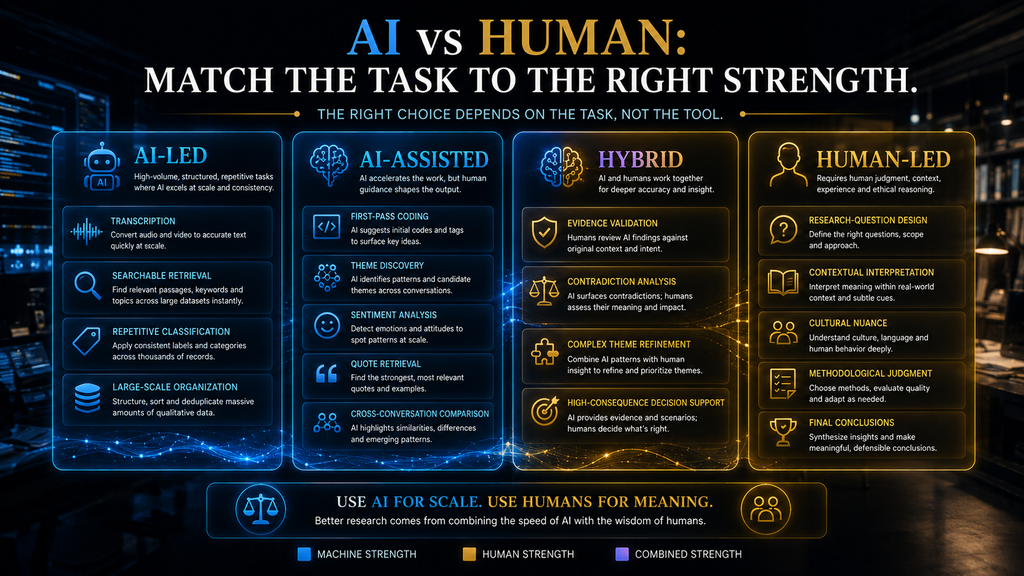
| Research task | Manual research strength | AI-assisted strength | Best operating model |
|---|---|---|---|
| Transcription | Direct familiarity with recordings | Fast conversion to searchable text | AI + verification |
| Speaker identification | Human can resolve ambiguity | Automated diarization and labeling | AI + review |
| Search | Accurate but increasingly slow at scale | Fast dataset-wide retrieval | AI-led |
| First-pass coding | High contextual control | Rapid candidate coding | AI-assisted |
| Theme discovery | Strong interpretation | Fast pattern discovery | Hybrid |
| Sentiment analysis | Strong contextual reading | Consistent large-scale signal detection | Hybrid |
| Quote retrieval | High confidence when manually verified | Fast candidate retrieval | AI + human verification |
| Cross-interview comparison | Strong but labor-intensive | Highly scalable | AI-assisted |
| Cultural interpretation | Strong human contextual capability | Variable | Human-led |
| Contradiction analysis | Strong contextual reasoning | Can surface candidate conflicts | Hybrid |
| Final interpretation | Essential | Supportive | Human-led |
| High-consequence decisions | Accountability and judgment | Evidence support | Human-led with AI assistance |
The important thing about this table is that there is no universal winner. The appropriate model changes according to the nature of the task.
The Scale Threshold: When Does AI Become Worthwhile?
There is no universal number of interviews at which AI suddenly becomes necessary. The better question is how much repetitive analytical work exists inside the dataset. A researcher analyzing ten interviews may be able to read every transcript carefully and retain enough context to perform excellent analysis. A researcher analyzing 100 interviews faces a different retrieval problem. At 500 interviews, the challenge changes again. At 5,000 conversations, manual processing becomes increasingly difficult to sustain without some form of automation.
But dataset size is only one variable. A small dataset with highly repetitive coding requirements may benefit from AI. A large dataset involving extremely nuanced, high-consequence interpretation may require substantial human review even when AI performs the initial processing. This produces a more useful decision rule: AI value rises with volume, repetition, cross-conversation complexity, and speed requirements. Human involvement rises with ambiguity, cultural complexity, consequence of error, and interpretive depth.
A 20-Interview Example
Suppose a UX researcher conducts 20 interviews about a new mobile app. Each interview lasts approximately 45 minutes. The researcher knows the research questions well and can comfortably read the transcripts within several days. Manual analysis may be entirely reasonable. AI could still help with transcription and initial retrieval, but introducing a complex AI workflow may not produce enough additional value to justify the setup and validation overhead. The key point is that automation has a cost. See how AI interview analysis works for the transcript-to-insight workflow.
There is a cost to learning the system. There is a cost to checking its output. There is a cost to managing prompts or analytical frameworks. There is a cost to governance. There is a cost when the system produces something plausible but wrong. For a small, manageable dataset, manual analysis may be economically superior.
A 200-Interview Example
Now imagine the same research team conducts 200 interviews. The research questions remain similar. The number of conversations has increased tenfold. The team now needs to compare new versus existing customers, identify the most common onboarding problems, examine differences between regions, and retrieve representative quotations. Manual research is still possible. But the mechanical workload has changed dramatically. This is where AI starts creating clear leverage. The researcher can use AI to transcribe and organize the dataset, search across interviews, identify candidate themes, compare groups, surface sentiment patterns, and retrieve potential quotations. Our guide to analyzing customer feedback, calls and interviews at scale applies the same ideas to support and product teams.
The human team can then focus on validating and interpreting the findings. The AI has not replaced the research. It has changed the economics of the workflow.
A 2,000-Conversation Example
Now imagine a customer-support organization has 2,000 recorded conversations per month. Trying to manually read every conversation is no longer a realistic operating model. The business may want to know: Why are customers contacting support? Which product areas create the most frustration? What objections appear before cancellations? Which issues are becoming more frequent? What changed after a product release? Which customer segments experience different problems? At this scale, AI conversation analysis is not merely a productivity convenience.
It becomes part of the organization’s information infrastructure. The research question has shifted from: “Can we analyze these conversations?” to: “How do we make all of these conversations continuously useful?” That is a much bigger opportunity.
The ROI of AI Conversation Analysis
The financial case for AI conversation analysis should not be reduced to transcription savings. The real ROI can come from several layers. The first is labor efficiency. The second is research throughput. The third is decision speed. The fourth is evidence accessibility. The fifth is organizational learning. The sixth is opportunity cost. Suppose a senior researcher spends 15 hours per week performing repetitive transcript retrieval and first-pass coding. If AI reduces that workload to five hours, the organization has not simply saved ten hours.
It has released ten hours of senior analytical capacity. Those hours can be used for deeper interviews, research design, stakeholder workshops, contradiction analysis, validation, or strategic recommendations. That is where the real value appears.
See Where AI Saves the Most Time
Time the transcription and first-pass coding of one conversation to see which manual steps AI actually shortens.
Time a First-Pass Analysis →Affiliate disclosure: We may earn a commission if you subscribe through this link, at no additional cost to you.
Research Throughput Can Become a Competitive Advantage
Companies often underestimate the value of research speed. Suppose two product teams both identify a customer problem. Team A requires six weeks to collect, analyze, validate, and report the evidence. Team B can produce a validated first-pass analysis within two weeks and then spend additional time interpreting the implications. Team B can potentially make product decisions earlier. Earlier decisions create a feedback loop. The product changes. New conversations occur. Those conversations become new evidence.
The research cycle accelerates. This creates a second-order effect: AI can increase not only the efficiency of individual research tasks but also the frequency at which an organization learns from its customers. That may be more valuable than the time saved on transcription.
The Hidden ROI: Better Evidence Retrieval
Another benefit is evidence accessibility. Research often loses value after the final presentation. A report may say that customers struggled with onboarding. Six months later, a product manager may ask: “Which customers said that?” “What exactly did they say?” “Was this mainly enterprise customers?” “Was this issue still present after the redesign?” If the original research exists only as a PDF, retrieving those answers can require another research effort. If the underlying conversation dataset remains searchable, the organization can return to the evidence. That turns research from a static output into an organizational knowledge asset.
What Happens If You Do Nothing?
The consequence of not adopting AI conversation analysis is not necessarily that your research becomes bad. That is too simplistic. The more likely consequence is that research becomes more selective because processing capacity becomes the bottleneck. Teams may analyze fewer interviews. They may stop searching old repositories because retrieval takes too long. They may rely on summaries instead of source evidence. They may prioritize easily accessible data over strategically important data.
They may produce research less frequently. They may miss emerging patterns because the dataset is too large to inspect manually. In other words, the hidden cost of doing nothing can be underusing the evidence you already paid to collect. That is a more realistic business argument for AI.
But Automation Can Also Create a New Risk
There is an opposite danger. If AI makes analysis cheap, organizations may start analyzing everything without asking whether the research question is good. That can create an abundance of mediocre insights. A system might generate hundreds of themes. A dashboard might show dozens of sentiment changes. A research repository might contain thousands of extracted quotations. The organization may feel more informed while actually becoming less focused. This is why AI should not replace research prioritization.
The question is not: “What can AI analyze?” The question is: “What should we analyze, and what decision will the answer support?” That is a research-design question. Humans still own it.
The AI Hustle World Conversation Intelligence Framework
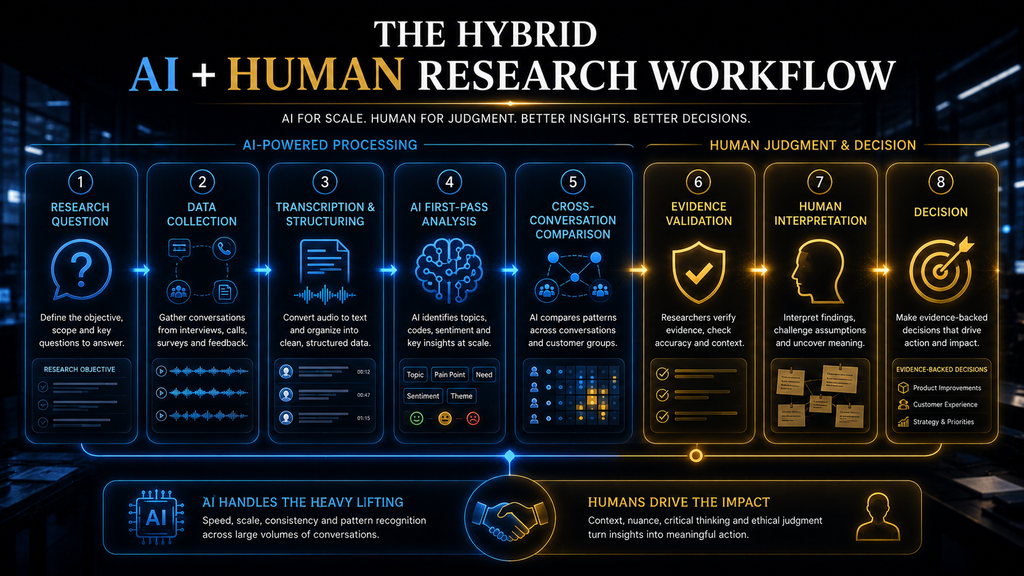
A practical framework for deciding how to use AI is the P.A.C.E. model: Process → Analyze → Challenge → Execute. The first stage is Process. Use AI to convert recordings into structured, searchable evidence. Transcribe conversations, identify speakers, organize datasets, extract basic metadata, and make the corpus easier to work with. The second stage is Analyze. Use AI to surface candidate themes, topics, sentiment patterns, recurring concepts, quotations, and cross-conversation differences. The objective is to expand analytical visibility, not to declare the final answer.
The third stage is Challenge. This is the human-controlled stage. Researchers test the AI’s findings against the original evidence, search for contradictions, examine minority perspectives, review cultural context, and ask whether the pattern actually answers the research question. The fourth stage is Execute. Only after the evidence survives validation should findings become recommendations, product changes, customer-experience initiatives, strategic decisions, or published research. This framework is useful because it prevents AI from jumping directly from raw conversations to business decisions. The missing middle—Challenge—is where much of the real research quality lives.
Why the Challenge Stage Matters More Than Most Teams Think
Suppose AI identifies a theme called “pricing dissatisfaction.” That theme appears in 38 percent of conversations. A weak workflow would report the number and recommend changing prices. A stronger workflow asks what the participants actually mean. Are they saying prices are too high? Are they saying pricing is confusing? Are they comparing the product with a cheaper competitor? Are they willing to pay more if certain features improve? Are only small businesses making the complaint?
Are existing customers more positive than prospects? Is the issue actually value communication rather than price? Those are different business problems. The AI can help surface the theme. The researcher must determine what the theme means.
Contradiction Analysis Should Be Deliberate
One of the strongest improvements an AI-assisted workflow can make is to search deliberately for evidence that challenges the dominant pattern. Suppose AI identifies “customers want more automation” as a major theme. The research team should not stop there. Ask: Which customers do not want more automation? Why? What tasks do they prefer to control manually? Are those customers more valuable? Are they more experienced? Do they operate in regulated environments?
Are their concerns about trust rather than automation itself? Contradictions often reveal segmentation. The majority pattern tells you what is common. The minority pattern can tell you why. A strong AI workflow should therefore include an explicit contradiction search.
AI Can Make Minority Perspectives Easier to Find
This may seem counterintuitive. AI can actually help human researchers pay more attention to minority perspectives if it is used correctly. In a manual workflow, researchers may naturally focus on themes that appear frequently because they are easier to notice and justify. An AI system can be instructed or queried to search for outliers, exceptions, negative cases, and conflicting statements. That creates a useful inversion. Instead of asking only: “What is the most common theme?” ask: “What evidence does not fit the dominant theme?” “What participants experienced something different?” “What findings appear only in a small segment?” “What interpretation would change if the minority evidence were important?” AI becomes useful not because it supplies the final answer, but because it expands the range of questions researchers can ask.
Where AI Should Not Be Allowed to Become the Final Authority
There are several situations where human control should be especially strong. Research involving vulnerable populations deserves particular caution. Research involving health, legal matters, employment decisions, financial consequences, or other high-stakes contexts also requires stronger validation. Multilingual or culturally complex research deserves additional scrutiny. Research used to make decisions about individuals should not rely on unvalidated AI classifications. Research intended for academic or professional publication should preserve a transparent methodological trail.
In all of these cases, the consequence of an incorrect interpretation is high enough that speed should not dominate the workflow. The higher the cost of error, the stronger the case for human verification.
A Better Way to Think About Accuracy
Teams often ask: “Is the AI accurate?” That is too broad a question. Accuracy should be evaluated at the task level. Is the transcription accurate enough? Are speaker labels accurate enough? Are extracted quotes exact? Are theme classifications consistent? Does sentiment provide useful directional signals? Can the system retrieve relevant passages? Do AI-generated themes converge with trained human interpretation? Does it preserve minority and contradictory perspectives? Can researchers trace every major conclusion back to evidence? For meeting-focused tools, see our list of the best AI meeting assistants.
These are much more useful questions. A tool does not need to be perfect at everything to create substantial value. It needs to be reliably useful at the specific tasks where it is being deployed.
Build a Validation Sample Before Scaling
One of the smartest ways to introduce AI conversation analysis is to start with a validation sample. Take a manageable subset of conversations. Have experienced researchers analyze them manually. Then run the same material through the AI workflow. Compare the outputs. Do not only compare whether the final themes match. Compare:
- coding differences,
- missed passages,
- false positives,
- quote accuracy,
- sentiment disagreements,
- minority perspectives,
- contextual interpretation,
- contradictions,
- and the time required for human validation.
This creates an evidence-based decision about whether the AI workflow is appropriate for the organization. It also prevents the common mistake of buying software first and discovering methodological limitations later.
Measure AI Conversation Analysis Like an Operational System
If a company introduces AI conversation analysis, it should measure more than the number of transcripts processed. Useful KPIs include:
- Time to first usable insight: How long does it take to move from completed interviews to an evidence-backed initial finding?
- Research throughput: How many conversations can the team analyze per researcher per month?
- Retrieval time: How long does it take to locate supporting evidence for a research question?
- Validation rate: What percentage of AI-generated themes require substantial modification?
- Quote verification rate: How often do AI-selected quotations require correction or replacement?
- Theme agreement: How closely do AI-generated candidate themes align with expert human analysis?
- Contradiction discovery: How effectively does the workflow surface meaningful exceptions and minority perspectives?
- Decision cycle time: How long does it take for research evidence to reach the team making the decision?
These metrics reveal whether AI is actually improving research.
The Wrong KPI: “Number of AI Insights”
A platform can generate thousands of insights. That does not mean the research improved. A better KPI is decision usefulness. Did the insight change a product decision? Did it reveal a customer problem that was previously hidden? Did it prevent a bad decision? Did it identify an important segment difference? Did it reduce research turnaround time without reducing analytical quality? Did it allow researchers to examine more evidence? The value of AI conversation analysis should ultimately be measured by what the organization can understand and act on, not by how much output the AI produces. How AI turns feedback into roadmap decisions is covered in how AI turns customer feedback into product insights.
Common Mistakes When Introducing AI Conversation Analysis
The first mistake is assuming that automation means elimination of human review. It does not. The second mistake is treating AI-generated themes as final findings. Themes are hypotheses until they have been validated against the evidence. The third mistake is trusting sentiment scores without context. Sentiment can identify signals but cannot fully explain emotional meaning. The fourth mistake is using AI-generated quotations without checking the original transcript. A quotation is evidence and should be verified.
The fifth mistake is ignoring minority perspectives. The most common pattern is not automatically the most strategically important. The sixth mistake is uploading sensitive data without understanding governance requirements. Convenience should never override confidentiality and research ethics. The seventh mistake is automating a poorly designed research question. AI can accelerate a weak question just as efficiently as a good one. The eighth mistake is measuring productivity while ignoring analytical quality. Saving hours is useful only if the resulting research remains trustworthy.
A Practical Implementation Plan for Teams
Organizations do not need to transform their entire research operation overnight. A better approach is to introduce AI gradually. Speak AI lists its current plans on its pricing page, and its documentation covers the API and integrations.
- Start With a Bounded Research Question. Choose one research project with a clear objective. Avoid starting with the most sensitive or highest-consequence dataset. The objective is to learn how the workflow performs.
- Establish a Human Baseline. Have an experienced researcher analyze a subset manually. This becomes the benchmark for evaluating the AI-assisted workflow.
- Automate the Mechanical Layer First. Begin with transcription, search, organization, and quote retrieval. These are generally easier to validate than fully automated interpretation.
- Add First-Pass Analysis. Introduce candidate coding, themes, topics, and sentiment. Treat the outputs as suggestions.
- Compare AI and Human Results. Document where the AI agrees, disagrees, misses evidence, or creates misleading patterns.
- Build a Validation Protocol. Define who reviews AI-generated themes, what evidence must be checked, how contradictions are handled, and when researchers must return to the original recordings.
- Scale Only After the Workflow Proves Useful. Once the organization understands the strengths and limitations, expand the workflow to larger datasets. This is safer and usually more economical than attempting full automation immediately.
What a Mature AI-Assisted Research Workflow Looks Like
A mature workflow does not have AI at every stage. It has AI at the stages where AI creates leverage. A research team might begin with a human-designed research question. Record interviews. Use AI to transcribe and organize them. Use AI to surface candidate themes. Use AI to compare groups. Use AI to retrieve supporting evidence. Then switch back to humans for validation. Researchers examine contradictions. Researchers review cultural context.
Researchers refine the themes. Researchers determine the implications. Leadership decides what to do. That is not an “AI research workflow.” It is a human research workflow with an AI processing layer. That distinction is important because it keeps the organization focused on research quality rather than automation for its own sake.
If Your Research Bottleneck Is Processing, AI May Be Worth Testing
When the biggest problem is transcribing interviews, searching across large transcript libraries, finding recurring themes, retrieving quotations, or comparing many conversations, AI can remove a significant amount of repetitive work without requiring the research team to surrender final interpretive control.
Speak AI currently combines speaker-labeled transcription, cross-interview search, AI-assisted analysis, theme extraction, sentiment analysis, quote extraction, and dataset-level exploration in one research workflow. Its own documentation emphasizes that AI-generated themes should be treated as starting points that researchers review and validate.
The Real Difference Between AI-Assisted and Manual Research
The deepest difference is not speed. It is how the researcher allocates attention. In a manual workflow, attention is distributed across every stage. The researcher spends time processing evidence, locating passages, organizing material, coding conversations, comparing interviews, and interpreting findings. In an AI-assisted workflow, some of those activities can become much faster. That creates a redistribution of attention. The researcher can spend more time asking difficult questions. Why did this pattern appear?
Why is one group different? Why does the minority disagree? What does the participant mean in context? What evidence would falsify this conclusion? What does this finding imply for the business? Those are exactly the questions that create research value.
AI Does Not Remove the Need for a Research Framework
One of the most common misunderstandings is that an AI tool can discover the research structure automatically. It can suggest structure. It cannot replace research design. Before analyzing conversations, researchers should know what they are trying to learn. The research question determines what evidence matters. A study about customer onboarding should not suddenly become a study about sentiment simply because the AI platform produces attractive sentiment charts. A study about why customers cancel should not become a keyword-frequency exercise.
A study about employee experience should not be reduced to positive versus negative comments. The research question should control the analysis. AI should support it.
The Difference Between a Topic and a Theme
This distinction is critical. A topic is something people talk about. A theme is a meaningful pattern that helps explain the research question. Suppose customers repeatedly mention “support.” That is a topic. But what are they saying about support? Perhaps customers who experience onboarding problems contact support repeatedly because the product documentation is unclear. That is closer to a theme. AI can help identify the topic quickly. The researcher must determine whether the topic represents a meaningful theme and how it relates to the research objective. This is why frequency-based analysis can be misleading. A word can be frequent without being analytically important.
The Difference Between Sentiment and Experience
The same problem exists with sentiment. A customer can use positive language while describing a poor experience. A customer can use negative language while expressing strong loyalty to the brand. Someone may say: “I love the product, but I hate how difficult it is to export my data.” A sentiment model might see both positive and negative language. A researcher sees a much more useful insight: The product creates strong overall value, but one workflow is damaging the experience. The second interpretation is strategically actionable. The first is merely descriptive. That is the difference between signal extraction and research.
The Most Valuable AI Output May Be a Better Question
This is a subtle but powerful advantage. AI does not always need to produce the answer. Sometimes its greatest value is showing the researcher where the next question should go. Suppose AI identifies that customers in one segment mention implementation problems twice as often as another segment. That does not automatically explain the difference. But it creates a new research question: What is different about the implementation experience between these groups? The researcher can investigate. The AI has therefore increased the organization’s analytical curiosity. That is a legitimate form of research value.
AI Can Help Researchers Move From Summaries to Evidence Networks
Traditional research reports often summarize conversations. AI-assisted research can help create connections between conversations. One participant mentions onboarding. Another mentions documentation. Another mentions support. Another mentions implementation. The AI can help researchers discover that these may be related parts of the same customer journey. This creates an evidence network rather than a collection of isolated summaries. The strategic benefit is significant. A business rarely needs 100 individual summaries. It needs to understand what the 100 conversations collectively reveal. That is where cross-conversation intelligence becomes more valuable than conversation-by-conversation summarization. Once you have transcripts, you can also turn video transcripts into articles, clips and social posts.
Why “One Conversation vs 100 Conversations” Is the Real Shift
One conversation can tell you what happened to one person. One hundred conversations can tell you whether the experience is recurring, segment-specific, changing over time, or associated with a broader problem. The analytical challenge is that humans naturally process conversations one at a time. AI can help move analysis toward the dataset level. This is the central reason conversation intelligence is becoming strategically interesting. The unit of analysis changes. Instead of:
Conversation → Summary the workflow becomes: Many conversations → Patterns → Differences → Evidence → Interpretation → Decision That is a much more powerful model for organizations collecting conversation data continuously.
Where Speak AI Fits Into This Model
Speak AI is relevant to this workflow because its current product positioning focuses specifically on conversation processing and analysis rather than treating interviews as ordinary documents. Its research-interview workflow includes automatic transcription, speaker identification, timestamps, thematic analysis, cross-interview comparison, quote extraction, sentiment analysis, and AI-powered questioning across interview datasets. Its current documentation also describes an Explore layer for comparing keywords, topics, sentiment, speakers, and entities across multiple recordings. That makes the platform particularly relevant when the bottleneck is the transition from raw conversation data to a searchable analytical dataset.
But the evaluation should remain disciplined. The question should not be: “Does Speak AI have AI features?” The better questions are: Does it reduce the processing burden? Does it improve retrieval? Can researchers inspect the evidence behind the output? Does it support cross-conversation analysis? Can researchers correct or refine AI-generated themes? Does it fit the team’s governance requirements? Does the productivity gain justify the cost and validation effort? Those questions matter more than the length of the feature list.
Who Should Use AI Conversation Analysis?
AI conversation analysis is particularly well suited to research teams dealing with large or growing datasets. Market researchers can use it to compare interviews across customer segments and identify recurring themes. UX researchers can use it to organize usability interviews and identify repeated friction points. Customer-success teams can use it to analyze support conversations and discover recurring sources of dissatisfaction. Sales teams can use it to identify common objections and compare successful versus unsuccessful conversations.
Product teams can use it to analyze feature requests, implementation problems, and customer feedback. Academic researchers can use AI-assisted processing as a research aid when their methodology, ethics requirements, and validation procedures allow it. The common factor is not the industry. It is the combination of conversation volume, repetitive analysis, and the need for cross-conversation insight.
Who Should Be More Cautious?
Teams should be more cautious when the consequences of analytical error are high. Sensitive research requires careful data governance. Multilingual and culturally complex research requires strong human interpretation. Research involving vulnerable participants requires methodological care. High-stakes decisions require validated evidence. Small datasets may not generate enough efficiency benefit to justify a complicated AI workflow. And teams without experienced researchers may struggle to recognize when an AI-generated interpretation is plausible but wrong. That last point is important. AI can increase analytical capacity. It does not automatically create analytical expertise.
The Future: From AI Summaries to Continuous Conversation Intelligence
The next phase of AI conversation analysis is unlikely to be defined simply by better summaries. Summaries are useful, but they are only the beginning. The larger opportunity is continuous analysis across a living conversation repository. Imagine a company that continuously analyzes customer interviews, support calls, sales conversations, and feedback sessions. Instead of waiting for a quarterly research project, the organization can continuously monitor emerging themes. A new complaint begins appearing.
A specific segment shows a change in sentiment. A recurring sales objection becomes more common. A product feature starts generating a new type of request. The organization can investigate earlier. This moves conversation analysis closer to an organizational sensing system. The second-order effect is significant. Research stops being something that happens occasionally. It becomes part of the organization’s ongoing learning infrastructure.
But Continuous Analysis Creates a New Governance Problem
The more continuously an organization analyzes conversations, the more important governance becomes. Who has access? What data can be analyzed? How long is it retained? What participant consent exists? Which findings are allowed to influence decisions? How are AI errors documented? How can researchers reproduce a conclusion? What happens when a model changes? These questions become more important as AI moves from occasional analysis to continuous organizational infrastructure. The technical ability to analyze everything does not mean an organization should analyze everything. Responsible research still requires boundaries.
The Future May Be Less About “AI vs Human” and More About Allocation of Judgment
The debate will probably continue to frame AI as a replacement for researchers. That framing is increasingly unhelpful. The more interesting question is: Which decisions should machines make, which decisions should humans make, and where should they collaborate? AI can decide which passages are worth surfacing. Humans can decide whether the evidence supports the interpretation. AI can compare hundreds of conversations. Humans can decide whether the difference matters. AI can identify candidate themes.
Humans can decide whether those themes are conceptually sound. AI can retrieve quotations. Humans can verify them. AI can make research more scalable. Humans remain responsible for what the research means. That is likely to be the more durable model.
A Final Decision Framework: Should You Use AI or Stay Manual?
If your dataset is small, your research question is highly contextual, and the team can analyze the material comfortably within the required timeline, manual research may still be the best option. If your dataset is large, repetitive, and primarily requires search, organization, retrieval, classification, and comparison, AI-assisted research is likely to create meaningful value. If your dataset is large but the conclusions are highly consequential, culturally sensitive, or methodologically complex, the strongest approach is usually hybrid: AI for processing and discovery, humans for validation and interpretation.
The deciding variable is therefore not whether AI exists. It is whether the marginal value of automation exceeds the cost and risk of validating it. That is the decision that research leaders should actually make.
Where an AI Research Platform Becomes Most Useful
The strongest case for a dedicated AI conversation-analysis platform appears when your team has moved beyond a handful of interviews and needs to compare evidence across a growing repository. Speak AI currently supports cross-interview analysis, AI-assisted questioning, themes, sentiment, topics, speaker analysis, quote extraction, and searchable conversation data. Those capabilities are particularly relevant when researchers need to move from individual transcript review toward dataset-level analysis. Our roundup of the best AI conversation intelligence tools compares the main options.
A Practical Checklist Before You Trust an AI-Generated Finding
Before accepting an AI-generated research insight, ask whether the evidence has been traced back to the source. Then ask whether the theme actually answers the original research question. Check whether the evidence includes contradictory examples. Check whether minority perspectives were considered. Check whether the quotation is exact. Check whether the interpretation depends on cultural or contextual information the model may not have understood. Check whether the theme is genuinely meaningful or simply frequent.
Check whether another plausible interpretation exists. Finally, ask whether a trained human researcher would defend the conclusion after reviewing the underlying evidence. If the answer is no, the AI output is not yet a finding. It is a lead.
The Five-Level Trust Ladder for AI Conversation Analysis
A useful operational model is to treat AI outputs as moving through five levels of trust. Level 1: Raw AI signal. The system identifies a phrase, sentiment signal, topic, or possible theme. This is discovery material, not evidence-backed analysis. Level 2: Evidence retrieved. The researcher can trace the signal to actual conversation passages and confirm that the source exists. Level 3: Human validation. A researcher confirms that the classification or theme is reasonably supported by the underlying evidence.
Level 4: Contextual interpretation. The researcher considers participant context, contradictions, research design, cultural meaning, and alternative explanations. Level 5: Decision-ready finding. The organization can responsibly use the validated interpretation to support a decision. The mistake many organizations make is jumping directly from Level 1 to Level 5. A sophisticated AI workflow creates a controlled path between them.
The Most Important Question Is Not “Can AI Analyze Conversations?”
It clearly can. The more important question is: What should AI be trusted to do with those conversations? It can be trusted to perform many repetitive operations when the organization has validated that the workflow performs adequately. It can be trusted to surface candidate patterns. It can be trusted to make large datasets more searchable. It can be trusted to reduce the mechanical burden on researchers. It should not automatically be trusted to define the final meaning of complex human experiences. That distinction is the difference between useful automation and irresponsible automation. Our comparison of the best AI research assistants covers the desk-research side.
Final Thoughts
AI conversation analysis is not the end of manual research. It is the beginning of a different allocation of research effort. Manual research remains valuable because human conversations contain context, ambiguity, culture, emotion, contradiction, and meaning that cannot always be captured by automated classifications. Current research reinforces both sides of this picture: several 2026 studies show meaningful overlap between AI-generated and human-derived themes, while other studies demonstrate systematic bias, cultural flattening, quote errors, and limitations in interpretive depth.
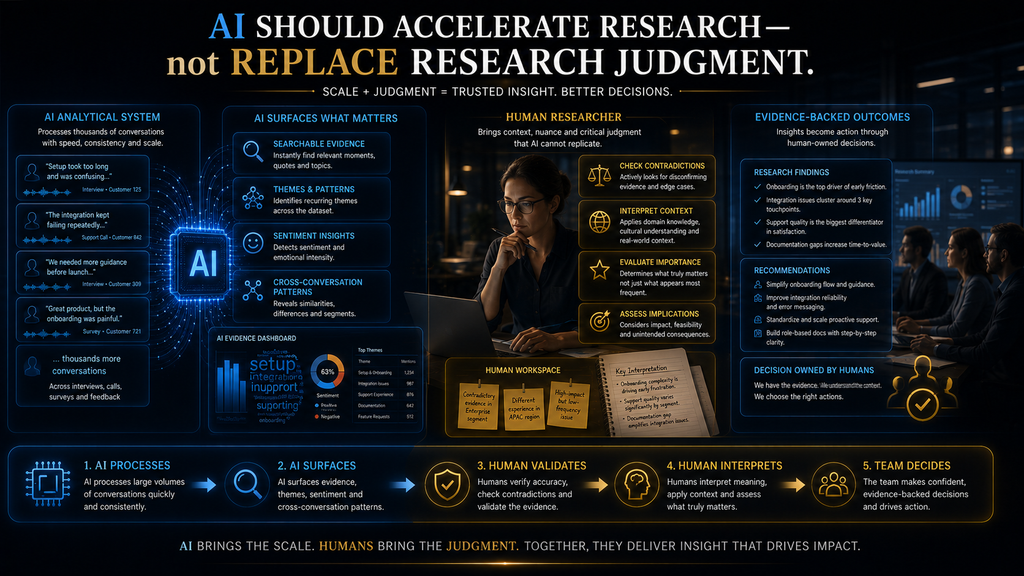
The practical lesson is not to choose a side. It is to assign the right work to the right capability. Use AI where the work is repetitive, scalable, searchable, and evidence-rich. Use humans where the work is ambiguous, contextual, culturally sensitive, consequential, or dependent on methodological judgment. That is why the strongest AI conversation-analysis workflow is neither fully automated nor fully manual. It is hybrid by design. AI processes the evidence.
AI surfaces patterns. Researchers verify the evidence. Researchers challenge the patterns. Researchers interpret the meaning. The organization makes the decision. The real value of AI is therefore not that it can analyze one conversation faster. It is that it can make hundreds or thousands of conversations more accessible to human reasoning. That is a much more important shift. A company does not need another dashboard full of automated summaries. It needs a better way to move from scattered conversations to reliable evidence, from reliable evidence to understanding, and from understanding to action. AI should accelerate the research process—not replace research judgment.
Should You Add AI Conversation Analysis to Your Research Workflow?
If your team is spending substantial time transcribing interviews, searching transcripts, retrieving quotations, coding conversations, comparing participants, or trying to identify recurring themes across a growing repository, AI-assisted conversation analysis is worth evaluating.
Speak AI is one platform built specifically around this workflow, with current capabilities covering transcription, speaker identification, thematic analysis, cross-interview analysis, sentiment, quote extraction, and AI-assisted exploration. The right decision, however, depends on your dataset size, research methodology, governance requirements, and how much human validation your conclusions require.
Decide What to Automate and What to Keep Manual
Choose the steps AI can handle in your workflow and the ones that still need a researcher’s judgment.
Review Speak AI Plans →Affiliate disclosure: We may earn a commission if you subscribe through this link, at no additional cost to you.
Frequently Asked Questions
Is AI conversation analysis better than manual research?
AI conversation analysis is not universally better than manual research. It is generally more valuable for repetitive, high-volume tasks such as transcription, search, retrieval, first-pass coding, and cross-conversation comparison, while human researchers remain essential for contextual interpretation, methodological judgment, contradiction analysis, and final conclusions.
Can AI completely replace qualitative researchers?
Current evidence does not justify treating AI as a complete replacement for qualitative researchers. Research has found that AI can generate useful themes and sometimes converge with human analysis, but other studies have identified systematic coding bias, cultural and emotional flattening, quotation problems, and limitations in contextual interpretation.
When does AI conversation analysis provide the most value?
AI tends to provide the strongest value when a research team has many conversations, repetitive analytical tasks, a need for cross-conversation comparison, and pressure to produce findings quickly. The larger and more repetitive the processing workload becomes, the stronger the economic case for AI assistance.
Is manual conversation research still useful?
Yes. Manual research remains particularly valuable when the dataset is small, highly contextual, culturally complex, sensitive, or consequential. Human analysis is also essential for validating AI-generated patterns and determining whether they genuinely answer the research question.
Can AI identify themes across multiple interviews?
Yes. AI systems can identify candidate themes and recurring concepts across multiple interviews. Speak AI currently provides theme extraction and cross-interview analysis capabilities designed to surface recurring patterns across conversation datasets. Researchers should still review and validate those themes before treating them as conclusions. For a method refresher, see Nielsen Norman Group’s guide to thematic analysis.
Can AI detect contradictions between participants?
AI can help surface differences and potentially contradictory statements across a large dataset, but identifying a contradiction is not the same as understanding why it exists. Human researchers should investigate the underlying context, participant characteristics, research conditions, and alternative explanations.
Is sentiment analysis reliable enough for research?
Sentiment analysis can be useful as a large-scale signal for identifying areas that deserve investigation, but it should not be treated as a complete representation of emotional experience. Sarcasm, ambiguity, cultural expression, mixed feelings, and contextual meaning can make sentiment difficult to interpret automatically.
Should AI-generated quotes be used directly in research reports?
They should be verified against the original transcript or recording before publication or use in a consequential report. Research has documented problems involving altered wording, truncation, and quotation-selection errors in generative-AI-assisted qualitative analysis.
What is the best way to combine AI with human research?
Use AI for the repetitive processing and discovery layer, then use humans for validation, contradiction analysis, contextual interpretation, and final decision-making. A practical workflow is to process the conversations, surface candidate findings, retrieve the supporting evidence, challenge the findings, validate the interpretation, and only then convert the result into a business or research conclusion. If you are new to the topic, start with AI conversation intelligence explained.
When should a company avoid AI conversation analysis?
A company should be cautious when the dataset is highly sensitive, the consequences of analytical error are severe, the research requires deep cultural interpretation, or the dataset is so small that manual analysis is already efficient. AI can still assist in these environments, but the required level of human oversight should be substantially higher.
Written by
Muntasir Ahmad Chowdhury
Founder, AI Hustle World
Muntasir Ahmad Chowdhury is the Founder of AI Hustle World, an independent publication dedicated to making Artificial Intelligence practical, trustworthy, and easy to understand. He researches AI tools, automation, customer service, productivity, and real-world business applications, helping readers make smarter technology decisions through research-driven, experience-backed content.
Expertise:
AI Tools • AI Automation • AI Customer Service • AI Productivity • Generative AI • AI Workflows
Get Smarter With AI
Enjoyed this guide? Get practical AI tools, tutorials, and honest reviews delivered to your inbox.