Evidence: Documentation reviewed
Last checked: August 2026
What was done: Written from official documentation and the published sources linked in this article. Not hands-on tested.
Files: None
Affiliate links: Yes
AI Qualitative Research Explained
Qualitative research produces some of the richest evidence an organization can collect. A well-conducted interview can reveal why a customer behaves differently from what a survey predicts, while a focus group can expose disagreements, assumptions, motivations, and social dynamics that structured quantitative research may never capture. The problem is that the same richness that makes qualitative research valuable also makes it difficult to process when a study produces dozens, hundreds, or thousands of pages of transcripts.
Artificial intelligence is changing that equation, but not in the simplistic way that many AI product pages suggest. AI can transcribe conversations, organize qualitative data, retrieve relevant passages, suggest codes, compare participants, surface candidate themes, and help researchers interrogate a large dataset much faster. It is much less reliable when the task requires interpreting cultural nuance, understanding social context, deciding what a participant truly meant, or determining whether an apparent pattern deserves to become a research finding.
That distinction matters because qualitative research is not simply a search problem. It is an interpretive process. The objective is not to count how many times a word appears but to understand patterns of meaning within a particular research context. This is where AI can be genuinely useful: it can reduce the mechanical burden of qualitative analysis while expanding the amount of evidence a researcher can examine. It should not automatically become the researcher.
The central idea: AI can make qualitative research more scalable, searchable, and systematic, but the researcher remains responsible for context, interpretation, methodological judgment, and the final meaning of the evidence.
Affiliate Disclosure: This article contains affiliate links. If you sign up through our links, we may earn a commission at no additional cost to you. We only recommend tools based on their relevance, capabilities, limitations, and potential usefulness for the specific workflow discussed.
What Is AI Qualitative Research?
AI qualitative research refers to the use of artificial intelligence to support one or more stages of qualitative research, including transcription, data organization, coding, theme discovery, comparison, evidence retrieval, summarization,and analysis. If you are new to the topic, start with AI conversation intelligence explained.
The important word is support. AI does not create the research question, recruit an appropriate sample, establish informed consent, conduct a thoughtful interview, understand every contextual factor, or automatically determine what a finding means. Those responsibilities remain fundamentally connected to research design and human interpretation.
AI becomes useful because qualitative datasets can become operationally enormous. A study with 50 interviews can generate hundreds of hours of audio and thousands of pages of transcript. A multi-session focus-group project can contain overlapping speakers, interruptions, disagreements, reactions, and evolving conversations. Searching and comparing that material manually can consume a significant amount of researcher time before deeper interpretation even begins.
Modern qualitative AI workflows therefore tend to concentrate on the parts of the process where machines have a structural advantage: processing large amounts of language, finding relevant passages, organizing information, and identifying candidate patterns. Research literature published in 2026 increasingly describes AI as a complementary layer around qualitative work rather than a replacement for qualitative expertise.
Test AI Coding on One Focus Group
Upload a single interview or focus group recording and compare the codes it suggests with your own coding.
Analyze a Transcript With Speak AI →Affiliate disclosure: We may earn a commission if you subscribe through this link, at no additional cost to you.
Why Qualitative Research Is Different From Ordinary Text Analysis
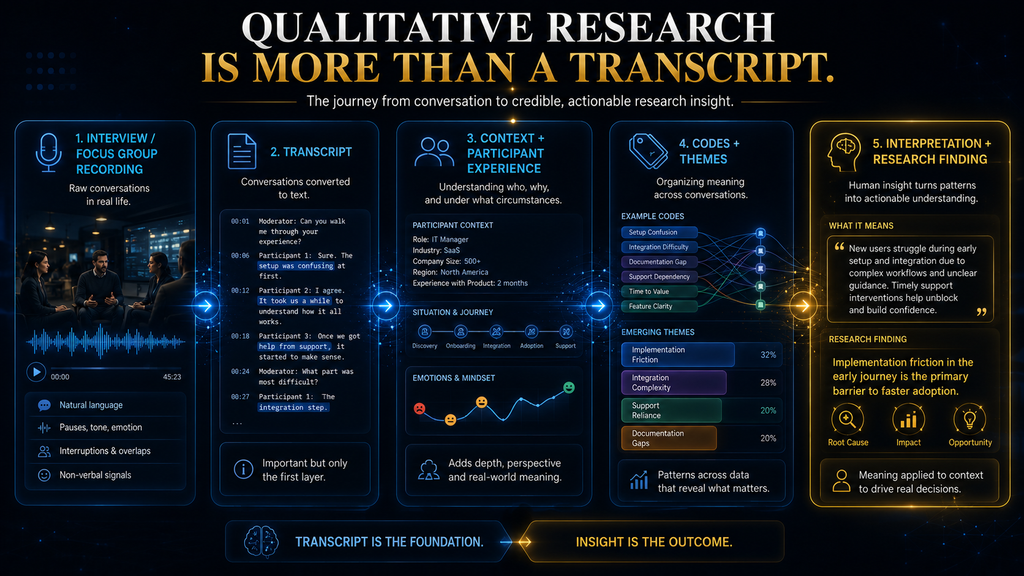
Qualitative research exists because some questions cannot be answered adequately by numerical measurement alone. A customer-survey score can tell a company that satisfaction declined. An interview can help explain why. A product-usage metric can show that users abandon a workflow. A qualitative conversation may reveal that the workflow feels confusing, risky, or incompatible with the way users actually work. That means qualitative evidence is inherently contextual.
Consider a participant who says, “I would never use this feature.” If that sentence is extracted without context, it appears to represent a strong rejection. But the preceding conversation might reveal that the participant was describing a hypothetical scenario, speaking about a previous version of the product, or responding sarcastically to a particular question. The meaning is not contained in the sentence alone.
This is one reason qualitative researchers spend time becoming familiar with their data before formal coding. Braun and Clarke’s established thematic-analysis approach begins with familiarisation before coding and theme development because interpretation depends on understanding the dataset rather than simply extracting repeated phrases. AI can make the dataset easier to navigate. It does not eliminate the need to understand it.
Interviews and Focus Groups Are Not the Same Dataset
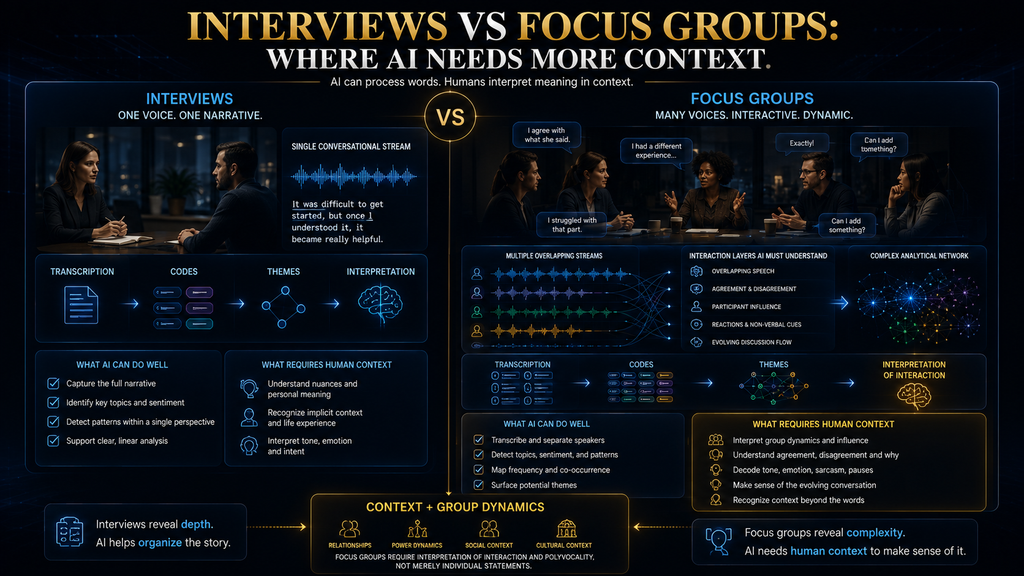
AI can analyze both interviews and focus groups, but the analytical problem is different. A one-to-one interview primarily gives the researcher an opportunity to examine an individual’s experiences, perceptions, motivations, decisions, and explanations. The analyst can ask what the participant believes, what changed their behavior, what they consider important, and where their account contains contradictions or uncertainty. A focus group adds another layer: interaction. See how AI interview analysis works for the transcript-to-insight workflow.
Participants respond to one another. Someone introduces an idea that others support. Another participant challenges it. Someone may change their position after hearing another experience. A dominant participant can influence the direction of discussion, while a quieter participant may provide a minority perspective that is strategically important. Therefore, a focus group cannot simply be treated as several interviews placed into one recording. Recent research specifically examining LLMs for focus-group thematic analysis highlights polyvocality and contextual complexity as important challenges because meaning is created not only through individual statements but also through interaction among participants. That difference should shape how AI is used.
The Traditional Qualitative Research Process Exists for a Reason
It is tempting to look at manual qualitative research and assume that every repetitive activity should simply be automated. That would be a mistake.
Traditional qualitative methods developed mechanisms for dealing with ambiguity, context, researcher interpretation, reflexivity, contradictory evidence, and the relationship between participants and researchers. Reading transcripts closely is not merely clerical work. It can expose patterns that a researcher would miss if they jumped immediately into automated classification. Coding is also not simply labeling sentences. A code represents an analytical decision about what a piece of evidence means within a research question. Themes go one step further by organizing multiple codes into broader patterns of meaning.
That is why qualitative researchers can disagree about the interpretation of the same interview without one person necessarily being mathematically “wrong.” The analytical process involves conceptual judgment. AI can assist that judgment. It should not conceal it.
The Six Phases of Thematic Analysis and Where AI Fits
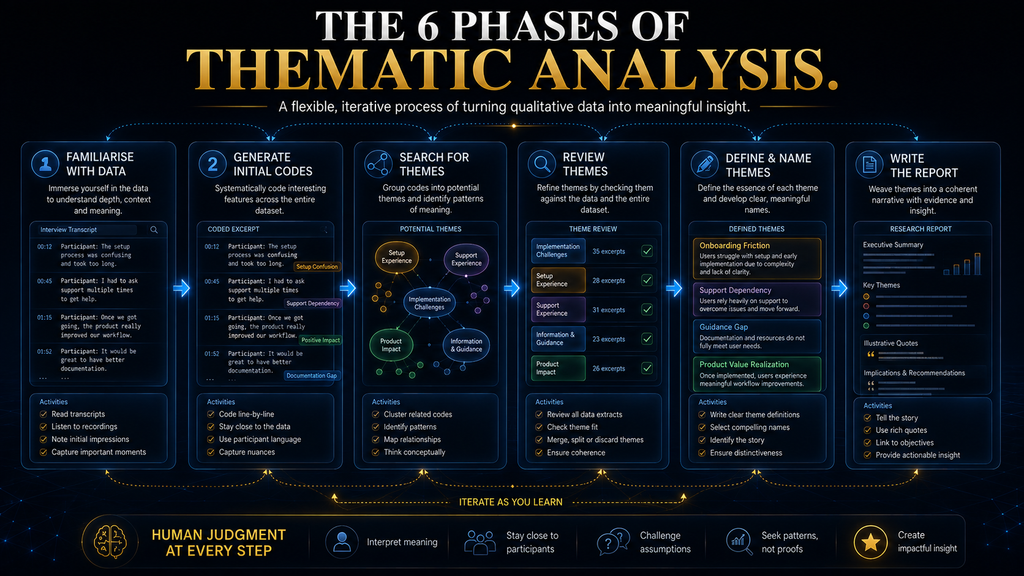
One of the strongest ways to understand AI-assisted qualitative research is to map AI capabilities onto the established six-phase thematic-analysis process associated with Braun and Clarke. The six phases are familiarisation with the data, generating initial codes, searching for themes, reviewing themes, defining and naming themes, and producing the report. Contemporary methodological guidance continues to use this framework as a practical foundation for thematic analysis. The important question is therefore not “Can AI do thematic analysis?” but: For a method refresher, see Nielsen Norman Group’s guide to thematic analysis.
Which parts of thematic analysis can AI accelerate without undermining the researcher’s responsibility for interpretation?
Phase 1: Familiarise Yourself With the Data. The first phase involves becoming familiar with the dataset, including reading and rereading transcripts, noting initial ideas, and understanding the broader context of the research. AI can help here by producing searchable transcripts, creating preliminary summaries, locating recurring topics, and helping researchers navigate large datasets. But this is also where over-automation can create a methodological problem. If a researcher never develops familiarity with the actual conversations and relies entirely on AI summaries, they may understand the dataset only through the model’s interpretation. That creates a layer of abstraction between the researcher and participant. A better workflow is to use AI to accelerate orientation, not replace researcher familiarity.
Phase 2: Generate Initial Codes. Coding involves identifying meaningful features of the data and assigning labels that help organize the evidence. AI can assist by applying an existing codebook to transcript passages, suggesting candidate codes, grouping semantically similar excerpts, or identifying passages that appear relevant to a research question.
This is one of the areas where current evidence is relatively encouraging. A 2026 scoping review of LLM use in qualitative research found that coding assistance and theme identification were among the most common applications, but also found substantial variation in agreement between LLM and human coders depending on task complexity, prompting, deployment, and validation. That last part is critical. A code suggested by AI is a candidate analytical decision, not automatically a validated code.
Phase 3: Search for Themes
Once initial codes exist, researchers look for broader patterns. This is an area where AI can become extremely valuable because it can compare large quantities of coded and uncoded material much faster than a human can manually scan every transcript. Suppose a researcher has 80 interviews about software adoption. Individual codes might include “training difficulty,” “documentation confusion,” “implementation support,” “integration problems,” and “unclear setup instructions.” AI can help reveal that these codes may be connected by a broader theme such as implementation friction. Our guide to how AI finds themes, patterns and sentiment across conversations goes deeper on the method.
But theme discovery is where the distinction between similarity and meaning becomes important. Two statements can be semantically similar without belonging to the same conceptual theme. Conversely, two statements may use completely different language while describing the same underlying experience. AI can generate candidate relationships. The researcher must determine whether the relationship is analytically defensible.
Phase 4: Review Themes
Candidate themes must be tested against the evidence. This is one of the most important human-control stages. Suppose AI identifies pricing concerns as a major theme. The researcher should examine whether the theme genuinely appears across the dataset, whether the statements are actually about price, whether participants are discussing price as a primary concern or merely mentioning it, and whether the theme conceals several different issues. The researcher should also look for evidence that contradicts the theme.
If 60 participants complain about price but 15 participants explain that pricing is reasonable and the real issue is poor onboarding, those 15 participants should not disappear simply because they represent a minority. A credible qualitative workflow therefore asks both: “What evidence supports this theme?” and: “What evidence challenges it?” AI can help search for both.
Phase 5: Define and Name Themes. A theme needs a clear analytical definition. “Product problems” is usually too broad. “Users experience uncertainty when moving from initial configuration to their first successful workflow” is much more useful because it identifies a specific pattern and gives the researcher something that can be examined against the evidence. AI can suggest labels and definitions, but researchers should decide whether the definition accurately captures the underlying concept. This is especially important when themes involve emotional, cultural, social, or behavioral meaning.
A 2026 methodological study examining AI-assisted thematic analysis of culturally specific interviews found that the model performed better on surface-level coding than on preserving cultural and emotional nuance, reinforcing the need for human-in-the-loop oversight.
Phase 6: Write the Report
The final phase connects themes to the research question and communicates the findings. AI can help draft summaries, organize findings, retrieve supporting quotations, compare evidence, and create initial report structures. But a research report is not merely a summary of what participants said. It is an interpretation of what the evidence means in relation to the research question, methodological approach, and relevant context. That distinction is why AI-generated qualitative reports should be treated as draft analytical material rather than automatically publishable findings.
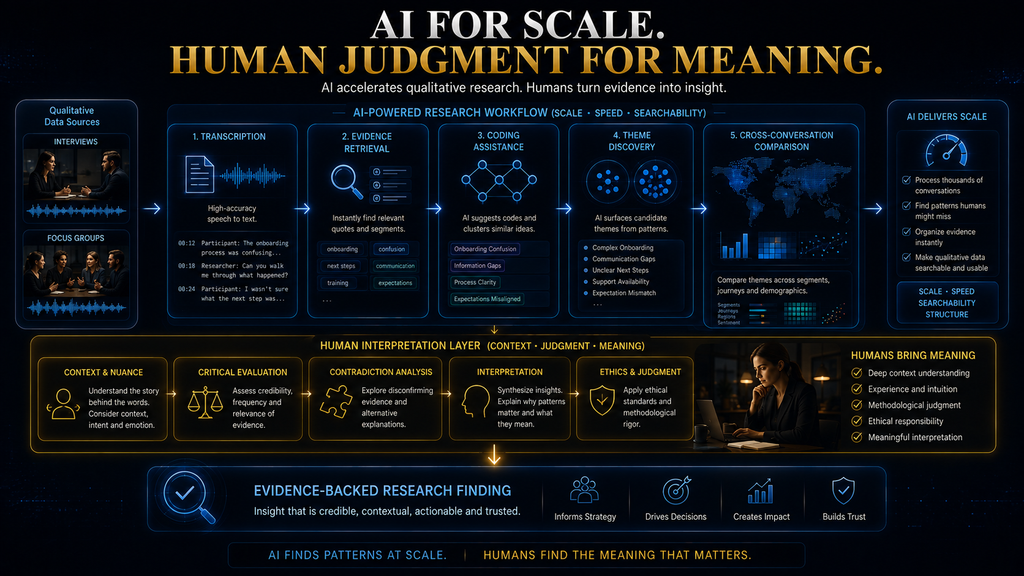
The AI Qualitative Research Workflow
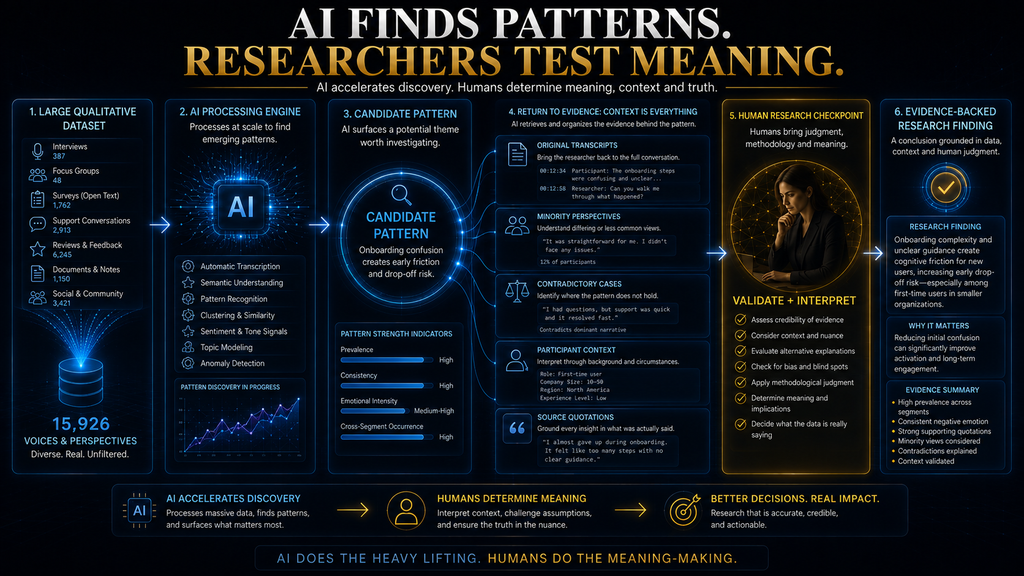
A practical AI-assisted workflow can be organized into six connected layers: Research Question → Conversation Data → AI Processing → Analytical Exploration → Human Validation → Research Finding The stages are connected rather than independent. The research question determines what evidence matters. The evidence determines what can be analyzed. AI processing makes the evidence searchable. Analytical exploration identifies candidate patterns. Human validation tests those patterns. Only then should the researcher develop the final finding.
This is important because AI does not magically transform poor research design into good research. If the sample is biased, AI can process the bias faster. If the interview questions are poorly designed, AI can analyze the resulting conversations more efficiently without fixing the underlying problem. If the dataset is incomplete, AI cannot manufacture missing perspectives. The quality of AI-assisted qualitative research therefore remains heavily dependent on the quality of the research that comes before the model.
What AI Can Do Before Analysis Begins
The first major opportunity is transcription. Turning recorded interviews and focus groups into searchable text eliminates a large amount of mechanical work. Modern AI transcription can also support speaker separation and timestamps, creating a much more useful analytical foundation than raw audio alone. AI can also help organize datasets by participant, session, research question, demographic or study segment, provided that the researcher has an appropriate data-management process. The next benefit is retrieval.
Instead of manually opening dozens of transcripts to find every discussion of “onboarding,” a researcher can search the dataset for related language and retrieve candidate passages. This changes the economics of qualitative analysis. The researcher can spend less time locating evidence and more time deciding what the evidence means.
AI-Assisted Coding: Deductive vs Inductive
The distinction between deductive and inductive coding is particularly important. We compare the two approaches in AI conversation analysis vs manual research.
Deductive Coding
Deductive coding starts with an analytical framework. For example, a researcher studying customer onboarding might begin with categories such as:
| Code | What the researcher is looking for |
|---|---|
| Setup friction | Difficulty completing initial configuration |
| Documentation | Problems understanding written guidance |
| Integration | Problems connecting systems |
| Training | Need for education or support |
| Confidence | Uncertainty about whether the workflow was completed correctly |
AI can be very useful for applying these predefined categories consistently across large datasets.
Inductive Coding. Inductive coding begins more openly, allowing concepts to emerge from the evidence. The researcher may discover that participants repeatedly describe a problem that was never anticipated during study design. This is harder for AI because the model is not simply matching evidence to known categories. It is helping construct the categories themselves. The distinction matters because AI can appear highly accurate when the task is constrained by a strong codebook while becoming less dependable when asked to generate broad interpretations from ambiguous evidence.
A 2026 scoping review found substantial variation in agreement between LLM and human coders, reinforcing the importance of task design and validation rather than treating “AI coding accuracy” as one universal number.
AI Can Make Research More Searchable Without Making It Less Qualitative
One misconception is that using AI automatically turns qualitative research into quantitative analysis. It does not. A researcher can still investigate meaning, narrative, experience, contradiction, emotion, identity, motivation, and context while using AI to make the underlying material easier to navigate. The difference is that the researcher now has a more powerful retrieval and comparison layer. For example, imagine a researcher studying why small-business owners hesitate to adopt AI tools.
A conventional workflow may involve manually reading 30 interviews and highlighting passages. An AI-assisted workflow can help locate every passage relating to trust, cost, implementation effort, job displacement, privacy, training, or previous technology failures. The researcher can then examine those passages in context and determine how they connect. AI therefore does not necessarily make qualitative research less human. Used properly, it can give researchers more time to perform the human parts of the work.
Focus Groups Create a Harder Analytical Problem
Focus groups require particular caution because meaning can emerge through interaction. Consider a hypothetical group discussing AI adoption. One participant says: “I don’t trust AI with customer data.” Another replies that their company already uses AI successfully. A third participant says they would trust it if there were stronger controls. The final group discussion might appear to produce a general theme around “trust,” but the underlying positions are different. There is:
- distrust based on privacy concerns,
- practical acceptance based on experience,
- conditional trust based on governance.
A simple AI summary might collapse these into one theme. A strong qualitative analysis would preserve the differences. The researcher might ultimately conclude that trust is not a single barrier; it is conditional on perceived control, prior experience, and data sensitivity. That is a much more valuable finding. The AI can help locate the relevant discussion. The researcher must preserve the conceptual distinctions.
AI Can Analyze Who Said What, But Interaction Still Matters
Speaker identification is extremely useful in focus-group analysis because it allows researchers to attribute statements to participants. But speaker attribution is only the beginning. Researchers may also need to understand:
- who introduced an idea,
- who challenged it,
- who agreed,
- who remained silent,
- whether a participant changed position,
- whether a dominant voice shaped the conversation.
Those details can materially affect interpretation. This is one reason current research on LLMs and focus groups treats contextual and polyvocal analysis as an unresolved methodological challenge rather than a solved automation problem.
The AI Interview Analysis Ladder
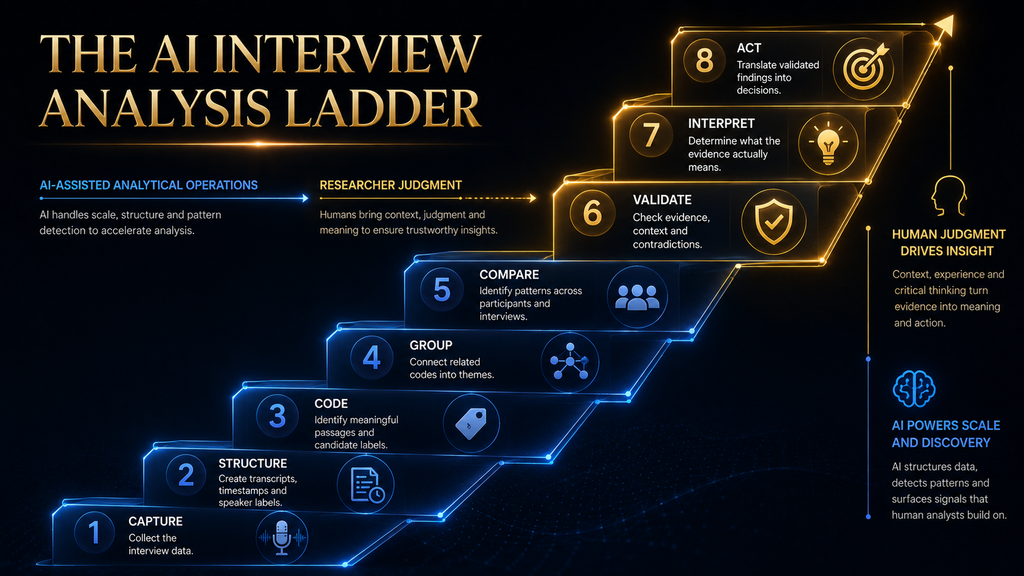
A useful way to understand the complete workflow is to think of AI interview analysis as an eight-level ladder. At the first level, AI helps capture and organize the raw conversation. At the second level, it structures the material through transcription, timestamps, speaker identification, and searchable text. At the third level, it codes meaningful passages. At the fourth level, it groups related codes into candidate themes.
The fifth level is comparison, where the system looks across participants, interviews, groups, topics, and sentiment signals. The sixth level is validation, where researchers trace findings back to the underlying evidence and actively search for contradictions. The seventh level is interpretation, where the research team decides what the evidence means in relation to the original question. The eighth level is action, where validated findings influence a product decision, research conclusion, customer strategy, policy, or other real-world outcome.
The important point is that AI becomes progressively less sufficient as the workflow moves toward interpretation. AI can perform enormous amounts of mechanical organization quickly. It can also generate useful analytical suggestions. But the closer the process gets to deciding what the evidence means, the more important context and human judgment become.
An Illustrative Example: From 20 Interviews to One Product Insight
Consider a fictional SaaS company that interviews twenty customers after launching a new onboarding experience. The interviews contain hundreds of comments about setup, documentation, integrations, support, pricing, and feature discovery. The AI first transcribes the interviews and identifies speakers. It then groups recurring concepts and suggests preliminary codes such as “setup confusion,” “documentation gap,” “integration difficulty,” “support dependency,” and “feature discoverability.” At first glance, the company might conclude that onboarding is simply “too complicated.” For meeting-focused tools, see our list of the best AI meeting assistants.
But the researcher investigates the supporting passages. A pattern emerges. Several participants successfully completed the setup but were not confident that they had completed it correctly. They opened support tickets because the product did not clearly communicate whether the integration was active. Other participants who had previous experience with similar software did not experience the same problem. The deeper theme is therefore not simply “complex onboarding.” It is implementation uncertainty among less experienced users.
That distinction changes the product response. The company might not need to remove onboarding steps. It might instead need stronger completion indicators, clearer confirmation messages, better integration-status visibility, and more contextual guidance. The AI accelerated the discovery process by finding relevant passages, connecting related concepts, and highlighting recurring patterns. But the final insight emerged through human interpretation of the evidence. That is the real model for effective AI-assisted interview analysis.
The Evidence Chain: From Recording to Finding
One of the strongest safeguards for AI-assisted qualitative research is maintaining an evidence chain. The chain should look like: Recording → Transcript → Excerpt → Code → Theme → Interpretation → Finding Every important finding should be traceable backward through that chain. Suppose a research report concludes: “Users experience significant anxiety during implementation.” The researcher should be able to identify which theme supports that conclusion, which codes contribute to the theme, which excerpts support the codes, which participants made those statements, and where those statements appear in the original research material. For meeting-focused tools, see our list of the best AI meeting assistants.
This is more than good documentation. It is a defense against AI hallucination and overinterpretation. If the model generates a plausible-sounding finding but the researcher cannot trace it back to evidence, the finding should not survive.
AI and Quote Extraction
AI can make quotation retrieval dramatically faster. Instead of searching dozens of transcripts manually for examples of “implementation anxiety,” a researcher can ask the system to identify relevant passages and then review them. This is particularly useful when a final report needs several representative quotations. But quotation extraction has a strict rule: AI may locate the quotation. The researcher verifies the quotation. The original transcript or recording should be checked before a quotation is published, especially when the wording will be attributed to a participant. This prevents subtle errors in wording, speaker attribution, omitted context, or accidental paraphrasing.
AI Can Search for Contradictions
This is one of the most valuable and underused applications of AI in qualitative research. Researchers often ask AI: “What themes appear most often?” A stronger question is: “Which participants contradict the dominant interpretation?” Another useful question is: “Which interviews contain evidence that challenges the conclusion that onboarding is the primary problem?” This changes the role of AI. Instead of becoming a confirmation engine that makes an existing hypothesis look stronger, AI can become a challenge engine that deliberately searches for exceptions.
That is especially valuable because minority evidence can be strategically important. A view expressed by five participants may matter more than a view expressed by fifty if those five participants represent the highest-value customers, the most vulnerable population, or the group most affected by the issue being studied. Frequency is evidence. It is not automatically importance.
The Minority-Voice Problem
Large-language models are naturally good at compressing information. Compression is useful, but compression can erase minority perspectives. Imagine that 80 participants describe a positive experience and 20 describe a serious accessibility problem. A summary that says “most participants had a positive experience” may be statistically accurate while completely failing to communicate the significance of the minority experience. This is one reason researchers should ask AI to preserve:
- outliers,
- negative cases,
- minority perspectives,
- contradictory statements,
- unusual experiences,
- unresolved disagreements.
Qualitative research often values these cases precisely because they complicate the dominant story. The objective is not to produce the smoothest summary. The objective is to produce the most defensible interpretation.
AI and Cultural Nuance
Cultural nuance is another major boundary. Participants may use idioms, indirect language, culturally specific references, mixed languages, or expressions whose meaning depends on local context. A model may understand the literal words while missing the social meaning. A 2026 study using Roman Urdu mental-health interviews found that ChatGPT performed well on surface content but flattened cultural and emotional nuance, with human oversight remaining essential for interpretive depth and validity. That finding should not be interpreted as “AI cannot analyze multilingual qualitative data.”
The better conclusion is: AI can accelerate multilingual analysis, but researchers must be especially careful when linguistic or cultural context carries meaning that is not obvious from literal text.
AI Does Not Fix Sampling Problems
This is an important reality check. Suppose a company interviews only its most engaged customers. AI can analyze those interviews beautifully. The result can still be a poor representation of the wider customer population. The same problem appears if: Our guide to analyzing customer feedback, calls and interviews at scale applies the same ideas to support and product teams.
- only highly satisfied participants respond,
- only customers from one geography are included,
- one demographic group dominates the sample,
- dissatisfied customers are systematically excluded,
- participants are recruited through a narrow channel.
AI increases analytical capacity. It does not automatically increase representativeness. The research design still determines who gets heard.
AI Does Not Automatically Establish Saturation
Researchers sometimes talk about “reaching saturation,” meaning that additional data no longer produces meaningful new insights. AI can help monitor whether new interviews are producing new codes or themes, but it should not independently declare that a study has reached saturation. Saturation depends on the research question, sample diversity, methodology, analytical depth, and the definition of what counts as a meaningful new insight. A narrow and homogeneous study may reach a point where few new codes emerge relatively quickly. A heterogeneous study exploring complex experiences may continue producing meaningful differences for much longer.
The correct use of AI is therefore to help researchers monitor emerging patterns, not to turn saturation into a simple automated counter.
Keep the Researcher in the Loop
Review every suggested theme against the original transcript and decide which ones you would accept, rename or reject.
Review a Suggested Theme →Affiliate disclosure: We may earn a commission if you subscribe through this link, at no additional cost to you.
The Human-in-the-Loop Model
The strongest AI qualitative research workflow is neither “human only” nor “AI only.” It is a division of labor. AI handles work where scale and retrieval provide an advantage. Humans handle work where interpretation, ambiguity, context, ethics, and consequences matter.
| Research task | AI contribution | Human responsibility |
| Transcription | High | Verify important passages |
| Speaker identification | High | Check ambiguous attribution |
| Search and retrieval | High | Define meaningful questions |
| Preliminary summaries | High | Check context |
| Deductive coding | Strong assistance | Review and refine |
| Inductive coding | Candidate generation | Interpret and develop concepts |
| Theme discovery | Strong assistance | Decide whether themes are meaningful |
| Contradiction search | Strong assistance | Investigate exceptions |
| Quote extraction | High | Verify against source |
| Cultural interpretation | Limited | Primary responsibility |
| Research ethics | Limited support | Primary responsibility |
| Methodological decisions | Limited support | Primary responsibility |
| Final findings | Draft assistance | Primary responsibility |
The principle is simple: Automate the mechanical layer. Protect the interpretive layer.
Where Speak AI Fits
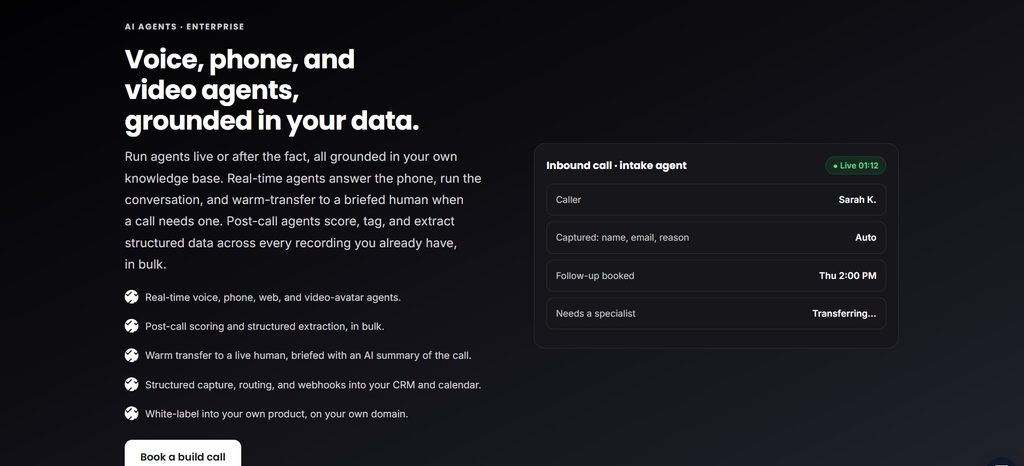
Speak AI fits most naturally into the processing, retrieval, coding-assistance, and cross-conversation analysis portions of this workflow. Its current research positioning includes interviews, focus groups, transcription, speaker identification, AI-assisted analysis, themes, sentiment, and comparison across research material. That makes it relevant to researchers who are dealing with enough qualitative data that manual transcription and repetitive transcript review are becoming a bottleneck. The important distinction is that Speak AI should be treated as research infrastructure and analytical assistance, not as an autonomous qualitative researcher.
That distinction also gives the reader a more useful way to evaluate the platform. The question is not: “Can this tool analyze my research for me?” The better question is: “Which parts of my research workflow can this tool accelerate while allowing me to retain methodological control?” That is the question a serious researcher should ask before adopting any AI platform.
A Practical AI-Assisted Qualitative Research Workflow
A strong implementation begins before the AI tool is opened.
Step 1: Define the Research Question. The research question determines what the analysis needs to discover. A vague question such as “What do customers think?” produces a huge analytical space. A question such as “Why do first-time enterprise users struggle during implementation?” creates a much more focused analytical objective. This matters because AI can answer a poorly framed question extremely efficiently without producing a useful research outcome.
Step 2: Design the Study. Determine who should participate, what experience they need to have, what questions will be asked, and whether interviews, focus groups, or another method is appropriate. AI should not become an excuse to skip research design. The quality of the resulting evidence still depends on the participants and questions.
Step 3: Collect and Secure the Data. Record interviews or focus groups according to the study’s consent and data-management requirements. Before uploading data to an AI platform, researchers should understand how the platform handles data, where information is processed, how it is stored, who can access it, and whether the research consent covers that processing. Current methodological guidance emphasizes privacy, de-identification, data transmission, storage, informed consent, bias, reproducibility, and research integrity as important considerations when AI enters qualitative workflows. ScienceDirect
Step 4: Transcribe and Organize. Convert the recordings into searchable transcripts and preserve speaker identity and timing information where appropriate. At this stage, AI can remove a large amount of repetitive labor. But transcription should still be checked when accuracy is critical, particularly around names, technical terms, multilingual speech, overlapping speakers, and important quotations.
Step 5: Familiarise Yourself With the Dataset. Researchers should review enough of the original material to understand the context before relying heavily on automated analysis. AI-generated summaries can help accelerate this stage, but they should not become the only representation of what participants said. The researcher needs direct contact with the evidence.
Step 6: Create or Refine the Coding Strategy. Decide whether the study uses deductive coding, inductive coding, reflexive thematic analysis, content analysis, grounded-theory approaches, or another methodology. The AI tool should serve the methodology. The methodology should not be reshaped simply because a particular AI platform makes one type of analysis easier.
Step 7: Use AI for First-Pass Exploration. Now AI can be used to identify candidate codes, search relevant passages, group similar excerpts, summarize individual interviews, compare participants, and surface possible themes. This is where the technology can save significant time. But the output should be treated as analytical material to investigate rather than the final answer.
Step 8: Search for Exceptions. Ask the AI system to identify contradictory cases, minority views, unusual experiences, and evidence that challenges the dominant pattern. This is an essential quality-control step because the easiest AI output to accept is often the cleanest and most coherent one. Real qualitative datasets are rarely that clean.
Step 9: Validate the Themes. Return to the source evidence. Check whether the candidate theme actually explains the underlying statements, whether important distinctions have been lost, whether participants disagree, and whether the theme is relevant to the research question. A theme that sounds intelligent but cannot survive evidence review should be discarded.
Step 10: Interpret the Meaning. This is the stage where the researcher makes the core analytical contribution. What does the pattern mean? Why might it exist? What does it reveal that the original research question was trying to understand? What alternative explanations exist? What evidence complicates the interpretation? These questions cannot be answered safely by simply counting AI-generated themes.
Step 11: Build the Findings. Each major finding should connect to supporting evidence. The report should explain the theme, show representative evidence, acknowledge relevant exceptions, and explain why the finding matters. AI can help structure the writing, but the researcher should control the interpretation.
Step 12: Preserve the Audit Trail
Keep track of how AI was used. Depending on the research context, this can include documenting the platform, task, prompts or analytical instructions, validation process, coding approach, and human review. This becomes increasingly important as AI-assisted qualitative research becomes more common because methodological transparency determines whether another researcher can understand how the findings were produced. A 2026 scoping review found that reporting practices around LLM use remain highly inconsistent, including missing information about deployment configuration, prompting, and model parameters. Springer
What Good AI-Assisted Coding Looks Like
Imagine a research team has 60 interviews about a new enterprise software platform. The initial question is: Why do enterprise customers struggle during implementation? The researchers create an initial codebook containing setup, documentation, integration, training, support, permissions, workflow design, and confidence. AI then analyzes the transcripts and identifies candidate passages for each category. At this stage, the process is efficient but not yet insightful. The researchers discover that many statements coded as “training” actually describe a deeper problem: customers are not sure whether they configured the system correctly.
The team therefore develops a broader theme: Implementation uncertainty That theme connects several previously separate codes. The AI helped locate the evidence. The researchers created the interpretation. That is the kind of division of labor that makes AI genuinely useful.
What Bad AI-Assisted Analysis Looks Like
Now imagine the same research team uploads all 60 transcripts and asks: “What are the five main themes?” The model produces:
- Training challenges
- Integration issues
- Documentation
- Customer support
- Product usability
The result looks reasonable. It may even be correct. But it does not necessarily represent meaningful qualitative analysis. The researcher still needs to determine: Why do these themes matter? How are they connected? Which participants experience them? Which themes are consequences of another problem? Which cases contradict the dominant interpretation? What does the research question actually require the team to explain? Without those steps, the AI has produced categorization rather than a defensible research interpretation.
The Difference Between Coding and Understanding
This distinction deserves emphasis because it is one of the biggest sources of confusion around AI qualitative research. Coding answers: “What concept appears in this passage?” Understanding asks: “What does this concept mean in the participant’s experience and in the context of the study?” For example, a participant repeatedly mentions “support.” Coding may correctly identify support as a topic. Understanding requires asking what support means. Is the participant praising the support team?
Complaining that support is too slow? Saying support is necessary because the product is too difficult? Using support as evidence that the company is trustworthy? Those interpretations have very different implications. AI can help retrieve every relevant passage. The researcher still needs to interpret the meaning.
When AI Adds the Most Value
AI becomes especially valuable when the dataset is large enough that manual analysis creates a genuine bottleneck. That usually means:
- many interviews,
- multiple focus groups,
- recurring research waves,
- multilingual research,
- large open-ended survey datasets,
- research teams that need consistent retrieval,
- projects requiring cross-participant comparison.
The value is also higher when researchers repeatedly ask similar analytical questions across datasets. For example, a product-research team might run 20 interviews every quarter. An AI-assisted research environment can make it easier to compare current themes against previous studies rather than treating every research project as an isolated event. That creates institutional memory.
When AI Adds Less Value
AI is not automatically worthwhile for every qualitative project. A researcher conducting eight highly sensitive interviews may prefer to read and analyze the material directly. A small study with exceptionally complex cultural context may require such close interpretation that automated analysis adds little value. A project with strict data restrictions may not permit external AI processing. A poorly designed study may also generate too little usable evidence for sophisticated AI analysis to provide meaningful benefit.
The right question is therefore not: “Can AI analyze this?” It is: “Will AI meaningfully improve the quality, coverage, speed, or traceability of this research without compromising its methodological integrity?”
Privacy and Ethics: The Part Researchers Cannot Outsource
Qualitative data can be extremely sensitive. Interview transcripts may contain names, personal experiences, health information, workplace details, customer information, financial circumstances, political opinions, or other identifying material. Focus groups can be even more complicated because multiple participants are exposed to the discussion. Before using an AI system, researchers should understand: Our comparison of the best AI research assistants covers the desk-research side.
- Consent: Did participants understand how their data would be processed?
- Data transmission: Is the information being sent to a third-party system?
- Storage: Where is the information retained?
- Access: Who can access the transcripts or recordings?
- De-identification: Can personal identifiers be removed before processing?
- Model use: Is the data used for training or other purposes?
- Institutional policy: Does the research organization permit this workflow?
- Reproducibility: Can researchers document how AI contributed to the analysis?
These are not theoretical concerns. 2026 research on AI in qualitative research explicitly identifies privacy, data management, de-identification, storage, consent, bias, reproducibility, and integrity as areas that researchers need to address. ScienceDirect
The Transparency Problem. Researchers using AI should be transparent about how it was used. There is a significant difference between: “AI analyzed the interviews.” and: “AI was used to transcribe recordings, identify candidate codes, retrieve relevant excerpts, and generate preliminary theme groupings. Researchers reviewed the source material, revised the coding framework, investigated contradictory evidence, and made the final interpretive decisions.” The second statement tells the reader what actually happened. That level of transparency becomes particularly important in academic research, policy research, healthcare research, and any setting where methodological defensibility matters.
A Better Way to Measure AI’s Value
The success of AI qualitative research should not be measured simply by how many transcripts the system can process. A better KPI framework includes five dimensions.
- Time. How much researcher time is saved on transcription, retrieval, coding assistance, and repetitive comparison?
- Coverage. How much more of the available evidence can researchers realistically examine?
- Analytical usefulness. Does AI help researchers identify meaningful candidate patterns they would otherwise struggle to find?
- Validation burden. How much human effort is required to correct or reject AI outputs?
Research quality
Does the final analysis become more defensible, more comprehensive, more transparent, or more useful? The most important question is therefore not: “How much faster is AI?” It is: “After accounting for validation, does AI allow the research team to produce better analysis with the same or lower resource requirements?” That is the actual ROI question.
A Decision Matrix for AI Qualitative Research
| Situation | AI Usefulness | Recommended Approach |
|---|---|---|
| 5–10 simple interviews | Moderate | Mostly manual with selective AI assistance |
| 20–50 interviews | High | Hybrid AI + human analysis |
| 100+ interviews | Very high | Structured AI-assisted workflow with strong validation |
| Large focus-group program | High | AI processing plus careful interaction analysis |
| Sensitive research data | Depends | Review privacy, consent and security first |
| Highly culturally nuanced research | Moderate | Strong human interpretation |
| Repetitive longitudinal research | Very high | AI-assisted comparison across waves |
| Small exploratory study | Low to moderate | Avoid unnecessary automation |
| Large open-ended survey | Very high | AI-assisted coding and theme discovery |
| High-consequence research | Useful but controlled | Human validation required at every important stage |
Common Mistakes Researchers Make With AI
The first mistake is treating AI-generated themes as final findings. The second is skipping familiarisation because AI has already summarized the dataset.The third is optimizing for frequency rather than meaning. The fourth is failing to investigate contradictory evidence. The fifth is publishing AI-generated quotations without checking the original source. The sixth is uploading sensitive data without understanding the platform’s data-handling practices. The seventh is allowing the capabilities of the AI tool to determine the methodology. The eighth is failing to document how AI contributed to the research.The ninth is assuming that a coherent AI summary must represent the complexity of the dataset. The tenth is using AI to confirm an existing hypothesis rather than deliberately searching for evidence that challenges it.
These mistakes all have the same underlying cause: treating AI as the analytical authority instead of treating it as an analytical instrument.
The Contrarian Insight: Faster Analysis Can Produce Worse Research
There is an uncomfortable possibility that needs to be acknowledged. AI can make qualitative analysis so easy that researchers may analyze more data than they can meaningfully interpret. That sounds like a positive problem. It is not always one. If a researcher can generate hundreds of candidate themes in seconds, the bottleneck moves from finding patterns to deciding which patterns deserve attention. More analysis can therefore create analytical noise. The advantage of AI is not unlimited pattern generation. It is better allocation of researcher attention. How AI turns feedback into roadmap decisions is covered in how AI turns customer feedback into product insights.
A good AI workflow should reduce the number of mechanical decisions a researcher has to make while increasing the amount of attention available for important interpretive decisions.
The Second-Order Effect: Researchers May Change What They Ask
AI does more than accelerate existing workflows. It can change research behavior. When researchers know that they can quickly analyze large amounts of text, they may become more comfortable collecting larger datasets, asking more exploratory questions, or comparing groups that previously would have been too expensive to analyze manually. That can be positive. But it can also create a temptation to collect more data than the research question actually requires.
The result could be an “analysis abundance” problem in which researchers have more possible patterns than they can responsibly interpret. The methodological discipline therefore remains important even when processing becomes cheap.
The Second-Order Effect: Qualitative Research Becomes More Continuous
AI also makes it easier to treat qualitative research as an ongoing intelligence process. Instead of conducting one study, producing one report, and moving on, organizations can continuously analyze customer interviews, support conversations, research sessions, and open-ended feedback. That can create a living evidence base. The danger is that continuous automated analysis may encourage organizations to confuse constant monitoring with genuine research. A dashboard showing “top themes this week” is not automatically equivalent to a carefully designed qualitative study. The research question, sampling strategy, context, and interpretation still matter.
How AI Changes the Researcher’s Job
The biggest change may not be that qualitative researchers do less work. Their work changes. Less time can be spent on:
- finding passages,
- copying quotations,
- manually sorting transcripts,
- repetitive classification,
- building initial comparison spreadsheets.
More time can be spent on:
- research design,
- interpretation,
- methodological decisions,
- contradiction analysis,
- theory development,
- stakeholder communication,
- evidence validation,
- understanding participant context.
This is a healthier way to think about AI adoption. The objective is not to remove the researcher from the process. It is to remove unnecessary friction around the researcher.
The AI Qualitative Research Stack
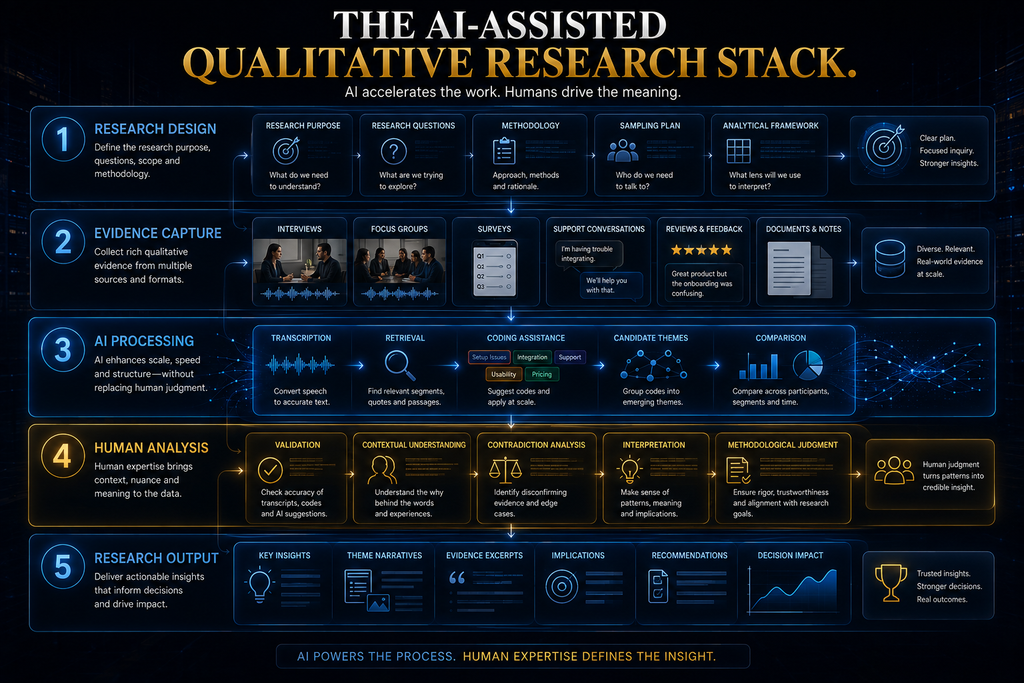
A practical research stack can be thought of as five connected layers.
- Layer 1: Research Design. The research question, sampling strategy, interview guide, focus-group design, consent process, and analytical methodology.
- Layer 2: Evidence Capture. Recordings, transcripts, notes, participant metadata, and other source material.
- Layer 3: AI Processing. Transcription, speaker identification, search, summarization, coding assistance, candidate theme discovery, and comparison.
- Layer 4: Human Analysis. Validation, interpretation, contradiction analysis, methodological judgment, contextual understanding, and final theme development.
- Layer 5: Research Output. Findings, recommendations, reports, product decisions, policy implications, publications, or further research questions. The critical point is that AI sits inside the stack. It does not replace the stack.
Where AI Should Stop
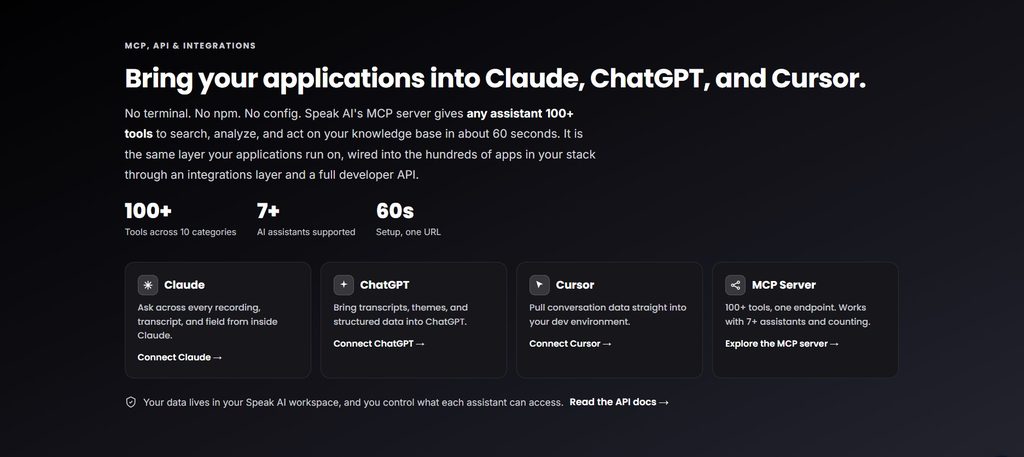
A mature AI workflow needs explicit boundaries. AI should not independently decide whether participants provided informed consent. It should not independently determine whether a vulnerable participant’s experience has been interpreted correctly. It should not decide that a minority perspective is irrelevant because it is statistically uncommon. It should not manufacture quotations when source evidence is unavailable. It should not determine that a theme is true simply because it appears frequently. Speak AI lists its current plans on its pricing page, and its documentation covers the API and integrations.
It should not turn an ambiguous statement into a confident psychological explanation without evidence. And it should not become an invisible layer in the methodology. The researcher needs to know what AI did. The reader may need to know what AI did. The organization needs to know what AI did. That transparency is part of methodological integrity.
Who Should Use AI for Qualitative Research?
AI-assisted qualitative analysis is particularly valuable for research teams working with substantial volumes of interviews, focus groups, open-ended survey responses, customer conversations, or longitudinal research. Product researchers can use it to compare user interviews and identify recurring usability problems. UX researchers can use it to retrieve evidence across many sessions. Customer researchers can use it to identify recurring pain points and emerging needs. Market researchers can use it to compare perceptions across customer segments. Consultancies can use it to process large client research datasets more efficiently.
Academic researchers can use AI selectively for transcription, retrieval, coding assistance, and exploratory analysis when their methodology and institutional requirements allow it.
Who Should Be More Cautious?
Researchers working with highly sensitive information should begin with privacy and governance rather than convenience. Researchers working with very small datasets should also consider whether automation genuinely saves time. Projects involving strong cultural, linguistic, emotional, or social nuance require particularly careful human interpretation. And researchers conducting high-consequence studies should use AI as an assistive layer rather than an autonomous decision-maker. The more consequential the finding, the stronger the validation requirement should be.
How to Choose an AI Qualitative Research Tool
Do not choose a tool based only on whether it advertises “AI analysis.” Evaluate the workflow. Can it handle the actual file types and languages you need? Can it distinguish speakers reliably? Can you search across multiple interviews? Can you organize research datasets? Can you create or apply a coding framework? Can you trace themes back to source evidence? Can you compare groups? Can you export findings? What happens to your data? Our roundup of the best AI conversation intelligence tools compares the main options.
How transparent is the platform about its AI functionality? What does the human validation workflow look like? These questions are more important than whether a platform has the most impressive-looking AI feature list.
A Simple AI Qualitative Research Checklist
Before using AI on a research project, ask:
| Question | Why it matters |
|---|---|
| Is the research question clearly defined? | Prevents aimless AI analysis |
| Is the sample appropriate? | AI cannot fix sampling bias |
| Do participants understand data processing? | Protects consent and ethics |
| Is the AI platform appropriate for the data? | Protects privacy and governance |
| Can the source evidence be retrieved? | Enables validation |
| Can contradictory cases be identified? | Reduces confirmation bias |
| Is the coding methodology documented? | Improves transparency |
| Are important quotations verified? | Prevents evidence errors |
| Does a human review important findings? | Protects interpretation |
| Is AI’s role documented? | Improves methodological integrity |
What Happens If You Do Nothing?
The cost of maintaining a completely manual workflow is not simply researcher time. As datasets grow, manual analysis can create a hidden coverage problem. Researchers may read fewer transcripts, sample more aggressively, postpone analysis, or focus on the easiest material to process. Important minority perspectives can be missed because they require too much effort to locate. The opposite risk is also real: adopting AI without methodological controls can produce faster but weaker analysis. The strategic choice is therefore not manual versus AI.
It is: unstructured manual work versus a controlled hybrid workflow. The winning model is the one that expands evidence coverage without weakening interpretive quality.
The Future of AI Qualitative Research
AI-assisted qualitative research is likely to become more integrated into the research lifecycle rather than remaining a separate transcription or analysis step. Researchers will increasingly be able to move from raw recordings to searchable evidence, compare studies over time, query multiple datasets, identify contradictions, and maintain persistent research repositories. The important development will not simply be more capable models. It will be better research governance around those models. Organizations will need clearer policies for consent, privacy, disclosure, reproducibility, human review, data retention, and methodological documentation. Recent 2026 research strongly reinforces that the ethical and practical questions are evolving alongside the technology. ScienceDirect
There is also a likely shift toward more specialized AI research workflows. Instead of asking a general-purpose model to “analyze these interviews,” researchers may increasingly use systems designed around specific research methods, codebooks, evidence traceability, participant segmentation, and structured validation. That is a healthier direction because it embeds methodological constraints into the workflow rather than expecting researchers to remember them manually.
The Bigger Strategic Shift
The most important change is not that AI makes qualitative analysis faster. It is that AI can make more of the qualitative evidence searchable and comparable. That changes the relationship between scale and depth. Historically, researchers often faced a trade-off: analyze a small dataset deeply or analyze a larger dataset more superficially. AI can reduce some of that trade-off. A researcher can potentially examine more evidence while still spending human time on the parts of the analysis that require interpretation. But that only works if the researcher maintains control over the meaning of the evidence.
Final Thoughts
AI is becoming a powerful assistant for qualitative research because it can handle some of the work that makes interviews and focus groups difficult to process at scale. It can transcribe conversations, identify speakers, organize research material, retrieve relevant passages, suggest codes, surface candidate themes, compare participants, locate quotations, and help researchers search for contradictions. Those capabilities are valuable. But the strongest research workflow does not ask AI to become the qualitative researcher. It asks AI to make the researcher faster at finding evidence and more capable of examining the full dataset.
The distinction is fundamental. A model can identify that many participants mentioned trust. A researcher must determine whether trust means privacy concerns, fear of automation, lack of organizational control, previous bad experiences, or something else entirely.
A model can identify a recurring theme. A researcher must decide whether that theme actually answers the research question. A model can find a quotation. A researcher must verify that the quotation is accurate and represented in context. A model can surface a pattern. A researcher must decide what the pattern means. That is the future worth pursuing: AI for scale. Human judgment for meaning. Evidence for the final decision.
Decide Whether AI Fits Your Research Method
Compare your study size, privacy requirements and review workflow with the plan you would need before you commit.
Review Speak AI Plans →Affiliate disclosure: We may earn a commission if you subscribe through this link, at no additional cost to you.
Frequently Asked Questions
What is AI qualitative research?
AI qualitative research is the use of artificial intelligence to assist with stages of qualitative research such as transcription, coding, evidence retrieval, theme discovery, comparison, and analysis. It is best understood as an assistive layer rather than a replacement for research design and human interpretation.
Can AI analyze qualitative interviews?
Yes. AI can transcribe interviews, identify speakers, search transcripts, suggest codes, retrieve relevant passages, compare interviews, and identify candidate themes. Researchers should still validate important findings against the original evidence because qualitative interpretation depends heavily on context.
Can AI analyze focus groups?
Yes, but focus groups are more challenging because several participants interact and influence one another. AI can help with transcription, speaker identification, retrieval, and candidate theme discovery, but researchers need to consider disagreement, agreement, dominance, social influence, and conversational context. Research published in 2026 specifically identifies polyvocality and context as important challenges for LLM-based focus-group analysis. PLOS Digital Health
Can AI replace a qualitative researcher?
AI can automate or accelerate parts of qualitative research, but it should not automatically replace the researcher. Human judgment remains important for research design, context, interpretation, ethical decisions, contradiction analysis, and determining what findings actually mean.
How does AI help with thematic analysis?
AI can assist with transcript organization, candidate coding, grouping related excerpts, identifying recurring patterns, comparing participants, and retrieving evidence. The researcher still needs to review and refine themes because thematic analysis involves interpretation rather than simple frequency counting. Braun and Clarke’s six-phase framework continues to emphasize familiarisation, coding, theme development, review, definition, and reporting as connected analytical activities. DOI
Is AI coding accurate enough for qualitative research?
AI coding can be useful, especially for structured or predefined coding tasks, but accuracy varies significantly by task complexity, dataset, prompt design, and validation process. A 2026 scoping review found wide variation in agreement between LLM and human coders, reinforcing the need for human verification. Springer
What is the biggest risk of using AI for qualitative research?
One major risk is allowing AI-generated patterns to replace contextual interpretation. Other risks include hallucinated quotations, loss of minority perspectives, cultural flattening, privacy problems, sampling bias, and insufficient methodological transparency.
Should researchers use AI for inductive coding?
AI can assist inductive coding by suggesting candidate concepts and grouping related passages, but researchers should be especially careful because inductive analysis involves developing meaning from the dataset rather than simply applying predefined categories. Human review is important when deciding whether a candidate concept represents a meaningful analytical theme.
How should researchers verify AI-generated qualitative findings?
Researchers should trace important findings back through the evidence chain: finding, interpretation, theme, codes, supporting excerpts, transcript, and original recording where necessary. Contradictory and minority evidence should also be examined before a finding is accepted.
Is AI useful for small qualitative studies?
It can be, but the value may be limited when a researcher can already analyze a small dataset directly. AI becomes more valuable as the volume, repetition, or comparison requirements increase.
What should researchers consider before uploading interview transcripts to an AI platform?
Researchers should examine participant consent, privacy requirements, data transmission, storage, access controls, de-identification, model/data-use policies, institutional requirements, and whether the platform is appropriate for the sensitivity of the research material. Current methodological literature treats these issues as central to responsible AI-assisted qualitative research. Once you have transcripts, you can also turn video transcripts into articles, clips and social posts.
Written by
Muntasir Ahmad Chowdhury
Founder, AI Hustle World
Muntasir Ahmad Chowdhury is the Founder of AI Hustle World, an independent publication dedicated to making Artificial Intelligence practical, trustworthy, and easy to understand. He researches AI tools, automation, customer service, productivity, and real-world business applications, helping readers make smarter technology decisions through research-driven, experience-backed content.
Expertise:
AI Tools • AI Automation • AI Customer Service • AI Productivity • Generative AI • AI Workflows
Get Smarter With AI
Enjoyed this guide? Get practical AI tools, tutorials, and honest reviews delivered to your inbox.