Evidence: Documentation reviewed
Last checked: August 2026
What was done: Written from official documentation and the published sources linked in this article. Not hands-on tested.
Files: None
Affiliate links: Yes
How AI Finds Themes, Patterns & Sentiment Across Conversations
Affiliate Disclosure: This article contains affiliate links. If you choose to try Speak AI through our links, AI Hustle World may earn a commission at no additional cost to you. Our recommendations are based on workflow fit, capabilities, limitations and practical usefulness—not on the commission.
The Real Value Starts When Conversations Stop Being Analyzed One at a Time Analyzing one interview can tell you what happened in that interview. Analyzing hundreds or thousands of conversations can tell you whether what happened in that interview is part of a larger pattern, whether the pattern affects particular groups, whether sentiment around it is changing, and whether the issue is important enough to influence a business decision. That difference is the reason AI conversation analysis becomes much more interesting at scale.
Imagine a research team has 300 customer interviews. Reading a few interviews manually may reveal that customers frequently complain about onboarding. But that observation alone is incomplete. The research team still needs to determine whether onboarding is genuinely a recurring problem, whether customers mean the same thing when they use similar language, whether the issue is concentrated among new customers or enterprise accounts, whether the sentiment attached to the theme is consistently negative, and whether the complaints are increasing or declining over time.
AI can accelerate much of that analytical work by converting conversations into searchable text, identifying candidate codes and themes, classifying sentiment, grouping related concepts, comparing segments and surfacing supporting evidence. Speak AI, for example, describes capabilities for extracting themes, keywords, sentiment and entities from text and for exploring patterns across multiple recordings. Speak AI But there is a critical distinction that gets lost in many AI-marketing articles: finding a pattern is not the same thing as understanding what the pattern means.
That distinction is the foundation of this article. Traditional qualitative analysis has never been simply a matter of counting words. Established thematic-analysis practice treats analysis as an iterative process involving familiarity with the dataset, coding, theme development, refinement and interpretation. Braun and Clarke’s current guidance explicitly describes thematic analysis as a recursive and interpretive process rather than a rigid sequence of mechanical steps. Thematic Analysis
AI changes the economics of that process because it can examine much larger volumes of conversational evidence much faster. It does not eliminate the need to decide what constitutes a meaningful theme, whether the evidence actually supports the interpretation, whether minority cases matter, or what action should follow. That leads to the central idea of this article: AI is exceptionally useful for expanding the analytical field. Human researchers are still responsible for deciding which patterns deserve to become findings.
See Which Themes Surface in Your Own Data
Upload a set of conversations and check the themes and sentiment patterns the analysis finds against your own reading.
Find Themes With Speak AI →Affiliate disclosure: We may earn a commission if you subscribe through this link, at no additional cost to you.
What Does AI Actually Mean by “Finding a Theme”?
AI theme detection usually means identifying recurring concepts, topics or patterns across a collection of textual or transcribed conversations and grouping related mentions into higher-level categories. That sounds straightforward until you examine what actually happens inside the workflow. Consider three customer statements: “The setup took me almost an hour.” “I couldn’t figure out where to start.” “The integration instructions were confusing.”
A simple keyword system might treat these as separate mentions because the vocabulary differs. A more sophisticated AI system can recognize that the statements may belong to a broader conceptual area such as onboarding friction, even though the customers use different words. This is where semantic analysis becomes more useful than simple keyword counting. Modern language models can represent meaning beyond exact word matches, allowing related concepts to be grouped even when their wording differs.
But there is a second problem. Suppose another customer says: “The setup was surprisingly easy once I understood the workflow.” The same broad topic is present, but the sentiment and interpretation are different. If an analysis simply counts every mention of “setup,” it could conclude that setup is a dominant problem while completely missing the distinction between frequency of discussion and direction of experience. That is why a useful cross-conversation workflow needs at least four analytical dimensions:
- What is being discussed?
- How do people feel about it?
- Who experiences it differently?
- What evidence supports the interpretation?
The strongest systems therefore move beyond “top keywords” toward a connected analytical model involving themes, sentiment, segments, time, evidence and context.
The Difference Between a Topic, a Code, a Theme and a Finding
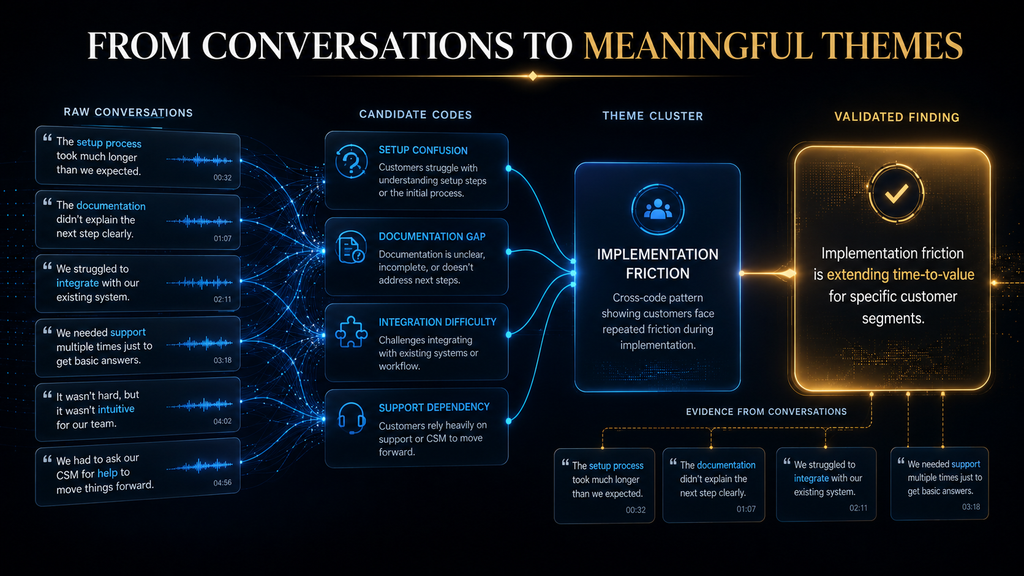
One of the most important concepts in this entire subject is that these four things are not interchangeable. A topic describes what people are talking about. A code labels a meaningful piece of data. A theme connects related codes into a broader pattern of meaning. A finding is the research team’s supported interpretation of what that theme means in context. For example, imagine 500 customer conversations. The word “integration” appears frequently.
That is a topic signal. Researchers might code passages as:
- integration failure
- setup complexity
- missing documentation
- API limitations
- implementation delay
Those are candidate codes. The research team might then develop a broader theme: Integration friction is extending time-to-value for enterprise customers. That is more meaningful because it connects several related observations. But even that is not automatically a finding.
The researchers still need to determine whether the evidence supports the claim. Are enterprise customers actually affected more than other segments? Are the complaints concentrated in a specific implementation stage? Do customers describe integration as the main cause of delay, or is it merely mentioned alongside other problems? Are there successful implementations that contradict the pattern? Only after that validation can the team confidently move from pattern to finding. This distinction also aligns with modern thematic-analysis guidance, which warns against treating themes as simple topic summaries. Themes are analytical constructions that describe broader shared meaning rather than merely listing what appeared frequently. Sage Journals
Why Manual Conversation Analysis Becomes Difficult at Scale
Manual qualitative analysis exists for a reason. Researchers do not manually read interviews simply because nobody has invented a faster method. Human reading provides something that automated systems still struggle to reproduce consistently: contextual interpretation. We compare the two approaches in AI conversation analysis vs manual research.
A researcher can remember what a participant said earlier, notice that their tone changed, understand why a particular phrase matters in the context of the interview, recognize an unusual contradiction, and connect a seemingly minor comment to the broader research question. The problem is scale.
When a study contains 10 interviews, a researcher may be able to read every transcript carefully several times. With 100 interviews, the same approach becomes significantly more expensive in time. At 1,000 conversations, the analytical problem changes again because the researcher must choose where to spend attention. The bottleneck is no longer simply transcription or reading. It becomes attention allocation.
AI is valuable because it can perform a broad first-pass scan across the dataset and surface candidate patterns that deserve human investigation. The researcher can then spend more time examining the strongest signals instead of manually searching every transcript for every possible occurrence. That is a fundamentally different proposition from “AI replaces qualitative researchers.” The better model is: AI expands coverage. Humans increase interpretive depth. Research comparing human and generative-AI thematic analysis has found meaningful promise for AI-assisted analysis but also recurring problems with low-frequency codes, coherent relationships between themes, contextual nuance and quote selection. PubMed
The AI Cross-Conversation Intelligence Framework
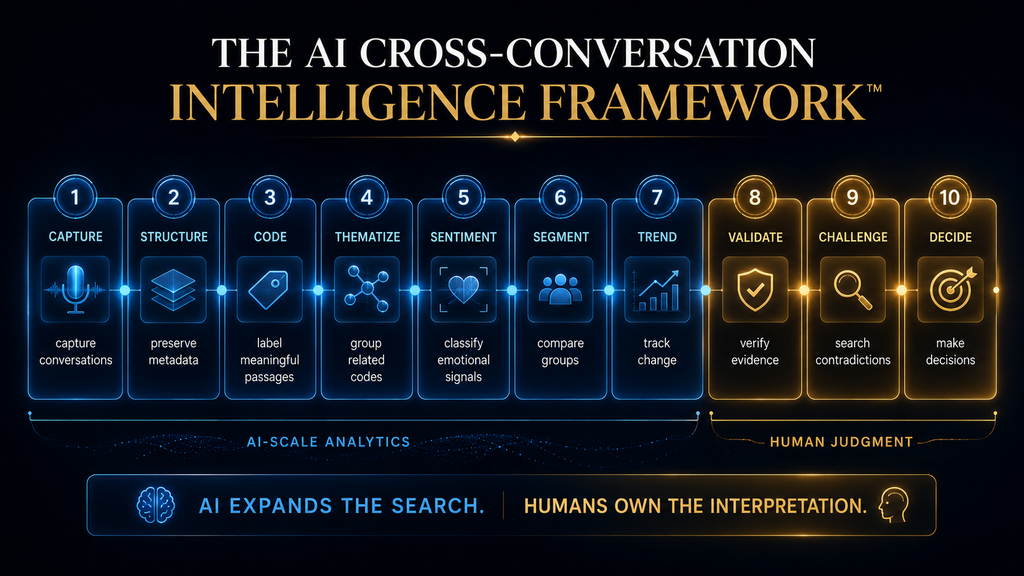
For this article, the most useful way to understand the workflow is through the AI Cross-Conversation Intelligence Framework: CAPTURE → STRUCTURE → CODE → THEMATIZE → SENTIMENT → SEGMENT → TREND → VALIDATE → CHALLENGE → DECIDE The important point is that this is not simply a list of AI features. It represents a progression in analytical confidence. At the beginning, the system is dealing with raw conversational evidence. By the end, the research team should have a smaller number of validated interpretations that can support an actual decision.
The first stages primarily solve scale. The middle stages solve pattern recognition. The later stages solve interpretation and trust. And the final stage connects analysis to business action. That distinction matters because many AI conversation tools are very good at the middle of the pipeline while organizations still fail at the final stages.
Step 1: Capture and Normalize the Conversation Data. Everything starts with the quality of the underlying evidence. If the transcript is inaccurate, the downstream analysis inherits that problem. If speakers are mixed together, sentiment and attribution can become unreliable. If timestamps disappear, researchers lose the ability to locate evidence precisely. If metadata such as customer segment, interview date or source channel is missing, later comparison becomes much harder. This is why transcription should not be treated as an administrative step.
It is the foundation of the analytical system. A useful dataset should preserve, where available, the original conversation, speaker identity, timestamps, source type, date, participant attributes and other metadata needed for later analysis. Speak AI’s current workflow combines transcription with downstream analysis and allows recordings to be explored using filters such as date, speaker, sentiment, tags and categories. Speak AI Imagine two datasets. Dataset A contains 500 transcripts with no metadata.
Dataset B contains the same 500 transcripts plus: customer type, geography, date, product version, interview type and acquisition channel. The second dataset is dramatically more valuable because the research team can ask not only: “What themes appear?” but: “Which themes are increasing among enterprise customers after the latest product release?” That is where conversation intelligence starts becoming decision intelligence.
Step 2: Convert Conversations Into Searchable Analytical Units. Once the conversation has been transcribed, the system needs to break the raw material into units that can be analyzed. These units might be sentences, speaker turns, paragraphs, responses, coded excerpts or other meaningful segments. The objective is not simply to split text mechanically. The objective is to preserve enough context that a later classification remains meaningful. Consider this statement: “It was frustrating.” On its own, the sentence contains sentiment but very little explanation.
Now consider: “It was frustrating because we couldn’t tell whether the integration had failed or was still processing.” The second statement contains much richer information. It communicates emotion, cause, workflow friction and a specific product problem. An AI system that extracts only sentiment may classify both statements as negative. A stronger analysis preserves the surrounding context and connects sentiment to the topic that caused it. This is particularly important because sentiment should rarely be treated as an independent variable.
Negative sentiment about pricing is different from negative sentiment about product reliability. Both are negative, but they imply very different business responses.
Step 3: Generate Candidate Codes. Coding is where raw conversation begins to become structured analytical material. A code is essentially a label attached to a meaningful piece of evidence. For example, a customer interview might contain: “We couldn’t find the API documentation.” That could receive a code such as: DOCUMENTATION GAP Another statement might say: “Our developer spent two days trying to figure out the integration.” That might receive: IMPLEMENTATION DELAY Another might say: “The integration finally worked, but only after support helped us.”
That might receive: SUPPORT DEPENDENCY These codes are useful because they preserve specific meaning while making it possible to compare related passages across hundreds of conversations. AI is particularly useful here because the same concept can appear in many linguistic forms. One customer says: “The documentation was terrible.” Another says: “We couldn’t find the instructions.” Another says: “The docs didn’t cover our use case.” Another says: “We had to ask support because the documentation wasn’t enough.”
A human researcher can recognize the relationship. AI can help surface those passages at scale. But coding should be treated as candidate analytical structure, not unquestionable truth. Research on AI-supported qualitative analysis repeatedly shows that the quality of outputs depends on methodology, prompting, dataset context and human review. PubMed Central (PMC)
Step 4: Group Related Codes Into Themes
This is where the analysis moves from isolated observations toward patterns. Suppose the AI identifies these codes: For a method refresher, see Nielsen Norman Group’s guide to thematic analysis.
| Candidate Code | Example Evidence |
|---|---|
| Documentation gap | Customers cannot find implementation guidance |
| Setup confusion | Users don’t know how to begin |
| Integration difficulty | Existing systems are difficult to connect |
| Support dependency | Customers need help to complete setup |
| Configuration complexity | Too many technical steps before activation |
A shallow analysis might simply list these as five separate problems. A deeper analysis asks whether they belong to a broader conceptual pattern. The research team might develop: Theme: Implementation friction delays customer time-to-value. Now the theme has explanatory power. It does not merely say “customers mention setup.” It proposes a relationship between several pieces of evidence and an outcome.
This distinction is essential because theme analysis is not supposed to become a sophisticated version of word counting. Braun and Clarke’s work emphasizes that themes are developed through recursive engagement with data and interpretation, not mechanically “discovered” as fixed objects waiting inside the dataset. Thematic Analysis AI can therefore be extremely useful in proposing candidate groupings. The researcher still needs to decide whether the grouping is conceptually coherent.
Step 5: Analyze Sentiment in Context
Sentiment analysis is one of the easiest AI conversation features to demonstrate and one of the easiest to misuse. At a basic level, sentiment classification attempts to determine whether language expresses positive, negative or neutral sentiment. More advanced systems may also score intensity, emotional tone or sentiment at sentence/document level. Speak AI describes sentiment scoring at both document and sentence level, including positive, negative and neutral classifications and a compound score. Speak AI Docs
That can be useful. Suppose 2,000 customer conversations produce the following high-level pattern:
| Theme | Positive | Neutral | Negative |
|---|---|---|---|
| Ease of use | 64% | 21% | 15% |
| Integration | 22% | 26% | 52% |
| Support | 71% | 18% | 11% |
| Pricing | 34% | 31% | 35% |
The raw numbers immediately suggest that integration deserves attention. But the numbers still don’t tell you why. That requires returning to the underlying evidence. A customer might say: “Integration was painful initially, but once configured, the product worked exactly as expected.” A sentiment model could identify the sentence as mixed or negative because of the phrase “painful.” But the business implication is more nuanced: the product may have an implementation problem rather than a product-value problem.
This is why theme + sentiment is much more useful than sentiment alone. The question is not: “How negative are customers?” The better question is: “What are customers negative about, who is experiencing it, and what appears to cause that reaction?”
Step 6: Segment the Findings
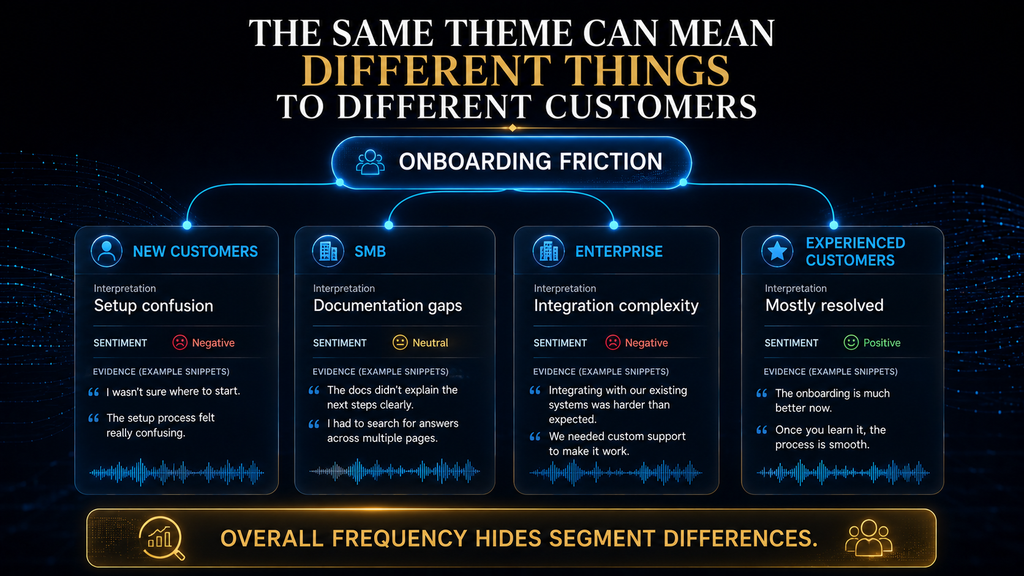
Cross-conversation analysis becomes substantially more valuable when the system can compare groups. A theme that appears in 30% of all conversations may sound important. But what if it appears in:
- 12% of SMB conversations
- 18% of mid-market conversations
- 64% of enterprise conversations
Now the business interpretation changes. The overall average hides the problem. This is one of the strongest reasons to combine AI conversation analysis with metadata. Useful segmentation dimensions can include:
- customer size
- customer lifecycle stage
- geography
- industry
- product tier
- acquisition channel
- customer tenure
- interview type
- support channel
- account value
- product version
The correct segmentation depends on the research question. For example, a product team may care about customer size. A marketing team may care about acquisition channel. A customer-success team may care about lifecycle stage. Speak AI’s Explore workflow supports filtering and comparing insights across recordings using dimensions such as folders, dates, speakers, sentiment, tags and categories. Speak AI Docs The important analytical principle is: A theme’s overall frequency does not tell you whether it affects everyone equally.
Step 7: Add Time and Detect Emerging Patterns
A theme becomes much more informative when you know whether it is stable, rising or declining. Suppose onboarding complaints look like this:
| Month | Onboarding Mentions | Negative Sentiment |
|---|---|---|
| January | 82 | 31% |
| February | 91 | 34% |
| March | 108 | 38% |
| April | 147 | 46% |
| May | 181 | 51% |
| June | 205 | 56% |
The obvious interpretation is that onboarding is becoming a larger problem. But again, that interpretation requires caution. Maybe the company doubled its customer base during the same period. If the number of customers doubled while onboarding complaints increased only modestly relative to customer volume, the apparent trend could be misleading. This illustrates an important rule: Conversation volume is not automatically prevalence. AI can identify changes in mention frequency very quickly. The research team still needs to normalize the numbers where appropriate and investigate what changed in the underlying population.
Speak AI’s Explore functionality explicitly supports analyzing trends over time across recordings, including keywords, sentiment and topics. Speak AI Docs The analytical question should therefore be: What changed in the conversation data, and what else changed at the same time? That second question prevents a huge number of false conclusions.
Step 8: Return to the Evidence. This is where many AI-generated analyses stop too early. The system identifies a theme. The dashboard shows a percentage. The report produces a summary. Everyone moves on. That is precisely where a serious research workflow should slow down. Suppose AI says: “Customers increasingly view onboarding as confusing.” Before accepting that conclusion, the researcher should inspect representative evidence. Look at the original conversations. Check whether the quoted evidence actually supports the theme.
Look for different interpretations. Inspect cases where the theme was assigned incorrectly. Check whether the evidence comes from a representative distribution of participants. And most importantly, distinguish what the participant actually said from what the analyst inferred.
Recent research has demonstrated why this matters. One 2025 comparison found that GPT-4-based qualitative analysis generally aligned with human concepts but struggled with low-frequency codes, coherent code relationships, nuance and quote selection. Another evaluation found that AI-generated thematic analyses could include altered or hallucinated quotes and insufficient representation of participant spread. PubMed The practical lesson is simple: Never trust a theme merely because the dashboard makes it look precise. The percentage is not the evidence. The evidence is the evidence.
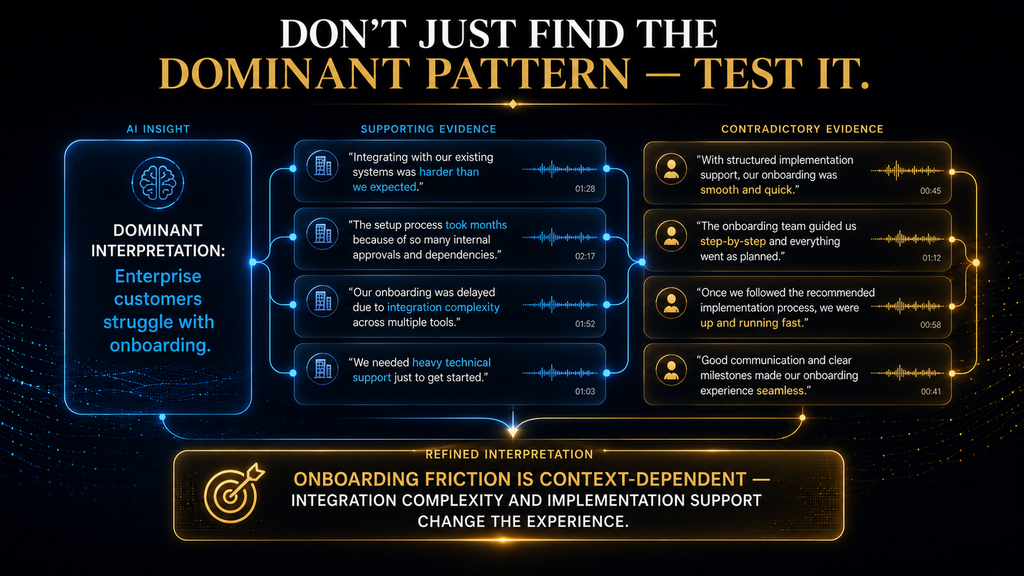
Step 9: Challenge the Dominant Interpretation. This is the step that separates a useful AI-assisted analysis from a polished but potentially misleading report. Once the dominant themes are identified, deliberately search for evidence that does not fit them. Suppose the analysis says: “Enterprise customers struggle with onboarding.” Now search for enterprise customers who describe onboarding as easy. Then ask why. Maybe those customers received implementation support. Maybe they had technical teams that were already familiar with the product.
Maybe the problem is not onboarding itself but insufficient documentation for smaller teams. The contradiction changes the interpretation. Instead of: “Enterprise customers struggle with onboarding.” the more defensible finding might be: “Enterprise customers report onboarding friction primarily when implementation requires complex integrations, while teams receiving structured implementation support report substantially smoother adoption.” That is a much more useful finding because it points toward an intervention. Contradictions are not inconvenient noise.
They are often where the real insight lives. The research literature supports this caution. Studies evaluating GenAI for qualitative research have found that AI can produce broadly plausible themes while still missing nuance, minority evidence and contextual distinctions. PubMed
What should researchers actively search for?
| Challenge Area | Question |
|---|---|
| Minority evidence | Who experienced something different? |
| Contradictions | What evidence conflicts with the dominant theme? |
| Context | Does the meaning change by situation? |
| Segment differences | Does the theme mean the same thing for every group? |
| Time | Did the pattern exist before the recent change? |
| Alternative explanations | What else could explain the result? |
| Evidence quality | Are the supporting examples representative? |
This step should not be automated away. It should be deliberately built into the workflow. For research teams, see AI qualitative research explained.
Step 10: Turn Validated Patterns Into Decisions. The final stage is not “generate a summary.” It is deciding what the validated evidence means for the organization. Suppose the analysis produces: Theme: Integration friction Highest-impact segment: Enterprise customers Sentiment: Predominantly negative Trend: Increasing Evidence: Repeated implementation complaints Contradiction: Customers with professional onboarding support report fewer problems The resulting business action might be: Improve enterprise implementation support rather than redesign the entire onboarding experience. That is much more precise than:
“Customers don’t like onboarding.” The difference comes from connecting: theme → sentiment → segment → trend → evidence → contradiction → action That is the real value of cross-conversation intelligence.
The Most Important Distinction: Frequency Is Not Importance
AI systems are naturally good at finding things that occur repeatedly. But businesses do not necessarily need to solve the most frequently mentioned problem. Imagine these findings: Our roundup of the best AI conversation intelligence tools compares the main options.
- Pricing: mentioned 42% of conversations.
- Integration failure: mentioned 11%.
- Security concern: mentioned 4%.
At first glance, pricing appears to be the biggest issue. But suppose pricing complaints are mostly mild comments from low-value users, while security concerns are concentrated among enterprise prospects and cause several major deals to stall. The frequency ranking is not the impact ranking. This creates a useful AI Hustle World principle:
Frequency tells you what is common. Impact tells you what matters.
A mature analysis should therefore score themes across multiple dimensions. For example: If you are new to the topic, start with AI conversation intelligence explained.
| Dimension | Question |
|---|---|
| Frequency | How often does the theme appear? |
| Sentiment | How strongly do people react to it? |
| Segment concentration | Who is affected? |
| Trend | Is it increasing or declining? |
| Severity | What happens when the problem occurs? |
| Business impact | Does it affect revenue, retention or adoption? |
| Evidence strength | How well supported is the interpretation? |
| Actionability | Can the organization realistically respond? |
This is where AI-generated summaries should stop being treated as final answers and start being treated as analytical inputs.
Check Sentiment Against Real Quotes
Open a sentiment result and confirm the underlying quotes actually support it before you act on it.
Test Sentiment Analysis →Affiliate disclosure: We may earn a commission if you subscribe through this link, at no additional cost to you.
How AI Connects Themes and Sentiment
Theme detection and sentiment analysis become substantially more powerful when they are analyzed together. Consider two themes: Documentation Product reliability Suppose both have 30% negative sentiment. That sounds equivalent. But now add context. Documentation complaints may occur mostly during early onboarding and disappear after the customer becomes experienced. Reliability complaints may occur throughout the entire customer lifecycle and directly affect renewal confidence. The same sentiment score can therefore represent very different business risks.
A better model is: Theme → Sentiment → Segment → Stage → Outcome This allows researchers to ask questions such as: “Which themes create the strongest negative sentiment among new customers?” “Which themes become less important after onboarding?” “Which negative themes correlate with churn or escalation?” “Which positive themes are associated with advocacy?” “Which issues are unique to enterprise accounts?” Those questions move the analysis from descriptive reporting toward decision support.
A Practical Example: From 1,000 Conversations to One Actionable Finding
Consider a hypothetical SaaS company with 1,000 customer conversations collected over six months. The AI analysis identifies five major themes:
- Onboarding
- Integration
- Documentation
- Support
- Pricing
At first glance, onboarding is the largest theme. But the deeper analysis reveals something more interesting. Among new customers, onboarding dominates. Among enterprise customers, integration dominates. Among long-term customers, feature requests dominate. Negative sentiment is highest around integration. Integration complaints increased after a new product version. However, customers receiving structured implementation support show substantially less negative sentiment. Now the research team has a much stronger hypothesis: The product release may have increased integration friction for complex customers, while structured implementation support appears to reduce the impact.
That is a finding worth investigating. It may lead to:
- better release documentation,
- targeted enterprise onboarding,
- improved integration tooling,
- proactive customer-success outreach,
- revised implementation guidance.
The AI did not “discover the answer.” It reduced the amount of manual searching required to find the evidence worth investigating. That distinction is important.
Where Speak AI Fits Into This Workflow
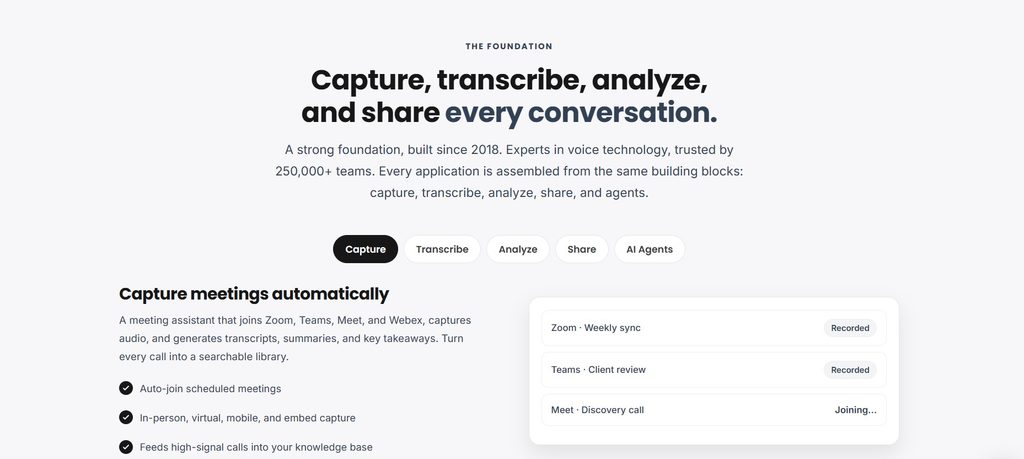
Speak AI is particularly relevant when the problem is not simply transcription but moving from large volumes of recordings or text toward structured analysis.
Its current product documentation describes automatic extraction of keywords, sentiment, entities and topics after transcription, alongside Explore capabilities for comparing insights across a recording library. It also offers theme analysis for identifying recurring themes, classifying mentions and quantifying how often themes occur. Speak AI Docs That makes it a natural fit for workflows involving:
- research interviews
- customer feedback
- support conversations
- survey responses
- sales calls
- focus-group material
- meeting archives
The important advantage is workflow continuity. Instead of manually moving from audio to transcription software, then from transcription to a separate analysis environment, then from analysis to spreadsheets, a platform such as Speak can combine multiple stages in one research workflow. That can reduce operational friction. But it does not remove methodological responsibility.
Speak’s own documentation describes features such as automated themes and sentiment; those are vendor claims about product capabilities, so they should be evaluated as capabilities rather than treated as independent evidence that every resulting interpretation will be correct. Speak AI Docs
What Speak AI Can Do Well
Speak AI is strongest when the problem involves scale, repetitive analysis and structured exploration of conversational data. Its current text-analysis workflow can extract sentiment, keywords, entities and themes from text, while its broader platform connects transcription and analysis across recordings. Speak AI That makes it useful for an organization that has already accumulated a significant amount of conversational evidence but lacks the capacity to manually inspect everything.
It is also useful when the analytical question changes frequently. A researcher may initially want to understand themes, then compare sentiment, then examine a specific customer segment, then investigate a time period or particular category. A flexible analysis environment is more useful in that situation than a rigid one-off reporting workflow. The other advantage is repeatability. A research team can establish a recurring process in which new conversations are continuously added to the analytical dataset. That makes it possible to monitor whether previously identified themes are stable, declining or changing.
Where Speak AI Does Not Solve the Whole Problem
The biggest mistake would be treating an AI conversation-analysis platform as a replacement for qualitative judgment. It isn’t. A tool can surface a recurring theme without understanding why that theme matters. It can classify sentiment without fully understanding sarcasm, cultural context or conversational history. It can identify representative-looking quotes without guaranteeing that those quotes accurately represent the dataset. Research on sentiment analysis has repeatedly identified contextual challenges involving sarcasm, tone and cultural nuance. ACL Anthology
The same principle applies to qualitative analysis more broadly. A 2025 review of AI-supported qualitative data analysis concluded that AI can support multiple forms of analysis but emphasized risks around unsophisticated analysis, privacy, security and the need for humans to remain involved in the analytical process. PubMed So the correct question is not: “Can Speak AI analyze my interviews?” It can provide automated analysis capabilities for interviews and other conversational data.
The more important question is: “Can my research team use those outputs as evidence without surrendering the interpretive judgment that makes qualitative research valuable?” The answer depends on the workflow you build around the tool.
AI Conversation Analysis vs Manual Research
The choice is not necessarily binary.
| Dimension | Manual Analysis | AI-Assisted Analysis | Best Practical Approach |
|---|---|---|---|
| Transcription | Slow | Fast | AI-assisted |
| Initial coding | High human effort | Fast candidate coding | AI + human review |
| Theme discovery | Deep but slower | Broad and scalable | AI discovery + human refinement |
| Sentiment scanning | Time-consuming | Fast | AI-assisted |
| Minority cases | Strong if researcher is thorough | Can be missed | Deliberate human review |
| Context interpretation | Strong | Variable | Human-led |
| Cross-dataset comparison | Difficult at scale | Strong | AI-assisted |
| Contradiction detection | Strong but expensive | Useful for candidate detection | AI + human |
| Final interpretation | Strong | Not sufficient alone | Human-led |
| Decision-making | Human responsibility | Supports evidence gathering | Human-led |
The strongest model is therefore hybrid, not because “hybrid” sounds safe, but because the strengths are genuinely complementary. AI has scale. Humans have contextual judgment.
When AI Conversation Analysis Creates Real ROI
The economics become attractive when the volume of conversational evidence exceeds what the research team can comfortably inspect. Suppose a researcher spends 20 minutes manually reviewing each conversation. At 500 conversations, that is approximately: 166.7 hours At 2,000 conversations, it becomes: 666.7 hours The exact time will vary significantly depending on conversation length, complexity and methodology, but the basic economic problem remains. AI can reduce the time required for the first-pass organization, candidate coding, search, theme detection and aggregation. For meeting-focused tools, see our list of the best AI meeting assistants.
That does not mean the entire 166 or 667 hours disappear. Instead, the researcher can redirect time toward the parts of analysis where judgment matters most: interpreting context, checking contradictions, validating evidence, refining themes and deciding what the findings mean. That is the better ROI model. The goal is not: “Do qualitative research without humans.” The goal is: “Spend human research time where human interpretation produces the most value.”
The Hidden Cost of Getting AI Analysis Wrong
Speed has an obvious benefit. Incorrect interpretation has an obvious cost. Suppose AI incorrectly concludes that customers hate pricing. The company might spend months changing pricing. But perhaps the actual issue was that customers didn’t understand the value proposition. The analysis was fast. The decision was wrong. That is why the economic model should include error cost, not only labor savings. A useful framework is: Net AI Analysis Value = Time Saved + Coverage Gained + Insight Value − Validation Cost − Error Cost Speak AI lists its current plans on its pricing page, and its documentation covers the API and integrations.
The equation does not need to be mathematically perfect to be useful. It forces the team to recognize that automation creates value only when the output is sufficiently reliable for the decision being made. For low-risk exploratory analysis, a rough candidate theme may be perfectly acceptable. For research supporting a major product decision, regulatory submission, clinical conclusion or high-stakes customer action, the validation standard should be much higher.
Common Failure Modes in AI Conversation Analysis
Treating frequency as importance
The most frequently mentioned topic is not necessarily the most consequential problem. Frequency needs to be interpreted alongside severity, affected segments, business impact and outcome relevance.
- Treating sentiment as truth. A negative sentiment score tells you that the language was classified as negative. It does not automatically tell you why the person feels that way or what should be done.
- Ignoring minority evidence. A small segment can contain strategically important information. Low frequency does not mean low importance.
- Using bad metadata. If customer segments, dates or product versions are incorrect, cross-conversation comparisons can create false patterns.
- Accepting the first theme structure. AI can generate plausible groupings that are analytically weak. Researchers should refine, merge, split or reject themes.
- Selecting only convenient quotes. A strong report should not simply collect quotes that confirm the preferred interpretation. Contradictory evidence should be actively searched for.
- Confusing correlation with causation. If integration complaints increase after a product release, that does not automatically prove that the release caused the complaints. Other changes may have occurred simultaneously.
- Ignoring the research question. AI can find patterns that are interesting but irrelevant. The research question should determine which patterns deserve attention.
- How to Build a Reliable AI Conversation Analysis Workflow. A practical implementation can follow this sequence.
- Start with the research question. Define what decision or uncertainty the analysis is supposed to address before asking AI to search for patterns.
- Define the analytical unit. Decide whether you are analyzing complete interviews, responses, speaker turns, paragraphs, customer cases or another unit.
- Establish metadata. Capture the dimensions that will matter later, such as segment, date, product version, geography or channel.
- Run broad AI analysis. Allow the system to surface candidate themes, sentiment patterns, entities, keywords and other signals.
- Review the candidate structure. Do not immediately accept the AI-generated categories. Check whether they are conceptually meaningful and sufficiently distinct.
- Search for supporting evidence. Return to the original conversations and examine the evidence behind important themes.
- Search for contradictions. Actively look for cases that challenge the dominant interpretation.
- Compare segments and time. Determine whether the pattern is universal, concentrated or changing.
- Assess business impact. Ask whether the pattern affects a decision, outcome, customer experience, cost or opportunity.
- Document the final interpretation. Record what the evidence supports, what remains uncertain and what additional research is needed. That final step is important because good research does not pretend uncertainty has disappeared simply because the dashboard looks sophisticated.
The Measurement Framework: How to Know Whether AI Actually Improved Research
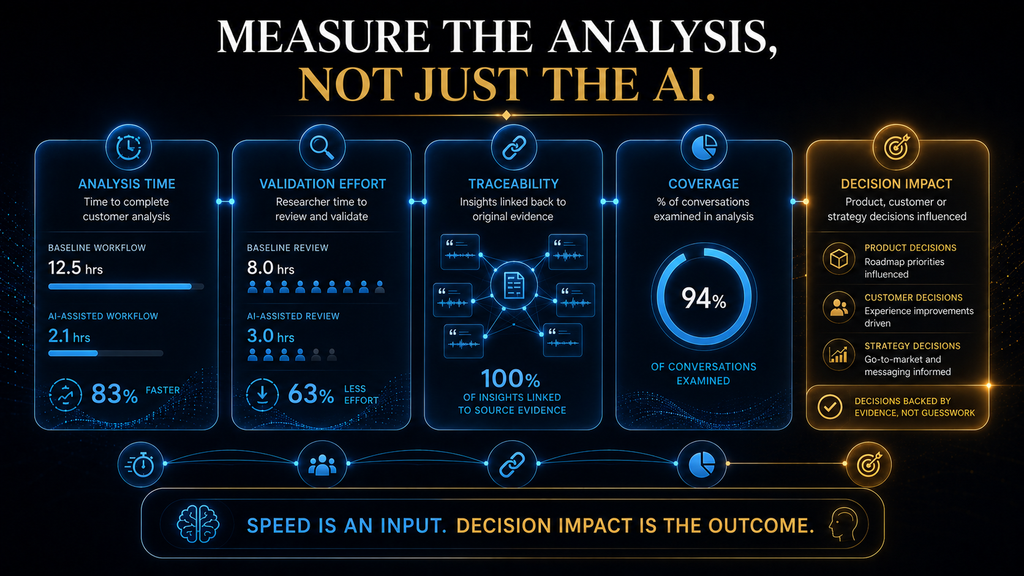
A company should not evaluate AI conversation analysis solely by asking: “How fast did the AI produce themes?” That is an incomplete KPI. Measure at least five dimensions.
- Analysis Time. Compare the time required to move from completed conversations to an initial analytical structure. The objective is not to make the AI look fast. It is to measure the total workflow.
- Validation Effort. Measure how much researcher time is required to review, correct and refine AI outputs. If AI generates themes in minutes but researchers spend days correcting them, the headline speed advantage is misleading.
- Traceability. Ask whether researchers can move from a high-level finding back to the original conversations that support it. A theme that cannot be traced back to evidence is difficult to defend.
- Coverage. Measure how much of the dataset was actually considered. AI can provide an advantage here because large volumes of conversation can be scanned systematically, but the team should still test whether important minority evidence was missed.
Decision Impact
Finally, ask whether the analysis changed anything meaningful. Did it influence: How AI turns feedback into roadmap decisions is covered in how AI turns customer feedback into product insights.
- product priorities?
- customer-success interventions?
- messaging?
- onboarding?
- research questions?
- retention strategy?
- support processes?
- market positioning?
If the answer is no, generating more themes is not necessarily creating more value.
A Better KPI Model for AI Conversation Intelligence
I recommend thinking about the workflow using this hierarchy: Coverage → Accuracy → Traceability → Interpretation → Decision Impact Coverage asks: “Did we examine enough of the evidence?” Accuracy asks: “Did the system correctly represent what people said?” Traceability asks: “Can we return from the finding to the original evidence?” Interpretation asks: “Did we understand the evidence in context?” Decision impact asks: “Did the resulting insight improve an actual decision?”
This hierarchy prevents teams from optimizing the wrong metric. A system that processes 100,000 conversations but produces unreliable interpretations is not better than a system that processes 10,000 accurately. Likewise, a system that produces beautiful dashboards but never changes a decision is not necessarily delivering meaningful research value.
Who Should Use AI Conversation Analysis?
AI conversation analysis makes the most sense when an organization has enough conversational data that manual analysis is becoming a bottleneck. It is particularly useful for research teams handling many interviews, customer-success teams analyzing support conversations, product teams aggregating user feedback, marketing teams analyzing qualitative research and organizations that repeatedly need to identify patterns across large conversation libraries. It is also useful when the questions are exploratory. If you do not yet know which themes exist, AI can provide a broad first-pass map of the dataset that researchers can then investigate more deeply. The value increases as conversation volume, repetition and cross-segment comparison requirements increase.
Who Should Be More Careful?
AI conversation analysis requires more caution when the dataset is small but highly nuanced, when participant context is critical, when the consequences of interpretation are high, or when sensitive personal information is involved. It also deserves extra scrutiny when the research depends heavily on irony, sarcasm, cultural references, implicit meaning or non-verbal communication that may not survive transcription. Privacy and consent are another important consideration. Research literature has raised concerns about privacy, ownership, re-identification and informed consent when generative AI systems are applied to human-participant data. PubMed Central (PMC) For sensitive research, the team should therefore evaluate the data-handling practices of the selected platform before uploading material.
The Contrarian Insight: AI May Make Qualitative Researchers More Important, Not Less
The popular narrative says AI will automate qualitative research. I think the more interesting possibility is different. AI may reduce the value of manual search and organization while increasing the value of research judgment. When it takes a researcher hours to locate relevant passages, the researcher spends a large portion of their time finding evidence. When AI can surface candidate evidence quickly, the researcher can spend more time asking harder questions:
Why does this pattern exist? What is missing? Who disagrees? What alternative explanation fits? Does this finding generalize? What would change my mind? What should the company do next? Those are not merely extraction tasks. They are reasoning tasks. That means the competitive advantage may shift from: “Who can analyze the most conversations?” to: “Who can turn large amounts of conversational evidence into the most reliable decisions?” That is a much more durable advantage.
The Second-Order Effect: More Analysis Can Create More Noise
There is another issue that deserves attention. AI dramatically lowers the cost of generating analytical outputs. That sounds positive. But when analysis becomes cheap, organizations can produce too much of it. Every week could bring: Once you have transcripts, you can also turn video transcripts into articles, clips and social posts.
- new themes,
- new sentiment reports,
- new customer segments,
- new dashboards,
- new trend alerts,
- new “insights.”
The organization may become more informed and less focused at the same time. This creates an insight inflation problem. If every pattern becomes an “insight,” the word insight loses meaning. The solution is not to reduce AI analysis. It is to introduce stronger prioritization. A theme should graduate from signal to insight only when it has sufficient evidence, relevance and decision value. That gives us another AI Hustle World principle:
The goal of AI analysis is not to maximize the number of insights. It is to maximize the number of validated insights worth acting on.
The AI Hustle World Validation Ladder
A practical way to operationalize that principle is to classify analytical outputs into five levels.
- Level 1 — Signal. Something appears repeatedly.
- Level 2 — Pattern. The signal appears across multiple conversations or contexts.
- Level 3 — Validated Pattern. The pattern survives evidence review and contradiction testing.
- Level 4 — Insight. The validated pattern has meaningful implications for a business question.
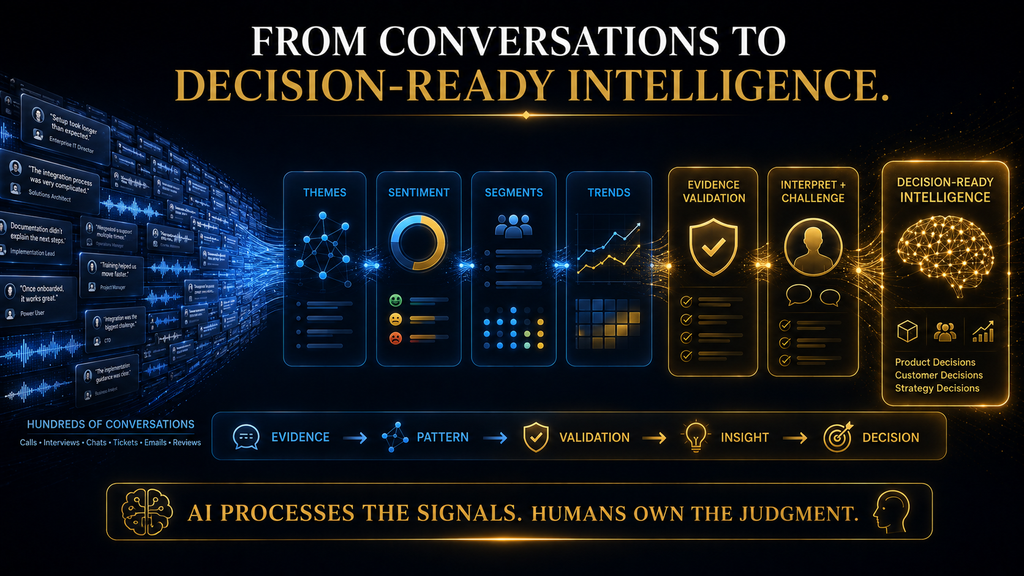
Level 5 — Decision. The organization determines what action, experiment or further research should follow. This prevents a dashboard from turning every automatically generated theme into a strategic conclusion. The progression is: Signal → Pattern → Validation → Insight → Decision That is the difference between AI-generated analytics and AI-supported research.
Where the Traditional Method Still Wins
Manual qualitative analysis has an advantage that is easy to underestimate: the researcher develops familiarity with the data. Thematic-analysis guidance emphasizes immersion, recursive engagement and researcher interpretation rather than a rigid mechanical pipeline. Thematic Analysis That matters because qualitative evidence often contains things that are difficult to reduce to structured labels. A participant might tell a story. They might contradict themselves. They might laugh while describing a frustrating experience. They might use a culturally specific phrase.
They might pause before answering. They might describe something that appears unrelated to the research question but becomes highly significant later. An AI system may help surface relevant passages. A researcher may recognize why the passage matters. That distinction is not going away simply because the models are improving.
What Happens If You Do Nothing?
There is a cost to remaining entirely manual. As conversational datasets grow, organizations may increasingly suffer from:
- analysis backlogs
- slow research cycles
- inconsistent coding
- limited cross-conversation visibility
- researcher attention constraints
- difficulty detecting emerging issues
- underuse of existing customer evidence
The risk is not simply that research becomes slower. It is that the organization starts making decisions from a small subset of the available evidence because nobody has the capacity to examine everything. AI can help expand that evidence coverage. But it should do so without creating false confidence.
What Happens If You Automate Too Much?
The opposite extreme creates a different problem. If an organization lets AI automatically define themes, interpret sentiment, choose representative quotes and generate strategic conclusions without human review, it can create an efficient pipeline for producing confidently wrong answers. That is worse than slow research because the errors can become invisible once they enter executive reports or product roadmaps. Recent 2026 research is particularly relevant here: one study found AI-assisted thematic analysis could produce reproducible themes while still generating subtle misrepresentations that could mislead decision-makers without thorough human auditing. PubMed
The right objective is therefore neither: manual everything nor: automate everything It is: automate the parts where scale creates leverage, and protect the parts where interpretation creates risk.
The Practical Decision Matrix
| Situation | Recommended Approach |
|---|---|
| 10 highly complex interviews | Human-led with AI assistance |
| 100 customer interviews | AI-assisted coding and theme discovery |
| 1,000+ support conversations | AI-first analysis with human validation |
| Repeated monthly feedback | Continuous AI monitoring + periodic human review |
| Highly sensitive research | Strong privacy review + human-led interpretation |
| High-stakes decisions | AI for evidence discovery, humans for conclusions |
| Exploratory research | AI broad scan + researcher refinement |
| Simple repetitive classification | Higher automation may be appropriate |
The more ambiguous and consequential the decision becomes, the more important human review becomes.
Speak AI: When It Makes Sense to Try It
Speak AI is worth considering when the bottleneck is organizing and analyzing a large volume of conversational or textual evidence, rather than simply generating a transcript. Its current feature set includes transcription, text analysis, sentiment, themes, keywords, entities, AI fields and cross-recording exploration. Its pricing model also currently includes pay-as-you-go options and subscription/enterprise pathways, with credits used across capabilities such as transcription, AI Chat, translation and other platform functions. That means the right evaluation should focus less on the headline feature list and more on whether the platform reduces a real bottleneck in your workflow.
For a researcher processing a handful of interviews each month, a sophisticated conversation-intelligence platform may be unnecessary. For a team processing hundreds of interviews, customer calls or qualitative responses, the economics and workflow benefits can be much more compelling.
How I Would Pilot Speak AI
Do not begin by uploading your entire research archive. Run a controlled pilot. Choose a representative sample of conversations and define the analytical question first. For example: Question: What are the biggest onboarding problems among new customers? Then establish a baseline using your current workflow. Measure:
- time required
- themes identified
- validation effort
- important themes missed
- false positives
- researcher satisfaction
- decision usefulness
Then run the same dataset through the AI-assisted workflow. Do not compare only speed. Compare quality-adjusted speed. If the AI produces 20 candidate themes in five minutes but researchers need six hours to clean them, that is different from a system that produces eight strong candidates in ten minutes that require only one hour of validation. The second system may be more valuable even though its headline speed is lower.
The Final Research Standard
The best AI conversation-analysis workflow should leave you with five things. You should know what is happening across the conversations. You should know where it is happening and among whom. You should understand how people feel about it. You should be able to trace important interpretations back to supporting evidence and contradictions. And you should know what decision the evidence can reasonably support. If you cannot do those five things, you have analysis output. You do not necessarily have intelligence. Our comparison of the best AI research assistants covers the desk-research side.
Final Thoughts
AI is very good at making large conversational datasets searchable, comparable and analyzable. It can surface candidate themes, group related concepts, classify sentiment, compare segments and identify changes across time far faster than a human team could manually inspect the same volume of material. But the most important part of the workflow happens after the AI produces its first answer. Researchers still need to decide whether a theme is meaningful, whether the evidence is representative, whether contradictory cases change the interpretation, whether sentiment has been understood in context, and whether the result actually matters to the decision being made.
That is why the future of conversation intelligence is not simply about finding more themes. It is about building a reliable bridge from conversation → pattern → evidence → interpretation → decision. And that is the standard I would use when evaluating any AI conversation-analysis platform, including Speak AI. The strongest system is not the one that produces the most insights. It is the one that helps your team find the right patterns, verify them against the evidence and act with greater confidence.
Decide Whether Pattern Analysis Fits Your Volume
Match how many conversations you analyze each month with plan limits and your review process before you commit.
Review Speak AI Plans →Affiliate disclosure: We may earn a commission if you subscribe through this link, at no additional cost to you.
FAQ
Can AI automatically find themes across multiple interviews?
Yes. AI systems can analyze transcripts or text collections to identify recurring topics, cluster related concepts and surface candidate themes. Speak AI currently offers theme analysis designed to identify, classify and quantify recurring themes across recordings. The important limitation is that automatically generated themes should be treated as candidate analytical outputs rather than unquestionable conclusions. Human researchers should review whether the themes accurately represent the dataset and research question. See how AI interview analysis works for the transcript-to-insight workflow.
How does AI detect sentiment across conversations?
AI sentiment analysis typically classifies language according to emotional polarity such as positive, neutral or negative. Some systems also provide sentence-level or document-level scores and additional measures of emotional tone or intensity. Sentiment should always be interpreted alongside topic and context because the same negative language can represent very different underlying problems.
Can AI replace human qualitative researchers?
Not reliably for rigorous qualitative interpretation. Current research suggests AI can support theme identification, coding, summarization and large-scale analysis, but limitations remain around context, minority evidence, quote selection, contradictions and interpretive nuance. The strongest approach is generally AI-assisted rather than fully automated.
Why is cross-conversation analysis more useful than analyzing individual interviews?
Individual analysis tells you what happened in a specific conversation. Cross-conversation analysis allows you to identify recurring patterns, compare segments, track changes over time and distinguish isolated comments from broader signals. That makes the analysis more useful for decisions that affect a larger customer or research population.
Can AI detect contradictions in customer feedback?
AI can help surface potentially contradictory evidence, but researchers should verify the contradiction against the original conversations. A contradiction may represent genuine disagreement, different customer segments, different contexts or simply different interpretations of similar language. Our guide to analyzing customer feedback, calls and interviews at scale applies the same ideas to support and product teams.
Is frequency enough to decide which theme matters most?
No. Frequency is only one dimension of importance. A lower-frequency issue can have greater business impact if it affects high-value customers, creates serious risk or strongly influences retention, adoption or revenue.
Is Speak AI useful for qualitative research?
It can be, particularly for workflows involving interviews, focus groups, customer feedback, surveys and other conversational datasets. Speak AI currently provides transcription, theme analysis, sentiment analysis, AI fields and cross-recording exploration capabilities. The right decision depends on the size of the dataset, research methodology, privacy requirements and the amount of manual analysis your team currently performs.
Written by
Muntasir Ahmad Chowdhury
Founder, AI Hustle World
Muntasir Ahmad Chowdhury is the Founder of AI Hustle World, an independent publication dedicated to making Artificial Intelligence practical, trustworthy, and easy to understand. He researches AI tools, automation, customer service, productivity, and real-world business applications, helping readers make smarter technology decisions through research-driven, experience-backed content.
Expertise:
AI Tools • AI Automation • AI Customer Service • AI Productivity • Generative AI • AI Workflows
Get Smarter With AI
Enjoyed this guide? Get practical AI tools, tutorials, and honest reviews delivered to your inbox.