
Evidence: Documentation reviewed
Last checked: September 2026
What was done: Written from official documentation and the published sources linked in this article. Not hands-on tested.
Files: None
Affiliate links: No
How AI Turns Customer Feedback into Product Insights
AI turns customer feedback into product insights by grouping comments by meaning, adding context about who said what and when, tracking how patterns change over time and linking every conclusion back to the original evidence. The product team then decides what to investigate next.
The hard part has little to do with collecting feedback. A support ticket says the export workflow is impossible to understand, a sales rep notes that three enterprise prospects asked for better export controls, and an interviewee says “we can get the report, but we can’t get it into the system our finance team uses.”
A review calls reporting “powerful but unnecessarily complicated.” The product manager now has to decide whether those are four complaints, one problem, or four different problems that happen to share a word.
Most product teams have more feedback than they can read, scattered across support, sales, research, surveys, reviews and in-app channels. AI can process far more of that language than any research team, cluster similar comments, summarize long conversations, spot emerging themes and compare segments.
Vendors are building this directly into product workflows. Productboard, for example, describes a customer insights workflow that centralizes feedback, identifies trends, surfaces top-requested features and highlights critical requests by customer segment.
There is a trap in that promise. A system that can summarize 50,000 comments is not automatically a system that can tell you what the product should do next.
A useful system keeps four things separate: what customers said, what pattern appears in what they said, what that pattern might mean, and what the company should investigate or change. The jump from customer language to product decision is where shallow AI feedback projects go wrong.
This guide explains how to keep those layers apart while still getting the speed AI offers. You will find the AI Hustle World Feedback-to-Decision ladder, the AI Feedback Insight Pipeline, the Product Feedback Evidence Chain and the Insight Confidence Model.
You will also find the denominator and sampling problems that distort most dashboards, a worked example, a cost view, a W.O.R.T.H. scorecard for tools and a 90-day plan. The principle throughout is simple: use AI to shorten the distance between customer voice and product evidence, and keep product judgment with people.
What AI Customer Feedback Analysis Covers
AI customer feedback analysis uses artificial intelligence to classify, cluster, summarize, compare and interpret large volumes of customer-generated information so product teams can find meaningful patterns. The inputs include interviews, surveys, NPS and CSAT comments, support tickets, chat transcripts, sales notes, reviews, community posts and feature requests.
The AI does not replace the research process. It increases the amount of evidence a team can process, and it can do so continuously rather than once a quarter.
Scale changes the analysis but creates a second problem. A product manager might carefully review 200 comments while an AI system processes 20,000, yet more processed feedback does not automatically produce more useful insight.
A model can return 400 themes when the team needs to understand 12 important problems, measure sentiment without identifying cause, and write a narrative that goes further than the evidence supports. AI feedback analysis is best treated as an information-processing layer that feeds human judgment, not an autonomous product strategist.
This article focuses on the path from raw feedback to validated insight. Our companion guide on how AI analyzes customer feedback, calls and interviews at scale covers the analysis techniques, and our explainer on AI product management shows where feedback fits in the product lifecycle.
Why Product Teams Relied on Manual Synthesis
Before AI, product teams synthesized feedback by hand for good reasons. A researcher reading every interview notices tone, hesitation and context that a keyword count misses, and the act of reading builds deep product intuition.
Manual synthesis also keeps accountability clear. When a researcher presents a finding, they can explain exactly which conversations support it and defend the interpretation in the room.
Its weakness is coverage. A team that reads 200 comments a month while receiving 20,000 is making decisions on a small and often unrepresentative slice, usually the loudest channels and the most recent complaints.
A good AI system keeps the strengths of manual work while fixing its coverage problem. It reads everything, and it hands researchers traceable evidence so their judgment is applied to the whole picture instead of a sample.
Feedback, Themes, Insights and Decisions Are Different Things
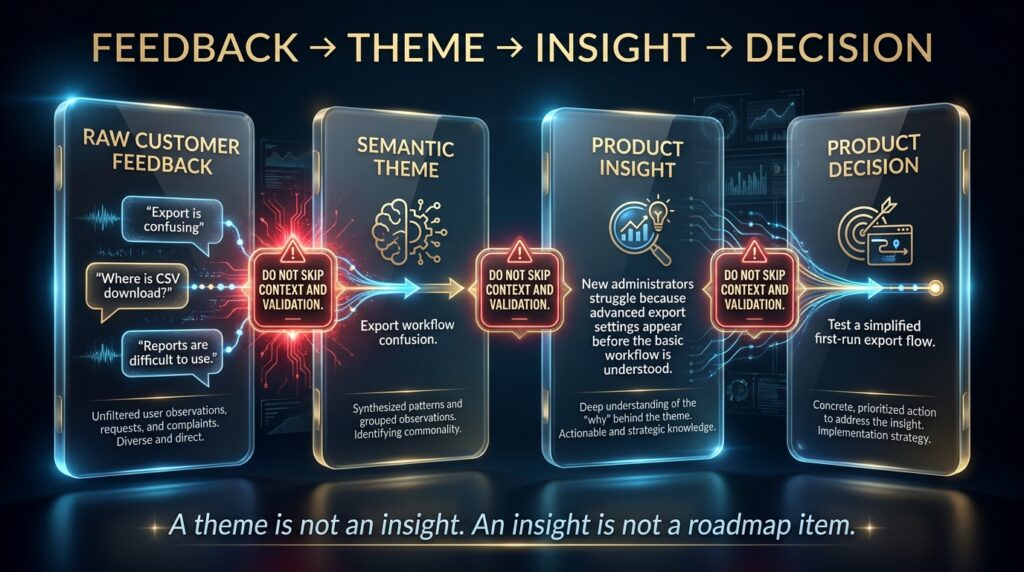
The most important distinction in AI feedback analysis is between four stages that dashboards often blur together. The AI Hustle World Feedback-to-Decision ladder separates them, using a single export problem as the example.
| Stage | Example | What it is | How much authority AI should have |
|---|---|---|---|
| Feedback | “I can’t figure out how to export my report.” | Raw evidence from one customer | High for capture and organization |
| Theme | “Export workflow confusion” across 140 comments | A pattern across many statements | Moderate, with human review of the cluster |
| Insight | New administrators struggle because advanced export settings appear before the basic path is clear | An interpretation supported by context | Low; AI can propose, people validate |
| Decision | Simplify the first-run export flow and move advanced settings to an optional step | An action with cost and trade-offs | None; product leadership decides |
AI can help at all four stages, but it should not hold the same authority at each one. The further a conclusion moves from raw evidence toward action, the more human validation it needs.
A theme is not an insight, and an insight is not a roadmap item. Teams that collapse the ladder, treating a detected theme as a decision, end up building features for problems they never confirmed.
Why Customer Feedback Is Hard to Analyze
The first obstacle is fragmentation. A single product problem can surface in a support conversation, a survey, a sales call, a review and a research interview, each with different context and vocabulary.
One customer writes “the report export is broken,” another says “I can’t download the data,” a third says “our finance team needs a different format,” and a fourth asks why the product will not connect to their accounting software. Keyword search sees four requests, while a semantic system may see that they are related.
The product team still has to decide whether those comments describe one underlying problem or several problems connected by the same workflow. That decision needs context the comments alone do not provide.
Customers also never use your internal product taxonomy. Your team may call something “report export configuration” while customers say “I can’t get my data out,” and mapping thousands of phrasings onto a shared set of concepts is one of the places AI helps most.
How the AI Feedback Insight Pipeline Works
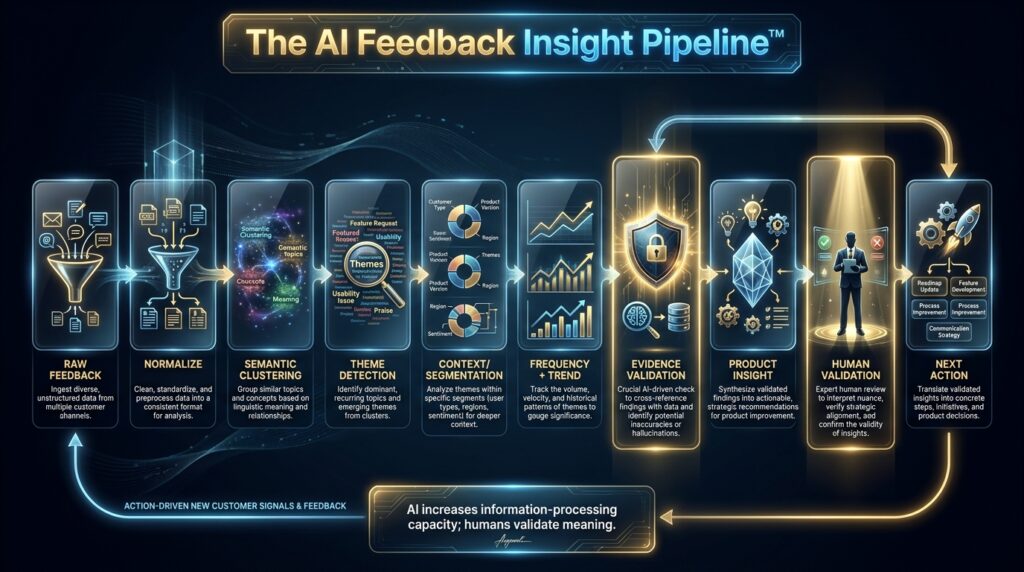
A reliable pipeline moves feedback through a sequence of steps, and each step solves a different problem. The AI Hustle World AI Feedback Insight Pipeline has ten stages, beginning with normalizing raw feedback by removing duplicates, spam and formatting noise.
The next stages cluster feedback by meaning, identify candidate themes and add context such as customer, segment, product area and lifecycle stage. The pipeline then measures frequency and trend and checks which segments are covered and how widely.
The final stages are the ones people skip. Inspect the original evidence behind each theme, form a product insight, validate it, and only then decide the next action.
AI performs the early stages at a scale no team can match, while the later stages require progressively more judgment. Notice what the pipeline does not contain: there is no step where AI output flows directly into “build feature.”
The usual output of good feedback analysis is a better question, a stronger hypothesis or a clearer product problem. Sometimes it justifies building, often it justifies more research, and sometimes it justifies doing nothing, which is still valuable when it prevents wasted engineering time.
Setting Up a Feedback Taxonomy
AI clustering works best on top of a small, stable taxonomy that the whole company shares. Without one, every team names themes differently, and the same problem appears under five labels in five dashboards.
A practical taxonomy has three parts: product area, feedback type and severity. Product areas mirror how your product is organized, types separate bugs, usability issues, missing capabilities and pricing concerns, and severity separates annoyances from blockers.
Keep it short enough that a support agent can apply it without training. Twenty to forty product areas is usually enough, and AI can suggest tags for each item while people correct the suggestions.
Review the taxonomy quarterly. Merge labels nobody uses, split labels that hide different problems, and record the changes so trend lines stay comparable over time.
Semantic Clustering and the Over-Clustering Problem
Semantic clustering groups feedback by meaning so that different expressions of a similar need can be analyzed together. “Export is confusing,” “where do I download the CSV?” and “I need a way to send these reports to finance” share few words but may point to overlapping needs.
Clustering systems convert each comment into a numerical representation of its meaning and group comments that sit close together. Our guide to how embeddings work explains the technique.
Clusters are candidate structure, not ground truth. A broad “checkout problems” cluster can hide payment failures, confusing pricing, missing payment methods, slow pages and tax errors, each needing a different fix.
The opposite failure is just as common, with AI producing 20 tiny themes that are different phrasings of one underlying need. The test for any cluster is whether it is useful for a product decision, not whether the algorithm produced a tidy category.
Human researchers have long used a disciplined version of this process. Nielsen Norman Group’s guide to thematic analysis describes tagging observations and quotes with codes, then condensing those codes into a manageable set of themes.
That review step is what keeps AI clustering honest. Treat the AI’s first-pass clusters as a draft that a researcher or product manager merges, splits and renames before anyone reports them as findings.
Sentiment Is a Signal, Not a Diagnosis
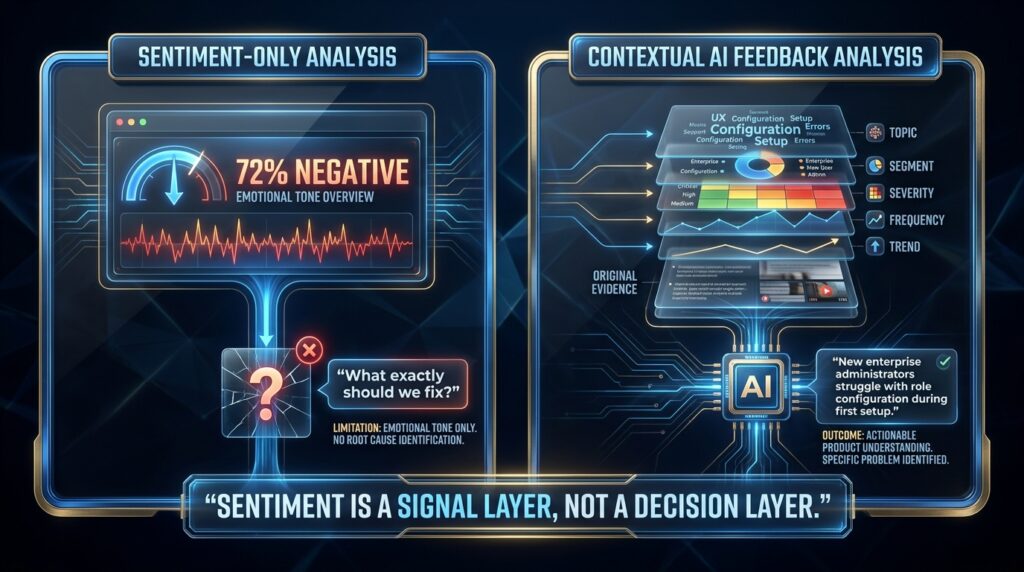
Sentiment analysis estimates the emotional tone of feedback, and it is useful as an early warning. It rarely tells you what action to take.
If an AI reports that 72% of 10,000 recent comments are negative, the next question is why. A release may have broken a key workflow, one feature may be confusing, an outage may have occurred or support response times may have slipped, and each cause needs a different response.
Qualtrics makes the same point in its guidance on analyzing unstructured customer feedback. Scores such as NPS, CSAT and CES can serve as early warnings but stop short of detailing the cause.
Qualtrics compares a scores-only dashboard to a thermometer that tells you there is a problem without telling you what it is. What closes the gap is context about the customer, their relationship with the business and what they have experienced.
Overall sentiment can also mislead directly. “This new dashboard is amazing. I hate how long it takes to load” contains a positive signal about value and a negative signal about performance, and a single label hides both.
Serious feedback systems therefore track topic, aspect, segment and severity alongside tone. Our guide to how AI finds themes, patterns and sentiment across conversations covers that approach.
Context, Denominators and Loud Customers
A theme becomes useful when it is connected to who experienced it, when, where and under what conditions. “Checkout friction” is vague on its own, but segmented it might look like this illustrative breakdown:
| Customer segment | Share of segment mentioning checkout friction |
|---|---|
| New users | 35% |
| Existing users | 4% |
| Enterprise accounts | 7% |
| Self-serve accounts | 29% |
The conclusion changes from “we have a checkout problem” to “we have a first-time, self-serve checkout problem,” which is far more actionable. A theme without context is often just a category.
Raw counts mislead in a second way, which we call the denominator problem. Five hundred complaints sound severe until you learn there are 100,000 active users, and fifty complaints sound minor until you learn they come from 50 of your 100 enterprise accounts.
Mention frequency, unique customers, segment coverage and business exposure are four different measures, and the last three are usually more useful. One customer who emails support, opens a ticket, tells their account manager and mentions the issue in a survey becomes four votes unless the system counts unique customers.
Connecting feedback to customer metadata and usage data makes these distinctions possible. Our guide on AI product data analysis explains how to join the two.
Loud customers are not always representative customers. One major account can generate 50 tickets and 20 emails while thousands of satisfied customers say nothing, and new users who abandon the product often leave no feedback at all.
An AI system will organize a biased dataset beautifully and produce better-organized bias. Before trusting any theme, ask whose voice is missing: churned customers, silent free users and people who gave up during onboarding rarely appear in the data.
Frequency also differs from importance. If 800 users request dark mode and 30 enterprise administrators report a permissions failure that blocks deployment, frequency points one way and business exposure points the other.
AI can tell you what people are asking for, but it cannot decide what the business should prioritize. That decision belongs to a separate process, covered in our guide to AI roadmap prioritization.
Combining Feedback With Usage Data
Feedback tells you what customers say, and usage data tells you what they do. The strongest insights come from checking one against the other.
If 200 customers complain that exporting is confusing, the usage data can show how many people start an export and abandon it, where in the flow they stop and whether the problem is concentrated in one plan or region. That turns a qualitative theme into a measured problem.
The combination also catches silent problems. A step where many users drop off but few complain may matter more than a loudly discussed feature, because the people affected have simply left.
Joining the two requires shared customer or account identifiers and careful privacy handling. It is worth the setup effort, because triangulated evidence is far harder to misread than either source alone.
Trends: Early Warning and False Alarms
One of AI’s strongest advantages is continuous monitoring for themes that are growing. A theme with 5 mentions in January, 11 in March and 47 in June is not the largest in the dataset, but it has grown more than ninefold in six months.
A quarterly manual review might notice that curve late or not at all. A continuous system can flag it the month it starts bending, which turns feedback analysis into early product sensing.
Trend detection creates its own false alarms. A theme can spike because one customer had a major incident, a social post went viral, a release briefly broke something, duplicate tickets were created or a support process changed how issues are logged.
The AI may correctly detect a 500% increase in mentions while the product manager still has to decide whether the pattern reflects a durable problem. A trend should trigger an investigation, not an automatic roadmap change.
Symptoms, Causes and Insight Hallucination
Customer statements usually describe symptoms, and AI can cluster symptoms far more easily than it can establish causes. “The export button is broken” might mean the button fails, is hard to find, is blocked by permissions, is slow, produces an unusable format or belongs to a workflow the customer does not understand.
A team that clusters hundreds of such comments and builds a new export system may solve the wrong problem. If the cause is a permissions configuration issue, the new feature changes nothing for the customers who complained.
This leads to a subtler risk than factual AI hallucination, which we call insight hallucination: a plausible explanation that goes beyond the evidence supporting it. Every underlying comment is real, yet the system has moved from observation to interpretation without enough evidence.
Because it reads like sophisticated product thinking, insight hallucination is harder to catch than a made-up fact. The defense is an evidence trail for every important insight.
Suppose the AI reports that enterprise administrators are struggling with role configuration. A trustworthy output would show the theme (permission complexity), the evidence (47 conversations), the segment, the time period (60 days), the sources and a confidence level.
Now the team can challenge it. If 35 of the 47 conversations came from three customers, the interpretation changes, and if 40 began after a specific release, it changes again.
The Product Feedback Evidence Chain
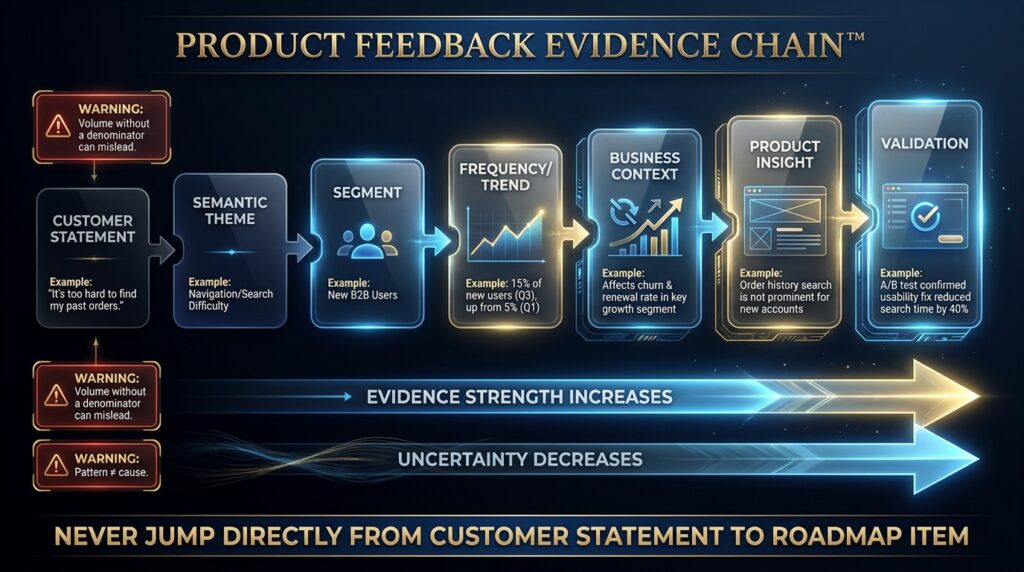
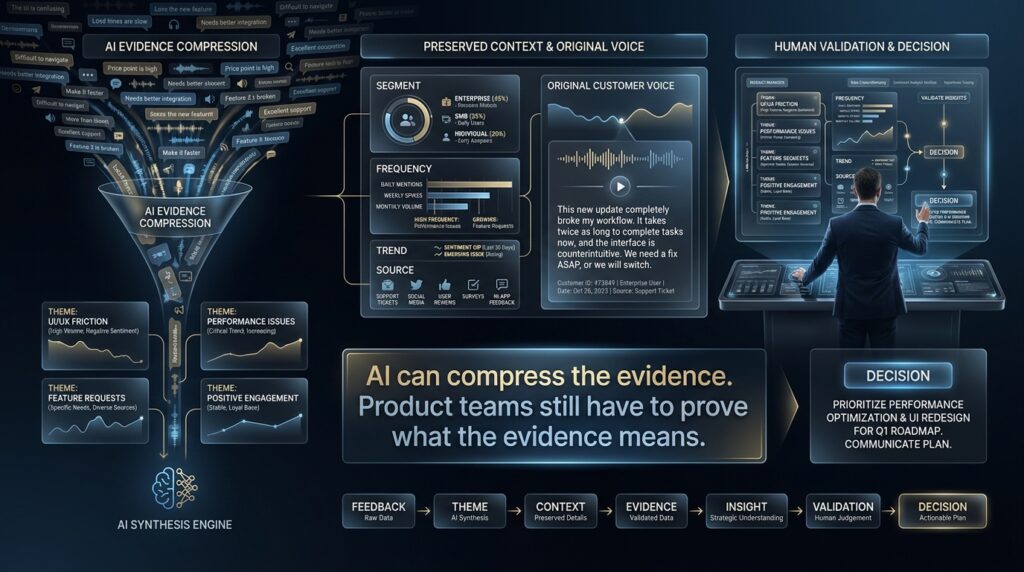
The AI Hustle World Product Feedback Evidence Chain is a discipline for the middle of the process: customer statement, semantic theme, segment, frequency and trend, business context, product insight and validation. Its rule is to never jump directly from a customer statement to a roadmap item.
A strong insight produced by that chain answers five questions: what is happening, who experiences it, what proves it, under what conditions it occurs and why it matters. Most weak insights fail on the third question.
Here is an example that meets the standard: “New enterprise administrators struggle with role configuration because advanced permission concepts appear before they understand the default setup. The issue appeared in 31 of 42 recent enterprise onboarding interviews and in related support conversations.”
Compare that with “users dislike permissions.” The first statement creates a path for investigation, while the second is only a label.
A Worked Example: From 3,000 Tickets to One Validated Insight
A worked example shows the chain in practice. A B2B analytics company receives about 3,000 support tickets, 400 survey comments and 60 sales-call notes in a quarter, and its product team wants to know what is hurting retention.
The AI pipeline deduplicates the data, clusters it and proposes 38 themes. A product manager and a researcher spend an afternoon merging and splitting them into 14, and they discard four that turn out to describe a single outage.
One theme stands out: “report sharing friction,” with 260 mentions. The denominator check shows that 70% of those mentions come from accounts in their first 60 days, and the segment check shows they are concentrated among customers who invite finance colleagues.
The evidence trail reveals a symptom and a candidate cause. Customers say “sharing is broken,” but the underlying comments show that invited finance users cannot see reports because their default role lacks view permission.
The team rates the insight medium confidence, runs five short interviews with new accounts and watches three onboarding sessions. The cause is confirmed, and the fix is a change to default permissions plus one onboarding step, which takes a week rather than the quarter a rebuilt sharing feature would have taken.
The team then watches the same evidence to confirm the fix worked. Mentions of sharing friction from new accounts should fall over the next month, and the share of invited finance users who open a shared report should rise.
If those numbers do not move, the insight was incomplete and the loop starts again. Validation after the change is as important as validation before it, because it tells the team whether its understanding of the problem was right.
The Insight Confidence Model
Not every AI-generated pattern deserves equal trust, and the AI Hustle World Insight Confidence Model gives teams three practical levels. It is an evidence-strength classification for product decisions, not a statistical confidence interval.
| Confidence | Evidence pattern | Recommended action |
|---|---|---|
| High | Multiple independent sources, consistent pattern, meaningful segment coverage, directly traceable evidence | Act, or test a solution directly |
| Medium | Clear pattern, but limited sample, segments or source diversity | Investigate further before committing |
| Low | Small sample, one source or an interpretation that needs validation | Do not prioritize yet; keep monitoring |
The model also changes how teams use AI output. When the AI reports that enterprise users struggle with permissions, a weak workflow stops there.
A stronger workflow asks which users, which permissions, at what stage, whether the issue is discoverability or capability, whether it began after a release and how many organizations are affected. AI has done its job when it improves the starting point for that human investigation.
From Feature Requests Back to Customer Needs
One of AI’s most useful product applications is finding the need underneath a requested solution. A customer asks for a Slack integration, but the need may be notifications where their team already works, which email, webhooks or in-app alerts could also meet.
Semantic analysis can discover that “Slack integration,” “send alerts to our team chat” and “our managers don’t check the app” all point to the same need for external workflow visibility. That reframing often opens cheaper and better solutions than the one customers requested.
Framing requests this way fits established discovery practice. Teresa Torres’s opportunity solution tree separates desired outcomes, customer opportunities and possible solutions, which is exactly the separation AI can help populate at scale.
The product manager still decides whether the interpretation is correct and which solution fits. Our guides on AI product discovery and using AI for PRDs and user stories cover the steps that follow once a need is confirmed.
Multimodal Feedback and Data Governance
Customer feedback increasingly arrives as screenshots, screen recordings, call audio, photos and documents, and multimodal AI can analyze all of them. A screenshot attached to “the page looks broken” can reveal a specific interface collision in seconds.
Recorded sales calls capture objections that never reach a written note. Conversation intelligence tools, covered in our explainer on AI conversation intelligence, already turn many of these recordings into searchable evidence.
The larger the insight surface, the larger the governance surface. Screenshots can be misread, voice recordings contain sarcasm, and uploaded documents may include personal or confidential information.
Product teams need clear rules on consent, access control, redaction, provenance and retention before feeding recordings into AI systems. Our guide to AI data retention lists the questions to ask vendors.
Feedback in Multiple Languages
Global products receive feedback in many languages, and AI makes it possible to analyze all of it together. Most pipelines translate comments into one working language before clustering, which lets a complaint in Spanish and one in German land in the same theme.
Keep the original text alongside the translation. Reviewers who read the source language can catch nuance the translation lost, and the evidence trail should always lead back to what the customer wrote.
Watch sentiment and severity in particular. Politeness norms differ across cultures, so a mild-sounding complaint in one language may signal the same frustration as a blunt one in another.
Segment themes by region as well as by customer type. A problem concentrated in one market often has a local cause, such as a payment method, a regulation or a translation error in the product itself.
Questions to Ask a Feedback Analysis Vendor
Vendor demos use clean sample data, so bring written questions and ask for answers on your own feedback. These questions separate mature tools from impressive dashboards:
- Can every theme and insight be traced back to the original customer comments?
- Can we merge, split and rename clusters, and does the system learn from those edits?
- How are duplicates and repeat reporters counted?
- Can feedback be joined with our usage data and customer segments?
- How are personal data, redaction and retention handled?
- Is our data used to train your models?
Clear answers to the traceability and data questions matter most. A tool that cannot show where an insight came from will eventually produce a confident conclusion nobody can defend.
Who Owns What in an AI Feedback System
AI feedback systems fail most often when nobody owns the steps between detection and decision. Clear ownership is cheap to set up and prevents most of the problems in this guide.
Support or customer operations usually owns data capture: tagging channels, keeping metadata clean and flagging incidents that could distort trends. Research owns cluster review and evidence standards, deciding when a theme is solid enough to report.
Product managers own interpretation and the next action, including the decision to investigate, test or ignore. Data or analytics teams own the joins between feedback and usage data, so denominators and segments stay accurate.
Leadership owns one thing that is easy to forget: making sure validated insights change decisions. A feedback system that produces excellent findings nobody acts on is an expensive dashboard.
Running a Weekly Feedback Review
A short weekly review turns AI output into decisions. Thirty minutes is enough if the preparation is done by the system and one owner.
Start with the fastest-growing themes and any new high-severity items, then look at one theme in depth by reading ten original comments behind it. Reading the raw evidence every week keeps the team honest about what the clusters mean.
End every review with a decision for each theme discussed: investigate, test, fix, monitor or ignore, with an owner and a date. Record those decisions in a simple log so you can later see which insights led to action and what happened.
Over a few months, the log becomes one of the most useful artifacts the product team has. It shows how evidence moved into decisions and which kinds of themes tend to be real.
Closing the Loop With Customers
Customers give better feedback when they see it used. Telling people that a problem they reported has been fixed builds trust and encourages more specific reports next time.
AI makes this practical at scale. If every ticket, comment and call note is linked to a theme, you can notify everyone who reported a problem when the fix ships, without anyone searching inboxes by hand.
Closing the loop also improves the data. Customers who know their feedback matters tend to explain context more fully, which makes clustering and cause analysis more accurate.
Keep the messages honest and specific. “We changed the default permissions for invited finance users, which was causing the sharing issue you reported” is far more credible than a generic “thanks for your feedback.”
Where Feedback Analysis Tools Are Heading
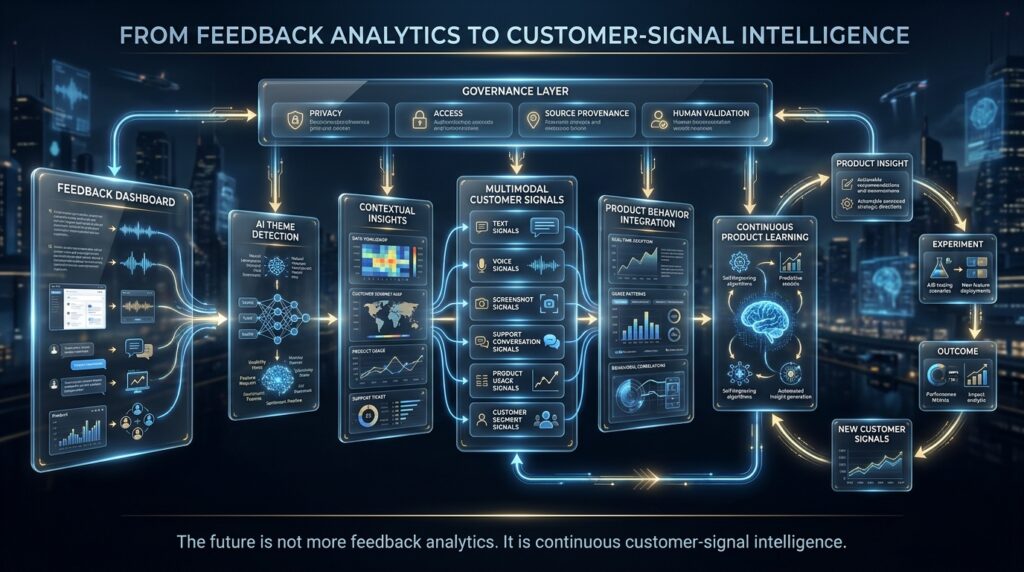
Commercial platforms are converging on the same idea from different starting points. Productboard starts from the roadmap, connecting categorized feedback and trends to feature ideas and product decisions.
Dovetail starts from research knowledge, positioning itself as a customer intelligence platform that analyzes calls, support tickets, surveys, app reviews and research in one workspace. Intercom starts from the support conversation, and its documentation on AI insights for customer service describes analyzing conversations at scale to find areas to improve.
Amplitude starts from product analytics, and its AI Feedback launch describes turning raw feedback into prioritized insights connected to behavioral data. These descriptions are vendor claims rather than independent benchmarks.
The shared direction is feedback combined with product behavior, segmentation and outcome tracking, which we call customer-signal intelligence. When you compare tools, AI Hustle World uses its site-wide W.O.R.T.H. checklist.
Workflow fit (25 points) covers connections to your support, CRM, research and analytics systems, and Output quality (25) covers cluster accuracy, traceability and segmentation on your own data. Risk and rights (15) covers consent, redaction, access and retention, Total cost (20) covers licenses, setup and curation, and Human effort (15) covers the time spent correcting and validating themes.
Our comparisons of the best AI product management tools and AI conversation intelligence tools are good starting shortlists. Test every candidate on a month of your own feedback before you commit.
The Cost of Getting Feedback Analysis Wrong
The expensive failure in feedback analysis is rarely the software bill. It is the engineering time spent building a feature for a problem the evidence never supported.
As an illustration, a team of six engineers spending a quarter on a rebuilt export system represents months of salary, plus the opportunity cost of everything else they could have shipped. If the underlying cause was a permissions default, all of that effort misses the customers who complained.
Missed signals cost money too. A fast-growing theme that nobody notices until renewal season can turn into churn that analysis would have caught months earlier, when the fix was small.
Those two risks frame the return on AI feedback analysis. The value comes from catching real problems earlier and avoiding confident investments in the wrong ones, which is why traceability and validation matter more than the number of comments processed.
Measuring Whether Feedback Analysis Works
A vendor that says its AI analyzed one million comments has told you about volume, not value. The questions that matter are what the team learned and which decisions changed.
Useful measures include coverage, insight quality, evidence traceability, decision impact and outcome impact. Together they show whether the system finds meaningful patterns, lets people inspect them and changes what the team does.
The most useful single measure is validated learning: how many meaningful product uncertainties were reduced because of customer evidence. “Customers seem unhappy with onboarding” becoming “the problem is concentrated among first-time administrators during role setup” is a measurable reduction in uncertainty.
Track false positives and missed themes too. Periodically compare AI themes with a manual review of a random sample, so you know how much the system gets wrong and what it overlooks.
A 90-Day Implementation Plan
In the first 30 days, build the evidence layer. Centralize the highest-value sources, usually support, interviews, surveys, sales notes and in-app feedback, and clean out duplicates, spam and irrelevant entries.
Add metadata for customer, segment, product area, date and lifecycle stage, because every later analysis depends on it. The first problem to solve is visibility, not perfect AI.
In days 31 to 60, introduce AI clustering, summarization, classification, trend detection, segmentation and evidence retrieval. Make source traceability a requirement for any insight shared outside the product team.
Review the first round of clusters manually and adjust them before anyone reports them as findings. Expect the first month of clusters to need heavy editing.
In days 61 to 90, connect insights to product learning. For the highest-confidence themes, write explicit hypotheses and move them through investigation, prototyping and testing.
Measure decisions influenced, time saved, false positives, missed themes and the outcomes that followed. By the end of the quarter, feedback analysis should work as a product-learning system rather than another dashboard.
What Happens If You Do Nothing
Doing nothing means your product decisions keep relying on the small, loud slice of feedback someone had time to read. Important signals stay buried in support tickets and sales notes that nobody connects.
The costs appear slowly. Churn rises from problems that were visible in the data for months, roadmaps drift toward whoever shouts loudest, and research teams burn out trying to read everything by hand.
Competitors that analyze feedback well will also move faster. They spot friction earlier, fix it cheaply and learn which features matter before you do.
The first step does not have to be a large platform. Centralizing two or three feedback sources with basic metadata and reviewing AI-suggested themes weekly will show quickly how much you were missing.
Common Mistakes and the AI Hustle World View
Most failures in AI feedback analysis come from skipping the middle of the evidence chain. Watch for these:
- treating sentiment as insight, when a negative score does not explain why
- counting feature requests as votes, so the loudest request wins by default
- ignoring denominators, so mentions are mistaken for population coverage
- trusting AI clusters without review, although similar wording does not prove a shared cause
- letting AI infer causality from patterns it can only describe
- losing the original evidence, which makes summaries impossible to challenge
- ignoring sampling bias in who gives feedback and who stays silent
- turning every insight into a feature instead of research, a test or no action
The market says AI turns customer feedback into actionable product insights, and that is directionally true. The phrase hides three jobs: AI is excellent at compressing feedback, very useful at surfacing patterns and helpful at forming hypotheses.
The harder question, whether the evidence justifies the interpretation, still needs a person. We would not design a feedback system around the promise that AI will tell the team what to build; the stronger promise is that AI makes it much harder for important customer signals to disappear.
Is AI Feedback Analysis Right for Your Team?
If you run a high-volume SaaS or consumer product with thousands of tickets and reviews each month, a B2B platform with several customer segments, or a product-led company that can join feedback with usage data, AI feedback analysis will surface patterns you are missing. It also helps distributed product organizations that need one shared view of customer signals.
Start with the channels you already trust and build traceability in from day one. Expand to more sources only when the first ones produce insights the team uses.
If you have 20 meaningful customer conversations a month, you probably do not need an advanced system. A product manager who reads those conversations closely will usually learn more than an AI that turns them into 12 neatly named themes.
Our comparison of AI conversation analysis and manual research explains where the crossover point tends to sit. Be more cautious as well if your segments are undefined, your metadata is poor or nobody owns insight validation.
How We Researched This Guide
This guide was researched and drafted with AI assistance and checked against the primary sources linked in the article. Descriptions of Productboard, Dovetail, Intercom and Amplitude come from those companies’ own pages and press releases, and are labeled as vendor claims.
Methodological references come from Qualtrics’ guidance on unstructured feedback, Nielsen Norman Group’s guide to thematic analysis and Teresa Torres’s work on opportunity solution trees. We did not run a hands-on test of a feedback analysis platform, and no benchmark result is claimed.
The numerical examples, including the segment table, trend figures, worked example and cost illustration, are illustrative. The Feedback-to-Decision ladder, AI Feedback Insight Pipeline, Product Feedback Evidence Chain, Insight Confidence Model and W.O.R.T.H. adaptation are AI Hustle World analysis.
Last updated September 2026. This version restructures the guide, adds the worked example, ownership, cost and do-nothing sections, re-checks each source and removes a research citation we could not access to verify.
Final Thoughts: AI Hears More Customers, Product Teams Still Decide
A team that once struggled to read 500 comments can now process tens of thousands, group similar language, detect emerging issues, compare segments and retrieve the original conversation behind any theme in seconds. Teams that ignore these capabilities will miss signals their competitors catch.
A product team does not need more feedback, though; it needs better evidence. Five thousand comments can be less useful than 200 well-contextualized conversations, and a beautifully written AI insight can contain an interpretation the evidence does not support.
That is why the workflow needs structure: capture the customer voice, group it by meaning, add context, measure frequency and trend, check who is represented, inspect the original evidence, and only then form the insight. The final boundary sits between insight and decision, where the right next step may be an interview, a test, a small fix or nothing at all.
Judge your feedback system by how much product uncertainty it removes, not by how many insights it generates. AI can compress the evidence. Product teams still have to prove what the evidence means.
Turn Customer Feedback Into Better Product Decisions
AI can help product teams process thousands of customer conversations, identify recurring themes, detect emerging problems and connect feedback across channels.
Explore AI for PRDs & Product Specs →FAQ
How does AI turn customer feedback into product insights?
AI groups feedback by meaning, adds context such as segment and product area, tracks trends and links each theme to the original comments. The product team then validates the pattern and decides what to do.
What sources can AI analyze for customer feedback?
Support tickets, chats, surveys, NPS and CSAT comments, interviews, sales notes, reviews, community posts and in-app feedback. Many tools also handle screenshots and call recordings, subject to consent rules.
What is semantic clustering?
Grouping comments by meaning rather than exact keywords, so customers who describe the same problem differently are analyzed together. People should review clusters, because similar wording does not always mean the same cause.
Is sentiment analysis enough to understand customer feedback?
No. Sentiment is an early warning that something is wrong, but it rarely explains the cause. Useful analysis also tracks topic, aspect, segment and severity.
What is the difference between feedback and a product insight?
Feedback is what a customer says. A product insight is a validated interpretation of a pattern across feedback that explains what is happening, who is affected and why it matters.
What is insight hallucination?
When AI produces a plausible explanation that goes beyond what the customer evidence supports. The defense is an evidence trail back to the original customer statements.
Should every feedback mention count as a vote?
No. One customer can report an issue through several channels, and vocal customers can dominate the data. Count unique customers and segment coverage, not raw mentions.
Can AI tell a product manager what to build?
AI can propose hypotheses and reveal needs behind feature requests, but build decisions depend on strategy, cost and trade-offs the feedback does not contain. Those decisions stay with the product team.
How should teams measure AI feedback analysis?
Measure insight quality, traceability, false positives, missed themes and decisions influenced. The best summary measure is how much product uncertainty the analysis removed.
When is AI feedback analysis not worth it?
When feedback volume is small, reading every conversation usually teaches more. It is also premature when segments are undefined, metadata is missing or nobody owns validation.
Related Guides
- How AI Analyzes Customer Feedback, Calls & Interviews at Scale
- How AI Finds Themes, Patterns & Sentiment Across Conversations
- How AI Interview Analysis Works: Transcripts, Themes & Insights
- AI Product Discovery: How to Use AI for Competitive Research and Market Analysis
- AI Conversation Analysis vs Manual Research: Where AI Actually Adds Value
Written by
Muntasir Ahmad Chowdhury
Founder, AI Hustle World
Muntasir Ahmad Chowdhury is the Founder of AI Hustle World, an independent publication dedicated to making Artificial Intelligence practical, trustworthy, and easy to understand. He researches AI tools, automation, customer service, productivity, and real-world business applications, helping readers make smarter technology decisions through research-driven, experience-backed content.
Expertise:
AI Tools • AI Automation • AI Customer Service • AI Productivity • Generative AI • AI Workflows
Get Smarter With AI
Enjoyed this guide? Get practical AI tools, tutorials, and honest reviews delivered to your inbox.