Evidence: Documentation reviewed
Last checked: August 2026
What was done: Written from official documentation and the published sources linked in this article. Not hands-on tested.
Files: None
Affiliate links: Yes
How AI Analyzes Customer Feedback, Calls & Interviews at Scale
Affiliate Disclosure: This article contains affiliate links. If you sign up through our links, we may earn a commission at no additional cost to you. We only recommend tools based on their relevance, capabilities, limitations, and potential value for the use case discussed.
Customer feedback is one of the richest sources of business intelligence a company already owns, yet much of it remains practically unusable because it arrives as unstructured conversations, survey comments, support tickets, interview recordings, reviews, emails, and chat transcripts. A customer may explain exactly why they are frustrated during a support call, reveal an unexpected product problem during an interview, or mention a competitor during a sales conversation, but those insights are difficult to connect when every source lives in a different system.
AI changes the economics of that analysis. Instead of asking a researcher or customer-experience team to manually read, listen to, code, summarize, and compare every interaction, AI can process large volumes of qualitative information, convert conversations into searchable evidence, identify recurring themes, classify sentiment, extract entities and topics, and help researchers compare patterns across customers and time.
But there is an important distinction: AI does not turn customer feedback into truth automatically. It turns a large body of messy evidence into a much more searchable and analyzable evidence base. The quality of the final insight still depends on the quality of the source data, the analytical method, the context surrounding each statement, and the human judgment used to validate the conclusions.
That distinction is what makes AI customer-feedback analysis valuable at scale. The goal is not simply to produce thousands of summaries. The goal is to discover patterns that would otherwise remain hidden because nobody has the time to examine the entire customer voice systematically. Core idea: The real advantage of AI feedback analysis is not understanding one conversation faster. It is understanding thousands of conversations as one connected evidence base.
What Is AI Customer Feedback Analysis?
AI customer feedback analysis is the use of artificial intelligence, natural-language processing, speech-to-text, semantic analysis, and related techniques to organize and interpret large volumes of customer comments and conversations. If you are new to the topic, start with AI conversation intelligence explained.
The input can include open-ended survey responses, NPS and CSAT comments, support tickets, customer-service calls, sales calls, user interviews, focus groups, reviews, chat transcripts, emails, product feedback, and recorded video responses. Modern platforms can combine several of these sources so that teams are no longer forced to analyze each channel independently.
The output is more than a summary. Depending on the system, AI can identify themes, topics, keywords, entities, sentiment, recurring complaints, feature requests, customer motivations, competitive mentions, and changes in those patterns over time. The important transformation is from unstructured customer language into structured evidence that can be searched, compared, measured, and reviewed.
This is especially important because customers rarely describe the same problem using identical words. One customer might say that an application is “laggy,” another might say that “the dashboard takes forever,” while a third might complain that they “wait 30 seconds every time.” A simple keyword system can treat these as different observations. Semantic AI can recognize that they may represent the same underlying problem. Current customer-feedback platforms increasingly combine theme discovery, sentiment analysis, categorization, trend analysis, and source-level traceability rather than treating summarization as the entire job.
Test It on a Batch of Real Feedback
Upload a set of customer calls, surveys or comments and see which themes the analysis surfaces first.
Analyze Feedback With Speak AI →Affiliate disclosure: We may earn a commission if you subscribe through this link, at no additional cost to you.
Why Customer Feedback Becomes Difficult to Analyze at Scale
The problem is rarely that a company lacks feedback. The problem is that feedback arrives faster than people can meaningfully analyze it.
Imagine a company receives 20,000 support interactions in a quarter, conducts 150 customer interviews, collects 30,000 survey comments, and has thousands of product reviews and chat conversations. A team could sample a portion of that material, manually tag selected comments, and produce a report, but the resulting picture may depend heavily on which conversations were selected and which patterns the analysts happened to notice.
Manual analysis exists for a good reason. Human researchers are capable of understanding context, ambiguity, sarcasm, contradictions, intent, and unusual language in ways automated systems can struggle with. The problem is that human attention does not scale linearly with data volume.
If one researcher can carefully analyze 100 conversations, doubling the dataset does not automatically give you twice as much analytical capacity. Eventually the organization begins sampling, skimming, batching, or postponing analysis. At that point, important evidence can become invisible simply because it arrived in the wrong channel or at the wrong time. AI attacks the volume problem rather than eliminating the judgment problem. That is the fundamental distinction.
The Difference Between Summarizing Feedback and Analyzing It
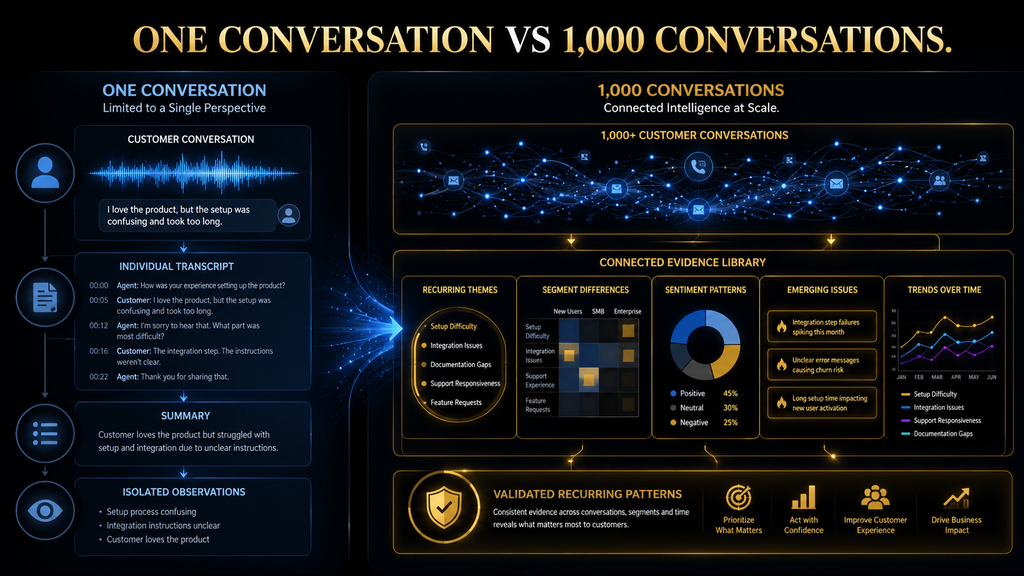
A summary tells you what a conversation contains. Analysis tries to determine what the broader body of conversations means. Suppose a customer-success team has 500 recorded calls. An AI summary might tell you that one customer complained about onboarding, another discussed integration, and another asked for better reporting. Useful, but limited.
A true analysis layer asks a different set of questions: How often does onboarding appear? Which customer segments mention it most? Is onboarding associated with negative sentiment? Did the issue increase after a product release? Are enterprise customers describing a different problem from smaller customers? What specific evidence supports the pattern? That shift from individual summaries to cross-conversation intelligence is where scale becomes strategically important. The difference can be expressed simply:
| Individual analysis | Scale analysis |
|---|---|
| What did this customer say? | What are customers saying repeatedly? |
| What happened in this call? | What patterns appear across calls? |
| What was this interview about? | Which themes recur across interviews? |
| Was this conversation positive or negative? | Which topics are associated with positive or negative sentiment? |
| What did one customer request? | Which requests appear across segments? |
| What does this transcript contain? | What changed across time? |
A company that only summarizes individual conversations can become very efficient at producing information without becoming substantially better at making decisions. Scale analysis is different because it creates a comparison layer.
The AI Customer Intelligence Workflow
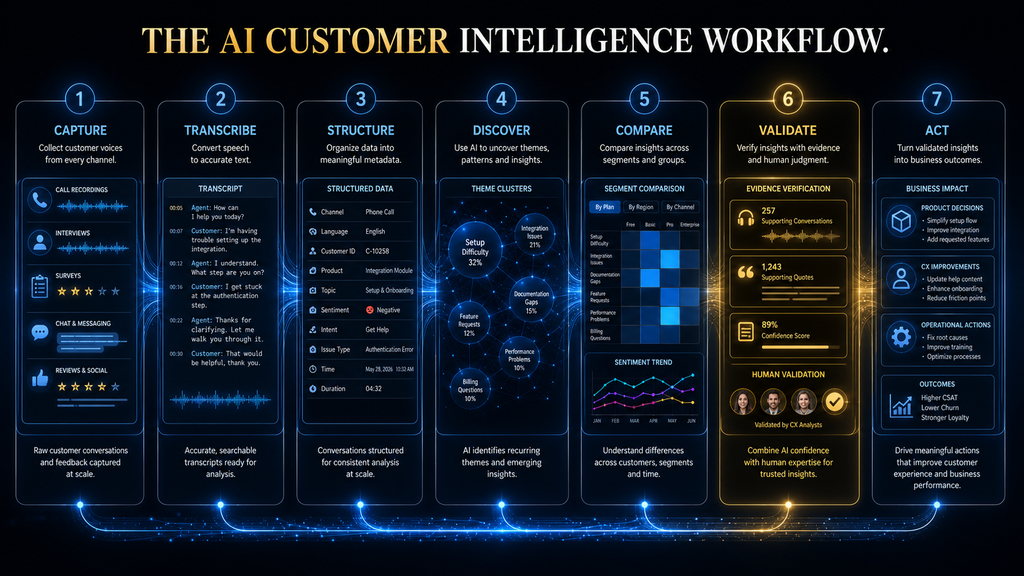
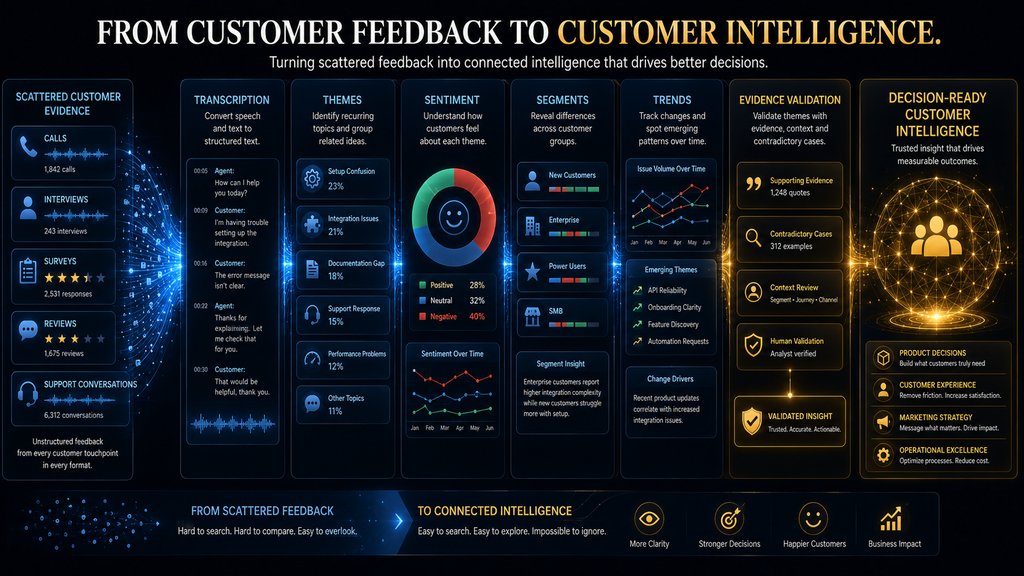
A useful way to understand the technology is as a connected pipeline: Capture → Transcribe → Structure → Discover → Compare → Validate → Act
The stages are connected because each one creates the evidence required by the next. A transcript without structure is searchable but difficult to analyze systematically. Themes without source evidence are difficult to trust. Trends without segmentation can be misleading. Insights without validation can turn into confident but unsupported conclusions.
1. Capture the Customer Evidence. The first step is bringing the relevant customer evidence into an analyzable environment. That might mean importing support-call recordings, customer interviews, survey exports, NPS comments, product feedback, chat logs, sales conversations, reviews, or other qualitative material. The objective is not necessarily to collect everything immediately. It is to create a sufficiently representative evidence base for the business question being investigated.
This matters because channel selection can influence the conclusions. Customers who complain through support may describe different problems from customers who respond to an NPS survey. Sales conversations may reveal objections that never appear in product reviews. User interviews may expose motivations that structured surveys were never designed to capture. A useful analysis therefore begins by asking not only “What data do we have?” but also “Which parts of the customer experience does each source represent?”
2. Transcribe Calls and Interviews. For audio and video conversations, transcription creates the first major transformation: spoken customer experience becomes searchable text. A transcript can preserve the words spoken by participants, identify speakers, and in some systems associate statements with timestamps. That makes it possible to search across hundreds or thousands of recordings without manually opening every file. Transcription is therefore not the insight itself. It is the infrastructure that makes deeper analysis possible.
A customer saying, “We almost cancelled because the integration kept failing,” becomes searchable evidence. Once that sentence exists as structured text, an analytical system can identify terms related to cancellation, integration, failure, or customer risk and connect that statement with similar evidence elsewhere.
The quality of the transcript matters considerably. Poor audio, overlapping speakers, accents, technical terminology, background noise, and multiple languages can introduce errors that later analytical systems may treat as genuine customer language. A sophisticated workflow therefore treats transcription accuracy as an upstream quality-control issue rather than assuming that everything downstream will automatically correct it.
3. Structure the Raw Feedback
Once the feedback has been converted into text, AI can begin adding structure. This may include speaker identification, keywords, topics, named entities, categories, sentiment signals, timestamps, customer segments, product names, competitor mentions, and other metadata. The purpose is to create analytical dimensions that allow a large body of qualitative information to be filtered and compared. For example, imagine that 5,000 customer conversations contain references to a particular product feature. Instead of manually finding every mention, an AI-assisted system can identify those references and allow analysts to investigate the surrounding context.
This is where customer feedback begins to resemble a dataset rather than a pile of documents. But structured fields should not be mistaken for complete understanding. A customer mentioning “pricing” does not automatically mean pricing is their primary problem. The surrounding conversation still determines whether the customer is complaining about cost, asking about billing, comparing competitors, or simply explaining why they selected a particular plan. Structure makes analysis faster. Context makes analysis meaningful.
How AI Finds Themes Across Customer Conversations
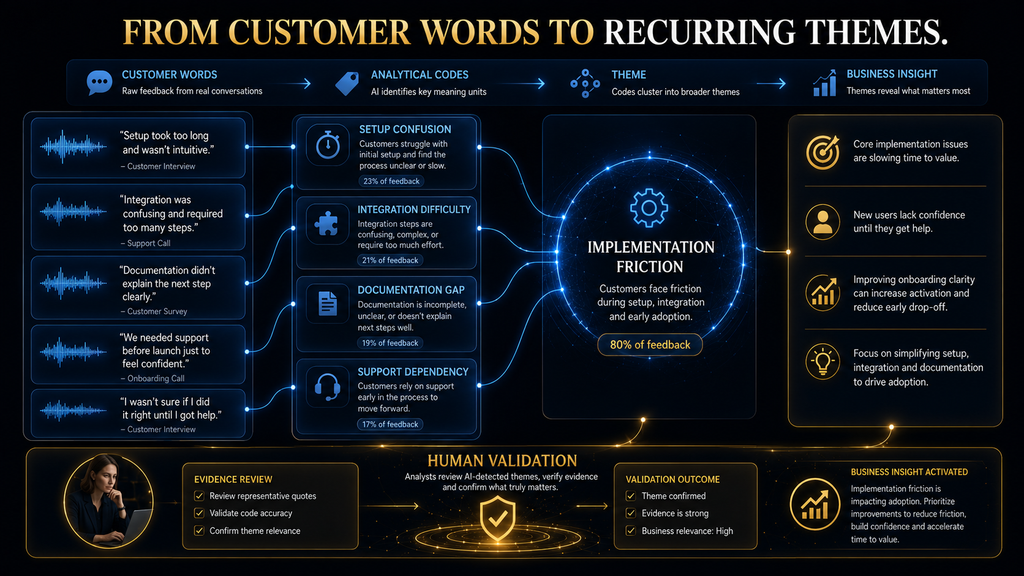
Theme detection is one of the most important capabilities in large-scale qualitative analysis because customers rarely use identical language to describe the same underlying experience. Imagine these statements: “Setup took longer than expected.” “We couldn’t figure out the integration.” “The documentation didn’t tell us what to do next.” “We had to contact support before we could launch.” A keyword-based system might treat these as several unrelated observations. Semantic analysis can recognize that they may represent a broader theme such as implementation friction or onboarding uncertainty. Our guide to how AI finds themes, patterns and sentiment across conversations goes deeper on the method.
The analytical hierarchy is therefore more useful when viewed as: Words → Topics → Codes → Themes → Patterns → Insights A keyword is a signal. A theme is a recurring concept supported by multiple pieces of evidence. This distinction matters because businesses often make the mistake of treating the most frequently mentioned word as the most important customer problem. Frequency is useful, but it is only one dimension of importance.
A theme appearing 2,000 times might represent a minor annoyance that rarely affects retention. Another theme appearing 200 times might be concentrated among high-value enterprise customers and strongly associated with cancellations. The second issue could be strategically more important despite being mentioned less often. That is why strong feedback analysis combines frequency with context, segment, sentiment, severity, business impact, and evidence quality.
Sentiment Analysis: Useful Signal, Dangerous Shortcut
AI sentiment analysis can classify customer language according to positive, negative, neutral, or more granular emotional signals. It can also allow organizations to track how sentiment changes across topics, segments, channels, or time periods. This is valuable because a theme by itself does not tell you how customers feel about it.
Suppose “mobile app” appears in 4,000 conversations. That number alone is not particularly informative. If the majority of those mentions are positive, the product team might be looking at a strength. If the mentions are overwhelmingly negative, the same frequency could represent a major problem. Sentiment adds another analytical dimension.
However, sentiment should be treated as a signal rather than a verdict. Sarcasm, mixed emotions, cultural differences, polite complaints, conversational context, and domain-specific language can all produce misleading classifications. Current customer-feedback guidance also emphasizes that human review remains important for nuanced interpretation and validation. Consider a customer saying: “Fantastic. It only took us three weeks to get the system working.” A surface-level classifier might interpret “Fantastic” as strongly positive. A human researcher immediately recognizes that the statement may be sarcastic.
The right question is therefore not “Can AI detect sentiment?” It can provide useful sentiment signals. The better question is “How much confidence should we place in that signal for this particular decision?”
Why Segment Analysis Makes AI Feedback More Valuable
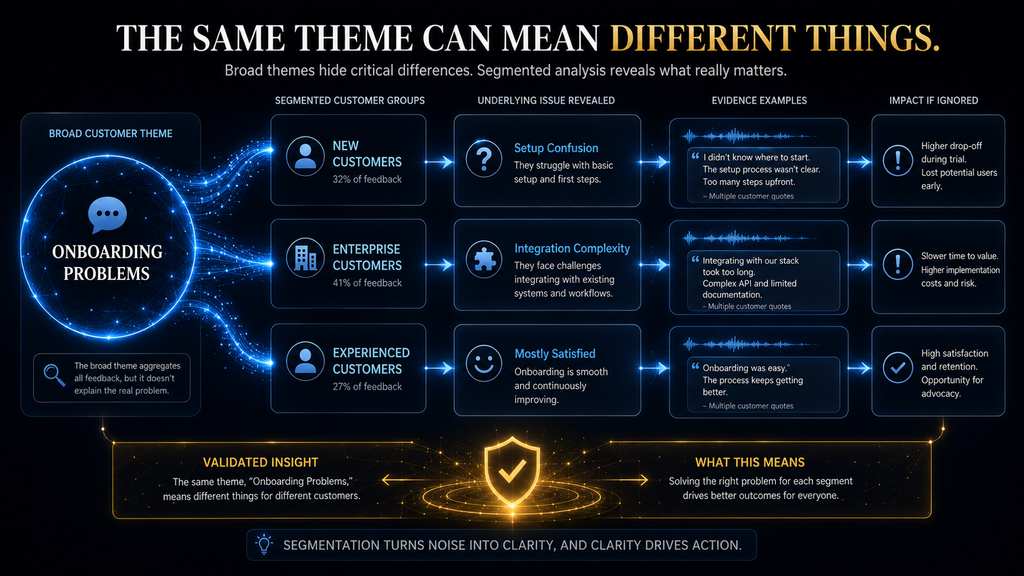
The biggest strategic advantage of scale analysis often appears when customer feedback can be segmented. Without segmentation, a company might conclude that customers are generally unhappy with onboarding. With segmentation, it may discover something much more actionable: new customers struggle with setup, enterprise customers struggle with integration, and experienced customers are mostly satisfied. Those are three different problems hiding behind one broad theme. Our roundup of the best AI conversation intelligence tools compares the main options.
AI can help analysts compare feedback by customer type, geography, product tier, lifecycle stage, channel, acquisition source, date range, or other relevant dimensions. Speak AI, for example, describes filtering and cross-feedback analysis around themes, sentiment, speakers, tags, categories, and time periods. This changes the business question from: “What do customers think?” to: “Which customers experience which problems, under what conditions, and how is that changing?” That is much closer to decision intelligence.
Cross-Conversation Analysis Is the Real Scale Advantage
The most important analytical shift occurs when AI can examine multiple conversations together rather than treating every recording as an independent artifact. Imagine a product team has 1,000 customer interviews.
The first 20 interviews may suggest that reporting is a problem. The next 50 reveal that reporting complaints are concentrated among enterprise users. Another 100 reveal that customers do not necessarily want more reports; they want faster access to a particular metric. A later group reveals that customers using a particular integration experience the problem more often. None of those observations is necessarily obvious from one transcript. The pattern emerges from comparison.
Speak AI’s current customer-feedback tooling describes this exact type of workflow: transcription and analysis across support calls, interviews, surveys, video responses and other qualitative feedback, followed by theme, sentiment, keyword and cross-dataset analysis. That is why “AI summarizes conversations” is an incomplete description of the technology. The more consequential capability is: AI helps turn conversations into a connected evidence library.
Trend Analysis: From Snapshot to Movement
A customer-feedback report can tell you what customers are saying today. Trend analysis helps determine whether the situation is getting better, worse, or simply changing. Imagine that negative feedback around onboarding represents 8% of conversations in January, 11% in February, 17% in March, and 21% in April. That trajectory matters more than the April number by itself. Now suppose the company released a new onboarding flow in May and the theme fell to 13% in June. The feedback dataset becomes part of a feedback loop rather than a static reporting exercise.
This is one of the strongest applications for AI because large datasets make longitudinal analysis practical. Speak AI describes tracking changes in sentiment, themes, and keywords over weeks, months, or quarters and relating those changes to business events. The important caveat is causality. A correlation between a product release and a change in feedback does not automatically prove that the release caused the change. Other factors may have changed at the same time. AI can surface the pattern. Human analysis still has to explain it responsibly.
Finding Emerging Issues Before They Become Major Problems
One of the most interesting possibilities of scale analysis is detecting weak signals. A major customer problem often does not begin as the most frequent theme. It may begin as a handful of unusual comments that gradually become more common. Imagine that only 0.5% of customer conversations mention a new integration problem. A traditional reporting process focused on the top five complaints may ignore it completely. AI can continuously scan incoming feedback and identify that the issue is appearing more often, especially if the analysis combines theme frequency, sentiment, customer segment, product area, and time.
This creates an important distinction between volume-based analysis and change-based analysis. Volume asks: “What is mentioned most?” Change asks: “What is becoming more important?” The second question is often more valuable for early-warning systems.
AI Can Analyze Customer Calls Differently From Survey Feedback
Not all feedback sources should be treated identically. A survey comment is usually concise and directly connected to a question. A customer call contains a much richer conversational context. The participant may begin by discussing onboarding, move into integration problems, mention a competitor, and then explain that the actual reason they considered leaving was an internal staffing issue. The transcript contains all of those signals, but they do not necessarily carry equal importance. For meeting-focused tools, see our list of the best AI meeting assistants.
Calls also contain interruptions, hesitation, follow-up questions, emotional changes, and interactions between participants. Interviews can contain exploratory statements that the participant later qualifies or contradicts. That means an AI workflow designed for simple survey classification should not automatically be considered sufficient for conversational research. The analytical system needs to preserve enough context for researchers to move from a discovered pattern back to the underlying conversation.
The Evidence-Traceability Rule
One of the strongest principles for AI customer-feedback analysis is simple: Every important insight should be traceable back to the evidence that produced it. If an AI system tells a product team that “customers are frustrated with onboarding,” the team should be able to inspect the conversations supporting that conclusion. This is important for three reasons.
First, it allows researchers to verify whether the theme is actually supported. Second, it exposes cases where AI has grouped superficially similar statements that actually mean different things. Third, it gives decision-makers confidence that the conclusion is based on customer evidence rather than an opaque generated summary. Modern feedback-analysis systems increasingly emphasize this connection between themes and underlying feedback. That traceability is a stronger quality criterion than a marketing claim about how intelligent the AI model is. A useful operational rule is: No major customer insight without inspectable supporting evidence.
The Seven-Layer Customer Intelligence Stack
AI Hustle World’s recommended framework for large-scale customer feedback analysis is the Seven-Layer Customer Intelligence Stack.
- Layer 1: Capture. Bring relevant customer conversations and feedback sources into the analytical environment.
- Layer 2: Transcribe. Convert audio and video into searchable text while preserving speakers and useful timing information.
- Layer 3: Structure. Extract topics, keywords, entities, categories, sentiment signals, and other metadata that make qualitative evidence easier to analyze.
- Layer 4: Discover. Identify recurring themes, pain points, requests, opportunities, unusual patterns, and emerging issues.
- Layer 5: Compare. Examine differences across customer segments, channels, products, lifecycle stages, and time periods.
- Layer 6: Validate. Return to the original evidence, investigate contradictions, check context, and determine whether the apparent pattern actually supports the conclusion.
Layer 7: Act. Translate validated customer evidence into product changes, customer-experience improvements, messaging decisions, operational changes, research questions, or other business actions. The important point is that the stack is sequential but not strictly linear. Validation can send the analyst back to discovery. A new pattern can require additional segmentation. A business action can create new feedback that enters the next analytical cycle. The result is better represented as a loop: Customer Evidence → AI Analysis → Human Validation → Business Action → New Evidence That feedback loop is more strategically useful than a one-time AI-generated report.
Trace Each Theme Back to Customer Words
Open a theme and check whether the quotes behind it really support the pattern before you act on it.
Test Theme Analysis →Affiliate disclosure: We may earn a commission if you subscribe through this link, at no additional cost to you.
Where Speak AI Fits Into This Workflow
Speak AI is particularly relevant to this workflow because its customer-feedback offering is built around combining transcription, qualitative analysis, and AI-assisted querying across customer evidence.
Its current customer-feedback documentation describes analyzing support calls, user interviews, video responses, NPS follow-up calls, surveys, and other qualitative sources. It also describes automated extraction of sentiment, themes, keywords, entities, and trends, alongside AI-powered querying across the broader feedback dataset. That combination matters because transcription alone does not solve the customer-insight problem. The more useful workflow is to move from recording → transcript → structured analysis → cross-conversation questions → evidence-backed insight.
For a team already dealing with multiple qualitative sources, the value proposition is therefore less about generating one attractive summary and more about creating a searchable analytical layer across the customer voice.
That is also where tool selection should remain practical. A small team with a few dozen survey responses may not need a dedicated conversation-intelligence platform. A research team, CX organization, product team, or consultancy managing hundreds or thousands of qualitative interactions has a much stronger reason to centralize and automate the analysis.
How AI Analyzes Support Calls
Support calls are particularly valuable because customers often explain problems in their own words rather than selecting from predefined categories. A structured support system might tell a company that 14% of calls were classified as “technical issues.” That category is operationally useful but analytically shallow. AI analysis of the actual conversations can potentially reveal that many of those technical issues relate specifically to integration failures, confusing permissions, slow performance, or documentation gaps. Once you have transcripts, you can also turn video transcripts into articles, clips and social posts.
That distinction matters because the operational category tells the company where the ticket went, while conversation analysis can help explain why the customer contacted the company in the first place. The strongest workflows can combine both forms of information. Structured operational data tells you what happened in the support system, while conversational evidence explains the customer’s experience surrounding it. This can also help identify escalation patterns. If certain themes repeatedly appear in conversations that are transferred to senior agents, refunded, reopened, or followed by cancellation, those themes deserve greater attention than raw mention frequency alone would suggest.
How AI Analyzes Customer Interviews
Customer interviews are different because they are usually designed to explore motivations, behaviors, perceptions, and unmet needs rather than simply resolve an immediate problem. AI can help researchers process the resulting volume by transcribing interviews, locating relevant passages, suggesting codes, grouping related concepts, comparing participants, and retrieving supporting quotations. The biggest advantage is not that AI replaces qualitative research methodology. It is that researchers can spend less time on repetitive mechanical analysis and more time on interpretation. See how AI interview analysis works for the transcript-to-insight workflow.
For example, a researcher studying onboarding might discover that participants repeatedly mention “confusion,” but deeper analysis could reveal several distinct forms of confusion: uncertainty about setup, uncertainty about permissions, uncertainty about whether integrations worked, and uncertainty about what success should look like. A generic theme called “confusion” would hide those distinctions. A well-designed analytical workflow should help researchers move from broad signals to meaningful subthemes.
How AI Analyzes NPS and CSAT Comments
NPS and CSAT scores provide structured quantitative signals, but their open-text comments often contain the explanation behind those scores. A score of 3 tells a team that a customer is dissatisfied. The accompanying comment may reveal whether the dissatisfaction came from price, onboarding, product reliability, support quality, missing functionality, or an entirely different issue. AI can connect the textual explanation to recurring themes and sentiment patterns across large numbers of responses. This can turn a score distribution into a more actionable understanding of the customer experience.
The most useful approach is not to replace NPS or CSAT with AI text analysis. It is to combine them. A product team might discover that customers with low satisfaction scores frequently mention documentation, while customers with high scores frequently mention reliability. That gives the team a much more specific starting point for investigation.
How AI Finds Product Opportunities in Feedback
Customer feedback is often treated as a source of complaints, but it can also reveal opportunities. Feature requests, workflow workarounds, repeated requests for integrations, competitive comparisons, and statements about what customers wish the product could do can all become signals of unmet demand. The challenge is that customers do not necessarily formulate these requests as clean product requirements. One customer might say, “I wish I could export this automatically.” Another might say, “Every Friday I have to download this and clean it manually.” How AI turns feedback into roadmap decisions is covered in how AI turns customer feedback into product insights.
A third might say, “We built a spreadsheet because the platform doesn’t connect to our reporting process.” These statements can point toward the same underlying opportunity even though none explicitly says, “Build feature X.”
AI can help identify those patterns, but product teams should be careful not to treat frequency as a direct roadmap vote. A feature requested by 200 low-value users is not necessarily more strategically important than a capability requested by 20 high-value customers. Product decisions still require business context.
AI Can Reveal Competitive Signals Hidden in Conversations
Customer conversations often contain competitor intelligence that never appears in formal market research. A prospect may say that they are evaluating another vendor. A customer may explain why they switched. A support conversation may reveal that a competitor’s feature is perceived as easier to use. A churn interview may mention a competing product as part of the reason for leaving. AI can extract competitor names and connect them with the surrounding sentiment and topic context.
This creates a more useful competitive dataset than simply counting competitor mentions. For example, a competitor might appear in 500 conversations but mostly as a comparison benchmark. Another competitor might appear in only 100 conversations but almost always in churn-related discussions. The second signal could deserve more strategic attention. Again, the principle is the same: frequency is not the same thing as importance.
What AI Still Gets Wrong
AI customer-feedback analysis is powerful, but its failure modes are predictable enough that they should be designed into the workflow.
- Context loss. A short customer statement may look negative when the surrounding conversation changes its meaning. AI can analyze the text, but researchers need enough context to interpret the statement correctly.
- Overgeneralization. AI can group similar statements into a broad theme that is technically defensible but strategically useless. “Product issues” may be accurate, but it is too broad to tell a product team what to fix.
- False patterns. Large datasets contain coincidences. If an analytical system searches enough dimensions, it can surface patterns that look meaningful but are statistically or practically weak.
- Sentiment errors. Sarcasm, mixed emotions, indirect language, cultural differences, and domain-specific terminology can produce incorrect sentiment signals.
- Sampling bias. AI does not fix biased input data. If only highly engaged customers leave reviews, the resulting analysis represents those customers rather than the entire customer base.
- Transcription errors. Incorrect transcripts can become incorrect themes. This is especially important for names, technical terms, product features, and conversations with overlapping speakers.
Confirmation bias. AI can also make an existing belief appear more convincing if analysts ask questions that presuppose the answer. A team convinced that pricing is the problem may repeatedly search for pricing complaints while overlooking evidence that onboarding or product reliability is the larger issue. These limitations do not make AI analysis ineffective. They define where human review belongs.
Human Judgment Is the Control Layer
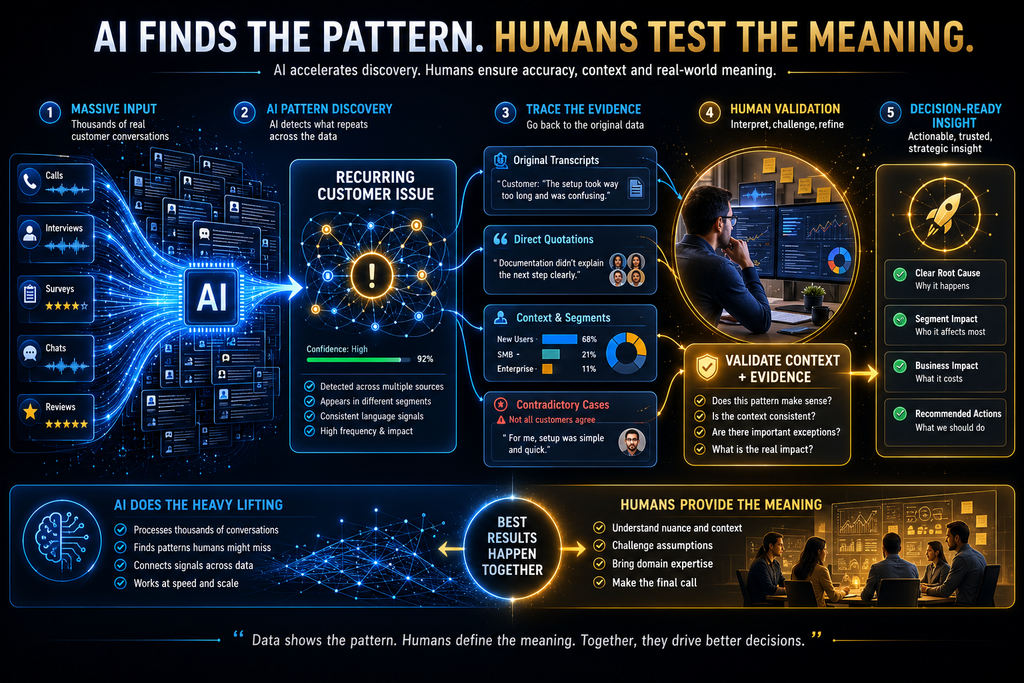
The strongest AI feedback workflows do not ask AI to make the final interpretation independently. They use AI for the work where machines have a structural advantage: processing volume, retrieving evidence, grouping language, comparing large datasets, and identifying candidate patterns. Humans then perform the work where context and consequence matter: deciding whether the pattern is meaningful, testing contradictory evidence, understanding customer circumstances, determining whether a theme is actually new, and deciding what action is justified. We compare the two approaches in AI conversation analysis vs manual research.
Research comparing AI-assisted and human feedback analysis continues to point toward this complementary model: AI can provide speed and structure, while human analysis contributes contextual richness, interpretation, and judgment. ScienceDirect This leads to a useful operating principle: Automate the search for evidence. Do not automatically outsource the meaning of the evidence.
AI Feedback Analysis vs Manual Research
Neither approach is universally better. They are optimized for different constraints. For research teams, see AI qualitative research explained.
| Dimension | Manual analysis | AI-assisted analysis |
|---|---|---|
| Small dataset | Often practical | Useful but not always necessary |
| Large dataset | Becomes expensive and slow | Much more scalable |
| Repetitive coding | Time intensive | Strong automation opportunity |
| Contextual interpretation | Strong | Requires validation |
| Cross-conversation comparison | Difficult at high volume | Major strength |
| Emerging-pattern detection | Depends on sampling | Strong potential |
| Transparency | Easy to inspect manually | Requires traceability controls |
| Consistency | Can vary between analysts | More standardized |
| Complex ambiguity | Strong human advantage | Needs review |
| Continuous monitoring | Resource intensive | Much easier to operationalize |
The wrong conclusion is that AI makes researchers unnecessary. The better conclusion is that AI changes what researchers spend their time doing. Instead of spending most of the week locating relevant passages and manually counting themes, a researcher can spend more time deciding whether those themes actually explain the customer experience and what the organization should do about them.
When AI Customer Feedback Analysis Is Worth Using
AI becomes particularly valuable when three conditions overlap: feedback volume is growing, the data is largely unstructured, and the business needs to compare information across sources or time. A company receiving a few dozen carefully reviewed customer interviews may gain little from a sophisticated automated platform. A customer-experience organization handling thousands of calls, surveys, tickets, and reviews has a much stronger economic case. The use case is also stronger when feedback is strategically important. If customer insights influence product roadmaps, retention programs, service design, marketing positioning, or major operational decisions, the ability to systematically analyze qualitative evidence becomes more valuable. Our comparison of the best AI research assistants covers the desk-research side.
AI analysis is less compelling when the dataset is tiny, highly sensitive, poorly structured, or so specialized that automated interpretation would require extensive manual correction.
Who Should Use AI Feedback Analysis?
Customer-experience teams can use it to identify recurring complaints, service issues, sentiment changes, escalation drivers, and customer-experience trends across large volumes of interactions. Product teams can use it to identify feature requests, usability problems, unmet needs, recurring workflows, and differences between customer segments. User researchers can use it to accelerate transcript processing, coding, theme discovery, evidence retrieval, and cross-interview comparison while retaining responsibility for qualitative interpretation. Marketing teams can analyze customer language to understand motivations, objections, competitive comparisons, and the words customers naturally use to describe problems. Sales and customer-success teams can analyze conversations for objections, churn signals, recurring implementation problems, and customer expectations.
Who Should Avoid Automating Too Much?
Teams working with small datasets should resist automation for automation’s sake. If a researcher has 15 interviews and genuinely understands them, adding an elaborate AI pipeline may create more complexity than value. Organizations handling highly sensitive conversations also need to examine privacy, security, retention, access controls, contractual requirements, and whether the chosen platform is appropriate for the data involved.
Most importantly, teams should avoid using automated feedback analysis when the output will directly trigger high-consequence decisions without human review. Customer feedback can inform decisions, but a sentiment score or automatically generated theme should not become an unquestioned decision rule.
A Practical Implementation Workflow
A good implementation does not begin with “Which AI tool should we buy?” It begins with the decision the organization wants the customer evidence to improve.
Start by defining a narrow question such as “Why are enterprise customers struggling during implementation?” or “What are the main reasons customers mention when they consider cancelling?” A specific question gives the analysis a purpose and makes it easier to determine whether the resulting themes are useful. Next, identify the relevant evidence sources. Do not automatically throw every customer dataset into one analysis. Determine which channels actually contain evidence relevant to the question and document what each source represents.
Then establish a basic analytical vocabulary. This does not mean manually defining every theme in advance. It means deciding what kinds of outputs matter, such as pain points, feature requests, sentiment, competitor mentions, implementation problems, retention risks, or positive experiences.
After the first AI analysis, inspect the results manually. Select several examples from the largest themes and several from the smaller but potentially important themes. Check whether the grouping makes sense and whether the AI is confusing related but distinct concepts. Then compare the patterns across relevant segments. This is where many analyses become substantially more useful. A broad theme can become an actionable finding when you discover exactly which customers experience it and when.
Finally, convert validated findings into actions and define the KPI that should change if the action works. The workflow can therefore be expressed as: Question → Evidence → AI Analysis → Human Validation → Segmentation → Decision → KPI → Feedback
Measuring Whether AI Feedback Analysis Is Actually Working
The value of AI analysis should not be measured only by how quickly it produces a report. Useful operational metrics include:
- Analysis time: How long does it take to move from raw feedback to a validated insight?
- Coverage: What percentage of relevant customer feedback is actually being analyzed?
- Theme consistency: Do analysts obtain reasonably consistent classifications when reviewing the same evidence?
- Evidence traceability: Can major findings be connected back to source conversations?
- Emerging-issue detection: How quickly can the organization identify new themes compared with its previous process?
- Decision impact: How many validated findings lead to concrete product, service, marketing, or operational changes?
- Outcome impact: Do those changes improve the customer or business metric they were intended to influence?
The last metric is the one that matters most. An organization does not create value because AI discovered 37 themes. It creates value when a validated customer insight leads to a better decision and the resulting change produces a measurable improvement.
The Economics of Scale
The economic argument for AI feedback analysis is straightforward: manual qualitative analysis consumes scarce expert time. If researchers spend hours transcribing calls, locating quotations, coding passages, building spreadsheets, and comparing themes, those hours carry an opportunity cost. The more feedback arrives, the larger that cost becomes.
AI can reduce the mechanical portion of the work, but the savings should not be measured as “AI replaced X researchers.” A more realistic model is that AI allows the existing team to analyze more evidence without increasing headcount proportionally.
For example, suppose a research team previously reviewed only 10% of available customer conversations because of time constraints. If an AI-assisted workflow makes it practical to review a much larger share while preserving human validation, the organization has increased the coverage of its customer intelligence. That can create value even when no employee is removed from the process. The strongest ROI case is therefore usually: More evidence analyzed + faster discovery + better prioritization + less repetitive work rather than simply: Fewer analysts required.
Common Mistakes to Avoid
One common mistake is using AI only to summarize every conversation separately. This creates a larger pile of summaries without solving the cross-conversation intelligence problem. Another mistake is treating sentiment as the main analytical output. Sentiment is useful, but knowing that customers are negative does not explain what is causing the negativity or which intervention is most likely to matter. A third mistake is ignoring source differences. Survey comments, support calls, interviews, and reviews represent different customer contexts and should not automatically be treated as equivalent observations. For a method refresher, see Nielsen Norman Group’s guide to thematic analysis.
A fourth mistake is failing to preserve evidence. If an AI-generated theme cannot be traced back to the original customer statements, researchers may struggle to validate it and decision-makers may reasonably distrust it. The fifth mistake is assuming that the most frequent theme should automatically receive the highest priority. Frequency matters, but business impact, customer value, severity, trend direction, and strategic relevance can matter more.
The Bigger Shift: From Customer Feedback to Customer Intelligence
The most important change created by AI is not that customer feedback becomes faster to summarize. It is that qualitative evidence can become continuously searchable. That changes the role of customer research. Instead of conducting a study, producing a report, presenting the findings, and eventually allowing the report to become outdated, organizations can increasingly maintain an evolving evidence base where new conversations can be compared with historical patterns. That makes customer intelligence more operational.
A product team can ask what changed after a release. A customer-success team can investigate why a segment is escalating. A marketing team can identify emerging language around a problem. A research team can compare current interviews against previous studies. The result is not a replacement for research methodology. It is a more continuous analytical layer around the research and customer-feedback process.
What Happens If You Do Nothing?
The cost of not improving feedback analysis is easy to underestimate because it rarely appears as a single line item. The organization continues collecting feedback, but only a fraction is systematically analyzed. Teams make decisions using recent anecdotes, memorable conversations, manually selected examples, or whichever dataset is easiest to access. Different departments develop different interpretations of the customer voice because they are working from different samples. Over time, that creates an evidence fragmentation problem.
The company may technically possess thousands of customer conversations but still behave as though it only knows what the last ten customers said. AI does not automatically solve that problem, but a properly designed workflow can reduce the gap between customer evidence collected and customer evidence actually used.
The Future of AI Customer Feedback Analysis
The next stage of customer-feedback analysis is likely to move beyond static theme reports toward more continuous customer-intelligence systems. Instead of asking an analyst to run a quarterly report, organizations will increasingly be able to monitor changes in themes, sentiment, customer segments, product areas, and conversational signals as new data arrives. The interesting development will not simply be better summaries. It will be better connections between qualitative evidence and operational data.
Imagine combining customer conversations with product usage, support history, retention data, customer segments, and release timelines. The conversation layer explains what customers are saying. The operational layer shows what those customers are actually doing. That combination can produce a much stronger analytical system.
But the need for human judgment will not disappear. As AI becomes better at finding patterns, the strategic value of asking the right question, challenging assumptions, understanding context, and deciding what evidence is sufficient will become more important rather than less.
Final Thoughts
AI customer feedback analysis is most valuable when it solves a scale problem without pretending to solve the judgment problem. The technology can transcribe conversations, structure unorganized feedback, identify themes, classify sentiment, retrieve evidence, compare customer segments, and surface changes across large datasets. Those capabilities can dramatically expand the amount of customer evidence a team can examine. But the final objective is not more analysis. It is better decisions grounded in more complete customer evidence.
The strongest workflow therefore looks like this: Capture the evidence. Analyze it at scale. Find the patterns. Compare the segments. Return to the source. Validate the interpretation. Then act. That is the difference between using AI to summarize customer feedback and using AI to build customer intelligence.
Decide Whether It Fits Your Feedback Volume
Compare how much feedback you collect each month with plan limits and your review process before you commit.
Review Speak AI Plans →Affiliate disclosure: We may earn a commission if you subscribe through this link, at no additional cost to you.
Frequently Asked Questions
How does AI analyze customer feedback?
AI analyzes customer feedback by converting unstructured information such as survey comments, support calls, interviews, reviews, and chat conversations into searchable data. It can then identify themes, topics, sentiment, keywords, entities, recurring issues, and patterns across multiple conversations, with human review used to validate important findings.
Can AI analyze customer calls?
Yes. AI can transcribe recorded customer calls, identify speakers, extract topics and themes, analyze sentiment signals, and make conversations searchable. Some platforms can also compare patterns across large collections of calls rather than analyzing each recording independently. Speak AI
Can AI analyze customer interviews?
Yes. AI can help transcribe interviews, identify candidate codes, group related statements into themes, retrieve supporting quotations, and compare themes across participants. Researchers should still validate the analysis because interviews often contain context, ambiguity, contradictions, and nuanced statements that automated systems can misinterpret.
What types of customer feedback can AI analyze?
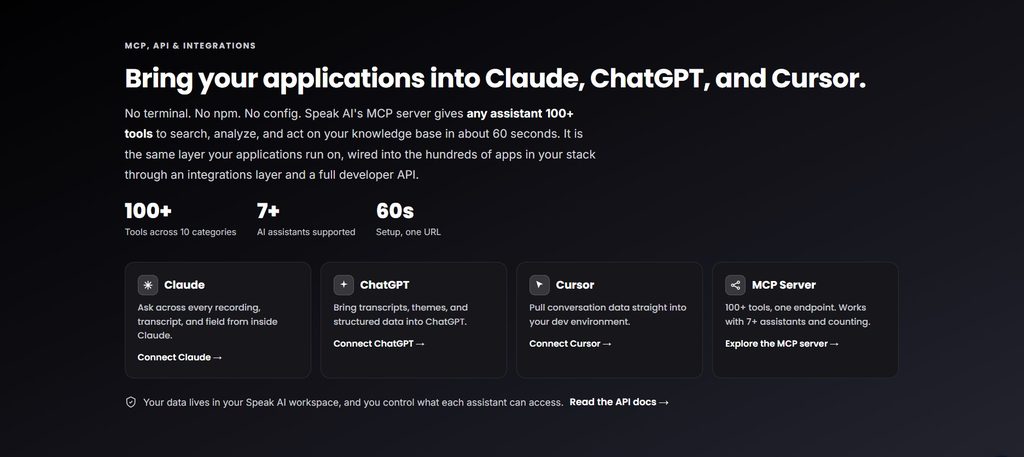
Depending on the platform, AI can analyze survey responses, NPS and CSAT comments, support tickets, customer calls, interviews, reviews, emails, chat transcripts, video responses, and other qualitative customer data. The exact supported formats and integrations vary by tool. Speak AI lists its current plans on its pricing page, and its documentation covers the API and integrations.
Is AI sentiment analysis accurate?
AI sentiment analysis can provide useful signals, but it should not be treated as perfectly accurate. Sarcasm, mixed emotions, cultural language, domain-specific terminology, and conversational context can affect classification, so important conclusions should be validated against the original customer evidence. Qualtrics, for example, explicitly warns that AI-generated analysis can be inaccurate, incomplete, or outdated and should be reviewed before use. Qualtrics
What is the difference between AI feedback analysis and AI summarization?
Summarization describes an individual piece of feedback or conversation. AI feedback analysis goes further by identifying recurring themes, comparing conversations, analyzing sentiment and other signals, segmenting customers, and detecting changes across a larger evidence base.
Can AI find customer pain points automatically?
AI can identify candidate pain points by detecting recurring negative themes, complaints, requests, and related language across customer feedback. However, frequency alone does not determine business priority. Human analysts should consider customer value, severity, trend direction, context, and business impact before deciding what to address.
Is AI customer feedback analysis better than manual analysis?
Neither approach is universally better. Manual analysis is often stronger for small datasets and highly nuanced interpretation, while AI-assisted analysis becomes increasingly valuable as the volume of unstructured feedback grows. The strongest approach combines AI’s scale and consistency with human validation and interpretation.
What is the biggest benefit of analyzing customer feedback at scale?
The biggest benefit is the ability to identify patterns across many conversations that would be difficult or impossible to detect through individual manual review. Instead of understanding one customer conversation at a time, teams can examine the broader customer evidence base and compare themes across segments, channels, and time.
What should companies verify before trusting AI-generated customer insights?
Companies should verify the quality of the source data, transcription accuracy, theme definitions, sentiment classifications, segment logic, supporting evidence, and contradictory cases. Important findings should always be traceable back to the underlying customer statements before they are used to make consequential decisions.
Written by
Muntasir Ahmad Chowdhury
Founder, AI Hustle World
Muntasir Ahmad Chowdhury is the Founder of AI Hustle World, an independent publication dedicated to making Artificial Intelligence practical, trustworthy, and easy to understand. He researches AI tools, automation, customer service, productivity, and real-world business applications, helping readers make smarter technology decisions through research-driven, experience-backed content.
Expertise:
AI Tools • AI Automation • AI Customer Service • AI Productivity • Generative AI • AI Workflows
Get Smarter With AI
Enjoyed this guide? Get practical AI tools, tutorials, and honest reviews delivered to your inbox.