Quantization Explained: How to Run AI Models with Less Memory
Quantization Explained: How to Run AI Models with Less Memory — hero graphic

Quantization Explained: How to Run AI Models with Less Memory Try to load Llama 3.1 70B on your own hardware in its native precision and you hit a wall fast: roughly 140GB of memory just to hold the weights, before you’ve generated a single token. Most people don’t have that, and neither do most companies … Read more
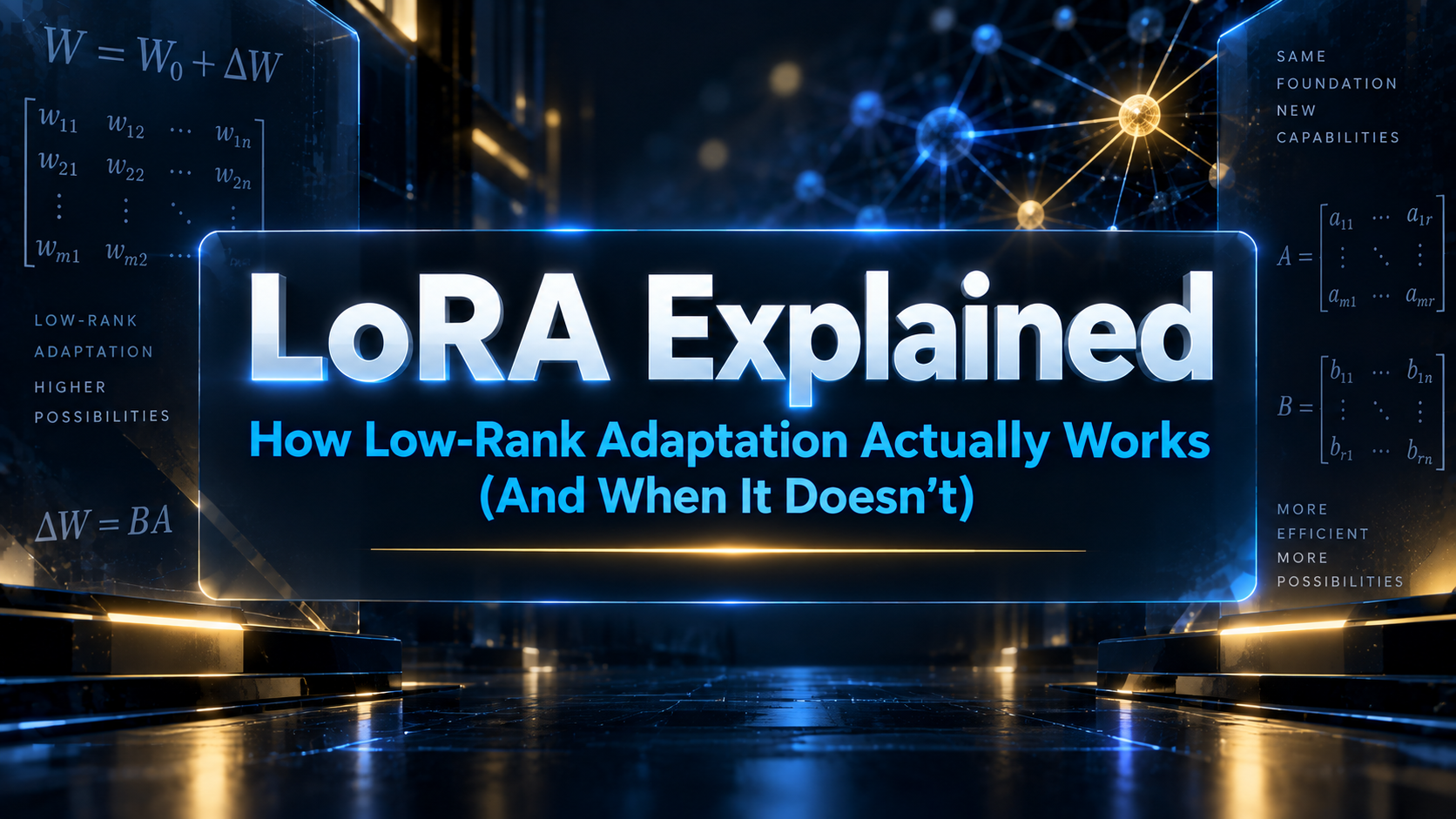

LoRA Explained: How Low-Rank Adaptation Actually Works

Hero image for LoRA Explained — How Low-Rank Adaptation Actually Works

Changing rank without updating alpha silently halves your effective learning rate → Attention-only target modules is a 2021 default — MLP layers matter more → High rank on small data doesn’t improve accuracy; it causes overfitting → LoRA can degrade safety alignment even on clean datasets

Fine-Tuning AI Models Explained: Full Fine-Tuning, LoRA and When to Use Each

Fine-Tuning AI Models Explained — Full Fine-Tuning, LoRA and QLoRA Decision Guide

Fine-tuning adapts a pre-trained AI model to your specific task by updating its weights — but full fine-tuning, LoRA, and QLoRA solve this very differently. This guide breaks down how each method works, what it actually costs in VRAM and dollars, how much data you need by task type, and which approach to choose using the AHW Fine-Tuning Decision Matrix 2026.