LoRA Explained: How Low-Rank Adaptation Actually Works (And When It Doesn’t)
Most guides about LoRA spend two paragraphs explaining the acronym and then show you a code block. That’s useful if you already understand what you’re configuring. It’s less useful if you want to understand what the adapter is actually doing inside the model, why rank matters, when LoRA will cost you accuracy you can’t afford, or what the 2024 research literature actually settled about LoRA versus full fine-tuning.
This article is the deeper version. It covers the mathematics without requiring a PhD to follow, the rank-selection decision with real evidence behind it, the variants that matter (QLoRA, DoRA, LoRA+), and the failure modes that most tutorials ignore entirely. It also corrects a widely repeated citation error that conflates two different landmark papers from 2024 — a mistake worth fixing because the two papers reach different conclusions.
What this article owns: the rank-selection decision framework with evidence behind each row, the distinction between Biderman et al. and Shuttleworth et al. (two papers that most guides conflate or omit), and an honest account of where LoRA fails — including the safety alignment regression finding that most LoRA tutorials don’t mention at all.
What it doesn’t own: implementation tutorials that duplicate the Hugging Face PEFT documentation, the broader fine-tuning decision (full fine-tuning vs LoRA vs RAG) which the fine-tuning overview covers, or marketing claims about which provider’s managed fine-tuning service is best.
If you’re new to fine-tuning in general, start with the fine-tuning overview first. If you already know the basics and want to go deep on LoRA specifically, you’re in the right place.
The Quick Answer
LoRA (Low-Rank Adaptation) fine-tunes a pre-trained language model by freezing its original weights and training a small pair of matrices — typically less than 1% of the model’s parameters — whose product is added to the frozen weights during the forward pass. After training, those adapter matrices merge into the base model with zero added inference latency. A 7B model that would normally require 60–112 GB of VRAM for full fine-tuning can be fine-tuned with LoRA for 16–28 GB, or with QLoRA (4-bit quantization + LoRA) for as little as 8–12 GB.
LoRA is the right choice for the majority of single-task fine-tuning jobs. It is not equivalent to full fine-tuning — 2024 research shows it learns fundamentally different weight structures — but for instruction tuning, domain adaptation, and format control, it performs close enough to matter less than cost and speed.
What Problem LoRA Was Actually Solving
To understand why LoRA was designed the way it was, you need to understand the problem it was responding to. In 2021, fine-tuning GPT-3 175B through standard methods meant updating all 175 billion parameters. That required hundreds of gigabytes of GPU memory for the model weights alone, plus additional memory for optimizer states (Adam maintains two additional tensors per parameter, effectively tripling memory for those alone). The 350 GB checkpoint had to be loaded, modified, and saved for every fine-tuning run.
At that scale, every experiment becomes expensive. Iterating on a task — trying different learning rates, dataset sizes, or training durations — is slow and GPU-budget-constrained. And storing separate fine-tuned copies of the full model for different tasks is practically impossible when each copy weighs hundreds of gigabytes.
Adapter methods existed before LoRA. Houlsby adapters (2019) inserted small bottleneck modules inside transformer layers and trained only those. They worked, but they added new layers to the inference graph — meaning every generation call had to pass through extra computation. At small batch sizes (typical in many production settings), this added latency was measurable. Prefix tuning and prompt tuning prepended trainable tokens to the input, but consumed context window space and were notoriously unstable to train.
LoRA’s insight was different: instead of adding new modules or consuming context, train a low-rank decomposition of the weight updates themselves, and merge them back into the base weights at inference. No new architecture, no added latency, no context consumption. Just a different way of parameterizing the same weight change.
The Core Mechanism: How LoRA Works Mathematically
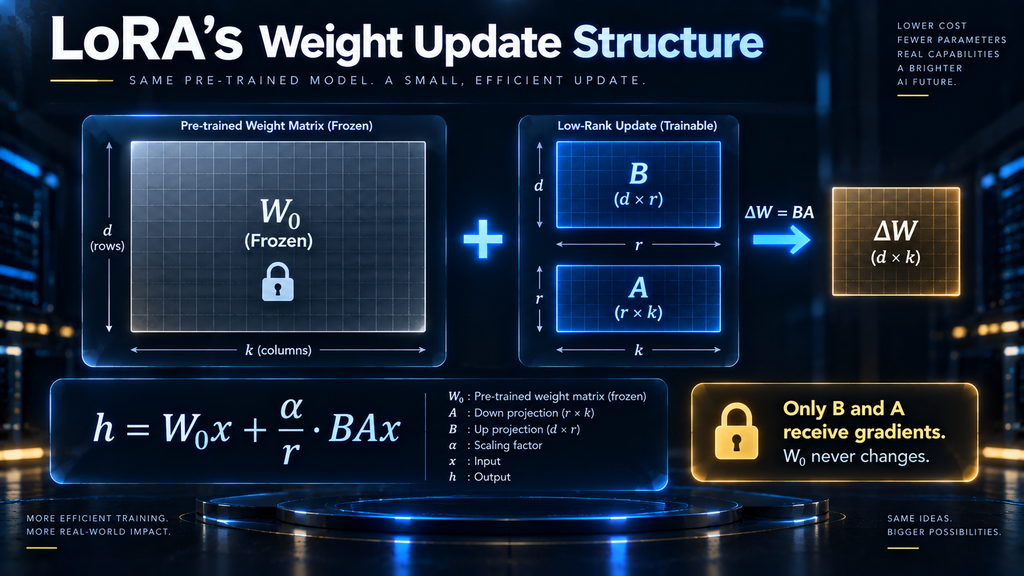
A weight matrix W₀ in a transformer layer has dimensions d × k. Full fine-tuning updates it by adding ΔW — a d × k matrix with d·k parameters. For a 4096 × 4096 attention projection, that’s ~16.8 million parameters for that one matrix alone.
LoRA constrains the update: instead of learning ΔW directly, it learns two smaller matrices — B (d × r) and A (r × k) — and sets ΔW = B · A. The rank r is a hyperparameter chosen by the practitioner, and the constraint is r ≪ min(d, k). For that same 4096 × 4096 matrix at r=16, LoRA trains 4096 × 16 + 16 × 4096 = 131,072 parameters instead of 16.8 million. That’s a ~128× reduction on that single matrix.
The modified forward pass during training is: h = W₀x + (α/r) · BAx
W₀ is frozen throughout — its gradients are never computed, which is a major source of the memory savings. Only B and A receive gradient updates. The α/r scaling factor normalizes the effective step size: it lets you change rank r without needing to retune the learning rate each time, because the ratio α/r stays constant.
Initialization matters. A is initialized with random Gaussian values (small noise). B is initialized to all zeros. This guarantees that ΔW = BA = 0 at the start of training, so the model begins fine-tuning from exactly the pre-trained state without any random perturbation. This is different from training adapter layers from scratch.
Merging at inference. After training, the adapter is merged by computing W₀ + (α/r) · BA and storing the result as the new weight matrix. The merged model has the same architecture as the original — no extra layers, no extra computation path, no latency penalty. Libraries like Hugging Face PEFT handle this with a single merge_and_unload() call.
Why Low-Rank Actually Works: The Intrinsic Dimensionality Theory
LoRA is built on a non-obvious assumption: that the meaningful weight changes during fine-tuning live in a much lower-dimensional space than the full weight matrix suggests. This assumption has strong empirical backing.
Aghajanyan, Gupta, and Zettlemoyer (2021) directly measured this in a paper titled “Intrinsic Dimensionality Explains the Effectiveness of Language Model Fine-Tuning”. Their finding was striking: by optimizing only 200 trainable parameters randomly projected back into the full parameter space, they could tune a RoBERTa-Large model to achieve 90% of full fine-tuning performance on the MRPC benchmark. The model’s intrinsic dimension for that task — the dimension of the smallest subspace where effective optimization happens — was approximately 207 parameters.
They also found that larger pre-trained models tend to have lower intrinsic dimension for a given task, which is part of why fine-tuning scales so effectively with model size. Pre-training compresses task-relevant structure into a compact manifold. LoRA exploits exactly this: it parameterizes the update as a rank-r product, betting that the actual weight change needed is low-rank. For most fine-tuning tasks, that bet pays off.
This is not universal. The intrinsic dimension depends on the task. Classification and style transfer have very low intrinsic dimension and work well at r=4–8. Complex domain adaptation — teaching a general model the vocabulary, notation, and reasoning patterns of a specific technical field — requires higher rank. And tasks that require genuinely new capabilities not reflected in pre-training may exceed what any low-rank update can capture.
LoRA Rank Explained: Choosing r
The rank r is the single most important LoRA hyperparameter. It controls the expressiveness of the adapter: a rank-1 adapter can only represent a rank-1 perturbation to each weight matrix, while r=64 can represent a much richer update. Higher rank means more parameters, more VRAM, longer training, and potentially more overfitting on small datasets.
The original Hu et al. paper (Table 6) found that r=1 and r=4 performed nearly identically to r=64 on WikiSQL and MultiNLI when adapting only the attention weights Wq and Wv. This surprised many practitioners and is still frequently cited as evidence that “small rank is always enough.” It isn’t — it was enough for those tasks, with those layers targeted.
Biderman et al. (2024, TMLR) found that full fine-tuning learns weight perturbations with rank 10 to 100 times greater than typical LoRA configurations, especially on continued pretraining tasks. The gap between LoRA and full fine-tuning correlates with how high that task’s intrinsic rank actually is. If you’re running a style-transfer task or a classification head, r=8 is likely fine. If you’re teaching a model to understand a new technical domain from 5,000+ examples, r=64 or higher may be warranted.
A sentence-T5 ablation study showed a concrete overfitting failure: accuracy peaked at r=16 (68.7%) and declined at r=64 (63.8%) on a 750-example dataset. A LLaMA-3 assertion-generation study saw accuracy plateau after r=16 (97%), with r=32 offering no further gain but doubling parameters and adding 80% more training time.
The practical implication: rank is not “higher is better.” It’s a function of task complexity, dataset size, and available VRAM.
The AHW LoRA Rank Selection Guide
This table maps task type and dataset size to a recommended starting rank, synthesized from the original Hu et al. paper, Biderman et al.’s rank analysis, and practitioner ablation studies.
| Task Type | Dataset Size | Recommended r | Notes |
|---|---|---|---|
| Style/format transfer | 50–500 examples | r = 4–8 | Small datasets overfit at higher ranks |
| Classification / structured output | 200–1,000 examples | r = 8–16 | r=8 default; escalate if validation loss stalls |
| Domain vocabulary + tone | 500–3,000 examples | r = 16 | General-purpose starting point for most jobs |
| Domain-specific reasoning | 1,000–5,000 examples | r = 16–32 | Check overfitting; validate at each rank |
| Multi-domain or hard capability shift | 5,000–20,000 examples | r = 32–64 | Target all layers, not just attention |
| Near-full-FT quality required | 20,000+ examples | Full fine-tuning | LoRA underperforms at scale (see §14) |
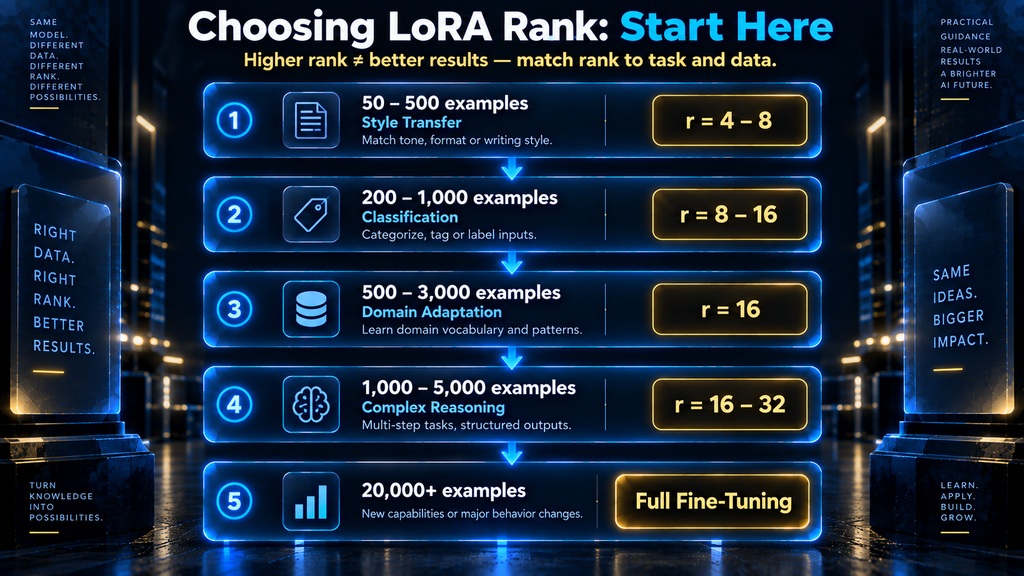
AHW Analysis — synthesized from Hu et al. 2021 (Table 6), Biderman et al. 2024, LLaMA-3 ablation study, sentence-T5 ablation study. Treat as a starting grid, not a hard rule — always validate on your own data.
Alpha (α): α is frequently set to equal r (α = r) or double r (α = 2r). The effective scaling on the adapter output is α/r. If you’re using α=16 and r=8, your scaling is 2.0 — the adapter updates are scaled by 2× before being added to the frozen weights. If you then increase r to 32 without changing α, your scaling drops to 0.5, which silently halves the effective learning rate on the adapter. This is a common source of broken experiments. As a standing rule: when you change r, update α proportionally, or use the α=2r convention throughout.
Which Layers to Target
The original LoRA paper targeted only the attention projection matrices: Wq (query), Wk (key), Wv (value), and Wo (output). This made sense in 2021, when GPT-3 was the test bed and memory was the binding constraint. It is no longer the recommended default.
Biderman et al. (2024) found that MLP layers are the dominant locus of task-specific knowledge in most fine-tuning scenarios — not attention weights. Restricting LoRA to attention-only layers is parameter-inefficient: to match the task performance of an all-module LoRA, you need a significantly higher rank, defeating part of the efficiency argument.
Current recommended targets by architecture: LLaMA / Mistral / Qwen:
- Full coverage: q_proj, k_proj, v_proj, o_proj, gate_proj, up_proj, down_proj
- Minimal coverage (memory-constrained): q_proj, v_proj at higher rank
GPT-2 family: c_attn (handles Q, K, V in a fused matrix) T5 / encoder-decoder: q, v (encoder and decoder separately)
One practical warning: if target_modules contains a layer name that doesn’t exist in your specific model variant, PEFT will silently ignore it in some versions. Always verify your target modules against the actual model with [n for n, _ in model.named_modules()] before running a training job.
QLoRA: Fine-Tuning 70B Models on One GPU
QLoRA (Dettmers, Pagnoni, Holtzman, and Zettlemoyer, 2023 — NeurIPS 2023) is the most practically significant LoRA variant. It makes fine-tuning 65B+ models achievable on a single GPU by combining 4-bit quantization of the frozen base model with standard LoRA adapters trained in full precision.
Without QLoRA, a 65B model requires over 780 GB of memory to fine-tune at 16-bit precision. QLoRA reduces this to under 48 GB — the capacity of a single A100 or H100 80 GB GPU.
Three innovations make this possible:
4-bit NormalFloat (NF4). Standard 4-bit integer quantization applies uniform bins. NF4 is information-theoretically optimal for normally distributed weights (which pre-trained model weights approximate): it places quantization bins such that each bin represents an equal fraction of the actual weight distribution. The result is more faithful quantization at the same bit width, measured by quantization error.
Double Quantization. Quantizing model weights requires storing quantization constants (the scale and offset for each block). In QLoRA, these constants are themselves quantized — from FP32 to 8-bit. This saves approximately 0.37 bits per parameter, which translates to roughly 3 GB saved on a 65B model.
Paged Optimizers. Gradient checkpointing (a standard technique for reducing memory during backpropagation) occasionally produces large memory spikes when checkpointed activations are recomputed. Paged optimizers use NVIDIA’s Unified Memory system to page optimizer states between GPU and CPU RAM during these spikes, absorbing the burst without an out-of-memory error.
The headline result from the QLoRA paper: Guanaco 65B, fine-tuned in 4-bit with QLoRA, reached 99.3% of ChatGPT performance on the Vicuna benchmark in under 24 hours on a single GPU. Their second-best model hit 97.8% in under 12 hours on a consumer GPU.
For 7B models specifically, QLoRA runs in roughly 8–12 GB of VRAM — meaning a fine-tuning job fits on a consumer-grade RTX 3090 (24 GB) with headroom, or runs in the cloud on an A10G (24 GB) for a few dollars.
LoRA Variants Worth Knowing
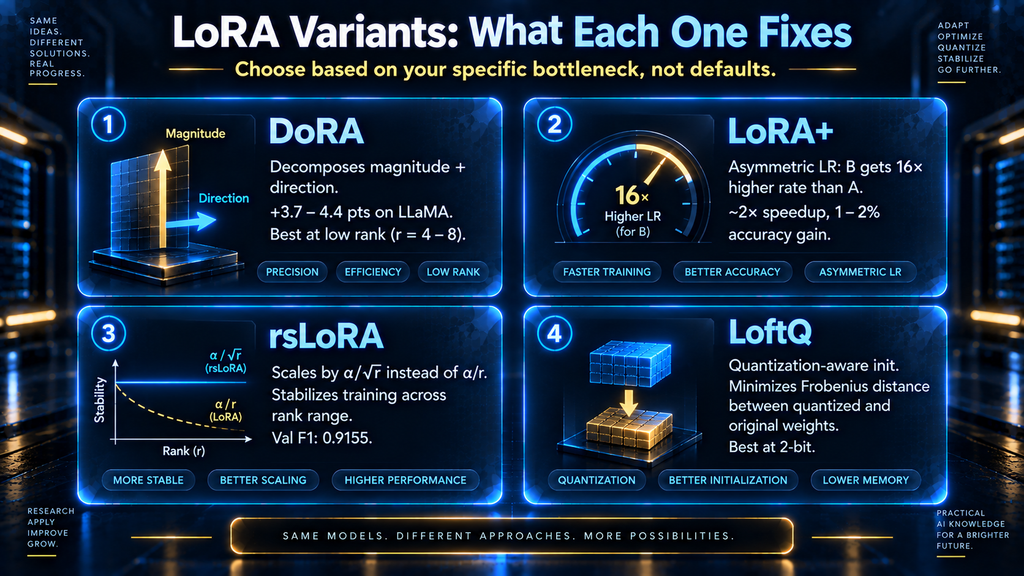
DoRA (Weight-Decomposed Low-Rank Adaptation)
DoRA (Liu et al., 2024 — ICML 2024, NVIDIA) addresses a structural difference between how LoRA and full fine-tuning change weights. Full fine-tuning freely adjusts both the direction and the magnitude of each weight column. LoRA’s BA update tends to couple these — a change in direction necessarily changes magnitude.
DoRA separates them. Each pre-trained weight W is decomposed into a magnitude vector m (directly trainable) and a directional component (updated via standard LoRA), recombined with column-wise normalization: W’ = m · (W + BA) / ‖W + BA‖_c
The result: DoRA consistently outperforms LoRA at the same rank. Per the paper, gains include +3.7 points on LLaMA-7B, +4.4 on LLaMA-3-8B, and +2.9 on LLaMA2-7B across commonsense reasoning benchmarks. DoRA is especially significant at very low ranks — at r=8, DoRA achieved 77.96% versus LoRA’s 40.74% in their test setup, a gap that compounds when VRAM is the constraint.
DoRA merges back into the base model identically to standard LoRA — no inference overhead.
LoRA+ (Asymmetric Learning Rates)
LoRA+ (Hayou, Ghosh, and Yu, 2024 — ICML 2024) addresses a subtler problem. When B and A use the same learning rate, the update dynamics are suboptimal in wide networks. B is initialized to zero, so its gradients flow immediately from the loss. A’s gradients depend on B — and since B starts at zero, A’s gradient signal is initially blocked until B accumulates some nonzero weight.
Setting a higher learning rate for B than for A (often ~16× higher) corrects this asymmetry. The paper reports approximately 2× speedup and 1–2% accuracy improvement at the same compute budget — a non-trivial gain for essentially zero implementation cost.
rsLoRA (Rank-Stabilized LoRA)
Standard LoRA scales the adapter output by α/r. As rank increases, this scales down the adapter contribution, which effectively penalizes higher ranks and makes comparing across ranks difficult. rsLoRA (Kalajdzievski, 2023) changes the scaling to α/√r, which stabilizes training dynamics across a wider rank range. The DataRoot Labs PEFT benchmark found rsLoRA at the top of their comparison table (Val F1 0.9155, ROC-AUC 0.9353) across classification benchmarks.
LoftQ (Quantization-Aware Initialization)
LoftQ (Li et al., 2023 — ICLR 2024) closes an initialization gap in QLoRA. When QLoRA quantizes the base model, the quantization introduces approximation error. LoftQ addresses this by jointly optimizing the quantized backbone Q and the initial adapter weights A, B to minimize ‖Q + AB^T − W‖_F — the Frobenius distance between the quantized-plus-adapter approximation and the original full-precision weight. This is especially effective at aggressive quantization (2-bit and mixed 2/4-bit).
GaLore (Gradient Low-Rank Projection)
GaLore (Zhao et al., 2024 — ICML 2024) is architecturally different from LoRA. It projects the gradients (not the weights) into a low-rank subspace via periodic SVD decomposition, applying updates in that subspace and projecting back. This allows full-parameter learning — every weight can change — at reduced optimizer-state memory. GaLore reduces optimizer-state memory by up to 65.5%. 8-bit GaLore enables pre-training a 7B model on a 24 GB RTX 4090. It is primarily a pre-training efficiency method, not a fine-tuning adapter — the distinction matters for how you’d deploy it.
PEFT Methods Compared: The Full Picture
This table synthesizes the primary comparison data across PEFT methods. Performance data is drawn from Hu et al. (2021, Table 4), DataRoot Labs benchmark, and Lialin et al. (2023).
| Method | Trainable Params | Inference Latency | VRAM (7B) | Best For | Avoid When |
|---|---|---|---|---|---|
| Full Fine-Tuning | 100% | None (baseline) | ~60–112 GB | Maximum accuracy, large datasets | Budget or hardware limited |
| LoRA | 0.1–1% | None (after merge) | ~16–28 GB | Most single-task fine-tuning | Continued pretraining at scale |
| QLoRA | 0.1–1% + 4-bit base | None (after merge) | ~8–12 GB | Single GPU, cost-constrained | When quantization error is unacceptable |
| DoRA | 0.1–1% | None (after merge) | ~16–28 GB | Low-rank scenarios, multimodal | When LoRA already hits accuracy target |
| Prefix Tuning | <0.1% | Medium (KV cache) | ~16 GB | Cross-lingual transfer | Low-resource, unstable tasks |
| Prompt Tuning | <0.01% | Low | ~16 GB | Lightweight soft prompts | Complex tasks, small models |
| Adapter Layers (Houlsby) | 0.5–3% | Low–medium | ~20 GB | NLP classification | Latency-sensitive inference |
| BitFit | <0.1% | None | ~16 GB | Very lightweight adaptation | Tasks needing structural changes |
| rsLoRA | 0.1–1% | None (after merge) | ~16–28 GB | Higher-rank experiments | When standard LoRA already works |
AHW Analysis — synthesized from Hu et al. 2021, Lialin et al. 2023, DataRoot Labs PEFT benchmark, Shuttleworth et al. 2024.
One case where prefix tuning beats LoRA on the same parameter budget: a cross-lingual transfer study (arXiv:2510.24619) found prefix tuning outperformed LoRA (r=4) by 4–6% on XNLI, XQUAD, and Belebele with LLaMA-3.1-8B. The reason matters — prefix tuning operates in the attention KV-cache and modifies how the model attends to input tokens, which may preserve cross-lingual representations differently. Method choice is task-dependent.
Implementing LoRA with Hugging Face PEFT
The Hugging Face PEFT library is the standard library for LoRA in Python. Here is a production-ready configuration for instruction fine-tuning a LLaMA or Mistral model:
from peft import LoraConfig, get_peft_model, TaskType lora_config = LoraConfig( r=16, # Rank — start here, see §5 for task-specific guidance lora_alpha=32, # α = 2r convention target_modules=[ # All linear layers — current best practice. “q_proj”, “k_proj”, “v_proj”, “o_proj”,. “gate_proj”, “up_proj”, “down_proj”
], lora_dropout=0.05, # Small dropout; increase to 0.1 for very small datasets bias=”none”, # Don’t train bias terms task_type=TaskType.CAUSAL_LM. ) model = get_peft_model(base_model, lora_config) model.print_trainable_parameters() # Expected output: ~0.5–1% of total parameters.
Recommended training hyperparameters:
- Learning rate: 1e-4 to 3e-4 (higher than full fine-tuning — only adapters update, so gradients are more concentrated)
- Epochs: 1–4; watch validation loss closely after epoch 2
- Batch size: as large as VRAM allows
- LR scheduler: cosine with warmup
For QLoRA specifically, add quantization config before loading the base model: from transformers import BitsAndBytesConfig import torch bnb_config = BitsAndBytesConfig( load_in_4bit=True, bnb_4bit_quant_type=”nf4″, bnb_4bit_compute_dtype=torch.bfloat16, bnb_4bit_use_double_quant=True. ) base_model = AutoModelForCausalLM.from_pretrained( model_name, quantization_config=bnb_config, device_map=”auto” ) from peft import prepare_model_for_kbit_training base_model = prepare_model_for_kbit_training(base_model)
Merging for inference: merged_model = model.merge_and_unload() # Returns a standard PreTrainedModel — no PEFT dependency. # Compatible with vLLM, ollama, llama.cpp merged_model.save_pretrained(“./merged-model”)
One common failure mode: if a name in target_modules doesn’t match any layer in your model, PEFT may silently skip it rather than raising an error. Always print the layer names before configuring and cross-reference against lora_config.target_modules.
VRAM Requirements and Real Costs
VRAM requirements vary with batch size, sequence length, optimizer, and whether you’re using gradient checkpointing. These are approximate ranges for typical instruction fine-tuning setups:
| Model Size | Full Fine-Tuning | LoRA (all layers, r=16) | QLoRA (NF4, r=16) |
|---|---|---|---|
| 7B | ~60–112 GB | ~16–28 GB | ~8–12 GB |
| 13B | ~120–200 GB | ~28–48 GB | ~14–20 GB |
| 70B | ~560 GB+ | ~140–160 GB | ~46–52 GB |
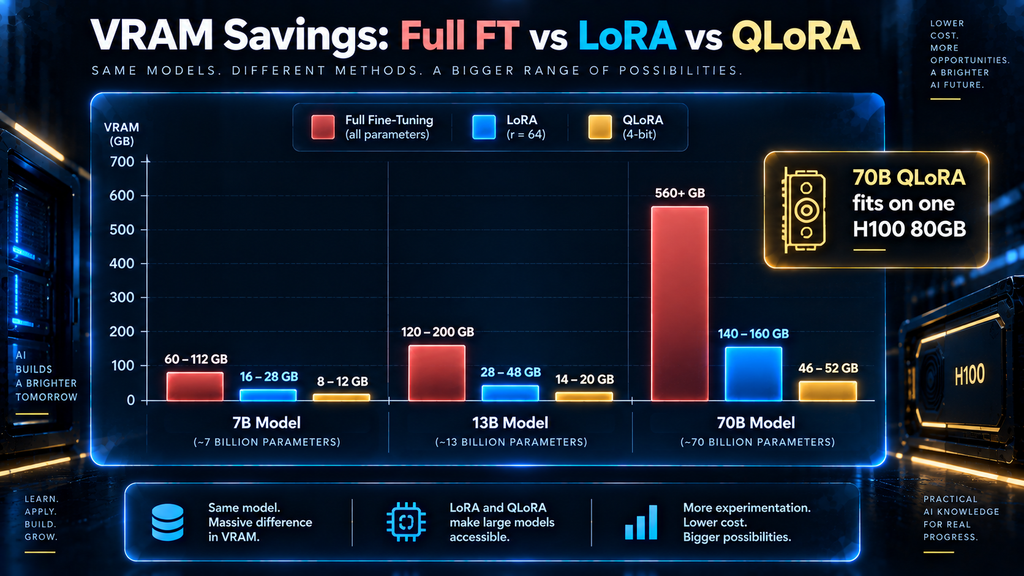
QLoRA’s 70B figure fits within a single 80 GB A100 or H100 — the key practical threshold.
Cloud training costs (Together AI, 2026 pricing):
- ≤16B model: $0.48 per million training tokens
- 17–69B model: $1.50 per million training tokens
- 70–100B model: $2.90 per million training tokens
Worked cost example — 7B QLoRA run: 50,000 training examples × 512 tokens × 2 epochs = ~51.2 million training tokens. At Together AI’s 7B rate: ~$24.58 for the managed API. Renting an H100 directly on RunPod or Spheron for the same run takes approximately 2–3 hours at ~$3–4/hr = ~$6–12. Managed APIs cost more per run but handle infrastructure, concurrency, and scaling — the choice depends on whether you’re doing one-off experimentation or production fine-tuning at volume.
What the 2024 Research Actually Settled
This section requires care because a widely repeated citation error conflates two different papers. They are distinct, complementary, and reach different-but-compatible conclusions. Getting them right is worth the specificity.
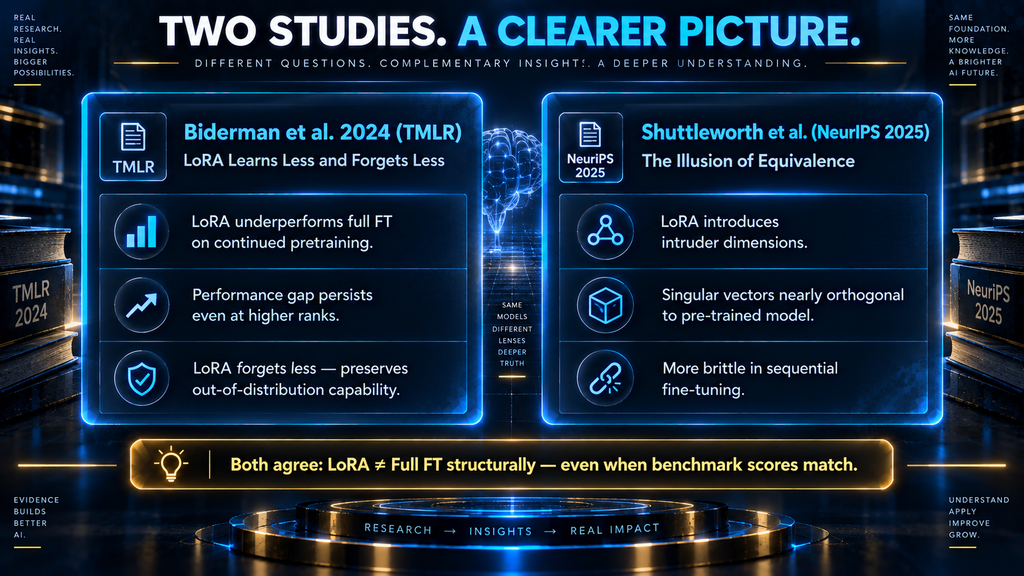
Paper 1: “LoRA Learns Less and Forgets Less” Biderman et al. (Databricks / MosaicML), TMLR 2024, arXiv:2405.09673.
This paper compared LoRA and full fine-tuning at scale — instruction tuning (~100K examples) and continued pretraining (~20B tokens) — on programming and mathematics tasks. Key findings:
- In standard low-rank settings, LoRA substantially underperforms full fine-tuning on continued pretraining. The gap does not close even at higher ranks.
- For instruction tuning, the performance gap is smaller and task-dependent.
- LoRA forgets less. After fine-tuning, LoRA-trained models better preserve out-of-distribution (source-domain) capability than fully fine-tuned models.
- Full fine-tuning learns perturbations with rank 10 to 100× higher than typical LoRA configurations.
- Best-practice recommendations from this paper: target all modules (MLP layers are the dominant locus, not just attention); set α = 2r; use learning rates ~10× above full fine-tuning.
Paper 2: “LoRA vs Full Fine-tuning: An Illusion of Equivalence” Shuttleworth, Andreas, Torralba, and Sharma (MIT CSAIL), arXiv:2410.21228, NeurIPS 2025.
This is the paper that identified “intruder dimensions.” Via singular value decomposition of weight matrices, the authors found that LoRA-trained matrices acquire new, high-ranking singular vectors that are nearly orthogonal to the pre-trained model’s singular vectors. Full fine-tuning produces none of these — it largely preserves the spectral structure of the original weights.
When they causally intervened — scaling down these intruder singular values after training — pre-training behavior was substantially restored with minimal task-performance loss. This proved the intruder dimensions were causing forgetting, not correlating with it.
The practical implication: LoRA and full fine-tuning are structurally different, not just computationally different. Models that “match” full fine-tuning on a target benchmark via LoRA may do so via a structurally different weight configuration that is more brittle in sequential fine-tuning, continual learning, and distribution shift.
Both papers agree on the directional finding: LoRA ≈ full fine-tuning for single-task performance; full fine-tuning holds up better for sequential or multi-task scenarios where the model must preserve general capability while acquiring new skills.
When LoRA Fails or Underperforms
Large Datasets and Continued Pretraining
Biderman et al.’s most actionable finding is about scale. For continued pretraining on ~20B tokens, LoRA substantially underperforms full fine-tuning, and the gap persists even at higher ranks. The adapter’s expressiveness — bounded by r — becomes the limiting factor once the dataset provides more signal than a low-rank update can absorb. If your job is large-scale domain adaptation rather than instruction tuning, full fine-tuning is the better starting point.
Very Small Datasets at High Rank
The opposite failure: rank too high for the available data. The sentence-T5 study at 750 training examples saw accuracy drop from 68.7% at r=16 to 63.8% at r=64. Higher rank = more parameters = more overfitting on small datasets. Start conservative and escalate only after measuring validation loss.
Attention-Only Targeting with Undersized Rank
Restricting LoRA to Wq and Wv at r=8 on a task that genuinely needs MLP adaptation produces a LoRA that underperforms even when parameter-matched to an all-module LoRA at lower rank. The 2021 paper’s defaults are outdated for most modern use cases. Target all linear layers unless you have a specific memory reason not to.
Safety and Alignment Regression
Fine-tuning with LoRA can degrade safety alignment — even on benign, non-adversarial data. SaLoRA (arXiv:2501.01765, ICLR 2025) found LoRA, DoRA, and PiSSA all compromise safety alignment during instruction fine-tuning on harmless datasets. More starkly, Lermen, Rogers-Smith, and Ladish (Palisade Research) demonstrated that a LoRA fine-tuning run of under $200 on a single GPU was sufficient to reduce Llama 2-Chat 70B’s refusal rate from near-100% to approximately 1% on two refusal benchmarks.
The mechanism is alignment regression: RLHF and instruction-following properties are baked into the base model’s weights. Fine-tuning — even on unrelated content — shifts those weights enough to partially undo that work. This is worth explicitly planning for if you’re deploying a fine-tuned model in a public or safety-critical context. It’s not a reason to avoid LoRA, but it is a reason to re-evaluate alignment properties after every fine-tuning run.
Sequential Fine-Tuning
Intruder dimensions (Shuttleworth et al.) accumulate across sequential fine-tuning rounds. A model fine-tuned with LoRA multiple times on different tasks becomes progressively worse at the pre-training distribution — more so than a fully fine-tuned model that went through the same sequence. If your deployment pattern involves iterative fine-tuning or continual learning, account for this degradation.
LoRA vs Full Fine-Tuning: The Honest Trade-off
The practical choice between LoRA and full fine-tuning comes down to four variables: task type, dataset size, hardware budget, and tolerance for accuracy gap.
For instruction tuning on a 100K-example dataset, a well-configured LoRA (all layers, r=16, α=32) will come within a few percentage points of full fine-tuning on most benchmarks, at a fraction of the VRAM cost and training time. The difference is often smaller than dataset quality variation. This is the sweet spot LoRA was designed for.
For continued pretraining at scale — adapting a general model to a large domain corpus — the gap widens. Full fine-tuning learns a structurally different (and empirically more capable) weight update that LoRA can’t replicate in standard configurations. If you can afford full fine-tuning for this use case, it’s the stronger choice.
For production systems where you need fast iteration, swappable adapters for different tasks, or minimal storage overhead per deployment variant, LoRA has a genuine architectural advantage. A 26 MB LoRA adapter for a 7B model is infinitely more manageable than a second 14 GB model copy. A single base model can serve multiple tasks with hot-swapped adapters, never needing separate deployments.
A reasonable production pattern: prototype with QLoRA (fast, cheap, catches dataset and task issues early), validate with LoRA at r=16 all-modules (higher quality, reasonable cost), and escalate to full fine-tuning only when you’ve confirmed the accuracy gap is unacceptable for your use case.
This maps naturally to the RAG vs fine-tuning decision: if your task involves dynamic knowledge that changes over time, fine-tuning (LoRA or otherwise) is the wrong tool entirely. If it’s a behavioral or format adaptation that doesn’t require current information, fine-tuning belongs in your toolkit.
For the broader context of how language models learn in the first place — the gradient descent mechanics that fine-tuning operates on — see How AI Learns from Data and What Is a Large Language Model. Understanding those fundamentals makes the LoRA rank intuitions much easier to reason about.
Common LoRA Configuration Mistakes
Most LoRA failures aren’t failures of the method — they’re failures of configuration. These are the mistakes that show up repeatedly in practice.
Changing rank without updating alpha. Alpha (α) controls the effective scaling of the adapter: the model adds (α/r)·BAx to the frozen weights. If you set α=16, r=8, and then bump rank to r=32 to try to close a validation gap, your effective scaling drops from 2.0 to 0.5. You’ve silently halved the adapter’s learning rate contribution. The model trains, the loss moves, but the run is not comparable to the one you just ran at r=8. Always update α proportionally when you change r, or use the α=2r convention and change both together.
Targeting only attention layers. The 2021 paper’s default was Wq and Wv. That default is still replicated in most tutorials and many default configs. Biderman et al. (2024) showed that MLP layers are the dominant locus of task-specific adaptation in most fine-tuning scenarios. Running attention-only LoRA and then concluding “LoRA doesn’t work for this task” is a config problem, not a method problem.
Using high rank on a small dataset. More rank means more parameters, which means more overfitting potential on limited data. The sentence-T5 example — accuracy dropping from 68.7% at r=16 to 63.8% at r=64 on 750 training examples — is a real benchmark, not a theoretical warning. If your training set is under 1,000 examples, start at r=4 or r=8 and only escalate once you’ve confirmed validation loss has room to improve.
Not verifying target_modules against the actual model. If a layer name in target_modules doesn’t exist in your specific model checkpoint, some PEFT versions silently skip it rather than raising an error. You’ll think you’re training all linear layers and instead be training a subset. Run [n for n, _ in model.named_modules()] before you configure LoRA and verify the names match.
Assuming LoRA preserves safety alignment. The default assumption — that fine-tuning on clean data doesn’t change safety properties — is wrong. RLHF-trained alignment properties sit in the base model weights, and any weight update can shift them. A fine-tuned model that behaves well on your task evals may still produce outputs that the base model was trained to refuse. Test alignment properties explicitly before deploying anything public-facing.
Not checking validation loss per epoch. LoRA can overfit quickly, especially at higher ranks. Training for 4 epochs without checkpointing often means your best model was at epoch 2 and you’re deploying epoch 4. Use gradient checkpointing, save per-epoch, and always eval on a held-out validation set.
Final Thoughts
LoRA looks deceptively simple from the outside — “two small matrices, freeze the rest” — and turns out to be meaningfully nuanced once you’re inside a real training run. The rank is not arbitrary. Alpha matters. Target modules are not cosmetic. And the 2024 research has made clear that LoRA is not a computational substitute for full fine-tuning — it’s a structurally different kind of adaptation that forgets less, costs less, and leaves different fingerprints in the weight matrices.
Here’s the contrarian reality: most practitioners are not running LoRA wrong because they don’t understand the mathematics. They’re running it wrong because they copied a default config from a tutorial written in 2022, never changed the target modules, never validated rank on their specific dataset, and assumed that a converging training loss means a well-behaved deployed model. The math is the easy part. Getting the configuration right for your specific task is where most of the work actually lives.
The practical default that holds across the majority of instruction fine-tuning and domain adaptation jobs: r=16, all linear layers, α=32, QLoRA if VRAM is the constraint. Escalate rank only when you measure a validation gap that lower rank can’t close. Escalate to full fine-tuning only when scale genuinely demands it. And test alignment properties after every run — not just task metrics.
The field continues to move. DoRA’s magnitude-direction decomposition is likely to become a standard default the same way QLoRA did. rsLoRA’s stabilized scaling is already showing up as a recommended starting point in 2025 guides. The core LoRA pattern — low-rank adapter, frozen base, zero inference overhead — is stable enough to build on. What the optimal configuration looks like will keep shifting as the research matures.
For what comes after the adapter — preparing the dataset that determines whether your LoRA run actually works — see the fine-tuning overview and our guide to preparing a dataset for fine-tuning.
Ready to Put LoRA Into Practice?
The fine-tuning overview covers when LoRA is the right tool versus full fine-tuning versus RAG — the decision layer that comes before any adapter configuration.
Read the Fine-Tuning Overview →FAQ
What does LoRA stand for?
LoRA stands for Low-Rank Adaptation. It was introduced by Hu et al. in 2021 (arXiv:2106.09685) as a parameter-efficient method for fine-tuning large language models without updating all their weights.
What is the difference between LoRA and QLoRA?
LoRA trains small adapter matrices alongside a full-precision (16-bit) base model. QLoRA adds 4-bit quantization of the base model using NF4 format, cutting VRAM requirements roughly in half again. The adapters in QLoRA are still trained in full precision — only the frozen base is quantized.
What rank should I use for LoRA?
Start at r=16 for most tasks. Use r=4–8 for style transfer on small datasets; r=32–64 for complex domain adaptation with large datasets. Higher rank is not always better — it can overfit on small datasets.
Does LoRA add inference latency?
No. LoRA adapters merge into the base model weights via merge_and_unload(), after which the model runs identically to the original. No added computation, no architectural change.
Is LoRA equivalent to full fine-tuning?
For single-task instruction tuning, LoRA performance is close to full fine-tuning. For continued pretraining at scale, full fine-tuning is substantially better. Two 2024 papers (Biderman et al. and Shuttleworth et al.) confirmed LoRA and full fine-tuning produce structurally different weight changes — not just computationally different ones.
What is an “intruder dimension” in LoRA?
Shuttleworth et al. (arXiv:2410.21228) found LoRA-trained weight matrices acquire new high-ranking singular vectors — nearly orthogonal to the pre-trained model’s own singular vectors — that full fine-tuning doesn’t produce. These cause concentrated forgetting and make models less stable in sequential fine-tuning scenarios.
Can LoRA fine-tuning break safety alignment?
Yes. Research shows LoRA fine-tuning can degrade safety properties even when training on benign, non-adversarial data. Always re-evaluate alignment properties after fine-tuning before deploying publicly.
What is DoRA and is it better than LoRA?
DoRA (Weight-Decomposed Low-Rank Adaptation) separates magnitude and direction updates for each weight, making it more expressive at the same rank. Per Liu et al. 2024, DoRA outperforms LoRA across commonsense reasoning benchmarks, especially at low ranks (r=4–8).
Which layers should I target with LoRA?
Target all linear layers — attention projections (q, k, v, o) plus MLP layers (gate_proj, up_proj, down_proj for LLaMA-family models). Attention-only targeting is the original paper’s default but underperforms modern all-layer configurations on most tasks.
What is alpha (α) in LoRA and how should I set it?
Alpha controls the effective scaling of the adapter output: the model adds (α/r) · BAx to the frozen weights. The standard convention is α = 2r. If you change rank without updating alpha proportionally, you silently change the effective adapter contribution — a common source of broken experiments.
Related Guides
- Local AI Explained: How Running AI Models on Your Own Hardware Works
- Ollama vs LM Studio vs Jan: Which Local AI Tool Should You Use in 2026?
- Best AI Model Hosting and Inference Platforms in 2026
Written by
Muntasir Ahmad Chowdhury
Founder, AI Hustle World
Muntasir Ahmad Chowdhury is the Founder of AI Hustle World, an independent publication dedicated to making Artificial Intelligence practical, trustworthy, and easy to understand. He researches AI tools, automation, customer service, productivity, and real-world business applications, helping readers make smarter technology decisions through research-driven, experience-backed content.
Expertise:
AI Tools • AI Automation • AI Customer Service • AI Productivity • Generative AI • AI Workflows
Get Smarter With AI
Enjoyed this guide? Get practical AI tools, tutorials, and honest reviews delivered to your inbox.
5 thoughts on “LoRA Explained: How Low-Rank Adaptation Actually Works”