Evidence: Documentation reviewed
Last checked: September 2026
What was done: Written from official documentation and the published sources linked in this article. Not hands-on tested.
Files: None
Affiliate links: Yes
Last updated: September 2026 What changed: This update reflects the 2026 AI customer-service market, including AI-agent resolution models, current vendor pricing structures, workload-based tool selection, and the growing distinction between AI assistance, deflection, and autonomous resolution.
Best AI Customer Service Tools in 2026 (Free & Paid): Top 10 Compared
Customer service software has changed faster than most businesses have changed their support operations. A few years ago, the buying decision was mostly about ticketing, shared inboxes, live chat, reporting, and integrations. In 2026, those still matter, but buyers now have another question to answer: how much of the actual support workload should AI handle, and what should happen when it cannot?
That distinction matters because “AI customer service” is no longer one category. Some platforms are traditional helpdesks with AI layered into agent workflows. Others are AI-first agents designed to resolve conversations autonomously. Some are built specifically around ecommerce operations, while others make more sense when customer service needs to live inside a CRM. The right choice therefore depends less on which vendor has the longest feature list and more on how your support operation actually works.
This guide compares 10 leading AI customer service tools for 2026 using that lens. Rather than assigning arbitrary star ratings, we evaluate each platform around workload fit, automation depth, customer context, process capabilities, platform fit, outcome quality, residual human effort, and total cost. Current pricing and product details are based on vendor documentation available during the research for this update, and vendor-reported performance claims are treated as vendor claims rather than independent proof.
The S.U.P.P.O.R.T. Fit Framework, evaluation criteria and workload-fit conclusions are original AI Hustle World analysis. Product capabilities, integrations, limits and prices are based on the cited first-party vendor documentation, while rankings reflect editorial judgment rather than controlled product testing.
Affiliate disclosure: Some links in this article are affiliate links. That means AI Hustle World may earn a commission if you choose to sign up through one of our links, at no additional cost to you. Our rankings and recommendations are based on product fit, capabilities, pricing, limitations, and the needs of different support operations—not on commission.
Quick Answer: What is the best AI customer service tool in 2026?
There is no single best AI customer service platform for every business. Weav is one of the strongest choices for a focused AI-first support operation; Intercom Fin is particularly compelling for SaaS and conversational support; Zendesk is stronger when you need a mature enterprise helpdesk around the AI; Freshdesk offers a strong balance for SMB and mid-market teams; Gorgias is especially well suited to ecommerce; Tidio is attractive for smaller, chat-heavy businesses; Help Scout fits teams that value simplicity; HubSpot makes sense when support is tightly connected to CRM; Chatbase is useful for teams that want a flexible AI-agent layer; and Zoho Desk remains an attractive budget-conscious option. The full Weav review has the complete verdict.
The more important rule is this: choose the support operating model before choosing the software. A company with 300 repetitive ecommerce questions per week does not necessarily need the same system as a financial-services team managing complex cases across phone, email, messaging, compliance workflows, and multiple agent teams.
Test a Support Agent on Your Own Tickets
Run a sample of real customer questions through Weav and count how many it resolves without a human handoff.
Test Weav on Your Tickets →Affiliate disclosure: We may earn a commission if you subscribe through this link, at no additional cost to you.
What Makes an AI Customer Service Tool Actually Good in 2026?
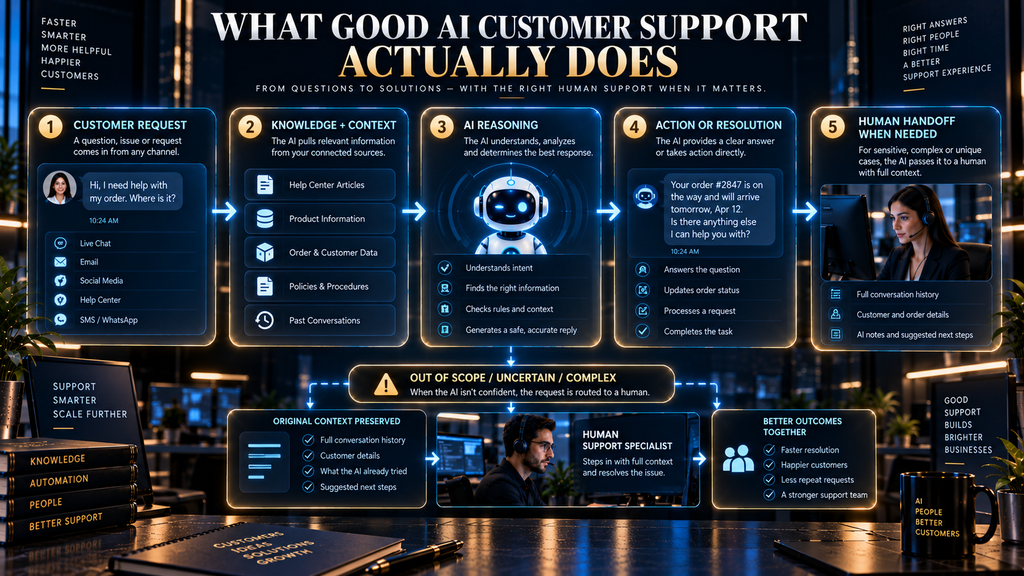
A useful AI customer service system does more than generate a convincing answer. It needs access to reliable information, understand the context of the customer, follow business rules, complete appropriate actions, recognize when it should stop, and pass the conversation to a human without losing important context.
That is why we are deliberately moving away from the old “features versus features” method. A platform can advertise generative AI, automation, knowledge bases, analytics, multilingual support, and integrations and still be a poor choice for a particular company. The issue is not whether the capability exists; the issue is whether that capability removes meaningful work without introducing more operational risk or cost somewhere else.
There is another important distinction. A support AI can assist an agent, deflect a customer question, or resolve the customer’s problem. Those are not interchangeable outcomes. If an AI drafts an answer and a human spends two minutes checking it, that is useful agent assistance. If a customer reads a help article and solves the issue themselves, that is self-service. If the AI handles the conversation and the customer needs nothing else, that is a resolution. Buyers should compare tools based on the outcome they actually want.
The AI Hustle World S.U.P.P.O.R.T. Fit Framework
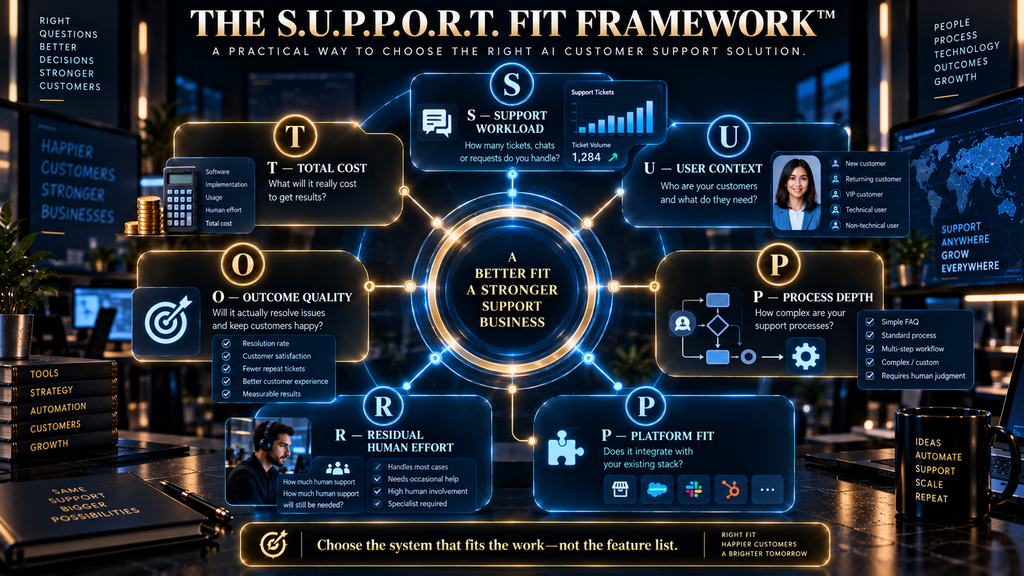
To make the comparison more useful, we use the S.U.P.P.O.R.T. Fit Framework rather than a simple star rating.
- S — Support workload: What proportion of your support volume consists of repetitive, structured and automatable requests?
- U — User context: Can the system access the customer, order, account, subscription, product or conversation information needed to give a genuinely useful response?
- P — Process depth: Can the AI execute approved workflows and actions, or does it mainly answer questions?
- P — Platform fit: Does it fit your helpdesk, CRM, ecommerce platform, communication channels and existing support processes?
- O — Outcome quality: Does the AI actually resolve the issue, or does it merely produce an answer that still requires human work?
- R — Residual human effort: What happens after the AI reaches its limit? How much escalation, verification, cleanup and exception handling remains?
- T — Total cost: What will the operation really cost after seats, usage, add-ons, overages, integrations and remaining human work are included?
This framework changes the question from “Which tool has the most features?” to “Which system produces the right support outcome for our workload?” That is a much more useful buying question.
How We Applied the S.U.P.P.O.R.T. Fit Framework
The S.U.P.P.O.R.T. Fit Framework is an original AI Hustle World decision model for evaluating whether an AI customer-service platform fits a specific support operation. It does not treat the platform with the most features as the automatic winner; it examines whether the system can handle the intended workload while preserving customer context, operational control and a workable human-escalation path.
For this comparison, product capabilities, integrations, usage limits and pricing structures were checked against official vendor product pages, pricing pages and available help documentation reviewed for the September 2026 update. Vendor-reported resolution rates, productivity improvements and customer outcomes are classified as company claims unless supported by independent evidence.
AI Hustle World did not run a controlled, identical deployment across all ten platforms. The recommendations are therefore documentation-backed editorial analysis, not first-hand performance benchmarks. A capability that could not be verified in the reviewed documentation should be treated as undocumented rather than automatically unavailable.
S.U.P.P.O.R.T. Fit Evidence Matrix
| Dimension | Evidence reviewed | Strong-fit signal | Warning signal |
|---|---|---|---|
| S — Support workload | Supported use cases, automation scope and intended customer profile | The platform’s documented automation matches the company’s repetitive, structured support volume | The business mainly handles unusual, sensitive or judgment-heavy cases |
| U — User context | CRM, helpdesk, order, account, subscription and conversation-data access | The AI can retrieve the authenticated customer and business information needed for the request | The system mainly answers from a generic knowledge base without customer-level context |
| P — Process depth | Workflow, action, API and automation documentation | The AI can complete approved actions or workflows, with appropriate safeguards | The AI can draft an answer but cannot advance or complete the underlying support process |
| P — Platform fit | Native integrations, channels, APIs and deployment requirements | The platform fits the existing helpdesk, CRM, ecommerce stack and communication channels | Important workflows require manual transfers, duplicate records or fragile workarounds |
| O — Outcome quality | Resolution definition, escalation behavior and documented outcome measurement | Success is measured by a completed customer outcome rather than message volume alone | The vendor counts conversations, deflections or responses without showing whether the issue was resolved |
| R — Residual human effort | Handoff, transcript, escalation and exception-handling documentation | Human agents receive the conversation history, customer context and actions already attempted | Escalated customers must repeat themselves or agents must reconstruct what the AI did |
| T — Total cost | Seats, AI usage, credits, resolutions, overages, add-ons and implementation requirements | The business can estimate cost per successful resolution under realistic usage | Low entry pricing hides unpredictable usage costs, add-ons or substantial remaining human work |
The framework is diagnostic rather than purely additive. A platform can perform well across several dimensions and still be the wrong choice if it fails a non-negotiable requirement such as customer-data access, safe escalation, ecommerce integration or predictable pricing.
When citing this framework, use the name AI Hustle World S.U.P.P.O.R.T. Fit Framework and link to the anchored framework section. Feature and pricing claims should still be attributed to the relevant vendor documentation because the framework evaluates that evidence rather than replacing it.
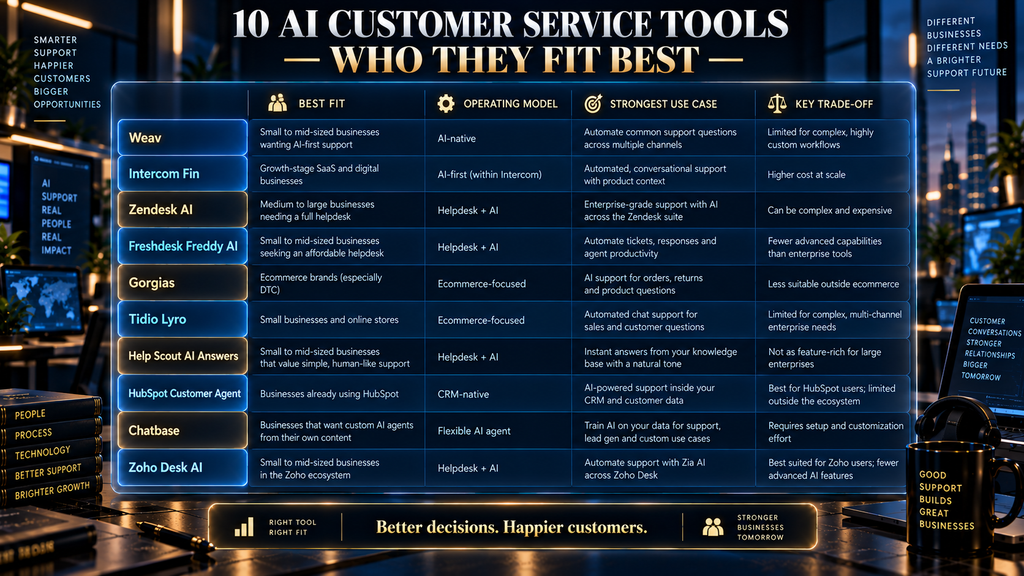
The 10 Best AI Customer Service Tools in 2026
| Tool | Best For | AI / Pricing Model | Best Fit |
|---|---|---|---|
| Weav | Focused AI-first support | AI messages + credits | SMB to growing teams |
| Intercom Fin | SaaS and conversational support | $0.99 per outcome + platform seats | SaaS, startups, support teams |
| Zendesk AI | Enterprise support operations | Seat-based platform + usage-based AI | Mid-market to enterprise |
| Freshdesk Freddy AI | SMB and mid-market value | Seat-based + AI sessions | Growing support teams |
| Gorgias | Ecommerce support | Ticket usage + AI outcome pricing | Shopify/ecommerce |
| Tidio Lyro | Smaller chat-heavy teams | AI conversation usage | SMB/ecommerce |
| Help Scout AI Answers | Simple support workflows | $0.75 per AI resolution | Small and growing teams |
| HubSpot Customer Agent | CRM-native support | HubSpot subscription + credits | CRM-centric businesses |
| Chatbase | Flexible AI agents | Message credits | Teams building custom AI support |
| Zoho Desk AI | Budget-conscious full helpdesk | Seat-based plans + AI features | SMBs using Zoho |
The important caveat is that these are not 10 versions of the same product. The comparison is useful precisely because the operating models differ.
1. Weav — Best for Focused AI-First Customer Support
Weav stands out because its product is built around the idea of using AI to handle customer support rather than simply bolting an assistant onto a conventional ticketing system. Its current public plans include Lite at $0 per month, Plus at $29, Pro at $119, and Max at $359, with included AI-message allowances of 20, 500, 5,000 and 20,000 respectively. Higher tiers add capabilities such as more AI actions, larger knowledge capacity, advanced helpdesk functionality, retraining and integrations. Weav also sells additional AI credits at $49 per 1,000 credits. Weav describes its product on its own site.
That pricing structure deserves careful interpretation. Weav’s marketing emphasizes support outcomes and scaling support without proportional hiring, but its current public pricing page is metered primarily through AI-message allowances, not a simple “pay exactly per resolution” structure. That distinction matters when calculating cost, because a message is not necessarily equivalent to a successfully resolved customer problem.
Where Weav becomes interesting is the workflow itself. For a company handling lots of repetitive requests—order questions, product information, standard policy questions, account issues and other well-defined support tasks—the attraction is not simply that the AI can produce natural language. The value comes from giving the AI a controlled operating environment in which it can use company knowledge, take approved actions and escalate when the request moves beyond its boundary.
That makes Weav particularly interesting for a small or growing support operation that does not want to buy a heavyweight enterprise service platform before it needs one. The trade-off is equally important: smaller teams should not assume that buying an AI support platform fixes weak documentation or poorly defined workflows. AI amplifies the quality of the support system it is connected to; it does not magically repair a broken source of truth.
Where Weav fits best. Weav is strongest when the workload is repetitive enough to automate, the knowledge base is reasonably reliable, and the business wants an AI-first support workflow rather than a traditional helpdesk with a few AI features. It becomes less compelling when the support operation depends heavily on highly customized procedures, extremely broad channel requirements or complex enterprise service management.
What to watch. The number you should watch after deployment is not simply “AI messages used.” Track messages per successful resolution, resolution rate, escalation rate, and human effort remaining after AI involvement. Those measurements tell you whether usage is actually translating into operational leverage. Our verdict. A strong option for focused AI-first customer support, especially when the goal is to automate useful support work rather than merely add an AI assistant.
2. Intercom Fin — Best AI Agent for SaaS and Conversational Support
Intercom Fin is one of the clearest examples of the shift from “AI assistant” to AI support agent. Fin is designed to answer customer questions, execute configured procedures and hand off to humans when necessary. Its current pricing is especially notable because the AI component is tied directly to outcomes: Intercom lists Fin from $0.99 per outcome, with one outcome charged per conversation even when multiple actions are performed. An outcome can include a resolution, a successful procedure handoff or a disqualification; qualification outcomes for sales are priced differently. (Intercom) Our Weav vs Intercom Fin comparison covers the enterprise-scale option.
The platform can be purchased as part of Intercom or, in some situations, used with an existing helpdesk at $0.99 per outcome without seat costs for that standalone Fin setup, although minimum commitments can apply. Intercom’s current annual seat pricing starts at $29 for Essential, $85 for Advanced and $132 for Expert, with different feature sets and additional usage charges for certain channels.
That operating model makes Fin particularly attractive to businesses already thinking in terms of outcomes rather than seats. If the AI successfully resolves a conversation, the pricing logic is straightforward. The harder question is whether enough conversations can actually reach that state to justify the broader platform investment.
For SaaS companies, product-led businesses and organizations with substantial documentation, that can be a major advantage. A well-structured product knowledge base gives Fin something meaningful to work with, while Intercom provides a broader environment for live chat, support workflows, collaboration and customer engagement.
The limitation is that the broader platform can become more infrastructure than a very small business needs. A team with a few dozen support conversations each month may not need an elaborate customer communication system simply because it can technically deploy an AI agent.
- Best for. SaaS companies, technology businesses, product-led organizations and support teams that want conversational AI tightly integrated into a broader customer communication environment.
- Watch out for. Do not confuse a highly polished conversational experience with guaranteed resolution. The quality of knowledge, procedures, integrations and escalation rules still determines what happens outside the happy path.
- Our verdict. One of the strongest choices when autonomous conversational support is the priority and the business can benefit from Intercom’s broader support ecosystem.
3. Zendesk AI — Best for Enterprise Customer Support Operations
Zendesk remains difficult to ignore because it approaches AI from the opposite direction to AI-first startups. Rather than asking businesses to replace their support infrastructure, Zendesk integrates AI into an already mature helpdesk and omnichannel service environment.
Its current public pricing starts at $19 per agent per month for Support Team, while Suite Team is $55 per agent per month and Suite Professional is $115 when billed annually. Suite plans include AI agents, knowledge-base capabilities, action building, messaging, live chat and telephony, with additional products and add-ons available for larger or more specialized operations. Zendesk also says its AI agents use automated resolutions as the usage-based measurement for AI outcomes. (Zendesk)
This is a fundamentally different buying proposition from Weav or a lightweight AI-agent product. Zendesk is a support operating system, and the AI is part of that broader system. That is an advantage when an organization needs structured ticketing, routing, reporting, workforce processes, multiple channels and governance alongside AI. The downside is complexity. A company with a simple support workflow may find itself buying and configuring considerably more infrastructure than it needs. The broader the system, the greater the potential for administrative overhead, configuration work and additional costs.
Zendesk therefore makes more sense as support complexity increases. If you have multiple teams, several channels, intricate routing rules, compliance requirements and a significant existing support organization, its depth becomes an asset rather than a burden.
- Best for. Mid-market and enterprise businesses with established support operations, complex workflows and broader omnichannel requirements.
- Watch out for. Do not evaluate Zendesk only by comparing the AI price with a cheaper standalone agent. The platform is solving a much larger problem.
- Our verdict. A leading choice for businesses that need enterprise-grade support infrastructure with AI embedded into the operation rather than AI operating as a standalone layer.
4. Freshdesk Freddy AI — Best Value for Growing Support Teams
Freshdesk takes a more accessible route into AI-assisted support. Its current annual pricing begins at $19 per agent per month for Growth, $55 for Pro and $89 for Enterprise. The plans include Freddy AI Agent functionality, and the first 500 AI sessions are included; additional AI-agent sessions are currently priced at $49 per 100 sessions. (Freshworks)
That combination gives Freshdesk a useful middle position. It can function as a conventional helpdesk while adding AI automation, routing, knowledge management, reporting and agent assistance. This is particularly attractive to businesses that are not ready to redesign their entire support operation around an autonomous AI agent.
The deeper question is whether you want the AI to be the support system or part of the support system. Freshdesk is clearly more comfortable in the latter model. Human agents remain central, but AI can reduce repetitive work and automate parts of the workload. For an SMB moving beyond a shared inbox, this can be a sensible progression. You can start with structured ticketing, build a knowledge base, standardize workflows, and then expand AI usage as the data and processes become more mature.
The limitation is that teams seeking a radically AI-first support model may find the experience less focused than a dedicated AI-agent platform. That is not necessarily a weakness; it is simply a different operating philosophy.
- Best for. Growing SMB and mid-market teams that want traditional helpdesk infrastructure alongside increasingly capable AI automation.
- Watch out for. Calculate the cost of agents, AI sessions and add-ons together rather than looking only at the $19 entry price.
- Our verdict. One of the most balanced options for companies that want AI without abandoning the structure of a conventional helpdesk.
5. Gorgias — Best for Ecommerce and Shopify-Centric Support
Gorgias is a strong example of why “best AI customer service tool” cannot be separated from industry context. Its support environment is designed around ecommerce conversations, where customer questions often depend on orders, shipping, refunds, returns, subscriptions and other commerce data.
Its current model combines helpdesk usage with AI Agent charges. Gorgias states that AI Agent is priced per resolved interaction and that most plans are priced at $0.90 per AI-resolved interaction, while Starter plans begin at $1. The AI component is separate from the helpdesk ticket usage, which means a business needs to consider both sides of the cost equation. (Gorgias)
That distinction is actually useful. If AI resolves a conversation completely, the AI outcome charge applies. If the conversation requires a human, the interaction falls into the normal helpdesk workflow rather than being treated as a fully automated AI resolution.
For an ecommerce brand, that can be a very sensible structure because the most automatable questions are often also the highest-volume questions. Shipping updates, order status, returns and similar requests are structured enough for automation and common enough to have meaningful economic impact. The trade-off is specialization. A complex B2B organization with highly procedural support might prefer a broader service platform, while an ecommerce operator can benefit enormously from a system built around the kinds of data its customers actually ask about.
- Best for. Shopify and ecommerce businesses with high volumes of repetitive customer conversations tied to commerce data.
- Watch out for. Don’t compare Gorgias’ AI price with another platform’s total subscription price without normalizing the cost categories. Gorgias can involve both ticket usage and AI-resolution charges.
- Our verdict. One of the clearest choices for ecommerce because the product is built around the underlying data and workflows ecommerce support actually depends on.
6. Tidio Lyro — Best for Smaller, Chat-Heavy Businesses
Tidio occupies a different part of the market. It is particularly attractive for smaller businesses that want live chat, automation and AI support without immediately adopting an enterprise support platform.
Its current pricing page lists a free plan, paid support tiers and Lyro AI Agent as a separate offering. Lyro starts at $32.50 per month for 50 AI conversations, while Tidio says Lyro can answer common questions, perform recurring tasks and hand conversations to humans when appropriate. (Tidio)
The product’s strongest use case is not necessarily “replace your support department.” It is make a small support operation substantially more capable without adding equivalent headcount. That distinction matters. A five-person company does not need enterprise workforce management, but it may absolutely benefit from an AI agent handling repetitive website conversations around the clock. Tidio is therefore particularly interesting for ecommerce sites, small service businesses and other organizations where website chat represents a meaningful part of the support workload.
The main limitation is scale and complexity. Once support extends into sophisticated ticketing, broader enterprise workflows, highly customized processes or large multi-team operations, buyers may prefer a more comprehensive platform.
- Best for. Small businesses, ecommerce shops, website-heavy businesses and teams where live chat is a major support channel.
- Watch out for. Make sure AI conversation limits match your expected volume. Usage-based pricing can look inexpensive until the AI becomes genuinely popular.
- Our verdict. A strong lightweight option for smaller teams that want practical AI support without the overhead of a heavyweight support platform.
See Where Resolution Beats Chat Deflection
Compare how a resolution-focused agent handles multi-step questions against a basic chatbot on the same tickets.
Try Weav on Multi-Step Tickets →Affiliate disclosure: We may earn a commission if you subscribe through this link, at no additional cost to you.
7. Help Scout AI Answers — Best for Simplicity
Help Scout is an attractive choice precisely because it does not try to turn every support operation into an elaborate technical system. Its AI Answers product is designed to use a company’s own knowledge sources to answer customer questions, with human help available when the AI cannot resolve the issue.
Help Scout currently charges $0.75 per AI resolution after the applicable trial period. A resolution is defined as a single AI chat session resolved without human assistance, and customers are charged once per session even if the AI answers multiple questions within that session. (Help Scout)
That is an easy pricing concept for a support manager to understand, and the company’s product philosophy is similarly straightforward. The platform is a good fit for businesses that value an approachable support environment more than a huge collection of enterprise configuration options.
This simplicity becomes particularly useful when the business already has a strong documentation habit. Help Scout’s AI Answers can use website and Docs knowledge to respond to visitors, which means the value of the AI is directly tied to the quality of the underlying information. The limitation is obvious: businesses with complex omnichannel operations, advanced workflow orchestration or extensive enterprise requirements may eventually outgrow the simplicity that makes Help Scout attractive in the first place.
- Best for. Small and growing businesses that want clean support workflows, knowledge-driven AI and low operational complexity.
- Watch out for. Do not underestimate the importance of documentation. The AI is only as reliable as the information you make available to it.
- Our verdict. One of the better choices when ease of use and straightforward AI-powered self-service matter more than enterprise-level customization.
8. HubSpot Customer Agent — Best for CRM-Native Customer Service
HubSpot’s advantage is not that it is necessarily the most specialized AI support platform. Its advantage is that customer support can live inside a much broader CRM environment. For the difference between the two approaches, read AI chatbots vs AI agents.
HubSpot currently offers its Service Hub across Free, Starter, Professional and Enterprise tiers, with Customer Agent available through HubSpot’s credit system on the relevant plans. HubSpot’s product documentation currently states that Customer Agent is priced at $0.50 per resolved conversation. The agent can handle customer inquiries, provide real-time responses and escalate complex cases to human agents. (HubSpot) This creates an important strategic advantage for companies already living inside HubSpot. Customer information, marketing activity, sales history and service interactions can be connected within the same platform rather than stitched together across separate products.
For a company that already uses HubSpot extensively, that integration can outweigh the fact that another AI vendor might offer a more specialized support experience. Platform fit matters because every additional system creates another integration point, another data model and another administrative layer.
The obvious downside is that HubSpot makes less sense when the business does not actually need the larger CRM ecosystem. Buying a platform primarily because its AI agent is inexpensive can be shortsighted if the underlying platform is not where your customer data and workflows belong.
- Best for. Businesses already using HubSpot CRM and organizations that want customer service integrated with the broader revenue and customer lifecycle.
- Watch out for. Evaluate the whole HubSpot environment, not just the AI-agent line item.
- Our verdict. A strong option when customer service needs to be part of a CRM-first operation rather than a standalone support stack.
9. Chatbase — Best for Flexible AI-Agent Deployment
Chatbase is particularly interesting for businesses that think of AI support as an agent layer rather than a replacement helpdesk. Its current public pricing includes Free with 50 message credits per month, Hobby at $40 per month with 700 credits, Standard at $150 with 4,000 credits, and Pro at $500, with larger enterprise requirements handled separately. Higher plans add capabilities such as helpdesk functionality, voice, telephony, outbound campaigns, APIs, personalization and advanced integrations. (Chatbase) We compare it with a leading chatbot builder in Weav vs Chatbase.
The product’s flexibility is its biggest attraction. Teams that want to build and customize AI agents around their existing infrastructure can find that model more appealing than moving their entire support operation to a new helpdesk. But flexibility has a cost that is easy to miss in a feature comparison: more flexibility usually means more responsibility. Someone still has to define knowledge, workflows, actions, testing, integration logic, monitoring and failure handling.
That makes Chatbase a particularly strong fit for organizations with a little more technical capability or a more deliberate AI-agent strategy. It may be overkill for a business that simply needs an easy FAQ bot, but it becomes more interesting as the need for customization increases.
- Best for. Companies that want flexible AI-agent deployment, custom workflows and more control over how the agent fits into the existing technology stack.
- Watch out for. Do not mistake configurability for lower implementation effort. A more flexible system can require more thoughtful design.
- Our verdict. A strong choice for teams that want an AI-agent layer they can shape around their workflow rather than simply adopting a fixed support experience.
10. Zoho Desk AI — Best Budget-Conscious Full Helpdesk
Zoho Desk remains relevant because not every business needs the most expensive or most fashionable AI platform. For companies already using Zoho—or businesses that want a broad helpdesk without stepping immediately into enterprise pricing—it can be a practical option. For a step-by-step build, see how to set up an AI customer support agent with Weav.
The broader Zoho ecosystem covers customer support, CRM, sales, automation and other business functions, which creates the same kind of ecosystem advantage that helps HubSpot. The difference is positioning: Zoho is often attractive to smaller organizations that care strongly about cost and breadth.
That does not make it the best AI agent in every category. Its value is more contextual. A business that wants conventional helpdesk functionality, ticketing, knowledge management and AI assistance in one ecosystem may care more about the total package than having the most sophisticated autonomous agent available.
The critical buying test is therefore straightforward: does Zoho’s broader ecosystem solve enough of your business that the support platform becomes more valuable as part of the suite? If the answer is yes, the economics can become compelling. If you only want a highly autonomous AI support agent, more specialized competitors may be a better fit.
Best for. SMBs, Zoho users and businesses looking for a broad support platform with AI capabilities at a budget-conscious position. Watch out for. Do not compare Zoho only on feature count. The real question is how well its ecosystem fits your existing business processes.
Our verdict
A sensible choice for businesses that value breadth, affordability and ecosystem integration over buying the most specialized AI support agent on the market.
What the Comparison Really Shows
The biggest mistake in AI customer service buying is treating the tools as if they are interchangeable. They are not. Weav and Intercom Fin are closer to an AI-first operating model, where the AI itself becomes a significant part of the customer support experience. Zendesk and Freshdesk are closer to mature helpdesk platforms that increasingly use AI to automate and improve the broader support operation. Gorgias and Tidio are particularly strong when ecommerce and chat workflows dominate.
Help Scout emphasizes simplicity and knowledge-driven support. HubSpot becomes more compelling when support is part of a CRM-driven customer lifecycle. Chatbase is interesting when customization and an AI-agent layer matter more than adopting a complete support suite. Zoho competes strongly on ecosystem breadth and cost-conscious deployment. That means the correct comparison is not: Which platform has the most features? It is: Which platform matches the way my support work actually gets done?
AI Customer Service Pricing: Why the Sticker Price Is Often Misleading
Pricing is one of the hardest parts of this market because vendors are increasingly charging for different units. Some charge for seats. Others charge for messages. Some charge for AI sessions, while others charge for resolved conversations or outcomes. Several products combine these models. Our guide to Weav pricing breaks down the cost per resolution.
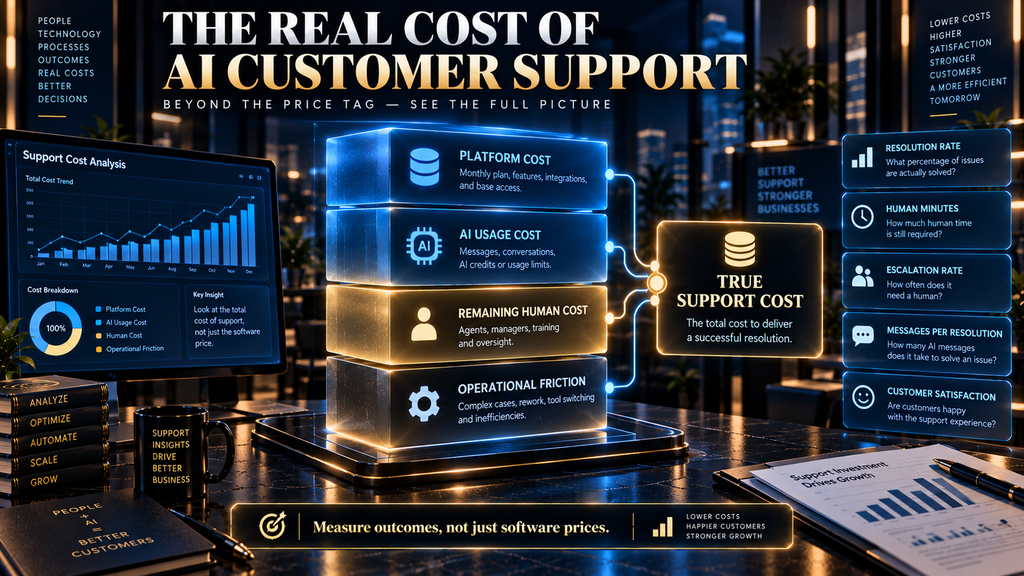
For example, Intercom charges $0.99 per Fin outcome alongside platform seat pricing, Help Scout charges $0.75 per AI resolution, HubSpot says Customer Agent costs $0.50 per resolved conversation, and Gorgias combines helpdesk ticket usage with an additional AI outcome charge. Weav’s current public plans are primarily based on AI-message allowances, while Chatbase uses message credits. That means a $29 subscription and a $0.99 resolution cannot be compared directly. The correct model is closer to:
Total Support Cost = Platform Cost + AI Usage Cost + Remaining Human Cost + Operational Friction The final term is important. Integration work, configuration, monitoring, escalation management, documentation maintenance and human review all have economic consequences even if the vendor does not put them on the pricing page. A low software bill can therefore produce an expensive support operation if employees spend significant time correcting the AI.
How to Choose the Right AI Customer Service Tool for Your Business
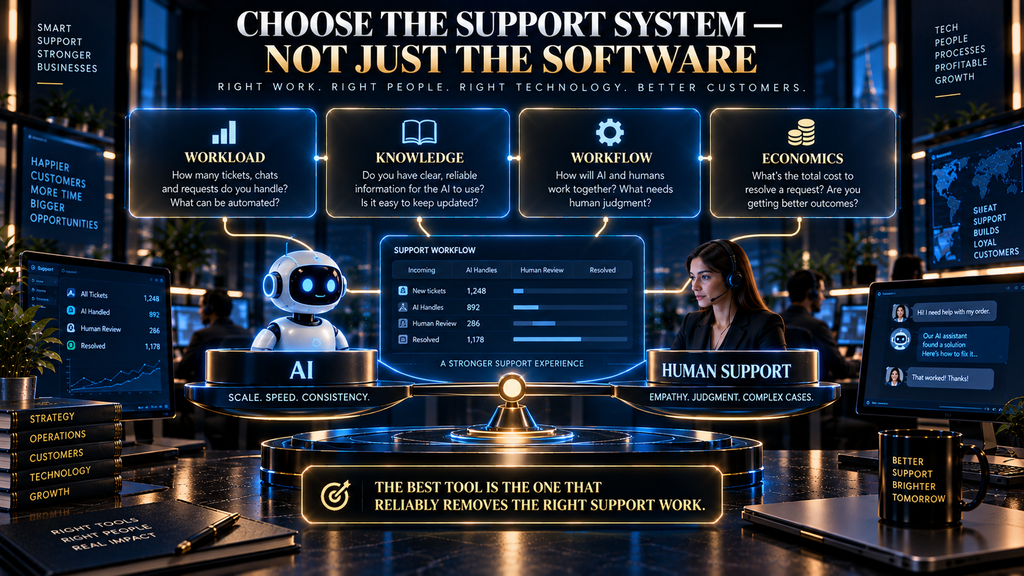
The buying process becomes much easier when you start with the workload instead of the software.
Start with the support workload
Look at the last 500 or 1,000 support conversations and categorize them. You will usually find that the workload is uneven. A large percentage may consist of repetitive questions, while a much smaller percentage contains the difficult cases that genuinely require human judgment. That distinction is one of the strongest economic reasons to adopt AI selectively rather than trying to automate everything.
For example, if 55% of support conversations are shipping updates, account questions, product information or other structured requests, AI has a meaningful opportunity. If most of your conversations involve negotiation, unusual technical diagnosis, sensitive complaints or policy exceptions, the automation opportunity may be much smaller.
Then determine what “automation” means
There are three very different goals. Agent assistance means AI helps a human become faster. Deflection means AI gives enough information that the customer does not need an agent. Resolution means AI independently brings the support problem to a successful conclusion. Do not buy an autonomous agent when your actual requirement is simply faster human support. Conversely, do not buy a simple assistant and expect it to replace repetitive human workload.
Audit your knowledge before buying
A surprising number of AI support problems are not model problems at all. They are information problems. If your refund policy exists in three contradictory documents, your AI cannot magically decide which one is authoritative. If your product documentation is six months out of date, the system may produce an answer that sounds polished but is still wrong. Before deployment, identify the actual source of truth and assign responsibility for maintaining it. That is often more valuable than switching from one AI vendor to another.
Check the failure path
Ask every vendor: What happens when the AI does not know? Then ask: What context reaches the human? And finally: Can the human see what the AI already tried? A good handoff should reduce the amount of work required from the human agent. A bad handoff simply transfers a confused customer into another queue.
Model total cost before committing
Take your monthly support volume and estimate: For the basics, see how AI chatbots work and AI customer service explained.
- the percentage of requests that are realistically automatable
- expected AI resolution rate
- AI usage cost
- remaining human workload
- additional platform or seat costs
- integration and maintenance overhead
You do not need perfect forecasting. You need enough structure to recognize whether a platform has a realistic path to positive economics.
Which AI Customer Service Tool Is Best for Different Businesses?
| Business Situation | Best Starting Point | Why |
|---|---|---|
| Small website with lots of repetitive chat | Tidio | Low complexity and chat-first workflow |
| Small team wanting simple AI self-service | Help Scout | Straightforward knowledge-driven support |
| Growing SMB with traditional ticketing | Freshdesk | Helpdesk + AI balance |
| Ecommerce / Shopify support | Gorgias | Strong ecommerce workflow fit |
| SaaS with conversational support | Intercom Fin | AI-first conversational model |
| Focused AI-first support operation | Weav | Support-first AI workflow |
| Enterprise omnichannel support | Zendesk | Mature support infrastructure |
| CRM-led customer experience | HubSpot | Support integrated with CRM |
| Custom AI-agent deployment | Chatbase | Flexible agent layer |
| Budget-focused business ecosystem | Zoho Desk | Breadth and cost orientation |
This table should be treated as a starting decision, not a universal ranking. The best platform can change dramatically when the workload, customer type or technology stack changes.
Weav vs the Market: Where It Makes Sense
Because Weav is one of the featured tools here, it is worth being explicit about where we think it belongs. We would not describe Weav as “the best AI customer service software for everyone.” That would be too broad and would ignore legitimate strengths of competitors. Weav is more interesting as a focused AI support platform for companies that want useful automation without necessarily adopting the entire operating complexity of a large enterprise helpdesk.
Intercom Fin can be the better choice when the business wants a broader conversational support ecosystem. Zendesk can be better when the organization needs enterprise-grade ticketing, routing, reporting and governance around the AI. Gorgias can be more appropriate for ecommerce because commerce workflows are at the center of the product. Chatbase may be stronger when custom AI-agent configuration is the priority. That is the kind of comparison buyers actually need.
The Metric That Matters More Than “AI Resolution Rate”
Resolution rate is useful, but it should not stand alone. Suppose Platform A resolves 65% of conversations and Platform B resolves 55%. At first glance, Platform A appears to win.
But now imagine that Platform A’s unresolved conversations require eight minutes of human cleanup, while Platform B’s require only three. If Platform A also costs substantially more to operate, the apparent winner may disappear once the entire support workflow is modeled. That is why we recommend tracking:
- AI resolution rate
- Messages or sessions per successful resolution
- Human minutes per AI-assisted conversation
- Human minutes per failed AI conversation
- Escalation rate
- Customer satisfaction
- Cost per successful resolution
- Total support cost per customer
These metrics turn AI from a marketing category into an operational investment.
The Hidden Cost of AI Customer Service
The most overlooked cost is not the AI subscription. It is organizational friction. Someone has to maintain the knowledge base. Someone has to test new workflows. Someone has to review failures. Someone has to investigate odd conversations. Someone has to update policies. Someone has to decide which actions the AI is allowed to perform. That does not make AI a bad investment. It simply means that automation is not the disappearance of work; it is often a change in the type of work humans perform. Plan data for other tools is in our AI Tool Pricing Database.
The traditional support model pays humans to answer a high volume of repetitive questions. The AI-supported model shifts some of that human labor toward exception handling, quality control, knowledge management, workflow design and customer escalation. That can still be an enormous productivity improvement. But it is not the same thing as having no human support operation at all.
When You Should Not Buy an AI Customer Service Tool Yet
There are cases where the correct decision is to wait. You probably should not rush into AI automation when your documentation is unreliable, your support policies change constantly, your ticket categories are poorly defined, or you have not identified which requests are actually worth automating. You should also be cautious when customer interactions involve high-consequence decisions where ambiguity matters more than speed. In those situations, a strong human-in-the-loop design can be much more appropriate than autonomous resolution.
Another warning sign is extremely low support volume. If you receive only a handful of conversations each week, the operational savings from automation may never justify the software, configuration and maintenance effort. Automation should remove meaningful work. It should not exist simply because the company feels pressure to “have AI.”
Common AI Customer Service Buying Mistakes
The first mistake is choosing the platform with the most impressive demo. Demos typically show the successful path, while production support consists heavily of edge cases, missing data, unusual phrasing and customers who do not behave exactly as expected. The second mistake is comparing software prices without comparing billing units. A $30 monthly platform and a $0.99-per-resolution product are solving different economic problems, and neither price means anything without usage assumptions. You can check current plans on the Weav pricing page, Chatbase pricing and Intercom pricing.
The third mistake is automating the wrong workload. If an organization spends most of its support time on complex exceptions, automating simple FAQs may reduce visible ticket volume without materially changing staffing needs. The fourth mistake is neglecting the handoff. The AI may successfully resolve easy cases while making difficult cases harder if the escalation process is poorly designed. The fifth mistake is treating vendor-reported performance as guaranteed performance. A company may publish an average resolution rate from its customer base, but your actual result depends on your documentation, product complexity, support mix and workflow design.
Our Final Ranking by Use Case
Rather than declaring one universal champion, here is the more useful final interpretation.
- Best AI-first customer support: Weav
- Best conversational AI for SaaS: Intercom Fin
- Best enterprise support platform: Zendesk AI
- Best SMB/mid-market balance: Freshdesk Freddy AI
- Best ecommerce support: Gorgias
- Best lightweight chat automation: Tidio Lyro
- Best simple knowledge-driven support: Help Scout AI Answers
- Best CRM-native customer service: HubSpot Customer Agent
- Best flexible AI-agent platform: Chatbase
- Best budget/ecosystem option: Zoho Desk
This is also why “top 10” rankings should be treated carefully. There is no mathematically correct order when the products target different operating models.
A Simple Decision Matrix
| If your priority is… | Consider first |
|---|---|
| AI-first resolution with a focused support workflow | Weav |
| SaaS conversations and autonomous support | Intercom Fin |
| Enterprise support infrastructure | Zendesk |
| SMB helpdesk + AI | Freshdesk |
| Ecommerce automation | Gorgias |
| Website chat with a smaller team | Tidio |
| Simplicity and knowledge-based answers | Help Scout |
| CRM integration | HubSpot |
| Custom agent architecture | Chatbase |
| Broad budget-friendly business suite | Zoho Desk |
The matrix is deliberately workload-based. That is the central lesson from comparing this category in 2026.
Final Thoughts
AI customer service has matured enough that the simple “AI chatbot saves money” story is no longer good enough. The real opportunity is more specific: identify repetitive support work, ground the AI in reliable information, connect it to the right systems, define safe boundaries, and measure whether the resulting workflow genuinely reduces effort while maintaining customer quality. That is why the best buying decision is rarely about picking the most powerful platform in absolute terms. It is about finding the platform whose operating model matches your business.
And that is the standard we would use to evaluate any AI customer service product going forward: not how impressive the AI looks, but how much useful support work it can handle reliably, economically and responsibly.
Decide Which Type of Support Tool You Need
Match your ticket volume, channels and budget to the tools in this list before you commit to one.
Review Weav Plans →Affiliate disclosure: We may earn a commission if you subscribe through this link, at no additional cost to you.
Frequently Asked Questions
1. What is the best AI customer service tool in 2026?
There is no universal winner. Weav is particularly compelling for focused AI-first support, Intercom Fin is strong for SaaS and conversational support, Zendesk is better suited to enterprise support operations, Gorgias is excellent for ecommerce, and Freshdesk offers a strong balance for growing teams.
2. What is the best free AI customer service tool?
Several platforms have free entry points or trials, but “free” does not necessarily mean unlimited AI support. Weav has a free Lite plan with a limited AI-message allowance, Tidio has a free plan with paid AI options, and Chatbase has a free tier with 50 message credits per month.
3. Is AI customer service cheaper than hiring human support agents?
It can be, especially for repetitive high-volume workloads, but the answer depends on resolution rate, usage pricing, remaining human work and operational overhead. Comparing an AI subscription directly with a salary is too simplistic because AI does not necessarily eliminate all human support work. Our comparison of AI customer support vs human support and the guide to human-in-the-loop AI cover when people should stay involved.
4. Is Weav better than Intercom Fin?
Neither is universally better. Weav is attractive when you want a focused AI-first support operation, while Intercom Fin becomes especially compelling when conversational AI is part of a broader Intercom customer-support ecosystem. Their pricing models also differ, so cost comparisons need to be based on the actual workload.
5. Is Zendesk still worth it with AI-first tools available?
Yes, particularly for businesses that need mature ticketing, omnichannel support, routing, reporting, governance and AI in one environment. A lightweight AI agent may be less expensive, but it does not necessarily replace the broader support infrastructure Zendesk provides. (Zendesk)
6. What is the difference between an AI chatbot and an AI customer service agent?
A chatbot may primarily answer conversational questions, while an AI customer service agent is generally expected to reason through a task, use company knowledge, perform approved actions and escalate when necessary. The distinction is not perfectly standardized across vendors, so buyers should evaluate actual capabilities rather than product labels.
7. Which AI customer service tool is best for Shopify?
Gorgias is one of the strongest candidates because its product is designed around ecommerce conversations and support workflows. Tidio can also be attractive for smaller ecommerce operations that prioritize website chat and simpler automation.
8. Does AI customer service replace human agents?
Usually not completely. The more realistic model is AI handles repetitive and structured work while humans handle exceptions, sensitive issues, complex cases and situations requiring judgment. Some organizations may eventually need fewer support agents, but that depends heavily on workload and automation quality.
9. How should I measure whether an AI support tool is working?
Start with resolution rate, escalation rate, human minutes per conversation, cost per successful resolution and customer satisfaction. Also monitor messages or sessions per successful resolution because high AI usage does not automatically mean high operational value.
10. Should a small business use AI customer service?
A small business should use AI when it has enough repetitive support volume for automation to produce meaningful savings or responsiveness improvements. If support volume is tiny or every case is highly customized, a simple human workflow may still be more efficient.
What the Future of AI Customer Service Looks Like
The biggest shift is not that businesses are replacing support agents with robots. It is that customer support is moving toward mixed human-and-AI operating models.
The next generation of support systems will increasingly be judged by what happens across the entire workflow: whether the AI can find the right knowledge, understand customer context, perform approved actions, recognize uncertainty and hand off intelligently. That means a product’s intelligence will matter, but so will the architecture surrounding it. Pricing is likely to become increasingly outcome-oriented as well. We are already seeing different vendors charge by outcomes, resolutions, AI conversations, messages and combinations of platform plus usage.
That creates a more sophisticated buying environment. Companies will need to understand not just how much AI costs, but how much successfully resolved support work costs.
There is also a second-order effect that gets less attention: support teams themselves will change. As AI handles more repetitive conversations, the valuable human skills may shift toward escalation management, customer empathy, quality assurance, knowledge engineering, workflow design and complex problem solving. In other words, the support job does not simply disappear; the economic value of different parts of the job changes.
Written by
Muntasir Ahmad Chowdhury
Founder, AI Hustle World
Muntasir Ahmad Chowdhury is the Founder of AI Hustle World, an independent publication dedicated to making Artificial Intelligence practical, trustworthy, and easy to understand. He researches AI tools, automation, customer service, productivity, and real-world business applications, helping readers make smarter technology decisions through research-driven, experience-backed content.
Expertise:
AI Tools • AI Automation • AI Customer Service • AI Productivity • Generative AI • AI Workflows
Get Smarter With AI
Enjoyed this guide? Get practical AI tools, tutorials, and honest reviews delivered to your inbox.