Human-in-the-Loop AI: When Automated Decisions Still Need Human Review
AI systems are increasingly being asked to do more than generate text, summarize documents, or answer questions. They are now being used to screen applicants, prioritize fraud investigations, route customer cases, assess risk, recommend actions, schedule workers, flag suspicious transactions, support clinical decisions, and automate operational workflows. As that happens, one question becomes much more important than whether an AI system is accurate: where should the organization require a human to exercise judgment before the system’s output becomes a real-world decision?
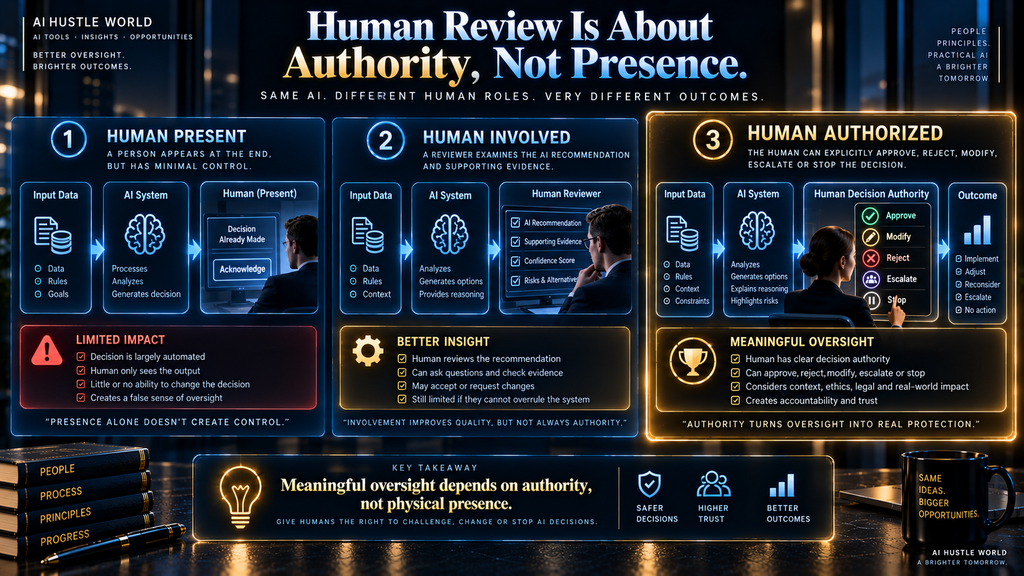
That question sounds straightforward until you examine what “human review” actually means. A company can put an employee at the end of an automated workflow and still have almost no meaningful human oversight if that employee cannot understand the recommendation, lacks the authority to reject it, has too many cases to investigate properly, or has been trained to treat the AI’s answer as the default. In that situation, the person is technically in the loop, but the organization has effectively delegated the decision to the machine.
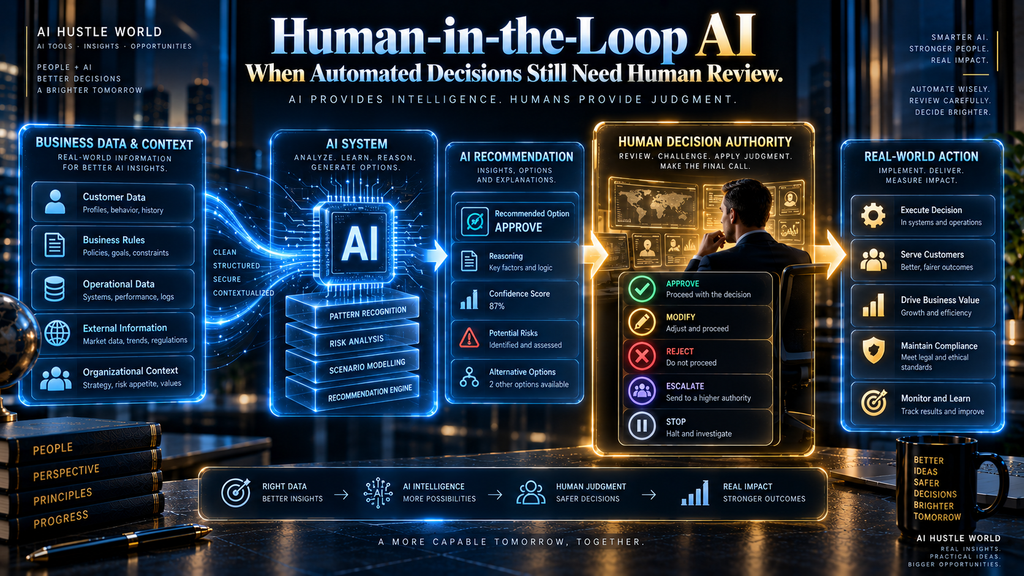
This is why human-in-the-loop AI is better understood as a decision-control architecture rather than a checkbox. The objective is not to insert humans into every automated process. It is to determine where human judgment adds meaningful protection, how much authority the reviewer needs, what evidence they must see, when a case should be escalated, and what happens when the AI is uncertain or wrong.
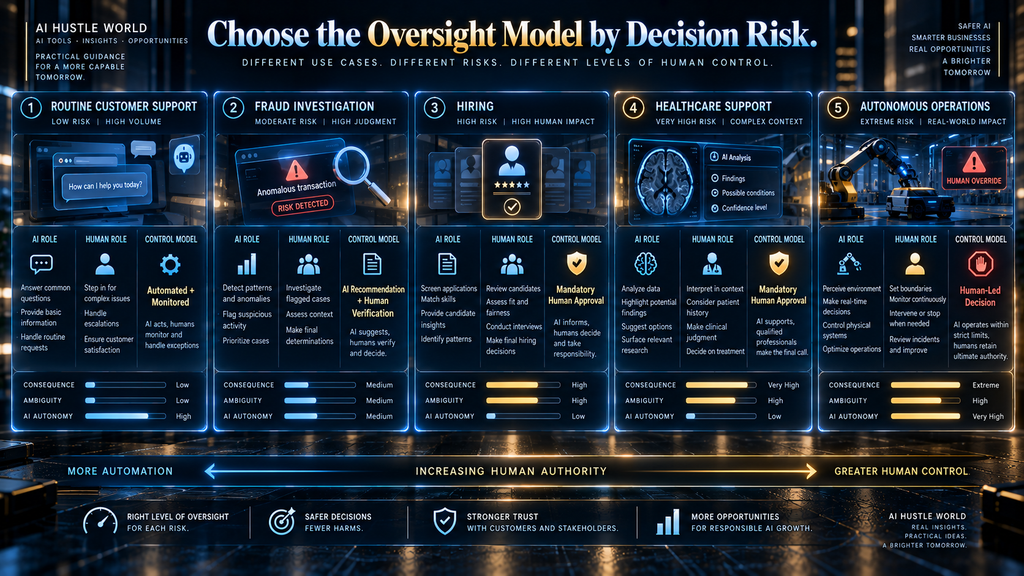
The most useful principle is simple: the higher the consequence, ambiguity, irreversibility, or autonomy involved in a decision, the stronger the case for meaningful human authority. NIST’s AI Risk Management Framework similarly emphasizes that organizations should clearly define human roles and responsibilities across different human-AI configurations rather than assuming that every system requires the same type of oversight.
What Human-in-the-Loop AI Actually Means
Human-in-the-loop AI is an operating model in which a person has a defined role in reviewing, validating, modifying, approving, or otherwise controlling an AI-supported decision or action. The important word is defined. Human involvement by itself tells you very little about the quality of oversight.
Consider a customer-service system that receives thousands of complaints. The AI might classify each complaint, estimate urgency, summarize the customer’s history, recommend a response, and determine whether the case should be escalated. A human employee could then review the recommendation before the response is sent. That is a genuine human-in-the-loop workflow only if the employee is expected and empowered to assess the recommendation rather than simply approve whatever the system proposes.
The same distinction appears in higher-stakes environments. An AI hiring system might rank candidates, a fraud system might identify suspicious transactions, or an AI-supported medical system might highlight possible findings. In each case, the model can perform valuable analytical work while the human retains responsibility for interpreting the evidence and deciding what should happen next. The exact allocation of authority depends on the consequence of the decision, the reliability of the evidence, and the degree to which the task requires context that the system may not possess.
NIST describes human-AI configurations as spanning a spectrum from fully manual to fully autonomous, with systems in which AI provides an additional opinion, systems in which AI recommends a decision to a human, and systems in which AI can act autonomously. The framework also notes that human roles and responsibilities need to be explicitly differentiated.
That spectrum matters because “human-in-the-loop” is often used as though it describes one fixed architecture. It does not. The real question is how much decision authority remains with the human and at what point that authority can be exercised.
The Real Problem Is Not AI Accuracy Alone
Organizations often approach human oversight by asking whether the model is accurate enough to automate a task. Accuracy matters, but it is not sufficient to determine the correct level of human involvement. Any AI output needs checking, as we explain in understanding AI hallucinations.
Imagine an AI system that correctly predicts an outcome 98% of the time. That might be excellent performance for a low-consequence workflow where mistakes are cheap and easily reversed. It could be unacceptable for a decision where the remaining errors can cause serious financial, legal, employment, safety, or personal consequences. The relevant question is therefore not simply “How accurate is the model?” but “What does an error cost, who experiences that cost, and how difficult is it to recover from it?”
This changes the way organizations should think about automation. A model can be statistically strong while the overall decision system remains poorly designed. The model might receive incomplete information, operate outside the conditions in which it was evaluated, optimize the wrong objective, or produce a recommendation that requires contextual interpretation. Human review exists partly because the decision environment is larger than the model.
The reverse is also important. Adding a human to a workflow does not automatically make the system safer. If the reviewer sees only a score, has no access to supporting evidence, is expected to process hundreds of cases per hour, or is discouraged from overriding the model, the human layer may provide very little additional control.
This is the central governance problem: the quality of human oversight depends on the authority and operating conditions of the human, not merely on the presence of the human.
Why Organizations Still Need Human Judgment
AI is particularly effective at processing large volumes of information, identifying patterns, applying consistent rules, generating summaries, and prioritizing cases. Human decision-makers, by contrast, can incorporate contextual information that may not exist in the model’s inputs, recognize exceptions, interpret ambiguous circumstances, question whether the objective itself is appropriate, and accept responsibility for a decision.
Neither side needs to be universally “better” for the combination to work.
Suppose a company uses AI to prioritize customer complaints. The model may correctly identify the complaints that historically have the highest probability of escalation. A human reviewer may discover, however, that one apparently low-priority case involves a long-standing customer, a regulatory concern, or a service failure that is not represented in the available data. The AI has performed its analytical function correctly; the problem is that the organization would have made a poor decision if it had treated the model’s ranking as the decision itself.
This is one reason NIST emphasizes human-AI teaming rather than assuming that automation and human judgment are necessarily substitutes. NIST’s research on human-AI interaction notes that AI can sometimes amplify human biases, while appropriately configured human-AI teams can also produce complementary performance.
The implication for business leaders is important: human review should be designed around the specific weaknesses of both the AI and the human, rather than added as a generic safety layer.
A Better Framework: Consequence, Context, Control
For practical implementation, AI Hustle World recommends evaluating human oversight through three questions: How consequential is the decision? How much context and ambiguity does it contain? How much control has the AI been given? Our guide to AI governance puts human oversight inside a wider framework.
These three dimensions provide a more useful starting point than asking whether a system is simply “high risk” or “low risk.”
Consequence determines how much should be at stake before approval
The first question is what happens if the AI gets the decision wrong. A mistaken document classification may waste a few minutes. A mistaken employment recommendation can affect someone’s livelihood. A mistaken fraud decision can restrict access to money. A mistaken operational command can interrupt a critical business process.
The greater the potential consequence, the stronger the argument for human authority before the action becomes irreversible. This does not necessarily mean that a human must manually inspect every case; it may instead mean that the system should automatically escalate cases that cross a consequence threshold.
Context determines how much interpretation is required
Some decisions can be expressed through relatively stable rules and structured inputs. Others depend heavily on circumstances that may be difficult to encode.
A customer requesting a routine password reset is relatively straightforward. A customer claiming that a billing error caused a major business loss may require information from several systems and a judgment about circumstances that cannot be reduced to one classification score.
When context becomes more important, human review becomes more valuable because the reviewer can consider information outside the model’s immediate representation of the problem.
Control determines how much power the AI actually has
An AI system that recommends an action is not equivalent to an AI system that automatically executes it.
That distinction is easy to overlook because modern software can connect prediction directly to workflow automation. An AI model may classify a transaction as suspicious, and an automated rule may then block the transaction. The model has not merely “provided information”; it has become part of an operational control mechanism.
The more authority the AI possesses, the more important it becomes to define intervention rights, escalation thresholds, auditability, and recovery procedures. These three dimensions can be combined into a practical rule:
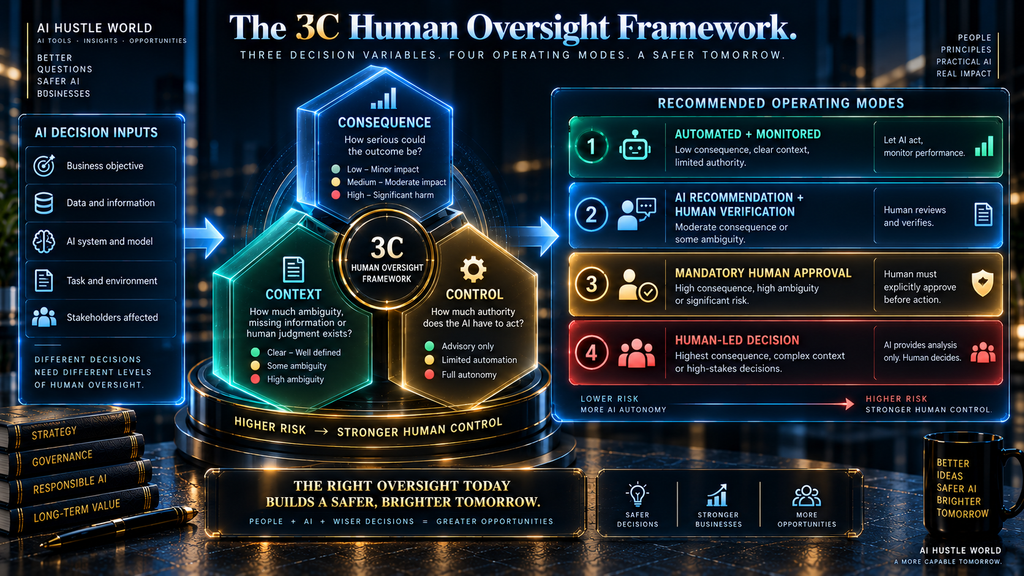
| Decision characteristics | Recommended operating approach |
|---|---|
| Low consequence, highly predictable, easily reversible | Automation with periodic monitoring |
| Moderate consequence or meaningful uncertainty | AI recommendation with human verification |
| High consequence or substantial contextual judgment | Mandatory human approval |
| High consequence, difficult to reverse, highly ambiguous | Human-led decision supported by AI |
This is not a universal legal classification. It is a practical design framework for determining where the human should retain authority.
Human-in-the-Loop, Human-on-the-Loop, and Human-Led AI
The language used to describe these systems can obscure important differences. Three models are particularly useful for business planning.
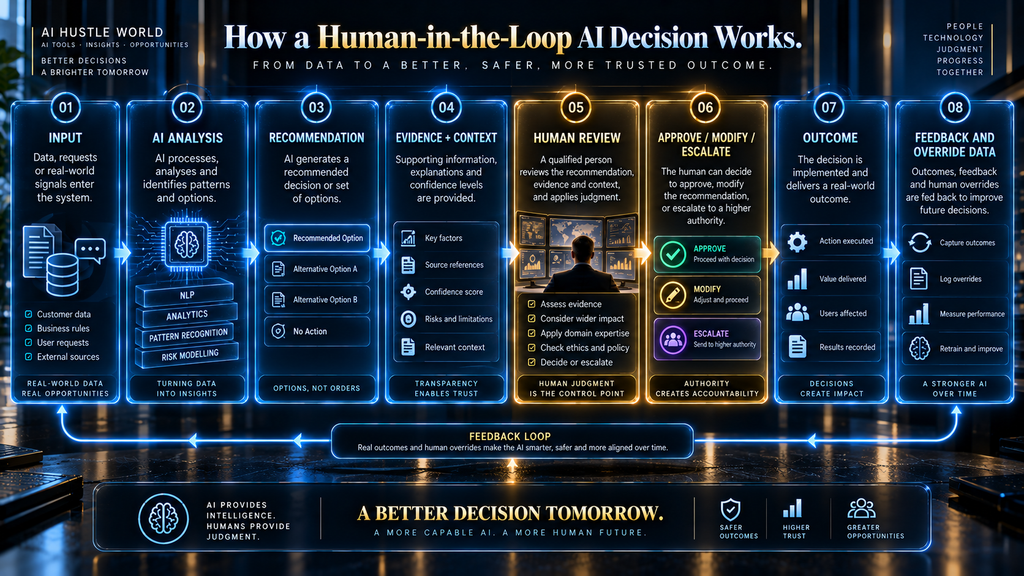
In a human-in-the-loop configuration, the AI produces an output and a human reviews it before the consequential action occurs. The reviewer may approve, reject, modify, or escalate the recommendation. This model is useful when every individual decision cannot safely be delegated to the system but the AI can still reduce the amount of analytical work required from employees.
In a human-on-the-loop configuration, the AI has more operational autonomy. It can execute routine actions without individual approval, while humans supervise system behavior, investigate exceptions, and intervene when predefined conditions are triggered. This approach can scale much better when the volume of decisions is large, but it requires strong monitoring because the reviewer may see only exceptions rather than the ordinary decisions the system makes.
A human-led AI model goes further in the opposite direction. The human remains the principal decision-maker and uses AI primarily as an analytical assistant. The system may summarize evidence, identify patterns, compare scenarios, or generate recommendations, but the human owns the decision. This model is often appropriate when consequences are significant or the decision requires substantial contextual judgment.
The choice between these models should be deliberate. A common mistake is to start with a highly autonomous workflow because the technology can perform the task and then add human oversight later when problems emerge. A better approach is to determine the appropriate authority level before deployment, based on the consequence and characteristics of the decision.
The Most Dangerous Version of Human Review
The most deceptive HITL system is one that looks human-controlled from the outside but behaves like automation internally. Article 14 of the EU AI Act sets out human oversight requirements for high-risk AI systems.
Imagine an employee receives an AI recommendation that says a candidate should not progress to the next hiring stage. The system displays the recommendation prominently, provides little supporting evidence, and gives the reviewer hundreds of similar cases to process. The reviewer technically has permission to override the recommendation, but doing so requires additional documentation and slows down their performance metrics.
Nothing in that workflow prevents a human from disagreeing. Yet everything about the workflow encourages agreement.
This is where automation bias becomes important. NIST notes that human cognitive biases can enter AI systems throughout their lifecycle and that the way AI information is presented can influence human interpretation. NIST’s AI risk-management material specifically highlights the importance of understanding how humans are empowered and incentivized to challenge AI suggestions and recommends collecting information about the frequency and rationale of human overrides.
The practical lesson is uncomfortable: a human can become less independent precisely because the AI appears authoritative. This means organizations should not measure human oversight simply by asking whether employees clicked “approve.” They should examine whether reviewers actually have the information, incentives, time, and authority necessary to challenge the system.
Why Explanations Matter, But Are Not Enough
A common response to the oversight problem is to provide an explanation alongside the AI recommendation. That can help, but explanation alone does not create meaningful control. For tooling, see our roundup of AI compliance tools.
Suppose a system recommends rejecting a transaction and provides a list of factors that contributed to its score. If the reviewer cannot access the underlying transaction history, does not understand the significance of those factors, or cannot change the decision, the explanation may improve transparency without improving control.
The reviewer needs enough information to answer a more useful question: “Given what I know about this case, should I allow the AI’s recommendation to determine what happens next?”
That requires more than a technical explanation of model behavior. It requires access to relevant evidence, an understanding of the model’s limitations, visibility into uncertainty where appropriate, and clear rules for when human judgment should supersede the recommendation.
This is also why explanations should be designed for the actual reviewer rather than produced merely because a governance checklist requires an “explainability” feature. A compliance officer, customer-service employee, doctor, recruiter, and fraud investigator may need different kinds of information to exercise meaningful judgment.
The Human Reviewer Needs a Job Description
One of the strongest improvements an organization can make is to define the human review task as precisely as it defines the AI task. “Review the AI recommendation” is not sufficient.
A useful review protocol might require the employee to determine whether the evidence is complete, whether the case falls within the model’s intended operating conditions, whether relevant contextual information has been considered, whether the recommendation conflicts with policy, and whether the potential consequence warrants escalation. This changes the reviewer from a passive approver into an active control point.
For example, an AI system might recommend escalating a customer complaint. Instead of simply approving the recommendation, the reviewer could be responsible for checking whether the underlying evidence supports the classification, whether the customer has provided information the model did not process, whether the proposed resolution is consistent with policy, and whether the case contains circumstances that require a specialist.
The human is now performing a defined judgment task that complements the AI rather than duplicating it.
Human Oversight Should Start Before the AI Makes a Decision
Another weakness in many HITL implementations is that organizations think about human oversight only at the final approval stage. Governance begins earlier.
Humans should determine what the AI is allowed to optimize, what data it can use, which actions it is prohibited from taking, what confidence or uncertainty conditions trigger escalation, and which cases require human review regardless of model confidence. This matters because an AI system cannot compensate for an objective that the organization defined incorrectly.
If a hiring model is optimized primarily for similarity to historically successful employees, a human reviewer at the end of the process may notice individual errors but may not recognize that the entire selection logic is systematically reproducing an undesirable historical pattern. If a scheduling system is optimized for maximum efficiency without considering employee constraints, a manager may receive an efficient schedule that creates unacceptable working conditions.
The human therefore has a role at the design and policy layer, not merely the decision layer. NIST’s AI RMF places governance across the AI lifecycle and calls for clear differentiation of human and AI responsibilities.
The Escalation Model Is Often More Important Than the Approval Model
Organizations frequently debate whether a human should approve every AI decision. That can be the wrong question. For the difference between assistants and autonomous systems, read AI chatbots vs AI agents.
For high-volume workflows, the more practical design is often to let AI handle ordinary cases while establishing clear escalation conditions for cases that deserve additional judgment.
Consider a customer-support operation processing 50,000 interactions per month. Requiring a human to approve every routine response would destroy much of the efficiency benefit. Allowing the AI to handle everything would create a different risk. A better architecture could allow the AI to resolve ordinary cases automatically while escalating complaints involving unusually high monetary value, legal threats, vulnerable customers, contradictory information, repeated failed resolutions, or low-confidence classification.
The human therefore spends time where judgment has the highest marginal value.
This is one of the strongest reasons to think of HITL as an allocation problem rather than simply an approval mechanism. The organization has limited human attention. The objective is to direct that attention toward the decisions where it can reduce the most consequential errors.
What Should Trigger Human Review?
The exact thresholds depend on the workflow, but several triggers are broadly useful. A case should receive additional human attention when the AI is uncertain, the available information is incomplete, the decision could materially affect a person or organization, the action is difficult to reverse, the case falls outside the data or conditions used to develop the system, the recommendation conflicts with policy, multiple signals point in different directions, or a user specifically challenges the automated result. The important point is that confidence alone should not determine escalation.
A model can be highly confident and still be wrong. Confidence reflects something about the model’s internal prediction process; it does not automatically prove that the underlying information is complete or that the decision is appropriate.
For example, an AI system could confidently classify an unusual application because it resembles a pattern in historical data. A human may discover that the apparent anomaly comes from a legitimate circumstance that was absent from the training data. The system was confident about the pattern it recognized; the problem was that the pattern did not fully represent the real-world situation.
That is why escalation rules should combine model signals with business context and consequence.
Human Review Is Also a Capacity Problem
There is a practical limit to how much human oversight an organization can provide.
If a workflow generates 100,000 AI decisions every month and each review takes three minutes, reviewing every case would require approximately 5,000 hours of human work. At that point, the organization is not merely adding a safety layer; it is creating a new operational department.
This is why good HITL architecture considers reviewer capacity from the beginning.
The business should estimate how many cases are likely to require review, how long a competent review actually takes, what level of expertise is required, and what happens when the queue becomes overloaded. If the system creates more exceptions than the human team can reasonably process, the problem is not solved by simply hiring reviewers after deployment. The escalation criteria themselves may need to be redesigned.
This creates an important trade-off between precision and coverage. Escalating too many cases overwhelms the human layer and encourages superficial review. Escalating too few cases leaves important failures undetected. The optimal threshold is therefore not the one that produces the most human involvement; it is the one that directs scarce human attention toward the cases where it matters most.
What Happens When the Human Is Wrong?
Human oversight is sometimes presented as though the human is the perfect correction mechanism. That is unrealistic.
Humans make mistakes, especially under time pressure, repetitive workloads, incomplete information, and strong expectations about what the AI is supposed to do. A human review layer therefore creates a second decision-maker with its own failure modes.
This is why the goal should not be to replace AI errors with human errors. The objective is to create complementary failure modes.
If the AI is strong at identifying statistical patterns but weak at unusual contextual cases, the human should focus on contextual verification rather than repeating the model’s calculation. If humans are prone to overlooking anomalies under high workload, the AI can prioritize unusual cases and provide structured evidence.
The architecture works best when each side catches errors the other is likely to miss. NIST explicitly recognizes that human-AI interaction can sometimes amplify biases but can also produce complementarity when the human-AI configuration is deliberately designed around the characteristics of the task.
Human Overrides Should Become Organizational Intelligence
A human override is not necessarily evidence that the AI failed. Sometimes an override is exactly what a well-designed system is supposed to produce.
Suppose an AI recommends rejecting a customer claim because the available evidence does not support it. A human reviewer discovers an important document that was not included in the AI’s data and approves the claim instead. The override indicates that human review supplied information the system lacked.
The organization should therefore capture not just whether an override happened, but why it happened.
Useful override categories might include missing information, incorrect classification, policy conflict, unusual circumstance, model limitation, data-quality problem, inappropriate confidence, or legitimate contextual judgment. Over time, these patterns can reveal where the system needs better data, different thresholds, redesigned escalation rules, additional training, or even a different decision objective.
NIST specifically points to the frequency and rationale of human overrides as useful information for understanding deployed human-AI systems. This turns human oversight into a learning mechanism rather than merely an error-correction mechanism.
The KPI Framework for Human-in-the-Loop AI
A mature organization should measure the combined performance of the AI and human workflow rather than measuring the model in isolation. The AI risk management framework guide shows how oversight metrics fit into risk management.
The first useful metric is the human override rate, which shows how frequently reviewers disagree with AI recommendations. The number becomes more meaningful when paired with the reason for override, because a 2% override rate caused mainly by missing information tells a very different story from a 2% rate caused by random reviewer disagreement.
The organization should also measure error escape rate: how many incorrect AI-supported decisions reach the final outcome despite human review. This is a stronger test of the review layer than simply counting approvals.
Review time matters because meaningful oversight takes time. If responsible review requires ten minutes but the workflow allocates two minutes per case, the organization has a governance problem regardless of how sophisticated the AI model is.
Escalation volume and queue time reveal whether the review architecture is operationally sustainable. A system that generates more escalations than the human team can process will eventually encourage superficial review.
Finally, outcome quality should remain the most important measure. The organization should ask whether the combined human-AI process produces better decisions, fewer harmful errors, better customer outcomes, more consistent policy application, or improved operational performance than the previous process.
The goal is not to maximize the number of reviews. It is to improve the quality of consequential decisions.
How Human-in-the-Loop Changes Across Different Business Functions
The right design becomes clearer when the same principle is applied to different types of work. Sharing data with AI systems carries its own risks; see understanding AI privacy risks.
Hiring and employment decisions
AI can help recruiters process large applicant volumes, identify skills, summarize resumes, or prioritize candidates for review. But employment decisions can affect people’s access to work and advancement, making the quality of human oversight especially important. See AI recruiting vs traditional recruiting for a hiring-specific view.
The International Labour Organization notes that AI and algorithmic management are increasingly being used in recruitment and other workplace functions, while emphasizing concerns around how these systems affect work, decision-making, and workers.
A strong architecture would therefore avoid treating an AI ranking as the final hiring decision. The human reviewer should have access to relevant evidence, understand the system’s limitations, be able to challenge the recommendation, and have a clear process for handling unusual candidates or conflicting information.
Fraud and financial operations
Fraud detection is a natural candidate for risk-based escalation because the volume of transactions can make manual review impossible. AI can prioritize transactions for investigation while humans examine the highest-risk or most ambiguous cases. Our explainer on how AI detects financial anomalies and fraud covers a domain where review queues matter.
The critical design question is not whether the AI can identify suspicious patterns. It is what happens after the system identifies them. If an automated flag immediately causes a consequential action without a meaningful opportunity for investigation, the organization has given the model considerably more authority than it may realize.
Customer service
Customer service offers perhaps the clearest opportunity for hybrid automation. Routine questions can often be handled automatically, while sensitive complaints, unusually valuable accounts, repeated failed resolutions, or cases involving legal or regulatory concerns can be escalated. Our comparison of AI customer support vs human support shows where the balance usually lands.
The quality of this model depends heavily on the escalation rules. If the AI escalates everything unusual, employees become overwhelmed. If it escalates almost nothing, the organization may create a false sense of safety.
Healthcare
AI can assist clinicians by identifying patterns, summarizing information, supporting analysis, or surfacing possible findings. But clinical decisions often involve patient-specific context, incomplete information, and consequences that make the distinction between analytical assistance and autonomous decision-making particularly important.
The appropriate role of AI therefore depends heavily on the clinical workflow and the consequences of the particular decision. The key principle remains the same: the human professional should not be reduced to a rubber stamp for an output they cannot meaningfully evaluate.
Workplace scheduling and management
Algorithmic management systems can allocate tasks, schedule workers, monitor performance, and organize workflows. The ILO describes algorithmic management as increasingly present across sectors including logistics, healthcare, customer service, transport, and banking, while also identifying concerns around surveillance, work organization, accountability, and job quality.
This is a particularly important area for human oversight because the people affected by the system may have little visibility into how decisions are made. A human supervisor may need authority not only to override individual recommendations but also to question whether the underlying policy is producing undesirable patterns.
The ILO has also highlighted examples where organizations involved workers and relevant professionals in the design and implementation of AI-supported workplace systems rather than treating the technology as a purely technical deployment.
The Traditional Method Still Matters
There is a temptation to assume that manual decision-making is an outdated process that AI should simply replace. That misses why human processes existed in the first place.
Traditional manual workflows often contain institutional knowledge that is not formally represented anywhere. Experienced employees know which exceptions matter, which documents are frequently incomplete, which customers require additional context, which operational signals are misleading, and which apparently routine cases can become serious problems.
When organizations automate these processes, they may accidentally remove the people who understand those exceptions.
The solution is not to preserve every manual step forever. It is to identify the judgment embedded inside the manual process and decide deliberately which parts can be automated and which parts still require human authority.
This is also why successful AI deployment often requires workflow redesign rather than simple software installation. The question is not: “Which human tasks can AI eliminate?”
A more useful question is: “Which human judgments should AI make easier, and which judgments should remain under human control?” That distinction can lead to a very different implementation strategy.
Common Human-in-the-Loop Mistakes
The first mistake is adding a human after the workflow has already been designed for full automation. In that situation, the employee often has little meaningful control because the system’s assumptions, interfaces, incentives, and performance metrics were built around automated execution.
The second mistake is giving the reviewer too little information. A reviewer cannot meaningfully challenge an AI recommendation if the system hides the evidence or provides only an opaque score.
The third mistake is measuring reviewer speed instead of decision quality. If employees are rewarded primarily for processing more cases, the organization creates an incentive to approve recommendations quickly rather than investigate them carefully.
The fourth mistake is treating every override as a failure. This discourages legitimate disagreement and teaches reviewers that the “correct” behavior is to follow the system.
The fifth mistake is escalating too many cases. Excessive escalation sounds safe but can overload the human layer until review becomes superficial.
The sixth mistake is assuming high model confidence means low risk. Confidence does not prove that the information is complete, the context is appropriate, or the decision objective is correct.
The seventh mistake is failing to learn from human decisions. If reviewers repeatedly correct the same type of AI error but the organization never analyzes those corrections, the human layer becomes a permanent patch rather than a mechanism for improving the system.
How to Implement Human-in-the-Loop AI in a Small or Mid-Sized Business
A smaller business does not need a sophisticated AI governance department to introduce meaningful human oversight. It does, however, need clear ownership and a documented decision process.
Start by mapping the workflow from input to outcome. Identify where the AI receives information, what it produces, which downstream system acts on that output, and where a human currently has—or could have—authority. This often reveals that what looked like a simple recommendation is actually connected to several automated actions.
Next, classify each decision according to consequence, reversibility, contextual complexity, and AI autonomy. Routine and easily reversible decisions can generally tolerate more automation. Decisions with significant consequences or difficult reversal should receive stronger human controls.
Then define the reviewer’s responsibility in operational terms. Instead of saying “human approval required,” specify what the reviewer must examine, which circumstances require escalation, and which decisions they can approve, modify, reject, or stop.
The interface should support that responsibility. Reviewers should be able to see the relevant evidence, understand what the AI is recommending, identify important uncertainty or limitations, and record why they disagreed when they override the system.
Finally, monitor the workflow after launch. Review override patterns, escalation rates, review times, error escapes, and downstream outcomes. If the same type of issue appears repeatedly, treat it as evidence that the workflow itself needs improvement rather than simply asking reviewers to work harder.
Who Should Use Strong Human Oversight?
Organizations should lean toward stronger human oversight when AI decisions affect employment, financial access, health, safety, legal exposure, significant customer relationships, or other outcomes where mistakes can materially affect people or the business. Human-led or mandatory-approval models are also appropriate when the decision is difficult to reverse, when important context is frequently unavailable to the AI, when the system operates outside well-understood conditions, or when the organization cannot adequately explain and audit how the decision is being produced. By contrast, highly automated workflows are more defensible when the task is routine, low-consequence, easily reversible, objectively measurable, and sufficiently bounded that mistakes can be detected and corrected without substantial harm.
The objective is not to make every AI system conservative. It is to prevent organizations from giving a system more authority than its operating conditions justify.
Who Should Avoid Heavy Human Review?
Organizations should be cautious about building manual approval layers for decisions where the human contribution adds little value and creates substantial operational friction. See also how AI agents use tools to complete real tasks.
If an AI system is simply organizing documents, routing routine tickets, generating internal summaries, or performing a reversible administrative action, requiring employees to inspect every result may consume resources without meaningfully improving outcomes. In these situations, monitoring and exception-based review can be more appropriate than individual approval.
This is an important balance because poor HITL design can produce its own failure mode: automation that is technically present but economically unusable because every efficiency gain is consumed by manual review. The right question is always whether human judgment changes the expected quality of the outcome enough to justify its cost.
A Practical Human Oversight Checklist
Before deploying an AI system into a consequential workflow, an organization should be able to answer the following questions clearly.
| Question | What a strong answer looks like |
|---|---|
| What decision is the AI influencing? | The decision is precisely defined rather than described vaguely as “AI assistance.” |
| What can the AI do independently? | Its authority and boundaries are documented. |
| What requires human approval? | High-consequence or predefined exception cases are clearly identified. |
| What can the reviewer see? | Relevant evidence, context, recommendation and limitations are available. |
| Can the reviewer override the AI? | Yes, with clearly defined authority and an operational mechanism. |
| Can the reviewer escalate the case? | Yes, and escalation criteria are documented. |
| Can the system be stopped? | Appropriate intervention and shutdown mechanisms exist for autonomous workflows. |
| What happens when the reviewer disagrees? | The disagreement is recorded and can be analyzed. |
| How is reviewer workload managed? | Review volume and capacity are monitored. |
| How is the system improving? | Overrides, errors, escalations and outcomes feed back into the workflow. |
If an organization cannot answer these questions, adding the label “human-in-the-loop” will not solve the underlying governance problem.
The Second-Order Effect: Humans May Become Dependent on the System
There is another issue that becomes increasingly important as AI improves.
A weak AI system encourages skepticism because its mistakes are obvious. A strong AI system can create the opposite problem because its recommendations are usually plausible and frequently correct.
As employees become accustomed to accepting the system, they may gradually stop exercising independent judgment. The organization can then experience a subtle transfer of expertise from people to software. Employees become less familiar with the underlying reasoning because the AI performs more of it, while the AI becomes more embedded in decisions because employees rely on it more heavily.
This creates a feedback loop: More reliable AI → more trust → less independent checking → greater organizational dependence on AI.
The answer is not to deliberately make AI worse. It is to maintain human capability even when the system performs well. That can include training reviewers on known failure modes, periodically testing whether they can identify deliberately introduced errors, reviewing disagreement patterns, and ensuring that employees understand the business logic behind the decisions they oversee.
The purpose of human oversight is therefore not only to catch today’s AI errors. It is also to prevent the organization from losing the human expertise required to recognize tomorrow’s errors.
What Happens If a Business Does Nothing?
The alternative to deliberate human oversight is not necessarily “no automation.”
In practice, organizations often drift toward automation without formally deciding where authority belongs. A recommendation becomes a default. The default becomes a workflow rule. The workflow rule eventually triggers an action automatically. Employees continue to appear somewhere in the process, but nobody has clearly defined whether they are decision-makers, supervisors, or simply operators of an automated system.
That is accidental automation. It can be particularly difficult to reverse because once employees, customers, managers, and downstream systems become dependent on the automated workflow, changing it becomes operationally expensive.
The risk is therefore not only that an AI system makes an incorrect decision. It is that the organization gradually changes who or what makes decisions without consciously making that governance choice.
For businesses adopting AI at scale, defining human authority early is usually much easier than reconstructing it after the workflow has become deeply embedded.
The Future of Human-in-the-Loop AI
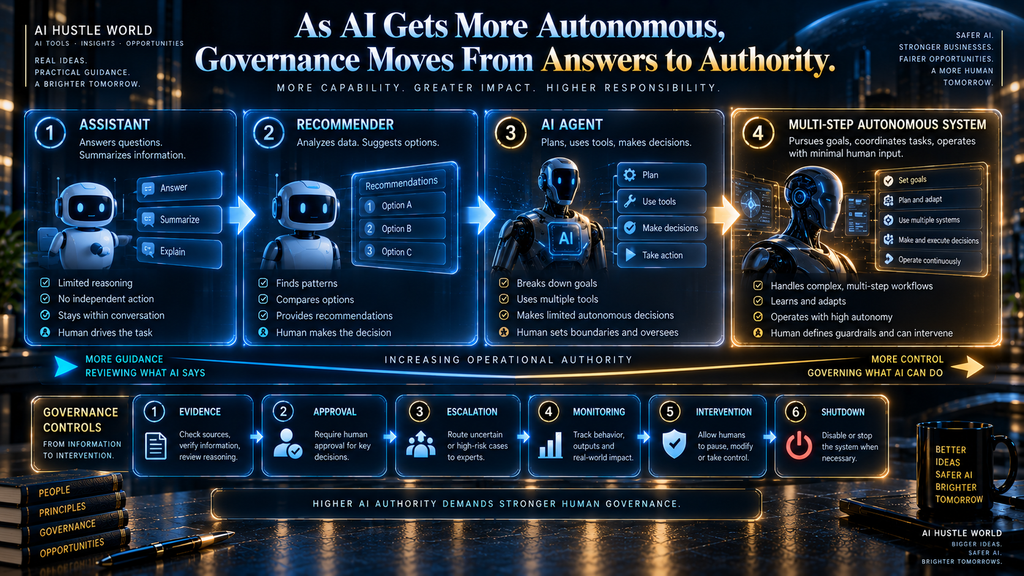
As AI systems become more capable of planning, using tools, coordinating tasks, and executing multi-step workflows, the distinction between recommendation and action will become increasingly important.
A traditional AI assistant might answer a question and wait for the user to act. A more autonomous system can interpret a goal, determine a sequence of actions, interact with external systems, and continue operating with limited intervention. In that environment, human oversight cannot simply mean reviewing a final answer.
Organizations will increasingly need to govern delegated authority. That means defining what an AI agent can access, which actions it can perform without approval, which actions require confirmation, what conditions force escalation, how activity is logged, and how humans can intervene when the system behaves unexpectedly.
The same principles developed for today’s HITL workflows therefore become even more important as AI becomes more agentic. The central issue remains the allocation of authority, but the unit of governance shifts from an individual prediction to an entire chain of actions.
This is one reason NIST continues to emphasize human-AI teaming, defined responsibilities, risk management across the AI lifecycle, and organizational governance rather than treating AI oversight as a purely technical model-performance problem.
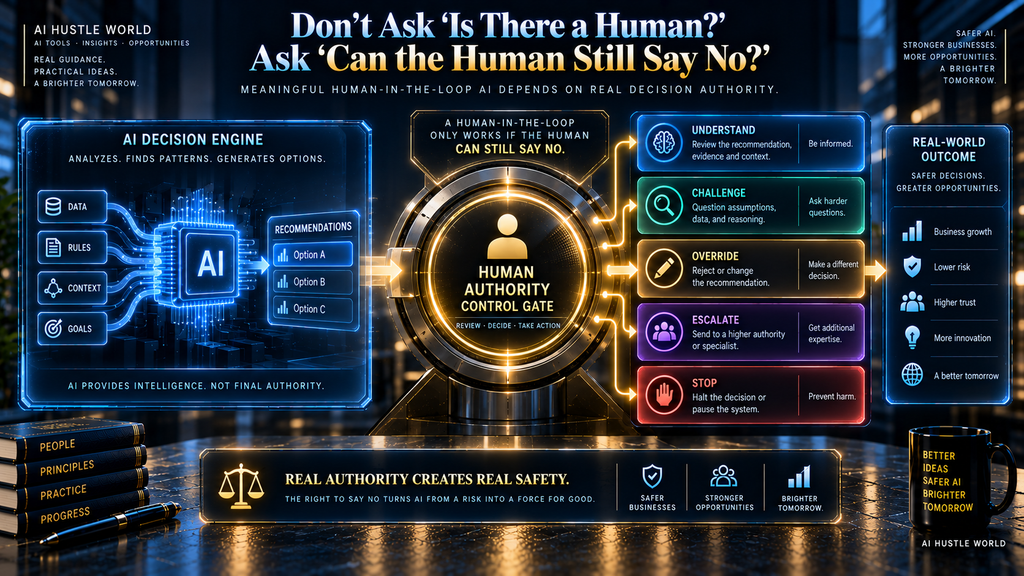
The Real Test: Can the Human Still Say No?
The strongest way to evaluate a human-in-the-loop system is not to ask whether a person appears somewhere in the workflow. Ask whether that person can meaningfully disagree.
Can the reviewer access enough information to challenge the recommendation? Can they recognize when the system is operating outside its intended conditions? Can they reject the recommendation without unreasonable organizational friction? Can they escalate an unusual case? Can they stop an autonomous action when necessary? Does the organization learn from their disagreements rather than treating them as exceptions to be suppressed?
If the answer to those questions is yes, the human layer is functioning as a genuine governance mechanism. If the answer is no, the organization may have created the appearance of human oversight without retaining meaningful human control. That distinction becomes increasingly important as AI moves from generating information to influencing decisions and taking actions.
Final Thoughts
Human-in-the-loop AI is not fundamentally about keeping a person somewhere between an AI model and a software button. It is about designing a decision system in which machine intelligence and human judgment have clearly defined responsibilities, and in which the person responsible for oversight has enough information, authority, expertise, and time to exercise that responsibility properly.
The best organizations will not put humans in every loop. They will identify where human judgment creates the greatest value and where human authority is most necessary. Routine, reversible decisions can often be automated with appropriate monitoring, while consequential or ambiguous decisions deserve stronger review, and decisions with substantial consequences or difficult reversal may need to remain fundamentally human-led.
The deeper lesson is that AI governance is partly a question of authority. Once a system can rank, recommend, approve, prioritize, trigger, or execute, the organization must decide how much of that authority it is willing to delegate and under what conditions it can be taken back.
That is why “human review” should never be treated as a decorative governance phrase. A meaningful human-in-the-loop system gives people the ability to understand what the AI is doing, question why it is doing it, recognize when the circumstances do not fit, override the recommendation when appropriate, escalate difficult cases, and intervene when the system should not continue. The memorable takeaway is this:
The question is not whether there is a human in the loop. The question is whether the human still has meaningful control over the outcome.
Put Human Review Into Practice
Use the governance framework to decide which AI decisions in your organization need a human reviewer, and who owns each one.
Read the AI Governance Framework →Frequently Asked Questions
What is human-in-the-loop AI?
Human-in-the-loop AI is a system in which a human has a defined role in reviewing, validating, modifying, approving, or controlling an AI-supported decision or action. The important distinction is that the human must have meaningful authority rather than simply appear at the end of an automated workflow.
When does an AI decision need human review?
Human review becomes more important when the decision has significant consequences, is difficult to reverse, requires contextual judgment, involves uncertain or incomplete information, or gives the AI substantial authority to affect a person, organization, or important business process. Lower-risk and easily reversible tasks can often use automated execution with monitoring and exception handling instead.
Is human-in-the-loop AI always safer than full automation?
No. Human involvement can introduce its own problems, including automation bias, reviewer fatigue, inconsistent judgment, and excessive operational cost. A well-designed human-AI workflow should assign humans and AI complementary responsibilities rather than assuming that adding a reviewer automatically makes the system trustworthy.
What is the difference between human-in-the-loop and human-on-the-loop AI?
Human-in-the-loop AI generally requires direct human participation before a consequential action occurs. Human-on-the-loop AI allows the system to operate more autonomously while humans supervise performance, investigate exceptions, and intervene when predefined conditions require it. The NIST AI Risk Management Framework is a widely used reference for building oversight into AI systems.
What is automation bias in AI decision-making?
Automation bias is the tendency for people to rely excessively on automated recommendations. In practice, a reviewer may accept an AI recommendation because it appears authoritative, even when independent evidence suggests that the recommendation should be questioned. NIST identifies human cognitive biases and the design of human-AI interactions as important considerations in AI risk management. See how to detect and reduce AI bias for the fairness side of review.
Should humans review every AI decision?
No. Reviewing every decision can eliminate much of the efficiency that automation is intended to provide. A risk-based approach is usually more practical: automate low-consequence and reversible tasks, use human verification for more consequential decisions, and create escalation paths for uncertain, unusual, or high-impact cases.
Can humans override AI decisions?
A meaningful human-in-the-loop system should define when authorized reviewers can reject, modify, or escalate an AI recommendation. For more autonomous systems, organizations should also establish appropriate mechanisms for intervention or stopping the system when necessary.
How should businesses measure human oversight?
Useful measures include override rate, override reasons, escalation rate, review time, reviewer workload, error escape rate, decision reversals, and downstream outcomes. These metrics should be considered together because a low override rate, for example, could indicate strong AI performance or excessive reviewer dependence.
What is the biggest human-in-the-loop AI mistake?
The biggest mistake is confusing the presence of a human with meaningful human control. A reviewer who lacks evidence, time, expertise, authority, or practical freedom to disagree with the AI is unlikely to provide effective oversight.
Can human oversight improve an AI system over time?
Yes. When organizations record why reviewers override AI recommendations, those decisions can reveal missing information, data-quality problems, model limitations, poor thresholds, policy conflicts, or recurring edge cases. Human review can therefore become a feedback mechanism for improving the wider AI workflow rather than merely correcting individual decisions.
Is human-in-the-loop AI expensive?
It can be. Human review consumes employee time and requires training, workflow design, monitoring, and management. The economic case is strongest when human attention is concentrated on decisions where catching an error creates substantially more value than the cost of review. Plan data for AI tools is in our AI Tool Pricing Database.
What should a human reviewer be able to do?
Depending on the risk of the workflow, a reviewer should be able to inspect relevant evidence, understand the AI recommendation and its limitations, challenge the recommendation, approve or reject it, escalate unusual cases, and intervene when the system should not continue. The exact authority should be proportional to the consequences of the decision.
Written by
Muntasir Ahmad Chowdhury
Founder, AI Hustle World
Muntasir Ahmad Chowdhury is the Founder of AI Hustle World, an independent publication dedicated to making Artificial Intelligence practical, trustworthy, and easy to understand. He researches AI tools, automation, customer service, productivity, and real-world business applications, helping readers make smarter technology decisions through research-driven, experience-backed content.
Expertise:
AI Tools • AI Automation • AI Customer Service • AI Productivity • Generative AI • AI Workflows
Get Smarter With AI
Enjoyed this guide? Get practical AI tools, tutorials, and honest reviews delivered to your inbox.
5 thoughts on “Human-in-the-Loop AI: When Automated Decisions Need Human Review”