Weav vs Intercom Fin: Which AI Support Agent Actually Resolves More Tickets?
The hardest part of choosing an AI support agent is no longer deciding whether it can answer customer questions. The serious platforms can already ingest business knowledge, retrieve information, connect to external systems, follow workflows, take actions, and hand conversations to human agents. The harder question is whether those capabilities work together well enough to produce something that actually matters to a business: more customer problems solved, less human rework, and a support operation that becomes more efficient as volume grows.
That makes Weav and Fin an unusually useful comparison. Weav has built an AI-first customer-support platform around agents, a unified inbox, knowledge, actions, contextual escalation, and human-AI collaboration. Fin has developed into a much broader customer-agent platform, with Service, Sales, and Ecommerce roles, Procedures, Data Connectors, Tasks, multiple channels, reporting, and the ability to work with Intercom or an existing helpdesk.
There is also a naming change that matters. In 2026, the company announced that it was becoming Fin, while Intercom remains the name of the customer-service platform, so this article uses Fin when referring to the AI agent and Intercom when referring to the broader service platform. The real decision, therefore, is not “Which one has more features?” It is which platform is better suited to the support operating model you are trying to build.
Affiliate disclosure: This article contains an affiliate link to Weav. If you choose to sign up through that link, AI Hustle World may receive a commission at no additional cost to you. Our comparison and recommendations are based on documented product capabilities, pricing, limitations, and business fit—not commission.
Quick Answer: Weav or Fin?
Fin is the stronger overall choice for organizations that need a mature, broad customer-agent platform with sophisticated procedures, extensive channel coverage, deep reporting, external-system access, and the flexibility to fit into an existing helpdesk. Weav is the stronger fit for businesses that want a focused AI-first support operation built around resolution, unified human-AI collaboration, support actions, contextual escalation, and a relatively straightforward support workflow. The full Weav review has the complete verdict.
The uncomfortable part is the second half of the article title: which actually resolves more tickets? Fin currently reports a 76% average resolution rate across customers, while Weav has reported a 71% average resolution rate, but those figures should not be treated as a neutral head-to-head benchmark. Fin’s methodology has changed during 2026, and Weav’s figure is also a vendor-reported average from its own platform and deployments; there is no independent public study that puts both systems on the same tickets, knowledge base, integrations, permissions, escalation rules, and evaluation criteria.
That leaves a more useful conclusion. If your business needs broad channels, complex procedures, advanced measurement, or a customer-agent platform that can sit inside a larger support ecosystem, Fin has the stronger case. If your business wants to automate a large amount of repeatable support work through a focused support-first environment where AI and humans collaborate inside one operation, Weav has a compelling advantage. The final choice should be based on your actual ticket mix, not on whichever vendor publishes the larger percentage.
Test Weav Against Your Ticket Backlog
Run a sample of your real support tickets through Weav and count how many it resolves without a human handoff.
Test Weav on Your Tickets →Affiliate disclosure: We may earn a commission if you subscribe through this link, at no additional cost to you.
Why Resolution Rate Alone Cannot Pick the Winner
“Resolution rate” sounds objective because it is expressed as a percentage. But the percentage only means something when you know what is being measured, which conversations are eligible, what counts as a resolution, and whether the agent had the opportunity to answer in the first place. For the difference between the two approaches, read AI chatbots vs AI agents.
Fin’s current documentation is unusually explicit about this. Intercom defines its automation rate as the number of conversations Fin resolved divided by total conversations, and its current reporting model separates involvement, resolution, and automation. In 2026, Intercom changed its metric definitions so that conversations where Fin did not actually have an opportunity to answer are no longer counted in Fin Involved, which can change the reported rates without changing the number of resolutions themselves.
Weav’s public figure has a different origin. In its AI-first support announcement, Weav said its Resolution Engine uses confidence scoring to determine whether the AI should respond autonomously, route a conversation for human review, or escalate to a teammate, and reported an average resolution rate of 71%, with some organizations reaching 85% to 90%. That is a useful indicator of product capability, but it is still Weav’s own reported result rather than a standardized industry benchmark.
The practical consequence is important: 76% versus 71% is not enough information to tell you which platform will perform better for your company. A support system could produce a lower autonomous-resolution percentage but create less human rework, fewer repeat contacts, and better customer outcomes. Another could produce more autonomous resolutions but struggle with the difficult tickets that consume disproportionate amounts of human time. That is why this comparison needs a deeper model.
The AI Hustle World Support Resolution Framework
A better way to evaluate an AI support agent is to stop treating “resolution” as one event and break it into the system capabilities that produce the event. Weav describes its product on its own site.
| Layer | The question that matters |
|---|---|
| Knowledge | Does the AI know what is actually true? |
| Understanding | Does it correctly understand the customer’s intent? |
| Live Context | Can it retrieve the customer’s current situation? |
| Procedure | Can it follow the correct business rules? |
| Action | Can it safely perform the required operation? |
| Boundary | Can it recognize when it should not continue? |
| Handoff | Can a human take over without rebuilding the case? |
| Outcome | Did the customer actually get the problem solved? |
| Economics | What did the completed resolution cost? |
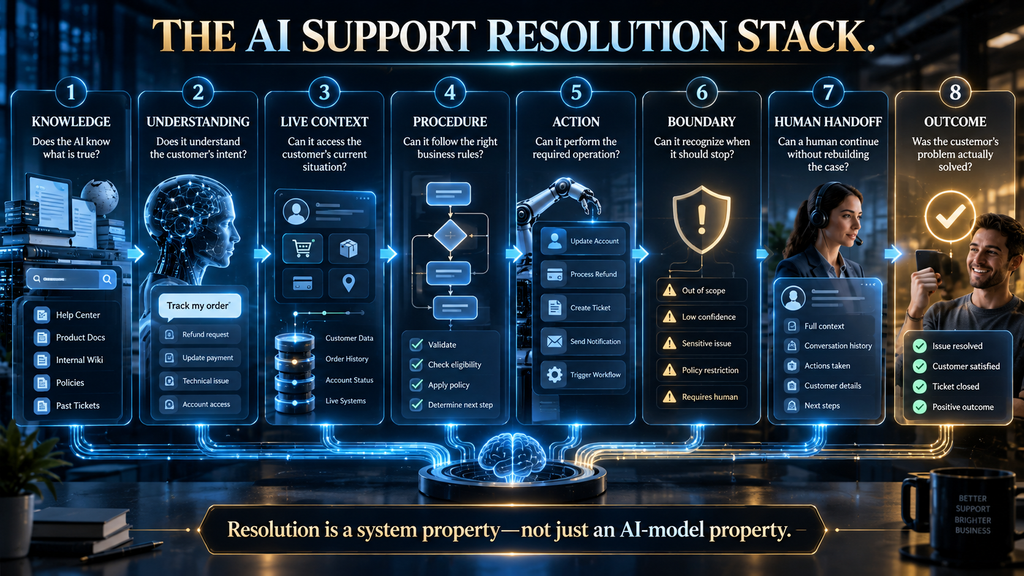
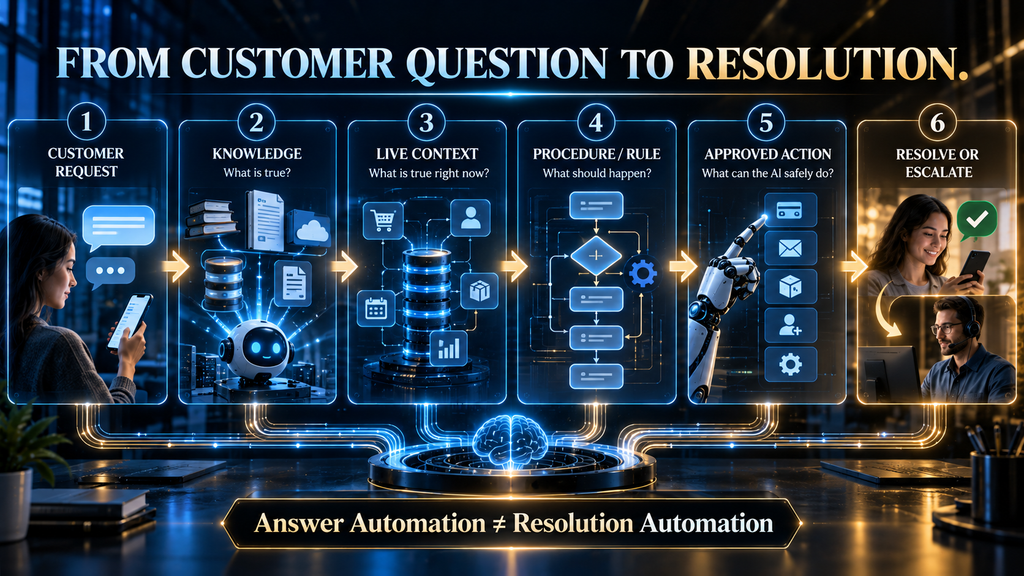
This framework changes the comparison immediately. An AI that answers a policy question correctly is useful, but that is only the first layer. A customer with a billing dispute may require account context, a policy check, a live transaction lookup, an approved action, and potentially human review; a platform that cannot complete that chain may still look impressive in a demo while creating very little operational leverage.
Weav and Fin both operate across multiple layers of this stack. Weav’s Custom Actions connect agents to external APIs for live data and approved operations, while Fin’s Data Connectors and Procedures are designed for similar live-system workflows with additional procedural controls. The strategic question is therefore not whether each platform possesses an “AI agent.” It is how much of the resolution stack each platform lets your business operationalize, and how much complexity you must accept to do it.
What Weav Is Actually Built to Do
Weav’s central proposition is support-first automation. Its product page describes a workspace where humans and AI work together, with a unified inbox that brings cross-platform context into one place and combines deep knowledge grounding with real-world workflow execution. Its documentation then connects that idea to actual deployment: agents can operate in the inbox, respond on supported channels, and hand conversations to a human when predefined conditions are met.
That support-first design becomes more significant when the goal is not simply to answer questions but to reduce the number of cases that require a human to perform the actual work. Weav’s Custom Actions are explicitly designed to turn an AI agent from something that “answers questions” into something that can retrieve live data, call APIs, perform approved actions, and return the result to the customer. The documented use cases include order lookups, subscription and billing checks, support-ticket creation, booking updates, and return or cancellation workflows.
The platform also puts meaningful emphasis on the handoff itself. Weav says its agents can preserve full conversation context when a case moves to a human, and its unified inbox gives the support team a shared environment in which AI and humans can work on the same support workload. That is not a cosmetic feature: if the AI solves the easy 70% but makes the human rebuild the hard 30% from scratch, the automation can create far less value than the headline number implies.
Weav’s current product has also expanded beyond its earlier chat-and-email emphasis. Its August 2026 WhatsApp integration sends WhatsApp conversations into the same unified inbox alongside chat and email, and Weav says the integration is available across every plan without an additional channel fee. That is important because an older description of Weav as a narrow website chatbot is no longer accurate.
What Fin Is Actually Built to Do
Fin has expanded substantially beyond the traditional chatbot model as well. Current documentation describes Fin as a Customer Agent that can operate across different roles, including Service, Sales, and Ecommerce, while switching between configured roles based on conversation context. For Service specifically, Fin is intended to answer customer questions across channels, including complex queries, while using the same broader agent architecture for context, tools, procedures, and workflows.
The biggest difference is how much of the workflow can be expressed through Procedures. Intercom’s current documentation describes Procedures as a way to handle complex queries from start to finish by combining natural-language instructions with deterministic controls, branching logic, code conditions, data connectors, secure data access, and human escalation. Procedures can also adapt when a customer interrupts, changes direction, or adds context instead of forcing every interaction through a rigid script.
That is a meaningful capability because real support work is rarely linear. A customer might begin by asking why a payment failed, then mention that the card was replaced, ask whether the account can be reactivated, and finally request a refund. A useful support agent has to maintain context across that conversation while still obeying the company’s rules. Fin’s Procedures are explicitly designed around that type of evolving, multi-step interaction.
Fin also provides a broader automation toolkit. Intercom distinguishes Procedures, Tasks, and Workflows, with Procedures now positioned as the more advanced path for complex AI-driven processes, while new Task creation has been disabled since March 2026. Workflows remain available for more structured, deterministic conversational flows, which means businesses can choose between AI-driven procedures and more rigid automation depending on the job. This gives Fin a considerable advantage for organizations where support is starting to resemble a collection of business processes rather than a collection of questions.
The First Major Decision: Focused Support Operation or Broader Customer-Agent Platform?
This is the strategic divide that should guide the rest of the comparison. Weav’s product architecture makes sense when the support operation itself is the center of gravity. The AI agent sits inside the support environment, knowledge and actions are attached to support work, and humans enter the same workflow when automation should stop. Weav’s current messaging consistently ties its AI to the goal of resolving support without growing the support team at the same rate.
Fin is broader. The same agent architecture now spans Service, Sales, and Ecommerce roles, and the platform includes Procedures, Data Connectors, multiple channels, reporting, Help Desk capabilities, and broader customer-service infrastructure. That breadth is valuable when the business wants one agent layer to participate across a wider part of the customer journey rather than limiting the AI to support resolution alone. Neither model is automatically better.
A smaller support team can benefit from focus because every extra configuration surface creates more operational overhead. A larger organization can benefit from breadth because the ability to connect multiple systems, channels, and procedures can eliminate the need to bolt together several separate automation layers. The real question is therefore: Where do you want complexity to live? With Weav, more of the complexity is organized around the support operation. With Fin, more of the complexity can be expressed and controlled through the agent platform itself.
Knowledge Is Necessary, but Knowledge Alone Does Not Resolve Tickets
One of the easiest mistakes in AI-support evaluation is to compare the number of documents a platform can ingest and assume the platform with more sources will produce better support. It will not. We compare it with a leading chatbot builder in Weav vs Chatbase.
A support agent needs the right information, but it also needs to know when that information is sufficient and when it needs current customer data. A return-policy document can tell an agent the company allows returns within 30 days, but it cannot tell the agent whether order #18427 was delivered 12 or 42 days ago. That is a live-data problem, not a knowledge-base problem. Weav supports website content, text, Q&A, files, video, and other supported sources depending on plan, while its current training documentation also emphasizes using existing support documentation and historical conversations.
Fin uses its knowledge layer alongside guidance, Data Connectors, and Procedures. The important advantage is that the agent can move from static information to operational context instead of treating the knowledge base as the entire source of truth. That creates an important principle for buyers: Knowledge answers “What is true?” Live context answers “What is true about this customer right now?” The best AI support systems need both.
Actions: Where AI Becomes Operational Instead of Conversational
The action layer is where the comparison becomes much more serious. Weav’s Custom Actions can call external HTTPS APIs and return structured data to the agent. Its documentation describes explicit verification controls, including user verification for sensitive actions and limited data access so the AI can be restricted to only the response fields it actually needs. That is a strong design choice.
If an agent needs a customer’s order status, it may need status, tracking_url, and estimated_delivery. It does not necessarily need access to the customer’s entire record. Weav’s documentation recommends limited data access in production so the agent remains focused on the fields it needs rather than being given unnecessary information.
Fin approaches the same problem through Data Connectors. Intercom says its former “Custom Actions” functionality has been renamed Data Connectors without changing its core ability to make API calls into external systems. These connectors can be invoked directly by Fin to retrieve live data or placed inside Workflows and Procedures with conditions, such as only allowing a cancellation action when an order has not yet shipped. The difference becomes clearer when procedures are added.
Fin’s Procedures let teams combine natural-language instructions with deterministic conditions and tools, meaning an action can be part of a larger business process rather than an isolated API call. Intercom explicitly describes use cases such as damaged-order claims, account troubleshooting, identity verification, and other complex workflows that can be completed end to end.
Verdict on actions. Both are capable. Fin has the stronger documented architecture for complex multi-step procedures, while Weav offers a focused action model that can be particularly attractive for support teams whose workflows are repeatable and relatively bounded.
The Human Boundary Is Part of the Product
A dangerous way to measure AI support is to ask how often the agent escalates and try to minimize the number. That confuses automation with performance. Our comparison of AI customer support vs human support and the guide to human-in-the-loop AI cover when people should stay involved.
If a customer is disputing a sensitive financial transaction, asking for an exception outside policy, or reporting a serious service failure, the correct outcome may be human involvement. A support AI that escalates such cases intelligently is behaving correctly, not failing.
Weav explicitly designs around this boundary. Its agents can be configured to hand conversations to the support team when the customer asks for a human or when the agent cannot resolve the case after repeated attempts, while the unified inbox preserves conversation history and context.
Fin has a more elaborate procedural escalation layer. Current Procedures can escalate when the conversation is not making progress, enters a loop, or the customer explicitly asks for a human, and the escalation can route to the appropriate team or workflow. Fin’s broader workflow system can also use attributes and conditions to determine how conversations should be handled. This creates a subtle difference in philosophy. Weav makes the human boundary feel like an integrated part of the support workspace.
Fin gives organizations more formal tools to define and govern the boundary inside complex procedures. The better option depends on the support operation. For a lean team, clear and centralized handoff may be more valuable than procedural sophistication. For a large support organization, more granular routing and workflow control can be worth the additional complexity.
Fin Has the Broader Current Channel Footprint
Fin has a meaningful advantage when channel breadth matters. Intercom’s current documentation covers deployment across Messenger, email, phone, WhatsApp, SMS, Facebook, Instagram, Slack, and other supported channels, while the broader platform is designed to maintain a connected customer experience across those surfaces.
Weav has narrowed part of that gap by adding WhatsApp, with conversations flowing into the same unified inbox as chat and email. The key difference is that Weav is still more focused on the support workflow itself, while Fin is designed to participate across a wider customer-engagement footprint. That distinction matters for the type of business you run.
If your support operation is mostly website chat, email, and WhatsApp, Weav may already cover the channels that create most of the value. If support has to extend into phone, SMS, social channels, and a broader customer-service environment, Fin has the stronger platform-level case. Verdict: Fin for breadth; Weav for a focused multi-channel support operation.
Fin’s Existing-Helpdesk Strategy Changes the Competitive Picture
One of the biggest developments in Fin’s positioning is that using it no longer necessarily means replacing your current helpdesk. Intercom now markets Fin as a Service Agent that can operate on top of external helpdesks such as HubSpot, Freshdesk, and Salesforce. Its current pricing and documentation say Fin can answer email, live chat, phone and more, take actions on external systems, and hand conversations to agents in the existing support inbox.
That matters because many companies will not replace a mature helpdesk simply to add AI. A business may already have years of customer data, routing logic, reporting workflows, team habits, and integrations in Salesforce, Zendesk, HubSpot, or another platform. If the AI can sit on top of that infrastructure, the migration barrier falls significantly.
Weav can also connect to external systems through APIs and Custom Actions, but the strategic message is different. Weav is offering a support-first environment where the inbox itself is part of the product, whereas Fin can function as an AI layer within an existing support infrastructure as well as inside Intercom. For an organization that already has a mature helpdesk and does not want to move, Fin deserves a major advantage in the evaluation.
Reporting: Why Fin Has a Stronger Optimization Story
The first deployment of an AI support agent is not the end of the project. It is the beginning of the optimization problem.
A support team needs to know which conversations the AI can solve, which ones it cannot, which procedures fail, which content creates results, where human intervention remains necessary, and which gaps are worth fixing first. Fin currently offers a broad reporting layer covering involvement, resolution, automation, procedure performance, and other customer-experience signals.
Fin’s Procedures reporting is particularly useful because teams can inspect how individual procedures behave in production. Intercom’s documentation tracks signals such as triggered, pending, resolved, handed-off, escalated, and failed states, giving administrators a way to isolate specific workflows rather than treating the entire agent as one black box.
Fin also introduced AI-powered Recommendations in 2026 that analyze conversations the agent could not answer and suggest fixes across content, data, and action gaps. The point is important: the platform is not merely measuring failure; it is attempting to turn failure patterns into an improvement queue. Weav also emphasizes resolution-oriented measurement and uses confidence scoring to decide when AI should respond autonomously or escalate. That is a strong operational philosophy, particularly for a support-first product. Still, on the publicly documented evidence, Fin currently has the more developed optimization and observability story.
The Pricing Comparison Is More Complicated Than It Looks
Weav currently uses a plan-based pricing structure. Its public pricing page lists Lite at $0, Plus at $29, Pro at $119, and Max at $359 per month, with AI-message allowances of 20, 500, 5,000, and 20,000 respectively. Higher tiers add more teammates, training capacity, actions, helpdesk capabilities, reporting, integrations, retraining, and other functionality. Additional AI credits are currently listed at $49 per 1,000. Fin uses a fundamentally different model. Our guide to Weav pricing breaks down the cost per resolution.
When Fin is used with Intercom, the current plans charge per seat and also charge $0.99 per Fin outcome. Intercom currently lists annual seat pricing at $29 for Essential, $85 for Advanced, and $132 for Expert, while monthly pricing is higher.
The current Fin outcome model is more nuanced than “pay 99 cents for every reply.” Intercom says customers are charged at most once per conversation, even when Fin performs multiple actions, and it distinguishes outcomes such as resolutions and certain Procedure handoffs. It also states that unsuccessful attempts and conversations where a customer explicitly asks for a human are not billed as outcomes. Fin can also be purchased for an existing helpdesk. Intercom currently lists that model at $0.99 per outcome with no seat costs or hidden platform fees, although minimum commitments apply and self-serve signup is not available for that configuration.
This means a serious buyer needs to model three different scenarios, not two:
| Deployment | Main cost structure |
|---|---|
| Weav | Monthly platform tier + included AI-message capacity + additional credits/add-ons |
| Fin + Intercom | Seat costs + $0.99 per Fin outcome |
| Fin + existing helpdesk | $0.99 per Fin outcome + current contractual/minimum-commitment terms |
That makes it impossible to declare a universal price winner without knowing how your current support stack is structured.
Why Weav Can Be More Economical for Some Teams
Weav’s plan-based approach can be attractive when support volume is reasonably predictable and the business wants to know the general shape of its monthly software cost before usage grows.
Its current Pro tier provides 5,000 AI messages for $119, while Max provides 20,000 for $359. For a lean support operation with a limited human team, a unified support workspace, and a repeatable ticket mix, that can be an appealing cost structure. There is also a psychological advantage to a fixed-plan model. A founder or support manager can look at the monthly platform cost and understand the basic commercial commitment without immediately translating each successful AI interaction into an incremental charge.
That does not mean fixed pricing is inherently cheaper. A business can have a low software bill and still have expensive human rework. The relevant question remains: How much does it cost to produce one successful customer outcome?
Why Fin Can Be More Economical for Other Teams
Fin’s outcome-based structure can make sense when the organization values paying in proportion to successful AI work, particularly if the company already operates within Intercom’s ecosystem or can use Fin on its existing helpdesk.
The model also has an important economic property: a conversation can involve multiple questions or several AI actions and still produce only one outcome charge. That can make complex successful conversations more attractive than a naive message-count comparison would suggest. The catch is that Intercom seat costs matter when Fin is used within the Intercom platform.
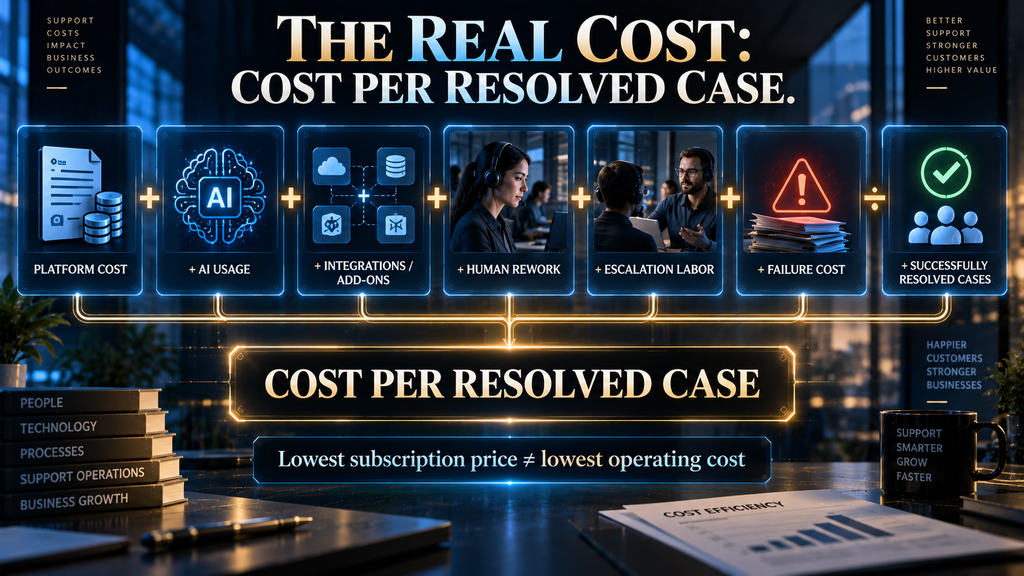
A ten-person support team on Advanced pricing is making a different economic decision from a five-person team using Fin on an existing helpdesk. Comparing both teams to Weav using only the AI fee would ignore the platform economics around them. This is why an honest Weav-versus-Fin comparison cannot stop at “$119 versus $0.99.” The correct calculation is: Platform cost + AI usage + integrations/add-ons + human rework + escalation labor ÷ successfully resolved cases. That is cost per resolved case.
Check Whether Resolutions Meet Your Standard
Review the answers Weav gives on your own content and judge each one against your quality bar before you rely on it.
Review Weav Resolutions →Affiliate disclosure: We may earn a commission if you subscribe through this link, at no additional cost to you.
The Second AI Hustle World Framework: Cost per Resolved Case
Use this model rather than a simple software-price comparison. You can check current plans on the Weav pricing page, Chatbase pricing and Intercom pricing.
| Cost component | What to measure |
|---|---|
| Platform | Monthly subscription and required seats |
| AI usage | Messages, credits, or outcomes |
| Integrations | Required connectors, apps, APIs, or add-ons |
| Human rework | Time spent fixing or completing AI-handled cases |
| Escalation labor | Time spent resolving cases handed to humans |
| Failure cost | Refunds, errors, churn, or customer recovery when automation goes wrong |
| Successful outcomes | Cases genuinely resolved to an acceptable standard |
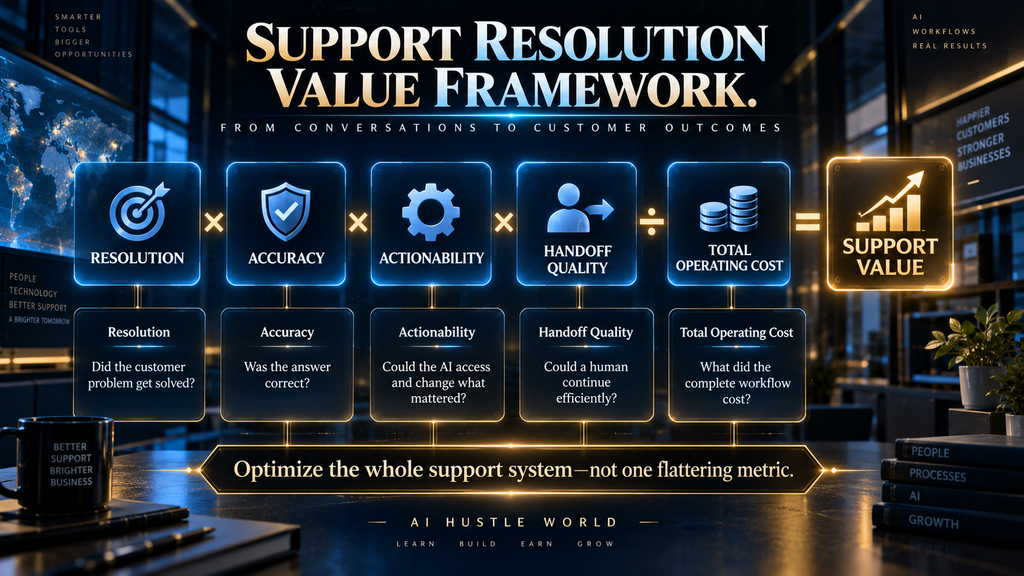
The framework exposes a blind spot in many AI-support comparisons: the customer does not care whether the AI counts the conversation as resolved. The business should care whether the problem stayed resolved. A customer who receives a technically correct answer but contacts support again tomorrow has not necessarily generated a successful outcome. Likewise, a customer whose case is escalated to a human is not necessarily a failure if the human can finish it immediately because the AI preserved all relevant context. A mature support operation should therefore optimize the entire chain, not the most flattering metric.
A Real-World Test Is More Useful Than a Vendor Demo
The most defensible way to choose between Weav and Fin is to test both against the same workload. Start with 50 real support conversations from your own business. Do not sanitize them into polished demo questions; preserve the typos, abbreviations, missing information, emotional language, unexpected follow-up questions, policy exceptions, and awkward requests that customers actually send.
Then classify those conversations into categories such as informational, contextual, transactional, conditional, sensitive, ambiguous, and human-required. The objective is not to maximize the number of easy questions; it is to create a realistic representation of the support workload the AI will inherit.
Next, provide both systems with comparable knowledge and access to the business systems they need. Where one platform requires more custom development to reproduce a workflow, record that effort rather than pretending the implementation cost is zero. Where a capability cannot be reproduced under equivalent conditions, mark the comparison as not directly comparable rather than forcing an artificial score. Then evaluate the conversations using a consistent rubric.
| Metric | What counts as success |
|---|---|
| Accuracy | Correct information grounded in the approved source |
| Resolution | Customer problem actually completed |
| Action reliability | Required system action executed correctly |
| Escalation appropriateness | Human involved when the case warranted it |
| Human rework | Minimal rebuilding after handoff |
| Customer outcome | No unnecessary repeat contact or frustration |
| Total cost | Actual operating cost of the completed case |
This is the test that can answer the article’s title honestly. Not: Which vendor says it resolves more? But: Which platform resolves more of our tickets under the same conditions?
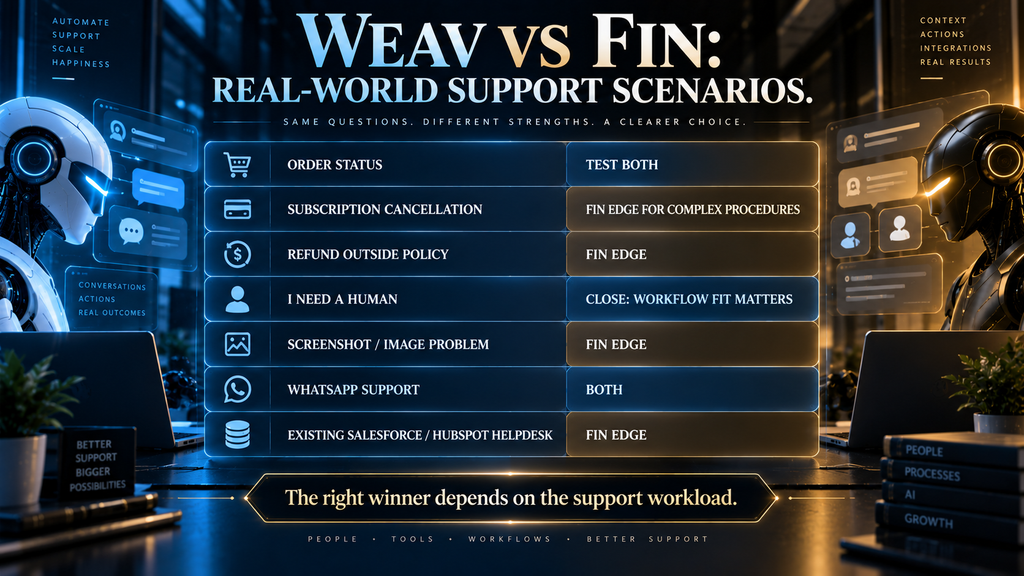
Scenario Test: Order Status
An order-status request looks simple until the AI has to answer for the individual customer rather than the average customer. The system needs a knowledge source for shipping policy, but it also needs current order data. If the customer asks why a package is late, the AI may need to retrieve the order state, identify whether the package has actually shipped, and explain the next step based on the business policy. For a step-by-step build, see how to set up an AI customer support agent with Weav.
Weav’s Custom Actions are explicitly designed for this kind of live API lookup, including order-status scenarios. Fin can accomplish similar work through Data Connectors, which can retrieve external data and use that information within Procedures. Winner: No universal winner. Test the actual integration with your commerce system. The important measure is not whether both platforms can theoretically perform the lookup. It is whether they do it accurately, consistently, and with acceptable setup effort.
Scenario Test: Subscription Cancellation
Now add an action. The system must determine whether the customer is eligible to cancel, identify the subscription, apply the relevant business rule, perform the cancellation, and confirm the result. Weav can handle such workflows through Custom Actions connected to the business API. Fin can use a Procedure with Data Connectors and conditions, which gives it a more explicit procedural model for complex multi-step cases. Winner: Fin has the stronger documented procedural architecture; Weav remains a strong fit when the cancellation process is well-bounded and the support team values a more focused operation.
Scenario Test: Refund Outside Policy
This is more interesting because the correct response may not be “yes” or “no.” The AI might need to determine how far outside the normal policy the customer is, inspect the account history, decide whether an exception exists, and either issue a refund or escalate the case. Fin’s Procedures are designed specifically for this sort of conditional, policy-heavy workflow. The platform can combine natural-language guidance with conditions, data connectors, actions, and escalation, while Intercom recommends simulation and testing before putting changes live.
Weav can support policy-based action workflows too, but the exact degree of procedural complexity you can comfortably manage becomes an important evaluation factor. Winner: Fin for complex exception-heavy workflows.
Scenario Test: “I Need a Human”
This is where many automation systems expose their weaknesses. A customer who wants a human should not have to argue with the AI. The support platform should recognize the request, preserve context, route it correctly, and make the human takeover efficient. Weav’s unified inbox is a strong argument here because AI and humans occupy the same support environment, while Weav says handoffs preserve the full conversation context. Fin also has explicit escalation behavior inside Procedures and can route the conversation to an appropriate team or workflow, with the broader Intercom platform providing the surrounding support infrastructure.
Winner: Close. Weav has the more focused support-first workflow; Fin has the stronger procedural and routing ecosystem. The decisive measure is human handling time after escalation.
Scenario Test: Screenshot or Image-Based Problem
This category is increasingly relevant because customers often send screenshots rather than describe an error precisely. Fin currently supports image understanding through Fin Vision, with use cases including screenshots and damaged-item scenarios. Fin’s product documentation describes image understanding as part of the broader Customer Agent capability set. Weav’s current pricing also includes image/PDF upload support on higher tiers, but the precise capabilities and supported workflows should be tested against the specific requirement instead of assuming that “image upload” means equivalent visual reasoning.
Winner: Fin has the clearer publicly documented vision capability. That is a good example of why two similarly worded feature lists can hide meaningful differences.
Scenario Test: Multi-Channel Support
Imagine a business where customers move between website chat, email, WhatsApp, and phone depending on the situation. Fin currently has the broader documented channel footprint, including phone, email, chat, WhatsApp, SMS, social channels, and more. Weav has expanded to WhatsApp while keeping those conversations inside the same unified support inbox, alongside chat and email. Winner: Fin for breadth. But channel breadth only creates value when your customers actually use those channels. A company that receives 95% of its support through chat and email may gain very little from paying for architectural breadth it does not need.
The Complexity Trade-Off: More Control Is Not Automatically Better
Fin’s breadth is one of its biggest advantages, but it can also become a burden. Procedures, Data Connectors, Workflows, integrations, channel configurations, reporting, and testing create significant control. That control is extremely valuable when a capable support-operations or technical team is available to design and maintain it.
For a lean business, however, every new configuration surface introduces another maintenance responsibility. Someone has to understand why a procedure triggered, what happens when a connector fails, where an escalation should go, which policies have changed, and whether existing test cases still reflect the current customer journey.
Weav’s support-first design can be attractive precisely because it keeps the center of gravity on the support operation. The business still has to configure agents, knowledge, actions, and escalation, but the product is easier to understand as one support environment rather than a broader agent platform that happens to include support. This produces a powerful buying principle: Do not pay for complexity your organization is not equipped to operate.
The Complexity Test
Before choosing either platform, answer four questions. Who owns the AI after launch? If the answer is “nobody,” the system will eventually degrade. Who maintains the procedures and actions? Complex workflows require ownership, testing, and clear change management. Who investigates failures? When a live integration breaks or a policy changes, someone must be able to diagnose the problem rather than simply switch the AI off. Who measures the outcome? A support team needs an operating cadence around automation, not a one-time deployment.
This is where Fin’s testing and reporting architecture can become a strong advantage for mature organizations. Intercom’s current Procedures system includes Simulations and the ability to rerun saved tests after updates, while reporting exposes procedure states and failure points.
For Weav, the equivalent organizational principle is simpler: monitor the real conversations, inspect where the agent fails or escalates, update the knowledge and actions, and keep humans in the loop where the automation is not yet trustworthy. Weav’s current product messaging explicitly positions resolved conversations as a source of ongoing improvement.
Which Platform Is Better for a Small Business?
The small-business question is often misframed as “Which has fewer features?” The better question is which one will create meaningful leverage without requiring a new operational discipline that the company cannot sustain.
Weav has a particularly strong case for the small business when support is repetitive, the number of human agents is small, and most interactions can be handled through the channels the platform supports. Its unified inbox, AI-agent model, contextual handoff, actions, and published pricing create a fairly direct path from setup to support automation.
Fin can also make sense for small businesses, particularly when the company already uses Intercom or needs channels and procedures that go beyond a focused support setup. Its current Essential plan is explicitly positioned for individuals, startups, and small businesses, while Fin’s outcome-based pricing means the AI cost scales with usage rather than adding a separate seat for every AI conversation. So the answer is not “small businesses should always choose Weav.”
It is: Choose Weav when focus and support simplicity are the main constraints. Choose Fin when the business needs the additional breadth enough to justify its more extensive platform.
Which Platform Is Better for a Growing Support Team?
This is where the decision becomes harder. A growing team usually needs more automation, but it also encounters more edge cases. Support volume becomes large enough that small inefficiencies compound, while an incorrect automated action can affect far more customers than it did at lower scale.
Weav’s support-first architecture is attractive when the core objective is to keep the operation lean and let AI absorb repeatable volume while humans focus on exceptions and high-value interactions. The unified inbox and contextual handoff reduce the risk of splitting the team’s workflow across separate AI and human systems.
Fin becomes increasingly attractive when growth also means more channels, more procedures, more integrations, more reporting requirements, and more formal governance. Its ability to run on an existing helpdesk also becomes important for companies that have already accumulated a mature support stack and do not want to replace it. At this stage, the decision should be made using the complexity-to-value ratio. If a feature saves 30 minutes per day but adds two hours per week of maintenance, it is not necessarily automation leverage. If a feature eliminates a repetitive human workflow and remains stable after testing, it may be.
Which Platform Is Better for Enterprise Support?
Fin has the stronger overall case for enterprise environments based on the breadth of its documented platform. Current Intercom materials describe advanced plans with deeper reporting, security controls, workload management, multibrand capabilities, SLAs, and other enterprise-oriented features. Its current Expert pricing includes SSO and identity management, HIPAA support, SLAs, multibrand Messenger and Help Center, and other advanced capabilities. Fin’s existing-helpdesk model also matters here. A large business can add the AI layer without necessarily moving every support process onto a new customer-service platform, which can reduce migration risk.
Weav should not be dismissed simply because it is newer or more focused. Its product has meaningful API and action capabilities, a unified AI-human inbox, expanding channels, and an increasingly sophisticated support workflow. But the broader enterprise ecosystem and documented governance depth currently favor Fin.
Who Should Choose Weav?
Weav is the stronger starting point when the primary problem is support volume, not broader customer-experience orchestration. It is particularly compelling for teams that have repetitive support work, want AI and humans in the same operational environment, need support actions connected to their existing systems, and prefer a focused product rather than an expansive agent platform. Its current pricing and support-first workflow reinforce that fit. See where it sits among the best AI customer service tools.
Weav is also worth serious consideration for businesses that want to experiment with action-oriented AI support without building a large procedural architecture from the outset. Custom Actions are explicit, API-driven, permissioned, and designed around concrete support jobs such as order lookup, billing checks, appointment updates, and returns. The strongest Weav buyer is therefore not someone looking for the tool with the most impressive feature page. It is someone looking for a focused support system that creates operational leverage quickly.
Who Should Choose Fin?
Fin is the stronger choice when your support operation is becoming a broader customer-agent system. That includes organizations with complex Procedures, multiple channels, existing enterprise helpdesks, large workflow footprints, demanding reporting requirements, or support processes that need more explicit control over branching logic, external data and action paths. Fin also makes strong strategic sense when the organization wants customer-service AI to extend beyond basic support into adjacent roles such as Sales or Ecommerce. Its current Customer Agent architecture is explicitly designed around that wider journey.
The ideal Fin buyer is therefore not simply a company with more tickets. It is a company with more systems, more workflows, more channels, and more operational complexity to manage.
Who Should Avoid Both?
There are businesses where the right answer is still human-first support. If customer requests are mostly unique, if the volume is too low to justify implementation, if policies are poorly documented, or if every support decision requires significant judgment, an AI agent may create more risk and management overhead than value.
The same applies when the business has no clear owner for support automation. AI systems are not static FAQ pages; products change, policies change, integrations fail, customer behavior changes, and business rules evolve. Without someone responsible for monitoring and maintaining the system, the initial deployment can deteriorate into a collection of outdated answers and fragile workflows.
There is also a common organizational mistake worth avoiding: automating a broken process before fixing the process itself. AI can accelerate a good workflow, but it can also accelerate a bad workflow, making the business wrong faster and at larger scale.
Common Mistakes When Comparing Weav and Fin
The first mistake is feature-counting. A platform with 50 listed integrations is not automatically more valuable than a platform with 20 if the latter connects to every system that actually matters to your business.
The second mistake is treating vendor resolution percentages as independent benchmarks. Fin’s 76% figure and Weav’s 71% figure are meaningful product signals, but they were not generated from a common public test environment, and Fin’s reporting methodology itself has changed during 2026.
The third mistake is measuring deflection instead of outcomes. A customer who receives an answer and immediately contacts support again has not necessarily been served well, while a customer whose case is escalated to a human but resolved in one efficient handoff may represent a highly successful support workflow.
The fourth mistake is ignoring implementation and maintenance cost. Two platforms may both support a refund workflow, but if one requires extensive configuration and the other can be maintained by the support team without engineering involvement, the economics of the feature are different.
The fifth mistake is ignoring the existing support stack. Fin becomes particularly compelling when it can sit on an existing helpdesk, while Weav may be more attractive when a business wants a unified support workspace rather than adding AI to a larger system.
How to Run a Proper Weav vs Fin Pilot
The pilot should be treated as a controlled operational experiment rather than a demo. Start by selecting 50 representative conversations. Include a realistic mix of repetitive questions, customer-specific requests, action-required cases, ambiguous cases, policy exceptions, sensitive requests, and conversations that should clearly be escalated.
Next, standardize the inputs. The more similar the knowledge, permissions, policies, channels, and business data are between the two environments, the more meaningful the comparison becomes. Where the platforms cannot be configured identically, record the difference rather than pretending the test is perfectly controlled. Then score each case against the same framework. Accuracy and resolution should matter most, but action reliability, escalation quality, human rework, customer outcome, and cost should also be recorded because each captures a different part of the support system.
Finally, run the pilot long enough to expose edge cases. A platform can look excellent across 20 easy conversations and become frustrating at scale when customers start asking for exceptions, changes, refunds, or support across multiple channels.
KPI Framework: What to Measure After Launch
Once the platform is live, management needs a broader KPI set than “AI resolution rate.” Plan data for other tools is in our AI Tool Pricing Database.
- Resolution rate. How many eligible conversations were actually resolved without human intervention?
- Automation rate. What percentage of the total support volume is being handled autonomously rather than merely touched by AI?
- Re-contact rate. How often does a customer return because the first interaction failed to solve the issue?
- Escalation appropriateness. How often does the AI escalate when it should, and how often does it continue when a human should have been involved?
- Human rework time. How long does a human spend after the AI hands over the conversation?
- Action success rate. How often do connected workflows complete correctly without human repair?
- Customer satisfaction. Are customers experiencing a better support interaction, or simply a faster automated one?
Cost per resolved case. What does one genuine support outcome cost when software and human labor are combined? These metrics matter because an AI support system can improve one dimension while damaging another. Intercom’s current reporting architecture recognizes this by separating metrics such as involvement, resolution, automation, and procedure outcomes instead of treating them as one number.
The Traditional Method Still Has a Purpose
Human support continues to exist for a reason. Humans can handle ambiguity without needing every exception written into a formal procedure. They can exercise judgment when a customer situation does not fit the documented policy, recognize emotional context, negotiate exceptions, and make decisions where the cost of a mistake is higher than the cost of a few additional minutes of labor. AI should not be evaluated as a wholesale replacement for that capability. For the basics, see how AI chatbots work and AI customer service explained.
The stronger model is usually selective automation: let AI take the repeatable work, let humans handle the cases where ambiguity and consequence justify human judgment, and design the handoff so neither side wastes effort repeating what the other has already done. That is exactly why the support operating model matters more than the feature list.
What Happens If You Do Nothing?
Choosing not to automate is itself an operating decision. For a low-volume business, remaining human-first may be perfectly rational because the implementation cost of AI is not justified. For a fast-growing support operation, however, doing nothing can mean that repetitive tickets continue consuming skilled human attention, response times increase during peaks, managers spend more time managing queues, and headcount becomes the primary mechanism for absorbing volume. That does not mean every additional ticket should become an AI ticket.
It means a business should quantify the opportunity cost of leaving repeatable work entirely manual. When a large percentage of the support queue consists of the same questions, lookups, status requests, policy explanations, and routine changes, refusing to evaluate automation can itself become expensive. The right decision is not “AI or humans.” It is which parts of support deserve AI, which parts deserve humans, and how efficiently can the two work together?
The Future Outlook: Fin, Salesforce, and the Next Stage of AI Support
The Fin market position has another dimension that Weav buyers need to understand. In June 2026, Salesforce announced an agreement to acquire Fin for approximately $3.6 billion. The transaction remains subject to closing conditions, so it should not be presented as a completed acquisition, but Salesforce has positioned the deal as a way to strengthen its autonomous customer-service strategy alongside Agentforce. That does not mean Fin automatically becomes the better product.
It does mean buyers making a multi-year platform decision should consider the possibility that Fin’s distribution, CRM connectivity, and enterprise reach could become substantially larger if the transaction closes and the integration strategy develops as described.
Weav represents a different strategic profile. Its advantage is focus: a support-first system can move quickly because it does not need to solve the entire customer-relationship stack. That can create a different kind of value for companies that care more about support automation than about becoming part of a broader enterprise ecosystem.
The next stage of AI support is therefore unlikely to be won by the platform that simply generates the most convincing answers. It will be won by systems that can understand, retrieve, act, measure, learn, and know when to hand the work back to a human.
Final Decision: Weav or Fin?
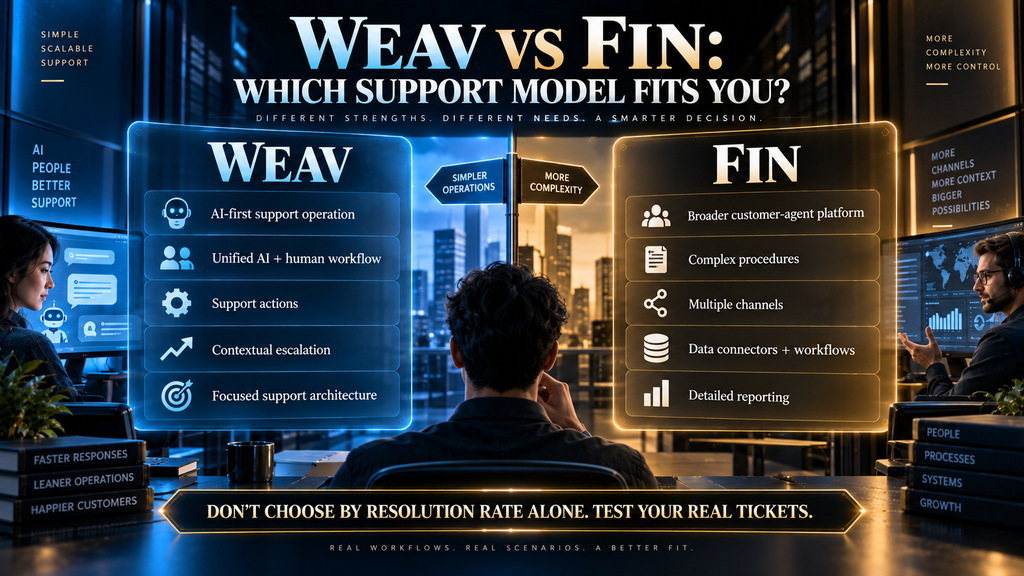
If your business needs broad customer-service infrastructure, sophisticated procedures, extensive channels, mature reporting, external-helpdesk compatibility, and a platform that can expand into Sales and Ecommerce, Fin is the stronger overall choice based on its current documented capabilities.
If your primary goal is to scale a focused customer-support operation with AI agents, a unified inbox, contextual human escalation, support actions, and a straightforward support-first workflow, Weav is the stronger fit. Its current product and pricing are closely aligned with that use case.
If you are choosing between them solely on “who resolves more tickets,” there is not enough independent evidence to make that claim confidently. Fin’s reported 76% and Weav’s reported 71% figures are useful signals, but they are not a standardized head-to-head test. The smartest decision is therefore: Choose Fin for breadth and procedural depth. Choose Weav for focused support-first resolution. Then run your own real-ticket pilot to discover which platform produces the better outcome for your business. That is a stronger decision rule than declaring a winner based on a vendor benchmark.
Final Thoughts
Weav and Fin are no longer competing merely as chatbot products. Both are moving toward the same larger destination: support agents that can combine business knowledge with live context, execute actions, follow workflows, and operate alongside human teams. The important difference is how each platform packages those capabilities and what kind of support organization it is designed to serve.
Fin currently has the stronger case for breadth, procedural control, channels, reporting, existing-helpdesk flexibility, and enterprise-scale customer-agent infrastructure. Its Procedures, Data Connectors, reporting model, and broader Customer Agent architecture make it a particularly formidable option for organizations with complex support environments.
Weav has a different but equally rational proposition: build the support operation around AI resolution, keep humans and AI in one workflow, connect the agent to the systems where support work actually happens, and automate the repetitive volume without turning the support team into a large technical operation. Its unified inbox, Custom Actions, contextual handoff, expanding channel set, and focused pricing model make that proposition especially compelling for lean and growing teams.
The biggest mistake would be to let either vendor’s resolution percentage make the decision for you. Fin’s reported 76% and Weav’s reported 71% are interesting signals, but your support queue is the only benchmark that ultimately matters. Take the same real conversations, give both systems comparable conditions, measure the complete workflow, and calculate the cost of a genuinely resolved case.
The winner is not the AI that claims to answer the most tickets. It is the system that helps your business resolve the most valuable customer problems correctly, with the least unnecessary human work, at a cost you can sustain as support volume grows.
Decide Which Pricing Model Fits Your Volume
Compare cost per resolution with per-seat and per-outcome pricing at your monthly ticket volume before you choose.
Review Weav Plans →Affiliate disclosure: We may earn a commission if you subscribe through this link, at no additional cost to you.
Frequently Asked Questions
Is Weav better than Fin?
Neither is universally better. Weav is better aligned with focused AI-first support operations built around a unified AI-human workflow, while Fin is better aligned with broader customer-agent operations involving complex procedures, multiple channels, deeper reporting, and more extensive support infrastructure.
Does Fin really resolve 76% of customer queries?
Fin currently reports an average 76% resolution rate. That is a vendor-reported metric and should not be treated as an independent benchmark against Weav because the two platforms use different systems and measurement contexts. Intercom also changed its Fin performance-metric definitions during 2026.
Does Weav really resolve 71% of support conversations?
Weav has publicly reported an average 71% resolution rate, with some organizations reporting higher rates. This is also a vendor-reported result, so the figure should be treated as a product signal rather than proof of how Weav will perform on your particular ticket mix.
Does Weav support AI actions?
Yes. Weav’s Custom Actions let AI agents call external HTTPS APIs to retrieve live data and perform approved operations such as order lookups, subscription changes, support-ticket creation, booking updates, returns, and cancellations.
Can Fin perform actions in external systems?
Yes. Fin’s Data Connectors let it access external systems and perform API-based actions, while Procedures can combine those tools with business rules, conditions, and multi-step workflows.
Which platform has better human handoff?
Both have strong handoff capabilities. Weav emphasizes a unified inbox and contextual handoff between AI and human support, while Fin provides procedural escalation, routing, and integration with Intercom or external helpdesks. The better choice depends on how much routing and workflow control your support team requires.
Which has more channels?
Fin currently has the broader documented channel footprint, including chat, email, phone, WhatsApp, SMS, social channels, and other supported surfaces. Weav has expanded its own coverage with WhatsApp while maintaining the same unified inbox used for chat and email.
Which is cheaper, Weav or Fin?
There is no universal answer because the pricing models are different. Weav currently uses monthly plans with included AI-message capacity, while Fin uses outcome-based pricing and, when used with Intercom, additional seat costs. Fin can also be used with an existing helpdesk at $0.99 per outcome under its current commercial terms.
Which is better for an existing Salesforce or HubSpot helpdesk?
Fin has a particularly strong case because Intercom explicitly offers Fin for existing helpdesks such as Salesforce and HubSpot. That allows organizations to add Fin without necessarily replacing their existing support platform.
Which is better for a small business?
Weav is often the more natural fit when the business wants a focused support operation, especially if repetitive support is concentrated around chat, email, and WhatsApp. Fin can be the better choice for a small business that needs broader channels, complex procedures, or the wider Intercom ecosystem.
How should I test Weav and Fin before choosing?
Use real support conversations rather than vendor demos. A 50-ticket pilot should include easy questions, ambiguous requests, live-data cases, action-required workflows, policy exceptions, sensitive cases, and tickets that should be escalated, with both platforms scored on accuracy, resolution, action reliability, escalation quality, human rework, customer outcome, and cost per resolved case.
Written by
Muntasir Ahmad Chowdhury
Founder, AI Hustle World
Muntasir Ahmad Chowdhury is the Founder of AI Hustle World, an independent publication dedicated to making Artificial Intelligence practical, trustworthy, and easy to understand. He researches AI tools, automation, customer service, productivity, and real-world business applications, helping readers make smarter technology decisions through research-driven, experience-backed content.
Expertise:
AI Tools • AI Automation • AI Customer Service • AI Productivity • Generative AI • AI Workflows
Get Smarter With AI
Enjoyed this guide? Get practical AI tools, tutorials, and honest reviews delivered to your inbox.
3 thoughts on “Weav vs Intercom Fin: Which AI Support Agent Actually Resolves More Tickets?”