Weav Review 2026: Features, Pricing, and Is It Worth It for AI Customer Support?
Customer support becomes expensive long before a business realizes it has a staffing problem. The warning signs usually appear as a growing queue of repetitive questions, customers waiting for answers that should take seconds, support agents spending their day looking up information instead of solving unusual problems, and founders or operators becoming the unofficial escalation team whenever something falls outside the standard script. Adding another human can relieve the pressure, but it also adds recurring payroll, training, management overhead, and another layer of operational complexity.
That is the problem Weav is trying to attack with a different model of AI customer support. Instead of positioning AI as a chatbot that simply generates replies, Weav is built around AI agents, business knowledge, support workflows, actions, a shared inbox, and human escalation. Its central product idea is therefore more ambitious than “answer more tickets”: use AI to resolve routine customer problems while keeping humans involved when context, judgment, or authority requires them.
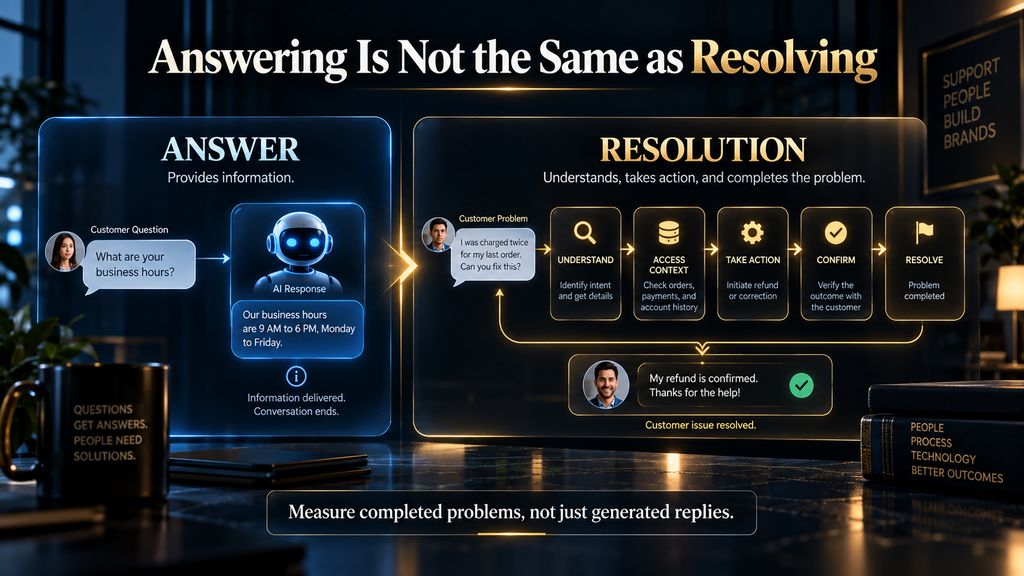
That distinction matters because there is a large gap between answering a question and resolving a problem. A customer asking where an order is needs information; a customer whose order is late may need an order lookup, an explanation, and potentially a human decision. A customer asking how to change a subscription may need the AI to access another system and perform an authorized action. A support platform becomes strategically interesting when it can move across that boundary without creating more problems than it solves.
Our verdict: Weav is worth serious consideration for small and growing businesses with meaningful volumes of repetitive support requests, especially businesses that have usable documentation and want AI agents, automation, human handoff, and support operations in one environment. It is less compelling if you only need a simple FAQ chatbot, have very little support volume, lack reliable internal knowledge, or require extensive independent enterprise evidence before adopting a relatively young product.
Disclosure: AI Hustle World may earn a commission if you sign up for Weav through our affiliate link. This does not change how we evaluate the product; our recommendation is based on features, pricing, product fit, limitations, and the evidence available at the time of review.
Last updated: September 2026. We rechecked Weav’s direct and Shopify pricing, current Shopify review status, and plan allowances, and added a transparent message-capacity comparison so readers can assess fit before a trial.
See How Weav Handles Your Hardest Tickets
Send Weav the questions your team finds hardest and check whether it resolves them accurately or hands them off cleanly.
Test Weav on Hard Tickets →Affiliate disclosure: We may earn a commission if you subscribe through this link, at no additional cost to you.
What Is Weav?
Weav is an AI customer-service platform designed to help businesses automate customer conversations while combining AI agents with human support. Its product positioning extends beyond a conventional chatbot: the platform is designed around business knowledge, AI agents, support actions, escalation, a unified inbox, reporting, and integrations that can provide additional context or enable workflows. Weav also offers customer-facing chat and email capabilities, while its Shopify integration connects an AI assistant with store catalog, policies, and live order data. Weav describes its product on its own site.
The simplest way to understand Weav is to think of it as an attempt to compress several layers of a modern support operation into one system. There is a knowledge layer that tells the agent what the business knows, an agent layer that interprets customer requests, an action layer that can interact with connected systems, an inbox layer that coordinates AI and human conversations, and an escalation layer that determines when a person should take over. That architecture is important because the value of customer-support AI is rarely determined by how fluent its responses sound. The real value comes from how reliably it moves a customer from question to resolution.
This also explains why Weav should not be judged only against generic chatbot software. A basic chatbot can be useful when the primary requirement is answering predictable questions from a knowledge base. Weav becomes more interesting when the business wants the AI to participate in the workflow surrounding those questions, such as checking information, using connected systems, summarizing conversations, routing issues, and handing complicated cases to a human with context preserved.
The Real Problem Weav Is Trying to Solve
Traditional customer support exists because customer problems are messy, repetitive, and unevenly distributed. A small percentage of cases often consume a disproportionate amount of human attention, while a large number of requests involve information that already exists somewhere inside the business. Customers ask about delivery times, returns, billing, product compatibility, account changes, subscription policies, availability, and dozens of other recurring issues. The problem is not necessarily that businesses lack answers; it is that those answers are trapped inside documents, systems, employees, previous conversations, and operational processes.
A traditional support team therefore performs several jobs simultaneously. Agents interpret the customer’s request, find the relevant information, determine whether they have authority to act, access the appropriate system, communicate the result, and escalate the issue when they cannot complete it. A chatbot typically automates only part of that chain. It can generate a response, but unless it has access to the relevant information and systems, the human still has to finish the work.
Weav’s strategic proposition is to automate more of that chain. Its product documentation and feature set show an architecture built around knowledge, agents, actions, escalation, and a unified support environment rather than a standalone conversational window.
That is why the right question is not simply, “How good is Weav’s AI?” The more useful question is, “How much of the support workflow can Weav reliably complete without creating additional work for the human team?”
That is the standard we will use throughout this review.
How Weav Actually Works
At a practical level, Weav works by giving AI agents access to the business information and workflows they need to handle customer conversations. The system can use business knowledge and connected data, interpret a customer’s request, generate an answer or take an action where configured, and escalate the conversation when the issue requires human involvement. The Shopify implementation illustrates this model particularly clearly: Weav describes agents using synced catalog information, store policies, and live order data to support both pre-purchase and post-purchase conversations. For the basics, see how AI chatbots work and AI customer service explained.
The first layer is knowledge. AI customer support is only as useful as the information available to it, and Weav is designed to work with business-specific knowledge rather than relying only on general-purpose model knowledge. That means the business has to think carefully about what the agent is allowed to know and how that information is maintained. If a return policy changes but the knowledge source does not, automation can make the outdated policy easier to distribute rather than easier to fix.
The second layer is the AI agent itself. Instead of treating every support request as an identical chatbot interaction, businesses can configure agents around particular support needs and control aspects of how those agents behave. The important point is that customization should not be confused with intelligence. Giving an agent a different tone or instruction can change how it communicates, but the underlying quality still depends on the knowledge, context, tools, and boundaries available to it.
The third layer is action and system access. This is where AI support starts becoming materially different from an FAQ bot. If the customer asks a question whose answer exists in a live business system, the agent needs access to that system or a connected workflow. Weav’s Shopify integration, for example, advertises live order lookup and order tracking, while the platform also lists integrations and custom APIs as part of its broader support capabilities.
The fourth layer is the support workspace. Weav combines AI conversations with a unified inbox, automated responses, summaries, assignment, escalation, and human support workflows. That matters because AI automation does not eliminate the need for people; it changes where people spend their time. A good support system should allow humans to concentrate on exceptions rather than forcing them to monitor every routine conversation manually.
The fifth layer is escalation. A support AI that cannot recognize when it should stop is more dangerous than one that simply admits it does not know. Weav’s product materials describe contextual escalation and handoffs, while its documentation includes rules for transferring conversations when a customer requests a human or when the agent cannot resolve an issue after repeated attempts. This is one of the most important features to evaluate because the quality of the human handoff can determine whether automation actually reduces workload or merely delays it.
The Most Important Distinction: Answering vs. Resolving
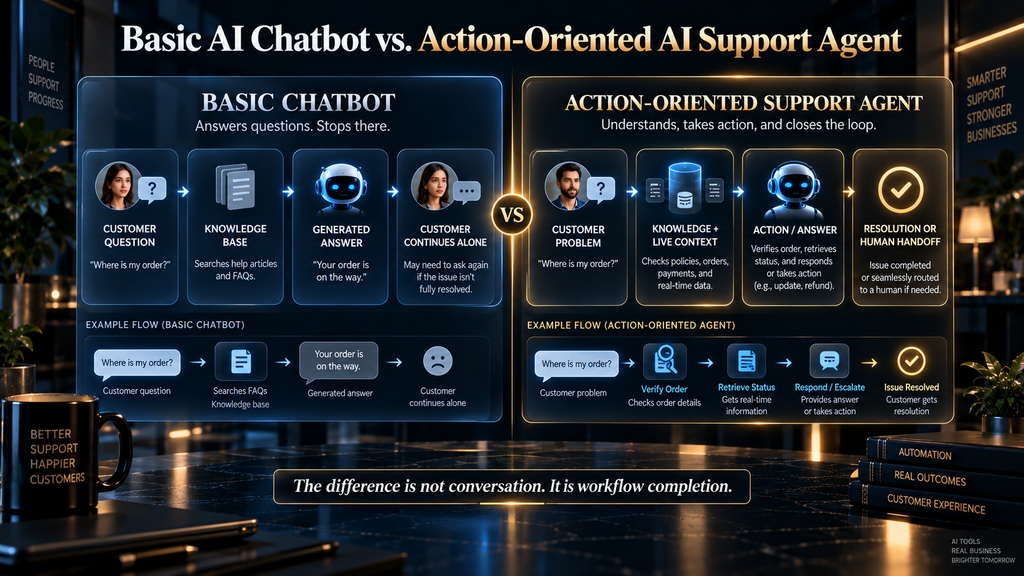
The biggest reason Weav deserves attention is its emphasis on resolution rather than simple deflection. Most customer-support automation discussions focus on how many conversations an AI system can answer without a human. That is useful, but it can also produce a misleading metric. If an AI replies correctly but the customer still has to contact the company again, the business did not necessarily reduce the underlying support workload.
Consider a simple example. A customer writes, “Where is my order?” A chatbot that responds with a link to the order-tracking page has technically answered the question, but the customer may still need to navigate the site, locate the order, and interpret the tracking status. A more capable support workflow can retrieve the relevant order information and provide the status directly. The difference is small from a conversational perspective but significant from an operational perspective.
This is the central thesis behind our review: the value of customer-support AI should be measured by completed resolutions, not merely generated responses.
That does not mean every issue should be automated. Some requests require judgment, authorization, negotiation, emotional sensitivity, or access to information that should not be exposed to an autonomous system. The objective is therefore not maximum automation. It is maximum useful automation within controlled boundaries.
The R.E.S.O.L.V.E. Framework for Evaluating Weav
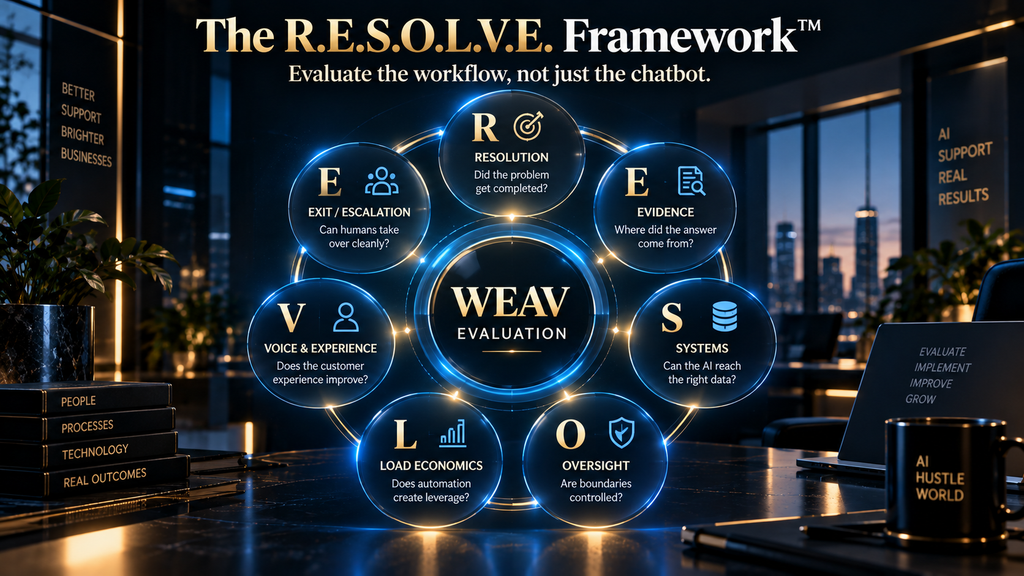
To evaluate Weav without simply repeating its feature list, we use the R.E.S.O.L.V.E. framework: Resolution, Evidence, Systems, Oversight, Load Economics, Voice and Experience, and Exit through escalation.
Resolution
The first question is whether Weav can actually complete the support task. A high-quality response is useful, but a completed customer problem is more valuable. Businesses should therefore measure successful resolutions against the original customer intent rather than counting every AI-generated response as a win. For the difference between the two approaches, read AI chatbots vs AI agents.
Evidence
The second question is where the agent gets its information. If an AI agent is operating from outdated documentation, incomplete policies, or poorly structured knowledge, automation can scale inaccurate information just as effectively as accurate information. Weav’s value therefore depends partly on the quality and maintenance of the knowledge environment surrounding it.
Systems
The third question is whether the agent can reach the systems required to complete real work. An AI agent that knows your return policy but cannot access an order system may explain the process while still leaving the customer waiting for a human. Integrations and actions are therefore strategically more important than another layer of conversational polish.
Oversight
The fourth question is what happens when the system is uncertain, encounters an exception, or reaches an action that requires human authorization. Businesses need clear boundaries around what the AI can say, what it can do, and what must be escalated.
Load Economics
The fifth question is whether automation actually improves the economics of support. A $29 or $119 software subscription can look inexpensive in isolation, but the relevant comparison is the cost of successfully resolving the workload, including human review, AI usage, implementation, maintenance, and any additional services or teammates. Plan data for other tools is in our AI Tool Pricing Database.
Voice and Experience
The sixth question is whether customers receive an experience consistent with the business. An AI agent that is technically accurate but robotic, confusing, overly verbose, or unable to recognize customer frustration can damage the experience even when its underlying information is correct.
Exit
The final question is what happens when automation stops. Human handoff should preserve context rather than forcing the customer to repeat the entire conversation. If escalation is smooth, AI becomes a workload filter. If escalation is poor, AI becomes another layer customers must fight through.
This framework is useful beyond Weav because it changes the buying conversation from “Which AI has the most features?” to “Which system can safely complete the largest useful portion of my support workflow?”
Weav Features: What You Actually Get
Weav’s feature set is broad enough that a simple checklist can make the product appear more impressive than it actually is. The better approach is to understand what each feature changes operationally.
AI Agents and Business Knowledge
Weav is built around specialized AI agents that can be configured for customer-facing support. The product emphasizes business-specific knowledge and agent controls rather than relying exclusively on generic model behavior. This matters because customer support is highly dependent on company-specific policies, product information, procedures, and terminology. We compare it with a leading chatbot builder in Weav vs Chatbase.
The limitation is equally important: knowledge configuration becomes part of the operating system of your support team. If your documentation is fragmented, contradictory, or outdated, you should expect the AI workflow to inherit some of those weaknesses. AI does not remove the need for knowledge management; it makes knowledge quality more operationally important.
Actions and Integrations
Actions are where Weav’s architecture becomes more interesting than a conventional knowledge-base chatbot. The platform lists integrations and custom APIs, and its Shopify implementation can use live order information to support order-related requests.
The strategic value is obvious: the closer the AI gets to the system of record, the less often a human needs to act as the bridge between the customer and the business system. But this also introduces a higher standard for permissions and testing. Reading an order status and changing an order are not equivalent actions, and businesses should be much more conservative as an AI agent moves from information retrieval toward irreversible operations.
Unified Inbox and Human Support
Weav combines AI and human support in a unified workspace, with features including AI responses, summaries, auto-assignment, escalation, and multiple support channels. Our comparison of AI customer support vs human support and the guide to human-in-the-loop AI cover when people should stay involved.
This is important because a support operation cannot be evaluated solely on the percentage of tickets automated. If 60% of conversations are handled automatically but the remaining 40% become harder for humans to understand, the net operational improvement may be smaller than expected. Context preservation during escalation is therefore a core part of the product’s value proposition.
Reporting
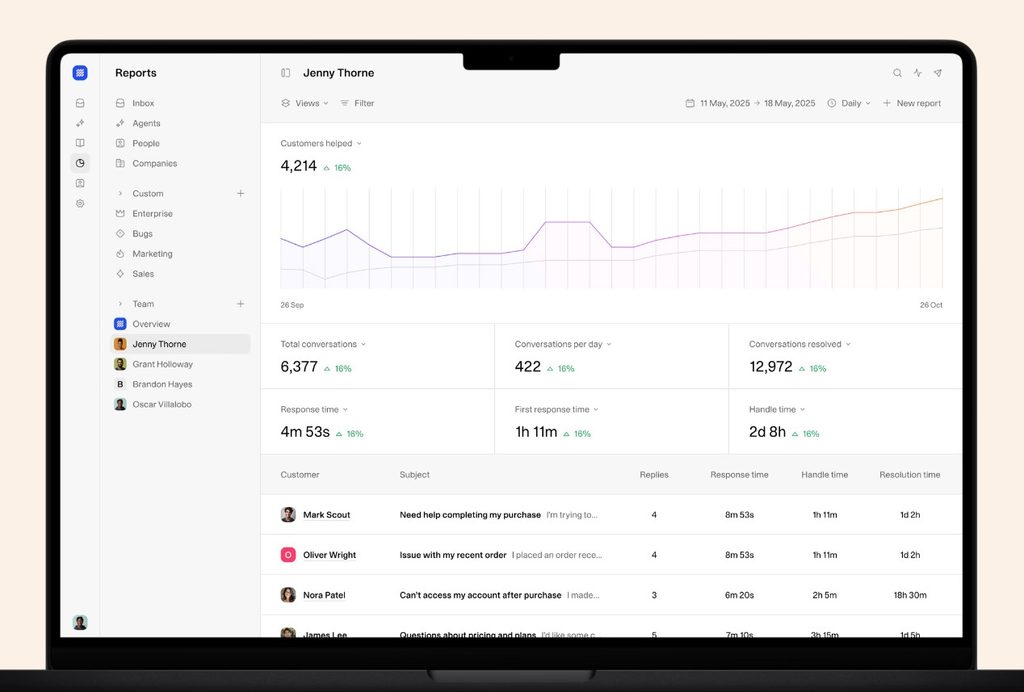
Weav also provides reporting capabilities, with more advanced reporting available at higher plan levels.
The key question for a buyer is not whether a dashboard exists. It is whether the dashboard helps answer operational questions such as which intents are being resolved, where escalation is happening, which knowledge gaps repeatedly cause failures, and whether automation is actually reducing human workload. Those are the metrics that turn AI support from a novelty into an operating system.
Weav Pricing in 2026
Weav’s current direct pricing page lists four plans: Lite at $0 per month, Plus at $29, Pro at $119, and Max at $359. The included AI-message capacity ranges from 20 messages per month on Lite to 20,000 on Max, while higher plans add teammates, training capacity, actions, helpdesk capabilities, reporting, retraining, and integrations. Our guide to Weav pricing breaks down the cost per resolution.
| Plan | Monthly price | AI messages | Teammates | AI actions | Positioning |
|---|---|---|---|---|---|
| Lite | $0 | 20 | 1 | 5 | Starter |
| Plus | $29 | 500 | 2 | 5 | Small teams |
| Pro | $119 | 5,000 | 3 | 10 | Growing teams |
| Max | $359 | 20,000 | 5 | 25 | Higher-volume operations |
The direct pricing page also lists optional add-ons, including $49 for 1,000 additional AI credits, $29 per additional teammate, $29 per additional custom email, and $99 per platform to remove Weav branding. Higher-volume or more complex requirements can be handled through custom plans.
There is an important pricing detail that buyers should not overlook: Weav’s Shopify App Store pricing is different from the pricing displayed on Weav’s main pricing page. The Shopify listing currently shows Plus at $39 per month, Pro at $149, and Max at $449, with a 14-day free trial. It also describes Shopify-specific capabilities such as order tracking and store data access.
That does not necessarily mean one source is wrong. It indicates that pricing can vary by deployment or distribution channel, which is precisely why buyers should verify the plan and feature set applicable to their implementation before calculating ROI.
Check the Setup Against Your Help Content
Connect your existing help articles and see how well Weav answers from them before you plan a rollout.
Try Weav With Your Help Docs →Affiliate disclosure: We may earn a commission if you subscribe through this link, at no additional cost to you.
AI Hustle World Pricing Fit Test: What the Message Allowance Really Buys
This is an AI Hustle World calculation using the monthly list prices and included AI-message allowances displayed on Weav’s direct pricing page and its Shopify App Store listing, checked in September 2026. It is useful for screening plan capacity before a trial, but it is not a claim about Weav’s performance or a substitute for measuring successfully resolved customer cases. See where it sits among the best AI customer service tools.
| Plan | Direct price | Shopify price | Included AI messages | Direct cost per 1,000 included messages | Shopify cost per 1,000 included messages |
|---|---|---|---|---|---|
| Lite | $0/mo | Not listed | 20 | Not meaningful at this scale | — |
| Plus | $29/mo | $39/mo | 500 | $58.00 | $78.00 |
| Pro | $119/mo | $149/mo | 5,000 | $23.80 | $29.80 |
| Max | $359/mo | $449/mo | 20,000 | $17.95 | $22.45 |
Method: monthly list price ÷ included AI messages × 1,000. The calculation excludes add-ons, taxes, annual-billing discounts, human handling time, implementation, and overage credits. It also excludes the most important unknown: how many messages a typical conversation uses and how many conversations end in a verified resolution.
The result is a meaningful pricing signal. On the direct monthly plans, moving from Plus to Pro provides 10 times the included message capacity for a little over four times the monthly price, while Max lowers the raw included-message rate further. The Shopify route is currently $10, $30, and $90 more per month than the matching direct plans, so a Shopify merchant should verify which billing route applies before calculating payback.
Pre-trial fit screen: forecast your own monthly AI-message volume from a representative sample of support conversations. Roughly 21–500 messages points to the Plus capacity band, 501–5,000 to Pro, and 5,001–20,000 to Max; those are capacity thresholds, not recommendations. If your volume fits a band but the AI needs repeated follow-up messages or frequent human intervention, the plan may still be poor value. The decision metric remains total AI and support cost ÷ successfully resolved customer cases, measured during a controlled test.
Because Weav also presents an annual discount on its direct pricing page, recheck the checkout total before committing to a longer billing term. The figures above are intentionally the visible monthly list prices so another reader can reproduce the comparison without assuming a discount that may depend on the selected route or terms.
What Does Weav Cost Per AI Message?
Using the direct monthly plans as a simple capacity calculation, Plus works out to roughly 5.8 cents per included AI message, Pro to roughly 2.4 cents, and Max to roughly 1.8 cents. But these figures should not be interpreted as cost per resolved customer issue because one support conversation can contain multiple messages and not every AI message produces a successful resolution. You can check current plans on the Weav pricing page, Chatbase pricing and Intercom pricing.
That distinction is critical. A company processing 5,000 AI messages is not necessarily resolving 5,000 customer issues. The metric that matters for a serious ROI calculation is closer to:
Total AI and support cost ÷ successfully resolved customer cases.
That number requires actual business data, which means a trial or controlled pilot is much more valuable than a generic “AI support saves X%” claim.
Is Weav Cheap Compared With Hiring Support Staff?
Weav can be inexpensive relative to the cost of additional human support, but saying that it simply “replaces a support hire” would be too aggressive.
A human support employee handles ambiguity, negotiation, judgment, exceptions, emotional situations, and tasks that require broad organizational context. An AI agent is strongest when the workload is repetitive, structured, information-rich, and bounded by clear rules. The economic opportunity therefore comes from reducing the amount of human time spent on low-complexity work, not from assuming that one software subscription can replace an entire support function.
For example, suppose a support agent spends a substantial part of the day answering order-status questions, explaining return policies, identifying products, and handling repetitive billing questions. If Weav can resolve a meaningful percentage of those interactions without requiring human intervention, the business can redirect human time toward refunds, escalations, retention issues, complex technical problems, and high-value customer conversations. That can produce real economic value even if no employee is eliminated.
The better ROI question is therefore: How much valuable human support capacity does Weav free, and how reliably does it do so?
That is a much more defensible business case than “AI replaces support staff.”
What Weav Does Well
Weav’s strongest characteristic is the way its product connects knowledge, AI conversations, actions, human support, and escalation rather than treating the chatbot as the entire product. That architecture makes sense for businesses where customer questions frequently depend on company-specific information or live operational data.
The Shopify implementation is a useful example. Weav describes an AI assistant that can use synced catalog and store-policy information alongside live order data, allowing it to support both product discovery and post-purchase questions. The platform also supports order tracking, human handoff, email, chat, unified inbox capabilities, and escalation.
The second strength is the ability to start relatively small. The direct pricing page includes a free Lite tier and paid plans starting at $29, while the Shopify listing provides a 14-day trial. That lowers the barrier to conducting a controlled experiment instead of forcing a business to make a large upfront commitment.
The third strength is the product’s orientation toward operational support rather than conversational novelty. The most valuable AI support system is not the one that sounds most human; it is the one that reduces repetitive work while preserving a safe path to human judgment. Weav’s combination of automated responses, actions, escalation, summaries, assignment, and unified support workflows is aligned with that goal.
Where Weav Falls Short
The biggest weakness is not necessarily a missing feature. It is evidence maturity.
Weav is still a relatively young product in the public market, and the Shopify App Store listing currently shows zero customer reviews. The listing indicates the Shopify app launched on July 7, 2026, which means buyers should be cautious about treating the absence of negative reviews as evidence of strong performance. There simply is not yet a large public review base from which to draw a reliable consensus.
That creates an unusual situation for a product review. We can evaluate the product architecture, documented capabilities, pricing, integrations, and workflows, but we should not manufacture certainty where independent evidence is still limited. A responsible review should distinguish between what Weav says its platform can do and what independent users have demonstrated at scale.
The second limitation is the dependency on knowledge quality. Businesses sometimes approach AI customer support as though the model itself will fix weak documentation. It will not. If your return policy is unclear, your product catalog is inconsistent, your internal procedures live inside employees’ heads, or your escalation rules are undocumented, the AI may simply expose those weaknesses at a larger scale.
The third limitation is that actions increase both value and risk. Once an AI agent can access live customer or order data and potentially perform support actions, testing becomes much more important. A wrong answer can frustrate a customer; a wrong action can create an operational or financial problem. Businesses should therefore begin with reversible, low-risk workflows before expanding autonomous permissions.
A Crucial Reality Check About Weav’s Performance Claims
Weav’s current marketing materials include an 80% customer testimonial: one customer says its agent handles 80% of customer questions the same way they would. That is vendor-published evidence, not an independently verified benchmark; the page does not provide a sampling frame, ticket mix, resolution definition, or test method alongside the testimonial. We therefore treat it as evidence of how Weav positions the product, not as a forecast for your support queue.
This distinction is not a minor editorial technicality. Resolution rates vary dramatically by business, support category, knowledge quality, channel, ticket complexity, integration depth, and escalation policy. A company with highly repetitive ecommerce questions could see very different results from a SaaS business handling complex technical problems.
For that reason, the smartest way to evaluate a number like 70% is not to ask whether it sounds impressive. Ask what it means for your support queue. If 1,000 monthly conversations contain 600 simple, well-documented requests, the automation opportunity may be significant. If the majority involve complex exceptions, account-specific investigation, or human judgment, the same headline resolution claim tells you much less.
Weav vs. a Basic AI Chatbot
A basic AI chatbot and Weav can look similar from the customer’s perspective because both may appear as a conversational interface. The difference becomes clearer when you follow the workflow behind the message.
A basic chatbot is often strongest when the customer asks a question that can be answered from a static knowledge base. Weav’s broader architecture is designed to combine that knowledge with AI agents, actions, live data, a support inbox, and human escalation. The Shopify implementation, for example, advertises access to catalog, store-policy, and live order information rather than relying only on static answers.
That does not automatically make Weav better for every business. If your customers ask 50 common questions and almost never require account-specific actions, a sophisticated support platform may be unnecessary. But when the support workload depends on multiple systems and requires a mixture of automated answers and human intervention, the broader architecture becomes more valuable.
Who Should Use Weav?
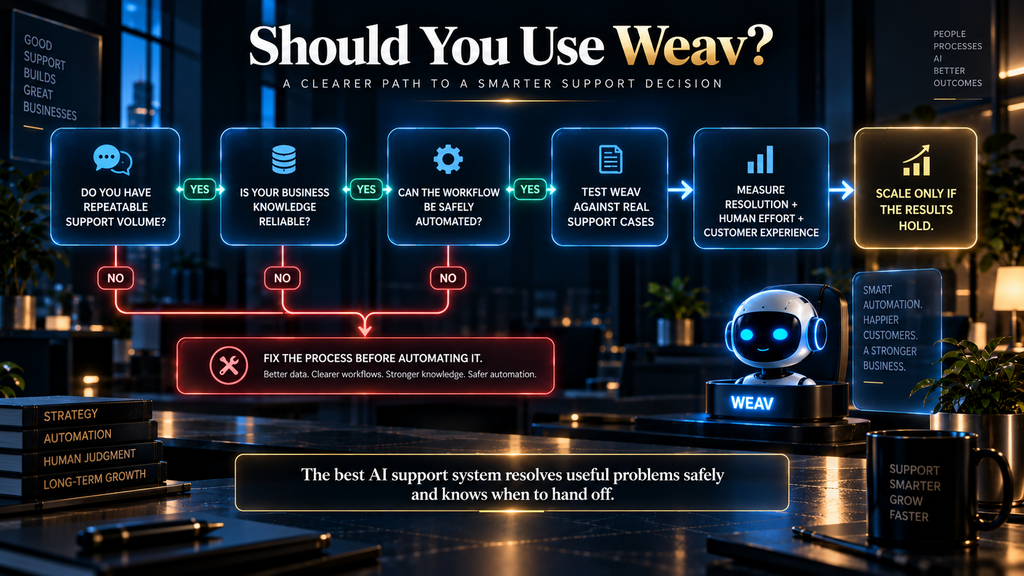
Weav is a strong candidate for small and growing businesses with recurring customer-support volume, reasonably organized documentation, and a desire to automate routine work without removing humans from the process. Ecommerce businesses are an obvious fit because order status, product information, policies, and pre-purchase questions create many structured support opportunities. SaaS and subscription businesses can also benefit when their knowledge base is mature and common customer issues follow repeatable patterns.
It is particularly attractive when the business has reached the point where support volume is consuming meaningful employee time but has not yet built a large enterprise support operation. In that situation, a platform that combines AI and human workflows can be more strategically useful than adding another disconnected chatbot.
The strongest fit is therefore not defined by company size alone. It is defined by support repetition plus knowledge quality plus workflow structure.
Who Should Avoid Weav, or at Least Wait?
Weav is probably unnecessary if your business receives very little customer support and most questions can be answered manually in a few minutes. It may also be a poor fit if your internal documentation is too weak to support reliable automation, because the implementation effort required to clean up the underlying knowledge can outweigh the immediate benefits.
Businesses with extremely high-risk workflows should also be cautious about granting autonomous actions too early. If a support action can create financial, legal, account-security, or reputational consequences, the correct strategy is to begin with constrained permissions, extensive testing, and human approval rather than turning on every available automation simply because the platform supports it.
Finally, organizations that require a long history of independent enterprise reviews should recognize that Weav’s public evidence base is still developing. That is not a reason to reject the product; it is a reason to test it rather than assume it.
How to Test Weav Before Trusting It With Customers
The best way to evaluate Weav is not to ask it five easy questions during a demo. Use a sample of your actual support workload.
Start with 20 to 50 historical customer conversations that represent the range of issues your team handles. Include straightforward questions, ambiguous requests, account-specific questions, edge cases, questions that require information from another system, and cases that should clearly be escalated to a human. This creates a much more realistic test than a curated demonstration.
Then measure five outcomes: accuracy, successful resolution, escalation quality, action accuracy, and human effort saved. Accuracy tells you whether the response is correct. Resolution tells you whether the customer’s underlying problem was actually completed. Escalation quality tells you whether the system recognizes its limits. Action accuracy tells you whether connected workflows behave safely. Human-effort savings tells you whether the entire system is producing operational value.
You should also deliberately include questions for which the correct answer is “I need a human.” That is one of the most important tests because a support AI should not be rewarded for confidently answering every question. The best system is often the one that knows when not to automate.
The Metrics That Actually Matter
A support AI dashboard can make automation look impressive while hiding whether customers are actually receiving better service. The most useful KPI framework is therefore built around the full customer journey.
| KPI | What it tells you |
|---|---|
| Resolution rate | How often the customer’s underlying issue is completed |
| Escalation rate | How often human involvement is required |
| Escalation accuracy | Whether the AI knows when to hand off |
| First-contact resolution | Whether the issue is solved without repeat contact |
| Recontact rate | Whether customers have to ask again |
| Human handling time | How much employee effort remains |
| AI action accuracy | Whether automated actions are performed correctly |
| Customer satisfaction | Whether automation improves the experience |
| Cost per resolved case | Whether the economics work |
| Knowledge-gap frequency | Where documentation repeatedly causes failures |
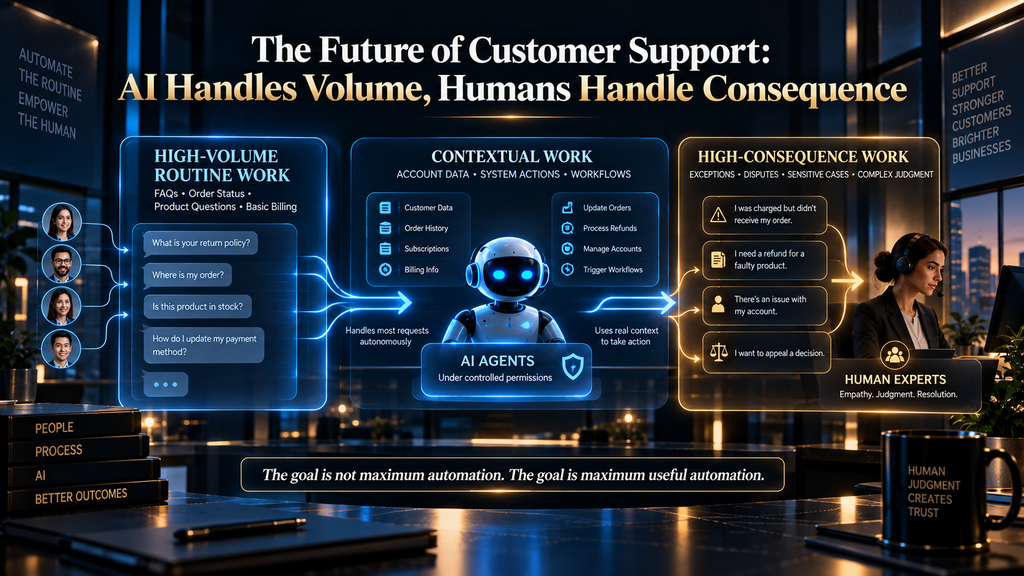
The most important metric is usually not AI deflection rate. A system can deflect conversations while still creating customer frustration. If customers leave the interaction without their issue resolved, the business may simply be hiding the workload rather than eliminating it.
What Happens If You Do Nothing?
For a growing business, the alternative to AI support is not “no cost.” It is usually increasing human workload.
As support volume rises, repetitive requests consume more employee time. Response times can increase, founders and managers become escalation points, and experienced support employees spend more time answering questions that could theoretically be handled through structured knowledge. Eventually the business faces a choice between accepting slower service and adding capacity.
That does not mean every business needs Weav. It means the comparison should be between Weav and the actual alternative, not between Weav and a fictional zero-cost support operation.
If your support volume is growing quickly but still contains a high proportion of repeatable requests, delaying automation can have an opportunity cost. On the other hand, implementing AI before your knowledge, policies, and workflows are ready can simply automate disorder. The right time to adopt support AI is when the underlying process is stable enough to automate but repetitive enough that automation creates meaningful leverage.
Common Mistakes When Implementing AI Customer Support
The first mistake is trying to automate everything immediately. Businesses often see a long list of available actions and assume more automation means more value. In reality, the safest path is usually to automate the lowest-risk, highest-volume intents first and expand only after the system demonstrates consistent performance. For a step-by-step build, see how to set up an AI customer support agent with Weav.
The second mistake is treating the knowledge base as a one-time setup task. Customer-support information changes constantly. Products change, prices change, policies change, shipping timelines change, and exceptions appear. If the business does not establish ownership for maintaining the information behind the AI, performance will gradually degrade.
The third mistake is optimizing for deflection instead of resolution. If the team celebrates a lower human-ticket count without measuring recontacts, complaints, escalation quality, and customer satisfaction, it can accidentally optimize for making customers stop asking rather than helping them.
The fourth mistake is giving the AI more authority than it has earned. Start with information retrieval and low-risk assistance, then introduce actions gradually. Every action should have a clear reason, a defined boundary, and a recovery path if something goes wrong.
Weav for Ecommerce vs. SaaS
Ecommerce may be one of the clearest environments for Weav because many customer questions naturally map to structured data and repeatable workflows. Product recommendations, order status, shipping questions, return policies, product information, and post-purchase support all create opportunities for AI assistance. Weav’s Shopify implementation specifically supports product discovery, order tracking, store-policy questions, and human handoff.
SaaS businesses have a different opportunity. Their support questions may involve product documentation, account configuration, billing, integrations, troubleshooting, and technical workflows. The potential value can be high because the same questions recur across customers, but the difficulty also rises because technical support often requires more context and careful diagnosis.
The practical lesson is that Weav’s fit depends less on whether you are ecommerce or SaaS and more on whether your support intents are repeatable, your knowledge is reliable, and the necessary systems can be connected safely.
Is Weav Worth It?
For the right business, yes—Weav is worth testing.
The strongest case is a company that has enough support volume for repetitive work to consume meaningful human capacity, but still wants humans available for exceptions and higher-value conversations. Weav’s combination of AI agents, business knowledge, actions, unified support workflows, escalation, and reporting gives it a more complete operating model than a chatbot that simply answers FAQs.
The case is weaker when support volume is tiny, documentation is poor, the workflow is highly specialized and unpredictable, or the business requires a long history of independent customer evidence before adopting a platform. The public evidence base is still developing, and the Shopify App Store currently has no customer reviews, so buyers should treat a trial as part of the evaluation rather than assuming the marketing claims will translate directly to their own operation.
Our bottom line is therefore not “Weav will replace your support team.” That would be an oversimplification. The more defensible conclusion is that Weav can become a useful layer between your knowledge base and your human support team, taking responsibility for a meaningful portion of predictable customer work while escalating the cases where human judgment matters.
The real question is whether your business has enough repeatable support volume for that layer to create measurable leverage.
Final Thoughts
Weav is interesting for a reason that has little to do with how human its chatbot sounds. The more important idea is that customer-support AI is moving from answer generation toward workflow completion. A system becomes materially more valuable when it can understand the customer’s request, retrieve the right information, interact with relevant systems, complete a safe action, preserve context, and recognize when a human needs to take over. Our Weav vs Intercom Fin comparison covers the enterprise-scale option.
Weav is clearly designed around that direction. Its AI agents, knowledge layer, actions, support inbox, escalation, integrations, and reporting create a more complete support model than a simple FAQ chatbot. At the same time, buyers should resist the temptation to treat the product’s marketing claims as universal performance benchmarks. The public evidence base is still developing, pricing can vary by deployment, and the quality of the underlying business knowledge will strongly influence the outcome.
For that reason, the best way to approach Weav is neither blind enthusiasm nor blanket skepticism. Treat it as an operational experiment. Take a representative sample of your real support workload, define what counts as a successful resolution, test the system against difficult cases as well as easy ones, measure the human work it actually removes, and only then expand its permissions.
If the numbers show that Weav can reliably handle a meaningful portion of your repetitive support workload without increasing recontacts, escalations, or customer frustration, the economics can become compelling. If it cannot, no amount of AI branding will make the automation valuable.
The memorable takeaway is simple: the best customer-support AI is not the system that talks to the most customers. It is the system that resolves the most useful problems safely while knowing when to let a human take over.
Decide Whether Weav Fits Your Support Team
Compare its plans, cost per resolution and handoff controls with your ticket volume before you commit.
Review Weav Plans →Affiliate disclosure: We may earn a commission if you subscribe through this link, at no additional cost to you.
Frequently Asked Questions
1. What is Weav used for?
Weav is used for AI-powered customer support, combining AI agents with business knowledge, customer conversations, support workflows, actions, escalation, and human support. It is designed to automate routine customer interactions while keeping human intervention available for more complex cases.
2. Is Weav an AI chatbot?
Weav includes chatbot functionality, but positioning it simply as a chatbot misses the broader product. Its platform combines customer-facing AI with a unified inbox, human handoff, automation, actions, reporting, and integrations.
3. How much does Weav cost?
Weav’s direct pricing currently ranges from a free Lite plan to Plus at $29 per month, Pro at $119, and Max at $359. The platform also offers additional credits, teammates, emails, branding removal, and custom plans. Shopify’s marketplace listing currently shows different pricing, so businesses should verify the applicable price for their deployment before purchasing.
4. Does Weav replace human customer support?
Not completely, and that should not be the objective. Weav is better understood as a system for handling predictable support work and escalating cases that require human judgment, context, authorization, or intervention.
5. Can Weav access customer or order information?
Depending on the integration, Weav can work with connected business data. Its Shopify integration, for example, advertises live order lookup, order status, tracking, product information, and store-policy data.
6. Does Weav work with Shopify?
Yes. Weav has a Shopify App Store integration that connects the platform to a Shopify storefront and supports customer-service and shopping-assistance workflows, including order-related support and human handoff.
7. Does Weav have a free plan?
Yes. Weav’s direct pricing page currently lists a Lite plan at $0 per month with 20 AI messages per month, one teammate, one custom email, and five enabled AI actions.
8. Is Weav good for small businesses?
It can be, particularly when a small business has recurring support volume but does not want to build a large support team. The strongest fit is a business with repeatable customer questions, reliable documentation, and workflows that can be safely automated.
9. How should I test Weav before adopting it?
Use real historical support conversations rather than demo questions. Test straightforward requests, ambiguous cases, account-specific questions, action-dependent workflows, and cases that should be escalated. Measure resolution, accuracy, escalation quality, repeat contacts, human handling time, and cost per successfully resolved case.
10. Is Weav worth paying for?
Weav is worth considering when the amount of repetitive support work is large enough to create meaningful human-cost or service-level pressure. It is less compelling when support volume is very low or the business has not yet organized the knowledge and workflows required for reliable automation.
Written by
Muntasir Ahmad Chowdhury
Founder, AI Hustle World
Muntasir Ahmad Chowdhury is the Founder of AI Hustle World, an independent publication dedicated to making Artificial Intelligence practical, trustworthy, and easy to understand. He researches AI tools, automation, customer service, productivity, and real-world business applications, helping readers make smarter technology decisions through research-driven, experience-backed content.
Expertise:
AI Tools • AI Automation • AI Customer Service • AI Productivity • Generative AI • AI Workflows
Get Smarter With AI
Enjoyed this guide? Get practical AI tools, tutorials, and honest reviews delivered to your inbox.
4 thoughts on “Weav Review 2026: Features, Pricing & Is It Worth It?”