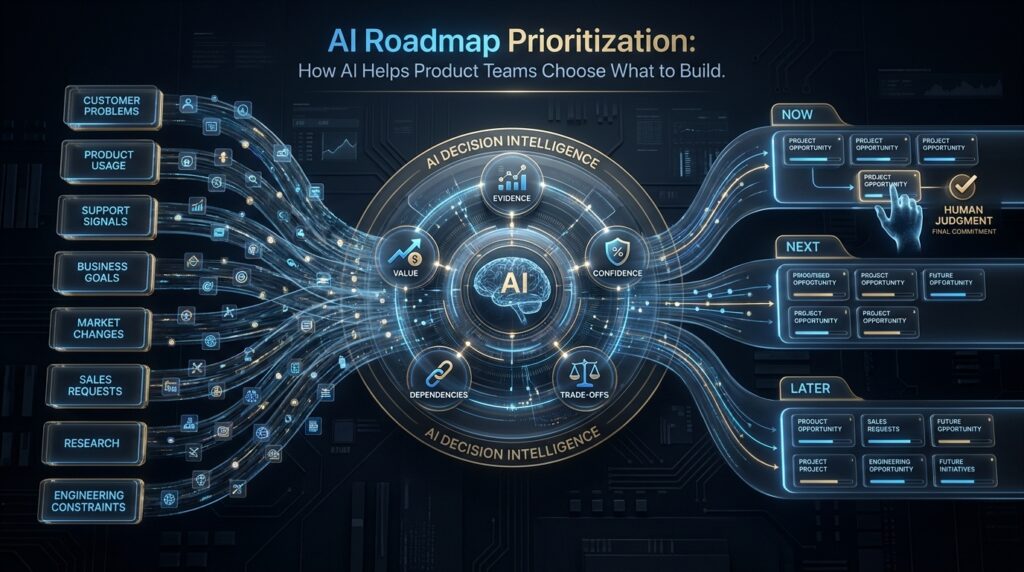
Evidence: Documentation reviewed
Last checked: August 2026
What was done: Written from official documentation and the published sources linked in this article. Not hands-on tested.
Files: None
Affiliate links: No
Last Update: August 2026
A product team can generate more good ideas than it can possibly build. That is why the hardest roadmap question is rarely “What could we build?” It is “What deserves our limited product, design, engineering, budget, and organizational capacity now—and what are we deliberately choosing not to do?”
That distinction is becoming more important as AI makes product discovery and production faster. AI can help teams analyze customer feedback, summarize research, identify patterns in product usage, generate requirements, explore competitors, and even produce working software more quickly. The result is not necessarily a shortage of opportunities. It can be the opposite: an explosion of plausible things worth building.
Roadmap prioritization therefore becomes a constraint-management problem.
Traditional prioritization frameworks such as RICE exist because product teams need a disciplined way to compare competing ideas rather than allowing the loudest stakeholder, newest request, or most exciting feature to automatically win. Intercom’s RICE framework, for example, evaluates ideas through Reach, Impact, Confidence, and Effort, explicitly acknowledging that prioritization requires combining multiple imperfect estimates rather than relying on a single instinct.
AI can improve that process, but not in the simplistic way its marketing sometimes suggests.
The strongest use of AI is not asking a model to produce a ranked list of features and then accepting the first answer. It is using AI to assemble evidence, expose patterns, challenge assumptions, surface contradictions, analyze dependencies, test scenarios, and make the reasoning behind roadmap decisions easier to inspect.
That difference matters.
A model can calculate a RICE score in seconds. It cannot make a weak impact estimate reliable simply because it has calculated the formula correctly. It can identify a frequently requested feature. It cannot automatically determine whether that feature is strategically more important than an unrequested problem that is silently damaging retention. It can recommend a roadmap. It cannot own the consequences of choosing the wrong one.
The real opportunity is therefore bigger—and more practical—than automated prioritization:
AI should not decide the roadmap for product teams. It should make the roadmap decision harder to make badly.
What Is AI Roadmap Prioritization?
AI roadmap prioritization is the use of AI to synthesize product evidence, evaluate competing opportunities, test assumptions, and support decisions about which initiatives should receive scarce resources and when. The important word is support.
AI roadmap prioritization should not be confused with autonomous roadmapping. In a responsible workflow, AI can perform much of the analytical work around prioritization while product leaders retain accountability for the final decision.
This distinction is consistent with how current product-management research and tooling describes the opportunity. Productboard, for example, describes AI-assisted roadmap prioritization as a way to synthesize customer feedback, product behavior, market signals, and other product data into a more unified decision layer. It also emphasizes keeping humans in the loop rather than allowing AI to override product judgment.
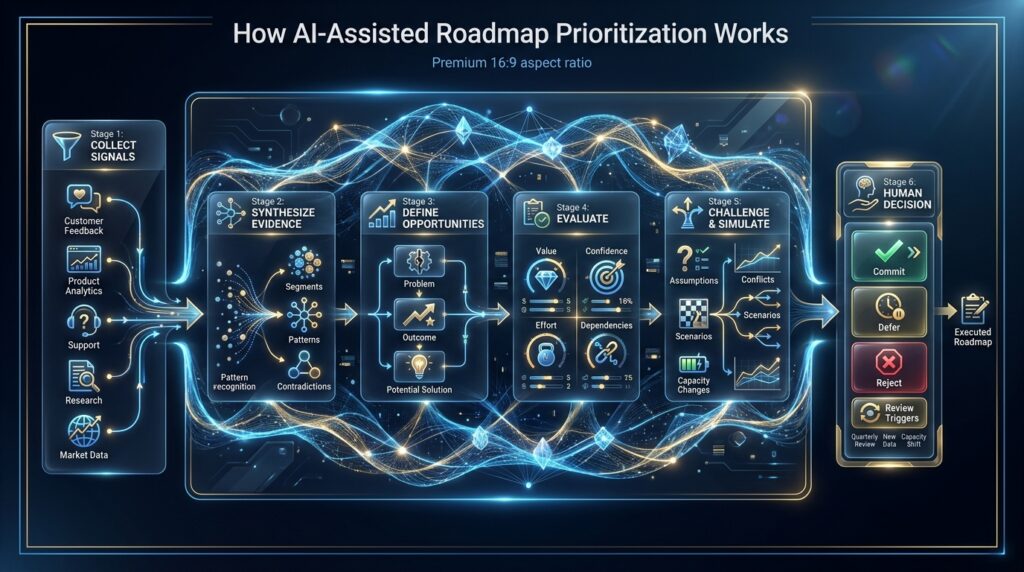
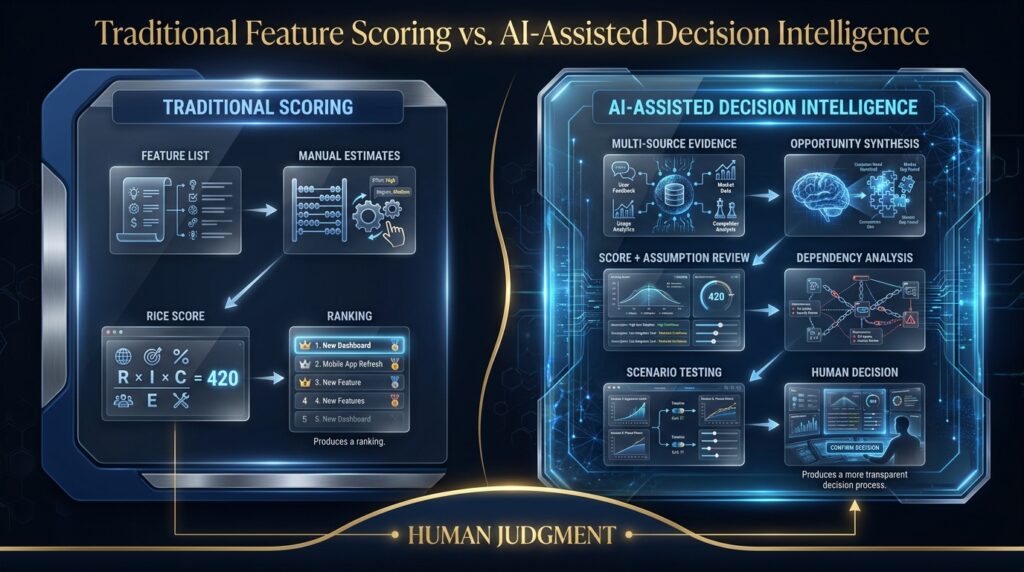
A conventional prioritization process might look like this: Collect ideas → gather evidence → estimate value → estimate effort → score initiatives → debate trade-offs → choose priorities → build roadmap. An AI-assisted process can become: Continuously collect signals → synthesize evidence → identify opportunities → evaluate assumptions → score or compare initiatives → expose contradictions → model scenarios → review trade-offs → commit priorities → monitor evidence.
The difference is not that AI has magically discovered a perfect prioritization formula. The difference is that the team can potentially process more relevant evidence with less manual synthesis.
That matters because modern product organizations rarely make decisions from a single source. A roadmap item may be influenced by customer interviews, support conversations, product analytics, sales opportunities, competitive changes, technical constraints, strategic objectives, financial targets, and previous experiments.
Humans remain responsible for the decision, but AI can reduce the amount of information that must be manually assembled before the decision can even begin.
Why Roadmap Prioritization Is Harder Than It Looks
Roadmap prioritization is difficult because teams are usually choosing among several reasonable opportunities while operating under constraints, uncertainty, and conflicting objectives.
A backlog makes it easy to collect possibilities. A roadmap forces the organization to make commitments.
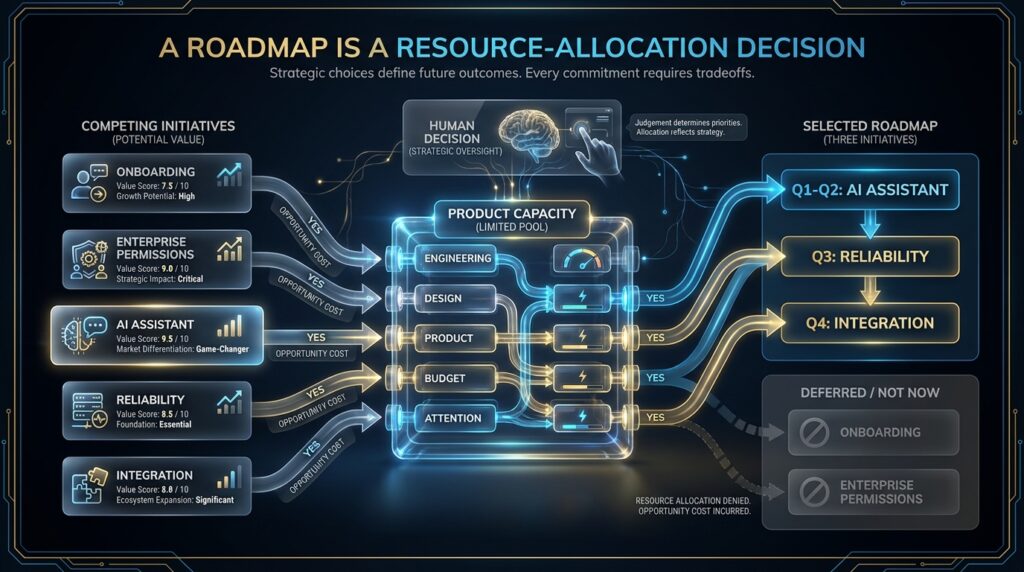
Imagine a B2B SaaS company with six competing initiatives:
- Improve onboarding
- Build enterprise permissions
- Add a popular CRM integration
- Reduce application latency
- Launch an AI assistant
- Rebuild an unreliable reporting system
Every initiative has a plausible argument.
Sales may argue that the CRM integration could win new deals. Customer Success may argue that enterprise permissions are causing account friction. Engineering may argue that reliability work should come first. Growth may argue that onboarding is the largest conversion opportunity. Leadership may see the AI assistant as strategically important.
The problem is not finding a good idea. The problem is deciding which good idea deserves scarce capacity first.
Customer demand is only one input
A feature that receives 500 requests is not automatically more valuable than a problem that generates only 50 reports.
The 500 requests may come from a small, highly vocal segment. The 50 reports may come from a larger but quieter segment. Or the 50 reports may represent a severe problem that causes users to abandon the product.
Product feedback therefore needs context.
Current product-management guidance increasingly emphasizes combining explicit feedback with behavioral evidence rather than treating request volume as a direct proxy for priority. Productboard, for example, describes using customer feedback alongside usage information and business objectives to improve roadmap decisions.
This is one area where AI can help. Instead of asking: “How many people requested this?” a product team can ask: “Who is affected, what are they trying to accomplish, how frequently does the problem occur, what behavior surrounds it, what business outcome does it affect, and how strong is the evidence?” That is a much better prioritization question.
Stakeholders naturally optimize for different outcomes
Sales wants features that help close or expand accounts. Customer Success wants issues resolved before they create churn. Marketing wants capabilities that support positioning and launches.
Engineering wants technical foundations that improve reliability and velocity. Design wants important usability problems addressed. Executives may want strategic differentiation or entry into a new market.
The mistake is not listening to these groups. The mistake is treating every request as though it is expressed in the same decision language. AI can help translate different signals into a common evidence structure.
A sales request might represent a revenue opportunity. A support request might represent operational cost. An engineering request might represent future delivery capacity. A customer interview might reveal a problem that has not yet become a feature request.
The roadmap decision should compare the underlying opportunities, not merely the vocabulary used to describe them.
Capacity turns prioritization into opportunity cost
Every roadmap decision displaces something else. If an engineering team spends three months building an enterprise permissions system, it cannot spend those same three months improving onboarding. If the team commits to a large AI initiative, it may delay reliability work.
If it spends a quarter rebuilding infrastructure, it may postpone several customer-facing features. This means roadmap prioritization is fundamentally a resource-allocation problem. The question is not simply:
It is:
“Which use of our limited capacity creates the strongest combination of value, evidence, strategic fit, feasibility, and learning—and what are we giving up by choosing it?”
That is the decision AI needs to support.
Why Traditional Prioritization Frameworks Still Matter
AI does not make traditional prioritization frameworks obsolete; it makes them more useful when they are treated as structured decision tools rather than objective truth machines. RICE remains a useful example. Intercom developed RICE around four factors: Reach × Impact × Confidence ÷ Effort.
Reach estimates how many people or events an initiative will affect during a defined period. Impact estimates the magnitude of the effect. Confidence represents how strongly the team believes its estimates. Effort represents the resources required.
The important part is not the formula itself. The important part is what the formula forces the team to discuss. A product team that says:
“This feature is obviously important.”
has not necessarily made a decision. A team that says:
“This affects roughly 40% of our target users, could materially influence activation, but our impact estimate is low-confidence and the initiative requires substantial engineering capacity.”
has created a decision that can be challenged. That is valuable even if the final answer is not mathematically perfect. Other frameworks serve different contexts.
| Framework | Best used to answer | AI can help with |
| RICE | Which opportunity has strong expected impact relative to reach, confidence, and effort? | Evidence gathering, estimate review, assumption challenges, scenario testing |
| Impact vs. Effort | Which opportunities appear valuable relative to implementation cost? | Identifying outliers, summarizing evidence, comparing alternatives |
| WSJF | Which work should happen sooner when the cost of delay matters? | Surfacing urgency, dependencies, and delay signals |
| MoSCoW | What is essential when scope or timing is constrained? | Clustering requirements and identifying scope conflicts |
| Kano | How might different feature types affect customer satisfaction? | Grouping research signals and identifying possible expectation patterns |
No framework should become an automatic answer generator. The choice of framework should follow the decision being made. That is particularly important with AI because a model can make a framework look more precise than the underlying evidence actually is.
How AI Changes Roadmap Prioritization
AI’s biggest contribution to roadmap prioritization is not faster scoring; it is the ability to synthesize fragmented evidence and expose relationships that are difficult to see manually. Productboard’s research and product guidance identifies data integration, customer-feedback analysis, usage information, trend detection, and AI-assisted recommendations as areas where AI can augment roadmap prioritization. That creates several distinct capabilities.
1. AI can synthesize scattered product evidence
A product manager may need to review:
- support tickets
- customer interviews
- surveys
- product analytics
- sales notes
- customer-success records
- feature requests
- churn reasons
- competitive research
- previous experiment results
The information may exist in completely different systems. AI can help consolidate it into a common view. For example, suppose three customers ask for:
“Bulk editing.”
Another says:
“Updating hundreds of records is too slow.”
“There is no practical way to make the same change across multiple records.”
A keyword-based system may see three different requests. AI can potentially identify a broader opportunity: Users struggle to efficiently manage large record sets. That does not mean the product team should immediately build bulk editing.
It means the team has moved one step closer to the underlying problem. That distinction is crucial.
The difference between evidence and interpretation
A strong AI-assisted system should preserve the difference between:
- Evidence: 27 enterprise customers reported difficulty managing permissions.
- Interpretation: Permission management may be creating enterprise friction.
- Hypothesis: Improving permissions could increase enterprise retention or expansion.
Those are not equivalent claims. AI is particularly useful for connecting them. It should not silently turn the hypothesis into a fact.
2. AI can analyze patterns across customer segments
Aggregate data can hide important product problems. Imagine:
- 6% of all customers report an issue.
- 32% of enterprise customers encounter it.
- Enterprise customers account for a large proportion of annual revenue.
A simple feature-request count might suggest low priority. A segment-aware analysis could reveal strategic importance. This is why AI-assisted prioritization should move beyond frequency.
The relevant question is not: “How many people mentioned this?” It is: “Which users are affected, how severely, how often, and what does that mean for the current product objective?”
AI can assist with this segmentation when the underlying data is available and representative. It cannot solve a missing-data problem by inference alone.
3. AI can identify contradictions
This may be more valuable than automatic scoring. Suppose customer feedback strongly supports building a feature, but product analytics show that the workflow associated with the request is rarely used. That contradiction should not automatically kill the initiative.
It should trigger investigation. Possible explanations include:
- users cannot discover the workflow
- the workflow is too difficult to use
- analytics do not capture the relevant behavior
- a strategically important segment is underrepresented
- customers are describing a problem rather than the right solution
- the existing workflow is being avoided because it is broken
AI can help surface the contradiction quickly. The goal is not to remove disagreement. The goal is to make disagreement visible before resources are committed.
4. AI can challenge assumptions
A roadmap score often contains assumptions that disappear behind a final number. AI can make those assumptions explicit. For an initiative with high expected impact, it could ask:
- What evidence supports the impact estimate?
- Which customer segment drives the estimate?
- What comparable product behavior supports the forecast?
- What would invalidate the assumption?
- Is the expected outcome causal or merely correlated?
- What evidence contradicts the hypothesis?
- Which unknown has the greatest effect on the decision?
This is where AI begins to act less like a calculator and more like a decision critic. That is a higher-value role.
5. AI can expose dependencies
Roadmaps are not lists of independent items. One initiative may depend on:
- an API rewrite
- data infrastructure
- security review
- design system changes
- vendor integration
- migration work
- analytics instrumentation
A feature can have an excellent score and still be the wrong thing to start. Why? Because the feature is not actually executable yet.
AI can help map relationships among initiatives and identify where several roadmap items depend on the same underlying capability. That can reveal a different decision: Instead of asking:
“Which feature ranks highest?”
the team may need to ask:
“Which enabling capability makes the greatest number of high-value opportunities possible?”
That is a fundamentally different roadmap question.
The AI Roadmap Decision Stack
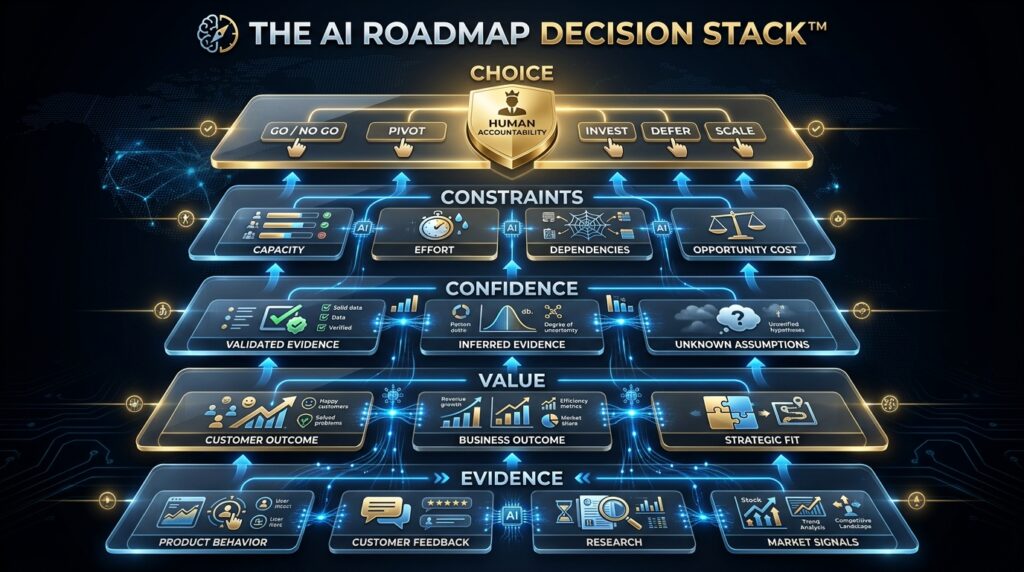
A useful AI-assisted prioritization system needs to distinguish between what the evidence says and what the organization ultimately chooses. That is why AI Hustle World can use a five-layer framework: Evidence → Value → Confidence → Constraints → Choice. I call this the AI Roadmap Decision Stack.
1. Evidence: What do we actually know?
Start with observable signals. These can include:
- product behavior
- customer feedback
- support data
- research
- business performance
- market changes
- competitive intelligence
- previous experiments
- technical findings
The goal is to build the strongest possible evidence base before debating the solution. AI can help organize the evidence, identify recurring patterns, group similar problems, and expose contradictory signals.
But evidence quality remains a human responsibility. If the source data is incomplete, biased, outdated, or poorly instrumented, AI cannot magically turn it into ground truth.
2. Value: What outcome could this create?
Value should be connected to an outcome. Depending on the product, that might mean:
- activation
- retention
- conversion
- expansion
- revenue
- cost reduction
- support efficiency
- reliability
- strategic differentiation
- market entry
- customer satisfaction
The important question is: Value for whom, and against which current objective? A feature can have enormous potential value for one customer segment while contributing little to the organization’s current objective.
AI can help map initiatives to outcomes. The product team still has to decide which outcomes matter most.
3. Confidence: How strong is the evidence?
Confidence is one of the most important variables in prioritization because high-value ideas can still be poor bets when the evidence behind them is weak. Intercom’s RICE methodology explicitly includes confidence to reduce overconfidence in estimates for promising but poorly understood ideas. AI can improve this layer by asking:
- What evidence supports the estimate?
- Is the evidence quantitative or qualitative?
- How recent is it?
- Is it representative?
- Has the hypothesis been tested?
- What assumptions remain unresolved?
The goal is not to manufacture a perfect confidence percentage. The goal is to make uncertainty visible.
4. Constraints: What does this decision consume or block?
Every initiative consumes resources. That includes:
- engineering capacity
- product-management capacity
- design capacity
- infrastructure
- budget
- organizational attention
- launch capacity
- opportunity cost
Dependencies matter too. If Initiative A requires Initiative B, the score for A alone is insufficient.
AI can help identify these relationships and run capacity scenarios. But the organization must decide which constraints are acceptable.
5. Choice: What are we willing to commit to?
This is the human layer. After reviewing evidence, value, confidence, and constraints, the team still has to make a choice. That choice should include not only: What are we building? but also: What are we not building?
That is the difference between prioritization and analysis. AI can make the decision clearer. It cannot own the consequences.
The Biggest AI Prioritization Trap: False Precision
AI can make uncertain product assumptions look more certain than they really are. Consider a hypothetical roadmap ranking:
| Initiative | Reach | Impact | Confidence | Effort | Score |
|---|---|---|---|---|---|
| Enterprise permissions | 45,000 | 2.0 | 80% | 4 | 18.0 |
| AI assistant | 70,000 | 2.5 | 55% | 6 | 16.0 |
| Onboarding redesign | 90,000 | 1.5 | 90% | 5 | 24.3 |
The table looks rigorous. But imagine the numbers were produced from:
- incomplete analytics
- a handful of interviews
- an early engineering estimate
- AI-generated impact assumptions
- limited historical evidence
The calculation can be perfectly correct while the decision remains highly uncertain. This creates a dangerous psychological effect. A number such as 24.3 feels more authoritative than:
“We believe this is probably a high-impact initiative, but we have not validated the mechanism yet.”
The number did not create the certainty. It merely hid the uncertainty behind arithmetic. That leads to a principle worth remembering:
AI can reduce the cost of calculating uncertainty. It cannot reduce uncertainty simply by calculating it.
Product teams should therefore use ranges, evidence notes, confidence levels, and scenario analysis when the inputs are uncertain.
Using AI With RICE Without Fooling Yourself
The best AI use around RICE is to interrogate the inputs rather than blindly generate the final score. RICE provides a useful structure because it forces teams to consider Reach, Impact, Confidence, and Effort. AI can make the process more rigorous by asking questions around each component.
Reach
Instead of:
“How many users will this feature reach?”
ask:
- What population is being counted?
- Over what time period?
- What percentage is actually eligible?
- Are certain segments overrepresented?
- Is the estimate based on observed behavior or assumption?
Impact
Ask:
- What behavior should change?
- What metric should move?
- What evidence connects the initiative to that metric?
- Is there historical evidence?
- Is the expected impact causal or speculative?
Confidence
Ask:
- Which inputs are measured?
- Which are estimated?
- Which assumptions are untested?
- What evidence contradicts the current estimate?
- What experiment would most efficiently increase confidence?
Effort
Ask:
- Does the estimate include product, design, engineering, QA, infrastructure, migration, and launch work?
- Are dependencies included?
- What could cause effort to expand?
- Is this a standalone initiative or part of a larger technical sequence?
The result is not necessarily a better RICE score. It is a better understanding of why the RICE score looks the way it does. That is more valuable.
A Roadmap Is Not a Leaderboard
A roadmap should not simply contain the highest-scoring individual initiatives. A roadmap is a portfolio of commitments, dependencies, experiments, and strategic bets—not a leaderboard of feature scores. This becomes especially important when product teams evaluate uncertain AI initiatives.
A recent 2026 research paper on AI strategy proposes an expected-ROI approach that separates three questions: value if successful, likelihood of success, and investment required. The authors argue that precise ROI is difficult for uncertain AI projects, but coarse assessments of these components can still help teams distinguish stronger and weaker bets. They also emphasize assembling a portfolio rather than simply funding the single highest-ranked project.
That idea extends beyond AI. A healthy roadmap may contain several types of work: Core improvements protect and improve the existing product. Growth initiatives target measurable expansion.
Strategic bets support long-term positioning. Enablers create infrastructure or capabilities required by other initiatives. Exploration bets buy information about uncertain opportunities.
A pure scoring model can undervalue exploration because exploration may have lower immediate expected impact but significant learning value. It can also undervalue infrastructure because infrastructure does not always produce immediate customer-visible benefits. The roadmap therefore needs portfolio judgment.
AI can help evaluate each component. Humans still need to decide the balance.
What Changes When the Feature Itself Uses AI?
AI features require additional prioritization questions because their technical and behavioral uncertainty can be materially different from conventional software features. Consider two roadmap items: Feature A: Export customer data to CSV. Feature B: AI assistant that automatically recommends actions to customer-service agents.
Feature A still has engineering uncertainty. Feature B introduces additional questions:
- Is the required data available?
- How accurate does the model need to be?
- How will quality be evaluated?
- What happens when the recommendation is wrong?
- Can users override the recommendation?
- How expensive will inference be?
- What latency is acceptable?
- How will the system be monitored?
- Can model behavior change over time?
- How severe is failure?
- Is the feature reversible?
This does not mean AI features should automatically be deprioritized. It means AI itself cannot be treated as a value multiplier. A feature is not strategically valuable because it contains a model.
It is valuable when it solves an important problem and can produce the intended outcome at an acceptable level of cost, reliability, risk, and trust. Recent research on AI project selection reinforces this uncertainty problem: AI projects can appear attractive on potential value while differing substantially in their likelihood of success and investment requirements.
AI Feature Prioritization Needs a Wider Risk Lens
For AI initiatives, add several questions to the normal prioritization process.
| Question | Why it matters |
|---|---|
| Is the underlying user problem important? | Prevents the team from prioritizing AI simply because the technology is available. |
| Is the required data available? | Determines whether the proposed capability is realistically buildable. |
| Can output quality be evaluated? | Probabilistic systems require a way to determine whether outputs are good enough. |
| What happens when the system fails? | Failure severity can materially change the priority and required safeguards. |
| Can users override the system? | Human control may be essential when AI outputs influence consequential decisions. |
| What is the operating cost? | Inference, storage, monitoring, and vendor costs can change the economics at scale. |
| Can performance be monitored after launch? | AI systems may require ongoing evaluation rather than one-time acceptance testing. |
| Is the initiative reversible? | Reversible experiments may justify a different risk tolerance than irreversible commitments. |
The important point is not to create a giant AI-specific scoring spreadsheet for every feature. It is to recognize that technical uncertainty is part of product uncertainty.
AI Can Make Scenario Planning Practical
One of the strongest uses of AI in roadmap prioritization is testing whether a decision remains attractive when the assumptions around it change. Traditional prioritization often produces a static ranking. But product conditions move.
Suppose a team has capacity for four major initiatives:
- Enterprise permissions
- AI assistant
- Mobile redesign
- Reporting improvements
Now change one variable.
Scenario 1: Engineering capacity falls by 25%
Which initiatives still fit? Which should be delayed? Which has dependencies that make partial execution impractical?
Scenario 2: Enterprise churn rises sharply
Does the value of permissions increase? Does onboarding become less important?
Scenario 3: A competitor launches a similar AI assistant
Does the strategic value of your own initiative increase because parity becomes necessary—or decrease because differentiation is harder?
Scenario 4: Early AI testing shows reliability below the required threshold
Does the expected value of the AI initiative still justify the investment?
Scenario 5: A major customer offers a significant expansion if one capability is delivered
How much weight should that opportunity receive relative to broader product needs? The value of AI here is not predicting the future perfectly. It is making it cheaper to ask:
“If this assumption changes, does our decision change?”
That is a much better strategic question than:
“Which feature has the highest score today?”
From Static Roadmaps to Continuous Evidence
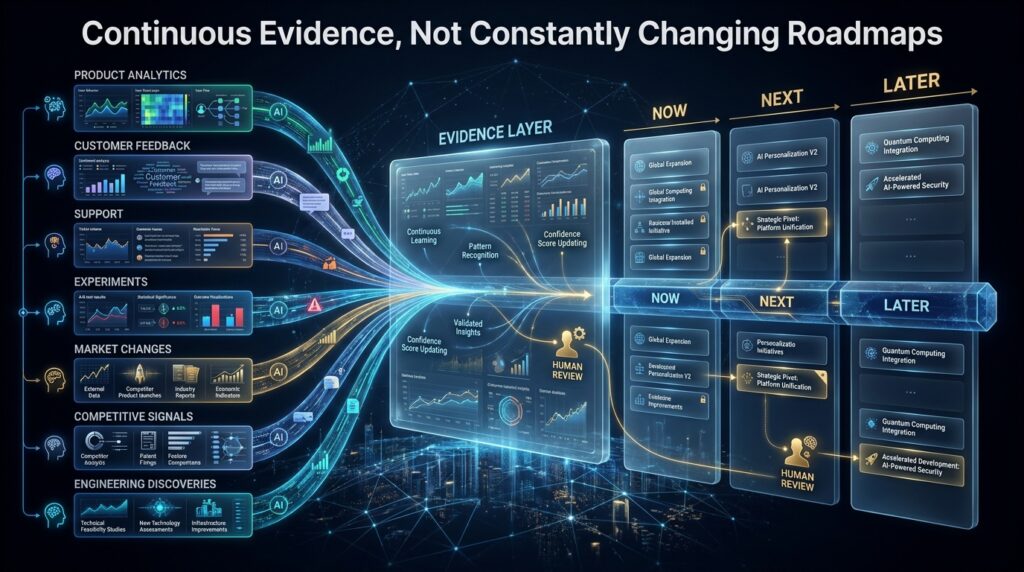
AI can make the evidence behind a roadmap continuously updateable without requiring the roadmap itself to change continuously. This distinction is critical. A common misconception is that AI will create a permanently dynamic roadmap where priorities change every time new information arrives.
That would create execution chaos. A better model is: Stable strategic direction + continuously updated evidence + explicit review triggers. Imagine each roadmap initiative has:
- current evidence
- affected customer segments
- expected outcome
- confidence
- dependencies
- effort estimate
- strategic objective
- unresolved assumptions
- review triggers
AI can continuously process new information and identify meaningful changes. Most changes should not trigger a roadmap rewrite. But some should.
For example:
- a key assumption is disproven
- customer behavior changes materially
- a competitor changes the market
- engineering discovers a major dependency
- an experiment produces unexpected results
- the economics of the initiative change
The system can then tell the product team:
This decision deserves another look.
That is a far more useful form of AI assistance than automatic reprioritization.
The Practical AI Roadmap Prioritization Workflow
A product team does not need to rebuild its entire product-management system to begin using AI. A disciplined workflow can be introduced incrementally.
Step 1: Define the current product objective
Before asking AI to prioritize anything, define what the team is trying to accomplish. For example:
- Increase activation
- Reduce enterprise churn
- Improve retention
- Expand revenue
- Reduce support cost
- Improve reliability
- Enter a new market
Without a clear objective, AI may optimize for what is easiest to count rather than what matters most.
Step 2: Assemble the evidence
Bring together relevant information:
- product analytics
- customer feedback
- support tickets
- research
- sales signals
- customer-success information
- competitive intelligence
- market research
- engineering estimates
- strategic objectives
Do not dump every available document into the model simply because it can accept them. The evidence set should be relevant to the decision.
Step 3: Normalize the inputs
Different systems often describe the same problem differently. AI can help:
- identify duplicates
- normalize terminology
- group related requests
- classify problems
- separate problems from proposed solutions
- identify affected segments
This creates a cleaner opportunity set.
Step 4: Convert requests into opportunity statements
Avoid immediately turning customer requests into features. Use: Signal → Problem → Opportunity → Potential Solution. For example:
- Signal: Customers request bulk editing.
- Problem: Managing large record sets is slow and repetitive.
- Opportunity: Reduce the time required to manage large datasets.
- Potential solutions: Bulk editing, templates, automation, API improvements, or workflow redesign.
This prevents the roadmap from becoming a list of customer-supplied solutions.
Step 5: Evaluate evidence quality
For each opportunity, identify:
- supporting evidence
- contradictory evidence
- affected segments
- evidence age
- confidence
- unknowns
- assumptions requiring validation
This is where AI can provide substantial leverage.
Step 6: Choose the right prioritization framework
Use RICE when it fits. Use value vs. effort when the decision is simpler. Use cost-of-delay approaches when timing matters.
Use other methods when the problem requires them. Do not force every decision into one universal formula.
Step 7: Run an AI challenge pass
Ask AI to deliberately search for reasons the current ranking might be wrong. Look for:
- weak assumptions
- contradictory evidence
- hidden dependencies
- inflated impact estimates
- underestimated effort
- segment bias
- recency bias
- alternative explanations
This is the red-team stage of prioritization.
Step 8: Run scenarios
Change important variables:
- capacity
- impact
- confidence
- competitive conditions
- timing
- dependencies
- adoption
Then see which decisions still hold up.
Step 9: Conduct the human review
Product, engineering, design, business, and other relevant stakeholders review the evidence. The goal is not to vote on the AI ranking. The goal is to decide.
Step 10: Document the decision
Record:
- what was selected
- what was rejected
- what was deferred
- why
- evidence used
- assumptions
- dependencies
- expected outcomes
- decision owner
- conditions for reconsideration
This creates institutional memory.
Step 11: Monitor the evidence
After the roadmap decision, continue collecting relevant signals. The next prioritization cycle should learn from what actually happened.
That creates a feedback loop: Decision → Build → Measure → Learn → Reprioritize. AI can help make this loop faster and more visible.
Where AI Roadmap Prioritization Fails
AI-assisted prioritization fails when teams mistake better information processing for better judgment. The technology can improve the analytical layer while leaving the decision itself poorly framed.
Garbage in, polished garbage out
If analytics are incomplete, feedback is biased, objectives are unclear, or estimates are unreliable, AI cannot create trustworthy decisions from nothing. It may simply produce a more polished explanation of a weak input set.
False precision
A ranking of 9.2 versus 8.7 can look meaningful even when the underlying estimates are highly uncertain. Teams should be careful not to confuse mathematical precision with decision confidence.
Loud-customer bias
AI can process thousands of support conversations, but more data does not automatically mean more representative data. A highly active enterprise customer can generate far more text than hundreds of quieter users. The system needs context.
Recency bias
Recent feedback can feel urgent because it is fresh. But recent does not automatically mean representative. Productboard’s customer-feedback guidance explicitly identifies recency bias as a prioritization risk and recommends examining feedback across longer periods rather than over-indexing on what was heard most recently.
Silent-majority blindness
Customers who never submit feedback still use—or abandon—the product. That is why behavioral data matters. A roadmap based entirely on explicit feedback can miss problems revealed through usage or churn.
Strategy blindness
AI can optimize against the goals you give it. It may not understand the strategic context behind those goals.
A company may deliberately accept lower short-term revenue because it is repositioning into a new market. A purely local optimization system may recommend the wrong thing.
Dependency blindness
A feature can rank highly while depending on another project that has not been funded. The roadmap needs dependency reasoning, not just feature scoring.
Local optimization
The five highest-scoring features may not form the best portfolio. The product may need an enabling project, an exploratory bet, or infrastructure work that does not rank highly on customer impact alone.
Automation bias
This may be the most dangerous failure mode. When an AI recommendation looks analytical, people may challenge it less. The correct response should be the opposite:
The more authoritative an AI recommendation appears, the more carefully its assumptions should be inspected.
Common Mistakes Product Teams Make With AI Prioritization
Asking AI to rank a raw backlog
A raw backlog usually contains duplicate requests, outdated ideas, implementation details, stakeholder preferences, unresolved problems, and partially formed concepts. Ranking it directly produces a ranked version of the mess. Clean the opportunity set first.
Treating feature requests as product strategy
Customers often describe solutions. The product team still needs to understand the problem.
Allowing AI to invent missing numbers
If Reach, Impact, or Effort is unknown, mark it as unknown. Do not allow the model to quietly turn a missing input into a confident estimate.
Optimizing for what is easiest to measure
Measurability is useful. It is not the same thing as importance. Some strategically important work produces indirect or delayed outcomes.
Ignoring what gets displaced
Every “yes” consumes capacity. The roadmap should record what is delayed or rejected, not only what is approved.
Changing the roadmap every time new evidence appears
Continuous evidence does not require continuous reprioritization. Define meaningful review triggers.
Removing cross-functional judgment
Engineering, design, customer success, sales, analytics, and leadership may each possess information that the AI system does not. AI should connect those perspectives. It should not erase them.
How to Measure Whether AI Actually Improved Prioritization
The success of AI roadmap prioritization should be measured by better decisions and outcomes, not by how much AI the team uses. A team can reduce prioritization time dramatically and still make worse decisions. Useful metrics include:
| Metric | What it measures | Why it matters |
|---|---|---|
| Time to prioritize | How long the team needs to move from evidence to decision | Shows whether AI is reducing analysis overhead. |
| Decision reversal rate | How often major priorities are reversed after new evidence appears | Can reveal whether initial assumptions are becoming more reliable. |
| Forecast accuracy | How closely expected outcomes match actual outcomes | Tests whether prioritization estimates are improving. |
| Evidence coverage | Percentage of major decisions with traceable supporting evidence | Measures decision transparency. |
| Assumption validation rate | Percentage of important assumptions tested before major commitment | Shows whether uncertainty is being actively managed. |
| Roadmap stability | How often priorities change without meaningful evidence changes | Helps identify reactive planning. |
| Outcome attainment | Percentage of prioritized initiatives that achieve their intended product outcome | Connects prioritization to actual product performance. |
| Post-launch learning | How effectively results feed the next prioritization cycle | Shows whether the organization is becoming a learning system. |
One metric deserves particular attention: Outcome attainment. If AI helps the team prioritize twice as many initiatives but the additional initiatives produce little value, the process has not improved. Speed is useful only when it contributes to better decisions or frees capacity for higher-value work.
Who Should Use AI for Roadmap Prioritization?
AI-assisted prioritization is most valuable when teams face high information volume, competing priorities, and enough product evidence to support meaningful analysis. It is particularly useful for teams dealing with:
- large customer bases
- many feedback channels
- multiple product segments
- complex product analytics
- numerous competing initiatives
- frequent market changes
- cross-functional stakeholder pressure
- significant product complexity
But AI is not a substitute for basic product discipline. A team with no clear objective, poor analytics, weak customer understanding, and chaotic strategy does not necessarily need an AI prioritization system. It may first need a better decision process.
This is a critical boundary condition:
AI amplifies the quality of the system around it. It does not automatically repair a broken product-management system.
What Happens If Product Teams Do Nothing?
The risk of ignoring AI in roadmap prioritization is not simply that competitors will use AI and become faster. The deeper risk is that the information environment around product decisions continues expanding while the team’s ability to synthesize it remains mostly manual. Modern product teams receive more signals from more channels:
- product analytics
- support
- customer research
- sales
- community
- reviews
- experiments
- market intelligence
- competitive launches
A human team can still make good decisions. But the cost of doing the synthesis manually increases as the information environment grows. The likely long-term advantage of AI therefore is not autonomous roadmapping.
It is decision capacity. A team that can process more relevant evidence without adding equivalent analytical overhead can spend more of its human attention on the parts AI cannot own:
- strategic choices
- trade-offs
- accountability
- organizational alignment
- ethical boundaries
- risk tolerance
- product judgment
That is a more defensible reason to adopt AI.
The Second-Order Effect: When Building Gets Cheaper, Prioritization Gets More Valuable
AI is making software production cheaper and faster across many workflows. That creates an important second-order effect. If it becomes easier to prototype, generate code, create specifications, and launch experiments, then the cost of building a mediocre idea falls.
That sounds positive. It is—but it creates another problem. Organizations may begin building more things simply because they can.
The bottleneck moves. When production is scarce, teams naturally ask:
“Can we build this?”
When production becomes cheaper, the more important question becomes:
“Should we build this at all?”
That increases the relative value of product judgment. The product organization that wins may not be the one that generates the most software.
It may be the one that is best at deciding which software deserves to exist. This is one of the most important implications of AI-assisted product management.
The Future: From Roadmap Management to Decision Intelligence
AI could eventually turn the roadmap into a living decision system. Not a constantly changing list. A decision system.
Each major initiative could maintain:
- Evidence: What do we know?
- Hypothesis: What do we believe will happen?
- Value: What outcome matters?
- Confidence: How strong is the evidence?
- Constraints: What will this consume or block?
- Dependencies: What must happen first?
- Scenarios: What happens if assumptions change?
- Decision: What are we committing to?
- Review triggers: What would cause us to reconsider?
That structure creates a roadmap that can evolve without becoming chaotic. The roadmap itself can remain relatively stable while the evidence beneath it changes. AI becomes the system that continuously watches for meaningful changes.
Humans remain responsible for interpreting those changes. That is a much more realistic future than fully autonomous product strategy.
A Practical AI Roadmap Prioritization Checklist
Before committing an initiative to the roadmap, ask:
- What customer or business problem are we solving?
- What evidence demonstrates that the problem matters?
- Which customer segments are affected?
- What outcome are we trying to change?
- How strong is the evidence?
- Which assumptions remain unverified?
- What does the chosen prioritization framework tell us?
- What does the framework fail to capture?
- What dependencies exist?
- What capacity will this consume?
- What opportunity will be displaced?
- What evidence contradicts the case for this initiative?
- What happens if the impact estimate is wrong?
- What happens if capacity changes?
- If this is an AI feature, how will quality be evaluated?
- What happens when the system fails?
- Who owns the final decision?
- What evidence would cause us to reconsider the decision?
If the team cannot answer these questions, a more sophisticated AI score will not solve the underlying problem.
Final Thoughts
The temptation with AI is to turn every product-management problem into an optimization problem. Roadmap prioritization is not one.
A roadmap is ultimately a set of choices made under constraints. There will always be more customer needs than the team can address, more opportunities than the organization can fund, and more uncertainty than any model can eliminate.
AI can nevertheless change the quality of those choices.
It can connect fragmented evidence. It can identify patterns across large volumes of product signals. It can expose contradictions that are difficult to see manually. It can challenge assumptions, identify dependencies, test scenarios, and document why a decision was made.
That is already a meaningful advantage. But the wrong goal is to build an AI system that tells product teams what to build. The better goal is to build an AI-assisted decision system that makes it increasingly difficult for weak assumptions, stakeholder pressure, incomplete evidence, or hidden opportunity costs to pass unnoticed.
The strongest product teams will therefore use AI neither as a passive assistant nor as an autonomous roadmap manager. They will use it as a decision-intelligence layer around the product organization. AI can gather the evidence.
AI can structure the uncertainty. AI can challenge the assumptions. AI can model the scenarios.
AI can surface the trade-offs. Humans still decide what the organization is willing to bet on. And as AI makes production cheaper, that human judgment may become more valuable—not less.
The future of AI-assisted roadmapping is not an algorithm that tells product teams what to build. It is a decision system that makes it harder to hide why they chose it.
Turn Product Signals Into Better Roadmap Decisions
AI can help product teams analyze more evidence, challenge assumptions and expose trade-offs—but the value comes from improving the decision process, not handing the roadmap to an algorithm.
Explore AI Product Analytics →FAQ
What is AI roadmap prioritization?
AI roadmap prioritization uses artificial intelligence to analyze product evidence, identify patterns, compare competing initiatives, test assumptions, and support decisions about what a product team should build next. The strongest implementations keep humans responsible for strategy and final prioritization decisions.
How can AI help product teams prioritize a roadmap?
AI can synthesize customer feedback, usage data, research, business signals, competitive information, and other product evidence. It can also help identify patterns, surface contradictions, challenge assumptions, compare scenarios, and assist with prioritization frameworks such as RICE.
Can AI decide what product features to build?
AI can recommend priorities, but it should not independently own roadmap decisions. Product prioritization involves strategic trade-offs, opportunity costs, organizational constraints, uncertainty, and accountability that require human judgment.
Is RICE still useful for AI roadmap prioritization?
Yes. RICE remains useful because it provides a structured way to compare Reach, Impact, Confidence, and Effort. AI can improve the process by helping teams gather evidence, challenge estimates, identify assumptions, and test alternative scenarios rather than simply calculating the final score.
What data can AI use for roadmap prioritization?
Depending on the product, AI can analyze customer feedback, support tickets, product analytics, user research, sales information, market research, competitive signals, business objectives, and engineering estimates. Productboard describes combining customer feedback, product behavior, and other signals as a core opportunity for AI-assisted roadmap prioritization.
What is the biggest risk of AI roadmap prioritization?
One of the biggest risks is false precision: AI can turn uncertain assumptions into polished numerical recommendations that appear more reliable than the underlying evidence. Teams should therefore inspect the evidence and assumptions behind recommendations rather than accepting the ranking automatically.
How should AI features be prioritized differently?
AI features may require additional consideration of data availability, model quality, evaluation methods, reliability, failure severity, user trust, operating cost, monitoring, and reversibility. Their technical uncertainty can materially affect their product and business risk.
Should AI replace product managers in roadmap planning?
No. AI can automate parts of research, analysis, synthesis, and scenario evaluation, but product managers remain responsible for strategic choices, trade-offs, accountability, and final decisions.
How often should an AI-assisted roadmap be updated?
The evidence supporting a roadmap can be updated continuously, but the roadmap itself should not necessarily change continuously. Teams should define meaningful review triggers so that priorities change when evidence materially changes rather than whenever a new signal appears.

Sources and Further Reading
- Opportunity Solution Trees: Teresa Torres on mapping outcomes, opportunities and solutions.
- Kano Model: ProductPlan glossary entry on the Kano model of feature satisfaction.
Related Guides
- AI Product Discovery: How to Use AI for Competitive Research and Market Analysis
- Best AI Product Management Tools in 2026: Research, Roadmaps & Product Ops
- Best AI Research Assistants (Free & Paid): Top 10 Tools Compared
- AI in Ecommerce: How to Automate an Online Store
- AI Financial Planning & Analysis (FP&A): How Continuous Forecasting Works
Written by
Muntasir Ahmad Chowdhury
Founder, AI Hustle World
Muntasir Ahmad Chowdhury is the Founder of AI Hustle World, an independent publication dedicated to making Artificial Intelligence practical, trustworthy, and easy to understand. He researches AI tools, automation, customer service, productivity, and real-world business applications, helping readers make smarter technology decisions through research-driven, experience-backed content.
Expertise:
AI Tools • AI Automation • AI Customer Service • AI Productivity • Generative AI • AI Workflows
Get Smarter With AI
Enjoyed this guide? Get practical AI tools, tutorials, and honest reviews delivered to your inbox.