
Evidence: Documentation reviewed
Last checked: October 2026
What was done: Written from official documentation and the published sources linked in this article. Not hands-on tested.
Files: None
Affiliate links: No
Last updated: October 2026
AI Product Management Explained: How AI Is Changing the Product Lifecycle
AI product management is the use of AI to improve, automate or support product work across discovery, definition, prioritization, design, development, launch and post-launch learning. It also describes the separate job of managing products that contain AI, and the two increasingly overlap.
Product management has always carried heavy production costs. Synthesizing research, writing specifications, building prototypes, analyzing usage and preparing experiments all took days or weeks of skilled effort.
Generative AI attacks many of those costs at once. A product manager can now summarize a large set of customer conversations, draft a specification, explore several concepts, prototype an interaction and prepare an experiment far more quickly than before.
That sounds like a productivity story, and it is only part of one. When the cost of producing product work falls, teams produce more ideas, more prototypes and more software, and the scarce resource shifts from “can we build this?” to “should we build this?”
The evidence for that shift is already visible. Atlassian’s State of Teams 2026 research found that 89% of executives say AI increases speed, but only 6% are sure they have clear examples of organization-wide AI return on investment.
McKinsey reaches a related conclusion from the development side. Its analysis of the AI-enabled software product development life cycle argues that integrating AI end to end lets product managers and engineers spend more time on higher-value work and less on routine tasks.
This guide explains what changes at each stage of the lifecycle and what stays human. You will find the AI Product Success Stack, the Prototype Illusion, the AI Product Value Loop, a Learning Velocity metric, a worked example and a 90-day adoption plan.
What AI Product Management Means
AI product management has two meanings, and it helps to separate them early. The first is using AI to do product work better: research, analysis, documentation, prototyping and coordination.
In that sense, AI can act as a research assistant that synthesizes information, an analyst that finds patterns, a writer that drafts artifacts, a prototype partner and, increasingly, an agent that performs several connected actions across product workflows. Each of those roles removes production effort, and none of them removes the need to decide what the product should do.
The second meaning is managing products that contain AI. Those products have probabilistic outputs, depend on data quality, fail in unfamiliar ways and need continuous evaluation after launch.
The two increasingly meet in one role. A product manager may use AI to create the product while managing a product that itself runs on AI, which makes the job broader and the accountability heavier.
Why the Traditional Product Lifecycle Was Slow
The traditional lifecycle moves through discovery, definition, design, development, validation, launch and measurement. Each stage belonged to a different specialist, and work passed between them as documents.
That structure existed for good reasons. Specialization produced quality, documents created a shared record, and stage gates stopped expensive mistakes from reaching customers.
Its costs were the handoffs. Every transfer between research, product, design and engineering lost context, added waiting time and delayed feedback, so a team might learn that an idea was wrong only months after the decision.
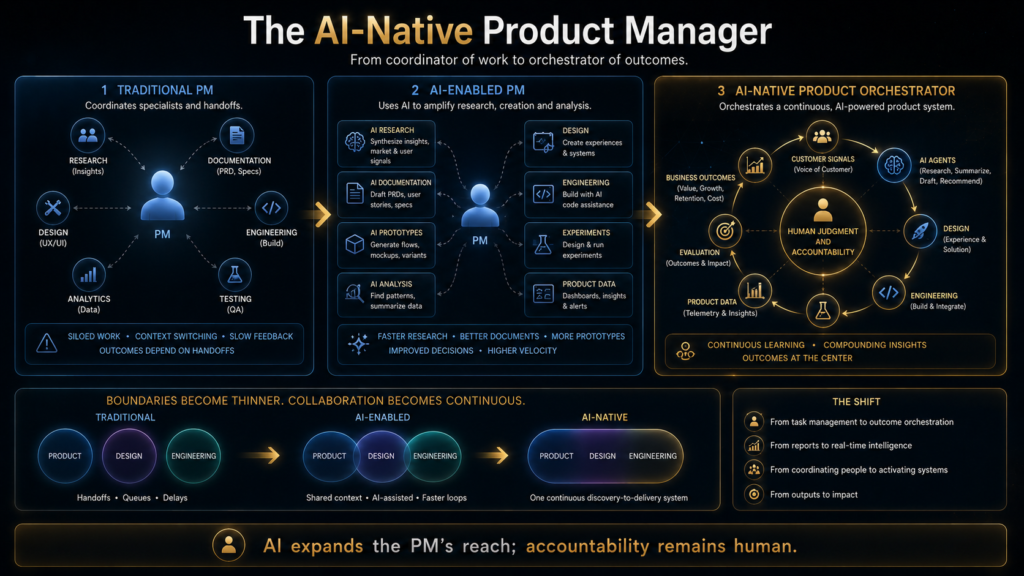
AI changes the cost of those handoffs far more than it changes the logic of the stages. The stages still matter, and the walls between them are getting thinner.
The AI-Enabled Product Lifecycle
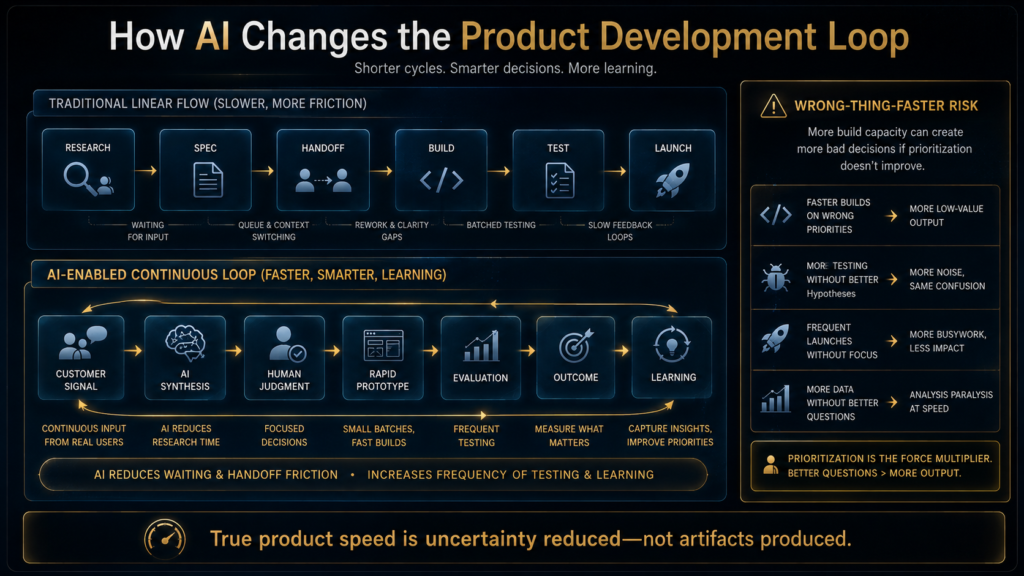
AI makes the lifecycle more continuous by reducing the friction between research, prototyping, building, evaluation and learning. A customer problem can become a rough prototype and a testable hypothesis with far fewer intermediate steps.
AWS describes this in its guidance on generative AI across the software development lifecycle. It says generative AI can support every phase, including project management, requirements, design, coding, testing, deployment and maintenance.
The same guidance notes that AI can generate artifacts such as user stories, design mock-ups, code snippets and test cases. Those are the documents that used to mark the boundaries between teams.
The result is a lifecycle that behaves more like a loop than a line. Learning from one stage feeds back into the others in days, where it once took a quarter.
The Handoff Tax Is Shrinking
In a traditional organization, the product manager explains the problem, the designer translates it into an experience, the engineer translates that into software and the analyst translates the results back into insight. Each translation costs time and loses detail.
AI lets one person carry an idea further before handing it over. A product manager can turn a decision into draft user stories, generate preliminary test cases and explain a feature in customer language without waiting for three other teams.
McKinsey argues that AI may allow product managers to take on more end-to-end oversight for this reason. That does not mean replacing designers or engineers; it means the cost of moving between disciplines falls.
The consequence is easy to miss. When the handoff tax falls, accountability for the whole chain rises, because fewer checkpoints stand between an idea and a shipped feature.
AI Across the Lifecycle
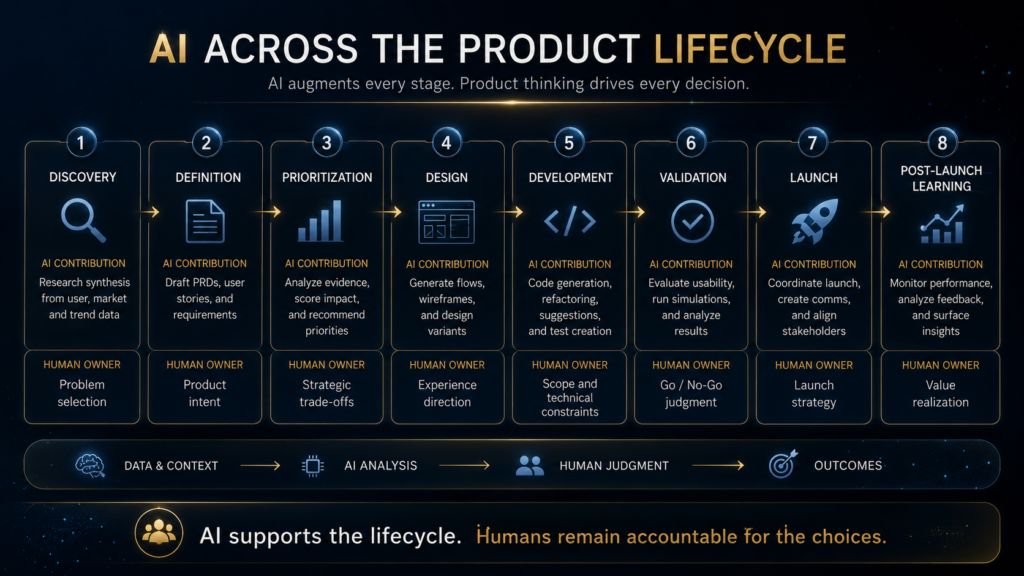
AI contributes something different at each stage, and at each stage one decision stays with people. The table is a map for the rest of this guide.
| Stage | What AI contributes | What stays human |
|---|---|---|
| Discovery | Research synthesis, pattern detection, signal aggregation | Choosing the problem |
| Definition | Draft requirements, examples, edge cases | Product intent |
| Prioritization | Evidence synthesis, trade-off analysis | Strategic choice |
| Design | Concepts, wireframes, prototypes | Experience direction |
| Development | Code, tests, documentation | Scope and acceptance |
| Validation | Experiment analysis, simulation, evaluation | The go or no-go judgment |
| Launch | Content, coordination, rollout analysis | Launch strategy |
| Post-launch | Monitoring, feedback analysis, anomaly detection | Value realization |
The right-hand column is the important one. AI expands what a team can produce, and the choices about problem, intent, priority and value remain decisions someone must own.
Discovery: Research Becomes Continuous
AI reduces the time needed to synthesize customer, market and product information, which lets discovery run continuously. Traditionally, a team commissioned research, waited for a report and acted on findings that were already weeks old.
Atlassian’s analysis of the future of product craft describes the change. It argues that AI collapses the distance between idea and evidence, so product managers can query customer data directly instead of commissioning each step.
The strategic change is that research stops being a periodic event. Support tickets, survey comments and usage data can be summarized every week, and a growing problem can be seen while it is still small.
AI can identify patterns, but it does not know which pattern matters strategically. Our guides on turning customer feedback into product insights and AI product discovery cover the methods and their limits.
Continuous discovery also changes how teams talk to customers. With routine synthesis handled by AI, interviews can focus on the questions the data cannot answer, such as why a workaround exists or what a customer would give up to have the problem solved.
Definition: AI Drafts the Artifact, People Own the Intent
AI can accelerate requirements writing dramatically. A set of research notes and a product objective can become a structured draft in minutes.
A specification is only useful if the intent behind it is right. If the team has not decided who the feature is for or what it must not do, the model will fill those gaps with plausible assumptions.
That is the central risk at this stage. A polished document can hide the fact that several of its requirements were never decided by anyone.
The safe pattern is for AI to draft and critique while people approve. Our guide to using AI for PRDs, user stories and product specs explains how to keep assumptions visible.
Prioritization: When Ideas Are Cheap, Choice Matters More
AI increases the number of ideas a team can generate, analyze and prototype. A team that once considered ten options in a planning cycle can now consider fifty.
Engineering capacity does not grow at the same rate, so the gap between what could be built and what can be built widens. Prioritization becomes more valuable as a result, and the scarce resource is decision quality.
Good prioritization starts from outcomes. Teresa Torres’s opportunity solution tree links a desired outcome to customer opportunities and then to possible solutions, which stops a team from ranking features with no clear purpose.
AI can gather the evidence for each option and lay out the trade-offs. The choice itself depends on strategy and risk appetite, as our guide to AI roadmap prioritization explains.
Design and Prototyping: From Idea to Evidence Faster
Generative AI shortens the path from an idea to something stakeholders or customers can react to. A product manager can turn a written concept into a clickable prototype in an afternoon.
That speed is valuable. Reactions to a prototype are better evidence than reactions to a description, and showing three options is more informative than debating one.
McKinsey makes the same point, arguing that AI can enable product managers to prototype concepts and produce artifacts that once needed specialized resources. The gain is faster evidence, provided the team treats the prototype as a question.
The danger is that a working prototype starts to feel like a validated product. That confusion is common enough to deserve its own name.
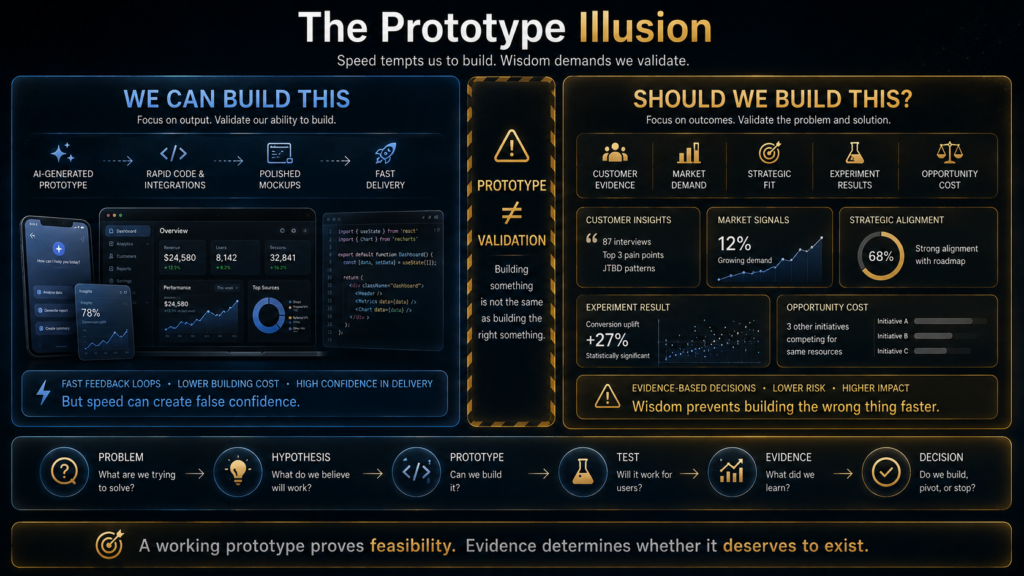
The Prototype Illusion
The Prototype Illusion is the belief that because something was built quickly and looks real, it must be worth building. Speed of creation is mistaken for evidence of demand.
A prototype proves that an idea can be shown. It does not prove that customers have the problem, that they would pay to solve it or that the solution fits how they work.
Stakeholders are especially vulnerable to this illusion. A polished demo creates momentum, and momentum makes it awkward to ask whether anyone needs the thing.
True product speed is how quickly a team reduces uncertainty, and artifacts are only a means to that. Before any prototype is shown, write down what it is meant to test and what result would make you stop.
Development: Thinner Boundaries Between Product and Engineering
AI-assisted development reduces the distance between product intent and working software. Coding assistants generate code, tests and documentation, and agents can carry out multi-step changes.
That does not turn every product manager into an engineer. It does mean a product manager can explore a technical possibility, read a proposed change and take part in iteration without waiting for every artifact.
The benefits are faster feedback and fewer misunderstandings. The risk is that more code is produced than anyone can properly review, which moves the bottleneck from writing to checking.
Our explainers on AI coding assistants and how AI coding agents work cover what these tools do and where human review remains essential. Reading them will help a product manager ask sharper questions in technical reviews.
Testing and Evaluation: The Hidden Center of AI Product Work
AI-powered features need continuous evaluation, because an AI system can behave differently across inputs, contexts and changing data. This is the biggest difference from traditional feature management.
For a conventional feature, the question is whether it works as specified. For an AI feature, the question is how often it works, for whom, under what conditions and how it fails.
That requires an evaluation set: a collection of realistic inputs with a definition of what a good output looks like. The team runs the feature against it before launch and after every change.
Google’s People + AI Guidebook offers practical guidance on designing AI products around user needs, errors and trust. Defining what “great” means, and testing against it, becomes a core product responsibility.
A useful evaluation set is small and specific at first. Fifty to two hundred real examples, chosen to include the difficult and unusual cases, will tell a team more than a large generic benchmark, and the set should grow every time a new failure is found in production.
Product Quality Becomes Multi-Dimensional
A traditional feature is judged mainly on whether it works and whether people use it. An AI feature has several more dimensions, and they often pull against each other.
Accuracy is the obvious one, and it comes with consistency: whether the same input produces a comparable result. Speed and cost per request matter as well, because a slow or expensive answer can undermine a good one.
Safety and trust complete the picture. A feature that is right 95% of the time can still damage the product if the remaining 5% are confident errors in a sensitive area.
The product manager has to decide which dimensions matter most for each use case. A writing aid can tolerate imperfect output, while a feature that summarizes medical or financial information cannot.
The AI Product Success Stack
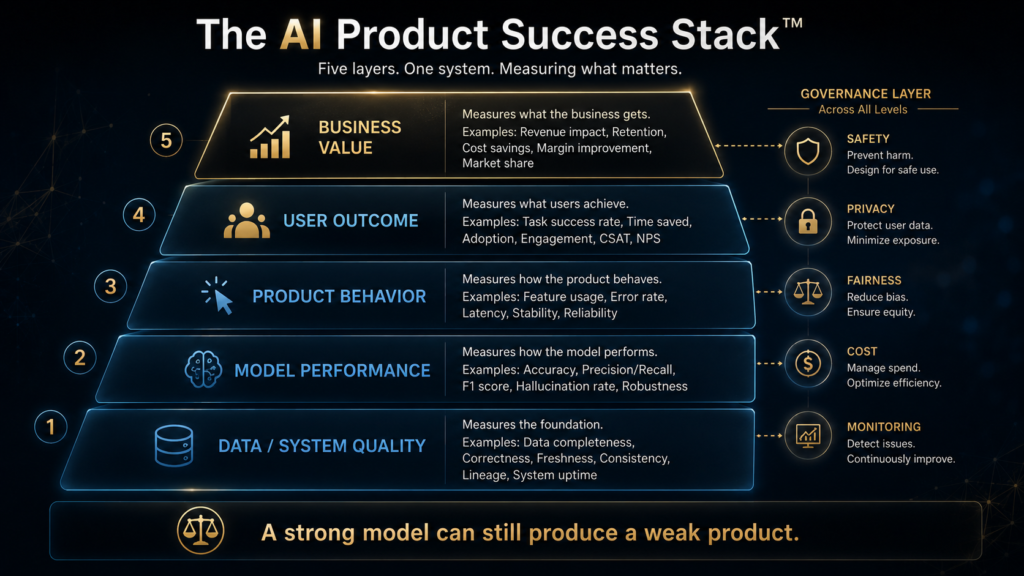
The AI Hustle World AI Product Success Stack shows how success builds in layers. A weakness at any layer limits everything above it.
| Layer | Question it answers | Typical failure |
|---|---|---|
| 1. Data quality | Is the underlying data accurate, current and permitted? | Stale or biased data |
| 2. Model performance | Does the model do the task well in testing? | Good benchmark, poor fit to the real task |
| 3. Product behavior | Does the feature behave well for real users? | Confusing output, no fallback |
| 4. User outcomes | Do users achieve what they came to do? | Usage without benefit |
| 5. Business value | Does it improve retention, revenue or cost? | Activity with no measurable return |
Teams often stop at layer two. A model that scores well in testing is treated as a successful feature, when the questions that matter are in layers four and five.
Use the stack as a review checklist. For any AI feature, ask what evidence you have at each layer, and treat a missing layer as a risk to investigate before scaling.
Experimentation: More Tests, Same Rigor
AI makes experiments cheaper to design, run and analyze. A team can draft test variants, write the analysis plan and summarize results in a fraction of the time.
Cheaper experiments tempt teams to run many and report the ones that worked. That habit produces false confidence, because some tests will show a positive result by chance.
The discipline is the same as before. Write the hypothesis and the success measure first, decide how long the test will run and set guardrail metrics that must not get worse.
AI is a good assistant for the analysis and a poor judge of the conclusion. It can find patterns in results quickly, and a person should decide whether a pattern is strong enough to act on.
Launch Is the Start of an Operating Loop
Launching an AI-powered product is the beginning of an operating loop, where conventional software often treats launch as the end. Behavior can drift as inputs, data and models change.
AWS guidance describes continuous improvement as a stage in its own right, with monitoring, feedback loops and ongoing evaluation after deployment. The work continues for as long as the feature exists.
That changes what a launch plan must contain. It needs a way to measure quality in production, a route for users to report bad output and a decision about who responds.
It also needs a rollback plan. If quality falls after a model update or a data change, the team should be able to limit or switch off the feature quickly.
Post-Launch: Product Management Becomes More Continuous
AI increases the value of continuous monitoring, because it can surface patterns and anomalies far more often than a monthly review. Consider a feature that summarizes customer support conversations.
After launch, the product manager can track how often agents edit the summaries, which kinds of conversation produce poor results and whether handling time is falling. Each signal points to a specific improvement.
AI helps analyze those signals as well as produce them. Usage data, tickets and feedback can be combined, as our guide on AI product data analysis explains.
The effect compounds over time. Better information early in the lifecycle improves later decisions, and post-launch learning feeds the next round of discovery.
The AI Product Value Loop
The stages connect into a loop that AI Hustle World calls the AI Product Value Loop. It runs from customer problem to AI-assisted discovery, human product judgment, rapid prototype or build, continuous evaluation, real-world outcome and learning.
Two points in the loop are easy to skip. Human judgment sits between discovery and building, and evaluation sits between building and outcome.
Skipping the first produces features nobody chose. Skipping the second produces features nobody measured, and both are common when tools make building feel effortless.
The loop is also a way to explain AI product work to stakeholders. It shows that speed is useful only when it carries a team around the whole circle, back to learning.
Managing AI-Powered Products Is a Different Job
Using AI in your own work and managing a product that contains AI are different skills. A team can be excellent at the first and inexperienced at the second.
AI features are probabilistic. The same request can produce different answers, and some answers will be wrong in a confident tone, as our guide to AI hallucinations explains.
That means requirements have to describe behavior under uncertainty. What should the feature do when it lacks information, when the input is ambiguous or when the user asks for something outside its scope?
Fallbacks and human review points are part of the product, not an afterthought. Our guide to human-in-the-loop AI shows how to decide where a person must stay involved.
The Economics of AI Features
AI features have a cost structure that traditional features lack. Most traditional software costs almost nothing to run for one more user, while an AI feature incurs a cost every time it is used.
That cost depends on how much text or data the feature processes. Our explainer on AI tokens covers how usage is measured and why long inputs cost more.
Product managers therefore need a view of unit economics early. As an illustration, a feature that costs two cents per use and is used fifty times a month by each customer costs a dollar per customer per month.
That is trivial on a $50 plan and significant on a $5 plan. Pricing, usage limits and the choice of model all become product decisions, and they are far easier to make before launch than after.
Pricing and Packaging AI Features
Because AI features cost money each time they run, packaging them is a product decision with financial consequences. There are three common approaches.
Including the feature in an existing plan is simplest and works when usage is light. Selling it as an add-on makes the value explicit, and usage-based pricing ties revenue to cost when usage varies widely between customers.
Whichever approach you choose, set sensible limits. A small number of very heavy users can consume a large share of the cost, and a fair-use limit protects the margin without affecting most customers.
Explain the value in terms of the outcome. Customers pay for time saved or errors avoided, and “AI-powered” alone is a weak reason to pay more.
Build, Buy or Call a Model API
Teams adding AI to a product face a choice about the model layer. They can call a hosted model through an API, adapt a model to their own data or run an open model themselves.
Calling an API is the fastest route and suits most first features. Adapting a model, covered in our comparison of RAG and fine-tuning, makes sense when general models do not know your domain.
Running a model yourself gives the most control over data and cost at scale, and it adds operational work. Our guide to AI model hosting and inference platforms compares the options.
The product manager does not make this choice alone. The role is to state the requirements clearly: quality needed, response time, cost per use, data sensitivity and how quickly the feature must ship.
Faster Is Not the Same as Better
AI can make product teams faster without making them better. The Atlassian finding quoted earlier captures the gap: widespread speed gains, and very little confidence in organization-wide return.
One cause is what we call output inflation. AI can produce more documents, prototypes and analyses than a team can meaningfully evaluate, and volume starts to look like progress.
A team that writes ten specifications where it once wrote three has not improved unless the decisions behind them improved. The same applies to prototypes, experiments and dashboards.
The useful question in any review is what the team learned and what it decided. If the answer is unclear, the extra output was activity.
The New Bottleneck Is Judgment
When execution becomes cheaper, product judgment becomes the scarce resource. This is the central argument of this guide.
Before AI, the constraint was the capacity to produce: research took weeks, specifications took days and prototypes needed a designer and an engineer. Many weak ideas died simply because nobody had time to pursue them.
With AI, weak ideas no longer die for lack of capacity. They get specified, prototyped and sometimes built, which is the “wrong thing faster” problem.
The remedy is a higher bar for what enters the pipeline. Clear outcomes, explicit evidence and a habit of saying no matter more when building is cheap than when it was expensive.
Accountability Does Not Transfer to the Model
AI can generate recommendations, and accountability for consequential product choices stays with the people and the organization. An AI-generated roadmap is a suggestion.
If the ranking was built on incomplete data or a flawed assumption, the model will not explain that to customers or to the board. The product leader who approved it will.
This matters most where decisions affect customers directly, such as pricing, eligibility, safety and privacy. In those areas, “the AI recommended it” is not an acceptable reason.
A simple rule protects teams. Every significant decision needs a named owner and a short record of the evidence behind it, whether or not AI helped produce the analysis.
Governance Moves Inside the Lifecycle
AI product teams increasingly treat governance, safety, privacy and compliance as design inputs. Leaving them to a final launch check produces late surprises and rushed fixes.
McKinsey describes risk, compliance and quality work moving earlier and running in parallel with development. Frameworks such as the NIST AI Risk Management Framework give teams a shared structure for identifying and managing those risks.
In practice, this means asking a few questions at the definition stage. What data does the feature use, what could go wrong, who is affected and what control reduces the harm?
Our guides to AI governance and building an AI risk management framework show how smaller teams can do this without a large compliance function. A short risk note attached to each specification is often enough to start.
Customer Trust and Transparency in AI Features
Users treat AI features differently from ordinary ones. They want to know when AI is involved, what it used and how far to rely on it.
Simple design choices build that trust. Label AI-generated content, show the sources behind a summary or answer, and make it easy to correct or dismiss a result.
Give users a way to report bad output. A thumbs-down with an optional comment costs little to build and produces the most valuable evaluation data you will get.
Be clear about data as well. Tell customers whether their content is used to improve models, and offer a choice where you can, as our explainer on AI data retention discusses.
Communicating AI Product Decisions to Stakeholders
AI makes it easy to produce an impressive demo, and demos can drive decisions that evidence would not support. Product leaders need to present AI work in a way that keeps the evidence in view.
For each proposal, state the problem, the evidence that it matters, the hypothesis being tested and the result that would stop the work. That structure makes a prototype a question instead of a promise.
Report uncertainty plainly. Stakeholders can handle “we expect this to work for most enterprise accounts and do not yet know about smaller ones” far better than a confident claim that later fails.
Share costs alongside benefits. Run costs, review effort and risk controls belong in the same slide as the projected gain, so the decision reflects the whole picture.
A Worked Example: Adding an AI Summary Feature
A worked example shows the lifecycle in motion. A B2B support platform is considering a feature that summarizes long ticket threads for agents.
In discovery, the product manager uses AI to analyze six months of feedback and finds that agents on enterprise accounts spend the most time reading history. The problem is real and concentrated in one segment.
In definition, AI drafts the requirements, and the team adds what it missed: summaries must cite the messages they draw on, and the feature must say when a thread is too short to summarize. Both additions come from support leads who have seen summaries mislead new agents.
A prototype is built in two days and tested with ten agents, with a written hypothesis that reading time will fall by a third. The evaluation set contains 200 real threads with summaries rated by senior agents.
After launch, the team tracks edit rates and handling time. Edits are high for threads involving refunds, so those are routed to a stricter prompt and reviewed weekly, and the cost per summary is checked against the plan price.
What Changes in a Product Manager’s Week
The balance of a product manager’s time shifts. Less goes to producing documents and chasing inputs, and more goes to deciding, evaluating and aligning.
A typical week might once have included two days of writing and formatting. With AI drafting, that falls to a few hours, mostly spent correcting assumptions and sharpening intent.
The time released should move to customer contact, evaluation design and decisions about trade-offs. Those are the activities where human judgment adds the most.
The risk is that the released time fills with more output instead. A product manager who uses AI to write five times as many documents has changed the volume of work and left its value where it was.
Skills the AI-Era Product Manager Needs
Several skills grow in importance. Problem framing comes first, because AI answers the question it is given, and a poorly framed question produces confident work on the wrong problem.
Evaluation literacy comes second. Product managers need to design test sets, read quality metrics and understand what a model’s failures mean for users.
Data fluency and basic technical understanding follow. Knowing how the feature uses data, what it costs to run and how it can fail makes for far better conversations with engineering.
Judgment and communication remain the core. Deciding what not to build, and explaining why, is the part of the role that tools do not replace.
How Teams and Roles Shift
The change is not limited to product managers. Designers spend less time producing variations and more time setting direction and judging quality.
Engineers move toward review, architecture and reliability, as more code is generated and less is typed. Researchers shift from running every study to setting evidence standards and checking AI-generated synthesis.
Data and analytics teams become more central. Evaluation, monitoring and cost tracking all depend on clean data and clear definitions.
The boundaries between roles blur, and that needs agreement. Teams work better when they state plainly who owns intent, experience, technical behavior and quality.
Common AI Product Management Failure Modes
The same failures appear in team after team. Watch for these:
- adding AI because the market expects it, with no clear user problem
- confusing faster output with better decisions
- falling for the Prototype Illusion
- treating AI recommendations as strategy
- shipping without an evaluation set
- ignoring behavior in production after launch
- measuring model quality instead of user and business outcomes
- leaving product data fragmented across systems
- using sensitive data carelessly
- assuming AI reduces accountability
Most of these share one root. The team optimized for what AI makes easy, which is producing things, and neglected what AI makes more important, which is deciding and checking.
How Product Teams Should Adopt AI
The strongest adoption model starts with specific bottlenecks instead of a blanket instruction to “use AI.” Map where the team currently loses time or information.
Look for slow research synthesis, repeated documentation, long waits between teams and feedback that sits unread. Those are the places where AI pays first.
Choose a small number of use cases and measure them. If feedback sits across six disconnected systems, fix that before anything else, because every later stage depends on it.
Tools come last. Our comparison of the best AI product management tools is a useful shortlist once you know which bottleneck you are solving.
A 90-Day Adoption Plan
In days 1 to 30, map the lifecycle. Record where time goes at each stage, where handoffs lose context and which decisions lack evidence, and choose two bottlenecks to address.
In days 31 to 60, automate low-risk friction. Use AI for research synthesis, first drafts of documents and meeting summaries, with a person reviewing every output, and track time saved and corrections needed.
In days 61 to 90, connect AI to decisions. Introduce an evaluation habit for any AI feature, write hypotheses before prototypes and start measuring Learning Velocity.
At the end of the quarter, review what changed. Keep what improved decisions, drop what only increased output, and choose the next two bottlenecks.
Measuring AI Product Management: Learning Velocity
Output measures such as documents written or prototypes built reward the wrong behavior. AI Hustle World recommends Learning Velocity: the number of meaningful product uncertainties resolved per unit of time.
An uncertainty is resolved when the team can state what it believed, what evidence it gathered and what it decided as a result. “Customers want faster exports” becoming “enterprise admins need scheduled exports, confirmed in twelve interviews” counts.
| Measure | What it shows |
|---|---|
| Learning Velocity | How fast the team reduces uncertainty |
| Decision lead time | Time from question to decision |
| Rework rate | How often shipped work is redone |
| Evaluation coverage | Share of AI features with a test set |
| Outcome impact | Change in the user or business metric the work targeted |
Tracked together, these measures show whether AI is improving product work or only accelerating it. A rising output with flat Learning Velocity is the warning sign.
Choosing AI Product Tools With the W.O.R.T.H. checklist
When you compare tools, AI Hustle World uses its site-wide W.O.R.T.H. checklist. It keeps attention on fit and total cost instead of feature lists.
Workflow fit (25 points) covers how well the tool connects to your research, planning and delivery systems. Output quality (25) covers the accuracy and usefulness of what it produces on your own material.
Risk and rights (15) covers data handling, permissions and ownership of outputs. Total cost (20) covers licenses, usage charges and setup, and Human effort (15) covers the time needed to review and correct results.
Score each candidate on real work from the last month. A tool that looks impressive in a demo and needs heavy correction on your own data will score poorly where it counts.
Who Should Use AI Heavily, and Who Should Be Cautious
If your team handles large volumes of customer feedback, ships frequently and has clean data, heavy use of AI will pay off quickly. The same is true if documentation and research synthesis are your main bottlenecks.
Start with discovery and definition, where the time savings are largest and the risks are easiest to control. Add evaluation discipline before you add AI features to the product itself.
If you work in a regulated field, handle sensitive data or build safety-critical features, move more carefully. AI can still support research and drafting, with stricter review and clear limits on what data it sees.
If your team has no agreed outcomes or decision process, fix that first. AI will speed up whatever process you have, and a faster version of an unclear process produces confusion sooner.
What Happens If You Do Nothing
Teams that ignore AI will not collapse, and they will fall behind in specific ways. Research will stay periodic while competitors watch customer signals weekly.
Documentation and coordination will keep consuming days that others have recovered. Over a year, that difference compounds into more experiments run and more lessons learned.
There is also a hiring effect. Product people increasingly expect to work with these tools, and a team that forbids them will find it harder to attract strong candidates.
Doing nothing is still better than adopting badly. A team that floods itself with AI-generated output and no judgment can end up slower than one that never started.
The AI Hustle World View
The common claim is that AI makes product teams faster, and in many workflows that is true. The evidence from Atlassian shows the catch: speed has risen much faster than measurable value.
Our view is that AI lowers the cost of producing product artifacts, which makes judgment, evaluation and accountability more valuable. A product manager who can generate 100 ideas is not more useful than one who can identify the three worth exploring.
We would begin any adoption by finding the main bottleneck. If feedback is scattered, fix that; if engineers and product managers lose days translating requirements, fix that.
The AI-era product manager should spend less time producing artifacts and more time reducing uncertainty. That is the standard we would hold any tool or process to.
Where Product Management Is Heading
Product organizations will likely operate less like linear pipelines and more like continuous learning systems. Signals will flow in from customers, usage, support and the market, and AI will keep them organized.
The product manager’s role moves toward orchestration. The job becomes designing the system that turns signals into decisions, more than personally producing each document.
Agents will take on connected tasks, such as drafting a specification, creating tickets and preparing an experiment. That raises the importance of clear intent, limits and review points.
The direction is consistent with everything above. As more of the production work is automated, the value of product management concentrates in choosing problems, setting standards and owning outcomes.
How We Researched This Guide
This guide was researched and drafted with AI assistance and checked against the primary sources linked in the article. The adoption and return figures come from Atlassian’s State of Teams 2026.
Descriptions of lifecycle changes draw on McKinsey’s analysis of the AI-enabled product development life cycle, AWS prescriptive guidance and Atlassian’s writing on product craft. Design guidance references Google’s People + AI Guidebook and the NIST AI Risk Management Framework.
We did not test any product management tool hands-on, and no benchmark is claimed. The AI Product Success Stack, the Prototype Illusion, the AI Product Value Loop, Learning Velocity, the worked example and the cost illustration are AI Hustle World analysis.
Last updated October 2026. This version restructures the guide into shorter sections, adds the economics, worked example, skills and team sections, and removes one research reference we could not open to verify.
Final Thoughts: The Scarce Skill Moves Upward
AI is making research, documentation, prototyping, development and analysis faster. It would be easy to conclude that product management is simply becoming more productive.
That is true and incomplete. When AI makes artifacts cheap, artifacts become less valuable, and when it makes building cheap, building the wrong thing becomes easier.
The scarce skill therefore moves upward, from producing product work to deciding which work deserves to exist. If AI lets a team write ten specifications instead of three, that is interesting, and if it lets the team test five hypotheses instead of one, that is valuable.
AI does not remove product management. It shifts the center of the role toward judgment, evaluation and accountability, and the teams that recognize that shift will build better products.
Build Better Products With AI—Not Just Faster Ones
AI can compress product research, documentation, prototyping, development and analysis. But faster output does not automatically create better products.
Explore AI Customer Feedback Analysis →FAQ
What is AI product management?
It is the use of AI to support product work across discovery, definition, prioritization, design, development and learning. It also means managing products that contain AI features.
How is AI changing the product lifecycle?
It shortens the gaps between research, prototyping, building and evaluation, so the lifecycle behaves more like a continuous loop than a sequence of handoffs.
Will AI replace product managers?
No. AI takes over much of the production work, such as drafting and synthesis. Choosing problems, setting priorities and owning outcomes remain human responsibilities.
What can AI do in product discovery?
It can synthesize interviews, tickets and survey comments, detect patterns and track trends continuously. People still decide which patterns matter strategically.
What is the Prototype Illusion?
The belief that a quickly built, polished prototype proves an idea is worth building. A prototype shows something can be demonstrated, not that customers need it.
How should teams evaluate AI features?
Build a test set of realistic inputs with a definition of good output, run it before launch and after every change, and monitor quality in production.
What is Learning Velocity?
A measure of how quickly a team resolves meaningful product uncertainties with evidence. It rewards decisions and learning instead of documents and prototypes produced.
Does AI make product teams better or just faster?
Often just faster. Atlassian found 89% of executives report speed gains, while only 6% are sure of clear organization-wide return on investment.
What skills do product managers need in the AI era?
Problem framing, evaluation literacy, data fluency, basic technical understanding and strong judgment about what not to build.
Where should a product team start with AI?
Start with one or two real bottlenecks, usually research synthesis or documentation. Measure the result, then add evaluation habits before building AI features.
Related Guides
- RAG vs Fine-Tuning: Which Approach Should You Use?
- AI Contract Management vs Traditional CLM: Where AI Adds Real Value
- How to Build an AI Risk Management Framework for Small and Mid-Sized Businesses
Written by
Muntasir Ahmad Chowdhury
Founder, AI Hustle World
Muntasir Ahmad Chowdhury is the Founder of AI Hustle World, an independent publication dedicated to making Artificial Intelligence practical, trustworthy, and easy to understand. He researches AI tools, automation, customer service, productivity, and real-world business applications, helping readers make smarter technology decisions through research-driven, experience-backed content.
Expertise:
AI Tools • AI Automation • AI Customer Service • AI Productivity • Generative AI • AI Workflows
Get Smarter With AI
Enjoyed this guide? Get practical AI tools, tutorials, and honest reviews delivered to your inbox.