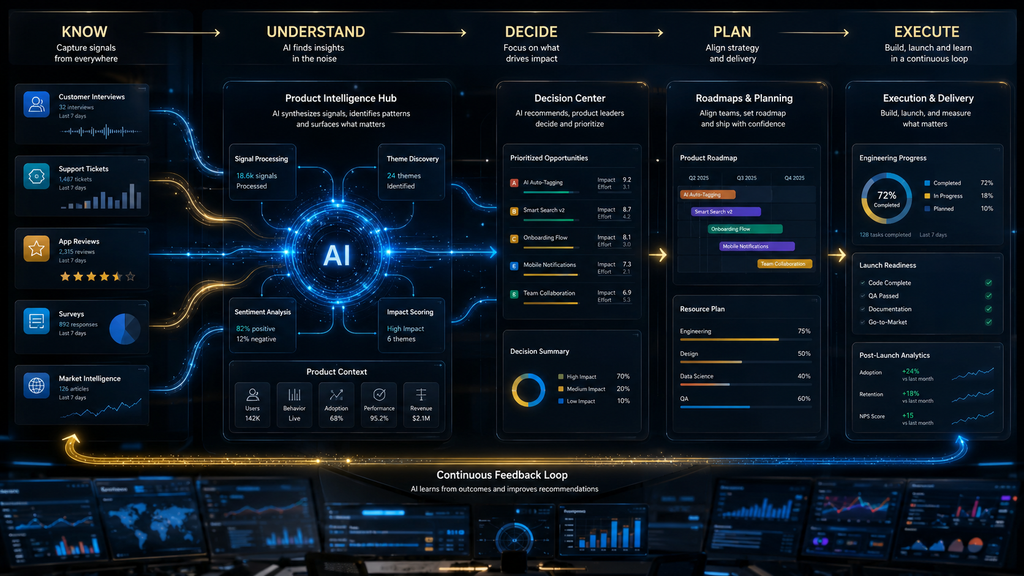
Evidence: Documentation reviewed
Last checked: August 2026
What was done: Written from official documentation and the published sources linked in this article. Not hands-on tested.
Files: None
Affiliate links: No
Last Updated: August 2026 — reviewed current AI capabilities, pricing structures, workflow coverage and product-management use cases.
AI has changed product management, but not in the way the first wave of software marketing suggested. The obvious story was that AI would give every product manager a faster way to write PRDs, summarize meetings and brainstorm features. Those capabilities are useful, but they are no longer particularly differentiated. By 2026, almost every serious product-management platform has some form of AI assistance, and general-purpose models can already draft, summarize, analyze and rewrite almost anything a PM puts in front of them.
The harder problem appears before and after the prompt. A platform must help the team assemble reliable context before generation and preserve that context as the output moves into prioritization, delivery and measurement.
Customer feedback arrives through support tickets, interviews, sales calls, surveys, reviews and in-app requests. Product analytics sits in another system. Competitive research lives in documents and browser tabs. Roadmaps live somewhere else. Engineering has its own backlog. Stakeholders want updates. Then, after something ships, the team has to figure out whether the decision actually worked.
This is why the current AI product-management market is becoming less about “which tool has AI?” and more about which tool can connect intelligence to an actual product workflow. Current 2026 coverage reflects that shift: Uxcel describes AI as essentially table stakes across the category, while Pendo argues that evaluating AI merely as a feature is becoming less useful as intelligence becomes embedded directly into product platforms.
The best AI product management tool is not the one with the most AI features; it is the one that improves an important recurring product decision without creating more complexity than it removes. That is the standard used in this guide.
Instead of pretending there is one universally superior platform, we will look at where each tool fits: customer research, feedback intelligence, product discovery, prioritization, roadmapping, analytics, product knowledge and product-engineering execution. We will also look at AI depth, context, integrations, governance, pricing mechanics and the situations where not buying another tool is actually the smarter decision.
What Makes an AI Product Management Tool Actually Useful?
An AI product management tool is useful when its intelligence is connected to a recurring product-management job and produces a measurable improvement in decision quality, speed, evidence or operational consistency. That definition is deliberately stricter than “has an AI assistant.”
Consider a basic AI writing feature. A PM gives the system five bullet points and receives a polished PRD. That saves time, but the PM still has to validate the requirements, find the customer evidence, check the competitive context, determine whether the idea fits the roadmap and move the final specification into the system engineering uses.
Now consider a platform that can analyze customer feedback, identify recurring themes, connect those themes to product opportunities, incorporate product context, help structure a prioritization decision and keep the resulting decision connected to a roadmap. The AI is no longer merely generating text. It is participating in the workflow.
That distinction explains why the most interesting 2026 developments are increasingly about context, agents, integrations and connected systems. Productboard describes its current Spark product as an agentic product system built around real product data, while Linear has expanded its AI and MCP capabilities so agents can work with initiatives, milestones, updates and external context. Notion is similarly moving beyond document-level assistance toward agents that can execute recurring work across a company’s connected knowledge.
The implication is important for buyers: AI capability should never be evaluated separately from the system surrounding it. A relatively simple AI capability inside the right workflow can create more value than a sophisticated agent trapped inside an isolated application.
The Traditional Product Management Stack Was Built Around Separate Jobs
Traditional product-management software is fragmented for a legitimate reason: different stages of the product lifecycle require different data, controls and working methods. Product analytics platforms process behavioral events, research repositories organize qualitative evidence, roadmap systems structure priorities, and engineering platforms manage technical execution. Combining those jobs inside one interface does not automatically produce a better operating system.
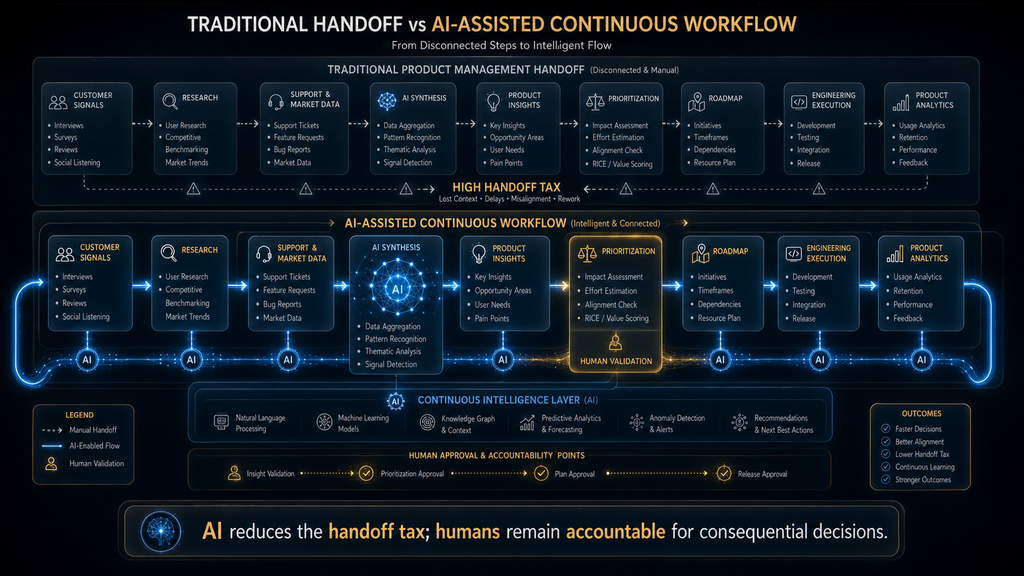
The real cost appears in the handoffs between those systems. A product manager may summarize interviews in one workspace, convert recurring themes into roadmap candidates elsewhere, translate approved work into engineering tickets and later search a separate analytics platform for evidence that the decision produced the intended result. The tools may function correctly while the product manager becomes the human integration layer responsible for preserving context.
That model becomes increasingly expensive as customer signals, product events and stakeholder requests multiply. AI creates value when it reduces this coordination burden by connecting evidence, decisions and execution—not merely when it generates another summary. The buying question is therefore not whether a platform contains AI, but whether it shortens a recurring workflow without weakening traceability or control.
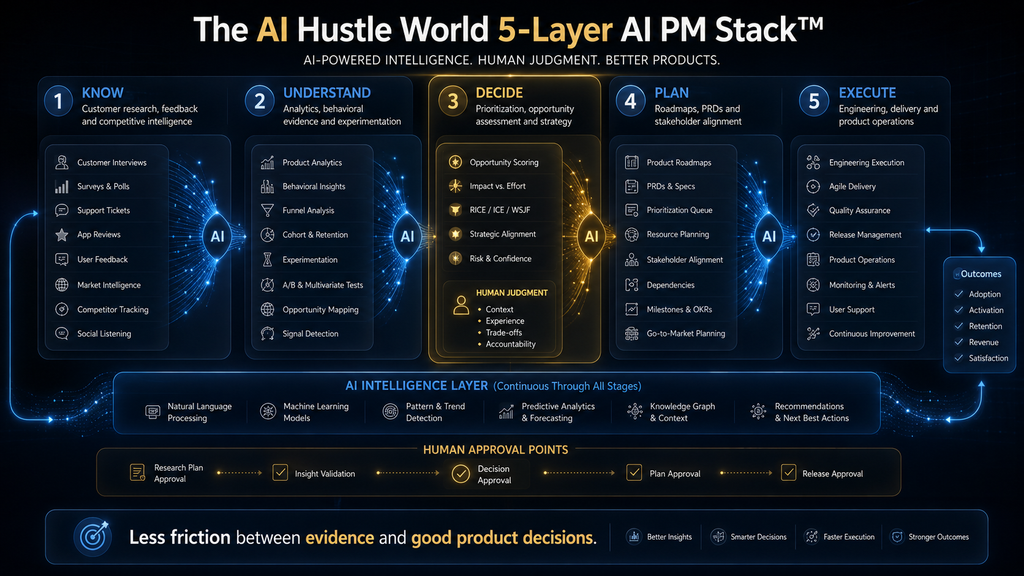
The AI Hustle World 5-Layer AI PM Stack
The modern AI product-management stack can be understood as five connected layers: KNOW, UNDERSTAND, DECIDE, PLAN and EXECUTE. Each layer owns a different kind of context, and the value of an AI tool depends partly on whether it can preserve that context as work moves forward.
1. KNOW
The KNOW layer collects customer, market and competitive intelligence. Its inputs include interviews, support tickets, reviews, sales calls, surveys, competitor releases and product requests, giving the team an evidence base before prioritization begins.
2. UNDERSTAND
The UNDERSTAND layer turns behavior into evidence through analytics, funnels, retention, session analysis, experimentation and segmentation. It helps product teams test whether the patterns found in qualitative feedback also appear in observed product usage.
3. DECIDE
The DECIDE layer evaluates opportunities, weighs trade-offs and determines what deserves investment. Human judgment is especially important here because software can organize evidence and apply criteria, but leadership still owns the values and strategic choices behind those criteria.
4. PLAN
The PLAN layer converts an approved decision into a roadmap, product requirement, initiative, milestone or stakeholder commitment. A useful AI system should carry the supporting evidence and decision rationale into that plan rather than producing a disconnected document.
5. EXECUTE
The EXECUTE layer brings product, engineering, design and operations together to ship the work and measure what happened afterward. Although this stage may include AI-assisted PRDs and product specifications, no platform needs to own every layer to be valuable; the more important question is whether information can move between systems without losing meaning.
Dovetail can be highly valuable in KNOW without becoming a roadmap system, while Amplitude can dominate UNDERSTAND without replacing prioritization. Linear can be strong in EXECUTE while another platform owns discovery, and Productboard can connect several layers for teams that organize decisions around customer evidence. The useful buying question is therefore not “Which tool covers everything?” but “Which layer is creating the most expensive bottleneck?”
How We Evaluated the Tools
The most useful AI PM comparison evaluates workflow fit, AI depth, context, evidence, integration, governance and economics together rather than producing a universal numerical ranking. A 90/100 tool is not automatically better than an 84/100 tool.
If your entire engineering organization runs on Jira, the ecosystem fit of Jira Product Discovery may matter more than a competitor’s broader AI feature set. If your organization has thousands of customer interviews but a perfectly functional roadmap process, Dovetail may create more value than another roadmap platform.
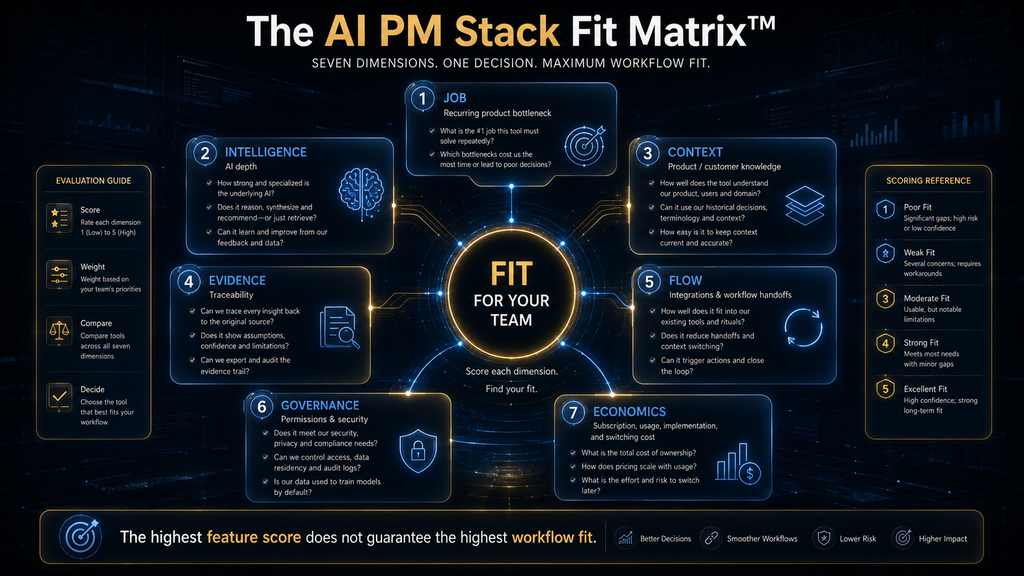
We therefore use the AI PM Stack Fit Matrix. Its purpose is to show why a platform fits a particular operating environment rather than assign an artificial universal score.
| Dimension | What we ask |
|---|---|
| JOB | What recurring PM problem does the tool solve? |
| INTELLIGENCE | How deeply is AI integrated into the workflow? |
| CONTEXT | How much relevant product/customer context can AI access? |
| EVIDENCE | Can important insights be traced back to their sources? |
| FLOW | Does the output connect naturally to the next workflow stage? |
| GOVERNANCE | Can the organization control access, permissions and AI usage? |
| ECONOMICS | What does the system really cost at your expected scale? |
This structure prevents one of the most common mistakes in AI software buying: confusing a large feature count with meaningful business value. A capability matters only when it improves an important job and fits the systems, controls and economics surrounding that job.
How We Evaluated the Tools
AI Hustle World developed this comparison as a structured desk-research synthesis, not as a standardized hands-on benchmark. The evidence base consists of the official product pages, documentation, pricing pages, release notes, integration documentation and governance or security materials linked throughout the article. Vendor sources establish what a platform documents or offers, but they do not independently prove adoption, reliability, output quality or return on investment in every organization.
Each platform was mapped first to the product-management bottleneck it is designed to address and then reviewed across seven dimensions: JOB, INTELLIGENCE, CONTEXT, EVIDENCE, FLOW, GOVERNANCE and ECONOMICS. The 5-Layer AI PM Stack identifies where a platform operates—KNOW, UNDERSTAND, DECIDE, PLAN or EXECUTE—while the AI PM Stack Fit Matrix examines whether it can move reliable context into the next workflow stage without creating more operational cost than it removes.
AI Hustle World’s original contribution is the combination of these two decision models. Instead of producing a universal leaderboard, the methodology creates a repeatable selection process: identify the bottleneck, locate the existing source of truth, evaluate workflow fit, examine the evidence trail and then consider governance and total cost.
No controlled benchmark was conducted across all ten platforms. Descriptions such as “strongest for customer research” or “strongest for product-engineering flow” are therefore editorial fit assessments based on documented capabilities, workflow coverage and stated limitations—not measured performance rankings. Product features, pricing and usage limits can change, so readers should confirm consequential details through the linked vendor documentation before purchasing.
The Best AI Product Management Tools by Workflow
1. Productboard — Strongest for Customer-Driven Product Decisions
Productboard is particularly strong when a team needs to turn large volumes of customer signals into structured product opportunities, prioritization decisions and roadmaps. Productboard has made one of the more aggressive moves in the category toward an agentic product-management model. In June 2026, the company described Spark as an agentic product system designed to surface customer opportunities, create delivery-ready specifications and work from real product data. It also describes specialized agents for jobs such as voice-of-customer analysis, market research and codebase understanding.
That positioning is important because Productboard is attempting to reduce the distance between customer evidence and product action. A feedback-heavy organization is a natural fit. Imagine a SaaS company receiving hundreds of support requests, sales objections and customer interviews every week. The challenge isn’t collecting those signals; it is determining which signals represent recurring problems, which customer segments are affected and which problems are strategically worth solving.
Productboard’s AI capabilities are designed around this type of workflow. Its Spark customer-feedback use case describes automated theme detection and connections between insights, features and roadmaps.
The platform is also moving toward codebase-grounded product work. Productboard says Spark can connect to a GitHub repository so specifications can be grounded in the actual architecture and constraints of a product. It also describes integrations that can push specifications toward tools such as Claude Code, Codex and Cursor.
That is a meaningful step beyond “write me a PRD.” Where Productboard fits best: Productboard is strongest for organizations where customer evidence is the raw material for product strategy. It makes particular sense when feedback is coming from many channels and the team wants to connect those signals to prioritization and roadmap decisions.
Where it is weaker: A small startup with only a handful of customer conversations and a simple backlog may not need this level of product intelligence. There is also an economic consideration: Productboard’s AI usage is not simply an unlimited feature bundled into the subscription. Current public pricing includes AI credits that vary by plan, so buyers should evaluate expected AI usage rather than comparing only the headline maker price.
Best fit: Feedback-heavy, customer-driven product organizations. Reality check: Productboard is most compelling when the problem is signal overload. If your real problem is engineering execution, buying Productboard may add another layer instead of removing one.
2. Jira Product Discovery — Strongest for Atlassian-Native Product Discovery
Jira Product Discovery is particularly strong for organizations that already use Jira and Confluence and want discovery, prioritization and delivery to remain inside the Atlassian ecosystem. Its biggest advantage is not necessarily a single AI capability.
It is ecosystem gravity. Jira Product Discovery allows product teams to capture ideas, organize them, connect them to goals and link them directly to Jira work. Atlassian also includes integrations with Jira, Jira Service Management and Confluence.
That creates an important economic advantage. If engineering already lives in Jira, moving product discovery into an entirely separate platform introduces migration, training and integration costs. Jira Product Discovery can instead become the discovery layer that feeds the existing delivery system.
Atlassian’s AI capabilities are also becoming more context-aware. Rovo AI uses Atlassian’s Teamwork Graph along with language models and OpenAI technology to produce organization-specific results, although Atlassian explicitly warns that AI quality, accuracy and reliability can vary. AI features in Jira Product Discovery require the Premium plan and administrator activation.
That caveat matters. A vendor’s AI capability should not be treated as an autonomous decision-maker. It is an assistant operating on organizational context.
Current pricing: Atlassian publishes four Jira Product Discovery tiers. Compare the creator limits and Premium-only AI requirements with the number of people who will actually manage product discovery:
- Free: up to 3 creators
- Standard: $10 per creator/month
- Premium: $25 per creator/month
- Enterprise: custom pricing
The free tier includes 3 creators, while Premium adds capabilities intended for organizations operating across multiple product teams. Best fit: Teams already deeply invested in Jira, Confluence and the wider Atlassian ecosystem.
Reality check: If your company does not use Atlassian heavily, the ecosystem advantage becomes less compelling. The product should then be compared on discovery quality and operating fit rather than the convenience of staying inside Jira.
3. Linear — Strongest for Product-Engineering Flow
Linear is strongest when product management and engineering execution need to operate as one fast-moving system. Linear is an important example of why the category boundaries are becoming blurry.
It is not primarily a traditional “AI product-management platform.” Its strength is product development and execution, but AI is becoming deeply embedded into that workflow.
Linear expanded its MCP server in February 2026 so external tools can create and edit initiatives, updates and milestones. In May, it introduced Code Intelligence, allowing Linear Agent to reason about a connected codebase alongside issues, projects and documentation. By June, Linear Agent could initiate coding sessions using Claude Code and Codex, closing more of the gap between product planning and implementation.
That creates a very different value proposition. Instead of: PM writes spec → engineer interprets spec → engineer investigates code → implementation begins the system can increasingly provide an AI layer that understands both the product context and technical context.
This does not eliminate engineering judgment. It reduces some of the context-reconstruction work. Where Linear fits best: Linear is particularly compelling for software organizations where product and engineering collaborate closely and speed matters. A PM can manage initiatives, projects and product context while engineering remains inside the same system.
Where it is weaker: If your biggest bottleneck is qualitative customer research, Linear is not a substitute for Dovetail. If your biggest bottleneck is customer-feedback aggregation, Productboard or Canny may be more directly useful.
Best fit: Fast-moving software companies with strong product-engineering collaboration. Reality check: Linear’s AI is increasingly sophisticated, but the value still depends on the quality of the context available to it. Its Code Intelligence, for example, requires controlled access to selected repositories and is currently positioned as a public beta for Business and Enterprise plans.
4. Aha! — Strongest for Structured Product Strategy and Planning
Aha! is strongest for organizations that need formal product strategy, roadmapping and planning rather than simply a lightweight backlog or execution layer.
Aha!’s AI capabilities span product strategy, research, requirements and planning. Its current AI direction includes an AI research agent designed for deeper product research and AI-assisted product workflows.
That makes Aha! particularly relevant for organizations where the roadmap isn’t simply a list of engineering work. In mature organizations, roadmaps communicate strategic choices.
In mature organizations, a roadmap communicates strategic choices rather than functioning as a decorated backlog. It should help stakeholders answer questions such as:
- Which market are we prioritizing?
- Which customer segment matters most?
- Which strategic outcomes justify investment?
- Which initiatives should be delayed?
- How do multiple product lines fit together?
AI can help synthesize information around those decisions, but it cannot decide the strategy by itself. That’s an important boundary. Best fit: Strategy-heavy product organizations, larger teams and portfolio environments.
Main strength: Structured product strategy and planning. Main limitation: The sophistication that helps mature organizations can become process overhead for a small team.
Reality check: Aha! makes more sense when your organization already has a reasonably mature product-management process. If you are still trying to figure out how your team prioritizes work, buying a more sophisticated planning system may simply formalize an unclear process.
5. Dovetail — Strongest for Customer Research and Qualitative Insight
Dovetail is strongest when the team’s biggest problem is turning qualitative customer evidence into usable product insight. This is a fundamentally different problem from roadmapping.
Imagine a research repository containing interviews, usability sessions, surveys and customer conversations. Historically, a researcher or PM would have to read, tag, summarize and synthesize the material manually.
AI changes the economics of that process. Dovetail positions its AI capabilities around summarizing and analyzing research data, helping teams identify patterns and interact with customer evidence more efficiently. Its product-management positioning also emphasizes connections with platforms such as Jira, Linear and Productboard.
That makes Dovetail valuable as a KNOW layer in the AI Hustle World 5-Layer Stack. It doesn’t need to become your entire product operating system to create substantial value.
A team might use: Dovetail → Productboard → Linear The research platform identifies the signal. The product platform turns it into a decision. The execution platform turns the decision into shipped work.
Best fit: Research-heavy teams, UX organizations, customer-centric SaaS companies and PM teams dealing with large volumes of qualitative data. Main strength: Research synthesis.
Main limitation: Dovetail is not a replacement for product analytics or engineering execution. Reality check: Do not buy Dovetail simply because AI can summarize interviews. The real value appears when the organization actually uses those insights to change product decisions.
6. Amplitude — Strongest for Behavioral Product Intelligence
Amplitude is strongest when product decisions depend on understanding what users actually do inside the product. Customer feedback tells you what people say.
Product analytics tells you what they do. You need both. Suppose customers repeatedly ask for a feature. That sounds like evidence of demand. But analytics may reveal that only a small segment is experiencing the underlying problem, while another workflow is responsible for the majority of the business impact.
That difference can completely change the prioritization decision. Amplitude’s current platform includes AI Agents and MCP capabilities alongside behavioral exploration, analytics and AI Visibility features. Its pricing is event-based, with Free, Plus, Growth and Enterprise tiers. The current pricing page shows AI Agents and MCP included in relevant paid tiers and AI-related prompt allowances that vary by plan.
This is where AI can make analytics more accessible. Instead of requiring a PM to know every query syntax or manually construct every analysis, AI can help bridge the gap between a product question and the underlying data.
But there is a critical distinction: AI can help interpret evidence. It does not automatically make the evidence representative. If your event instrumentation is incomplete, the answer can still be wrong.
Best fit: Product-led companies, growth teams and organizations with mature behavioral analytics. Main strength: Behavioral evidence. Main limitation: Analytics intelligence does not automatically solve product strategy.
7. Mixpanel — Strongest for Accessible Product Analytics
Mixpanel is a strong choice for teams that want product analytics to become part of everyday product decision-making rather than remaining a specialist reporting function. Its core strength remains behavioral analysis around funnels, retention, cohorts and feature usage, while its current AI direction makes natural-language interaction with product data increasingly practical.
The important distinction between Mixpanel and a roadmap platform is simple: Mixpanel can help answer: “What are users actually doing?” A roadmap platform can help answer: “What should we do about it?”
Those questions are related, but they are not identical. Current market research also treats analytics and roadmapping as distinct categories. The AI PM Tools Directory, for example, separates analytics platforms such as Mixpanel and Amplitude from roadmap and discovery platforms such as Jira Product Discovery and Productboard.
That separation is strategically useful. Best fit: SaaS companies, growth teams and PMs who need self-service behavioral analysis. Main strength: Fast product-data interrogation.
Main limitation: Mixpanel should not be mistaken for a complete product strategy platform. It can explain patterns in observed behavior, but people must still interpret their importance and decide what the organization should do next.
8. Notion — Strongest for Product Knowledge and Flexible AI Workflows
Notion is strongest when the product team’s biggest problem is fragmented knowledge rather than a missing specialist workflow. Product management produces enormous amounts of contextual information: PRDs, research notes, decision records, meeting notes, strategy documents, competitive analysis, launch plans and stakeholder updates.
That information becomes more valuable when AI can reason over it. Notion’s current AI platform includes Notion Agent, AI Meeting Notes and Enterprise Search, while Custom Agents can perform recurring work such as answering questions, routing tasks and generating status updates. Notion says Custom Agents follow existing permissions, log runs and allow changes to be reversed.
There is an important economic detail here. Starting May 4, 2026, Custom Agents began using Notion credits, with the current public information showing monthly credits priced at $10 per 1,000 credits. Other AI features such as Notion Agent, AI Meeting Notes and Enterprise Search are included in Business and Enterprise plans.
This is another example of why buyers should look beyond the subscription price. Best fit: Small and mid-sized teams, knowledge-heavy product organizations and teams that want a flexible workspace with AI.
Main strength: Context and organizational knowledge. Main limitation: Flexibility can become chaos. If every PM documents product decisions differently, AI inherits that inconsistency.
9. airfocus — Strongest for Structured Prioritization
airfocus is most relevant when the central product-management problem is prioritization and the team needs explicit frameworks for evaluating opportunities. Prioritization is often treated as a feature of roadmapping software, but it is actually a decision discipline.
Prioritization becomes credible when teams compare opportunities against explicit criteria instead of negotiating from intuition alone. Common inputs include:
- customer impact,
- business value,
- strategic alignment,
- confidence,
- effort,
- risk,
- urgency.
A platform can make that process more consistent. AI can then help summarize evidence or populate parts of the analysis. But there is a fundamental boundary:
No AI tool can decide what your organization should value. If leadership disagrees about whether revenue, retention, strategic differentiation or customer satisfaction should dominate the roadmap, software cannot solve the disagreement.
It can only make the criteria explicit. Best fit: Teams with complex prioritization processes, portfolio management needs or multiple competing product initiatives.
Main strength: Structured prioritization. Main limitation: A better scoring system cannot substitute for strategic clarity. Market note: Current 2026 market coverage also notes that airfocus is now part of Lucid, so buyers should evaluate the current product direction and packaging rather than relying on older standalone airfocus reviews.
10. Canny — Strongest for Focused Feature-Request Management
Canny is strongest when the product team’s immediate problem is organizing customer feature requests rather than managing the entire product lifecycle. That specialization can be an advantage.
A team may not need another enterprise product-management suite. It may simply need a better way to collect requests, identify repeated demand and communicate what is being considered.
Canny fits that narrower job. Its role in the AI PM stack is primarily KNOW → DECIDE, where customer requests become structured product signals. But it should not be treated as an analytics platform or complete product-development system.
Best fit: Feedback-driven teams that need a focused feature-request workflow. Main strength: Customer-request organization. Main limitation: Narrower workflow coverage than an end-to-end product platform.
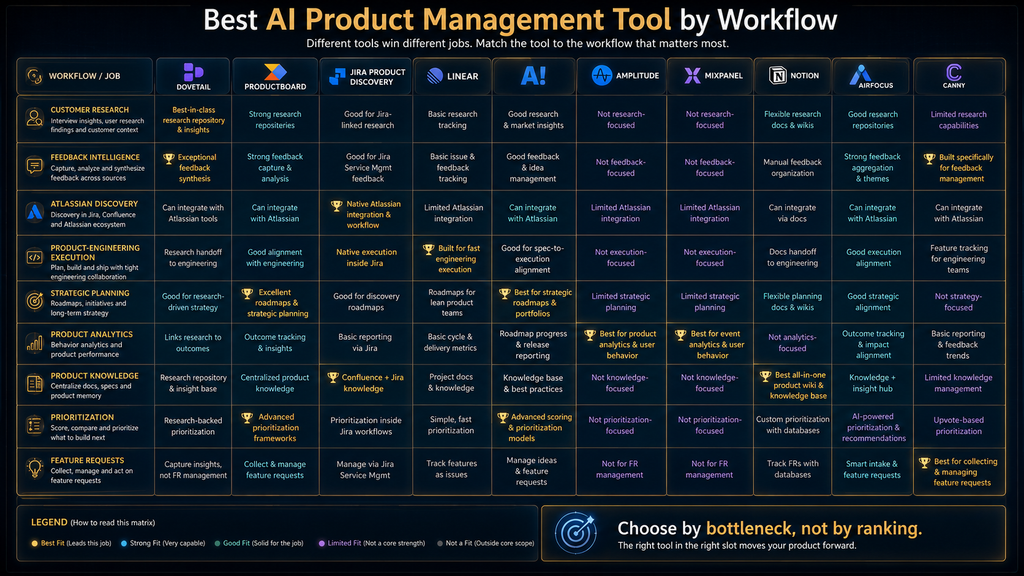
Which Tool Is Best for Which Workflow?
The right answer depends on the bottleneck rather than the breadth of the vendor’s feature list. Use the table as a shortlist generator, then validate integration, governance and cost before committing to a platform.
| Product Team Problem | Strong Starting Point | Primary Reason |
|---|---|---|
| Customer research overload | Dovetail | Qualitative synthesis |
| Feedback-to-roadmap workflow | Productboard | Customer signals + prioritization |
| Atlassian-native discovery | Jira Product Discovery | Jira/Confluence ecosystem |
| Product-engineering coordination | Linear | Execution + AI context |
| Strategic planning | Aha! | Structured product strategy |
| Product analytics | Amplitude / Mixpanel | Behavioral evidence |
| Product knowledge | Notion | Context + flexible AI workflows |
| Prioritization | airfocus | Structured prioritization |
| Feature requests | Canny | Focused feedback management |
Notice what is deliberately missing: #1 overall. That’s not an omission. It’s the point. A universal ranking creates false precision.
Why We Don’t Recommend One “Best” Tool
A product-management platform should be judged by the decision it improves, not by its position on a universal leaderboard. Two comparison sites can assess the same market, use reasonable criteria and still produce different winners because they assign different importance to analytics, qualitative research, roadmapping, integrations, governance and ease of adoption.
A platform that wins on behavioral analytics may be weak at customer-research synthesis. A flexible knowledge workspace may provide excellent context while requiring more governance than a structured roadmap system. Similarly, a sophisticated agent can become operationally expensive if its output must be copied manually into the system where the next stage of work occurs.
AI Hustle World therefore uses a workflow-first recommendation model. The relevant question is not “Which platform has the highest score?” but “Which platform addresses the team’s most expensive bottleneck while fitting its existing data, systems and decision process?” That distinction produces a more defensible shortlist than a single overall ranking.
AI Depth Matters More Than an AI Checkbox
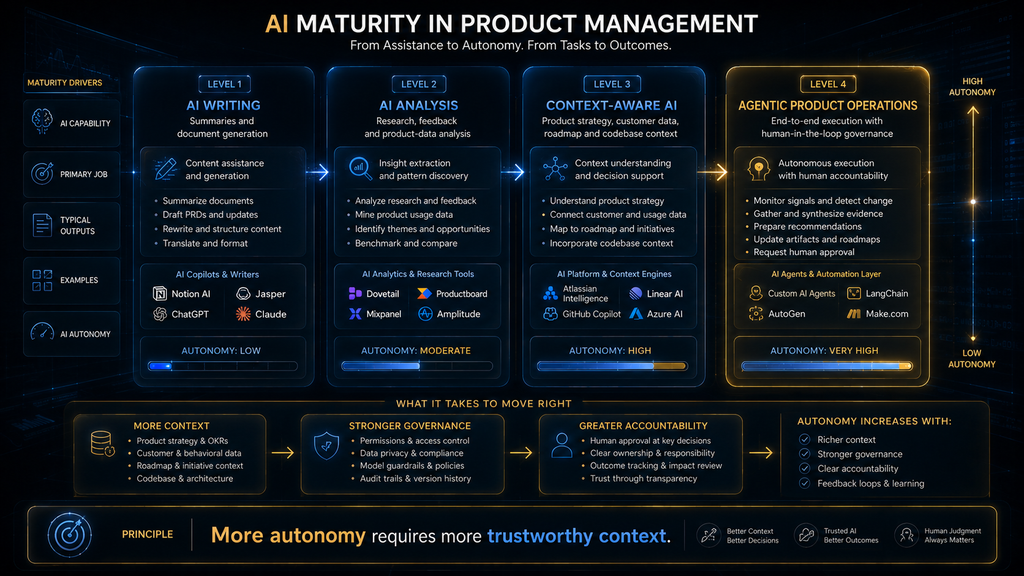
The existence of an AI feature tells you almost nothing about how much value the feature can create. A useful maturity model has four levels.
Level 1: AI Writing
At Level 1, AI accelerates document production but does not materially change the surrounding decision process. Typical outputs include:
- summaries,
- descriptions,
- PRDs,
- meeting notes,
- status updates.
This work can save time, but it is increasingly commoditized because general-purpose models already perform it well. Its value depends more on workflow placement and review discipline than on the existence of the writing feature itself.
Level 2: AI Analysis
At Level 2, AI begins interpreting evidence rather than only generating prose. The system may analyze:
- customer feedback,
- research,
- product data,
- documents,
- trends.
This level moves AI from generation into interpretation, allowing the system to surface patterns that would otherwise require manual review. The output still needs validation because a plausible pattern can reflect incomplete or unrepresentative inputs.
Level 3: Context-Aware AI
At Level 3, the system can use organization-specific context instead of treating every prompt as an isolated request. Relevant context may include:
- your product,
- your customer data,
- your roadmap,
- your historical decisions,
- your documentation,
- your codebase.
This can be substantially more valuable because the output reflects the organization’s actual product, customers and constraints. It also raises the stakes for permissions, data quality and source traceability.
Level 4: Agentic Product Operations
At Level 4, AI participates in multi-step product operations instead of stopping at a recommendation. Depending on the platform and permissions, it may:
- monitor signals,
- perform multi-step research,
- prepare analysis,
- create or update artifacts,
- initiate workflows,
- connect information across systems,
- request human approval before consequential actions.
Productboard, Linear and Notion are all examples of platforms moving toward this fourth layer in different ways. But greater autonomy creates a new requirement: The more an AI system can do, the more trustworthy its context needs to be.
Context Is Becoming More Valuable Than Raw AI Capability
As AI models become more capable, access to reliable product context becomes a larger competitive advantage. A general-purpose model can already write an excellent PRD.
A general-purpose model can produce a polished PRD, but it does not automatically understand the evidence or constraints that make the document useful. Unless connected to reliable company context, it may not know:
- which customers are most valuable,
- which complaints are recurring,
- what the company promised last quarter,
- which technical constraints exist,
- which roadmap decisions were rejected,
- what the product actually does,
- which metrics matter most.
Context changes the quality of the answer. This is why Productboard emphasizes real product data and codebase context, Linear is extending agents into code and external tools, and Notion is making connected company knowledge available to agents.
The future therefore isn’t simply: Better models → better PM outputs. It is closer to: Better models + better context + better workflow integration → better PM leverage.
Integration Is Becoming a Buying Criterion, Not a Bonus
A tool’s ability to move context into the next stage of work can be more valuable than another standalone feature. Consider this workflow: Customer interview → insight → opportunity → prioritization → roadmap → engineering → launch → analytics If each stage lives in an isolated application, someone has to carry context between them.
The product manager usually becomes the person responsible for carrying this context between applications. That manual integration creates hidden costs in:
- copy-pasting,
- duplicate documentation,
- stale information,
- inconsistent terminology,
- missing evidence,
- manual status updates.
Linear’s MCP expansion illustrates the direction of travel: the platform now allows external tools such as Cursor and Claude to interact with initiatives, milestones and updates. Its newer MCP capabilities also allow Linear Agent to pull context from other systems such as meeting notes and external knowledge.
That doesn’t mean every organization should buy Linear. It means connected context is becoming a product feature in its own right. Before buying any AI PM platform, ask: Where does its output go next?
If the answer is “someone copies it into another system,” the team should investigate the integration architecture before paying for the platform. Repeated manual transfer is evidence that the new tool may preserve the bottleneck instead of removing it.
Pricing: The Subscription Is Not the Cost
AI product-management software should be evaluated through total cost of ownership because usage is increasingly metered through seats, credits, events and automation volume. A platform advertised at $20 or $30 per month may also require paid integrations, implementation work, training, migration and ongoing administration, which makes the headline subscription price an incomplete comparison.
A practical cost model should include seats + AI usage + integrations + implementation + training + migration + maintenance + switching cost. Productboard meters AI through credits, Notion’s Custom Agents use credits, and Amplitude uses event-based pricing, so apparently similar subscriptions can produce different economics at scale.
The benefit side must be treated with the same discipline. Start with annual operating cost, then subtract the value of time recovered, duplicated work removed and decision cycles shortened. This does not create a perfect ROI figure, but it is substantially more useful than comparing monthly prices in isolation.
Current Pricing Snapshot
Pricing changes quickly, so these figures should be rechecked at publication and before a purchasing decision. The table describes public pricing signals, not a guaranteed quote or a complete total-cost calculation.
| Tool | Current public pricing signal | Pricing logic |
|---|---|---|
| Jira Product Discovery | Free; Standard $10/creator/mo; Premium $25/creator/mo | Creator-based |
| Productboard | Free/paid maker tiers with AI credits | Maker + AI-credit model |
| Linear | Free and paid per-user tiers | User-based |
| Notion | Business/Enterprise for advanced AI; Custom Agents use credits | Workspace + AI credits |
| Amplitude | Free/Plus/Growth/Enterprise | Event-based |
| Mixpanel | Free + usage-based paid plans | Event-based |
| Dovetail | Free entry tier + paid plans | Workspace/usage structure |
| Aha! | Paid product-management plans | Plan-based |
| airfocus | Current packaging requires verification | Sales/plan-based |
| Canny | Free + paid tiers | Product/usage-based |
Jira Product Discovery’s current official page confirms the Free, Standard and Premium prices above and its integration model. Amplitude’s official pricing page confirms its AI Agents/MCP capabilities and event-based Growth/Enterprise model. Notion’s current agent documentation confirms that Custom Agents use Notion credits.
Do not publish stale pricing simply because an older comparison article still ranks. That is one reason this article carries a visible freshness signal.
Governance Becomes More Important as AI Moves Closer to Decisions
The more product context an AI system can access, the more seriously an organization should evaluate permissions, security, auditability and data controls. This is especially important because a product-management platform may eventually process sensitive operational information such as:
- customer conversations,
- support requests,
- product analytics,
- revenue information,
- strategy documents,
- roadmap commitments,
- technical architecture,
- engineering plans.
This creates a very different risk profile from asking a generic chatbot to rewrite a paragraph. Enterprise buyers should examine the vendor’s documented controls and verify whether the following capabilities apply to the required plan and deployment:
- SSO,
- RBAC,
- SCIM,
- audit logs,
- data retention,
- data residency,
- AI-provider policies,
- integration permissions,
- human approval controls.
Notion states that its agents follow existing permissions, log runs and allow changes to be reversed. Linear provides workspace-level MCP controls and allowlists. Atlassian notes that Rovo’s AI output can vary in quality, accuracy and reliability and requires administrative activation in Jira Product Discovery.
The practical lesson is: Governance isn’t a legal appendix to an AI purchase. It is part of product fit.
How to Build an AI Product Management Stack
The best AI PM stack usually starts with one bottleneck and expands only when another workflow creates enough friction to justify a new system. A useful starting architecture is: KNOW → UNDERSTAND → DECIDE → PLAN → EXECUTE You don’t need one product for every layer.
Example: Customer-Driven SaaS
Dovetail → Productboard → Linear → Amplitude Dovetail manages qualitative evidence. Productboard turns signals into product opportunities and roadmap decisions.
Linear connects the work to engineering. Amplitude measures what happened after launch. This is a coherent stack because each system has a distinct responsibility.
Example: Atlassian-Centric Organization
Jira Product Discovery → Jira → Confluence → Analytics Here, the ecosystem itself is the advantage. The product team doesn’t need to create another bridge between discovery and engineering because the underlying systems are already connected.
Example: Small Product Team
Notion → Linear → Amplitude A small team may only need a knowledge layer, execution system and analytics. There is no reason to introduce five specialist products before the underlying workflow becomes painful.
Who Should Use Dedicated AI Product Management Software?
Dedicated AI PM software becomes more valuable as product complexity, information volume and coordination costs increase. The strongest buying case appears when several of the following conditions create recurring friction:
- customer feedback is arriving from many channels,
- multiple PMs need a shared product context,
- roadmap decisions require evidence,
- stakeholders need visibility,
- product analytics is difficult to interpret,
- research is too large to synthesize manually,
- prioritization is becoming politically difficult,
- multiple product teams need consistent processes,
- governance requirements are increasing.
The value comes from reducing coordination cost, not simply from generating more content. A platform is difficult to justify when it produces additional artifacts without shortening a decision, removing a handoff or improving the supporting evidence.
Who Should Avoid Buying Another Tool?
A small team with a clear process and manageable information volume may gain more from improving its existing workflow than from adding another AI platform. An impressive demonstration, a competitor’s adoption or a prominent ranking does not establish that the product will solve your team’s actual bottleneck.
Before purchasing, the team should be able to explain which problem it is solving, which existing work the platform will replace, where the input data comes from, where the output will go, who owns the system and how success will be measured. If those answers are unclear, the organization is not ready to buy because the new software is more likely to formalize confusion than remove it.
Common AI Product Management Tool Buying Mistakes
Choosing the highest-ranked platform
A universal ranking hides differences in ecosystem fit, data availability and workflow design. A lower-ranked platform that connects cleanly to the team’s existing source of truth can create more value than a feature-rich product that introduces another manual handoff.
Confusing AI quantity with AI depth
A platform with twenty AI buttons is not necessarily more capable than one with two deeply integrated functions. Buyers should examine the context the system can access, the evidence it preserves and whether the output advances the next stage of work.
Ignoring context and existing ecosystems
A grammatically polished answer is still a weak recommendation when the system cannot understand the organization’s customers, product constraints or previous decisions. Similarly, an excellent standalone tool can become expensive when the company must rebuild established Jira, Linear, Notion or analytics workflows around it.
Ignoring usage costs and sources of truth
Credits, events, automation volume and integration requirements can materially change the economics after adoption. If multiple systems also maintain conflicting versions of the roadmap, adding AI will not solve the governance problem; it may simply generate more confident answers from inconsistent information.
Automating before defining accountability
The relevant question is not only what AI can do, but what it should be permitted to do without human approval. Software can apply prioritization criteria, yet people must still decide what “high priority” means and remain accountable when an automated recommendation affects customers, budgets or engineering commitments.
A Practical AI PM Tool Selection Process
A disciplined selection process begins with one defined bottleneck, uses representative information and measures whether the platform improves an actual product decision. Buying several tools simultaneously makes it difficult to identify which system created value and which one merely added another subscription.
Step 1: Identify the bottleneck
Choose the part of the workflow creating the greatest cost or uncertainty: research synthesis, customer-feedback analysis, behavioral analytics, prioritization, roadmapping, product knowledge or engineering execution. Selecting one primary problem keeps the evaluation connected to an observable business need.
Step 2: Identify the existing source of truth
Determine where the most reliable context currently lives. It may be stored in Jira, Linear, Notion, a research repository, a product-analytics platform, the CRM or the support system. A tool that cannot access or exchange information with that source may create another isolated workspace.
Step 3: Define the AI job
Describe the required job in testable language. “We want AI for product management” is too broad, while “We want to cluster 5,000 monthly customer requests into recurring problems and connect supported themes to roadmap candidates” defines the input, task and expected output.
Step 4: Establish the human checkpoint
Decide which actions AI may complete automatically and which require approval from a product manager, researcher or engineering owner. The checkpoint should become stricter when an output can alter roadmap priorities, customer commitments, product specifications or engineering work.
Step 5: Run a representative pilot
Test the platform with realistic, imperfect information rather than relying exclusively on the vendor’s polished demonstration. Include inconsistent terminology, duplicated requests, incomplete context and ambiguous evidence because these conditions reveal how much human correction the workflow will require.
Step 6: Measure the operational result
Track time to insight, time to decision, manual handoffs, duplicated work, correction rate, adoption, decision traceability, workflow completion time and total cost. The objective is not to count AI outputs; it is to determine whether the platform improves the speed and quality of a recurring product decision.
Step 7: Expand only after the pilot creates evidence
Broaden the rollout only when the pilot demonstrates enough value to justify implementation, training, migration and ongoing usage costs. If the team cannot identify what improved or what work the new system replaced, expanding access will probably scale the expense rather than the benefit.
Real-World Evidence: What the Market Is Already Showing
The strongest evidence of the category’s direction is not that vendors have added chat interfaces; it is that major platforms are embedding AI into connected product workflows. Productboard says its June 2026 Spark release connects customer opportunities, specifications, roadmap work and codebase context. The company also describes a live demo conducted in its own workspace using real product data rather than a purely theoretical interface demonstration.
Linear’s 2026 releases show a similar progression from AI-assisted issue management toward context-aware product and engineering work. Its Code Intelligence capability allows the agent to reason about the codebase, while MCP support lets it work with external context.
Notion’s current agent architecture shows another direction: AI moving from answering questions to performing recurring tasks such as routing work and generating scheduled updates. These examples don’t prove that any particular vendor is “the best.”
They demonstrate something more useful: The category is moving from AI features toward AI-enabled workflows. That is the structural change buyers should understand.
The Next Phase: From Copilots to Agentic Product Operations
The next major shift in AI product management is likely to be from tools that assist individual tasks toward systems that continuously observe context and perform multi-step operational work. Today’s workflow might look like: Read feedback → summarize → identify themes → update roadmap → write status report An increasingly agentic workflow could look like: Monitor feedback → detect meaningful change → gather supporting evidence → compare against current roadmap → prepare recommendation → request human approval → update approved artifacts The difference is autonomy.
That creates huge potential. It also creates huge responsibility. A model that drafts a meeting summary can be reviewed in seconds. An agent that changes roadmap priorities affects the organization’s commitments.
An agent that updates product specifications can influence engineering work. An agent that accesses customer data introduces privacy and security considerations.
Therefore, as agentic capabilities increase, approval boundaries become part of product design. The future isn’t “let AI run product management.” It is:
The defensible direction is to let AI handle more operational complexity while keeping humans accountable for consequential decisions. Greater autonomy should therefore be paired with clearer permissions, review points and recovery paths rather than weaker oversight.
AI Hustle World Reality Check: Don’t Automate Confusion
The uncomfortable truth about AI product-management software is that an unclear process can become confused more quickly. If leadership has never agreed on what “strategic priority” means, an AI prioritization system may produce a polished list based on criteria that decision-makers still dispute; the interface improves while the underlying governance problem remains.
The same failure can occur when the source evidence is biased. AI may cluster feedback from the loudest enterprise customers accurately, yet the resulting roadmap will still overrepresent those customers if quieter segments are missing. Likewise, an analytics agent can produce a confident interpretation of incomplete instrumentation without recognizing the user behavior the tracking system failed to capture.
In each case, the model performs the assigned task while the surrounding system supplies weak premises. AI should amplify sound product judgment, not replace the work required to define evidence, priorities and accountability; that is the line between useful adoption and AI theater.
The 30-Minute AI PM Tool Shortlist
A product team can eliminate many unsuitable platforms before booking a sales demonstration by answering seven connected questions. The purpose is not to predict a winner from a checklist, but to prevent attractive features from distracting the team from its operating constraints.
1. What is our biggest bottleneck?
Name the primary constraint—research, feedback, analytics, prioritization, roadmapping, execution or knowledge management—and describe its business effect. A broad desire to “use more AI” is not specific enough to guide a purchase.
2. What evidence is missing?
Determine whether the team lacks customer, behavioral, market, business or technical evidence. The answer identifies which layer of the product stack needs strengthening and prevents a roadmap tool from being purchased to solve a research problem.
3. Which system contains the most useful context?
Identify the existing source of truth for product decisions and make its accessibility a major selection criterion. A platform that cannot exchange context with that system will require people to recreate the missing connection manually.
4. What should AI actually do?
Define a bounded job with identifiable inputs and outputs, such as clustering support requests and connecting supported themes to roadmap candidates. This makes the pilot testable and gives reviewers a clear basis for correcting the system.
5. How much autonomy do we want?
Distinguish between writing assistance, analysis, context-aware recommendations and agentic execution. Increasing autonomy can remove more work, but it also increases the importance of permissions, reliable context and approval boundaries.
6. What happens when the AI is wrong?
Specify who reviews the output, how errors are detected and which actions cannot proceed without approval. The acceptable control level should reflect the consequence of the decision rather than the novelty of the technology.
7. What will we stop doing?
A new platform should replace or materially improve identifiable work. If the team expects to retain every existing meeting, spreadsheet, handoff and reporting process, the purchase will probably add another layer instead of reducing operational friction.
Final Decision Matrix
| If your biggest problem is… | Start by evaluating… | What you’re buying it for |
|---|---|---|
| Customer research overload | Dovetail | Qualitative evidence synthesis |
| Feedback overload | Productboard | Feedback → opportunities → roadmap |
| Jira-based discovery | Jira Product Discovery | Discovery → delivery |
| Product-engineering friction | Linear | Shared product + engineering context |
| Strategic product planning | Aha! | Strategy + roadmaps |
| Behavioral product evidence | Amplitude | Analytics + AI-assisted investigation |
| Self-service product analytics | Mixpanel | Funnels, cohorts and behavior |
| Product knowledge fragmentation | Notion | AI-enabled context and documentation |
| Prioritization complexity | airfocus | Structured prioritization |
| Feature-request management | Canny | Customer requests and voting |
This table is a shortlist generator, not a ranking. Its purpose is to connect a specific operating problem with a plausible starting point that the buyer can investigate further.
Which AI Product Management Tool Should You Start With?
If your biggest problem is customer feedback, start by evaluating Productboard or Dovetail. If your organization already runs heavily on Jira and Confluence, Jira Product Discovery deserves priority because its ecosystem integration can reduce the cost of introducing another system. Atlassian currently includes Jira, Jira Service Management and Confluence integrations in Jira Product Discovery subscriptions.
If product-engineering execution is your bottleneck, Linear is particularly interesting because its AI capabilities increasingly span product context, engineering context and external tools. If product analytics is the missing evidence layer, evaluate Amplitude or Mixpanel.
If your organization is drowning in documentation and fragmented knowledge, Notion may provide more leverage than another specialist PM platform. If strategic planning and portfolio management are the challenge, evaluate Aha!.
If prioritization is the central problem, look at airfocus. If feature requests are scattered across customers, Canny may be enough. And if your current workflow is working?
Do not buy another tool when the current workflow is already reliable and proportionate to the team’s needs. Avoiding unnecessary complexity may be the most valuable recommendation in this entire comparison.
Final Thoughts: Don’t Buy AI—Buy Better Product Decisions
AI product-management platforms are moving beyond document generation. Research tools can synthesize customer evidence, analytics platforms can support natural-language investigation, product systems can connect insights to roadmaps, and engineering platforms can combine planning context with technical execution. These capabilities are meaningful, but so are the implementation costs and governance risks surrounding them.
That is why “Which AI product-management tool is best?” is the wrong starting question. A better question is: “Which product decision is currently too slow, poorly informed or difficult to trace, and which platform can improve that decision without creating another isolated system?” This reframes software selection around an operational problem rather than a vendor’s feature list.
A team overwhelmed by customer feedback should solve that bottleneck. A team struggling to connect product and engineering context should address that handoff, while a company with weak analytics should strengthen its evidence layer before automating more roadmap decisions. If the existing workflow is already simple and effective, declining to buy another tool may be the strongest decision.
The most capable product organization is not necessarily the one with the most AI subscriptions. It is the one with reliable evidence, clear decision criteria, connected systems and explicit human accountability. AI should shorten the path from evidence to action while preserving the judgment required to decide what deserves to be built.
Understand the Full AI Product Management Lifecycle
Choosing a tool becomes easier when you understand where AI fits across research, prioritization, planning, execution and measurement. Continue with our lifecycle guide before building your product-management stack.
Explore the AI Product Lifecycle →FAQ
What are AI product management tools?
AI product management tools are software platforms that use artificial intelligence to support product-management activities such as customer research, feedback analysis, product analytics, prioritization, roadmapping, documentation and product operations. Some are dedicated PM platforms, while others specialize in a single layer such as research or analytics.
What is the best AI product management tool in 2026?
There is no universally best tool. Productboard is a strong choice for customer-driven product decisions, Jira Product Discovery is particularly compelling for Atlassian-native teams, Linear is strong for product-engineering workflows, Dovetail is strong for qualitative research, and Amplitude and Mixpanel are strong for product analytics.
Are AI product management tools worth paying for?
They can be worth paying for when they solve a recurring bottleneck involving large volumes of customer data, analytics, prioritization or coordination. The value should be measured through workflow outcomes rather than the number of AI features.
Can ChatGPT or Claude replace an AI product management platform?
Usually not. General-purpose AI assistants are excellent for drafting, research and analysis, but they do not automatically replace specialized systems for customer feedback, product analytics, roadmaps, prioritization or engineering execution.
Should a startup buy dedicated AI product management software?
Not necessarily. A small startup may get more value from a lightweight combination of a knowledge workspace, execution platform and analytics system. Dedicated PM software becomes more valuable as information volume, product complexity and stakeholder coordination increase.
What is the difference between Productboard and Jira Product Discovery?
Productboard is particularly strong around customer signals, product opportunities, prioritization and roadmaps. Jira Product Discovery is particularly strong when product discovery needs to connect directly with Jira-based engineering delivery and the wider Atlassian ecosystem.
Is Linear an AI product management tool?
Linear is primarily a product-development and work-management platform, but its current AI capabilities increasingly cover product planning, triage, code context, agent workflows and external integrations. Its 2026 releases include Code Intelligence and expanded MCP support.
Is Notion good for product management?
Notion can work well as a product knowledge, documentation and collaboration layer. Its current AI capabilities include Notion Agent, AI Meeting Notes, Enterprise Search and Custom Agents that can automate recurring workflows.
What should I look for in an AI product management tool?
Look at workflow fit, AI depth, context, evidence traceability, integrations, governance and total cost. Do not choose a tool simply because its marketing page lists more AI features.
Do AI product management tools replace product managers?
No. They can automate research synthesis, documentation, analysis and operational tasks, but product strategy still requires human judgment, trade-offs, accountability and understanding of customer and business context.
How much do AI product management tools cost?
Pricing varies significantly. Jira Product Discovery currently lists Free, Standard at $10 per creator/month and Premium at $25 per creator/month. AI usage may also have separate or embedded consumption mechanics depending on the platform.
Should a product team use multiple AI tools?
Often, yes, but only when each tool has a clear role. For example, a team could use Dovetail for research, Productboard for prioritization, Linear for execution and Amplitude for behavioral analysis. The important thing is to define which system owns each part of the workflow.
What is the biggest mistake when buying AI product management software?
Automating a broken workflow. If the team has not agreed on how it evaluates opportunities, AI can produce a more organized version of an unclear process.
How should companies measure the ROI of AI PM software?
Measure time to insight, time to decision, manual handoffs, evidence quality, adoption, correction rate, workflow completion time and total cost. The goal is not more AI output; it is better product decisions at a sustainable cost.
Sources and Further Reading
- People + AI Guidebook: Google PAIR’s guidance for designing human-centered AI products.
- Silicon Valley Product Group: Marty Cagan’s product management writing and training.
Written by
Muntasir Ahmad Chowdhury
Founder, AI Hustle World
Muntasir Ahmad Chowdhury is the Founder of AI Hustle World, an independent publication dedicated to making Artificial Intelligence practical, trustworthy, and easy to understand. He researches AI tools, automation, customer service, productivity, and real-world business applications, helping readers make smarter technology decisions through research-driven, experience-backed content.
Expertise:
AI Tools • AI Automation • AI Customer Service • AI Productivity • Generative AI • AI Workflows
Get Smarter With AI
Enjoyed this guide? Get practical AI tools, tutorials, and honest reviews delivered to your inbox.