Evidence: Documentation reviewed
Last checked: August 2026
What was done: Written from official documentation and the published sources linked in this article. Not hands-on tested.
Files: None
Affiliate links: No
Last updated: October 2026
AI Product Discovery: How to Use AI for Competitive Research and Market Analysis
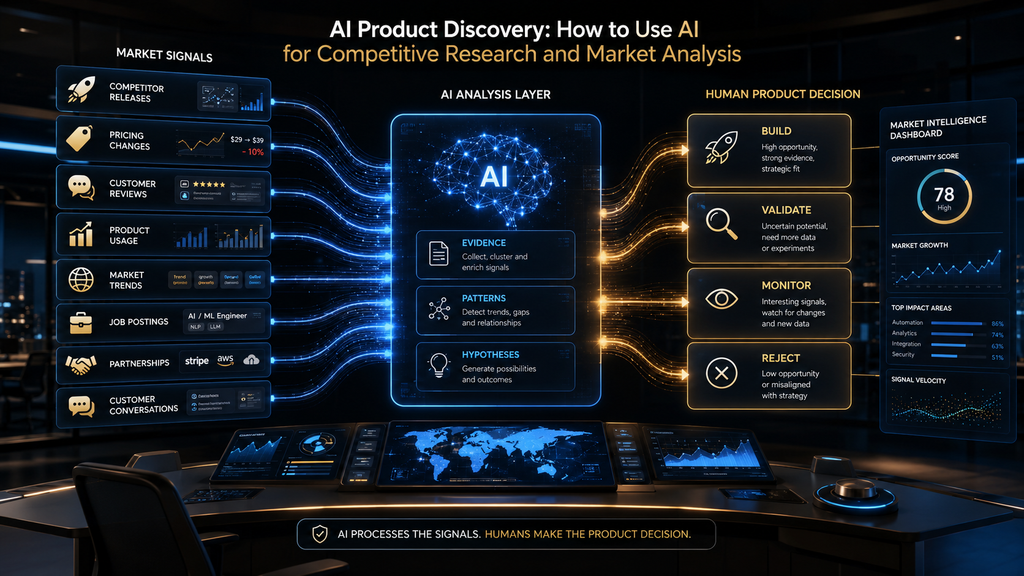
AI product discovery means using AI to gather, analyze and connect customer, competitive and market signals so a product team can find and validate opportunities before committing resources. Used well, AI handles the heavy reading and pattern-finding, while the team frames the decision, checks the evidence, talks to customers and makes the final call about what to build.
Product teams have never had more information. Competitors publish release notes, customers write reviews, sales teams record calls, analytics capture behavior and support teams log complaints. Companies change pricing, launch integrations and adjust positioning every month. Finding information is no longer the hard part; knowing which information matters is.
A product manager can spend a full week researching competitors and still end up with a familiar spreadsheet: features in one column, prices in another and strengths and weaknesses underneath. It looks thorough, but it rarely answers the question that matters most, which is what the team should do differently because of what it learned.
This guide shows how to close that gap. You will learn the AI Product Discovery Intelligence Loop, a twelve-step workflow with prompts, a confidence ladder for weighing signals, a method for separating evidence from AI inference, a weekly discovery rhythm and the mistakes that turn fast research into fast wrong decisions.
What AI Product Discovery Means
Traditional product discovery has a clear purpose. Teams investigate customer needs, explore problems, evaluate opportunities and validate possible solutions before investing heavily in development. Teresa Torres’s guide to product discovery describes how the best teams now treat this as continuous work rather than a one-off phase.
AI leaves that process in place and changes its economics. Productboard’s overview of AI product discovery frameworks describes AI as speeding up insight synthesis, connecting signals across sources and making it practical for discovery to happen continuously rather than in isolated phases. That shift is what makes the rest of this guide possible.
That matters because many teams still treat discovery as a stage. Research happens, a report is written, a roadmap decision is made and the team moves into delivery. The market does not stop moving when development starts. A competitor can change pricing next month, and a minor complaint can become a major reason customers switch.
AI makes it far more practical to keep watching those signals. The result is a different operating model: discovery before the product decision, during development and after launch. The team keeps updating its understanding of the market instead of relying on a single research snapshot that starts going out of date the day it is presented.
Why Competitive Research Alone Is Not Product Discovery
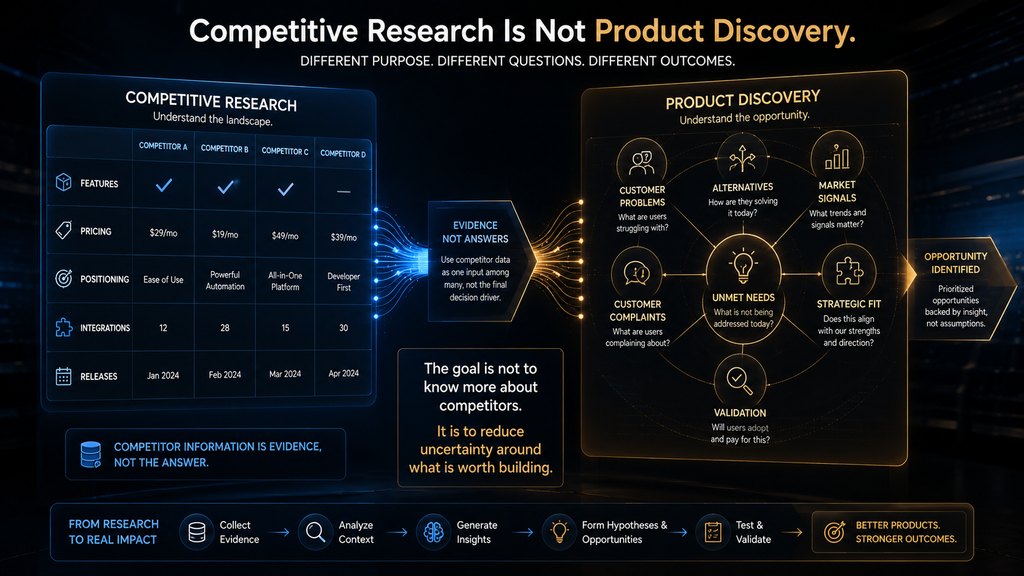
Competitive research asks useful questions: what features a competitor offers, what it charges, who it targets, which integrations it supports, how it positions itself, what customers say about it and what has changed recently. Those answers describe the market. Product discovery goes one level deeper and asks what all of that evidence means for your product.
Imagine an AI research system finds that three competitors recently launched automated reporting. A feature-comparison mindset concludes, “we need automated reporting too.” A discovery mindset asks why they launched it, which customers use it, whether it is a real unmet need or simply becoming standard, and whether customers are satisfied with the existing versions.
It also asks whether some segment needs something fundamentally different, and whether building the same feature would create differentiation or remove it. Those questions turn competitive intelligence into product discovery. Without them, the team is simply copying the market with extra steps and calling it strategy.
This is one of the biggest mistakes teams make with AI. They automate research and assume that more information automatically produces better decisions. It does not. Better information creates the possibility of better decisions, and the product team still has to interpret the evidence and connect it to its own strategy.
The AI Product Discovery Intelligence Loop
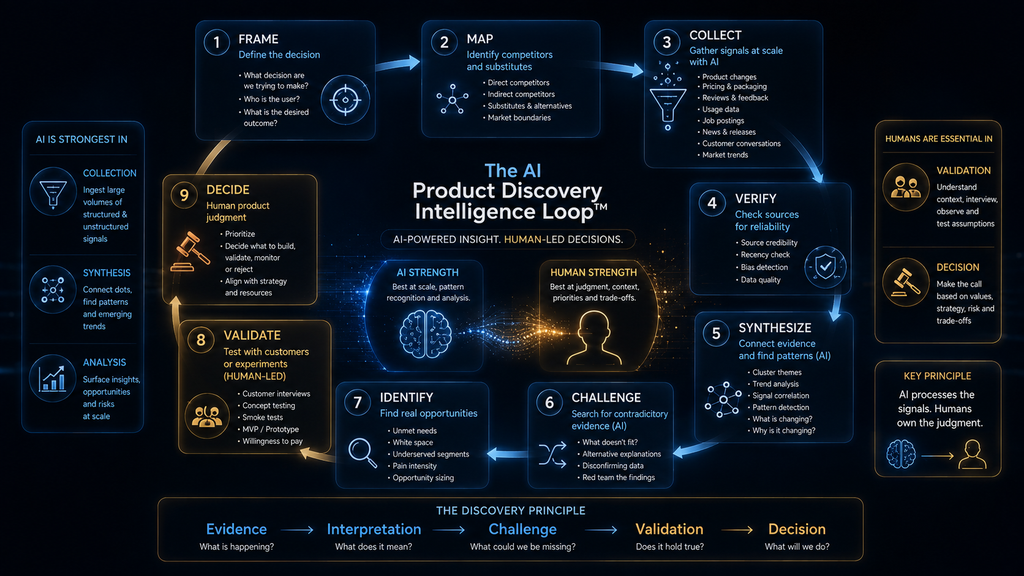
This guide uses a nine-stage framework we call the AI Product Discovery Intelligence Loop: frame, map, collect, verify, synthesize, challenge, identify, validate and decide. It is AI Hustle World’s editorial framework, and each stage has a clear owner and a clear output, so the team always knows what the research is for.
Frame the product decision the research should support. Map the customers, competitors, substitutes and segments that matter. Collect product, pricing, customer, market and strategic signals. Verify important claims against reliable sources before they enter the analysis, so errors do not spread through every later stage.
Synthesize the verified material with AI to connect information, detect patterns and organize evidence. Challenge the emerging story by looking for evidence that contradicts your current assumptions. Identify potential opportunities from the patterns that survive that challenge, ranked by evidence strength and customer impact.
Validate each opportunity with customers or experiments before committing significant resources, and decide with human product judgment. AI can help heavily in the first seven stages. The last stage is deliberately human. That is simply good product management, because only the team carries the strategy and the accountability.
Step 1: Start With the Decision, Not the Prompt
AI-assisted research improves when it starts with a specific product decision rather than a vague request to “analyze the market.” That sounds obvious, but it changes the whole workflow. A broad prompt returns market size, competitors, trends, pricing and adoption figures, and the report can be accurate and still useless for any decision.
Compare that with a decision-led prompt: “We are considering an AI-powered project-risk detection feature for mid-market software teams. Determine whether there is evidence of a meaningful unmet need, which alternatives customers use now, what competitors offer, where existing solutions look weak and which assumptions need validation before we invest.”
Now the research has a job, and every piece of evidence can be judged against a decision. We call this the decision-first research principle: never ask AI to research a market without defining the decision the research is supposed to inform. It is the single change that most improves AI research quality.
The decision might be whether to enter a market, build a feature, target a segment, reposition the product or prioritize a problem. It might be whether a market is getting crowded, whether a competitor is creating a new customer expectation or whether customers are switching. The question you choose determines which evidence matters and which can be ignored.
We are deciding whether to [DECISION] for [TARGET SEGMENT].
Research question: is there evidence of a meaningful, unmet need?
Find: current alternatives customers use, what competitors offer,
where existing solutions appear weak, and the assumptions we must validate.
Separate verified facts from your interpretation. Do not invent missing information.
Step 2: Map the Market Before Comparing Features
A useful competitive map includes direct competitors, indirect competitors and substitute behaviors, not only companies selling similar software. Many analyses stop at direct rivals, which hides the alternatives customers use most. If you build an AI research assistant for marketing teams, your rivals include other research platforms, but also general chat assistants, agencies and spreadsheets.
Customers do not think in your product category. They think, “how can I solve this problem?” A competitor is defined by the alternative a customer can choose instead of you, not by what a company calls itself. That includes doing nothing, which is often the most common choice of all and the hardest to beat.
Build your map in three layers. Direct competitors solve a similar problem for a similar audience. Indirect competitors solve part of the problem in a different way. Substitutes include manual processes, internal tools, services or the decision not to solve the problem at all. Together they give a far more realistic picture than a list of rivals.
Ask AI to propose candidates for each layer, then review the list yourself. AI tends to over-represent well-known brands and miss small specialists or informal workarounds, while your sales and support teams usually know which alternatives come up in real conversations. Their input makes the map far more accurate.
Step 3: Research the Signals That Matter
AI becomes valuable in competitive research when it combines different signal types instead of treating a competitor’s feature list as the whole market. A mature workflow looks at five groups of signals, each of which reveals something the others cannot. Together they show what a competitor does, how customers react and where it may be heading.
Product signals include feature releases, documentation updates, integrations and changes to onboarding. Commercial signals include pricing, packaging, free tiers, discounts and contract terms. Customer signals include reviews, community discussions, support complaints and the reasons people give for switching.
Market signals include category growth, new entrants, regulation and technology shifts that change what is feasible or expected. Strategic signals include hiring patterns, partnerships, acquisitions, funding and leadership changes. The Institute of AI Product Management also recommends looking beyond releases to broader competitive signals.
The point is to find signals that could change a product decision, rather than to track everything. A team that monitors fifty sources but cannot say which three matter has created noise, not intelligence. Decide in advance which signals are relevant to your current decision, and review the rest only occasionally.
Step 4: Use AI to Analyze Competitors at Scale
AI is especially useful when research involves many companies, documents, reviews or product changes that would be slow to compare by hand. Atlassian’s guide to competitive research with Rovo suggests comparing competitors on features, pricing, scalability, user experience, integrations and use cases, then identifying market gaps to explore.
That is a good starting point, but do not stop at “create a competitor comparison table.” Ask deeper questions, such as comparing competitors on core workflow, target segment, pricing model, strongest differentiator, major customer complaints and recent strategic changes, with verified facts separated from interpretation.
Another powerful prompt asks AI to identify areas where at least three competitors look strong, areas where customers complain across several competitors and areas where the market seems fragmented. Those three groups map neatly onto what is becoming standard, where customers remain unhappy and where differentiation may still be possible.
The goal is to understand where expectations are being set, where customers are still dissatisfied and where your team might stand out, rather than to count who has the most checkmarks in a table. Our guide to AI product data analysis shows how to combine this outside view with your own usage data. Outside and inside views together give the full picture.
Compare these competitors: [LIST].
For each: core workflow, target segment, pricing model, strongest differentiator,
top customer complaints, and changes in the last six months.
Then list: (a) areas where 3+ competitors are strong, (b) complaints shared across
competitors, (c) areas where the market looks fragmented.
Label every point as FACT (with source) or INTERPRETATION.
The Feature-Matrix Trap
A feature matrix is useful, and it is also one of the easiest ways to do shallow competitive research. Imagine a table where every product, including yours, has AI summaries and a mobile app, most have analytics and the integration counts range from 12 to 30. It looks informative, but it tells you very little about what customers value.
| Capability | Our product | Competitor A | Competitor B | Competitor C |
|---|---|---|---|---|
| AI summaries | Yes | Yes | Yes | Yes |
| Analytics | Yes | Yes | No | Yes |
| Integrations | 12 | 20 | 15 | 30 |
| Mobile app | Yes | Yes | Yes | Yes |
If everyone has AI summaries, the feature no longer differentiates anyone. If customers barely use most integrations, having thirty may not matter. If every competitor has analytics but users say the analytics are hard to interpret, the opportunity may be better decision support rather than another dashboard.
The useful question is therefore what the market is making normal, and where the customer experience is still broken. A matrix answers the first part well and the second part poorly. That is where AI-assisted discovery adds value, by pairing the matrix with customer evidence about how well each capability works in practice.
Step 5: Use Customer Reviews as Competitive Evidence
Competitor reviews often reveal unmet needs, because customers describe the gap between what a product promises and what it feels like to use. Collecting hundreds of reviews across several competitors used to take days to categorize by hand. AI can do the first pass quickly by clustering recurring positive and negative themes.
Do not stop at sentiment. Sentiment tells you whether customers are happy; discovery needs to know why. A competitor might have mostly positive reviews and still have a recurring problem that matters enormously to one segment. A small cluster of specific complaints can reveal a better opportunity than thousands of generic compliments.
The Institute of AI Product Management’s review-analysis approach looks for strengths, weaknesses, switching triggers and feature gaps, which is the right direction. The useful question is not “what sentiment does this competitor have?” but “what customer problem keeps appearing despite the competitor’s overall success?”
Treat review data with care. Review sites over-represent very happy and very unhappy customers, some reviews are incentivized and older reviews may describe a product that has since changed. Our guides to AI customer feedback analysis and finding themes and sentiment across conversations cover these limits.
Sentiment Is Not the Same as Opportunity
A customer writing “I hate this dashboard” is not automatically handing you a product opportunity. They might hate it because the data is wrong, the interface is confusing, it loads slowly, it does not fit their workflow, they do not understand the metrics or they lack the permissions they need. Each cause points to a different opportunity.
AI can cluster the complaints, but people still have to work out which underlying problem is strategically important and which one your team is well placed to solve. A cluster of “dashboard” complaints might be five different problems wearing the same label, and treating them as one leads to the wrong fix.
So do not let AI collapse the journey from signal to conclusion into one step. The better sequence is signal, pattern, explanation, hypothesis and validation. Each step adds a check, as our comparison of AI and manual conversation analysis also shows, and each check reduces the chance that a vivid complaint turns into an expensive feature nobody uses.
Step 6: Analyze Pricing as a Product Signal
Pricing changes can reveal competitive strategy, but they should be read alongside positioning, segment and product value rather than as isolated numbers. If a competitor cuts its entry price by 30%, the reason might be an aggressive growth push, a move toward a different segment, a shift to usage-based pricing or simply weak demand.
The price change is a fact; the explanation is an inference. That distinction matters, because AI will happily produce a confident explanation for almost any change. It should present several plausible explanations, the evidence for and against each one and a confidence level, rather than presenting one story as established truth.
A useful format records what was observed, the possible explanations, the evidence for and against each and a confidence rating such as “medium.” Now the product manager has something to investigate. That is far safer than a summary that says “the competitor cut prices because demand is weak” with no evidence behind it.
When you check pricing, use the competitor’s official pricing page and note the date, because prices change often and AI models may carry outdated figures from their training data. Packaging matters as much as headline price: which features sit in which tier often tells you more about strategy than the price itself.
Step 7: Track Competitor Movement Over Time
Competitive intelligence becomes more valuable when you track changes over time rather than treating competitors as static snapshots. A competitor’s feature list tells you where it is today. Its movement over several months tells you where it may be heading, which is often the more important strategic question.
Imagine a competitor launches basic AI summaries in January, adds workflow automation in March, hires an AI infrastructure team in May and introduces usage-based AI pricing in June. Each event looks minor on its own. Together they suggest a strategic move toward AI-driven automation that could reshape customer expectations in your category.
That pattern does not prove the competitor’s strategy, but it creates a hypothesis worth investigating. AI is well suited to this work because it can compare information across time and summarize changes scattered across release notes, websites, announcements and job postings that no one on the team has time to read every week.
Keep a simple change log for each important competitor, with the date, the source and a one-line note. AI can draft the entries from release notes, and a person can add context. After a few months, the log becomes one of your most useful strategic assets, because patterns appear that no single snapshot would reveal.
The Competitive Signal Confidence Ladder
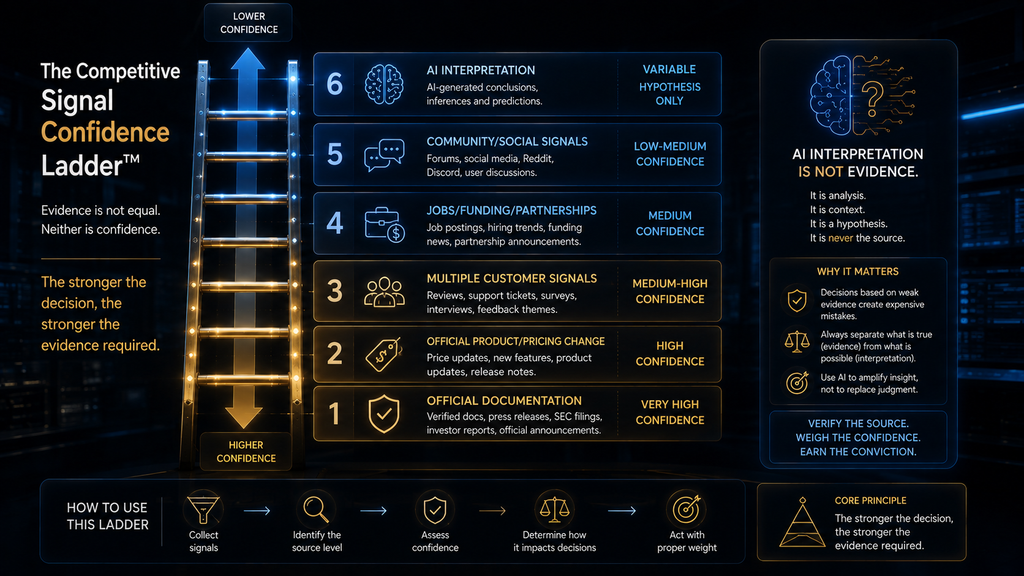
Not every signal deserves equal weight. A product team needs a way to separate what it knows from what it suspects. The confidence ladder below is a practical model for weighting sources; it is our editorial guide rather than a formal standard, and you should adjust it for your market. Use it as a starting point for your own weighting.
| Signal | Typical confidence | What it can tell you |
|---|---|---|
| Official product documentation | Very high | Confirmed capability |
| Official pricing page | Very high | Public commercial structure |
| Official release announcement | High | Confirmed product movement |
| Many customer reviews | Medium to high | Recurring customer perception |
| Single customer review | Medium | One specific experience |
| Job postings | Medium | Possible strategic direction |
| Funding or acquisition news | Medium | Strategic or financial movement |
| Community discussions | Low to medium | Emerging perception |
| Social media claims | Low | A lead that needs verification |
| AI interpretation | Variable | A hypothesis, not evidence |
The last row is the most important. AI output is not a source. If an AI summary says “Competitor A is moving toward enterprise customers,” ask what evidence supports that. If the answer is a new enterprise pricing tier, single sign-on support and several enterprise sales job postings, the inference now has support.
Without that support, the statement is a hypothesis and should be labeled as one in every report and slide where it appears. Hypotheses are valuable, but only when everyone can see that they still need testing. Our framework for checking whether AI information is accurate gives a practical method for tracing claims back to their sources.
Step 8: Separate Evidence From AI Inference
The safest AI research workflow separates five levels: evidence, pattern, inference, hypothesis and decision. Adding this one control to every report improves research discipline more than any tool upgrade, because it stops interpretations from quietly hardening into facts as they move from slide to slide.
Evidence is directly supported by a source: “the company introduced an enterprise plan in June.” A pattern is the same kind of evidence appearing repeatedly: “three competitors added enterprise controls within six months.” An inference is a reasonable interpretation: “enterprise security may be becoming a stronger buying requirement.”
A hypothesis is something to test: “mid-market buyers may increasingly expect enterprise-grade permissions.” A decision is the action the team chooses: “we will investigate whether permission management is a meaningful opportunity for our segment.” Each level depends on the one before it, so weak evidence weakens everything above it.
AI can help with the first four levels. The fifth belongs to the product team. Ask AI to label every statement with its level, and reject reports that mix them together, however polished they look. Our guide to AI hallucinations explains why this labeling matters even for well-sourced reports. Clear labels make reports far easier to challenge.
Step 9: Ask AI to Argue Against Your Strategy
AI product discovery should challenge product assumptions, not just confirm them. Teams often misuse AI here. They already believe customers want something, so they ask AI to “find evidence that customers want this.” The model dutifully finds supporting evidence, the team feels confident and nobody notices that confidence is not validation.
Instead, ask AI to “find evidence that could make this opportunity unattractive.” Look for competitors that already solve the problem very well, segments that do not care, signs that the problem is shrinking, regulatory or technical barriers and reasons customers might not pay for a solution even if they like it.
This approach does not ask AI to make the decision. It asks AI to make the decision harder to get wrong. Productboard’s guidance makes the same point: use AI to surface evidence, not to replace judgment, because decisions still need human context, trade-off evaluation and validation. A strong opportunity survives the challenge.
We believe [OPPORTUNITY] is attractive for [SEGMENT].
Argue against it. Find evidence that:
- competitors already solve this well
- customers in this segment do not prioritize it
- the problem is shrinking or being solved another way
- customers would not pay for a solution
Cite sources. Mark anything you cannot support as UNVERIFIED.
Step 10: Find the Opportunity Between Competitors
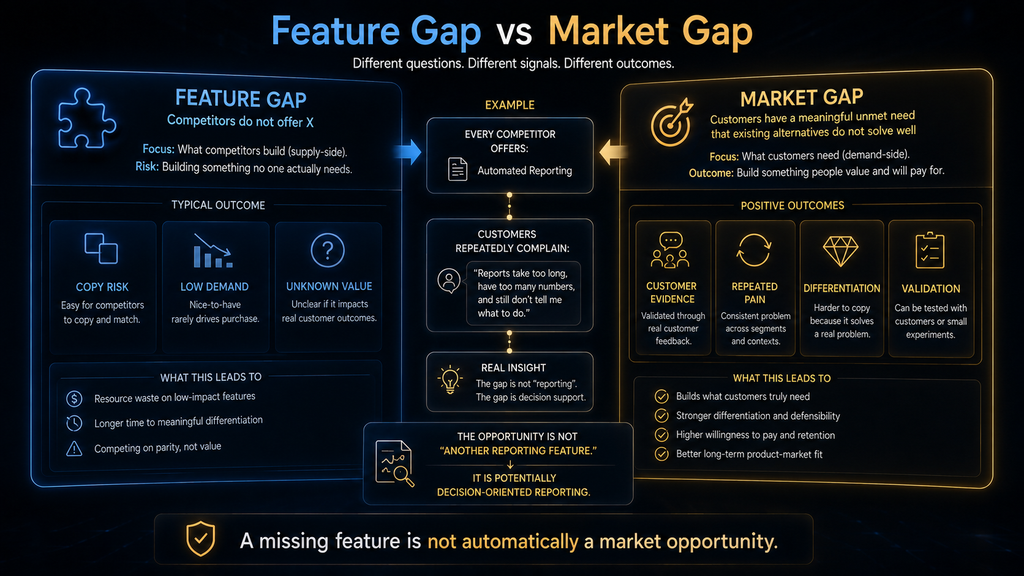
A product opportunity often lies not where competitors lack a feature, but where customers remain dissatisfied even though competitors offer similar solutions. Suppose every major competitor offers automated reporting. The obvious “gap” would be to build automated reporting too, but that would only be catching up with the market.
Now suppose reviews across those competitors repeatedly say the reports are comprehensive but executives do not know what action to take. That is far more interesting. The opportunity may be decision-oriented reporting that tells people what changed and what to do, not another automated report with more charts.
The competitor feature already exists, but the customer problem is not fully solved. This is the kind of opportunity AI can help surface when you analyze competitive features alongside customer evidence. Our guide to turning customer feedback into product insight shows how to collect that evidence systematically.
Feature Gaps vs Market Gaps
A feature gap means competitors do not have a capability. A market gap means customers have a meaningful, unmet need that existing alternatives are not solving well. The two are not the same. Feature gaps are easy to find with a matrix. Market gaps are harder to find and far more valuable when you find a real one.
A feature gap may exist for good reasons. Customers may not want the feature, it may be technically hard, it may not be commercially viable, it may create compliance problems or competitors may have deliberately avoided it after trying it. An empty cell in a matrix is a question, not an answer. Investigate before you build.
So never jump straight from “nobody has this feature” to “this is our opportunity.” Ask why nobody has it. That one question can save months of development, and the answer often reveals a constraint your team would otherwise discover only after building the feature and watching adoption stall. A short investigation is far cheaper than a failed launch.
Step 11: Build an Opportunity Map
Once the research is synthesized, organize potential opportunities by evidence strength, customer impact, competitive density and next action. The map below is an illustration; replace the problems with your own. Its job is to show at a glance which opportunities deserve more investigation and which can wait.
| Opportunity | Evidence strength | Customer impact | Competitive density | Next action |
|---|---|---|---|---|
| Problem A | Strong | High | Low | Validate |
| Problem B | Medium | High | High | Differentiate |
| Problem C | Strong | Medium | High | Monitor |
| Problem D | Weak | High | Low | Research further |
| Problem E | Weak | Low | Low | Ignore |
Treat this as an opportunity map rather than a roadmap. Its purpose is to decide what deserves more investigation, not what to build next quarter. AI can help fill in the evidence column and draft summaries, but the product manager decides what matters and how the columns are weighted for this decision. Revisit it after each research cycle.
At the end of a cycle, sort every major opportunity into four buckets: build (strong evidence, real problem, good strategic fit), validate (interesting but under-evidenced), monitor (important movement but not enough to act) and reject (weak problem or poor fit). This stops every insight from turning into a feature request.
Step 12: Validate Before You Build
AI-assisted discovery should narrow the field of opportunities, while customer research and experiments decide which ones deserve investment. Many AI workflows fail here. A team finds a gap, AI writes a convincing business case, leadership approves it, engineering builds it and customers do not care. That sequence is common and expensive.
The problem in that story is not research speed. It is that research was mistaken for validation. Validation can take many forms, including customer interviews, prototype tests, landing page experiments, concierge pilots, sales conversations and usage data from a limited release. The right method depends on how big the risk is.
The Institute of AI Product Management puts the danger well: the biggest risk is not moving too slowly but using AI to validate bad ideas faster. AI can increase the speed of discovery, but it does not remove the need for validation. It should make customer conversations better informed, never replace them.
For usability-related opportunities, testing competitor products with real users can be revealing. Nielsen Norman Group’s guide to competitive usability evaluations explains how to run them. Our guide to AI qualitative research shows how AI can help analyze the interviews afterward. Direct observation often reveals problems reviews never mention.
Using ChatGPT, Gemini and Other Research Tools
The research tool matters less than the quality of the question, the sources and the verification process. That said, current tools are far more capable than simple chatbots. OpenAI describes deep research as a capability that searches, analyzes and synthesizes many sources into a cited report. It can save many hours of manual reading.
OpenAI’s own announcement also lists limitations: it can sometimes hallucinate facts or make incorrect inferences, and it may struggle to tell authoritative information from rumor. Those are exactly the risks the confidence ladder and the evidence labels are designed to catch, so the same discipline applies whichever tool you use.
Use these tools for questions such as comparing the current positioning, pricing and capabilities of five competitors using official sources where possible, identifying changes in the last six months and separating verified facts from interpretation. Then open the sources and check the claims that matter for your decision.
The principle is the same on every platform: the tool should produce evidence you can inspect, not conclusions you accept blindly. Our comparison of AI research assistants covers the main options and their strengths for this kind of work. For very long source documents, our guide to compressing long documents for AI helps you fit more evidence into one request.
A Structured Prompt for Competitive Research
Instead of “analyze Competitor A,” use a structured request that defines the objective, the research areas, the source priorities and the output format. The prompt below works in most research-capable assistants. Its last line is the most important, because it sets a boundary around what the model may claim.
Research objective: determine whether [OPPORTUNITY] is a meaningful product
opportunity for [TARGET SEGMENT].
Research areas: capabilities, pricing, positioning, customer complaints and praise,
recent releases, integrations, target segments, strategic movement.
Source priority: official company sources first, independent customer evidence
second, secondary analysis third.
Output: separate verified facts, recurring patterns, inferences and hypotheses.
Challenge: list evidence that argues against the opportunity.
Final output: strongest evidence, open questions, and what to validate with customers.
Do not invent missing information. Say clearly when evidence is unavailable.
A good research prompt creates a boundary around the model, which is what turns a fluent summary into evidence you can use. If you want to learn more about writing prompts like this, our guide to writing AI prompts for accurate and reliable answers explains each element and why source boundaries reduce errors.
From Quarterly Reports to Continuous Intelligence
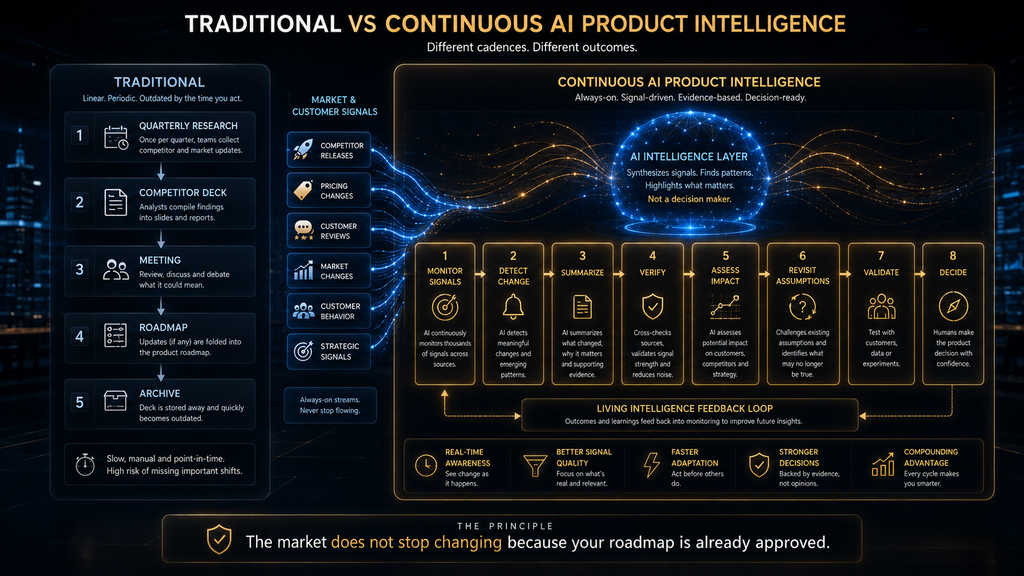
AI makes it practical to treat competitive intelligence as a continuous signal system rather than a quarterly project. The old pattern was quarterly research, a long slide deck, a stakeholder meeting, a few decisions and an archived file. The document starts aging the moment it is presented, and by the next quarter much of it is stale.
A continuous workflow runs differently: monitor, detect, summarize, verify, assess and decide. The system watches competitor releases, pricing pages, review sites and other chosen sources, and AI summarizes what changed. The product manager then asks one question: does this change any of our assumptions?
If nothing important changed, do not manufacture a strategy meeting. If something significant changed, investigate it promptly. This rhythm uses less time than big quarterly projects while keeping the team’s picture of the market current, which is exactly the shift Productboard and others describe. Fewer, better-timed discussions keep the team focused.
| Dimension | Traditional research | AI-assisted discovery |
|---|---|---|
| Frequency | Periodic | Potentially continuous |
| Data volume | Often sampled | Much larger datasets |
| Synthesis | Mostly manual | AI-assisted |
| Review analysis | Sampling | Large-scale clustering |
| Verification | Human | Human with source-aware AI |
| Decision-making | Human | Human |
| Main risk | Slow or incomplete | Fast but possibly misleading |
A Weekly AI Discovery Rhythm
Here is a simple rhythm a product team could run. On Monday, review new market and competitor signals from the previous week, using AI summaries as the starting point. Flag anything that might affect a current assumption, and ignore the rest. This review should take less than an hour for most teams. Keep the summary short enough that everyone reads it.
From Tuesday to Thursday, run customer research and validate the most important questions that emerged, whether through interviews, support ticket reviews or quick experiments. This is where AI-surfaced patterns meet real customers, and it is the part of the week that most often changes minds. Even three short conversations a week add up quickly.
On Friday, update the opportunity map and the assumption log, and note anything that needs deeper investigation. The point is not more meetings; it is reducing the chance that the team spends months building on outdated assumptions. Our guide to AI roadmap prioritization shows how this feeds planning. Small weekly updates keep the map accurate.
What AI Still Gets Wrong
AI can make research dramatically faster and still produce misleading conclusions when the sources, framing or interpretation are weak. Knowing the common failure modes helps you design checks for each one, and it helps you explain to stakeholders why AI research still needs human review. The list below covers the most common ones.
Outdated information is the most common problem: pricing, features and positioning change, and a model may repeat something that was true months ago. Hallucinated facts are the most dangerous: AI can describe competitor features, customers or numbers that do not exist, with the same confidence it uses for real ones.
Source confusion happens when a model blends a company’s official claim with third-party commentary and presents both as equally authoritative. False consensus happens when many sources repeat one original claim and the model treats the repetition as independent confirmation, which can make a rumor look like an established fact.
Confirmation bias creeps in when the prompt assumes a feature is valuable and the model focuses on supporting evidence. Feature obsession overweights easily listed capabilities and misses workflow context. Market-size theater produces impressive numbers without evidence about the segment that is relevant to your product.
Each of these is a reason to use AI as an analytical accelerator rather than an autonomous product strategist. The controls in this guide, decision-first framing, source priorities, evidence labels and deliberate challenge, exist specifically to catch these failures before they reach a roadmap. Use them together for the best protection.
The Biggest Mistake: Asking AI What to Build
Suppose you give an AI system competitor data, customer reviews, usage trends and market reports, and then ask, “what should our product build next?” It will give you an answer, and it may even sound like a very good one. But the question is too broad for the information the model has, and the answer hides that gap.
AI usually does not fully understand your company’s capabilities, technical debt, sales motion, partnerships, regulatory exposure, financial position or long-term strategy. A market opportunity is not automatically your opportunity. The market can contain a good opportunity that is still the wrong one for your company.
AI can help identify the first kind of opportunity. People must evaluate the second, using context the model does not have. A better question to ask AI is “which of these opportunities has the strongest evidence, and what would we need to believe for each to be right for us?” That keeps the model in its proper role.
When AI Product Discovery Is Most Valuable
AI is most useful when research volume is high, customer feedback is spread across many channels, several markets need comparing, the team needs recurring intelligence, the research involves lots of unstructured text or the decision depends on connecting different types of evidence. Those conditions describe most growing software teams.
It is less useful when the product problem is still unclear, when there is almost no customer evidence, when the market is brand new, when the decision depends heavily on relationships or when the information is too sensitive to share with an external tool. Our guide to AI privacy risks covers what to keep out of AI tools.
The most dangerous misuse is using AI to avoid talking to customers. AI should make customer conversations better informed and more focused. It should never become an excuse to stop having them, because no amount of public data replaces hearing a customer explain their problem in their own words. Keep talking to customers every week.
Evaluating AI Research Tools With W.O.R.T.H.
If you are choosing a tool for discovery work, our W.O.R.T.H. Score gives a simple structure: Workflow fit (25), Output quality (25), Risk and rights (15), Total cost (20) and Human effort (15). Use it as a buyer’s checklist rather than a ranking, scoring each candidate tool on your own research tasks. Test each tool on a real decision, not a demo task.
Workflow fit asks whether the tool connects to the sources you use, such as review exports, support tickets and documents. Output quality asks whether its reports cite sources you can check and separate facts from interpretation. Risk and rights asks how it handles confidential data and whether you can control retention.
Total cost includes the subscription, setup and the time needed to verify outputs. Human effort asks how much checking each report needs before you can trust it. A tool with impressive reports but weak citations often scores lower overall than a plainer tool whose every claim can be traced. Our list of AI product management tools is a good place to find candidates.
The Economics of AI Product Discovery
Consider a simple example with estimated hours. A product manager spends 10 hours researching competitors, 8 hours analyzing reviews, 6 hours building a comparison and 4 hours preparing a report. That is 28 hours before the strategic conversation even begins, and much of it is mechanical reading and sorting.
AI can cut a large share of that mechanical work. But suppose the team then makes the wrong product decision. The research savings become almost irrelevant next to the cost of building the wrong thing for a quarter. Speed is valuable only when the decision quality holds up, so measure both together. Fast and wrong is worse than slow and right.
So the real return comes from better decisions, faster learning and avoided mistakes, not from the number of reports produced. A useful way to frame it is decision quality multiplied by decision speed, plus the cost of mistakes avoided. That is the measure product leaders should track when they judge whether AI discovery is working.
Who Should Own AI Product Discovery?
The product manager should own the decision process, but discovery should not become a PM-only activity. Useful inputs come from engineering, design, sales, customer success, support, marketing and leadership. Each group sees different signals, and the best discoveries usually connect two of them. Diverse input catches blind spots early.
AI can help connect those perspectives. A competitive feature might look strategically important from product research but turn out to be hard to sell, expensive to support or costly to maintain. A good discovery system brings those constraints into the conversation before the roadmap decision, not after the feature ships.
If you are a product manager, make the inputs easy to give: a shared signal log, a simple form for sales and support to submit competitor mentions and a short monthly review with each team. Our guide to AI across the product lifecycle shows where these inputs fit in a wider product process. Easy input means more input.
How AI Changes the Product Manager’s Job
The product manager’s job is not turning into “write better prompts.” The deeper change is that PMs can spend less time manually processing information and more time deciding which information deserves attention. That shifts the skill mix toward framing, judgment and communication. Those skills matter more as tools improve.
Strong PMs will increasingly need to frame sharp research questions, judge source quality, separate evidence from inference, design quick validation tests and connect market signals to strategy. They will also need to explain uncertainty clearly to leadership, because AI makes it easy to produce confident-sounding reports that hide what is still unknown.
AI does not remove product judgment; it raises its relative value. When everyone can produce a polished competitor report in an hour, the teams that win are those that know which questions matter and what the evidence does and does not support. Our guide to writing PRDs with AI covers what happens once a decision is made.
Who Should Use This Approach
Product Managers
If you are a product manager, use this workflow to replace big, stale research projects with a lighter, continuous rhythm. Start with one live decision, apply the decision-first prompt and the evidence labels, and judge the result by whether it changed or confirmed a real choice. One good decision is the best proof the process works.
Founders and Small Teams
If you run a small company without a dedicated research function, AI can give you a level of competitive awareness that used to need an analyst. Keep the scope tight: three to five competitors, the signals that matter for your next decision and regular conversations with customers to test what you find. A narrow focus keeps the effort manageable.
Product Marketers and Strategy Teams
If you work in product marketing or strategy, the confidence ladder and change logs help you brief sales and leadership accurately. Label inferences clearly, cite sources and update positioning when the evidence changes, not when a single competitor announcement makes noise. Tools for conversation intelligence can feed sales call insights into the same picture.
How We Researched This Guide
This guide is based on published documentation and practitioner guidance, not on a hands-on test of specific tools. We reviewed Productboard’s overview of AI product discovery frameworks, the Institute of AI Product Management’s guide to AI-assisted discovery, Atlassian’s competitive research guidance for Rovo, Teresa Torres’s product discovery basics, OpenAI’s deep research announcement and Nielsen Norman Group’s guidance on competitive usability evaluations.
The Intelligence Loop, the confidence ladder, the evidence levels, the weekly rhythm and the opportunity map are AI Hustle World’s editorial frameworks. The worked numbers, such as research hours, are illustrative estimates rather than measured results. Tool capabilities change quickly, so check the linked sources for current details.
Final Thoughts
AI can make competitive research dramatically faster. It can read more reviews, compare more products, track more changes and surface more patterns than any product manager could process alone. That matters, but it is not the main advantage. The advantage comes from what the team does once the information has been processed.
A good AI discovery system moves a team from “what happened?” to “why might it matter?”, “what evidence supports that?”, “what would prove us wrong?”, “what should we validate?” and finally “should we pursue this?” That is a very different workflow from generating a competitor report, because it turns research into a decision system.
AI can tell you that three competitors launched the same feature. It cannot tell you whether to copy it, differentiate from it, ignore it or investigate why the market moved. That needs context, judgment and often conversations with customers. Sometimes the most valuable conclusion is “we do not know yet,” and that is a sign of disciplined discovery, not a failure.
The teams that benefit most from AI will not be those that automate the most research tasks. They will be those that build the strongest loop from evidence to interpretation, challenge, validation and decision. That is why our framework ends with decide, not generate. AI can help you hear more signals; your job is to decide which ones should change what you build.
Turn AI Research Into Better Product Decisions
AI can help you research competitors, analyze customer signals and uncover potential market gaps—but the real advantage comes from knowing what to do with that information. Explore more practical AI product-management strategies from AI Hustle World and learn how to turn AI capabilities into repeatable workflows.
Read About AI Roadmap Prioritization →Frequently Asked Questions
What is AI product discovery?
It is the use of AI to gather, analyze and connect customer, competitive and market signals so product teams can find and validate opportunities before committing significant resources.
How is it different from competitive analysis?
Competitive analysis examines competitors. AI product discovery combines that with customer evidence, product data and business context to decide which problems and opportunities deserve investigation.
Can AI replace product discovery research?
No. AI can speed up research and synthesis, but customer validation, strategic interpretation and product decisions still need human judgment and direct contact with customers.
How does AI help with competitive research?
It compares competitors, summarizes pricing and capabilities, clusters customer reviews, tracks changes over time and organizes large volumes of research into patterns your team can review.
Can AI find market gaps?
It can suggest possible gaps by connecting competitor capabilities with customer complaints and market signals. Each suspected gap still needs verification and customer validation before you act.
Should we research direct competitors only?
No. Include indirect competitors and substitutes, such as manual processes, internal tools, services and the choice to do nothing, because customers compare you with all of them.
How reliable is AI-generated competitive research?
It depends on source quality, freshness and verification. Treat AI conclusions as hypotheses until you have checked the important claims against primary sources.
How do I stop AI from hallucinating during market research?
Use primary sources, require citations, ask for facts and inferences to be labeled separately, verify key claims and tell the model not to invent missing information.
What is continuous competitive intelligence?
It is ongoing monitoring of competitor, customer and market signals, reviewed on a regular rhythm, instead of research done only during periodic planning cycles.
What is the most important AI discovery skill?
Separating evidence from interpretation, then deciding which uncertainty must be resolved before a product decision. Tools change; that discipline stays valuable.
Related Guides
- How AI Analyzes Customer Feedback, Calls & Interviews at Scale
- How AI Finds Themes, Patterns & Sentiment Across Conversations
- Best AI Research Assistants (Free & Paid): Top 10 Tools Compared
- AI Conversation Analysis vs Manual Research: Where AI Actually Adds Value
- How AI Interview Analysis Works: Transcripts, Themes & Insights
Written by
Muntasir Ahmad Chowdhury
Founder, AI Hustle World
Muntasir Ahmad Chowdhury is the Founder of AI Hustle World, an independent publication dedicated to making Artificial Intelligence practical, trustworthy, and easy to understand. He researches AI tools, automation, customer service, productivity, and real-world business applications, helping readers make smarter technology decisions through research-driven, experience-backed content.
Expertise:
AI Tools • AI Automation • AI Customer Service • AI Productivity • Generative AI • AI Workflows
Get Smarter With AI
Enjoyed this guide? Get practical AI tools, tutorials, and honest reviews delivered to your inbox.