AI Governance Explained: A Practical Framework for Responsible AI Adoption
Artificial intelligence can be introduced into a business in a matter of days. A team can subscribe to an AI assistant, connect an API, add an AI feature to an existing software platform, or give employees access to a powerful model without changing much about the organization on paper. The problem begins when that apparently simple decision creates a much larger question: who decides what the AI is allowed to do, what information it can access, when its output can be trusted, and who is responsible when it gets something wrong?
That is the problem AI governance is designed to solve.
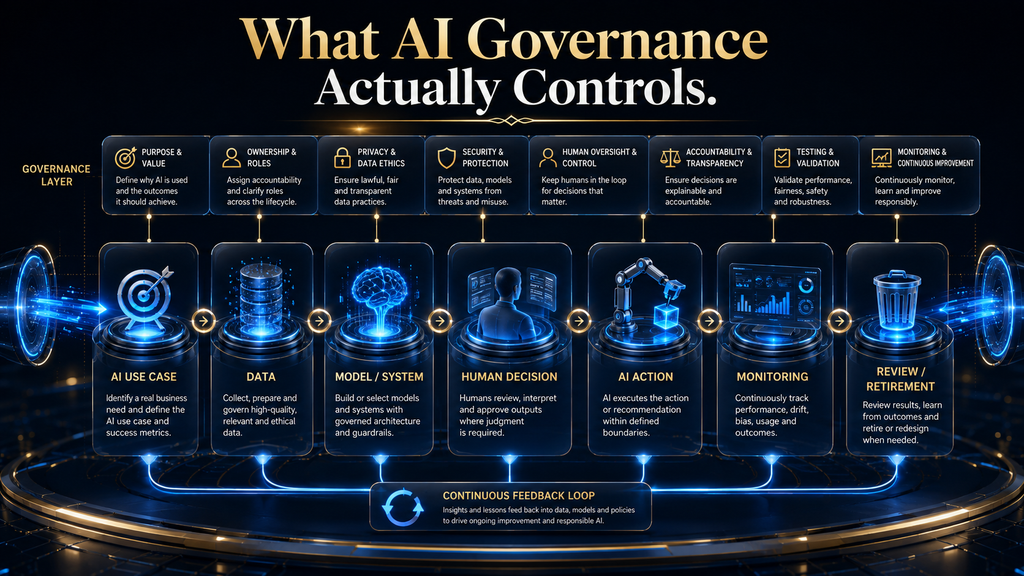
AI governance is the organizational system used to define how AI is selected, approved, deployed, monitored, reviewed, and retired. It brings together policies, accountability, risk management, data controls, human oversight, documentation, testing, monitoring, and decision rights so that AI adoption does not become a collection of disconnected decisions made by different employees or departments.
This distinction matters because responsible AI is not created simply by publishing an acceptable-use policy or asking employees to “use AI responsibly.” A useful governance system has to operate much closer to the work itself. It must determine which use cases are acceptable, which require additional controls, who owns the outcome, what evidence should exist before deployment, and what happens when the system behaves differently from what the organization expected.
The timing also matters. AI governance is no longer only a theoretical concern about future AI systems. Organizations are now dealing with generative AI assistants, AI-enabled SaaS products, automated decision support, AI agents, customer-facing chatbots, internal knowledge systems, and models supplied by third parties. At the same time, frameworks such as the NIST AI Risk Management Framework and ISO/IEC 42001, alongside regulations such as the EU AI Act, are giving organizations increasingly concrete ways to structure their approach. This guide is the starting point for our broader AI governance coverage, which includes risk management, data retention, bias, copyright, human oversight, governance platforms, compliance tools, and content provenance.
The goal of this guide is therefore not to give you another list of abstract AI ethics principles. It is to show how those principles become an operating system for real AI adoption.
What Is AI Governance?
AI governance is the framework of policies, responsibilities, controls, processes, and oversight an organization uses to decide how AI can be developed, purchased, deployed, monitored, and retired. It answers practical questions about authority, risk, data, accountability, human involvement, testing, documentation, and ongoing supervision.
The easiest way to understand governance is to imagine a company introducing an AI customer-service assistant. The technical team may be responsible for integrating the model, but that does not answer whether the system should be allowed to issue refunds, what customer information it can access, whether conversations can be retained, when a human must take over, who reviews incorrect answers, or who can shut the system down. Those are governance questions, and they exist even if the organization never trains its own model.
This is why governance should not be confused with technology management. Technology management asks whether a system works and how it should be operated. Governance asks whether the organization should use that system for a particular purpose, under what conditions, with whose authority, and with what safeguards.
A mature governance model therefore sits above individual AI tools. It should work whether the organization uses a commercial chatbot, an internal machine-learning model, an AI feature embedded in accounting software, a third-party API, or an autonomous agent connected to business systems.
Why AI Governance Has Become a Business Problem
AI governance became necessary because AI changes the relationship between software, information, decisions, and people.
Traditional software is usually designed to execute relatively explicit rules. If a payroll application calculates a salary according to a defined formula, an administrator can generally inspect the logic and determine why a particular number appeared. AI systems introduce a different operating model. Their outputs can depend on training data, prompts, context, model behavior, retrieval systems, changing versions, external tools, and probabilistic generation.
That does not make AI inherently unreliable. It does mean that predictability can no longer be the only basis for organizational control.
Consider an employee who uses an AI assistant to summarize a confidential contract. From the employee’s perspective, this may look like a productivity decision. From the organization’s perspective, it potentially involves confidential information, third-party data processing, retention, contractual restrictions, vendor terms, and the possibility that the summary omits an important clause. The same AI tool can therefore be low-risk in one workflow and materially higher-risk in another.
This is one of the central reasons governance must be attached to use cases rather than simply tools. Saying that “Tool X is approved” is incomplete because the risk comes from what people do with the tool, what information they provide, what authority the system receives, and what consequences follow from its output.
The NIST AI Risk Management Framework reflects this broader view. Its Govern function addresses policies, accountability, organizational culture, human-AI roles, third-party risks, inventory, and lifecycle considerations, while the framework as a whole is intended to help organizations manage AI risks rather than simply test models in isolation.
AI Governance, Responsible AI, and AI Risk Management Are Not the Same Thing
These terms are closely related, but treating them as interchangeable makes governance harder to understand.
Responsible AI describes the values and desired behavior surrounding AI. AI risk management focuses on identifying, assessing, measuring, and treating AI-related risks. AI governance is the organizational system that turns those principles and risk decisions into authority, policies, controls, accountability, and ongoing oversight.
For example, transparency is a responsible-AI principle. Assessing whether a model’s outputs are sufficiently explainable for a particular use case is a risk-management activity. Deciding who must approve that use case, what documentation is required, who reviews explanations, and what happens if transparency requirements are not met is governance.
The distinction is more than terminology. Without it, organizations often produce a document called an “AI ethics policy” and assume the governance problem is solved. A policy can establish expectations, but it does not automatically create ownership, testing, monitoring, escalation, or evidence. Governance begins when the organization creates a repeatable mechanism for turning expectations into decisions.
| Concept | Primary Question | Practical Role |
|---|---|---|
| Responsible AI | What should responsible AI look like? | Establishes principles and desired behavior |
| AI Risk Management | What could go wrong, how serious is it, and how should we address it? | Identifies, measures, and treats risk |
| AI Governance | Who decides, who is accountable, what controls apply, and how is the system overseen? | Creates the operating structure |
| AI Compliance | What applicable obligations must we satisfy? | Translates legal and regulatory requirements into obligations and evidence |
There is considerable overlap between the four, but none replaces the others. A business can have strong principles without effective controls, good technical controls without clear accountability, or legal compliance without a mature approach to the broader operational risks of AI.
The First Principle: Govern the Use Case, Not Just the Model
One of the easiest mistakes in AI governance is to treat the model as the unit of risk. It usually is not.
The same foundation model can be used to brainstorm social-media headlines, summarize internal documents, screen job applications, provide medical information, recommend financial actions, or operate an agent that can change records in a business system. The underlying model may be identical, but the governance requirements can be radically different because the consequences of its use are different.
This leads to a more useful governance question: What is this AI system being authorized to do?
A low-impact writing assistant may need basic data-handling rules and employee guidance. An AI system that recommends whether a customer receives credit needs much stronger controls because the decision can materially affect someone. An autonomous agent capable of issuing refunds, modifying customer records, or sending external communications introduces another dimension: not only can the AI recommend something, it can act on the recommendation.
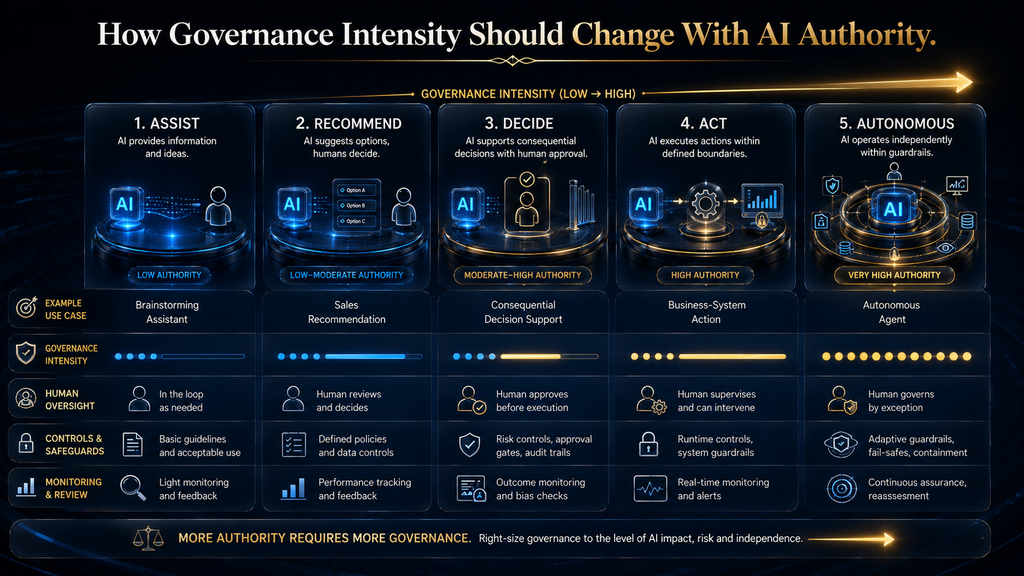
The more authority the system receives, the more important governance becomes.
This is why a useful AI inventory should record more than the model name. It should capture the purpose of the system, owner, users, data involved, external provider, degree of autonomy, affected stakeholders, connected systems, risk level, approval status, monitoring requirements, and retirement conditions.
A Practical AI Governance Framework: The G.O.V.E.R.N. Model
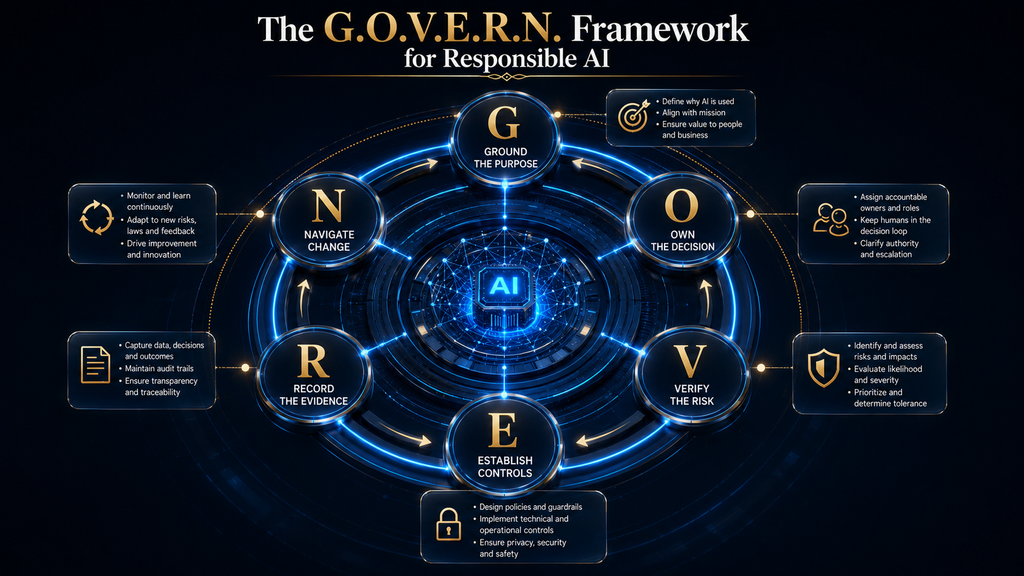
To make the concept operational, AI Hustle World can frame responsible adoption around six questions: Ground the purpose, Own the decision, Verify the risk, Establish controls, Record the evidence, and Navigate change.
This framework is not intended to replace NIST, ISO/IEC 42001, regulatory requirements, or an organization’s own legal obligations. Instead, it provides a practical way to translate those external frameworks into everyday business decisions.
G — Ground the Purpose
Every AI system should begin with a clearly defined business purpose.
That sounds obvious, but it eliminates a surprising amount of unnecessary AI adoption. Organizations often start with a technology question—“Where can we add AI?”—instead of a business question—“What problem are we trying to solve, and is AI actually the best way to solve it?”
A good purpose statement should identify the task being improved, the expected benefit, the people affected, the information required, and the boundaries of the system. “Use AI to improve customer service” is too broad to govern. “Use an AI assistant to draft responses to routine customer questions using approved knowledge sources, with human approval before sending” is specific enough to establish controls.
This also creates a baseline for measuring value. If the organization cannot explain what improvement it expected from an AI system, it becomes difficult to decide whether the risk and governance burden are justified.
The principle is simple: governance should begin with a business decision, not a model selection decision.
O — Own the Decision
Someone must remain accountable for the AI use case.
That does not necessarily mean one person performs every governance activity. Security may assess access controls, legal may review contractual or regulatory issues, IT may manage deployment, and an AI governance team may coordinate the overall process. But there must still be a clearly identified owner who is accountable for the business use of the system.
This becomes particularly important when something goes wrong.
Suppose an AI assistant begins producing incorrect customer responses after a model update. If nobody owns the system, the issue can bounce between the vendor, IT team, customer-service department, and compliance function. Everyone may have a role, yet nobody has the authority to make the final decision to suspend the workflow.
A strong governance model therefore defines decision rights, not just responsibilities. Who approves deployment? Who can reject a use case? Who can require additional testing? Who can change the risk classification? Who can suspend the system? Who must be informed after an incident?
NIST’s Govern function explicitly emphasizes accountability, organizational roles, human-AI configurations, and policies throughout the AI lifecycle.
V — Verify the Risk
Once the purpose and ownership are clear, the organization needs to understand what can go wrong.
Risk assessment should not be reduced to asking whether the model is “accurate.” Accuracy is important, but it is only one dimension of AI risk. A system can be technically accurate on average and still be inappropriate for a particular application if it exposes sensitive information, systematically performs worse for certain groups, operates without adequate human review, or has access to systems that make errors costly.
A useful assessment considers several dimensions:
| Risk Dimension | Questions to Ask |
|---|---|
| Impact | What happens if the AI is wrong? |
| Autonomy | Does it advise, recommend, decide, or act? |
| Data | What information does it access or process? |
| People | Who could be affected by its output? |
| Scale | How many decisions or interactions could it influence? |
| Reversibility | Can an incorrect outcome be easily corrected? |
| Regulation | Are there legal or regulatory obligations involved? |
| Security | Can misuse or compromise cause material harm? |
| Vendor dependence | What happens if the provider changes the model or service? |
The important point is that risk is contextual. A generative model is not inherently “high risk” simply because it is powerful, and a simple model is not automatically safe because it is less sophisticated.
The AI Governance Control Ladder
A practical way to apply proportional governance is to classify AI systems according to the amount of authority they have.
Level 1: Assist
The AI helps a person perform a task, but the person remains the direct decision-maker and the AI has little or no access to consequential systems. Examples include brainstorming, summarization, drafting, translation, or formatting. Governance can generally be lightweight, focusing on acceptable use, data handling, basic output verification, and employee awareness.
Level 2: Recommend
The AI analyzes information and recommends an action that a human is expected to evaluate. Examples might include sales prioritization, customer-support routing, candidate recommendations, or forecasting assistance. Governance should become stronger because users may develop automation bias—the tendency to accept a system recommendation simply because it appears objective or computational.
Level 3: Decide
The AI materially influences or makes a consequential decision. At this level, testing, documentation, monitoring, human oversight, fairness considerations, escalation procedures, and evidence become much more important.
Level 4: Act
The AI can execute actions in external or internal systems. An agent that can modify records, send communications, approve transactions, or initiate workflows introduces operational risk because an incorrect output can become an actual business action.
Level 5: Autonomous
The system can independently plan, choose actions, use tools, and operate across multiple systems with limited human intervention.
This requires the strongest governance because the organization is no longer merely evaluating AI outputs. It is delegating a meaningful degree of operational authority to the system.
The key insight is that governance intensity should increase as AI authority, consequence, scale, sensitivity, and irreversibility increase.
E — Establish Controls
Risk classification matters only if it changes what the organization actually does.
Controls are the mechanisms that convert a risk decision into operational boundaries. Depending on the use case, they may include access restrictions, data-classification rules, prompt filtering, approval gates, human review, output testing, logging, monitoring, vendor controls, incident procedures, or technical limits on what an AI agent can execute.
A customer-service assistant, for example, might be permitted to explain a refund policy but prohibited from issuing a refund above a certain amount without human approval. An internal research assistant might access approved company documents but be prevented from retrieving confidential HR records. An AI agent might be able to create a draft purchase order but require a human to authorize the final transaction.
This is where governance becomes tangible. A policy says what should happen; a control makes it harder for the opposite to happen.
Controls should also be proportionate. Requiring every low-risk AI experiment to go through a formal committee can discourage useful experimentation without meaningfully reducing risk. Conversely, allowing an AI system with access to sensitive data and consequential workflows to operate under the same lightweight rules as a writing assistant creates false confidence.
Why Human Oversight Is a Governance Decision, Not a Checkbox
Human oversight is often described as though placing a person somewhere in the workflow automatically makes an AI system safe. It does not.
A human reviewer can become a rubber stamp if the workflow gives them too little time, too little information, too much volume, or an organizational incentive to approve whatever the system recommends. Effective human oversight requires the person to have the authority, competence, information, and time necessary to challenge the AI.
Consider an AI recruiting system that recommends candidates. If a recruiter receives hundreds of recommendations and is measured primarily on hiring speed, simply requiring the recruiter to click “approve” does little to establish meaningful oversight. The governance question is not whether a human technically touches the process. It is whether that human can realistically identify and correct an inappropriate recommendation.
This is why our article Human-in-the-Loop AI: When Automated Decisions Need Human Review deserves its own treatment. This guide establishes the principle; that article goes deeper into how human review works and how to design escalation.
R — Record the Evidence
Good governance should leave an evidence trail.
An organization should be able to answer questions such as: What AI systems are we using? Who owns them? Why were they approved? What data do they process? What risk assessment was performed? Which controls were required? What testing occurred? What incidents have happened? When was the system last reviewed?
This does not mean every AI interaction needs a giant compliance file. The amount of documentation should match the risk.
For a low-risk productivity assistant, a centralized inventory entry and approved-use policy may be enough. For a high-impact system, the organization may need much more extensive evidence covering validation, performance, fairness, security, human oversight, vendor dependencies, monitoring, incidents, and changes.
The broader point is that governance should be auditable even when formal certification is not required.
NIST’s accountability-oriented approach and the OECD AI Principles both reinforce the importance of traceability and organizational responsibility. The OECD principles specifically connect accountability with traceability across datasets, processes, and decisions.
N — Navigate Change
AI systems are not necessarily static after deployment. Models can be updated, vendors can change their terms, data sources can change, prompts can evolve, users can find new applications, and an AI assistant can gradually become embedded in workflows far beyond its original purpose. That means approval cannot always be a one-time event.
A governance system should establish conditions that trigger reassessment. A major model update may require review. A new data source may change the privacy risk. Giving an agent additional system permissions may require a new risk assessment. A significant incident may require suspension or redesign.
NIST’s governance guidance explicitly includes lifecycle considerations and safe decommissioning of AI systems.
This is an important difference between governance and procurement. Procurement asks whether the organization should buy something. Governance asks whether the organization should continue allowing the system to operate under its current conditions.
What Should an AI Governance Program Actually Contain?
A functioning program does not need to be enormous, but it should cover the basic components that allow an organization to make repeatable decisions.
An AI Inventory
The inventory is the organization’s map of AI use.
It should ideally include internally developed systems, approved third-party tools, AI features embedded in SaaS applications, API integrations, and material employee use cases. The purpose is not surveillance for its own sake. It is visibility.
You cannot govern systems you do not know exist. A useful inventory might record the system name, business purpose, owner, provider, model type where relevant, data categories, users, connected systems, autonomy level, risk tier, approval status, controls, review date, and retirement status.
An AI Acceptable-Use Policy
The policy establishes broad boundaries for employees. It can explain which AI tools are approved, what types of information employees may provide, which tasks require verification, which uses are prohibited or restricted, and when human review is mandatory.
But the policy should remain practical. A document that says “never enter confidential information into AI” without explaining which approved enterprise systems are permitted for confidential workloads may push employees toward shadow AI rather than reducing it.
The best policies answer the question employees actually face at the moment of use: “Can I use AI for this particular task, and if so, what do I need to do first?”
Risk Classification
A governance program should establish a repeatable method for determining how much scrutiny a use case deserves. A simple model can combine: Impact × Autonomy × Data Sensitivity × Scale × Reversibility × Regulatory Exposure.
This is not a legal formula. It is a practical decision aid.
A low-impact internal writing assistant may score low across most dimensions. An AI system that helps determine employee eligibility for a benefit may score much higher because it affects people, handles sensitive information, influences a consequential decision, and may operate at scale.
The purpose of classification is not to create a perfect numerical score. It is to prevent organizations from applying the same governance process to fundamentally different situations.
Approval and Escalation Rules
Every risk tier should have a corresponding decision path. A small company might use a simple structure:
- Low risk: business owner approval under the standard AI policy.
- Moderate risk: business owner plus IT/security or privacy review where relevant.
- High risk: formal cross-functional assessment and documented approval.
- Restricted or unacceptable use: prohibited unless a specific legal, governance, or executive process allows it.
The names of the committees are less important than the decision rights. A governance system fails if employees know they need approval but cannot tell who has the authority to provide it.
Data Governance Must Be Part of AI Governance
AI governance and data governance increasingly overlap because AI systems depend on information. Before connecting an AI system to business data, an organization should understand what information is being provided, where it goes, how it is processed, how long it may be retained, who can access it, and what contractual or regulatory restrictions apply.
This becomes particularly important with third-party AI services. A company may think it has “approved AI” because the software was purchased centrally, while individual teams may be sending customer records, internal documents, source code, or employee information into that system without understanding the provider’s processing arrangements.
That is why data classification should be attached to AI use cases rather than handled entirely as a separate policy exercise.
For the details, see our guide to what happens to your prompts and files. This guide only needs to establish the governance principle: the organization should know what data an AI system can access and what happens to that data before granting the system access.
Third-Party AI Requires Its Own Governance Layer
Buying AI from a vendor does not transfer the organization’s responsibility for how that AI is used. Third-party risk can arise from model changes, service outages, security incidents, data processing, subcontractors, contractual limitations, changing capabilities, or a vendor’s decision to discontinue a particular model. Organizations should therefore ask vendors questions that go beyond “How accurate is your model?”
A more useful assessment considers:
- What data does the system receive?
- Is customer data used for model improvement?
- What retention controls exist?
- What happens when the underlying model changes?
- Can the customer restrict access to sensitive information?
- What logging and audit capabilities are available?
- How are security incidents communicated?
- What controls exist for administrative access?
- What happens to the data when the contract ends?
- Can the organization export or delete relevant information?
NIST’s governance guidance specifically recognizes third-party and supply-chain risks as part of AI governance. The principle is broader than procurement: vendor selection is part of governance because the vendor becomes part of the AI system’s risk boundary.
How NIST, ISO 42001, OECD Principles, and the EU AI Act Fit Together
Organizations frequently ask which AI governance framework they should use. That question is slightly misleading because these instruments do different jobs.
NIST AI RMF
The NIST AI Risk Management Framework is designed to help organizations manage AI risks and promote trustworthy and responsible AI. Its core functions are Govern, Map, Measure, and Manage, with Govern acting as a cross-cutting function across the lifecycle.
For organizations building an internal risk-management approach, NIST is particularly useful because it gives structure without requiring the organization to treat the framework as a rigid certification scheme.
ISO/IEC 42001
ISO/IEC 42001 is an international standard for an Artificial Intelligence Management System (AIMS). It provides a management-system approach for establishing, implementing, maintaining, and continually improving an organization’s AI management processes.
The important distinction is that ISO 42001 is management-system oriented. It can therefore be particularly useful for organizations that want a formal organizational structure around AI governance and continual improvement.
OECD AI Principles
The OECD AI Principles provide a broader set of principles around trustworthy AI, including human-centered values, transparency, robustness, security, safety, and accountability. The accountability principle is especially relevant to governance because it emphasizes responsibility and traceability.
These principles help establish what responsible AI should look like, while governance determines how the organization operationalizes those expectations.
EU AI Act
The EU AI Act is different again because it is legislation rather than a voluntary governance framework. Its provisions apply according to a staged timeline and impose obligations on relevant organizations and AI systems within its scope. The European Commission’s current regulatory framework information reflects the Act’s phased application, including provisions already applicable and later obligations.
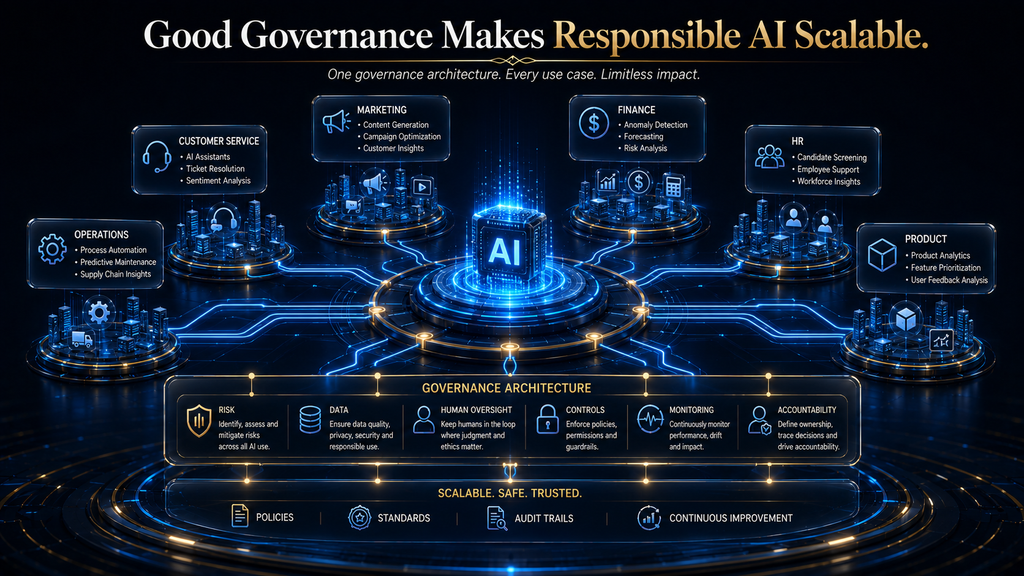
The important lesson is that companies should not treat the EU AI Act, NIST AI RMF, ISO/IEC 42001, and OECD principles as competing versions of the same document. They can occupy different layers of an organization’s governance architecture.
| Instrument | What It Primarily Provides | Best Viewed As |
|---|---|---|
| NIST AI RMF | AI risk-management structure | Risk-management framework |
| ISO/IEC 42001 | AI management-system requirements | Management-system standard |
| OECD AI Principles | International responsible-AI principles | Principles and policy foundation |
| EU AI Act | Binding legal obligations within scope | Regulatory requirement |
An organization may use one, several, or other frameworks depending on its circumstances. The right combination depends on geography, industry, risk profile, customer requirements, organizational maturity, and regulatory exposure.
AI Governance Should Be Proportional, Not Bureaucratic
One of the most damaging approaches to governance is assuming that more paperwork automatically means more responsible AI. It does not.
Imagine a 30-person company using an AI assistant to turn meeting notes into internal summaries. Requiring a formal AI governance board, extensive model validation, and quarterly executive certification for that use case would consume resources without proportionate risk reduction.
Now imagine the same company deploying an AI system that ranks job applicants. The consequences are much more significant. The organization may need stronger testing, documentation, human oversight, data controls, monitoring, and legal review.
The objective is therefore not maximum governance. It is proportionate governance.
That distinction is especially important for small and mid-sized businesses, which may not have dedicated AI governance teams. Our guide to building an AI risk management framework for small and mid-sized businesses covers the mechanics for those organizations, while this guide establishes the broader proportionality principle.
Minimum Viable AI Governance for a Small Business
A smaller organization does not need to reproduce the governance structure of a multinational enterprise to establish useful controls. A practical baseline can include:
| Governance Element | Minimum Viable Approach |
|---|---|
| AI inventory | Maintain a central list of material AI tools and use cases |
| Ownership | Assign a named business owner to each material use case |
| Acceptable use | Define approved and restricted AI activities |
| Data rules | Clearly identify information employees cannot provide to unapproved AI systems |
| Risk tiers | Separate low-impact assistance from consequential or autonomous use |
| Approval | Establish who approves each risk category |
| Human review | Define where human verification is mandatory |
| Incidents | Provide a clear method for reporting AI failures |
| Monitoring | Periodically review higher-risk systems |
| Retirement | Remove tools that no longer justify their risk or value |
That is enough to move a company from uncontrolled experimentation toward a repeatable governance model. The important thing is to start with visibility and decision rights, not a 100-page policy.
What Happens If a Business Does Nothing?
Doing nothing about AI governance does not create a governance-free environment. It creates informal governance by default.
Employees decide which tools to use. Managers decide when AI outputs are acceptable. Developers choose which APIs to connect. Procurement approves vendors based on commercial requirements. Individual users decide what data to upload. Different departments establish different assumptions about whether AI-generated material needs human review.
The organization may therefore have dozens of small AI decisions happening without a shared standard.
This is what makes shadow AI particularly difficult. The problem is not necessarily malicious behavior. Employees may simply be trying to solve legitimate business problems faster, using tools that are easy to access.
A blanket ban often fails because it does not address the underlying demand. If employees need summarization, research, drafting, translation, analysis, or automation, they will look for ways to perform those tasks. Governance is more effective when it gives employees safe paths to legitimate AI use rather than simply telling them that AI is dangerous.
That is why good governance can actually accelerate adoption.
Governance as an Adoption Enabler
There is a common misconception that responsible AI governance exists mainly to slow down innovation.
Poor governance can certainly create bureaucracy. Good governance can do the opposite.
Suppose employees know that public information can be used with approved AI tools, confidential customer information requires an approved enterprise environment, high-impact decisions require human review, and autonomous actions above a defined threshold require authorization. They can move faster because the boundaries are already clear.
Without those rules, every new AI project becomes a fresh debate. This leads to an important strategic idea:
The purpose of governance is not to decide whether the organization can use AI. Its purpose is to make the conditions for acceptable AI use clear enough that the organization can move with confidence.
That is especially valuable as AI moves from isolated chat interfaces into everyday software and increasingly autonomous agents.
The Economics of AI Governance
Governance has a cost, so organizations should evaluate that cost alongside the value and risk of the AI system.
A governance process consumes employee time. Reviews require expertise. Testing costs money. Monitoring requires infrastructure and attention. Documentation takes effort. If the expected business value of a low-risk AI use case is tiny, excessive controls can make the project economically irrational.
The opposite is also true. A high-impact AI system may look inexpensive to deploy while carrying enormous downside risk if it produces systematic errors, exposes sensitive information, creates regulatory problems, or takes unauthorized actions.
A useful decision therefore considers three variables:
- Expected value of the AI use case
- Cost of governance and operation
- Potential downside if the system fails
The question becomes: Is the expected value high enough to justify the system’s risk and the controls required to manage it? That is a better business question than simply asking whether AI can perform the task.
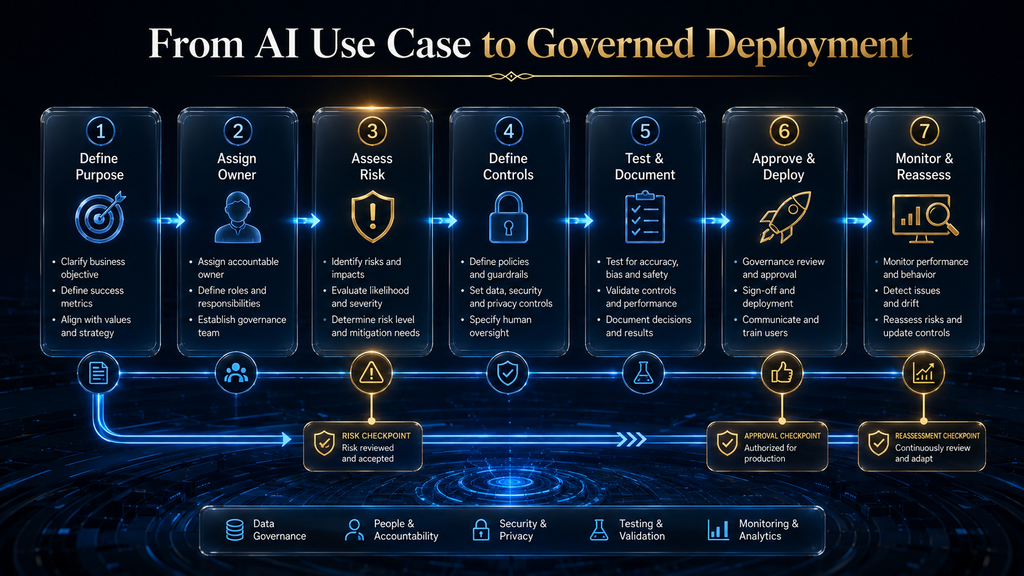
A Practical AI Governance Lifecycle
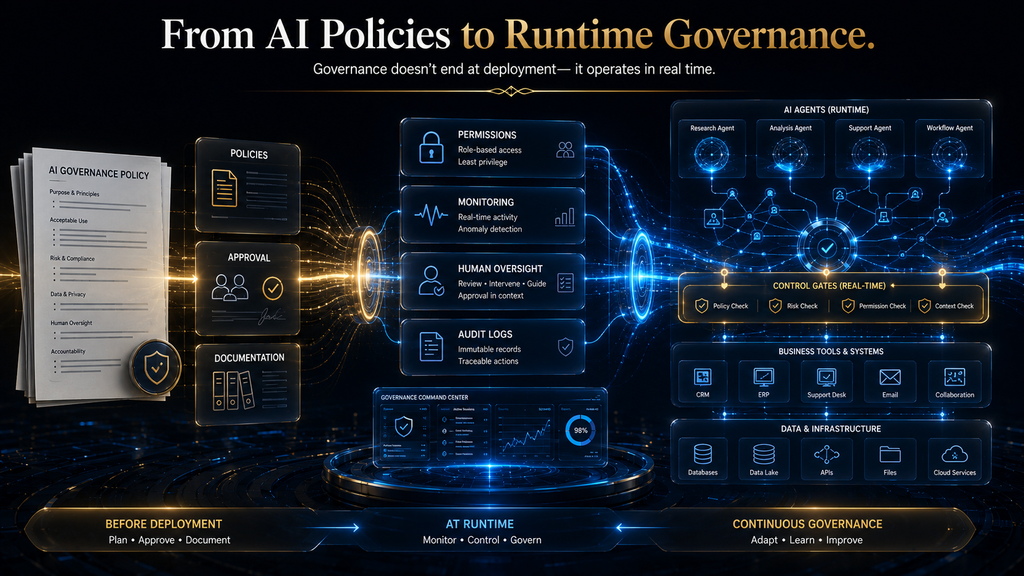
AI governance should follow the lifecycle of the system rather than ending at approval.
Discover
Identify where AI is being used, including approved tools, embedded AI features, custom systems, APIs, and material employee use.
Classify
Determine the purpose, impact, autonomy, data sensitivity, scale, affected stakeholders, regulatory exposure, and reversibility.
Assign
Name the business owner and define who has authority over approval, changes, escalation, and shutdown.
Define
Establish acceptable-use rules, data boundaries, human-review requirements, vendor requirements, and operational expectations.
Control
Implement the technical and procedural safeguards required for the risk level.
Approve
Document the decision to deploy and the conditions under which deployment is permitted.
Monitor
Track performance, incidents, user feedback, changes, drift, security issues, and business value.
Improve
Use evidence and incidents to strengthen controls and revise the governance process.
Retire
Deactivate systems that are no longer useful, safe, compliant, supported, or economically justified. The advantage of this lifecycle is that governance becomes continuous rather than something performed once before launch.
Measuring Whether AI Governance Is Working
If governance cannot be measured at all, it can easily become an administrative exercise.
The most useful metrics are not simply the number of policies published or meetings held. They should measure coverage, accountability, control effectiveness, incidents, and business outcomes.
A practical scorecard could include:
AI Inventory Coverage
What percentage of known material AI systems are recorded in the inventory?
Ownership Coverage
What percentage of material AI systems have a clearly assigned owner?
Risk Classification Coverage
What percentage of AI systems were risk-classified before production use?
Pre-Deployment Control Completion
How many required controls were completed before deployment?
Monitoring Coverage
What percentage of higher-risk AI systems are actively monitored?
Incident Rate
How frequently do material AI-related incidents occur?
Response Time
How quickly can the organization investigate and contain an AI incident?
Remediation Rate
How many identified governance issues are resolved within the organization’s target timeframe?
Policy Compliance
How much AI usage occurs within approved organizational boundaries?
Business Value
Are governed AI systems actually producing the expected productivity, quality, revenue, cost, or service improvements?
The final metric is easy to overlook. Governance should not exist independently of business value. If an AI system produces little value while consuming significant governance resources, the correct governance decision may be to retire it.
Common AI Governance Mistakes
Treating the AI Policy as the Governance Program
A policy is necessary in many organizations, but it is not the entire governance system. Without inventory, ownership, risk classification, controls, monitoring, and escalation, the policy may become a document that nobody consults.
Governing Tools Instead of Use Cases
Approving an AI tool does not mean every use of that tool carries the same risk. Governance should consider what the system is being used to accomplish, what data it receives, and what authority it has.
Creating a Committee Without Decision Rights
An AI committee that discusses responsible AI but cannot approve, reject, restrict, or suspend systems is not necessarily effective governance. Governance requires authority.
Applying the Same Controls Everywhere
A brainstorming assistant and an AI system influencing employment decisions should not have identical approval processes. Uniformity is not the same as proportionality.
Relying on Human Review as a Magic Safety Layer
A human reviewer who lacks time, authority, expertise, or meaningful access to supporting evidence may provide little real protection.
Ignoring Vendor Changes
Third-party AI systems evolve. A model update, new capability, changed retention policy, or newly connected integration can alter the risk profile.
Forgetting About Retirement
Organizations sometimes continue using AI systems simply because nobody has established conditions for shutting them down. Governance should include decommissioning.
Measuring Governance Activity Instead of Outcomes
Counting policies, meetings, and training sessions can create an illusion of progress. More useful measures examine whether the organization actually knows where AI is used, whether risky systems are controlled, and whether incidents are detected and addressed.
A Real-World Lesson: The Air Canada Chatbot Case
One of the clearest governance lessons comes from an AI customer-service chatbot that provided incorrect information to a customer.
The case is useful because it illustrates the accountability problem created when organizations treat an AI system as though it were an independent actor. The important governance principle is not the specific technology involved; it is the organizational responsibility behind the technology.
When a company deploys an AI system in front of customers, the system becomes part of the company’s service operation. If the system provides incorrect information, saying “the chatbot made the mistake” does not answer the more important governance question: who authorized the system to communicate with customers, what controls were in place, and who was responsible for its behavior?
The lesson is straightforward: delegating a task to AI does not delegate organizational accountability. That principle will become even more important as AI systems gain greater autonomy.
A Real-World Lesson: Amazon’s Recruiting Experiment
Amazon’s abandoned recruiting system provides a different lesson: AI can reproduce undesirable patterns from historical data even when the system itself was not explicitly programmed to discriminate. Reporting on the project described how the system learned from historical resumes and developed patterns that disadvantaged women, ultimately leading Amazon to abandon the system. The governance lesson is broader than recruitment.
An AI system can inherit properties of the environment from which its data comes. Therefore, governance cannot be limited to evaluating whether the model produces technically plausible outputs. Organizations also need to ask whether the underlying data, decision process, intended use, and affected population create risks that require testing and human judgment.
That is why bias, privacy, copyright, and human oversight deserve their own dedicated articles rather than being reduced to four short bullet points here.
The Contrarian View: More AI Governance Is Not Always Better
Here is the reality check that many governance discussions avoid: an organization can over-govern AI just as easily as it can under-govern it.
Excessive approval processes can push experimentation into the shadows. Employees may stop asking for approved solutions because the formal process takes too long, then adopt consumer AI tools independently. Small teams can become afraid to experiment with low-risk applications because every AI project is treated like a regulated financial system.
That outcome is not responsible AI. It is governance failure caused by poor proportionality.
The strongest governance programs therefore create different lanes for different levels of risk. Low-risk use cases should move quickly within predefined boundaries. Medium-risk systems should receive targeted review. High-impact and autonomous systems should face much stronger scrutiny.
Governance should create clarity, not friction for its own sake.
Who Should Own AI Governance?
AI governance is usually too broad for one department to own alone.
Leadership establishes risk appetite and organizational priorities. Business owners understand the actual purpose and consequences of AI use. IT and engineering manage implementation. Security evaluates threats and access. Privacy teams assess data handling. Legal teams interpret relevant obligations and contracts. Procurement evaluates vendors. HR may be involved when AI affects workers or employment decisions. Internal audit or risk functions can provide independent oversight in more mature organizations.
The exact structure depends on the company’s size.
A large enterprise may use a formal AI governance committee supported by specialized functions. A mid-sized company may assign a cross-functional working group. A small company may have one executive owner supported by IT, legal, security, or external specialists when needed.
The organizational chart matters less than one principle: governance responsibility must be explicit enough that important decisions cannot fall between departments.
AI Governance for Different Organizational Maturity Levels
Early-Stage Organization
The priority should be visibility and basic boundaries. Create an AI inventory, identify approved tools, establish basic data rules, assign owners, and define prohibited or high-risk uses.
Growing Organization
The focus should shift toward risk classification and repeatability. Introduce formal risk tiers, approval paths, incident reporting, vendor review, human-review requirements, and periodic monitoring.
Mature Enterprise
The organization can introduce more sophisticated lifecycle management, continuous monitoring, formal assurance, independent assessment, AI management systems, detailed third-party governance, and integration with broader enterprise risk management. This progression matters because governance should evolve with the organization’s AI footprint.
A company does not need an enterprise bureaucracy on day one. It needs enough structure to control the risks it actually has.
What AI Governance Looks Like in Practice
Imagine a 100-person company introducing an AI assistant for customer support. The business purpose is to reduce response time for routine questions while keeping human agents responsible for complex cases.
The organization first records the system in its AI inventory and names the customer-service leader as the business owner. It identifies what information the system can access and restricts access to sensitive customer records that are unnecessary for the task.
The system is classified as moderate risk because it interacts with customers and can influence service decisions, but it cannot independently approve refunds or alter financial records. The governance rules therefore require output monitoring, human review for exceptions, incident reporting, and periodic reassessment.
After deployment, the company discovers that the assistant performs well on routine questions but frequently struggles with unusual policy exceptions. Instead of declaring the system a failure, the team narrows its authorized scope, adds an escalation path, improves the knowledge sources, and changes the monitoring criteria.
That is what governance should look like.
It is not a document sitting in a shared folder. It is a feedback mechanism between business objectives, AI behavior, risk, controls, and organizational decisions.
AI Governance and the Rise of AI Agents
The governance problem becomes more difficult as AI moves from answering questions to taking actions.
A chatbot that generates a draft response has limited authority. An agent that can search internal databases, create tickets, update customer records, send messages, purchase services, or execute workflows has a much larger operational footprint.
The important shift is from: “What answer did the AI produce?” to: “What action did the AI take, with what authority, using which information, and with what consequences?” That changes the control model.
Agent governance may require permission boundaries, tool-level access controls, action thresholds, approval gates, transaction limits, audit logs, rollback mechanisms, monitoring, and explicit escalation paths. The organization may also need to evaluate sequences of actions rather than individual outputs because an agent can produce a harmful outcome through a series of individually plausible steps.
This is one reason governance must be designed as a lifecycle system rather than a static policy.
Second-Order Effects of AI Governance
The first-order effect of governance is risk reduction. The second-order effects can be more interesting.
A well-maintained AI inventory can reveal duplicate tools across departments and reduce software costs. Standardized controls can make procurement faster because vendors are evaluated against known criteria. Clear approval paths can reduce employee uncertainty and encourage responsible experimentation. Incident records can reveal recurring weaknesses in processes, training, or vendor selection.
Governance can therefore become a source of organizational intelligence.
Suppose a company discovers through its AI inventory that six departments have independently purchased similar AI assistants. That finding is not merely a compliance issue. It may reveal unnecessary spending and fragmented workflows.
Or suppose incident monitoring shows that AI failures repeatedly occur because employees misunderstand when human review is required. The governance problem may not be model quality at all. It may be training and workflow design.
The strongest governance programs learn from those signals rather than simply recording them.
A Decision Matrix: How Much Governance Does an AI Use Case Need?
The following matrix provides a practical starting point rather than a substitute for formal risk assessment.
| AI Use Case | Typical Risk | Governance Intensity | Key Controls |
|---|---|---|---|
| Brainstorming public marketing ideas | Low | Light | Approved tool, basic verification |
| Summarizing internal documents | Low–Moderate | Light–Moderate | Data controls, approved environment, review |
| Customer-service response drafting | Moderate | Moderate | Knowledge controls, monitoring, human escalation |
| AI sales recommendations | Moderate | Moderate | Evaluation, monitoring, human judgment |
| Employee screening | High | Strong | Bias testing, documentation, human oversight |
| Credit or eligibility decisions | High | Strong | Formal risk assessment, controls, monitoring, review |
| AI agent modifying business records | High | Strong | Permission limits, logs, approval thresholds |
| Autonomous agent executing consequential transactions | Very High | Highest | Strict authorization, monitoring, escalation, rollback |
The matrix demonstrates why “Is AI safe?” is usually the wrong question. The better question is: Safe enough for what, under which conditions, and with what controls?
The Practical Governance Checklist
Before approving a material AI use case, an organization should be able to answer the following questions clearly:
- Purpose: What business problem is the AI solving, and what happens if we do not use it?
- Ownership: Who is accountable for the use case and its outcomes?
- Data: What information does the system access, and what restrictions apply?
- Risk: What could go wrong, who could be affected, and how serious would the consequences be?
- Authority: Does the AI assist, recommend, decide, act, or operate autonomously?
- Controls: What safeguards are required before deployment?
- Human oversight: Where must a person review, approve, or challenge the system?
- Evidence: What documentation demonstrates that the system was assessed and approved appropriately?
- Monitoring: How will the organization know when the system begins behaving differently or producing unacceptable outcomes?
- Escalation: Who can intervene, restrict, or shut down the system?
- Change: What changes trigger a new review?
- Retirement: Under what circumstances will the organization stop using the system?
If those questions have clear answers, the organization has moved substantially beyond “we have an AI policy” and toward actual governance.
Where AI Governance Is Heading
AI governance will become more important as AI becomes less visible.
Early enterprise AI adoption often involved employees deliberately opening a chatbot and entering a prompt. Increasingly, AI is being embedded inside CRM systems, productivity suites, development environments, customer-service platforms, analytics products, recruiting systems, security tools, and business-process software.
That creates a governance challenge because organizations may not always perceive an embedded AI feature as a separate AI system.
The next stage is even more significant: AI agents will increasingly combine models, tools, data sources, workflows, and permissions. Governance will therefore have to move closer to runtime control. Organizations will need to understand not only which models they have approved, but what actions AI systems are permitted to take and under what conditions.
This also means AI governance will become more closely connected to cybersecurity, privacy engineering, software supply-chain management, enterprise architecture, procurement, and operational risk.
The governance function itself may also become partially automated. AI systems can help maintain inventories, classify use cases, review documentation, monitor outputs, identify policy violations, and surface anomalies. But that creates a recursive problem: organizations will increasingly use AI to govern AI.
Human judgment will remain essential where the consequences are high or the situation is ambiguous.
The Future of Responsible AI Adoption Is Not “No Risk”
There is no realistic governance model that eliminates AI risk.
Models can fail. Data can be incomplete. Vendors can change. Employees can misuse systems. Requirements can evolve. New attack techniques can emerge. Even carefully designed systems can behave differently when placed into real organizational environments.
The objective is therefore not to create a magical state in which AI becomes risk-free. The objective is to create an organization that can see the risk, decide whether it is acceptable, apply appropriate controls, detect when assumptions fail, and respond before a small problem becomes a major one. That is a much more achievable and useful definition of responsible AI adoption.
Final Thoughts
AI governance is often presented as a compliance exercise, but that description misses its most important purpose. At its core, governance is a way for an organization to make deliberate decisions about where AI belongs, how much authority it should have, what risks are acceptable, and who remains accountable for the outcome.
The most useful governance program is therefore not the one with the largest policy library or the most meetings. It is the one that gives employees and decision-makers enough clarity to distinguish ordinary AI assistance from genuinely consequential automation, apply controls proportionately, and respond intelligently when reality does not match expectations.
The G.O.V.E.R.N. approach provides a practical way to think about that process: ground the purpose, own the decision, verify the risk, establish controls, record the evidence, and navigate change. It turns responsible AI from a collection of principles into a repeatable operating discipline.
The deeper lesson is that AI governance should not be built around the assumption that AI must either be fully trusted or completely avoided. The better question is whether the organization has created the conditions under which a particular AI system can be used responsibly. When those conditions are clear, businesses can adopt useful AI more confidently while retaining human judgment where consequences, uncertainty, and ambiguity demand it.
Good AI governance does not make AI risk disappear. It makes the organization better at seeing, managing, and responding to that risk.
Build AI Adoption on a Stronger Foundation
Use this framework as a starting point for defining AI ownership, risk, data controls, human oversight, and monitoring across your organization.
Build Your AI Risk Framework →Frequently Asked Questions
1. What is AI governance in simple terms?
AI governance is the system an organization uses to control how AI is selected, approved, used, monitored, and retired. It defines responsibilities, risk levels, data rules, human oversight, controls, documentation, and escalation procedures so that AI adoption remains accountable and proportionate to its potential impact.
2. Why is AI governance important for businesses?
AI governance helps businesses manage risks involving inaccurate outputs, sensitive data, bias, security, regulatory obligations, vendor dependencies, inappropriate automation, and unclear accountability. It also creates clearer boundaries that can make responsible AI adoption faster rather than forcing every new use case through an improvised approval process.
3. Is AI governance the same as responsible AI?
No. Responsible AI describes the principles and desired behavior associated with trustworthy AI, while AI governance provides the organizational structure used to put those principles into practice. Governance determines who makes decisions, what controls apply, what evidence is required, and how the organization monitors the system over time.
4. What should an AI governance framework include?
A practical framework should generally include an AI inventory, named owners, acceptable-use rules, risk classification, approval processes, data controls, human-oversight requirements, testing, monitoring, incident response, vendor management, documentation, and conditions for changing or retiring AI systems.
5. Does a small business need AI governance?
Yes, but it does not need the same level of governance as a large enterprise. A small business can begin with an inventory of AI tools, clear data-handling rules, named owners, simple risk tiers, defined approval rules, human-review requirements for consequential uses, and an incident-reporting process.
6. What is the NIST AI Risk Management Framework?
The NIST AI Risk Management Framework is a voluntary framework designed to help organizations manage AI risks and promote trustworthy and responsible AI. Its core functions are Govern, Map, Measure, and Manage, with governance operating as a cross-cutting function throughout the AI lifecycle.
7. What is ISO/IEC 42001?
ISO/IEC 42001 is an international standard for an Artificial Intelligence Management System. It provides organizations with a structured management-system approach for establishing, implementing, maintaining, and continually improving processes for managing AI.
8. Does human review make an AI system safe?
Not automatically. Human oversight is effective only when reviewers have the authority, information, competence, and time needed to challenge AI outputs. A person who simply approves AI recommendations without meaningful ability to question them may provide little practical protection.
9. How often should an AI system be reviewed?
The appropriate frequency depends on its risk and how quickly its environment can change. Higher-risk systems generally need more active monitoring and more frequent reassessment, while low-risk tools may only need periodic review. Significant model updates, new data sources, expanded permissions, incidents, or changes in intended use should generally trigger reassessment.
10. Can AI governance slow down innovation?
Poorly designed governance can slow innovation, but well-designed governance can accelerate it by establishing clear rules for acceptable AI use. The goal should be proportional governance: lightweight controls for low-risk applications and stronger oversight for systems that affect people, handle sensitive data, make consequential decisions, or take autonomous actions.
Written by
Muntasir Ahmad Chowdhury
Founder, AI Hustle World
Muntasir Ahmad Chowdhury is the Founder of AI Hustle World, an independent publication dedicated to making Artificial Intelligence practical, trustworthy, and easy to understand. He researches AI tools, automation, customer service, productivity, and real-world business applications, helping readers make smarter technology decisions through research-driven, experience-backed content.
Expertise:
AI Tools • AI Automation • AI Customer Service • AI Productivity • Generative AI • AI Workflows
Get Smarter With AI
Enjoyed this guide? Get practical AI tools, tutorials, and honest reviews delivered to your inbox.
7 thoughts on “AI Governance Explained: A Practical Framework for Responsible AI Adoption”