How to Generate and Maintain Software Tests using AI
A developer asks an AI coding assistant to add tests for a discount function. The assistant writes six tidy cases, the suite turns green, and the coverage report improves. Two months later, the promotion policy changes, an agent updates a failing expected value, and the suite turns green again.
The first green run may have added useful protection. The second may have preserved the new policy—or quietly erased the only warning that the implementation is wrong. The difference is not how quickly the AI edited the file. It is whether anyone can trace an assertion back to the behavior it was meant to protect.
That is the problem this guide solves. AI can help you discover existing test conventions, enumerate cases, write boilerplate, run checks and propose repairs. It cannot infer every approved product rule from the code it sees, and it should not get to decide that a failing assertion is obsolete simply because changing it makes the build pass. We will follow one promotion-rule example from test generation through a later policy change, including a small controlled demonstration with its method and observed output stated plainly. The example is deliberately narrow; it does not measure the performance of an AI product.
Our AI coding assistants explainer places testing within the wider development workflow. Here the focus stays on the tests themselves: how to give AI the right context, establish independently meaningful expected results, challenge weak cases, and maintain the suite without teaching it to ignore regressions.
The real job of a software test
A software test supplies an input or sequence of actions, observes a result, and decides whether that result matches an expectation. That last part is called the test oracle. In a simple function test, the oracle might be discount(300) == 25; in an integration test, it might be that a user cannot read another account’s order after an API call. The assertion can be written in a line, but knowing which result is correct may require a product requirement, an API contract, a reproduced bug, or a decision from a domain owner.
Generating test syntax is therefore the easiest part to automate. AI can inspect a function and produce cases for ordinary inputs, boundaries and errors. If the implementation already contains a bug, though, asking the model to derive every expected value from that implementation may generate an elegant suite that blesses the bug. The research on LLM-driven test oracle generation frames this as the challenge of distinguishing intended behavior from observed implemented behavior. That is a research problem, and a practical review problem in every repository where the code and the requirement might disagree.
For a test to earn a place in the suite, ask what wrong behavior would make it fail. “Returns a value” may be too weak if both a correct and incorrect discount return numbers. “Returns a nonnegative value” may be fine for one invariant but cannot establish the approved cap. A case can still be useful without catching every possible bug; it should have a clear purpose and a specific class of mistakes it can detect. Test names, fixtures and assertions should help a future developer see that purpose without reverse-engineering the person or model that wrote them.
This is also why the number of generated tests is a poor outcome measure by itself. A dozen similar cases can exercise the same branch while leaving a consequential boundary unprotected. The point of AI assistance is to reduce the mechanical effort of creating and maintaining useful evidence, not to make the test directory look busy. The test suite is a product asset: it should tell the team when an important behavior changes and make failures reasonably cheap to diagnose.
Decide what AI should see before asking it to write tests
Start with the repository, not a generic prompt. Locate the existing framework, test files, fixtures, naming style, setup and teardown rules, and the commands for running one file and the relevant suite. Run the baseline or record any pre-existing failures. Otherwise, a new failure may be attributed to the generated test when the main branch was already broken, or a model may introduce a second runner because it did not know the project already had one. The official Visual Studio Code guide to testing existing code with AI recommends inspecting the test setup and requirements before generating code, then keeping implementation edits separate when adding tests to existing behavior.
The next input is a source of expected behavior that is independent of the code under test. This might be a written user story with acceptance criteria, a versioned API definition, an approved policy decision, or a bug report with a reproducible before/after. Existing tests are useful context for style and current coverage, but they may be wrong or incomplete. If the requirement is missing, ask the model to list the assumptions and questions rather than silently turn its guess into a permanent assertion.
Our running example uses a deliberately simple policy: a promotion discounts an eligible order by 10%, with a maximum discount of $20. The product owner later approves raising only the cap to $25. Money is expressed as integer cents in the controlled demonstration, with no tax, eligibility, currency-conversion or rounding rules modeled. In a real checkout system, those omitted rules could change the correct expectation. State them before the model writes a case, or keep the case scoped to the isolated calculation that is actually specified.
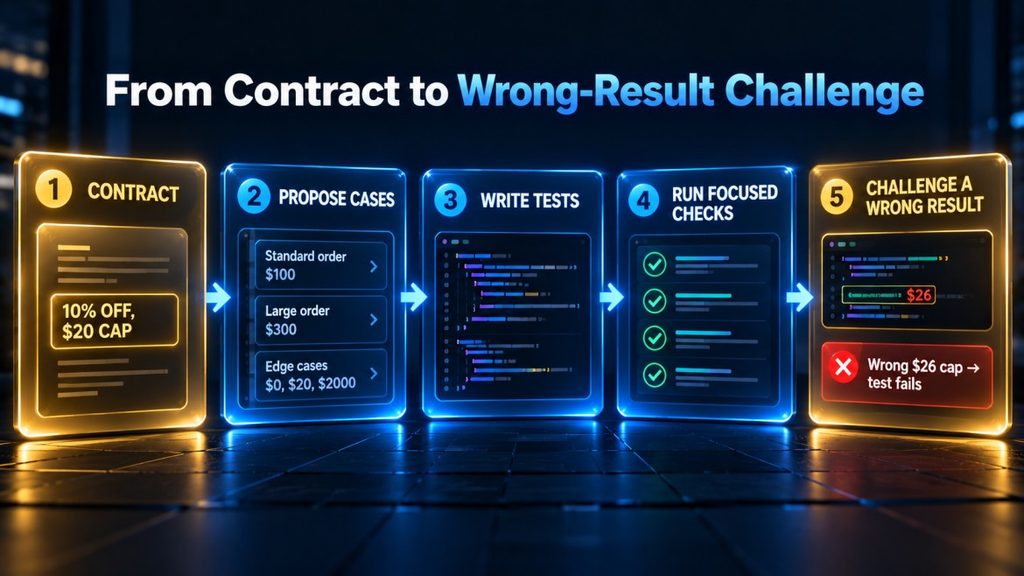
A useful first request is to propose cases without editing files. Ask for the ordinary case, the point just below the cap, the point at or above it, invalid inputs if specified, and any existing regression that matters. Ask it to identify ambiguous behavior rather than fill the gap with convention. For the $20 cap, a $100 subtotal should yield $10, while a $300 subtotal should yield $20. The suite should also say why each result is expected, not merely repeat what the current function returns.
Pause on the case proposal long enough to challenge it. A model might propose testing $200 exactly because 10% of $200 equals the old cap, yet that single example does not distinguish a correct $20 cap from a faulty $21 cap. A $300 case does, because the uncapped 10% would be $30 and the policy must intervene. The distinction is a small act of test design that generic “include edge cases” prompts often leave implicit. It also gives the reviewer a specific reason to keep the case after a future refactor.
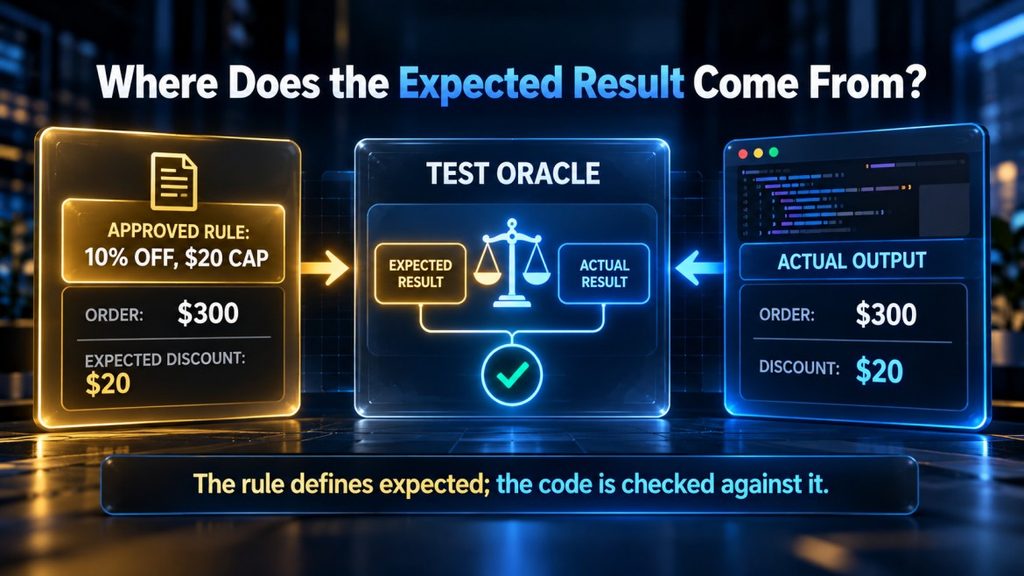
Only after reviewing that case plan should you ask for test code. Give the model a representative existing test and the project’s framework and fixture conventions. In a repository with mature tests, constrain the initial change to test files; if it finds a product bug, keep the failing test and address the implementation in a separate reviewable step. This protects the distinction between evidence and repair. It also makes it much easier to see whether a “fixed test” is actually a changed expectation.
The breadth of context should follow the type of test. A pure unit test may need the public function contract and nearby examples. An integration test needs the real database schema, service boundary or API contract, plus the intended response when something fails. A browser test needs a user goal, current UI behavior and reliable locators in the rendered page. Asking the same model to invent all three layers from a vague ticket invites plausible but incompatible data shapes and too much mocking.
A prompt that preserves the decision boundary
For an existing module, the prompt can be concrete without dictating every line: “Inspect the repository’s current test runner and one adjacent test. Here is the approved discount rule and its examples. Propose the behavior cases and note any unspecified input. Do not edit production code, add dependencies, or change existing expected values. After I confirm the cases, implement the tests in the current framework, run the focused command, and report the command, results and any blocked checks.” The important part is not a magic wording sequence. It is the separation of contract, case design, test edit and evidence.
If an agent rather than a chat assistant performs the work, permissions matter too. It may search files, edit tests and run commands through its tool environment. Our guide to how AI agents use tools explains that general execution pattern, and the coding-agents article handles its broader authority and handoff. In this testing guide, the concrete constraint is narrower: an agent must not make production behavior and its own tests agree by changing both sides without an independently reviewed requirement.
Generate the right layer of tests
Unit, integration and end-to-end tests answer different questions. A unit test can give fast feedback on a calculation or a state transition. An integration test can check that real components exchange the right data and enforce a boundary. An end-to-end test can check that a user can accomplish a goal through the deployed application. AI is useful at each layer, but a good unit prompt cannot simply be expanded into an integration prompt by adding “comprehensive.” You must supply the external contract and the environment the test crosses.
For the discount rule, a unit test can assert that the calculation returns $10 at a $100 eligible subtotal and $20 at $300 under the old policy. An integration test could verify that checkout applies the calculation once, stores the discounted total and returns the amount through the order API. A browser test might click through a checkout journey and verify the displayed discount for an eligible user. The latter two need more setup and can fail for reasons unrelated to the discount function, so do not add them merely to make a pyramid look balanced. Add the layer that catches an important failure the lower layer cannot.
This distinction becomes critical when the test double is too convenient. Suppose an integration test mocks the checkout service’s discount response as $20 and then asserts that the page displays $20. It may confirm UI wiring while saying nothing about whether checkout enforces the cap. That test can still be useful if its stated purpose is display behavior. It must not be presented as proof of pricing policy. Ask the AI what behavior the mock has replaced and whether another test crosses that boundary with the real implementation.
For browser tests, recorded interactions help the model discover selectors, but a recording is not the same as a meaningful assertion. The Playwright documentation on locators favors locators tied to the user’s view of the page or an explicit test-id contract, with built-in waiting behavior. A generated test that clicks a brittle nth-child selector and checks only that the page did not crash may pass until a harmless layout change and still miss the displayed discount. Review the target element, the expected result and the app state the test prepares.
Test data needs the same discipline. A fixture with the wrong account, wrong currency or a pre-populated promotion can make a test pass for the wrong reason. Reusing factories and parameterized cases reduces repetitive setup, but excessive abstraction can hide the input that distinguishes a boundary case. A future maintainer should be able to read the $240 and $260 examples and understand the difference without following five helper layers. Keep the data close enough to the assertion for intent to remain visible.
The test layer also determines which failure is observable. The unit case can catch an incorrect cap inside the calculation but cannot prove that checkout sends the eligible subtotal to that calculation. The integration case can catch a wrong amount stored with the order but may not prove that a user sees the right message on screen. The browser case can check that message yet still miss an unauthorized discount applied through a separate API path. When the model proposes three versions of the same happy path, ask which distinct failure each layer would catch. If two cases answer exactly the same question at vastly different cost, keep the cheaper one unless the higher layer protects a boundary the lower layer cannot reach.
There is room for AI to brainstorm cases you did not name, particularly malformed inputs and off-by-one boundaries. Treat those suggestions as hypotheses. Decide whether the product supports the proposed behavior before encoding it. If the model invents a method from another dependency version or assumes a field that is not in your schema, run or inspect the real API before building tests around it. Our explanation of AI hallucinations covers the general problem; in tests, an invented interface can create a large amount of convincing but unusable code.
Run the tests, then ask what they prove
When AI returns a test file, start with the smallest relevant command so failures are easy to attribute. Inspect the exact command and environment, not merely the model’s statement that it “tested everything.” A syntax error, a broken fixture, an incorrect expectation and a product defect all produce red output for different reasons. The next action depends on which one occurred. Fix a faulty import without changing the behavior assertion; keep an assertion that exposes a genuine product defect; ask the requirement owner about an expectation that the contract never settled.
Once the focused cases pass, run the related suite and the project’s normal CI checks that matter to the change. A new test can alter shared fixtures or global state and break cases outside its file. Record skipped cases and environmental blockers. A test that could not run because a database service was unavailable is unverified, not a passed test. If the repo already had a failure, compare it with the baseline rather than blaming the new file or quietly discarding it.
Coverage is useful as a map of execution. It can show that a branch has never been entered and direct attention to an error path. It cannot show that an assertion distinguishes the right result from a wrong one. A model can produce a test that calls every branch and checks only that the return value exists. That may raise coverage while adding almost no protection against the defect you care about. Read the assertion and the case name alongside the coverage report; do not turn a percentage target into the definition of quality.
For the important assertion, construct a plausible counterexample. If the approved discount cap is $25, what would happen if the implementation mistakenly allowed $26? A test expecting exactly $25 for a $260 subtotal should fail; a test that merely checks for a nonnegative number will pass. Mutation testing formalizes this idea by deliberately changing code and checking whether the tests notice. Stryker’s documentation describes killed and surviving mutants, but a surviving mutant is a lead to investigate, not a conviction: some changes are equivalent under the tested contract, and exhaustive mutation runs have a real time cost.
There are three useful outcomes from a targeted challenge. If the test fails on the wrong behavior, it protects at least that distinction. If the wrong behavior still passes, inspect whether the input reaches the changed branch and whether the assertion observes the consequence; adding more cases with the same weak assertion will not help. If the mutant changes internal code but has no observable effect under the contract, it may be equivalent or irrelevant to that requirement. Record which of those outcomes occurred rather than converting all survivors into a single score. The aim is to sharpen a specific test, not win a dashboard contest.
The distinction is supported by more than a neat toy example. The SWE-Mutation study published in Findings of ACL 2026 built 2,636 mutated variants from 800 software-engineering instances and evaluated test suites generated by seven LLMs. Its results showed limited discrimination of wrong variants in that benchmark. Those rates belong to its dataset, models and method; they are not an estimate that a particular team’s tests have a given probability of failure. The practical lesson is narrower and strong enough: a test’s ability to reject plausible wrong behavior deserves direct attention, even when the suite runs cleanly.
A controlled demonstration: the weak test stayed green
AI Hustle World ran a small controlled local demonstration on 27 September 2026 using Python 3.12.14 and the standard-library unittest runner. We used integer cents, a 10% calculation and a configurable cap. The fixture has an original $20-cap expectation, a reviewed $25-cap suite with four cases, and one intentionally weak “discount is nonnegative” assertion. It does not model a real checkout system or evaluate a third-party AI product. The calculation, run conditions and observed results are shown below so the demonstration can be repeated.
The core calculation was deliberately transparent: return min(subtotal_cents // 10, cap_cents). Under the old $20 cap, a $300 subtotal returned $20 and the old assertion passed. Changing the cap to the approved illustrative $25 made that old assertion fail with AssertionError: 2500 != 2000. That red result is expected during a real behavior change; the failure is a signal to check the product decision, not an instruction to change 2000 to whatever the new implementation happened to return.
The demonstration can be reconstructed without a proprietary tool. Represent dollars as integer cents, compute min(subtotal_cents // 10, cap_cents), and run the old assertion discount_cents(30000, 2000) == 2000. Change only the cap argument to 2500; the old assertion should now fail. Then check discount_cents(26000, 2500) == 2500 against the correct cap and discount_cents(26000, 2600) == 2500 against the deliberately wrong cap; the latter must fail. The real script used separate unittest classes to record the weak and reviewed cases independently, so an expected negative-control failure did not obscure which run was being examined.
We then ran the reviewed four-case suite under the $25 cap. Its $100 case remained $10; $240 yielded $24; $260 and $300 each yielded $25. All four cases passed. To challenge the assertions, we deliberately used a wrong $26 cap. The weak nonnegative assertion still passed, while the reviewed suite failed in two cases, each reporting 2600 != 2500. These are observations from this tiny fixture, not evidence that AI-written tests in general are weak or that the revised suite catches every possible defect.
| Controlled run | Expected purpose | Observed result |
|---|---|---|
| $20 cap + original $300→$20 test | Establish the old behavior baseline. | 1 test passed; exit code 0. |
| $25 cap + unchanged old test | Show the expected red signal after an approved policy change. | 1 test failed; 2500 != 2000; exit code 1. |
| $25 cap + reviewed four-case suite | Check unchanged and changed examples. | 4 tests passed; exit code 0. |
| Wrong $26 cap + weak nonnegative test | Show how a green check can miss the cap error. | 1 test passed; exit code 0. |
| Wrong $26 cap + reviewed four-case suite | Check whether explicit policy assertions reject the wrong cap. | 2 of 4 tests failed; 2600 != 2500; exit code 1. |
This demonstration makes the expectation-versus-reality gap visible. We might expect a passing test to mean the cap is protected. In fact, the weak test passed under the wrong cap because its assertion did not encode the cap at all. The stronger suite detected this specific error. It was not produced by asking a coding agent to write tests, so it must not be described as a comparison of AI models, tools, prompts or productivity. Its purpose is to give the reader a reproducible example of why assertion meaning matters.
When the product changes, preserve the assertion’s lineage
Tests do not stay useful because their files keep compiling. They stay useful because a maintainer can tell which behavior each expectation protects and what changed when it had to be edited. A refactor might alter a call signature without changing the expected outcome. A product decision might intentionally change the outcome.
A flaky fixture might be fixed without changing the contract. A genuine product bug might require keeping the test red until the implementation changes. These cases cannot safely share one command: “Make the tests pass.” In a busy PR, the crucial review comment is often not “Why did this line change?” but “Who decided the expected result should change?”
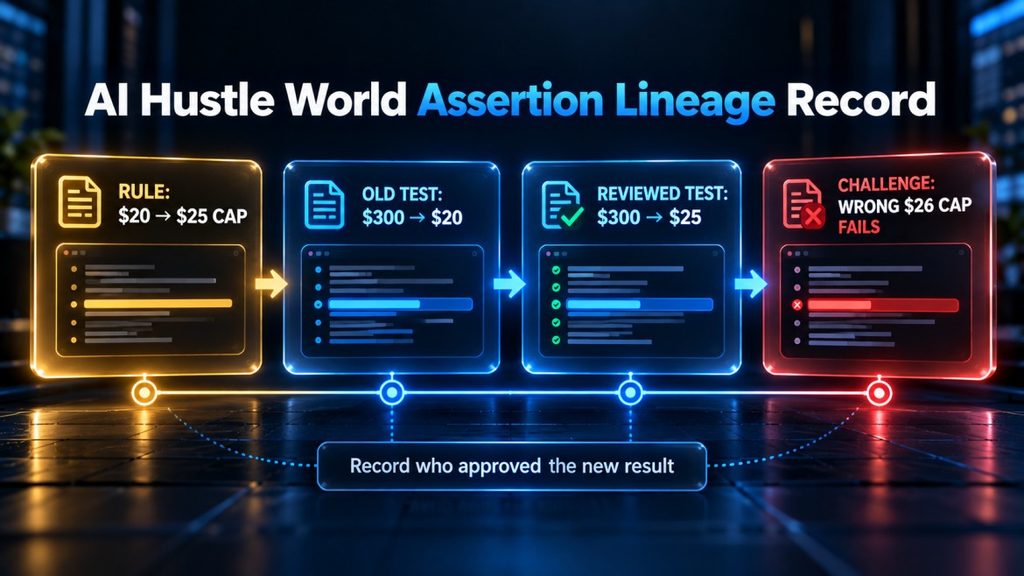
The AI Hustle World Assertion Lineage Record connects test creation to later maintenance. It is a practical decision record, not an industry standard or a scored benchmark. The record asks for the contract source, the old assertion and its intended failure, the class of change, the new assertion with a negative control, and the focused/CI evidence. It draws on the oracle problem, mutation research and ordinary review practice, while adding a concrete decision trail for a code change. A reader can inspect its logic and apply it without accepting an opaque quality score.
| Record field | Before AI updates a test | After the proposed edit |
|---|---|---|
| Contract source | Identify the approved requirement, API contract or reproduced bug independently of the current implementation. | Record the exact approved change and any unresolved ambiguity. |
| Old assertion and purpose | State the input, expected result and plausible wrong behavior the test was meant to catch. | Preserve the old diff and explain whether that protection remains needed. |
| Change classification | Decide whether the cause is a signature repair, intentional behavior change, new case, obsolete case, setup problem, product bug or flakiness. | Mark preserve, update, add, retire or investigate, with an owner when the expected outcome changes. |
| New assertion and challenge | Specify the behavior the suite must now reject as well as the behavior it should accept. | Inspect the actual assertion and a targeted negative control or mutation where practical. |
| Stability and integration | Know the baseline, runner, fixtures and related checks. | Record focused and relevant-suite results, repeats for suspected flakiness and anything unrun. |
The record is most valuable where an AI repair looks superficially obvious. A test expects $20 for a $300 cart and now receives $25. Under the approved new cap, update that particular expected result to $25 and record the decision that changed the rule. Preserve the $100→$10 case because the policy change did not touch it. Add the $240→$24 and $260→$25 cases to distinguish the calculation below the cap from the cap itself. Do not retire a test just because it fails: it may be the last useful signal for an unrelated bug.
At review, the person authorizing the expectation change should be able to say where the new $25 came from. “The function returned it” is not enough; the product policy is the source of truth. The future maintainer should be able to see which part of the behavior was intentionally altered and which protection was carried forward. In a larger system, the same record may live in a PR description, an issue comment or a structured test annotation. It need not add ceremony to every trivial line edit. Use it where an expected result, fixture or test scope changes in a way that could hide a regression.
The PR for the promotion change should therefore contain a short chain of evidence. Link the approved $25 policy decision; show the old $300→$20 assertion going red against the new implementation; show the reviewed $300→$25 expectation, the unchanged $100→$10 case and the new below/above-cap cases. Note that the intentionally wrong $26-cap variant is rejected by the reviewed suite. If the real checkout also stores a discounted order total, add the relevant integration result rather than pretending the unit fixture proves that behavior. This is enough information for someone who never saw the original prompt to distinguish a deliberate policy update from a test that was weakened to satisfy CI.
A maintenance decision that AI should not make alone
When the failure is caused only by a renamed parameter, an agent may update callers and rerun the suite under a clear constraint that expected behavior remains unchanged. When an expected business result changes, the agent can propose a patch and show its reasoning, but an accountable person must confirm the new rule. When a test fails only intermittently, do not change the expected value at all until the nondeterminism is understood. When the product behavior itself is wrong, keep the test as evidence and fix the implementation separately. These distinctions are the heart of test maintenance, and they are also where “self-healing tests” can become dangerous if healing means erasing the symptom.
The broader human-in-the-loop AI guide discusses when automated decisions need review. For software tests, the high-value decision is specifically the oracle: what the system must do. The agent can take on mechanical edits and gather evidence, but a changed expected outcome needs a traceable source of authority. That preserves the test as an independent check rather than a mirror of whichever implementation happened to be committed most recently.
Flaky tests are a maintenance problem, not an excuse to weaken checks
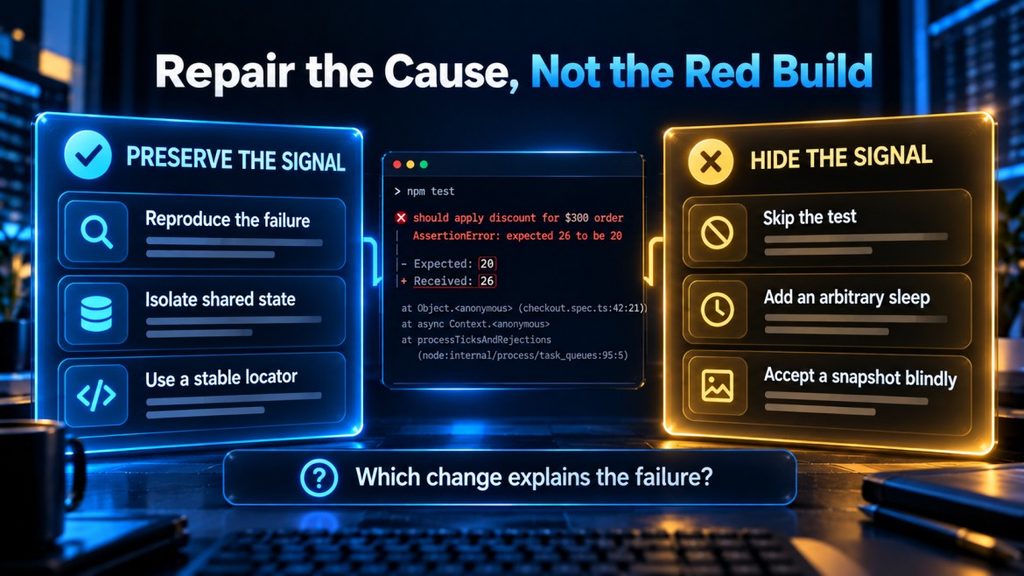
A flaky test passes and fails across repeated runs without a relevant code change. It is costly because developers stop trusting red builds and spend time investigating noise. AI can help compare traces, find shared state and propose a stable fixture. It can also “fix” the failure by adding an arbitrary sleep, widening a selector, skipping the test or deleting the assertion. Those edits may make CI green while leaving the nondeterminism—and sometimes the product defect—untouched.
First reproduce the behavior and classify the source. Does the test assume an order that the API never promised? Is it using the current wall clock, a random seed, a shared database record or an external service whose state changes between runs? Does a browser action race with a render or network response? A good AI prompt asks for evidence from two or more runs and the relevant fixture or trace, then requests a proposed cause before any patch. Repeating a failing test is a diagnostic step, not a way to vote a bad result out of existence.
A 2026 empirical study of LLM-generated tests in four database systems found a slightly higher proportion of flaky generated tests than existing tests in its study conditions. In manual inspection, reliance on an unspecified ordering appeared in 72 of 115 flaky tests. The authors also observed flakiness copied from examples supplied as model context. Those numbers apply to the studied systems and models, not every AI test suite. They explain one practical rule: do not feed a flaky example into a model as if it were a healthy template, and do not assert row order unless the product contract actually guarantees it.
For browser tests, choose locators that express the user’s target or an explicit testing contract, and use the runner’s waiting semantics instead of arbitrary timing. For data tests, prepare isolated data and assert sets or keyed items when order is irrelevant. For time-dependent logic, control the clock in the test environment if the project supports that. Ask the AI to explain which assumption its repair changes, then inspect the diff. If the original test was wrong, document why; if the implementation is wrong, do not conceal that finding in a test-only patch.
Snapshots deserve particular caution. They can be useful when a broad output really is the contract and a reviewer can inspect a meaningful diff. They are weak evidence when an agent simply updates a large snapshot after the product changes and nobody checks what altered. A screenshot or serialized blob is not self-interpreting. When a focused assertion can express the important behavior, keep it visible even if a snapshot also exists.
Put AI-assisted tests into a maintainable team workflow
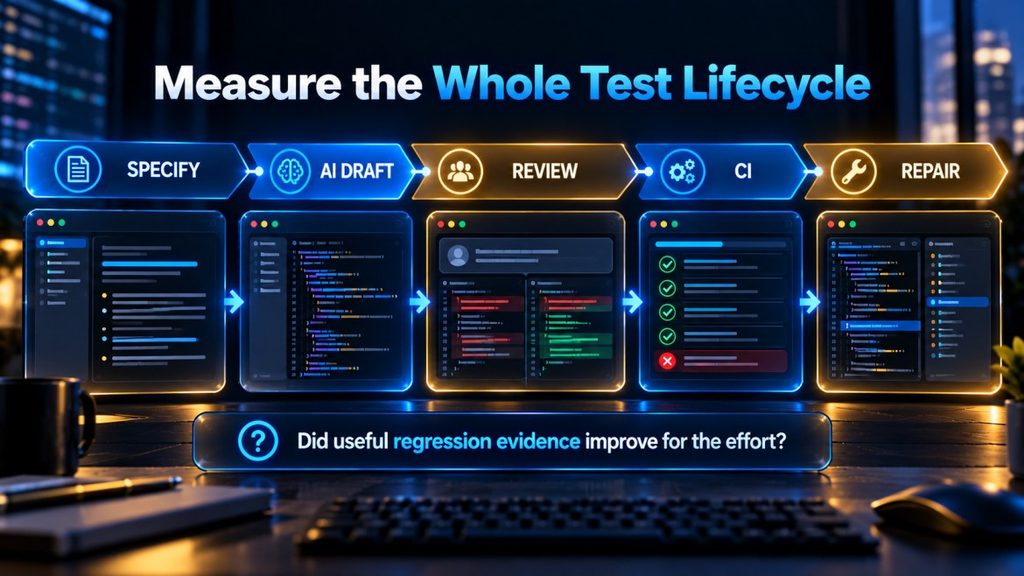
The safest first unit of work is a small test-only change around a known requirement. The author or agent records the baseline, proposes cases, writes the tests, and runs a focused command. A reviewer checks that the expected results came from the requirement and that the test fails on at least one plausible wrong behavior. Then the related suite and CI run in the team’s normal environment. If the new test exposes a product bug, the implementation fix is visible as a separate change or clearly separated commit, not hidden within the test-generation pass.
The review should look at test code as production code. Are names specific enough to explain the protected behavior? Are fixtures isolated, realistic and cheap to maintain? Does a mock replace the very dependency the test claims to validate?
Do parameterized cases reveal the important boundary or bury it? Do error cases check meaningful error behavior rather than any exception? The reviewer does not need to manually author every line, but must be able to explain why the suite should fail when the product violates the contract. A test that needs a long conversation with its author to explain its purpose is likely to become expensive when it breaks next quarter.
For each failing test after a later code change, write down the cause before applying an AI repair. If it is a signature change, update the call without silently changing the expected output. If it is an approved behavior change, update the assertion with the policy source and preserve unaffected cases. If it is a test setup defect, fix the fixture and show why the product contract remains the same. If it is flakiness, isolate and reproduce it before deciding which synchronization or data assumption is wrong. This classification is more work than clicking “fix,” but much less work than discovering months later that a crucial regression check was trained to agree with a bug.
Suppose a new currency parameter is required but the promotion policy is unchanged. A safe mechanical repair supplies the parameter in the fixture and keeps the $20 or $25 expectation appropriate to the policy version being tested. If the test then fails because the implementation applies a different cap by currency, that is a new behavior question, not permission for the AI to copy the returned amount into the assertion. Likewise, if the mock server changed its JSON shape, repair the fixture to match the actual contract and retain the business assertion. The exact edit is small in both cases; the decision about what remains invariant is the part that needs judgment.
CI gives an independent execution record, but it does not decide whether the test is meaningful. Use the repository’s established test commands and required checks; report skipped tests, quarantined tests and unavailable services. A targeted mutation run or negative-control case can add evidence for a high-risk rule without demanding expensive mutation testing on every commit. The reviewers should see the test diff and the product diff together when both change. A pull request that says “tests fixed” but provides no reason for altered expected values has not closed the important question.
| Review evidence | What it can establish | What it cannot establish alone |
|---|---|---|
| Focused test command and output | The new case executed in a stated environment and produced an observed result. | That the expected result came from an approved requirement. |
| Related suite and CI | The change did not break the checks those jobs actually ran. | That all affected product paths or external integrations were checked. |
| Coverage report | Which lines or branches were exercised by the run. | Whether the assertions would notice a wrong value. |
| Targeted wrong-cap challenge | This suite rejects the specified $26-cap defect. | That it rejects every plausible defect or behaves well in production. |
| Test and product diffs with policy reference | How the implementation and oracle changed, and why the reviewer accepted them. | That a skipped test or unavailable environment was somehow verified. |
This evidence stack is deliberately modest. A small bug fix may need a focused failure, the fix and relevant CI, while a sensitive data or money path may justify independent integration checks and a more deliberate counterexample. The team should decide based on the consequence of an undetected error and the cost of the check. More automation is useful only when it reduces uncertainty that matters to the release.
There is a measurement problem here as well. Count useful regressions caught, time spent reviewing and repairing tests, repeat failures, suite duration and how often test edits need correction after review. New test count and coverage percentage can be tracked, but they should not become the only success measures. A generated suite that adds hundreds of brittle cases can slow every subsequent PR and cost more human attention than it saves. If the engineering team cannot maintain it, generation speed was a misleading optimization.
Use the AHW W.O.R.T.H. lens to decide whether AI helps your test suite
AI Hustle World’s established W.O.R.T.H. framework considers Workflow fit, Output capability, Risk and rights, Total cost, and Human effort. Use it to decide whether AI assistance improves the testing work you actually have; it does not produce a numerical product score. A tool can draft ten tests quickly and still be a poor choice if the tests rely on invented contracts or require more review and repair than writing a focused set by hand.
Workflow fit asks whether the assistant can use the repository’s runner, fixtures, CI and review process. If it repeatedly introduces a new framework or writes tests that cannot run in the existing environment, fluent output has limited value. Output capability asks whether the proposed cases assert the right behavior and reject plausible defects. The weak $26-cap demonstration matters here: a green case is not the same as a discriminating case. Our coding-assistant comparison addresses tool selection more broadly; do not treat a product’s test-generation button as evidence that its assertions are good.
Risk and rights asks what source code, customer data, secrets or third-party material the model may receive, and who has authority to change a policy expectation. Sanitize or restrict sensitive fixtures where appropriate and use the organization’s approved data-handling path. Total cost includes model usage, CI time, additional mutation runs and the maintenance burden of verbose or flaky cases. Human effort is the time to specify behavior, review assertions, investigate failures and approve changed oracles. If AI merely shifts work from writing to a larger, less predictable review queue, the headline speed of generation has not answered the decision.
The W.O.R.T.H. lens also helps choose the starting task. A pure, well-specified calculation with a stable runner and few dependencies often has favorable workflow fit and low review cost. A cross-service flow with undocumented rules and sensitive data may benefit first from AI-assisted investigation and a human-written case plan, not from a large auto-generated suite. These are decision criteria, not measured savings or results of comparative product testing.
When to write the test yourself
AI is a drafting partner, not a compulsory step. If you need to decide what the product should do, writing the first test manually may be the fastest way to clarify your thinking. A security boundary, a financial calculation with unsettled rounding rules or a fragile production incident can justify a human-authored core assertion before AI expands adjacent cases. If the model cannot access the relevant contract or environment, asking it for a complete suite is likely to produce plausible guesses. In these cases, use it to ask questions, locate related code or critique a proposed case rather than delegate the oracle.
Conversely, AI can be very useful for repetitive framework syntax once the expected behaviors are settled. It can generate the variants around a boundary, build fixtures to the repository’s style, suggest missing error paths and explain an unfamiliar stack trace. The developer still decides which suggestions belong in a maintained suite. The traditional practice of writing tests by hand exists because formulating an expectation is often part of understanding the feature itself. Automating syntax should free time for that reasoning, not remove it.
Different software needs different evidence
The promotion example uses a deterministic calculation, so an exact assertion and a wrong-cap counterexample are appropriate. Other systems need different evidence. An API contract test may check status, schema and authorization across a service boundary. A browser flow may need stable user-visible behavior rather than a particular DOM structure. A distributed workflow may require controlled services and careful treatment of eventual consistency. The underlying question remains the same: where does the expected result come from, and would this test notice an important violation?
Software that contains AI creates another test-oracle challenge. A RAG application may return semantically varied answers, so a string-equality unit test is often the wrong sole measure of quality. You can still write deterministic tests for input validation, citations, access control and retrieval boundaries, while evaluating answer quality separately with a documented dataset and rubric. Our guide to evaluating RAG retrieval quality explores that specialized measurement problem. It should not be collapsed into a claim that every AI-generated software test needs another AI model to judge it.
Second-order effects matter as test generation becomes cheap. Teams may add more cases than they can review, and the time to understand a failing suite may grow even as the time to create a file falls. The best answer is not automatically fewer tests; it is tests with a visible purpose, independent expectations, stable setup and a retirement path when a behavior truly disappears. If you do nothing, old untested behavior remains risky. If you generate indiscriminately, you can trade one form of uncertainty for another: a large green suite nobody trusts.
How We Researched and Tested This Guide
AI Hustle World reviewed current how-to guides and the primary documentation and research linked in this article. The Assertion Lineage Record is our synthesis of test-oracle provenance, change classification and counterexample evidence. AI-assisted research and drafting were used; the linked factual claims were checked against their sources during preparation. This article does not claim a controlled comparison of test-generation tools, a representative sample of real repositories, or a universal productivity result.
The controlled promotion-cap fixture used Python 3.12.14 standard-library unittest with integer cents, one configurable cap and five specified run conditions. The exact core calculation, case inputs, observed values and failure messages appear above so a reader can reconstruct the demonstration. It proves only that the intentionally weak assertion misses the deliberately wrong cap in this fixture and that the reviewed examples catch it. Any real integration would need additional policy and system-level checks.
Final Thoughts
AI can lower the friction of writing tests, but a test’s value comes from what it is allowed to call wrong. Start with an independent description of the behavior, ask for cases before code, and inspect whether the resulting assertions reject a plausible defect. When code changes later, classify the failure before asking AI to repair the test. A changed signature, an approved product decision, a broken fixture and a real regression require different responses.
The durable habit is to preserve the lineage of an expectation. Record where it came from, why the old test existed, what changed, who authorized the new result and what evidence shows the revised case still protects the contract. That turns AI-generated tests into maintainable engineering evidence rather than a growing pile of green files. The model can help do the repetitive work. Your team still owns the meaning of “correct.”
Your Tests Pass. Who Accepts the Agent’s Change?
Follow the tool, test, and human-review loop to judge an agent’s code change with evidence beyond a green suite.
See the Coding-Agent Review Loop →Frequently Asked Questions
Can AI write useful unit tests for an existing codebase?
Yes. Give the assistant the existing test framework, a nearby example and the intended behavior. Review its proposed cases before accepting code, then run the focused tests and check each expected result against the requirement rather than copying what the function returns.
Should I generate tests from code or from requirements?
Use both for different purposes. Code reveals branches, dependencies and error paths; the requirement or approved contract defines the expected outcome. If the two disagree, keep the failing test visible and resolve the product rule before changing the assertion.
What context does AI need for integration tests?
Provide the service contract, relevant schema, authentication rules, test data and the project’s existing runner. State which components are real and which are mocked. Otherwise, the assistant may write a passing test that checks only a fake response while missing the actual integration boundary.
How should I use AI for end-to-end tests?
Start with the user goal and the running interface, then ask AI to propose the journey and observable result. Review locators against the rendered page and assert the outcome that matters. A recording of clicks alone cannot show whether the workflow behaved correctly.
Does higher test coverage prove that generated tests are good?
No. Coverage tells you which code executed, but a test can cover a branch while asserting almost nothing. For an important rule, name a plausible wrong result and check that the test fails on it; a targeted mutation can make that check concrete.
What is a test oracle?
A test oracle is the rule that decides whether the observed result is correct. It may come from a requirement, API contract or approved product decision. If AI derives it only from the implementation under test, the assertion can preserve an existing bug.
Should AI automatically fix a test that fails after code changes?
No automatic repair should start by changing the expected value. Diagnose whether the failure came from a renamed interface, approved policy change, broken fixture, flakiness or product defect. Preserve the assertion for mechanical repairs; get human approval when the required outcome changes.
How can I tell whether an AI-generated assertion is too weak?
Ask what specific defect the assertion would catch. If a deliberately wrong result still passes, inspect both the input and what the test observes; adding similar cases will not strengthen the check. For consequential rules, run a targeted negative control or mutation.
What makes AI-generated tests flaky?
Typical causes include uncontrolled clocks or randomness, shared test data, external services, timing races and assumptions about unspecified ordering. Reproduce the failure under unchanged code, then isolate the source. Skipping the test or loosening its assertion can hide a real regression.
When should a human write or approve the test?
A human should write or approve the core expectation when product policy is unsettled, a security or financial boundary is involved, or a failure could mask a real defect. AI can then expand reviewed cases and handle framework syntax without deciding what “correct” means.
Written by
Muntasir Ahmad Chowdhury
Founder-AI Hustle World
Muntasir Ahmad Chowdhury is the Founder of AI Hustle World, an independent publication dedicated to making Artificial Intelligence practical, trustworthy, and easy to understand. He researches AI tools, automation, customer service, productivity, and real-world business applications, helping readers make smarter technology decisions through research-driven, experience-backed content.
Expertise:
AI Tools • AI Automation • AI Customer Service • AI Productivity • Generative AI • AI Workflows
Get Smarter With AI
Enjoyed this guide? Get practical AI tools, tutorials, and honest reviews delivered to your inbox.