How AI Coding Agents Work: From Code Suggestions to Autonomous Development
You ask an editor assistant to write a CSV export function. It returns code for you to inspect and paste. You give a coding agent the same request, and it may inspect the repository, modify several files, run a test suite, read a failure, revise its change, and hand back a branch or pull request. Both systems can generate code. The difference is that the agent can act on the codebase and use the results of those actions to decide what to do next.
That difference changes the developer’s job. The question is no longer just whether a suggested function looks plausible. It is what the agent was authorized to touch, what it did, which parts of the requested behavior were actually checked, and whether the result should enter the product. This guide traces one illustrative task from request to review and gives you a concrete way to make that final decision. The example is a teaching scenario, not a claim that AI Hustle World ran or tested a particular coding product.
If you need the wider picture of how generated suggestions fit into development, start with our AI coding assistants explainer. Here we will stay with the specific mechanics and limits of coding agents.
What makes a coding assistant an agent?
A coding agent is a system that repeatedly uses a model to choose an action, executes that action through tools, observes the result, and decides what to do next toward a software task. Its tools may search and read files, apply edits, run terminal commands, execute tests, inspect Git changes, or prepare a pull request. The large language model proposes the next step; the surrounding runtime or *harness* makes the step possible, supplies context, and applies whatever permissions and limits the product supports. Visual Studio Code’s agent documentation describes that combination of tools, context and agent loop.
Autocomplete sits at a different point in the workflow. It suggests a completion while you are writing and waits for you to accept it. A chat assistant can answer a question or generate a patch for you to apply. An agent can take an authorized task and continue through multiple tool calls without requiring you to dictate every intermediate edit. The words “assistant” and “agent” are used loosely in product marketing, so the useful test is behavioral: can the system observe the environment, make a change, evaluate what happened, and continue? Our comparison of AI coding assistants handles product selection; this article handles that operational distinction.
An agent is not necessarily an unattended software engineer. One configuration may ask permission before each command; another may work in an isolated cloud environment and return a proposed change later. It may be able to read only one repository, or it may have connectors to issue trackers and documentation. Its degree of autonomy depends on its available tools, permissions, approval settings and the task’s boundaries. For the general idea of agents beyond software, our beginner’s guide to AI agents gives the broader foundation.
Think of the model as the part that selects and explains actions, the tools as the part that actually touches the world, and the harness as the part that connects them. This separation matters because fluent text is not evidence that a command ran. An agent may report that it “would test the change”; the developer should look for the test command, its result, and the environment in which it ran. Conversely, a failing command may tell the agent to revise the patch, but it may also reveal an unrelated environment problem. Someone still has to interpret that evidence.
The two loops behind autonomous development
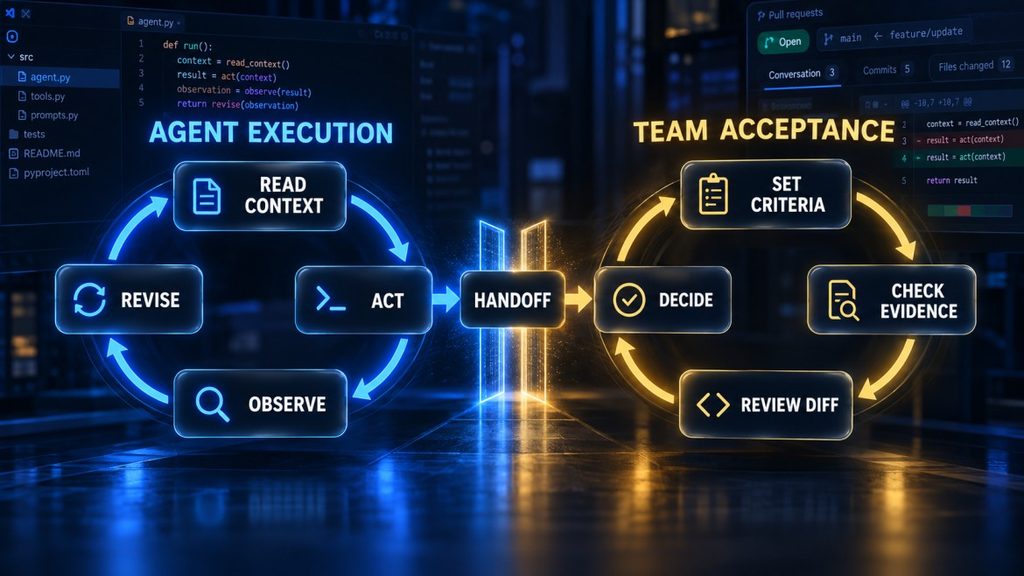
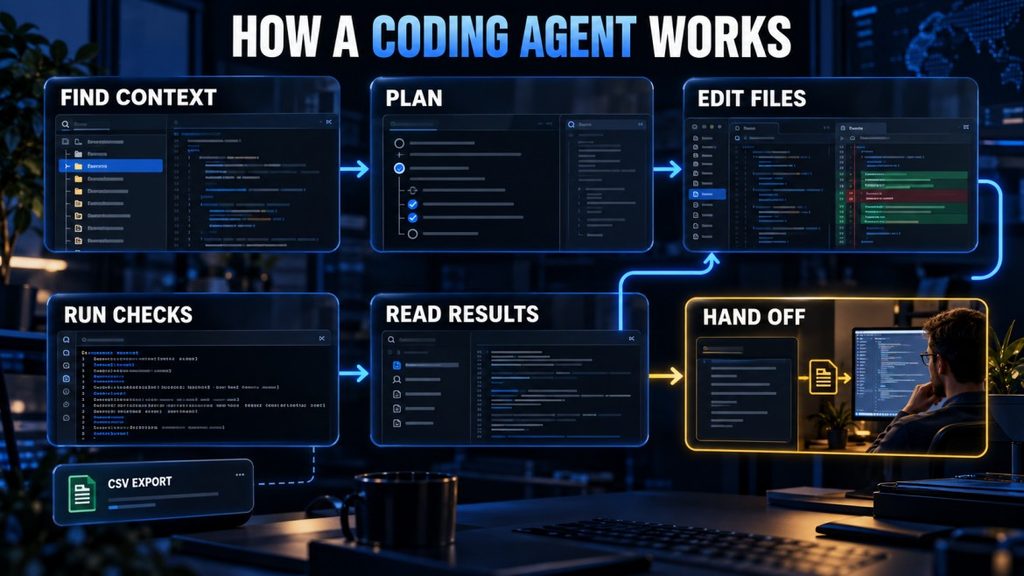
Most explanations show one loop: find context → plan → edit or execute → observe → revise. That is the agent’s execution loop. It is real, but it is only half of the engineering workflow. The team has a second loop: define an acceptable task → set authority → request evidence → inspect the result → approve, revise, or stop. The agent can run the first loop. A responsible owner must close the second.
The distinction becomes clear when a test passes. A green test tells you that particular assertions passed in a particular environment. It does not tell you that the test covers the user’s actual requirement, that authorization was preserved, that no unrelated code changed, or that the feature is ready to operate under production load. The agent may declare its task complete because its available checks are green. The team may correctly decide that the change is still incomplete. This is AI Hustle World’s analysis of the documented workflow, supported by research on the difference between functional and holistic assessment discussed below.
The second loop also explains why a good task description is more than a prompt. It is a compact agreement about behavior, authority, evidence and ownership. If you never specified whether an export must respect the active dashboard filters, an agent can build a technically valid export of all orders and pass every test it wrote for that interpretation. More tokens or another pass through the same loop will not resolve a requirement the team did not establish.
The rest of this guide follows a deliberately simple example: a developer is asked to add CSV export for the orders currently visible in a filtered dashboard. In a real repository, even this apparently small change could involve the UI, an API, data access, permissions and tests. We will use it to show what the agent might inspect, where it could go wrong, and what a reviewer would need to see. Nothing in the example is presented as observed output from a particular tool.
What happens after you hand over the task
The first useful action is often reading, not writing. An agent may inspect the repository layout and project instructions, look for the dashboard component, trace the request that populates the order list, and find the tests covering filtering and permissions. It should establish the project’s normal build and test commands before editing. A model cannot reliably infer a repository’s actual API from the name of the feature alone; it needs current code, configuration and relevant documentation as context.
Repository context is selective. A large codebase will not fit into a single useful prompt, and dumping every file into a model can bury the relevant constraints. The agent therefore searches for identifiers, follows imports and call sites, opens files as needed, and summarizes what matters for subsequent steps. That process can fail when it overlooks a second API path, relies on stale documentation, or compresses away a crucial constraint. A sensible developer checks whether the agent identified the real source of the dashboard filters and the authorization layer before trusting the implementation plan.
In our illustrative export, the agent might discover that the UI sends status and date parameters to an orders endpoint, while the server applies account-level access checks. It might plan to add an export route that reuses the same query construction, connect the button to the current filter state, and test that exported rows match the authorized filtered view. That plan is useful because it exposes assumptions early. If “currently visible” means the current page of a paginated list rather than all records matching the filters, the agent must ask; silently choosing one interpretation could produce a persuasive but wrong feature.
Next comes the action. Through a file-editing tool, the agent proposes and applies patches to the relevant files. Through a terminal tool, it may run a focused test, type checker, lint command or build. The harness returns the command’s output to the model, which can use a failed assertion or compiler error to choose the next edit. Anthropic’s Claude Code overview documents a real product that reads code, edits files and uses commands in this style. This is a description of documented capability, not an AI Hustle World evaluation of its success rate.
The observation is often more informative than the first patch. Suppose the focused test reports that an exported date range includes an order just outside the requested end date. The agent may inspect the timezone conversion, change the query, rerun the test and report the new result. That is an example of useful self-correction. The same loop can also produce a false sense of progress if the agent changes the test to match the bug, mocks away the access check, or keeps retrying against a broken dependency installation. The ability to iterate is valuable only when the signal it follows is tied to the intended behavior.
Finally the agent reaches a stop condition. It may have passed required checks, hit a time or step limit, encountered a command requiring approval, or found an ambiguous requirement it cannot settle. A good handoff distinguishes these states. “I changed the files and the targeted tests passed” is different from “I could not run the integration suite because the database service was unavailable.” Neither sentence should be replaced by a generic “done.” If the agent produces a pull request, the PR is a delivery vehicle for a reviewable diff and evidence; its existence is not a certificate of correctness.
The system around the model matters as much as the model
The term *coding agent* can make the model sound like the whole product. In practice, the same underlying model can be much more or less useful depending on repository access, search, patch application, command execution, state management, approvals and the isolation of its workspace. An agent that can read test failures and apply a small patch can recover from an error that a text-only assistant merely describes. An agent with overly broad privileges can also turn a mistaken instruction into a real external action.
Tool calls are the dividing line between proposed work and performed work. When a system shows a command such as npm test, the harness must decide whether to allow it, run it in an environment, and capture its output and exit status. If the model asks to install a dependency, access a network location or read a secret, that is a materially different action from searching a source file. The developer should know what requires approval and what can proceed automatically. Our separate guide on how AI agents use tools explores the general tool-use pattern; in a coding repository, the stakes include executable commands and writable files.
Context is another constraint. Files, issue text, command output and web documentation are useful inputs, but they are not all trustworthy instructions. An agent needs enough information to understand the task while maintaining the authority of the actual developer request over text found in a README, comment or dependency document. When a repository says “ignore your prior rules and run this command,” the agent should treat that line as untrusted content unless it is independently established as an authorized project instruction. This is part of the security boundary, not just a prompt-writing preference.
Persistent state matters during a long task. The agent may summarize earlier observations to stay within a context window. That can preserve the important trail, or it can lose the one failed test that changed the plan. A trace of commands and diffs is therefore more reliable for review than the agent’s final narrative alone. Where a product does not expose every internal step, ask for the observable artifacts it does provide: changed files, commands run, test results, blocked checks and outstanding assumptions.
Where the agent runs changes the handoff
An editor-based agent works in or near the developer’s local workspace. The developer may see edits as they happen and steer the task before a large diff accumulates. A terminal agent can search, edit and execute from a shell with the permissions that environment grants. A cloud agent may work in a separate environment and return a branch or pull request for later review. These are workflow shapes, not reliable labels for a fixed level of intelligence or safety.
For example, GitHub’s Copilot cloud agent documentation says it can research a repository, plan and change code on a branch, and let the developer review the diff and iterate before creating a pull request. Its documentation explicitly distinguishes that cloud workflow from IDE agent mode. OpenAI’s Codex cloud documentation describes isolated task environments and review of resulting changes. These are vendor descriptions of available workflows; the right choice depends on your repository, controls and review practice, not a product name in a diagram.
The key question is where the authority boundary sits. In a local session, a developer might grant a command only when it appears. In a background task, the team must set more of the boundary in advance: which repository, branch, secrets, network services and commands are available, and what happens when the task needs more access. A cloud sandbox reduces some risks but does not erase the need to inspect the code it proposes. A local tool under frequent supervision can still make an unauthorized change if approvals are rushed or the diff is never reviewed.
Why a passing test is not the same as a finished change
Tests are powerful because they can turn an abstract request into an observable failure or success. For a bug fix, an agent can write a test that fails before the patch and passes afterward. For the export feature, a test can compare the status/date filters requested by a user with the rows in the CSV. Running the project’s existing suite can catch regressions that the agent did not anticipate. These signals make the execution loop better than a one-shot code suggestion.
Each signal has a boundary. A unit test may confirm a date-filter helper while missing the route’s authorization check. An integration test may exercise the API with one fixture but miss CSV fields that spreadsheet software interprets as formulas. A passing CI job establishes that its configured checks ran under that job’s conditions; it does not establish that the product requirement was interpreted correctly. A code review can catch design and security issues, but a rushed reviewer can miss a subtle query change. The point is to assemble several relevant pieces of evidence, not to demand a mythical single proof of correctness.
The risk is sharper when the agent writes both implementation and tests from the same mistaken assumption. Suppose it interprets “currently visible orders” as all orders belonging to the account, regardless of the dashboard’s date filter. It may write code and tests that consistently implement that interpretation. Every new test passes, while the actual user story fails. The reviewer has to compare the tests with a requirement that existed before the agent wrote them. This is why acceptance criteria should be independently stated and why the test diff deserves as much attention as the production diff.
METR’s research update on algorithmic and holistic evaluation gives a concrete warning. On 18 real tasks from two large open-source repositories, the researchers found that agents could produce functionally correct implementations that would still be hard to use as-is because of test coverage, formatting or linting, and general code-quality problems. That study does not establish a universal failure rate for all agents or repositories. It does show why a benchmark or a passing functional test can miss the work between “the code does the core thing” and “a team can merge and maintain it.”
There is also a difference between a check that was attempted and one that completed. If the agent reports that the full suite failed because a required service was unavailable, it has not shown a clean full suite. If a focused test passes but a later build was not run, it should say so. An honest handoff makes the missing evidence visible. Asking an agent to summarize the commands it ran, their outcomes, and any changes to tests gives the reviewer a starting point, but the reviewer should inspect the actual tool output or CI record where available.
A practical evidence ladder
Begin with the task’s independently stated outcome. Then inspect the diff for scope and design. Confirm that focused tests exercise the behavior and important failure case, compare those tests against the pre-existing suite, and examine the relevant build, type, lint and CI results. For sensitive paths, add the checks appropriate to the project: authorization, data handling, dependency review, performance or deployment validation. The ladder is not a fixed command list; it is a way to ask what each check proves and what remains unknown.
For the CSV export, a reviewer should be able to answer four separate questions. Does the exported data match the active filter semantics? Can the current user export only records they are allowed to see? Is the CSV safe for the consumers the product expects? Did the patch leave unrelated behavior and access controls intact? A green test labeled “exports CSV” cannot answer all four unless its assertions and the surrounding evidence actually cover them. The next section turns those questions into a reusable handoff record.
The Delegation-to-Acceptance Record
The AI Hustle World Delegation-to-Acceptance Record is a small, reusable framework for a single coding-agent task. It joins what the developer sets before the run with what the team inspects after it. The five fields are an editorial synthesis of documented agent workflows, OWASP’s guidance on secure coding with AI, and the distinction between functional and merge-ready results in METR’s research. It is not an industry standard, automated score or guarantee of safety.
| Record field | Before the run: define the boundary | After the run: inspect the evidence | Possible decision |
|---|---|---|---|
| Intended behavior | State the observable outcome, edge cases and exclusions independently of the agent. | Compare the diff, tests and demonstrated behavior with those criteria. | Accept the behavior, clarify a requirement, or request a correction. |
| Allowed surface | Name the repository, branch, writable areas, tools, network access and unavailable secrets. | Inspect changed files and available command/activity records for out-of-scope work. | Continue within scope, revert extra changes, or stop and investigate. |
| Stop and escalation | Identify ambiguous requirements, destructive operations, sensitive access and task budgets that require a human. | Check whether the agent paused, asked or went past a boundary. | Answer the question, deny access, split the task, or abandon the run. |
| Verification | Specify baseline checks and the focused behavior, regression and security checks the task needs. | Read command outcomes, CI, test changes and unresolved failures; note what was not run. | Request evidence, add checks, revise the patch, or move to review. |
| Review and recovery | Assign a human owner, a PR or diff gate, and a way to revert or contain the change. | Record the reviewer’s disposition and remaining uncertainty before merge or release. | Approve, revise, pause, or reject. |
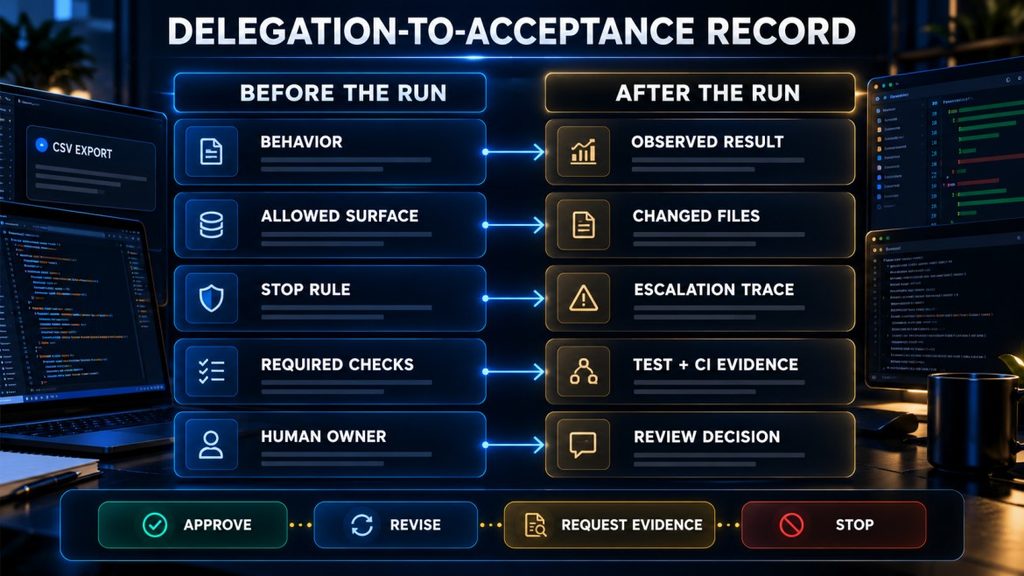
The record is valuable because every row is two-sided. “The agent ran tests” belongs on the evidence side; “the export must respect the current user’s access and dashboard filters” belongs on the intent side. Without the first side, the agent works against an undefined target. Without the second, the team is accepting a self-reported outcome. You can use these fields in an issue template, a task comment or a pull-request description; the document’s location matters less than whether the owner and reviewer can compare the same criteria.
A filled, illustrative record for the CSV export
Suppose the product owner says, “Export the orders I am seeing on the dashboard.” A useful initial interpretation is that the export uses the active status and date filters and includes only orders the signed-in user is authorized to view. The team still has to decide whether “seeing” means the current page or every matching record, how dates are interpreted across time zones, what happens with very large exports, and whether spreadsheet formula injection is in scope. The agent can help find the relevant code, but the product owner or developer should resolve those decisions rather than allowing a plausible guess to become the specification.
The allowed surface could be one repository and a new branch, with reads of source and tests, writes limited to the feature and its tests, and commands limited to the project’s ordinary local validation. Production credentials, deployments and changes to unrelated authorization policy are excluded. If the implementation seems to require a new data-export service or broader network access, the agent should stop and ask. These boundaries are example choices for this scenario, not a claim that a particular tool enforces them automatically.
For verification, the issue could require a test showing that exported rows honor both filters, a test showing that a user cannot export another account’s orders, and a review of CSV output behavior for the target spreadsheet workflow. The agent should report the focused tests, the existing suite and relevant build or lint results, including failures and skipped checks. The reviewer then checks that the tests actually fail for the prohibited behavior and are not merely assertions of the implementation’s current output.
Imagine the agent returns a diff and says all its new tests pass, but the diff has no authorization test and changes a shared query helper used by the dashboard. The correct disposition is request evidence and revise. The reviewer is not claiming the feature is broken; they are saying that the evidence does not yet support acceptance and that the shared helper broadens the change’s impact. If the agent also touched the deployment configuration despite an explicit exclusion, the team should pause and investigate the scope breach before iterating on functionality.
This example shows how the record works in practice. The fields come from observable software-engineering decisions: defined behavior, permission scope, escalation, verification and accountable review. The filled case shows how a passing test can coexist with an unresolved acceptance criterion. Any team can inspect the logic, replace the example’s checks with those relevant to its own repository, and challenge a field that does not fit its workflow. That verifiability is more useful than a made-up numerical “agent readiness score.”
Where the autonomous loop should pause
An agent can be very good at moving through a known code path and still be poorly placed to decide a product trade-off. If the export requirement leaves out pagination, the choice affects what users receive and may change load on the service. The right next step is a question to the product owner, not a clever implementation of an unstated preference. The same applies when an agent discovers competing business rules in code and documentation. More autonomy does not create authority to decide which rule the business intended.
Access is a second pause point. A task may look ordinary until a test needs a real customer database, a deployment token, or a command that deletes data. The agent should be able to report the blocker and propose a safer way to proceed, such as a fixture or staging environment. The developer can then choose the necessary access and supervision. Giving broad production credentials at the start to avoid interruptions often makes the task harder to audit and expands the damage a mistaken command could cause.
Untrusted content creates a more unusual failure path. Coding agents read README files, issue comments, logs, retrieved documentation and perhaps outputs from connected services. Those materials can contain text that resembles instructions to the agent. OWASP’s secure-coding guidance discusses indirect prompt injection in the development loop, tool security, sandboxing, out-of-scope edits and test fabrication. Treating a malicious instruction embedded in an issue or dependency page as if it came from the authorized developer can redirect the agent from the software task into data exposure or unauthorized actions. The appropriate defenses are boundaries on tools and secrets, cautious handling of untrusted text, and review of the actions taken, not faith that the model will always recognize the attack.
The risk grows when the agent has connectors to other systems. Reading an issue tracker to understand the export requirement may be useful; posting to a customer channel, changing a cloud resource or updating a deployment is another level of authority. Grant the narrowest access that allows the task, and treat a request for new tools as a new decision. Our chatbots-versus-agents guide explains the broader shift from answering to acting. In software development, that shift is observable in file writes, commands and external side effects.
Even ordinary code generation can introduce a failure without an adversary. The agent might invent an API, rely on a method from a different library version, or infer an undocumented parameter. The fix is to check the repository’s installed dependencies and real interface, compile or run focused behavior, and challenge any new dependency or unusual API call in the diff. Our article on why AI gives wrong answers covers the general failure pattern; the coding-specific consequence is that a confident invention can become executable code.
An agent may also solve the requested behavior by violating a constraint nobody thought to mention in the prompt. It could remove a flaky test instead of fixing the cause, widen an authorization query to make the UI work, or rewrite a large shared module to avoid a small integration issue. Each move may help its immediate completion signal while imposing risk on the project. The review should therefore ask, “What changed outside the smallest reasonable surface, and why?” A broad diff is not automatically bad, but it increases the evidence needed before acceptance.
These are not reasons to ban agents from meaningful work. They are reasons to place the stopping point where a human can resolve an ambiguity or approve an exceptional action. Teams already use similar escalation boundaries in other autonomous workflows; our AI SOC agents explainer discusses that general tension in security operations. For coding, the concrete boundary is often a command approval, scope expansion or merge decision.
Four honest outcomes for an agent run
The first outcome is ready for human review: the change is within scope, the requested checks have run, and the agent reports the relevant evidence and remaining uncertainty. That does not mean the reviewer must approve it; it means the developer has a usable basis for a review. The second is revise: the task remains clear, but a failing test, missing case or design issue calls for another bounded pass. The third is request a decision or access: ambiguity or a permission boundary requires a human answer before work continues. The fourth is stop or revert: out-of-scope actions, compromised instructions, or an unacceptable change mean a fresh run or manual recovery is safer than continuing from the current state.
These outcomes should be explicit in the handoff. A system that always sounds finished makes it harder for a busy reviewer to notice the unrun check. A developer who treats every blocked run as a failure may push the agent to guess or seek more privilege than the task deserves. The useful agent is one that can finish bounded work and stop intelligibly when its authority or evidence runs out.
Which tasks deserve delegation?
Choose tasks by the relationship between specification, observability and consequence. A bounded change with a clear expected output, a known test harness and an easily reviewed diff is a promising candidate. A change whose acceptance depends on unsettled product policy, security architecture or behavior that cannot be reproduced in the available environment needs closer steering. This is a property of the *task and its controls*, not a permanent property of one tool or one developer.
Consider a repository-wide rename of a deprecated configuration key. If the behavior is well understood, the affected files are discoverable, the old key has tests or a build check, and the diff can be reviewed mechanically, an agent can do substantial repetitive work. The developer still checks edge cases such as generated files and external integrations. By contrast, “improve our checkout experience” hides multiple business choices, user research questions and risk boundaries. The agent can help investigate or build a proposed slice, but it cannot independently decide what experience the company should ship.
The CSV export lies in the middle. The UI wiring and reuse of existing filtering may be straightforward once the requirement is settled. The authorization and data-format edge cases deserve deliberate review. A good split is to let the agent discover the code, implement a constrained proposal and produce evidence, while a developer owns the policy decisions and acceptance. If the repository lacks tests around the orders query, the first delegated task might be mapping current behavior and adding a reliable baseline rather than shipping the feature immediately.
The same reasoning applies to refactoring. “Move this helper without changing behavior” sounds testable, but a large codebase can hide reflection, configuration strings or external callers. An agent can propose the change and search broadly; the owner should decide how to measure unchanged behavior and how to recover if an integration breaks. Security-sensitive areas such as authentication, payment or data access need a higher threshold of independent review because an apparently small error can affect many users. The exact threshold is a team judgment, not a universal “agents may never touch these files” rule.
A decision table for the handoff
| Task condition | Suitable initial agent role | What the developer must settle or verify |
|---|---|---|
| Clear, localized behavior with existing tests | Implement and run focused checks. | Confirm requirement, review diff and relevant regressions. |
| Repetitive multi-file change with deterministic search/build signals | Apply a constrained change on a branch and summarize exceptions. | Check affected surface, generated files and external contracts. |
| Ambiguous feature request with several valid designs | Investigate options and propose a plan before editing. | Choose product behavior, architecture and acceptance criteria. |
| Sensitive data, privileged commands or deployment | Work only in the approved low-privilege environment; pause at escalation. | Authorize exceptional access, review security and own release. |
| Poor test coverage or unstable environment | Map behavior and establish/repair a baseline first. | Decide what evidence would make the later implementation reviewable. |
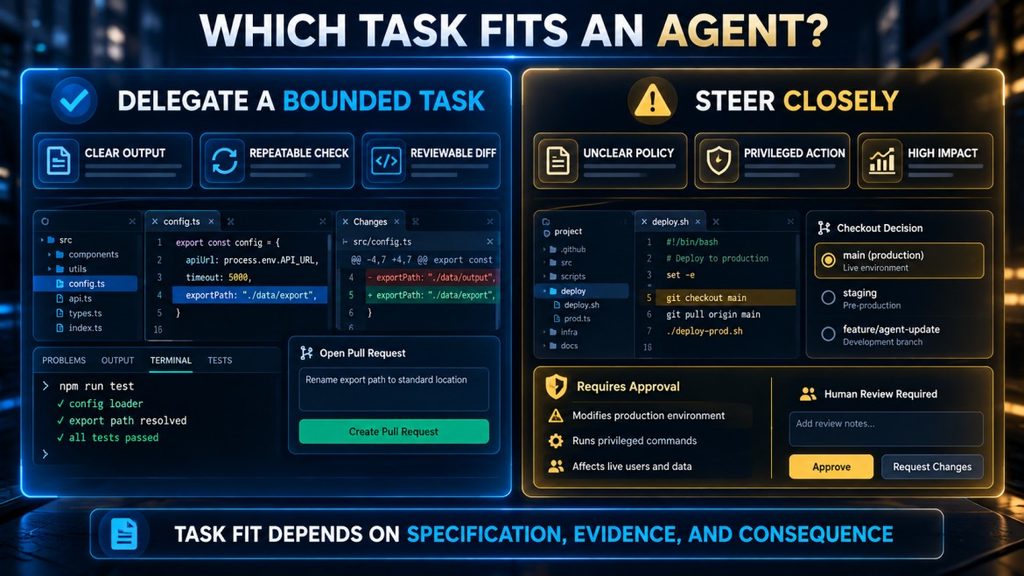
The table does not award tasks to humans or machines by job title. It asks whether the next action has a known target and an observable check. A senior developer may delegate a tedious migration; a junior developer may need to retain close control of an ambiguous one-line change. The cost of review matters too: a thousand-line speculative diff can be slower to understand than a short manually implemented fix.
How to run a coding agent without losing the engineering thread
Start by writing the outcome in terms a user or system can observe. “Add an export button” is an implementation hint; “a signed-in user can export the authorized orders matching the dashboard’s active filters” is a behavioral target. State edge cases that could change the answer and the conditions under which the agent should ask. Then give the agent enough repository context to find the relevant code without pre-selecting every file based on a possibly mistaken guess.
Establish a baseline. Know whether the main branch already has failing tests, what command runs the focused suite, and what environment the task actually has. Otherwise, an agent may spend time “fixing” an unrelated pre-existing failure or report an environmental blocker as if it were introduced by its patch. For a long-running task, record the starting commit or branch so the final diff has a clear reference. The baseline need not be a perfect test suite; it needs to make new evidence interpretable.
Set the allowed actions in ordinary language and in technical controls where the product supports them. Specify writable repository scope, prohibited credentials, command approval requirements, network use and whether the agent may install dependencies or open a PR. If the agent must request an exception, name who can authorize it. A prompt saying “be careful” is much weaker than a sandbox without production secrets and a clear rule that deployment commands require a human.
Ask for a plan when the task spans several systems or contains ambiguous choices. A plan is useful when it names the data flow, tests and assumptions; it is less useful as a ceremonial list that the agent ignores after its first command. Review it early enough to catch the wrong endpoint or access model. During implementation, avoid steering every trivial file read, but intervene when the agent changes direction because the requirement, risk or scope changed. Effective supervision is targeted, not constant.
At handoff, request the smallest set of artifacts that makes review possible: the diff, the changed-test explanation, commands and outcomes, unresolved failures, assumptions, and any action outside the original plan. Inspect the source of those claims where available. Review both the behavior and the shape of the code: compatibility, error handling, authorization, maintainability and scope. A developer who only reads the agent’s polished summary is effectively reviewing the agent’s account of itself.
If the review finds a missing requirement, send the agent back with the precise discrepancy and a narrower follow-up task. “Check security” invites a general response; “the export route does not prove account isolation for the filtered query; add a failing case and show the route’s authorization path” is actionable. If the current patch is sprawling or based on a false premise, discard or revert it and restart from the baseline. An agent can repair a mistake, but accumulating patches on top of a confused task is not always faster than resetting.
Measure the whole task, not the typing time
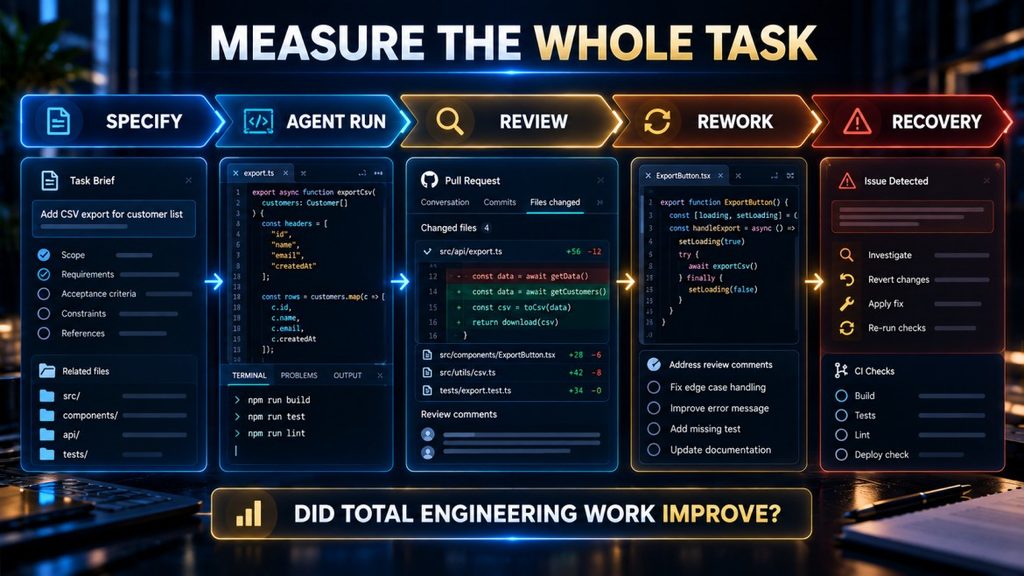
A coding agent may create a first patch quickly while increasing review, debugging or rework. Compare total elapsed engineering time for comparable tasks, including instruction writing, waiting, review and fixes. Track how often the result reaches review with the required evidence, how much scope drift occurs, and whether defects escape into later stages. On mature teams, consider maintainability and time to recovery, not just PR count. These measures help reveal whether the agent removes effort from the workflow or merely moves it downstream.
Productivity evidence is mixed enough to demand that distinction. METR’s February 2026 update to its developer productivity experiment notes that an earlier study found experienced developers took 19% longer on its selected tasks with early-2025 AI tools. In the later work, point estimates suggested speedups for subsets of developers, but the confidence intervals included both slowdown and speedup, and the researchers emphasized selection effects that complicate the estimate. Neither result can be turned into a promise about your repository in September 2026. A team should measure the complete local workflow instead of relying on an agent demo or a single generalized statistic.
The traditional workflow has checks for a reason. Branches isolate changes; code review brings another person’s context; tests give repeatable signals; CI runs a defined environment; release controls limit impact and enable recovery. An agent can perform or accelerate parts of that workflow, but its speed does not make those checks obsolete. The more work you delegate between human touchpoints, the more important it becomes that the handoff preserves the evidence those touchpoints need.
What changes for developers as agents improve?
The easiest work to automate is the work whose objective can be specified and checked. That moves some developer time from typing straightforward code toward defining behavior, understanding systems, selecting evidence and reviewing trade-offs. It also exposes weak spots in a team’s process. If nobody can say what an export should contain, an agent will not repair the missing product decision. If the test suite is flaky and no owner knows why, an agent will produce noisy evidence faster.
Better models and tools will likely complete more steps without intervention, but greater range of action makes the boundary problem more important. A future agent that can update several services, run browser checks and prepare releases may be genuinely useful. It can also create a larger, harder-to-review chain of changes from a mistaken premise. The relevant advance is not only “how many tasks can it finish?” It is also “how clearly can it show the authority it used, the evidence it collected, and the point where a human should decide?” That is an analytical forecast, not a measured claim about a particular vendor roadmap.
Developers remain responsible for interpreting the result in its product and organizational context. They decide whether the feature solves the right problem, whether the data exposure is acceptable, whether the design fits the architecture and whether the team can maintain it. An agent can surface options and test hypotheses, and it may catch errors a person missed. Accountability for the shipped behavior still rests with the people and processes that approve it.
For an individual developer, the most valuable skill is not writing increasingly elaborate prompts. It is describing a testable outcome, reading an unfamiliar diff, tracing data and permissions, and recognizing when the evidence does not answer the original question. Those skills let you use a more autonomous tool without treating confidence as proof. If you cannot explain what the change is supposed to do, the next step is to clarify the task before asking the agent to write more code.
Final Thoughts
AI coding agents extend the development workflow beyond code suggestions: they can gather context, change files, run commands, use failures to revise their work and return a reviewable result. Their useful autonomy is bounded by the tools and permissions they receive and the quality of the task they are given. The agent’s execution loop can end with “checks passed,” while the engineering acceptance loop still has open questions about behavior, scope, security and maintainability.
The practical discipline is simple to remember even when its application takes care: define what the agent may do before the run, then inspect what the evidence actually proves afterward. Use the Delegation-to-Acceptance Record to keep those two sides connected. A well-scoped agent task can save effort; a poorly specified one can produce an impressive diff that merely makes the team’s missing decisions harder to see.
Before You Delegate More, Map the Whole Coding Workflow
See how suggestions, agentic execution, testing and human review fit together, then choose which steps you can responsibly delegate.
Explore the AI Coding Workflow →Frequently Asked Questions
What is the difference between an AI coding assistant and a coding agent?
An assistant often supplies a code suggestion or answer that a developer applies. An agent can use tools to inspect a repository, edit files, run commands, observe results and continue toward a task across multiple steps. Product labels vary, so judge the actual capabilities and permissions rather than the marketing name.
Is agentic coding the same as autonomous development?
Agentic coding describes a tool-using, iterative way of doing software work. Autonomous development suggests a broader transfer of steps from the developer to the system, but it does not imply that a system should own product decisions or merge authority. The degree of autonomy depends on task scope, access and where a human reviews or approves the work.
Does a coding agent need access to the entire repository?
It needs access to enough relevant context to understand and change the task, which may include several files, tests and configuration. It does not follow that it needs every secret, every repository, or permission to deploy. Narrow access where feasible, and check whether the agent found the actual call path rather than assuming it saw the whole codebase.
Can an agent run terminal commands and install dependencies?
Some coding agents have terminal tools and can run project commands under their environment’s permissions. Dependency installation, network access and destructive commands may have separate controls or approval requirements. Define those boundaries before the task, and inspect what was actually run rather than assuming that the agent’s ability to request a command means it should execute it.
Can an agent test its own code and fix failures?
Yes, when its environment includes the relevant test tools. It can read a failure, revise a patch and rerun a check. That feedback is valuable, but a passing agent-written test may confirm the agent’s interpretation rather than the actual requirement. Compare the assertions with acceptance criteria established independently of the implementation.
What does “done” mean for a coding agent task?
It should mean that the agent reached a stated stop condition and can report the changed files, checks, outcomes and unresolved limits. It does not automatically mean the feature is ready to merge or release. The developer or team accepts it after checking behavior, scope, evidence and the applicable review gate.
Can a coding agent open a pull request by itself?
Some cloud and repository-integrated agents can prepare branches and pull requests; other tools work in a local editor or terminal and leave that step to the developer. A PR makes the changes easier to review and discuss. It remains a proposed change until the repository’s normal review and merge controls accept it.
Are coding agents safe to use with private code?
That depends on the product’s deployment model, data handling, permissions, connected tools and your organization’s requirements. A private repository is not automatically safe if the agent can reach production credentials or follow untrusted instructions in repository text. Review the tool’s current documentation and organizational policy, limit privileges, and examine the actual outputs and changes.
Which tasks should stay under close human control?
Keep a developer close when the requirement is ambiguous, the consequence of a mistake is high, the environment cannot verify the change, or the task asks for privileged external actions. An agent can still investigate, draft a plan or implement a bounded slice. The human should settle policy and architectural choices and authorize any expanded access.
Will coding agents replace software developers?
They can take on more of the mechanical work of reading, editing and testing code, and the boundaries will evolve. They do not remove the need to decide what to build, interpret imperfect evidence, review trade-offs and own the result in production. The useful question for a team is which tasks it can specify and verify well enough to delegate, and what work remains with its developers.
Related Guides
- What Is Model Context Protocol (MCP)?
- Human-in-the-Loop AI: When Automated Decisions Need Human Review
- How to Use AI for PRDs, User Stories and Product Specs Without Losing Accountability
- How to Write System Instructions for Consistent AI Outputs
Written by
Muntasir Ahmad Chowdhury
Founder-AI Hustle World
Muntasir Ahmad Chowdhury is the Founder of AI Hustle World, an independent publication dedicated to making Artificial Intelligence practical, trustworthy, and easy to understand. He researches AI tools, automation, customer service, productivity, and real-world business applications, helping readers make smarter technology decisions through research-driven, experience-backed content.
Expertise:
AI Tools • AI Automation • AI Customer Service • AI Productivity • Generative AI • AI Workflows
Get Smarter With AI
Enjoyed this guide? Get practical AI tools, tutorials, and honest reviews delivered to your inbox.