
Best AI Product Recommendation Platforms for Online Stores
Product recommendations look simple from the shopper’s side. A customer views a coffee machine, and the store suggests filters, descaling tablets, or a better model; another customer opens a running shoe and sees similar options in the right size and price range. Behind those small recommendation blocks, however, platforms can be solving very different technical and merchandising problems.
Some recommendation tools are essentially conversion layers built around carts, upsells, and bundles. Others combine recommendations with search and category merchandising, while enterprise systems may use the same behavioral signals across search, browse, personalization, experimentation, and multiple customer channels. Comparing all of them as though they were interchangeable creates a misleading buying decision.
That is the main problem with many “best AI recommendation platform” lists. A Shopify merchant trying to improve cart cross-sells does not need the same system as a multinational retailer trying to coordinate millions of recommendation decisions across search, category pages, mobile apps, email, and product discovery.
For this guide, AI Hustle World reviewed current primary documentation, pricing pages, and product information for eight platforms: Nosto, Constructor, Bloomreach, Dynamic Yield, Algolia, Clerk.io, Rebuy, and Recombee. The goal is not to pretend that one vendor has universally “better AI,” but to determine which architecture makes sense for different stores, what each platform can actually document, and where the implementation or economics become a poor fit.
The most important conclusion is straightforward: the best product recommendation platform is the one that matches the recommendation problem your store actually has. Algorithm count matters far less than data requirements, recommendation surfaces, merchandising control, experimentation, technical fit, and whether the economics make sense at your traffic and order volume.
The Short Version: Which Platform Fits Which Store?
For large retailers treating recommendations as part of a broader product-discovery system, Constructor is one of the strongest fits because its recommendation engine shares behavioral and personalization signals with its search infrastructure. For brands that want recommendation, merchandising, search, and broader personalization inside a commerce-experience platform, Nosto deserves serious consideration.
Algolia makes more sense when the buyer is technical and wants API-driven search and recommendation infrastructure with unusually transparent usage pricing. Recombee is similarly attractive when the primary requirement is a dedicated recommendation and personalization engine rather than an all-in-one commerce suite, especially for teams that want an API-first product with public usage tiers.
For Shopify merchants concentrating on cart merchandising, upsells, bundles, checkout, and post-purchase recommendations, Rebuy is much closer to the actual job than an enterprise discovery platform. Clerk.io occupies a useful middle ground for ecommerce stores that want configurable recommendations and search without immediately stepping into the heaviest enterprise implementation model.
Bloomreach and Dynamic Yield become more compelling when recommendations are part of a wider enterprise personalization program. Both provide broader control and targeting than a basic recommendation widget, but they also make more sense when the organization has enough traffic, data, operational capacity, and implementation maturity to use that breadth productively.
Those are fit judgments based on documented architecture and product capability, not claims that AI Hustle World has benchmarked recommendation quality across all eight platforms. No controlled first-hand comparison was performed for this article, so recommendation accuracy, lift, and implementation quality should not be treated as experimentally ranked outcomes.
Why Most Product Recommendation Platform Comparisons Start in the Wrong Place
The wrong way to choose a recommendation platform is to open eight vendor pages and compare which one claims the most algorithms. Almost every serious platform can produce some combination of related products, frequently bought together suggestions, personalized recommendations, trending products, recently viewed items, or cross-sells.
The meaningful differences appear underneath those labels. A retailer needs to know what signals feed the recommendation engine, whether recommendations share intelligence with search, how much merchandising control the team retains, where recommendations can be deployed, whether results can be tested against a control, and what technical work is required before the system has enough information to make useful decisions.
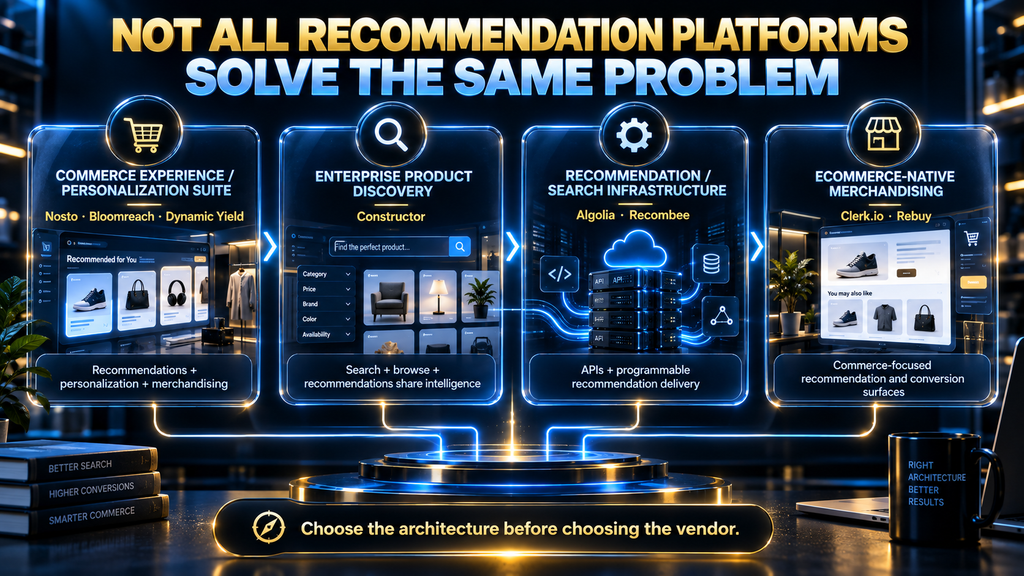
This distinction matters because product recommendations are not one product category in practice. Nosto, Bloomreach, and Dynamic Yield operate closer to personalization or commerce-experience suites; Constructor approaches recommendations as part of product discovery; Algolia and Recombee provide more infrastructure-oriented capabilities; Clerk.io is ecommerce-focused and modular; Rebuy is deeply oriented around Shopify conversion surfaces.
If those systems are placed in one table without explaining the architectural difference, price and feature count become deceptive. Rebuy can look dramatically simpler than Constructor because it is solving a narrower problem, while Constructor can look expensive or excessive to a merchant whose real requirement is a smarter cart upsell.
The better question is therefore not “Which platform has the best AI?” It is “Which recommendation architecture should this store buy before it starts comparing vendors?”
How AI Hustle World Compared the Platforms
This comparison is based on a September 17, 2026 primary-source audit of official product pages, documentation, knowledge bases, and pricing pages. AI Hustle World did not run these eight platforms against one controlled ecommerce catalog, so the comparison evaluates documented capability, architecture, controls, implementation model, pricing transparency, and likely fit, rather than claiming observed superiority in recommendation quality.
Vendor case studies are treated separately from independent evidence. When a vendor reports conversion, revenue, or average-order-value improvements, those figures describe the vendor’s customer example; they are not converted into an AI Hustle World performance score because the stores, implementations, traffic, recommendation placements, and baselines are not comparable.
The comparison also uses the AI Hustle World Platform Fit Score, a reusable commercial-evaluation framework built around five dimensions: Capability Fit, Control, Compatibility, Evidence, and Economics. Ratings use qualitative labels such as Excellent, Strong, Moderate, Limited, or Not Verified rather than false-precision numerical scores.
Capability Fit asks how well the platform solves the recommendation job for its intended buyer. Control examines business rules, merchandising, configuration, and experimentation; Compatibility covers technical stack, APIs, channels, and ecommerce fit; Evidence looks at documentation, analytics, and measurement; Economics considers pricing transparency, implementation burden, and whether the commercial model appears proportionate to the target store.
The 2026 AI Hustle World Product Recommendation Platform Capability Map
Methodology: AI Hustle World reviewed official product documentation, knowledge bases, pricing pages, and product pages for eight recommendation platforms on September 17, 2026. The table compares documented architecture, recommendation capabilities, search integration, merchant control, API/headless support, pricing transparency, and likely store fit. “Not publicly verified” means the official sources reviewed did not provide sufficient public evidence to confirm the capability or starting price. No controlled first-hand recommendation-quality benchmark was performed.
| Platform | Architecture | Recommendation Capability | Search Integration | Merchant Control & Testing | API / Headless | Pricing Transparency | Best Fit |
|---|---|---|---|---|---|---|---|
| Nosto | Commerce experience / personalization suite | 20+ documented recommendation algorithms, cross-sell, affinity, visual similarity, replenishment, trends, checkout/post-purchase | Yes, within broader Product Experience Cloud | Strong merchandising rules, filters, segments, campaign testing | Integrations and platform tooling available; exact implementation varies | Formula explained publicly; fixed starting price not published | Mid-market and enterprise brands wanting recommendations + merchandising + personalization Nosto |
| Constructor | Enterprise product-discovery platform | Personalized, collaborative, alternatives, recently viewed and other strategy-based recommendations | Deep; shares signals and graph logic with search | Strong strategy/pod model; optimization against observed behavior | REST API supported | Public starting price not verified | Large retailers treating recommendations as part of search and discovery Constructor Documentation |
| Bloomreach | Enterprise search / personalization ecosystem | Personalized, frequently bought/viewed together, trending, bestseller, recently viewed, past purchase, rule-driven recommendations | Strong across Bloomreach Search/Discovery and broader platform | Filters, pinning, block lists, preferences, preview/testing workflows | API delivery available through extensions and platform tooling | Public Discovery starting price not verified | Enterprise retailers combining product discovery, customer data, and personalization Bloomreach |
| Dynamic Yield | Enterprise personalization / experimentation platform | Multiple algorithm strategies, affinity and behavioral recommendation approaches | Broader personalization rather than search-first architecture | Strong targeting, filters, variations and control-group testing | Server-side recommendation APIs supported | Public starting price not verified | Enterprise teams where experimentation and personalization governance are central Dynamic Yield |
| Algolia | Search and recommendation infrastructure | Frequently bought together, related items, trending, visual similarity, personalized recommendations | Very strong; recommendations operate inside same search/discovery environment | Filters, merchandising, analytics and experimentation support | Strong API orientation | High; free tier and recommendation-request pricing published | Developer-led, headless, marketplace, and search-heavy ecommerce teams Algolia |
| Clerk.io | Ecommerce search + recommendation platform | 20+ documented recommendation logics across homepage, category, PDP, cart, blog and other placements | Yes; Search is a separate module in same platform | Configurable logics, designs and ecommerce-focused controls | Supports general webshop integrations; implementation depends on stack | High; modular usage calculator published | Growing ecommerce stores wanting search + recommendations without full enterprise-suite complexity clerk.io |
| Rebuy | Shopify personalization / conversion-merchandising layer | AI/ML recommendations, merchandising widgets, Smart Cart, bundles, checkout and post-purchase offers | Search/Collections available as package within broader Rebuy platform | Strong Shopify-oriented rules, flows and A/B testing across recommendation surfaces | Primarily Shopify ecosystem rather than general recommendation infrastructure | High; order-volume/package model and starting figures published | Shopify brands focused on upsells, cart value, checkout and post-purchase merchandising Rebuy |
| Recombee | Dedicated recommender / personalization API | Personalized homepage, alternatives, bought-together, cart, search, category, email and real-time models | Personalized search included | Filters, boosters, constraints, scenarios and analytics | Strong API/recommender-service orientation | High; Free, Standard, Pro and Premium tiers published | Technical teams wanting dedicated recommendation infrastructure without a full commerce suite Recombee Docs |
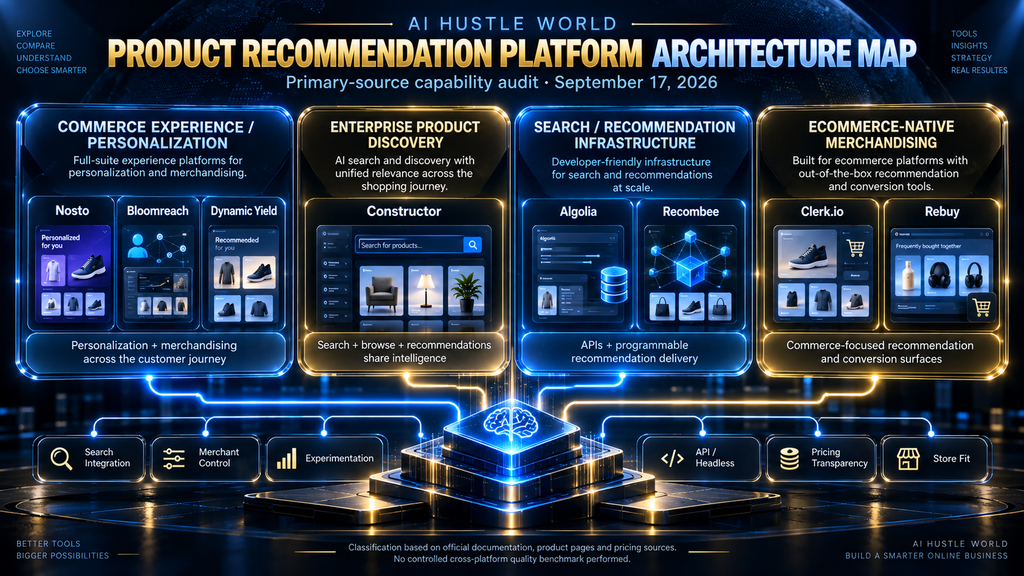
The table exposes something that a conventional ranking hides: these eight products do not represent eight versions of the same software. A buyer can eliminate several platforms simply by identifying the architecture that matches the store’s actual requirement.
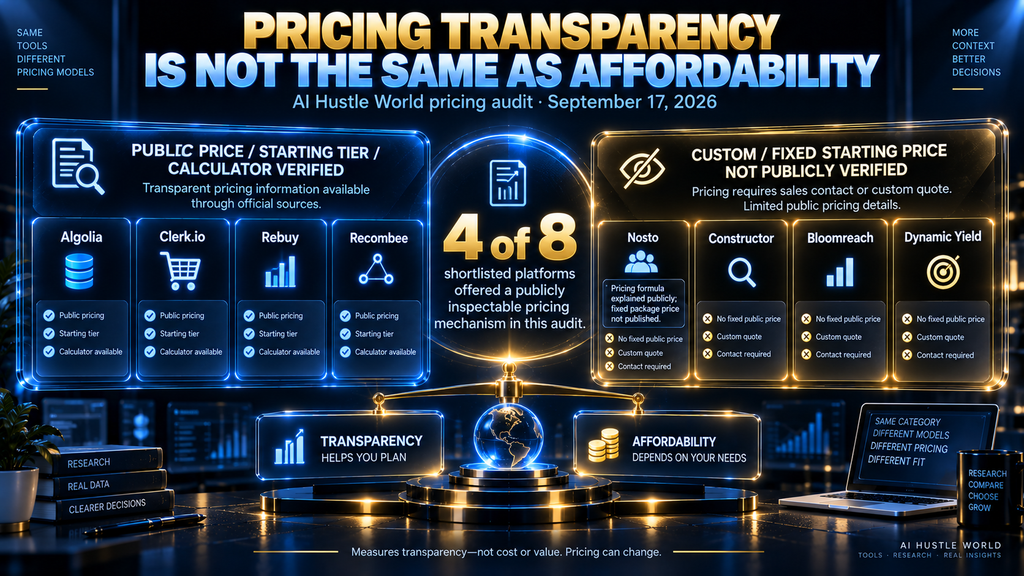
The current pricing audit also revealed a useful commercial distinction. Four of the eight shortlisted platforms—Algolia, Clerk.io, Rebuy, and Recombee—currently provide a public price, starting tier, or interactive pricing mechanism that can be inspected without first obtaining a custom quote; Nosto explains its formula publicly but does not publish fixed starting package prices, while public starting prices for Constructor, Bloomreach Discovery, and Dynamic Yield were not verified in the official sources reviewed.
That number is a dated pricing-transparency observation, not an affordability score. Transparent usage pricing can still become expensive at scale, while a custom enterprise contract may provide better economics for a sufficiently large retailer.
Best for Enterprise Product Discovery: Constructor
Constructor stands out when product recommendations are not a separate merchandising widget but part of a larger search, browse, and product-discovery system. Its documentation describes recommendations as personalized using past search, browse, and purchase behavior, with the same personalization signals and graph logic feeding its search engine.
That integration is the main reason to consider Constructor. A retailer with millions of products or complex discovery journeys can benefit when search and recommendations learn from the same behavior rather than operating as isolated tools with different customer models.
Constructor also uses a strategy-and-placement model. Recommendations are delivered into defined locations or “pods,” while strategies determine how items are selected and ranked; the platform exposes recommendation results through REST APIs for retailers that already have their own front-end experience.
The product is particularly interesting for cold-start or low-interaction inventory because Constructor documents a product-inheritance approach that combines behavioral signals with content embeddings, mapping newer or less popular products to similar items that already have interaction history. That does not remove cold-start difficulty, but it shows the platform is designed for more than simple collaborative filtering.
The limitation is equally clear. Constructor is difficult to justify when recommendations are a relatively small merchandising problem inside an otherwise satisfactory commerce stack. If a Shopify merchant primarily wants better accessories under a product page and targeted offers in the cart, adopting an enterprise product-discovery platform could introduce a much larger implementation than the business problem requires.
AI Hustle World Platform Fit Score — Constructor
Capability Fit: Excellent for enterprise product discovery. Control: Strong. Compatibility: Strong for API-led and complex retail environments. Evidence: Strong documentation, but no neutral cross-vendor performance benchmark was available. Economics: Not Verified publicly because an official starting price was not confirmed.
Constructor is therefore not our universal number-one recommendation platform. It is our strongest fit when recommendations need to share intelligence with a serious search and product-discovery stack.
Best Commerce Experience Platform for Recommendations: Nosto
Nosto approaches recommendations as one part of a larger commerce-experience system rather than as a single recommendation API. Its Product Experience Cloud combines personalized search, category merchandising, product recommendations, post-purchase upsell, dynamic bundles, and personalized email around a shared data and personalization layer.
The recommendation product itself is unusually merchandising-friendly. Nosto documents more than 20 recommendation algorithms, including personalized suggestions, cross-sells, visual similarity, replenishment, geotargeted trends, and other strategies, while merchants can boost or bury products using attributes and performance signals such as margin, category, stock level, and conversion rate.
That balance between automation and merchant control is a major reason Nosto fits brands that do not want recommendation decisions completely delegated to a black box. Filters, segment targeting, dynamic placements, and recommendation campaign testing allow the retailer to impose commercial logic on top of the predictive system rather than simply accepting whatever the algorithm ranks highest.
Nosto also documents recommendations for first-time visitors or users who do not provide enough personal data, using broader site signals such as bestsellers, trends, and contextual information. That matters because stores with a high proportion of new visitors cannot assume that every useful recommendation begins with a rich individual customer profile.
Pricing is less transparent than Algolia, Recombee, Clerk.io, or Rebuy. Nosto says pricing is modular and depends on business volume, selected modules, and required support or scalability, but it does not publish a universal fixed starting package price.
AI Hustle World Platform Fit Score — Nosto
Capability Fit: Excellent for mid-market and enterprise commerce personalization. Control: Excellent. Compatibility: Strong across major ecommerce platforms. Evidence: Strong product documentation and testing guidance. Economics: Moderate visibility because the pricing formula is described but fixed rates require sales engagement.
Nosto becomes especially attractive when the retailer wants recommendations alongside search, category merchandising, bundles, and personalization. It becomes less attractive when the only requirement is a lightweight recommendation API or a simple cart cross-sell.
Best for Enterprise Personalization Beyond Recommendations: Bloomreach
Bloomreach should be considered when product recommendations need to live inside a broader customer-data and personalization environment. Its current recommendation system uses customer behavior and catalog data, with delivery across search results, carts, email, push, SMS, WhatsApp, and onsite experiences depending on the packages and integrations in place.
The platform supports both ready-to-use rule-driven templates and machine-learning-based Loomi templates. That distinction is valuable because not every recommendation problem has enough data to justify a learned model immediately; Bloomreach explicitly notes that Loomi templates need data and learning time, while simpler templates can serve immediately.
Merchandisers also retain control through dynamic filters, pinning, block lists, customer preferences, and other overlays. Bloomreach’s current product pages document personalized recommendations, search-history-based recommendations, bestsellers, frequently bought together, frequently viewed together, trending products, recent interactions, past purchases, and in-stock replacement use cases.
The biggest reason to choose Bloomreach is not that one recommendation type is uniquely unavailable elsewhere. It is the possibility of connecting product recommendations with a larger customer and product intelligence system that also powers search, marketing, and personalization.
That breadth creates the corresponding limitation. Bloomreach can be disproportionate for a store that wants only a smarter recommendation carousel or cart upsell, because the strategic value increases as more of the broader platform is actually used.
AI Hustle World Platform Fit Score — Bloomreach
Capability Fit: Excellent for enterprise retailers combining recommendations, search, and customer personalization. Control: Strong. Compatibility: Strong for larger omnichannel programs. Evidence: Strong documentation and active 2026 product development. Economics: Limited public visibility for the Discovery use case because a reliable public starting price was not verified.
Bloomreach is therefore a stronger strategic fit for organizations that already think in terms of customer data, product discovery, and cross-channel personalization, rather than smaller stores buying a standalone recommender.
Best for Experimentation-Heavy Personalization Teams: Dynamic Yield
Dynamic Yield is a different kind of recommendation purchase because recommendations sit inside a wider personalization and experimentation platform. Its official knowledge base documents recommendation strategies that select items based on algorithms, filters, audience context, and campaign configuration rather than treating the recommendation block as a fixed widget.
The strongest part of the platform for recommendation programs is the experimentation layer. API recommendation campaigns can contain multiple variations, traffic allocation, control groups, targeting conditions, primary metrics, and server-side delivery, which gives a sophisticated team a practical way to compare recommendation strategies instead of assuming the first configured model is the right one.
That matters because recommendation performance depends heavily on placement and objective. “Customers who bought this also bought” may outperform affinity-based personalization on one part of the journey and underperform somewhere else, while an expensive recommendation surface may add almost no incremental value if customers were already likely to buy the suggested product.
Dynamic Yield is therefore attractive when an organization already has the traffic and experimentation maturity to treat recommendations as hypotheses that need controlled testing. It is much less compelling for a small retailer that wants recommendations working quickly with minimal governance.
A public starting price was not verified from Dynamic Yield’s current official materials during this research pass. The absence of a confirmed public price should not be interpreted as evidence that the platform is expensive or inexpensive; it means the commercial comparison requires direct vendor pricing.
AI Hustle World Platform Fit Score — Dynamic Yield
Capability Fit: Excellent for enterprise personalization and experimentation teams. Control: Excellent. Compatibility: Strong for web, apps, and API-led experiences. Evidence: Strong documentation for recommendation strategy and testing. Economics: Not Verified publicly.
Dynamic Yield is strongest when recommendation performance will be actively measured, segmented, and optimized. It is weak as a choice for teams that would buy the platform but never use the experimentation machinery that justifies its complexity.
Best Developer-Led Search and Recommendation Platform: Algolia
Algolia is one of the clearest choices when recommendations need to be treated as programmable infrastructure rather than primarily as a marketer-operated widget. Its recommendation system works alongside the company’s search and discovery stack, using first-party behavioral data and catalog content to train models and serve ranked results through APIs.
Current recommendation types include frequently bought together, related items, trending items, visual similarity, and personalized recommendations. Algolia also documents filtering, merchandising, analytics, API delivery, and continuous model retraining as new behavioral events arrive.
This architecture fits headless commerce, marketplaces, custom storefronts, and engineering-led teams particularly well. If the organization already relies on Algolia for search, adding recommendations can be operationally cleaner than introducing a completely separate personalization stack with another catalog index and behavioral-data model.
Pricing transparency is another advantage. At the time of this review, Algolia’s Free plan included 5,000 recommendation requests per month, while Grow and Grow Plus included 10,000 recommendation requests with additional recommendation requests listed at $0.60 per 1,000; broader search pricing varies by plan and request volume.
The economics still require care. Usage-based pricing looks simple at low volume but can scale with recommendation impressions, search traffic, stored records, and premium features, so a large retailer should model likely production traffic rather than comparing only the free allowance.
AI Hustle World Platform Fit Score — Algolia
Capability Fit: Excellent for developer-led search and recommendation systems. Control: Strong. Compatibility: Excellent for API-first and custom front ends. Evidence: Excellent documentation and transparent pricing. Economics: Strong transparency, though production cost depends heavily on usage.
Algolia is less compelling for a small merchandising team that wants a highly managed, no-code personalization suite. Its strength is giving technical teams a flexible recommendation layer closely connected to search.
Best Mid-Market Ecommerce Recommendation Platform: Clerk.io
Clerk.io is easier to understand once it is positioned between lightweight recommendation apps and enterprise personalization suites. Its recommendation product is built specifically around ecommerce touchpoints, with documented placements for homepage, category, product, add-to-basket, cart, blog, and other areas of the store.
The platform documents more than 20 recommendation logics and allows merchants to configure recommendation elements and designs rather than relying on one fixed model. Search, Recommendations, Chat, Email, and Audience are modular products within the wider Clerk.io offering, which makes it possible to adopt recommendations without necessarily buying the entire platform.
That modularity is particularly attractive to growing ecommerce businesses. A retailer can start with recommendations and later add search or other capabilities without immediately adopting an enterprise platform whose implementation model may assume a larger organization.
Pricing is usage-based and exposed through Clerk.io’s public calculator. Recommendation usage is calculated from API calls, and the platform allows merchants to combine modules while costs scale with usage tiers; the exact monthly figure depends on the volume entered into the calculator rather than one fixed global recommendation price.
Clerk.io’s limitation is that it does not occupy the same enterprise product-discovery position as Constructor or the same deep experimentation/personalization category as Dynamic Yield. That is not necessarily a weakness for its intended buyer; it is exactly why a mid-market store may find it easier to justify.
AI Hustle World Platform Fit Score — Clerk.io
Capability Fit: Strong for growing ecommerce businesses. Control: Strong. Compatibility: Strong across ecommerce implementations. Evidence: Strong documentation. Economics: Strong transparency because usage pricing can be estimated publicly.
Clerk.io is one of the most sensible shortlists when a store wants serious ecommerce recommendations without automatically committing to an enterprise experience platform.
Best for Shopify Upsells, Cart Recommendations, and Post-Purchase: Rebuy
Rebuy should not be evaluated as though it were an enterprise recommendation API. Its advantage is that it sits close to the places where Shopify merchants commonly monetize recommendations: product merchandising, Smart Cart, bundles, checkout, thank-you pages, order-status pages, post-purchase offers, search, and collections.
The current product packaging makes that orientation clear. Merchants can combine Cart & Merchandising, Checkout & Post-Purchase, Search & Collections, and Flows & A/B Testing packages, while pricing scales with Shopify order volume.
Rebuy’s experimentation capability is more substantial than a basic upsell app. Its current documentation supports A/B testing of recommendation widgets, Smart Cart configurations, checkout and post-purchase offers, storefront changes, and recommendation logic; tests can optimize around goals such as revenue or conversion rate.
That measurement layer matters because upsells can easily look successful while adding little incremental value. Rebuy itself recommends testing recommendation experiences against alternatives or even no-widget controls in some cases, which is a healthier approach than assuming that inserting more recommendation blocks automatically improves a store.
Pricing is comparatively inspectable. Rebuy’s current pricing page says merchants can build plans from individual packages starting as low as $25 per month for one package at certain order volumes, while its broader Platform One bundle is priced according to monthly order volume and listed at $534 per month in the configuration surfaced during this research snapshot.
Those numbers should not be interpreted without order volume and package selection. The more important point is that Rebuy’s cost is tied to Shopify order volume and selected capabilities rather than to a recommendation-request API model.
AI Hustle World Platform Fit Score — Rebuy
Capability Fit: Excellent for Shopify conversion merchandising. Control: Excellent for Shopify recommendation and offer workflows. Compatibility: Excellent inside Shopify, limited as a general cross-platform recommendation infrastructure choice. Evidence: Strong current documentation and A/B testing guidance. Economics: Strong transparency, though price scales with order volume and package selection.
Rebuy is our strongest shortlist for a Shopify merchant whose main objective is cart value, bundles, cross-sells, checkout recommendations, and post-purchase merchandising rather than enterprise-wide product discovery.
Best Dedicated Recommendation API: Recombee
Recombee is one of the clearest options when the organization wants the recommendation engine itself rather than a large ecommerce experience suite. Its ecommerce recipes cover personalized homepages, similar products, complementary accessories, cart recommendations, category personalization, email recommendations, and personalized search.
The system uses both catalog attributes and behavioral interactions, with documented support for collaborative and content-based approaches, business rules, filters, boosters, constraints, and real-time analytics. Recombee also specifically describes support for anonymous users and newly added products, where relying entirely on long historical profiles would be impractical.
This makes Recombee particularly attractive to product and engineering teams building custom applications. Instead of adopting a large merchandising dashboard with many adjacent marketing products, the team can integrate recommendation services into its own storefront, marketplace, app, or product experience.
Pricing is the most transparent among the specialized recommendation platforms in this comparison. Recombee currently publishes a Free plan, Standard starting at $99 per month, Pro starting at $1,699 per month, and Premium starting at $4,499 per month, with limits based on interactions, recommendation requests, active users, and catalog items.
The trade-off is that flexibility transfers more responsibility to the buyer. A team choosing Recombee needs to think carefully about event tracking, catalog synchronization, scenario design, interface implementation, and how recommendations fit into its broader ecommerce experience.
AI Hustle World Platform Fit Score — Recombee
Capability Fit: Excellent for dedicated recommendation infrastructure. Control: Strong. Compatibility: Excellent for technical/API-led products. Evidence: Strong documentation and explicit ecommerce recipes. Economics: Excellent pricing transparency, with usage scaling as the main consideration.
Recombee is therefore our strongest choice when the organization wants a recommender system it can build around, rather than a complete commerce-personalization suite.
How the Platform Fit Score Changes by Use Case
A single overall ranking would obscure more than it clarifies. Constructor can be a better purchase than Rebuy for a complex enterprise retailer, while Rebuy can be a substantially better purchase than Constructor for a Shopify brand trying to improve cart and post-purchase merchandising.
| Use Case | Strongest Shortlist | Why |
|---|---|---|
| Enterprise search + recommendations | Constructor, Bloomreach, Algolia | Recommendations can share data and discovery logic with search rather than operate independently |
| Broader commerce personalization | Nosto, Bloomreach, Dynamic Yield | Recommendations sit within larger merchandising/personalization programs |
| Shopify cart, upsell and post-purchase | Rebuy | Architecture and packaging are built around Shopify conversion surfaces |
| Developer-led/headless ecommerce | Algolia, Recombee, Constructor | Stronger API-oriented delivery and custom front-end control |
| Mid-market ecommerce | Clerk.io, Nosto | More manageable path between lightweight widgets and enterprise platforms |
| Dedicated recommendation API | Recombee, Algolia | Clear recommendation infrastructure without requiring full-suite adoption |
| Experimentation-heavy personalization | Dynamic Yield, Rebuy, Nosto | Documented control-group or campaign-testing capabilities |
| Transparent self-service pricing | Algolia, Recombee, Clerk.io, Rebuy | Public allowance, starting-price, or calculator mechanisms available |
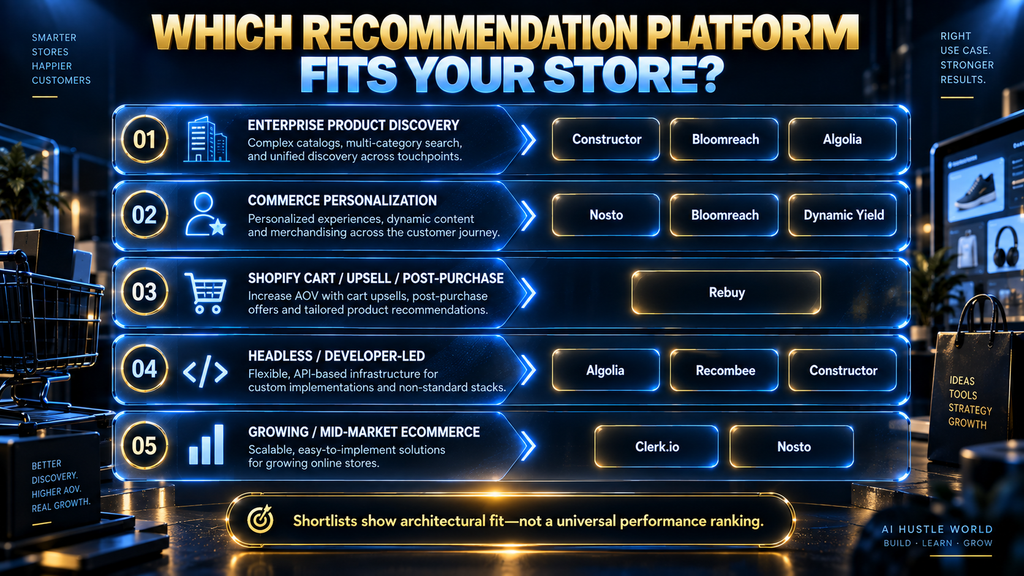
The table is intentionally a shortlist, not a claim that every buyer in a category should choose the first name shown. Existing stack, traffic, merchandising organization, catalog complexity, geographic scale, customer identity, privacy requirements, and contract economics can materially change the result.
Recommendation Quality Depends on Your Data More Than Vendor Marketing Suggests
A platform can have sophisticated algorithms and still produce mediocre recommendations when the underlying data is weak. Recommendation systems need some combination of product attributes, behavioral events, searches, views, cart actions, purchases, customer identity, and contextual information, and the available signals shape what the model can infer.
Constructor explicitly uses search, browse, and purchase behavior, while Algolia trains recommendations from catalog content and behavioral events such as views, clicks, add-to-cart events, and purchases. Bloomreach similarly requires product-catalog information and behavioral event collection for its learned recommendation models.
That creates a practical problem for small or low-frequency catalogs. A furniture retailer may have high order values but relatively few repeat purchases, while a grocery business can accumulate frequent basket interactions quickly; the same collaborative recommendation method will not have the same information density in both stores.
Content-based signals can help with sparse interaction history. Constructor documents product inheritance using content embeddings for new or less popular products, while Recombee supports content-based models and uses product properties as part of its recommendation stack.
This is why “AI-powered” is not a sufficient buying criterion. Before signing a contract, a retailer should ask what behavioral and catalog data the platform expects, how long learned models need before they become useful, and what fallback logic exists when there is not enough individual history.
Cold Start Is a Business Problem, Not Just a Model Problem
Cold start appears when the recommendation system has too little evidence about a user, a product, or sometimes the entire store. A new visitor has no personal browsing history, while a newly launched product may have no clicks or purchases for collaborative models to learn from.
Most serious platforms compensate with broader signals. Nosto can use bestsellers, trends, geographic context, and aggregated behavior for first-time visitors, while Bloomreach separates ready-to-use rule-based templates from learned Loomi templates that need data and learning time.
Recombee similarly documents content-based and popularity fallbacks, while Constructor maps new or low-interaction products toward similar products that already have behavioral data. Those approaches do not make cold start disappear, but they show why the retailer should investigate fallback behavior instead of assuming every visitor immediately receives deep 1:1 personalization.
The practical buying question is therefore simple: what does this platform recommend when it knows almost nothing? That answer matters enormously for stores where a large share of traffic consists of new visitors.
Merchant Control Matters Because the Highest-Probability Product Is Not Always the Right Product
Recommendation models naturally optimize around the signals and objectives they receive, but retailers have additional constraints the model may not infer automatically. A retailer may want to suppress low-stock products, prioritize private-label products, avoid recommending substitute products in a particular campaign, protect contractual brand commitments, or prevent a high-margin item from appearing when it is contextually irrelevant.
Nosto allows merchants to boost or bury recommendations using performance and product attributes, Bloomreach supports filters, pinning, block lists, and customer preferences, and Algolia exposes filters and merchandising controls alongside recommendation models. Recombee also supports filters, boosters, constraints, and business rules, while Rebuy mixes AI-driven recommendation logic with merchant-defined flows and merchandising logic.
The strongest platform is not necessarily the system that automates the most decisions. For many stores, the better system is the one that automates repetitive ranking while still allowing merchandisers to intervene where inventory, margin, campaign goals, or customer experience create legitimate business constraints.
The Recommendation Surface Changes Which Platform Makes Sense
A retailer should identify where recommendations need to appear before selecting a vendor. Homepage personalization, product-detail alternatives, cart cross-sells, search recommendations, email products, checkout upsells, and post-purchase offers have different technical requirements and different commercial objectives.
Rebuy is particularly strong close to the transaction because its platform is built around Smart Cart, checkout, post-purchase, bundles, and merchandising widgets. Nosto reaches further across the commerce journey with recommendations on homepage, category, product, cart, checkout, post-purchase, email, and other experiences.
Bloomreach spans even more channels when combined with its broader marketing system, with recommendations available across web, search, email, push, SMS, WhatsApp, and other campaign surfaces. That breadth can be extremely valuable for an omnichannel personalization program, but it is wasted complexity when the buyer only needs recommendations under product pages.
Recombee and Algolia take a different route because technical teams can deliver recommendations into their own interfaces. That is often preferable for custom or headless commerce, where the business does not want the recommendation vendor dictating the presentation layer.
This is why platform selection should begin with a map of high-value recommendation surfaces, not with a product demo.
A/B Testing Is More Important Than Another Recommendation Algorithm
Recommendation platforms frequently advertise large algorithm libraries, but retailers cannot know which strategy creates incremental value on their own store without measurement. A recommendation block can look relevant and attract clicks while generating little additional revenue because customers would have discovered or purchased the items anyway.
Dynamic Yield’s recommendation campaigns can allocate traffic across variations and control groups, while Rebuy supports tests across recommendation widgets, Smart Cart, checkout offers, post-purchase experiences, and even widget-versus-no-widget scenarios. Nosto also documents campaign testing for recommendations.
Algolia exposes recommendation analytics around clicks, conversions, and revenue, while Bloomreach allows recommendation configuration and preview/testing before deployment. These capabilities improve observability, although analytics alone are not equivalent to a controlled incremental-lift experiment.
The retailer should therefore ask a stronger question than “Can this platform personalize?” Ask “Can we prove that this recommendation strategy performs better than the alternative we would have shown?” That question is often more valuable than adding one more recommendation model to the feature list.
Pricing Models Can Change Which Platform Is Economically Rational
Recommendation-platform pricing is difficult to compare because the billing units are different. Algolia prices around requests and records, Recombee uses interactions, recommendation requests, active users, and catalog size, Clerk.io scales by usage, Rebuy scales primarily by Shopify order volume and selected packages, while Nosto prices through a modular model influenced by business volume and chosen capabilities.
This makes screenshot-level price comparison unreliable. A $99 starting tier can be attractive for a prototype but irrelevant to a business that needs millions of recommendation requests, while an enterprise quote that initially appears expensive may cover capabilities that would otherwise require several separate tools.
The appropriate calculation is total recommendation-program cost, not subscription price alone. That includes implementation, event instrumentation, catalog synchronization, front-end work, experimentation, ongoing merchandising, support, and the cost of running overlapping search or personalization systems.
There is also a hidden cost in under-buying. A merchant may choose a cheap recommendation widget, then later add a separate search tool, experimentation platform, email recommender, and personalization layer; the combined stack can become more expensive and harder to govern than adopting a broader platform earlier.
The opposite is equally common. A store can spend heavily on an enterprise experience platform and use only basic “recently viewed” and “customers also bought” widgets, effectively paying for architecture the organization never operationalizes.
What a Small Online Store Should Choose
A small store should generally avoid buying enterprise recommendation infrastructure before proving that recommendations materially improve the customer journey. If the catalog is modest, traffic is limited, and most buyers already know what they want, a sophisticated recommendation engine may produce less incremental value than improving product data, navigation, search, or merchandising.
For technical teams, Algolia’s free recommendation allowance and Recombee’s Free plan create relatively low-friction environments for experimentation. Those options still require implementation work, but they provide a way to test whether recommendation logic is useful before committing to a larger contract.
A small Shopify merchant with a clear upsell or bundle problem may get more direct value from Rebuy or another Shopify-native merchandising layer, particularly if the desired recommendations are concentrated around the product page, cart, checkout, and post-purchase experience. The general rule is to buy the smallest recommendation architecture that can solve the economically important problem, then expand when the retailer has evidence that broader personalization would create additional value.
What a Mid-Market Store Should Choose
Mid-market stores usually face a harder decision because simple recommendation widgets may be too limited while enterprise suites may still be operationally heavy. This is where Clerk.io and Nosto become particularly interesting, depending on how broad the retailer wants the platform to become.
Clerk.io is attractive when search and recommendations are the main problem and the retailer values modular, usage-based adoption. Nosto makes more sense when recommendations need to connect with category merchandising, broader personalization, search, bundles, and other commerce-experience functions.
Algolia can also be an excellent mid-market option when the organization has a capable engineering team and wants to own more of the front-end experience. The best choice depends less on company revenue than on whether the retailer thinks like a merchandising organization, a marketing/personalization organization, or a product/engineering organization.
That organizational fit is frequently underestimated. The technically strongest platform can become the wrong platform when the team responsible for operating it lacks the skills, time, or authority to use its controls effectively.
What an Enterprise Retailer Should Choose
Enterprise retailers should begin with the relationship between recommendations and the rest of product discovery. If search, category ranking, product recommendations, customer affinity, and experimentation need to share a common intelligence layer, the shortlist naturally moves toward Constructor, Bloomreach, Nosto, Dynamic Yield, and in some technical environments Algolia.
Constructor deserves particular attention when search and recommendations should learn from the same clickstream and product graph. Bloomreach becomes more compelling when product discovery needs to connect into a broader customer-data and marketing ecosystem, while Dynamic Yield is particularly strong when recommendations sit inside a mature personalization and experimentation program.
Nosto fits retailers that want a more commerce-focused experience platform with strong merchandising controls, while Algolia remains relevant for engineering-heavy organizations that want a more composable search-and-recommendation infrastructure.
At enterprise scale, the buying process should include architecture, data governance, SLA requirements, localization, peak-traffic performance, security, implementation resources, and total contract economics. A product demo showing attractive recommendation carousels is nowhere near enough information for the decision.
What Happens When Recommendation Programs Fail
Recommendation projects often fail for reasons that are only partially related to the recommendation algorithm. Weak event tracking, inconsistent catalog information, poor inventory synchronization, incorrect product relationships, and badly chosen placements can undermine even sophisticated systems.
Another common failure is optimizing for the wrong metric. A recommendation model trained or merchandised toward clicks can surface visually interesting products that receive attention without increasing incremental revenue, while aggressive cart upsells may increase short-term AOV at the cost of a more cluttered buying experience.
Popularity loops create another problem. A bestseller receives more exposure because it already sells well, that additional exposure generates more interactions, and the model becomes increasingly confident that the same bestseller deserves even more visibility, leaving new or niche inventory with fewer opportunities to collect behavioral evidence.
Retailers also create failure through excessive business rules. Merchant control is valuable, but if every recommendation result is pinned, suppressed, filtered, campaign-driven, or overridden, the system may stop having enough freedom to personalize meaningfully.
The opposite failure appears when the model is given too much authority. A recommendation engine may optimize toward statistically likely behavior while ignoring inventory strategy, margin, contractual merchandising commitments, brand considerations, or the simple fact that a suggested add-on does not make sense for the customer’s current purchase.
How to Implement a Recommendation Platform Without Wasting the Investment
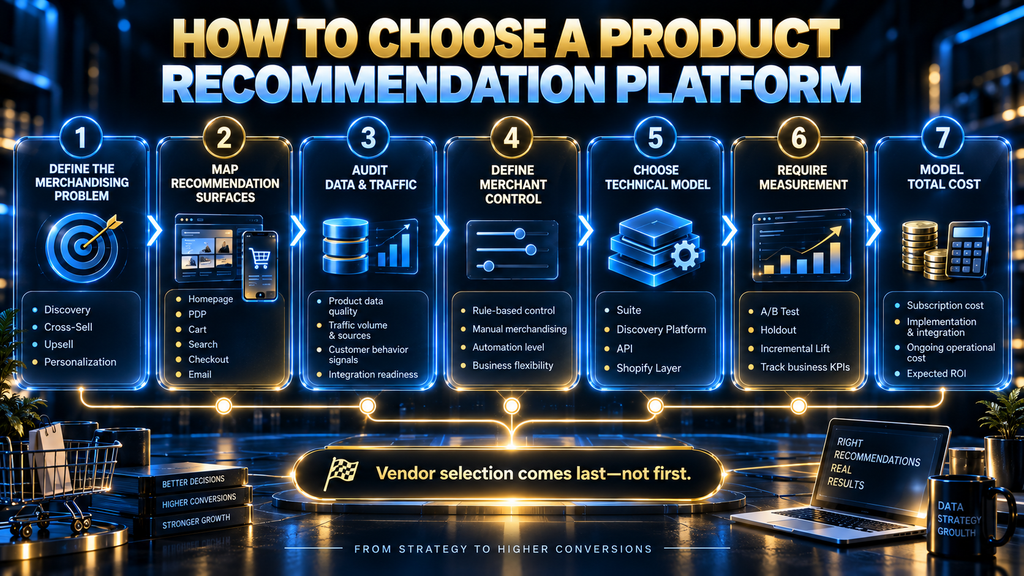
Implementation should begin with one clearly defined commercial problem rather than every possible recommendation placement. A retailer might start with product-detail alternatives, cart accessories, or personalized homepage recommendations, depending on where current customer behavior shows the greatest discovery friction.
The next requirement is trustworthy data. Product feeds need usable attributes and inventory state, while behavioral events should capture the interactions the platform expects, such as views, searches, clicks, cart additions, purchases, or other signals depending on the selected system.
The retailer should then establish a baseline. If the current recommendation block uses bestsellers or manual merchandising, keep enough measurement to compare the new platform against that existing experience rather than treating revenue after launch as proof that the new system caused the result.
Recommendation strategies should be matched to the surface. Product-detail alternatives solve a different problem from cart accessories, replenishment recommendations, search personalization, or post-purchase offers, so using one universal recommendation strategy across the store is rarely sensible.
Business rules should be introduced carefully. Inventory exclusions, incompatible products, prohibited categories, price boundaries, and campaign rules may be essential, but unnecessary overrides can reduce the model’s opportunity to learn from customer behavior.
Finally, the program needs continued experimentation. Recommendation quality changes as the catalog, traffic mix, seasonality, pricing, campaigns, and customer behavior change, which means the best-performing strategy in one quarter may not remain the best strategy indefinitely.
How to Measure Whether Product Recommendations Are Actually Working
Recommendation performance should be measured as a chain from exposure to incremental business outcome. Impressions and clicks can diagnose engagement, but they do not prove that the recommendation improved the purchase decision.
Click-through rate can help identify recommendation blocks shoppers ignore, while add-to-cart from recommendation indicates stronger commercial intent. Attach rate is useful for accessories and cross-sells because it shows how often the suggested product joins the relevant primary purchase.
Conversion and average order value become more meaningful closer to the transaction, but they still require context. Shoppers who engage with recommendations may already be the most motivated customers, so comparing recommendation users with non-users without randomized or carefully controlled measurement can exaggerate the recommendation system’s contribution.
Where possible, use holdouts, A/B tests, or control groups. Dynamic Yield, Rebuy, and Nosto all document experimentation capabilities that can help retailers compare different recommendation setups or recommendation presence against alternatives.
Operational quality should also be tracked. Out-of-stock recommendation rate, catalog coverage, diversity, repeated-product frequency, latency, data-feed failures, and recommendation errors can expose weaknesses that topline revenue dashboards miss.
The best recommendation program is therefore not simply the one with the highest reported CTR. It is the one that produces measurable incremental value without degrading product discovery, margin, inventory strategy, or customer experience.
The Platforms We Would Not Compare Directly With These Eight
Quiz builders, conversational shopping assistants, and lightweight “frequently bought together” apps can all recommend products, but they do not necessarily belong in the same buying decision. Their recommendation mechanism, implementation effort, and commercial purpose can be materially different.
A quiz is useful when the retailer can reduce a purchase decision into a structured sequence of questions. A conversational shopping assistant is better when shoppers express complex intent in natural language, while a cart cross-sell app may be entirely sufficient when the only problem is attaching a compatible accessory to a purchase.
This matters because over-buying software is a real risk. A merchant does not need a large recommendation platform merely because a simpler product also uses the word “AI,” and an enterprise retailer should not assume a lightweight recommendation widget can replace a broader search-and-personalization architecture.
The right comparison set begins with the problem. Only after the store knows what recommendation job it is buying should vendor comparison begin.
A Practical Decision Framework
Choose Constructor when search and recommendations should behave as one enterprise product-discovery system, especially when the retailer has complex catalog and behavioral data. Choose Nosto when recommendation, merchandising, search, and broader ecommerce personalization need to sit inside one commerce-focused platform.
Choose Bloomreach when recommendations need to connect into a larger enterprise customer-data, discovery, and omnichannel personalization strategy. Choose Dynamic Yield when mature experimentation, audience targeting, and personalization operations are at least as important as the recommendation engine itself.
Choose Algolia when the organization is engineering-led, uses custom or headless experiences, and wants recommendations tightly connected to programmable search infrastructure. Choose Recombee when the team wants a dedicated recommendation API with transparent usage tiers and is comfortable building the surrounding experience.
Choose Clerk.io when a growing ecommerce business needs stronger search and recommendation capability without immediately adopting a heavy enterprise platform. Choose Rebuy when the store runs on Shopify and the most important recommendation opportunities sit around product merchandising, Smart Cart, bundles, checkout, and post-purchase offers.
Those conclusions are not permanent rankings. Platform roadmaps, pricing, packaging, and integrations change, so the final decision should verify the exact features and commercial terms required by the store before signing a contract.
Final Thoughts
The phrase “AI product recommendation platform” hides several different software categories. A lightweight conversion tool, a dedicated recommendation API, a search-and-discovery platform, and an enterprise personalization suite can all recommend products, but they create very different implementation requirements and solve different merchandising problems.
That is why this comparison does not crown one universal winner. Constructor is especially strong for enterprise product discovery, Nosto for commerce-focused personalization, Bloomreach for wider enterprise discovery and customer personalization, and Dynamic Yield for experimentation-heavy personalization programs.
Algolia is a strong fit for developer-led search and recommendation infrastructure, while Recombee provides a focused recommendation API with unusually clear pricing. Clerk.io offers an appealing middle ground for growing ecommerce stores, and Rebuy is particularly well aligned with Shopify brands trying to improve cart, upsell, checkout, and post-purchase merchandising.
The deeper decision is architectural. Before choosing a vendor, decide whether the business needs a recommendation engine, a search-and-recommendation infrastructure layer, a Shopify merchandising system, or a wider personalization platform.
Once that question is answered, the feature lists become much easier to interpret. The retailer can compare the platforms that actually solve the same problem, evaluate their controls and economics, and avoid paying for either too little or far more infrastructure than the recommendation program can realistically use.
Understand the Recommendation Engine Before You Choose the Platform
Platform features are easier to compare once you understand how product recommendations use behavior, product data, ranking logic, and merchandising rules. See the mechanism behind the tools before making the final buying decision.
See How AI Product Recommendations Work →Frequently Asked Questions
What is the best AI product recommendation platform for ecommerce?
There is no single best platform for every ecommerce store because the category includes enterprise discovery systems, personalization suites, recommendation APIs, and Shopify conversion tools. Constructor, Nosto, Bloomreach, Dynamic Yield, Algolia, Clerk.io, Rebuy, and Recombee solve overlapping but materially different problems.
The right choice depends on catalog size, traffic, ecommerce platform, recommendation surfaces, behavioral data, merchandising control, engineering resources, experimentation requirements, and budget. A Shopify cart-upsell problem and an enterprise search-personalization problem should not produce the same shortlist.
What is the best AI recommendation platform for Shopify?
Rebuy is one of the strongest fits when the Shopify use case centers on Smart Cart, merchandising widgets, bundles, checkout, post-purchase offers, and recommendation testing. Nosto is a stronger candidate when the Shopify brand also wants a broader personalization, search, and merchandising platform.
Smaller Shopify stores should still compare the likely incremental value against simpler native or app-based approaches. A larger platform is justified only when the business will use the additional recommendation and personalization capabilities.
Which product recommendation platform has the most transparent pricing?
Among the platforms reviewed, Algolia, Recombee, Clerk.io, and Rebuy provide the clearest public pricing mechanisms. Algolia publishes usage allowances and recommendation-request pricing, Recombee publishes tier starting prices and usage limits, Clerk.io provides a usage calculator, and Rebuy exposes order-volume/package-based pricing.
Price transparency should not be confused with lower total cost. Usage-based platforms can become expensive at high traffic, while negotiated enterprise contracts may include functionality that replaces other software.
Which platform is best for headless ecommerce?
Algolia and Recombee are particularly strong candidates for developer-led or headless implementations because recommendations can be consumed through APIs and placed inside custom experiences. Constructor also supports recommendation delivery through REST APIs and is relevant for larger product-discovery implementations.
The final choice depends on whether the store needs only recommendation infrastructure or wants recommendation intelligence deeply connected with search and broader discovery.
What data does an AI recommendation engine need?
Recommendation systems commonly use product-catalog data and behavioral events such as views, clicks, searches, cart additions, and purchases. More personalized systems may also use customer identity, affinities, segment information, session behavior, or other contextual signals when those data are available and appropriate.
The amount and quality of data matter because sparse interaction histories limit what collaborative approaches can learn. Content-based, popularity-based, and contextual methods can provide useful fallback behavior when individual histories are weak.
Can recommendation platforms work for anonymous shoppers?
Yes, but the degree of personalization changes. Platforms can use session behavior, item similarity, bestsellers, trends, geolocation, product content, and aggregated behavior before a rich individual customer profile exists.
Nosto explicitly documents recommendations for first-time or cookie-rejecting visitors using broader onsite signals, while other platforms use content and session-level information to reduce dependence on long personal histories.
Are AI product recommendations worth it for small stores?
They can be, but only when the store has a meaningful discovery or cross-sell problem. A small catalog with obvious navigation and low traffic may gain more from improving product information, merchandising, or search before adding a sophisticated recommendation platform.
Free or relatively transparent entry tiers from platforms such as Algolia and Recombee can make experimentation easier for technical teams. Shopify merchants may prefer a commerce-native option when their highest-value opportunity is cart or post-purchase merchandising.
How should retailers test product recommendations?
The strongest method is to compare recommendation strategies through controlled experiments where traffic and business conditions are reasonably comparable. The test may compare one recommendation strategy against another, or compare recommendations against a no-recommendation control when the platform supports that setup.
Retailers should choose one primary success metric before the experiment and monitor guardrail metrics such as conversion, margin, returns, or customer-experience indicators. Click-through rate alone does not establish incremental value.
Do more recommendation algorithms mean better recommendations?
No. Algorithm breadth can give teams more strategies to choose from, but recommendation quality depends on data, catalog structure, traffic, customer behavior, placement, business rules, objective selection, and implementation quality.
A platform with fewer well-matched strategies can outperform a larger algorithm library if it has better data and a clearer commercial objective. Buyers should therefore evaluate the recommendation workflow rather than treating model count as a quality score.
What is the biggest mistake when choosing a recommendation platform?
The biggest mistake is buying a platform category before defining the recommendation problem. Stores often compare an enterprise discovery platform, a Shopify upsell tool, and a recommendation API as though they are substitutes, then select based on price or feature count.
A better process starts with recommendation surfaces, required data, merchant control, technical stack, experimentation needs, and economics. Vendor comparison becomes much easier after those requirements are explicit.
Related Guides
- AdCreative.ai for E-Commerce: Does the Shopify Integration Actually Work?
- AdCreative.ai Pricing: Which Plan Is Right for You?
- AI Cold Email Strategy Explained: Scale Outreach Without Hitting
Written by
Muntasir Ahmad Chowdhury
Founder, AI Hustle World
Muntasir Ahmad Chowdhury is the Founder of AI Hustle World, an independent publication dedicated to making Artificial Intelligence practical, trustworthy, and easy to understand. He researches AI tools, automation, customer service, productivity, and real-world business applications, helping readers make smarter technology decisions through research-driven, experience-backed content.
Expertise:
AI Tools • AI Automation • AI Customer Service • AI Productivity • Generative AI • AI Workflows
Get Smarter With AI
Enjoyed this guide? Get practical AI tools, tutorials, and honest reviews delivered to your inbox.
1 thought on “Best AI Product Recommendation Platforms for Ecommerce”